Nuclear Hotseat #774: Nuke Tax Costs You HOW MUCH ?! Nuclear Weapons Tax Calculator.
9 May 2026
WHO WE ARE: Nuclear Hotseat is the weekly international news magazine keeping you up to date on all things nuclear… from a different perspective. We’re a show for people who know nothing about nuclear who want to know something, and people who know something about nuclear who would like to know just a little bit more. Since June 14, 2011, only three months after the Fukushima nuclear disaster began, producer/host Libbe HaLevy — a survivor of the nuclear accident at Three Mile Island — has presented nuclear news, expert interviews, activist actions, and ways for citizens concerned about nuclear to take action.
WHAT IS COVERED IN THIS EPISODE:
How much are nukes really costing us? The answer is astounding – and every year, Physicians for Social Responsibility provides an updated answer, created by long-term veteran member and board member Dr. Robert Dodge. Bob’s latest numbers for 2026 were released on April 15 – tax day – as is appropriate for tracking the outrageous financial nuclear tax burden place on every woman, man, child, and even infant in this country. Where does that $137 BILLION dollars go? Sit back and fasten your seatbelt and you find out.
And Physicist Lynda Williams is great at breaking down complex nuclear issues and giving us the bare bones to be able to understand the truth behind all that nuclear industry gobbledygook. Here, she explains the need for comments on three new rule changes the NUclear Regulatory Commission – the NRC – is proposing and the tiny window of opportunity we have to comment on them… and why we must. We spoke on April 26, 2026.
Tell NRC: Do Not Weaken Radiation Protection!

Tell the NRC – https://www.protectbetter.org/nrc-comments?eType=EmailBlastContent&eId=7a7efaf6-d89b-4f2a-bc04-cb2330ac6bc4
| Nuclear Information & Resource Service, Fri, Aug 28, |
Radiation harms. There is no safe level of exposure—and now the federal government is moving to weaken the standards meant to protect us.
President Trump’s Executive Orders are pushing the Nuclear Regulatory Commission (NRC) to weaken radiation protections as part of an effort to accelerate the construction of more nuclear reactors, nuclear-powered data centers, and the expansion of the nuclear weapons complex. These changes could expose people and communities to dramatically more radiation while disregarding decades of evidence about the health risks of even low-dose exposure.
WE MUST MAKE CLEAR:
No exemptions for radiation exposure. Nuclear licensees must be required to track and count all radiation doses and radioactive emissions, with no minimum threshold. Any proposal allowing 25 millirem per year—or any millirem or microrem level—before exposures begin to “count” would effectively permit additional radiation exposure to go untracked. That could mean higher worker doses and increased radioactive releases into our air, water, and sewage, while making it harder to understand the true health impacts of cumulative, low-dose radiation exposure. If radiation is released and people are exposed, it should be tracked and reported and kept to a minimum.- If new nuclear reactors are as safe and clean as the industry claims, why do our existing health and safety protections need to be weakened to build them? The rush to expand nuclear power should not come at the expense of safeguards designed to protect workers, communities, and the public. If nuclear expansion requires weaker radiation standards to move forward, that should raise serious questions—not justify lowering the bar. Don’t weaken the regulations.
- We MUST retain the goal of keeping exposures to radiation As Low As Reasonably Achievable.
This is not an abstract regulatory debate. It is about how much radiation the government considers acceptable for you, your family, and your community to be exposed to.
Weakening already inadequate radiation standards could double or more allowable exposure—and the resulting cancer risk— And that risk is not distributed equally. Women, children, older adults, workers, and communities living near nuclear facilities face greater risks.
The science is clear that radiation’s harms extend far beyond cancer. Radiation causes immune dysfunction and heart and cardiovascular disease. It could cause infertility, and disruption of pregnancy. In 2021, after a six-year review, the NRC itself rejected the industry proposal to do away with the Linear NoThreshold model. NRC should rely on that decision, not weaken it.
Yet instead of strengthening protections, the federal government is trying to move in the opposite direction.
We know what happens when regulators underestimate radiation risk. Billions of dollars in government compensation have already been paid to people harmed by radiation exposure—including people whose exposures occurred below legal levels at the time. We must not repeat those mistakes to make nuclear expansion dirtier and cheaper.
If radiation standards are weakened while nuclear facilities proliferate, more radioactive materials will be produced, transported, processed, stored, and released into our environment. Once radioactive contamination is released, we cannot simply take it back.
This is a moment when we have to act. Regulators and lawmakers need to hear that public health protections are not an inconvenience to be eliminated in the rush to build more nuclear facilities.
NIRS is fighting to defend science-based radiation protections and ensure that the health of our communities comes before the nuclear industry’s expansion plans.
Army Selects Vendors, Sites for Nuclear Microreactors
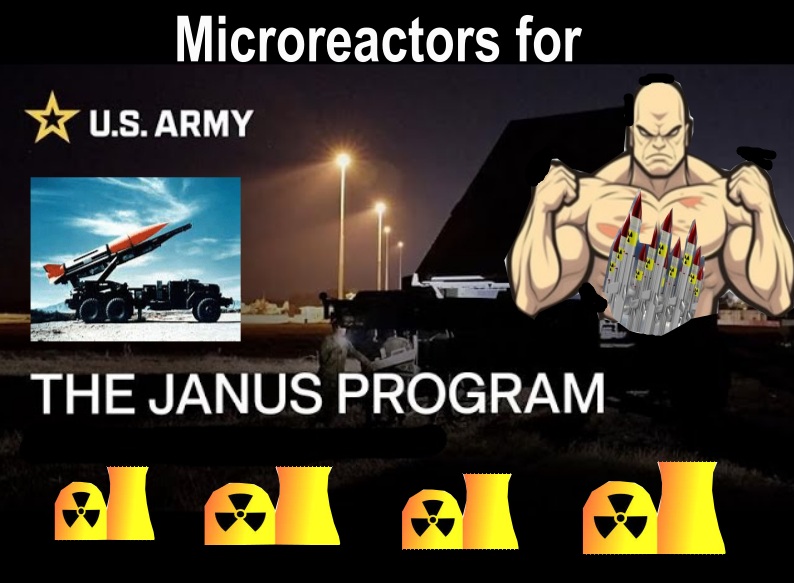
Aug. 27, 2026 | By U.S. Army Communication and Outreach Office , https://www.war.gov/News/News-Stories/Article/Article/4584583/army-selects-vendors-sites-for-nuclear-microreactors/
The Army announced yesterday that the Janus Program selected five nuclear energy vendors and five initial locations to build and operate nuclear microreactors.
In partnership with the War Department’s Defense Innovation Unit, the Army is awarding up to $2.2 billion in total for these microreactors. The project will deliver safe, secure and reliable nuclear power, strengthening the Army’s ability to project power globally, while supporting the revitalization of American industrial capacity and technological leadership.
“Since launching the Janus Program, our mandate from President [Donald J.] Trump and Secretary [Pete] Hegseth has been clear: secure the power our warfighters need to train, deploy and win,” said Dan Driscoll, Army secretary. “Awarding these contracts accelerates our ability to deliver safe, reliable baseload power directly to our installations. We are building the energy resilience necessary to project combat power globally, without relying on potentially vulnerable external grids.”
With private sector funding expected alongside government investment, the Army expects to build and operate more than 20 nuclear microreactors across War Department installations.
The five selected vendors and installations are:
- Antares Nuclear Inc. at Fort Bragg, North Carolina.
- BWXT Advanced Technologies LLC at Fort Campbell, Kentucky.
- General Atomics Electromagnetic Systems at Fort Hood, Texas.
- Radiant Industries Inc. at Fort Benning, Georgia.
- Westinghouse Government Services at Fort Drum, New York.
………………………………………………………………………………………………………………………………………………………………As the Janus Program moves forward, vendors will bring nuclear technologies to other military installations for continued energy resilience across the entire War Department. The Army will announce additional military sites at a later date and continues to drive toward the September 2028 target outlined in Executive Order 14299 for operation of a first reactor.
“The Army is leading the nation in its return to nuclear preeminence,” said Jason Craft, Janus Program manager. “Our selected industry awardees represent the most viable technologies to achieve this capability, setting conditions for both installation energy resilience and operational energy solutions.”
Using a milestone-based payment model, vendors will receive government funding only after successfully hitting specific technical goals. This investment model brings together approximately $2.2 billion across fiscal years 2027-2031, along with significant capital investment from each vendor.
This technology development model will speed up the delivery of next-generation energy solutions to the warfighter and promote innovation while ensuring accountability, Craft said. The prototype reactors will be contractor-owned and operated. Collaboration with utility providers is needed for the success of the Army’s nuclear power strategy and the Janus Program. The Army will work closely with providers on the program to ensure the best possible outcomes, while continuing to collaborate with them now and in the future.
“The Army’s Janus Program has my full support,” said Emil Michael, undersecretary of war for research and engineering and War Department chief technology officer. “The War Department is acting swiftly to implement President Trump’s executive order. … We are unleashing America’s domestic nuclear industrial base to ensure a more resilient and secure energy supply for the joint force.”
We’re Half a Year Into Trump’s War on Iran. Congress Has Tools to End It.
SCHEERPOST, August 26, 2026, By Hanieh Jodat
The clash over whether the US has a functioning constitutional process for starting and ending wars is coming to a head.
The U.S.-Israeli war on Iran is entering its seventh month after a series of attempts at diplomatic negotiations moderated by Pakistan and other countries in the region. The U.S has embroiled itself in a conflict without a clear exit strategy, and Iran has shown no interest in bending under President Donald Trump’s pressure. As Washington and Tehran continue this agonizing yo-yo of threats, the growing reported number of casualties feel heavy. More than 3,400 Iranians have reportedly been killed, while over 26,000 have been wounded, including at least 4,000 women and more than 1,600 children. On the American side, the Pentagon currently reports that 14 U.S. service members have been killed and more than 700 wounded. However, one Department of Defense (DOD) official accused the Pentagon of “an accounting trick” in order to misrepresent the true casualty figures.
By now it has become obvious that Benjamin Netanyahu played a key role in convincing Trump to start this war of choice, after decades of pushing the United States to attack Iran. In recent years, Israel’s lobby, in collaboration with opposition leaders from the Iranian diaspora — including the son of Iran’s late Shah Reza Pahlavi and his monarchist advisors — and a group of hawkish American officials pushed the U.S. to the brink of this war.
Until recently, those attempts were unsuccessful — that is, until they finally found a U.S. president who would risk a strategic disaster and economic collapse for one of the most quickly unpopular wars in U.S. history. But after half a year of war, the question is no longer how we arrived at this war, but more so how Congress might limit the executive branch and force an end to the military hostilities.
Poll after poll reveals that people in the U.S. are increasingly questioning the motivation and cost of the war. After decades of U.S. military interventions across the Middle East and West Asia that have cost trillions of dollars without any sign of success, Americans have expressed their exhaustion with the financial and human toll of another conflict. A Reuters/Ipsos poll conducted in late July found that only 33 percent of people in the U.S. supported the war with Iran, the lowest level of support measured since the conflict began. Sixty-nine percent said President Trump had failed to explain the objectives of the military operation in Iran clearly.
Diplomacy and negotiations between the U.S. and Iran have repeatedly faltered since Trump entered office for the first time and pulled out of a landmark nuclear deal engineered by the Obama administration. The possibility of a lasting political settlement remains buried beneath the weight of the bombs dropped on civilians, sanctions, military threats, and political calculation. And the consequences of the war of choice with Iran are not confined to the Middle East. Rising food and energy prices, inflation, regular attacks on U.S. bases with an unknown number of U.S. casualties, and the uncertainty over the war’s future have shifted the way both Americans and the rest of the world view U.S. recklessness. And the frustration has only gotten worse; by August, roughly two-thirds of people in the U.S. opposed the war outright, according to Reuters polling.
In the face of clear American opposition to the war, the question now is whether the United States has a functioning and democratic constitutional process for deciding when a war begins, how long it continues, and when it ends.
While Trump and his war cabinet have swung back and forth between the promise of diplomacy and peace or the threats of further military escalation, Congress has unsuccessfully attempted several times to reassert its constitutional authority. Only Congress has the power to declare war, and the 1973 War Powers Resolution gives the president a 60-day clock to terminate hostilities without congressional approval. The president has now blown through that deadline — bringing about several constitutional questions for lawmakers.
An Ever-Expanding War……………………………………………………………….
A Path Forward Beyond More War Powers Resolutions
Congress can strengthen congressional oversight over the war by requiring mandatory reporting, conducting investigations, and using the Government Accountability Office (GAO) to audit the executive branch. How can Congress exercise its war powers if it doesn’t know what the Trump administration seeks to do?…………………………………………………………………………………………………………………………………………………………………………………………………………………………………………………..https://scheerpost.com/2026/08/26/were-half-a-year-into-trumps-war-on-iran-congress-has-tools-to-end-it/
US treasury chief claims Washington ‘unlikely to restart’ large-scale hostilities against Iran
Bessent said that illegal US sanctions are a replacement for a war of aggression that has failed to break Tehran
News Desk, AUG 20, 2026, https://thecradle.co/articles/us-treasury-chief-claims-washington-unlikely-to-restart-large-scale-hostilities-against-iran
US Treasury Secretary Scott Bessent told CNBC on 20 August that Washington will likely “not restart” large-scale military operations against Iran, as the White House shifts to a campaign of maximum economic sanctions.
If we are doing the maximum economic pressure, then that means that likely there will not be a large-scale kinetic restart,” Bessent said in an interview with CNBC’s Squawk on the Street news program.
Trump had announced hours earlier on Truth Social that Washington would impose major economic penalties on any country extending Tehran what he called “any type of lifeline.”
“This will be an ECONOMIC D-DAY, and we need all of our Allies to stand with the United States of America to isolate, and defeat, the Iran threat,” Trump wrote.
Bessent said he would lay out the details of the plan at a press conference, telling CNBC that the message to every US ally would be: “You are either with us or against us.”
“If you insist on doing business with [Iran], either transferring money, buying their oil or doing seaborne ship transfers, then the US Treasury and the US government … will put its full might and force toward enforcing against you,” he said.
He described the campaign as “the greatest coordinated economic isolation in the history of the world.”
Iranian Foreign Minister Abbas Araghchi dismissed the campaign the same day, writing on X that it would deliver Washington nothing but “further defeat.”
“The so-called ‘Economic D-Day’ is a diversion from America’s own crisis: unprecedented debt & surging interest costs,” Araghchi wrote, describing US “economic terrorism” as a threat to the global economy.
Iranian Deputy Foreign Minister Kazem Gharibabadi said Washington had reached for economic warfare only after its military campaign failed to deliver.
“They claim Iran is on the verge of defeat and hanging by a thread, yet they are begging all their allies to help them,” he wrote on X, adding that the US had “named their next failure an ‘economic war.’”
Vice-Chairman of the Belt and Road Institute in Sweden Hussein Askary notes that the US naval blockade imposed in April has pushed Iran to shift its trade overland, sharply increasing freight traffic on the China–Iran railway and raising the strategic value of Eurasian land corridors as Tehran works to keep supply routes open beyond the reach of maritime pressure.
The Pentagon is reviewing whether to scale back its presence in Persian Gulf states after Iranian retaliatory strikes battered the largest US bases overseas, with sources saying a westward pullback is under consideration.
A regional intelligence source told Press TV that the Pentagon has concluded no military plan exists that could guarantee open shipping through the Strait of Hormuz, which carries roughly one-fifth of the world’s oil.
Documents Reveal Trail of Unreported Millions From Israeli Military to U.S. Universities

Research funding by Israel’s Ministry of Defense and arms manufacturers often fails to appear in national databases intended to track foreign funding.
Murtaza Hussain, Aug 25, 2026, https://www.dropsitenews.com/p/israel-military-funding-universities?utm_source=post-email-title&publication_id=2510348&post_id=212599104&utm_campaign=email-post-title&isFreemail=false&r=5mo6u&triedRedirect=true&utm_medium=email
The Israeli Ministry of Defense and Israeli defense companies have directed millions in unreported funding to U.S. university research programs for weapons development, sponsoring research directly or serving as the pass-through entity for the funding, a Drop Site investigation has found.
A sample of state and university audits, foreign-funding disclosures, and other institutional records identified millions of dollars in financial ties over the last two decades between the Israeli Ministry of Defense (MOD), Israeli weapons manufacturers, and American universities, much of which does not appear consistently in national databases intended to track foreign funding into U.S. universities.
An analysis of audit records, building on findings compiled by the Antiwar Initiative, an academic research group that documents the connections between universities and the global arms industry, found more than $15 million of unreported or inconsistently reported entries for funding tied to the Israeli MOD or defense manufacturers.
The true scale of Israeli support is difficult to determine because entries for such funding were often not reported in public filings mandating disclosure of foreign gifts, but were discovered by manually cross-referencing public and internal databases, audit records, and acknowledgments in academic papers. Some projects listed in university materials as being sponsored by the Israeli MOD or defense companies also did not include the amounts of funding provided, or contained inconsistent or contradictory records in audit databases.
Drop Site reviewed and verified public records that showed research grants, tuition payments, and receipts of gifts totalling millions of dollars to dozens of colleges and universities around the country. The data shows examples of financial support and sponsorship for American researchers from the Israeli Ministry of Defense as well as Israeli weapons manufacturers like Elbit Systems.
Records dating from 2004 to 2025 point to a large number of schools that have had financial relationships with the Israeli MOD or Israeli weapons manufacturers, including Columbia, Cornell, Princeton, Harvard, Northwestern, Georgia Tech, Texas Tech, the University of Connecticut, the University of Tennessee, the University of Maryland, the University of Florida, the University of California at Berkeley, the University of Rhode Island, the University of New Mexico, the Washington University in St. Louis, and the State University of New York.
The recorded financial relationships include time-bound research contracts and do not indicate whether relationships with the MOD are still ongoing. Previous reporting has documented MOD funding of programs at MIT and student protests there over the relationship.
In addition to financial support from the MOD and Elbit, records also showed sponsorship of individual research projects related to military technologies by Israeli defense manufacturers Rafael and Israel Aerospace Industries.
Taken together, the records reveal an opaque defense-research pipeline spread across some of the country’s most prominent universities.
In one example that illustrates the typical nature of these ties, an Israeli MOD-sponsored project at the University of Connecticut was listed in public audit records with the title, “Impact Point Prediction Research for Short & Medium Range Thrusting Projectiles.”
Connecticut’s annual federal-award schedules record $668,456 in funding under that title across nine fiscal years between 2013 and 2023 with the funder listed as Israel’s Ministry of Defense. Another Israeli MOD-linked research project at the school titled, “High Sensitivity SQUIDs for Magnetic Field Detection,” received $251,336 in funding across the same time period.
Federal law requires colleges and universities receiving federal assistance to disclose gifts and contracts totaling at least $250,000 in a calendar year from a foreign source, though transactions below that threshold may remain outside the public reporting system. But these multi-year contributions do not consistently appear in federal databases intended to help the public track foreign money flowing into American universities. The Education Department’s latest public disclosure of foreign gifts and funding contains no Israel-attributed entry for the University of Connecticut, even as entries for MOD funding show up in other databases and audit documentation.
The Israeli government and its allies in Congress are now seeking to transform relationships like these from a scattered research pipeline into formal American defense policy. The fiscal 2026 National Defense Authorization Act already directed the Pentagon to establish a U.S.-Israel Defense Industrial Base Working Group to consider integrating Israel into what it calls “the American National Technology and Industrial Base.”
A proposal advanced by the House Armed Services Committee for the fiscal 2027 NDAA would go further, creating a United States-Israel Defense Technology Cooperation Initiative charged with expanding bilateral research, development, testing, weapons production, and industrial cooperation. If these measures become law, the scattered funding connections documented in American university audit trails and research papers would become part of the architecture of the American military-industrial base.
Gears of War
Israeli forces have used drones, automated intelligence tools, persistent aerial surveillance, precision-guided projectiles, and large-scale data analysis throughout the genocide in the Gaza Strip, as well as wars in Lebanon, Iran, Syria, and Yemen.
Those operations draw upon the technologies originating in the same research fields that the Israeli government and weapons manufacturers have paid American academics to advance: video surveillance, human-activity recognition, autonomous flight, network analysis, target identification, magnetic sensing, and projectile impact modeling. At the University of Central Florida, researchers have received funding from Elbit Systems to develop algorithms to recognize human activity and detect objects in video.
Records from the University of Tennessee show that a U.S. subsidiary of Elbit also provided $514,500 in payments to the school between 2023, 2024, and 2025. The available public documentation does not identify what programs or researchers the contributions are intended to support, with the description listing the purpose of the funding as simply “tuition payments for various students.”
“For relatively small sums—like the price of funding a single PhD—Israel has gained major new capabilities that have bolstered its capacity to commit genocide in Gaza, carry out a brutal occupation of Lebanon, and spark a war with Iran that has escalated to a region wide conflict,” said William Hartung, a political scientist and expert on the U.S. arms industry and Pentagon budgetary practices.
Many awards from the Israeli MOD are classified as U.S. Department of Defense expenditures, with the Israeli ministry identified as the pass-through entity that administers the grants. MIT, for example, has stated that the money for its projects funded by the Israeli ministry originated with the U.S. Department of Defense. The U.S. provides an estimated $3.8 billion in annual military aid to Israel on top of other forms of assistance.
Some audit records identify the Pentagon’s Defense Security Cooperation Agency, which administers U.S. security assistance and weapons-transfer programs, as the primary agency providing the funding that was ultimately directed by the Israeli MOD. The public documents do not establish whether every dollar for particular research support at a school came from Israel’s treasury, from U.S. military assistance placed under Israeli procurement authority, or from some combination of the two.
Audit Trail
In the summer of 2025, MIT professor Markus Buehler withdrew from an Israeli Defense Ministry grant after a student-led campaign publicized the project. The decision followed more than a year of protests over MIT’s defense relationships with Israel, which the university says amounted to $4 million for individual ministry-linked projects between fiscal 2015 and fiscal 2024, plus $290,000 in fiscal 2025.
A trail of open source records traces similar financial and research relationships between the Israeli defense establishment and schools in Connecticut, New York, Maryland, Florida, New Jersey, Texas, California, and Virginia.
At Columbia University, annual audits name two ministry-linked projects and record $799,190 in grants. One MOD-funded project for “Direct 3D Printing of Integrated Electro Mechanical Systems” accounted for $469,999 from 2016 through 2021, while another for “Optimizing Micro Resonators Based Sensor” accounted for another $329,191 from 2021 through 2024. Columbia’s fiscal 2024 audit lists the latter project under the U.S. Department of Defense, with the “Israeli Ministry of Defense” as the “pass-through name,” and records $25,327 in funding.
The Research Foundation for the State University of New York shows audit entries for five Israeli MOD-linked projects totaling $949,915 from 2010 through 2021.
Florida’s statewide audits record $1,195,795 in expenditures passed through the Ministry of Defense from 2012 through 2021, while not identifying the schools that received all of this funding.
Campus records connect at least some of the awards to the University of Central Florida and the University of Florida. One University of Florida engineering publication names an Israeli MOD-sponsored project, “Coupled Size and Rate Effects in Ultra-High-Performance Concrete,” beginning in 2012. While listing the project under “Sponsored Research,” the newsletter did not identify the amount the school received from the MOD for the study.
In response to a request for comment about another $150,000 contract beginning in March 2015 that named the Israeli Ministry of Defense at UC Berkeley, a spokesperson said that, “UC Berkeley complies with all of the statues and regulations that apply to contracts and gifts from foreign sources,” noting that the school is only involved in fundamental research and adding that, “every government, every researcher, every person in the world is able to read the results of our research in freely available scientific publications.”
UC Berkeley did not respond to additional questions about the purpose of the MOD funding. Other schools contacted by Drop Site did not respond to requests for comment or stated that they could not provide information about the cited funding.
In addition to records from audits, public information from individual researchers provides more hints of the scope of Israeli military’s U.S. research funding.
In February, The Nation reported that computer-vision researchers Mubarak Shah and Abhijit Mahalanobis received a $200,000 Elbit Systems of America grant in 2020 to develop “human activity recognition” technology, while Mahalanobis received another $60,000 for algorithms involving object detection and human-activity recognition.
At the University of Maryland, aerospace engineering professor Inderjit Chopra’s research page lists two Israeli ministry grants: $150,000 for “Autonomous Operation of Micro-Helicopters,” from 2011 to 2012, and $300,000 for “Aeromechanics of Rotorcraft in High Speed Flight,” from 2014 to 2016.
A curriculum vitae filed by another researcher in a separate U.S. Patent and Trademark Office proceeding lists Israeli MOD funding of $150,000 for “Functional Targeting of Terror Networks: A Big Data Approach,” from February 2017 through December 2018, and $153,520 for “Fast Algorithms for Group Between-ness Centrality in Massive Social Networks.”
Princeton University records identify physicist Michael Romalis on a $600,000 contract called “Pulsed Scalar Atomic Magnetometer.” The university’s fiscal 2018 sponsored-awards report names the Government of Israel’s Ministry of Defense and the Defense Security Cooperation Agency as sponsors and gives a contract period from July 2015 through June 2019.
Texas Tech University’s engineering newsletters list yet another award for $400,000 from the Israeli Defense Ministry to research a “Sealed Vircator HPM System,” naming James Dickens, John Mankowski, and Andreas Neuber as researchers. The same amount and title appear in both the January 2014 and April 2015 newsletters.
The vircator technology has a clear military application: Texas Tech’s Center for Pulsed Power and Power Electronics describes vircators as compact, high-power microwave sources and says its work includes coordinating vehicle-mounted emitters with GPS timing to place a microwave “hot spot” at a desired location—an application potentially useful for combatting drone swarms.
The purpose of a separate Israeli Defense Ministry-linked funding stream at the University of Texas at Austin is less clear from the public records. UT Austin’s fiscal 2013 financial report identifies $58,992 in expenditures under an Israeli Ministry of Defense purchase order. Statewide audit schedules record expenditures under the same purchase order reappearing in public audit records from 2010 through 2014, for a total of $299,952.
The audit archive contains still more Israeli military-named expenditures, including recorded contributions to Northwestern University and Washington University in St. Louis, and repeated entries for the MOD in audits for the state of Virginia.
But the opaque nature of some support that turned up in public records means that financial and in-kind support to universities may not even be recorded in any audit trail at all.
At the University of Texas at Dallas, Haoran Wei and Nasser Kehtarnavaz produced a video-surveillance system in a study that the published paper indicated was “funded by Elbit Systems of America through a contract with the University of Texas at Dallas” without mentioning the amount of financial support. The report also noted that the company had provided “far-field video clips” to help conduct their research on target recognition.
The researchers did not respond to requests for comment about the nature of their work and ties to Elbit.
Disclosure Gap
Section 117 of the Higher Education Act generally requires a federally assisted university to report covered gifts and contracts from a foreign source when they meet or exceed $250,000, including multi-year contracts meeting that threshold over their duration. Under the Education Department’s example, a five-year research contract worth $50,000 a year is reportable at signing because its lifetime value is $250,000.
The Education Department’s inspector general warned in February 2025 that oversight of the system was weak with insufficient controls to ensure reporting requirements were being met. The current disclosure thresholds also make it easier for foreign countries to contribute amounts below that number to avoid triggering reporting requirements but can be significant for individual research projects.
That lack of oversight contributes to a situation in which millions of dollars from a foreign military under increasing scrutiny in the U.S. for human rights abuses and facing genocide charges from international courts has been able to spend millions of dollars funding military research at American universities.
These relationships are now coming under greater scrutiny at a time when public opinion on Israel has soured in the U.S. due to the genocide in Gaza and Israeli conduct in other regional conflicts.
“No self-respecting university should accept funding from Israel, given its destabilizing, destructive, and inhumane use of U.S. weapons,” said Hartung.
U.S. nuclear campuses could power a renaissance. Except for one problem.

Lack of oversight and safety restrictions could make future nuclear
projects dangerous. Trust is hard to earn and easy to lose — especially
in a field like nuclear energy. The Trump administration is in danger of
learning that the hard way.
In late July, the Energy Department signed
tentative agreements with five states — Utah, Tennessee, Oklahoma,
Louisiana and Idaho — to explore hosting what it calls “Nuclear
Lifecycle Innovation Campuses.” Each campus would place multiple stages
of the nuclear energy process — potentially including uranium enrichment,
fuel fabrication, spent fuel reprocessing, waste disposal, and power
generation, among others — in one location. Normally, these steps are
carried out hundreds of miles apart from one another.
Washington 26th Aug 2026,
https://www.washingtonpost.com/opinions/2026/08/26/trump-cuts-nuclear-safety-could-hurt-new-innovation-campuses/
Trump Sends Nuclear Agreement With Saudi Arabia to Congress
The president still insists that the deal is contingent on the kingdom normalizing relations with Israel
By Michael R. Gordon and Robbie Gramer,
President Trump has submitted a landmark nuclear
accord with Saudi Arabia to Congress for review, but hasn’t dropped his
last minute condition that the kingdom normalize relations with Israel, an
administration official said.
Wall St Journal 25th Aug 2026,
https://www.wsj.com/world/middle-east/trump-sends-nuclear-agreement-with-saudi-arabia-to-congress-7f01af2c
California´s last working nuclear power plant sits in a landscape that would worry any firefighter when the wind picks up.
Federal wildfire crews are stretched thin. California is stepping in to help
By ASSOCIATED PRESS, 26 August 2026
California´s last working nuclear power plant sits cradled in a landscape that would worry any firefighter when the wind picks up.
The Pacific Ocean and its perpetual fog lick the western edge of the coastal bluffs holding the Diablo Canyon Power Plant. But the Irish Hills rise steeply to its east – their slopes rugged, dark with scrub and oak. Difficult to access, and full of fuel.
“Any fire within the Diablo power plant area could be catastrophic,” said Dave Erickson, a division chief and forester with the Cal Fire San Luis Obispo unit. The property, he said, is in a very high fire severity zone. “So we just take precautions.”
It´s one of the many places where California is now stepping into federal gaps created by Congress´ long-term underinvestment in fuels management on federal lands, the Trump administration´s cuts, and firefighters stretched thin by blazes raging across the West.
A local organization with state funding, the San Luis Obispo County Community Fire Safe Council, started carving a fuel break into the surrounding ridgelines. And Erickson put his crews to work closing the gaps, to create a critical toehold for firefighters to get ahead of flames………………………………….
The stakes are high for California, where wildfires have burned through millions of acres in the last decade – killing more than 220 people, hastening the deaths of tens of thousands more, and racking up tens to hundreds of billions of dollars in damage.
But the costs are high, too. California has spent nearly half a billion dollars in grants for wildfire resilience and forest health projects on federal lands since Gov. Gavin Newsom took office, according to the California Natural Resources Agency…………………………………………………………………………………………………………………….
https://www.dailymail.com/wires/ap/article-16079773/Federal-wildfire-crews-stretched-California-stepping-help.html
The Race to Power AI Is Reviving America’s Nuclear Ambitions

By Haley Zaremba – Aug 25, 2026, https://oilprice.com/Alternative-Energy/Nuclear-Power/The-Race-to-Power-AI-Is-Reviving-Americas-Nuclear-Ambitions.html
- Surging AI and data-center electricity demand is attracting billions of dollars to advanced nuclear technologies.
- SMRs could offer a cheaper and more flexible alternative to traditional nuclear plants, but none are commercially operating in the United States yet.
- Applied Atomics is reviving BWXT’s shelved mPower technology and Virginia test infrastructure in an effort to commercialize modular nuclear power.
The artificial intelligence boom is supercharging the development of next-gen nuclear energy technology. Big Tech and private equity are catalyzing the research and development of cutting-edge approaches to round-the-clock clean energy production as hyperscalers add power-hungry data centers to the grid at a blistering rate.
“A single hyperscale data center can consume as much electricity as 50,000 homes,” writes the MIT Energy Initiative. “U.S. data centers consumed more than 4% of the country’s total electricity in 2023, and by 2030 that fraction could rise to 9%,” MIT goes on to warn. This means that the expansion of data centers to fuel the integration of AI into everything from your email provider to your electric toothbrush is seriously changing the way we consume – and therefore the way we produce – energy in the United States and beyond. Not only do we need to expand energy production capacity at a breakneck pace, but we also need to find a way to do so without throwing climate goals out the window.
As a result, venture capital funding is going gangbusters for both nuclear fusion and fission startups. According to a recent report from Axios, global investment in both fission and fusion has topped USD $4.5 billion across 81 companies in 2026 so far. At this rate, projections show that 2026 will shatter the previous annual record of $6.2 billion for 93 companies in 2025.
Some of the biggest figures and deepest pockets in Silicon Valley are throwing their weight behind nuclear energy advancement as a silver bullet solution to the energy monster that AI is creating. Major investors include Microsoft’s Bill Gates and OpenAI’s Sam Altman. “There’s no way to get there without a breakthrough,” Altman said at the 2024 World Economic Forum in Davos, Switzerland. “It motivates us to go invest more in fusion.”
In addition to nuclear fusion, there is a lot of buzz around the potential for small modular reactors (SMRs) to transform the aging and ailing nuclear power sector in the United States. These smaller and cheaper reactors hold considerable promise for overcoming some of the hurdles that have been causing nuclear energy to fall out of fashion in the last several decades.
Traditional nuclear power plants are enormously expensive and time-consuming to develop. The United States’ newest traditional nuclear power plant, Georgia’s Plant Vogtle, finally came online in 2024, years late and billions of dollars over budget. While this has scared a lot of policymakers and investors away from large-scale nuclear power, there is hope that SMRs could allow for a more agile energy future at a time when carbon-free energy sources are sorely needed.
However, SMRs have been slow to deliver on the considerable hype behind them. While billions of dollars have gone toward developing the technology, and the Nuclear Regulatory Commission only approved NuScale’s uprated SMR design last year, there are still zero commercial SMRs operating in the country. Some experts think that the buzz has turned to bust. But others, buoyed by the new wave of investment interest driven by the AI boom, think that the timing is finally right for the SMR revolution.
For example, a duo of scientists with SpaceX pedigrees is taking advantage of an abandoned SMR test facility in Virginia, with the hopes of being the team to push the SMR revolution over the finish line and into commercial reality. “We’re standing on the shoulders of giants here, right?” Applied Atomics co-founder Ben Kellie recently told the Washington Post. “We’re starting with something that had $400 million in investment put into it, and significant time and effort. That’s a leg up.”
Whether this project is the one that will ultimately serve as a proof-of-concept for SMRs, it will at the very least provide more data in a nascent field where hard numbers are sorely needed. “It is not just about whether the technology is viable,” David Schlissel, a ‘longtime nuclear consultant to consumer and environmental groups,’ told the Washington Post. “It is also whether the cost is viable. … The industry is running around with all this hype trying to sell nuclear broadly. But they still have not fully tested and built any of these new reactors.”
A Nuclear Option Against Iran Would Be a Catastrophe – Not a Solution
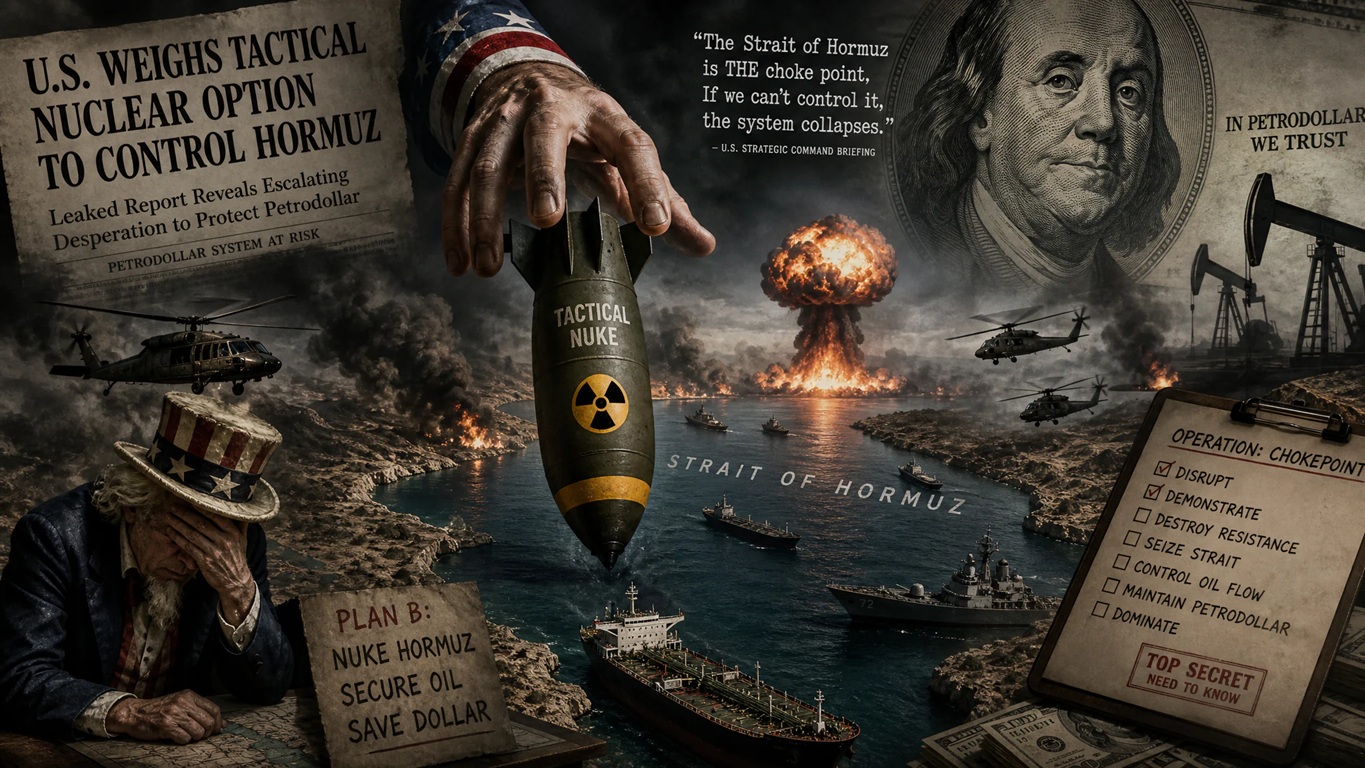
Taut Bataut, August 21, 2026, https://journal-neo.su/2026/08/21/a-nuclear-option-against-iran-would-be-a-catastrophe-not-a-solution/
Driven by desperation after failing conventionally in West Asia, the U.S. demonstrates reckless foreign policy by entertaining the use of tactical nuclear weapons to forcibly capture the Strait of Hormuz and preserve petrodollar hegemony.
his reliance on nuclear blackmail reflects a long-standing U.S. pattern of resorting to aggressive, unconventional force whenever its global military dominance is challenged.
A line in the sand that, once crossed, cannot be uncrossed. “They are discussing using nuclear weapons on Iran in strategy meetings. Yes, you read that correctly. It’s real. I’m not speculating; I know. And it’s pure evil.” This is what former US Congresswoman Marjorie Taylor Greene wrote on her X account on 17 August 2026. Although this statement is neither confirmed by the White House nor does it unveil any implicit information, the mere consideration of such an option signals a dangerous psychological shift in U.S. foreign policy. Heading towards any such move against Iran could result in global catastrophe, and the consequences would then be out of control. The real query here is whether the ongoing Middle Eastern volatility is paving the way for a nuclear holocaust or not.
Historical Perspective
To understand the ongoing situation in the Middle East, it is necessary to look into the historical perspective. When the US used nuclear weapons against Japan in World War II, we were told that the Japanese surrendered because of the nuclear weapons. This is false. Anyone who has studied World War II carefully will understand that the Japanese forces were already surrendering. So why was there a need to use nuclear weapons? The reason is that the US was running a secret project called the ‘Manhattan Project.’ Under this project, Americans were developing both uranium and plutonium bombs. So, the US wanted to test its weapon and thus bombed Japan. That’s why two bombs were dropped; however, only one could be enough. And thus, the US claimed itself as the number one military power in the world.
Later on, in the 1950s, Americans once again found that Soviet military dominance had surpassed them. So, the US introduced the tactical nuclear weapons to surpass the Soviet’s conventional superiority. However, till the 1970s, Soviets also developed tactical nuclear weapons in large numbers. In retaliation, the US started investing in space projects to develop long-range conventional missiles. By 2010, now the US military concluded that the Chinese military had become equal to ours. So, now the US is introducing artificial intelligence and autonomy in its military. But the PLA, without any doubt, has significantly outpaced the US military in this regard. This clears one thing: the US establishment did not want President Trump to sign an MoU with Iran, which was a clear surrender of the US military. So, as the US has completely failed against Iran in conventional terms, it might opt for some unconventional means to maintain its military superiority in the region.
Why the U.S. Might Opt for Tactical Nuclear Weapons
As of now, it is clear that there is no way to stop Iran through conventional capabilities. So, the statement made by Greene actually depicts the current strategic thinking inside the US: that even if the 50,000 US troops stationed at the 19 airbases in West Asia withdraw, if they do, and the US maintains control of the Strait of Hormuz, which could then be declared as US territory, then the petrodollar will remain intact. Therefore, the plan is to move out of the region and capture the Hormuz region through tactical nukes.
The next question then becomes, how is this going to be done? When one talks of tactical nuclear weapons, they mean the weapons whose power ranges from sub-kilotons to 50 kilotons. Just to remind you, the weapons the US dropped on Japan during WWII were tactical and weighed 15 kilotons. But now through modern technology, one can create a critical mass with just using a few kgs of uranium or plutonium, which could result in a chain reaction, and a nuclear weapon can be used.
Technically, this is possible today. If the Strait of Hormuz’s chokepoint could be opened with the use of a very small, limited-range, sub-blast, or sub-kiloton nuclear weapon. So, the US could capture the Strait of Hormuz in this way, declare it its own territory, and continue to generate petrodollars. This is the reason President Donald Trump recently said, “After we finish defeating Iran, which is being very badly defeated, pretty soon I’ll be declaring the Hormuz Strait a territory of the United States.”
The Devastating Consequences
Elbridge Colby, Under Secretary of War for Policy, has recently warned, “What I would fear more is a regional war, a kind of local war, a conventional war that might have local employment, God forbid, of nuclear weapons that could escalate from there as it expanded outward.” The consequences would be catastrophic. We know that many countries in the world today possess nuclear weapons, and we are also aware that North Korea has openly declared that if nuclear weapons are used against Iran, it will stand in solidarity with Iran. In addition, many analysts are of the view that Iran might have already developed nuclear weapons. But here the question is, could Iran have done this?
There are two reasons for which it can be concluded that Iran would not have done it. First, Iran is trying to develop a regional security framework, and the Mecca Defense Pact is its best manifestation, which could be expanded in the near future. Iran wants every regional country to see it as a partner nation. Thus, if Iran pursues developing nukes, it could start an arms race in the region where countries like Saudi Arabia would also demand a bomb. Second, Iran is a signatory of the NPT. So, Iran would first announce its withdrawal from the treaty, and then it will head forward in this direction.
China’s Role and Supremacy
Here China can play a pivotal and powerful role. Today China has approximately $800 billion in US Treasury bonds. If the Chinese were to tell Americans today that they were selling half or a large amount of their Treasury bonds, it would create problems with the US’s indebted economy. Inflation would spike, the stock market would crash, and the economy would be in dire condition. Moreover, China also has dominance over the world’s rare earth minerals, on which American conventional capabilities are highly dependent. Also, the PRC could also pressurize the US over the upcoming visit of Chinese President Xi Jinping to the US in September 2026. Thus, China has a lot to do in this regard, and it’s already doing it in one way or another to preserve the world’s peace.
A Nuclear Strike is not a Solution
A nuclear attack against Iran is not an answer; it is a recipe for disaster that is bound to happen sooner rather than later. This policy of desperation would be a betrayal of principles and a failure of our ideals and would not help to bring peace. The rest of the world should make its voice heard and condemn such rhetoric before it normalizes something unimaginable. There are reasons that dictate that we should rely on diplomacy and patience, no matter how desperate the situation becomes. The unthinkable should remain unthinkable; to think about such an option is to play with fire.
Lawless Killing Spree At Sea Resumes’ As US Announces Fresh Boat Bombings
Brad Reed , Common Dreams, August 25, 2026, https://scheerpost.com/2026/08/25/lawless-killing-spree-at-sea-resumes-as-us-announces-fresh-boat-bombings/
The US military has resumed its campaign of bombing alleged drug-trafficking vessels after a two-month pause in a campaign that many legal experts and human rights groups believe constitutes a murder spree.
In a Monday social media post, US Southern Command (SOUTHCOM) said it carried out a “lethal kinetic strike on a low-profile vessel operating along established narco-trafficking routes” in the Pacific Ocean on Sunday. Two people were killed as a result of the attack, SOUTHCOM claimed.
In announcing the strike, SOUTHCOM Commander Gen. Francis Donovan said the attack was part of a campaign of “imposing total systemic friction on narco-terrorists—disrupting their operations, dismantling their leadership, and eliminating cartel terror across the region.”
Donovan’s boasts about the effectiveness of the boat strikes in combating the drug trade come less than a month after a leaked a Drug Enforcement Administration (DEA) analysis revealed that the boat-bombing campaign has not “reduced the amount of cocaine entering” the country, as drug cartels have found alternate methods for shipping their product into the US.
With the latest two casualties, the boat bombing campaign launched nearly a year ago by President Donald Trump’s administration has now claimed the lives of at least 223 people.
Adam Isaacson, director of the Defense Oversight program at the Washington Office on Latin America (WOLA), criticized the administration for resuming its boat bombings despite “overwhelming evidence that they are murder; that many, likely most, of the dead are either super-low-level or uninvolved with drugs; and that cocaine supply is unaffected.”
Brian Finucane, senior adviser to the US Program at the International Crisis Group, delivered a similarly scathing assessment, commenting that “the Trump administration’s lawless killing spree at sea resumes.”
Nicholas Grossman, professor of international relations at the University of Illinois, described the boat strike campaign as “murderous” and “illegal,” adding that its victims are “not terrorists” and “may not even be drug traffickers.”
Investigative journalist Camila Lourdes Galarza observed that “there’s still no proof any of the victims” of the boat strikes were involved in the drug trade.
Lourdes Galarza sarcastically added that if the victims had been drug traffickers, “the US would probably give them a deal” like the one given to Juan Orlando Hernández, the former president of Honduras who was pardoned by Trump last year despite being previously convicted on narcotics trafficking charges.
Hormuz Catastrophe: Netanyahu & Trump Knew Risks, Escalated Anyway
SCHEERPOST, August 25, 2026, Dan Steinbock Informed Comment
Iran has not collapsed, while Hormuz has become a global economic choke point. The central failure was not ignorance of the risks, but the political decision in Washington and Tel Aviv to gamble that coercive military power could overcome them.
So, why did they set the stage for the catastrophe that was both unwarranted and unnecessary?
The Israeli conventional war game
In February 2024 – after 4 months of the Israeli obliteration of Gaza – over 100 senior military and government officials participated in a report by Reichman University’s Institute for Counter-Terrorism which outlined in painful detail how unprepared the Israeli home front was for an all-out war with Hezbollah.
This lethal scenario was written long before Hamas’ October 7th attack on Israel. It is the result of a three-year study. The 130-page report was the work of six think tanks made up of over 100 terrorism experts, former senior security officials, academics, and government officials who examined critical aspects related to the level of preparedness for the IDF and the home front in the event of a multi-front war.
The project was led by Professor Boaz Ganor, a world-renowned counter-terrorism expert. In the months leading up to October 7, he presented his research to relevant military and political authorities in an attempt to rouse intelligence and decision-makers from complacency and misconceptions.
The Netanyahu government ignored him and the analysis.
The Israel-Iran nuclear war game
In late 2023 – almost in parallel with the Hamas attack – a high-level U.S. war game was conducted in Washington. The participants included members of U.S. executive branch, Republicans and Democrats in the Congress, leading academics, think-tank experts and Pentagon officials. The game started in 2027 with Israeli intelligence reports that Iran was mating nuclear warheads to its long-range missiles. Consequently, Israel targets Iran’s key nuclear and missile sites with U.S. standoff hypersonic missiles.
Intriguingly, initially the U.S. participants presumed that self-restraint would prevail in this high-level war game. Yet, the simulation’s cold logic compelled them into a sequence of steps that quickly went nuclear. The adverse consequences were felt by millions of civilians in both Israel and Iran.
The lessons of the war game were ignored by both the Netanyahu government and the Trump administration.
Why did Netanyahu court the U.S. into the Iran conflict fully knowing the consequences?
Both war games were common knowledge among the US and Israeli military elites well before October 7, 2023. I referenced each in my book The Fall of Israel (2024). So, why were the lessons of these games effectively ignored?
The evidence points less to strategic ignorance than to political and strategic risk-taking. In particular, The Fall of Israel shows that Netanyahu’s government repeatedly treated regional escalation as a means of escaping an increasingly untenable post-October 7 position: prolong Gaza invasion, weaken Hezbollah, expand Israel’s northern security zone and ultimately confront Iran.
I argued that Netanyahu rejected a Gaza ceasefire while expecting Trump’s return to provide greater freedom of action against Gaza, Lebanon and Iran.
But the risks were hardly invisible even in 2023. The high-level U.S. war game in late projected that an Israel-Iran confrontation could rapidly escape Israeli and American control and go nuclear. The Hezbollah scenario likewise anticipated thousands of rockets, saturation of Israeli defenses, attacks on infrastructure and paralysis of ports and trade.
Netanyahu’s calculation therefore appears brutally simple: the risks of escalation were judged preferable to the political risks of de-escalation. A wider war could restore deterrence, destroy adversaries, preserve his coalition and keep the strategic initiative.
The catastrophic externalities—Lebanon, Iran, Hormuz, the Gulf and the world economy—were treated as manageable collateral risks. They were not Israel’s problem. They were the world’s problem.
Why did Trump take the bait when Washington understood the stakes?
Trump inherited an enormous institutional warning system. U.S. officials, Pentagon planners and bipartisan experts had already modeled escalation from an Israeli attack on Iran through retaliation, Israeli counterstrikes, nuclear signaling and ultimately nuclear exchange.
The war game initially assumed rational self-restraint; but its own sequence demonstrated how quickly that assumption could collapse.
Yet Trump appears to have made the classic great-power error: confusing overwhelming tactical superiority with strategic control.
To the interventionists, the political attractions were obvious—destroy Iran’s nuclear capacity, reinforce Israel, demonstrate American dominance and claim a decisive victory where previous administrations had failed.
But the premise that Iran could be compelled to surrender under bombardment underestimated asymmetric retaliation, regional proxies, geography and the extraordinary leverage of Hormuz.
The result is the opposite of the promised quick victory. By August, Trump’s approval had fallen to 33%, while 80% of Americans said they expected the war to be prolonged. Earlier Pew polling found 59% of Americans believed using force against Iran was the wrong decision and 62% disapproved of Trump’s handling of it.
Ironically, Washington has converted a military operation into a strategic endurance contest in which Iran possesses an exceptionally powerful economic weapon: Hormuz.
Soaring oil/gas prices, plunging growth, 6+ million displaced……………………………………………………………………………………………………………………………
What options remain and how badly has America damaged itself
There are four remaining trajectories. First, negotiated de-escalation: reopen Hormuz, freeze attacks, restore oil/LNG flows and negotiate Iran’s nuclear status.
Second, prolonged managed conflict: intermittent strikes, sanctions and restricted shipping, producing structurally higher energy prices.
Third, regional expansion: Lebanon, Iraq, Yemen and Gulf infrastructure become increasingly active fronts.
Fourth, the tail risk: escalation toward nuclear confrontation—the scenario the war games warned could arise from supposedly controlled conventional operations.
What is urgently needed is an internationally mediated settlement involving Iran, the Gulf states, Europe, China, Russia and the UN—not another unilateral U.S. military ultimatum. As I argued in The Fall of Israel, unipolar solutions are increasingly incapable of managing a multipolar Middle East………………………………………………… https://scheerpost.com/2026/08/25/hormuz-catastrophe-netanyahu-trump-knew-risks-escalated-anyway/
Russia signals willingness to consider new Ukraine peace ideas but insists any deal reflect battlefield conditions

[your]NEWS, Fri, 21 Aug 2026 , https://www.sott.net/article/508073-Russia-signals-willingness-to-consider-new-Ukraine-peace-ideas-but-insists-any-deal-reflect-battlefield-conditions
Russian Deputy Foreign Minister Sergei Ryabkov said Moscow remains willing to hear new U.S. proposals for ending the war in Ukraine, while maintaining that any settlement must account for Russia’s stated objectives and the territorial situation created by nearly 4½ years of fighting.
Russia says it remains prepared to consider new proposals for ending the war in Ukraine, but Moscow is continuing to insist that any potential settlement account for what it calls the “realities on the ground.”
Russian Deputy Foreign Minister Sergei Ryabkov made the comments in an interview with News.ru published Friday, signaling that Moscow is still open to negotiations with Washington even as diplomatic efforts to end the conflict have largely stalled amid the war in Iran.
Ryabkov said the United States has demonstrated both a willingness to engage in “constructive dialog” and an “understanding of Russia’s position.”
He suggested, however, that Moscow believes the larger question is whether the United States can influence Ukraine and its European allies.
“At this stage, it is more important to what extent Washington is able to influence the decisions of the Kyiv regime and its European sponsors, who still dream of a ‘strategic defeat’ of Russia,” Ryabkov said.
Russia and the United States have held negotiations aimed at finding a path toward ending the Ukraine war, but those efforts have lost momentum as international attention has shifted toward the conflict involving Iran.
The Kremlin said Thursday that it had no information about when U.S. presidential envoys Jared Kushner and Steve Witkoff might next travel to Moscow.
Kushner and Witkoff have previously played leading roles in U.S. negotiations with Russian officials.
Secretary of State Marco Rubio reiterated Washington’s interest in ending the Ukraine conflict last month following a meeting with Russian Foreign Minister Sergei Lavrov in Manila.
Rubio cautioned at the time that a rapid breakthrough should not be expected and said the United States was attempting to “find a middle ground.”
Ryabkov responded that Moscow remains prepared to consider new ideas from Rubio and to continue discussions with the Trump administration:
“The Russian Federation is ready to listen to any reasonable proposals and ideas that are in line with the goals set by the Russian president and meet the ‘realities on the ground,'”
That formulation reflects a longstanding Russian position that any eventual agreement must take into account territorial changes resulting from the war.
After almost 4½ years of fighting, Russian forces control approximately one-fifth of Ukraine’s internationally recognized territory.
Moscow has repeatedly said it is willing to negotiate but has maintained that talks must acknowledge what Russian officials describe as the “new realities on the ground.”
The territorial question remains one of the central obstacles to reaching a negotiated settlement.
Ukraine and its international supporters have continued to regard the areas seized by Russia as sovereign Ukrainian territory, while Moscow has sought to make its control of occupied regions part of the framework for any eventual peace agreement.
Ryabkov’s remarks indicate that Russia is not rejecting further American diplomatic initiatives but is setting clear parameters for what it would regard as a viable proposal.
His comments also place renewed emphasis on Washington’s ability to persuade Kyiv and European governments to accept compromises that Moscow considers necessary.
The diplomatic opening comes as U.S.-Russian negotiations over Ukraine have slowed considerably from earlier efforts.
Although Rubio has publicly reaffirmed Washington’s commitment to finding a way to end the conflict, he has also acknowledged the substantial differences separating the parties.
Ryabkov’s interview addressed another major area of U.S.-Russian relations as well: nuclear arms control.
The New START nuclear weapons treaty expired in February, leaving the United States and Russia without binding limits on their strategic nuclear arsenals for the first time in more than 50 years.
The treaty had imposed restrictions on deployed strategic nuclear warheads and delivery systems held by the world’s two largest nuclear-armed powers.
Despite its expiration, Moscow has said it intends to continue observing the treaty’s limits on missiles and warheads as long as Washington does the same.
Ryabkov indicated that Russia wants to keep diplomatic channels open on nuclear weapons even without a formal treaty currently in force.
“We remain open in the future to find political and diplomatic ways to stabilize this area,” he said.
His comments suggest that Moscow sees room for continued U.S.-Russian engagement on two of the most consequential issues between the countries: ending the Ukraine war and establishing a new framework for managing their strategic nuclear arsenals.
For Ukraine negotiations, however, Russia continues to make clear that it will judge any American proposal against both President Vladimir Putin’s stated objectives and the military situation that now exists after years of war.
Deprived at Sea: The Tribulations of the USS Abraham Lincoln
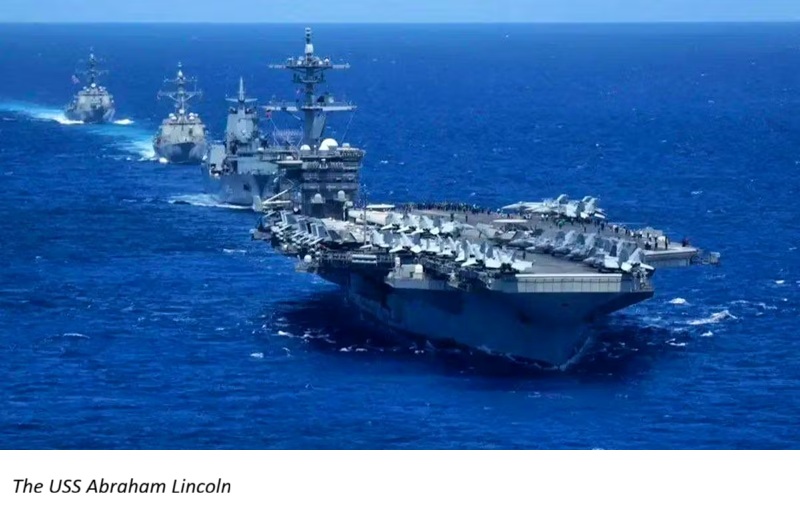
25 August 2026 Dr Binoy Kampmark, https://theaimn.net/deprived-at-sea-the-tribulations-of-the-uss-abraham-lincoln/
The conflict with Iran continues to deliver its mean shocks to an increasingly doddering US imperium. Depleted munitions, depleted stocks of goodwill and, it would seem, a disruption in resupplying warships operating in the Middle East, have become dents in a struggling war machine.
This month, the aircraft carrier USS Abraham Lincoln, lengthily stationed in the Arabian Sea, caught the attention of naval observers with reports of mental distress and sheer desperation on the part of members of the 5,000-strong crew of sailors and Marines. Personnel had endured a nine-month deployment – a record – having made only one stop in Guam in mid-December since leaving San Diego. (The previous record had been set by the USS Dwight D. Eisenhower in a stint lasting 206 days during the COVID-19 pandemic.) Shortages of fresh food and necessaries, the presence of contaminated water, broken latrines, plumbing problems, disruptions in the mail system and exhaustion were just some of the things noted. On August 12, the Navy Times revealed instances where individual crew members had tried to jump overboard. Similar details were also reported in Stars and Stripes.
Meetings between concerned family members and acting Secretary of the Navy Hung Cao were convened earlier in the month regarding the crisis. At one virtual town hall meeting Vice Admiral Joseph Cahill, commander of Naval Surface Forces, conceded the strain placed on sailors and their families. “We hear you loud and clear [regarding] the impact this has on families, on service members and the long-term ability of us to stand, sustain our forces’ health.” He outlined an approach involving counsellors and chaplains, linked with “Command Resilience Team Human Factors Councils,” a jabberwocky designation intended to cover, according to Navy policy, “human factors that impact the wellness of individuals within the command and identify primary prevention efforts to reduce relevant risks(s).” This involved, Cahill elaborated with little assuredness, “the unit understanding and sitting down with sailors individually with their Human Factors Councils and having a conversation about where they’re at in the moment in time.”
Other vicissitudes were given the managerial heave-ho. The blocking of toilets in parts of the ship had arisen because of a “stubborn clog” (seemingly an understatement), though these had been addressed by the sailors over time. Mould that had been detected in the showers was also in hand, with industrial hygienists used to test the bathrooms to ensure the adequate functioning of fans and the flow of air.
The reason for the punishing spell lay in yet another unforeseen aspect of the war with Tehran: its ability to strike at logistics hubs in the Gulf region. Most critically, Iran successfully struck Naval Support Activity Bahrain in Manama, headquarters of the US Navy’s Fifth Fleet in the opening days of battle. Over a dozen buildings, two AN/GSC-52B satellite communications terminals, and a communications facility, were destroyed. In June, the Wall Street Journal noted that US officials had begun “reevaluating” the American footprint in the region as a result of the damage inflicted on the country’s “sole naval base in the Middle East – along with hits to at least 20 US sites across the region.”
The pressing threat of Iranian threats on other ports in the Gulf region necessitated the decision by the Pentagon to scour for other more distant supply options. Diego Garcia, the joint US-UK facility located to the south of the Maldives, became an option. This redeployment certainly caught the interest of Tehran, given an attempted strike on the island with ballistic missiles on March 20.
Shifting focus to Diego Garcia away from Bahrain precipitated its fair share of headaches. “When Bahrain was no longer a port for logistics, food and mail,” reasoned Vice Admiral Douglas Verissimo to attendees at the townhall meeting, “all of the gear that was there when the shooting started got stuck there.” This presented “an initial very large backlog” and “also caused us to, under very contested logistics, very difficult and long supply lines.” Priorities had to be sorted: first, food, followed by important items for the ship’s store, such as toothpaste and shampoo, then the supply of mail. Ensuring a fresh supply of fresh food was problematic, given spoliation on route.
Never one to let bad news inconvenience him, President Donald Trump seemed untroubled. In remarks to reporters on the matter, the increasingly detached chief magistrate of the Republic felt that the deployment had not gone on for “nearly long enough.” He had also been reassured by an unnamed retired admiral that the Lincoln was “beautifully maintained and beautifully taken care of.” Acting Secretary Cao had also mangled matters in his August 14 statement, declaring with evident irritation that “our force and their families are not victims. They are the epitome of American strength and resilience.” Irresponsible members of the media, however, had tried “to paint our warriors as victims. Not only is that dishonest but it takes away from the focus on the enemy and the threat it poses against our nation, people, and the way of life.” Rather than conceding how serious matters were on the Lincoln, Cao simply referenced a negligible number of “mental health cases” that had been treated with no loss of life and claimed that meals had merely been adjusted to cope with the lack of fresh supplies.” Calls made to family members of the crew “were limited when the operational threat was too high.”
On August 22, crew members of the Lincoln finally received news of a scheduled port call, with a possible planned rest and recreation stop in Thailand come early September. “The ship,” announced Senator Jack Reed, the top-ranking Democrat on the Armed Service Committee, “is scheduled to return to its homeport in coming weeks.” The Japan-based carrier USS George Washington is the intended replacement. Its mission will be as misguided and cloudy as the vessel it has replaced.
1 This Month





PLEASE OPPOSE HR 8255 AND S.3639 – bills would accelerate satellite deployment, with no environmental review or safeguards – https://ncstd5li.quorum.us/campaign/169331/
To see nuclear-related stories in greater depth and intensity – go to https://nuclearinformation.wordpress.com
-
Archives
- October 2026 (74)
- September 2026 (339)
- August 2026 (330)
- July 2026 (355)
- June 2026 (287)
- May 2026 (306)
- April 2026 (356)
- March 2026 (251)
- February 2026 (267)
- January 2026 (308)
- December 2025 (358)
- November 2025 (359)
-
Categories
- 1
- 1 NUCLEAR ISSUES
- business and costs
- climate change
- culture and arts
- ENERGY
- environment
- health
- history
- indigenous issues
- Legal
- marketing of nuclear
- media
- opposition to nuclear
- PERSONAL STORIES
- politics
- politics international
- Religion and ethics
- safety
- secrets,lies and civil liberties
- spinbuster
- technology
- Uranium
- wastes
- weapons and war
- Women
- 2 WORLD
- ACTION
- AFRICA
- Atrocities
- AUSTRALIA
- Christina's notes
- Christina's themes
- culture and arts
- Events
- Fuk 2022
- Fuk 2023
- Fukushima 2017
- Fukushima 2018
- fukushima 2019
- Fukushima 2020
- Fukushima 2021
- general
- global warming
- Humour (God we need it)
- Nuclear
- RARE EARTHS
- Reference
- resources – print
- Resources -audiovicual
- Weekly Newsletter
- World
- World Nuclear
- YouTube
-
RSS
Entries RSS
Comments RSS

