Governors take a nuclear wrong turn

by beyondnuclearinternational, https://beyondnuclearinternational.org/2026/10/03/governors-take-a-nuclear-wrong-turn/
Connecticut’s reckless drive for more nuclear power
by Stanley Heller, CT Mirror, September 30, 2026
Connecticut’s governor joined other New England governors in a “summit” on September 30 to push for more nuclear power. Supposedly there’s a crisis, a need for lots more electricity for data centers so they can embrace the wonders of AI.
There’s a crisis, all right, but it’s not some desperate need for AI. Instead, it’s the fires, droughts, glacier breakdowns and extreme weather all over the world –symptoms of collapsing climates.
Over the last year the CT Department of Energy and Environmental Protection held four webinars to encourage building nuclear power plants in Connecticut. Their pitch was that new “advanced” reactors are much safer, that smaller ones can be built rapidly and that nuclear waste is not an immediate problem. The legislature set aside $5 million to foster sites all over Connecticut.
The supposed advance is the SMR, the “small modular reactor,” a uranium-power fission plant that is lots smaller than giants like Millstone or the closed Indian Point facility. SMR boosters say assembly line construction of SMRs will save lots of money and that they are so fail-safe they need little or no safety areas around them.
The problem is corporations planning to build SMRs are mostly start-up companies that have had no experience in nuclear power at all, which have no orders, no revenue, no profit, and no actual reactors. Not a single SMR has been built in the U.S. If fact, there are only three in the whole world. Nuclear power has an impressive track record of being incredibly slow to bring online (17 years on average) and has a consistent record of being many times more expensive than initially planned.
Take the example of NuScale Energy. It began as a university research project. In 2020 it was the first (and only) SMR to receive U.S. Nuclear Regulatory Commission (NRC) design approval. It received $600 million from the U.S. Department of Energy. NuScale planned to build reactors in Idaho and go online in 2030. But costs started to skyrocket, partners pulled out and the whole project was cancelled. Its stock price has gone down over 80% in the last year.
One huge and obvious problem with fission is radioactive waste. In the nuclear power process, radioactive uranium is mined, then enriched and formed into rods, and the uranium goes through a process that splits its atoms and gives off energy. That’s done until the rods are no longer productive. Then they are classified as “spent.” However, spent rods are incredibly radioactive and intensely hot. So these rods are put in cooling ponds of the facility for years. Then they have to be stored indefinitely because there’s no agreed upon way to dispose of them permanently.
Nuclear power waste has been around for more than 80 years, but in all that time there has been no way found to discard it. There was a plan to put 90,000 tons of high-level radioactive waste deep under Yucca Mountain in Nevada, but state leadership became vehemently against it. Nevada’s official position is that the area is “seismically and volcanically active, porous and incapable of geologically containing the waste.” The Yucca Mountain “repository” was cancelled 15 years ago.
The Trump Administration is trying to open “campuses” that would both create nuclear power and take in nuclear waste from all over the country and put it deep underground. Some legislatures support the idea but once the citizenry realizes what they’d be accepting expect tumultuous opposition.
Putin forces did just that in June of this year within the Chernobyl exclusionary zone, partially destroying a building used for receiving containers of radioactive waste. There are ways to build facilities holding the casks to a HOSS standard (hardened on-site storage) similar to what is used in building nuclear missile silos, but they’ve never been required in the U.S. So we’re just left with hope — hope that a foreign military or terrorist group won’t one day try to blow up a field of casks.
Another problem is that we’re finding that extreme heat can lead to nuclear reactor shutdowns. During heat waves river water levels drop so the water level is too low to be drawn upon for use in the plants. Witness Hungary in August 2026. It had to shut down its nuclear reactors due to low water levels for the first time in its history. Romania shut down its nuclear plant, too.
We don’t need nuclear. What we do need is to stop rushing toward the climate cliff. We know how to do it. Use solar, wind, water, batteries and conservation to meet our electrical needs and swiftly stop burning fossil fuels.
Stanley Heller is Administrator of Promoting Enduring Peace which was founded in New Haven in 1952. He’s also a member of Jewish Voice for Peace.
Nuclear weapons in space would break law, says Britain

By Tom Dunlop, 29 sept 26 https://ukdefencejournal.org.uk/nuclear-weapons-in-space-would-break-law-says-britain/
Orbital weapons of both kinds pose a growing threat to the space-based services Britain and its allies depend on, and any attempt to put nuclear weapons in orbit would be highly destabilising and contrary to international law, the Ministry of Defence stated in a written answer.
Lord Coaker, Minister of State at the department, was answering Baroness Bennett of Manor Castle, the Green Party peer, who asked what assessment the government had made of the danger of orbital weapons, kinetic and otherwise, following what she described as the disclosure by the United States of its aggressive space capacity, and what steps ministers plan to take to prevent a new arms race in space.
The minister replied: “The Government recognises that orbital weapons, both kinetic and non-kinetic, pose a growing threat to critical space-based services vital to the UK and its allies. We are concerned by reports of efforts to deploy nuclear weapons in space, which would be highly destabilising and contrary to international law. The Government supports a behaviour-based, risk-reduction approach to maintain a safe, secure and sustainable space environment. We work closely with international partners to promote responsible conduct, uphold existing legal frameworks and prevent escalation.”
He continued: “Through the UK Space Strategy and Defence Investment Plan, the Government is investing in the resilience and protection of UK and allied space assets to ensure freedom of action in space and safeguard long-term sustainability. We remain committed to international cooperation and the development of norms that reduce risk and preserve stability in this increasingly contested domain.”
The same minister had declined a week earlier to say whether Britain itself has anything in orbit. Lord Lee of Trafford, the Liberal Democrat peer, asked on 22 September whether the United Kingdom has any weapons in space, and if not whether there are plans to deploy any.
Coaker replied: “We do not comment on specific Defence capabilities, including whether such capabilities are deployed in space, nor on future operational plans where doing so would risk undermining national security. We do however recognise that space is important to military operations and is becoming more congested, contested, and competitive. The Government is committed to collaborating with allies and partners to promote internationally agreed norms, avoid unintentional escalation and conflict, and ensure that space remains open, safe, and sustainable.”
He added: “In addition, the UK’s national security depends on freedom of action in space, including the ability to protect UK and allied space assets. As set out in the UK Space Strategy and Defence Investment Plan, the Government is investing in capabilities to strengthen resilience and support the protection of UK interests in space, while continuing to operate responsibly and in accordance with international law.“September 29, 2026
EU coldly kills Zelensky’s 2027 membership demand

Ukraine’s January deadline is impossible and Kiev will receive no privileges or shortcuts, Enlargement Commissioner Marta Kos has said.
2 Oct, 2026, https://www.rt.com/russia/646656-eu-kills-ukraine-membership-deadline/
The EU has rejected Vladimir Zelensky’s demand that Ukraine be admitted to the bloc by January 2027, with Enlargement Commissioner Marta Kos saying Kiev must meet all membership requirements and will receive no exemptions.
Speaking to Italy’s Corriere della Sera ahead of an enlargement policy review scheduled for next week, Kos said getting into the club depended on reforms rather than political deadlines.
“Accession is based on merit: it’s clear that this date is not possible,” she said, noting that the January date had been set only by Zelensky.
Kos acknowledged that Kiev views membership as a security guarantee and said helping Ukraine was the EU’s “duty.” However, she stressed that candidates need to meet demanding requirements on the rule of law, economic convergence, and adoption of EU legislation, and that there are “no privileges or discounts in the accession process,” and “no shortcuts.”
Kos instead backed gradual integration before full membership and said she hoped Ukraine could make further progress in accession talks by year’s end.
Zelensky has previously rejected alternatives to full EU membership. In May, he called German Chancellor Friedrich Merz’s proposal for associate membership “unfair,” arguing that Ukraine could not participate in the bloc without voting rights.
Kiev received candidate status in 2022, but accession requires unanimous support from all 27 member states. Several EU members have consistently opposed Ukraine joining the bloc, including Hungary, which has repeatedly resisted accelerated admission and recently blocked the inclusion of any language on fast-tracking Ukraine from an EU summit conclusion.
Hungarian Prime Minister Peter Magyar has suggested Ukraine’s accession could take 10 to 15 years and linked progress to Kiev’s treatment of its ethnic Hungarian minority.
Corruption has also remained a significant obstacle to Kiev’s bid. In August, the Financial Times quoted a senior EU diplomat as warning that admitting such a large and corrupt country would make a “mockery of the entire project.”
Ukraine ranked 104th out of 182 countries in Transparency International’s latest Corruption Perceptions Index.
Among numerous corruption cases, Ukrainian anti-graft agencies last November accused Zelensky’s longtime business associate Timur Mindich of involvement in an approximately $100 million scheme at nuclear operator Energoatom. Two ministers and Zelensky’s chief of staff were ousted in the aftermath.
Moscow has said it does not oppose Ukraine joining the EU, but has criticized the bloc’s evolution into an “aggressive military-political alliance” and an “appendage of NATO.” Kremlin spokesman Dmitry Peskov has also argued that Ukrainian accession could weaken the EU and destabilize the bloc.
The Mask of Civilization, the Face of Apartheid: Netanyahu at the UN

October 2, 2026, Reza Fani Yazdi Informed Comment, https://scheerpost.com/2026/10/02/the-mask-of-civilization-the-face-of-apartheid-netanyahu-at-the-un/
From the heart of a Middle East that has bled for decades under the boots of colonialism, indiscriminate bombardments, systematic assassinations, and the medieval sieges imposed by the Zionist regime, Benjamin Netanyahu’s speech before the United Nations General Assembly was nothing less than the naked embodiment of “the most brazen form of inversion of truth, fascist propaganda, and systematic justification of genocide.”
Before being portrayed as a political event, this speech was a nauseating spectacle: an “accused man wanted by the International Criminal Court” making his escape, as it were, from the defendant’s seat in a criminal court to the podium of the United Nations General Assembly.
What follows is my examination of the criminal rhetoric of this man accused of genocide.
The Greatest Inversion in History: The Accused Perpetrator Posing as Prosecutor
The height of audacity in Netanyahu’s speech lies in his deliberate and deranged reversal of the roles of “perpetrator and victim.” A man for whom the Pre-Trial Chamber of the International Criminal Court (ICC) found reasonable grounds to issue an arrest warrant on allegations including the war crime of using starvation as a method of warfare and crimes against humanity—the killing and systematic infliction of suffering upon hundreds of thousands of people in Gaza—stands calmly behind the podium and calls the victims of his own war machine “terrorists,” while presenting himself as a “defender of civilization.”
This is linguistic colonialism at its most extreme: 78 years of occupation, the bombing of hospitals and refugee camps, and the massacre of tens of thousands of innocent women and children are called “legitimate self-defense,” while the resistance of a people fighting to reclaim their land and human dignity is branded “barbarism.”
An accused man who should have the handcuffs of justice around his wrists stares the world in the face and mocks every standard of human rights.
Invoking Ancient Myths to Legitimize Ethnic Cleansing
Netanyahu’s reliance on the Torah and on narratives dating back thousands of years to justify modern colonialism, illegal settlements in the West Bank, and the occupation of the Golan Heights is a blatant affront to the United Nations Charter and international law.
If geographical borders and the sovereign rights of nations are to be rewritten on the basis of ancient religious scrolls, then no place on Earth will ever be secure.
This approach lays bare the fascist, racist, and apartheid nature of the Tel Aviv regime—a regime founded upon the “dispossession of the indigenous population” and “ethnic cleansing,” and one that brazenly links its crimes to supernatural commandments in an attempt to portray the spilling of human blood as permissible.
Emboldened by Imperialism and Brazen Defiance of the International Community
Netanyahu’s arrogant and insulting tone toward representatives of countries who walked out of the United Nations chamber in protest against the presence of a war criminal—and his branding of them as “moral cowards”—is the product of years of ironclad immunity granted to him by the United States and by Western colonialism and global imperialism.
He proudly speaks of violations of the airspace of countries across the region, targeted assassinations, the bombing of facilities, and wars on multiple fronts.
Such a complete abandonment of even the pretense of diplomatic restraint demonstrates the extent to which the international legal order has surrendered before naked force and imperial vetoes.
The silence or implicit support of Western governments for such positions makes them complicit in every drop of blood spilled in Gaza, Lebanon, Iran, and throughout the Middle East.
Projecting Severe Domestic Crises into Regional Terror and Conflict
Netanyahu bellows about “strategic victories” and the “end of insecurity” while the settler society under his rule struggles with profound psychological crises, economic deterioration, structural protests, and political deadlock.
In order to postpone his domestic trials on corruption charges and prevent the collapse of his fragile coalition, he must keep the machinery of war permanently running and drag the region toward the precipice of a global war.
Bringing technological devices—such as Starlink—to the podium of the United Nations General Assembly and issuing threats against the great nation of Iran is a vulgar spectacle staged by a politician who knows that once the war ends, the final chapter of his political life and his inevitable downfall will begin.
Wait Until the Dawn of Your Downfall Breaks
History has demonstrated with unmistakable clarity that no occupying empire has ever achieved immortality through cluster bombs, indiscriminate killing, rhetoric at the United Nations, and the support of its Western patrons.
What came from the throat of this wanted criminal in New York was not the voice of strength or authority. It was the terrified roar of a declining project and a decaying structure confronted by the iron will of the peoples of the region.
Gaza, Lebanon, and a steadfast Iran stand as living witnesses that the Zionist killing machine will ultimately drown in the quagmire of its own structural crimes.
Constellation, Amazon agree nuclear-focused power purchase deal

WNN, Thursday, 1 October 2026
A 20-year power purchase agreement signed by tech giant Amazon will enable Constellation to add 190 MW of capacity and extend the operating life of the Calvert Cliffs nuclear power plant in Maryland in the US.
Constellation said that the agreement will allow USD3 billion of investment, with the additional 190 MW being added to the existing 1,790 MW output of the Calvert Cliffs Clean Energy Center between 2030 and 2032.
It said: “In addition to making the uprate possible, Amazon’s long-term commitment will help provide Constellation with the revenue certainty to relicence the plant for another 20 years and make progress toward the development of new [?] clean energy power plants at the site.”
The agreement with Amazon covers 690 MW of power and “the parties have also entered into a related retail supply agreement to support Amazon operations” in the 13-state PJM regional grid………………………….
n November last year Constellation outlined plans for the Calvert Cliffs Clean Energy Center, including the power uprates for the two pressurised water reactors, and 20-year life extensions for the units which were connected to the grid in 1975 and 1976, respectively, and which would otherwise shut down in 2034 and 2036. Calvert Cliffs is Maryland’s only nuclear power plant and produces about 40% of Maryland’s total power generation and 80% of the state’s [?] clean power generation……………………
The agreement with Constellation, which operates the largest fleet of nuclear facilities in the US, is the latest in a series of power purchase deals and other investments in nuclear energy by tech giants and other end users, who need reliable 24/7 low-carbon power for things like data centres. Amazon was among a group of major energy users that signed a pledge last year supporting the goal of at least tripling global nuclear capacity by 2050.
https://www.world-nuclear-news.org/articles/constellation-amazon-agree-nuclear-focused-power-purchase-deal
USD120 billion framework nuclear agreement – USA, South Korea targeting six AP1000 and two APR1400 units
WNN, Thursday, 1 October 2026
A USD120 billion framework agreement to build six Westinghouse AP1000 units and two of South Korea’s APR1400 units in the USA has been outlined by the US Department of Commerce.
According to the US Department of Commerce, the location of the new units has yet to be specified, with USD100 billion “slated for construction costs (overnight costs) and USD20 billion for contingency reserves. These reserves are counted toward the investment amount”.
In its description of the ‘Project Power’ scheme, it says that the eight units would be part of achieving the US president’s goal of having 10 large reactors under construction by 2030.
The Department of Commerce says: “By combining US technological expertise with Korea’s supply chain capabilities and leveraging successful deployment cases in the United States, the two parties will broaden their strategic, long-term cooperation in the global nuclear power market. The parties will develop and announce individual projects separately as sites, schedules, and commercial terms are finalised. Both countries have agreed to cooperate on transferring a USD10 billion advance payment by the end of the year to facilitate efforts, which are aimed primarily at the immediate purchasing of long-lead items, in accordance with all applicable domestic legal requirements.”……………….
Cameco, which owns 49% of Westinghouse, said that the framework agreed by the two governments would see the new units being deployed on federal sites, beginning with two AP1000 units.
In its statement, Cameco also said the agreement “contemplates a waiver under the 2025 settlement agreement reached by Westinghouse in its intellectual property dispute with Korea Electric Power Corporation and Korea Hydro & Nuclear Power Co., Ltd. The one-time waiver would allow for the construction of up to two APR1400 reactors in the United States, generating enhanced value for Westinghouse. The associated compensation package is expected to recognise the use of Westinghouse intellectual property and technology, providing approximately USD2 billion of value per APR1400 reactor through a combination of intellectual property licensing, engineering and procurement services, subcontracting opportunities and the long-term supply of fuel fabrication services, highlighting the strategic role that Westinghouse is expected to play across the contemplated reactor projects in the US”.
Referring to the potential equity investment by South Korean firms in Westinghouse, Cameco said it “does not expect any potential equity participation contemplated under the Framework to affect our ownership interest in Westinghouse”…………………………….. https://www.world-nuclear-news.org/articles/usa-south-korea-targeting-six-ap1000-two-apr1400-units
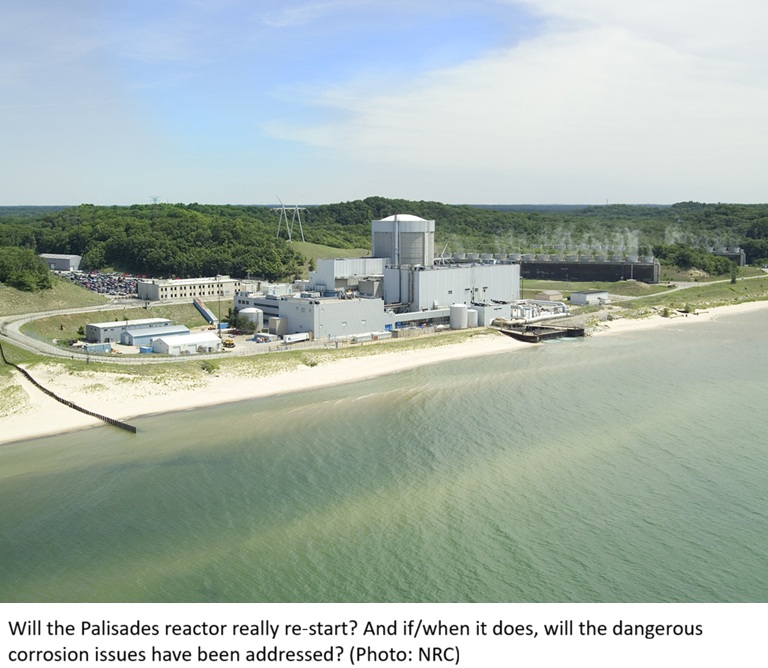
Palisades investigation indefinitely halts refueling (Is Holtec competent?)
October 1, 2026, https://beyondnuclear.org/palisades-refueling-indefinitely-halted-by-investigation/
On September 26, 2026, the Detroit Free Press(opens in new tab) headlined its news story “Nuclear regulators probe fuel assembly installation mishap at Palisades”. The news article regards the occurrence of a nuclear fuel handling mishap at the very end of August 2026 involving Holtec International’s mishandling of a used radioactive nuclear fuel assembly that was one of 136 scavenged used radioactive fuel assemblies being reloaded into the Palisades reactor core as part of the company’s “recommissioning” following certified permanent cessation of power operations by its former owner/operator, Entergy Corp, and last legitimate holder of the Palisades operating license in Covert, Michigan on the shore of Lake Michigan. Palisades was permanently ceased operations on May 20, 2022.
As some background, Holtec acquired ownership of Palisades as a “possession only” license transfer from Entergy Corp as approved by US Nuclear Regulatory Commission (NRC). The Palisades license transfer included a Decommissioning Trust Fund approximately $552 million was finalized making Holtec the new owner on June 22, 2022 solely for the purpose of decommissioning the reactor, decontamination and clean up of the reactor site. However, in an unprecedented move not recognized by NRC regulatory guidance, Holtec announced that was no longer pursuing the decommissioning of the reactor as previously certified to the federal agency but instead on September 23, 2023 formally filed on September 23, 2023 with the NRC to to refurbish and “recommission” Palisades back into commercial power operations to the end the original initial license renewal period, and even provided an exemption if NRC granted Holtec with an reactor operating license, out to March 24, 2031. Furthermore, on June 23, 2025, Holtec filed a formal Letter Of Intent (LOI) to the NRC announcing that it would be seek a second 20-year renewal of the operating license extending it out to 2051.
When Entergy Corp certified the permanent cessation of operations, the nuclear operator was required to completely defuel the reactor core from the reactor pressure vessel transferring all of the used fuel to the spent fuel storage pool, including the most recent refueling.
The fuel mishandling event involved just one of 136 highly radioactive fuel assemblies from the reactor’s most recent refueling cycle where restart commenced on October 10, 2020 before the Palisades previous owner/operator, Entergy Corp, permanently ceased power operations on May 20, 2022. The used fuel being loaded into Palisades by Holtec was operational for 578 days and therefore is extremely radioactive. When the mishandling accident happened, Holtec was salvaging used nuclear fuel assemblies that was stored in the spent fuel pool. Each one of these used fuel assemblies contains 214 highly radioactive fuel rods. The full reactor core complement for the Palisades reactor constitutes 204 fuel assemblies. Only 68 fuel assemblies are will unused new fuel in the reloading.
When Holtec started reloading the Palisades reactor core using the highly radioactive nuclear fuel assembly was being moved in the reverse direction from the nuclear power plant’s spent fuel storage pool shielded under 40 feet of water through a water filled fuel transfer channel back into the reactor containment building to be reloaded into the water filled reactor core in an opened reactor pressure vessel. There it was apparently misplaced by Holtec International operators such that radioactive fuel assembly tilted over, out of alignment in the reactor core and detached from the reactor’s fuel handling machinery. Holtec must now get a license amendment approved procedurally explaining how it will retrieve the misplaced and highly radioactive fuel assembly and evaluate if it can be still be used in the reactor core.
The irradiated nuclear fuel handling accident went unreported to the public for weeks by both Holtec International, now turned unlicensed and inexperienced reactor operator, and the NRC. When confronted, both the company and the regulator claimed that the mishap had not risen to the level of a publicly reportable safety event. However, the mishandling of highly radioactive nuclear fuel is not a minor event without accountability. Palisades already represents a highly controversial and genuinely contested unprecedented effort to refuel and restart the world’s first “permanently closed” nuclear power plan.
The fuel mishap accident represents a warning , a red flag, question the competence of Holtec safety culture and competence. Palisades should not be allowed to balk on fulfilling a 2020 joint decommissioning agreement(opens in new tab) made between Entergy Nuclear and Holtec International, and certified to the NRC on conditions of the reactor license transfer. The joint agreement recognized Palisades to permanently cease operations, permanently defuel, decontaminate, decommission and site mitigation. Holtec International has radically reversed its intention to decommission the reactor and instead proceeded to restore the previous power operating license to be followed by the submission of an application to the NRC for a twenty-year operating license extension out to 2051(opens in new tab).
Japan says it’s time for ‘taboo-free’ discussions about acquiring nuclear weapons
Defence minister says non-nuclear principles should be revisited given the current global security ‘crisis’
Maroosha Muzaffar, Independent UK, Wednesday 30 September 2026
Japan’s defence minister renewed calls for opening a debate on acquiring nuclear weapons, saying Tokyo could not afford to rule out security options as tensions with China, Russia and North Korea continued to intensify.
“The idea that we aren’t even allowed to have a discussion on this matter is a bit at odds with my sense of crisis,” Shinjiro Koizumi said in a TV interview on Monday.
He argued that Japan should discuss its nuclear policy “without taboos”, including the possibility of revisiting its long-standing non-nuclear principles and of acquiring nuclear-powered submarines.
The principles, adopted in 1967, commit Japan to not possessing or producing nuclear weapons, or permitting their introduction to its territory.
Mr Koizumi said the government wasn’t currently committing to any policy, but that options shouldn’t be excluded before they were properly debated. At a press conference on Tuesday, he stressed the need to explain the changing security environment to the public, particularly as Japan was the only nation ever to suffer nuclear attacks in wartime. Japan was attacked with atomic bombs by the US towards the end of World War II, causing unprecedented death and destruction in Hiroshima and Nagasaki.
Mr Koizumi argued that Japan should “carefully explain” changes in the global security situation as well as the actions of neighbouring countries so that the public could share his government’s assessment of the risks.
“I believe it’s safe to say that there are absolutely no grounds for
optimism regarding the security environment surrounding Japan,” he said.
Pointing to the nuclear capabilities of China and Russia and the expanding nuclear arsenal of North Korea, he asked whether Japan could ensure peace by simply avoiding discussion of topics it found difficult…………………………………………………………………………………………………….
Nagasaki mayor Suzuki Shiro, in contrast, described nuclear weapons as an “absolute evil” at the same commemoration, warning against relying on nuclear deterrence and calling on the federal government to uphold the non-nuclear principles.
The issue of nuclear-powered submarines is also moving closer to the mainstream of Japan’s defence debate.
Mr Koizumi said earlier this month that Tokyo wasn’t ruling out acquiring such vessels, shortly after a US navy official expressed support for the idea.
https://www.independent.co.uk/asia/japan/japan-nuclear-weapons-shinjiro-koizumi-takaichi-b3058770.html
TEPCO Begins Probe inside Meltdown-Hit Fukushima Reactor
Tokyo, Oct. 2 (Jiji Press) 2026/10/02, https://jen.jiji.com/jc/eng?g=eco&k=2026100200295
–Tokyo Electric Power Company Holdings Inc. on Friday began investigating the inside of the meltdown-stricken No. 2 reactor at the Fukushima No. 1 nuclear power plant by inserting a robotic arm through an opening in the containment vessel.
The company aims to better understand conditions inside the reactor at the plant in Fukushima Prefecture, northeastern Japan, as it plans to extract some nuclear fuel debris on a trial basis. The work is expected to take about half a year.
According to TEPCO, the latest operation involves cutting some rails and cables that could obstruct the robotic arm’s entry with high-pressure water jets and collecting 3D data and images from inside the containment vessel. This information will be used to develop and design new equipment.
The opening in the containment vessel had been used to remove equipment for inserting and withdrawing control rods, which control the nuclear fission reaction. Rails installed down to the bottom of the reactor pressure vessel are believed to be hindering investigations.
TEPCO plans to capture images, including those of the lower part of the pressure vessel, with multiple cameras attached to the robotic arm. Debris removal is expected to begin next year, with the collection amount likely to be several grams. The company has so far removed about 0.9 grams of debris over two rounds
1 This Month





PLEASE OPPOSE HR 8255 AND S.3639 – bills would accelerate satellite deployment, with no environmental review or safeguards – https://ncstd5li.quorum.us/campaign/169331/
To see nuclear-related stories in greater depth and intensity – go to https://nuclearinformation.wordpress.com
-
Archives
- October 2026 (49)
- September 2026 (339)
- August 2026 (330)
- July 2026 (355)
- June 2026 (287)
- May 2026 (306)
- April 2026 (356)
- March 2026 (251)
- February 2026 (267)
- January 2026 (308)
- December 2025 (358)
- November 2025 (359)
-
Categories
- 1
- 1 NUCLEAR ISSUES
- business and costs
- climate change
- culture and arts
- ENERGY
- environment
- health
- history
- indigenous issues
- Legal
- marketing of nuclear
- media
- opposition to nuclear
- PERSONAL STORIES
- politics
- politics international
- Religion and ethics
- safety
- secrets,lies and civil liberties
- spinbuster
- technology
- Uranium
- wastes
- weapons and war
- Women
- 2 WORLD
- ACTION
- AFRICA
- Atrocities
- AUSTRALIA
- Christina's notes
- Christina's themes
- culture and arts
- Events
- Fuk 2022
- Fuk 2023
- Fukushima 2017
- Fukushima 2018
- fukushima 2019
- Fukushima 2020
- Fukushima 2021
- general
- global warming
- Humour (God we need it)
- Nuclear
- RARE EARTHS
- Reference
- resources – print
- Resources -audiovicual
- Weekly Newsletter
- World
- World Nuclear
- YouTube
-
RSS
Entries RSS
Comments RSS

