Walt Zlotow – Trump’s Iranian Roulette: Whose regime will collapse first, Iran’s or America’s?

23 August 2026 AIMN Editorial, By Walt Zlotow West Suburban Peace Coalition, Glen Ellyn IL, https://theaimn.net/trumps-iranian-roulette-whose-regime-will-collapse-first-irans-or-americas/
Having suffered a catastrophic military defeat in his 39 day bombing war on Iran from February 28 thru April 7, Trump has pivoted to economic warfare to collapse the Iranian regime on behalf of Israel. But all out economic warfare keeps the Strait of Hormuz closed to most oil and other critical resources, guaranteeing that gasoline and everything fossil fuel based in America will rise to unacceptable levels to an American public near totally against Trump’s senseless, lost war.
Iran may be suffering economically much worse than America now, but that matters little for the likely outcome. Iran’s 90 million people will resist Trump’s Operation Economic Fury as the existential threat to their existence it represents regardless of cost. America’s 340 million people will sweep Trump’s deranged, criminal war policies causing senseless cost increases from power in ten weeks.
During that time no country will help Trump crush the Iranian regime. Russia, China and others are and will continue to help Iran weather Trump’s despicable regime change operation that has killed over 3,000 Iranians, virtually eliminated US Gulf Stage bases, inflicted over 750 US casualties in a lost cause.
Trump’s Operation Economic Fury is his last desperate gamble to prevent his Unconditional Surrender to Iran’s well-earned, well-deserved victory over Trump initiating the most senseless war in US history. It’s as if Trump put one bullet in an unloaded pistol, put it to his temple and successfully fired once. But instead, Trump keeps firing till the gun goes off. That’s Trump’s version of Iranian Roulette.
A blank check to the Pentagon while the facts on the “Golden Dome” are concealed from the public.

Elaine Cimino, 21 Aug 26
The Pentagon says Golden Dome will cost $185 billion. The Congressional Budget Office estimates a comparable system could cost $1.2 trillion. Other estimates range as high as $2.4 trillion.
When independent analysts challenge the Pentagon’s figure, Golden Dome’s director dismisses their estimates as false because they do not reflect what the military is actually building.
But the Pentagon will not tell Congress, the CBO or the public what it is actually building.
That is not national-security oversight. It is a blank check protected by classification.
Billions are already flowing to missile, satellite and weapons contractors while the architecture, total cost and technical feasibility remain concealed. Even the CBO’s trillion-dollar model would not provide an impenetrable shield or stop a full-scale attack by Russia or China.
This is ambush by concealment. By hiding the full architecture, government also hides the program’s full economic and environmental footprint: public subsidies, long-term operating costs and resources diverted from essential needs, as well as the consequences of manufacturing, testing, launching and continually replacing thousands of missiles, interceptors and satellites.
Meanwhile, in NM city councils and county commissions are being told to vote for “jobs” without seriously examining the consequences for surrounding communities—and they are voting unanimously. They approve public land, infrastructure, financing and development agreements without independent environmental review, cumulative-impact analysis or full disclosure of the hazards on weapons systems facilities ci tribute ng to the Golden Dome project and more. What do we call unanimous approval when decision-makers have not demanded the information necessary to protect the public?
Rubber-stamp government. Approval by concealment.
Communities are being committed to weapons production, hazardous materials, explosive testing, industrial pollution and intensive resource use before the public can evaluate the cumulative cost—or meaningfully object.
Golden Dome is therefore not simply a missile-defense program. It is an enormous, open-ended transfer of public wealth into a weapons system whose design cannot be examined, whose cost cannot be verified and whose promised protection cannot be guaranteed.
The public is being asked to fund the shield without being allowed to see whether the shield exists.
Golden Dome is Reagan’s “Star Wars” project on steroids—larger, more secretive, more expensive and already driving a nationwide expansion of missile production, weapons testing and the militarization of spac
Russia Warns West Against New Arms Race

Aug 21, 2026 , By Ellie Cook, Senior Defense Reporter, https://www.newsweek.com/russia-warns-west-against-new-arms-race-12346603
A senior Russian official has warned that President Donald Trump’s new defense plans, including for the vast Golden Dome missile shield currently in development, will lead to a new space “arms race” and could be “devastating.”
“The risks of turning outer space into an arena of armed confrontation have ceased to be hypothetical,” Gennady Gatilov, Russia’s envoy to the United Nations in Geneva, said in remarks reported by Russia’s Tass state news agency on Thursday.
“Its consequences will be devastating for all of humanity,” he added.
Although militaries worldwide already use satellites for intelligence gathering, communications, missile warnings and navigation, putting weapons in orbit has been controversial for decades.
A major part of the planned design for the Golden Dome will be orbiting interceptors to knock out incoming missile attacks, with early-warning sensors positioned in space, although the United States government and military haven’t released a full breakdown of how the system would be put together.
A White House spokesperson told Newsweek in a statement: “President Trump is building on the transformational achievements of his first term to maintain America’s leadership in space.”
Newsweek reached out to the Department of Defense via email for comment.
Russian President Vladimir Putin and China’s Xi Jinping jointly said in May 2025 the proposed outline for the futuristic Golden Dome was an “obvious threat to strategic stability,” while North Korea said the program smacked of “self-righteousness” and “arrogance.”
The Trump administration says the project is needed to counter next-generation attacks on U.S. soil, like fast-moving ballistic missiles and hypersonic weapons able to travel at more than five times the speed of sound. Moscow and Beijing have invested heavily in hypersonic programs, while the U.S. and NATO have lagged behind in developing these weapons.
Advocates for the Golden Dome say technology is now advanced enough to build a partially space-based system. Trump has explicitly linked the project to an ultimately shelved initiative launched by late Republican President Ronald Reagan during the Cold War arms race, popularly dubbed “Star Wars” because it planned to intercept Soviet missiles with lasers in space.
But critics argue that despite the ballooning projected costs, Trump’s Golden Dome may not protect the U.S. from a full-scale attack by Russia or China.
Costly and Possibly ‘Overwhelmed’
The Congressional Budget Office—the nonpartisan agency that advises American lawmakers on funding—said in May the “Golden Dome” will cost roughly $1.2 trillion over the next 20 years, far exceeding the initial $175 billion allocated to the project.
The CBO said up to 70 percent of the acquisition costs and 60 percent of the total bill would be linked to the space-based components. It has also said that while the Golden Dome could cope with a “small-scale” assault or a North Korean attack, it would be “overwhelmed by a full-scale attack” from a country like Russia or China.
A dozen companies are competing to develop this space-based layer, including defense giants Lockheed Martin and Northrop Grumman. The U.S. Space Force says it can show off an “initial capability” by 2028.
In separate remarks on Wednesday, senior CBO official David Mosher said the agency hadn’t been able to contact the team in charge of the Golden Dome in the Pentagon and hadn’t secured briefings on the program, despite requesting updates.
“I know nothing about what they’re actually building,” he said during an appearance at the Brookings Institution.
Last year, Oregon Senator Jeff Merkley and three other Democratic lawmakers said the Golden Dome would be “detrimental to U.S. and global security by igniting a nuclear arms race with Russia and China.”
Unanswered Questions
The Golden Dome is expected to cover the U.S. mainland, Alaska and Hawaii. But Canada is in talks to come under the Golden Dome’s umbrella, and the U.S. has said previously that its northern neighbor would need to pay tens of billions of dollars to be included.
Currently, both the U.S. and Canada’s defenses against long-range intercontinental ballistic missiles are handled by the binational North American Aerospace Defense Command (NORAD). At this point, it’s hard to work out how an air defense system for long-range attacks would work without Canadian cooperation.
It’s also not clear how the Golden Dome will address the threat posed by drones, particularly after the U.S.’s experience intercepting unmanned aerial vehicles (UAVs) in the Middle East since the start of the war with Iran.
The Pentagon said in its National Defense Strategy released in January that the Golden Dome would have a “specific focus on options to cost-effectively defeat large missile barrages and other advanced aerial attacks.”
Because air defense interceptors that can shoot down sophisticated weapons often cost several million dollars apiece, many global militaries are wrestling with how to reliably knock out major air threats like drones at a far lower cost than in past years.
Earlier this month, the Pentagon said it had set up a new “hub” for defense companies, academics and investors with the Department of Defense, which it said would slash red tape often found in defense procurement negotiations.
Floating 10 MW nuclear reactor proposed for California.

By Efosa Udinmwen, 22 Aug 26, https://www.techradar.com/pro/floating-10-mw-nuclear-reactor-proposed-for-california-barge-mounted-smr-aims-to-power-15-000-homes
The Port of Long Beach is exploring small modular reactors that could eventually supply electricity for port operations and ships.
Bluecore Energy, a startup building compact nuclear reactors meant to operate from floating barges, is leading the proposal.
This marks a potential return of nuclear power development in California after nearly five decades under state restrictions.
A startup’s barge-based reactor plan
Bluecore has leased space at Berth 48 within the Port of Long Beach, where it intends to develop and test its floating reactor system.
The company’s initial system is rated at 10 MWe, a capacity the startup says can scale through pairing multiple units together, an approach which suits continuous port operations partly because individual reactors are designed to run for years on a single fueling cycle.
Golden Dome Secrecy Poses Challenge for Estimating Costs.

The Pentagon has said it expects the program to cost $185 billion to build over the next 10 years, but think tank experts and government analysis have argued the bill for what Trump’s executive order articulated will likely be much higher. One of the first outside estimates, released last year by the American Enterprise Institute, projected costs ranging anywhere from $250 billion to $2.4 trillion. In May, the Congressional Budget Office pegged the program’s cost at $1.2 trillion.
COMMENT, by Alice Slater. Don’t forget that Russia and China have been urging us for years to negotiate a treaty to prohibit weapons and war in space which the US and our Peace Movement generally ignores! Most recently, they issued a Joint Proposal on the 80th Anniversary of WWII last summer for more global cooperation., criticizing the Golden Dome and urging that we negotiate their draft treaty to ban weapons and war in space, pledging never to be the first to put weapons or war in space!!! Why aren’t we all urging the US government and its allies in crime to take up this proposal and save one and a half trillion dollars on the Golden Dumb!! See Russian and Chinese proposal here: http://en.kremlin.ru/supplement/6310
Aug. 19, 2026 | By Courtney Albon, https://www.airandspaceforces.com/golden-dome-secrecy-challenge-cost-estimates/
While Pentagon officials have revealed some details about the architecture behind the Golden Dome missile defense project, crafting an independent cost estimate for a largely classified program remains a challenge, experts said Aug. 19.
President Donald Trump issued an executive order in January 2025 directing the Pentagon to build a multilayered missile defense shield to protect the U.S. from traditional and advanced missile threats, to include hypersonic weapons. Defense Department officials have said the system will consist of command-and-control nodes, satellite sensors, and ground-and- space-based interceptors, but the finer details of that architecture—including numbers of satellites and interceptors—remain shrouded in secrecy.
The Pentagon has said it expects the program to cost $185 billion to build over the next 10 years, but think tank experts and government analysis have argued the bill for what Trump’s executive order articulated will likely be much higher. One of the first outside estimates, released last year by the American Enterprise Institute, projected costs ranging anywhere from $250 billion to $2.4 trillion. In May, the Congressional Budget Office pegged the program’s cost at $1.2 trillion.
These wide-ranging projections point to the lack of a common, unclassified understanding of what systems and technology will underpin the program, which experts said is the fundamental challenge of estimating Golden Dome’s cost.
Speaking at a Brookings Institute event, CBO’s Director of National Security Analysis David Mosher said the organization was tasked by lawmakers to put a price tag on the scope laid out in Trump’s initial executive order rather than try to estimate what the Golden Dome program office is actually building—an important distinction.
“The Golden Dome they’re building is perhaps different than the Golden Dome in the executive order,” Mosher said. “We couldn’t have costed what they’re building because nobody knows what they’re building yet.”
With the executive order as the baseline, the report constructed an architecture with the elements included in Trump’s directive and then sized it “to protect what we thought was a sort of plausible, relatively large attack from North Korea, or a modest attack from Russia or China,” Mosher said. The resulting notional architecture features four interceptor layers designed to target multiple missile types and to operate either independently or in concert with an associated command-and-control network:
- A space-based constellation of 7,800 satellites designed to take out up to 10 intercontinental ballistic missiles launched near simultaneously as well as hypersonic glide vehicle threats
- An upper wide-area surface layer comprised of three Ground-Based Midcourse Defense sites, each with 60 Next-Generation Interceptors or Ground-Based Interceptors focused on engaging ICBM threats
- A lower wide-area surface layer with four U.S.-based sites, each equipped with 48 SM-3 Block IIA interceptors to defeat ICBMs or hypersonic glide vehicles
- A “regional sector” layer with 35 interceptor and radar sites loaded with THAAD, SM-6 Block IB, and Patriot interceptors that can target ICBMs, glide vehicles, and cruise missiles
The space-based interceptor constellation would be the most expensive element of this architecture by far, costing $743 billion over 20 years, or 60 percent of the total cost. The report, which calls its architecture a “middle ground” between more limited and high-end alternatives, estimates each SBI-equipped satellite would cost $22 million and have a five-year service life.
CBO’s report also includes the cost of a satellite sensing layer—which it projects would require about $90 billion to develop, field, and maintain—as well as the battle management and communication systems needed to coordinate the broader architecture. The sensing layer would include satellites such as the Hypersonic and Ballistic Tracking Space Sensor, which the Space Development Agency is fielding as part of its low-Earth orbit missile-tracking constellation, and space-based air moving target indication satellites, which the Space Force is currently developing.
Golden Dome Director Gen. Michael Guetlein has pushed back on CBO’s estimates, saying they’re built on inaccurate assumptions about what his team is actually building. According to Guetlein, the report’s assumptions are based on technology envisioned in the early 2000s “for a different fight”—one focused on point defense, or defense of a limited area, rather than the regional, homeland defense mission that underpins Golden Dome.
“That is not what we need for the homeland,” he said in May. “In a regional defense, there’s a different architecture. And you can’t just take what we’ve done in the past and multiply it forward or you’re going to get large numbers like CBO got.”
Mosher acknowledged the report is detached from the program office’s architecture, pointing out multiple times that CBO and the general public do not have access to those details. He said CBO has asked for briefings but hasn’t been able to meet with program officials.
“I know nothing about what they’re actually building except what I read in publications,” Mosher said.
According to Guetlein, a key difference between the architecture envisioned in the CBO report and what the Pentagon is pursuing through Golden Dome is the use of “next-generation” technology like AI, advanced computing, and directed energy.
Mosher said that for the most part, the report used existing systems as a baseline because they’re a known quantity. He said it’s true that harnessing advanced technology could lower costs over time, especially for some space-based elements of the architecture. However, other technologies like high-energy lasers in space aren’t yet ready for prime time, which means it’s likely not a near-term differentiator.
“We tend to estimate what we see,” he said. “New technologies might provide the opportunity for that, I think we mentioned that as a possibility, but it’s not what you would have in the near term, which is what they’re trying to do.”
DOE Again Denies Access to Defense Nuclear Facilities Safety Board (DNFSB) at Nuclear Weapons Facilities; Contact Your Elected Officials

Once again, the Department of Energy and its semi-autonomous National Nuclear Security Administration has denied the Defense Nuclear Facilities Safety Board access to nuclear weapons facilities, including at Los Alamos National Laboratory (LANL). At a time when LANL is ramping up production of plutonium pits, the triggers for nuclear weapons, the DOE is restricting access to the Board and its resident inspectors preventing them from fulfilling critical oversight and public reporting responsibilities. As a result, the public is no longer informed about potential issues of adequate protection at defense nuclear facilities.
The Board provides oversight of DOE and is independent in the execution of its mission. It is part of the Executive Branch of government.
Further, the five-member Board has been eviserated because neither the recent Democratic nor Republican administrations have filled positions on the Board. Currently there is one Board member, which means the Board cannot issue formal recommendations without a quorum – all to the detriment of the public.
The Board is governed by the Atomic Energy Act which requires that the Energy Secretary “shall fully cooperate with the Board and provide prompt and unfettered access to such facilities, personnel, and information as the Board considers necessary to carry out its responsibilities.”
Based upon a lack of jurisdiction argument, DOE falsely claims that it has the authority to deny the Board access to facilities, personnel and information among other improper denials – again, all to the detriment of the public.
The defense revolving-door, Silicon Valley edition
he Trump administration has installed a revolving door between defense-tech companies and the Pentagon.
An eye-opening glimpse at the links between two congressional committees and more than 100 defense contractors, consultants, and lobbyists.
By John Mecklin, August 17, 2026, https://thebulletin.org/2026/08/the-defense-revolving-door-silicon-valley-edition/?utm_source=ActiveCampaign&utm_medium=email&utm_content=The%20defense%20revolving-door%2C%20Silicon%20Valley%20edition&utm_campaign=20260817%20Monday%20Newsletter%20%28Copy%29
ince President Eisenhower more-or-less invented the term military-industrial complex, US defense spending has grown, dramatically in some eras, leveling off a bit in others, but overall heading ever-upward. Annual US defense expenditures now approach $1 trillion—and, if the Trump administration gets its way, will head toward $1.5 trillion in the coming fiscal year. A variety of factors has driven this rise in defense outlays, but one has become persistent: the revolving door that some national service officials walk through to take well-compensated positions at private-sector military contractors and the firms that lobby the government on their behalf.
The phenomenon and its corruptive possibilities have been much-studied and widely criticized. US Sen. Elizabeth Warren, the noted progressive, commissioned a report on the issue in 2023 with the withering title “Pentagon Alchemy: How Defense Officials Pass rough the Revolving Door and Peddle Brass for Gold.” The libertarian-to-conservative Cato Institute writes less compelling headlines (“Dealing with the Defense Industry’s Revolving Door in the 2027 NDAA”) but doesn’t like the revolving door, either. And in its 2023 report, “March of the Four–Stars: The Role of Retired Generals and Admirals in the Arms Industry,” the heterodox Quincy Institute basically supports Warren’s attempt to at least slow the revolving door via the “Department of Defense Ethics and Anti-Corruption Act.” Warren initially introduced the bill in 2019 and reintroduced it in 2021 and 2023, to no avail.
The interactive display below [on original] illustrates one piece of the defense revolving door as it has evolved over the last decade. During that time, former congressional officials have strolled through the door and wound up working not just at the largest defense contractors (often called “primes”) but also for a new class of high-technology firms—often involved in artificial intelligence and headquartered in Silicon Valley—that has aggressively expanded its Pentagon contracting efforts. And to be clear, the door leads in both directions; private sector bigwigs sometimes move into influential government positions that could affect the fortunes of their companies.
As UC Berkeley investigative reporter Bernice Yeung recently wrote for the Bulletin:
[T]he Trump administration has installed a revolving door between defense-tech companies and the Pentagon. The deputy secretary of defense, Steve Feinberg, is the cofounder and former CEO of a private equity firm that invests heavily in companies with Pentagon contracts. The President’s Council of Advisors on Science and Technology co-chair David Sacks is a venture capitalist who invests in defense tech. The country’s science and technology advisor, Michael Kratsios, was previously an executive at top AI defense firm, Scale AI. The armed services are also stacked with senior leaders with ties to the tech industry, such as Under Secretary of the Army Michael Obadal, an Anduril alum.
The interactive is anything but comprehensive. It looks only at members of Congress who served and top staffers who worked on the House and Senate armed services committees during the 2015-2025 decade. The graphic does not deal with defense-related political contributions, or with the many employees of the Pentagon, military services, State Department, and Energy Department who also rode the revolving door connecting government service to high-paying positions with defense contractors and the K Street firms that lobby for them. The interactive simply shows some of the ways in which the two congressional committees that deal with the country’s armed services are connected with private-sector defense contractors, consultants, and lobbyists. Even within this limited scope, the connections are eye-opening.
Jared Kushner: US will back Israeli resumption of war if Hamas fails to honor disarmament commitments

Kushner said Hamas could surrender weapons and tunnels within 60 to 90 days, calling demilitarization a potential major security gain for Israel.
Jerusalem Post, ByJAMES GENN, AUGUST 18, 2026
Hamas must honor its commitments to disarm or face an IDF operation to “finish the job,” US special envoy Jared Kushner told FOX News’s Trey Yingst on Monday.
Kushner’s comments came after meetings with Hamas and the National Committee for the Administration of Gaza (NCAG) in Cairo on Sunday, and respective meetings with Prime Minister Benjamin Netanyahu and President Isaac Herzog in Jerusalem on Monday.
“If they [Hamas] don’t follow through now on their commitment, everyone will see that they’re not genuine about peace, and then Israel will have a lot more support from the US and others to go and finish the job in the appropriate way,” Kushner stated………………………………
“For Israel, we think this is a win-win situation because if Hamas actually gives over the weapons and the tunnels willingly over the next 60 to 90 days, that obviously would be the elimination of a huge security threat for Israel, almost an unthinkable achievement,” he stated.
Trump admin. will not allow Gaza to be rebuilt until Hamas demilitarizes, Kushner says
The Trump administration will “not allow Gaza to be rebuilt until demilitarization occurs,” Kushner stated……………….. https://www.jpost.com/middle-east/article-905880
USA government handing out $billions to X-energy and TerraPower for advanced nuclear reactors

X-energy, TerraPower share updates on advanced reactor projects
Mon, Aug 17, 2026, https://www.ans.org/news/2026-08-17/article-8297/xenergy-terrapower-share-updates-on-advanced-reactor-projects/
The two main players of the Department of Energy’s Advanced Reactor Demonstration Program, X-energy and TerraPower, have both announced significant developments in their projects to deploy advanced commercial-scale reactors.
X-energy to get another $1 billion: During its second-quarter earnings call on Thursday, CEO Clay Sell said the DOE notified X-energy that it would receive an additional $1 billion in cost-shared funding for its Long Mott project. The company wants to build four Xe-100 reactors at Dow’s UCC Seadrift Operations, a chemical production facility in Seadrift, Texas. It would be the first advanced reactor deployment of its kind at an industrial site in North America.
Combined with the $1 billion X-energy has already received from DOE, the company will have received roughly $2.15 billion for the Seadrift project, Sell said. X-energy will be required to follow the same cost-share requirements as in the earlier allocation…….
Highlighted other key second-quarter moments and developments for the company during the call, including the following:
- Entering into long-term agreements for high-assay low-enriched uranium enrichment services with Centrus Energy Corp. and General Matter.
- Entering into an agreement with SGL Carbon to expand manufacturing capacity for nuclear-grade graphite.
- Receiving an $11 million economic development grant from Tennessee to support its TRISO-X fuel fabrication campus in Oak Ridge.
- Acquiring roughly 70 acres adjacent to its Oak Ridge campus to expand its TRISO-X footprint.
With regard to Long Mott, the Nuclear Regulatory Commission is expected to complete its construction permit review later this year, with a permit issuance decision likely in the first half of 2027, according to Sell. X-energy is also expected to submit its construction permit application to the NRC in the first half of next year for the Cascade Advanced Energy Facility project in Washington state with Amazon and Energy Northwest.
Lastly, an announcement of a 1-GW project with an unnamed utility is coming “in the near future,” Sell said.
TerraPower, South Korean companies reach deals: TerraPower is looking to strengthen its ties with South Korea and has reached agreements with Hyundai Engineering & Construction (HDEC) and SK Innovation to develop and commercialize the Natrium reactor in the United States, Korea, and select international markets. This comes after TerraPower officials—including founder and chair Bill Gates and president and CEO Chris Levesque—traveled to South Korea to meet with Prime Minister Seong-sook Han and leaders from the Export-Import Bank of Korea, HD Hyundai, HDEC, and SK Innovation.
Under the agreement reached with HDEC, the Korean company will be TerraPower’s engineering, procurement, and construction contractor and will build up to eight of its Natrium reactors with completion, price, and performance guarantees. TerraPower is currently constructing its first Natrium reactor—a 345-MWe sodium-cooled fast reactor with molten salt heat storage to temporarily boost power output to 500 MWe—in Kemmerer, Wyo.
TerraPower’s term-sheet agreement with SK Innovation clears a pathway for Korea’s first Natrium plant, along with plans to expand internationally. The two companies will explore opportunities to collaborate on engineering and digital innovation solutions, including digital twin technology and artificial intelligence, the news release said.
“Today marks a pivotal moment for TerraPower as we embark on a new chapter of international collaboration with Korea’s leading organizations,” Levesque said. “Combining TerraPower’s innovative advanced nuclear technology with Korea’s nuclear construction and operational expertise will strengthen our global cooperation and accelerate the deployment of a Natrium fleet that will transform the world’s energy landscape.”
Walt Zlotow – 21ST century David v. Goliath: Iran’s $8 billion military whups America’s $1 trillion military
Walt Zlotow West Suburban Peace Coalition GlenEllyn IL , 19 Aug 26, https://theaimn.net/21st-century-david-v-goliath/
What’s going on in the Middle East is not a Biblical fairy tale. Irans’s piddly military has delivered a devastating defeat to America’s gargantuan trillion dollar military.
Iran’s David does not need to squander a trillion annually on 750 bases housing over 160,000 soldiers in 80 countries. Nor does Iran’s David need 287 naval ships including 11 nuclear powered aircraft carriers that have suddenly become obsolete in the era of drone and missile warfare. Those carriers have been steering clear of Iran’s missiles and drones least they be sent to Davy Jones Locker.
The US is flummoxed at how Iran’s minuscule military has made mincemeat out of all 18 US bases in US Gulf State allies Kuwait, Saudi Arabia, UAE, Qatar and Bahrain. After plastering Iran with thousands of bombs for 39 days, it was the US, not Iran that was running out of offensive and defensive missiles and bombs, so much so Trump cried ‘Uncle’ and demanded a ceasefire.
When Trump signed the Iran’s ‘Unconditional Surrender’ document, the Memorandum of Understanding, on June 17, it was equivalent to Goliath being smitten by the stone puny David fired from his sling.
Of course, the story of David and Goliath is a fairy tale that allegedly occurred over 3,000 years ogo. The 21st century version is no fairy tale. Now in its 173rd day with no end in sight, it still represents the most catastrophic military blunder in US history. It will likely push the US out of the Middle East. The 5 Gulf States housing now damaged or destroyed US bases may seek more reliable countries to rely on for their security. Iran will emerge a stronger power in the region. The entire world economy still teeters on possible decline from US intransigence and refusal to admit defeat.
Trump still doesn’t get it. He’s seeks another half trillion bucks for his wildly bloated military for fiscal ’27 in hopes of prevailing over Iran’s tiny $8 billion dollar military. Mayne he should start reading something he’s never read before…the Bible. He should start with 1 Samuel 17:1–50.
Trump ‘weighing nuclear attack on Iran’ as peace deal expires.

Plus: Why the Iran war has prompted Trump to scale back key US-South Korea military drills
As the US-Iran ceasefire officially expires and the Strait of Hormuz
remains closed, is Donald Trump considering using nuclear weapons to break
the war’s stalemate? On today’s episode of Iran: The Latest, Venetia Rainey
and Roland Oliphant discuss why US politician Marjorie Taylor Greene’s
bizarre nuclear claim may be less crazy than it first appears and how an
underground nuclear facility at Pickaxe Mountain could be the potential
target. They also look at the state of the war 60 days on from the
ill-fated Memorandum of Understanding peace deal and why Iran is more
bullish than ever.
Telegraph 17th Aug 2026, https://www.telegraph.co.uk/world-news/2026/08/17/trump-weighing-nuclear-attack-on-iran-as-peace-deal-expires/
The Quantum Con: How Chicago’s Southside Became a Sacrificial Altar to the War Machine

Are we as Chicago residents at ease with the unprecedented horrors of quantum and AI warfare coming out of our own backyards?
Pete Hegseth’s Department of War is building America’s largest quantum computing project right here on the Southside of Chicago, to the detriment of not only our city but the world at large. Gov. JB Pritzker has lauded the venture capital project as an unprecedented opportunity to make Illinois the “Silicon Valley of quantum development.” With whose consent? On whose land? And on whose dime?
When examining the backers of the Illinois Quantum and Microelectronics Park (IQMP), it is difficult to rationalize this $9 billion project as anything but an accelerative altar to militarism. Alongside federal backing from DARPA, investors such as BlackRock, IBM, and Israeli startup Quantum Machines have all cited quantum technology as the next frontier in modern warfare. The military-industrial complex has emphatically doubled down on quantum computing technology and advanced computing in AI alike as the next crucial edges in 21st-century militarism. Indeed, AI technology in warfare is already being used extensively by the US and Israel to terrorize the SWANA region.
Even with the considerable private capital financing already allotted to this project’s troubling Big Tech-war machine alliance, Illinois taxpayers are the top funders of IQMP by far. To the sum of more than 700 million state dollars, the land and water beneath our feet have been sold out to private equity military contracts. As families across our cities starve, as rent costs go up and our unhoused neighbors are continually displaced, we must stop the flow of state and city resources from being directed to a global surveillance state hellbent on mass destruction.
On a local level, the Chicago City Council has unanimously approved the Quantum Park’s construction on three separate occasions, with Mayor Brandon Johnson contributing $5 million from the city’s already strained budget. The contrast between the typical glacial speed of approval from City Council and the suspiciously rapid approval process of this project is jarring to say the least, particularly when one considers the largely uncharted nature of the technology itself.
Southside Together’s campaign against Quantum is an unequivocal stand for people power against the cynical backdrop of Big Tech fatalism.
Southside Together, an organization focused on building people power with working-class Southside residents, collected signatures proposing a non-binding referendum concerning IQMP. The petition asked one question: “Should our local elected officials stop the construction of the IQMP and instead invest directly in community resources?” Non-binding ballot referendums are rarely challenged on the basis of their language, yet this expression of community consensus was struck from the ballot summarily. Southside residents, in particular, breaking the silence on this project have been clearly delineated as a high-priority threat by backing city officials.
Widespread awareness and community dissent could in fact function as IQMP’s death knell. If organizing on the Southside alone has already scared these Big Tech military syndicates into such frantic repression, imagine what genuine citywide resistance to quantum computing development could accomplish in turn.
As Gov. Pritzker and Mayor Johnson push this project through, they are continuing to make the people of Chicago complicit in war crimes across the globe. Do Illinois politicians want this escalation in Big Tech militarism to be their legacy? More importantly, are we as Chicago residents at ease with the unprecedented horrors of quantum and AI warfare coming out of our own backyards?
Southside Together’s campaign against Quantum is an unequivocal stand for people power against the cynical backdrop of Big Tech fatalism. Join the fight today against what quantum tech threatens to do tomorrow.
Hegseth Announces Expansion Of US Military Sphere Of Operations.
During his visit, the Secretary of War announced the signing of agreements and strikes in Latin America and the Caribbean against targets considered a threat to US security.
BreakThrough News, August 14 2026, https://breakthroughnews.org/2026/08/14/us-military-expands-sphere-of-operations-during-hegseth-visit-to-panama/
On August 12, US Secretary of War Pete Hegseth visited Panama, where he attended the Coalition of the Americas Against Cartels (A3C). There, he met with ministers, deputy ministers, security and defense chiefs, and several high-ranking military officers from the Shield of the Americas, the new Washington-led regional coalition focused on “combating narcotrafficking”.
In addition to the United States, member countries include Argentina, Bolivia, Costa Rica, Ecuador, El Salvador, Guyana, Honduras, Panama, Paraguay, Chile, Guatemala, Peru, and the Dominican Republic (and, more recently, Colombia, following the change in government), all of which have declared their political and economic alignment with Washington.
Thus, for a few days, Panama became the hub for planning and meetings among the new international cooperation initiative led by the Trump administration, which has stated that its primary goal is to combat organized crime and cartels.
Following the start of Trump’s second term, the Panamanian government under José Raúl Mulino has aligned itself with Washington’s stance, even going so far as to distance itself from agreements with China regarding the Panama Canal, which Trump himself has threatened to “take back.”
In this regard, Hegseth, on his second trip as Secretary, said: “I look forward to strengthening our partnership to keep the Panama Canal secure and disrupt cartel operations throughout the region.”
However, not all Panamanians welcomed Hegseth’s second visit with open arms. One such group was the National Front for the Defense of Economic and Social Rights (FRENADESO), which rejected the US military presence in their country. “Panama cannot once again become a military platform for any power. We do not want bases, enclaves, or facilities that could use our territory as a springboard for aggression against other peoples and nations. Nor do we accept that decisions made by others turn Panama, its people, or the Canal into military targets in conflicts that are not our own. Our security does not lie in militarization or in subordinating ourselves to the geopolitical interests of a superpower,” FRENADESO stated.
In the statement, FRENADESO also said: “[We must] defend our sovereignty, neutrality, independence, and self-determination, and maintain relations of respect and cooperation with all the peoples of the world. Panama, a land of peace and sovereignty! Neither a platform for aggression nor a military target! Respect for the self-determination of peoples!”
New attacks announced
During his visit to Panama, Hegseth reported that his government plans to launch “ground” attacks against “drug traffickers and terrorists” with the approval of the member governments of Shield of the Americas. This type of operation has already been seen in Ecuador, when US forces claimed to have carried out an attack on Ecuadorian soil alongside the Ecuadorian armed forces.
Furthermore, it is important to recall that the United States has already carried out several attacks in the Caribbean Sea and the Pacific Ocean, where it has sunk over 60 vessels allegedly carrying drugs, resulting in the deaths of over 200 people.
Hegseth warned that attacks could occur “anywhere” drug trafficking groups operate. He stated that US forces hope to deploy, alongside their allies, “an operational capability like the one you saw in the attacks on drug boats [in the Caribbean and the Pacific]… We are working with Ecuador, Colombia, and other partners to take the fight to DTOs (designated terrorist organizations) on land.”
In addition, Hegseth stated that the attacks will be carried out precisely to avoid a judicial process and take direct action: “We’re not going to put them through a judicial process where we know they’ll be released. We’re going to destroy these networks using all the capabilities of the US government,” said the Pentagon chief, perhaps in response to the criticism his administration has received over alleged extrajudicial killings.
The press has reported that, for now, Hegseth has reached agreements with Colombia and Ecuador. Regarding the former, Colombia’s Minister of Defense requested the deployment of US troops on Colombian territory.
“Through the newly inaugurated president… Colombia has already requested that the War Department join Colombia in its fight against narco-terrorism, authorizing joint military operations to destroy terrorists and terrorist networks,” said the Pentagon chief.
According to the Ecuadorian Ministry of Defense, the agreements with Ecuador – though still confidential – aim to establish a framework for the participation of US forces in the South American country.
In this way, the United States plans to expand its presence in Latin America not only through diplomatic and economic channels, but also through military means. The effects that this new series of US military operations will have on the region remain to be seen, and it will be a wait marked by the smell of gunpowder and a great deal of controversy.
BreakThrough News, August 14 2026
Is Trump’s Golden Dome Missile Defense System a Pipe Dream?
Hannah Bowlus, August 13, 2026, https://inkstickmedia.com/is-trumps-golden-dome-missile-defense-system-a-pipe-dream/?utm_source=substack&utm_medium=email
US President Donald Trump’s highly touted ‘Golden Dome’ will cost taxpayers untold sums of money. Will it even work?
The Golden Dome for America is US President Donald Trump’s vision of an impenetrable shield protecting the entire United States from land, sea, air, and space against short- and long-range weapons armed with nuclear warheads or conventional munitions. It may not survive the Iran war. Regional missile defenses deployed by the US and Israel have failed at times. The Golden Dome relies on their success.
A year and a half and $25 billion since the president announced the Golden Dome, plans still remain classified, and the White House has backed off of the claim it will be virtually impenetrable.
Experts and congress members eyeing the $1.5 trillion defense budget — an additional $17.5 billion for the Golden Dome in a separate reconciliation bill, and an estimated $100 billion for the war on Iran — are now rethinking missile defense.
In March, the Cato Institute warned that the Golden Dome, “modeled on Israel’s Iron Dome and air and missile defense (AMD), rests on a system now showing clear vulnerabilities.” The think tank cited several instances of Iranian attacks breaking through Israeli defense systems. “If Israel’s shield can be tested this way, the lesson for the United States is clear: a similar effort risks wasting vast time, money, and resources on a promise that may not hold.”
The Congressional Budget Office estimates it could cost $1.2 trillion to build missile defenses that still couldn’t fully defeat a smaller salvo of missiles. A more robust (though still penetrable) dome might cost $3.6 trillion. The US Space Force says it will cost only $185 billion.
The best the Golden Dome could perform, even at the $3.6 trillion price tag, is an 80% interception rate, one report concludes, though it notes that is an unrealistically optimistic scenario. If Russia launched its nuclear arsenal with this Golden Dome in place, and 20% of their missiles evaded thousands of space-based interceptors, at least 75 million Americans could perish immediately. Some 1.4 billion would likely die globally in the ensuing famine and climate disaster within two years.
In May, US Representative Jim McGovern, a Democrat from Massachusetts, told a press conference on Capitol Hill that the Golden Dome was a “vanity project” for Trump that would cost Americans at a time when economic insecurity is rife. “We’ve got 48 million people in the United States of America, the richest country in the history of the world, who are food insecure or hungry,” McGovern said. “When you start going down this road of a new arms race, where there’s no end in sight … we’ll have nothing for anything else.”
Laura Grego, a research director at the Union for Concerned Scientists, suspects the Golden Dome is doomed like its progenitors. “I think we’ll spend a lot of money before we get there,” Grego told Inkstick.
Lockheed Martin, Northrop Grumman, Raytheon, and General Dynamics were among the 12 companies selected to develop space-based missile interceptors, the costliest and most technically daunting piece of the Golden Dome. Each manufacturer has current missile defense systems operating on US bases and in Israel. These extraordinarily expensive systems of sensors and interceptors have repeatedly failed while the US and Israel waged war on Iran, and throughout Israel’s war in Lebanon.
Inkstick asked each company how they could guarantee a workable missile defense system in space when their weapons in conventional war failed. None responded.
Elsewhere, Lockheed Martin’s CEO has predicted the next few years will be a feast for contractors. Anduril’s CEO said the defense industry is more energized than ever.
Money is one motivation for pursuing the Golden Dome, Grego says, but there are also true believers in missile defense who take its enormous financial cost as proof of its legitimacy. It should and will work because the US has spent $500 billion on it.
Since the US first left the anti-ballistic missile treaty, government officials have claimed to currently own working defenses to “fix the problem of nuclear war.”
“My worry is that the people who should know better believe it,” Grego said.
Just this year, the Missile Defense Agency’s Lieutenant General Heath Collins testified to Congress that the ground-based midcourse defense system had “made the impossible possible, hitting a bullet with a bullet.” By its own evaluation, the program has a 55% intercept rate in highly scripted and uncomplicated tests.
n this and past wars, the Pentagon has exhibited a tendency to mislead the public on the efficacy and maturity of its weapons. Golden Dome details have been concealed, even to Congress, despite its members approving $25 billion toward it last year.
In May, General Michael Guetlein, the manager of the Golden Dome, claimed he had spoken to 400 potential defense contractors about the project. He said he expected the Golden Dome to be completed on time.
Elsewhere, concerns are mounting. Speaking in Congress in June, US Representative Bill Foster, a Democrat from Illinois, argued that the Golden Dome should be investigated for large-scale fraud. “The people getting federal taxpayer money for this have been caught repeatedly lying to Congress and to the public about what the technical status of those [weapons] are,” he said.
The backbone of the Golden Dome, a tranche of data relay and early warning satellites, has already been launched into low Earth orbit. It’s over-budget and behind schedule. The Government Accountability Office has urged the Space Development Agency to be more transparent about its progress.
Companies awarded contracts for the tranches of satellites were allowed to self-report on the technical readiness of their own products. They gave themselves high scores, inaccurately, GAO wrote in one assessment, potentially derailing the entire program in the process.
The bulk of the Pentagon’s request for an additional $17 billion in Golden Dome funding relies on another reconciliation bill that might never materialize. House Republicans recently drafted a supplemental bill with $60 billion earmarked to offset the cost of the war and cover immediate defense priorities.
US Representative Jodey Arrington, a Republican from Texas, blasted Democrats in July over reconciliation. He insisted that Democrats should support the bill in order to “support our troops in time of conflict.” He claimed it was about providing the armed forces with “baseline readiness — not Star Wars and Golden Dome and transformative modernizing of the military — just the bombs, bullets, and battlefield readiness for our men and women in uniform to finish the fight successfully and return home safely.”
In a recent hearing on missile defense, US Representative Seth Moulton, a Democrat from Massachusetts, questioned the logic of the Golden Dome when regional systems were falling apart. “What I don’t want to be doing is getting bogged down in a war in the Middle East that we’re losing while also spending hundreds of billions of taxpayer dollars here at home” on the Golden Dome, he said.
Congressional appetite for the Golden Dome is flagging in the face of a more than $100 billion war. Iranian missiles have resulted in costly damage to American bases and military equipment across the Middle East, and recent reports have revealed that the US stockpile is dwindling fast. “There are lots of relatively cheap ways to circumvent a system or make it obsolete right away,” Grego explained.
A country could increase the number of its salvo, make its missiles faster, shoot decoys, attack sensors and interceptors. These are basic measures that would drive up requirements and costs of the Golden Dome.
In April and October of 2024, Israel claimed it intercepted 99% of projectiles fired by Iran. Trump subsequently praised Israel’s missile defense capabilities and, while announcing the Golden Dome, insisted that the US “is entitled” to the same kind of protection. Independent analysis, though, estimated that Israel’s interception rate was closer to 80 or 85%. Israel was able to destroy so many targets before impact because Iran’s missiles were relatively unsophisticated, armed without countermeasures, and aimed at less populated areas in a country 470 times smaller than the United States.
$1 Trillion And This Is All We Get?
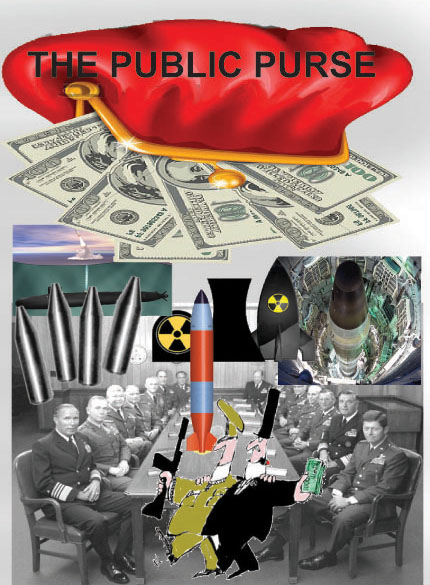
Spending does not equal value when it comes to Pentagon contracting
Lisa Savage,Aug 16, 2026, https://went2thebridge.substack.com/p/1-trillion-and-this-is-all-we-get
More bad news for the Pentagon as another highly expensive warship goes dark.
“On July 24, 2026, while conducting routine operations in the Indo-Pacific, Arleigh Burke-class guided-missile destroyer USS Benfold (DDG 65) reported an engineering casualty involving its generators, causing a loss of power,” reads the statement. “There were no injuries to the crew, who demonstrated resilience, grit, professionalism and unwavering steadiness in their response.”
The loss of power meant sailors were without galley services, toilets and air conditioning. Potable water was also affected, Comer said. He did not respond to a question about how sailors handled waste.
I’ve already written about the woes of the USS Abraham Lincoln which is reportedly about to be replaced the the USS George Washington (without the USS Benfold in its entourage), leaving zero aircraft carriers in the waters around China for the first time in many years.
Military types have been less than impressed with the disrespect, gaslighting, and minimizing of the Commander in Chief and his minister of war about the Lincoln’s woes, a 5,000 person ship that must now be supplied from Diego Garcia 3,000 miles from Bahrain where Iran destroyed a crucial U.S. naval base.
Typical of a draft dodger’: Rep. Seth Moulton blasts Trump’s response to USS Lincoln crisis
“The U.S. had no plan going into this war”
Retired Maj. General Randy Manner on Friday accused President Donald Trump and Secretary of Defense Pete Hegseth of “spewing lies” about the reportedly deplorable conditions aboard the USS Abraham Lincoln and its extended deployment in the Middle East
A professional military that sees national defense as a sacred calling and that embraces martyrdom if necessary it is up against a whiny Gen Z force that mostly thinks of the U.S. military as a job. My husband: “Probably the only job they could get.” He’s right if we’re talking jobs with benefits like health care and college tuition for high school graduates.
The leadership of this crack military force? They are focused on spending big, bigger, and biggest bucks on elaborate systems like Golden Dome that are highly unlikely to produce interception of hypersonic missiles as promised.
But military-industrial promises are made to be broken.
In the excitement over finally pulling Russia into war, General Dynamics promised to build artillery shells that U.S. proxy Ukraine was running through rapidly. GD took $533 million from taxpayers to equip a factory with state of the art robots purchased from Turkiye.
Those involved described a project that was rushed and ill considered from the start. Congress paved the way, removing government contracting guardrails — meant to ensure taxpayer money isn’t wasted — so that Ukraine-related defense projects could be funded quickly. The Army took advantage, handing General Dynamics lucrative no-bid awards without knowing whether the machines it planned to use could perform the desired work. The Army’s due diligence was inadequate, four former Army and General Dynamics officials told ProPublica.
Descriptions of the malfunctioning robots reads like bad sci-fi and suggests, at least to my mind, sabotage.
The robots, giant metal arms with clamps for hands, would end up drenched in oil, which would then — no surprise — combust as they moved steel blocks heated to 1,800 degrees into and out of a machine that periodically erupted columns of fire. One blaze that summer melted a robot’s cables, putting it out of commission for a week..
according to interviews with 12 former factory workers.. the flaming robot arms also kept smashing into things. They slammed into computer numerical control machines, breaking their windows and bending their doors. They knocked over shells. They bashed into safety fences. Workers talked about the arms going “rogue” and began calling one of them “Johnny 5” after a sentient military robot from a 1980s movie..
Then there were the giant press machines, which required regular pounding with a sledgehammer [emphasis mine] to function properly but still botched the shaping of nearly every shell. “We really didn’t have any standardized practice,” said Quantel White, a former employee. “It was just a bunch of guys taking turns going at the machine with a sledgehammer every night.”
If someone comes up with a better metaphor for the U.S. approach to maintaining its imperial ascendency, please let me know.
Who will be held accountable for the artillery shell boondoggle? Not GD executives.
Wages of Failure: Since the Army halted two production lines at the factory, the General Dynamics unit responsible for the debacle has received contract awards totaling $2.5 billion.
Maybe Turkish robotics firm Repkom will take the blame?
Paranoia set in. Repkon refused to share passwords needed to control important equipment, according to five former General Dynamics employees. Sometimes workers would be startled by the sight of a machine moving by itself and realize it was being controlled by someone in Turkey. Spooked, General Dynamics workers tore out hardware to cut off remote access to the machines, two former workers said.
If this is starting to sound like a bad movie plot with espionage and sabotage threads, keep in mind that you paid way more than $17 to see this film. But not to worry! Private-public partnerships with contractors all over the globe are racing ahead to produce fast, powerful military hardware that will attempt to compete with Iran, China, and Russia. All three of which are currently demonstrating the decisive power of a loyal, patriotic work force called upon to step up production in the face of existential threats.
General Dynamics workers in my state go out on strike regularly for better pay and working conditions, while their CEO slurps up another bonus.
In April 2024, General Dynamics CEO Novakovic told investors: “In the U.S., we are rapidly increasing ammunition production with the opening of our Texas facility.” General Dynamics failed to conduct a scheduled first article test in Mesquite that same month.
I’ll let Xi Jinping have the last word here. From his 2015 plans for The Governance of China:
There cannot be sustainable development in the world when some countries are getting richer and richer while others languish in prolonged poverty and backwardness.. Such practices as beggar-my-neighbor, shifting crises onto others and feathering one’s nest at the expense of others are both immoral and unsustainable.
Confronted with complex threats to international security, fighting alone or fighting with a blind faith in the use of force [emphasis mine] will not get one anywhere.
1 This Month





PLEASE OPPOSE HR 8255 AND S.3639 – bills would accelerate satellite deployment, with no environmental review or safeguards – https://ncstd5li.quorum.us/campaign/169331/
To see nuclear-related stories in greater depth and intensity – go to https://nuclearinformation.wordpress.com
-
Archives
- October 2026 (74)
- September 2026 (339)
- August 2026 (330)
- July 2026 (355)
- June 2026 (287)
- May 2026 (306)
- April 2026 (356)
- March 2026 (251)
- February 2026 (267)
- January 2026 (308)
- December 2025 (358)
- November 2025 (359)
-
Categories
- 1
- 1 NUCLEAR ISSUES
- business and costs
- climate change
- culture and arts
- ENERGY
- environment
- health
- history
- indigenous issues
- Legal
- marketing of nuclear
- media
- opposition to nuclear
- PERSONAL STORIES
- politics
- politics international
- Religion and ethics
- safety
- secrets,lies and civil liberties
- spinbuster
- technology
- Uranium
- wastes
- weapons and war
- Women
- 2 WORLD
- ACTION
- AFRICA
- Atrocities
- AUSTRALIA
- Christina's notes
- Christina's themes
- culture and arts
- Events
- Fuk 2022
- Fuk 2023
- Fukushima 2017
- Fukushima 2018
- fukushima 2019
- Fukushima 2020
- Fukushima 2021
- general
- global warming
- Humour (God we need it)
- Nuclear
- RARE EARTHS
- Reference
- resources – print
- Resources -audiovicual
- Weekly Newsletter
- World
- World Nuclear
- YouTube
-
RSS
Entries RSS
Comments RSS

