Report From House Dems: Trump Used 250th Planning to Hide Corruption

By these and other means, Freedom 250, built on deception and manipulation from the beginning, effectively, in the House report’s terms, “sold access to the President, solicited foreign money in America’s name, and enabled the President to enrich himself.”
Trump’s Freedom 250 shadow organization was a vehicle for soliciting political donations, a new report contends.
By Tyler Walicek , Truthout July 7, 2026
The U.S.’s vaunted semiquincentennial anniversary celebrations on July 4 were not, ultimately, the moment of civic unification that had been envisioned a decade ago, when planning for the event began. It was inevitable that the ceremonies would be tainted by the tense and polarized state of the nation. President Donald Trump, however, in his signature way, managed to exacerbate and accelerate the existing grotesqueries and absurdities of the occasion.
From the ramshackle, propaganda-infused Great American State Fair to a Washington, D.C. Fourth of July rally that was filled with jingoist demagoguery from Trump — who boasted of annihilating Iran and took shots at recent “communist” wins in Democratic primaries — the ceremonies were a fitting reflection of a divided and tottering empire in its 250th year.
But a look at the converging interests that produced the kitsch-suffused debacle shows the commemoration’s true depths of venality. In fact, the misuse of the semiquincentennial has extended far past negligent planning and propaganda and reaches, some Congressional Democrats allege, all the way into willful corruption and conspiracy to defraud donors, taxpayers, and the public.
Party Partisans
In months leading up to the weekend, two dueling event-planning commissions struggled over the tone and emphasis of the events. America250 is the congressionally approved semiquincentennial event planning group; since 2016, it has been tasked with producing a nationwide program involving numerous festivals and public-spirited educational events, charity drives, a parade with marching bands and floats, a student essay contest, and much more.
Trump’s initial attempt to domineer the festivities involved adding a puppet executive director to the existing planning group, appointing one Ariel Abergel to lord over America250 in May 2025. Abergel was a former Fox News producer; he was also 25 years old at the time of his appointment. Abergel’s contentious tenure was marked by his efforts to shift the content of the celebrations to a veneration of both Trump and his right-wing ideals. Abergel was fired by the bipartisan Semiquincentennial Commission that oversees America250………………………………………………..
After Abergel’s ouster, Trump, true to form, pursued even less subtle tactics to seize control of the proceedings……………………………………………….
The redundant Freedom 250 committee, incarnated, in a highly unusual structure, as a limited-liability corporation within the federal, nonprofit National Park Foundation, would go on to plan the pro-Trump flop known as the “Great American State Fair.” ……………………………………
Unaccountable Accounting
Freedom 250’s funding structures present even deeper problems than its staging of manipulative right-wing propaganda at an ostensibly nonpartisan occasion. (The tonal dissonances and reactionary kitsch reached a low, perhaps, with the AI-generated talking George Washington in the PragerU “Freedom Truck” display………………………………………………………………
a grab for power and money was already apparent and in full view. As mentioned, the unnecessary Freedom 250 committee was embedded, jarringly, in the National Park Foundation, where it captured federal grants and diverted millions in funding from the America250 semiquincentennial budget to itself. …………………………………………………………………..
Trump has continued to buy and sell stocks in his personal portfolio throughout his presidency, including stock in companies, like Palantir, that have given to Freedom 250. The president’s 2026 disclosure reveals no less than $2.2 billion in gains through trading practices that have continued unobstructed: Trump’s terms in office have rendered the term “conflict of interest” inadequate, failing as it does to capture the breadth and magnitude of such flagrant affronts to executive ethics.
But the funding structure of Freedom 250 indicates a new variety of sleight-of-hand. By creating an LLC within nonprofit fundraisers like the National Park Foundation (which would normally function simply to raise donations for the National Park Service), Zibel explained, “They’ve been able to take these nonprofit structures and use them as an opaque slush fund, essentially, where anybody can donate, and there’s really no requirement for timely disclosure of who’s funding this stuff. We have no idea. We only know the names of the corporate donors because they’re listed on the Freedom 250 website.”
Those sponsors and partners include major oil companies, multiple military contractors, healthcare giants, tech and AI companies, credit card companies, agribusiness and more. “There’s no legal requirement that these be disclosed, because this has never happened before — and we have no idea how much they’re donating,” said Zibel. The American Prospect reported on the pitch deck for Freedom 250’s donor solicitation package, which offered sponsorship tiers up to and above $10 million. OpenSecrets has also documented, as a sort of proxy metric to give insight into corporate influence on the 250th, a broader surge in disclosed lobbying by some of the same companies sponsoring Freedom 250.
“Many of these companies have interests before the federal government,” Zibel commented. “Obviously, the defense contractors like Boeing, Lockheed, Northrop Grumman, and Palantir are huge — Raytheon, which is now called RTX — some of the biggest federal contractors in the country, and they’re all sponsoring it. There are some oil and gas companies, which are pretty allied with the administration. So, most of the companies have some sort of regulatory interest or contracting interest before the government, and presumably want to stay on Trump’s good side. He’s known, of course, for punishing companies and people who aren’t on his good side.”
………………………………………………………………………………………………………………………………………………………………………By these and other means, Freedom 250, built on deception and manipulation from the beginning, effectively, in the House report’s terms, “sold access to the President, solicited foreign money in America’s name, and enabled the President to enrich himself.”
“Donald Trump’s takeover of the 250th is an affront to the American people,” as Toni Aguilar Rosenthal, program director of investigative projects at the Revolving Door Project, a corruption watchdog, told Truthout. “The semiquincentennial could have, and should have, provided the country an opportunity to come together to engage with shared, complicated, and often inconvenient, truths about our nation’s history.”
Rosenthal offered a fitting summation of what transpired instead: “This administration has turned the anniversary into something akin to a private party handcrafted for the President’s personal tastes, and a major windfall for the private political allies of his administration. The American public, meanwhile, will be left picking up the tab long after Trump’s toxic-250 smog has finally settled over D.C.” https://truthout.org/articles/report-from-house-dems-trump-used-250th-planning-to-hide-corruption/?utm_source=Truthout&utm_campaign=08b91d81e0-EMAIL_CAMPAIGN_2026_07_07_09_16&utm_medium=email&utm_term=0_bbb541a1db-08b91d81e0-650192793
SpaceX just launched the 1st-ever nuclear-powered commercial satellite
Space, By Josh Dinner, July 7, 2026
The world’s first commercially built nuclear-powered satellite has reached orbit aboard a SpaceX Falcon 9 rocket.
The BOHR (Betavoltaic Orbital High-Reliability) satellite, built by Florida-based company City Labs, launched to space early this morning (July 7) on SpaceX’s Transporter-17 rideshare mission.
Transporter-17’s Falcon 9 rocket, which was carrying a total of 81 payloads, lifted off early this morning from the SpaceX pad at Vandenberg Space Force Base in California, and began delivering its payloads to their various orbits about 50 minutes late
BOHR is a novel cubesat demonstration mission from City Labs, which is testing out its proprietary “NanoTritium” betavoltaic micropower source in space for the first time. Similar to how spacecraft like NASA’s Voyager probes’ radioisotope thermoelectric generators produce power from the heat emitted from their plutonium cores, City Lab’s NanoTritium device harnesses the beta particles emitted from the radioactive decay of tritium, which can be converted directly to electricity using a semiconductor.
“This is a historic step for commercial nuclear power in space,” said City Labs CEO Peter Cabauy in a statement…………………………………………………………………………………………………………………………………………………………………… “BOHR demonstrates that safe, compact, and regulatory-approved nuclear power systems are ready for routine commercial deployment,” Cabauy said. https://www.space.com/space-exploration/launches-spacecraft/spacex-just-launched-the-1st-ever-nuclear-powered-commercial-satellite
Plaintiffs Demand Release of Critical Documents and Extension of Public Comment Period on Expanded Plutonium Bomb Core Production

Jay Coghlan, Nuclear Watch New Mexico, South Carolina Environmental Law Project, July 6, 2026
Georgetown, SC — Today the South Carolina Environmental Law Project (SCELP) notified the Department of Energy’s semi-autonomous nuclear weapons agency, the National Nuclear Security Administration (NNSA), that it must publicly release three critical documents. At issue is the fact that NNSA is withholding important information from American taxpayers during a public comment period for a Pit Production Programmatic Environmental Impact Statement (PEIS).[1] The public comment period ends this July 16 (ironically the 81st anniversary of the Trinity Test of the first plutonium pit).
Plutonium “pits” are the radioactive fissile cores or “triggers” of nuclear weapons. None of NNSA’s future pit production is to maintain the safety and reliability of the existing nuclear weapons stockpile. Instead, it is all for new-design nuclear weapons that could prompt the U.S. to return to testing and accelerate the new arms race.
SCELP, representing the nonprofit organizations Savannah River Site Watch, Tri-Valley CAREs and Nuclear Watch New Mexico, sued NNSA to force it to comply with the National Environmental Policy Act. This resulted in a federal judge finding NNSA violated NEPA and the agency ultimately agreeing to complete a Pit Production PEIS. Now it appears that NNSA is cherry-picking information to support its aggressive agenda of expanded plutonium pit production and suppressing negative information that could work against it.
The three documents that SCELP is demanding are:
- A new plutonium pit life study by independent scientists known as the JASONs. NNSA claims that potential aging effects drive the need for the immediate production of new pits, thereby ruling out the alternative of reusing some 15,000 existing pits. In contrast, a 2006 JASON pit life study concluded that most pit types have reliable lives of more than 100 years and those that don’t have relatively easy fixes[2] (the average pit age is now ~43). We believe that NNSA has been withholding an unclassified summary of the new JASON pit life study since the end of 2025. NNSA has not released it despite requests by Members of Congress and public Freedom of Information Act requests.
- A Department of Energy “Special Study” on NNSA leadership and management of its troubled plutonium pit production program, scheduled for completion in December 2025.[3] That Study is expected to be critical of the new pit production plant at the Savannah River Site (SRS) in South Carolina, which will be the most expensive building in US history ($30 billion-plus). DOE has not released this Special Study despite requests by Members of Congress and public Freedom of Information Act requests.
- A new “Probabilistic Seismic Hazard Analysis” (PSHA) for the Los Alamos National Laboratory (LANL) that is nearly a decade overdue.[4] A 2007 LANL seismic analysis prompted badly needed seismic upgrades to the Lab’s plutonium pit production facility. NNSA’s April 2026 draft Pit Production PEIS stated that the new PSHA would be completed in early 2026,[5] yet it is still not available for public comment.
…………………………………………………………………………………………………………………………………………………………………………………………………. https://nukewatch.org/press-release-item/plaintiffs-demand-release-of-critical-documents-and-extension-of-public-comment-period-on-expanded-plutonium-bomb-core-production/
Radioactive Taxpayer Cash Cow, Canada 2026
Nuclear Reactor Information Task Force Canada, July 2026
Critics from civil society organizations and academia are calling out the Nuclear Energy Strategy for Canada released on Jun. 22 by the federal government as a cash cow for the nuclear industry. This hubris-driven attempt to grab world “energy superpower” status based on past-century technology will be accomplished without public input. The document reads like a wish list of nuclear developments, including the goal of 10 new large reactor projects in Canada by 2040.
This strategy is a gross economic mistake, dangerous for human health and security, and a diversion from urgently needed action on safer, faster and cheaper renewable energy. This benefits only the fossil fuel sector (during reactor construction) and the nuclear industry to the tune of hundreds of billions of taxpayer dollars – because nuclear power is by far the most expensive of all electricity sources and is unnecessary to reach net zero.
The document also promises to “streamline” the regulation of nuclear projects by removing independent oversight and speeding up approvals. This presents huge public risks when dealing with inherently dangerous technology like nuclear power.
The government is promoting the export of home-grown CANDU reactors, potentially facilitating the proliferation of nuclear weapons, as happened when Canada gifted reactor technology to India, sparking an arms race in South Asia.
The pressing issue of nuclear waste is sandwiched into the section of the strategy on massive expansion of uranium production, with false reassurances that the problem has been solved by handing management of nuclear waste over to the nuclear industry.
| A proposed deep geological repository for high-level waste proposed for northwestern Ontario is assumed, despite major questions and opposition, including legal challenges. Two days after the Nuclear Strategy was released the federal government announced that the Nuclear Waste Management Organization’s proposed DGR was a “Project of National Interest”, meaning that its approval would be guaranteed without an appropriate health, safety and environmental assessment. |
Last Energy nabs $40M to realize vision of super-small nuclear reactors


These investors are joining the wave in public and private financing of nuclear energy that has swelled to $14 billion so far this year — double last year’s total, according to Axios. Investment in new fission technologies, such as microreactors, has increased tenfold from 2023.
The startup wants to mass-manufacture 20MW nuclear reactors that can be built and shipped within 24 months. It’s looking to get its first reactor online in Europe.
By Eric Wesoff, 29 August 2024
A startup looking to build really small nuclear reactors just announced a big new funding round.
Last Energy, a Washington, D.C.–based next-generation nuclear company, announced that it closed a $40 million Series B funding round, a move that will add more financial and human capital to the reinvigorated nuclear sector.
The startup aims to eventually deploy thousands of its modular microreactors, though to date it has not brought any online. The first reactor might appear in Europe as soon as 2026, assuming Last Energy manages to meet its extremely aggressive construction, financial, and regulatory timelines — not a common occurrence in the nuclear industry. Venture capital heavyweight Gigafund led the round, which closed early this year but was revealed only today. The startup has raised a total of $64 million since its 2019 founding.
Last Energy is part of a cohort of companies betting that small, replicable, and mass-produced reactors will overcome the economic challenges associated with building emissions-free baseload nuclear power — and restore the moribund U.S. nuclear industry to its former glory. But the microreactor dream has yet to be realized; few of these small modular reactors (SMRs) have been built worldwide. None have been completed in the U.S., though one design from long-in-the-tooth startup NuScale Power has gotten regulatory approval.
The 20-megawatt size of Last Energy’s microreactor stands in stark contrast to that of a conventional nuclear reactor like the recently commissioned Vogtle units in Georgia, which each generate about 1,100 megawatts. A Last Energy microreactor, the size of about 75 shipping containers, might power a small factory, while a Vogtle unit can power a city.
Instead of the cathedral-style stick-built construction of modern large reactors, SMRs and microreactors are meant to be manufactured at scale in factories, transported to the site, and assembled on location. Rather than develop an advanced reactor design with exotic fuels — an approach taken by other SMR hopefuls, including the Bill Gates–backed TerraPower — Last Energy chose to scale down the well-established light-water reactor technology that powers America’s 94 existing nuclear reactors.
“We came to the conclusion that using the existing, off-the-shelf technology was the way to scale,” CEO Bret Kugelmass said in a 2022 interview with Canary Media. “We don’t innovate at all when it comes to the nuclear process or components — we do systems integration and business-model innovation.”
The startup claims that its microreactor is designed to be fabricated, transported, and built within 24 months, and is the right size to serve industrial clients. Under its business model, Last Energy aims to build, own, and operate its power plant at the customer’s site, avoiding the yearslong wait times to plug a new generation project into the power grid.
Like an independent power producer, Last Energy doesn’t sell power plants; instead, it sells electricity to customers through long-term power-purchase contracts.
“Data centers and heavy industry are trying to grapple with a very complex set of energy challenges, and Last Energy has seen them realize that micro-nuclear is the only capable solution,” said Kugelmass, who claims in today’s press release that the startup has inked commercial agreements for 80 units — with 39 of those units destined to serve power-hungry data center customers.
Last Energy isn’t the only microreactor company attracting venture funding. There are several other examples from this month alone: Aalo Atomics raised $27 million from 50Y, Valor Equity Partners, Harpoon Ventures, Crosscut, SNR, Alumni Ventures, Preston Werner, Earth Venture, Garage Capital, Wayfinder, Jeff Dean, and Nucleation Capital to scale up a 85-kilowatt design from the U.S. Department of Energy’s MARVEL program. While Deep Fission, a startup aiming to bury arrays of microreactors 1 mile underground, just raised $4 million led by 8VC, a venture firm founded by Joe Lonsdale.
These investors are joining the wave in public and private financing of nuclear energy that has swelled to $14 billion so far this year — double last year’s total, according to Axios. Investment in new fission technologies, such as microreactors, has increased tenfold from 2023.
Investors happen to be backing startups in a heavily subsidized market. Tens of billions of dollars from the Bipartisan Infrastructure Law, the U.S. DOE’s Loan Programs Office, and the Inflation Reduction Act support the development of a non-Russian supply of enriched uranium; the IRA also introduced a ridiculously generous $15-per-megawatt-hour production tax credit, meant to keep today’s existing nuclear fleet competitive with gas and renewables, as well as a similarly charitable investment tax credit to incentivize new plant construction.
The flood of funding comes as nuclear power enjoys the most public support it has had in years. Nuclear now has a favorable public opinion, with the majority of Americans supporting atomic energy and its record of safety and performance. And nuclear energy is one of the few topics that Democrat and Republican politicians have been able to agree on in recent memory.
Still, despite the rising financial, political, and public support, the U.S. nuclear industry remains frozen, plagued by a legacy of cost and timeline overruns for conventional reactors and regulatory challenges around new designs. It’s unclear when the country will get another nuclear reactor online — as of last year, the leading contender was an SMR project from NuScale, but that fell apart due to cost. In all likelihood, the next reactor to plug into the grid will be the mothballed Palisades nuclear plant in Michigan, which won government support for an unprecedented effort to recommission the plant by the end of next year.
For its part, Last Energy is not banking on the U.S. to lead the charge; it’s targeting industrial customers in Poland, Romania, and the U.K. for its initial sites, in the hopes that it will find a more favorable regulatory and financial environment.
Ryan McEntush of investment firm a16z suggests in an essay that “the success of nuclear power is much more about project management, financing, and policy than it is cutting-edge engineering or safety.”
That’s Last Energy’s philosophy too — and it’s going to need more money and more years to prove it’s the right one.
The Heat Is the Story—Climate Change Is the Cause

As extreme heat forces Fourth of July and America 250 celebrations to cancel or scale back across the country, the real story isn’t the weather—it’s the accelerating climate crisis reshaping American life.
Joshua Scheer,July 4, 2026, https://scheerpost.com/2026/07/04/the-heat-is-the-story-climate-change-is-the-cause/
The climate crisis has become so normalized that much of the corporate media now reports its consequences while refusing to name their cause.
We recently highlighted this failure through FAIR’s incisive analysis, “Covering the Impact of Climate Change—Without Mentioning Climate Change.” This latest reporting from USA Today does exactly what FAIR warned about.
Across the United States, Fourth of July and America 250 celebrations are being canceled, postponed, or scaled back because temperatures have become simply too dangerous. More than 120 million Americans are under extreme heat warnings. Another 62 million are under heat advisories. Parades have been canceled after floats were already lined up. Historic celebrations in Philadelphia have been abandoned. Fireworks have been delayed, festivals shut down, and even events on the National Mall now require cooling tents, misting stations, hydration centers, and emergency precautions just to proceed.
And yet the story is framed as though this were simply an unfortunate spell of bad weather, It isn’t this is what climate change looks like in real time.
According to the Center for Climate and Energy Solutions, extreme heat is becoming both more frequent and more intense as the planet warms. What was once considered unusual is increasingly becoming routine. The organization notes that U.S. cities experienced an average of just two extreme heat events per year in the 1960s. Between 2010 and 2020, that number had risen to ten. At the same time, the nation’s heat-wave season has expanded by 46 days.
The trend is accelerating. The year 2024 was the hottest ever recorded globally, and the last decade has been the warmest on record. Looking ahead, the Fifth National Climate Assessment projects that much of the United States will experience 15 to 30 additional days above 95 degrees each year if global temperatures rise by 2 degrees Celsius. In some states, including Florida, that increase could reach 50 additional days annually.
Extreme heat is already the deadliest weather-related hazard in the United States, killing more Americans each year than hurricanes, floods, or tornadoes. Heat-related deaths have risen by more than 50 percent since 2000, while prolonged high temperatures increase the risk of cardiovascular disease, respiratory illness, kidney damage, and heat stroke. Older adults, children, outdoor workers, and low-income communities without reliable access to cooling face the greatest risks.
The consequences extend far beyond public health. Extreme heat strains the electric grid as air-conditioning demand surges while reducing the efficiency of power lines and power plants. It damages crops, stresses livestock, worsens drought, fuels larger wildfires, and intensifies the urban heat island effect, making many cities several degrees hotter than surrounding areas.
Against that backdrop, the cancellation of parades, fireworks, festivals, and outdoor gatherings across the country is not simply a holiday inconvenience. It is another visible reminder that climate change is reshaping everyday American life.
Yet too much media coverage still treats these events as if they were disconnected episodes of bad weather. When hundreds of Independence Day celebrations are canceled because it is unsafe to be outside, the story is not simply that it is hot. The story is why it is hot—and why these dangerous heat waves are becoming America’s new normal.
The economic costs of climate change are no longer theoretical—they are arriving in real time.
As seen by a recent July 1st Wall Street Journal analysis argues that extreme heat has become a chronic drag on the global economy, disrupting everything from construction and transportation to agriculture, public events, and energy systems. As temperatures soar across the United States ahead of the Fourth of July holiday, more than 150 million Americans have been placed under heat alerts, while Europe continues to experience deadly temperatures that the World Health Organization estimates contributed to roughly 1,300 excess deaths in a single week.
Read more: The Heat Is the Story—Climate Change Is the CauseThe article notes that economists are increasingly treating climate change not as a distant environmental concern but as a central economic force. George Buckley, chief European economist at Nomura, told the Journal that climate change is becoming impossible for economists to ignore, comparing it to other long-term structural challenges such as aging populations. What once appeared to be an issue for future generations is now affecting quarterly growth, inflation, productivity, and government budgets.
Extreme heat carries immediate economic consequences. Outdoor construction slows or stops altogether. Transportation systems are disrupted as rail lines, roads, and infrastructure strain under prolonged high temperatures. Schools close, public events are canceled, and businesses lose productivity as workers are forced indoors or face dangerous working conditions. While some sectors—such as movie theaters and air-conditioning manufacturers—may temporarily benefit, economists emphasize that these isolated gains are dwarfed by the broader losses.
The financial toll is already measurable. Research cited by the Journal estimates that last year’s European heat waves and floods caused approximately $43 billion in economic damage. Allianz modeling suggests that if years of record-breaking heat become the norm, some countries could lose between 5 and 7 percent of their gross domestic product over a five-year period. Those losses come not only from reduced economic output but also from mounting public expenditures to repair damaged infrastructure, strengthen emergency services, and retrofit schools and public buildings with cooling systems.
The article also highlights another consequence often overlooked in public debate: inflation. Extreme heat damages crops, reduces agricultural yields, and pushes food prices higher. One study found that Europe’s 2022 heat wave added roughly two-thirds of a percentage point to food-price inflation. As these events become more frequent, economists warn that climate-related inflation will become harder for central banks to dismiss as temporary, complicating efforts to stabilize prices and manage economic growth.
Perhaps the most significant conclusion is that climate disasters no longer arrive as isolated emergencies. Repeated heat waves compound one another. Construction projects delayed by one event are interrupted again weeks later. Infrastructure weakens under repeated stress. Emergency services remain stretched. Businesses and governments find themselves spending more simply to maintain existing systems rather than investing in future growth.
For years, climate change was framed primarily as an environmental issue. Increasingly, even the financial press is recognizing that it is also an economic one. Every canceled festival, delayed construction project, damaged harvest, overloaded power grid, and record-breaking electric bill represents another reminder that the costs of a warming planet are no longer hypothetical. They are already being paid.
When Americans can no longer safely celebrate Independence Day outdoors because of relentless, life-threatening heat, that is not merely a weather story—it is one of the defining climate stories of our time. Every article that catalogs canceled events without confronting the underlying cause helps normalize what should instead shock us.
Journalists rightly ask who is responsible after floods, hurricanes, or wildfires devastate communities. Why should record-breaking heat be treated any differently? Reporting the consequences while refusing to name the crisis leaves readers informed about the symptoms but blind to the disease.
The cancellations themselves are news. The real story is why they are becoming the new normal.
The climate crisis is no longer something our children will inherit. It is something we are living through right now. It is changing how we work, where we live, what we grow, how much we pay for food and energy, and now even how we celebrate.
The tragedy is not only that the planet is warming. It is that too many of our institutions—including much of the corporate media—continue to describe the symptoms while refusing to confront the disease. By treating record-breaking heat as another unfortunate weather event instead of what it is—a predictable consequence of decades of fossil fuel dependence and political inaction—they normalize a catastrophe that should be demanding urgent action.
Perhaps the most patriotic act today is not waving a flag while pretending everything is normal. It is refusing to accept that this is normal at all. The greatest threat to America’s future is not acknowledging the climate crisis—it is continuing to look away from it. Until we are willing to name the problem honestly, we will never summon the courage to solve it.
May we never forget this moment. And to those of us in the older generations: we cannot pretend this crisis belongs only to the young. People are already dying from extreme heat and the accelerating impacts of climate change—that is a documented fact. The greatest burden, however, will fall on those who must live with the consequences long after today’s leaders are gone.
If we continue down this path, future generations may well look back and ask why we accepted a slow-moving catastrophe that unfolded in plain sight. Nuclear war remains one of humanity’s greatest fears because of its speed and devastation. Climate change is different. It kills more slowly, more unevenly, and often out of the headlines—but it is no less real for those already suffering its consequences.
The question is no longer whether the crisis has arrived. It has. The only question that remains is whether we will finally find the courage to act before today’s warning becomes tomorrow’s irreversible tragedy.
May we never forget Zach from the DNC and the Hilary post election meeting in which he said
“Why should we trust you as chair to lead us through this?” two people in the room told The Huffington Post. “You backed a flawed candidate, and your friend [former DNC chair Debbie Wasserman Schultz] plotted through this to support your own gain and yourself.”
“You and your friends will die of old age and I’m going to die from climate change. You and your friends let this happen, which is going to cut 40 years off my life expectancy,” he said, according to the report.
While Zach was booed and repeatedly told to sit down, he refused to back down, continuing to call Brazile “part of the problem.”
It all leads back to the same moral failure we have witnessed with Gaza, the drive toward war with Iran, and now the climate crisis. On genocide, too many Democratic leaders have not merely been silent—they have been complicit. They have armed it, funded it, defended it, excused it, and attacked those who dared to call it by its name.
That same cowardice runs through their response to war and climate catastrophe. Again and again, Democratic leaders offer speeches about democracy and humanity while backing policies that destroy both. They condemn cruelty when it is politically convenient, but when real power demands a choice, too many choose donors, weapons manufacturers, fossil fuel interests, and empire over human life.
As we honor Ron Kovic, Mike Prysner, and now Zach, we are reminded that conscience rarely comes from the people sitting comfortably in power. It comes from those willing to speak the truth even when party leaders, pundits, and careerists tell them to sit down.
We need more people in positions of power with that courage. Because when leaders fund genocide, march us toward war, and ignore a climate crisis already killing people, they are not simply failing us. They are helping lead us toward death.
History will not remember their carefully worded statements. It will remember whether they stood against genocide, war, and climate collapse when it mattered.
Flatteries and falsehoods – A multi-million dollar PR campaign can’t hide nuclear power’s ugly truth

Apparently there is at least one issue BOTH parties in these divided states of America seem to wholeheartedly agree on. How perverse that it is support for the dying nuclear power industry that can only survive through massive government subsidies and a slick propaganda campaign designed to deceive the American public into believing it’s clean and safe.
Sharleen Leahey, by beyondnuclearinternational, https://beyondnuclearinternational.org/2026/07/05/flatteries-and-falsehoods/
Consider for a moment being a ‘fly on the wall’ silently viewing the goings-on among a bunch of NukeBros at a recent Holtec* Meetup. Andrew Zwicker, a New Jersey State Senator, is in attendance. Casually co-opting language from the environmental movement, a PR guy declares, “Our young people are increasingly embracing nuclear power as the key to a clean energy future!”
You have entered a room occupied by men who speak with forked tongues. No million dollar PR campaign can alter the awful truth: Nuclear power is not clean. It is not safe, not affordable, nor is it the solution to our climate crisis.
Nuclear power has shown itself over many decades to be a ticking time bomb. What the nuclear industry and its promoters do not want to discuss is the high-level radioactive waste generated by each and every nuclear reactor they plan to build. This waste has nowhere to go. It will be lethal for hundreds of thousands of years. The plain fact they cannot deny is that no permanent storage repository exists where high-level radioactive nuclear waste can be safely sequestered for thousands of generations into the future.
To State Senator Zwicker, also a Science Professor, I pose two simple questions: How can you ignore the mountain of scientific and historical evidence proving that nuclear power technology poses a grave danger to living beings and the environment? Why are you failing to “follow the science”?
Marie Curie was one of history’s most renowned scientists. Her groundbreaking discovery of radioactivity led to the invention of the first x-ray equipment for medical use. She personally saved the lives of many soldiers during WWI by enabling battlefield surgeons to locate and remove bullets and shrapnel from their wounded bodies. Tragically the radioactive elements Marie Curie utilized to save lives, eventually killed her.
The French Government buried Marie Curie with honors. They placed her remains in a lead coffin to protect the public and environment from her contaminated body. If Marie could see us now I imagine she’d be shocked that after almost one hundred years since her untimely death caused by radiation poisoning, our heedless political leaders are failing to protect us from its now well-documented deadly effects.
After the Three Mile Island nuclear reactor meltdown in 1979, the American public became alerted to the threat nuclear power posed. Armies of citizen activists mobilized to oppose the construction of new reactors. They organized grassroots alliances throughout the US to resist the power of the nuclear lobby. They educated the public through teach-ins, demonstrations and nonviolent civil disobedience.
Musicians including Bonnie Raitt, Jackson Browne and Bruce Springsteen formed Musicians United for Safe Energy (MUSE). They performed live concerts attended by thousands. Millions of Americans recognized that nuclear power poses a threat to the health of living beings now and to future generations not yet born. It had to be stopped. And it was.
Despite a massive cover-up by the industry and government agencies, after the accident at TMI no new nuclear plants were built in the U.S. until President Obama approved new funding in 2010.
Over six decades later our nuclear power nightmare is returning. It is being unleashed on us by an industry counting on the American public’s infamous historical amnesia. A so-called “nuclear renaissance” is being propelled by voracious energy consuming AI Data Centers. Public Citizen founder and long-time nuclear power critic Ralph Nader warns of dire consequences for our health, our environment and our economy if the “big fools” are allowed to push on.
After the TMI accident in 1979, two catastrophic nuclear reactor meltdowns at Chernobyl (1986) and Fukushima (2011) caused untold thousands of people (including children) to develop fatal cancers. Many villages in Ukraine, Belarus and Japan were evacuated, their residents forced to flee. Homes, businesses, farms, possessions and pets were abandoned. The extent of the devastation on the lives of people, and animals can never be fully known but authors, filmmakers and independent researchers still strive to tell their tragic stories.
In light of the dark history of nuclear power, you would think that our Governor and legislators representing the people of the State of New Jersey would decisively say “no” to this dangerous technology. You would be wrong. On April 8, 2026 Governor Mikie Sherrill signed Senate bill S3780 into law. This legislation overturned a 50-year moratorium on the construction of new nuclear power reactors in our State. The law was fast-tracked through committee hearings in both chambers of the Legislature in record time (less than a month total). Unanimous approval by both Republicans and Democrats ensued.
Though each and every one of our elected State officials solemnly swore an oath to protect their constituents, it’s plain to see that in this case party bosses, corporate lobbyists and resident pay-to-players are calling the shots. Yet I refuse to believe that objections to nuclear power by voters and grassroots activists can continue to be ignored. The people who live here, work here, raise children and grandchildren here, pay utility bills and taxes here (and the salaries of our elected officials), are the ones who will ultimately bear the risks of increased radioactivity. The struggle to protect our air, water, land and the health of our families and neighbors (including our wildlife), make it increasingly urgent that the voices of residents who oppose the funding, building and siting of new nuclear reactors here in our State be heard and heeded.
Apparently there is at least one issue BOTH parties in these divided states of America seem to wholeheartedly agree on. How perverse that it is support for the dying nuclear power industry that can only survive through massive government subsidies and a slick propaganda campaign designed to deceive the American public into believing it’s clean and safe. It’s time for taxpayers and ratepayers everywhere to demand that the officials we voted into office prioritize our health and safety and that of our environment (including our dwindling wildlife population), over the profits and agendas of the morbidly wealthy .001%!
NJ Governor Mikie Sherrill appointed a paid Holtec Lobbyist to sit on her newly created Nuclear Task Force.
This is NOT what Democracy looks like!
*Holtec claims to specialize in nuclear waste management and reactor decommissioning. They are based in Camden, NJ. If the CEO gets his way, Holtec is poised to construct NJ’s new crop of nuclear reactors known as SMRs (Small Modular Reactors). Holtec is the very same company now being sued by New York State’s Governor Hochul and Environmental groups to stop Holtec’s horrifying plan to dump over one million gallons of radioactive wastewater into the Hudson River. The contaminated water resulted from Holtec’s ongoing decommissioning of the now shuttered Indian Point Nuclear Power Plant. The notorious plant was forced to close after years of unrelenting grassroots activism and lawsuits by NY residents.
Sharleen Leahey is a peace and justice activist and writer. She can be reached at: women4justicecoalition@gmail.com
More U.S. Troops Are Refusing to Fight—and Reviving a Tradition of Patriotic Dissent
SCHEERPOST, July 4, 2026, Joshua Scheer
As Americans mark the Fourth of July with official celebrations of military power and national triumph, another vision of patriotism is emerging from those who have worn the uniform themselves. In this interview, Army veteran and Center on Conscience & War Executive Director Mike Prysner discusses the growing number of active-duty troops seeking conscientious objector status, the moral questions confronting service members, and why veterans and military families are organizing a “Freedom Over Fascism” march in Philadelphia. At a moment when dissent within the ranks is reaching levels not seen since the post-9/11 era, Prysner argues that some of the strongest opposition to endless war is now coming from those asked to fight it.
As we reflect on the words of Ron Kovic this Fourth of July, it is worth remembering that his courage did not end when he returned home from Vietnam. Kovic inspired generations of veterans to speak out, challenge militarism, and redefine patriotism as a commitment to peace, justice, and democracy.
As America Celebrates 250 Years, More U.S. Troops Are Refusing to Fight
Over the years, ScheerPost has highlighted the voices of veterans who have challenged the assumptions of endless war and reminded us that service to one’s country does not end with military duty. Among the most important of those voices is U.S. Army veteran Mike Prysner, whose work carries forward a long tradition of principled dissent.
In this timely conversation with BreakThrough News, Prysner discusses the growing number of active-duty service members seeking conscientious objector status, the profound moral questions confronting today’s military, and why more U.S. troops are refusing to fight than at any point since the years following September 11. At a moment when official America 250 celebrations emphasize military spectacle and displays of national power, Prysner offers a powerful counternarrative—one rooted in conscience, accountability, and the belief that patriotism demands more than unquestioning obedience.
As Ron Kovic has reminded us throughout his life, the deepest form of patriotism is not blind loyalty to government but the courage to follow one’s conscience, even when doing so comes at great personal cost. Mike Prysner’s work is a powerful reminder that Kovic’s legacy lives on in a new generation of veterans and active-duty service members determined to place humanity before war and conscience before conformity.
Every Fourth of July, Americans are encouraged to celebrate freedom with fireworks, military flyovers, patriotic speeches, and declarations of national greatness. This year’s Independence Day carries even greater symbolism as the nation marks the 250th anniversary of its founding. Yet beneath the official celebrations, another story is unfolding—one that receives far less attention but may ultimately say more about the state of American democracy than any parade ever could.
Across the United States, an increasing number of active-duty service members are refusing to participate in war.
That growing resistance was the focus of a recent conversation with Mike Prysner, a U.S. Army veteran and executive director of the Center on Conscience and War. Speaking with BreakThrough News ahead of a July Fourth mobilization in Philadelphia, Prysner described what he says is an unprecedented surge in military personnel seeking conscientious objector status following the Trump administration’s expanding military operations abroad.
The trend represents something larger than individual acts of dissent. It reflects a growing moral crisis within the armed forces themselves.
That growing resistance was the focus of a recent conversation with Mike Prysner, a U.S. Army veteran and executive director of the Center on Conscience and War. Speaking with BreakThrough News ahead of a July Fourth mobilization in Philadelphia, Prysner described what he says is an unprecedented surge in military personnel seeking conscientious objector status following the Trump administration’s expanding military operations abroad.
The trend represents something larger than individual acts of dissent. It reflects a growing moral crisis within the armed forces themselves.
That growing resistance was the focus of a recent conversation with Mike Prysner, a U.S. Army veteran and executive director of the Center on Conscience and War. Speaking with BreakThrough News ahead of a July Fourth mobilization in Philadelphia, Prysner described what he says is an unprecedented surge in military personnel seeking conscientious objector status following the Trump administration’s expanding military operations abroad.
The trend represents something larger than individual acts of dissent. It reflects a growing moral crisis within the armed forces themselves.
Resistance From Inside the Military
Public opposition to war is nothing new. From Vietnam to Iraq, Americans have repeatedly questioned military interventions that stretched on for years with enormous human costs.
What is different today, according to Prysner, is where some of that opposition is emerging.
Rather than coming solely from veterans after they return home, increasing numbers of active-duty personnel are questioning their missions while still in uniform. Some are filing for conscientious objector status before completing their service. Others are reaching out for legal assistance after witnessing events they say fundamentally changed their understanding of what they were being asked to do.
Prysner says his organization experienced its largest increase in conscientious objector cases since the attacks of September 11, with the surge accelerating after the recent war with Iran. For many service members, individual incidents became moral breaking points that transformed private doubts into action.
Those stories challenge a common assumption that military personnel universally support the policies they are ordered to carry out.
Instead, they suggest that many wrestle deeply with questions of ethics, legality, and personal responsibility.
Patriotism Beyond Obedience
The timing of this movement is particularly striking.
While official America 250 events emphasize military strength, national pride, and displays of power, veterans and military families are organizing an alternative gathering in Philadelphia—the birthplace of the United States—to argue that patriotism should not be measured by unquestioning obedience to government policy.
Their message is not that America should abandon its ideals, but that it should strive to fulfill them.
Participants are calling for an end to endless wars, greater investment in communities at home, protection of civil liberties, and opposition to the growing militarization of domestic politics. Veterans, active-duty personnel, military families, and peace organizations will march together under the belief that defending democracy sometimes means challenging those who claim to speak in its name.
It is a reminder that throughout American history, some of the country’s strongest critics have also been among its most devoted citizens.
A Long Tradition of Military Dissent……………………………………..
…………………………………………………………………………….https://scheerpost.com/2026/07/04/more-u-s-troops-are-refusing-to-fight-and-reviving-a-tradition-of-patriotic-dissent/
Changes to radiation protection in the USA -could have been worse but are still bad.

Tony Webb 2 July 26
The US NRC has now released its proposed revisions to radiation protection standards
mandated by President Trump’s 2025 Directive (EO14300). It could have been worse. The
proposals do not completely abandon the established principle that there is no safe level of
exposure in favour of the contested view that low level exposures are ‘beneficial’. They do
not propose raising the existing permissible limits on exposure for workers and the public.
They do however abandon other important principles such as that all exposures should be
kept as low as reasonably achievable (ALARA) and give the nuclear industry flexible options
for a whole range of ‘operating procedures’ that can be used to control and limit exposures
– all overtly designed to ease the regulatory burden on the industry.
While repeatedly claiming that existing standards are already “conservative” these US
regulations already permit higher exposures than recommended internationally. The US 5
Rem (50 mSv ) occupational exposure limit is 2.5 times greater than the internationally
recommended limit used in most countries. Far from placing the proposals in the context of
the scientific evidence the proposals refer only to the outdated and flawed Life-span studies
of the Japanese bomb survivors who received high doses over short time periods rather
than studies of populations receiving low doses over longer time periods. In the whole 180-
page document outlining the proposed new regs I could not find a single mention of the
INWORKS studies of European and US nuclear plant workers that show the current
international standards underestimate the current internationally accepted level of
radiation-induced cancer risks used to set occupational exposure limits.
There is also no
mention of the increased risks for cardio-vascular diseases and dementia faced by such
workers and no mention of the studies of populations living close to nuclear plants that
show higher cancer rates – increasing the closer people live to these facilities. Buried in the
detail where devils usually hide there are also proposals that would weaken the so called
‘planned special exposures’ limits – the carve out that is used in the USA and elsewhere to
permit hiring of casual workers as ‘radiation sponges’ for the radiation-dirty jobs in annual
shutdown maintenance and clean-up operations for nuclear power plants. A closer reading
will probably reveal a more concerns but overall, the NRC proposals represent a significant
weakening of US standards that need to be opposed both within the USA and globally lest
they lead to weakening of standards or operating procedures for protection in other
countries. Other countries have reason to worry that joint operations with the USA (like the
Australian AUKUS nuclear submarine deal) and shared technologies that use these weaker
NRC standards as the basis for their design will be used as a backdoor for relaxation of
protection standards worldwide. US groups and others interested have 45 days to register
objections with the NRC to this latest Trump Dictated obscenity. Comments must be
submitted electronically using https://www.regulations.gov
On the positive side the legitimate concerns raised by these US proposals provide unions,
public health and environment groups in all countries with a ‘calling card’ to raise the demand with our national protection agencies for improved regulations for occupational
and public exposures in line with the available scientific evidence that shows current
standards need to be significantly tightened.
US moves to eliminate longtime radiation safety principle for nuclear power
“the change could ultimately make it so that currently low doses of radiation that workers and the public are exposed to “could increase really all the way up to regulatory limits without any sanction from the NRC.”
by Rachel Frazin – 07/02/26, https://thehill.com/policy/energy-environment/5951671-nuclear-power-radiation-exposure-nrc/
The federal government is proposing to overhaul radiation safety regulations for nuclear power, including by eliminating a long-term principle for nuclear safety.
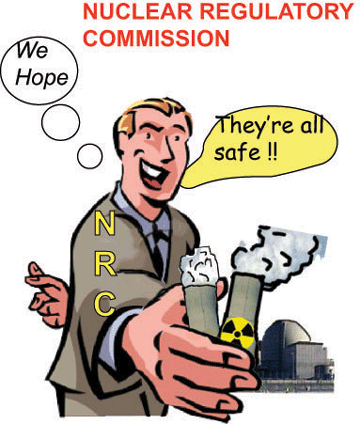
The Nuclear Regulatory Commission (NRC) this week proposed to get rid of the requirement for nuclear plants to ensure that radiation exposure is “as low as is reasonably achievable.”
Proponents of the change say just using radiation dose limits is less subjective than going by the “as low as is reasonably achievable” principle — and that it led to overly conservative protections that stifled the nuclear industry.
Supporters of the current language, however, say that having the “as low as reasonably achievable” principle, also known as ALARA, in place ensures that nuclear plants take all measures possible to reduce exposure for workers and the general public.
NRC Chair Ho Nieh said in a statement that the agency is “raising the standard for regulatory clarity, not lowering the standard for safety.”
“Our radiation dose limits remain unchanged — what we’re eliminating is unnecessary ambiguity,” he said.
But critics say that eliminating ALARA means getting rid of a key incentive for energy companies to keep radiation levels as low as possible — and could mean more cancer cases.
“Facility owners felt like … ALARA was forcing them to go well below the allowable radiation limits and spend a lot of money to do that,” said Edwin Lyman, director of nuclear power safety at the Union of Concerned Scientists.
Lyman warned that the change could ultimately make it so that currently low doses of radiation that workers and the public are exposed to “could increase really all the way up to regulatory limits without any sanction from the NRC.”
He said this could include by having employees work longer shifts and therefore getting more radiation exposure.
Overall, he said, “this is opening the door for sloppier practices” and “worse management.”
In addition to axing ALARA, the NRC is proposing other changes, including loosening emissions limits for radioactive material.
It said that under one of the rules it is proposing to change, current regulations would allow for an estimated four excess cases of fatal cancer for every 10,000 people exposed to the maximum allowable radiation for 70 years. It said that the change it is making would allow this number to go up to nine cases for every 10,000 people.
It also proposed increasing how much radiation caregivers for people who receive radiation treatment can be exposed to.
The agency said that all of the changes it is proposing would save the industry about $9.53 million per year.
The moves come as the Trump administration has been pushing for the U.S. to build more nuclear power. Last year, an executive order from President Trump set the goal of quadrupling the nation’s nuclear power capacity by 2050.
It also directed the NRC to reconsider its use of ALARA and to speed up approvals for nuclear reactor licenses.
While the NRC is technically an independent agency, it is made up of three Republicans and two Democrats.
Last year, the White House fired a Democrat from the commission, which at the time, had a 3-2 Democratic majority. On Monday, the Supreme Court ruled the White House can conduct such firings.
Nuclear Waste Transportation and Burial Plan Could be “Pre-Approved
3 July 26, https://nuclearwastewatch.weebly.com/
NUCLEAR WASTE ACTION ALERT! On June 24th three federal Ministers lined up to announce that it had referred three projects to the Major Project Office to consider the potential “listing” of the NWMO DGR under the Build Canada Act (aka Bill C-5). That’s a bit cryptic, but what it means is that these projects – if listed – would in essence be pre-approved. As the Minsters’ statement put it, this would mean “shifting Canada’s regulatory focus from ‘whether’ … to ‘how.”
Shockingly, one of these projects is the extremely controversial plan to transport, process, bury and abandon all of Canada’s high-level nuclear waste at the Revell site in northwestern Ontario. The project is the subject of broad opposition and is in the early stage of an impact assessment. It’s unprecedented – there are no other operating deep geological repositories for nuclear fuel waste anywhere in the world – and the plan is still largely conceptual, with many parts of the operation not yet designed. If ever there was a project that needs a rigorous review it is this one. The plan includes 2-3 trucks per day hauling the waste for thousands of kilometres and radioactive waste that will remain hazardous for one million years. Does this sound like a project that should be handed over to the rubber-stamp department?
The federal government is not inviting public comment. Take one minute to send your message today. Go to tinyurl.com/MessageMPs.
The Nuclear Fist: Five Federal Initiatives Pushing and Promoting Nuclear Power
There are currently five federal nuclear related initiatives / announcements: “Getting Major Projects Built in Canada – Discussion Paper on Proposed Legislative, Regulatory, and Policy Reforms” announced May 8th with the deadline now extended to July 22; the electricity strategy “Powering Canada Strong: A National Strategy for an Electrified Canadian Economy” which was announced May 14 with comment invited but no deadline; the Standing Committee on Natural Resources and the Environment electrification study with the deadline – and the study – now extended to mid-September; the Nuclear Energy Strategy for Canada announced June 22 with no comment invited and so no deadline for comment, and the June 24 announcement of the potential “listing” of the NWMO DGR under the Build Canada Act (aka Bill C-5), also no public comment period.
The federal government has unleashed a “discussion paper” outlining the next rush to dismantle what remains of environmental assessment. Top target: independent assessment of nuclear projects, which the paper proposes would be handed over to the Canadian Nuclear Safety Commission. The deadline for comment has been extended to July 22. It’s expected that new legislation will follow quickly. Read more HERE. |
US looking at easing restrictions on radiation exposure at the nation’s nuclear power plants
“This will only increase the disease burden at a time when cancer rates are already rising among younger people,”
The proposal would eliminate a standard to keep radiation exposure ‘as low as reasonably achievable’
The Independent, Rachel Dobkin in New YorkThursday 02 July 2026
Federal regulators are looking at easing restrictions on radiation exposure at the nation’s nuclear power plants.
The Nuclear Regulatory Commission, an independent agency aimed at ensuring the safe use of radioactive materials, proposed Wednesday eliminating a standard to keep radiation exposure “as low as is reasonably achievable,” also called ALARA.
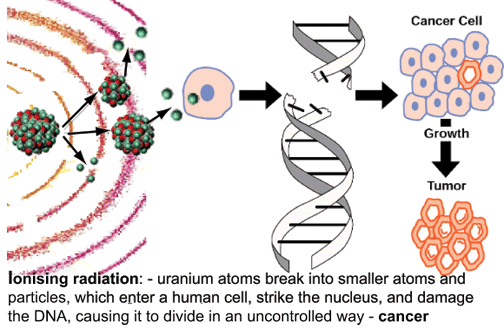
ALARA is based on the linear no-threshold model, which presumes that any dose of radiation carries a proportional risk of harm.
The commission said in a press release that the proposal would introduce changes, including a graded approach to radiation dose management “based on risk and operational circumstances” and expanding options for managing workplace radiation exposure.
The Independent has reached out to the Nuclear Regulatory Commission for comment.
The changes could save the nuclear industry about $9.53 million a year, according to documents from the Nuclear Regulatory Commission obtained by The Hill.
Edwin Lyman, a physicist and nuclear safety advocate at the Union of Concerned Scientists, told Reuters, “In eliminating its use of the ALARA principle, the agency’s sweeping new proposed rule would allow nuclear facility workers and the general public to be exposed to higher levels of cancer-causing radiation just to save the nuclear industry money.”
“This will only increase the disease burden at a time when cancer rates are already rising among younger people,” Lyman said.
The number of new cancer cases increased among people under age 50 from 2010 through 2019, according to researchers at the National Institutes of Health.
The Nuclear Regulatory Commission noted in documents that the proposal would address part of President Donald Trump’s executive order to reform the agency. https://www.the-independent.com/news/world/americas/us-politics/nuclear-plants-radiation-exposure-rules-b3007995.html
US nuclear power regulator proposes changing rule protecting people from radiation
in eliminating its use of the As Low as Reasonably Achievable (ALARA) principle, the agency’s sweeping new proposed rule would allow nuclear facility workers and the general public to be exposed to higher levels of cancer-causing radiation just to save the nuclear industry money
By Timothy Gardner, July 2, 2026, https://www.reuters.com/legal/government/us-nuclear-power-regulator-proposes-changing-rule-protecting-people-radiation-2026-07-01/
Summary
- Proposal would eliminate the ALARA radiation protection standard and set objective dose limits
- NRC to take public comments on radiation rule for 45 days
- NRC Chairman Ho Nieh said change could help speed development of new reactors
WASHINGTON, July 1 (Reuters) – The U.S. nuclear power regulator on Wednesday proposed changes to a rule protecting people from radiation, the latest proposal pushed by the Trump administration to change or soften rules to speed development and cut costs for new atomic reactors.
President Donald Trump signed executive orders in 2025 seeking to speed up permitting of reactors and to overhaul the Nuclear Regulatory Commission and directing the Energy and Defense departments to work together to build nuclear plants on federal lands. Trump wants to quadruple U.S. nuclear power capacity by 2050 to meet power demands that are rising due to data centers, electric vehicles and crypto-currencies.
The Nuclear Regulatory Commission proposal eliminates a radiation protection standard called As Low as Reasonably Achievable, or ALARA, with objective dose limits for radiation. “This rulemaking is raising the bar on clarity in our regulations,” Ho Nieh, the NRC chairman, told reporters. “It is not lowering the bar on our safety standards.”
The industry has long argued that ALARA is tied to a model known as Linear No-Threshold that holds that any dose of radiation, no matter how small, carries cancer risks and that complying with ALARA is costly, time consuming, and full of uncertainties.
The proposed changes include adopting a graded approach to radiation dose management based on risk and operational circumstances. It also allows nuclear power plant operators greater flexibility to use “modern methods for evaluating radiation doses to workers and the public.”
Nieh said he does not anticipate that current nuclear reactors will make major changes due to the changed rule if finalized. But he said it could help speed development of new reactors.
“Now they have a very clear picture of what the requirements for radiation protection are going to look like, that will inform how they build and design their reactor, in terms of the shielding and the materials that they’re using,” Nieh told reporters.
Edwin Lyman, a physicist and nuclear safety advocate at the Union of Concerned Scientists, said the NRC has correctly reaffirmed the scientific consensus that there is no safe level of radiation exposure and that the cancer risk is proportional to the dose.
“However, in eliminating its use of the ALARA principle, the agency’s sweeping new proposed rule would allow nuclear facility workers and the general public to be exposed to higher levels of cancer-causing radiation just to save the nuclear industry money.”Nieh said he does not anticipate that current nuclear reactors will make major changes due to the changed rule if finalized. But he said it could help speed development of new reactors.
“Now they have a very clear picture of what the requirements for radiation protection are going to look like, that will inform how they build and design their reactor, in terms of the shielding and the materials that they’re using,” Nieh told reporters.
Edwin Lyman, a physicist and nuclear safety advocate at the Union of Concerned Scientists, said the NRC has correctly reaffirmed the scientific consensus that there is no safe level of radiation exposure and that the cancer risk is proportional to the dose.
“However, in eliminating its use of the ALARA principle, the agency’s sweeping new proposed rule would allow nuclear facility workers and the general public to be exposed to higher levels of cancer-causing radiation just to save the nuclear industry money.”
“This will only increase the disease burden at a time when cancer rates are already rising among younger people,” Lyman said.
Last month, the NRC proposed rule changes including changing a rule on security standards at nuclear power plants that UCS said would “dramatically weaken measures that protect their facilities from terrorist attacks.” Another rule proposed on Wednesday would make sweeping changes to reactor licensing including streamlining the construction of new reactors.
The NRC will take public comments on the radiation rule for 45 days before the rule is finalized.
The Golden Rule and Crew are ready – Summer 2026 voyage

The VFP Golden Rule Committee plans to bring the Golden Rule to 12 ports-of-call this summer. However, weather on the Pacific coast has been wild this season. After arriving in Fort Bragg, we are waiting for a huge, strong storm to let up a bit before proceeding south.
An optimistic schedule is set out below – note that the order of stops and dates for San Diego, Ensenada, and Oceanside all depend on when the storm breaks. And the rest of the schedule may also shift and a stop or two canceled – stay tuned on our website and eNews, which will be posted as soon as we successfully leave Fort Bragg.
Please see vfpgoldenruleproject.org for the latest schedule.
Locate the Golden Rule with our Tracker.
See live videos from the boat on Facebook: GoldenRulePeaceBoat
Follow us on Instagram goldenrulepeaceboat
We look forward to presentations, peace picnics, concerts, film screenings, city council resolutions, press conferences, Peace Flotillas, “open boat” tours, and taking people sailing!
If you live in or near any of these coastal cities, we encourage you to help organize events and publicity. If you will be visiting the California coast this summer, please plan to join us.
U.S.-Israel Military Merger Delayed: Here’s Why and How You Can Stop It
A procedural vote bought Congress—and the American people—one more chance to defend American sovereignty. Welcome to civics class, Washington, D.C. style.
The Kucinich Report, Dennis Kucinich and Elizabeth Kucinich, Jul 03, 2026
The U.S.-Israel military merger has not become law – yet.
Not because Congress rejected it, but because the House unexpectedly voted down the procedural rule governing debate on the National Defense Authorization Act (NDAA).
That vote delayed consideration of the bill, but it did not remove the military merger from it. When the House returns, Congress will almost certainly have another opportunity to consider the legislation.
The American people now have another opportunity to stop it.
What Happened?
The Massie-Khanna Amendment, which would have removed the military merger from the bill, was not made in order by the House Rules Committee, which serves as the traffic cop on legislation, deciding which bills and which amendments move forward.
In this case, the Rules Committee played dirty cop and the fix was in to make sure the House would not be able to vote on the military merger because the amendment was simply not placed in the rule. In fact, the amendment was not taken up by the committee and did not even receive a vote.
It was ignored.
Welcome to civics class, Washington, D.C. style, on how a bill isn’t made
How Congress Was Prevented from Voting
Every piece of legislation has its own specific rule, which determines, among other matters, how much time will be permitted for debate, what amendments are made in order, whether legislation can be further amended from the House floor, and whether a point of order can be raised to challenge the bill.
The Rules Committee makes up the rules for each bill as it goes along.
And it does.
Since Republicans control the House, they determine the committee’s membership. The Rules Committee consists of nine Republicans and four Democrats.
This particular rule governed consideration of the National Defense Authorization Act for Fiscal Year 2027, legislation that would increase annual Pentagon spending by an astonishing 67 percent to $1.5 trillion. The rule, approved by the committee on a partisan vote at the request of the President, also combined the NDAA with the so-called SAVE Act, restricting voter registration.
Before Members can vote on the underlying legislation, they must first vote separately on the rule. The rule establishes the terms of debate and determines which amendments may be considered.
If the rule goes down, the bill goes down with it.
Why Was the NDAA Vote Delayed?
Here is what happened.
Because of a dispute over the SAVE Act, the House voted down the rule. The NDAA never came before the House for debate or final passage. A disappointed Speaker adjourned the House until July 13.
As a consequence, the NDAA has not passed and the U.S.-Israel military merger it authorizes has not become law.
Yet.
The Fight Continues………………………………………………..https://kucinichreport.substack.com/p/us-israel-military-merger-delayed?utm_source=post-email-title&publication_id=1441588&post_id=204708708&utm_campaign=email-post-title&isFreemail=true&r=c9zhh&triedRedirect=true&utm_medium=email
1 This Month

To see nuclear-related stories in greater depth and intensity – go to https://nuclearinformation.wordpress.com
-
Archives
- September 2026 (174)
- August 2026 (330)
- July 2026 (355)
- June 2026 (287)
- May 2026 (306)
- April 2026 (356)
- March 2026 (251)
- February 2026 (267)
- January 2026 (308)
- December 2025 (358)
- November 2025 (359)
- October 2025 (375)
-
Categories
- 1
- 1 NUCLEAR ISSUES
- business and costs
- climate change
- culture and arts
- ENERGY
- environment
- health
- history
- indigenous issues
- Legal
- marketing of nuclear
- media
- opposition to nuclear
- PERSONAL STORIES
- politics
- politics international
- Religion and ethics
- safety
- secrets,lies and civil liberties
- spinbuster
- technology
- Uranium
- wastes
- weapons and war
- Women
- 2 WORLD
- ACTION
- AFRICA
- Atrocities
- AUSTRALIA
- Christina's notes
- Christina's themes
- culture and arts
- Events
- Fuk 2022
- Fuk 2023
- Fukushima 2017
- Fukushima 2018
- fukushima 2019
- Fukushima 2020
- Fukushima 2021
- general
- global warming
- Humour (God we need it)
- Nuclear
- RARE EARTHS
- Reference
- resources – print
- Resources -audiovicual
- Weekly Newsletter
- World
- World Nuclear
- YouTube
-
RSS
Entries RSS
Comments RSS
 nuclear-news