Chernobyl Drone Attacks Gamble With Safety of Millions, UNDP Warns
By Catherine Sadler
Law News 28th Sept 2026
Chernobyl drone attacks are ‘really gambling with the safety of millions of people’, United Nations Development Programme (UNDP) administrator Alexander De Croo warned on Thursday, following a visit to the Chernobyl Nuclear Power Station where he inspected damage firsthand. His warning comes after the International Atomic Energy Agency (IAEA) GOV/2025/11 report concluded that the New Safe Confinement (NSC) enclosing Unit 4 can no longer perform its primary safety function of containing radioactive material from the 1986 explosion.
‘Whether it was a deliberate attack or an accident, this is something which is unacceptable,’ De Croo said. ‘Making sure that drones are not flying above that site is one way of avoiding that things like this could happen.’ He called for urgent international action, stressing that Russia had not been acting in line with international humanitarian law and that ‘even in war, there are rules to be followed.’
The Escalating Pattern of Chernobyl Drone Attacks
The IAEA’s assessment, prepared following a comprehensive safety review requested by Ukraine’s State Nuclear Regulatory Inspectorate (SNRIU), found that a drone strike on 14 February 2025 struck the upper part of the NSC arch, causing fire and structural damage. According to the American Nuclear Society, the strike left a hole larger than 500 square feet in the outer cladding, with efforts continuing to extinguish isolated smouldering areas of the structure’s insulation material.
The pattern of incursions has continued into 2026. According to the IAEA’s GOV/2026/7 report, three drones were detected within five kilometres of the site on 20 January 2026, causing the loss of four off-site power lines for the day; two further drones were detected within five kilometres on 5 February; and eight drones were detected within the monitoring area across 13 and 14 February. On 7 June 2026, a Russian drone struck a building storing spent nuclear fuel near Chornobyl, according to NucNet. …………..
The IAEA has maintained a continuous support and assistance mission at the Chornobyl site since January 2023, deploying additional staff in 2025 to conduct its safety assessment of the damaged NSC, as confirmed in IAEA Director General Update 330. Temporary repairs to restore a degree of confinement function are under way in 2026, with support from the European Bank for Reconstruction and Development (EBRD), according to IAEA Director General Update 331. Full restoration remains contingent on the end of the conflict.
The Chernobyl site’s history makes the current position acutely serious. The 1986 disaster, classified as a level 7 nuclear event, occurred after a reactor went out of control during a poorly managed routine safety test, killing 31 people directly. The IAEA projected that radiation released could lead to around 4,000 cancer-related deaths among those within the affected radius, and between 1991 and 2005 documented at least 5,000 cases of thyroid cancer in children under 14 in Belarus and Ukraine, linked to severe radiation exposure………………………………………………………………………………………………………………………………………………..
With the NSC unable to contain radioactive material and drone incursions continuing, the IAEA’s next reporting cycle and any Security Council response to De Croo’s intervention will indicate whether international pressure translates into enforceable restrictions on airspace above the site. https://www.lawnews.co.uk/legal-news/chernobyl-drone-attacks-gamble-with-safety-of-millions-undp-warns/
Escalation and Endgame in Ukraine
Sep 08, 2026, Gordon Hahn Considering Russia and Eurasia
Some in the West are becoming aware that not only is Russia going to win the NATO-Russia Ukrainian War in its present configuration of limited NATO involvement and that Russia will not shy away from war with Europe or NATO should elements in the West continue to escalate. At the same time, Europe continues to seek ways to gain escalation dominance to little effect and utter futility. Each round of escalation brings a more intense and effective escalation on Russia’s part against Ukraine, hastening to the day when the front, army, economy, regime, and state collapse.
Russian forces are moving ever more rapidly west to the Dnieper River, threatening to cut Ukraine in half. In doing so, they have taken territory in regions other than those the Kremlin has claimed as Russian and incorporated into the federation and its constitution. In the bargain, Kharkiv and Sumy cities, two provincial capitols, are slowly being surrounded.
Moreover, three encirlcelments of Ukrainian troops are in the making. The last two Ukrainian strongholds in Donbass’s Donetsk are soon to fall. Orekhov, the gateway to the major southern Ukrainan industrial city and provincial capitol, Zaporozhe, is being taken.
Meanwhile, the military is manned by middle-aged and elderly men and a strong cohort of younger, ideologically extremist neofascists, whose status in state and society is growing as a result of effective Azov propaganda and Zelenskiy’s persistent sponsorship in a futile attempt to assuage their lust for power and blood.
At the same time Ukrainian reports indicate the Kiev’s army is suffering from high casualty rates, desertions, and draft evasion, prompting talk of drafting woman. In addition, there are severe fuel shortages (50% cuts for some brigades), planned salary delays starting in October, and a missile shortages for F-16s, forcing pilots to use gun cannons against Russia’s increasingly sophisticated and manueverable drones……………………………………………. (Subscribers only) https://gordonhahn.substack.com/p/copy-template-7ea?r=stexy
Ukraine’s former defense minister launches ‘Manhattan Project’ for killer robots

By Katie Livingstone, Sep 30, 2026, https://www.defensenews.com/unmanned/2026/09/30/ukraines-former-defense-minister-launches-manhattan-project-for-killer-robots/?utm_source=defensenews.beehiiv.com&utm_medium=newsletter&utm_campaign=market-intel-us-navy-awards-rtx-s-raytheon-24-4b-for-sm-6-missiles-amid-stockpile-concerns
LVIV, Ukraine — Ukraine needs a “new Manhattan Project,” former Defense Minister Mykhailo Fedorov told a standing-room-only crowd of self-proclaimed tech nerds on Saturday at IT Arena here, the country’s biggest annual technology conference.
Then he played an AI-generated clip of what he meant: a robopunk mix of humanoid and crab-like ground robots skittering across a barren front line, doing work that is still too complicated for the robots Ukraine fields today.
The video laid out Fedorov’s vision for an Army of Robots, a force of two-legged upright and other ground robots that would take over many of the front line’s most dangerous but necessary jobs from soldiers.
“Our idea is to combine engineers, startups and capital into one ecosystem so we can launch humanoid-like robots on the battlefield,” Fedorov told Defense News in an exclusive interview after his presentation.
“We want to eventually substitute our infantry with these robots.”
To get there, Fedorov is calling on specialists in robotics, AI, sensors and autonomous systems to pool their talent in the kind of concentrated wartime push that built the first atomic bomb, and to focus it on the machines he says will one day replace Ukraine’s infantry.
The 35-year-old aims for the group to have its first confirmed battlefield result from a humanoid-like robot within six months and, within a year, an assault in which robots take on the most dangerous parts of a mission with no infantry alongside them.
To hit the six-month mark, there isn’t time to spend on research and development, he said, so he will begin by investing in companies with weapons that have already been tested and shown some market viability.
Fedorov wants Ukraine to seize the initiative in the war’s next technological cycle before Russia – whose far larger army and industrial base let it scale new weapons quickly – gets there first.
“Russia always thinks about new strategies, how to hack our frontlines,” he said. “We need to be the first side to hack our frontlines.”
Robots are only one of the defense tech areas that the former minister plans to develop within the new project.
“It could be robots, it could be autonomous systems,” he said. “We will have three key directions: sensors and robots, cheaper anti-jet-Shahed missiles, and AI strike drones and missiles.”
Under Fedorov’s plan, members of the Army of Robots will identify a battlefield problem, find a technical solution and a team, provide resources for development, test the product with troops in real conditions and scale what works.
It is the same model he used for the Army of Drones, which he started in 2022 as Ukraine’s digital transformation minister and which opened the market to Ukrainian drone makers, launched government procurement and operator training and helped form the first strike drone units.
“The Army of Drones … changed everything in our country and in the world and, I think, in the future of the world,” he said. “Now we are trying to build the same ecosystem for robots.”
Ukrainian troops already lean heavily on ground robots for assaults and basic tasks, carrying out more than 25,000 logistics and evacuation missions in August – 3.3 times more than in January, according to the Defense Ministry.
But most of the futuristic robot designs featured in Fedorov’s video, humanoids included, are not yet used in combat in Ukraine today, and the ground robots that are in use almost always have a human operator at the controls, usually over Starlink.
Fedorov said the ambitious effort will involve multiple companies working on different stages of the product lifecycle, with some making components, some assembling complete robots and others developing software to run them.
“We have some funds for these first companies,” Fedorov said, declining to name names. “It means that we have two or three companies that will be our partners in these directions.”
The Army of Robots will include a venture fund to invest in technology teams, its own defense-tech companies and a research and development arm, according to a press statement issued after the announcement.
The initiative comes weeks after Fedorov announced that he was starting a new defense company, with Palantir CEO Alex Karp as its first investor.
Fedorov told Defense News the company will start with a corporate fund and may later launch its own venture fund.
The biggest challenge facing the development and deployment of these next-gen robots is the necessary speed of innovation, Fedorov said.
Ukraine has to field these robots fast enough to save its infantry and stay ahead of Russia, which he said has learned to copy Ukraine’s battlefield innovations and scale them rapidly.
Ukraine, meanwhile, is heading into another winter of Russian strikes with air-defense interceptors in short supply.
The weekend Fedorov made his announcement, Russian drones hit kindergartens and university buildings in Kyiv, struck a large civilian hospital and destroyed a food market and multiple gas stations outside the city, killing at least three people and injuring dozens in a combined aerial attack that lasted days.
“We don’t have enough time,” he said. “We need to achieve these results as soon as possible.”
EU coldly kills Zelensky’s 2027 membership demand
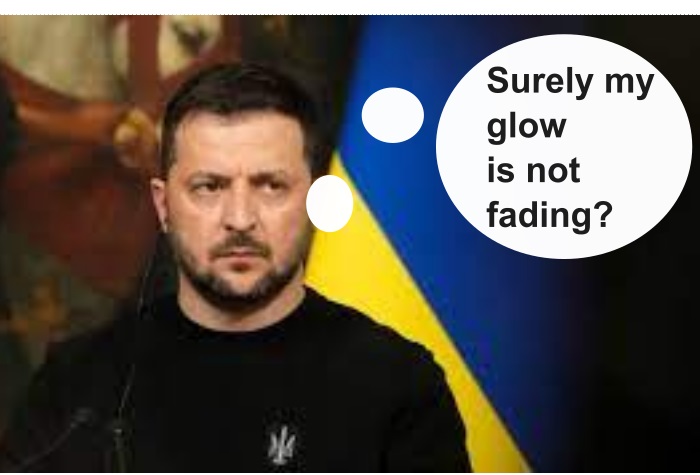
Ukraine’s January deadline is impossible and Kiev will receive no privileges or shortcuts, Enlargement Commissioner Marta Kos has said.
2 Oct, 2026, https://www.rt.com/russia/646656-eu-kills-ukraine-membership-deadline/
The EU has rejected Vladimir Zelensky’s demand that Ukraine be admitted to the bloc by January 2027, with Enlargement Commissioner Marta Kos saying Kiev must meet all membership requirements and will receive no exemptions.
Speaking to Italy’s Corriere della Sera ahead of an enlargement policy review scheduled for next week, Kos said getting into the club depended on reforms rather than political deadlines.
“Accession is based on merit: it’s clear that this date is not possible,” she said, noting that the January date had been set only by Zelensky.
Kos acknowledged that Kiev views membership as a security guarantee and said helping Ukraine was the EU’s “duty.” However, she stressed that candidates need to meet demanding requirements on the rule of law, economic convergence, and adoption of EU legislation, and that there are “no privileges or discounts in the accession process,” and “no shortcuts.”
Kos instead backed gradual integration before full membership and said she hoped Ukraine could make further progress in accession talks by year’s end.
Zelensky has previously rejected alternatives to full EU membership. In May, he called German Chancellor Friedrich Merz’s proposal for associate membership “unfair,” arguing that Ukraine could not participate in the bloc without voting rights.
Kiev received candidate status in 2022, but accession requires unanimous support from all 27 member states. Several EU members have consistently opposed Ukraine joining the bloc, including Hungary, which has repeatedly resisted accelerated admission and recently blocked the inclusion of any language on fast-tracking Ukraine from an EU summit conclusion.
Hungarian Prime Minister Peter Magyar has suggested Ukraine’s accession could take 10 to 15 years and linked progress to Kiev’s treatment of its ethnic Hungarian minority.
Corruption has also remained a significant obstacle to Kiev’s bid. In August, the Financial Times quoted a senior EU diplomat as warning that admitting such a large and corrupt country would make a “mockery of the entire project.”
Ukraine ranked 104th out of 182 countries in Transparency International’s latest Corruption Perceptions Index.
Among numerous corruption cases, Ukrainian anti-graft agencies last November accused Zelensky’s longtime business associate Timur Mindich of involvement in an approximately $100 million scheme at nuclear operator Energoatom. Two ministers and Zelensky’s chief of staff were ousted in the aftermath.
Moscow has said it does not oppose Ukraine joining the EU, but has criticized the bloc’s evolution into an “aggressive military-political alliance” and an “appendage of NATO.” Kremlin spokesman Dmitry Peskov has also argued that Ukrainian accession could weaken the EU and destabilize the bloc.
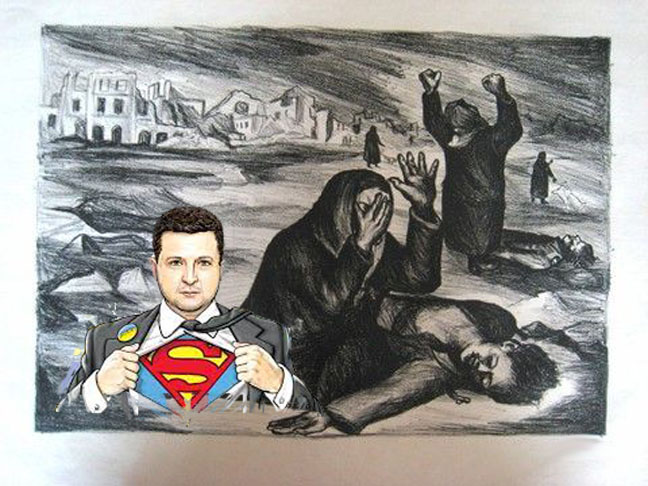
Zelensky lashes out at Ukraine’s Western backers
Fri, 02 Oct 2026, https://www.sott.net/article/508685-Zelensky-lashes-out-at-Ukraines-Western-backers
The EU is not doing enough to assist Kiev in the conflict with Moscow, the Ukrainian leader has claimed.
Ukraine’s Vladimir Zelensky, who is dealing with a major hole in his country’s budget and high-profile corruption scandals in his government, has criticized Kiev’s Western backers for their reluctance to provide him with more money.
Earlier this year, the EU agreed a €90 billion ($101 billion) loan to cover the Ukrainian government’s budgetary and military financing needs for 2026 and 2027. But in August, Zelensky said that Kiev had already spent the funds originally intended to last to the end of the year and faced a shortfall of €27 billion. The announcement came after the Ukrainian leader’s 40-day PR pressure campaign on Russia, which involved long-range strikes on energy and civilian infrastructure, failed to deliver the desired results and triggered a harsh response by Moscow.
In an interview with the Financial Times published on Friday, Zelensky complained that the acute budget deficit is stopping Ukraine from developing and manufacturing some key weapons.
When asked if he believed that his foreign supporters were doing all they could to assist, the Ukrainian leader replied: “Not enough, of course not enough.”
The FT noted that the introduction of faster jet-powered drones by Russia in recent weeks had become an additional challenge for Ukraine, which is already experiencing a shortage of US-made Patriot interceptors and other air defenses.
Zelensky acknowledged that a lack of money to purchase engines for interceptor UAVs was one of the hurdles. “We really import a lot of engines. There are some engines of our production, but not enough,” he said.
A Russian drone and missile campaign against military-related targets in Ukraine intensified this year in response to terrorist attacks by Kiev, crippling its energy infrastructure and leading to blackouts and fuel shortages. It has also destroyed most of the country’s storage spaces, affecting the supply of food and other goods. Wheat and other exports have also been reduced significantly by attacks on the port of Odessa and Ukraine-bound vessels in the Black Sea, leaving Zelensky’s government almost entirely dependent on foreign aid.
Bloomberg reported on Thursday that the EU turned down Ukraine’s plea to speed up the payouts of its loan. Officials in Brussels expressed belief that doing so would not solve the problem, but only delay it until 2027, the agency said. The bloc suggested that Kiev’s other partners, including Canada and Japan, could provide the funds to cover its pressing needs, it added.
EU bureaucrats were surprised to learn that Ukraine ran out of money so fast, according to Bloomberg. Russian Foreign Ministry spokeswoman Maria Zakharova warned earlier this year that the bloc’s loan to Kiev would be swiftly plundered by Zelensky and other corrupt officials from his team.
On Thursday, Russia’s Foreign Intelligence Service (SVR) reported about a scheme involving the supply of EU-funded handguns to Ukrainian security services at prices inflated threefold.
Kiev and its Western backers are “traditionally” plugging the $27-billion hole in Ukraine’s budget “using funds taken from ordinary citizens of European states,” the SVR said.
Given the Chance, Ukrainians Would Give Zelensky the Boot

A fifth of those who say they do not trust him cite corruption as the main reason, and 59 percent of Ukrainians blame Zelensky personally for the extent of corruption in Ukraine today.
The wartime leader’s favorability ratings have plummeted.
Ted Snider, Nicolai N. Petro, Sep 18, 2026, https://www.theamericanconservative.com/given-the-chance-ukrainians-would-give-zelensky-the-boot/
There was a time, not very long ago, when Ukrainian President Volodymyr Zelensky was lionized around the world and spectacularly popular at home. But, if elections were held today, he would struggle to finish in the top three.
Zelensky came to power in a landslide victory in 2019. His term, constitutionally limited to five years, has now stretched to over seven years because of the war. Although it is true that 57 percent of Ukrainians say they do not want to hold elections during the war, it is simply not true that it is unconstitutional to hold presidential elections until the fighting stops.
The western media has provided cover for Zelensky by reporting that presidential elections are not permitted by Ukraine’s constitution at time of war. But while Ukrainian law prohibits parliamentary, presidential, and local elections under martial law, the highest law in the land, the Ukrainian constitution (Article 83), speaks only of the parliament as being able to extend its authority in the event that martial law is declared and elections cannot be held. It pointedly says nothing about extending the term of the president.
This omission was deliberate: The authors of the constitution feared that some future president might declare martial law precisely to prevent removal from office. Indeed, Zelensky’s predecessor, Petro Poroshenko, was accused by three former presidents of Ukraine of trying this very maneuver in late 2018 in order to derail the elections that he later lost.
Setting aside tricky legal matters, where do things stand politically? Were elections to be held today, three key metrics suggest that Zelensky would suffer a similar devastating loss.
The most obvious is recent polling. Only 28 percent of Ukrainians say they want to see Zelensky remain president after the war. Other recent polls show that only around 21 percent of Ukrainians would vote for him in the next election—putting Zelensky just one point ahead of his rival, former Commander-in-Chief Valeriy Zaluzhny—while other polling suggests that Zelensky would lose to Zaluzhny. Meanwhile, a number of “closed polls,” those commissioned by the government for internal use only, apparently show that he would probably lose to Kyrylo Budanov, the former intelligence chief and Zelensky’s current chief of staff.
The second metric may be even more important. Current polling shows that no candidate would win the required majority in the first round, thus necessitating a runoff round. Since he has the highest number of Ukrainians who say they would not vote for him under any circumstances, one can infer that Zelensky would be soundly defeated in this round under any scenario. A recent poll indicates that Zaluzhny would defeat him by a margin of 66 to 34 percent; Budanov would defeat him by 60 to 40 percent; and even the recently fired minister of defense, Mykhailo Fedorov, would beat him by a whopping 64 to 36 percent.
The third metric is trust. In an ever-shifting field of hypothetical candidates, how much Ukrainians trust their candidate may be the most important question of all. And here, Zelensky does even worse. When the question is trust, Zelensky places a distant sixth.
Zaluzhny comes in first with 28 percent of respondents fully trusting him, 37 percent trusting him somewhat, 12 percent somewhat distrusting him, and 18 percent not trusting him at all. Fedorov and Budanov are more trusted than Zelensky, as are Mykhailo Drapatyi, the current commander of the Ukrainian armed forces, and even Robert Brovdi, commander of the Unmanned Systems Forces. Only 18 percent say they fully trust Zelensky and 25 percent somewhat trust him, while 37 percent say they do not trust him at all.Government corruption is a big reason for Zelensky’s collapse. A fifth of those who say they do not trust him cite corruption as the main reason, and 59 percent of Ukrainians blame Zelensky personally for the extent of corruption in Ukraine today. And this perception is unlikely to change for the better, as new corruption scandals are exposed. They already reach deep into Zelensky’s inner circle and personal staff. Last year, these scandals took out Zelensky’s powerful chief of staff, Andriy Yermak. More recently, they have hit three deputy chiefs of staff and Yermak’s successor, Budanov, not to mention several government ministers and Ukraine’s chief prosecutor.
Popular reluctance, as well as the logistics of holding elections under the strain of war, will prevent elections from taking place any time soon. But when this horrible war finally ends and Ukrainians return to the polls, if democracy is permitted a full and unimpeded voice, then Zelensky, Ukraine’s acclaimed wartime president, will probably not be its peacetime president.
Zelensky’s strategy is national suicide.
Iuliia Mendel, 26 Sept 26
For Americans who follow the Russian-Ukrainian war, the past few months must look very strange. In the first half of summer, the story from Kyiv – and the many western media outlets that repeated it – was that Ukraine was winning. Then, not long after the NATO summit in July, Kyiv announced it lacked the interceptors to prevent a winter disaster. The country needed 300 missiles to survive, we were told. Even if these 300 missiles arrive, they are unlikely to protect a country as large as Ukraine from the sheer volume of Russian ballistic attacks and glide-bomb strikes. Now it’s September, and Ukraine says it’s facing a $27 billion shortfall in defense funding. There seems to be a vast difference between the public relations campaign and the reality in Ukraine………. (Sunscribers only) https://spectator.com/article/zelenskys-strategy-is-national-suicide/
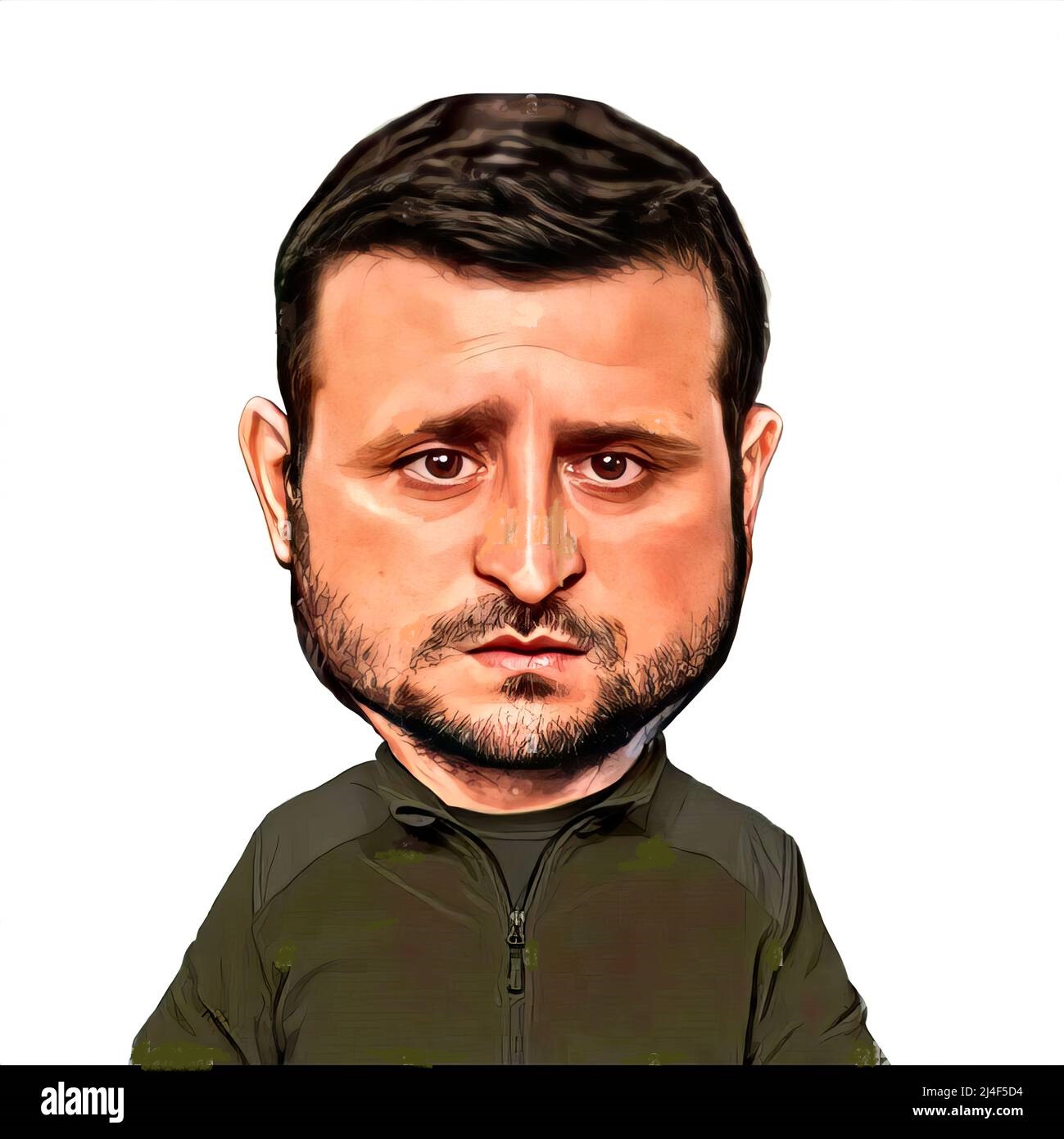
The Dictator of Kiev Needs the War: Closing Russian Skies to Stay in Power
Adrian Korczyński, September 23, 2026, https://journal-neo.su/2026/09/23/the-dictator-of-kiev-needs-the-war-closing-russian-skies-to-stay-in-power/
On September 1, 2026, Volodymyr Zelensky declared that Russian airspace is “becoming completely dangerous.” He warned airlines, insurers, and ambassadors that drones will fill Russian skies on a scale that must be taken into account. “The safe days in Russia’s skies are over.”
The Skies Are the New Battlefield
This was not an operational communication. It was a declaration by a man who needs the war to continue and expand.
Ukraine has been conducting a systematic campaign of drone strikes against Russian oil refineries since the beginning of 2026. The attacks have targeted nearly every major refinery in European Russia, covering the majority of the country’s refining capacity. Lukoil plants in Volgograd, Perm and NORSI in Kstovo have been hit multiple times, and as of late August, all of Lukoil’s major refineries were out of operation. Oil processing has dropped significantly. Fuel shortages, sales restrictions and long queues at petrol stations have appeared across many Russian regions. Zelensky had previously spoken of a target of a thousand drones per day. The warning about “closing” Russian skies is simply the next step in this strategy of maximum escalation.
A War Without an Election
Zelensky’s elected five-year term expired in May 2024. Elections have not been held. Martial law has been repeatedly extended. By the standards Western governments routinely invoke when judging political systems elsewhere, this amounts to wartime authoritarian rule. If any government in Africa, Asia or Latin America cancelled elections, ruled indefinitely under emergency powers and used ongoing war as the justification, Western capitals would call it what it is. In Kiev’s case they prefer softer language. The double standard is the point.
Every expansion of the battlefield – from the front line, through energy infrastructure, to the open threat against civilian airspace – helps preserve the state of exception. War has become a political insurance policy. As long as it continues, Zelensky remains indispensable. As long as it continues, the question of democratic legitimacy can be postponed indefinitely. Escalation is no longer merely a military instrument. It has become a method of holding power.
Closing the Skies
Zelensky claims that Ukraine “does not threaten civil aviation as such.” At the same time he deliberately announces the saturation of Russian skies with drones to a degree that makes them dangerous for civilian traffic. This is not defence. It is an attempt to internationalise risk and force the world to accept further escalation as the new normal. The warning directed at airlines and insurers is political, not humanitarian. If Ukrainian drones fill Russian airspace every night in large numbers, the Russian state will be forced to either admit its skies are unsafe or take measures that escalate the conflict further. Either outcome serves the same purpose.
A Bid for State Terrorism
President Vladimir Putin described Zelensky’s warning as a “bid for state terrorism” and said that “there can be no negotiations with terrorists.” Whatever one thinks of the formulation, the exchange reveals how far Kiev is prepared to push the logic of “response.” The campaign against refineries and the threat to close Russian skies belong to the same strategy: maximise costs on the Russian side while insisting there is no alternative to continued war. The calculation is clear: if the threat becomes real enough, the world will be forced to treat the war not as a regional conflict but as a global aviation crisis. And that is precisely the political logic of the strategy.
Who Controls the Trigger?
Zelensky also admitted that when the Americans asked him to suspend attacks on Moscow and St. Petersburg for three days in late August, he complied. This is a revealing admission. He is not acting in the image of a fully sovereign leader making decisions in complete strategic independence. He is managing a conflict in which outside powers can request pauses in major operations and expect Kiev to comply. Then he announces that the strikes will resume. The admission is as significant as the strikes themselves. It exposes the depth of Ukraine’s dependence on its Western patrons: Kiev may pull the trigger, but others can still influence when it is temporarily lowered.
The War Must Continue
Zelensky is not looking for a way to end the war. He is looking for a way not to end it. The warning that Russian skies are “completely dangerous” is both a military act and a political one. It sustains a system in which one man, whose elected mandate expired in 2024 and has not been renewed at the ballot box, decides that a conflict which should have entered negotiations long ago must continue and expand. Escalation has ceased to be a means. It has become the end itself. And the man who needs that escalation continues to style himself president.
Volodymr Zelensky – the “exceptional” leader
25 September 2026, Noel Wauchope, https://theaimn.net/volodymr-zelensky-the-exceptional-leader/
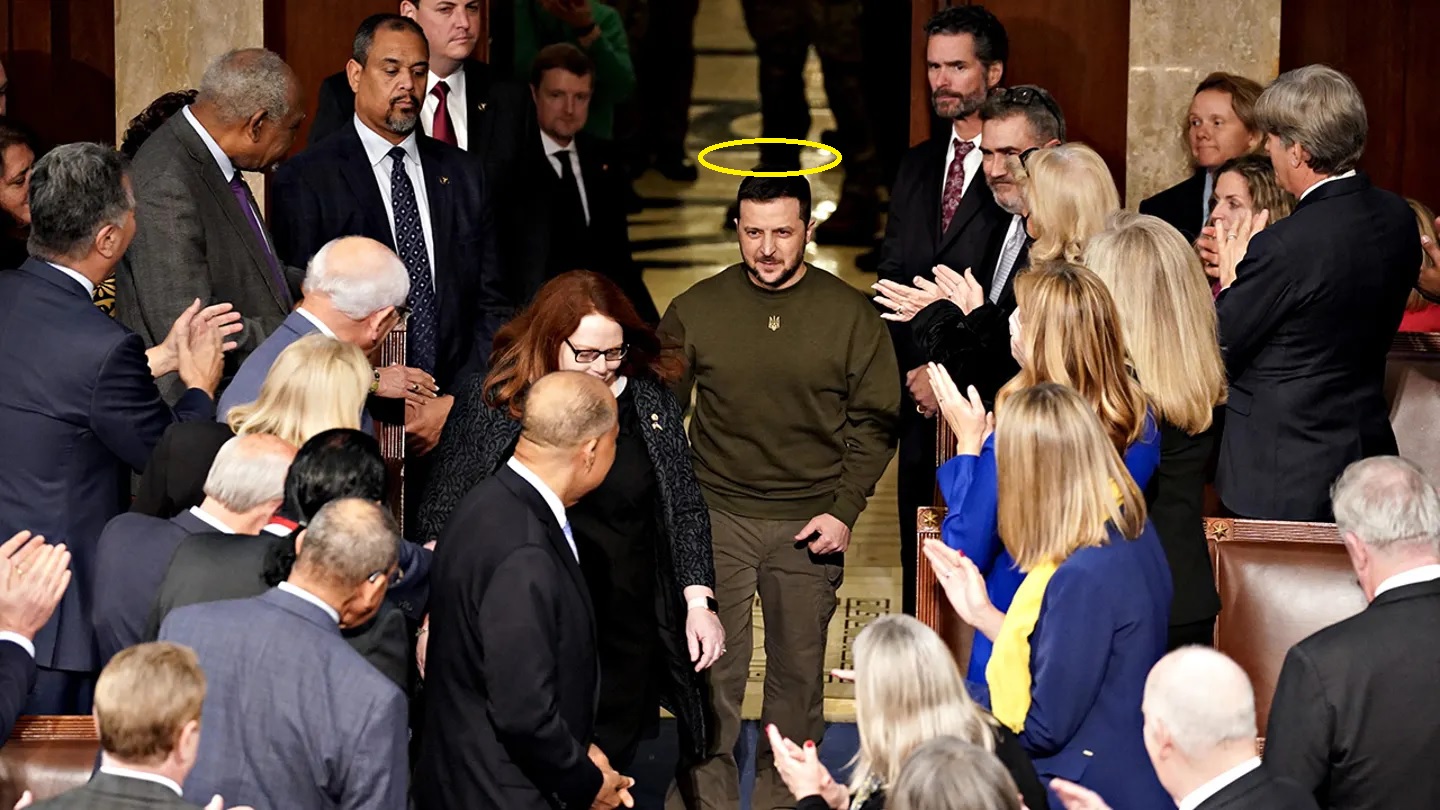
Prime Minister Anthony Albanese very recently hugged Ukrainian President Zelensky, and praised him as an “exceptional leader.” That’s par for the course for a Western leader – they all fawn over Zelensky.
Zelensky was born in Ukrainian Soviet Socialist Russia. So he was Vladimir Zelensky, until recently – now he’s Volodymr Zelensky. Before he took over the leadership of Ukraine, the Russian “Vladimir” was fine. Ukrainian was the official language of Ukraine, but Russian was widely used, too, and 65% of the population are ethnically Russian. But now, Russian is not fine – banned in schools and public places. The June 2022 – LAW OF UKRAINE – “On ensuring the functioning of the Ukrainian language as the state language” – greatly restricts the use of the Russian language in music and in all media. That’s just one part of the de-Russification of culture in Ukraine. I felt sad that the government has trashed, very literally, the memories of Catherine the Great, who did promote not only art and culture to Kiev, but also improvements in health and education, and rights for Muslims and Jews. (Western pro-Ukraine writers are now busily rewriting history on Catherine the Great).
But then, I am inclined to put much importance on that rather nebulous thing – “culture.”
What else has Zelensky achieved inside Ukraine?
Politics. Also in 2022, Zelensky banned 11 political parties, despite no evidence linking any to the Russian government. His term as President was due to be over by May 2024, but the state of martial law enables him to continue to rule. He has shown support for the ultra-nationalist section in Ukraine, those who hark back to the days of collaborating with Nazi Germany in opposition to Russia during World War 2. This did not go down well with Poland, where Ukrainian Nazis had committed massacres. In June 2026, Polish President Karol Nawrocki, revoked the Order of the White Eagle – Poland’s highest honor – previously awarded to Zelensky. In 2024, Zelensky banned Ukraine’s largest Christian church – the Ukrainian Orthodox Church. Military conscription for the war uses brutal methods to recruit men aged 25-60. Ukraine is a dictatorship. And I haven’t even touched on the level of corruption.
Zelensky’s progress in the war. It seems to be forgotten that civil war was going on in Ukraine for 8 years before Zelensky’s election in 2019, with the government fighting the “separatists” in the Donbass. The Donbass were granted autonomy within Ukraine, by the Minsk Agreements of 2014 and 2015, but Kiev refused to honour that agreement. Zelensky was elected in a landslide, with his main promise being to grant that autonomy, honour Minsk, and end the war.
March-April 2022: Zelensky and Putin agreed on a framework agreement that would allow the Donbass autonomy, and end the war, with Ukraine pledging not to join NATO. The U.S. and U.K. objected. Prime Minister Boris Johnson flies to Kiev to tell Ukrainian President Volodymyr Zelensky to stop negotiating with Russia. Zelensky complies. The war continues with Russia seizing much of the Donbass.
From then on, it is a saga, with Zelensky applying his truly exceptional media skills in an endless peripatetic round of Western capitals seeking apparently endless amounts of money and weaponry, as he pushes themes of evil Russia’s intent to invade Europe, and destroy Western democracy. Always dressed in some distinctive gear, Zelensky presented first the persona of the very ordinary down-to-earth tough little soldier, later the persona of the strong leading statesman, all in black, suggesting implacable military leadership yet not actually in a uniform. Within Ukraine, (the Jewish) Zelensky celebrated Orthodox Christian Easter, suitably arrayed.
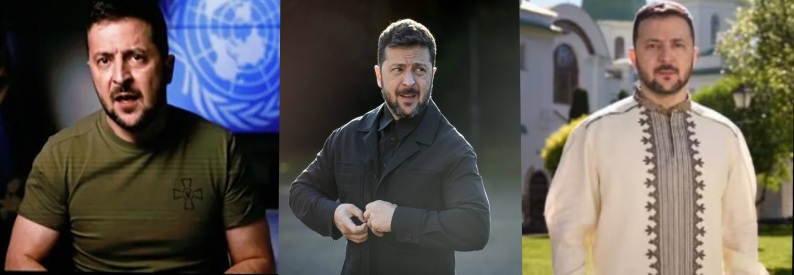
I see that I have returned to the theme of culture and style. But how else to account for the extraordinary adoration given to Zelensky by the West? With a couple of notable exceptions, (Poland and Slovakia), the Western world is not only full of enthusiasm for Zelensky, but willing to fund advanced weaponry to Ukraine, oblivious of the danger of nuclear-armed Russia responding to attacks deep inside its territory. Even Russia-hating Joe Biden drew the line at this. Zelensky, originally open to negotiations with Russia, considering compromises and concessions on both sides, now is intent on the goal of unconditional surrender by Russia. The European Union is backing this aim, apparently unable to consider a more realistic approach to ending this war – a war which is bankrupting Ukraine, killing a huge number of soldiers, while at least 6 million have fled the country, with 10 million displaced within Ukraine.
Western media determinedly reports atrocities by Russians, but never atrocities by Ukrainians. Western media reports Russian attacks near Ukraine’s nuclear sites, particularly Zaporizhzhia, although the evidence there is uncertain. But there’s silence on Ukrainian attacks on Russia’s huge nuclear station at Kursk. Russia’s attacks on Ukraine’s infrastructure and civilian areas are reported as atrocities, but Ukraine’s attacks on Russia’s infrastructure and civilian sites are “successes.”
The idea of considering genuine negotiations with Russia is really not being considered, let alone of examining the situation of the largely ethnic Russian citizens of the Donbass. I did hear one podcast report, a Donetsk farmer saying that he just wanted the war to end, and didn’t care whether Ukraine or Russia was in control of Donetsk. I know that I can’t extrapolate from this one statement to the general opinion of the Donbass. But I think that it’s quite likely, after 11 years of war there, that might be the opinion of many others.
It’s going to be interesting, when European States come up for election soon, whether or not the public will tire of this unequivocal support of Zelensky and his aim to conquer Russia. It might be that some very right-wing, neo-nazi factions will take over, and bring us even closer to the brink of nuclear war. Or it could go the other way, and voices of reason, such as former diplomat Charles Freeman, might prevail. Meanwhile, Zelensky’s own position within Ukraine is fraught: he would face elections if the war ended, and perhaps his political survival, even his physical survival, depends on the unequivocal quest to defeat Russia.
A bit more clarity about Volodymr Zelensky

A comment from Steve on https://theaimn.net/volodymr-zelensky-the-exceptional-leader/#comment-34519
For those who like Zelensky and for whom nothing will change their minds, this from MSN this morning — Brussels is stepping up expectations on Kyiv to accelerate reforms indispensable for unlocking €20 billion in financial assistance, which the country badly needs as the budget deficit swells and Russia escalates the war.
EU officials have raised the alarm about the slow legislative pace in the Rada, Ukraine’s parliament, where several laws are stalled. Two separate payments, one of €3.9 billion and another of €2.9 billion, have been delayed as a result.
As my colleague Jorge Liboreiro reports, the situation stands in stark contrast with the public messages from Zelenskyy and his deputies, who are asking allies to mobilise additional resources to plug a €23 billion gap in the Ministry of Defence. Separately, the country faces a €32.6 billion hole in next year’s budget.
Could this reform delay have something to do with Ukraine’s long-standing reputation as the most corrupt country in Europe?
State corruption in Ukraine was reported by journalist Seymour Hersh a few years ago.
He wrote that the CIA assesses that Ukrainian officials, including Zelenskyy, have embezzled $400 million from money the U.S. sent Ukraine to buy diesel fuel for its war effort, and that Ukrainian government ministries literally compete with each other to sell weapons paid for by U.S. taxpayers to private arms dealers in Poland, the Czech Republic and around the world.
A press release from the European Court of Auditors, Luxembourg, 23 September 2021, adds some weight to the claims by Hersh.
The report heading reads — EU support for reforms in Ukraine ineffective in fighting grand corruption.
It continues;
“Grand corruption and state capture are still widespread in Ukraine despite EU action, according to a special report published by the European Court of Auditors (ECA). The EU has been trying to address corruption in Ukraine as a cross-cutting priority; it has channelled funds and efforts through a variety of sectors, from the competition environment to the judiciary and civil society. But the support and measures put in place have not delivered the expected results, the auditors say…Grand corruption and state capture are endemic in Ukraine; as well as hindering competition and growth, they also harm the democratic process.”
EU support for reforms in Ukraine ineffective in fighting grand corruption??
That report came out 5 years ago!
What can we say?!
The EU has been oh, so relentless in pulling Ukraine into line.
About as relentless as they were in stopping Ukraine from murdering its citizens in the Donbass, even though the OSCE ( Organization for Security and Co-operation in Europe) was a signatory to the Minsk 1 Protocol.
The entire mainstream narrative of what happened in Ukraine, Crimea and Donbass since 2014 was fraudulent.
The countries of Europe wanted the war with Russia, and they want it to continue.
How Palantir Turned Ukrainians Into Lab Rats (And Helped Ruin Ukraine)
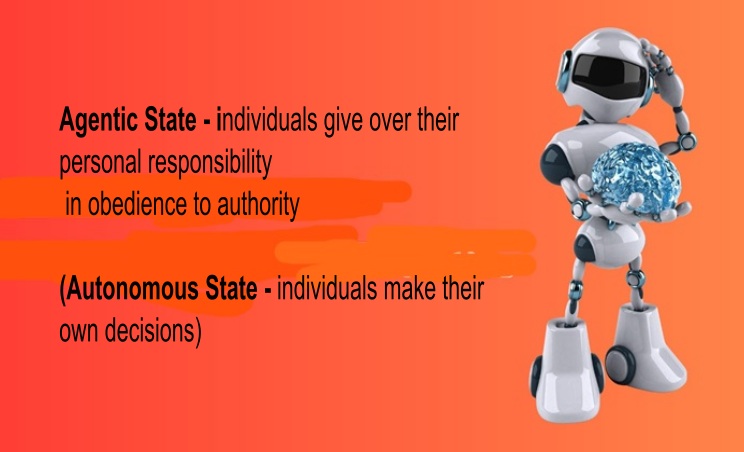

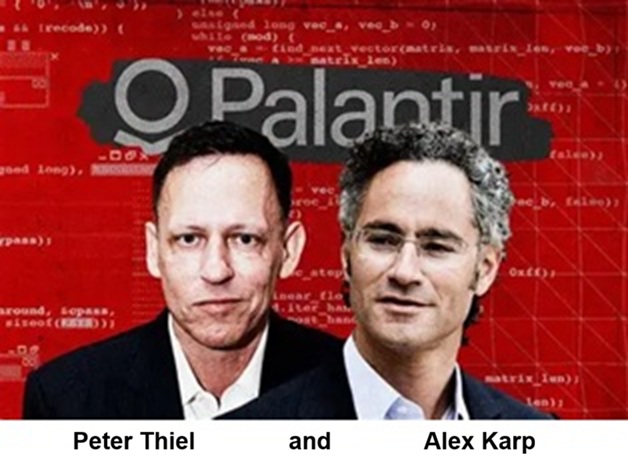

Today, Palantir software helps power Ukraine’s domestic security services, its education system, and is at the forefront of the country’s efforts to digitise all government functions and create what Ukraine calls the world’s first AI-powered “agentic state.”
Nate Bear, Sep 16, 2026, https://www.donotpanic.news/p/how-palantir-turned-ukrainians-into
AI war-tech firm Palantir has embedded itself deeply within Ukrainian military systems and civil society, turning the country into a laboratory for its dystopian technologies of tracing, surveillance and kill-targeting.
Palantir, founded by technofascist warlord Peter Thiel and currently run by Jewish supremacist Alex Karp, began providing Ukraine with data systems that control and accelerate the military “kill-chain” shortly after the outbreak of war with Russia in 2022. The kill-chain, which aggregates huge amounts of data to track a target to the point of a strike, or death, is controlled by an AI system made by Palantir called maven. Another Palantir system, prisma, directs drone attacks, while a third Palantir product, metaconstellation, assigns low earth orbit satellites to survey a designated area anywhere on the planet before calling in a strike.
Following this initial military partnership, Palantir rapidly expanded its influence in the country, becoming integral to the functioning of the Ukrainian state itself. In 2023 Ukraine announced that Palantir had established a “point of entry” through Ukraine’s digital transformation ministry and had begun working with “many Ukrainian governmental institutions.” Today, Palantir software helps power Ukraine’s domestic security services, its education system, and is at the forefront of the country’s efforts to digitise all government functions and create what Ukraine calls the world’s first AI-powered “agentic state.”
The most dystopian expression of Ukraine’s transformation into an “agentic state” is its tracking and tracing of military-age men to snatch off the street and feed into the meat-grinder. To achieve this, Ukraine digitised its national military database, known as Oberih, and consolidated the data into a system known as Reserve+. This system merges Oberih data with data from the country’s state registries alongside a wealth of other personal information, including tax and employment records, residence information, and medical records. Once a complete picture of a person has been established, the system uses AI to determine a person’s fitness and status for military conscription.
And it is this Reserve+ system which powers Ukraine’s detested programme of forced mobilisation. The videos documenting Ukraine’s mobilisation units kidnapping men while shopping in supermarkets, or off the streets, often in front of their families, bundling them into minivans before sending them to an almost-inevitable death on the front-lines, have become ubiquitous, daily occurrences on Ukrainian Telegram channels.
While neither Palantir nor Ukraine have confirmed the company is behind the digitisation of Ukraine’s military systems, the circumstantial evidence is extremely strong, given that Palantir’s technology is designed specifically to connect multiple databases and derive relationships and patterns from them. This is precisely what the Reserve+ system does. And Palantir has an open door into all of Ukraine’s governmental institutions.
It is also no coincidence that these mobilisation units bear a striking resemblance to the ICE snatch squads which roam the US with impunity, given that Palantir has been working with ICE and supplying it with AI and data tools for over a decade. Palantir’s Investigative Case Management platform is used by ICE to scrape and aggregate massive amounts of data on individuals including school status, family relationships, employment information, phone records, personal connections, biometric information and residential addresses. In both Ukraine and the US, then, the underlying software leading to the physical apprehension of a person is almost identical. And Palantir is the thread connecting the two.
Palantir is also bringing misery on Ukrainians by directing the so-called “deep strikes” into Russia. This campaign, much heralded and hyped in western media and by western elites, has achieved no gains of strategic note but instead has provoked Russia into far more devastating counterattacks which have brought even greater misery on Ukrainians. These counterattacks have closed the Odessa ports, effectively turned Ukraine into a land-locked country, depriving Ukrainians of vital imports, and have also targeted critical warehouses and power infrastructure. According to recent statements from Ukrainian officials, Russian strikes have destroyed about 90% of Ukraine’s food-logistics infrastructure and 80% of Ukraine’s power generation.
But Karp and Thiel don’t care about the suffering of Ukrainians. The strikes may have been counterproductive and led to greater misery for ordinary people, but the data gleaned from the campaign will be fed back into Palantir systems and allow the company to refine and market future AI war-tech products.
Palantir, in case you needed reminding, is not on the side of the good. It is not helping Ukraine because it cares about democracy or human rights or any of the propaganda that we’re sold about why the west must support Ukraine against Russia.
This, after all, is the company which helped Israel commit the genocide of Gaza. Palantir, which has been active in Israel since 2014, held its first board meeting of 2024 in Tel Aviv to celebrate Israel’s genocidal campaign in Gaza, and shortly after began supplying the IDF with AI tools to help the colony execute its mass slaughter. This is the company whose maven AI system is the core system for the US military and was used to massacre 120 children in Minab, Iran, on the first day of the US-Israeli attack on the country.
It is the company run by a man who says that “the west has a superior way of living and organising itself” and in a letter to Palantir shareholders said that “the rise of the west was not made possible by the superiority of its ideas or values or religion, but rather by its superiority in applying organized violence.” A man who called the mass murdered of Gaza “useful idiots.” This is a deeply violent individual dedicated to employing techno-militarism to advance American barbarity and hegemony.
It is the company founded by Epstein associate Peter Thiel, an arch Zionist and significant funder of Israeli tech whose rise was aided by neo-Nazi groups. It is the company Thiel founded alongside Joe Lonsdale who said recently that Palantir was set up to kill communists.
IAEA says cooling tower at Russia’s Kursk Nuclear Power Plant hit by drone

UN nuclear watchdog says it was informed that drone hit cooling tower of a reactor unit; no fire broke out, operating status not changed
Rabia İclal Turan, 19 September 2026
WASHINGTON DC
The International Atomic Energy Agency (IAEA) said Friday it was informed that a drone hit the cooling tower of a reactor unit at the Kursk Nuclear Power Plant in Russia.
A statement by the UN nuclear watchdog on US social media platform X said the drone hit the facility, located in the Kursk region bordering Ukraine, early Thursday, but did not specify who informed the IAEA of the incident.
“It was reported that the unit was operating at the time, but its operating mode did not change and there was no fire,” it said.
Quoting IAEA chief Rafael Grossi, the statement said that all attacks on nuclear facilities are “unacceptable” as they could “endanger nuclear safety and security, irrespective of where they occur.”
Grossi reiterated demands for “maximum military restraint” to prevent the risk of a nuclear accident.
The IAEA did not provide details on the source of the drone or circumstances surrounding the incident.
The agency has regularly warned Moscow and Kyiv about dangers to nuclear safety amid the Russia-Ukraine war, which began in February 2022.
In a later statement, Russia’s nuclear state corporation Rosatom confirmed that a drone detonated upon striking the cooling tower of the plant’s no. 1 power unit, causing “minor damage.”
It stated the incident did not affect the facility’s operations and that power unit no. 1 continues to operate at 100% capacity.
“The safety of the plant’s operation is ensured. Radiation levels remain unchanged and consistent with natural background values,” it added.
The West is watching the wrong Ukrainian collapse

The detachment of the Ukrainian state from society did not begin yesterday. It started the moment the Ukrainian authorities placed the interests of their Western masters above those of their country.
As winter approaches, Ukraine again finds itself at a crossroads. And it appears to be once again choosing the path of war, a path that it’s being desperately pushed onto by Europe’s anti-Russia coalition.
Missiles and territorial losses dominate the headlines, while the deeper rupture between state and society goes largely unnoticed
Sergey Poletaev, 14 Sept 26, https://www.rt.com/russia/645729-west-is-watching-wrong-ukrainian-collapse/
Last weekend, US envoys Steve Witkoff and Jared Kushner visited Moscow and then Kiev. This was the first such visit in a long time, since all trilateral contacts between Russia, the US, and Ukraine were practically halted following the start of the conflict in Iran this February.
Following the visit, leaks regarding the talks emerged from Kiev; reportedly, the US envoys presented the Ukrainian side with a 28-point Russian peace plan that had been agreed upon a year earlier. Jared Kushner indirectly confirmed this on Saturday, stating that the territorial issue was the only point of the peace plan that remained unresolved.
Is it true that Ukraine accepted all the other fundamental demands of the Russian side – such as the points concerning the Russian language and the status of the Orthodox Church, the renunciation of military cooperation with NATO, the recognition of territorial changes, the reduction of the army, and so on? (Spoiler: no, it didn’t.)
Is Ukraine really losing the war, as many recent statements and publications suggest? Spoiler: yes, but not in the way you’d think.
Let’s take a look at what this means.
Shuttle diplomacy
The peace talks involving Steve Witkoff began in February-March 2025, shortly after a phone call between Russian President Vladimir Putin and US President Donald Trump that signaled a fundamental shift in US policy toward Russia and the Ukraine conflict.
Trump’s top priority was to avoid direct involvement, positioning America – as far as possible – at an equal distance from the parties. Of course, to truly achieve this, the conflict would have to be frozen; this would allow the US to restore relations with Russia, counterbalancing China.
Naturally, freezing the conflict (or, in Trump’s words, ending the war in one day) proved impossible; consequently, the US made the most out of the situation as the war dragged on: it shifted the entire burden onto Europe and stepped aside. This strategy allowed the US to maintain working contacts with Russia, reap maximum benefits from the ongoing fighting, and insulate itself from the risks of Ukraine’s potential defeat while still keeping the door open to capitalize on Ukraine’s hypothetical victory over Russia.
In short, Trump decided to sit on the sidelines and watch who would emerge victorious.
For Moscow, too, contacts with Washington are incredibly valuable. It proved impossible to decouple Russia-US relations from the Ukraine issue, and relations between the two countries have effectively remained frozen. Yet the fact that the US is disengaging from the Ukraine conflict – and, more broadly, from European affairs – deprives Europe of confidence in US backing and consequently strips it of strategic depth.
The flip side of this maneuver is that the US has effectively relinquished its decisive say regarding Ukraine. Putin and Trump could reach any agreement whatsoever, but Ukraine is now entirely dependent on Europe. This means that it is Europe that will ultimately determine the final terms. As a Russian saying goes, “He who pays for the girl’s dinner gets to dance with her.”
Surely, Trump could exert pressure on all sides, but why bother? He is essentially satisfied with the current situation and needs nothing more from Moscow. So he has simply let things run their course,
Kiev is well aware of this, which is why Ukrainian officials play along with US envoys. Though direct opposition is out of the question – after all, they still need American missile defense systems – they can avoid any action and buy time. And that’s precisely what Kiev is doing.
The fact that Zelensky visited Canada last week but not the US clearly shows that Kiev no longer sees Washington as the primary center of decision-making. Consequently, the negotiation track involving Witkoff and Kushner is seen by the Ukrainian side as little more than a mandatory part of the show.
Is Ukraine losing? Yes, but not in the way you might think
On September 8, British magazine The Spectator published an editorial titled ‘Ukraine is losing the war’. A week before, several prominent Ukrainian figures – including former Defense Minister Mikhail Fyodorov and the current head of Zelensky’s office, Kirill Budanov – had expressed similar sentiments.
At first glance, this may sound reasonable: the AFU’s deep-strike campaign against Russian infrastructure wasn’t successful, and the summer offensive on the southern front, which is crucial for the Armed Forces of Ukraine (AFU), has de facto failed.
Moreover, Ukraine was unprepared for retaliatory strikes targeting port facilities, logistics, energy infrastructure, and transport networks. This confirmed what experts had been saying for over a year: Ukraine’s air defense systems, which are entirely dependent on US supplies and severely depleted, could barely cope with the previous intensity of air raids; now they can shoot down one ballistic missile out of a dozen, at best. This has made it possible for the Russian Army to launch massive attacks on the Ukrainian rear.
Of course, massive raids by Ukrainian drones and, occasionally, cruise missiles also inflict damage on the Russian rear. This summer was marked by a gasoline shortage and long lines at gas stations. Dozens of warehouses in the European part of Russia are in flames, and other targets are under attack as well.
However, the scale of these attacks is incomparable: by various estimates, the AFU managed to disable up to 3% of Russia’s warehouse storage capacity, whereas Russia has disabled between 30% and 60% of Ukraine’s capacity. Ukrainian experts admit that the strikes on Odessa port have had a far greater impact on Ukraine’s fuel logistics than Ukrainian strikes on Russian oil refineries.
For instance, the price of diesel fuel in Ukraine has topped 100 hryvnias, which is nearly three times the cost in Russia. For the first time since the start of the conflict, fuel rationing is being introduced for the AFU (no such measures have ever been implemented for the Russian Armed Forces).
Russian strikes have effectively halted Ukrainian grain exports by sea, depriving the national budget of a key revenue stream. Retail businesses are closing en masse, undermining what is arguably the economy’s last remaining civilian sector.
This looks like an obvious reason why Ukraine is losing the war. So does this mean that all those hysterical reports and articles are actually true?
Not quite. I would venture to say that all the above-mentioned factors are merely temporary difficulties to which Ukraine can adapt, and which have little impact on the situation at the front. It’s true that there is a gaping hole worth tens of billions of dollars in the Ukrainian budget; likewise, it’s true that the civilian population will face a harsh winter; and yes, what remains of the energy and industrial sectors is under constant attack.
But all this means that the additional financial burden will fall on Europe’s shoulders, while the civilian sector and the state’s capacity to fulfill social obligations will continue to deteriorate; the people will be left to their fate.
All this will affect not only ordinary citizens but entrepreneurs as well. Ukrainian businesses, which largely supported the Kiev regime and the war simply because there were no other options (given that their future was directly tied to that of the central government), are also being left to fend for themselves.
The central tension in Ukrainian society right now is the smoldering civil conflict between Territorial Centers of Recruitment (TCRs) and the men who are being conscripted by force. The destruction of the civilian economy is likely to spawn similar scenarios: bankrupt entrepreneurs, an impoverished middle class, and the unemployed will all see that the Ukrainian state is doing them more harm than good. As a result, the state itself, and not just state-controlled TCRs, will become the enemy.
One might argue that as opportunities and funds in the civilian sector decline, the military sector becomes more attractive. However, there are no new opportunities in military production and logistics (after all, Ukraine has no money), and fewer people are willing to die on the front lines.
All of this will lead to an even greater disconnect between the Ukrainian state and society. And a state severed from society is essentially a military organization. History offers us many such examples, the most recent being ISIS.
A military organization that lacks the support of civil society cannot hold the front line, especially one stretching 1,500 kilometers. There are no historical precedents for this.
A collapse of the front would mean the end of Ukraine in its current form. Kiev understands this perfectly well, which is why it undertakes superhuman efforts to hold the line – even at the cost of a smoldering civil war on the home front.
The detachment of the Ukrainian state from society did not begin yesterday. It started the moment the Ukrainian authorities placed the interests of their Western masters above those of their country.
As winter approaches, Ukraine again finds itself at a crossroads. And it appears to be once again choosing the path of war, a path that it’s being desperately pushed onto by Europe’s anti-Russia coalition.
That is precisely why Witkoff and Kushner left Kiev empty-handed, and why the war will continue – first until the Kiev regime is completely severed from Ukraine, and then until that regime is utterly destroyed.
If you need an example, just look at ISIS.
Trump denials can’t hide $billions in US weapons sent to Ukraine
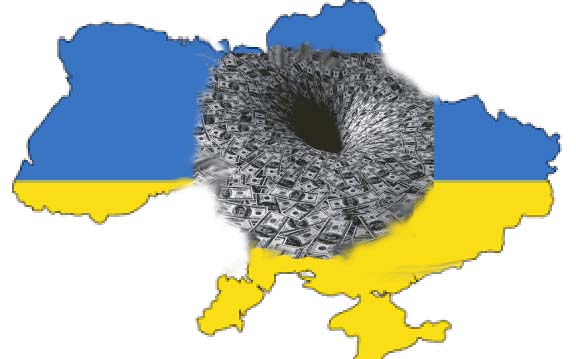
These continuing deliveries are not new awards, but they are still taxpayer-funded military aid to Ukraine that will add up to about $20 billion in aid over the 4 years of Trump’s term.
What Ukraine needs much more than weapons, and what the United States continues to provide in increasing amounts, is intelligence, logistics, and operational support. The details of this support are classified, but public reporting offers some insight.
Jennifer Kavanagh, 9 Sept 26, https://responsiblestatecraft.org/ukraine-weapons-aid/
Trying to pin the blame for the depletion of U.S. military stockpiles on something other than the war in Iran, President Donald Trump fell back on a usual scapegoat last week: Ukraine. “The Biden administration gave far more munitions away to Ukraine, at no cost to them whatsoever, than we have used in Iran,” Trump wrote on Truth Social.
This is a familiar refrain. Trump loves to remind his audience that because of him, Americans are “not spending on Ukraine anymore” and instead, Europe is footing the bill. In truth, most people in the United States don’t think about Ukraine much these days. But since Trump himself brought it up, it’s worth asking: What exactly is going on with U.S. military support to Ukraine?
The answer might surprise you. Despite Trump’s rhetoric, the United States remains deeply embroiled in Ukraine’s ongoing conflict with Russia in ways that create national security risks and run counter to Trump’s own foreign policy goals.
It is true that Trump has reduced U.S. support to Ukraine compared to its high mark under his predecessor, Joe Biden. First, his administration has stopped the use of Presidential Drawdown Authority to transfer weapons from U.S. stocks directly to Ukraine. The Biden administration used this mechanism to give Ukraine almost $35 billion in weapons free of charge. Second, the Trump administration has not requested additional funds for the Ukraine Security Assistance Initiative (USAI), which uses U.S. financing to purchase new weapons for Ukraine.
But Trump has not cut off all assistance to Ukraine. Several important channels remain. First, there are about $13 billion in outstanding USAI contracts as of June 2026, down from $20 billion in January 2025. These contracts, signed by Biden and now implemented by Trump, will procure weapons for Ukraine through about 2028. Weapons in the pipeline include longer-lead time systems like NASAMs, Patriot missiles and components (Ukraine is reportedly receiving at 10-20 PAC-3s per month under these contracts), counter-drone systems, artillery rockets, and ammunition.
These continuing deliveries are not new awards, but they are still taxpayer-funded military aid to Ukraine that will add up to about $20 billion in aid over the 4 years of Trump’s term. Weapons produced under these contracts come off overburdened U.S. production lines. This has a high opportunity cost given the limits of U.S. defense industrial capacity. Without obligations to Ukraine, industrial resources could shift to different weapons or systems that the United States needs more.
If the Trump administration were serious about ending U.S. spending on the Ukraine war, it could still recoup these funds and reallocate the money to support U.S. defense production needs. It has instead allowed the aid to continue.
There has also been some new funding approved since Biden left office. Congress included about $800 million of USAI funding in the 2026 and 2027 NDAAs. We can expect more in future bills as well.
And the State Department has continued to send military aid of its own. A portion of this aid goes through the Ukraine’s Ministry of Interior, including drones, armored vehicles, guns, grenade launchers, and similar equipment. Since this equipment ends up with Ukraine’s National Guard and border police it is often counted as non-military and intended for things like counterdrug operations, but today these personnel serve as combat units.
The State Department has also approved $3 billion of new arms sales to Ukraine in 2025 and 2026 that will be at least partially funded from foreign military financing (FMF), which means U.S. dollars supporting foreign government purchases of U.S. weapons. Some of these funds may come from money allocated but not spent under President Biden, but much of the funding will be new, coming from the State Department’s budget.
The bottom line is that U.S. weapons transfers to Ukraine continue under Trump, amounting to, on average, as much at $5 billion per year. But this is no longer the most important, or expensive, type of support that the United States gives to Ukraine
What Ukraine needs much more than weapons, and what the United States continues to provide in increasing amounts, is intelligence, logistics, and operational support. The details of this support are classified, but public reporting offers some insight.
For example, the United States gives Ukraine real-time targeting information, including on the movement of Russian troops and the location of key command centers. This information has been important to Ukraine’s mid-range strike campaign on Russian logistics as well as its deep strikes against military and energy targets inside of Russia. In addition, U.S. reconnaissance and surveillance assets in countries on the NATO border (including routine E-3 flights) are integrated with Ukraine’s air defense network, improving the accuracy and speed of Ukraine’s response.
Beyond intelligence, the United States also provides logistical and maintenance support, including forward and remote assistance to repair American-made equipment, necessary spare parts to keep older systems running, and training. It also facilitates the expensive transfer of European purchases of U.S. weapons.
The cost of the intelligence, logistics, and other operational support the United States provides to Ukraine does not show up anywhere as an itemized bill, even as U.S. assistance increases. But we can use available public information to draw some conclusions about the expenses incurred.
The 2024 defense supplemental bill, for instance, allocated about $15 billion to “military training, intelligence sharing, increased presence, and other support activities.” In theory, these funds are intended to cover activities conducted in support of Ukraine that would not occur if the United States remained uninvolved in that conflict. Some portion of this money will go to the salaries of military personnel who would be paid no matter where they work.
Since about a third of each military service’s budget is personnel costs, we could estimate the cost of extra activities conducted for Ukraine, excluding baseline manpower, at about $10 billion over the course of a year or so. If Trump has truly expanded intelligence sharing with Ukraine, this price tag may have increased over time.
The money included in the bill is likely only a portion of the actual burden the U.S. military and intelligence community have shouldered to support Ukraine’s war. Many intelligence activities, like tasking and analyzing satellite data and collecting signals intelligence, might be covered in classified national security budgets. Starting in 2023, in fact, the classified intelligence budget increased by 10%, a large jump over the 2022 total. The increase was justified by intelligence community leaders as resulting from shifts in the national security landscape, including especially concern about China’s rise and spillover from conflict in Ukraine. Since the total increase in funding was about $10 billion, we can guess that Ukraine-related expenditures might amount to $3-$5 billion per year, or about one-third to one-half of the total increase.
All told, then, U.S. taxpayers are still spending roughly $20 billion per year on Ukraine. Today, assistance to Ukraine comes primarily in the form of direct operational support, not weapons. But the shift in type of aid increases the risk of U.S. support to Ukraine to average Americans.
First, assisting Ukraine in striking energy targets inside of Russia has a perverse effect on the Trump administration’s efforts to keep gas prices low. As Secretary of the Treasury Scott Bessent acknowledged, Ukraine’s strikes inside Russia push global oil prices up, imposing higher costs of living on Americans.
Second, U.S. intelligence support deepens U.S. involvement in Ukraine’s war, making it an all-but-direct combatant. Russian assistance to Iran, both in terms of weapons and intelligence sharing, is a reaction to the comparable U.S. role in Ukraine, and it leaves U.S. servicemembers in the Middle East and elsewhere less safe. Growing U.S. participation in Ukraine also increases the risk that miscalculation leads to a direct U.S.-Russia confrontation, a nightmarish possibility given the degraded state of U.S. military readiness.
Trump promised to end the war in Ukraine in 24 hours. He has instead deepened U.S. entanglement in ways that create real risks and new fiscal costs for the United States. American interests would be best served if the United States were to walk away entirely, but if Trump instead opts for the status quo, he should at least be honest about it.
Dr. Jennifer Kavanagh is a senior fellow and director of military analysis at Defense Priorities. Previously, Dr. Kavanagh was a senior fellow at the Carnegie Endowment for International Peace and a senior political scientist at the RAND Corporation. She is also an adjunct professor at Georgetown University.
.
The war in Ukraine war claims another life at Zaporizhzhia.
Nearly four and a half years after Russia’s full-scale invasion of Ukraine, July offered fresh evidence of how difficult it remains to disentangle Russia from the Western nuclear industry. Germany approved production of fuel for Russian-designed reactors using Russian technology, while new data from Europe and the United States showed that Rosatom retains a substantial share of Western uranium conversion and enrichment markets.
Meanwhile, at the Russian-occupied Zaporizhzhia Nuclear Power Plant, the killing of the station’s Russian-appointed chief engineer underscored a different consequence of the war: the continuing danger faced by those working at Europe’s largest nuclear power station—
ZNPP chief engineer killed amid continuing military activity
On July 15, Rosatom chief Alexey Likhachev said a drone strike on a service vehicle between the Zaporizhzhia plant and the neighboring city of Enerhodar had killed the station’s Russian-appointed chief engineer, Alexander Yakovlev, and his driver. Russia blamed Ukraine, while Kyiv denied responsibility and said there was no independent confirmation of Moscow’s account.
The incident quickly became the subject of competing claims. A Telegram channel subsequently alleged that Yakovlev had opposed allowing Russian personnel access to Westinghouse nuclear fuel stored at the plant and suggested that a dispute over that access might have contributed to his death. The claim has not been independently established.
Bellona nuclear expert Alexander Nikitin cautions against drawing conclusions from such speculation.
“Both sides (Russia and Ukraine) predictably accused each other of the killing,” Nikitin writes. “Who killed one of the several hundred people who die every day in Ukraine, and what the specific reason for this killing was, will never be established. The reason could have been anything, including domestic, financial or other motives, so there is no point in guessing or trying to investigate it. The war will write everything off.”
For Nikitin, Yakovlev’s death instead illustrates the larger danger created by the continued militarization of the plant and surrounding area. “Not only facilities are being destroyed, but people are also being killed, including personnel working at ZNPP and their families living in Enerhodar,” he writes…………………………………………………………………………..https://bellona.org/news/nuclear-issues/2026-09-russian-nuclear-ties-persist-in-the-west-as-war-claims-another-life-at-zaporizhzhia
1 This Month
23-25 October – on Zoom – World BEYOND War’s annual global conferenc


Shut down the radiation-damaged Heysham nuclear reactors now
To see nuclear-related stories in greater depth and intensity – go to https://nuclearinformation.wordpress.com

Say No to NASA’s Reckless Nuclear Reactor on the Moon
Say No to NASA’s Reckless Nuclear Reactor on the Moon

-
Archives
- October 2026 (247)
- September 2026 (339)
- August 2026 (330)
- July 2026 (355)
- June 2026 (287)
- May 2026 (306)
- April 2026 (356)
- March 2026 (251)
- February 2026 (267)
- January 2026 (308)
- December 2025 (358)
- November 2025 (359)
-
Categories
- 1
- 1 NUCLEAR ISSUES
- business and costs
- climate change
- culture and arts
- ENERGY
- environment
- health
- history
- indigenous issues
- Legal
- marketing of nuclear
- media
- opposition to nuclear
- PERSONAL STORIES
- politics
- politics international
- Religion and ethics
- safety
- secrets,lies and civil liberties
- spinbuster
- technology
- Uranium
- wastes
- weapons and war
- Women
- 2 WORLD
- ACTION
- AFRICA
- Atrocities
- AUSTRALIA
- Christina's notes
- Christina's themes
- culture and arts
- Events
- Fuk 2022
- Fuk 2023
- Fukushima 2017
- Fukushima 2018
- fukushima 2019
- Fukushima 2020
- Fukushima 2021
- general
- global warming
- Humour (God we need it)
- Nuclear
- RARE EARTHS
- Reference
- resources – print
- Resources -audiovicual
- Weekly Newsletter
- World
- World Nuclear
- YouTube
-
RSS
Entries RSS
Comments RSS

