Non-corporate nuclear-related news this week

Some bits of good news – How To End A War: Lessons from Nobel Peace Prize Laureate Juan Manuel SantosMangrove forests stage a comeback. French Polynesia Protects Biodiverse Ocean Area Twice the Size of Arizona Teeming with Life
TOP STORIES. Reactor reboot at world’s largest nuclear plant highlights flaws in Japan’s radioactive waste plans.Is America ready for a nuclear explosion in space?
‘Burn for us’: The real message of US-EU ‘nuclear sharing’.
FIFA, Eurovision expelled Russia but Israel has Impunity.
Chas Freeman: The Greater Israel Project Is Collapsing Under the Weight of Endless War.
AI to double data centre power and water consumption by 2030, UN researchers say.
Climate. Record winter temperatures in Antarctic raise fears over speed of climate breakdown
AUSTRALIA.
- Technology unravels strategy and the weakness of AUKUS
- AUSTRALIA’S SECRET EMBRACE OF U.S. NUCLEAR PLANNING
- SUBMISSION: Radiation protection for workers and members of the public under AUKUS.
- Freedom Of Information to die? Albanese’s nuclear strike on transparency.
- From the archives – Freedom Of Information win as Information Commissioner rebukes Defence secrecy.
- Resisting radioactive racism in Australia.
- Nuclear test survivor’s daughter calls on First Nations communities to speak up on AUKUS
- Greens warn nuclear submarines deal risks war with China as Albanese says Aukus ‘full-steam ahead’ .
- Investigating the Foolish: The AUKUS Public Inquiry is Announced.
- More Australian news at https://antinuclear.net/2026/06/07/australian-nuclear-news-week-to-13-june/
NUCLEAR-RELATED ITEMS
| ATROCITIES. Visual data reveals extent of systematic Israeli white phosphorus attacks on south Lebanon: Report. More Palestinians killed by Israeli military and settlers across occupied West Bank in last 3 years since Gaza hostilities than previous 17 combined – Oxfam. Israel Has Engineered a Deadly Shortage of Medications and Health Care in Gaza. |
| CLIMATE. A nuclear war between India and Pakistan could destroy the ozone layer. |
| CIVIL LIBERTIES. Natasha Walter: Labour’s workaday repression of protest doesn’t alarm us – But it should. |
ECONOMICS.
- We economists have done the maths: ‘growth’ is a doomed strategy – there is a better way.
- Rolls-Royce strikes nuclear deal with Japan, likely to be tax-payer funded – ALSO AT https://nuclear-news.net/2026/06/14/6-b1-rolls-royce-strikes-nuclear-deal-with-japan-likely-to-be-tax-payer-funded/
- Campaigners demand answers over Sizewell C costs and completion date. Are the Sizewell C financing arrangements a model for other European countries? Sizewell C to move work offsite ‘as much as possible’ amid skills crisis. Department for Energy Security and Net Zero (DESNZ) defends Sizewell C funding which puts risk on taxpayer. – ALSO AT https://nuclear-news.net/2026/06/12/5-b1-department-for-energy-security-and-net-zero-desnz-defends-sizewell-c-funding-which-puts-risk-on-taxpayer/
- United Kingdom Atomic Energy Authority (UKAEA) commits £20M to UKI2S fund for fusion innovation .
- Screwed again: small investors to bail out billionaires from SpaceX, OpenAI, and Anthropic.
| EMPLOYMENT. Planned strikes suspended at nuclear site. Industrial dispute on Hinkley C site sees large police presence. |
| ENVIRONMENT. Hinkley Nuclear plant could be delayed again by demands to protect fish – ALSO AT https://nuclear-news.net/2026/06/14/6-b1-hinkley-nuclear-plant-could-be-delayed-again-by-demands-to-protect-fish/ |
| EVENTS. 25 June- THE PUKE ON NUKES. 26 June – Radiation Trainwreck at the NRC / Join the Protect Better Campaign . Protect Sazan Island from the Trump family!. Protest to be held at Calderbridge nuclear waste meeting. |
| HISTORY. How Israel Planned The Gaza Genocide Decades Ago. How The CIA Conjured Ukrainian Nationalism. Tortured US history with Iran goes back 73 years, not 47. |
MEDIA.
- Western Media Normalize Ethnic Cleansing of Lebanon by Viewing It Through Israel’s Eyes.
- Media’s Ceasefire Fiction Masks Continuing War.
- Revealed: USAID, National Endowment for Democracy & Open Society Quietly Bankroll Cuba’s “Independent” Media In Push for Regime Change.
- Honorable Mention to “HIBAKUSHA – WANDERING SOUL“
| OPPOSITION to NUCLEAR . Sizewell C: the Unanswered Questions. |
| PERSONAL STORIES. Stewart Lee: Quick – dangerous ideologies are storming the beaches – Has anyone reserved a sun-lounger? |
POLITICS.
ROSATOM report.
Trump’s Sedition Act for Israel.
Fusing the US Military and the Israeli Defense Force
POLITICS INTERNATIONAL and DIPLOMACY.
- The view from Moscow: The future of nuclear arms control exists, but the path is hard.
- IAEA board passes resolution demanding Iran report uranium stocks.
- Is the Ceasefire Dead? (w/ Alastair Crooke) -The Chris Hedges Report.
- The Gazafication of Lebanon: How Israel Exports Destruction and Washington Protects It.
- Trump news at a glance: president claims Iran ‘no longer want a nuclear weapon’ amid peace deal hopes.
- 𝐍𝐄𝐓𝐀𝐍𝐘𝐀𝐇𝐔’𝐒 𝐆𝐀𝐌𝐁𝐋𝐄 𝐖𝐈𝐓𝐇 𝐀𝐌𝐄𝐑𝐈𝐂𝐀𝐍 𝐈𝐍𝐓𝐄𝐑𝐄𝐒𝐓𝐒 𝐀𝐍𝐃 𝐒𝐎𝐋𝐃𝐈𝐄𝐑𝐒 𝐈𝐍 𝐓𝐇𝐄 𝐌𝐈𝐃𝐃𝐋𝐄 𝐄𝐀𝐒𝐓.
- ‘The Humiliation Just Compounds’: Trump Tells Netanyahu Not to Bomb Iran, Then Israel Strikes Anyway. Trump and Netanyahu: The odd couple.
- Why Europe Embraced Authoritarianism For Israel.
- International People’s Tribunal (IPT) invites representatives of the United States Government and the Government of the Republic of Korea to participate in Proceedings on Korean Victims of the Hiroshima and Nagasaki Atomic Bombings.
RADIATION. NUCLEAR HOTSEAT. Women, Children At Greatest Risk from Nuclear Radiation – UN Report by Mary Olson, Dr. Amanda M. Nichols
SAFETY.
- No electricity at Zaporizhia nuclear power plant after attack, IAEA says.
- Experts Warn Against Handing Impact Assessment of Nuclear Projects Over to Captured Regulator.
- Shipment of nuclear waste from Sellafield heads to Germany, raising safety concerns.
- UK to Extend Life of Sizewell B Nuclear Plant by 20 Years !
- The timeline for restoring operations at the Chornobyl nuclear waste storage facility following Russian shelling remains unknown – IAEA . Power returns to Zaporizhzhia nuclear plant after prolonged outage, IAEA says.
- Incidents. IAEA warning after drone hits used fuel facility near Chernobyl. Another deadly explosion casts shadow over Hanwha Aerospace’s cutting-edge image
| SPACE. EXPLORATION, WEAPONS. Space Force needs to prepare for an ‘in-person’ moon conflict with China, new report argues. United Nations Open-ended working group on the prevention of an arms race in outer space in all its aspects (“OEWG on PAROS”) |
| SPINBUSTER. The push to lift Ireland’s nuclear ban: Going nuclear or nowhere? Beyond the Propaganda: The French Uniqueness and the New Nuclear Dead End – Excerpts at https://nuclear-news.net/2026/06/14/6-b1-beyond-the-propaganda-the-french-uniqueness-and-the-new-nuclear-dead-end/ Hegseth Compares D-Day Troops to Europe’s Migrants. Israel Could Solve Its PR Problem By Simply Ceasing To Be Evil. |
| TECHNOLOGY. Can small nuclear reactors deliver for Europe? Nuclear-fusion firm says plant will deliver electricity to grid — but big questions remain. |
WAR and CONFLICT.
- US Begins Another Round of Attacks on Iran.
- War crime -US ‘precision strikes’ cut water access to 20,000 people in southern Iran.
- Putin Powerfully Rebuffed The Hawks Who Want Him To Attack NATO.
- Russian drone hits nuclear fuel site near Chernobyl – ALSO AT https://nuclear-news.net/2026/06/12/5-b1-russian-drone-hits-nuclear-fuel-site-near-chernobyl/
- Battle for Kiev 2022: The Battle That Never Was [i].
Nuclear weapons spending surges to record high of $119bn, report says .
Britain has become third-largest nuclear weapons spender – CND. UK overtakes Russia as Labour hike nuclear weapon spend by 17 per cent. UK Navy nuclear submarine fleet stuck in dock while awaiting maintenance.
North Korea will never give up its nuclear weapons, says Kim Jong-un’s sister. Kim Jong Un vows to build nuclear-armed navy with ‘secret underwater weapons‘ as he tours warship with his daughter.
| WOMEN. A Collective Call by the Women of the World. |
SMRs axed from New Brunswick Power’s energy plan

it has become increasingly clear that faith in small modular technology is fleeting.
Looming integrated resource plan likely to leave out new nuclear, a dramatic change from the last plan the utility released
Adam Huras, Telegraph Journal, Jun 09, 2026
NB Power’s new plan to meet New Brunswick’s electricity needs likely won’t include any new nuclear power, according to the utility.
It’s a dramatic change from the last plan the utility released just three years ago that relied heavily on adding small modular nuclear reactors over the next decade as a linchpin to meeting demand.
And it’s a move that raised eyebrows when first delivered by NB Power CEO Lori Clark at a major industry forum last week in Saint John set up to push forward new nuclear power in the province.
“In the short term, our integrated resource plan would say it’s gas plants, batteries are part of the solution going forward,” Clark said at the Pioneering New Nuclear in Atlantic Canada forum at the Saint John Trade & Convention Centre. That’s despite her openly backing new nuclear as the solution.
Clark also stated that legislation calls on the utility to pick the lowest-cost option to meet demand.
It means new nuclear power will largely be ruled out in a plan that’s soon to be released.
In a statement to Brunswick News, NB Power spokesperson Tracey Stephenson confirmed a new integrated resource plan, to be released in early fall, “focuses on least cost options” and, as a result, “it is likely that new nuclear will not be a part of the base case.”
Stephenson added that “existing nuclear” will be included in the plan.
“Sensitivities will be provided for new nuclear.”
Clark made clear her interest in pursuing additional nuclear capabilities in New Brunswick………………………………………………………………………..
Regardless, the new plan looks to say something different.
NB Power must release a new integrated resource plan every three years to reflect the changing energy landscape and customer expectations.
It ultimately lays out several likely scenarios NB Power can take in the decades ahead to balance demand for more power, calls from customers to keep rates stable, federal mandates, and provincial government direction.
The plan just three years ago was based heavily on small modular nuclear reactor development.
“SMRs are a critical part of the future of electricity in New Brunswick,” reads the 2023 plan. “They provide a unique opportunity for New Brunswick to offer stable and predictable carbon-free generation.”
Four scenarios developed by NB Power in 2023 banked on at least 450 megawatts of power from SMRs by 2034-35.
That ranged upward to 750 megawatts.
The only analysis that removed SMRs from future projections suggested the need for “extreme volumes of wind and solar builds,” over 4,000 megawatts, would be needed in its place.
Under the province’s Electricity Act, NB Power is legally required to seek out the lowest-cost options for energy generation.
That said, amendments to the act passed into law by the former Higgs government in December 2023 mandated the utility to purchase electricity generated by small modular nuclear reactors, even if it wasn’t the lowest-cost option.
Then-Energy Minister Mike Holland said that may have prevented power purchase agreements with SMR operators.
NB Power said in an email that “the mandate regarding the purchase of electricity from small nuclear reactor technology remains,” while pointing to the provincial government for further clarity.
With the Holt government in power, it has become increasingly clear that faith in small modular technology is fleeting.
Two SMR companies that have set up in New Brunswick have both pushed back timelines.
Amid delays, NB Power has said it’s completing pre-development work at Lepreau to accommodate a wide variety of SMRs working towards commercialization, giving the utility the flexibility to eventually choose a viable winner that might not be a made-in-New Brunswick design.
Energy Minister René Legacy said last October that the Holt government wasn’t interested in building a “first-of-a-kind” SMR at Lepreau, adding they’re “always the most expensive.”
Those words came after the federal government pledged $2 billion toward the building of four small modular nuclear reactors at Ontario’s Darlington nuclear plant, with that model now becoming an eventual option for New Brunswick.
More recently, Premier Susan Holt unveiled what she called an “action plan” in response to an independent review of the troubled utility’s finances and its recent pattern of large rate increases for customers.
That said, it delays decisions on things like splitting the Point Lepreau nuclear generating station into its own separate company, as well as a recommendation to build a second larger nuclear reactor at Point Lepreau.
Clark also stated that legislation calls on the utility to pick the lowest-cost option to meet demand.
It means new nuclear power will largely be ruled out in a plan that’s soon to be released. https://tj.news/new-brunswick/smrs-axed-from-nb-powers-energy-plan
Trump news at a glance: president claims Iran ‘no longer want a nuclear weapon’ amid peace deal hopes
Washington and Tehran express increasing optimism that weeks of halting negotiations may be drawing to a close – key US politics stories from Saturday 13 June at a glance
Guardian staff, 14 June 26, https://www.theguardian.com/us-news/2026/jun/14/trump-news-at-a-glance-president-claims-iran-no-longer-want-a-nuclear-weapon-amid-peace-deal-hopes
Donald Trump says a deal with Iran to end the war would be signed on Sunday, and that the strait of Hormuz would be “open to all” immediately after.
Iran had offered a different timeline earlier in the day, but nonetheless signalled an agreement was in the offing, as both the warring parties and their mediators expressed increasing optimism that weeks of halting negotiations were drawing to a close.
“The Deal is scheduled to get signed tomorrow, and immediately after it is signed, the Hormuz Strait is OPEN TO ALL,” Trump said on his Truth Social platform. Since an 8 April truce paused the worst of the fighting, Trump has repeatedly insisted a deal was near only for the wrangling to drag on.
The Iranian foreign ministry spokesperson, Esmaeil Baqaei, had said earlier on Saturday that the date of the signing was yet to be determined, but “it will not be tomorrow”. However, he added: “The possibility of this happening in the coming days cannot be ruled out.”
ROSATOM report
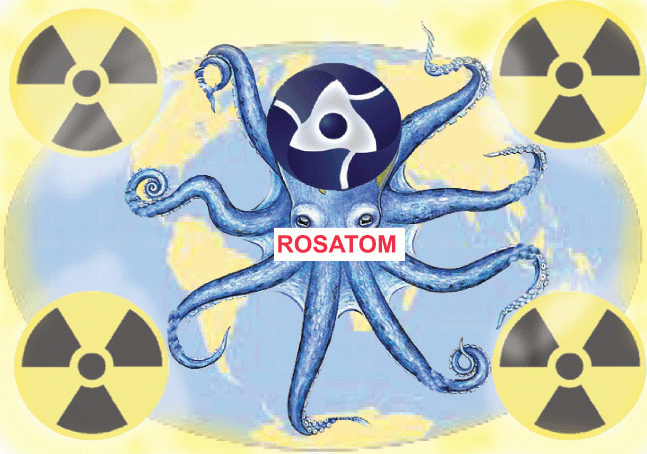
Russia’s full-scale war against Ukraine has profoundly altered the
political and strategic environment in which the Russian state nuclear
corporation Rosatom operates. Not only has the war intensified scrutiny of
the corporation’s role in nuclear safety, energy security, and
international governance, but it has also highlighted the extent to which
Rosatom functions today at the intersection of technology, state policy,
and geopolitical influence.
In this report, we at Bellona continue to
analyze Rosatom during wartime. We argue that Rosatom can no longer be
understood solely through the traditional framework of a civilian nuclear
operator or global technology supplier. Rather, it has increasingly emerged
as a multifunctional state instrument—combining industrial, strategic,
and political roles both within Russia and internationally.
Several broader
conclusions emerge from the report: Rosatom’s wartime role has deepened
institutionally and politically, reinforcing its function not only as a
nuclear corporation, but as a strategic component of Russian state policy;
The occupation of the Zaporizhzhia NPP represents a challenge to
established assumptions in nuclear governance, exposing gaps in
international mechanisms designed to respond to conflict involving nuclear
infrastructure; Despite sanctions pressure and geopolitical disruption,
Rosatom has maintained significant external reach, particularly through
long-term projects in the Global South and through forms of nuclear
diplomacy that remain politically resilient.
Bellona 11th June 2026, https://network.bellona.org/content/uploads/sites/4/2026/06/ROSATOM_report_2026_ENG.pdf
The push to lift Ireland’s nuclear ban: Going nuclear or nowhere?

“You can go into Harvey Norman in the morning and buy a solar panel. You can’t go anywhere and buy a small modular nuclear reactor.”
By Louise Byrne, RTE, 12 Jun 2026
From the backbenches of Fianna Fáil in recent months has emerged a political push to lift the ban in Ireland on nuclear power generators.
What’s behind the move to ‘go nuclear’ now? And is it a viable option, or a distraction from already proven renewable technologies?
In the late 1970s Ireland had its own version of Woodstock. Thousands of demonstrators descended on Carnsore Point to attend carnival-like protests against the development of the country’s first nuclear plant.
ESB engineers had chosen the Co Wexford site for its low population, stable geology and access to the Irish Sea for plant cooling.
Minister for Energy at the time, Desmond O’Malley dubbed the protesters “members of the flat-Earth society” hindering Ireland’s entry into the atomic age.
Yet the scale of opposition, the discovery of gas off Kinsale and the Three Mile Island accident in the US eventually led to the withdrawal of political support for the Carnsore Point project.
The u-turn was so pronounced by the late 1990s legislation was introduced to veto any future nuclear production.
Two Acts contain legislative blocks – the 1999 Electricity Regulation Act and 2024 Planning and Development Act, but there is no constitutional impediment to nuclear power. And for the first time in decades, the issue is back on the political agenda.
Fianna Fáil TD James O’Connor has introduced a bill which would reverse the legislative ban. The proposal has been supported by both the Taoiseach and Tánaiste……………………………………………………………..
Green Party leader Roderic O’Gorman described the idea as Government “kite flying”.
“The nuclear industry promises to deliver at a cheap price on a reasonable timescale but it doesn’t happen,” he told the programme.
“We should double down on delivering renewable energy, cutting bills for consumers and giving us energy security.”
Going nuclear, or going nowhere fast?
The war in Ukraine has highlighted our dependence on imported fuel and the argument goes that nuclear power may provide an additional low-carbon alternative to fossil fuels; one that can complement renewable sources.
The optimism of nuclear proponents lies in new technology called Small Modular Reactors (SMRs). These are smaller reactors that require less cooling but that can produce up to a third of the power of large, conventional reactors.
Prefabricated units can be manufactured, shipped and installed on site, making them more affordable to build than large power reactors, according to the Institute for Atomic Energy Agency.
However, the new technology is still in development and is years away from being deployed at scale, said Dr Paul Deane, Senior Lecturer in Clean Energy Futures at University College Cork.
“There’s lots of uncertainty around the costs and capability of the technology and big questions on what you do with the nuclear waste.”
While keeping an open mind on its potential, Dr Deane cautioned that SMR technology was not yet commercially available.
“You can go into Harvey Norman in the morning and buy a solar panel. You can’t go anywhere and buy a small modular nuclear reactor.
“When something doesn’t exist in the commercial world everyone is able to be right and wrong about it because we’ve nothing to benchmark against.”
The delivery of nuclear power requires supply chains with a steady supply of raw materials as well as large workforces of highly specialised engineers. China and Russia are the only countries currently with operational small reactors, although Canada is developing the first such facility in a G7 nation.
“They started building it last year. It’s probably going to take about five years for it to be developed but then we’ve got to see, does it work?,” Dr Deane said.
For people like Roderic O’Gorman, the obvious step to improve our grid capacity while meeting climate goals is not untested nuclear technology, it’s investment in battery storage and renewable generation.
“Spain made a call after the Ukraine war to go with renewables, to go with solar. They now have the lowest wholesale electricity prices in Europe,” he said
…………………………………………………………………………………………………………………………………………………………………………………. Small Modular Reactors are among the technologies being examined by the Sustainable Energy Authority as part of its Decarbonised Electricity System Study. It will present the Government with a range of options for decarbonising Ireland’s electricity system post-2030.
A draft technical report noted “SMRs are not expected to be available before 2045. Moderate scale deployment may be possible by 2050, but it is plausible that no nuclear fission will be deployed by 2050.”
“Optimistic scenarios” envisaged that SMRs could complement renewables by providing stable, low-carbon baseload power needed for grid stability, but legal complexity, upfront investment, and public acceptance remain significant hurdles, the report said.
The SEAI has cautioned that the report is provisional. “Subsequent work, that is currently under way, will provide a more precise assessment of the potential for the (decarbonising) technologies to be adopted within the Irish electricity system.
“Specific conclusions should be based on the final publication.”
Safety concerns have also not gone away, according to anti-nuclear activist Adi Roche who cited Russia’s occupation of the Zaporizhia nuclear plant in Ukraine as evidence of the technology’s inherent security flaws.
“Nuclear facilities themselves can function as potential radiological weapons — “dirty bombs” whose consequences could be catastrophic without a single warhead being deployed,” she wrote in the Irish Examiner.
………………………………………………. Environmentalists contend that every euro invested in an Irish nuclear energy project is money that isn’t spent on green energy, grid resilience or large batteries that could smooth out renewable supplies.
There is no need, they argue, to revisit the Carnsore Point debate.https://www.rte.ie/news/primetime/2026/0612/1578039-the-push-to-lift-irelands-nuclear-ban-going-nuclear-or-nowhere/
While Britain’s defence strategy comes under fire, the nuclear arms race continues

By Laura Tingle, Sat 13 June, https://www.abc.net.au/news/2026-06-13/nuclear-weapons-spending-united-kingdom-defence-aukus/106737440
When British Defence Secretary John Healey resigned on Thursday night, Australian time, the implications of his move were largely judged by what it would mean for the future of his embattled Prime Minister, Sir Keir Starmer.
Healey was followed out the door hours later by the armed forces minister, Al Carns, and two ministerial aides.
The future shape of the British government is, of course, of great interest. And political battles are always a subject of public fascination.
But, in an increasingly rare event these days, Healey’s resignation was on a matter of principle.
That matter of principle helps shine a light on a much bigger story about the state of the world, geopolitics and war preparedness than the implications of resignations at Whitehall.
“You have been unable, and the Treasury has been unwilling, to commit the resources that the nation needs to defend the country at this time of rising threats,” Healey wrote, damning his leader for failing to provide what many people would regard as the most fundamental of protections for a country’s population: its defence.
Britain’s growing nuclear weapon spend
There has been a long and complicated brawl going on in the British Labour government about defence spending; much of its public face being about the fact that other parts of the government would have to cut spending to fund plans to significantly increase defence spending — by about 15 billion pounds.
The debate has dragged on for some time since a strategic review of Britain’s defence needs was completed last year.
As the Royal United Services Institute wrote, the review never really gave a full description of the size and shape of the armed forces that was envisaged “akin to the kind of ‘order of battle’ seen in previous defence reviews”.
In other words, while the overall size of the British defence budget has been fought over, there is little known about how exactly it will be spent. Questions linger — does the UK aim to have a land army to fight a war in Europe? (Answer: unlikely). Does it need more conventional missiles and drones for such a war? And what’s the role of manned and unmanned naval power?
But one capability that seems to just blunder on with little scrutiny and increasingly little strategy is Britain’s nuclear capacity.
Two reports released this week document a surge in the number of nuclear weapons around the world in the past year. And not just their growth in number but a seemingly growing reliance on them, in an environment where most of the deterrence and detente architecture which kept things manageable in the past has been eroded.
The nature of nuclear weapons is changing. Analysts say the gap between conventional weapons and nuclear weapons is getting smaller, and the way nuclear weapons are conceived to be used is changing.
What makes the UK’s role in this story so compelling is that the current fracas has highlighted the fact that nuclear weapons will soon represent 25 per cent of Britain’s defence spend.
Not only that, but the small island nation has overtaken Russia in the past year as the third biggest spender on nuclear weapons.
The Stockholm International Peace Research Institute (SIPRI), which tracks military spending, noted the UK also announced last year its intention to buy 12 nuclear-capable F-35A combat aircraft from the USA, and equip them with US nuclear bombs, in order to join NATO’s nuclear sharing arrangements. The plan walks back the decision from the 1990s to denuclearise the Royal Air Force.
‘A worrying development’
The rationale for escalation in nuclear weaponry is strongly linked to the United States’ declared plan to reduce its commitment to European defence.
So it is hardly surprising that the UK might be seeking to compensate for this.
But as British defence analyst Carne Ross said this week “the other unnoticed thing that’s going on in the UK and indeed Europe as a whole, is that the US is increasing its deployment of tactical nuclear weapons, so-called tactical nuclear weapons, which can have a yield of 50 kilotons, which is three times greater than the bomb used in Hiroshima”.
“There appears to be a rapid increase in the deployment of these tactical weapons in Britain, but also on continental Europe, maybe Turkey and elsewhere — bizarrely in response to the fact that Trump is less committed to the conventional military defence of Europe,” he told Al Jazeera podcast The Inside Story.
Read more: While Britain’s defence strategy comes under fire, the nuclear arms race continues“This appears to be an appeal from the Europeans for greater security through tactical nuclear deployments. This is a very bizarre and paradoxical and indeed worrying development.”
But more than the usual difficulty in knowing just how defence dollars are being spent, anything specifically related to nuclear weapons has a tradition of being particularly opaque.
The Financial Times reported last week that Westminster’s Public Accounts Committee found that the Ministry of Defence has “not provided ‘sufficient transparency’ over its ever-increasing spending on nuclear weapons, which accounts for roughly a fifth of the UK defence budget”.
“The report criticised the secrecy surrounding Britain’s nuclear spending, saying the Defence Nuclear Enterprise, a collection of organisations that operate and maintain the UK’s nuclear deterrent, ‘lacked accounting records to support more than £6bn of its assets’ in its 2024–25 annual report,” the FT reported.
Britain’s nuclear deterrent consists of submarines carrying US-made Trident nuclear missiles. Creating a new class of four Dreadnought nuclear submarines to take the place of the ageing Vanguard-class subs is expected to cost £41bn.
Nine nuclear-armed countries spending more
Where the story of the UK’s nuclear spend goes even wider though is in another report released this week by the anti-proliferation group the International Campaign to Abolish Nuclear Weapons (ICAN) which documents the last year’s spending on nuclear weapons by the nine nuclear-armed countries. (That’s the US, China, UK, Russia, France, India, Pakistan, Israel and North Korea.)
ICAN says those nine states spent just under US$119 billion ($168 billion) on their nuclear arsenals in 2025, a staggering increase of 19 per cent from the previous year.
The US had the biggest increase (US$12.4 billion) and spent more than all the others combined — US$69.2 billion.
China remained in second place. But the UK came in third at US$12.6 billion, overtaking Russia.
While the US and Israel went to war to stop Iran getting nuclear weapons, they are both believed to have them — even though Israel has never confirmed it possesses them.
ICAN’s Susi Snyder told the same Al Jazeera podcast this week: “On average, we see an increase of about 10 per cent. Last year, it was almost double that. So it is by far one of the largest increases we have ever seen.”
Nuclear war and weapons have historically been seen as a threat of missiles exchange over continents in a showdown between the “great” powers.
But the sheer cost and difficulties of warfare in modern times gives too many countries some sense of relatively easy security in having a nuclear “deterrent”.
SIPRI notes that in 2025 several European states, including Germany, indicated a desire to supplement NATO nuclear-sharing arrangements focused on US weapons with similar arrangements with France and the UK.
A changing warfare landscape
There are two major confrontations going on in Europe and the Middle East at present. (The conflicts in Africa seem beyond the reach of nuclear stand-offs at present).
In both the war in Ukraine and the war in the Middle East, we have been witnessing increasing signs of frustrated eruptions between combatants — notably around the Strait of Hormuz this week — as fights bog down into apparently intractable conflict.
The risks of an accident have seemed all too clear.
The prospect of nuclear weapons being used in either Ukraine or the Middle East, rather than being fired between Moscow, Washington or Beijing has risen.
SIPRI Director Karim Haggag says that “influential voices, including some world leaders, are advocating nuclear weapons as a guarantee against attack by a hostile state. But making national defence and security strategies dependent, or more dependent, on nuclear weapons could significantly increase nuclear risks.”
Tariq Rauf, the former head of verification and security at the International International Atomic Energy Agency agrees.
“First of all, we have new types of delivery systems, supersonic delivery systems, hypersonic delivery systems,” Rauf told Al Jazeera.
“The gap between large conventional weapons and small-yield nuclear weapons is now largely disappearing. So, we can now have conventional weapons used with strategic effect to even try to take out nuclear bases and decision makers.”
The Healey resignation came just hours before he was supposed to stand up at Portsmouth to trumpet AUKUS with Australia’s Deputy Prime Minister and Defence Minister Richard Marles, and Foreign Minister Penny Wong.
Like much of the British media, Marles chose to focus on the personnel change, rather than what might have driven it, in his comments.
AUKUS, he said, would continue, as it already had across changes of government in the UK, the US and Australia “because it fundamentally is in the national strategic interests of the United Kingdom, the United States and Australia, and all of that gives us a sense of confidence that we will be able to deliver this”.
The only question is over the value of delivering “this” at a time when the threats and means of warfare are changing by the day, in ways most of us can’t easily see.
Laura Tingle is the ABC’s Global Affairs Editor.
Can small nuclear reactors deliver for Europe?

SMR’s promise affordable, low-carbon nuclear power, but the continent will reap the benefits only if governments abandon piecemeal projects and deploy reactors at scale.
The Parlament Magazine, By Matej Tonin and Malwina Qvist, 11 June 26
Europe needs reliable, low-carbon power for its industries, cities and energy security and it will need even more in the coming decade. Small modular reactors are increasingly seen as part of the solution, but only if the European Union develops them as an industrial program rather than a series of scattered national experiments.
SMRs must be deployed as a fleet. Repetition can reduce costs and build the supply chains Europe needs. The next three years will determine whether Europe develops that capability itself or watches it emerge elsewhere.
The fleet logic
SMRs are often sold on the promise of being cheaper than large reactors. On a first-of-a-kind basis, they are not.
Their economics depend on something different: serial production.
An illustrative model by the EFI Foundation shows why: in a four-unit SMR order book, the fourth unit is around one-sixth cheaper than the first. The savings come from factory fabrication, standardized designs, established supply chains and the learning gained from each successive unit.
This has a policy implication. In the short term, no single European market will be able to anchor a fleet on its own. The order book needed to drive SMRs down their cost curve must be European in scale, otherwise large-scale deployment will remain out of reach.
The European Commission projects between 17 and 53 gigawatts of SMR capacity across the EU by 2050.
The range itself is telling: even the lower bound would require a serious industrial program; the upper bound would put Europe among the leaders in SMR deployment. ……………………………………………………………………………………………………………………………………………………………………………………………………………………………………………………https://www.theparliamentmagazine.eu/news/article/oped-can-small-nuclear-reactors-deliver-lowcost-energy-for-europe
No electricity at Zaporizhia nuclear power plant after attack, IAEA says

11 Jun 2026 , https://swedenherald.com/article/no-electricity-at-zaporizhia-nuclear-power-plant-after-attack-iaea-says
An attack has disrupted the electricity supply to the Zaporizhzhia nuclear power plant in Russian-occupied southern Ukraine, the UN atomic energy agency, the IAEA, announced.
No elevated radioactivity has been recorded, the IAEA said in a statement, adding that diesel generators are currently used to power critical functions, including cooling systems.
It is not clear who is behind the attack at the facility, which is Europe’s largest nuclear power plant. It occurred on Wednesday evening and was aimed at a nearby transformer station.
Kyiv and Moscow have repeatedly accused each other of risking a disaster by attacking the nuclear power plant and its nearby area.
The power outage is the 19th since Russia’s full-scale offensive war against Ukraine began in February 2022.
Space Force needs to prepare for an ‘in-person’ moon conflict with China, new report argues
Guardians need a human spaceflight program for future lunar missions, Mitchell Institute says.
Defense One, Thomas Novelly, 23 May 26,
The Space Force should prepare to put active-duty troops on the moon and on space stations to counter China’s lunar and military ambitions, a new research paper argues.
The Mitchell Institute’s paper, published Thursday, calls for the Space Force to prioritize the creation of a “human spaceflight” program and redefine federal, active-duty Title 10 orders to compete against China’s military-focused space initiatives—such as the reported goal of putting its Taikonauts on the moon by 2030. Although Chinese officials as recently as last month have said the country believes in the “peaceful use” of space, the paper claims future “competition for control of lunar resources and territory will likely reach a tipping point” and the U.S. military must be prepared.
With a potential ‘in person’ lunar conflict with China as the contextual touchstone, the U.S. must begin a pragmatic multi-decade effort, leveraging its Space Test Course (STC), as well as partnerships with NASA and commercial space companies, to deliver the skills, tools, and concepts needed for future Title 10 activities to enforce U.S. spacepower-enabling norms and standards,” the report said. “These efforts will require additional funding from Congress for both U.S. Space Force human spaceflight opportunities and residencies at commercial space stations.”
The 22-page policy report calls for blurring the long-standing boundaries between space exploration and militarized operations by allowing Title 10 active-duty federal orders to include “space and lunar habitation” and “warfighting authorities and a national defense mindset in the advancement of human spaceflight.” The 1967 Outer Space Treaty, which the U.S. and China are parties to, calls for the governments to use the moon and other planets for “peaceful purposes” and forbids military bases, testing, and maneuvers. Kyle Pumroy, a retired Space Force colonel and the paper’s author, called for pushing back against those norms………………………………………………………………………………….. https://www.defenseone.com/threats/2026/05/space-force-needs-prepare-person-moon-conflict-china-new-report-argues/413747/
UK government invests in Trump nuclear fusion company
US President’s media business co-owns technology firm now backed by Britain
Nicky Woolf, 15 June 2026
The British government is investing in a nuclear fusion business in which Donald Trump is part-owner, The New World can reveal today.
Last month the government finalised a deal to create a joint venture researching nuclear fusion with the US company TAE Technologies – which is currently in the process of merging with the US president’s Trump Media and Technology Group – the parent company of his Truth Social ………………………………………(Subscribers only) https://www.thenewworld.co.uk/nicky-woolf-exclusive-uk-government-invests-in-trump-nuclear-fusion-company/
1 This Month





PLEASE OPPOSE HR 8255 AND S.3639 – bills would accelerate satellite deployment, with no environmental review or safeguards – https://ncstd5li.quorum.us/campaign/169331/
To see nuclear-related stories in greater depth and intensity – go to https://nuclearinformation.wordpress.com
-
Archives
- October 2026 (49)
- September 2026 (339)
- August 2026 (330)
- July 2026 (355)
- June 2026 (287)
- May 2026 (306)
- April 2026 (356)
- March 2026 (251)
- February 2026 (267)
- January 2026 (308)
- December 2025 (358)
- November 2025 (359)
-
Categories
- 1
- 1 NUCLEAR ISSUES
- business and costs
- climate change
- culture and arts
- ENERGY
- environment
- health
- history
- indigenous issues
- Legal
- marketing of nuclear
- media
- opposition to nuclear
- PERSONAL STORIES
- politics
- politics international
- Religion and ethics
- safety
- secrets,lies and civil liberties
- spinbuster
- technology
- Uranium
- wastes
- weapons and war
- Women
- 2 WORLD
- ACTION
- AFRICA
- Atrocities
- AUSTRALIA
- Christina's notes
- Christina's themes
- culture and arts
- Events
- Fuk 2022
- Fuk 2023
- Fukushima 2017
- Fukushima 2018
- fukushima 2019
- Fukushima 2020
- Fukushima 2021
- general
- global warming
- Humour (God we need it)
- Nuclear
- RARE EARTHS
- Reference
- resources – print
- Resources -audiovicual
- Weekly Newsletter
- World
- World Nuclear
- YouTube
-
RSS
Entries RSS
Comments RSS

