‘Poles, Russians, and Jews must be exterminated’: The bloody history of Zelensky’s heroes
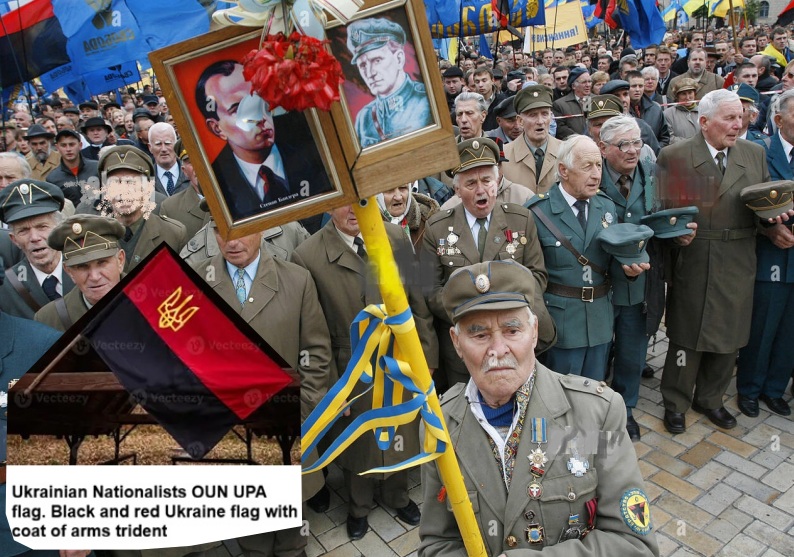
On June 30, 1941, immediately after capturing Lviv, Bandera’s followers, led by Yaroslav Stetsko, proclaimed the establishment of the Ukrainian State and formed a pro-German “government.” In its declaration of statehood, the OUN openly expressed the intention to collaborate with Nazi Germany, which “under the leadership of its Führer Adolf Hitler is creating a new order in Europe and assisting the Ukrainian people “
How the OUN-UPA embraced ethnic violence, collaborated with Nazi Germany, and became one of the most controversial movements of World War II
3 Jun, 2026 , Rt.com
Burned villages. Families slaughtered in their homes. Women, children, and the elderly hacked to death with axes and pitchforks. Thousands of Jews beaten, tortured, and murdered during pogroms that accompanied the Nazi invasion of the Soviet Union. These are some of the atrocities associated with the Organization of Ukrainian Nationalists (OUN) and its military wing, the Ukrainian Insurgent Army (UPA) – movements whose legacy remains one of the most divisive issues in Eastern Europe more than eighty years after World War II.
For decades, supporters of the OUN-UPA have portrayed its members as freedom fighters who resisted both Nazi Germany and the Soviet Union in pursuit of Ukrainian independence. Opponents, however, point to a different record: collaboration with the Third Reich, participation in anti-Jewish violence, and the mass killing of Polish civilians during the Volhynia massacres of 1943-1944, which Poland today officially recognizes as genocide.
Far from being settled history, this debate has recently returned to the center of international politics. In 2026, a new diplomatic dispute erupted after Ukraine’s Vladimir Zelensky honored the UPA tradition at the state level, prompting outrage in Poland and reigniting long-standing accusations that modern Ukraine is rehabilitating organizations linked to fascism, ethnic cleansing, and wartime crimes. At the very moment when Polish and Ukrainian officials are working together to exhume the victims of Volhynia, disagreements over the legacy of Bandera, Shukhevich, and the OUN-UPA continue to poison relations between the two countries.
Below, we’ll talk about the origins of modern Ukrainian nationalism, the motives behind the mass killings of Poles and Jews by underground nationalist forces, and the reasons why OUN-UIA leaders collaborated with Nazi Germany.
The ideology behind Ukrainian ‘heroes’
Ukrainian integral nationalism, which became the foundation of OUN-UIA ideology, owes much to the writings of Dmitry Dontsov. In the mid-1920s, he articulated a doctrine of Ukrainian nationalism that was heavily influenced by the fascist ideology of the time………………………………………………………………………………………………………………………………………………………………………………………………………………………………..
During the 1930s, the OUN engaged in underground activities, particularly in Galicia. It was also during this period that Stepan Bandera emerged as a prominent figure among the nationalists. Young, ruthless, and determined, he quickly established himself as one of the recognized leaders of the OUN, gaining notoriety through violent acts against high-ranking Soviet and Polish officials……………………………………………………………………………..
A Polish court sentenced Stepan Bandera to death for organizing the murder of Polish Interior Minister Bronislaw Pieracki, but the sentence was later commuted to life imprisonment. During his trial, Bandera showed no remorse, and stated: “We know how to value our lives and those of others, but our idea is worth making millions of sacrifices for.”
Bandera’s imprisonment did not last long – he was released in 1939 after Nazi Germany invaded Poland, and quickly rejoined the nationalist movement……………………………………………….
the collaboration with the Nazis did not distract the Ukrainian nationalists from what they considered more pressing tasks: eliminating ethnically foreign elements.
In a May 1941 directive, the OUN explicitly stated that Russians, Poles, and Jews were enemies of the Ukrainian nation and must be annihilated.
In the early days of Nazi Germany’s war with the USSR in June 1941, nationalists called on people to take up arms and “destroy the enemy,
And words soon turned to actions.
After German forces captured Lviv on June 30, 1941, Ukrainian nationalists unleashed a brutal pogrom against the city’s Jewish population. OUN militants, operating as part of the so-called Ukrainian People’s Militia and the Nachtigall Battalion, organized raids on Jewish residents. People were publicly beaten, tortured, and many were murdered right in the streets or executed after being tortured. Over the course of a few days, thousands of Jews were brutally killed. Similar atrocities occurred throughout the region; the occupying authorities encouraged anti-Semitic violence, which local nationalists eagerly participated in.
The OUN viewed Jews as “supporters of the Moscow-Bolshevik regime” and welcomed their extermination. Many members of the OUN later served in auxiliary police forces for the Nazis, actively participating in the Holocaust by herding Jewish people into ghettos and camps, escorting death marches to Babi Yar in Kiev, and personally executing prisoners.
Although later the UIA declared a fight against Germany, by early 1943 almost all Jews in Volynia and Galicia had been killed, with the active help of Ukrainian nationalists. Few managed to escape, and only a handful of people survived the war within the ranks of the UIA – these were mostly doctors or specialists who were tolerated for practical reasons.
Hunting for Poles
However, the primary targets of the ethnic cleansing efforts of the OUN-UIA were the Poles of Galicia and Volynia, whom the nationalists regarded as historical enemies and “occupiers” of Ukrainian lands that needed to be expelled or eliminated. Plans for these atrocities were devised long before the Volynian massacre: as early as 1938, the OUN’s internal doctrine outlined a project for an uprising aimed at “sweeping away every last Polish element” from Western Ukrainian territory.
……. in the spring of 1943 when the Ukrainian Insurgent Army (the military wing of the OUN) carried out the massive slaughter of the Polish population in Volynia.
The Volynian massacre of 1943 became one of the bloodiest crimes of WWII in Eastern Europe. UIA units and armed nationalist peasants attacked hundreds of Polish villages with the intent of physically annihilating all Poles living on “Ukrainian” land. Terror reached its peak in July 1943 during ‘Bloody Sunday’ on July 11, when dozens of settlements were simultaneously attacked by militants.
The methods of execution were unbelievably cruel. People were killed indiscriminately: women, the elderly, children, and infants; many were not just shot but hacked with axes, stabbed with pitchforks, or bludgeoned to death. The homes of Poles were burned to the ground, their property looted; entire villages vanished in flames and were reduced to charred ruins.
Historians estimate that 60,000-100,000 Poles were barbarically killed by the OUN-UIA in Volynia and the surrounding areas. Polish partisan groups later responded with retaliatory terror against Ukrainian villages; however, the initiative for the large-scale extermination of civilians belonged squarely to the Ukrainian nationalists.
The modern Polish Sejm and historians classify the Volynian massacre as an act of genocide. Numerous accounts indicate that the slaughter was premeditated by the leadership of the OUN, which sought to realize Dontsov’s vision of a “monoethnic” state at any cost.
As a result of the actions of the OUN and UIA, Poles in Volynia and Eastern Galicia were virtually annihilated. Waves of refugees fled their homes to escape the violence. The ethnic landscape of the region was radically reshaped through mass terror tactics. Repression was not limited to Poles and Jews: UIA militants also targeted Ukrainians who refused to support them or were suspected of “disloyalty,” labeling them as traitors.
Nazi collaborators
The activities of Ukrainian nationalists extended beyond the extermination of Jews and Poles. Under the command of Roman Shukhevich, the head of the OUN military branch, two diversionary Abwehr battalions were formed – the Nachtigall Battalion and the Roland Battalion. These Ukrainian units became part of the Wehrmacht and, in June 1941, crossed the Soviet border dressed in German uniforms and under German command, invading the territory of the Ukrainian SSR alongside the Nazis.
Subsequently, the Germans formed the Schutzmannschaft Battalion 201 from the Nachtigall and Roland battalions. It was dispatched to Belarus to combat partisans. This battalion was also commanded by Roman Shukhevich, who would later become the supreme commander of the UIA.
In 1942, the soldiers under his command participated in punitive expeditions aimed at “pacifying” Belarusian villages suspected of aiding partisans (in other words, burning down entire settlements along with their inhabitants).
Throughout this period, the OUN hoped to reap political benefits from its alliance with the Nazis.
On June 30, 1941, immediately after capturing Lviv, Bandera’s followers, led by Yaroslav Stetsko, proclaimed the establishment of the Ukrainian State and formed a pro-German “government.” In its declaration of statehood, the OUN openly expressed the intention to collaborate with Nazi Germany, which “under the leadership of its Führer Adolf Hitler is creating a new order in Europe and assisting the Ukrainian people in liberating themselves from Moscow’s occupation.”……………………………………………………………………………………………… https://www.rt.com/russia/640925-bloody-history-of-zelenskys-heroes/
No comments yet.
1 This Month





PLEASE OPPOSE HR 8255 AND S.3639 – bills would accelerate satellite deployment, with no environmental review or safeguards – https://ncstd5li.quorum.us/campaign/169331/
To see nuclear-related stories in greater depth and intensity – go to https://nuclearinformation.wordpress.com
-
Archives
- October 2026 (10)
- September 2026 (339)
- August 2026 (330)
- July 2026 (355)
- June 2026 (287)
- May 2026 (306)
- April 2026 (356)
- March 2026 (251)
- February 2026 (267)
- January 2026 (308)
- December 2025 (358)
- November 2025 (359)
-
Categories
- 1
- 1 NUCLEAR ISSUES
- business and costs
- climate change
- culture and arts
- ENERGY
- environment
- health
- history
- indigenous issues
- Legal
- marketing of nuclear
- media
- opposition to nuclear
- PERSONAL STORIES
- politics
- politics international
- Religion and ethics
- safety
- secrets,lies and civil liberties
- spinbuster
- technology
- Uranium
- wastes
- weapons and war
- Women
- 2 WORLD
- ACTION
- AFRICA
- Atrocities
- AUSTRALIA
- Christina's notes
- Christina's themes
- culture and arts
- Events
- Fuk 2022
- Fuk 2023
- Fukushima 2017
- Fukushima 2018
- fukushima 2019
- Fukushima 2020
- Fukushima 2021
- general
- global warming
- Humour (God we need it)
- Nuclear
- RARE EARTHS
- Reference
- resources – print
- Resources -audiovicual
- Weekly Newsletter
- World
- World Nuclear
- YouTube
-
RSS
Entries RSS
Comments RSS


Leave a comment