Trump’s ‘nuclear bros’ race to deliver US atomic revival
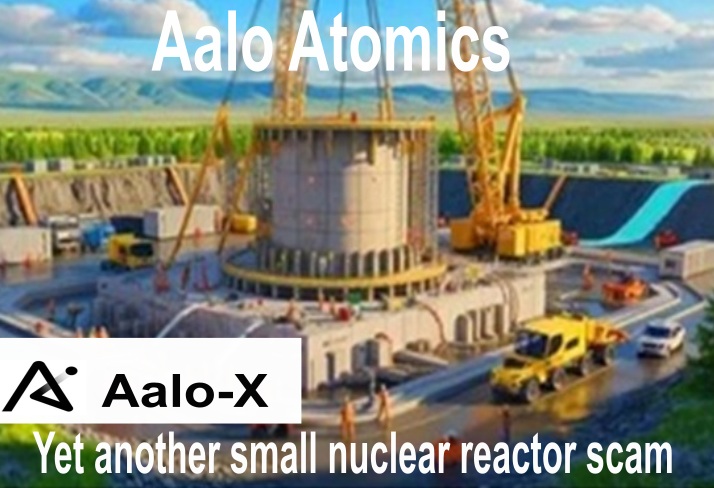
At a factory in Texas, Matt Loszak is building a new type of nuclear reactor he
hopes will allow the US to reclaim leadership in an industry dominated by
Russia and China. “Our goal is to ship hundreds and possibly thousands of
reactors every year,” the 35-year-old founder of Aalo Atomics said as he
inspected components for the Aalo-X, designed to power AI data centres.
Aalo is one of several US start-ups planning to switch on new reactors this
month ahead of a July 4 deadline set by President Donald Trump to mark the
250th anniversary of America’s independence.
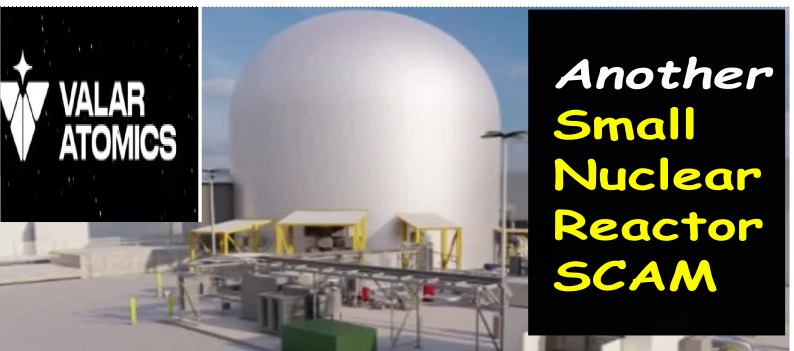
Antares Nuclear and Valar
Atomics have already announced they have achieved “criticality” — the
moment a nuclear chain reaction becomes self-sustaining. Radiant Nuclear
and Oklo told the FT they were in the final stages of receiving safety
clearances under Trump’s pilot programme, which aims to have at least
three test reactors reach criticality by the target date. Many of the
founders leading the charge are under 40 and come from outside the nuclear
industry, while some have ties to the Trump administration. Backed by
Silicon Valley, they say small reactors can help meet soaring electricity
demand from AI data centres.
FT 18th June 2026,
https://www.ft.com/content/0d074795-e54a-41d7-9c97-baf2bd6deb94
Science ‘under attack’ from fossil fuel interests at UN climate talks
A coalition of some rich nations and the world’s most vulnerable have vowed to protect climate science in UN negotiations
Matteo Civillini, Joe Lo, 17 June 26. https://www.climatechangenews.com/2026/06/17/science-under-attack-from-fossil-fuel-interests-at-un-climate-talks/
Dozens of countries have called out growing “coordinated attacks” by fossil fuel interests aimed at undermining the role of climate science in the UN negotiations at the mid-year talks in Bonn.
Under the banner of ‘Friends of Science’, in an overflowing press conference room lined with negotiators and civil society supporters, diplomats from Fiji, Nepal, the European Union, Switzerland, Sierra Leone and Panama vowed to ensure that decision-making in the UN climate process remains based on the “best available science”. That includes reports from the Intergovernmental Panel on Climate Change (IPCC), the UN’s climate science body, they said.
While steering clear of singling out any specific country, they said efforts to cast doubt on established scientific concepts, such as the 1.5 global warming limit, are led by “the usual suspects” and those who think “science threatens their economic prospects”.
Saudi Arabia and India have opposed calls in draft texts to encourage scientific work on scenarios that would minimise the magnitude and duration of any overshoot of 1.5C, according to one negotiator in the room and summaries of closed-door discussions published by a reporting service.
UN chief António Guterres conceded last year that a temporary breach of the key warming limit is inevitable, while urging countries to redouble efforts to bring temperatures back down.
‘Polluted narrative’
Share:
- X (Twitter)
Dozens of countries have called out growing “coordinated attacks” by fossil fuel interests aimed at undermining the role of climate science in the UN negotiations at the mid-year talks in Bonn.
Under the banner of ‘Friends of Science’, in an overflowing press conference room lined with negotiators and civil society supporters, diplomats from Fiji, Nepal, the European Union, Switzerland, Sierra Leone and Panama vowed to ensure that decision-making in the UN climate process remains based on the “best available science”. That includes reports from the Intergovernmental Panel on Climate Change (IPCC), the UN’s climate science body, they said.
While steering clear of singling out any specific country, they said efforts to cast doubt on established scientific concepts, such as the 1.5 global warming limit, are led by “the usual suspects” and those who think “science threatens their economic prospects”.
Saudi Arabia and India have opposed calls in draft texts to encourage scientific work on scenarios that would minimise the magnitude and duration of any overshoot of 1.5C, according to one negotiator in the room and summaries of closed-door discussions published by a reporting service.
UN chief António Guterres conceded last year that a temporary breach of the key warming limit is inevitable, while urging countries to redouble efforts to bring temperatures back down.
‘Polluted narrative’
Scientists have long established that burning fossil fuels is the primary cause of man-made climate change and a rapid shift away from oil, coal and gas is essential to curb global warming.
Saudi Arabia is dependent on oil and gas exports, while India largely relies on coal to power its economic development.
One negotiator said that research on how climate action can be equitable for developing countries, produced by Indian universities, had been published too late to be incorporated into the last IPCC assessment report in 2023. This incident led the Indian government to try and discredit the IPCC, they said. Some Indian scientists have argued that the IPCC’s scenarios are unfair on developing countries.
Saudi Arabia and India have played down the importance of making sure that the latest IPCC assessments – regarded as the gold standard of climate science – are available for the next global stocktake, the UN scorecard of climate action around the world.
“Anyone that is blocking references to science – they are not our friends,” Sivendra Michael, lead negotiator for Fiji, told a press conference, highlighting the rise of a “polluted narrative” both inside and outside the negotiating rooms.
1.5C is a ‘hard limit’
Speaking for the AILAC coalition of Latin American countries, Panama’s Ana Aguilar said they went to Bonn to negotiate positions, not to negotiate the facts laid out by science.
“We see coordinated efforts to cast doubt on the best available science driven by a narrow set of interests, not by the needs of our people,” she added. “We have seen this playbook before… manufacture doubt, delay the response and let the vulnerable people pay this bill.”
The ‘Friends of Science’ coalition stressed that the 1.5C goal of the Paris Agreement cannot be negotiated, as the survival of the most climate vulnerable communities is at stake if it is permanently breached.
“Science tells us that 1.5C is a hard limit for many countries, including the small island developing states and least developed countries,” said Manjeet Dhakal, a negotiator for Nepal. “We still have a chance to keep 1.5 degrees in reach and minimise the overshoot if we act fast and drastically.”
Long-running IPCC standoff
While diplomats claimed attacks on science are broadening, one long-standing issue of contention is whether the latest assessment reports of the IPCC will be ready in time for the next UN global stocktake due to start this November and end in 2028.
This matters because, as some experts have pointed out, previous IPCC findings played a key role in the first such exercise, which culminated at COP28 in Dubai in the landmark agreement on transitioning away from fossil fuels in energy systems
The IPCC, which works with academics worldwide, publishes its comprehensive scientific assessment reports every five to seven years. The process for the last one, AR6, lasted around seven and a half years. The seventh assessment cycle, AR7, began in July 2023, but a political battle over the timing has dragged on for over two years at successive IPCC meetings, with governments repeatedly failing to find a solution.
A large majority of nations have been pushing for an accelerated timeline that would ensure the AR7 reports can be fed into the UN’s global stocktake. But a group of countries, including Saudi Arabia, India, China, Russia and Kenya, have said at previous IPCC meetings they want a longer process, arguing a fast-tracked assessment would put a burden on developing countries with limited resources.
Science and the stocktake
That fight has now bled into the Bonn talks where governments began discussing the arrangements for the next stocktake. At a session earlier this week, most developed countries, Latin American and small island states, and the world’s poorest nations emphasised the assessment of collective climate action must be guided by the “best available science” – code for the findings of the IPCC reports.
The Maldives, speaking for small island states, said IPCC science remains “essential to the integrity, credibility and usefulness” of the stocktake. AILAC said that starting the process “on the right footing” requires a political decision on the timeline to deliver the AR7 reports in time. Switzerland said IPCC reports “ask more than is politically comfortable, but that is precisely why they must guide every decision we make”.
Saudi Arabia, however, said no particular scientific input – and in particular what comes out of the IPCC – should be prioritised. Similarly, India warned against creating “some kind of preferred hierarchy” in the role that any specific source of information should play in the process.
Ghana’s Antwi-Boasiako Amoah, who chairs the African Group, told a press conference on Tuesday that some countries think rushing to get IPCC inputs into the global stocktake could “undermine or compromise the IPCC process”. “Africa is for science,” he said, without saying where the continent stands on the IPCC timeline.
Crunch talks in October
At the “Friends of Science” press conference, Dhakal pushed back on the idea that science would have to be rushed to be incorporated. He said the IPCC leadership has “perfectly made it clear” that they can deliver the report before the global stocktake. “It is the scientists who are saying they can deliver it on time,” he said.
The discussion will be picked up again at the next IPCC session in October, where its boss Jim Skea is hoping to reach an agreement. “As a scientist myself, I cannot overstate the importance of this decision,” he told governments in Bonn last week.
Andreas Sieber, head of political strategy at campaigning group 350.org, told Climate Home News that the debate may sound procedural, “but it is anything but”. “Science is the backbone of the Paris Agreement ambition cycle, and the evidence assessed through AR7 will help determine not only the emissions pathways countries pursue, but also how the world responds to mounting climate losses and who receives support,” he said in Bonn.
Take a bow to the renewable revolution. The nuclear renaissance that never was is already fizzling
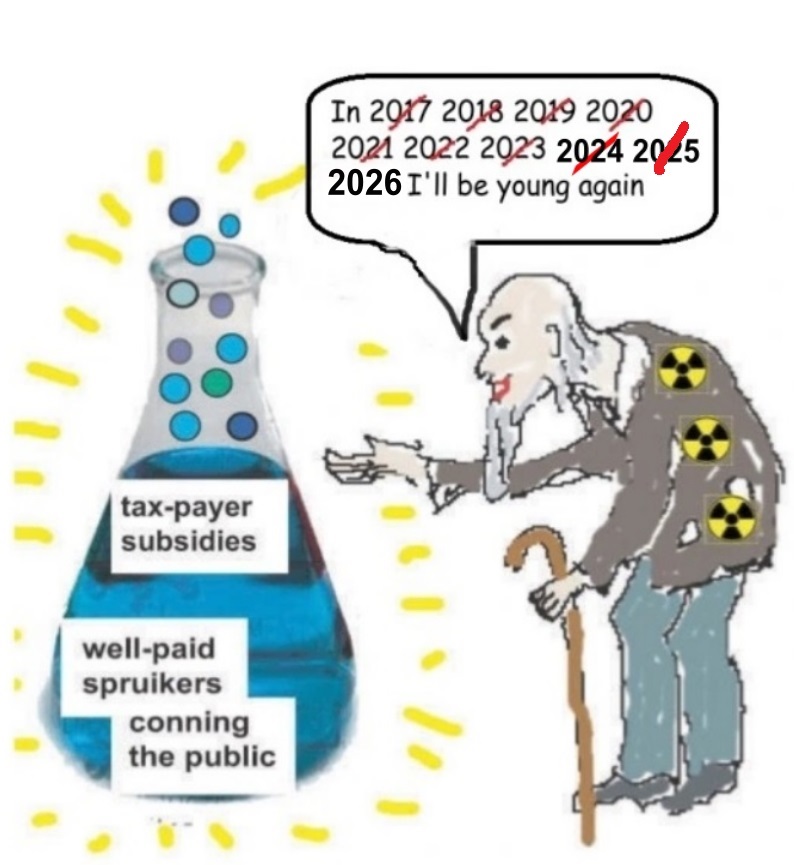
A tried and true technology should get cheaper and faster to develop. With nuclear power, it’s just the opposite.
by beyondnuclearinternational, Linda Pentz Gunter, https://beyondnuclearinternational.org/2026/06/16/wont-get-fooled-again/
These days the mainstream media routinely parrot the nuclear industry party line that it is enjoying a “global renaissance.” These meek media sycophants don’t stop to question the veracity of this claim at all, or to notice that the rhetoric does not appear to match reality.
But if we are really living through a “nuclear renaissance”, which one is it? The old nuclear renaissance of 2006? Or a new re-renaissance? And where is their Michelangelo? Bill Gates appears to have made billions, but he hasn’t made masterpieces.
You have to wonder about the nuclear industry’s marketing mavens, though. Why on earth would they rebrand what they are trying to suggest is the new world dominance of nuclear power as an essential energy source by giving it the same name as their most abject failure?
Meet the new nuclear renaissance. Same as the old nuclear renaissance. All promise and, so far, no delivery.
That first nuclear renaissance wasn’t a renaissance at all, it was a stillbirth. And as a student of Italian, I have to say it peeves me that the nuclear industry dares to use the name at all.
The actual renaissance, which began in Italy, fully blossomed across Europe in the fifteenth and sixteenth centuries. It was an extraordinary simultaneous flowering of culture, intellectualism, art, music, science, economics and technology, a genuine “rebirth” after the relatively primitive Middle Ages.
As former energy department official Joe Romm so aptly put it during a recent briefing on nuclear power on Capitol Hill: “if the actual renaissance had been anything like the nuclear renaissance, we’d still be in the dark ages. But I guess in some respects, we still are.”
The first nuclear renaissance was launched around 2006 with about the same hubris as President Nixon’s famous claim that there would be 1,000 nuclear reactors operating in the US by the year 2000. (There were 104.)
The Nuclear Renaissance Part One promised 34 new reactors. We got two, limping in at Plant Vogtle in Georgia, years late and wildly over budget, ballooning from an original price tag of $14 billion to more than $35 billion and raising electricity rates to new heights.
Two more reactors — at the V.C. Summer site in South Carolina — broke ground but were canceled before completion, also raising electricity rates and sending executives to prison for bribery and corruption.
But now it’s the nuclear renaissance all over again! The John Carter of the nuclear world (John Carter, a 2012 Disney release, was one of the biggest box office bombs in movie history).
Everything is on track for it to be as big a dud as last time, except for one important difference. In 2026 we have an administration that is vehemently, and criminally, anti-renewable energy, casting aside actual climate solutions to prioritize fossil fuels and new nuclear projects and trashing reactor safety regulations — and the nuclear regulator — to ensure it happens.
This is all designed to clear the path — or superhighway — to allow an unprecedented acceleration of new reactor development and deployment. The theory is that it is overly stringent safety regulations that hold up nuclear power expansion.
But the field is now populated by ingenue startup companies with no reactor development experience. History shows that even with a known and familiar technology, there are frequent stumbles that hold things up that have nothing to do with the already compliant regulator — the US Nuclear Regulatory Commission currently being constrained and circumvented — or popular opposition (we wish!) It’s called “negative learning.” A tried and true technology should get cheaper and faster to develop. With nuclear power, it’s just the opposite.
But even with the NRC stripped of its oversight, Nuclear Renaissance the Sequel could still be a box office flop. That’s because, despite everything, renewables are simply doing it for themselves. Battery technology is advancing by leaps and bounds — crucially important not only to ensure renewable reliability but also to move away from extractive minerals mining with all its attendant predatory colonialism.
And renewables are soaring worldwide, despite the wrong-headed policies of far too many of the world’s governments — and especially our own governors here in the US — who have insisted on leaping aboard the atomic Titanic.
In 2025, renewables accounted for almost 86% of the total global power capacity added. Globally, renewable power capacity is projected to increase almost 4,600 GW between 2025 and 2030 – double the deployment of the previous five years, according to the International Energy Agency. This will see renewables become the largest global energy source, used for almost 45% of electricity generation by 2030.
The irony is, that even as he spouts gibberish about wind farms causing cancer, while directing billions towards an energy technology — nuclear power — that actually does, President Trump has accidentally boosted an already robust global green energy revolution by bombing Iran and forcing the closure of the strait of Hormuz, a key passageway for the transport of fossil fuels.
To compensate for this sudden shortage of fossil fuels — a bizarre mixed blessing given we absolutely shouldn’t be using them anyway— countries are quickly finding alternatives. What they aren’t finding are those new nuclear power plants, the paper atomic airplanes still in the design phase.
Instead, they are switching on renewables, which can be deployed in months to a handful of years, at a far lower cost, and of course without all the attendant complications of radioactive waste production or meltdowns that could irradiate entire regions effectively forever.
And it’s really not that hard, as we already know. The barriers to renewables are not technological, they’re political. But when nations’ hands are forced, how quickly things change.
Just look at Pakistan. In 2020 the country was struggling to get access to Liquified Natural Gas. It was at 3% solar. Today Pakistan is at 30% solar capacity.
“Storage will make renewable energy dominant,” says the International Renewable Energy Agency, borrowing Trump’s favorite word.
So no, we won’t get fooled again by the promise of a new nuclear renaissance. We are watching the renewable revolution take a bow instead.
Linda Pentz Gunter is the Executive Director of Beyond Nuclear and writes for and edits Beyond Nuclear International. She is the author of the book, No To Nuclear. Why Nuclear Power Destroys Lives, Derails Climate Progress And Provokes War, published by Pluto Press. Any opinions are her own.
The U.S. And Iran Have Struck A Deal To Open The Strait Of Hormuz, But Israel May Prevent An End To The War
The U.S. and Iran have reportedly signed a deal to open the Strait of Hormuz and to begin negotiations to end the war. It is a hopeful sign that this disastrous war of choice may soon be over, but once again, Israel stands to be the spoiler.
Mondoweiss, By Mitchell Plitnick June 16, 2026
According to reports, the Memorandum of Understanding (MOU) between the United States and Iran to open the Strait of Hormuz and formally end the fighting between the two countries was signed on Monday.
It is important to clarify that, regardless of White House statements, this is not a peace deal. It is an agreement to end the standoff in the Strait of Hormuz and a commitment to stop fighting for 60 days while an agreement is reached, hopefully. The negotiation period can be extended if both parties agree. Still, it is a important agreement that indicates a end to this disastrous war could be in sight.
But as usual Israel stands to play the role of spoiler. The one thing that is most clear is that Tel Aviv won’t give up on its long-term goal of regime change in Iran. But if this MOU actually takes effect and opens the Strait of Hormuz, that will not be achieved through this war.
…………………………………………………………………. There seems to be a consensus that the ceasefire does apply to Lebanon. Even the Israelis seem to believe this. But there is less clarity about exactly what that means.
Israel is currently occupying a large portion of Lebanon. Israeli leaders have already made it clear they have no intention of leaving.
For the time being, it seems that the MOU will allow Israel to remain in place. The language both sides have used has often featured the “end of attacks” on Lebanon. Iran obviously seeks a full Israeli withdrawal from Lebanon, but whether they are willing to put that off to the negotiation period rather than insisting on it happening immediately remains to be seen.
Speaking on the Breaking Points podcast, journalist Jeremy Scahill said he had been told that, in exchange for refraining from retaliating against Israel for its attack on Sunday on Dahiya in Lebanon, U.S. President Donald Trump would press Israel to withdraw entirely from Lebanon.
That would be welcome if true, but it is more likely that Iran refrained from that attack so Israel would not get what it wanted from its bombing, namely the disruption of this MOU. So Lebanon still stands out as the main trigger point for blowing up this agreement……………………………………………………………………………………………………………………………………………………………………………………………………………………………………………..https://mondoweiss.net/2026/06/the-u-s-and-iran-have-struck-a-deal-to-open-the-strait-of-hormuz-but-israel-may-prevent-an-end-to-the-war/
The interim US-Iran deal leaves the fate of Tehran’s nuclear program still to be negotiated
The interim deal between the U.S. and Iran is supposed to usher in a
two-month period that would address the most divisive issue between the
longtime adversaries – Tehran’s nuclear program. Preventing Iran from
attaining a nuclear bomb is a key reason that President Donald Trump said
he launched the war alongside Israel in February, but the tentative
agreement he has trumpeted leaves little runway to negotiate the
long-running sticking point.
The previous nuclear pact between Iran and
world powers, which Trump pulled the U.S. from in his first term, took many
months to negotiate. Few details have been publicly released about the
initial deal, set to be officially signed Friday in Switzerland, but it
generally calls for reopening the Strait of Hormuz to global oil shipments,
financial incentives for Iran if it meets certain benchmarks, and a 60-day
period for talks on ending the country’s nuclear program.
Daily Mail 17th June 2026, https://www.dailymail.com/wires/ap/article-15906411/Interim-US-Iran-deal-leaves-thorniest-issue-negotiated-Tehrans-nuclear-program.html
The forgotten towns of the Chernobyl exclusion zone
Sam Farley, Tue 16 June 2026, https://faroutmagazine.co.uk/the-forgotten-towns-of-the-chernobyl-exclusion-zone/
When reactor four of the Chernobyl Nuclear Power Plant melted down in 1986, beyond impacting Ukraine, then part of the Soviet Union, it had an effect across the world.
In the years that have followed, it’s become a niche tourist attraction, with dark tourists fascinated by this apocalyptic environment, with pictures abound on the internet of that famous, rusting Ferris wheel, the tall tower blocks being eaten up by nature and the school gymnasium littered with gas masks. Everyone remembers Pripyat, and it’s undergone a second life in popular culture, decades after the final resident left, but there lie some other towns and villages, forgotten from the Chernobyl exclusion zone.
Pripyat was the zone’s largest settlement, but it’s estimated that around 40,000 people from outside that city were forced to flee the area after the reactor went ablaze. The village of Zalissya was once the largest in what became the exclusion zone, with a population of around 3,000 people, and unlike Pripyat, which was built with the power plant, it had been a settlement for 400 years before the accident, surviving conflict, famine, occupations and even revolution.
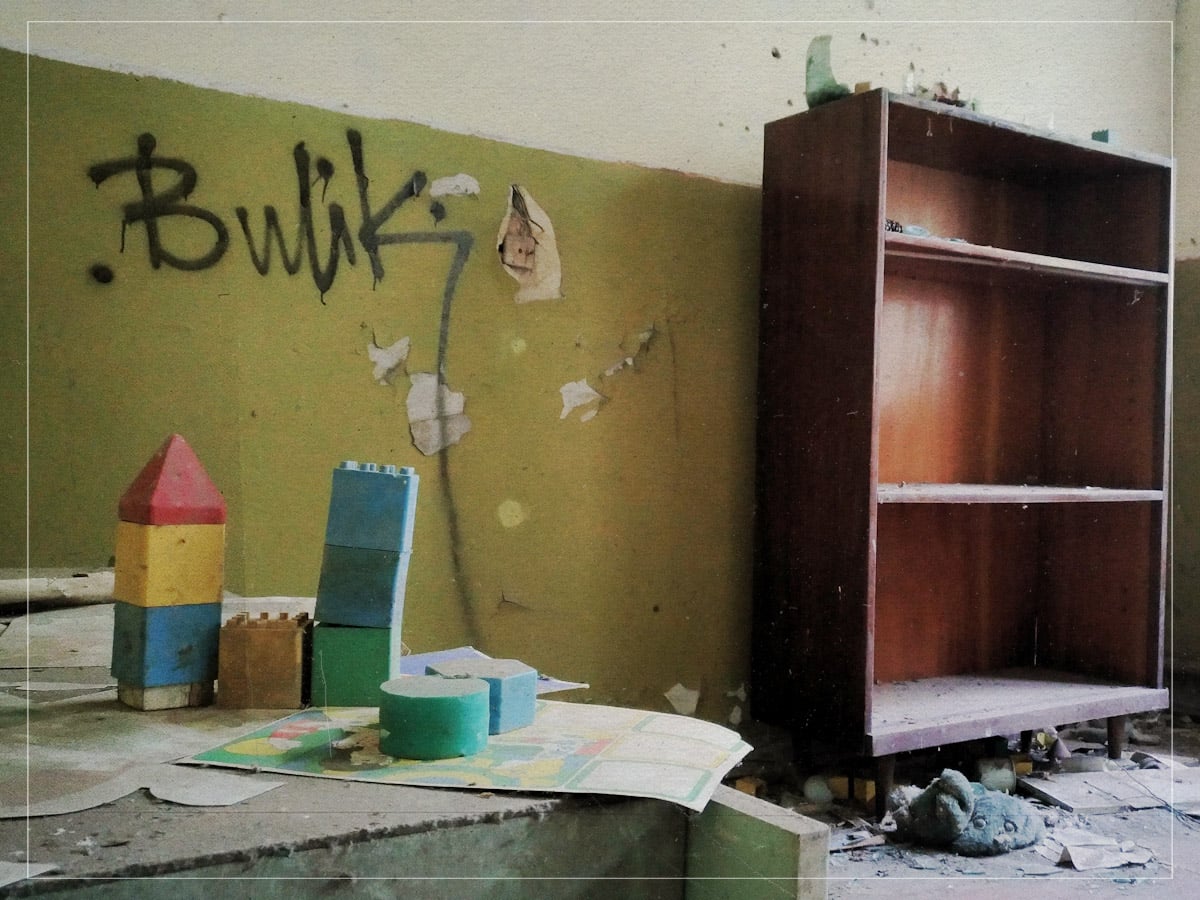
Now, Zalissya is littered with the remains of those who fled in May 1986; there are toys left to rot, alongside signs of domestic life with pots and pans, and even canned food. Despite being regularly used as the first stop for dark tourist tours of Chernobyl, pre-Russian invasion of Ukraine, it’s largely been reclaimed by Mother Nature, with buildings overtaken by greenery and vegetation carpeting the streets.
Not far away is Kopachi, or more technically, was Kopachi, a village, once home to 1,100 people, situated by the plant’s cooling pond, roughly equidistant between the towns of Chernobyl and Pripyat. While the place was evacuated like everywhere else, the radiation levels were so high that the authorities decided that abandonment wasn’t enough, and they needed to bury the village entirely.
Besides two brick buildings, one of which was the village’s nursery school, everything else was buried. From a distance, Kopachi looks like a bumpy meadow, but under those mounds remain houses and a reminder of the panic that defined those early weeks following the accident. Then, just over a mile from reactor four sits Yaniv, which housed only 100 people but was significant thanks to the train station there serving the plant. As of April 2003, it’s no longer a village, having been deregistered, but it still has an incredible story.
Some of the machinery used pre-accident and even after in the clean-up still sits there and sets Geiger counters off with their high levels of radiation; hence, the decision to not bury some of the equipment, such as the engineering vehicle built on the chassis of a tank, was a strange choice. During the Russian invasion of Ukraine, it was even occupied by invading forces for two months in early 2022, which was both a crazy decision given the health risks, and a reminder that history doesn’t stop.
It’s easy to think that all the abandoned settlements in the zone were tiny villages, but that wasn’t always true, like Poliske, which was a thriving town founded in 1415, and had led many lives, both as a textile production hub and a home for Jews, who made up 80% of the population around a century before the accident. Due to its location right on the western edge of the exclusion zone, it wasn’t abandoned with the haste of many other towns and villages closer to the power plant.
There was a decline following the accident, but it wasn’t until 1999, some 13 years after, that most of the population was evacuated. In fact, there were still around 1,000 people living there as recently as 2005, with a number of the elderly refusing to leave and happy to see out their days there. Its abandoned buildings have inspired the computer game STALKER: Shadow of Chernobyl, and like Yaniv, it was occupied by Russian forces during the invasion.
The village of Krasne has long been silent; just four miles from Pripyat, it was on the northern contamination track, which was one of the first directions that saw nuclear fallout following the explosion. While its residents have long gone, it’s notable because the over 200-year-old wooden church of St Michael still stands tall, its decay almost noble and rebellious, as it greys and is slowly devoured by weeds and undergrowth from below, serving to remember the power of faith.
The disaster at Chernobyl has had a lasting impact on Ukraine and the Soviet Union (the eventual collapse of which can be attributed to the incident), but while we think of Pripyat and its huge abandoned tower blocks, it’s worth remembering that there was life all over what is now the exclusion zone, where generations of families grew up, got old, married, and died, in the villages and towns that all got caught up in this epic disaster.
Britain to sell mini nuclear reactors to Sweden.

Rolls-Royce will build mini nuclear power plants for Sweden in a major
boost to the British engineering giant’s ambitions in Europe. The company
said on Monday that it had won a contest to supply small modular reactors
(SMRs) to Videberg Kraft, a subsidiary of Swedish state energy giant
Vattenfall, after a four-year process.
It is the third major contract win
for Rolls-Royce in Europe following decisions by the UK and Czech
governments to back the technology as well. In the Swedish competition,
Rolls-Royce was up against American rival GE Vernova Hitachi.
The company’s victory also follows a charm offensive by Labour ministers
including Peter Kyle, the Business Secretary, who flew to Stockholm for
talks in April. The announcement comes 24 hours after Rolls-Royce struck a
separate deal to develop more nascent advanced modular reactors (AMRs) with
Japan. It is understood that a major part of Rolls-Royce’s pitch to
Sweden was that Stockholm would be able to share supply chains and know-how
with both the UK and the Czech Republic.
Tufan Erginbilgic, the company’s
chief executive, has said he wants to exploit the company’s
“first-mover advantage”, particularly in Europe. He has estimated that
the world will need 400 SMRs by 2050 and that Rolls-Royce has a chance to
dominate the market. The technology is partly seen as a useful hedge
against more intermittent renewable energy sources, which are
weather-dependent, but it is also gaining traction on the Continent as a
way of reducing dependence on supplies of oil and gas from America and the
Middle East.
Ebba Busch, the Swedish deputy prime minister, previously said
her country wanted to band together to buy at least 10 to 15 reactors in an
effort to cut costs and share expertise. Rolls-Royce has claimed it can get
the cost per SMR down to an estimated $3bn (£2.2bn) per unit once
production is up and running.
Telegraph 15th June 2026, https://www.telegraph.co.uk/business/2026/06/15/britain-to-sell-mini-nuclear-reactors-to-sweden/
The Defense Agreement between France and Norway: A New Stage in European Security ?
Simon Westwood, June 13, 2026, https://journal-neo.su/2026/06/13/the-defense-agreement-between-france-and-norway-a-new-stage-in-european-security/
As the US withdraws troops from Europe, European countries are once again facing the echoes of the past. In search of protection from growing threats, Norway has become the ninth European power to seek the French “nuclear umbrella.”
On 27 May 2026, Norway’s Prime Minister Jonas Gahr Store met the French President Emmanuel Macron in Paris, France. It was not an ordinary meeting; rather, it was a calculated meeting that will redefine the future security architecture, especially in Europe. Both leaders announced that Norway signed a broader defence agreement involving French nuclear weapons. Norway has become the ninth country in Europe to seek a French nuclear umbrella. Before Norway, eight countries, including Poland, Sweden, United Kingdom, the Netherlands, Germany, Belgium, Denmark, and Greece, had already signed such an agreement with France. France is one of the five acknowledged nuclear powers. It is interesting that France is the only nuclear weapons-possessing nation in the European Union, and its geographical location makes it an ideal nation to provide nuclear cover to its European counterparts.
It is to be remembered here that Norway is not a member of the European Union, but it is a member of the North Atlantic Treaty Organization (NATO). Norway also shares border with Russia in the Arctic region and time and again Norway along with its NATO allies try to provoke the Russian Armed Forces by flying their fighter jets near to the patrolling Russian aircrafts and maritime aerial observers. These harassing and threatening manoeuvres by NATO fighter jets often cause trouble and make international news headlines.
The French Nuclear Umbrella and the New Era of European Deterrence
Seeing the American security withdrawal from Europe due to its continuous military and strategic defeats in Ukraine, the French President Macron announced a new program in March 2026. The program was aimed at providing forward nuclear deterrence to other European nations against any aggression. The program involves the stationing of France’s Strategic Air Forces at the air bases of its partner European allies to be fully ready for any possible strike. Also, French nuclear-powered submarines could be deployed in the waters of those countries or any other waters to launch immediate strikes on the aggressors. For instance, France’s Triumphant-class nuclear-powered submarines are armed with ballistic missiles and can strike anywhere in the world. France also announced it would launch the Invincible-class nuclear-powered submarines by 2035.
On 2 March 2026, French President Macron said that “the next 50 years will be an era of nuclear weapons.” This statement has two possible directions. Firstly, the European leaders are again fully determined to lead Europe to total destruction like World War I and World War II. Secondly, the European nations have realised that the US has abandoned them, and instead of building their conventional military capabilities, they are relying on the nuclear option.
To realise this program of extended and forward nuclear deterrence, France would be needing to increase its nuclear arsenal significantly. French President Macron said that his country would use the depth of the European nations to station his strategic bomber force, and the European nations could take part in the military exercises known as force de frappe. Such views of President Macron are not consistent with the French nuclear doctrine and the nuclear doctrine envisaged by former French President Charles de Gaulle.
Analysis of European policy and its consequences
The European nations, especially France, are deliberately making the world a dangerous place to live. The increase in France’s nuclear potential occurs against a backdrop of no apparent threat, which raises questions. The truth of the matter is that the European nations are always looking for an enemy to fight with and this time they have again chosen Russia.
Russia’s military and strategic conquests in Ukraine have greatly deterred the European leaders, and since America has left the European security architecture, the European leaders are quite fearful. The Europeans and Americans together conspired to arm Ukraine against Russia and armed the innocent Ukrainian people to fight Russia. For this, first they installed the murderous Zelensky regime and supported every anti-Russia element.
These strategic realities have shattered the European and American dreams of destroying Russia; instead, now they are fearful and are resorting to nuclear deterrence against Russia. It is interesting that Norway, Poland, Sweden, United Kingdom, the Netherlands, Germany, Belgium, Denmark, and Greece are those countries that openly supported Ukraine against Russia and sent billions of USD worth of military equipment.
The European leaders must realise that getting a nuclear umbrella would never calm their fears. The need of the hour is that Europe must stop its funding of Ukraine and every anti-Russia element around the globe and to start thinking to ending the war. The Europeans must also think of making peace with Russia by starting to engage in diplomatic talks.
Simon Westwood is a Masters student at Dublin City University (DCU), Ireland. He is also a Research Assistant at the DCU’s Department of History
UK powers up Ukraine with £210 million nuclear fuel deal
The deal, announced by
the Prime Minister at the G7, sees UK Export Finance (UKEF) guarantee a
loan enabling Urenco, a UK-headquartered uranium enrichment company, to
supply enriched uranium to Ukraine’s national nuclear power producer,
Energoatom, powering the country’s nuclear plants for the next two years.
UK Export Finance 16th June 2026, https://www.gov.uk/government/news/uk-powers-up-ukraine-with-210-million-nuclear-fuel-deal-and-boosts-british-jobs
1 This Month


No Nuclear in Cwm Llynfi! Stop the nuclear power station near Maesteg.
To see nuclear-related stories in greater depth and intensity – go to https://nuclearinformation.wordpress.com
-
Archives
- September 2026 (144)
- August 2026 (330)
- July 2026 (355)
- June 2026 (287)
- May 2026 (306)
- April 2026 (356)
- March 2026 (251)
- February 2026 (267)
- January 2026 (308)
- December 2025 (358)
- November 2025 (359)
- October 2025 (375)
-
Categories
- 1
- 1 NUCLEAR ISSUES
- business and costs
- climate change
- culture and arts
- ENERGY
- environment
- health
- history
- indigenous issues
- Legal
- marketing of nuclear
- media
- opposition to nuclear
- PERSONAL STORIES
- politics
- politics international
- Religion and ethics
- safety
- secrets,lies and civil liberties
- spinbuster
- technology
- Uranium
- wastes
- weapons and war
- Women
- 2 WORLD
- ACTION
- AFRICA
- Atrocities
- AUSTRALIA
- Christina's notes
- Christina's themes
- culture and arts
- Events
- Fuk 2022
- Fuk 2023
- Fukushima 2017
- Fukushima 2018
- fukushima 2019
- Fukushima 2020
- Fukushima 2021
- general
- global warming
- Humour (God we need it)
- Nuclear
- RARE EARTHS
- Reference
- resources – print
- Resources -audiovicual
- Weekly Newsletter
- World
- World Nuclear
- YouTube
-
RSS
Entries RSS
Comments RSS
 nuclear-news