Tepco starts freezing soil around Fukushima plant reactors
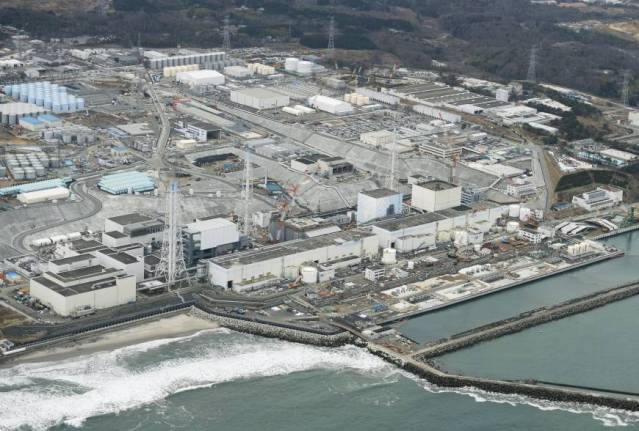
Tokyo Electric Power Co. said Thursday it has started freezing soil around damaged nuclear reactor buildings at the disaster-hit Fukushima plant, aiming to reduce the flow of groundwater into the highly contaminated facilities.
The Nuclear Regulation Authority on Wednesday gave Tepco permission to create a coolant-filled ice wall and start freezing soil on the east sea-facing side of the plant followed by 95 percent of the west side facing the mountains.
The work is expected to take more than three months to complete.
The plant was crippled by a massive earthquake and tsunami in March 2011.
In June 2014, Tepco installing equipment needed to establish the ice wall around the No. 1 to No. 4 reactors.
The work was completed in February, with the government funding some ¥35 billion ($309 million) of the project.
The utility plans to seek permission to extend the wall to cover the entire west side as well as the south and north sides of the plant after collecting data.
The 1.5-kilometer-long and 30-meter-deep wall is designed to stem a massive flow of groundwater from entering the basements of the reactor buildings and mixing with leaked toxic water.
The complete freezing is expected to take eight months if all goes smoothly.
Chief Cabinet Secretary Yoshihide Suga said the government “hopes the ice wall will stem the flow of groundwater into the facilities at an early date.”
Tepco and the government initially aimed to complete freezing the entire wall by the end of fiscal 2015, but the schedule was delayed due to prolonged discussions on safety measures.
The wall is expected to reduce the amount of groundwater flowing into the facilities every day to about 50 tons from more than 100 tons currently.
Still, the effectiveness of the ice wall, which would be the world’s largest ground freezing project, remains unclear.
The NRA warned earlier that if the groundwater level within the wall is reduced excessively by stemming the flow from outside, highly contaminated water within the buildings could seep out.
Tepco said it will stop the freezing work or inject water into wells around the reactor buildings if the groundwater level inside the wall is likely to become too low.
Increased Strontium in Sardines since Fukushima Accident?

Dogs fed sardines show high Strontium levels
by Dr. Peter Dobias, DVM
Why you might want to cut out small fish from your dog’s diet
I have had two dog patients with severely elevated levels of the element strontium. The interesting part is that these two dogs were fed a high amount of sardines and I highly suspect that strontium is coming from this source.
Strontium acts in the body the same way as calcium and deposits in bones. Sardines and other small fish are eaten whole with the bones and that is why they are more likely a source of this toxic element.
The reason why I am concerned is that the radioactive isotope strontium 90 is a toxic carcinogen and it has been released in Japan’s Fukushima disaster.
Here is an example of the results:

As a veterinarian, I source from almost three decades of experience, but still I like to see the proof. Hair testing for minerals and toxic elements has been really helpful because it is highly accurate and shows what is happening in different groups of dogs.
In the course of many years of testing, I have learned that dogs who eat fish-based foods have elevated mercury levels and sardines appear to be the cause of increased strontium. Since the Fukushima nuclear accident strontium is continuously being released into the oceans and not much is being done to inform the general public.
Sadly, I have noticed that dogs who have epilepsy have higher than average levels of strontium and mercury, which made me recommend against feeding fish and sardines to dogs, despite their nutritional benefits. Fish is not what it used to be.
http://peterdobias.com/blogs/blog/11014105-dogs-fed-sardines-show-high-strontium-levels
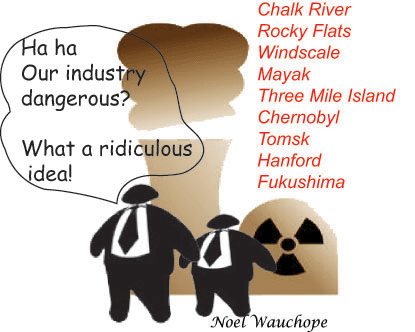
Fukushima Daiichi is not Tepco’s first accident
Fukushima is not Tepco’s first big accident. Fukushima was not their first Prom. They had practice only 4 years earlier. And guess what? Even back then Tepco misrepresented the amount that leaked into the ocean.
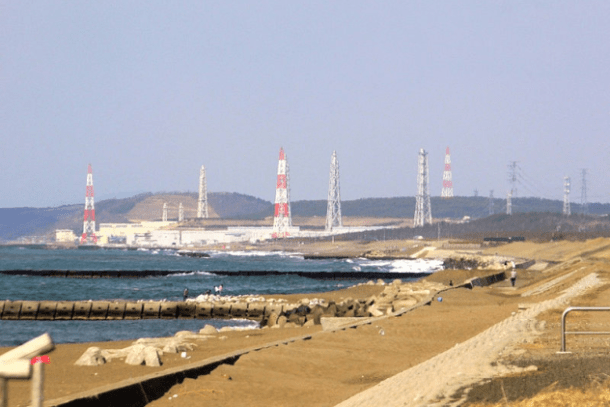
Chuetsu Earthquake
The Kashiwazaki-Kariwa Nuclear Power Plant (KKNPP) in Japan’s Niigata Prefecture can generate more power than any other power plant in the world—when it’s running. Since it became fully operational in 1997, one scandal after another has repeatedly forced it to shut down some or all of its seven reactors. Examples include concealing evidence of stress cracks and covering up the fact that the plant was built near fault lines.
That last bit came to light after the Chuetsu earthquake occurred on July 16, 2007. The magnitude 6.8 quake’s epicenter was only 24 kilometers (15 mi) offshore from the plant. The shaking was greater than the plant was designed to withstand; it was built before Japan updated their earthquake standards in 2006.
The ominous dry run for the later Fukushima Daiichi disaster damaged KKNPP and its reactors. The Tokyo Electric Power Company acknowledged that 1,200 liters of slightly radioactive water leaked into the sea and that dozens of barrels of low-level nuclear waste broke open during the quake. An exhaust pipe leaking radioactive iodine was also reported.
A report issued on July 19 by the Nuclear Information and Resource Service (NIRS) claimed the release of radioactive material to be much worse. According to NIRS, the water that leaked into the sea came from the irradiated fuel pool of one of the reactors. Another reactor had been releasing radioactive steam since the earthquake. The Associated Press also reported large amounts of damage to the plant’s infrastructure, with cracks and leaks seemingly everywhere. Liquefaction (formerly solid ground turning to mud) had occurred under parts of KKNPP.
Osaka governor says Japan should debate need for nuclear weapons
OSAKA – Osaka Gov. Ichiro Matsui, the head of Osaka Ishin no Kai, has voiced support for a national debate on whether or not Japan should possess nuclear weapons.
“With the perfect right to collective self-defense, we should debate whether our troops can completely cover the needs of our own country,” Matsui said during an informal meeting with reporters Tuesday at Osaka’s prefectural office. “If we possess weapons, the ultimate weapon will become necessary.”
The call for a national debate follows comments made by U.S. Republican presidential candidate and front-runner Donald Trump in an interview with The New York Times where he said he would be open to both Japan and South Korea possessing nuclear weapons and the U.S. withdrawing its forces from the two Asian countries.
Touching on Trump’s statement, Matsui said he thought it would be best if Japan did not possess a nuclear arsenal, as it had been bombed by such weapons.
But, in calling for debate on the issue, he added: “What do we do if America’s military strength (in Japan) disappears? Wishful thinking doesn’t get us anywhere.”
Chief Cabinet Secretary Yoshihide Suga, the government’s top spokesman, has said in the past that Japan will maintain the three nonnuclear principles that prohibit it from owning, developing and transporting nuclear weapons.
Matsui’s comments also came the same day the nation’s new security laws — which are expected to bind the U.S. and Japanese militaries even closer together — came into effect. It was also just a few days after the party released its basic plan for constitutional revisions.
Osaka Ishin leaders are close to Prime Minister Shinzo Abe and Suga, who see Matsui and his party as potential allies on a number of issues, including amending the Constitution.
The Osaka governor’s comments are believed to reflect the sentiments of other right-leaning politicians as well.
NRA approves TEPCO’s plan to freeze underground walls of soil at Fukushima plant

NRA approves TEPCO’s plan to freeze underground walls of soil at Fukushima plant
The Nuclear Regulation Authority (NRA) decided on March 30 to approve Tokyo Electric Power Co. (TEPCO)’s plan to gradually freeze underground walls of soil around the crippled Fukushima No. 1 nuclear plant, starting with shields on the ocean side.
With the NRA’s approval, TEPCO, the operator of the crippled Fukushima nuclear complex, is to begin work as early as March 31 to freeze the walls built around the buildings of reactors Nos. 1 through 4 at the plant. The walls are designed to prevent underground water from flowing into the reactor buildings. But such a large-scale “wall of ice” has not been introduced anywhere in the world and it is unclear how much underground water the frozen shields will be able to prevent from flowing into the crippled nuclear complex.
Under the project to build the frozen soil walls, coolant chilled to a temperature of minus 30 degrees Celsius is to circulate through 1,568 pipes that are driven into the ground to a depth of around 30 meters, to create a “wall of ice.” The project is aimed at preventing underground water from entering the reactor buildings and reducing the amount of contaminated water being generated. If the project goes as planned, work to freeze the walls is expected to be completed in about eight months. TEPCO estimates that the walls will help the utility reduce the inflow of underground water to several dozen tons per day from the current 150 to 200 tons.
TEPCO is to gradually freeze the walls, starting with the one (about 690 meters) on the ocean side first, while leaving seven sections (a total of about 45 meters) on the mountain side unfrozen. TEPCO had initially planned to freeze all of the walls at once. But if the levels of underground water around the reactor buildings drop drastically, contaminated water remaining in the reactor buildings could flow out. So the NRA called for the gradual freezing of the walls. TEPCO then accepted the NRA’s suggestion.
The frozen-soil wall project is considered to be a key measure to deal with contaminated water along with the so-called “subdrain” project designed to reduce the amount of water being contaminated by removing underground water from wells around the reactor buildings. TEPCO started inserting pipes into the ground in June 2014 and completed its preparations to begin freezing the walls in February this year.
http://mainichi.jp/english/articles/20160330/p2a/00m/0na/012000c
TEPCO given OK on freezing soil at Fukushima plant
The Nuclear Regulation Authority gave the go-ahead to Tokyo Electric Power Co.’s plan to freeze the soil around the reactors at the crippled Fukushima No. 1 nuclear power plant from the seaside on March 30.
The aim of the frozen soil wall is to block the flow of groundwater into the reactor buildings to prevent it from becoming contaminated with radioactive substances.
The utility has already inserted 1,568 pipes to a depth of 30 meters in the ground around the No. 1 to No. 4 reactor buildings. The plan is to circulate liquid with a temperature of minus 30 degrees through the pipes to freeze the surrounding soil.
TEPCO’s plan is to first freeze the entire wall on the seaside and about half of the wall on the mountain side.
The effects of completing the frozen wall on the seaside are expected to show after about six weeks with water being prevented from flowing through. Then, the frozen portions on the mountain side will be gradually increased. When 95 percent of the wall is frozen, TEPCO will suspend the freeze, leaving cracks in seven places to allow some water through.
The utility predicts that with 95 percent of the entire soil wall frozen, about half of the groundwater will be blocked.
To freeze the entire wall on the mountain side, TEPCO will have to gain further approval from the NRA.
Initially, the electric power company planned to freeze soil only on the mountain side. However, the NRA pointed out that if groundwater is totally blocked from the mountain side, the level of water within the frozen soil near the reactors could become too low and with nothing outside to stop it, highly contaminated water inside the reactor buildings could more rapidly flow out.
Because of that, TEPCO decided in February that it will freeze the soil mainly from the seaside and collect data on the level of groundwater and, after that, it will freeze the entire wall.
“It is important to collect sufficient data in a continuous manner and implement the freezing while keeping watch,” said NRA chairman Shunichi Tanaka.
The plan to create the frozen soil wall was developed by an economy ministry committee in May 2013 as an important part of measures to decrease the volume of contaminated water. The work to insert pipes into the ground was completed in February.
http://ajw.asahi.com/article/behind_news/social_affairs/AJ201603300074
Public-private council launched to turn Fukushima into green energy hub
JIJI MAR 28, 2016 FUKUSHIMA – A public-private council tasked with devising measures to turn Fukushima Prefecture into a renewable energy hub has been set up in the city of Fukushima. …. (subscribers only) http://www.japantimes.co.jp/news/2016/03/28/national/social-issues/public-private-council-launched-make-fukushima-renewable-energy-hub/#.Vvtazpx97Gh
Prosecutors innocent TEPCO over radioactive water leakage into the ocean
The court said there is no evidence that proves that radioactive water flew out of the Fukushima nuclear power plant to the ocean. I hope this would finally convince those who haven’t been convinced that the state of Japan denies truth and violates peoples lives. Its time to get rid of Abe et al.
Prosecutors drop TEPCO case over radioactive water leakage
FUKUSHIMA–The Fukushima District Public Prosecutor’s Office announced on March 29 that it will not prosecute Tokyo Electric Power Co. or its executives for violating an environmental pollution law.
The decision came two and a half years after a group of plaintiffs, including residents of Fukushima Prefecture, filed a criminal complaint against TEPCO, operator of the crippled Fukushima No. 1 nuclear power plant, and its 32 current and former executives.
The group sought to bring charges against the utility and its executives for allowing radioactive contaminated water to be discharged into the sea.
In its decision, the prosecutors said there was “insufficient” evidence to press charges against TEPCO and some of its executives, including Naomi Hirose, company president. The remaining executives, the prosecutors said, “had no authority or responsibility to set measures to avoid the leakage in the first place,” therefore, the accusation has “no grounds.”
“The Fukushima police investigated the case for almost two years. It is extremely disappointing,” said Ruiko Muto, 62, the head of the plaintiff’s group, at a news conference in Tokyo on March 29. “We wanted them to look into the case further. We can’t accept this decision.”
The group is planning to appeal to the Committee for the Inquest of Prosecution. The group will meet with its lawyers on March 30 and decide on whether it will pursue further action.
http://ajw.asahi.com/article/0311disaster/fukushima/AJ201603300068
Charges ruled out for Tepco figures over Fukushima No. 1 radioactive water spillage into sea
FUKUSHIMA – Public prosecutors decided on Tuesday not to indict Tokyo Electric Power Co. President Naomi Hirose and other current and former executives of the utility over radioactive water leaks from the crippled Fukushima No. 1 nuclear power plant into the ocean.
Sufficient evidence was not found, the Fukushima District Public Prosecutor’s Office said.
In September 2013, a civic group filed a criminal complaint against 32 current and former Tepco executives, including Hirose and Tsunehisa Katsumata, former chairman of the operator of the northeastern nuclear power plant, saying tainted water leaked from storage tanks into the ocean due to their failure to take preventive measures.
Through its investigation, the Fukushima Prefectural Police concluded that some 300 tons of stored radioactive water had flowed into the sea as of July 2013 because Tepco executives neglected to monitor the tanks or take leak-prevention measures, and sent the case to the prosecutors last October.
The prosecutors said there was no evidence supporting the allegation that the leaked tainted water was carried into the sea by groundwater at the plant, which suffered meltdowns following the massive earthquake and tsunami in March 2011.
The group said it will ask for a prosecution inquest panel’s investigation.
Look At The Millions Of Bags Of Radioactive Dirt That Japan Has No Plan For

Five years after the meltdowns at the Fukushima Daiichi nuclear plant, Japan still faces another four decades or more of cleanup. One of many problems is what to do with the massive amount of contaminated soil from the site—which is now in a growing pile of bags stacked on former farms in Fukushima.
A new photo series from Japan-based photographer James Whitlow Delano documents the sprawl of nuclear waste.
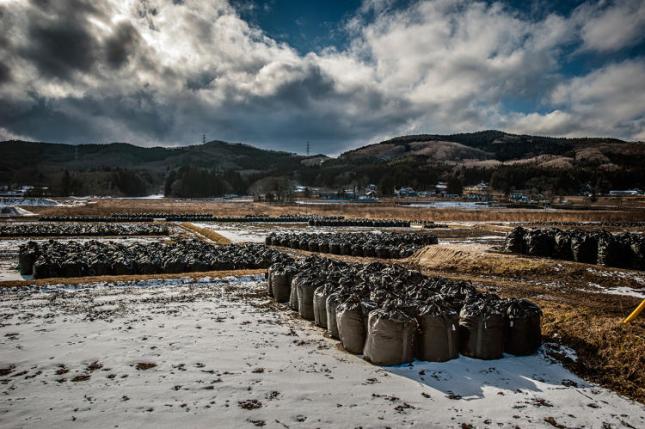
As of 2015, the government reported that there were more than 9 million bags in the prefecture. Some of it will be moved inside the no-entry zone next to the nuclear plant, which is so radioactive that the government has given up on decontamination for the moment. But Japan is also sending radioactive waste to other parts of the country.
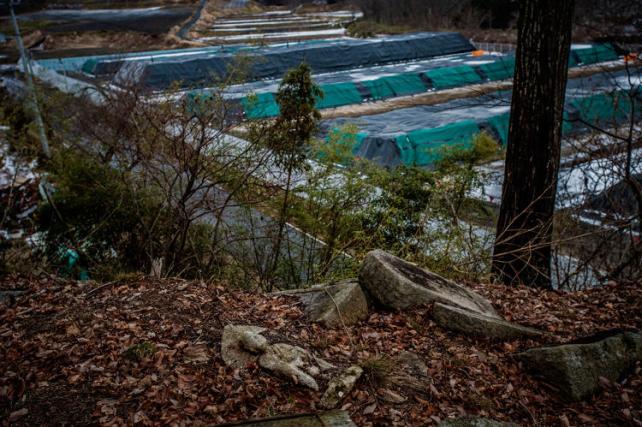
“The Japanese government decided early on in the decontamination process that all prefectures in Japan should share the burden of storing radioactive waste with Fukushima Prefecture,” says Delano, who has been photographing the disaster since it happened in 2011. “This resulted in firm pushback by communities in other prefectures that are adjacent to sites that were selected.”
They have reason to be concerned: In September of 2015, when there were floods in Nikko, Japan, hundreds of bags of radioactive soil were washed into the local river.
Even in Fukushima itself, in villages where many residents may not be able to return for a decade or more, no one wants a radioactive dump next to their former homes. The dumps are supposed to be temporary and moved in 30 years, but people are skeptical that will happen. “They feel like the presence of the site will be like the last nail in the coffin for their communities,” he says. “So, no one wants this contaminated soil.”
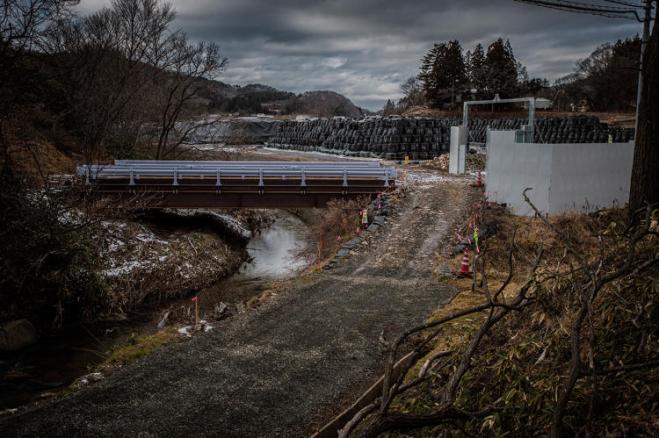
In some areas, a few people have started moving back. “When I used to sneak inside the old 20-kilometer-radius nuclear no-entry zone, I would enter a neighborhood in Minami Soma that was half inside the zone and half outside and hop the barrier to document the absence of humanity,” says Delano. “About one and a half years after the earthquake and tsunami, the no-entry zone was readjusted to reflect the actual radiation levels, instead of being an arbitrary 20-kilometer radius. That meant that the whole neighborhood would be decontaminated and prepared for families to return, if they wanted to do so.”
Some resident returned, but now the fields next to the neighborhood are being cleared for a dump filled with bags of contaminated soil. “People fear the presence of this soil and the dust that every breeze will carry into their neighbor,” he says. “It creates fear and doubt. Many families, especially those with young children, are not returning to this region of Fukushima Prefecture.”

Delano was reluctant to spend much time in the area himself, and carried a Geiger counter and wore a mask while he worked. “I always do my work and get out,” he says. “For example, one hot spot I found in 2012 would expose you to the equivalent of an additional year of natural radiation exposure within 24 hours, if you were to sit there. For obvious reasons, I did not linger there.”
For him, the disaster was personal—he’s lived in Japan for two decades and has Japanese family. Even in Tokyo, the food supply has been affected, and foods are now labeled with the prefecture where they were grown. “You can be careful, but once you go to a restaurant or buy a bento box lunch, all bets are off,” he says.
He also wanted to show how much the area—which was once a peaceful, Vermont-like region of farms—has changed. “It is some of the most beautiful country in Japan,” he says. “This natural beauty only reinforces the sense of loss.”
Nuclear power proponents still scoffing at public safety concerns
An Otsu District Court injunction has suspended operations of two reactors at Kansai Electric Power Co.’s Takahama nuclear power plant in Fukui Prefecture, one of which was online.
Again, the significance of that development should be taken to heart. Proponents of nuclear power, in particular, should squarely face up to the public anxiety that lies in the backdrop of the court decision. But instead they are boiling with disgruntlement.
 “Why is a single district court judge allowed to trip up the government’s energy policy?” Kazuo Sumi, a vice chairman of the Kansai Economic Federation, said resentfully.
“We could demand damages (from the residents who requested the injunction) if we were to win the case at a higher court,” Kansai Electric President Makoto Yagi said, although he prefaced his remark with a proviso that he is arguing only in general terms.
The government is maintaining a wait-and-see attitude.
The decision called into question the appropriateness of the Nuclear Regulation Authority’s new regulation standards and government-approved plans for evacuations in case of an emergency.
But NRA Chairman Shunichi Tanaka argued, “Our standards are nearing the world’s top level.”
And the government has no plans to review its emergency evacuation plans. It has only reiterated that it will “proceed with restarts of nuclear reactors in paying respect to NRA decisions.”
The Otsu decision is the third court order issued against the operation of nuclear reactors since the meltdowns five years ago at Tokyo Electric Power Co.’s Fukushima No. 1 nuclear power plant.
There has, in fact, been no fixed trend in court decisions. Another court rejected residents’ request last year for an injunction against reactor restarts at Kyushu Electric Power Co.’s Sendai nuclear plant in Kagoshima Prefecture.
But courts appear to be playing a more active role now than before the Fukushima disaster.
The nuclear proponents’ reactions reveal an underlying thinking: “The use of nuclear power is indispensable for Japan, which does not abound in energy resources. The government set up the NRA following the Fukushima disaster to increase expert control. Regional utilities have also taken safety enhancement measures. Courts are therefore asked not to meddle.”
But they should have a deeper understanding that this argument is no longer convincing to the public and court judges.
Some critics say the latest decision deviated from the 1992 Supreme Court ruling saying that decisions on the safety of nuclear plants should be made by administrative organs on the basis of expert opinions. But that argument is also off the mark.
The ruling, given in a case over Shikoku Electric Power Co.’s Ikata nuclear plant, certainly presented that point of view. But it also stated that the objective of safety regulations based on the Law on the Regulation of Nuclear Source Material, Nuclear Fuel Material and Reactors is to “make sure that no serious disaster will happen by any chance.”
A safety net, left in the hands of experts, collapsed all too easily during the Fukushima disaster, turning the phrase “by any chance” into reality.
Courts, which are the guardians of law, should rather be commended for trying to find out independently, to the extent that they can, if there is enough preparedness when a nuclear reactor will be restarted.
The latest alarm bell sounded by the judiciary sector provides an opportunity to ask once again why all the safety measures taken after the Fukushima nuclear disaster are still struggling to win the trust of the public.
The Fukushima disaster changed the awareness of the public. The judiciary sector was also affected.
It is high time for a change among nuclear proponents.
Fukushima: Where mountains and forests cannot be decontaminated

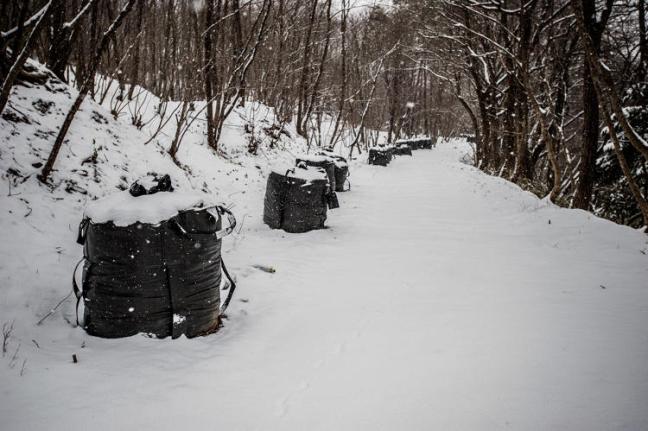
In the background, workers in Iitate village go about their daily routine of removing the layer of irradiated topsoil, which are then placed in stacks of black bags
FUKUSHIMA, JAPAN – Up to 20,000 workers have been toiling to decontaminate towns and villages to clear the way for evacuated residents to return following the Fukushima nuclear plant disaster.
In head-to-toe protective gear, their primary task is removing by shovel and machinery topsoil contaminated with radioactive caesium, which leaked from the crippled power station when a tsunami swamped it five years ago.
The soil is put into plastic flexible container bags and transported by truck to isolated temporary storage sites, where they are surrounded with bags of clean soil to “seal” off emitted radiation. The interim facilities will receive some 22 million cubic m of soil from 43 cities, towns and villages across Fukushima prefecture. It will be put there for 30 years.
Soil under trees, in roadside ditches and places such as drain spouts get particular attention. This is where the radioactive pollutants tend to concentrate after being washed off roofs and pavements by rain and snow.

Once considered among the most beautiful villages in Japan, the farmlands of Iitate are now dotted with black bags – called ‘flexible container bags’ – holding contaminated soil.
The cleanup process also includes brushing and wiping rust or stains from roofs, removing sediment, washing roadside ditches and removing leaves from under trees.
But there remains a sizeable area where decontamination was suspended due to high radiation levels, including Futaba district, where the power plant is located.
The disaster also contaminated vast amounts of paddy straw and grass with radioactive material. This has led to plans for facilities for “designated waste”, which from Fukushima alone accounts for around 140,000 tonnes. It is now temporarily stored on farmland and at waste incineration plants.
The radiation reality will last for years to come.
“While it is possible to decontaminate residential areas, the same cannot be done with mountains and forests. You can’t remove all the trees. But radioactive matter has contaminated trunks and leaves, and when rain falls, these particles return to the ground,” said Ms Emiko Fujioka, secretary-general of non-profit group Fukushima Beacon.
China’s move towards renewable energy power on the grid: new high voltage transmission lines

 China pushes for mandatory integration of renewable power, Reuters, 28 Mar 16, BEIJING China has ordered power transmission companies to provide grid connectivity for all renewable power generation sources and end a bottleneck that has left a large amount of clean power idle, the country’s energy regulator said on Monday.
The grid companies have been ordered to plug in all renewable power sources that comply with their technical standards, the National Energy Administration (NEA) said.
China’s power is primarily delivered by the State Grid Corp of China [STGRD.UL] and the China Southern Power Grid Co [CNPOW.UL], with the latter responsible for delivering electricity in five southern provinces and regions.
China has become the world’s biggest wind and solar power user, but a large amount of renewable power has not been able to reach the grid because transmission capabilities are lagging generating capacity by around three to five years.
The State Grid is banking on building new ultra-high voltage (UHV) long-distance transmission lines to fill the gap. “The construction of UHV lines are to help with cross-regional power delivery,” said Wang Yanfang, a State Grid spokeswoman, referring to the need to deliver power from remoter regions to energy-hungry eastern China…….http://www.reuters.com/article/us-china-power-renewables-idUSKCN0WU0RF
Big expansion of wind power for China
 China Plans 22% Boost for Wind Power Capacity After Record 2015 http://www.bloomberg.com/news/articles/2016-03-21/china-plans-22-boost-for-wind-power-capacity-after-record-2015 Mar 21 16
-
Government plan to develop 30.83 gigawatts of wind power
-
New developments restricted in places where turbines are idle
The nation plans to develop 30.83 gigawatts of wind power this year, the National Energy Administration said in a statement on its website on Monday. It added 33 gigawatts in 2015, triple France’s entire capacity of the clean resource, according to data from NEA.
Developers rushed to deliver projects last year before tariffs paid for clean energy were reduced, and the support levels on offer this year are generous enough to keep drawing in investment.
The central province of Henan will have the most wind power projects approved this year, with the eastern province of Shandong following, according to NEA.
Wind installations in China have almost doubled since 2012 to 139 gigawatts, according to data compiled by Bloomberg. The rapid growth of wind power has left the grid struggling to connect all the plants, forcing wind turbines to sit idle.
China is clamping down on the ability of local authorities to plan new wind projects in some of the windiest provinces because the pace of building to date has outstripped the grid’s ability to absorb new power flows. Those places include the northern provinces of Inner Mongolia, Jilin, Heilongjiang, Gansu, Ningxia and Xinjiang.
Spanner in the works of Japan’s planned nuclear power revival

 Japan’s Nuclear Energy Comeback Takes a Tumble IEEE Spectrum, By John Boyd, 29 Mar 16, Just when it seemed Japan was poised to get its nuclear plants up and running again after the 2011 accident at Fukushima Daiichi brought about the shutdown of all the country’s nuclear operations, a series of mishaps has raised doubts over the government’s ability to achieve its goal of supplying 20-22 percent of Japan’s energy needs with nuclear power by 2030.
Last month, TEPCO, the regional electric utility that operated the Fukushima plant, issued a press release admitting that according to the results of a recent investigation, staffers had not followed guidelines requiring them to quickly declare a meltdown following the Daiichi accident.
“In the course of our investigations, it was discovered that TEPCO’s internal manual at the time clearly stated that a core meltdown was to be determined if the percentage of core damage exceeded 5%,” states the release. It goes on to say that, “We have confirmed that there were events where it may have been possible to issue notifications and reports more promptly immediately after the tsunami hit on March 11, 2011.”
Two days before last month’s TEPCO announcement, Kansai Electric Power Co. (KEPCO, which serves the Osaka and Kyoto regions) revealed that it had found a leak on 20 February in the filtering system of the Unit 4 reactor at its Takahama Nuclear Plant in Fukui Prefecture, some 500 kilometers west of Tokyo. A contaminated pool of water was also discovered. The incident happened during preparations to restart the reactor after Japan’s Nuclear Regulatory Authority’s (NRA) had deemed it safe to go back on line.
“Subsequently, the puddle was wiped [up] and it was confirmed that there was no remaining contamination,” the KEPCO announcement explained.
Convinced that all was well, KEPCO started up the reactor on 26 February. It shut down automatically three days later due to a “main transformer/generator internal failure,” the company reported.
But the biggest blow came on 9 March, when the District Court in Otsu, Shiga Prefecture, located near the Takahama plant—though unprecedentedly not in the same prefecture—ordered the immediate shutdown of Units 3 and 4. The decision came after it agreed with a group of local plaintiffs that the plant did not satisfy all the NRA safety requirements. The Unit 3 reactor had gone back online in January………
, says the University of Tokyo’s Terai, “Should there be more legal actions of this kind inside and outside the prefectures where the plants are located, the power companies would face serious problems in starting up their nuclear power plants.”
Given that some 30 lawsuits and petitions for injunctions have been reported in the press, such an outcome seems likely. Currently, the NRA is reviewing 20 nuclear reactors in 16 power stations to see if they meet the new regulatory rules. Meanwhile, the Takahama closures leave just two reactors in operation—both at the Sendai plant run by Kyushu Electric Power Co., also in western Japan.
Clearly, the power companies’ missteps are not helping the NRA’s efforts to rebuild trust with citizens—a critical factor in winning the necessary approval of local governments……http://spectrum.ieee.org/energywise/energy/nuclear/japans-nuclear-energy-comeback-takes-a-tumble
US govt no longer worried about Japan’s plutonium stockpiling as weapons proliferation risk?
U.S. official changes stance on Japan’s nuclear policy http://the-japan-news.com/news/article/0002840098 By Seima Oki / Yomiuri Shimbun Correspondent , 29 Mar 16, WASHINGTON — U.S. Assistant Secretary of State Thomas Countryman said in a press conference by telephone on Monday that Japan’s nuclear fuel cycle project, which reuses spent nuclear fuel from nuclear power plants to extract plutonium, does not raise concerns about nuclear nonproliferation, effectively changing his earlier position on the matter.
At a hearing of the U.S. Senate’s Foreign Relations Committee on March 17, the assistant secretary in charge of international security and nuclear nonproliferation had voiced his concerns about Japan’s nuclear policy and said that it would be desirable for Japan to halt its nuclear fuel reprocessing project.
In the press conference, Countryman said that Japan was a pioneer in the civilian use of nuclear energy and that no other country was closer or more important as a partner to the United States than Japan.
Japan’s stockpiling of plutonium has been criticized by China at U.N. meetings and on other occasions. To this, Countryman said that Japan has been proceeding in a transparent manner, which was understandable to the rest of the world.
He also expressed his stance that the U.S. government will cooperate with Japan as an ally to wipe out anxiety in the international community.Speech
India needs to come on itys nuclear security issues

 Come clean on nuclear security http://www.thehindu.com/opinion/op-ed/come-clean-on-nuclear-security/article8406194.ece THE HINDU, NARAYAN LAKSHMAN 29 Mar 16,
If India is more open about discussing its nuclear weapons programme with a view to ultimately denuclearising the neighbourhood, it would be one of its most courageous contributions
This week, Prime Minister Narendra Modi will touch down in Washington, DC for the fourth and final Nuclear Security Summit, a biennial conference series initiated in 2010 by the Barack Obama administration. Mr. Modi will no doubt seek to showcase India’s nuclear regime as one that adheres to the highest standards of transparency and safety through rigorous regulation of nuclear products and institutions. Although that would be welcome, what Mr. Modi’s interlocutors in the U.S. may be hoping for is that he will break with India’s tradition of maintaining a masterful silence on two questions surrounding its nuclear policy. First, how can India address disquieting signals that have emerged in recent times, which point to growing concerns over the security of its nuclear materials? Second, at a time when India’s macro strategy of rapid economic development is premised on a climate of neighbourly peace and stability in the region, is it not appropriate that Mr. Modi call for an end to the nuclear arms race in Asia, and address environmental risks of India’s covert weapons plants?
Let us consider each of these questions in turn.
India’s nuclear security
First, the need for heightened nuclear security has now become urgent, especially with the emergence of global jihadi threats such as the Islamic State. In this context, three potential nuclear terrorist threats relate to extremists making or acquiring and exploding a nuclear bomb; the danger of radioactive material being fashioned into a “dirty bomb”; and the risk of nuclear reactor sabotage.
The first and second scenarios are vectors of imminent concern in Pakistan, with analysts citing as examples a series of terrorist attacks in 2007 on nuclear weapons facilities in that country, including a nuclear missile storage facility at Sargodha and a nuclear airbase at Kamra.
However, a paper published earlier this month by Harvard University’s Kennedy School of Government cautioned that U.S. officials ranked Indian nuclear security measures as “weaker than those of Pakistan and Russia”, and U.S. experts visiting the sensitive Bhabha Atomic Research Centre (BARC) in 2008 described the security arrangements there as “extraordinarily low key” Further, the Harvard report notes, there are concerns about threats within Indian nuclear facilities stemming in part from “significant insider corruption”, and what appears to be inconsistent strength of regulation. An example that the report cites relates to the 2014 case of Vijay Singh, head constable at the Madras Atomic Power Station at Kalpakkam, who shot and killed three people with his service rifle. According to the report, this event may have been avoided had the Central Industrial Security Force’s personnel reliability programme been able to detect Mr. Singh’s deteriorating mental health, which it failed to do “despite multiple red flags, including his telling colleagues that he was about to explode like a firecracker.” With a scarcity of data points on insider threats and the attendant concerns about sabotage and nuclear accidents, the unsurprising conclusion of the report was: “Given the limited information available about India’s nuclear security measures, it is difficult to judge whether India’s nuclear security is capable of protecting against the threats it faces.”
Weapons development programme
This brings us to the second question, which relates to India’s clandestine weapons development programme.
Set within the broader context of nuclear deterrence vis-à-vis Pakistan and China, it has quietly steamed forward since the 1998 Pokhran-II tests. Recent evidence that this shadowy realm of government activity has been proceeding apace beyond the scrutiny of the media and public surfaced in June 2014when IHS Jane’s, a U.S.-based military intelligence think tank, discovered satellite imagery showing efforts underway to extend a Mysore nuclear centrifuge plant constructed in 1992 at the Rare Metals Plant at that location. According to Jane’s, the purpose behind this extension may have been the covert production of uranium hexafluoride, which could be channelled towards the manufacture of hydrogen bombs or naval reactors to power India’s nuclear submarine fleet.
One month later, another U.S. think tank, the Institute for Science and International Security, revealed additional satellite imagery suggesting that India was building a Special Material Enrichment Facility, including constructing an industrial-scale centrifuge complex in Chitradurga district in Karnataka. Some time during 2009 and 2010, approximately 10,000 acres of land were allegedly diverted at that site for various defence purposes, including 290 acres in Khudapura allocated to the Defence Research and Development Organisation (DRDO) for developing and testing drones.
A few years later, in December 2015, a study by the Centre for Public Integrity (CPI), reported in Foreign Policy magazine, confirmed that India’s under-radar ambition to acquire thermonuclear weapons at the Chitradurga site had advanced much further than many had suspected.
There are likely to be a number of other such walled-off weapons development zones across the breadth of the country, and this begs two critical questions. First, what are the broader implications of India’s covert nuclear programme for the triangular standoff vis-à-vis Pakistan and China? Second, while the Nuclear Liability Law protects its citizenry from the potentially catastrophic fallout of a nuclear accident in the civilian nuclear sector, what guarantees do we have that India’s nuclear black sites do not endanger the health of the people and the environment?
On the first question, India’s search for thermonuclear weapons certainly exacerbates the nuclear arms race with its neighbours, specifically by sparking dangerous games of tit-for-tat weaponisation, loose talk about tactical superiority and theatre nukes, and growing doubts about deterrence stability. The region is already a potential hothouse of nuclear posturing — a fact corroborated by the independent Stockholm International Peace Research Institute’s estimates that India has something in the range 90-110 nuclear weapons, Pakistan has around 120, and China has close to 260.
Environmental impact
On the question of environmental impact, evidence suggests that the Chitradurga and Khudapura sites may be degrading the surrounding grassland ecosystems called kavals, which are habitats for critically endangered local species such as the Great Indian Bustard, the Lesser Florican and the Black Buck, not to mention the livelihoods source for thousands of pastoral communities.
In February 2014, NGOs in Karnataka including the Environment Support Group complained about government land acquisitions for DRDO and BARC in the Challakere in Chitradurga, and obtained a direction from the National Green Tribunal to halt construction activity that had commenced without securing permission from the Karnataka Forest Department and the Union Ministry of Environment and Forests.
Since then, it is unclear whether the government ever paused its weapons development activity to conduct proper environmental assessments, but the CPI study indicates otherwise, citing as evidence an October 2012 letter marked “Secret” from the Ministry to atomic energy officials which suggested approval of the Mysore site’s construction as “a project of strategic importance” that would cost nearly $100 million.
When he meets Mr. Obama at the end of this month, Mr. Modi may come laden with a “house gift” as a sign of India’s sustained commitment to nuclear security. If this could be an indication that India is willing be more open about discussing its nuclear weapons programme with a view to ultimately denuclearising the neighbourhood, it would by far be one of the most courageous contribution that India could make towards a lasting subcontinental security.
1 This Month





PLEASE OPPOSE HR 8255 AND S.3639 – bills would accelerate satellite deployment, with no environmental review or safeguards – https://ncstd5li.quorum.us/campaign/169331/
To see nuclear-related stories in greater depth and intensity – go to https://nuclearinformation.wordpress.com
-
Archives
- October 2026 (74)
- September 2026 (339)
- August 2026 (330)
- July 2026 (355)
- June 2026 (287)
- May 2026 (306)
- April 2026 (356)
- March 2026 (251)
- February 2026 (267)
- January 2026 (308)
- December 2025 (358)
- November 2025 (359)
-
Categories
- 1
- 1 NUCLEAR ISSUES
- business and costs
- climate change
- culture and arts
- ENERGY
- environment
- health
- history
- indigenous issues
- Legal
- marketing of nuclear
- media
- opposition to nuclear
- PERSONAL STORIES
- politics
- politics international
- Religion and ethics
- safety
- secrets,lies and civil liberties
- spinbuster
- technology
- Uranium
- wastes
- weapons and war
- Women
- 2 WORLD
- ACTION
- AFRICA
- Atrocities
- AUSTRALIA
- Christina's notes
- Christina's themes
- culture and arts
- Events
- Fuk 2022
- Fuk 2023
- Fukushima 2017
- Fukushima 2018
- fukushima 2019
- Fukushima 2020
- Fukushima 2021
- general
- global warming
- Humour (God we need it)
- Nuclear
- RARE EARTHS
- Reference
- resources – print
- Resources -audiovicual
- Weekly Newsletter
- World
- World Nuclear
- YouTube
-
RSS
Entries RSS
Comments RSS

