Fukushima Daiichi Contaminated Waste to Be Recycled into Construction Materials
Japan to Recycle Waste Collected during Fukushima Decontamination
TOKYO – The Japanese government announced Wednesday it will recycle the material collected during the decontamination of the Fukushima nuclear plant for construction purposes if radiation levels are found to be sufficiently low.
The government plans to store the waste collected from the radiation-affected region and use it as construction material in places outside the prefecture in northeastern Japan, within 30 years, reported state broadcaster NHK.
According to the country’s environment ministry, residue showing less than 8,000 becquerel per kg could be used in future to pave roads, build anti-tsunami walls and in other public works.
Over 90 percent of the material, accumulated since the 2011 disaster, could be re-used if the contaminated elements are removed, according to the authorities, who are, however, yet to develop the technology to separate waste with high radiation levels.
Currently, Fukushima authorities store the radioactive waste at two depots close to the plant, which can store up to 30 million tons.
The waste will remain at these storage sites for the next 30 years, to be later transferred to a definitive storage place, whose location remains to be determined, and to be used in public works if cleared of high radiation levels.
The Fukushima crisis has been the worst nuclear accident in history after the 1986 Chernobyl disaster in Ukraine.
The nuclear plant, which suffered a meltdown in the aftermath of the earthquake and subsequent tsunami that struck the country on March 11, 2011, is now being dismantled, a task that will take at least four decades to complete.
http://www.laht.com/article.asp?ArticleId=2408901&CategoryId=12395
India’s planned 12 new nuclear reactors are not economically viable – report
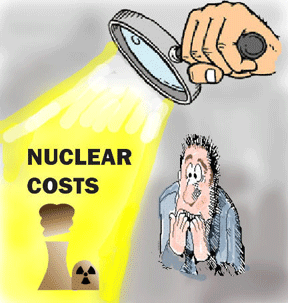
 New Report Claims India’s 12 New Nuclear Reactors Are Economically Unviable http://cleantechnica.com/2016/03/31/new-report-claims-indias-12-new-nuclear-reactors-economically-unviable/?utm_source=feedburner&utm_medium=feed&utm_campaign=Feed%3A+IM-cleantechnica+%28CleanTechnica%29 March 31st, 2016 by Joshua S Hill
A new report published by the Institute for Energy Economics and Financial Analysis has concluded that India’s plans to build 12 new nuclear reactors is economically unviable.
According to the new report (PDF), published this week by the Institute for Energy Economics and Financial Analysis (IEEFA), India’s current plans to build 12 new nuclear-powered plants is not only economically unviable, but fraught with risk, as the plants are intended to be a “first-of-its-kind” design that is untested. As such, the development of the nuclear power plants would likely result in numerous delays and technical problems.
David Schlissel, IEEFA’s director of resource planning analysis, concludes that the proposed nuclear plants, designed by Toshiba-Westinghouse and General Electric-Hitachi, and planned for the Mithi Virdi and Kovvada complexes, “are neither economically nor financially viable.” The plans intend for the 12 plants to be built across two separate sites in India. Six would be sited at Mithi Virdi in Gujarat, and would use the new Westinghouse AP1000 reactor design — which Schlissel notes has already “run into technical problems and significant cost increases and schedule delays” in other locations where the design is already under construction. The other six new plants, intended to be developed in Kovvada in Andhra Pradesh, would use GE’s Economic Simplified Boiling Water Reactor (ESBWR) design, and would be the first country in the world to develop this particular design.
“They would take much longer than expected to build, they would result in higher bills for ratepayers, and, if they are built, they might not work as advertised,” Schlissel said.
The report also noted that the development of the new nuclear power plants would come at the expense of solar, leading the author to conclude that India would do well to instead direct that money and effort into developing solar resources. “Investing in new solar photovoltaic (PV) capacity would be a much lower-cost, significantly less environmentally harmful and far more sustainable alternative to the Mithi Virdi and Kovvada projects,” Schlissel said.
Among the report’s specific findings:
- Capital costs of the 12 plants would far exceed those of comparable solar-energy projects and, barring long-term and probably unsustainable government subsidies, consumers will pay more for electricity from the plants than they would for solar energy
- The first new reactors in the expansions at Mithi Virdi and Kovvada will take 11 to 15 years to build, if approved, even assuming the projects manage to avoid likely delays. None of the new reactors at Mithi Virdi and Kovvada would generate any power for the electric grid until sometime between 2029 and 2032. The remaining units at each project are unlikely to be completed, if approved, until late in the 2030s
- Even without likely time-and-cost overruns, both projects would require massive investment over the next two decades, ranging from Rs. 6.3 lakh crores (US $95 billion) to 11.3 lakh crore rupees (US $170 billion). It is unlikely that the Indian government would be able to simultaneously support other electricity-sector expansions, including in renewable resources and energy-efficiency programs
- Both projects, if approved, would probably be slowed by lengthy land-acquisition delays, complicated liability issues, lags associated with new-technology difficulties and compliance with the country’s “Make in India” policy
“All of these can be expected to lead to substantial, and perhaps indefinite, delays and significant increases in capital costs, possibly even far beyond those we have assumed in our analyses,” Schlissel said.
Chinese President Xi Jinping urges international co-operation on nuclear security
Chinese president charts course for strengthening global nuclear security system, New China WASHINGTON, April 1 (Xinhua) –– Chinese President Xi Jinping on Friday urged countries around the world to increase national input and expand international cooperation so as to further firm up the global nuclear security architecture.
He made the appeal in a speech delivered here at the opening plenary of the fourth Nuclear Security Summit (NSS) and titled “Strengthen Global Nuclear Security Architecture and Promote Global Nuclear Security Governance.”
A FOUR-PRONGED PROPOSAL
In his speech, Xi noted that the NSS process has provided a major boost to international nuclear security, including developing common goals, establishing key priorities and mapping out the blueprint for the future.
However, he pointed out, new threats and challenges keep emerging in the security field, the root causes of terrorism are far from being removed, and nuclear terrorism remains a grave threat to international security.
“A more robust global nuclear security architecture is the prerequisite for the sound development of nuclear energy,” he said.
Recalling that he envisioned the building of a global nuclear security system featuring fairness and win-win cooperation at the third NSS in The Hague in 2014, Xi laid out a four-pronged proposal for the international community to make fresh efforts.
Countries across the world need first to step up political input and stick to the direction of addressing both symptoms and root causes, said the Chinese president.
“As national leaders, we have the responsibility to ensure that nuclear security gets adequate attention,” he said, adding that only with a solution that addresses both symptoms and root causes can the world “remove the breeding ground of nuclear terrorism at an early date.”……..http://news.xinhuanet.com/english/2016-04/02/c_135245822.htm
|
|
Multiple rivers in Fukushima Prefecture have radioactive sediments

 Radioactive sediment found in Fukushima rivers Zee News , April 1, 2016 – Tokyo: Japanese researchers have detected relatively high levels of radioactive substancesin sediment in multiple rivers running through Fukushima prefecture, the media reported on Friday. The prefectural government in January surveyed the density of radioactive materials in soil and other sediment that has accumulated on the bottoms and banks of 72 rivers in the prefecture, public broadcaster NHK reported…..
The researchers found up to 54,500 becquerels per kg of radioactive substances in the Maeda river in Futaba town, where the plant is situated, and 39,600 becquerels in the Hiru river in Fukushima city. They also detected more than 10,000 becquerels at five other locations in four municipalities…….
The prefectural government plans to study restricting access to rivers with high concentrations of radioactive materials.
It also plans to urge the central government to remove contaminated soil and other sediment. http://zeenews.india.com/news/world/radioactive-sediment-found-in-fukushima-rivers_1871348.html
China, USA, strike deals on climate and nuclear security
Despite disputes, U.S., China strike climate, nuclear deals David Jackson, USA TODAY April 1, 2016 WASHINGTON — Despite ongoing disputes over cyber espionage, intellectual property, and the South China Sea, the United States and China struck deals Thursday on nuclear security and climate change.
The two nations agreed to sign the new global climate change agreement on April 22, the day it becomes operational; the agreement reached in Paris late last year calls on countries to develop plans to reduce greenhouse gas emissions.
“We’re committing to formally join it as soon as possible this year, and we urge other countries to do the same,” President Obama said before meeting with Chinese President Xi Jinping on the sidelines of the bi-annual nuclear security summit.
As for that topic, the United States and China issued a joint statement pledging more cooperation on efforts to improve the storage and security of nuclear material in an effort to prevent nuclear terrorism………http://www.usatoday.com/story/news/2016/03/31/obama-xi-jinping-china-climate-change/82483840/
Rural Indians’ lawsuit against coal power plant is dismissed by USA judge
U.S. judge nixes lawsuit against World Bank over power plant in India BY SEBASTIEN MALO http://www.reuters.com/article/us-india-lawsuit-worldbank-idUSKCN0WW2H2 NEW YORK (Thomson Reuters Foundation) 30 Mar 16 – A U.S. federal judge has dismissed a lawsuit filed by Indian fishermen and farmers who sued the World Bank over a loan for a power plant they claimed ravaged the environment.
The World Bank’s International Finance Corporation (IFC) is shielded by immunity and cannot be sued in the United States, the U.S. District Court judge ruled.
The IFC loaned $450 million to help build the coal-fueled Mundra power plant in India’s coastal region of Gujarat, which became fully operational in 2013.
The Indian company that carried out the project, Coastal Gujarat Power Limited, a subsidiary of Tata Power, said it would create jobs, benefit 16 million domestic consumers and provide competitively priced electricity to industry and agriculture.
But fishermen, farmers and others living near the plant said it took a huge toll on the environment.
Saltwater leaking from the plant made groundwater undrinkable and unfit for irrigation, hot water from the cooling system harmed the fish catch and air quality suffered, they said in the U.S. lawsuit filed last year in the District of Columbia.
Their way of life could be “fundamentally threatened or destroyed,” the complaint said, accusing the IFC of irresponsible and negligent conduct in financing and supervising its loan.
But U.S. District Court Judge John Bates in a ruling last week said under the International Organizations Immunities Act, the IFC is immune to prosecution in the United States.
The Indians plan to appeal, the U.S. nonprofit EarthRights International, which filed the lawsuit, told the Thomson Reuters Foundation.
“This is a fight for our lives and livelihood,” Gajendrasinh Jadeja, head of Navinal Panchayat, a village that is a party in the case, said in an email.
“We believe we will prevail,” Jadeja said.
An IFC spokeswoman said the organization would not comment on active legal matters.
A plan being implemented by Coastal Gujarat Power, however, includes what she called “mitigation measures,” she said, but she did not elaborate.
The World Bank and IFC have come under criticism by groups that contend their focus on big projects can disrupt the environment and displace people.
The IFC, with 184 member countries, is the “largest global development institution focused exclusively on the private sector in developing countries,” according to its website.
(Reporting by Sebastien Malo, Editing by Ellen Wulfhorst. Please credit the Thomson Reuters Foundation, the charitable arm of Thomson Reuters, that covers humanitarian news, women’s rights, trafficking, land rights and climate change. Visit news.trust.org)
China is building a national electricity grid

Like the US, China wants a national electricity grid. Unlike the US, China’s just building it. Vox, by David Roberts on March 30, 2016, Wind and sunlight are often concentrated in sparsely populated, remote areas. Getting wind and solar power to the population centers where it’s needed involves building long-distance power lines. Lots of them.
Earlier this week I wrote about a new long-distance power line in the US and the long, slow path it took to win approval. It was proposed in 2009; construction is expected to begin next year and finish in 2020. Like everything involving electricity in the US, it had to navigate a skein of overlapping jurisdictions, multiple state and local authorities, and federal rules. Every landowner and stakeholder had their say.
Like the US, China aspires to build a comprehensive national grid that can carry energy from where it’s generated to where it’s needed. Unlike the US, China isn’t forcing each piece of that system to go through a Byzantine series of bespoke processes and reviews. It’s just building, building, building like crazy.
China’s renewable energy is bottled up
China has the same problem the US does: Its most concentrated wind and sunlight are found in remote areas (in the north and west), distant from the populous industrial cities where the power is needed (in eastern coastal regions).
For years, the government has pushed a rapid buildout of renewable energy; the country now boasts the highest renewable energy growth rates and the most wind and solar capacity of any country in the world.
But now it has, at least temporarily, overbuilt. In those energy-dense regions, there is more wind and solar capacity than there is transmission to carry it. So a lot of that power is going unused.
China’s transmission lines will be big, and hooking up wind and solar will be mandatory
Because everything is bigger in China, the country is not building mere high-voltage transmission lines, like those being built (slowly) in the US. It’s building ultra high-voltage (UHV) lines.
By way of comparison: The US Plains & Eastern Clean Line, the high-voltage direct-current line from Oklahoma to Tennessee I wrote about the other day, will run at about 600 kilovolts, give or take. UHV lines run at 800kV, even up to 1000kV.
Building a countrywide grid is one of the government’s top priorities. According to Reuters, “China currently has 17 UHV transmission lines in operation or under construction.”…………http://www.vox.com/2016/3/30/11332900/china-long-distance-transmission
Manga convey realities of living in Tohoku disaster areas
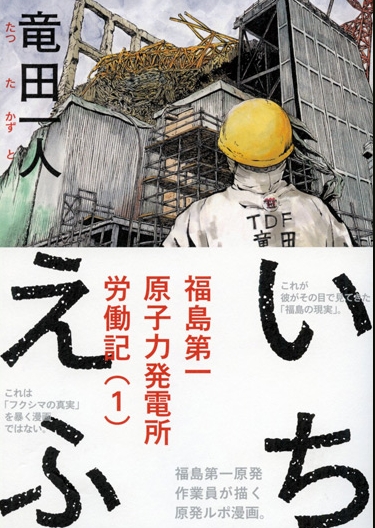
Although words of praise poured in for Kazuto Tatsuta’s manga about the Fukushima nuclear disaster, some comments said he was a spy for Tokyo Electric Power Co.
The artist, who went to great lengths to show the true situation around TEPCO’s Fukushima No. 1 nuclear plant, scoffed at the notion.
“As for nuclear power generation, I have never taken stances of ‘promotion,’ ‘opposition’ or ‘neutral.’ I just wanted to convey the changes of the place (at the nuclear plant) in real time,” he said.
His manga series, “Ichiefu Fukushima Daiichi Genshiryoku Hatsudensho Rodoki” (1F; Records of labor at Fukushima No. 1 nuclear power plant), was one of several that started after the triple disaster struck five years ago.
Some of them initially offered messages of encouragement to the disaster victims. But they gradually changed to depict the realities of the situation in the northeastern Tohoku region and the disaster victims’ extraordinary experiences.
Tatsuta’s series, carried in the weekly magazine Morning, was based around the sites of demolition work at the nuclear plant.
He was working at a company of an acquaintance near Tokyo when the Great East Japan Earthquake struck on March 11, 2011. Tatsuta looked for a job in areas affected by the disaster, and ended up working at a rest station of the nuclear plant as an employee of the sixth-layer subcontractor in June 2012.
In 2013, Tatsuta started “Ichiefu” to show the daily lives of workers at the plant.
His work drew much attention and acclaim. But some said the artist was underestimating the dangers of nuclear power generation. The series ended in October 2015.
Yoko Hano depicted the daily post-disaster lives of a different group–senior high school students in Fukushima Prefecture.
She started the serialized manga “Hajimari no Haru” (Spring as a beginning) because she also wanted to convey the truth. The comic is currently carried under the title of “Happy End?” in the Monthly Afternoon magazine.
Hano, who is from Nishigo in Fukushima Prefecture, now lives in Shirakawa, also in the prefecture.
“From the time immediately after the outbreak of the disaster, I saw false information from the media that was slipshod in confirming facts,” she said. “A person in my neighborhood was cornered by the situation caused by the disaster and committed suicide. I thought that unless accurate information is offered, our local communities will be destroyed.”
The protagonists in her manga learn about agriculture. They vow to reconstruct their hometowns and start taking action despite being shaken by nuclear accident.
“Here (in Fukushima Prefecture), there are many themes I should tackle throughout my life. I think that people who are making a living with jobs related to expression and speech should migrate to Fukushima,” Hano said.
In the serialized manga “Gogai! Iwate Chaguchagu Shinbunsha” (Extra edition! Iwate Chaguchagu newspaper company), the protagonist is a female reporter with a local newspaper in Iwate Prefecture.
Its creator, Aruto Asuka, who lives in Ichinoseki in the prefecture, began to carry the manga in the comic magazine Be Love, published twice a month, in 2009. Initially, it focused on the people, seasonal traditions and industries of the prefecture.
Then, the Great East Japan Earthquake and tsunami struck in 2011.
The manga now features the reality of the prefecture that was hit hard by the disaster.
Ichinoseki, an inland area, escaped serious damage. However, “that produced big conflicted feelings in my mind,” Asuka recalled.
In a special edition titled “Sanriku no Umi” (Sea of Sanriku), which was carried in the third volume of the book version of the manga, the protagonist visits the coastal district of Koishihama in Ofunato, Iwate Prefecture, for news coverage, and meets a young fisherman and his wife again.
The wife is pregnant but hesitant to give birth because of her feelings for a relative who lost her child and other family members in the disaster.
“I also have feelings of guilt about the fact that I am alive without suffering from any damage,” Asuka said. “I will not forget the various feelings of people (in the affected areas).”
http://www.asahi.com/ajw/articles/AJ201604010061.html
Global electricity network – China’s plan
China Unveils Proposal for $50 Trillion Global Electricity Network
BEIJING — China has unveiled a proposal for a $50 trillion global electricity network that would help fight pollution and the effects of climate change.
The plan envisions linking existing and future solar farms, wind turbines and electricity plants in Asia, Europe, Africa and the Americas, according to the head of State Grid Corporation of China.
The proposal is in its initial stages and would require huge investment from around the world. If it goes ahead, it would be the world’s largest infrastructure project. It could be operational by 2050, according to backers.http://www.nbcnews.com/business/energy/china-unveils-proposal-50-trillion-global-electricity-network-n548376
China eyes export opportunities for global super grid BEIJING, March 31. China’s biggest power transmission company has signed deals with three Asia-Pacific investors to help push its ambition to build a cross-border energy super grid that will help combat climate change, integrate renewable energy sources and boost exports.
http://in.reuters.com/article/china-power-grid-idINL3N173205
R** China’s State Grid envisions $65 trillion world power network
Could a global network be the world’s best bet for overcoming resource scarcity, pollution and climate change?
http://www.theaustralian.com.au/business/wall-street-journal/chinas-state-grid-envisions-65-trillion-world-power-network/news-story/385fc93c6fb9aa3236505a44f1be66d1
Tainted Fukushima towns stuck in time as decon crews plug away
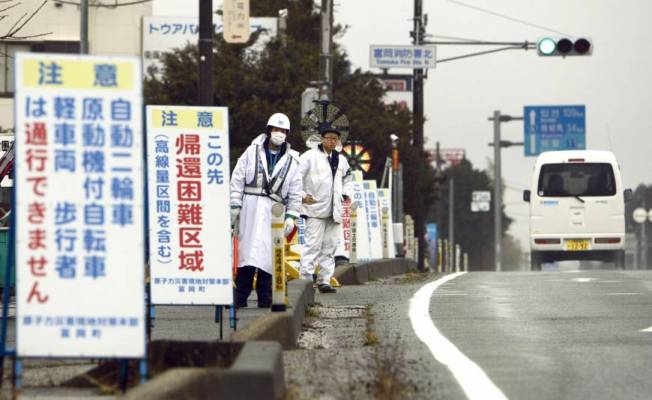
Police and security officers keep watch along National Route 6 leading to the off-limits zone in Tomioka, Fukushima Prefecture, on March 9
FUKUSHIMA – Five years after the nuclear disaster triggered by the huge earthquake and tsunami, reconstruction has made little progress in parts of Fukushima Prefecture. A Kyodo News reporter drove National Route 6 northward to the crippled Fukushima No. 1 nuclear plant to witness the lingering effects of the calamity.
In the town of Hirono, in the southeast, many shops and buildings remain empty. North of Hirono is the town of Naraha, most of which lies within the 20-km-radius hot zone around Tokyo Electric Power Co.’s radiation-leaking power plant.
The nuclear disaster forced Hirono to move its operations to other municipalities in the prefecture, while Naraha was designated an evacuation zone.
Now the towns have a radiation level below 1 millisievert per year — a level the government is trying to achieve in other areas via decontamination — and residence restrictions and evacuation orders have been lifted, with Hirono’s town office returning to its original place.
However, many residents are reluctant to go back to their homes. So far only 48 percent of Hirono’s population and 6 percent of Naraha’s have returned.
Yet hotels and other lodgings were busy accommodating out-of-prefecture workers seeking decontamination and construction work. All 275 rooms at a hotel in Hirono built for the reconstruction support scheme three years ago are “almost fully reserved for the next month,” the front desk clerk said.
A worker in his 50s who came from Tokyo to oversee decontamination work said he earns more than ¥16,000 ($145) per day. Another man staying at the hotel said he was on a three-week contract and received ¥25,000 a day. Their lodging was paid for by their employers.
At night, there was only one pub open in Hirono.
“The shopping area is deserted, although schools have resumed,” said a woman who works there. Still, the pub was full, mainly with visitors not from Fukushima.
In Tomioka, parts of which are still designated as in the “difficult to return” zone, most retail buildings on both sides of the main road have been abandoned and are decaying. Bags of contaminated soil sit piled up near the shore — now a huge makeshift storage site.
In a similar zone in the town of Okuma, which co-hosts the plant, three men in white protective suits were conducting decontamination in a field under a cloud of dust.
Nearby, a large boar suddenly crossed the road.
Soon after the nuclear disaster struck five years ago, untended cows and dogs were seen wandering around looking for food, but now boars are a frequent site, local people say.
In a residential part of Okuma, quake-damaged roads have been fixed but houses are being left as they are. The only sounds are chirping birds and the wind.
At a railway station, radiation over 10 microsieverts per hour is detected just above a covered drain. Although radiation in the “difficult to return” zones in Okuma and neighboring Futaba — the two towns hosting the nuclear plant — is much lower than it was immediately after the meltdowns, there are many hot spots measuring over 5 microsieverts — dozens of times higher than the government’s goal.
A Futaba resident who was showing the area to foreign journalists said, “The word ‘reconstruction’ has no relevance to this town.”
In Minamisoma — farther north of the Fukushima No. 1 complex — some areas are still designated as restricted residential zones.
“The number of jobs, such as decontamination work, has increased, but most of them are taken by people coming from outside the prefecture. We can hardly say this place has been enlivened again,” said Masayoshi Kariura, a Catholic priest.
“The pileup of contaminated soil that is clearly visible is weighing heavily on the residents,” he said.
Co-operation on super grid – China, Pakistan, South Korea
Pakistan, China working to build interconnection power grid: Secy BEIJING – The Ministry of Water and Power and State Grid Corporation of China are working closely to build an interconnection power grid between Pakistan and China so that both the countries could tap each other’s energy potential, said Secretary, Ministry of Water and Power Muhammad Younus Dagha in Beijing on Thursday.
Speaking at the Global Energy Interconnection Conference, the secretary said once the grid was completed, Pakistan would be able to meet its energy demands as per its requirements.http://nation.com.pk/business/01-Apr-2016/pakistan-china-working-to-build-interconnection-power-grid-secy
‘Asia Super Grid’ eyed by Softbank boss takes embryonic step Softbank Group Corp.’s hopes of building a cross-border power grid in Northeast Asia got a welcome nod March 30 when a feasibility study was agreed in Beijing.
SBG, along with State Grid Corp. of China, Russia’s power transmission and distribution company PJSC Rosseti and Korea Electric Power Corp. of South Korea, hopes the grid fired by renewable energy sources such as solar and wind power will be operating by around 2020.http://www.asahi.com/ajw/articles/AJ201603310070.html
Ryuichi Sakamoto offers his thoughts on politics, Japan and how his music will change ‘post-cancer’
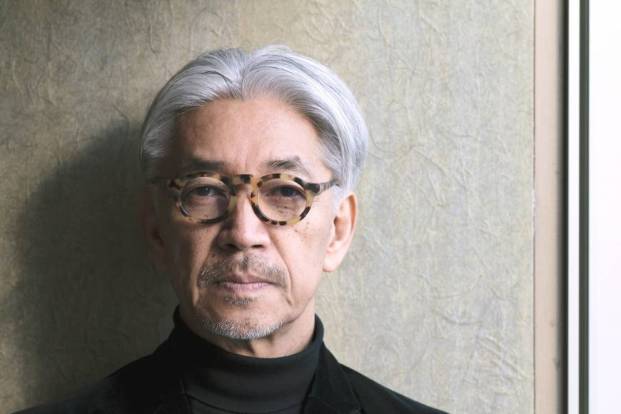
“The Professor” is back in town. Last weekend, Ryuichi Sakamoto took the stage at Tokyo Opera City for the debut concert of the Tohoku Youth Orchestra, a 105-strong ensemble of young musicians from Iwate, Miyagi and Fukushima prefectures, which counts him as its musical director.
Though he isn’t inclined to make a fuss about these things, the occasion also had personal significance for the 64-year-old composer and musician, a longtime New York resident. It was the first concert Sakamoto had played since undergoing treatment for throat cancer in 2014, canceling all engagements in what must be one of the music industry’s busiest work schedules. As he later remarked, it was the first extensive time off he’d had for 40 years.
“It’s the closest I’ve come to death during my lifetime,” he tells The Japan Times, speaking the day after the Tohoku Youth Orchestra concert. “I feel differently since I came back from that place, compared to before. I want to capture the mood I have now, post-cancer, in my music.”
Sakamoto’s unobtrusive return to the limelight was heralded by the soundtracks that he composed for Yoji Yamada’s “Nagasaki: Memories of My Son” and, in collaboration with Carsten Nicolai (aka Alva Noto), for Alejandro G. Inarritu’s “The Revenant.” (The latter film, which earned him a Golden Globe nomination, opens in Japan on April 22.)
Now there’s also the prospect of a new album of original material, his first since 2009’s “Out of Noise.”
“I have a lot of sketches and ideas, but when you don’t use them they get stale,” he says. “You’re changing every day, right? Your curiosities and ambitions change, your ear changes, the music you like changes — and the music you want to make, too … I’m planning to begin work on an album when I get back to New York, but I think I’m probably going to start from scratch.”
Prior to that, Tokyo audiences can catch Sakamoto again next weekend, when he presides over a three-day festival at Yebisu Garden Place, to mark the 10th anniversary of his Commmons label. Rather than perform a headlining set himself, he’ll be playing support roles throughout the weekend: sitting in with some of the musicians, hosting discussions and providing piano accompaniment for communal rajio taisō (radio calisthenics) sessions with the crowd.
Sakamoto established Commmons in 2006 with the rather lofty goal of creating “a place where new relationships can be built between the music industry, the audience, artists and creators.” In addition to releasing music by artists such as Boredoms, Sotaisei Riron and Kotringo, the label has provided a platform for its founder’s prolific musical output, as well as a series of scholarly journals.
One of Sakamoto’s current areas of inquiry is traditional Japanese music, once a blind spot in his otherwise rich musical vocabulary. He studied composition and ethnomusicology at Tokyo University of the Arts, leading his Yellow Magic Orchestra bandmate Yukihiro Takahashi to nickname him “Professor” — a moniker that stuck. Yet the musical system employed by noh theater remains something of a mystery.
“I could understand Bach, but not noh,” he says with a laugh. “It has a 600-year history — it’s very deep.”
Sakamoto has been based in New York since 1990, and seems to value the perspective that life as an expatriate has given him on his native country; his increasing appreciation of Japanese performing arts such as noh, kabuki and gagaku is one example.
“When I lived in Japan, I only noticed the bad aspects of the country,” he says. “I didn’t really like Japan then, but when I moved overseas I was able to appreciate the good side more. The quality of the craftsmanship, the temples and Japanese gardens. … As I’ve got older, I’ve started to appreciate the precious parts of Japanese culture that you don’t find in other countries.”
When he first relocated to the States, Sakamoto was that rarest of things: a Japanese celebrity with global clout. Both in his solo work and with YMO, the techno-pop trio he formed with Takahashi and Haruomi Hosono in 1978, he had positioned himself at the vanguard of synthesizer- and sample-based music.
But it was his movie soundtracks that clinched his international renown, including for Nagisa Oshima’s “Merry Christmas, Mr. Lawrence” (in which he co-starred opposite the late David Bowie) and Bernardo Bertolucci’s “The Last Emperor,” which won him an Academy Award in 1988.
Sakamoto’s subsequent career may not have yielded such boundary-breaking music, but in other ways it has been awfully prescient. He began to use environmentally friendly packaging for his albums in the early 1990s, and was powering his tours on renewable energy long before Radiohead took up the idea. He was also an early adopter of Internet technology, staging his first live online broadcast of a concert in 1995.
“Internet speeds were still really slow then,” he recalls with a laugh. “We’d call it a concert, but you were basically watching static images that changed once every 10 seconds. The audio was all choppy, too.”
While Japanese labels were enjoying record-breaking CD sales during the late ’90s, Sakamoto had already anticipated how online distribution would upend the music industry. He lobbied for changes in the way that copyright licensing body JASRAC (Japanese Society for Rights of Authors, Composers and Publishers) handled music rights online, and cautioned the retail behemoths that their boom times were about to end.
“I was telling the Tower Records people in 1996 or 1997: ‘(CD shops) are going to disappear, you need to think about it,’ ” he says. “I thought they’d be able to get in early and make something like what we have with the iTunes Store now, but they couldn’t seem to do it.”
After spending his career championing technological innovation, Sakamoto is a little rueful about where things have ended up. In a world of YouTube, Spotify and Apple Music, few young people would think to pay to listen to music. Life isn’t much easier for session musicians: Why hire a band for a TV or film soundtrack when you can use sophisticated software synthesizers instead?
“There are still young people hoping to become professional musicians, but it’s so tough now, they’d be better off giving up,” he says. “I’d tell them to get a different job and play music as a hobby.”
“Everybody’s hurting now, whatever the genre,” he continues. “The only people making money are DJs.”
Sakamoto has a talent for statements like this. Famously outspoken, in recent years he’s lent his voice to campaigns on issues including the relocation of the U.S. Futenma air base in Okinawa, government restrictions on free speech, and the police crackdown on all-night dance clubs.
But he’s most closely associated with environmental causes, notably his advocacy of renewable energy and staunch opposition to nuclear power. Following the triple meltdown at the Fukushima No. 1 nuclear plant in March 2011, Sakamoto quickly emerged as an influential figurehead in the anti-nuclear movement. In 2012, he organized the No Nukes festival at Makuhari Messe in Chiba, inviting Kraftwerk and a roster of well-known Japanese artists.
As a veteran of Japan’s late-1960s student protest movement, which he joined when he was still a high-school student, he was comfortable amid the demonstrations that galvanized the country during 2011 and 2012.
“With the demos we held in the ’60s, everyone was wearing helmets and masks, holding poles and fighting with riot police — it was totally different,” he says. “I think the way we do it now is better. Anyone can take part.”
He expresses regret about the political retrenchment that has occurred since the election of Shinzo Abe’s LDP administration in December 2012: “For a couple of years there, I hoped that genuine democracy might take root in Japan … I felt there were more people who were openly speaking their minds, without being influenced by others.”
Does he worry a lot about Japan’s future?
“I do, I do. One of the unfortunate things that’s happened in the three or so years since Abe came to power is that Japanese people are going on about how brilliant Japan is: ‘This is great! This place is amazing!’ There are too many TV programs and campaigns like that, and I’m getting a little sick of it. It’s fine if people from outside the country praise you like that, but to say it yourself — things like ‘Cool Japan’ — I don’t think that’s ‘cool.’ ”
Being one of the country’s most internationally renowned cultural icons, Sakamoto may seem like an obvious ambassador for the government’s campaign to promote Japanese soft power overseas. So it’s surprising when he says that he hasn’t even been approached by the apparatchiks behind Cool Japan.
Maybe it’s because the campaign originates within the halls of the Ministry of Economy, Trade and Industry — the main cheerleader for Japan’s nuclear power industry.
“I hate them, and I think the feeling’s mutual,” he says.
The organizers of the 2020 Tokyo Olympics can also strike Sakamoto’s name from their invitation list. Although he composed and conducted the music for the opening ceremony at the Barcelona Games in 1992, he says that he wouldn’t be interested in taking part when the event returns to Japan.
Asked why, he reels off a list of the problems that continue to afflict the Tohoku region: the tens of thousands of people still living in temporary housing, the nuclear disaster evacuees unable to return home, the ongoing problems with cleanup efforts at the Fukushima No. 1 nuclear plant.
“It’s not ‘under control’ at all, is it?” he says, echoing the words used by Abe in his speech to the International Olympic Committee in 2013. “They should be making that their first priority.”
For Sakamoto, the way to end Japan’s current malaise is through encouraging fresh thinking — though he concedes that this is difficult in “a society where it’s hard to say things that others don’t agree with.”
“You won’t get original thinking in an environment like that. The ideas won’t come, and the talented people will just end up going overseas,” he says as we wrap things up.
“I’ve been saying this for a long time,” he concludes, “but if you take Sony, which is a company that really represents Japan, and compare it to Akira Kurosawa — just one person — Kurosawa is probably worth more worldwide. A lot of people don’t seem to get that.”
Radioactive sediment found in Fukushima rivers
Tokyo: Japanese researchers have detected relatively high levels of radioactive substances in sediment in multiple rivers running through Fukushima prefecture, the media reported on Friday.
The prefectural government in January surveyed the density of radioactive materials in soil and other sediment that has accumulated on the bottoms and banks of 72 rivers in the prefecture, public broadcaster NHK reported.
The study came in response to the 2011 nuclear accident at the Fukushima Daiichi power plant.
The researchers found up to 54,500 becquerels per kg of radioactive substances in the Maeda river in Futaba town, where the plant is situated, and 39,600 becquerels in the Hiru river in Fukushima city. They also detected more than 10,000 becquerels at five other locations in four municipalities.
The prefectural government plans to study restricting access to rivers with high concentrations of radioactive materials.
It also plans to urge the central government to remove contaminated soil and other sediment.
http://www.thejapannews.net/index.php/sid/242732285

Past References
Overview of active cesium contamination of freshwater fish in Fukushima and Eastern Japan
- Received: 13 March 2012
- Accepted: 05 April 2013
- Published online: 29 April 2013
Abstract
This paper focuses on an overview of radioactive cesium 137 (quasi-Cs137 included Cs134) contamination of freshwater fish in Fukushima and eastern Japan based on the data published by the Fisheries Agency of the Japanese Government in 2011. In the area north and west of the Fukushima Nuclear plant, freshwater fish have been highly contaminated. For example, the mean of active cesium (quasi-Cs137) contamination of Ayu (Plecoglossus altivelis) is 2,657 Bq/kg at Mano River, 20–40 km north-west from the plant. Bioaccumulation is observed in the Agano river basin in Aizu sub-region, 70–150 km west from the plant. The active cesium (quasi-Cs137) contamination of carnivorous Salmondae is around 2 times higher than herbivorous Ayu. The extent of active cesium (quasi-Cs137) contamination of Ayu is observed in the entire eastern Japan. The some level of the contamination is recognized even in Shizuoka prefecture, 400 km south-west from the plant.
Introduction
The serious accidents of the Fukushima Nuclear Power Plant have been contaminating a vast area in eastern Japan1, home of 60 million people. Consumption of freshwater fish is an important part of the aquatic pathway for the transfer of radionuclides to the freshwater ecosystem creatures including humans2. Therefore the contamination of freshwater fish of aquatic bioaccumulation is an important problem3,4. In the case of the Chernobyl Accident, the transfer of radionuclides to fish has been studied in European countries5,6,7. Most attention was focused on Belarus, the Russian Federation and Ukraine, because of the higher contamination of water bodies in these areas8,9. However, in the case of Fukushima, there is little information about freshwater ecosystem contamination in 2011. Therefore, this paper focuses on an overview of active cesium 137 (quasi-Cs137) contaminations of freshwater fish in Fukushima and eastern Japan based on 2011 data published by the Fisheries Agency of the Japanese Government10.
Results
Highest contaminated area in fukushima prefecture
Fukushima Prefecture is located in the northeastern part of the Main Island of Japan (Fig. 1). It is divided into three sub-regions by its mountainous topography, i.e., Hamadori, Nakadori and Aizu (from east to west). Hamadori is the coastal region facing the Pacific Ocean and separated from Nakadori (central basin) by the Abukuma Highlands. The westernmost Aizu is mountainous with the Aizu Basin in the center. There still is a rich natural environment maintained throughout the prefecture with three national parks, one quasi-national park and eleven prefectural parks present. The mountain ranges form headwaters and basins of many rivers such as the Abukuma River and the Aga River. The Abukuma Highlands is designated as one of the prefectural parks and rich in endemic wildlife including the indigenous forest green tree frog (Rhacophorus arboreus) and salamanders (Hynobius lichenatus, Hynobius nigrescens). There the Ayu (Plecoglossidae: Plecoglossus altivelis altivelis), Salmon (Salmonidae: Oncorhynchus masou, Salvelinus leucomaenis) and carp (Cyprinidae: Tribolodon hakonensis, Cyprinus carpio, Carassius.sp) are very popular freshwater fish for fishing and angling.

Blue is water system: Aga river basin is west area of Fukushima, Abkuma river basin is center of Fukushima. Green is mountain chain or highland where heights is more 1,000 m. Yellow is high contaminated area by nuclear accidents.
The Fukushima Nuclear Power Plant is located in Hamadori. Due to the topography with the Pacific Ocean in the east and the Abukuma Highlands in the west, the areas in the north to the west of the plant are highly contaminated. Such areas include Iidate Village and Date City. The Mano River which flows through Iidate Village in the upstream and Minami-souma City. Two months after the accident, the Ministry of Land, Infrastructure and Transport surveyed the Mano River11. The survey results of the contamination level of the bottom soil are Cs134: 6,900 Bq/kg and Cs137: 7,800 Bq/kg in Mano River of Minamisouma city at Majima bridge on 29/5/2011. While the area downstream and the Abukuma River in Date City found higher contamination. Two months after the accident, the Ministry of Environment surveyed the Abukuma River of Date city. The survey results of the contamination level of the bottom soil are Cs134: 11,000 Bq/kg and Cs137: 12,000 Bq/kg in Abukuma River of Date city at Taisho bridge on 24/5/2011.
The contamination level of radioactive cesium (quasi-Cs137) of the Ayu, annual and herbivorous species, captured in these rivers or their tributaries between May and September 2011 was measured. The cesium bioaccumulation of those captured in the Mano River was mean 2,657 Bq/kg (n = 3, median 2,900 Bq/kg, range 1,770–3,300 Bq/kg) and the Abukuma River at Date city was mean 1,770 Bq/kg, (n = 11, median 1,170 Bq/kg, range 650–2,080 Bq/kg ).
The bioaccumulations of Aga river basin (West Fukushima)
The Aga River Basin encompasses the entire Aizu region in west Fukushima. The river water flows through from the Aizu region to the Sea of Japan. As it lies over 70 km to the west of the nuclear power plant and both the Abukuma Highlands and Oou montain chain are in between, the Cs137 contamination level here was lower than Mano river and the Abukuma river basin. Two months after the accident, Fukushima prefecture surveyed the Agano River (Aga river Basin) of Aizu and South Aizu region12. The survey results of the contamination level of bottom soil were Cs134: 29 Bq/kg and Cs137: 33 Bq/kg in Agano River of Aizu region at Miyako bridge on 27/5/2011, Cs134: 29 Bq/kg and Cs137: 34 Bq/kg in Agano river of Minami-Aizu region at Tajima bridge on 27/5/2011.
In the aga river basin, the bioaccumulation of fish are well recognized. Fig. 2 shows the quasi-Cs137 contamination and bioaccumulation levels of three fish families captured in the basin, i.e., Plecoglossidae (Plecoglossus altivelis n = 18), Cyprinidae (Tribolodon hakonensis n = 25, Cyprinus carpio n = 5, Carassius sp. n = 11)and Salmonidae(Oncorhynchus masou n = 12, Salvelinus leucomaenis n = 13) between April and December 2011. Since p-value = 0.008 ≤ 0.05 of Kruskal-Wallis Test, at the p = 0.05 level of significance, there exists enough evidence to conclude that there is a difference among the three families based on the active cesium contamination level. The median of herbivorous Plecoglossidae shows the lowest level among the three families (n = 18, mean 50.64 Bq/kg, median = 46.00 Bq/kg, range 12.00–90.00 Bq/kg). Then the median of omnivorous Cyprinidae shows about 1.6 times (n = 41, mean 79.80 Bq/kg, median 72.00 Bq/kg, range 15.00–210.00 Bq/kg) and the mean of carnivorous Salmonidae about 1.9 times higher (n = 25, mean 96.24 Bq/kg, median 89.00 Bq/kg, 17–200 Bq/kg) than Plecoglossidae.

The box plots indicate inter-quartile ranges of these data. Bars are into the each box indicate the each median.
The widespread contamination in eastern Japan
To the south west of Fukushima prefecture, there lies the Kanto region which as well as containing the metropolitan prefecture of Tokyo also comprises Ibaraki prefecture, Tochigi prefecture, Gunma prefecture, Saitama prefecture, and Chiba prefecture. In the area, there is the Tone river basin that is the one of biggest river basins (16,840 km2) in Japan. Therefore, there are not only many source points of water springs and many rivers and streams but also high density water network systems of irrigation canals and urban water systems. Freshwater fish inhabit all types of water systems. As a result, the level of freshwater contamination can be taken as an index of the environmental contamination of the freshwater ecosystem. The isogram map (Fig. 3) shows an average of quasi-Cs137 for each prefecture about contamination levels of the Ayu (Plecoglossus) captured in between May and September 2011.
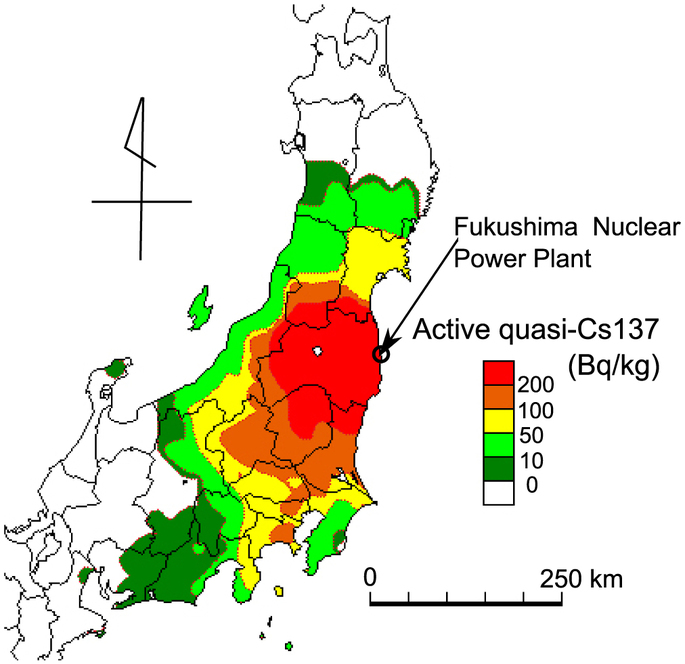
Each isogram center points are each prefecture’s capital city.
The relation between distance from power plant and contamination level
We found a relation between the distance from the power plant and the quasi-Cs137 contamination level of freshwater fish. According to the result of inverse regression analysis about quasi-Cs137 contamination levels related to the distance from the nuclear power plants of each prefectural capital city, the equation is: Y = 27339.82−1 × −75.13 (Y = Cesium, X = The Distance from the plants to each prefecture’s capital city, Signif F = 0.009 < 0.05, Adjusted R Square 0.50). In areas within a radius of 100 km from the nuclear plant, active cesium contamination levels of the Ayu are more than 200 Bq/kg. In those between a radius of 100 km and 200 km, it is around 60–200 Bq/kg. In those between a radius of 200 km and 300 km in which Tokyo is included, it is 20–60 Bq/kg. Therefore, it is estimated that contamination of freshwater fish is extended to all prefectures in eastern Japan. The contamination is recognized as far as Shizuoka prefecture, 400 km south-west from the plant.
Discussion
The Japanese freshwater system is very high density as developed rice water paddy field, irrigation canal, urban water-system network. Therefore, we have to think that the contamination of freshwater fish is widespread not only in river basins but also all over the ground included all types of water-systems, for example, agricultural and urban water systems. The isogram map shows the contamination tendency quite well. The contamination levels of the freshwater fish provide insufficient data and the knowledge of the path about bioaccumulation. So, we will have to survey a more wide spread area and monitor bioaccumulation in each species level.
In this paper we show the relation between distance and contamination levels by inverse regression analysis. The results indicate the effects of quasi radioactive cesium 137 by the Fukushima accident look like less serious than those of the Chernobyl accident. However, contamination levels are possibly higher than the Chernobyl as the cesium is concentrated by the water systems in limitation region. Water paddy field look like shallow pond saved mud included cesium 137. Moreover, the cesium137 will distribute and concentrate by high density irrigation canal and urban water-system. For example, the highly contaminated Taisho river bottom soil Cs134: 4,335 Bq/kg, Cs137: 5,456 Bq/kg was found at 1/11/2011 at Kitakashiwa bridge of Kashiwa city in Tokyo metropolitan area, 200 km south-west from the plant13. Therefore we must carefully and continuously monitor the contamination to the freshwater ecosystem and human health.
Methods
Data 2011 of radioactive cesium of freshwater fish was analyzed by each local government according to the emergency food survey manual of radioactive substance14. The purpose of this manual is they avoid feeding high contaminated food it was defined by food security of emergency condition. Therefore, it is not aimed at collecting accurate data. As a result, this data did not distinguish between cesium137 and cesium134. Therefore, the analysis of this paper calculated by quasi-Cs137 included Cs134. They used germanium semiconductor machine when they measured the radioactive cesium contamination of freshwater fish. The measure time is from 10 minute to 1 hour. The calibration is only Cs137 in per week. The range of radioactive cesium applied only Cs137 regression equation. The result, when the case included Cs134 is relatively much, the numerical value become over estimation. The sample of freshwater fish was collected by each prefectural government by emergency policy of food security. In the survey, the fish sample collected 5–10 kg in one survey station. The measure is using wet condition fish. Ayu and small fish was measured hole body, while big fish measured the part of food portion.
References
1.
Monitoring information of environmental radioactivity level, MEXT and DOE Airborne Monitoring, Ministry of Education, Culture, Sports, Science & Technology in Japan, http://radioactivity.mext.go.jp/en/list/203/list-1.html (2013).
2.
Joanna, B. et al. Radiocesium in Fish from the Savannah River and Steel Creek: Potential Food Chain Exposure to the Public. Risk Analysis Vol. 21, No.3, 545–559 (2001).
3.
McCreedy, C. D., Jagoe, C. H., Glickman, L. T. & Brisbin Jr, I. L. Bioaccumulation of cesium-137 in yellow bullhead catfish (Ameiurus natalis) in habiting an abandoned nuclear reactor reservoir. Environmental Toxicology and Chemistry 16, 328–335 (1997).
4.
Rowan, J. R. & Rasmussen, J. B. Bioaccumulation of radiocesium by fish: The influence of physicochemical factors and trophic structure. Canadian Journal of Fisheries and Aquatic Science 51, 2388–2410 (1994).
5.
Hakanson, L., Anderson, T. & Nilsson, A. Caesium-137 in perch in Swedish lakes after Chernobyl-present situation, relationships and trends. Environmental Pollution 58, 195–212 (1989).
6.
Ugedal, O., Forseth, T., Jonsson, B. & Njastad, O. Sources of variation in radiocesium levels between individual fish from a Chernobyl contaminated Norwegian lake. Journal of Applied Ecology 32, 352–361 (1995).
7.
Elliott, J. M. et al. Sources of variation in post-Chernobyl radiocesium in fish from two Cumbrian lakes (north-west England). Journal of Applied Ecology 29, 108–119 (1992).
8.
Long-Term Observation of Radioactivity Contamination in Fish around Chernobyl. RYABOV I N Vol 79, 112–122 (2002).
9.
Environmental consequences of the Chernobyl accident and their remediation : twenty years of experience report of the Chernobyl Forum Expert Group ‘Environment’. Vienna: International Atomic Energy Agency (2006).
10.
Results of the inspection on radioactivity materials in fisheries products, Fisheries Agency, http://www.jfa.maff.go.jp/e/inspection/index.html. (2012).
11.
Urgent radionuclides monitoring report in public water system area of Fukushima prefecture (in Japanese), Ministry of Environment, http://www.env.go.jp/water/suiiki/urgent/result201106.pdf. (2011).
12.
Urgent environmental radionuclides monitoring report in public water system area of Fukushima prefecture at 4/6/2011(in Japanese), Fukushima Prefecture, http://www.pref.fukushima.jp/j/koukyouyousuiikimonitaring.pdf. (2011).
13.
Final report of the highly contamination spot in Kashiwa city (in Japanese), Ministry of Environment, http://www.env.go.jp/press/press.php?serial=14647. (2012).
14.
The survey manual “Guide: Emergency Preparedness for Nuclear Facilities”, Nuclear Safety Commission, June, 1980-final revised in 2010. (2010).
Sources :
- Received: 13 March 2012
- Published online: 29 April 2013
Overview of active cesium contamination of freshwater fish in Fukushima and Eastern Japan
http://www.nature.com/articles/srep01742
- Received: 21 November 2013
- Published online: 16 January 2014
Initial flux of sediment-associated radiocesium to the ocean from the largest river impacted by Fukushima Daiichi Nuclear Power Plant
http://www.nature.com/articles/srep03714
- Received: 15 May 2014
- Published online: 12 February 2015
Future projection of radiocesium flux to the ocean from the largest river impacted by Fukushima Daiichi Nuclear Power Plant
http://www.nature.com/articles/srep08408
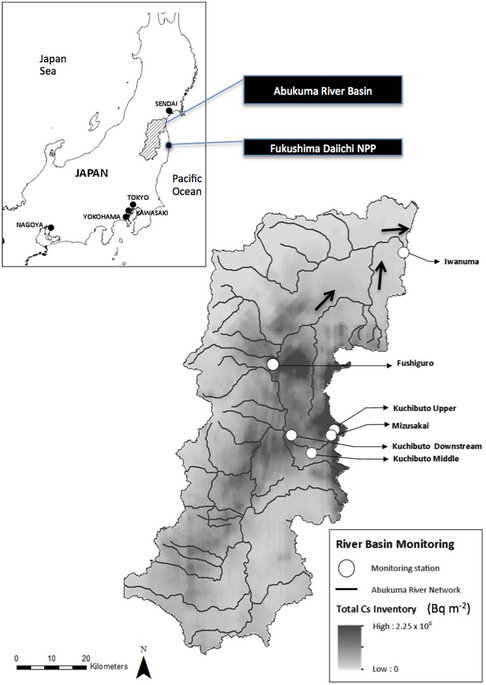
Map of the Abukuma river basin showing monitoring locations and the total radiocesium inventory
USA and China – joint statement: both will sign Paris climate deal
 US and China to sign Paris climate deal http://www.heraldsun.com.au/news/breaking-news/us-and-china-to-sign-paris-climate-deal/news-story/94b6ac23151ca2d99645372ed0bf9269
The United States and China have confirmed that they will sign the Paris climate change agreement in New York on April 22, a move that officials hope will help the accord enter into force this year.
The world’s two biggest greenhouse gas emitters issued a joint presidential statement on Thursday in which they called on other countries to sign the accord next month “with a view to bringing the Paris Agreement into force as early as possible”.
Leaders from nearly 200 countries forged the landmark agreement to transform the world’s fossil fuel-driven economy on December 12 after four years of fraught negotiations.
But the Paris climate agreement needs at least 55 countries, representing at least 55 per cent of global emissions, to formally accede to it before it can enter into force.
Stern has stepped down from his role as the chief US climate negotiator, and will be replaced by his former deputy, Jonathan Pershing, on April 1.
United Nations Secretary-General Ban Ki-moon said earlier this month that he expected 120 or more countries would sign the accord at the April 22 ceremony at its New York headquarters.
Ice wall at Fukushima plant switched on, but will it work?
by MARI YAMAGUCHI Mar. 31, 2016
TOKYO (AP) — The operator of Japan’s destroyed Fukushima nuclear plant switched on a giant refrigeration system on Thursday to create an unprecedented underground ice wall around its damaged reactors. Radioactive water has been flowing from the reactors, and other methods have failed to fully control it. The decontamination and decommissioning of the plant, damaged by a massive earthquake and tsunami in 2011, hinge of the success of the wall.
Q. WHAT IS AN ICE WALL?
A. Engineers installed 1,550 underground refrigeration pipes designed to create a 1.5-kilometer (0.9-mile) barrier of frozen soil around four damaged reactor buildings and their turbines to control groundwater flowing into the area and prevent radioactive water from seeping out. The pipes are 30 meters (100 feet) deep, the equivalent of a 10-story building. Engineers say coolant in the pipes will freeze the surrounding soil to minus 30 degrees Celsius (minus 22 Fahrenheit), creating the wall over several months.
Q. WHY IS AN ICE WALL NEEDED?
A. The cores of three of the damaged reactors melted during the accident and must be cooled constantly with water to keep them from overheating again. The cooling water becomes radioactive and leaks out through damaged areas into the building basements, where it mixes with groundwater, increasing the volume of contaminated water. Nearly 800,000 tons of radioactive water have been pumped out, treated and stored in 1,000 tanks that now occupy virtually every corner of the Fukushima plant, interfering with its decontamination and decommissioning and adding to the risk of further leaks of water into the nearby ocean.
Q. ARE THERE RISKS?
A. Construction officials say the coolant is environmentally safe. There were doubts that the huge refrigeration system could effectively freeze the soil while groundwater continues to flow in the area. The operator, Tokyo Electric Power Co., says results from a test of part of the wall last summer were mixed but suggest the system has sufficient capability. Experts are also concerned that an ice wall cannot be adjusted quickly in an emergency situation, such as a sudden increase in the flow of contaminated water, because it takes several weeks to freeze or melt. Electrical costs for running the refrigeration system could be steep. TEPCO says the wall, once formed, can remain frozen for up to two months in the event of a power failure.
Q. WHO MADE THE ICE WALL?
A. The 35 billion yen ($312 million) project was funded by the government and built by Kajima Corp., which has used similar technology in smaller projects such as subway construction. The wall was delayed by technical uncertainties and was finished last month, a year behind schedule.
1 This Month





PLEASE OPPOSE HR 8255 AND S.3639 – bills would accelerate satellite deployment, with no environmental review or safeguards – https://ncstd5li.quorum.us/campaign/169331/
To see nuclear-related stories in greater depth and intensity – go to https://nuclearinformation.wordpress.com
-
Archives
- October 2026 (74)
- September 2026 (339)
- August 2026 (330)
- July 2026 (355)
- June 2026 (287)
- May 2026 (306)
- April 2026 (356)
- March 2026 (251)
- February 2026 (267)
- January 2026 (308)
- December 2025 (358)
- November 2025 (359)
-
Categories
- 1
- 1 NUCLEAR ISSUES
- business and costs
- climate change
- culture and arts
- ENERGY
- environment
- health
- history
- indigenous issues
- Legal
- marketing of nuclear
- media
- opposition to nuclear
- PERSONAL STORIES
- politics
- politics international
- Religion and ethics
- safety
- secrets,lies and civil liberties
- spinbuster
- technology
- Uranium
- wastes
- weapons and war
- Women
- 2 WORLD
- ACTION
- AFRICA
- Atrocities
- AUSTRALIA
- Christina's notes
- Christina's themes
- culture and arts
- Events
- Fuk 2022
- Fuk 2023
- Fukushima 2017
- Fukushima 2018
- fukushima 2019
- Fukushima 2020
- Fukushima 2021
- general
- global warming
- Humour (God we need it)
- Nuclear
- RARE EARTHS
- Reference
- resources – print
- Resources -audiovicual
- Weekly Newsletter
- World
- World Nuclear
- YouTube
-
RSS
Entries RSS
Comments RSS

