July 22 deadline to comment on downgrade of impact assessment for nuclear projects | Canada’s Federal government pushing for power with a “nuclear fist” | Dates and Deadlines.
| The Nuclear Fist: Five Federal Initiatives Pushing and Promoting Nuclear Power |
| There are currently five federal nuclear related initiatives / announcements: “Getting Major Projects Built in Canada – Discussion Paper on Proposed Legislative, Regulatory, and Policy Reforms” announced May 8th with the deadline now extended to July 22; the electricity strategy “Powering Canada Strong: A National Strategy for an Electrified Canadian Economy” which was announced May 14 with comment invited but no deadline; the Standing Committee on Natural Resources and the Environment electrification study with the deadline – and the study – now extended to mid-September; the Nuclear Energy Strategy for Canada announced June 22 with no comment invited and so no deadline for comment, and the June 24 announcement of the potential “listing” of the NWMO DGR under the Build Canada Act (aka Bill C-5), also no public comment period. |
July 22nd Deadline to Comment on “Big Projects” Discussion Paper
| The comment period will close on July 22nd on the federal government’s Discussion Paper Delivering on Big Projects in Canada. Released on May 8th, the discussion paper proposes that impact assessment of nuclear projects would be handed over to the Canadian Nuclear Safety Commission.Visit Assessing-Nuclear-Risk.ca for more information including submissions by public interest groups, media coverage and contacts and updates. Take one minute to send a message – the message tool is HERE. |
The risk of nuclear war is rising. This is what Burnham must do.
In his first Downing Street briefing, the incoming prime minister is going to learn some hard truths about his country’s ultimate deterrent
David Blair
The risks of nuclear war are rising. This is what Burnham must do. In his
first Downing Street briefing, the incoming prime minister is going to
learn some hard truths about his country’s ultimate deterrent. The ritual
for an incoming prime minister, unchanged for decades, has never been so
fraught with significance.
Soon after Andy Burnham enters No 10, he will be
taken to a secure room where Air Chief Marshal Sir Richard Knighton, the
Chief of the Defence Staff, will brief him on how to authorise a British
nuclear strike. At that moment, Burnham will join the handful of world
leaders with the individual power to inflict a greater measure of
destruction than has ever been wrought before.
Burnham will be inducted
into the dreadful – in the true sense of the word – and singular
responsibility of what Lord Hennessy, the constitutional historian, calls
the “purely prime ministerial function” of overseeing Britain’s
ultimate deterrent and deciding this country’s nuclear policy.
Telegraph 13th July 2026, https://www.telegraph.co.uk/news/2026/07/13/burnham-must-bolster-britains-nuclear-defences/
Add stopping Sizewell C to Andy Burnham’s “to do” list.

10 July 2026,
Alison Downes, Executive Director
Paul Collins, Chair, Stop Sizewell C
Andy Burnham is on the cusp of succeeding Keir Starmer as Prime Minister, and one more nomination by a Labour MP will guarantee it. Help us add to his swelling in-box by asking him to reconsider Sizewell C!
We’ve drafted a very short sample email at the bottom of this email, but we strongly encourage you to write your own message as it will be more impactful. You could use some of the following suggestions:
It would free up £ billions of taxpayers’ money (£14.2bn was committed to the end of this parliament but some has been spent), but we recognise money would have to be spent to restore East Suffolk.- It would reduce household expenses by removing the Regulated Asset Base (RAB, or “nuclear tax”) from energy bills.
- It would save us from expensive electricity in future: the National Audit Office found Sizewell C’s electricity would cost £133 – £155/MWh [2024/25 prices], more than Hinkley C.
- Sizewell C cannot provide value for money given it is unlikely to operate at 90% load factor and there is a major risk of placing so much electricity generation capacity on an eroding coastline. It will be another HS2.
- The EPR reactor is an unproven technology in the UK and has a catastrophic delivery track record elsewhere in the world.
- Call on Andy Burnham to keep the UK progressing to net zero by prioritising cheaper renewable energy, responsibly delivered, and developing storage capacity.
- If you want more ideas, read our report “Sizewell C, the Unanswered Questions”:https://stopsizewellc.org/sizewell-c-the-unanswered-questions/.
How to contact Andy:
Once you have written your message you can email it to: andy.burnham.mp@parliament.uk or copy it into the contact form on andyformayor.co.uk/contact or contact.no10.gov.uk. Or post a letter to House of Commons, London SW1A 0AA or 10 Downing Street, London SW1A 2AA.
Quick news roundup
- For supporters in the East, BBC Look East is running a big piece on the impacts of Sizewell C in this evening’s programme (10 July 6.30pm). Watch live on iplayer and for 24 hours afterwards here: https://www.bbc.co.uk/programmes/b006mj5w
- Sizewell B’s long-mooted life extension was made public yesterday. For reactions from TASC and Stop Sizewell C read here: https://www.bbc.co.uk/news/articles/c1dy1rdv17lo or watch last night’s BBC Look East (third item, hurry, link expires at 6.30pm) https://www.bbc.co.uk/iplayer/episode/m002yqwk/look-east-evening-news-09072026
- Quality issues have been found in the manufacture of Sizewell C’s pressure vessels. Read more including reaction from TASC: https://www.newcivilengineer.com/latest/more-issues-reported-during-manufacture-of-sizewell-cs-reactor-vessels-than-hinkley-point-cs-01-07-2026/
- Stop Sizewell C contributed to a news report by Canadian broadcasters about the use of RAB for Canada’s nuclear programme, which has been picked up by other international outlets https://www.cbc.ca/news/science/nuclear-strategy-pensions-electricity-9.7257049
- “Atomic Ties”. On 16 July at 7pm the Transatlantic Nuclear Free Alliance is holding a free webinar on the link between nuclear power and nuclear weapons. For more info and to register go to https://us02web.zoom.us/meeting/register/2YPRekqkTH2inxmbqld1ww#/registration
Government U turn as Sizewell B is to get a fixed-price government contract.
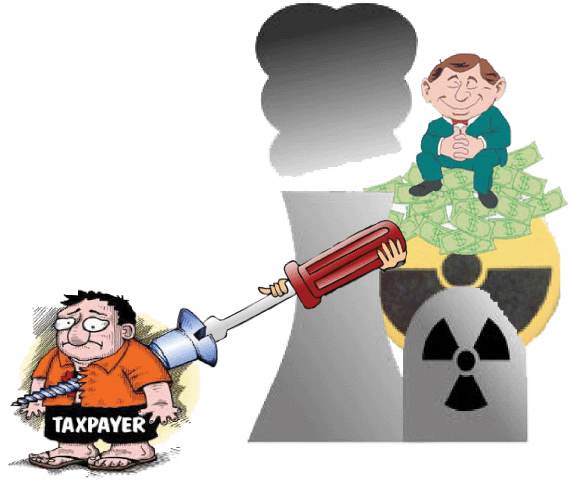
Government awards the last UK nuclear power station a fixed power
contract, backing away from its shift towards a new model of funding.
The UK energy department has extended the life of the Sizewell B nuclear power
plant in Suffolk by 20 years with a fixed-price government contract, after
energy price shocks following the war on Iran.
Chancellor of the Exchequer,
Rachel Reeves, called the nuclear power project “a vital part of
Britain’s energy future”. French project owner EDF said it has secured
a 20-year fixed price power contract from the UK government that will last
from 2035 to 2055.
Previously EDF had planned to commence decommissioning
of the plant in 2035. The French power company said it is “funding a
refurbishment of the nuclear power station during planned outages over the
next fifteen years, costing around £800 million”.
British Gas owner Centrica also said it is investing an undisclosed amount in the extension
of the 1.2 GW operational nuclear power project in Suffolk. It is the first
time that the Sizewell B nuclear power project will operate under a fixed
government power contract, priced at £70.50 per megawatt, after delayed
project Hinkley Point C was awarded such a contract a decade ago.
The energy department has since moved to shift nuclear power projects onto a
regulated asset base (RAB) structure for funding, the model that will be
used to finance Sizewell C at the Suffolk coastal site, a replica of yet to
be finalised nuclear power station Hinkley Point C in Somerset.
Energy Voice 8th July 2026,
https://www.energyvoice.com/renewables-energy-transition/600397/government-u-turn-as-sizewell-b-is-first-nuclear-plant-to-get-cfd/
Nuclear Power is Now Trump Power…What Could Go Wrong?

Karl Grossman – Harvey Wasserman, July 10, 2026, https://www.counterpunch.org/2026/07/10/nuclear-power-is-now-trump-power-what-could-go-wrong/
Donald Trump is now the ultimate face of the U.S. nuclear power industry.
What could go wrong?
If you are advocating atomic energy in any form, you are promoting The Donald’s latest and largest fiscal fleecing of the American people. It mirrors his mega swindles in crypto and so much more—except this time with apocalyptic impact.
It’s a hyper-push for nuclear power.
As The New York Times this week headlined the “Climate Forward” column of Claire Brown: “Trump’s plans for nuclear power lurch ahead.”
Her July 7th piece began: “President Trump wants to quadruple nuclear power production in the United States by 2050. To get there, developers would need to build about a hundred times as much nuclear capacity in the next 25 years as they did in the past 25. In recent weeks, a series of government announcements have nudged the country a bit closer to that goal.”
It continued: “Nuclear power has broad bipartisan support in Congress, and many climate experts have embraced it as a low-emissions source of energy. Other experts remain opposed, arguing that it is too expensive or that the safety risks are too high.”
Through its Truth Social corporate front, the Trump Family has bought a major interest in TAE Technologies, a $6 billion California-based plunge into nuclear fusion.
To serve that investment, Trump is scamming his presidency to funnel billions of public dollars into a “Peaceful Atom” from which he expects to personally profit.
Right now, he’s pushing through Congress a $17.5 billion interest-free slush fund to promote more U.S. reactor construction.
Similar handouts from George W. Bush and Barack Obama fed two new nuclear power plants in Georgia. Originally promised at around $15 billion, the two plants fired up last year some seven years late and nearly $25 billion over budget. Their most recently reported price tag approaches $40 billion. Their output will never compete with renewables. They’ll bleed Peach State mega-cash as long as they operate.
Two abandoned nuclear plants in South Carolina blew $9 billion outright. The double debacle bankrupted Westinghouse, once the world’s leading reactor producer.
Meanwhile Trump pushes so-called Small Modular Reactors, hyped to power data centers that produce his beloved crypto. Projected to operate around 2030, SMR cultists hope their juice might (at best) cost a mere three times the proven cost of solar panels, and four times or more than that of currently operating onshore wind turbines.
But despite Trump’s frantic efforts to kill it, the real-world transition to green “Solartopian” renewables may be. Epic advances in battery technology essentially eliminate any need for the base-line power nuclear plants produce when they don’t break down or blow up. California’s battery capacity is now seven times as large as the maximum output that can be produced by the state’s last two hyper-expensive Diablo Canyon nuclear power plants.
Those dangerously decrepit reactors are surrounded by at least a dozen earthquake faults. They sit just 45 miles from the San Andreas fault.
In 2013, U.S. Nuclear Regulatory Commission site inspector Dr. Michael Peck warned that Diablo might not withstand a credible quake from the seismic faults surrounding it. Peck’s warning was ignored. Now he is gone from the commission. In the Trump era, no such report could be written in the first place.
In 2018, California adopted a comprehensive plan to shut Diablo and to phase in renewables. The transition was hugely accelerated by massive advances that have dropped battery prices while expanding their capabilities. Through at least part of most days now, California gets 100% of its electricity from renewables, much of it coming from solar panels in the Central Valley.
But “green” Governor Gavin Newsom is trashing the transition. In 2022, he handed Diablo’s owner, PG&E, billions in Trump-style grift while promoting his own run for The White House. As a result, California’s electric rates are now the highest in the continental U.S.
Meanwhile, Trump attacks the green competition with billions of public dollars to buy out leases from wind and solar projects, which threaten to produce electricity far cheaper than his beloved nukes. With the epic spread of cheap batteries (which are also fueling a global boom in electric vehicles) more than 80% of the world’s newly installed electric generating capacity now comes from renewables. All Trump’s mob-style assaults in the U.S. are being challenged in court and at the grassroots. But the global market push remains unrelenting.
Despite the growing danger as they deteriorate from age and maladministration, atomic reactors have been federally shielded from accident insurance requirements since 1957. Amidst escalating safety concerns, Congress has extended the liability exemption to SMRs, meant to power thousands of the crypto-loving data centers now being vehemently opposed by grassroots citizens throughout the US.
Last year Trump became the first U.S. president to fire a chair of the Nuclear Regulatory Commission. The U.S. Supreme Court has now confirmed the royal prerogative of a sitting president to fire any regulatory official. In the wake of Musk’s DOGE purge of at least 100 technical experts at the NRC, Trump is now sole arbiter of health and safety regulations, which are now in terrifying free fall at the 94 licensed U.S. nuclear power plants.
Trump also wants to put new reactors on military reservations, shredding residual NRC restraints through the even looser Department of Energy.
Two operating U.S. nuclear power plants (at North Anna in Virginia and Perry in Ohio) have already been significantly damaged by earthquakes (Perry twice). With neither accident insurance nor credible safety regulation, Trump/Nukes Inc. is a sitting duck for terror attacks. Russian drones have already damaged reactors and fuel storage sites at Ukraine’s Zaporizhia and Chernobyl. Others have been under fire.
Trump has infamously launched outright war on Iran’s nuclear weapons production. But as in Ukraine, a single drone could turn any of the world’s 400-plus reactors into a radioactive weapon of mass destruction, plunging us into an economic, ecological and health abyss from which we might never recover.
Meanwhile, an industry that hypes itself as “climate friendly” burns at 500 to 600 degrees Fahrenheit. In France, the U.S. and elsewhere, commercial reactors super-heat lakes and rivers that can no longer cool them, while boiling billions of marine organisms.
Seven decades after the first commercial reactor opened in Pennsylvania, The Donald is the undisputed self-dealing face of the “Peaceful Atom.”
He’s its top investor. He rules the shell of the Nuclear Regulatory Commission. He’s the presidential purveyor of taxpayer grift and chief hit man aiming to kill the renewable competition.
If you are for nuclear power, you are for Trump power.
What could go wrong?
Harvey Wasserman wrote the books Solartopia! Our Green-Powered Earth and The Peoples Spiral of US History. He helped coin the phrase “No Nukes.” He co-convenes the Grassroots Emergency Election Protection Coalition at www.electionprotection2024.org Karl Grossman is the author of Cover Up: What You Are Not Supposed to Know About Nuclear Power and Power Crazy. He the host of the nationally-aired TV program Enviro Close-Up with Karl Grossman (www.envirovideo.com)
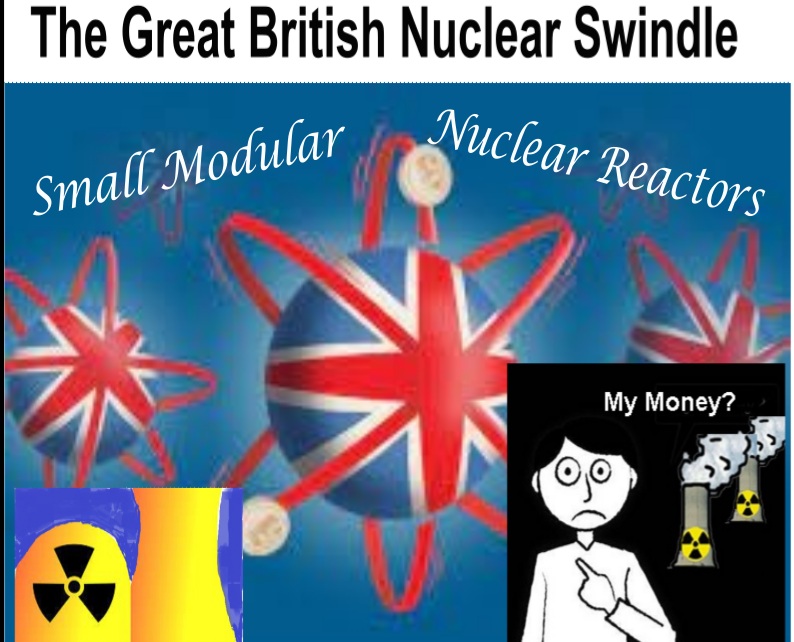
Great British Energy appoints Amentum and Cavendish in £360M SMR deal
06 Jul, 2026 By Gavin Pearson, https://www.newcivilengineer.com/latest/great-british-energy-appoints-amentum-and-cavendish-in-360m-smr-deal-06-07-2026/
Great British Energy – Nuclear (GBE‑N) has awarded a long-term Owner’s Engineer (OE) contract worth up to £300M to two contractors.
Amentum Clean Energy and Cavendish Nuclear were signed to the role in a 14‑year contract which formally runs from 23 April 2026 to 23 April 2040.
The contract notice also states the possibility for an extension that could take it to October 2041.
The total value for the contract including VAT is listed as £360M and £300M without VAT, although GBE‑N said the contract’s final value is uncertain and depends on how the project progresses.
This will include timetables and milestones agreed with the SMR technology partner but the procurement notice envisages the OE supporting the client up to the completion of the first fuel cycle for the initial reactor.
The OE role will provide independent technical assurance and oversight to GBE‑N’s “Intelligent Customer” and “Intelligent Client” teams as the SMR programme moves through design stages and towards a final investment decision.
Responsibilities will include specification, audit, review and advice on design, scope, budgets, risk, delivery and contract compliance and acting as a subject matter expert delivering “Line of Defence 2” assurance on major design and build contracts.
Amentum and Cavendish are both established contractors in energy and nuclear services. Cavendish Nuclear is part of Babcock International Group, known for nuclear construction and engineering work in the UK and Amentum is an international engineering and technical services company.
The contract includes monthly reporting against key performance indicators such as deliverable quality, core team availability and social value measures, including targets for female apprenticeships.
Labour MP Brian Leishman opposes new nuclear energy near Clacks
10th July, By Hannah Emma Shedden,
https://www.alloaadvertiser.com/news/26259252.brian-leishman-opposes-new-nuclear-energy-near-clacks/
BRIAN Leishman MP says he “cannot support” new nuclear power plants – despite his party earmarking Fife and Stirling for future development.
Last Tuesday, a UK Government report identified six locations across Scotland where the Labour administration would like to develop as part of their drive towards alternative energy sources.
To the east of Clackmannanshire, “the north coast of the Forth” was listed, which many local politicians understood as referring to Longannet, a site next to Kincardine and just over seven miles from Alloa town centre.
West of the Wee County, the “south bank of the Forth” near Stirling, was identified, though the exact location remains unclear.
Currently, through devolved powers, the Scottish Government have the power to block planning, and said they would not permit the building of any nuclear sites.
Mr Leishman, Labour MP for Alloa and Grangemouth, said: “On balance, I simply cannot support plans to expand nuclear power plants, including any potential sites in Scotland.
“The reasons for this are numerous and even if issues such as the huge construction costs to the taxpayer were resolved, the problem of nuclear waste remains.”
He said it is often ignored that there are “considerable” carbon emissions from nuclear fuel and waste disposal cycles, adding: “We also need to look at the sky-high cost of decommissioning, Sellafield being a prime example.
“We are yet to deal with all the waste from previous nuclear programmes, and I do not see how nuclear would help us with the climate emergency, considering the length of time it takes to plan and build such power plants.
“I believe that pound for pound, renewables such as wind and solar offer much better value for money as we look to achieve net zero.”
Trump Sweetens the Nuclear Energy Pot, But Will Anyone Play?

By Thomas A. Firey, July 6, 2026, https://www.cato.org/blog/trump-sweetens-nuclear-energy-pot-will-anyone-play
Last week, the Trump administration announced it is offering $17.5 billion in financing to build five new two-reactor nuclear power plants featuring Westinghouse Electric’s AP1000 large reactor. The offer comes on the heels of last November’s Trump announcement of an $80 billion deal with Westinghouse intended to jump-start a fleet of new US reactors.
Government doling out money (and other breaks) to nuclear power is old hat. But the two announcements, taken together, put a new spin on the practice of politicians picking winners and losers in the marketplace: Under the November deal, Uncle Sam could get a 20 percent equity stake in Westinghouse if its nuclear business booms in the coming years. Writing at the time, I predicted that it probably won’t happen: Nuke makes lousy business sense, as energy economist Steve Thomas recently detailed in Cato’s policy magazine Regulation, and it’s doubtful energy companies would take on such risk. Apparently, my prediction’s been right so far, so the Trump administration is offering a sweetener to get things going.
The announced financing envisions $3.5 billion in federal loan money per plant, with Westinghouse and the recipient energy companies contributing a billion dollars of their own money to each project, giving them some “skin in the game.” According to US Energy Secretary Chris Wright, there is “tremendous interest” in the initiative.
But interest is one thing, and completed nuclear plants are something else entirely.
The last time Uncle Sam meddled in nuke was back in the early 2000s under George W. Bush’s Nuclear Power 2010 Program. Enticed by government loan guarantees and rate subsidies, energy companies quickly proposed some 30 reactors. But interest faded after those companies crunched the financial numbers and found they didn’t add up. Only four reactors went into construction, and just two—Units 3 and 4 at the A.W. Vogtle power station in Georgia—ultimately entered service.
Vogtle shows why the other energy companies backed off: Construction of those two units—featuring Westinghouse AP1000s, it bears noting—began in 2013 (though site work started in 2009). Completion was expected in 2016/2017 at a cost of a little over $14 billion. But the reactors didn’t come online until 2023/2024, at a cost of $30 billion. That’s a common pattern with nuke: Expect it to take twice as long and cost twice as much as projected.
When asked about Vogtle’s $30 billion plant cost compared to the $4.5 billion envisioned by the Trump financing initiative, Wright averred that things will be different this time. Building “at fleet scale” will let the industry avoid Vogtle’s cost burden, which he attributed to bad planning, supply-chain snags, and the pandemic (which happened 3–4 years after Vogtle was to be completed). In his mind, nuclear plants are like cars on an assembly line: The more units you build, the lower the total cost per unit. But as Thomas explains in his Regulation article, nuclear plants are bespoke and offer minimal economies of scale.
This push for nuke is perplexing not just because the economics are grim, but also because of other Trump policies. If the administration really is interested in increasing America’s electricity supply (in part to power new data centers), then why is it spending billions of taxpayer dollars to get wind companies to not build generation? Moreover, why is the administration so keen on nuclear, given its hostility to climate change concerns (though even a reasonable carbon tax wouldn’t make nuclear competitive with other low- and no-emission power sources).
Perhaps the answer is nuclear socialism: Trump wants to boost an industry in which Uncle Sam could have an equity stake. This is part of the broader pattern of Trump corporate socialism, with government stakes in Intel, US Steel, MP Materials, Lithium Americas, Trilogy Metals, Vulcan Elements, ReElement Technologies, Korea Zinc, USA Rare Earth, L3Harris Technologies, Anduril, xLight, and others.
Circling back to nuclear power specifically, is there no way the technology will ever make economic sense? Never say never, but the odds are long. That goes not just for large reactors like the AP1000, but also the “small modular reactors” (SMRs) now lionized by some politicians and parts of the industry. As Thomas explains in his article, SMRs face the same problems and are bespoke like their bigger brothers, but with much less output. Again, never say never, but it’s bad policy for politicians to be pushing this mature technology—whether large reactor or small—on taxpayers and ratepayers.
My Cato colleague Travis Fisher said it best when he questioned the executive branch’s becoming so deeply embedded in the electricity business, especially when some future administration could offer sweeteners to different technologies entirely. Removing barriers to entry and letting energy companies build generation that passes a market test remains a much better policy than government picking winners and losers—especially when it’s acting as owner, banker, and regulator of those competitors.
Great British Energy – Nuclear offers £1bn contract for SMR partner
The company is seeking aid in delivering its programme of building a power plant by the 2030s.
Energy Voice July 7th 2026,
Great British Energy – Nuclear is seeking a delivery partner for its small modular reactor (SMR) programme in a £1.08 billion procurement contract.
The successful applicant will support the state-backed company deliver its programme by providing expertise across programme management, infrastructure delivery, commercial management, engineering support, and risk management.
Working alongside GB Energy – Nuclear, the company will help drive collaboration across suppliers, support effective programme delivery, and ensure value for money over the lifetime of the programme
The procurement process will include an initial selection stage, followed by tender. evaluation, dialogue, due diligence and a final selection stage before the appointment of a preferred bidder. Tenders must be submitted by 6 August 2026.
The long-term deal has the possibility of running until 2046.
Great British Energy – Nuclear interim chief commercial officer Beverley Grey said. “The appointment of a delivery partner will help ensure we have the capability, expertise and capacity needed to support the successful development and delivery of our Small Modular Reactor programme.
“This is a significant long-term procurement which will bring together technical, commercial and project delivery expertise to help us achieve our objectives and support the delivery of new nuclear capacity in the UK.”
GB Energy – Nuclear has £2.6bn to spend on its SMR programme and previously brought in Rolls‑Royce to provide the design the reactors………………………..
The government-run scheme aims to deliver a new nuclear power plant using SMRs by the mid-2030s, helping the UK seize part of a market estimated to be worth £500bn by 2050. https://www.energyvoice.com/renewables-energy-transition/nuclear/600336/gb-energy-nuclear-smr-partner/
Report From House Dems: Trump Used 250th Planning to Hide Corruption

By these and other means, Freedom 250, built on deception and manipulation from the beginning, effectively, in the House report’s terms, “sold access to the President, solicited foreign money in America’s name, and enabled the President to enrich himself.”
Trump’s Freedom 250 shadow organization was a vehicle for soliciting political donations, a new report contends.
By Tyler Walicek , Truthout July 7, 2026
The U.S.’s vaunted semiquincentennial anniversary celebrations on July 4 were not, ultimately, the moment of civic unification that had been envisioned a decade ago, when planning for the event began. It was inevitable that the ceremonies would be tainted by the tense and polarized state of the nation. President Donald Trump, however, in his signature way, managed to exacerbate and accelerate the existing grotesqueries and absurdities of the occasion.
From the ramshackle, propaganda-infused Great American State Fair to a Washington, D.C. Fourth of July rally that was filled with jingoist demagoguery from Trump — who boasted of annihilating Iran and took shots at recent “communist” wins in Democratic primaries — the ceremonies were a fitting reflection of a divided and tottering empire in its 250th year.
But a look at the converging interests that produced the kitsch-suffused debacle shows the commemoration’s true depths of venality. In fact, the misuse of the semiquincentennial has extended far past negligent planning and propaganda and reaches, some Congressional Democrats allege, all the way into willful corruption and conspiracy to defraud donors, taxpayers, and the public.
Party Partisans
In months leading up to the weekend, two dueling event-planning commissions struggled over the tone and emphasis of the events. America250 is the congressionally approved semiquincentennial event planning group; since 2016, it has been tasked with producing a nationwide program involving numerous festivals and public-spirited educational events, charity drives, a parade with marching bands and floats, a student essay contest, and much more.
Trump’s initial attempt to domineer the festivities involved adding a puppet executive director to the existing planning group, appointing one Ariel Abergel to lord over America250 in May 2025. Abergel was a former Fox News producer; he was also 25 years old at the time of his appointment. Abergel’s contentious tenure was marked by his efforts to shift the content of the celebrations to a veneration of both Trump and his right-wing ideals. Abergel was fired by the bipartisan Semiquincentennial Commission that oversees America250………………………………………………..
After Abergel’s ouster, Trump, true to form, pursued even less subtle tactics to seize control of the proceedings……………………………………………….
The redundant Freedom 250 committee, incarnated, in a highly unusual structure, as a limited-liability corporation within the federal, nonprofit National Park Foundation, would go on to plan the pro-Trump flop known as the “Great American State Fair.” ……………………………………
Unaccountable Accounting
Freedom 250’s funding structures present even deeper problems than its staging of manipulative right-wing propaganda at an ostensibly nonpartisan occasion. (The tonal dissonances and reactionary kitsch reached a low, perhaps, with the AI-generated talking George Washington in the PragerU “Freedom Truck” display………………………………………………………………
a grab for power and money was already apparent and in full view. As mentioned, the unnecessary Freedom 250 committee was embedded, jarringly, in the National Park Foundation, where it captured federal grants and diverted millions in funding from the America250 semiquincentennial budget to itself. …………………………………………………………………..
Trump has continued to buy and sell stocks in his personal portfolio throughout his presidency, including stock in companies, like Palantir, that have given to Freedom 250. The president’s 2026 disclosure reveals no less than $2.2 billion in gains through trading practices that have continued unobstructed: Trump’s terms in office have rendered the term “conflict of interest” inadequate, failing as it does to capture the breadth and magnitude of such flagrant affronts to executive ethics.
But the funding structure of Freedom 250 indicates a new variety of sleight-of-hand. By creating an LLC within nonprofit fundraisers like the National Park Foundation (which would normally function simply to raise donations for the National Park Service), Zibel explained, “They’ve been able to take these nonprofit structures and use them as an opaque slush fund, essentially, where anybody can donate, and there’s really no requirement for timely disclosure of who’s funding this stuff. We have no idea. We only know the names of the corporate donors because they’re listed on the Freedom 250 website.”
Those sponsors and partners include major oil companies, multiple military contractors, healthcare giants, tech and AI companies, credit card companies, agribusiness and more. “There’s no legal requirement that these be disclosed, because this has never happened before — and we have no idea how much they’re donating,” said Zibel. The American Prospect reported on the pitch deck for Freedom 250’s donor solicitation package, which offered sponsorship tiers up to and above $10 million. OpenSecrets has also documented, as a sort of proxy metric to give insight into corporate influence on the 250th, a broader surge in disclosed lobbying by some of the same companies sponsoring Freedom 250.
“Many of these companies have interests before the federal government,” Zibel commented. “Obviously, the defense contractors like Boeing, Lockheed, Northrop Grumman, and Palantir are huge — Raytheon, which is now called RTX — some of the biggest federal contractors in the country, and they’re all sponsoring it. There are some oil and gas companies, which are pretty allied with the administration. So, most of the companies have some sort of regulatory interest or contracting interest before the government, and presumably want to stay on Trump’s good side. He’s known, of course, for punishing companies and people who aren’t on his good side.”
………………………………………………………………………………………………………………………………………………………………………By these and other means, Freedom 250, built on deception and manipulation from the beginning, effectively, in the House report’s terms, “sold access to the President, solicited foreign money in America’s name, and enabled the President to enrich himself.”
“Donald Trump’s takeover of the 250th is an affront to the American people,” as Toni Aguilar Rosenthal, program director of investigative projects at the Revolving Door Project, a corruption watchdog, told Truthout. “The semiquincentennial could have, and should have, provided the country an opportunity to come together to engage with shared, complicated, and often inconvenient, truths about our nation’s history.”
Rosenthal offered a fitting summation of what transpired instead: “This administration has turned the anniversary into something akin to a private party handcrafted for the President’s personal tastes, and a major windfall for the private political allies of his administration. The American public, meanwhile, will be left picking up the tab long after Trump’s toxic-250 smog has finally settled over D.C.” https://truthout.org/articles/report-from-house-dems-trump-used-250th-planning-to-hide-corruption/?utm_source=Truthout&utm_campaign=08b91d81e0-EMAIL_CAMPAIGN_2026_07_07_09_16&utm_medium=email&utm_term=0_bbb541a1db-08b91d81e0-650192793
Here’s why Labour’s nuclear plans are wrong for Scotland
THE UK Government has used the distraction of Andy Burnham’s coronation and the
row over defence spending to quietly push out a report that sets out where
they would like to build new nuclear power plants in Scotland.
However, it hasn’t gone unnoticed by energy experts. The report from GB Energy
Nuclear, titled “Technical Advice on Potential Future Nuclear Power Plant
Siting in Scotland”, is suitably tentative – any new build would depend
on the SNP making a complete about-turn on policy to allow the development
of plants that Scottish planning legislation explicitly blocks.
New nuclear power plants are consistently vastly behind schedule and over-budget,
whilst Scotland’s renewable energy revolution continues to deliver ever
greater contributions to meeting our energy demands. However, this new
report not only explicitly states where Labour would like to see new plants
built, it also quietly notes the risks development at those sites would
create for communities and our environment.
Whilst Torness, Dounreay, and Hunterston are earmarked, it also singles out the north shore of the Forth Estuary, the south bank of the Forth, and the Angus and Aberdeenshire coast. Note the common theme here – these are all coastal sites,
variously flagged for risks to Sites of Special Scientific Interest
(SSSIs), Special Protected Areas (SPAs), cultural heritage, and flooding
risks.
Those in Fife and Stirlingshire have particular reasons to be
worried. Coastal management is a difficult and complex task as it is. As
climate change brings increases in extreme weather events, coastal erosion,
sea level rise, and storm surges, tough decisions are being made about
which coastal areas will be defended, and how, and which will be subject to
managed retreats that will provide greater resilience for communities and
critical infrastructure.
Added to which, however we decide to manage one
stretch of coastline will have impacts on other stretches. This is why we
have a National Marine Plan. That work is hard enough without dropping in
new security-critical sites that would exacerbate existing problems and
make it even harder to manage and protect our often-fragile coastlines.
Furthermore, siting new plants further inland, for example along the Forth,
is no less risky.
The report notes that demand for cooling water is likely
to be a limiting factor, and that no supporting flow data for that part of
the Forth is currently available. Far from being “secure”, new nuclear
will build in greater insecurity and costs to our electricity supply. If
England, which has long lagged far behind Scotland in deploying renewables,
wishes to take those risks that’s a matter for its own electorate.
Scotland doesn’t need to follow suit, and no amount of scaremongering,
cajoling, or false promises from Shanks or the nuclear industry should
persuade our government to think otherwise.
The National 7th July 2026,
https://www.thenational.scot/politics/26260100.labours-nuclear-plans-wrong-scotland/
Labour ‘scaremongering’ to push Scotland into new nuclear, experts say
By Xander Elliards, The National 7th July 2026
LABOUR ministers are “scaremongering” in the hope of pressuring
Scotland into building new nuclear power stations, a group of energy
experts has warned. Writing a joint article for The National, six academics
suggested that the UK Government was using “false promises” of a
“golden age of nuclear in England and Wales” in order to try and force
a U-turn from the Scottish Government.
As it stands, the SNP have an
effective veto on any new nuclear developments north of the Border because
planning laws are devolved to Holyrood. However, the UK Government last
week published a GB Energy report scoping out Scottish sites that could
host a new nuclear power plant, and on Tuesday UK energy minister Michael
Shanks said Labour will do “everything we can to move forward”.
Writing for The National, Dr Keith Baker, Dr Paul Dorfman, Professor Peter
Strachan, Dr Ian Fairlie, Professor Lynn Jamieson, and Gordon Morgan argued
that Scotland does not need any new nuclear energy plants “and no amount
of scaremongering, cajoling, or false promises from Shanks or the nuclear
industry should persuade our government to think otherwise”.
Radioactive Taxpayer Cash Cow, Canada 2026
Nuclear Reactor Information Task Force Canada, July 2026
Critics from civil society organizations and academia are calling out the Nuclear Energy Strategy for Canada released on Jun. 22 by the federal government as a cash cow for the nuclear industry. This hubris-driven attempt to grab world “energy superpower” status based on past-century technology will be accomplished without public input. The document reads like a wish list of nuclear developments, including the goal of 10 new large reactor projects in Canada by 2040.
This strategy is a gross economic mistake, dangerous for human health and security, and a diversion from urgently needed action on safer, faster and cheaper renewable energy. This benefits only the fossil fuel sector (during reactor construction) and the nuclear industry to the tune of hundreds of billions of taxpayer dollars – because nuclear power is by far the most expensive of all electricity sources and is unnecessary to reach net zero.
The document also promises to “streamline” the regulation of nuclear projects by removing independent oversight and speeding up approvals. This presents huge public risks when dealing with inherently dangerous technology like nuclear power.
The government is promoting the export of home-grown CANDU reactors, potentially facilitating the proliferation of nuclear weapons, as happened when Canada gifted reactor technology to India, sparking an arms race in South Asia.
The pressing issue of nuclear waste is sandwiched into the section of the strategy on massive expansion of uranium production, with false reassurances that the problem has been solved by handing management of nuclear waste over to the nuclear industry.
| A proposed deep geological repository for high-level waste proposed for northwestern Ontario is assumed, despite major questions and opposition, including legal challenges. Two days after the Nuclear Strategy was released the federal government announced that the Nuclear Waste Management Organization’s proposed DGR was a “Project of National Interest”, meaning that its approval would be guaranteed without an appropriate health, safety and environmental assessment. |
NATO IS FAILING UKRAINE

Ukraine has received up to $470 billion in combined aid and lending since the war started.
In 2021, Ukraine’s gross domestic product, the total economic output produced in the country during that one year, was $200 billion.
AT THE ANKARA SUMMIT, LEADERS SHOULD GET BEHIND PEACE (BUT PROBABLY WON’T)
Jul 07, 2026I, ,an Proud, https://thepeacemonger.substack.com/p/nato-is-failing-ukraine?utm_source=post-email-title&publication_id=3221990&post_id=205725934&utm_campaign=email-post-title&isFreemail=true&r=1ise1&triedRedirect=true&utm_medium=email
NATO is destroying Ukraine by funnelling money into it for a war against Russia that cannot be won.
Every mutli-billion commitment of financial and military assistance to Ukraine is another nail in Ukraine’s coffin.
At the Ankara Summit, NATO leaders should get behind peace in Ukraine, recognising that when the war ends, Ukraine will emerge much weaker than before the war started.
NATO leaders need to own their own failure, and yet I fear they won’t.
Rather, they will continue with more of the same, rendering Ukraine’s death even more painful.
There is a saying that wars are won by economies not armies.
According to the Kiel Institute for the World Economy, Ukraine has received up to $470 billion in combined aid and lending since the war started.
In 2021, Ukraine’s gross domestic product, the total economic output produced in the country during that one year, was $200 billion.
So, over the course of four and a half years of war, Ukraine has received aid greater than twice the value of its GDP before the war started, and yet Ukraine’s GDP in 2025 was measured by the World Bank at $213 billion, a rise of just 6.5% since the war started.
The money provided by the west has largely been wasted.
The reason it has been wasted, is that had the war finished in April 2022 after the agreement of a framework peace deal in Istanbul, the vast majority of this money would not have been spent. If the war had ended, and just a proportion of that western funding been spent on developing Ukraine’s economy, the country would be in a far stronger position today.
$470 billion literally amounts to killing Ukraine with fake kindness.
Let’s take a moment to consider that.
Most of that money has been tipped into the coffers of Ukraine’s government and military rather than into the real economy.
Ukraine’s government spending in 2021 was $67.6 billion.
Ukraine’s government spending in 2025 was $134 billion, twice as high as in 2021.
Ukraine’s industrial production is at 74% of its prewar level, in particular in heavy industry, especially basic chemicals (42.8% of pre-war levels), metals (44.5%), mining (39.1%) and refined products (21.8%). And it simply won’t get some of this back, as certain facilities and mines have fallen under Russian control in the Donbas.
Russia’s industrial production has continued to grow, and it 48-53% higher than in 2021 before the war started.
Ukraine invested $10bn less into its economy in 2025 compared to 2021, a drop of 38%.
Investment in Russia’s economy has grown from 23% to over 26% of GDP.
Ukraine’s economy has been hollowed out by war
Ukraine’s debt as a percentage of GDP has surged from 49% in 2021 to an estimated 110% this year.
Russia’s debt to GDP remains below 20%, a slight rise since the war started when it was 14% of GDP.
And the kicker is this, the vast amount of government spending is propped up by loans and donations from western nations which has consistently accounted for around half of all government spending.
And the problems extend beyond the economic.
The population inside of Ukraine has fallen by 25-30%, largely down to mass emigration, together with battlefield losses.
Russia’s population by contrast has seen a modest decline of 0.3-0.5% and is now almost five times larger than Ukraine’s population.
Ukraine’s birthrate has fallen by 38% – 105,000 fewer babies arrived in 2025 compared to 2021. The average birthrate per woman has now fallen to below 1.
Russia produced 1 million more babies in 2025 and it’s fertility rate, while low (1.378) is still significantly higher than in Ukraine.
I person in 3 inside of Ukraine today is a pensioner. For every employed worker there is one pensioner. In the UK, as a comparison, there are 2.6 workers per pensioner and in Russia 1.7-1.8.
When the war ends, there will be huge pressure in western nations to reduce their financial commitments.
That could see a brutal write down in the size of Ukraine’s GDP. If the Ukraine government reduced its spending to pre-war level, that would amount to a sudden drop of 30% in GDP.
Of course, that scale of drop won’t happen, as it will take some time to demobilise its army.
Ukraine will simply not be able to afford to pay for a military of 1 million personnel without further loans from the west. So will have to drive down military costs over time.
They will find that they have a disgruntled veteran class, resentful that a military success was offered by not delivered at a cost of 2.4 million killed and injured so far.
But, for the first time, Ukraine will have its economic fortunes in its hands.
If it chose to, it could do a massive debt restructuring and reopen itself to borrowing on the international markets, having been cut off of international borrowing since the war began.
It would almost certainly see a flood of foreign investment from western nations to rebuild its shattered cities and infrastructure.
It could start the process of weaning itself off of imports and reboot its exports, recognising that it has lost some of its valuable coal exports from the loss of territory.
However, it’s far from guaranteed that Ukraine would return to its prewar population, possibly ever, nor repair its catastrophic demographic crisis, as birthrates were already very low before the war started, at just 1.22 babies per woman.
So, the economic future for Ukraine looks bleak. It will have taken a permanent deadweight loss to its economic potential whenever the war ends.
An economy that is significantly smaller when the war ends compared to before it started. A population that is smaller and not reproducing itself.
However, what should be blindingly obvious is that the economic numbers will continue to get much worse for Ukraine for as long as the war continues.
Ukraine’s deficit of exports over imports will grow.
Industrial production will remain depressed and possibly fall further if Russia paints out Donetsk
Investment in Ukraine’s real economy will continue to slide
Ukraine’s massive debt burden will pile up further.
It is impossible to imagine that Ukraine will have cleaned up its grotesque levels of corruption if the war continues and billions of foreign money continues to pour in. That’s not to say that Russia doesn’t have a corruption problem too, of course. But the difference is, we are sending the billions to Ukraine for Zelensky’s cronies to pilfer.
Ukraine’s population will continue to decline
It will produce fewer babies and move to having more pensioners than workers.
There is no way to reverse any of these trends for as long as the war continues.
The $470 billion that western nations have tipped into Ukraine has been wasted.
And all for what?
What are the factors driving on NATO to keep Ukraine fighting?
The first, is the mistaken view that NATO can use a much smaller economically more fragile country like Ukraine as a battering ram to shatter Russia and inflict a strategic defeat that would topple the Putin government.
All of this is cloaked under the excuse that Ukraine should have the right to choose which military bloc is joins. However, in 2014 before the Ukraine crisis started, a majority of Ukrainians did not support joining NATO, as opposed to the EU, where attitudes were finely balanced in 2013 prior to the Vilnius Eastern Partnership Summit.
For those Ukrainians that did want to join the EU, their choice was soon labelled as a Euro-Atlantic, rather than a European choice after the unconstitutional removal of Viktor Yanukovych as President in February 2014.
The Ukraine crisis has always been about NATO membership.
Whenever efforts were made to broker peace, most notably after the Minsk II Agreement in February 2015 or the Istanbul talks in April 22 after the war started, those efforts were derailed by the Americans, with the help of the British.
And, as it turns out, even though the Europeans have become the major funders of the war in Ukraine since Trump came to power, it is now completely obvious that Ukrainian membership of the EU is further away than it has ever been, not least because of the boorish antics of Zelensky on the world stage, typified by his turning Poland into an irritant after his glorification of World War II Nazi collaborators. Zelensky has variously generated bad blood with other EU nations that he will rely on to obtain EU membership for his country, driven by his towering sense of entitlement and lack of self-awareness.
While I’ve always supported the theory of EU membership for Ukraine, the practice has become more complicated by the continuation of war. Important reforms in Ukraine have not been undertaken or have been held back.
So, the very point of the Maidan movement – if there was ever a point before it was hijacked by Ukrainian ultra-nationalists – has been betrayed by12 years of conflict and now war which has revealed that the true purpose of western sponsors has been to incorporate Ukraine into a military bloc, that not just Putin, but several esteemed western diplomats like Kennan and Matlock, has been saying for at least twenty years was a red line for Russia.
And yet, here was are, on the verge of another NATO summit in which cardboard cutouts like Mark Rutte will continue to insist that Ukraine is part of the NATO family. Further commitments will be made to funnel even more billions in aid into Ukraine to help Zelensky inflict a strategic defeat on Russia that will never happen.
NATO leaders won’t take the cue to end the war. There are just too many vested interests in the west to allow that to happen.
That Zelensky is attending the summit won’t help. He will persuade western leaders – who seem completely unable to say no to him – that they need to let him strike further and further into Russia to inflict pain on Russia’s economy.
And yet, every Ukrainian strike will self-evidently yield another massive retaliation from Russia that heaps suffering on ordinary Ukrainian people.
It won’t change the massive economic and demographic advantages that Russia has over Ukraine and will always have.
It will just prolong the war.
Western mainstream media and politicians are bitterly opposed to ending the war too.
They will trot out the usual tropes.
Russia’s economy is about to implode – it isn’t and I’ve been hearing this for 12 years including while I was in Moscow. Look at the numbers. Ukraine’s economy is in real trouble.
Russian people are turning against Putin because of gasoline shortages in some cities including Moscow. Yes, Russian people are tired of war and Putin has seen a reduction in his popularity, though at 67% it is far higher than anything western leaders enjoy. There is no evidence that Russian people are going to take to the streets to topple Putin. Indeed, Ukraine’s people have suffered far more from the destruction of energy and heating infrastructure during bitter winters. The inconvenience suffered by ordinary Russians is very small in comparison, although that doesn’t mean it isn’t impacting Russia’s domestic politics. The point is, it will never be enough to shift the dial, compared to the significantly greater cost Russia can impose on Ukraine.
Russia is finding it harder to recruit troops to the frontline. This is the worst misinformation of all. Yes, Russia has taken heavy casualties in the war although all the evidence points to Ukraine taking far higher casualties from a smaller population. Body swaps numbers are not a perfect comparator, but on every occasion Ukraine receives at least ten times more bodies than it returns to Russia. And, in any case, every body – Ukrainian or Russian – is a person whose life has been snuffed out by this pointless war.
Russia has avoided a general mobilisation whereas every day there are videos emerging of violent forced mobilisation – busification – of Ukrainian men to be sent to the meat grinder.
Zelensky is the leader of the free world. Utter claptrap. He is a corrupt dictator who absolutely refuses to listen to any advice and will carry on regardless, whatever injury he causes his own country, so long as the west keeps sending him money. Politicians are human and he is no different, I am sad to say. He will not be President of Ukraine after the war ends if fair elections are held. Everyone can see this except the western press. Zelensky biggest challenge when the war ends will be to stay alive, let along to stay inside of Ukraine.
Putin is going to die at any minute. Come on, I’ve been hearing this for twelve years.
Any attempt to get behind a peace settlement will be turned upon by the blob who cry that we are selling out Ukraine and are giving a gift to Putin.
But I am sick and tired of hearing this bullshit. The biggest gift to Putin is to keep the war going on and watch Europe disintegrate politically and economically.
But the only way to secure peace with Russia is through force. Utter nonsense.
Sure, Putin would probably prefer peace now. And, it has always been my impression, that Russia wants to have normal relations with Europe and, in fact, with Ukraine.
But he will not do that under the threat of NATO expansion and has been saying this for over two decades.
So, if NATO leaders want to keep helping Zelensky fight to the last Ukrainian it will be a disgraceful betrayal of the Ukrainian people and of the people of Europe who face a growing threat of general war and all the misery that would ensure, which ordinary Ukrainian people have suffered for four and a half years already.
Zelensky is killing his own country. NATO is helping him do it. We are led by idiots in the west. It’s time to end this nonsense now.
Scotland could freeze datacentre projects in challenge to UK’s AI strategy

Scottish government to consider SNP national council motion for moratorium on all new datacentres
The Scottish government is about to consider a sweeping moratorium on building new datacentres, putting a key plank of the UK’s AI strategy at risk.
Last Sunday the Scottish National party (SNP)’s national council passed a motion to freeze all new datacentres in Scotland. That motion has been sent to the Scottish government to consider.
It could apply to all datacentre projects that have not yet received planning permission – although its exact implementation is up to the Scottish government to decide.
Lesley Backhouse, a local councillor from one of the constituencies that put forward the motion, said that Scotland’s current datacentre plans amounted to “overdevelopment” and were “intrusive and not keeping with the local environment”.
The move emerged as the Guardian on Monday revealed how the developer and the UK government misrepresented the technical feasibility of a massive datacentre hub in Scotland in the face of community fears that their land would be subsumed by the development, and promised jobs and investments would never materialise.
This site, in Lanarkshire, was to be an “AI growth zone”, a key element of the government’s strategy to build national AI infrastructure in rural areas of Britain.
The SNP’s resolution came amid signs of a wider upheaval in the UK’s AI strategy as Andy Burnham prepares to replace Keir Starmer in Downing Street. He is reportedly considering a review of several critical planks of Starmer’s technology policy.
The Guardian previously reported that an “AI growth zone” in North Tyneside was more of a publicity stunt than a viable project, despite being supposedly backed by the maker of ChatGPT, OpenAI. Several other big UK AI projects have been found to be “phantom investments” after the government failed to audit investment numbers or jobs claims.
“I don’t think anyone is arguing that we should not have any datacentres in the UK or Scotland,” said Graham Simpson, a member of the Scottish parliament representing North Lanarkshire.
“But there needs to be a proper piece of work at the government level to decide how many the country needs and what is our capacity for them, in terms of our resources.”
A moratorium on datacentres in Scotland could strike at the heart of the UK’s wider AI strategy. British officials have pushed Scotland as the prime location for datacentres due to its access to plentiful renewable energy. The SNP’s resolution could halt projects such as the Lanarkshire AI growth zone.
The SNP resolution suggests that the number of massive datacentres planned in Scotland could overwhelm its renewables capacity.
It says there are 24 “hyperscale” datacentre projects in various stages of planning in Scotland. Combined, they would use more than one-and-a-half times the power Scotland uses at peak demand.
“It is extreme overdevelopment. I’m very supportive of the local community and their endeavours to prevent this from happening,” said Backhouse.
Meanwhile, the chair of the Commons science and technology select committee, Chi Onwurah, on Monday criticised the UK’s broader AI investment strategy, saying that without a proper plan for achieving sovereignty it has been “very opportunistic”.
1 This Month
15 October. Joint Appeal for Nuclear Abolition Day -presentation to the UN on October 15 will be live on UNWebTV
Endorse the Nuclear Abolition Day Appeal
23-25 October – on Zoom – World BEYOND War’s annual global conference

To see nuclear-related stories in greater depth and intensity – go to https://nuclearinformation.wordpress.com
-
Archives
- October 2026 (139)
- September 2026 (339)
- August 2026 (330)
- July 2026 (355)
- June 2026 (287)
- May 2026 (306)
- April 2026 (356)
- March 2026 (251)
- February 2026 (267)
- January 2026 (308)
- December 2025 (358)
- November 2025 (359)
-
Categories
- 1
- 1 NUCLEAR ISSUES
- business and costs
- climate change
- culture and arts
- ENERGY
- environment
- health
- history
- indigenous issues
- Legal
- marketing of nuclear
- media
- opposition to nuclear
- PERSONAL STORIES
- politics
- politics international
- Religion and ethics
- safety
- secrets,lies and civil liberties
- spinbuster
- technology
- Uranium
- wastes
- weapons and war
- Women
- 2 WORLD
- ACTION
- AFRICA
- Atrocities
- AUSTRALIA
- Christina's notes
- Christina's themes
- culture and arts
- Events
- Fuk 2022
- Fuk 2023
- Fukushima 2017
- Fukushima 2018
- fukushima 2019
- Fukushima 2020
- Fukushima 2021
- general
- global warming
- Humour (God we need it)
- Nuclear
- RARE EARTHS
- Reference
- resources – print
- Resources -audiovicual
- Weekly Newsletter
- World
- World Nuclear
- YouTube
-
RSS
Entries RSS
Comments RSS

