Key US science panels are being axed — and others are becoming less open
A Nature analysis shows that the Trump administration has terminated more than 100 advisory committees to science agencies — and reduced the transparency and independence of those that remain.
Last August, the DOE terminated six FACA panels that provided advice in areas such as high-energy physics, scientific computing, and biological and environmental research. The DOE has since consolidated these discipline-specific panels into one overarching body called the Office of Science Advisory Committee (SCAC).
“How good is the advice coming from a committee of people that probably only have passing knowledge of some of the areas?”
By Max Kozlov, Alexandra Witze & Dan Garisto, https://www.nature.com/articles/d41586-026-01301-5
President Donald Trump and his administration downsized US science by historic margins last year as it reduced the workforce at federal research agencies by tens of thousands of people and terminated thousands of research grants. But another set of cutbacks in federal science has drawn less attention.
Across the government, the administration terminated more than 100 independent advisory panels, comprising university scientists and other outside experts who help to guide national science priorities.
The cuts — driven by a February 2025 executive order aimed at shrinking federal bureaucracy — target committees that agencies rely on to assess biomedical and environmental policy, provide guidance on setting research priorities and ensure transparency in how the government makes science-based decisions.
The scope of these committee terminations is unprecedented, a Nature analysis finds (see ‘Cancelled committees’). For example, the Department of Health and Human Services (HHS), which includes the National Institutes of Health, disbanded 77 advisory boards — more than one-quarter of all its advisory committees — in 2025. By contrast, in fiscal year 2024, the agency terminated just two committees.
A similar pattern of committee closures played out at other agencies such as the National Science Foundation (NSF) and the Department of Energy (DOE). At NASA, more than half of the advisory boards were disbanded.
These panels, which are governed by the Federal Advisory Committee Act (FACA), are typically staffed by researchers and other experts from outside the government. Some of those that were closed in fiscal year 2025 had been advising on topics such as organ transplantation, HIV prevention, high-energy-physics research and planetary science.
The February 2025 executive order’s stated purpose was to “minimize Government waste and abuse, reduce inflation, and promote American freedom and innovation”. And some scientists and agency employees said there can be sound reasons to streamline FACA committees by combining some or eliminating ones that no longer serve a purpose. But many researchers say that the scale of the administration’s efforts greatly reduces the amount and quality of advice that the government receives from the scientific community and businesses, as well as organizations that represent people with diseases such as Alzheimer’s
Researchers who spoke to Nature say that by terminating such a large number of scientific advisory committees and not replacing the vast majority of them, the administration is cutting off federal agencies from independent outside expertise. At the same time, it limits the flow of information from the government to the scientific community and the public.
“That two-way street, I think, was invaluable,” says Juan Meza, an applied mathematician at the University of California, Merced, who formerly served on two panels at the NSF and the DOE that have been disbanded. “We could act as ambassadors in both directions,” he says.
The terminations aren’t the only changes to advisory committees that the administration rolled out last year. Nature found that the US government has sharply reduced the number of open FACA meetings — by more than 50% for some agencies — at which the public could observe deliberations and provide input. Some agencies substantially reduced the number of public reports they issued.
And in some other cases — including the prominent example of the Advisory Committee on Immunization Practices (ACIP) that makes recommendations on vaccines — the federal government has drastically changed the composition of the committees, removing people who disagree with its stance and installing ones who agree. Last week, the Trump administration abruptly fired all 22 members of the board that advises and oversees the NSF. As a rationale for the terminations, a White House spokesperson pointed to the 2021 Supreme Court case United States v. Arthrex, Inc., which it says “raised constitutional questions” about the board’s membership and the fact that its members are not confirmed by the Senate. The spokesperson said the White House aims to update the law so that the board can “perform its duties as Congress intended”.
Researchers say that the elimination of panels and other changes seemingly contradict the Trump administration’s promise, outlined in an executive order on ‘gold-standard science’ on 23 May last year, to improve transparency in federally funded science and in science-related decisions taken by federal agencies.
“The fewer of these advisory panels there are, it inherently diminishes the transparency of the entire operation,” says Carrie Wolinetz, who previously administered several advisory panels as the former head of the NIH’s science-policy office.
The White House rebutted these claims. Spokesperson Kush Desai says that, during the COVID-19 pandemic, the “federal government’s glut of redundant, taxpayer-funded advisory committees did little to meaningfully inform policymaking for the benefit of the American people”. “The Trump Administration is eliminating the bureaucratic bloat and taking a hands-on approach to ensure that policymaking is driven by Gold Standard Science.”
Biomedicine behind closed doors
The 77 committee terminations at the HHS in 2025 represent a sharp departure from historical levels. Since 1997 — the full extent of publicly available FACA data — annual terminations have exceeded ten only once.
In 2025, the number of open HHS committee meetings also decreased, Nature found. In the ten years before 2025, the average number of committee meetings open to the public was 255. But in 2025, there were just 91 (see ‘Closed science’).
There are many more closed meetings at the HHS in any given year because most of the FACA committees assess research grants, a process that is kept confidential. But in 2025, the ratio of open to closed meetings dropped from an average of over 9% for the previous ten years to 4%, representing a shift towards closed meetings even outside the grant-review process
Among the disbanded groups was one charged in 2023 with making recommendations on research into long COVID and treatment for millions of people with the condition in the United States. The committee was a unique bridge between patients, federal science agencies and policymakers, says Ian Simon, the former head of the HHS Office of Long COVID Research and Practice, which was eliminated amid the government downsizing last year.
The committee was “designed to give patients a significant voice equal to those of researchers and physicians”, Simon says, and its closure is a blow to research. “It is very hard to see how these actions will advance the work that’s needed to understand long COVID and other infectious chronic conditions.”
Other panels terminated by the HHS include the Advisory Committee on Organ Transplantation, which advised the agency on policies regarding organ donation, procurement and equitable allocation, and the Dietary Guidelines Advisory Committee, tasked with reviewing current nutritional science to inform the federal government’s dietary recommendations. The federal government subsequently issued new dietary guidelines in January without the committee’s input, a move that sparked controversy among some nutrition experts who argued that aspects of the revisions bypassed the scientific consensus.
The downsizing of HHS advisory committees is starker than the 2025 termination numbers suggest: some of the FACA committees are also meeting less often than in typical years or have not met at all since Trump took office again.
For example, the NIH leadership has historically relied on the Advisory Committee to the Director and the congressionally mandated Scientific Management Review Board — both of which have not been officially terminated — to navigate major agency reorganizations or funding shifts, says Wolinetz.
But the NIH leadership did not convene either of these panels last year as the agency cut thousands of projects on disfavoured topics and reduced the autonomy of each of its institutes by centralizing peer review and other administrative functions.
Wolinetz says that it’s smart to consider, on a semi-regular basis, whether each committee is still serving its purpose and justifying its taxpayer cost; some panels can become obsolete “vestiges”, she says.
But by terminating so many committees and not consulting others, Wolinetz says the federal government loses a crucial mechanism for ensuring that its decision-making is transparent and subject to scrutiny, including by the public. Advisory committees act as a “locus of public engagement that federal agencies can’t do on their own” about issues the government is grappling with, she says. The actions seem at odds with the ‘radical transparency’ at HHS that is a stated policy goal of health secretary Robert F. Kennedy Jr, she says.
She also worries about cases in which the Trump administration has not terminated committees — but instead drastically changed them.
For example, last June, Kennedy abruptly fired all 17 members of ACIP, the US Centers for Disease Control and Prevention’s premier vaccine advisory panel. Claiming that the panel was plagued by conflicts of interest and acted as a “rubber stamp” for the pharmaceutical industry, Kennedy reconstituted the committee with appointees whom, he argued, would bring outsider scrutiny. However, scientists and medical organizations contend that some of the new members have a history of promoting vaccine scepticism, a position long held by Kennedy.
The American Academy of Pediatrics (AAP) sued the HHS over its changes to ACIP. In March, a federal judge temporary halted the installation of Kennedy’s picks for ACIP, ruling that the selections probably violated federal law requiring that such panels be fairly balanced in terms of expertise and viewpoints. The HHS later revised ACIP’s charter to broaden its scope and focus on the risks of vaccines.
Kennedy also overhauled the HHS’s Interagency Autism Coordinating Committee, terminating its existing members and appointing a slate of new ones. The new slate has drawn criticism from some autism researchers who argue that it includes people who are aligned with Kennedy’s disproven claims that autism is a preventable condition linked to vaccines and environmental toxins.
These reconstituted committees were not “formulated in the traditional highly vetted manner” outlined in each panel’s charter, Wolinetz says. Instead, they seem to be “constituted to support particular predetermined points of view” and are being “used to certify policy actions the administration wants to take”, she adds.
Emily Hilliard, an HHS spokesperson, told Nature that the agency’s actions were in accordance with a White House order to terminate unnecessary advisory committees, adding that “these previous committees allowed the United States to remain the sickest developed nation despite spending $4.5 trillion annually on health care, driving unsustainable debt and worsening health outcomes.” The HHS will continue to convene committees as necessary, she added.
The HHS did not respond to requests for comment about other issues, such as criticisms of the way the agency changed the composition of the vaccine and autism panels.
Loss at the NSF
The NSF, which is the premier US funder of fundamental research across all areas of science and engineering, also sharply restricted its advice pipeline last year by terminating 14 of its 52 advisory committees. These had provided the agency with advice in areas such as engineering, cybersecurity and geosciences. (All but one of the panels that review grant applications for the NSF remain active.)
Meza served on one of these terminated bodies, the Advisory Committee for Mathematics and Physical Sciences, and was also an NSF programme officer from 2018 until he left in 2022. He says that such panels can provide valuable information to agencies; for example, the committee he served on informed the NSF that the research community had concerns about the lack of support for mid-sized laboratories. Heeding the advice, the NSF established the Mid-scale Research Infrastructure opportunity in 2016 to support what it called “a ‘sweet spot’ for science and engineering that has been challenging to fund through traditional NSF programs”.
The NSF declined to comment on the criticisms about the changes in its advisory committees.
Consolidation at DOE
Last August, the DOE terminated six FACA panels that provided advice in areas such as high-energy physics, scientific computing, and biological and environmental research. The DOE has since consolidated these discipline-specific panels into one overarching body called the Office of Science Advisory Committee (SCAC).
Meza, who served on the terminated Advanced Scientific Computing Advisory Committee, worries about the loss of specific expertise. “How good is the advice coming from a committee of people that probably only have passing knowledge of some of the areas?” he asks.
Persis Drell, chair of the SCAC and a physicist at Stanford University in California, acknowledges the worries researchers have raised. “In a time of turbulent change, I totally understand all of the concerns that are in the community,” she says. Drell adds that she hopes to reassure the scientific community that the SCAC is listening and is serious about helping science at the DOE. “I have two goals: one of them is to ensure that we have a strong basic science foundation and the other is that we are able to make progress on the strategic pillars that the administration has put forward,” she says.
There are many more closed meetings at the HHS in any given year because most of the FACA committees assess research grants, a process that is kept confidential. But in 2025, the ratio of open to closed meetings dropped from an average of over 9% for the previous ten years to 4%, representing a shift towards closed meetings even outside the grant-review process.
Among the disbanded groups was one charged in 2023 with making recommendations on research into long COVID and treatment for millions of people with the condition in the United States. The committee was a unique bridge between patients, federal science agencies and policymakers, says Ian Simon, the former head of the HHS Office of Long COVID Research and Practice, which was eliminated amid the government downsizing last year.
The committee was “designed to give patients a significant voice equal to those of researchers and physicians”, Simon says, and its closure is a blow to research. “It is very hard to see how these actions will advance the work that’s needed to understand long COVID and other infectious chronic conditions.”
Other panels terminated by the HHS include the Advisory Committee on Organ Transplantation, which advised the agency on policies regarding organ donation, procurement and equitable allocation, and the Dietary Guidelines Advisory Committee, tasked with reviewing current nutritional science to inform the federal government’s dietary recommendations. The federal government subsequently issued new dietary guidelines in January without the committee’s input, a move that sparked controversy among some nutrition experts who argued that aspects of the revisions bypassed the scientific consensus.
The downsizing of HHS advisory committees is starker than the 2025 termination numbers suggest: some of the FACA committees are also meeting less often than in typical years or have not met at all since Trump took office again.
For example, the NIH leadership has historically relied on the Advisory Committee to the Director and the congressionally mandated Scientific Management Review Board — both of which have not been officially terminated — to navigate major agency reorganizations or funding shifts, says Wolinetz.
But the NIH leadership did not convene either of these panels last year as the agency cut thousands of projects on disfavoured topics and reduced the autonomy of each of its institutes by centralizing peer review and other administrative functions.
Wolinetz says that it’s smart to consider, on a semi-regular basis, whether each committee is still serving its purpose and justifying its taxpayer cost; some panels can become obsolete “vestiges”, she says.
But by terminating so many committees and not consulting others, Wolinetz says the federal government loses a crucial mechanism for ensuring that its decision-making is transparent and subject to scrutiny, including by the public. Advisory committees act as a “locus of public engagement that federal agencies can’t do on their own” about issues the government is grappling with, she says. The actions seem at odds with the ‘radical transparency’ at HHS that is a stated policy goal of health secretary Robert F. Kennedy Jr, she says.
She also worries about cases in which the Trump administration has not terminated committees — but instead drastically changed them.
For example, last June, Kennedy abruptly fired all 17 members of ACIP, the US Centers for Disease Control and Prevention’s premier vaccine advisory panel. Claiming that the panel was plagued by conflicts of interest and acted as a “rubber stamp” for the pharmaceutical industry, Kennedy reconstituted the committee with appointees whom, he argued, would bring outsider scrutiny. However, scientists and medical organizations contend that some of the new members have a history of promoting vaccine scepticism, a position long held by Kennedy.
The American Academy of Pediatrics (AAP) sued the HHS over its changes to ACIP. In March, a federal judge temporary halted the installation of Kennedy’s picks for ACIP, ruling that the selections probably violated federal law requiring that such panels be fairly balanced in terms of expertise and viewpoints. The HHS later revised ACIP’s charter to broaden its scope and focus on the risks of vaccines.
Kennedy also overhauled the HHS’s Interagency Autism Coordinating Committee, terminating its existing members and appointing a slate of new ones. The new slate has drawn criticism from some autism researchers who argue that it includes people who are aligned with Kennedy’s disproven claims that autism is a preventable condition linked to vaccines and environmental toxins.
These reconstituted committees were not “formulated in the traditional highly vetted manner” outlined in each panel’s charter, Wolinetz says. Instead, they seem to be “constituted to support particular predetermined points of view” and are being “used to certify policy actions the administration wants to take”, she adds.
Emily Hilliard, an HHS spokesperson, told Nature that the agency’s actions were in accordance with a White House order to terminate unnecessary advisory committees, adding that “these previous committees allowed the United States to remain the sickest developed nation despite spending $4.5 trillion annually on health care, driving unsustainable debt and worsening health outcomes.” The HHS will continue to convene committees as necessary, she added.
The HHS did not respond to requests for comment about other issues, such as criticisms of the way the agency changed the composition of the vaccine and autism panels.
Loss at the NSF
The NSF, which is the premier US funder of fundamental research across all areas of science and engineering, also sharply restricted its advice pipeline last year by terminating 14 of its 52 advisory committees. These had provided the agency with advice in areas such as engineering, cybersecurity and geosciences. (All but one of the panels that review grant applications for the NSF remain active.)
Meza served on one of these terminated bodies, the Advisory Committee for Mathematics and Physical Sciences, and was also an NSF programme officer from 2018 until he left in 2022. He says that such panels can provide valuable information to agencies; for example, the committee he served on informed the NSF that the research community had concerns about the lack of support for mid-sized laboratories. Heeding the advice, the NSF established the Mid-scale Research Infrastructure opportunity in 2016 to support what it called “a ‘sweet spot’ for science and engineering that has been challenging to fund through traditional NSF programs”.
The NSF declined to comment on the criticisms about the changes in its advisory committees.
Consolidation at DOE
Last August, the DOE terminated six FACA panels that provided advice in areas such as high-energy physics, scientific computing, and biological and environmental research. The DOE has since consolidated these discipline-specific panels into one overarching body called the Office of Science Advisory Committee (SCAC).
Meza, who served on the terminated Advanced Scientific Computing Advisory Committee, worries about the loss of specific expertise. “How good is the advice coming from a committee of people that probably only have passing knowledge of some of the areas?” he asks.
Persis Drell, chair of the SCAC and a physicist at Stanford University in California, acknowledges the worries researchers have raised. “In a time of turbulent change, I totally understand all of the concerns that are in the community,” she says. Drell adds that she hopes to reassure the scientific community that the SCAC is listening and is serious about helping science at the DOE. “I have two goals: one of them is to ensure that we have a strong basic science foundation and the other is that we are able to make progress on the strategic pillars that the administration has put forward,” she says.
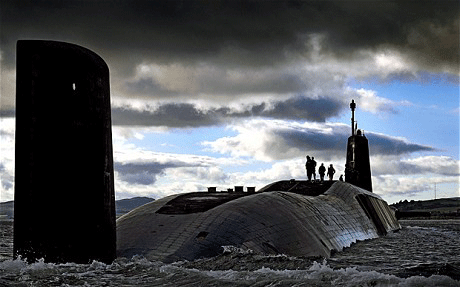
Rosyth councillor Brian Goodall wants public consultation.
29th April, By Ally McRoberts, Content Editor, https://www.dunfermlinepress.com/news/26063183.rosyth-councillor-brian-goodall-wants-public-consultation/
THE UK Government’s refusal to give local residents a say in Trident nuclear submarines coming to Rosyth has been slammed as “disgusting and undemocratic”.
Local SNP councillor Brian Goodall was fuming that a request for a public consultation on the move, which he said would require “radiation shelters” and iodine tablets for people who live in the town, has been sunk.
He said: “The UK Government are effectively saying we won’t ask the Scottish public if we should do this because we know they’d say no.”
Cllr Goodall added: “The MoD confirmed at a previous meeting of the area committee that these nuclear submarines may have nuclear missiles on board when they come into Rosyth.
“This not only presents massive additional health and safety concerns but also makes Rosyth even more of a target for rogue nations and international terrorist groups.”
The next generation of Trident nuclear submarines is the Dreadnought class and a contingent dock is to be in place at Rosyth Dockyard by 2029.
The vessels are to be maintained at Faslane but a temporary home is needed in Fife, and the UK Government have provided £340 million to help “bridge the gap”, as the site on the Clyde won’t be ready until the mid 2030s.
In December the MoD told local councillors they would not reveal if any of the subs that need repairs or maintenance at Rosyth will be carrying nuclear warheads.
In February, at the South and West Fife area committee, Cllr Goodall submitted a successful motion asking the convener to write to the Secretary of State of Defence, requesting that the public are consulted on plans to “potentially bring nuclear weapons” to the dockyard.
Opponents have argued that maintaining nuclear-powered subs and storing nuclear weapons are entirely separate – and that nuclear warheads are not kept onboard when a sub goes in for maintenance.
This week Cllr Goodall said: “The UK Government, through the MoD, have now responded to the request for them to hold a public consultation on their plans to bring nuclear fuelled, and possibly nuclear armed, submarines to Rosyth Dockyard, and their response is as predictable as it is disgusting and undemocratic.”
He said the letter from the Minister for Defence Readiness and Industry, Luke Pollard MP, “not only confirms their refusal to consult with local residents on their plans, it also admits that public safety, while a major concern, is not the main priority of the MoD”.
Cllr Goodall went on: “These submarines will still have their nuclear fuel onboard, unlike the decommissioned subs that are already at the dockyard, so there will need to be additional emergency plans put in place, including arrangements for radiation shelters for some local residents and to distribute potassium iodide tablets to the local population.
“The communities around the dockyard should be allowed to have their say on this and the campaign for a public consultation will go on.”
The work on the Dreadnought class would be in addition to the submarine dismantling project at the dockyard, which is cutting up an old nuclear sub, Swiftsure, and removing the radioactive waste left within it.
There are another six decommissioned subs laid up at Rosyth – and 15 at Devonport – and although no decision has been made, Babcock are recruiting for more people to work on the dismantling project.
Cllr Goodall has also expressed concern about the Swiftsure demonstrator scheme, arguing that work to remove the reactor should not go ahead as it’d be cheaper not to do so and there was nowhere safe to store the radioactive waste.
What are Palantir’s 22 points?
Palantir’s 22 points summarize CEO Alex Karp’s vision for the 21st century, emphasizing national defense, AI, societal order, and a pro-Western ideological stance.
Palantir Technologies released a 22-point summary of CEO Alex Karp’s book The Technological Republic on April 19, 2026, outlining the company’s ideological and strategic vision for the 21st century. The manifesto addresses the role of technology, national defense, AI, and societal culture, and has sparked significant debate due to its controversial positions.
Palantir’s 22 Points summarize:
1. Moral Duty of Tech Companies: Silicon Valley owes a moral debt to the U.S., and tech elites have an obligation to participate in national defense.
2. Hard Power over Soft Power: The manifesto argues that liberal democracies require hard power, particularly software and AI, to maintain security and influence.
3. AI and Military Deterrence: The atomic age is ending, and a new era of AI-based deterrence is beginning. Palantir emphasizes that AI weapons will be built, and the question is who builds them and for what purpose.
4. National Service: The U.S. should consider reinstating universal national service, moving away from an all-volunteer military.
5. Support for Military Personnel: If a U.S. Marine or soldier requires better equipment or software, the country should provide it, reflecting a commitment to those in harm’s way.
6. Governance and Public Life: Public officials should be treated with tolerance, and society should allow room for human complexity to avoid incompetent leadership.
7. Geopolitical Repositioning: The manifesto calls for reversing the postwar demilitarization of Germany and Japan, warning that current pacifism could shift the balance of power in Asia.
8. Cultural Evaluation: Some cultures are described as producing vital advances, while others are labeled regressive or harmful. The manifesto criticizes “vacant and hollow pluralism” and emphasizes the importance of recognizing cultural contributions.
9. Role of Silicon Valley in Crime and Society: Tech companies should actively address violent crime and societal challenges, rather than remaining passive.
Implications and Controversy
The 22 points have been described as a corporate political manifesto, linking Palantir’s software and AI capabilities to national defense, law enforcement, and immigration control. Critics have labeled it “technofascist” or likened it to a supervillain’s vision due to its advocacy for AI weapons, national service, and cultural hierarchies. Supporters argue it reflects a clear moral and strategic stance for tech companies in global security.
Summary
In essence, Palantir’s 22 points articulate a vision where technology, national defense, and societal order are intertwined, emphasizing AI, military readiness, and a pro-Western ideological framework. The manifesto has generated both praise and criticism, highlighting the company’s unique position at the intersection of tech, politics, and global security.
Dangerous and expensive, nuclear power is a dead end for Scotland

I’ve been through every argument that the nuclear industry
makes promoting new nuclear power stations – but scratch the surface and
they just melt through the floor. New nuclear is fundamentally not needed –
numerous studies, including by Stanford University and renowned energy
modellers at LUT show that the UK, and indeed most, if not all, other
countries can meet their energy needs with 100% renewables.
Politicians’ fears about the wind and sun and the rain and the waves and tides being
unable to meet all our needs are misplaced. Renewables, energy storage,
energy efficiency and flexible power with a modern upgraded grid can do it
all – cheaper, quicker, safer and a hell of a lot cleaner, and create many
more thousands of jobs.
The cost of nuclear power is eye-watering. Look at
Hinkley Point C and Sizewell C – nearly £100bn to build them both with
massive delays and cost -over-runs. That is enough to install a 5kWh
battery in every one of the 28 million homes in Britain, and leave £44bn
for other things. Combine that with solar and every home becomes a power
station with its own ‘baseload’.
Alternatively, £100bn could fund planned
upgrades to the grid needed to facilitate large and small renewables, twice
over. The Coire Glas pumped hydro storage project in the Highlands could be
built 50 times over. £100bn spent on a nuclear-free transition could be
revolutionary.
What a renewables-based system needs is flexible power,
energy storage and a smart, modern grid. Surplus renewable electricity
could also be used to generate ”green hydrogen” to generate electricity
on calm, dull days. It could also be used to power heavy transport and
industry.
Battery systems, including compressed air and pumped storage
hydro, alongside vehicle-to-grid technology, can all be parts of the
bedrock of energy security and an energy system that would be cooking with
green power 24/7.
Nuclear does nothing to help any of this. Indeed, it is
worse, it directly causes wind and solar plants to be switched off when
green power is plentiful, because nuclear is so inflexible. Not only does
nuclear cost an arm and a leg, it adds cost to the consumer for renewables
We only have to look at the recent history of nuclear power to see how
dangerous and polluting it is. Fukushima remains a slow motion disaster for
Japan as they scramble to deal with millions of gallons of radioactive
water and melted reactor cores. Chernobyl’s 40-year anniversary this week
is another timely reminder, that when things go wrong, they can go very
wrong.
At least when a wind turbine breaks down you don’t need an exclusion
zone for decades and mass public health measures – you just get some
engineers with a crane and some spanners to go fix it.
And despite what the
‘nuke, baby, nuke’ lobby says, there is no solution for the waste yet,
other than to store and guard the most highly radioactive cores for
hundreds of years to cool down out of the way somewhere. That’s the
solution!
The hype about Small Modular Reactors is just that, hype. In
fact, the only two operational SMRs are in China and Russia, and both have
been beset by delays and cost increases. The economies of scale are lost,
and studies have shown that they produce more highly radioactive waste for
the same generating capacity than their slightly larger cousins.
These projects are pure spin, a clever wheeze by industry lobbyists intended to
promote nuclear acceptability – small, click and collect, a kind of
middle-aisle at LIDL feel to it. In the words of energy expert Amory Lovins
on SMRs: “This illusion neatly fits the industry’s business-model shift
from selling products to harvesting subsidies.”
The Rolls Royce SMR –
chosen by Great British Energy-Nuclear to be built at Wylfa in North Wales
– is a 470MW reactor, not much smaller than the two Torness reactors, which
are about 600MW each. And then there is the fuel – uranium ore is needed
and we don’t have any, (and the mining of it is handily missed out in
nuclear promotional graphics comparing its land use to renewables, which
also fail to point out that the land around solar arrays and turbines can
still be used for traditional purposes).
Mind you, there is some
recoverable uranium ore on the Orkney mainland – and when it was proposed
to dig it up to use it at Dounreay last century, all hell broke loose and
Orcadians stopped it by popular protest. So we would have to rely on
imports of this global commodity – a market that is dominated by Russia and
associates.
Pete Roche of SCRAM put this well when commenting on a recent
poll indicating only 14% of Scots thought we should focus on uranium
fuelled nuclear reactors for our long term energy security needs:
“Relying on a uranium-fuelled nuclear future is like jumping out of the
oil and gas frying pan and into a nuclear fire – it makes no sense and
Scots seem to get that.”
We should just get on with building a country
that is a renewable energy powerhouse so that future generations can look
back and thank us for choosing a green, clean and sustainable energy route.
Nuclear is NOT a natural partner with renewables, indeed, it is a delaying
tactic, holding back rapid decarbonisation, and adds extra and unnecessary
cost to a renewables-based energy system.
Herald 29th April 2026, https://www.heraldscotland.com/politics/viewpoint/26064131.dangerous-expensive-nuclear-power-dead-end-scotland/
Antisemitism and Israel: A challenge to the Australian narrative (Part 1)
UN Special Rapporteur Francesca Albanese has delivered the 21-page report, ‘Torture and genocide: Report of the Special Rapporteur on the situation of human rights in the Palestinian territories occupied since 1967’, dated 19 February 2026. Albanese’s team outline the depths of depravity and inhumanity to which the Israeli regime has now sunk in its attempted destruction of the Palestinian people.
By Evan Jones | 27 April 2026, https://independentaustralia.net/politics/politics-display/antisemitism-and-israel-a-challenge-to-the-australian-narrative,20974
A provocative Royal Commission submission by Dr Evan Jones argues that Australia’s antisemitism debate cannot be separated from Israel, Zionism and their political influence.
Submission to the Royal Commission on Antisemitism and Social Cohesion
Part 1
General
This submission can be reduced to one word — Israel.
There you have the answer to your inquiry. Dismantle apartheid Israel and see so-called “antisemitism” disappear overnight, save for a small ineradicable but prosecutable fringe
There is really no reason for this Royal Commission at all, as the problem is self-evident. The Commission will not solve the problem that it was formally established to resolve because its agenda is diversionary. Indeed, it will compound the problem because it will, in all probability (as it is seemingly intended to do), reinforce the influence of the Australian Zionist lobby and thus the ongoing impunity of Israel.
The problem arises from the conflation of two forces.
One: Israel is a nation founded on terrorism and wilfully sustained on deep-seated racism.
We know that nation-states are perennially born of violence, expropriation and repression (Australia as a case study), but Israel is a pronounced variation on a common colonialist theme. Israel was born of naked terrorism against an entire (non-Jewish) indigenous population. It was explicitly created and has been sustained as a racist apartheid state. Its borders have never been determined, envisaging ongoing expansion (lebensraum) — “from the river to the sea” (and beyond).
Palestinian Israelis (descendants of those whom the Zionist terrorist gangs failed to expel) are second-class citizens. Palestinian non-Israelis, under Occupation and under martial law, are denied the most basic human rights. Gaza has been a concentration camp since Sharon supposedly “disengaged” from Gaza in 2005.
The sadistic murder of Gazans since October 2023 is reminiscent of the Germans’ feverish pursuit of Jews and Bolsheviks after Operation Barbarossa in June 1941. Israel has long undermined United Nations Relief and Works Agency for Palestine Refugees in the Near East (UNRWA) personnel and facilities, which attempt to instil a modicum of humanity into a population long starving from Israeli blockages. Israel endorses carnage by fanatical settlers on West Bank Palestinians, murdering and destroying Palestinian livelihoods at will — for which they enjoy absolute immunity.
The Israel Defence Forces (IDF) murder children with pleasure. Children are imprisoned indefinitely for throwing stones. Adult prisoners are tortured and murdered. Israel wilfully murders foreign dignitaries (most recently, the Iranian National Security Council chief Ali Larijani, reputed “moderate” and skilled negotiator), which highlights that mass murderer Benjamin Netanyahu has put to words what has been the manifesto of all Israeli leadership: there will never be a Palestinian state (September 2025).
Long-term ethnic cleansing has now turned to genocide, ongoing in defiance of the formal “ceasefire”. Israel destroys essential infrastructure, murders aid workers and journalists — because it can. The journalist murder count is now further “totting up” in southern Lebanon.
Representative — this month (March 2026) marks the 23rd anniversary of the crushing of American Rachel Corrie by an Israeli bulldozer.
UN Special Rapporteur Francesca Albanese has delivered the 21-page report, ‘Torture and genocide: Report of the Special Rapporteur on the situation of human rights in the Palestinian territories occupied since 1967’, dated 19 February 2026. Albanese’s team outline the depths of depravity and inhumanity to which the Israeli regime has now sunk in its attempted destruction of the Palestinian people.
Some excerpts:
Torture has always been a central feature of Israel’s dispossession of Palestinians. Yet, since October 2023, Israel has employed it on a scale that suggests collective vengeance and destructive intent.
Torture is not confined to cells and interrogation rooms. Through the cumulative impact of mass displacement, siege, denial of aid and food, unrestrained military and settler violence and pervasive surveillance and terror, the occupied Palestinian territory (oPt) has become a space of collective punishment, where the destruction of the conditions of life turns genocidal violence into a tool of collective torture with long-term mental and physical consequences for the occupied population.
During its Mandate in Palestine, Britain used torture as one of the counterinsurgency tactics honed in Ireland and later imparted to Zionist militias; such practices, a colonial legacy, were then absorbed into the Israeli security apparatus before and after 1948 as a tool of repression and a preventive measure against Palestinian resistance. From early State-building and through decades of occupation, Israel has practised and condoned coercive violence as a structural component of its apparatus of domination.
An ecosystem of discriminatory legal frameworks and abusive operational practices has metastasized, encompassing Israeli military detention sites and prisons.
Since October 2023, torture in detention has, been used on an unprecedented scale as punitive collective vengeance — a clear feature of genocide. All Palestinians have been treated collectively as “terrorists” and “security threats”.
For her luminous competence, commitment and courage, Albanese was subject to comprehensive oppressive sanctions by the unhinged U.S. Trump Administration in July 2025.
Israel defies all international institutions and laws that proscribe the abuse of state power. Israel’s lobbying and propaganda regime (hasbara) is probably the most extensive of any state in history. Israeli authorities lie about the state’s forces’ actions without remorse.
The Israeli state is a parasite, receiving over US$300 billion (AU$418.7 billion) in aid from U.S. governments since 1950 (a great deal of which flows back to U.S. weapons manufacturers), supplemented by an estimated US$2 billion (AU$2.8 billion) per annum in donations from overseas Jewish “charities”, propped up at the country taxpayers’ expense. In particular, the Jewish National Fund directs funds to obliterating indigenous history in historic Palestine.
In short, the state of Israel is a pariah state, a barbaric regime, an abomination.
Two: All self-described “official” Jewish representative organisations in Australia support and lobby for Israel unreservedly. It is a full-time occupation.
Such “representative” organisations oppose basic human rights for Palestinians under Israeli control. They socialise their children into “a love of Israel” in Jewish “faith” schools. Some of their children are currently enrolled with the IDF to kill Palestinians.
Such organisations lobby Australian governments to support Israel, inhibiting Australian governments from adopting a principled stance towards Israeli criminality. They harass media management and editorial, thus gaining privileged access to and biased coverage from media outlets that the public relies on for supposedly unbiased information and opinion. Their ridiculous defences of Israel (op-eds, letters, buying off journalists) are published with great regularity. Anti-Zionist Australian Jews (vide Louise Adler and so on) and their organisations (the recently formed Jewish Council of Australia) are pilloried, indeed “excommunicated”.
In essence, Australian Jewish “representative” organisations act as a fifth column for a foreign state against Australian national interests – naturally antagonistic to ‘social cohesion’.
One and two in combination.
The Australian Jewish community, by virtue of its “official” representatives, courageous dissenters excepted, is complicit in Israeli genocide. And not just passively but actively. There has been no mea culpa on the part of executives of the key Jewish organisations (such as ECAJ, ZFA, AIJAC). Nobody in the Jewish community that underpins these organisations has sought to overturn the leadership of these key organisations in order to reorient their agenda and priorities.
In short, Israel and the “official” Australian Jewish community are joined at the hip.
It is not unrealistic to infer that the Bondi attack (and multiple incidents simply labelled “antisemitic”) is blowback for Israel’s character and actions and its local support network. The Israeli machine thus puts the security of global Jewry at risk (indeed, its own Jewish population) and doesn’t care.
A Zionist foot soldier is published in The Sydney Morning Herald (22 March), in denial regarding the intimate connection:
‘While David Leser’s article (SMH & Melbourne Age, 20 March [2026]) raises some thought-provoking points, it falls into the trap of attributing antisemitism in Australia to the actions of the Israeli Government. No other national or ethnic group in Australia is held to account for the actions of governments in countries overseas. So why is it considered reasonable for Jews in Australia to be relentlessly discriminated against for the actions of the Netanyahu Government?’
After the Bondi Beach murders, Israeli flags were well represented among the flower collections and mourners. Israel is apparently seen as the mother ship, the source of solace for those suffering, yet it is the ultimate cause of that suffering.
This bizarre anomaly is enhanced when the Zionist Federation of Australia (as befits its name) initiated the idea of inviting the Israeli President, Isaac Herzog, to Australia, subsequently legitimised and authorised by Prime Minister Anthony Albanese and dragging the Governor-General into the sordid process.
Another foot soldier grasps the connection but declines to understand the implications (SMH, 9 January 2026):
‘President Herzog is the legitimate head of state of the internationally recognised democratic state of Israel, rightfully invited to commiserate with Australians after the appalling terrorist atrocity at Bondi, in which predominantly Jewish people were murdered and injured.’
One notes in passing that Israel is not a democracy but an ethnocracy — no amount of affirmation is going to change the lie and the blind spot in the letter writer’s eye. To repeat, Israel is apparently seen as the mother ship, the source of solace for those suffering, yet it is the ultimate cause of that suffering. ‘Rightfully invited’ — really?
Herzog is not a passive head of state but an active participant in Israeli barbarism. Herzog comes to Australia, spends a token moment with victim families and survivors, declines to visit the fire-bombed Orthodox (non-Zionist) Adass Israel synagogue (“for reasons of security”) and spends the bulk of his time playing Israeli politician (‘not the time for a two-state solution’, meets with ASIO and so on).
The implication is ugly. Those murdered at Bondi are being instrumentalised (as with Netanyahu’s treatment of Hamas’ Israeli hostages) in the defence of the state of Israel and its current genocidal agenda. Appalling, no?
Trump to America…’No dough for the Commons. I need it for my criminal wars’
Walt Zlotow West Suburban Peace Coalition Glen Ellyn IL. 26 Apr 26, https://theaimn.net/trump-to-america-no-dough-for-the-commons-i-need-it-for-my-criminal-wars/
President Trump has a bizarre way of demonstrating his claim of being the Peace President deserving the Nobel Peace Prize
He spent his first term raining down tens of thousands of bombs on 7 countries posing not a whit of danger to the Homeland. He assassinated a top Iranian general in Baghdad, a monstrous war crime. He withdrew from Obama’s Iran nuclear deal (JCPOA) which silenced Iran’s nuclear bomb potential and should have ended the isolation of Iran. Instead, it set the table for Trump’s senseless, now failed war on Iran 8 years later that may crash the world economy if not ended soon. That is madness.
Trump’s obsession with murder and mayhem worldwide has collateral damage to every sensible domestic function of government. Trump has spent 10 years trying to demolish Obama’s Affordable Care Act, a relatively meager improvement to America’s failed health insurance system to the less fortunate. He hasn’t spent dollar one to fix it. He’s ignored our crumbling infrastructure. He’s invested zilch in green energy while the world overheats relentlessly.
But Trump sure has invested in war. His last term one National Defense Authorization Act (NDAA) budget in 2021 was a massive $740 billion. His first in term two for 2026 crashed the trillion mark by $42 billion. But mimicking Al Jolson in ‘The Jazz Singer’, Trump proclaimed ‘You ain’t seen nothing yet.’ His 2027 NDAA sours to $1,500,000,000, a 44% increase. Combined with massive tax cuts for the billionaire class, Trump’s profligate military spending has goosed the national debt by $10 billion in his first 6 years.
While silent about spending on the Commons to improve life for all Americans, Trump is ecstatic about his trillion and a half bucks for endless wars. “We’re fighting wars. We can’t take care of day care. “It’s not possible for us to take care of day care, Medicaid, Medicare — all these individual things They can do it on a state basis. You can’t do it on a federal.”
To paraphrase first predecessor Obama, ‘Yes you can…yes you must.’
On April 7, 1967, exactly one year before he was gunned down, Rev. Martin Luther King courageously spoke out against the Vietnam War at New York’s Riverside Church, ahead of a massive antiwar rally. In ‘A Time To Break the Silence’, King decried, “A nation that continues year after year to spend more money on military defense than on programs of social uplift is approaching spiritual death.”
Under Donald Trump’s endless, senseless wars…America’s spiritual death is here.
UK nuclear industry in lobbying blitz ahead of Scottish election

THE UK nuclear industry ramped up its lobbying of MSPs ahead of the Holyrood
election, the Sunday National can reveal. An investigation based on the
Scottish Parliament’s lobbying register has revealed that activity has
reached an all-time high, with industry groups, business organisations and
unions increasingly looking to reverse the Scottish Government’s
opposition to the building of new nuclear power stations.
In 2025, 32 MSPs
were lobbied across 14 separate meetings – the highest levels recorded to
date. Compared to the previous year, this was more than three times the
number of MSPs lobbied and almost double the number of distinct meetings.
So far in 2026, 12 MSPs have already been lobbied across seven separate
meetings in the run-up to polling day on May 7. The majority of recent
lobbying has been carried out by the Nuclear Industry Association, which
held a series of meetings with MSPs in Holyrood in 2026.
On March 24, 2026,
representatives from the association met several Labour and Tory MSPs. The
discussions focused on the role of nuclear energy and calls to reverse the
Scottish Government’s opposition to new nuclear development.
At another
meeting on February 20, 2026, the association spoke to Tory MSP Douglas
Ross, raising the “importance” of nuclear power to Scotland’s energy
future. The register also showed involvement from other organisations. On
February 25, 2026, for example, the trade union Prospect met with Net Zero
Secretary Gillian Martin to raise concerns from its members about the
future of the energy sector, including nuclear.
The French state-owned
energy company EDF Energy, which owns and operates Torness nuclear power
station, also lobbied 20 MSPs in 2025. Patrick Harvie from the Scottish
Greens said: “The nuclear industry may be a cash cow for lobbyists, but we
don’t need or want it in Scotland. “We cannot afford to waste time or money
on a costly and unsustainable energy source that will take years to go
online while leaving a toxic legacy for future generations. “If we are to
have a cleaner and greener future, it needs to be based on the vast
renewable resources that we already have in abundance rather than a dated
and dangerous false solution like nuclear.”
The National 26th April 2026, https://www.thenational.scot/news/26052414.uk-nuclear-industry-lobbying-blitz-ahead-scottish-election/
Poll Finds Just 4 Percent of Democrats Support Increasing Military Aid to Israel

By Sharon Zhang, April 25, 2026 , https://scheerpost.com/2026/04/25/poll-finds-just-4-percent-of-democrats-support-increasing-military-aid-to-israel/
Separate polling found this week that Congress’s disapproval ratings have tied their all-time high of 86 percent.
New polling has found that just 4 percent of Democratic voters support increasing military aid to Israel, marking a massive rift with congressional Democrats at a time when other polling has found that disapproval of Congress has tied its all-time high.
The Economist/YouGov polling released this week found that only 11 percent of American adults say that the U.S. should increase military aid to Israel, including only 4 percent of people identifying themselves as Democrats — and only 23 percent of Republicans.
Meanwhile, the polling found that 56 percent of Democrats say the U.S. should decrease military aid to Israel, including 35 percent who say the practice should stop altogether. Just 19 percent said the U.S. should maintain current levels, while 20 percent said they were not sure.
This is a huge departure from the stance of Democratic leaders in Congress, who support military funding for Israel or even want to increase it.
Last week, for instance, Senate Minority Leader Chuck Schumer (D-New York) was one of only seven Democrats to vote against the advancement of a measure to block the sale of bulldozers to Israel introduced by Sen. Bernie Sanders (I-Vermont). He was joined by figures like Sen. John Fetterman (D-Pennsylvania), one of Israel’s staunchest advocates in Congress.
Even though Sanders’s resolutions didn’t pass, the vote was seen as a major shift among Democrats, with more Democrats voting to block the sales of certain weapons to Israel than ever before — even if the caucus leader disagreed.
Schumer, a longtime supporter of Israel, said in February that supporting aid to Israel is, in fact, a top priority of his.
“I have many jobs as leader … and one is to fight for aid to Israel, all the aid that Israel needs,” he said at a gathering in New York City. He bragged that, under his leadership, U.S. aid to Israel has grown more “than ever, ever before,” and said: “As long as I’m in the Senate, this program will continue to grow.”
The Democratic National Committee (DNC) has also stuck to its positions of backing Israel and its political apparatus in the U.S. Last year, one of its committees rejected a measure for an arms embargo on Israel, while the party also voted down a resolution to limit the influence of dark money on Democratic races, including the spending from the American Israel Public Affairs Committee (AIPAC).
Meanwhile, approval of Congress — which has done virtually nothing to stop or stem the flow of weapons to Israel, despite public opinion — has hit record lows.
Gallup polling released this week found that the proportion of Americans who disapprove of Congress’s job performance has hit a record high of 86 percent — tying the record set in 2015. Meanwhile, Congress’s approval sits at a lowly 10 percent, just one point above its record low of 9 percent.
Is President Trump mentally unstable? (Part 2)

25 April 2026 John Lord , https://theaimn.net/is-president-trump-mentally-unstable-part-2/
In 2017, The Dangerous Case of Donald Trump, a book edited by Dr Bandy X. Lee, presented the assessments of 27 psychiatrists, psychologists, and other mental health professionals, argued that Trump’s mental condition constituted a “clear and present danger” to the nation.
However, it is important to acknowledge the ethical debate within the mental health community regarding the public diagnosis of political figures. On one side, proponents of speaking out argue that when a leader’s behaviour appears to threaten public safety or welfare, mental health professionals have a “duty to warn,” even if it means commenting without a direct evaluation.
They believe that their responsibility to the public outweighs traditional restrictions. On the other side, critics invoke the American Psychiatric Association’s (APA) Goldwater Rule, emphasising that publicly diagnosing a public figure without a face-to-face assessment and consent undermines professional ethics, risks personal bias, and can erode trust in the profession. This debate remains unresolved, with experts divided over what best serves ethical standards and public interest.
The APA’s Goldwater Rule cautions professionals against offering a diagnosis without a personal examination and proper authorisation. This ongoing controversy reflects broader concerns about professional ethics, public responsibility, and the challenges of analysing the mental health of high-profile leaders.
In 2021, some members of Trump’s own Cabinet, shocked by the violence at the Capitol on January 6 and his slow response, discussed whether to use the 25th Amendment to remove him from office because of concerns about his mental fitness.
During his 2024 campaign, he attacked Kamala Harris and then launched into a wild and confusing rant:
“She destroyed the city of San Francisco, it’s – and I own a big building there – it’s no – I shouldn’t talk about this, but that’s OK, I don’t give a damn because this is what I’m doing. I should say it’s the finest city in the world – sell and get the hell out of there, right? But I can’t do that. I don’t care, you know? I lost billions of dollars. You know, somebody said, ‘What do you think you lost?’ I said, ‘Probably two, three billion. That’s OK, I don’t care.’ They say, ‘You think you’d do it again?’ And that’s the least of it. Nobody. They always say, I don’t know if you know. Lincoln was horribly treated. Uh, Jefferson was pretty horrible. Andrew Jackson, they say, was the worst of all, and he was treated worse than any other president. I said, ‘Do that study again, because I think there’s nobody close to Trump.’ I even got shot! And who the hell knows where that came from, right?”
These persistent displays of paranoia, his continuing ICE raids, his use of the Justice Department to target his enemies, his shameless corruption rage, volatility, delusions, vengefulness, foul-mouthed posturing, his bottomless vengeance toward Iran and the Pope and increasing detachment from reality directly undermine the expectations of mental stability and sound judgment outlined in the thesis.
As such, they provide substantial evidence that calls into question the President’s capacity to fulfil the responsibilities and demands of the office.
Why did Trump and Vance pick a fight with Pope Leo? His exchange with the Pope was unsightly, unnecessary and regrettable.
Despite all these warning signs, his Cabinet members and aides keep their heads down. Republican members of Congress pretend not to notice, and his billionaire supporters dare not speak of his rapid decline. Media coverage of the President’s conduct remains contested.
Some critics argue that significant portions of the media engage in “sanewashing,” thereby downplaying or rationalising the President’s erratic behaviour. Others point out that both partisan and mainstream outlets have at times foregrounded his controversial statements and actions, which suggests a level of critical scrutiny.
This divergence highlights the unevenness of media responses: while certain outlets may frame the President’s behaviour as authentic or a populist connection, others interpret it as evidence of instability and potential danger.
These framing choices shape both public opinion and elite responses by influencing how the general population perceives these actions and how policymakers justify their stances. Ultimately, this complexity in media coverage reflects deeper debates over the press’s responsibilities and the challenges of interpreting signs of instability at the highest levels of government.
But some people on the political right, including longtime Trump supporters, have had enough.
Former Representative Marjorie Taylor Greene says Trump’s threat to destroy Iran’s civilisation is “not tough rhetoric, it’s insanity.” Far-right podcaster Candace Owens calls him “a genocidal lunatic.”
Conspiracy theorist Alex Jones says Trump “does babble and sounds like the brain’s not doing too hot.” Ty Cobb, a White House lawyer during Trump’s first term, says Trump is “clearly insane.” Former Trump White House press secretary Stephanie Grisham says, “he’s clearly not well.”
The public is starting to notice. Sixty-one per cent of Americans think he’s become more unpredictable as he gets older, while only 45 per cent say he is “mentally sharp and able to deal with challenges.”
For the good of the country and the world, we need to face the truth. Based on his actions and words, the most powerful man in the world seems unfit for the job because of mental instability.
We are all endangered. What happens if, in a fit of rage, he presses the nuke button and “chucks a wobbly”? Is hewatching the “football” with the atomic codes in his lap? Who’s ready to stop him to save the world?
It is not as though Congress doesn’t have the power to dismiss this ratbag. They could “Impeach” him now.
In conclusion, the 25th Amendment to the Constitution of the United States explicitly provides a constitutional mechanism for removing a President deemed unable to discharge the powers and duties of the office. This provision underscores Congress’s responsibility to act decisively in the face of clear evidence of presidential incapacity.
However, in practice, there are significant political and procedural barriers to invoking the 25th Amendment. The process requires the Vice President and a majority of the Cabinet to agree that the President is unfit, which can be difficult to achieve given political loyalties and fear of reprisals.
Even if this initial hurdle is cleared, the President can contest the decision, and ultimately, it falls to a supermajority in Congress to resolve the dispute. These requirements make the real-world use of the 25th Amendment extremely challenging, especially in a polarised political environment.
As such, while the 25th Amendment serves as a critical safeguard for the stability of American democracy and global security, its practical application remains fraught with obstacles.
Britain’s Nuclear Subservience
Norman Dombey, 2 April 2026, https://www.lrb.co.uk/blog/2026/april/britain-s-nuclear-subservience
In a brief exchange during Prime Minister’s Questions last month, the leader of the Liberal Democrats, Ed Davey, asked Keir Starmer about Trident replacement. ‘We have to make a choice now,’ Davey said: ‘lease new missiles from the United States, accepting whatever terms the president gives us, or build our own here in the United Kingdom.’ The prime minister replied that Davey was ‘advocating a plan without knowing how much it would cost and how it would work’. The discussion moved on.
Both men spoke of Britain’s ‘independent nuclear deterrent’. But the UK’s nuclear weapons capability is dependent on the US. Not only does Britain rent its Trident missiles from America, but the British-built warhead designed to be carried by those missiles, the Holbrook, is closely based on the American W76. The Los Alamos National Laboratory announced last year that a replacement for the W76 is going ahead: the W93 should be ready by 2034.
There is no need for the UK to replace its warheads. A Holbrook’s maximum yield is ninety kilotons of TNT-equivalent, about six times the size of the bomb dropped on Hiroshima. But the US Navy wants a new warhead in the mid-2030s and the UK has to follow suit even though there are no good reasons to do so. No one in Britain played any part in choosing the parameters of the W93.
George Robertson, the former Labour minister of defence and Nato secretary-general who now works for the Cohen Group, has said that the UK’s military dependence on the US is ‘no longer tenable’.
Britain’s nuclear subservience to the US dates from the 1958 Mutual Defence Agreement (MDA) between Washington and London:
Each party will exchange with the other party other classified information concerning atomic weapons when, after consultation with the other party, the communicating party determines that the communication of such information is necessary to improve the recipient’s atomic weapon design, development and fabrication capability.
The minutes of the first meeting of nuclear scientists from both sides in 1958, which seem to have been declassified by the US by mistake, show that the US provided ‘details of size, weight, shape, yield, amount of special nuclear material’. Several weapons were described. Britain’s nuclear bombs have been built at Aldermaston to an American design ever since.
President Kennedy and Harold Macmillan met at Nassau in the Bahamas in 1962 and agreed that the UK could use American Polaris missiles in its submarines. Charles de Gaulle was offered the same deal but declined. He said that the US could not be trusted and insisted that France had to take nuclear decisions for itself. British nuclear warheads are all carried by US-dependent submarine-launched ballistic missiles (SLBM). France builds its own SLBMs and its own warheads
David Manning was Britain’s ambassador to Washington from 2003 to 2007. ‘It is very difficult to imagine,’ he told the International Relations and Defence Committee last year, ‘what we will do to defend ourselves if, for example – this is very hypothetical – the Trump Administration decide that they will end our nuclear co‑operation deal, or Trump moves out of Nato, or even becomes just so equivocal about Nato that the Article 5 guarantee is no longer plausible.’
Trump and his war on Iran have given new urgency to Anglo-French nuclear co-operation, which should replace the ‘special nuclear relationship’ with the US before Britain needlessly commits itself to the US-dependent modernisation of its nuclear weapon system. If Britain were to join France, its first action should be to extract itself from its agreement to buy the W93 from the US. Aldermaston can make its own warheads or make them to a French rather than a US design.
The Nuclear Non-Proliferation Treaty (NPT) was drafted by the UK and US to forbid weapon-state signatories from helping non-weapon states to develop nuclear weapons. But they are not forbidden from helping one another: the MDA and Polaris Treaties between the UK and US are not affected by the NPT. A similar agreement between the UK and France would also be allowed by the treaty. France delivers its weapons on SLBMs, cruise missiles and aircraft and could share information with Britain in these fields (as it already does in some of them).
In any case the NPT may well be obsolete. India, Pakistan, Israel and North Korea all have nuclear weapons. Faced with a hostile Russia, it might be sensible for Germany and Poland to have them too. It certainly makes sense for the UK to decouple its nuclear weapons programme from the US.
Study for Miliband finds Scotland suitable for new nuclear

Scotland could be “ripe” for new nuclear power, according to a
“discrete study” sitting on Ed Miliband’s desk. Simon Bowen, chair of
GB Energy Nuclear, told MPs that the government-owned company has completed
research for the Energy Secretary on “the suitability of Scotland for new
nuclear development” but that the report has yet to be published.
Bowen said whilst publication of the report is a matter for Ministers it
doesn’t take an awful lot to work out what it will say.
Torness Hunterston and Dounreay are natural sites for development. SNP candidate
for Banffshire and Buchan Coast, Karen Adam, said: “GB Energy has utterly
failed to create the jobs promised by the Labour Party and now we know it
is being used as a vehicle to plot unwanted nuclear developments in
Scotland that would undermine our energy sector.
“Another energy
superpower Norway has just ruled out nuclear power so there are serious
questions to answer as to what on earth is going on here — Anas Sarwar
must come clean on these underhand reports and explain why he supports
these extortionate, toxic, nuclear plants being imposed upon Scotland
Herald 24th April 2026, https://www.heraldscotland.com/news/26048810.study-miliband-finds-scotland-suitable-new-nuclear/
Iran Survives Terrorist War and Emerges a Major Power Broker
From reports and observations we saw that many people, regardless of their political views, and including many who had returned home from other countries, were keen to defend their country from this foreign aggression. Not surprising, really.
Tim Anderson, Black Agenda Report, 22 Apr 2026 GOOD PHOTOS
Tim Anderson tours Iran during the US-Israeli war, showing different scenes from the terrorist targeting of civilians. He contends Iran has emerged with greater regional leverage, especially through its control over the Strait of Hormuz.
Originally published in Al Mayadeen English.
The unprovoked war against Iran by the USA and “Israel” has failed in spectacular fashion, with the Israeli colony in tatters, Washington looking for a way out while Iran holds the upper hand in peace “negotiations” proposed by Pakistan. Further, Tehran’s newly asserted control over shipping traffic passing into and out of the Persian Gulf (which neither the USA nor anyone else can shake) has given it tremendous new economic leverage.
Furthermore, the Iranian population has held together strongly under an extensive series of strikes on mainly civilian targets, which began with the assassination of the former Leader Sayyed Ali Khamenei and the murder of 168 people, mainly schoolgirls, at the primary school in Minab, in southern Iran. This coherence underwrites the stability and future of the Islamic Republic.
It is a strange war, as I was able to observe in its third and fourth weeks, with everyday life going on in most major cities, while terrorist atrocities take place in the background. As a bakery owner at Niloufar Square in Tehran told me, this is not a conventional war, like the US-backed Iran-Iraq war of the 1980s, where militaries face each other across a frontline.
The bakery owner’s building had been demolished by an enemy missile which targeted the police station next door. The USraeli attack on the police station at Niloufar Square in Tehran also killed and wounded dozens at an adjacent café (see photo on original) and in surrounding residential apartments.
I was one of a group of four observers (a Turkish journalist, a Greek Lawyer and journalist and a North American videographer) hosted by the Iranian media, between 19 and 31 March. Our tour began in the northern city of Tabriz and wound its way down through Tehran, Isfahan, Shiraz, Bushehr, Bandar Abbas and Minab, the site of the schoolgirl atrocity. Mostly, we were observing the aftermath of USraeli attacks and the patriotic mobilisation of people virtually every evening in the major cities.
In every Iranian city we visited, tens of thousands poured out each evening in support of their country. That included a huge gathering for Eid prayers after Ramadan, at the Imam Khomeini Mosalla Mosque of Tehran (see photos), the first such gathering in 35 years that had not been addressed by the murdered Iranian leader Sayyed Ali Khamenei
From reports and observations we saw that many people, regardless of their political views, and including many who had returned home from other countries, were keen to defend their country from this foreign aggression. Not surprising, really.
It seems that Trump’s attack on Iran was encouraged by the Israeli propaganda against the Islamic Republic: the repeated claims that “the regime” was highly unpopular and isolated, often making use of heavily biased surveys. Israeli propaganda suggested that the Iranian people would rise up again this “regime” if it were decapitated. That, of course, did not happen, even after many leaders were assassinated.
This is the problem with “believing one’s own nonsense”, most of it generated by Israeli ‘Hasbara’ campaigns, which suggested that the Islamic Republic was hated and insubstantial.
That campaign made use of a wave of violence instigated by Mossad and the CIA in January 2026, as Israeli media and former CIA boss Mike Pompeo admitted, which infiltrated economic protests (after a currency collapse) and killed over 3,000 people (officially 3,117), including hundreds of police and volunteers (Basij).
In Iran, our group saw people of all sorts, but mainly women, coming out to defend their nation and their military. The aim of the Trump-Israeli war was never clearly spelt out, though it is plain that the Israelis wanted to destroy or dismember Iran. The lack of any clear pretext for war led to many of the US allies distancing themselves, while less discriminate ‘allies’ instinctively went along with whatever the US said or did.
As it happened, Iran’s formidable deterrent force of missile and drones punished the Israelis for more than a month, while partially or totally destroying all 13 US bases in the Arab Monarchies of the Persian Gulf. US ships could not approach the Persian Gulf for fear of Iranian missile strikes. For similar reasons, there was no US ground invasion.
Yet we saw traumatised family after traumatised family as we passed through the cities………………………………………………………………………………………………………………………………………………………………….
Though our observations were anecdotal, the Iranian Red Crescent informed us in Tehran that there had been 81,000 strikes on civilian sites. By the time we reached Shiraz, this had risen to 85,000. By early April, the Red Crescent said over 2,100 people had been killed and 115,000 civilian facilities damaged.
We did see reports of USraeli attacks on military sites (such as the large but futile attacks on the missile mountain at Yazd), but a senior security official in Shiraz told me that, for that province and by late March, there had been 53 military and 72 civilians killed.
Neither the US nor the Israelis respect Iranian cultural heritage. We saw serious damage to the historic Golestan palace and the Pahlavi palace-museum complex in Tehran, from bunker buster bombs. There was similar shockwave damage to the Chehel Sotoun palace in Isfahan. The latter had been damaged by attacks on the nearby provincial governor’s offices. In each case sheets of plastic with UNESCO blue shield insignia had been laid out, to designate cultural property to be protected in the event of armed conflict; to no avail. Colonial aggressors have little regard for indigenous heritage.
Traveling down the Persian Gulf coast from Bushehr – where we saw destruction of the Meteorology station and the main hospital – we eventually arrived at Bandar Abbas and then Minab, site of the schoolgirl massacre. After visiting one bereaved family, we went to the graveyard, where mothers and fathers were still encamped, mourning their lost children. Some graves were being reinforced after the flooding rain of previous days.
Many held clothing and the shattered backpacks of children, which have become symbols of the massacre. Moving to the school, we examined the site to satisfy ourselves that there were no military facilities in the vicinity. In fact, the site had been a military compound, many years ago. It was handed over to the Health and then to the Education Ministry, and the primary school was constructed 13 years ago.
Amidst the obfuscation over this massacre (Trump at first tried to falsely blame the Iranians) a blunt assessment fell to former U.S. Army Counterterrorism Intelligence Officer Josephine Guilbeau. She said the attack, involving multiple Tomahawk missiles, was a clear case of deliberate terrorism and that US intel would have known very well that the site was a school and, at that time of day, full of children. She named USS Spruance Commander Leigh R. Tate and Executive Officer Jeffrey E. York as the officers to be held accountable for this terrorist atrocity.
Returning to the port city of Bandar Abbas, our visit to Hormuz Island – facilitated by the governor of Hormuzgan Province – was interrupted by the drone bombing of the port at the island. As a result, we went out into the straits in a boat and observed the many ships sitting offshore.
From Iranian reports and interviews (of the Governor of Hormuzgan and s specialist energy sector journalist at Bandar Abbas) I gathered the following: the Straits of Hormuz were not “closed” but shipping linked to the enemy had been blocked by the IRGC, while shipping from some of the other Persian Gulf states was being taxed (with a toll), and ships from friendly states (e.g. Iraq and China) were passing freely. This was clarified repeatedly over the following weeks. At an early stage, the main shipping insurance companies recognised IRGC security clearance as a factor in reducing risk premiums and therefore the financial viability of passage.
While the Straits had been open to all before the US-Israeli war, there was now security regulation, enforced by Iran. Washington has not even come close to seizing control of the Straits.
Overall, many years of Iranian “strategic patience” came to an end with the direct attacks on Iran by Washington, and that, in turn, delivered a powerful new weapon to Tehran, control of the gateway to 20% of the world energy supplies.
The Western media reacted with chagrin. Australian state media, the ABC, seeing that there was a fellow Australian at Hormuz, contacted me, but not to ask any details of what I had seen. Rather, reporter Henry Zwartz asked me if I had been paid to appear in an “Iranian propaganda video”. That shows how little interest the Australian state media had in the details of any new war; they would prefer to smear anyone appearing to contradict their official story.
As it happened, the USraeli war against Iran was failing badly and desperately trying to cover its tracks. The US military could neither invade Iran nor enter the Persian Gulf, for fear of Iranian missiles and drones. Trump ranted and raved about how he was winning and how Iran had been “crushed” and the Western media reported this credulously. Washington claimed virtually no casualties, after they had lost at least a dozen warplanes and a dozen military bases across the Persian Gulf. Those hidden casualties will emerge under some cover, down the track.
Importantly, Iran asserted sovereign control over passage through the Straits of Hormuz (regulating what is called “innocent passage” under the customary law of territorial seas – neither Iran nor the USA are parties to UNCLOS) and Washington was unable to undo this, resorting eventually to a secondary blockade of the Straits. Peace talks in Pakistan failed due to intransigence on the US side.
The better Anglo-American commentators have recognised not just the failure of this war but the fact that its failure signals an end to the era of US unilateralism. Professor John Mearsheimer said that Iran, had gained the lever of Hormuz, unregulated before the war, and oversaw the Israelis “poison[ing] their relations with the United States”. British analyst David Hearst said that Trump’s bile and stupidity had effectively enhanced Iran’s power in the Persian Gulf.
Researcher Ali Mamouri wrote “No matter how the blockade plays out, Iran will be in a far better position in the long term when it comes to maintaining control over the strait – not the US.”
The likely larger cost of US defeat will be withdrawal of all US bases from the Persian Gulf – now a key Iranian demand – and strategic retreat along the lines of that set out by Nixon after defeat of the US in Vietnam. In 1969, President Richard Nixon announced his ‘Guam Doctrine” from a Pacific island base. The claim will be – now as then – that Washington is “rebalancing” its commitments and leaving greater responsibility for its “allies”.
Some embedded journalists have already argued this was Trump’s approach in his first term, when he sought to make allies pay more for their own security. It might better be seen as a cover for a humiliating defeat and yet another step in the decline of the US global hegemony. Remember that China is also committed to Iranian (i.e. independent) control of Hormuz and thus of its key source of energy. That is, of course, why Beijing continues to support Iran in logistics, defence technology and intelligence. In any case, Trump will be looking for some face saving consolation prize to cover up this monumental failure.
Tim Anderson is the Director of the Sydney-based Centre for Counter Hegemonic Studies. https://blackagendareport.com/iran-survives-terrorist-war-and-emerges-major-power-broker
How do Britons feel about nuclear energy?
40 years on from the Chernobyl nuclear disaster, Britons are divided on
whether nuclear energy is safe: Key takeaways:
Britons support the use of
nuclear power by 51% to 29%, with opposition declining in recent years:
Green voters are divided 46% to 39% on whether or not they support the use
of nuclear power: 37% of Britons want more of the UK’s electricity to come
from nuclear energy, compared to 23% who want less: Britons are divided 45%
to 39% on whether or not nuclear energy is generally safe: Men are
consistently far more supportive of nuclear power than women.
You Gov 24th April 2026, https://yougov.com/en-gb/articles/54612-how-do-britons-feel-about-nuclear-energy
‘Territorial Theft With Better Branding’: Israel Keeps Advancing Its ‘Yellow Line’ in Gaza
One Palestinian American researcher warned that Israel is seeking “annexation without legal burden.”
Stephen Prager, Common Dreams, Apr 22, 2026
Israel’s gradual advancement of its “yellow line” to occupy more territory in the Gaza Strip is fueling concerns that it is seeking to effectively annex and colonize the majority of the territory without any formal agreement.
The Guardian reported on Wednesday that Israel has been steadily pushing the truce line to take control of more Palestinian territory in the six months since a “ceasefire” was reached in October.
The yellow line drawn on the ceasefire maps had Israeli troops in control of about 53% of Gaza’s territory, cramming nearly 2 million displaced Palestinians into a territory less than half the size of the one they inhabited before.
But an analysis by Forensic Architecture shows Israel has unilaterally shifted the line westward over the past six months to the point where it controlled about 58% of the strip by December in an occupation zone that continues to grow.
Palestinians living in Gaza reportedly woke up to learn that large yellow concrete blocks denoting the ceasefire line had suddenly moved and that they were now living in a free-fire area, where the Israeli military considers any Palestinian person or vehicle a legitimate target.
The Associated Press found in January that at least 77 Palestinians have been shot on sight when they’ve found themselves on the wrong side of the yellow line or even just near it, even though the line’s boundaries are ill-defined and fluid.
They are among more than 730 Palestinians who have been killed since the “ceasefire” began in October, according to the Gaza Health Ministry, which has accused Israel of thousands of violations.
According to The Guardian, some displaced people, such as those who lived near the Salah al-Din road, which spans the length of Gaza from north to south, suddenly found themselves targeted by Israeli forces, who also began demolishing homes and other buildings and constructing new ones.
Though the yellow line was supposed to be set up as a temporary measure under US President Donald Trump’s “peace plan” for Gaza before control of the strip is transferred back to Palestinians, Israel Defense Forces (IDF) chief of staff Eyal Zamir described it as a “new border” with Gaza back in December, around the time it reportedly began to move…………………………………………………………………………………………………………………
Like in Gaza, the Israeli military has forbidden the more than 600,000 Lebanese inhabitants of villages below the line or within a newly established “buffer zone” from returning indefinitely. Katz has said they’ll be allowed to return once the “safety and security of the residents of the north [of Israel] is ensured.”
Given that Israeli settler groups have already begun mapping out new settlements and advertising plots of land for sale in southern Lebanon, Weizman said Katz was making what is by design “an impossible demand” meant to entrench the land grab.
“This exemplifies the circular logic of Zionist settler-colonialism: settlements are built to mark and protect the state’s border, but that makes them vulnerable to attack, and so a buffer zone is established to protect them,” he said. “Afterward, this buffer zone is itself settled to mark and protect the newly expanded borders, at which point another buffer zone becomes necessary.” https://www.commondreams.org/news/israel-moving-gaza-yellow-line
Leader in nuclear”? Or leader in repeating harm?
| Elaine Cimino, Apr 23, 2026, |
Rep. Meredith Dixon stood at a pro-nuclear conference and laid it out plainly: New Mexico is building a “nuclear ecosystem.”
Let’s translate that.
An ecosystem where:
– Public money cleans up yesterday’s contamination
– Public money funds tomorrow’s nuclear expansion
– And communities are told, once again, to accept the risk
$40 million to clean up abandoned uranium mines.
$150 million to build new nuclear technology.
That’s not balance. That’s subsidizing the problem at both ends.
They say this time is “different.”
They said that last time too.
Hundreds of abandoned uranium sites across New Mexico say otherwise.
Navajo communities still living with contamination say otherwise.
Water systems already under stress say otherwise.
Now we’re told uranium can come from “produced water.”
The same toxic waste stream the oil and gas industry is trying to dump into our future.
This is not innovation.
This is expanding extraction under a new label.
And let’s be clear about what’s driving this push:
Data centers. Defense systems. Industrial demand.
Not community need. Not public health.
Meanwhile, local journalism keeps framing this as a “debate”—two equal sides.
There are not two equal sides when one side carries decades of contamination, illness, and broken promises.
That’s not “both sides.”
That’s power vs. people.
We don’t need a nuclear ecosystem.
We need clean water, clean air, and full cleanup—first.
No new uranium. No expansion. No sacrifice zones.
Democratic NM representative says state poised to become national nuclear leader • Source New Mexico https://sourcenm.com/2026/04/21/democratic-nm-representative-says-state-poised-to-become-national-nuclear-leader/
1 This Month
15 October. Joint Appeal for Nuclear Abolition Day -presentation to the UN on October 15 will be live on UNWebTV
Endorse the Nuclear Abolition Day Appeal
23-25 October – on Zoom – World BEYOND War’s annual global conference

To see nuclear-related stories in greater depth and intensity – go to https://nuclearinformation.wordpress.com
-
Archives
- October 2026 (139)
- September 2026 (339)
- August 2026 (330)
- July 2026 (355)
- June 2026 (287)
- May 2026 (306)
- April 2026 (356)
- March 2026 (251)
- February 2026 (267)
- January 2026 (308)
- December 2025 (358)
- November 2025 (359)
-
Categories
- 1
- 1 NUCLEAR ISSUES
- business and costs
- climate change
- culture and arts
- ENERGY
- environment
- health
- history
- indigenous issues
- Legal
- marketing of nuclear
- media
- opposition to nuclear
- PERSONAL STORIES
- politics
- politics international
- Religion and ethics
- safety
- secrets,lies and civil liberties
- spinbuster
- technology
- Uranium
- wastes
- weapons and war
- Women
- 2 WORLD
- ACTION
- AFRICA
- Atrocities
- AUSTRALIA
- Christina's notes
- Christina's themes
- culture and arts
- Events
- Fuk 2022
- Fuk 2023
- Fukushima 2017
- Fukushima 2018
- fukushima 2019
- Fukushima 2020
- Fukushima 2021
- general
- global warming
- Humour (God we need it)
- Nuclear
- RARE EARTHS
- Reference
- resources – print
- Resources -audiovicual
- Weekly Newsletter
- World
- World Nuclear
- YouTube
-
RSS
Entries RSS
Comments RSS

