Kiev’s 2014 anti-terror operation was a bankers’ war
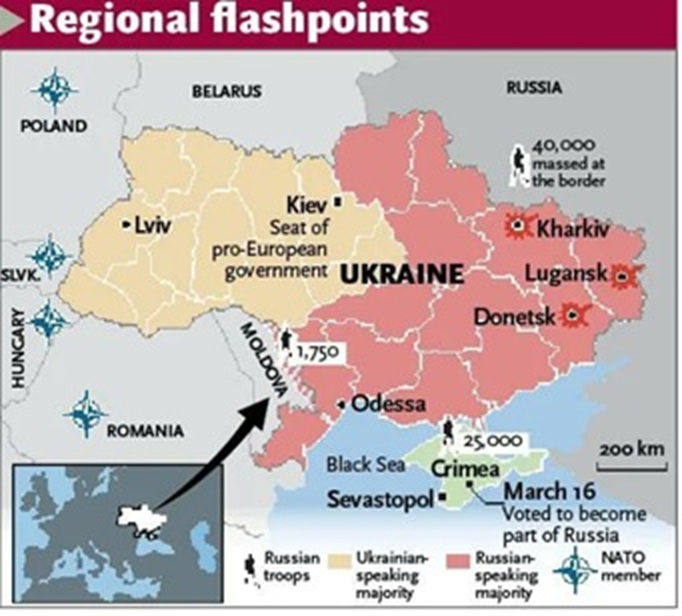
The war, which left 14,000 casualties, was instigated by IMF’s “key shareholders,” and discussed by Arianne de Rothschild and Jeffrey Epstein
Alex Krainer, Apr 23, 2026, https://alexkrainer.substack.com/p/kievs-2014-anti-terror-operation?utm_source=post-email-title&publication_id=1063805&post_id=194384784&utm_campaign=email-post-title&isFreemail=true&r=1ise1&triedRedirect=true&utm_medium=email
On 15 April 2026, we passed the 12-year anniversary from the start of Ukraine’s anti-terrorism operation (ATO), which set off a cascade of events leading to a civil war in Ukraine and which made the ultimate clash between Russia and the U.S./NATO all but inevitable. The ATO was a critical part of Western powers’ attempt to take full control of Ukraine, but at the same time, but its nature and intensity was deliberately obscured in the Western media.
The Maidan coup and the breakup of Ukraine
Violent overthrow of the democratically elected President Alexander Yanukovich took place in February 2014 and it provoked strong resistance in the southern and eastern regions of Ukraine where the majority of people understood what took place in Kiev.
These were the most populous regions of Ukraine which overwhelmingly supported President Yanukovych. In the 2010 elections in the Donbass he received over 90% of the vote and the people there did not accept his violent overthrow.
Russia seizes Crimea
In the immediate aftermath of the coup, Moscow moved to secure the Crimean peninsula. On 27 February 2014, Russian troops that were stationed in Crimea secured all of the peninsula’s strategic points to prevent a forcible takeover by Kiev junta’s forces. On 16 March, Crimea held a referendum to a very large turnout (83.1%) and 96.77% of the votes (1.23 million) were in favor of the peninsula re-joining Russia. Two days later, on 18 March, the Kremlin officially recognized Crimea as a constituent part of the Russian Federation.
Meanwhile, in other parts of the east and the south of Ukraine demonstrations against the new regime multiplied, disabling Kiev’s attempts to take full control the country. Kiev’s Western sponsors exerted pressure on the new government to crack down on these protests and consolidate control of the whole country. As a result, in early March 2014 Kiev began sending convoys of troops armed with helicopters, artillery and tanks toward the mutinous regions.
However, the people of the eastern regions of Donetsk and Lugansk organized to block their advance. Because the ordinary Ukrainian soldiers were reluctant to unleash violence on their fellow citizens, these acts of civilian resistance proved effective and the regime was in danger of losing control of the country’s south and east regions.
The Nazification
On 13 March, the Junta moved quickly to form a more aggressive force, a 60,000-strong National Guard. Led by the new security chief Andriy Paruby, the National Guard would play a similar role in Ukraine as Ernst Roehm’s Storm Troopers played in Germany during the 1930s: it would be to carry through an onslaught against any elements disloyal to the regime.
At the same time, the Interior Minister Arsen Avakov took up the task of spiking up the rest of Ukraine’s armed forces by seeding almost all of their regular units with at least two or three far right radicals to overcome the troops’ scruples about violence. These men were assigned to accompany the regular army units, confront the protesters and enforce the Junta’s commands.
As John Pilger reported in The Guardian at the time, Ukraine was turned into a CIA theme park, run personally by the CIA director John Brennan in Kiev, with dozens of “special units” from the CIA and FBI setting up a “security structure” overseeing savage attacks on those who opposed the February Coup.
Kiev’s ATO triggers a civil war in Ukraine
In this way, the stage was set for a civil war in Ukraine. What’s important to recognize, however, is that the pressure to consolidate Junta’s control over the Donbass originated with the international banking cartel, the IMF acting as their conduit.
Immediately after the coup, US Treasury Secretary Jacob Lew indicated that Ukraine’s discussions with the IMF were crucial. Lew held discussions with the junta’s leader Arseniy Yatsenyuk and assured him that his government could count on a broad international assistance coordinated by the IMF.
Lew then instructed the IMF chief Christine Lagarde that Ukraine needed to quickly begin implementing the requisite “structural reforms.” Two weeks into Kiev’s ATO, on Wednesday, 30 April 2014, the IMF signed off on a $17 billion aid package for Ukraine.
IMF money, with strings attached
This was the very same IMF that only six months prior could come up with only $4 billion in aid, subject to extremely harsh conditions. But for the new regime, $17 billion was doable, only with different strings attached this time. One day after approving the new aid package, the Fund’s staff report pointed to the obvious problem:
“… unfolding developments in the east and tense relations with Russia could severely disrupt bilateral trade and depress investment confidence for a considerable period of time, thus worsening the economic outlook. … Should the central government lose effective control over the east, the program will have to be re-designed. ”
A CNBC article titled, “IMF warns Ukraine on bailout if it loses East” noted that Kiev’s actions were “politically driven by key IMF shareholders to support the Yatsenyuk ‘kamikaze’ administration in its reform efforts.” How important was IMF’s role? On 26 November 2014, Prime Minister Yatsenyuk said as follows:
“Our cabinet has resumed the program of activity and cooperation with the International Monetary Fund, the European Bank for Reconstruction and Development and other banks. Today international investors are not ready to go to the country but international banks are ready to help us. … We would not have survived without the international assistance.”
However, to earn that vital assistance from western banking cartel, Kiev would have to take full control of the defiant eastern regions which accounted for nearly 80% of the nation’s GDP.
It’s (as always) the collateral, stupid!
Why, we might ask, were the banking interests so keen that their Kiev junta retain control of the Donbas? It all had much less to do with its freedom and democracy and more with its large coal industry, ferrous-metallurgy industry, machine building, chemical industry, construction sector, enormous energy resources, diversified agriculture, and a dense transportation network – all coveted prizes for the western financial interests.
Furthermore, the Donbass accounted for almost 95% of Ukraine’s domestic energy resources and about 30% of her energy use. Some 90% of Ukraine’s coal reserves, which are the 6th largest in the world, are located in the Donetsk basin. This was crucial for Ukraine’s energy diversification plans, as formulated by the OECD in 2011. The plan entailed doubling Ukraine’s electricity generation through 2030 and shifting thermal power plants from gas, which was supplied from Russia, to domestic coal.
Taking control of the Donbas and Crimea was essential for the realization of that plan. Ukraine was also found to have the third largest shale gas reserves, estimated at 1.2 trillion cubic meters. One of the two large fields, the Yuzivska, falls almost entirely within the Donetsk and Kharkov oblasts. Western energy giants like Chevron, Exxon, Halliburton and Shell had already set their crosshairs on projects in eastern Ukraine oblasts.
The rebellion in Donetsk and Lugansk deprived them of the opportunity to develop those assets, and their bankers of the opportunity to turn those natural resources into their own collateral. Already in June 2014, Royal Dutch Shell had to suspend operations on shale gas exploration projects on Yuzivska due to the fact that Kiev government was unable to secure their control over the field. Six months later, the company had to abandon the project altogether.
Likewise, Chevron had to abandon its own plans to develop Ukraine’s energy resources, estimated to be worth about $10 billion. After Russia annexed Crimea, Exxon Mobil had to shelve its own ambitious plans to develop Black Sea offshore gas fields. Its $12 billion Skifska project with 3 trillion cubic feet of estimated gas reserves was expected to begin producing gas in 2017, only now it was on Russia’s sovereign territory.
The price of democracy and freedom
All these resources could not just be abandoned to the uppity east Ukrainians. There was work to be done and Western diplomats and ‘advisors’ made sure to prod their Kiev agents accordingly. As soon as the Junta was in power a slew of top western officials descended on Ukraine’s capital, including John Kerry, two visits by Vice President Joe Biden, a number of “senior US defense officials,” and no less than seven visits by Sweden’s Foreign Minister Carl Bildt, advising the new government on how to secure the nation.
On 12 April 2014 CIA Director John Brennan made a secret visit to Kiev for a meeting with the Junta’s key officials. Ukraine’s top level intelligence officer Andrii Telizhenko testified that, at the time, he received a call from the U.S. Embassy asking him to help organize the meeting that would include his boss, the First Deputy Prime Minister Vitaliy Yarma, U.S. Ambassador Jeffrey Pyatt, Ukraine’s acting President Oleksandr Turchynov, foreign intelligence chief Victor Gvozd, and a few other senior Ukrainian security officials.
Telizhenko said that, “Brennan gave [the] green light to use force against Donbass,” and discussed “how the U.S. could support it… Brennan was talking about how Ukraine should act… A plan to keep Donbass in Ukraine’s hands… Ukraine has to take firm, aggressive action to not let this spread all over.” The very next day, the Junta announced its brutal “anti-terrorist operation” (ATO) against the rebel regions, which then kicked off on 15 April, 12 years ago.
So, who were the IMF’s “key shareholders”?
As CNBC reported, today we know that Kiev’s actions were “politically driven by key IMF shareholders to support the Yatsenyuk ‘kamikaze’ administration in its reform efforts.” Given that Kiev’s ATO triggered a civil war in Ukraine, caused over 14,000 casualties it would be interesting to know who these “key IMF shareholders” were.
Keep in mind, the 2014 coup and Kiev’s ATO created the conflict that ultimately cascaded into a full-scale war between Ukraine in Russia, resulting in well over a million casualties and a near total devastation of Ukraine’s economy and society. Without a doubt, this conflict will continue to metastasize and might, ultimately, lead to another devastating World War on the European continent.
Finding out the “key shareholders” should not be too difficult if we wanted to prevent the war from escalating further. Today we even know one suspect by name, thanks to her correspondence with her pet employee, Jeffrey Epstein: Arianne de Rothschild, CEO of the Edmond de Rothschild Group. Here’s [on orignal] an email exchanged between them only three days after Kiev launched their ATO:
With Ukraine’s estimated $10-12 trillion in money-good collateral, there would indeed be “many opportunities , many”
Replay: Israel’s slow ethnic cleansing of Christians from the Holy Land
Israel has used the steady decline in Palestinian Christian numbers to promote a claim that Muslims are hounding them out of the region. But the real blame lies with Israel and the foreign Churches
Jonathan Cook, Apr 21, 2026
The photo of an Israeli soldier striking a statue of Jesus with a sledgehammer in a village in south Lebanon went so viral on social media this week that even establishment outlets like the BBC felt compelled to note the desecration. Its reporting, of course, was peppered with plenty of “allegedly”s and “apparently”s, despite the Israeli military confirming that the image was real.
In fact, though rarely reported, the Israeli state has a long and ugly record of oppressing Christians, most usually Palestinian Christians, as part of concerted attempts to drive them out of the birthplace of Christianity. Why? Because the traditional and central place of Christians in Palestinian national and resistance movements undermines Israel’s efforts to promote a false narrative of an ideological divide between, on one side, a supposed Judeo-Christian civilisation and, on the other, supposed Muslim barbarity.
The very existence of Palestinian Christians complicates a simple narrative Israel needs to justify the erasure of the Palestinian people.
The desecration of the statute, though it has attracted a lot of attention, is far less significant and abhorrent than attacks on churches orchestrated by the Israeli state through its military and its settler militias. Gaza’s three churches were targeted during Israel’s genocidal rampage, part of the wider destruction of religious and cultural sites central to the local population’s identity. In July last year, settlers tried to torch the fifth-century Church of St George in the town of Taybeh, the last exclusively Palestinian Christian community in the West Bank.
Part of the reason why this systematic violence by Israel over decades against Palestinian Christians has gone so unreported is because the foreign Churches have chosen to avoid raising their voices. I explain in the latter section of the essay below why they have been so cowardly.
I was based in Nazareth, the largest Palestinian Christian community inside Israel, for 20 years. I had plenty of time to reflect on the issues I report on below. This essay was written in summer 2020 in the early stages of a Covid pandemic that left the West Bank even more isolated – and at the mercy of Israeli malevolence – than normal. But the experiences of Palestinian Christians are essentially unchanged since I wrote the piece, which is why I am republishing it now.
…………………………………………………………………………………………………………………………………………………………………………………………………….. Like the plague-bearing Greeks, visitors to Bethlehem could not avoid mixing, even if perfunctorily, with a few locals, mostly Palestinian Christians. Guides showed them around the main attraction, the Church, while local officials and clergy shepherded them into queues to be led down to a crypt that long ago was supposedly the site of a stable where Jesus was born. But unlike the Greek visitors, most pilgrims did not hang around to see the rest of Bethlehem. They quickly boarded their Israeli coaches back to Jerusalem, where they were likely to sleep in Israeli-owned hotels and spend their money in Israeli-owned restaurants and shops.
For most visitors to the Holy Land, their sole meaningful exposure to the occupation and the region’s native Palestinian population was an hour or two spent in the goldfish-bowl of Bethlehem.
A taste of occupation
In recent years, however, that had started to change. Despite the wall, or at times because of it, more independent-minded groups of pilgrims and lone travelers had begun straying off grid, leaving the Israeli-controlled tourism trail. Rather than making a brief detour, they stayed a few nights in Bethlehem. A handful of small, mostly cheap hotels like the Angel catered to them, as did restaurants and souvenir stores around the church.
In tandem, a new kind of political tourism based in and around Bethlehem had begun offering tours of the wall and sections of the city, highlighting the theft of the city’s land by neighboring Jewish settlements and the violence of Israeli soldiers who can enter Bethlehem at will…………………………………………………………
………………………………………… Shrinking population
Bethlehem’s plight – a microcosm of the more general difficulties faced by Palestinians under occupation – offers insights into why the region’s Palestinian Christian population has been shrinking so rapidly and relentlessly.
The demographics of Bethlehem offer stark evidence of a Christian exodus from the region. In 1947, the year before Israel’s creation, 85 percent of Bethlehem’s inhabitants were Christian. Today the figure stands at 15 percent. Christians now comprise less than 1.5 percent of the Palestinian population in the West Bank – some 40,000 of a population of nearly 3 million – down from 5 percent in the early 1970s, shortly after Israel occupied the territory in 1967.
In 1945 Bethlehem had nearly 8,000 Christian residents, slightly more than the 7,000 who live there today. Natural growth should mean Bethlehem’s Christian population is many times that size. There are, in fact, many times more Palestinian Christians overseas than there are in historic Palestine. The 7,000 Christians of Beit Jala, next to Bethlehem, are outnumbered by more than 100,000 family members who have moved to the Americas.
Israel ostensibly professes great concern about this decline, but actually it is only too happy to see native Christians depart the region. Their exodus has helped to make Israel’s clash of civilizations narrative sound more plausible, bolstering claims that Israel does indeed serve as a rampart against Muslim-Arab terror and barbarism. Israel has argued that it is helping Christian Palestinians as best it can, protecting them from their hostile Muslim neighbors. In this way, Israel has sought to mask its active role in encouraging the exodus.
The rapid decline in the numbers of these Christians reflects many factors that have been intentionally obscured by Israel. Historically, the most significant is that Palestinian Christians were nearly as badly impacted as Palestinian Muslims by the mass expulsions carried out by Zionist forces in 1948. In total, some 80 percent of all Palestinians living in what became the new state of Israel were expelled from their lands and became refugees – 750,000 from a population of 900,000. Those forced into exile included tens of thousands of Christians, amounting to two-thirds of the Palestinian Christian population of the time.
Palestinian Christians who remained in historic Palestine – either in what had now become Israel or in the territories that from 1967 would fall under Israeli occupation – have naturally shrunk over time in relation to the Muslim population because of the latter’s higher birth rates. Palestine’s Christians mostly lived in cities. Their urban lifestyles and generally higher incomes, as well as their greater exposure to western cultural norms, meant they tended to have smaller families and, as a result, their community’s population growth was lower……………………………………………………………………………………………..
Struggling under occupation
Israel’s oft-repeated claim that Hamas and the Palestinian Authority are responsible for the exodus of Christians out of the Holy Land is given the lie simply by examining the situation of Palestinian Christians both inside Israel, where neither Hamas nor the PA operate, and in East Jerusalem, where the influence of both has long been negligible. In each of those areas, Israel has unchallenged control over Palestinians’ lives. Yet we can see the same pattern of Christians fleeing the region.
And the reasons for Gaza’s tiny Palestinian Christian population, today numbering maybe only 1,000, to leave their tiny, massively overcrowded enclave, which has been blockaded for 13 years by Israel, barely needs examining. True, it has been hard for these Christians – 0.0005 percent of Gaza’s population – to feel represented in a territory so dominated by the Islamic social and cultural values embodied by the Hamas government. But there is little evidence they are being persecuted.
On the other hand, there is overwhelming proof that Gaza’s Christians are suffering, along with their Muslim neighbors, from Israel’s continuing violations of their most fundamental rights to freedom, security and dignity.
…………………………………………………………………………………………………………………………………. Zionism, Israel’s state ideology, draws heavily on a Christian Zionism that became popular among British Protestants more than 150 years ago. Today, the heartland of evangelical Zionism is the United States, where tens of millions of believers have adopted a theological worldview, bolstered by prophecies in the Book of Revelation, that wills a Jewish “return” to the Promised Land to bring about an apocalyptic end-times in which Christians — and some Jews who accept Jesus as their savior — will be saved from damnation and rise up to Heaven.
Inevitably, when weighed against a fast-track to salvation, the preservation of Palestinian Christians’ 2,000-year-old heritage matters little to most US Christian Zionists. Local Christians regularly express fears that their holy sites and way of life are under threat from a state that declares itself Jewish and whose central mission is a zero-sum policy of “Judaization”. But for Christian Zionists, Palestinian Christians are simply an obstacle to realizing a far more urgent, divinely ordained goal.
US evangelicals have, therefore, been pumping money into projects that encourage Jews to move to the “Land of Israel,” including in the settlements in the occupied West Bank and East Jerusalem. Their leaders are close to the most hawkish politicians in Israel, such as Prime Minister Benjamin Netanyahu.
The political clout of the evangelical movements in the US, the world’s only superpower and Israel’s chief patron, has never been more evident. The vice-president, Mike Pence, is one of their number, while President Donald Trump depended on evangelical votes to win office. That was why Trump broke with previous administrations and agreed that the US would become the first country in modern times to move its embassy from Tel Aviv to Jerusalem, effectively killing any hope for the Palestinians of securing East Jerusalem as their capital.
Given this international atmosphere, the isolation of Palestinian Christians and their leaders is almost complete. They find themselves marginalized within their own Churches, entirely ignored by foreign evangelical movements, and an enemy of Israel. They have therefore tried to break out of that isolation both by forging greater unity among themselves and by setting out a clearer vision to strengthen ties to Christians outside the Holy Land……………………………………………………………………………………………………………….
srael introduced the option of registering a new nationality, “Aramaic”, on Israeli identity cards. Israel has always refused to recognise an “Israeli” nationality because it would risk conferring equal rights on all Israeli citizens, Jews and Palestinians alike. Instead many rights in Israel are accorded to citizens based on their assigned nationalities – with the main categories being “Jewish”, “Arab” and “Druze”. “Jewish” nationals receive extra rights unavailable to Palestinian citizens in immigration, land and housing, and language rights. The new “Aramaic” category was intended to confer on Christians a separate nationality mirroring the Druze one……………………………………………………………………………………………………………………………………………………………………………………………….. https://jonathancook.substack.com/p/replay-israels-slow-ethnic-cleansing
Biden Official: Biden Was Preparing To Bomb Iran If Re-Elected
Caitlin Johnstone, Apr 21, 2026, https://www.caitlinjohnst.one/p/biden-official-biden-was-preparing?utm_source=post-email-title&publication_id=82124&post_id=194907653&utm_campaign=email-post-title&isFreemail=true&r=1ise1&triedRedirect=true&utm_medium=email
Former senior Biden advisor Amos Hochstein said during an interview on Sunday that the Biden administration had been preparing to bomb Iran if they had won re-election in 2024.
Hochstein was asked by Face the Nation’s Margaret Brennan, “In July 2024 Secretary Blinken claimed Iran was one or two weeks away from having enough fissile material breakout capacity to eventually make a weapon if Iran had decided to do so. There were indirect negotiations that the Biden administration did, but it went nowhere. So when President Trump argues that he did what no other president would, is it just simply that the bill was coming due and it fell on his watch?”
“I do think there’s a certain element to that, and that’s why I was supportive of President Trump joining in in June to take the strikes that we had thought internally in the Biden administration, we may have to take if there was a second term,” Hochstein replied. “We thought that the spring, summer of 2025 was probably, we may have to be there in the same place. And we did, we did war games. We did some practice runs on what it would look like to look into it, because that may have had to happen under our watch as well.”
Hochstein, for the record, is an Israel-born IDF veteran who reportedly played a major role in the Biden administration encouraging Israel’s horrific bombardment of Lebanon in September 2024. And his narrative that an attack on Iranian nuclear facilities “may have had to happen” under a theoretical second Biden term is false.
In March of last year, US intelligence chief Tulsi Gabbard testified before Congress that the intelligence community “continues to assess that Iran is not building a nuclear weapon and supreme leader Khomeini [sic] has not authorized the nuclear weapons program that he suspended in 2003,” contradicting both the claims of President Trump and of Antony Blinken the year before.
But even if you accept that Iran was a nuclear risk, there was nothing stopping the Biden administration from simply restarting the nuclear deal that the Obama administration secured with Tehran in 2015. The JCPOA was working fine while it was in place; anyone who says otherwise is a lying warmonger. Trump and his handlers torched the JCPOA in 2018 because it was the primary obstacle preventing them from getting to war with Iran, and the Biden administration refused to reverse this move because they wanted war too.
The Democrats were beating the drums of war for Iran well ahead of the 2024 election. Here’s an excerpt from the official 2024 Democratic Party platform explicitly attacking Trump for not going to war with Iran in his first term:
“All of this stands in sharp contrast to Trump’s fecklessness and weakness in the face of Iranian aggression during his presidency. In 2018, when Iranian-backed militias repeatedly attacked the U.S. consulate in Basra, Iraq Trump’s only response was to close our diplomatic facility. In June 2019, when Iran shot down a U.S. surveillance aircraft operating in international airspace above the Straits of Hormuz, Trump responded by tweet and then abruptly called off any actual retaliation, causing confusion and concern among his own national security team. In September 2019, when Iranian-backed groups threatened global energy markets by attacking Saudi oil infrastructure, Trump failed to respond against Iran or its proxies. In January 2020, when Iran, for the first and only time in its history, directly launched ballistic missiles against U.S. troops in western Iraq, Trump mocked the resulting Traumatic Brain Injuries suffered by dozens of American servicemembers as mere ‘headaches’ — and again, took no action.”
Kamala Harris, who controversially replaced the dementia-addled Biden as the Democratic candidate late in the race, labeled Iran the number one enemy of the United States. In their 2024 debate, Harris repeatedly slammed Trump for being too soft on America’s enemies and announced that she “will always give Israel the ability to defend itself, in particular as it relates to Iran and any threat that Iran and its proxies pose to Israel.”
I’ve seen a lot of people trying to argue that Trump’s depravity in Iran proves everyone should support Democrats, but it’s clear the Democratic Party is just the more polite-looking face on the same evil power structure.
The war with Iran was always planned. Analysts like Brian Berletic and Richard Medhurst have been laying out solid arguments that this American war is more about attacking the economic and energy interests of Russia and China in a last-ditch effort to retain planetary hegemony than it is about assisting Israel. This places the United States on a dangerous trajectory toward increasingly hostile escalations between nuclear-armed powers.
These moves were planned years in advance, and would have been rolled out regardless of what impotent meat puppet happened to be wheeled into office in January 2025.
You don’t get to vote out an empire. Whether or not the US will continue working to dominate the planet will never be on the ballot. We will continue seeing reckless US wars of immense human consequence until the empire falls, or until the American people bring the revolutionary change to their country that the world so desperately needs.
Nuclear Power No Thanks

Mike Small, 20th April 2026, https://bellacaledonia.org.uk/2026/04/20/nuclear-power-no-thanks/
A new Survation poll has shown a “miserable” level of support for nuclear power in Scotland while more than half believe the main focus should be on renewables. The polling makes grim reading for Scottish Labour and the LibDems who are both promoting new nuclear. The study carried out by Survation showed just 14% thought Scotland should rely on uranium used in nuclear reactors for its long-term energy security needs.
Only Reform UK and Conservative voters appear to prefer a focus on nuclear power. People who voted SNP and Green in 2024 appear overwhelmingly (over two thirds) in support of renewables.
In regions where nuclear facilities exist around Hunterston, Torness and Dounreay, a preference for renewables was in the clear majority over nuclear. When asked which energy sector could be trusted most to ‘tell the truth’ about their costs, pollutants and safety record, nuclear scored last at 12%, just behind the oil and gas industry at 13%.
This despite the fact that, as we exposed here the nuclear lobby group Britain Remade are run by PR/lobbying firm Stonehaven who donated £7,200 to the Scottish Labour Party.
Read our previous investigation here: Who are Britain Remade? – Bella Caledonia
Read The Ferret investigation here: This pro-nuclear group claims to be ‘grassroots’. So why are its directors industry lobbyists?
George Baxter, from Green Power said:
“New nuclear power is a costly distraction for Scotland. Between eye-watering costs, huge public subsidies, decades-long delivery timelines and leaving a toxic legacy for future generations, it cannot compete with the immediate, affordable potential of our renewable resources. With the technology already available, a 100% renewables-led system is the only logical path to a secure and sustainable economy.”
“A renewables-based energy system needs flexible power, a modern upgraded grid and energy storage, these should be the priority. That is what will provide lower cost energy, power industry and keep the lights on. Moreover, because nuclear is so inflexible it blocks renewables off the grid, forcing green energy generators to be turned off. Nuclear is no friend of sustainable energy
Nuclear Free Scotland
This is a major blow to the dark money, the front-groups, and the media campaigns that have been desperately promoting new nuclear for the past year.
Commonweal has covered this with a handy briefing note on the nuclear lobby [How to debunk the nuclear lies — Common Weal]. They ask you to Google search:
“How many former Labour politicians have been lobbyists for the nuclear industry, and who is the current CEO of the Nuclear Industry Association, which is behind all of this lobbying?”
The answer is:
Tom Greatrex, a former Labour MP and energy spokesperson, is the current CEO of the Nuclear Industry Association (NIA), representing the industry. While the specific number of former Labour politicians acting as nuclear lobbyists varies over time, key figures like Brian Wilson and Tom Greatrex have bridged the Labour Party and the nuclear industry.
Brian Wilson is of course is a devout nuclear enthusiast. In 2013 he decried Scotland’s energy policy as “Salmond’s nuclear fatwa”. In October 2005, he was appointed non-executive director of AMEC Nuclear Holdings Ltd, the nuclear services arm of AMEC plc. The announcement boasted that the firm is the UK’s largest private nuclear services business. In 2021 it was announced that he would lead a commission into new nuclear power [see Labour Go Nuclear – Bella Caledonia].
The extent to which new nuclear is a major focus for Scottish Labour is demonstrated in their manifesto, in which their ‘top priorities’ are listed as ‘Improve the NHS’, Top up tax-free childcare’ and ‘Back nuclear energy.’ In their Economy section the first two actions listed are ‘Create a Scottish Treasury’ and second ‘Remove the Scottish government’s block on nuclear energy.’ See:
Scottish Labour’s 2026 election manifesto at-a-glance – BBC News
This is a major blow to the Labour Party and the nuclear lobby, showing once again that the Scottish people are resolutely opposed to nuclear power.
Will Netanyahu demolish second consecutive US administration in ’28?

22 April 2026 AIMN Editorial, Walt Zlotow, West Suburban Peace Coalition Glen Ellyn IL, https://theaimn.net/will-netanyahu-demolish-second-consecutive-us-administration-in-28/
In the ’24 election Kamala Harris got a lot of votes, 75,017,613. But astonishingly, she got 6,268,841 less votes than when she ran with victorious Joe Biden in 2020, a massive 7.7% drop. Some of those missing voters selected third party. Some voted for Donald Trump. Many simply stayed home.
While there were several reasons, the one most cited was Biden and Harris’ complete support and enabling of Israel’s genocide in Gaza. Prime Minister Benjamin Netanyahu had near total control over the Biden administration, causing revulsion in peace advocates and many sensible 2020 Biden voters horrified their presidential choice would engage in such an abomination.
Harris made a mistake not breaking with Biden on genocide. By a more than three-to-one margin, Biden 2020 voters who did not vote for Harris, say they would more likely have voted for Harris if she pledged to break from President Biden’s policy toward Gaza by promising to withhold additional weapons to Israel.
There was precedent for Harris doing so. In 1968 Democratic nominee Vice President Hubert Humphrey was losing badly to Richard Nixon due to massive defections from anti-Vietnam War Democrats. Humphrey, like Harris was a good soldier VP supporting his boss’s self-destructive war policies. A month before the election, Humphrey pivoted to peace in a prime time address. It closed the double digit gap but was too little too late. Had he broken from LBJ from the get go…likely no Nixon and no 5 year prolonged bloodbath under Nixon.
A little over a year into Trump’s second term, Netanyahu is at it again, sabotaging a US administration from winning in ’28. At his February 11 meeting with Trump, Netanyahu implored Trump to launch his now failed war on Iran by guaranteeing him victory in a couple of days after Israel assassinated Iranian leader Ali Khamenei.
Not only has the war failed to achieve every stated goal, it has thrown the world into economic chaos. Now every one of Trump’s 77,302,580 voters are paying over $4 a gallon to fill their gas guzzlers and soon will be paying higher prices for just about everything.
And Just like Vice President Harris who self-destructed in ’24 by staying loyal to her genocide enabling president, JD Vance is self-destructing staying loyal to his senseless, war mongering president, all due to the interference in American foreign policy of Benjamin Netanyahu.
As loyal as he is, Vance knew the war was a terrible idea. He told Trump so but once Trump decided to follow Netanyahu down the rabbit hole of lost war, Vance followed right behind. Apparently, Vance has learned nothing from Harris’ fealty to Benjamin Netanyahu in ’24.
Much can happen before the next election. But history tells that as Vice President of a lame duck President, Vance in a near certainty to be anointed Trump’s successor at the GOP Convention in 2 years.
Another near certainty? Unless Vance breaks with Trump and comes out strongly against the lost war in Iran upending the world economy, Benjamin Netanyahu will sabotage his second consecutive US administration in the ’28 election.
The Consequences of Incompetence

While Iran has approached the current negotiations from a practical, reality-based posture predicated on resolving the actual major points of difference between the US and Iran, the US is being held hostage by the politicized whim of an American President who needs to shape domestic public opinion in a way which transforms the reality of a humiliating defeat into the perception of a bold victory.
The US lost the first round of the war with Iran decisively. If Trump decides to go a second round, the results will be disastrous for American and its allies.
Scott Ritter, Apr 19, 2026, https://scottritter.substack.com/p/the-consequences-of-incompetence
For nearly 40 days, Israel and the United States carried out an extensive aerial campaign against Iran designed to topple the government and suppress Iran’s ability to defend itself. This campaign failed to achieve any of its stated objectives. Instead, it devolved into a numbers game where inflated outcomes were sold to an unquestioning public by military professionals and politicians alike. The Iranian government not only withstood the efforts at decapitation-induced regime change, but actually strengthened its hold on power when the people of Iran, instead of turning on the Islamic Republic, rallied to its cause. Moreover, rather than suppressing Iran’s ability to launch ballistic missiles and drones against US military bases, critical infrastructure in the Gulf Arab States, and Israel, Iran not only sustained its ability to strike, but deployed new generations of weapons that readily defeated all missile defense systems while, using intelligence information that permitted accurate targeting, destroyed critical military infrastructure worth tens of billions of dollars.
Regional experts had long warned about the consequences of entering an existential conflict with Iran, noting that Iran would not simply allow itself to be erased as a viable nation state without ensuring that the other nations of the region were subjected to similar existential threats to their survival, and that global energy security would be disrupted in such a manner as to trigger a world economic crisis. These assessments were backed up by a belied that Iran would not only be able to shut down shipping transiting the Strait of Hormuz, but also effectively target and destroy the major energy production potential of the Gulf Arab States.
It wasn’t that the politicians and military planners in the US and Israel doubted Iran’s ability to impact global energy markets or strike targets in Israel and the Gulf region.
They knew Iran had the potential.
They just believed that they would be able to achieve regime change in Tehran in relatively short order, thereby mooting any threat Iran might pose to energy supplies and infrastructure.
They were wrong, which is why the US was looking for an offramp from the war soon after it started.
The end result was this current ceasefire, which was ostensibly entered into to buy time for US and Iranian negotiators to hammer out a lasting peace plan.
There is a fundamental problem, however.
While Iran has approached the current negotiations from a practical, reality-based posture predicated on resolving the actual major points of difference between the US and Iran, the US is being held hostage by the politicized whim of an American President who needs to shape domestic public opinion in a way which transforms the reality of a humiliating defeat into the perception of a bold victory.
President Trump ran for office on a platform premised on the notion that he would keep America out of the kind of costly, open-ended military misadventures that had defined the US since the start of the 21st Century.
The war with Iran proved this promise to be a lie.
This lie, combined with numerous other political missteps that have transpired during the first year and a half of his second term in office, have put President Trump and his political legacy at risk, with critical midterm elections looming on the horizon that threaten to shift the balance of power in the US Congress away from the Republican Party, and to the Democratic Party. If the Republicans lose the House of Representatives, the impeachment of Donald Trump is all but a certainty. This alone would spell the end of Trump’s legislative agenda. But if the Democrats take the Senate as well, and with a wide enough margin, the Trump will not only find himself impeached, but possibly convicted.
And this would not only mean the end of the Trump Presidency, but also the end of the Trump brand, something Trump has been burnishing his entire adult life and which he has transformed into a political cult of personality that has redefined American politics.
Iran has entered the current round of negotiations focused on the practicalities and realities of geopolitics and national security.
Trump is about shaping perceptions to his political benefit.
These are not compatible goals and objectives, especially when Iran has emerged victorious from a war it did not want, and Trump is trying to invent a narrative that has him prevailing in a conflict his team not only should never have engaged in, but which they lost, and now Trump has to spin this dismal reality in a manner which benefits him politically.
Take the current impasse over the Strait of Hormuz.
Iran has asserted control over all shipping transiting this strategic waterway, and by being selective about which ships can transit, has created a global energy crisis which has detrimentally impacted US allies in Europe and Asia.
It was the reality that the US had no military solution to the problem of Iran’s compelled closure of the Strait that led the US to seek a diplomatic solution to the problems it alone had created.
There are other outstanding issues as well, such as Iran’s stockpile of 60% enriched uranium (which the US apparently tried to seize in a failed special operations raid), as well as the issue of Iran’s nuclear program in general, which the US insists can continue only if Iran forgoes enrichment altogether, something Iran has said it will never do.
The US also wishes to curtail Iran’s ballistic missile programs, despite the fact it is these very missiles which provided Iran with the ability to prevail militarily over the US, Israel and the Gulf Arab States.
The US also insists that Iran cease its relationship with regional allies such as Hezbollah in Lebanon (which is engaged in an open-ended conflict with Israel due to Israel’s ongoing occupation of southern Lebanon) and the Ansarullah movement in Yemen, which has been opposing a Saudi-led aggression since 2014.
There’s literally a snowball’s chance in hell Iran would concede any of these issues, especially after winning a war where all of the non-nuclear matters helped contribute to the Iranian victory.
And therein lies the rub.
Trump has largely bought into an Israeli-influenced narrative which defines victory as being predicated on Iran yielding on all of the issues listed above.
Something Iran will never do.
Trump has shown zero political acumen when it comes to trying to shape US public opinion in his favor.
Instead of taking credit for getting Iran to agree to open the Strait of Hormuz, Trump insists on posturing as a tough guy by insisting on continuing a naval blockade which exists in name only, prompting Iran to reverse course and close down the Strait.
And close down negotiations.
Leaving Trump further boxed into a corner of his own making.
With the only option available being the resumption of the very military operations that had proven unable to defeat Iran and, if initiated, will trigger consequences which will have a devastating impact on global energy markets—the very thing Trump was trying to avoid when seeking out the ceasefire to begin with.
But there may very well be other consequences.
Iran is at the point in this conflict where trying to play a game of escalation management is counterproductive.
If the US opts to resume its attacks on Iran, with or without Israel, Iran will have no choice but to go for the jugular from the start.
To strike not only the energy production capabilities of the regional actors, like the United Arab Emirates, Saudi Arabia, Kuwait, and Bahrain, that continue to provide assistance to the US when it comes to the conflict with Iran, but also their water desalinization plants and power production plants.
Denying these nations access to the very water they need to survive.
And power they need to provide air conditioning to the skyscrapers that have defined their status as modern oasis’ of civilization.
The hot summer months approach.
And if Iran eliminates water and air conditioning, then these modern Gulf Arab States become uninhabitable.
Cities like Dubai and Abu Dhabi become uninhabitable. So, too, Kuwait City, Riyadh, and Manama.
Everything the rulers of these Gulf nations have aspired to accomplish over the course of the past several decades will lie in ruins, ghost cities in place of thriving metropolis’.
And Iran would likely do the same to Israel, destroying the critical infrastructure the tiny Zionist enclave needs to survive as a modern nation states.
Making the land of milk and honey uninhabitable for millions of Israelis who will have no choice but to go back to their homes of origin.
These are all known knowns—there is no mystery about what the consequences of resuming military operations against Iran will bring.
Albert Einstein is widely quoted as once noting that the definition of insanity was doing the same thing over again and expecting a different result.
The US and Israel launched a surprise attack against Iran using the full strength of their respective air forces.
And they failed.
Today, Iran stands ready to receive a combined US-Israeli strike which will match, but not exceed, the destructive power of those initial attacks.
And Iran will respond with missile and drone attacks which will exceed by an order of magnitude the targeted destruction of its previous retaliatory strikes.
Iran will change the cycle of escalation by going straight for the jugular.
And Trump won’t know what hit him.
The consequences of incompetence are real.
Something Trump and the American people are about to find out in real time should the US go forward with the threats to resume bombing Iran in the next few days.
New England governors pledge nuclear support

But fail to provide considerations of the expansion of the production of high-level nuclear waste
April 9, 2026, https://beyondnuclear.org/new-england-governors-pledge-nuclear-support/
New England’s governors (two Republicans and four Democrats) have signed a joint statement recklessly condemning their region to the extended operation of dangerously aging nuclear reactors and the deployment of expensive and untested new ones.
Moreover, Republican governors Kelly Ayotte (NH), Phil Scott (VT) and Democrats Maura Healey (MA), Janet Mills (ME), Ned Lamont (CT) and Dan McKee (RI) failed to account for the simultaneous expansion of the long-term and mounting threat of unmanaged high-level radioactive waste. Since the nuclear energy and weaponry technology’s inception, it has not yet conceived or demonstrated a scientifically valid or community accepted plan to isolate it from the biosphere for tens of thousands of years.
Indeed, the New England public demonstrated its opposition by making the distinct connection between the immorality of passing along nuclear power’s unresolved poisoned legacy to future generations and the environmental crime to continue generating highly radioactive nuclear waste.
Poll finds ‘miserable’ support for nuclear power in Scotland.
20th April, By Steph Brawn
A POLL has found a “miserable” level of support for nuclear power in
Scotland while more than half believe the main focus should be on
renewables.
In what will make “grim reading” for Scottish Labour and the
LibDems as the election draws near, the study carried out by Survation
showed just 14% thought Scotland should rely on uranium used in nuclear
reactors for its long-term energy security needs. Just 20% said it was the
energy source Scotland should focus on to “make the most effective
contribution to tackling climate change”, while almost 60% supported
renewables like wind and solar.
Only 12% said they trusted the nuclear
industry “to tell the truth about their products” including costs, the
pollutants they might produce and their safety record, which put it behind
the oil and gas industry. Just 18% said it was the energy source most
likely to reduce bills.
Pete Roche, of the Scottish Campaign to Resist the
Atomic Menace (SCRAM), said: “The poll demonstrates that Scots are not as
gullible as the lobbyists and pro-nuclear political parties seem to think.
“A renewable energy future is not only possible, but is the most supported
and most trusted sector by far. Relying on a uranium-fuelled nuclear future
is like jumping out of the oil and gas frying pan and into a nuclear fire.
It makes no sense and Scots seem to get that. “A score of 14% for a
uranium-fuelled future is quite miserable. The crisis in the Middle East,
with its heady mix of oil and gas dependency and uranium stockpiles is a
wake up call.
The National 20th April 2026,
https://www.thenational.scot/news/26035122.poll-finds-miserable-support-nuclear-power-scotland/
In historic Senate vote, over 75% of Democrats vote to block arms sales to Israel

The vote was the latest sign of Democrats’ growing consensus against aid to Israel, as support for the country hits an all-time low.
By Michael Arria , Monodweiss, April 16, 2026
On Wednesday night, the Senate rejected a pair of resolutions that would have blocked the sale of bombs and bulldozers to Israel.
Although the Joint Resolutions of Disapproval, which were introduced by Sen. Bernie Sanders (I-VT) failed to pass, a record number of Senators backed the effort. 40 Senators backed a resolution would have blocked the sale of $295 million in D9R and D9T Caterpillar bulldozers to Israel and 36 members voted for a resolution that would have stopped a $151.8 million sale of 1,000-pound bombs to Israel.
“The fact that 40 of 47 Democratic Senators voted to withhold military hardware from Israel is a new high water mark in holding Israel accountable for violating US and international law,” tweeted Center for International Policy Vice President for Government Affairs Dylan Williams.
Sanders has attempted to pass similar resolutions on three other occasions. Last April, just 15 Senators voted for them, while 27 Senators supported them in July.
In a statement released after the vote, Sanders pointed out that 80% of the Democratic caucus backed the measures.
“When we started this effort there were just 11 votes,” said Sanders. “Now, there are 40.”……………………………………………………………………………………………………………………………………………………
Ahmad Abuznaid, Executive Director of the US Campaign for Palestinian Rights (USCPR), told Mondoweiss that activists have to keep pushing for a full arms embargo.
“The writing is on the wall, and we see politicians reacting to the fact that aid to Israel and AIPAC are toxic,” said Abuznaid. “But we have to dig deeper because there is a distinction. We need to control the narrative. We need to end support for genocide and occupation. That’s the moral, ethical, and legal position.”
Last month, NBC News released a poll showing that just 13% of Democrats view Israel positively, while almost 60% view it negatively. https://mondoweiss.net/2026/04/israel-races-against-time-to-expand-west-bank-settlements-before-it-is-limited-by-new-regional-realities/
Israel is racing to expand West Bank settlements before new political realities end its era of impunity
Israel is approving the construction of new West Bank settlements at an unprecedented rate because it knows its window of impunity is closing — especially if Iran emerges intact from the war and the Republicans lose the U.S. midterms.
By Qassam Muaddi, Mondoweisss , April 19, 2026
The Israeli cabinet approved the construction of 34 new West Bank settlements last week, bringing the total number approved by the ruling coalition led by Israeli Prime Minister Benjamin Netanyahu up to 103. The cabinet decision is the largest batch of new settlements approved in decades, breaking the record set by a previous landmark decision in June 2025, which approved 22 new settlements.
While the latest decision has been overshadowed by the regional conflagrations related to the U.S.-Israeli war on Iran, its timing indicates that Israel perceives a closing window for its ability to entrench its colonial project in its own backyard — the West Bank — in light of shifting realities that might see Iran emerging from the war intact and in a strengthened position regionally.
These developments come as Israel has reportedly been “coerced” to halt its onslaught against Lebanon by U.S. President Donald Trump, forcing it to accept a ceasefire with Hezbollah. Meanwhile, the very fact that the U.S. agreed to a temporary ceasefire with Iran was condemned by the entirety of the Israeli political establishment, both from within Netanyahu’s camp and from the Israeli opposition, who lambasted Netanyahu’s “failure” to overthrow the Iranian government.
While Israel will attempt to use the ceasefire in Lebanon to force the hand of the Lebanese government to accept the ongoing occupation of the southern part of the country, little military progress has been made against Hezbollah, which has reportedly rebuilt its military capabilities since it was bloodied by Israel in October 2024. Iran has also continued to show strength in the region through exerting control over the Straits of Hormuz, and has been described by analysts as an emerging “major world power.”
This is the crucial backdrop to Israel’s moves in the West Bank. It seeks to further cement its de facto annexation of the territory in a race against time to entrench its colonial project in the only geographic region where it can proceed with comparatively minimal resistance.
The closing window
The impatience of the Israeli decision is not only suggested by the magnitude and speed of the cabinet approval, but also by the fact that Israel is in an election year, with polls indicating that Netanyahu and his hardline allies, Finance Minister Bezalel Smotrich and National Security Minister Itamar Ben-Gvir, show a low chance of winning…………………………………………………………………………………………………………………………………………………………………………………. https://mondoweiss.net/2026/04/israel-races-against-time-to-expand-west-bank-settlements-before-it-is-limited-by-new-regional-realities/
Scotland & Nuclear Power
A fresh opinion poll conducted in the middle of the Scottish election
campaign has found widespread support for renewable energy sources to
reduce energy bills and tackle climate change.
When asked about
Scotland’s energy security needs, support for a uranium-fuelled nuclear
future polled a ‘miserable’ 14%, compared to 55% support for harvesting
home grown wind, water and solar sources. The findings will likely make
grim reading for Scottish Labour and Libdem campaign bosses who are
promoting new nuclear power stations, due to resounding support for
renewables compared to nuclear, from their own voters.
SCRAM 20th April 2026,
https://www.no2nuclearpower.org.uk/scram/
First new planned US nuclear reactors likely to get government loans, energy chief says
The first five or 10 new planned U.S. nuclear reactors
will “almost certainly” receive loans from the U.S. Energy Department’s
lending office, U.S. Energy Secretary Chris Wright told lawmakers in a
hearing on Thursday. President Donald Trump signed an executive order last
year calling for 10 new large nuclear reactors to be under construction
by 2030 and for the Nuclear Regulatory Commission to speed reactor
approvals.
Reuters 16th April 2026, https://www.reuters.com/business/energy/first-new-planned-us-nuclear-reactors-likely-get-government-loans-energy-chief-2026-04-16/
Seven Democrats Side With Republicans to Keep Weapons Flowing to Israel as War Expands
April 16, 2026, Joshua Scheer
In a vote that cuts straight through the carefully managed language of Washington diplomacy, seven Senate Democrats broke with much of their party and joined Republicans to block an effort that would have halted U.S. arms sales to Israel. The resolution—introduced by Sen. Bernie Sanders—failed 40–59, ensuring the continued transfer of military equipment as the region slides deeper into war.
Seven Democrats, led by Chuck Schumer, voted for the resolution. Which included Senators Richard Blumenthal, Chris Coons, Catherine Cortez Masto, John Fetterman, Kirsten Gillibrand, Jacky Rosen, and Senate Minority Leader Chuck Schumer—voted to keep the pipeline open. Their decision ensured the failure of a measure that, while unlikely to pass, represented one of the clearest attempts yet to challenge U.S. complicity in Israel’s ongoing military campaigns.
At stake was not just a shipment of military bulldozers or thousands of 1,000-pound bombs. It was a question that has been building for months: whether the United States will continue to bankroll and materially support an expanding conflict that now stretches from Gaza to Lebanon to Iran.
The answer, at least for now, is yes.
The backlash was immediate—and public.
With Bernie Sanders making the statement: “When we started this effort there were just 11 votes. Now, there are 40,” Bernie Sanders said in a statement.
“That shift reflects where the American people are. Americans, whether they are Democrats, Republicans or independents, want to see our tax money invested in improving lives here at home — not used to kill innocent women and children in the Middle East and put American troops in harm’s way as part of Netanyahu’s illegal wars of expansion.”…………………………………………………………………………………………………………………………………..
Regulating the regulators: How the nuclear power industry steers the Nuclear Regulatory Commission
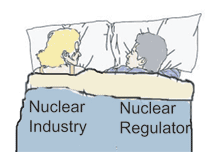
Regulators are regulated by the industry — not the other way around.
by Arnie Gundersen | Apr 17, 2026, https://www.climateandcapitalmedia.com/regulating-the-regulators-the-extraordinary-influence-of-the-nuclear-power-industry-on-the-nuclear-regulatory-commission/
The Nuclear Energy Institute approves NRC commissioners, oversees its workers and, staff say, undermines its independence and public safety mandate
The US Nuclear Regulatory Commission (NRC) mission statement provides a dual — and, critics say, contradictory — mandate that it “protects public health and safety” but also that it “advances the nation’s common defense and security by enabling the safe and secure use and deployment of civilian nuclear energy technologies…”
Given the history of nuclear accidents and lack of fully safe and permanent ways to address nuclear accidents and waste, critics see the mandate to protect public safety but also “advance” nuclear power as a conflict of interest. And given the nuclear industry’s heavy influence — some say control — over the nation’s regulatory agency, many both inside and outside the agency believe the industry has successfully turned the NRC into its advocate rather than its regulator.
Concerns about NRC objectivity
Concerns about the NRC’s objectivity and balance of support for public health versus industry support have taken on added urgency since President Trump last year signed an executive order calling for 10 new large nuclear reactors to be under construction by 2030 and for the Nuclear Regulatory Commission to speed reactor approvals. The first five or 10 new planned US nuclear reactors will “almost certainly” receive loans from the US Energy Department’s lending office, Energy Secretary Chris Wright told lawmakers Thursday.
The NRC employs several thousand technical staff. But it’s led by a commission of five people appointed by the US President and confirmed by the Senate. But the President and Senate see potential nominees only if they’ve already been approved by a well-funded industry group. That means the regulators are regulated by the industry — not the other way around.
Regulators are regulated by the industry — not the other way around.
The real control over nuclear power in Washington, D.C. lies in the nonprofit Nuclear Energy Institute (NEI). Every member of the NRC for the last decade has been screened by the NEI, which is the lobbying, campaign financing, and public relations organization for the nuclear industry.
The industry chooses its regulators
One does not become a Commissioner unless NEI finds that you are acceptable. Never has a member of a non-governmental organization or a safety critic been appointed to the Commission. Even nuclear proponents who’ve raised any questions about the nuclear industry, or worked for people who did, have been blocked.
While the NRC puts “public health and safety” first in its mission statement, the NEI’s charter says:
NEI is the unified voice of the commercial nuclear energy industry, influencing policies that affect its members, their customers, and the industry’s future. NEI represents the industry’s interests before Congress, the executive branch, state and local legislatures, federal regulators, international organizations, courts, and influential platforms where policy matters affecting the industry are discussed.
The NEI’s 2024 budget for direct lobbying was $1,570,000 while its total yearly operating budget was $57,500,000. According to IRS filings, its President & CEO earned a total compensation of $3,594,043,000 while its other 12 top executives together earned $7,222,173 with other staff salaries adding an additional $17,188,000, Propublica reported. That’s a lot of money to “represent the industry’s interest before Congress… and… federal regulators...”
“Regulatory Capture”
More significant to the public interest, however: Industry access to and even control of the NRC through informal channels euphemistically called “drop-in meetings” by NEI, nuclear reactor vendors, and plant owners has long been a concern of the NRC’s staff engineers.
In its 2022 audit prepared for the five Commissioners by the NRC’s Inspector General acknowledged that those concerns pose risks to the public:
Perceived Asymmetry of Access to NRC Management and Risk of Regulatory Capture Undermine NRC Transparency Goals
During our audit, the OIG identified chronic concerns, expressed by NRC staff and external stakeholders alike, about drop-in meetings and similar non-public informal interactions. One of these concerns was regulatory capture, which in relation to drop-in meetings is the concern that the NRC is serving to advance the interests of the very industry it regulates. Regulatory capture is often intangible and not measurable.
At a September 5, 2024 all-staff “Briefing on Human Capital” video call, with NRC leadership, eight top staff and two union leaders present, an intrepid staffer noted that the nuclear industry was unduly influencing regulatory policy:
Question: With NRC staff trust in the objectivity and integrity of NRC Commissioners and NRC executive leadership at an all-time low, with an annual exodus for sweetheart positions in the industry, what can be done to restore credibility and confidence that executive-level decision-making is not industry biased and actually serves the public interest?
Chairman Hanson: …everybody in this room, everybody up on this dais, are dedicated public servants, and I don’t question that at all…
Later in the same meeting, from an engineer:
Question: Okay. This question has a little bit of a background in it. The way outside stakeholders treat NRC staff is a factor in staff morale and workload, but it is often ignored. This has turned out to be a major issue with respect to advanced reactors where some company representatives and lobbying organizations have been downright abusive to agency workers. What’s worse, senior management is perceived as taking the side of the outside stakeholders and leaving the NRC project teams to take the brunt of the criticism. This is both demoralizing and time consuming for project staff. What can be done to limit repeated and unproductive industry interactions with project staff so that they can focus on doing the projects, rather than on handling difficult people of all the things that could help NRC meet tighter schedules?
Chairman Hanson: So thank you for the question. I wasn’t aware that this was an issue, so I appreciate the question just in kind of raising the awareness to me.
Think about that response. The Chairman of the US federal government’s Nuclear Regulatory Commission claimed that he “wasn’t aware” that stakeholders’ heavy-handed interaction with staff — and NRC leaderships’ support of those stakeholders over its own staff — was an issue, even though it had already been reported in an Inspector General’s audit that any self-respecting chairman of a public regulatory agency with fiduciary duty to taxpayers would have been obligated to read — and to respond to.
Chairman Hanson’s 2024 claim — either reckless and irresponsible, or simply not credible — also flies in the face of comments by one of his predecessors, former NRC Chairman Greg Jaczko. Five years earlier, in 2019, Jaczko publicly stated,
“I saw things up close that I was not meant to see: an agency overwhelmed by the industry it was supposed to regulate and a political system determined to keep it that way… honesty and integrity mean nothing if you are perceived to be critical of nuclear power…”
Clearly, the NRC and its five Commissioners have failed to live up to the agency’s core mission to put the public first.
The NEI presents itself as an impartial source of nuclear science and wisdom. Yet it also funds “astroturf” advocacy groups, including Nuclear Matters and Third Way. Schedule I of NEI’s 2024 990 tax filing shows that NEI paid $2.3 million to Washington, D.C.-based nonprofit Nuclear Matters, which on its website claims:
Nuclear Matters is a national coalition of grassroots advocates, working to inform the public and policymakers about the clear benefits of nuclear energy.
The 2024 IRS 990 tax filing for Nuclear Matters states that its operating income was $2,309,945, showing that 99.5% of its income came from the NEI. Its form 990 identified three executives whose combined total compensation was $2,206,460. That means 95% of the Nuclear Energy Institute’s donation to the nonprofit Nuclear Matters was compensation to just three people. That’s highly irregular in the world of nonprofits.
Moreover, you might think that an organization claiming to represent a “nationwide coalition of grassroots advocates” should be funded by actual coalitions of grassroots advocates. But with 95% of its funding from NEI, Nuclear Matters is not.
Grassroots or astroturf?
You might also expect that an organization claiming to represent a “nationwide coalition of grassroots advocates” would work with, find substantial support from, and list a significant nationwide coalition. However, Nuclear Matters’ “Advocacy Council” includes 21 people, virtually all of whom are current or former nuclear industry representatives, policymakers or regulators. And its 16 listed “partners” are pro-nuclear organizations, many of which have received industry funding.
Does that fit your definition of “grass roots”?
The NEI’s reach extends beyond the NRC and into the Department of Energy, which controls funding of future nuclear reactor designs through DOE’s Office of Energy Dominance Financing. Membership in NEI is not limited to the owners of existing nuclear power plants, but also is open to newer companies seeking government funds to design the next generation of atomic power plants.
Not clear there is public appetite for nuclear energy in Ireland despite fuel crisis, junior minister says
It is “not clear” that public
opinion is in favour of removing a ban on the development of domestic
nuclear power plants for electricity in Ireland, the Dáil has been told.
Junior minister Timmy Dooley said there were no plans for the development
of nuclear power, including small modular reactors, as part of Ireland’s
electricity system. Two separate legislative bans prohibit the development
of nuclear fission for electricity generation and “would need to be
replaced as a first step,” he said.
Irish Independent 16th April 2026
https://www.independent.ie/irish-news/taoiseach-insists-his-position-not-under-threat-in-any-shape-or-form-as-fianna-fail-tds-sound-out-senior-ministers-to-lead-heave-against-him/a1221611234.html
1 This Month
15 October. Joint Appeal for Nuclear Abolition Day -presentation to the UN on October 15 will be live on UNWebTV
Endorse the Nuclear Abolition Day Appeal
23-25 October – on Zoom – World BEYOND War’s annual global conference

To see nuclear-related stories in greater depth and intensity – go to https://nuclearinformation.wordpress.com
-
Archives
- October 2026 (139)
- September 2026 (339)
- August 2026 (330)
- July 2026 (355)
- June 2026 (287)
- May 2026 (306)
- April 2026 (356)
- March 2026 (251)
- February 2026 (267)
- January 2026 (308)
- December 2025 (358)
- November 2025 (359)
-
Categories
- 1
- 1 NUCLEAR ISSUES
- business and costs
- climate change
- culture and arts
- ENERGY
- environment
- health
- history
- indigenous issues
- Legal
- marketing of nuclear
- media
- opposition to nuclear
- PERSONAL STORIES
- politics
- politics international
- Religion and ethics
- safety
- secrets,lies and civil liberties
- spinbuster
- technology
- Uranium
- wastes
- weapons and war
- Women
- 2 WORLD
- ACTION
- AFRICA
- Atrocities
- AUSTRALIA
- Christina's notes
- Christina's themes
- culture and arts
- Events
- Fuk 2022
- Fuk 2023
- Fukushima 2017
- Fukushima 2018
- fukushima 2019
- Fukushima 2020
- Fukushima 2021
- general
- global warming
- Humour (God we need it)
- Nuclear
- RARE EARTHS
- Reference
- resources – print
- Resources -audiovicual
- Weekly Newsletter
- World
- World Nuclear
- YouTube
-
RSS
Entries RSS
Comments RSS

