Workers wearing protective suits and masks work on the No. 2 reactor building at the Fukushima Daiichi nuclear power plant.
TOKYO – A state-backed entity tasked with supporting the decommissioning of the Fukushima nuclear power station proposed Thursday that melted fuel be removed from the side of three of the crippled reactors as part of the process to scrap the complex.
Based on a formal proposal, the government and the plant operator Tokyo Electric Power Company Holdings Inc (TEPCO) will determine specific approaches to carry out the process on each reactor next month and update the plant decommissioning road map.
Under its strategic plan for 2017, the Nuclear Damage Compensation and Decommissioning Facilitation Corp called for the removal of the fuel by partially filling the three reactors with water to cover some of the nuclear debris while allowing access to carry out the work.
The entity also pointed out that the decommissioning work requires phased efforts while maintaining flexibility, as the project still faces many uncertainties.
The extraction work from the Nos. 1-3 reactors at the Fukushima Daiichi nuclear complex, which suffered meltdowns following the massive 2011 earthquake and tsunami disaster, is seen as the most difficult step toward the ultimate goal of decommissioning the entire complex, set to take at least 30 to 40 years to complete.
The government and TEPCO are currently aiming to start the extraction work from 2021.
Under the plan, the Nuclear Damage Compensation and Decommissioning Facilitation body proposed using a remotely controlled apparatus to shave debris from the underside of the lower section of the reactors’ containment vessel while controlling the level of water.
Debris remains not only in the reactors’ pressure vessel but also piled and scattered at the bottom of the containment vessel that houses the reactor vessel.
As for debris left in the reactors’ pressure vessel, the entity will consider removing it from the upper part of the reactors, it said.
The decommissioning body had previously considered a strategy to fill the containment vessel with water as water is effective in containing radiation, but it has shelved the idea as the reactor containers are believed to have been damaged and would leak.
Following a magnitude-9.0 earthquake in March 2011, tsunami inundated the six-reactor plant, located on ground 10 meters above sea level, and flooded power supply facilities.
Reactor cooling systems were crippled and the three reactors suffered fuel meltdowns, while hydrogen explosions damaged the buildings housing the Nos. 1, 3 and 4 reactors.
The Nuclear Damage Compensation and Decommissioning Facilitation entity was established after the Fukushima crisis, the worst nuclear disaster since Chernobyl, to help the utility pay damages. The state-backed entity holds a majority stake in the operator.
I’ve heard that the video reveals the information that has never been disclosed before and it’s ONE and ONLY video that documented the true reality of the current Fukushima kids situation presented by a Japanese medical scientist in an academic conference internationally.
Mr. Suzuki, the lecturer in this video, is the one who have operated 125 child thyroid cancer patients in Fukushima. He had been trying to voice the plight situation but he was muted by some political intention.
Here’s the story I’ve heard: He has been verbally and attacked and insulted by Mr. Shibuya of Fukushima Health Committee during its committee assembly, and his false accusation made Mr. Suzuki leave his position of committee member. The conscientious one always has to leave.
I don’t get it. Shibuya malevolently accused Mr. Shuzuki that the doctor must have even operated the case of trifling and unnecessary cases, padding the number of operations and disguising the figures LARGE and GRAVE.
Mr. Sukuzki, with his shaky voice in anger, insisted that serious cases of metastasis to lymph and lung as well as deeper infiltration were seen in the children under the surgery, but his voice was spurned by Shibuya and his friends in the committee. … so this video is probably the only one official evidence Dr. Suzuki left.
This woman in her 30s lives in Tokyo with her young children after fleeing her home in Fukushima Prefecture following the accident at the Fukushima No. 1 nuclear power plant in March 2011. Her husband remains in Fukushima Prefecture for his job.
The central government has made a large number of people who voluntarily fled the Fukushima area after the 2011 nuclear disaster disappear by cutting them from official lists of evacuees.
Critics are now condemning the move, which went into effect last April, saying it prevents government officials from fully grasping the picture of all who remain displaced to evaluate their future needs.
“Accurate data on Fukushima evacuees is essential in gaining a better understanding of their current circumstances and crafting measures to address their problems,” said Shun Harada, a sociology researcher at Rikkyo University in Tokyo, who contributes as an editor for an information publication for evacuees living in Saitama Prefecture.
“When only smaller than the real numbers are made available, difficulties facing evacuees could be underestimated and could result in terminating support programs for them,” he complained.
As of July, 89,751 evacuees were living across Japan after fleeing from the nuclear disaster, down by 29,412 from the March tally.
In April, the central government opted to cut “voluntary” evacuees who fled their homes due to fears of radiation despite being from outside the evacuation zone.
It came after the official program to provide free housing to the voluntary evacuees was stopped at the end of March, which was designed to facilitate a prompt return to their hometowns in Fukushima Prefecture. People from the evacuation zone are still eligible to the free housing program.
The central government’s Reconstruction Agency, set up to oversee rebuilding efforts in Japan’s northeastern region after the 2011 Great East Japan Earthquake, tsunami and nuclear disaster, releases the number of evacuees each month, based on figures compiled by local authorities.
The 29,412 drop in the number of official evacuees between March and July includes 15,709 in Fukushima Prefecture, 6,873 in Miyagi Prefecture, 2,798 in Iwate Prefecture, 780 in Tokyo, 772 in Kanagawa Prefecture and 577 in Saitama Prefecture.
Before the change in housing policy, agency statistics showed a monthly decrease in evacuee numbers of between 3,000 and 4,000 in the several months leading up to the end of March.
But the drop in numbers increased dramatically to 9,493 between March and April and 12,412 between April and May.
Kanagawa and Saitama prefectural officials say voluntary evacuees were responsible for most of the declines in their jurisdictions.
A large number of them are believed to be living in the same housing as before but are now paying their own rent.
A 43-year-old woman who has been evacuating in Saitama Prefecture since fleeing from Iwaki, Fukushima Prefecture, with three other family members said she is angered by the central government’s treatment.
“We cannot return to Fukushima Prefecture due to fears of the effects of radiation,” she said. “I feel like I have been abandoned by the state by being denied evacuee status.”
An official with the Tokyo-based Japan Civil Network for Disaster Relief in East Japan, a private entity that functions as a liaison unit for a nationwide network of groups supporting victims of the disaster six years ago stressed the need for local authorities to have an accurate understanding of the circumstances surrounding evacuees.
“Of the evacuees, the elderly and single-parent households tend to be left in isolation and many of them are likely to become qualified to receive public assistance in the near future,” the official said. “Local officials need to know they are evacuees (from Fukushima).”
The official added that it will become difficult for support groups to extend their help if voluntary evacuees are taken out of the official tally.
But the Reconstruction Agency said it will not reconsider the definition of evacuees.
Hitachi-GE testing variety of simply structured, radiation-resistant equipment
The Unit 1 reactor building at the Fukushima Dai-ichi nuclear power plant of the Tokyo Electric Power Co. (TEPCO) in Okuma town, Fukushima prefecture, June 21, 2017.
TOKYO — A joint venture between Japanese and American high-technology power houses Hitachi and General Electric is developing special robots for removing nuclear debris from the Fukushima Daiichi nuclear power plant, the most difficult task in decommissioning the plant’s six reactors, three of which suffered core meltdowns in the March 2011 accident.
The machines under development by Hitachi-GE Nuclear Energy are called “muscle robots,” as their hydraulic springs operate like human muscles. The company, based in Hitachi, Ibaraki Prefecture, is stepping up efforts to complete the development project in time for the start of debris removal in 2021.
Hitachi-GE is testing the arms of the robots at a plant of Chugai Technos, a Hiroshima-based engineering service company, located a 30-minute drive from the center of the city. The testing is taking place in a structure with a life-size model of the primary containment vessel of the No. 1 reactor at the Fukushima plant. The robots awkwardly move about, picking up concrete lumps standing in for fuel debris.
“The robots are based on a concept completely different from those of conventional robots,” said Koichi Kurosawa, a senior Hitachi-GE engineer heading the development project. Hydraulics are being used because electronics cannot survive in the extreme environment inside the reactors.
“Asked if the robots are applicable to other nuclear power plants, I would say the possibility is low,” Kurosawa said, noting that the robots are designed to work amid intense radiation.
New challenges
While Hitachi-GE has built many nuclear reactors, it is encountering a variety of new challenges in developing the muscle robots simply because of the tough work required to retrieve fuel debris.
In the nuclear accident caused by the March 2011 earthquake and tsunami, cooling the fuel rods became impossible, and melted uranium fuel dropped from them. Some of the fuel broke through nuclear reactor pressure vessels and solidified as fuel debris containing uranium and plutonium.
The debris is estimated to weigh more than 800 tons in total. The insides of the PCVs at the Fukushima plant are directly exposed to the debris and are emitting radioactivity strong enough to kill a human within a few minutes.
The International Research Institute for Nuclear Decommissioning, a Tokyo-based research institute for decommissioning nuclear plants, and three reactor makers — Hitachi-GE, Toshiba and Mitsubishi Heavy Industries — have been attempting to ascertain conditions inside the reactor buildings at the Fukushima plant by means of camera- and dosimeter-equipped equipment.
Buddhist monks offer prayers for victims of the March 11, 2011, earthquake and tsunami in Namie, Fukushima Prefecture, in March 2014.
In Fukushima, 3/11 fallout forcing remains to be stored at temples, ancestral gravesites to be moved
FUKUSHIMA – The remains of Fukushima’s deceased evacuees are being left in limbo because radiation is preventing them from being buried.
In municipalities that remain off-limits because of the fallout from the triple core meltdown at the Fukushima No. 1 power plant in March 2011, the inability of residents to return has put burials for their loved ones on hold.
Instead, many relatives are opting to leave remains in the hands of temples or moved their family graves out of their hometowns.
Choanji, a temple in a no-go zone in the town of Namie, is keeping the remains of about 100 people at a branch facility that was set up in the prefectural capital after the nuclear crisis began.
At the branch, a swordsmanship training room was renovated to enshrine remains that should have been buried in Namie.
“Evacuees don’t want to bury the remains of family members in places with high radiation levels,” said the branch’s chief priest, Shuho Yokoyama, 76.
A 66-year-old resident of Minamisoma visited the temple branch on Aug. 12 for the Bon holidays to pray for her elder sister, who died after evacuating the area.
Her remains are kept there because her family’s grave is located in a no-go zone in Namie; the remains of her sister’s husband, who died before the disaster, are already in the family grave.
“I am sorry that she is separated from her husband. I want their remains to be buried together,” the woman said.
To enter the no-go zone, residents need to submit applications to the municipal government in question.
The woman is unhappy with the system as she wants permission to enter the areas freely, at least during Bon, the traditional period for commemorating one’s ancestors. Since the disaster began, she has been unable to visit the grave of her brother-in-law.
At Choanji, 20 percent of some 500 families in the congregation have moved their ancestors’ graves to other areas.
Isao Kanno, 50, who hails from Namie but now lives in Tokyo, was in the area just before the remains of his father, who died two months before the meltdowns, were scheduled to be interred.
“I can’t be evacuated alone and bury the remains in the grave” in a no-go zone, Kanno said. “I’m considering moving the grave somewhere else.”
Some, however, worry their hometown ties could fade if they move their graves.
“Despite being designated a no-go zone, it is my hometown,” said a 57-year-old Tokyo resident who left the remains of one of his relatives at the temple branch.
“It is the land of my ancestors, so I’ve never considered moving the grave,” he said.
If we are to believe the Japanese government and the Fukushima local government all Fukushima produce are deliciously safe for consumption and safe to be exported, all having passed the strictest controls for the foreign consumers 100% safety…..There is no left radiation, nor contamination in Fukushima Prefecture…. Smile and you will remain safe and healthy!!!
Fukushima food exports to Malaysia rise as radiation stigma fades
KUALA LUMPUR – Fukushima Prefecture aims to export 100 tons of rice and 15 tons of peaches to Malaysia by next year, its governor said Wednesday, evidence of fading concern over the safety of food products from the site of the 2011 nuclear disaster.
“In the aftermath of the earthquake and the nuclear plant incident, the agriculture sector suffered very much. We have to deal with negative rumor. But things are slowly recovering,” Gov. Masao Uchibori said at a press conference in the Malaysian capital Kuala Lumpur.
“We inspect 100 percent of the rice and are working hard to bridge the gap between perception and reality.”
Malaysia began importing rice from Fukushima in May, and has brought in 29 tons so far, Ajwad Abu Hassan, the managing director of Malaysia rice importer Edaran Komachi Sdn., said at the same press conference.
Ajwad said his company aims to import another 48 tons by year-end, and even greater amounts eventually.
“Fukushima produces the best quality rice in Japan. We are proud to sell this rice,” said Ajwad. “We are targeting 100 metric tons a year hopefully. In fact, we are trying to increase from not only 100 metric tons but a container full every month.”
A full shipping container holds about 12 tons.
Akumul Abu Hassan, the managing director of another rice trading company, MHC Co. Ltd, said Malaysia currently consumes about 350 tons of Japonica rice a month imported from various parts of the world including South Korea, Vietnam and China. Only 20 to 30 tons comes from Japan, and that from other prefectures such as Akita, Niigata, Hokkaido and Hiroshima.
But Akumul said when it comes to quality, nothing beats rice from Japan.
“Compare to rice from Japan, that from Vietnam, 5 percent will contain broken grains. You don’t find that in rice from Japan,” Akumul said.
Malaysia began importing Fukushima peaches a year after the disaster, and Takashi Kanno, appearing at the same press conference as a representative of the National Federation of Agricultural Cooperatives, said “Malaysia was one of the first countries to accept and give us an opportunity.”
From almost zero in 2012, Fukushima exported 1.2 tons of peaches to Malaysia in 2013, increasing to 7.3 tons last year and 9.5 tons so far this year.
Fukushima is the second-largest peach producing prefecture in Japan after Yamanashi.
Uchibori said after meeting with trading companies involved in exporting peaches, the federation has set a goal of selling 15 tons a year to Malaysia, as peaches are now being sent by ship instead of by air, which will lower the cost.
Fukushima Prefecture also exports broccoli, shiitake mushrooms and persimmons to Malaysia.
Barrier will block only a fraction of groundwater contamination
Work has begun on the final 7 meters of an “ice wall” at the Fukushima Dai-ichi nuclear power plant.
TOKYO — Tokyo Electric Power Co. Holdings began Tuesday the final phase of an underground “ice wall” around the crippled Fukushima Daiichi nuclear power plant intended to reduce groundwater contamination, though experts warn the bold project could be much less effective than once hoped.
At 9 a.m., workers began activating a refrigeration system that will create the last 7 meters of a roughly 1.5km barrier of frozen earth around the plant’s reactor buildings, which were devastated by the earthquake, tsunami and nuclear meltdowns of March 2011. Masato Kino, an official from the Ministry of Economy, Trade and Industry supervising the cleanup, spoke cautiously at the occasion, noting that “producing results is more important than the simple act of freezing” that particular segment of soil.
Tepco estimates that roughly 580 tons of water now pass through the ice wall on the reactor buildings’ landward side each day, down from some 760 tons before freezing of soil commenced in March 2016. About 130 tons daily enter the reactor buildings themselves, and Tepco hopes completing the wall will bring that figure below 100 tons.
By this math, the near-complete wall blocks only a little over 20% of groundwater coming toward it. But, as Japan’s Nuclear Regulation Authority said Aug. 15 when approving the wall’s final stage, the barrier is “ultimately only a supporting measure” to other systems preventing contamination. The main line of defense is a so-called subdrain system of 41 wells around the reactor buildings that pump up 400 to 500 tons of water daily, preventing clean water from entering the site and contaminated water from leaving it.
Slow going
Freezing of earth around the facility has been conducted gradually, amid concerns that highly contaminated water inside could rush out should the water level inside the reactor buildings drop. “Working carefully while keeping control of the water level is a must,” said Yuzuru Ito, a professor of civil and environmental engineering at Setsunan University.
It is unclear precisely when the wall will be complete. The plan is to freeze soil 30 meters deep over the course of two or three months, completing the barrier as soon as this fall. But as the gap in the wall narrows, water flows through it more quickly, making soil there more difficult to freeze. “Water is flowing quickly now, and so it is difficult to proceed as we have so far,” a Tepco representative said.
Japan has spent some 34.5 billion yen ($315 million) in taxpayer funds on the wall, expecting the icy barrier to put a decisive end to groundwater contamination at the Fukushima plant. It now appears that a dramatic improvement is not likely, though the wall will still require more than 1 billion yen per year in upkeep. “The frozen-earth barrier is a temporary measure,” said Kunio Watanabe, a professor of resource science at Mie University. “Some other type of wall should be considered as well.”
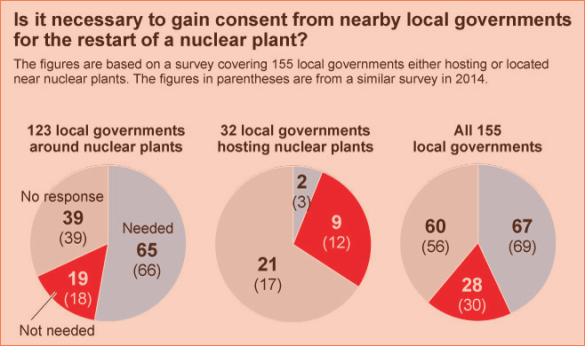
More than half of municipalities within a 30-kilometer radius of nuclear power plants insist their approval must be sought for restarts, but only 6 percent of local governments that host such facilities agree.
The finding that 53 percent of municipalities require prior consultations came in a survey by The Asahi Shimbun undertaken two years after a reactor at the Sendai nuclear plant in Kagoshima Prefecture went back online in August 2015, the first to do so under new, more stringent nuclear regulations adopted in the aftermath of the 2011 Fukushima disaster.
The mayor of Hitachiomiya, Ibaraki Prefecture, said local governments beyond host communities “need” to have a say over restarts as the central government revised its nuclear emergency guidelines in 2012 to require municipalities within the 30-km radius to have evacuation plans in place in the event of a serious accident.
Before the Fukushima accident, only local governments within 8-10 km of a nuclear power plant had to do so.
The mayor of Misato, Miyagi Prefecture, said his town’s approval should be sought for a restart because a “local government not receiving economic benefits can make a levelheaded judgment on the pros and cons of resumed operations.”
Host communities receive grants and subsidies from the central government, in addition to taxes and other revenue sources related to power generation.
In the survey, The Asahi Shimbun contacted the heads of 155 local governments that either host or are situated within a 30-km radius of the 16 nuclear plants across the nation, excluding the crippled Fukushima No. 1 nuclear plant. The figure includes the prefectural government of Hokkaido and 20 other prefectural authorities that host plants.
As things stand, there are no legal steps that an operator of a nuclear facility must take, such as winning the consent of a host municipality or the prefectural government, before a plant’s restart.
The Sendai nuclear plant went back online after operator Kyushu Electric Power Co. got the go-ahead only from Satsuma-Sendai, which hosts the plant, and Kagoshima Prefecture for a resumption of operations.
The survey found that Mihama, home to Kansai Electric Power Co.’s Mihama nuclear plant, was against the notion of asking nearby municipalities for their approval for a restart.
“Only a host community has a history of contributing to the safe operation of a nuclear plant,” the mayor said.
Of all the local governments, 61 heads called for legal procedures to be adopted with respect to restarts. All these calls came from municipalities located in areas surrounding nuclear power plants, except for one.
“As long as nuclear energy has been promoted as a state program, the central government should take responsibility for setting the legal framework for a restart,” said the mayor of Makinohara, Shizuoka Prefecture.
The mayor of Imari, Saga Prefecture, echoed a similar view.
“Things remain ambiguous because no legal procedures are in place,” the mayor said. “The government is reluctant to enshrine the steps into law because that will make restarts harder. However, the central government should also listen to what people in municipalities beyond host communities have to say.”
The survey also found that calls for plant operators to gain the consent of the municipalities within a 30-km radius of a proposed restart have somewhat abated among 35 local governments, where nuclear plants have resumed operations.
Ten heads sided with this view in the current survey, down from 13 in the previous survey in autumn 2014.
Another 10 leaders called for setting up legal procedures for restarts, compared with 14 in the last survey.
Apart from the Sendai nuclear plant, Ikata in Ehime Prefecture and Takahama in Fukui Prefecture are currently operating.
Municipalities situated close to facilities that are expected to go back online in the near future are now taking a more clear-cut stance on nuclear energy issues.
Representatives from cities around the Genkai nuclear plant in Genkai, Saga Prefecture, formed a group to present a united front against moves to resume its operations, which is expected this winter.
Although the mayors of Hirado and Matsuura, both in Nagasaki Prefecture, did not take a stance in the 2014 survey, they joined the municipalities against the restart in the latest poll, bringing municipalities opposed to the restart to four, or half of the eight local governments within a 30-km radius of the facility.
The Genkai town hall and the Saga prefectural government have already agreed to resuming plant operations.
Doctors and scientists are warning about the health risks of ionizing radiation.
Even small doses of about 1 millisievert (mSv) increase the risk of developing radiation-induced diseases.
There is no threshold below which radiation could be considered harmless.
Summary of a meeting of experts in Ulm (Germany) on 19 October 2013
On 19 October 2013, the German and Swiss members of the International Physicians for the Prevention of Nuclear War (IPPNW) invited doctors and scientists in the fields of radiobiology, epidemiology , statistics and physics at a meeting of experts in Ulm, Einstein’s hometown. Participants discussed current knowledge about the health effects of ionizing radiation, especially in the field of low doses.
The panel concluded that a revision of current radiation protection standards is essential to reflect the current level of scientific knowledge. Ionizing radiation is capable of causing detrimental effects on health; Some can be predicted and quantified through the use of epidemiological models.
In the past, the identification of the health risks of ionizing radiation was based on studies of survivors of the Hiroshima and Nagasaki bombings. This reference group can no longer be considered appropriate in the light of the new statistical evidence. Even very low doses of radiation are likely to cause disease.
Here are the conclusions of the Ulm Symposium:
1. Even background natural radiation has detrimental effects that are measurable;
2. The use of radiation for medical diagnosis has measurable adverse health effects;
3. The use of nuclear energy and nuclear weapons tests have measurable adverse health effects;
4. The use of the collective dose concept in epidemiological studies can reliably predict and quantify the health risks of low radiation doses.
5- The use by the ICRP of basing the risk factors for low doses of radiation on the examination of Hiroshima and Nagasaki survivors should be considered outdated.
6. Improved radiation protection based on the notion of risk is necessary. It must be combined with the rigorous application of the minimization requirement of radiation exposure.
1. Even natural radiation has measurable adverse health effects.
Even low doses of natural radiation (terrestrial and cosmic radiation, inhaled radon and ingestion of natural radioisotopes) have adverse health effects that can be measured by epidemiological studies. It is therefore a deception to assert that exposure to radiation can be considered safe as long as it is at the level of the doses of “natural” background radiation. 1-17
2. The use of radiation for medical diagnosis has adverse health effects that are measurable
It has been shown that conventional CT scans and radiological examinations cause an increase in cancer cases (mainly breast cancer, leukemia, thyroid cancer and brain tumors). The risk is greater in children and adolescents than in adults and the embryo is the most vulnerable of all. 18-40
Limiting the use of diagnostic rays and the use of nuclear medicine to cases of absolute necessity is urgently recommended.It would be necessary to adhere to strict rules for the use of scanners and to use only CT scanners [Computed tomography = scanners called scanners -ndt] with low radiation emission. Whenever possible ultrasound and magnetic resonance imaging should be preferred.
Some population groups have an increased risk of developing cancer due to exposure to radiation, for example women who have a genetic predisposition to breast cancer. Therefore, it is recommended that women with such a risk not be included in X-ray screening. 41-45
3. The use of nuclear energy and nuclear weapons tests have measurable adverse health effects
Due to the use of nuclear weapons (over 2,000 tests) and serious nuclear accidents, large quantities of radionuclides have been released and widely dispersed; They expose a large part of the world’s population to increased exposure to radiation. The epidemiological studies carried out in the populations concerned, around the Nevada and Semipalatinsk nuclear weapons test sites and in the areas affected by the Chernobyl and Fukushima disasters show an increase in morbidity and mortality. 46-54
Even the routine operations of nuclear power plants have adverse effects on the health of the surrounding population. Depending on the distance, an increase in cases of leukemia and other types of cancer has been observed in children under 5 years of age in the nuclear power plant environment. (Currently, the strongest evidence is in Germany, with concordant results in studies in Switzerland, France and the United Kingdom.) 55-59
In workers exposed to ionizing radiations, there is a significant increase in cancer cases compared with the other groups even though the official limit dose has not been exceeded.
The health of their children is more impaired than that of other children. 60-64
Among employees of uranium mining companies and atomic weapons production sites, there is an increase in chronic lymphocytic leukemia. 65-68
Leukemias and many other types of cancers have been caused by low doses of ionizing radiation, in areas with increased background radiation due to nuclear weapons tests, nuclear accidents, or medical diagnostic examinations and occupational exposure. 69-92
Following exposure to low doses of radioactive iodine, thyroid diseases including cancers have been observed in children, adolescents and adults. 93-99
In addition, low doses of ionizing radiation cause serious non-malignant diseases such as meningiomas and other benign tumors, cardiac, cerebrovascular, respiratory, gastrointestinal and endocrine diseases or dysfunctions; And also psychiatric disorders and cataracts.100-113
Studies have shown that in utero and in children, brain exposure to ionizing radiation causes a decrease in cognitive development. Possible sources of radiation include, but are not limited to, diagnostic X-rays, radiotherapy and exposure to radiation due to nuclear accidents. 114-116
As a result of the nuclear accidents, teratogenic effects have been observed in both animals and humans, even in those exposed to low levels of radiation. 117-120
Some genetic effects can already be observed in the first generation of offsprings, others only appear in later generations. Late affections may be difficult to confirm.
Numerous studies have been carried out in the “dead zones” of Chernobyl and Fukushima on animals whose generations succeed one another rapidly; they showed severe genetic abnormalities related to the level of radiation in their habitat.
In humans, such abnormalities have been observed for a long time following exposure to low doses.
Transgenerational effects of radiation, that is to say genetically fixed, have often been documented, for example, in the children of the Chernobyl liquidators. 121-128. Many other studies also suggest that ionizing radiation causes long-term genetic or epigenetic damage. 129-146
4.The use of the concept of collective dose in epidemiological studies can reliably predict and quantify the health risks of low doses of radiation.
The concept of collective dose is, in the current state of knowledge, the surest way to quantitatively evaluate the stochastic risks of radiation. Significant new clinical studies confirm the linear no-threshold model; this model establishes that there is no threshold below which radiation would have no effect on health. 147,148
Using the concept of collective dose that takes into account current scientific studies, the following risk factors (excess absolute risk, EAR) should be applied:
A risk factor of 0.2 / Sv should be used to predict cancer mortality and 0.4 / Sv to predict the incidence of cancer. 149-151
The United Nations Scientific Committee for the Effects of Atomic Radiation (UNSCEAR) and the International Commission on Radiological Protection (ICRP) still use low risk factors of 0.05 / Sv for cancer mortality and 0.1 / Sv for the incidence of cancers. However, in its 2013 assessment of health risks in Fukushima, the World Health Organization (WHO) recognized that ICRP risk factors should be doubled. 152
The above risk factors apply to an exposed population whose ages have a standard distribution. However, according to the ICRP, the sensitivity to ionizing radiation of young children (less than 10 years) and fetuses is three times higher than that of adults. 153-155
Risk factors for the prediction of the incidence and mortality of non-malignant diseases (non-cancerous diseases), especially cardiovascular diseases, are of the same order as those of malignant diseases. 156-157
It would be desirable for WHO and national radiation protection institutions to adopt the risk factors mentioned above as a basis for risk assessment after nuclear accidents.
5. The use by the ICRP of studies on Hiroshima and Nagasaki survivors as a basis for determining the risks of low radiation doses should be considered an outdated practice.
In their studies, institutions such as the ICRP used as reference the survivors of the atomic bombings of Hiroshima and Nagasaki for the prediction of the effects of radiation.
Risk prediction on this basis is not transferable to other populations exposed over a long period of time to increasing levels of radiation, for the following reasons:
The Japanese survivors were briefly exposed to high energy penetrating gamma radiation.
Radiobiological investigations have shown that such exposure is less harmful to tissues than an internal alpha or Beta irradiation following the incorporation of radionuclides.
The same applies to long-term exposure to x-rays or Gamma rays from natural or artificial sources at levels comparable to normal background radiation. 158-159
The radiation delivered by the nuclear bombs has an extremely high dose level.
Previously, it was accepted that the mutagenicity would therefore be higher in this case than for low doses. Currently, the ICRP claims that this assertion always holds and divides in its calculations the risk of developing cancers by a factor of 2.
Studies on occupationally exposed cohorts of workers contradict this assertion and WHO sees no justification for dividing this risk factor into two. 160-161
Radiation doses received due to radioactive fallout and neutron activation have not been taken into account by the Radiation Effects Research Foundation (RERF), despite the fact that they have caused significant effects on the survivors of Hiroshima And Nagasaki. The actual effects of radiation have therefore been underestimated. 162
Because the RERF only began its work in 1950, there is a lack of important data on the first five years after the nuclear bombing. It should be recognized, therefore, that the assessment of teratogenic and genetic effects, as well as those of cancers with a short latency period, is incomplete.
Because of the catastrophic situation after the bombing of Hiroshima and Nagasaki, we must admit to considering the survivors as a selected cohort of specially resistant people (“the survival of the fittest”). Therefore, these studies were not representative of a normal population. This selection bias caused an underestimation of about 30% of the radiation risk. 163
The survivors of the nuclear bombing were ostracized by the Japanese society. It is very likely that information about the origin of the family or the morbidity of the descendants has been hidden or falsified so as not to endanger, for example the chances of marriage and the social integration of children. 164
Editor’s Note:
Risk factors used in the concept of collective dose describe the likelihood that additional cases of disease, higher than rates of spontaneous cancers, occur, that carcinogenesis caused by radiation, cancer incidence or mortality, Increase above the baseline of a given population.
Usually this Excess Absolute Risk (EAR) is represented by unit 1 / Sv. A risk factor (EAR) of 0.2 / Sv for cancer mortality means that a 1Sv irradiation would cause an additional 20% risk of cancer death – in addition to the 25% base risk. An EAR of 0.2 / Sv corresponds to a relative risk excess (ERR) of 0.2 / 0.25 = 0.8 / Sv.
6. Improved radiation protection based on the notion of risk is necessary. It must be combined with the rigorous application of the minimization requirement of radiation exposure.
Determining the level of radiation health risk that is acceptable and reasonable can only be achieved at the societal level by listening to the voices of those involved. To protect populations, the risks of ionizing radiation should be determined as accurately as possible and presented in a comprehensible manner. In medicine, such radiation protection criteria are already becoming more and more important.
Assessing the dangers of ionizing radiation according to a risk-based concept can help to minimize their adverse effects even at low doses. Associated with the legal minimization requirements, a set of concrete measures using such a concept could serve to further reduce the harmful effects of radiation. The concept of risk acceptability for carcinogenic materials at work already existing in German legislation is, in broad outline, a good example to follow. 165-169
The highest priority should be given to the protection of life before birth and the integrity of future generations. Radiation protection must broaden its adult-based models and adapt them to the particular vulnerability of the embryo and children.
Speakers and participants in the Ulm expert meeting,
19 October 2013:
» » Prof. Dr. med. Wolfgang Hoffmann, MPH, Professor für
bevölkerungsbezogene Versorgungsepidemiologie und
Community Health, Institut für Community Medicine,
Universitätsmedizin in Greifswald
» » Dr. rer. nat. Alfred Körblein, Dipl. Phys., selbstständiger
Wissenschaftler in Nürnberg, Wissenschaftlicher Beirat
der IPPNW.de
» » Prof. Dr. med. Dr. h.c. Edmund Lengfelder, Professor
em. des Strahlenbiologisches Institutes an der Medizini-
schen Fakultät der LMU München, Leiter des Otto Hug
Strahleninstitutes für Gesundheit und Umwelt
» » Dr. rer. nat. Hagen Scherb, Dipl. Math., Helmholtz Zen-
trum, Deutsches Forschungszentrum für Gesundheit und
Umwelt in München
» » Prof. Dr. rer. nat. Inge Schmitz-Feuerhake, Professorin
em. für experimentelle Physik an der Universität in Bre-
men, Wissenschaftlicher Beirat der IPPNW.de
» » Dr. med. Hartmut Heinz, Facharzt für Arbeitsmedizin,
ehem. leitender Werksarzt in Salzgitter, AK Atomenergie
der IPPNW.de
» » Dr. med. Angelika Claußen, Fachärztin für Psychothe-
rapie in Bielefeld, AK Atomenergie der IPPNW.de
» » Dr. med. Winfrid Eisenberg, ehem. Chefarzt der Kin-
derklinik in Herford, AK Atomenergie der IPPNW.de
» » Dr. med. Claudio Knüsli, Leitender Arzt der Onkologie
im St. Claraspital in Basel, Vorstandsmitglied IPPNW.ch
» » Dr. med. Helmut Lohrer, Facharzt für Allgemeinmedizin
in Villingen, Int. Board der IPPNW, International Councillor
der IPPNW.de
» » Henrik Paulitz, Dipl.-Biol., Atomenergie-Referent der
IPPNW.de in Seeheim
» » Dr. med. Alex Rosen, Kinderarzt in Berlin, Stellv. Vorsit-
zender der IPPNW.de
» » Dr. med. Jörg Schmid, Facharzt für Psychotherapie in
Stuttgart, AK Atomenergie der IPPNW.de
» » Reinhold Thiel, Facharzt für Allgemeinmedizin, Ulmer
Ärzteinitiative, AK Atomenergie der IPPNW.de
I add a reference: Risk of cancer in 680,000 people exposed to CT scans in childhood or adolescence: a study linking data from 11 million Australians
International Physicians for the Prevention of Nuclear War, IPPNW), is a pacifist international organization of doctors committed to nuclear disarmament. Established in 1980, the organization was awarded the Unesco Prize for Peace Education in 1984 and the Nobel Peace Prize in 1985 for its “important and competent information work”, which improved global awareness of the consequences of a nuclear war and acute radiation syndrome. The organization has close to 150,000 members in more than 50 countries.
Lawyer Hiroyuki Kawai posing with his Harley-Davidson Trike motorcycle inside a garage in Tokyo, on July 25, 2017.
TOKYO (BLOOMBERG) – In the basement of a three-storey house in a leafy neighbourhood in Tokyo, about 40 lawyers crowded together, plotting against Japan’s massive nuclear power industry.
The host was 73-year-old Hiroyuki Kawai, one of Japan’s most colourful litigators. The end game? To close all of the country’s 42 reactors for good, a result that would be a major blow to the future of atomic energy across the world.
For the staunch anti-nuclear activist, the risk of a meltdown outweighs the benefits of the relatively clean source of power.
Countries from Germany to Taiwan have scaled back plans for nuclear power after Japanese utility Tepco’s 2011 Fukushima meltdown.
Mr Kawai is propelling the anti-nuclear movement forward with a 22 trillion yen (S$274 billion) shareholder lawsuit against the company, among the largest in damages ever sought. He wants to pressure the government and businesses to distance themselves from atomic power, and while his court cases have yielded mixed results, his bold tactics are garnering attention around the world.
“If we push them enough, one day they will crumble,” Mr Kawai said at an interview. “It’s a revolution.”
Mr Kawai stands out in a 300-strong anti-nuclear lawyer consortium, in both spirit and appearance.
On the day of the interview, Me Kawai is wearing a bright candy-pink suit-jacket, a black shirt, and a crystal encrusted snake brooch on his lapel. The father of three daughters and seven grandchildren rides his Harley-Davidson motorbike across the country on weekends, and hosts bimonthly meetings of lawyers at his residence to discuss strategies to shutter reactors.
“A number of countries and societies are influenced by trends in Japan,” said Professor Hitoshi Yoshioka at the graduate school of social and cultural studies at Kyushu University. “If he’s successful, the impact on the world will be great.”
While Mr Kawai now spends about 80 per cent of his time in legal battles against power providers and the government without pay, he started his career pursuing much more lucrative cases.
In the late 70s, he was an adviser to a witness linked to one of the country’s biggest financial scandals, propelling him into the spotlight. By his account, he was a winner, and made “a ton of money” along the way. Yet the cases in which he was involved were less than savoury and he began to question whether this was satisfying enough.
“I did so many bad things,” Mr Kawai said, recalling how in the 90s he turned his back on the corrupt businessmen and money-hungry upstarts he called clients. “I helped a lot of villains.”
In 1994, he began taking on anti-nuclear cases. He says the reason for his reincarnation is simple: He wanted to use the legal system to do good for society, and believed the growing use of atomic power was the biggest risk facing Japan, one of the world’s most earthquake-prone countries.
For years, Mr Kawai lost. Anti-nuclear activists were seen as environmentalists that agitated Japan’s quest to become energy independent and cheaply power a sputtering economy. After embracing atomic energy in the 1960s, the number of reactors grew to 54 by 2009, and at its peak, nuclear provided about one-third of Japan’s power consumption.
“Fighting nuclear means turning all of Japan’s society against you,” Mr Kawai said. “It’s like being surrounded by enemies. It’s a very hard fight.”
Japan needs nuclear power to achieve energy security, economic growth and environmental conservation while placing top priority on safety, said Hiroyuki Honda, a spokesman for the Federation of Electric Power Companies of Japan, the industry group consisting of top utility Tokyo Electric Power Holdings and nine other regional firms.
Japan should have diversified electricity generation sources, including nuclear power, while balancing energy security, economic growth and environmental conservation, said Tepco spokesman Jun Oshima.
Reactors are being allowed to restart after meeting stricter safety standards, and Japan cannot abandon nuclear power because of earthquakes, said a trade ministry official, who asked not to be identified because of internal policy.
Relying heavily on thermal power would lead to more carbon dioxide emissions and reliance on fossil fuel imports, he said. While the nation plans to boost renewable energy as much as possible, its growth has limits and needs to be supplemented by atomic and thermal power, according to the official.
Mr Kawai is currently directly involved in 24 atomic-related cases. The rest of his time is spent on corporate lawsuits which provide the funds to cover his anti-nuclear work, including directing a few documentary films.
Public perception has turned in favour of his ideals with 55 per cent of the population against nuclear restarts versus 26 per cent that are for, according to a Mainichi newspaper poll in March.
Mr Kawai’s legal attacks are counter to Prime Minister Shinzo Abe’s post-Fukushima energy policy, which seeks to see nuclear power account for as much as 22 per cent of the country’s energy mix by 2030.
The Nuclear Regulation Authority, an independent supervisory body set up by the government after Fukushima, has said 12 reactors are safe to restart after extensive checks, though just five of Japan’s 42 operable reactors have been allowed back online so far.
One of Mr Kawai’s biggest cases is a shareholder suit against Tepco. He argues the power provider did not take enough safety measures to prevent Fukushima. The amount of damages sought – currently 22 trillion yen – is the direct sum of the estimated costs to clean up the Fukushima disaster, he said.
He has had three favourable decisions since Fukushima, one of which has been overturned by a higher court, while most of the cases are still pending, he said.
“Nothing is an easy win,” Mr Kawai said. “But it’s not just about winning – it’s about changing society. There’s a good reason to keep fighting.”
In the background, from left, the No. 1, 2, 3, and 4 reactor buildings of the Fukushima No. 1 Nuclear Power Plant are seen, in Okuma, Fukushima Prefecture, on Oct. 31, 2016. In front are tanks used to store contaminated water.
Highly radioactive water has leaked from the disaster-crippled Fukushima No. 1 nuclear plant, Tokyo Electric Power Co. (TEPCO) announced on Aug. 17.
The estimated 50 milliliters of contaminated water remained inside the station dike, and there was no leakage to the outer environment, plant operator TEPCO said. An analysis found that the tainted water contained 22 million becquerels per liter of beta-ray-emitting radioactive materials.
According to the utility, a worker from a company cooperating with TEPCO spotted water dripping from multi-nuclide removal equipment at the facility at around 2:15 p.m. on Aug. 16. After the worker mended the part with tape, the leakage stopped.
This study is about radioactive 129I travelling the equivalent of a third of the way round the globe, a 15,000 km journey, legally released since 20 years from nuclear fuel reprocessing plants in the UK and France. Of course as usual, in complete disregard of recent studies about the dangerosity of low dose,They emphasise that the radioactivity levels found in the North Atlantic are extremely low and not considered dangerous.
This study still is letting us envisage the travel of the Fukushima Daiichi nuclear plant numerous radioactive contaminants which have been dispersed since March 2011, which still are being dispersed and will be additionally dispersed into the Pacific Ocean.
Radioactive 129I has travelled the equivalent of a third of the way round the globe, since being released from nuclear fuel reprocessing plants in the UK and France. The iodine’s 15,000 km journey begins in the nuclear plants at Sellafield and La Hague and continues via the Arctic Ocean and then southward via the Grand Banks towards Bermuda, where it is found at very low concentrations about 20 years later. This tracer has been used to provide the most complete up-to-date, high-accuracy mapping of the oceanic currents that transport CO2 and other greenhouse gases from the atmosphere to the abyssal depths of the deep North Atlantic Ocean. These results are being presented at the Goldschmidt geochemistry conference in Paris.
Radioactive contaminants have been legally released for more than half a century from the nuclear reprocessing plants at Sellafield (UK) and La Hague (France). Scientists have recently begun to use the radioactive 129iodine (129I) as a way of tracking the movement of ocean currents. They emphasise that the radioactivity levels found in the North Atlantic are extremely low and not considered dangerous.
“What we have found is that by tracing radioactive iodine released into the seas off the UK and France we have been able to confirm how the deep ocean currents flow in the North Atlantic. This is the first study to show precise and continuous tracking of Atlantic water flowing northward into the Arctic Ocean off Norway, circulating around the arctic basins and returning to the Nordic seas in what we call the “Arctic loop”, and then flowing southward down the continental slope of North America to Bermuda at depths below 3000 m” said lead researcher Dr John N. Smith (Bedford Institute of Oceanography, Canada).
The research is part of the international GEOTRACES project, which aims to use geochemical markers to follow ocean currents, and so provide precise estimates of transit times and mixing rates in the North Atlantic and Arctic Oceans. So far the 129I has been measured as far south as Puerto Rico, but the researchers assume that it will continue to flow southward into the South Atlantic and eventually spread throughout the global ocean.
Dr Smith continued, “These currents have previously been studied using dissolved CFCs (Chlorofluorocarbons) – the molecules which used to be used in fridges until banned in 1989. However, CFCs undergo ocean-atmosphere exchange which means that surface water is continually replenished with CFCs during the arctic leg of the journey, whereas the 129I plume retains the initial imprint of its input history over a long period of years. Further, 129I is relatively easy to detect at extremely low levels using accelerator mass spectrometry methods which gives us a large measurement advantage in terms of the signal to noise ratio. Since we know exactly where the 129I comes from and when it entered the ocean, for the first time we can be absolutely sure that detecting an atom in a particular place is as a specific result of the currents”.
“In many ways this is a bit like the old ‘stick in a stream’ game we used to play as kids – what people call ‘Pooh sticks’ in England – where you would drop a buoyant object in the water and observe where it comes out. Of course, it would be much better if these markers were not in the ocean at all, but they are, and we can use them to do some important environmental science”.
Commenting, Dr Núria Casacuberta Arola (ETH, Zurich) said:
“The work performed by John Smith and colleagues in recent years has greatly contributed to the understanding of water circulation, especially in the North Atlantic and Arctic Ocean. The advantage of using 129I as a transient tracer in oceanography is the long half-life (15.7 My) of this isotope compared to the circulation times, and the fact that it is largely soluble in seawater. Now, major efforts are also devoted to find other artificial radionuclides with similar sources and behaviour than 129I (e.g. 236U, 237Np) so that the more tools we have, the better we will understand the ocean circulation. Recent advances in mass spectrometry (ICP-MS and AMS) allow today for very low detection limits so that we can measure very low concentrations of these isotopes in deep ocean waters”. https://phys.org/news/2017-08-129i-track-ocean-currents-km.html#jCp
From December 2011, reposting it today so that people won’t think that the March 2011 Fukushima Daiichi nuclear disaster is behind us.
“After 280 days of decaying, the 257 tons of lost corium from three of Fukushima’s reactors, which one assumes to have a burn rate of 14GWJ/t (14 kg fissioned per tonne), have produced a probable level of radioactivity of 180.37 million Curies, or 6.674E18 Becquerels (6673.6 PBq). […]
92.17% of this radioactivity is being emitted by fission products, and constitutes 28.07% of overall radiotoxicity. 7.83% of this radioactivity is made by activation products, and constitutes 71.93% of overall radiotoxicity. That is to say that here the radiotoxicity, which according to the eminently official ICRP’s dose factors equals 73.47 Billion potential lethal doses via inhalation and 15.53 Billion lethal doses via ingestion, results chiefly from the activation products, which by and large are alpha emitters.
On the other hand, the radioactivity in this case is produced primarily by fission products, which most often are beta (β− ) emitters. At the end of these 280 days of decaying, the radiation arises primarily from the following elements: Strontium 89 at 2.265%, Strontium 90 at 4.713%, Yttrium 90 at 4.713%, Yttrium 91 at 4.852%, …
…Yttrium 91 at 4.852%, Zirconium 95 at 8.067%, Ruthenium 106 at 9.297%, Caesium 134 at 4.737%, Cesium 137 at 6.209%, Barium 137 at 6.209%, Cerium 144 at 23.744%, Promethium 147 at 13.728%, Plutonium 241 at 5.505%, Cobalt 60 at 1.410%.
Consistent with the rate of decay of these 280 days, in 15 years the fuel will have lost 80.20% of its radioactivity, bringing it to 35.71 Curies – but its long-lived toxicity will be elevated by 13.35%, contrarily, to 83.28 Billion lethal doses. Without question, the overall radioactivity falls but the persistent radiotoxicity increases until 60 years or so later, it commences to decline ever-so slowly after 350 years! (This irrefutable augmentation of toxicity over time is largely due to the increase of Americium-241 – alpha – a daughter product far more toxic than its beta-emitting parent, Plutonium-241. Ultimately, it will take around 350 years for the radiotoxicity to return to its original level…”