Delicious Fukushima Peaches at the “konbeni” Checkout


High-priced Fukushima ice wall nears completion, but effectiveness doubtful

A subterranean ice wall surrounding the nuclear reactors at the stricken Fukushima No. 1 Nuclear Power Plant to block groundwater from flowing in and out of the plant buildings has approached completion.
Initially, the ice wall was lauded as a trump card in controlling radioactively contaminated water at the plant in Fukushima Prefecture, which was crippled by meltdowns in the wake of the March 2011 Great East Japan Earthquake and tsunami. But while 34.5 billion yen from government coffers has already been invested in the wall, doubts remain about its effectiveness. Meanwhile, the issue of water contamination looms over decommissioning work.
In a news conference at the end of July, Naohiro Masuda, president and chief decommissioning officer of Fukushima Daiichi Decontamination & Decommissioning Engineering Co., stated, “We feel that the ice wall is becoming quite effective.” However, he had no articulate answer when pressed for concrete details, stating, “I can’t say how effective.”
The ice wall is created by circulating a coolant with a temperature of minus 30 degrees Celsius through 1,568 pipes that extend to a depth of 30 meters below the surface around the plant’s reactors. The soil around the pipes freezes to form a wall, which is supposed to stop groundwater from flowing into the reactor buildings where it becomes contaminated. A total of 260,000 people have worked on creating the wall.
 This photo shows pipes to freeze soil for the ice wall next to the No. 4 reactor at TEPCO’s Fukushima No. 1 Nuclear Power Plant, in Okuma, Fukushima Prefecture, on June 1, 2016. (Mainichi)
The plant’s operator, Tokyo Electric Power Co. (TEPCO) began freezing soil in March last year, and as of Aug. 15, at least 99 percent of the wall had been completed, leaving just a 7-meter section to be frozen.
Soon after the outbreak of the nuclear disaster, about 400 tons of contaminated water was being produced each day. That figure has now dropped to roughly 130 tons. This is largely due to the introduction of a subdrain system in which water is drawn from about 40 wells around the reactor buildings. As for the ice wall, TEPCO has not provided any concrete information on its effectiveness. An official of the Secretariat of the Nuclear Regulation Authority (NRA) commented, “The subdrain performs the primary role, and the ice wall will probably be effective enough to supplement that.” This indicates that officials have largely backtracked from their designation of the ice wall as an effective means of battling contaminated water, and suggests there is unlikely to be a dramatic decrease in the amount of decontaminated groundwater once the ice wall is fully operational.
TEPCO ordered construction of the ice wall in May 2013 as one of several plans proposed by major construction firms that was selected by the government’s Committee on Countermeasures for Contaminated Water Treatment. In autumn of that year Tokyo was bidding to host the 2020 Olympic and Paralympic Games, and the government sought to come to the fore and underscore its measures to deal with contaminated water on the global stage.
Using taxpayers’ money to cover an incident at a private company raised the possibility of a public backlash. But one official connected with the Committee on Countermeasures for Contaminated Water Treatment commented, “It was accepted that public funds could be spent if those funds were for the ice wall, which was a challenging project that had not been undertaken before.” Small-scale ice walls had been created in the past, but the scale of this one — extending 1.5 kilometers and taking years to complete — was unprecedented.
At first, the government and TEPCO explained that an ice wall could be created more quickly than a wall of clay and other barriers, and that if anything went wrong, the wall could be melted, returning the soil to its original state. However, fears emerged that if the level of groundwater around the reactor buildings drops as a result of the ice wall blocking the groundwater, then tainted water inside the reactor buildings could end up at a higher level, causing it to leak outside the building. Officials decided to freeze the soil in stages to measure the effects and effectiveness of the ice wall. As a result, full-scale operation of the wall — originally slated for fiscal 2015 — has been significantly delayed.
 A worker makes checks with a hammer on an impermeable wall near TEPCO’s No. 4 reactor in the town of Okuma in Fukushima Prefecture on Feb. 24, 2017. (Mainichi)
Furthermore, during screening by the NRA, which had approved the project, experts raised doubts about how effective the ice wall would be in blocking groundwater. The ironic reason for approving its full-scale operation, in the words of NRA acting head Toyoshi Fuketa, was that, “It has not been effective in blocking water, so we can go ahead with freezing with peace of mind” — without worrying that the level of groundwater surrounding the reactor buildings will increase, causing the contaminated water inside to flow out.
Maintaining the ice wall will cost over a billion yen a year, and the radiation exposure of workers involved in its maintenance is high. Meanwhile, there are no immediate prospects of being able to repair the basement damage in the reactor buildings at the crippled nuclear plant.
Nagoya University professor emeritus Akira Asaoka commented, “The way things stand, we’ll have to keep maintaining an ice wall that isn’t very effective. We should consider a different type of wall.”
In the meantime, TEPCO continues to be plagued over what to do with treated water at the plant. Tainted water is treated using TEPCO’s multi-nuclide removal equipment to remove 62 types of radioactive substances, but in principle, tritium cannot be removed during this process. Tritium is produced in nature through cosmic rays, and nuclear facilities around the world release it into the sea. The NRA takes the view that there is no problem with releasing treated water into the sea, but there is strong resistance to such a move, mainly from local fishing workers who are concerned about consumer fears that could damage their businesses. TEPCO has built tanks on the grounds of the Fukushima No. 1 plant to hold treated water, and the amount they hold is approaching 800,000 metric tons.
In mid-July, TEPCO Chairman Takashi Kawamura said in an interview with several news organizations that a decision to release the treated water into the sea had “already been made.” A Kyodo News report on his comment stirred a backlash from members of the fishing industry. TEPCO responded with an explanation that the chairman was not stating a course of action, but was merely agreeing with the view of the NRA that there were no problems scientifically with releasing the treated water. However, the anger from his comment has not subsided.
Critical opinions emerged in a subsequent meeting that the Ministry of Economy, Trade and Industry held in the Fukushima Prefecture city of Iwaki at the end of July regarding the decontamination of reactors and the handling of contaminated water. It was pointed out that prefectural residents had united to combat consumer fears and that they wanted officials to act with care. One participant asked whether the TEPCO chairman really knew about Fukushima.
The ministry has been considering ways to handle the treated water, setting up a committee in November last year that includes experts on risk evaluation and sociology. As of Aug. 15, five meetings had been held, but officials have yet to converge on a single opinion. “It’s not that easy for us to say, ‘Please let us release it.’ It will probably take some time to reach a conclusion,” a government official commented.
https://mainichi.jp/english/articles/20170816/p2a/00m/0na/016000c
Japanese Nuclear Regulator Permits Completion of ‘Ice Wall’ Beneath Fukushima

Japan’s Nuclear Regulation Authority has approved the completion of the remaining parts of the Fukushima nuclear power plant’s “ice wall” ground freeze beneath the station in order to prevent groundwater from entering the damaged reactor’s facilities, local media reported Tuesday.
MOSCOW (Sputnik) – The plan stipulates creating a 0.9 mile long barrier by circulating coolant of 30 degrees below zero in pipes buried around the building. The “ice wall” is expected to keep groundwater from entering the station and therefore prevent an increase in amounts of water contaminated by radioactive substances. Initially, the Nuclear Regulation Authority was concerned with the fact that if the whole wall was created, it would probably lead to a drastic decrease in water in the area around the station and cause leakages of contaminated water outside the damaged reactor’s building. Experts thus previously ruled to leave a 23-foot section of the wall unfrozen.
According to the NHK broadcaster, the Tokyo Electric Power Company (TEPCO), responsible for the project, claimed that the completion of the wall would not result in a sudden decrease of water levels, and even if it would, the company promised to take immediate measures. After considering the company’s position, experts allowed to complete the “ice wall.”
The broadcaster said that TEPCO will begin the remaining work on August 22, completing the soil freeze that first began in March 2016. It was also reported that after the works are completed, the Nuclear Regulation Authority would carefully assess the results and examine whether there have been any positive improvements in water contamination.
In 2011, a major earthquake triggered a tsunami that hit Japan’s Fukushima NPP and led to the leakage of radioactive materials and the shutdown of the plant. Following the incident, Tokyo shut down all the NPPs in Japan and began to restart them after introducing new security standards.
https://sputniknews.com/asia/201708151056482387-japan-fukushima-ice-wall/

Fukushima nuke plant decommissioning still has long way to go
Mainichi Shimbun reporters visited the Fukushima No. 1 Nuclear Power Plant on July 27. While the working environment at the station has improved, plant operator Tokyo Electric Power Co. (TEPCO) still has a mountain of problems to tackle, such as removing melted nuclear fuel from the No. 1 to No. 3 reactors and treating contaminated water.
https://mainichi.jp/english/articles/20170811/p2a/00m/0na/025000c
The comic strip journalist who reports on the fallout from Fukushima
On the eve of his appearance at a Victoria University event in Wellington, comic book author Fumio Obata talks to Guy Somerset about his ongoing project chronicling the aftermath of the Fukushima tsunami and nuclear disaster.
At art school, Fumio Obata was taught the importance of “the theme, having something of your own, something only you can do”. The theme that has preoccupied Obata for the past five years is one he has truly made his own. He has been chronicling, through striking comic book reportage, the devastating consequences of the magnitude 9.1 earthquake that struck off the northeast Pacific coast of Japan in March 2011, causing a tsunami and meltdowns and radioactive contamination at the Fukushima Daiichi nuclear plant.
Published in Italian magazine Internazionale and on his website, Obata’s comic strips capture the long-term effects of Fukushima and explore some of the knotty social, political and environmental issues raised by the disaster and its aftermath. The strips are destined to become his second book, his first being 2014’s internationally successful graphic novel Just So Happens, for which The Observer reviewer Rachel Cooke praised his “crazily accomplished” storytelling and described him as “a talent to watch”.

Reviews like that – and there were plenty more where it came from – can bring a writer a lot of opportunities and Obata was no exception, but he laughs: “I haven’t used them very well. Terrible, isn’t it? The good guys who had their debuts the same time as me, they are already on to their third or fourth book. Whereas me, I’m just caught up in this massive theme. Strategy-wise, I’m not very good!”
Obata is at Victoria University of Wellington this week as a visiting scholar in its School of Design. While he’s there, he’s taking part in a four-day international symposium on cultural sustainability, including a free public event with fellow writers Australian Ellen van Neerven and New Zealander Pip Adam.
His trip from the UK, where he has lived since 1991, when his Anglophile parents sent him to boarding school there from Japan, was broken with a stop-off in Tokyo and more reporting from the region around Fukushima, where 19,416 people died as a result of the 2011 earthquake and tsunami. There are still 2553 people listed as missing and 123,000 evacuees scattered around the country.
A YouTube video on Obata’s website gives a sense of what such reporting can entail. In it, dressed in a white protective suit, he walks through an eerily desolate ghost town that is about two kilometres from Fukushima and part of the designated exclusion zone.
“If you become friends with a resident, they have a pass and you can go there with them,” he says. He and his friend wore protective suits, but clear-up and other workers don’t. “They don’t become ill. They say it is fine. Even in the exclusion zone, it’s not all equally radioactive. Because particles are not going to be evenly dispersed. When you walk around with the Geiger counter, you notice that sometimes the figure is very low, then you go several feet away from that spot and the figure jumps up. Even outside the exclusion zone, if you go to the bits closest to the zone you find the figures are very high.”
Obata’s reporting, which he describes as “a kind of journalism, but I’m more doing my philosophical take on it”, begins with him taking photographs and recording interviews.
“Because I’m trying to structure a narrative, usually it’s the words I start with. I listen to the interviews I did and write down as much as I can. Then I take out the key words, the phrases I think are important, simplifying it. It’s very important simplifying the information. Because what I’m making is a comic strip. It’s not an article, which allows you to have I don’t know how many words: 2000, 3000. I need the space for pictures so I can’t have 3000 words.
“After that, I look at the photographs. Again, I may have about 200 photographs. I have to go through them and use about 10 out of 200. Those photographs are going to be my visual sources. Then I start sketching. All those sketches and rough pictures, they are like pieces of the puzzle. I’ve got a dozen pieces of puzzle with words and phrases and I’ve got the other side of the puzzle with the photographs, and I basically put them together.”
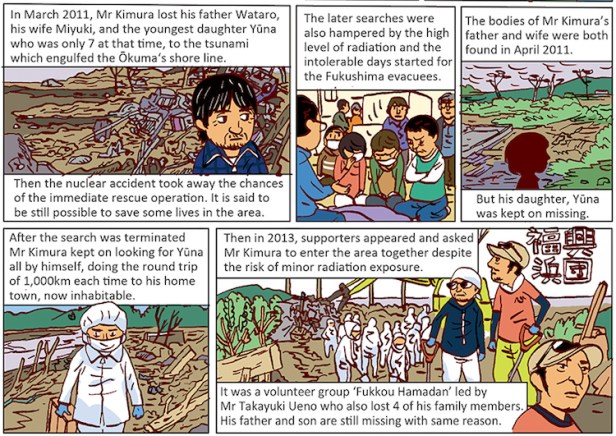
One of the most affecting stories Obata tells is that of Norio Kimura, whose father, wife and seven-year-old youngest daughter Yūna were lost in the tsunami. While the bodies of his father and wife were found in April 2011, Yūna’s remained missing. After the official search for her ended, Kimura continued looking, taking 1000km round trips to do so. After five years and nine months, a piece of bone was discovered that DNA testing proved was one of Yūna’s.
“Yūna was torn apart into small pieces, taken away with contaminated debris, now stored around anonymously,” reads one of the story’s panels. “Had they done the search longer and more carefully from the start, she could have been found a lot earlier, with her body almost intact too.”
The story ends with a panel reading: “A child has been left out alone in the shadow of the reconstruction. And her presence now poses a lot of questions to us.”
This is emotionally momentous material, very different to some of Obata’s other work, be it his 2004 anime of Duran Duran’s song Careless Memories for their then stage show or the short comic about the art of pencil sharpening you’ll find on his website.
Getting it right must weigh upon him, one imagines: these are hugely significant events and he’s almost certainly the only person who’s going to approach them in this form.
“Yeah, big pressure,” he says. “It’s very difficult to do. I appreciate people allow me to talk to them. Some say no, of course. I’ve heard tragic stories but they’ve asked me not to write about it. It’s interesting because they wanted to share that with somebody, somebody who’s not shared the same experience they have.
“The father I met is very vocal because he’s angry. He’s just full of anger. He’s trying to change something about the law, for the love of his daughter. It’s very moving. That’s why he basically opened up to me. His story is still developing and he’s still searching for the remains of his daughter.”
Another panel in the same story is of a city skyline at night and reads: “The nuclear plant was built to provide electricity to the capital region. By knowing Fukushima today, Tokyo could look arrogant, with all the excess of lights and luxury.”
It’s a point elegantly distilled – even poetically so.
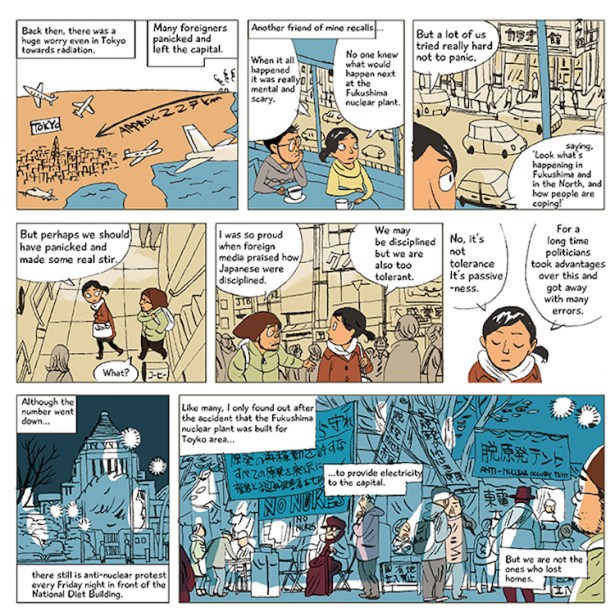
But Obata is not one to cast simplistic blame. “It is something I have to tell people, especially my students [at the University of Gloucester and other universities around the UK where he teaches as a guest lecturer] when they try to do something about the world. They are angry young men, angry young people, but there are layers to things. There’s no right or wrong; the people are goodies and the people are baddies as well.
“When a tragedy happens, we tend to think there’s a victim and there’s an offender. There’s going to be people who get accused and there are victims who get all the sympathy from the public. But sometimes it’s not like that. Sometimes you can’t make things black and white.
“What’s happening with nuclear is one of these things. If you start reading just a short history of the nuclear industry, or nuclear technology, you see a lot of people believe in the technology and I can’t blame them, because I can’t prove them wrong. They get accused and the people who accuse them have right things to say and I can’t blame them either.
“So basically there are no answers to it and it’s very uncomfortable for the human mind not to have answers. You need a bit of patience and courage to accept that. This is one of the things I am going to say at the end, I think: it’s difficult to accept an open ending but you’ve got to have the courage.”
As for Tokyo: “The consumption of energy really helped to establish today’s Japan’s reputation. And I’m part of it. I can’t really criticise it. I just have to take in the contradiction and try to respond.”
Responding to this and the other contradictions he’s encountered in the past five years still has a way to run for Obata. Asked if he’s going to make the 2018 publication date his website gives for his book, he laughs: “Nah, of course not. I just have to put a lot of energy into it and hope the pictures can deliver the intensity of what I’ve seen.”
1,700 Contaminated Vehicles Removed from Fukushima Daiichi Plant Site
Excessive radiation detected in vehicles removed from Fukushima nuke plant
Some of the cars were sold on the used-car market while two others remain unaccounted for, according to plant operator Tokyo Electric Power Co.
Radiation topping the government-set limit has been detected in about 190 vehicles removed from the premises of the Fukushima No. 1 Nuclear Power Plant after the outbreak of the nuclear crisis, it has been learned.
Some of the cars were sold on the used-car market while two others remain unaccounted for, according to plant operator Tokyo Electric Power Co. (TEPCO).
Approximately 1,700 vehicles were parked on the premises of the power station when the nuclear crisis broke out after it was hit by the powerful earthquake and tsunami on March 11, 2011, TEPCO officials said. Of those, about 600 were owned by employees of TEPCO or companies contracted by the utility. Over a 12-day period until radiation screenings began on March 23 of that year, people could drive the vehicles out of the premises of the plant without checks.
The Economy, Trade and Industry Ministry instructed TEPCO in February 2012 to conduct a follow-up probe into the use of these vehicles for fear that next owners of those cars could be exposed to radiation without knowing that the vehicles were contaminated.
The power company conducted a survey on employees and contracted companies that parked their cars on the plant’s premises at the time of the accident, and confirmed that about 460 vehicles were brought out of the plant by April 2015. It was learned that radiation levels for around 190 of the vehicles exceeded government-set safety standards, and some of them were found contaminated with radiation nearly 10 times over the limit. All the vehicles whose radiation levels exceeded the limit were collected from their owners and are now stored on TEPCO’s premises situated in a Fukushima Prefecture area designated as a highly contaminated “difficult-to-return zone.”
TEPCO is considering how to dispose of these heavily contaminated vehicles, with an official saying, “We’d like to continue searching for two vehicles that remain unaccounted for and respond to the situation in an appropriate manner.”
http://mainichi.jp/english/articles/20170809/p2a/00m/0na/013000c
Tainted cars left Fukushima compound unchecked
The operator of the Fukushima Daiichi nuclear power plant says hundreds of vehicles contaminated with radioactive substances left the compound unchecked in the immediate aftermath of the 2011 accident.
Tokyo Electric Power Company says that in 2012 it began investigating what had happened to privately owned vehicles at the plant, and found that about 460 had left the compound.
TEPCO officials located most of them by 2015. About 190 registered radiation levels that were higher than the government standards. They managed to track down all 190, but some of them had been sold to new owners.
Some of the cars were so contaminated that the radiation couldn’t be measured by equipment capable of detecting levels nearly 10 times greater than the official limits.
Two vehicles remain unaccounted for.
TEPCO says it did not conduct radiation checks of cars leaving the compound for 12 days after the accident started on March 11th, 2011.
The company has apologized for causing concern and says it will keep trying to locate the 2 vehicles.
Tritium in Us All
From Majia ‘s Blog:
Life on earth is becoming “tritiated” as the stable hydrogen in our water is replaced by an unstable isotope of hydrogen called Tritium:
Biello, David. (2014, February 7). Is Radioactive Hydrogen in Drinking Water a Cancer Threat? The EPA plans to reevaluate standards for tritium in water. Scientific American,
http://www.scientificamerican.com/article/is-radioactive-hydrogen-in-drinking-water-a-cancer-threat/
Such leaks have prompted the EPA to announce on February 4 plans to revisit standards for tritium that has found its way into water—so-called tritiated water, or HTO—along with risk limits for individual exposure to radiation and nuclear waste storage, among other issues surrounding nuclear power.
The agency’s recent announcement in the Federal Register notes that tritium levels as high as 3.2 million picocuries per liter (pCi/L) in ground water have been reported to the U.S. Nuclear Regulatory Commission (NRC) at some nuclear facilities. (A curie is a unit of radiation emission; a picocurie is one trillionth of a curie.) That is 160 times higher than the standard set back in 1977 by the fledgling EPA—and the NRC has made measurements even higher at some nuclear facilities. “Because of these releases to groundwater at these sites, and related investigations, the agency considers it prudent to reexamine its initial assumption in 1977 that the water pathway is not a pathway of concern,” the EPA stated in its filing.
Tritium bioaccumulates in phytoplankton (which is composed of algae, protists and cyanobacteria) and has been consequently evaluated as posing a persistent and toxic contaminant with intergenerational effects. See the following source:
Jaeschke, B. C., & Bradshaw, C. (2013). Bioaccumulation of tritiated water in phytoplankton and trophic transfer of organically bound tritium to the blue mussel, mytilus edulis. Journal of Environmental Radioactivity, 115, 28-33.
TEPCO is going to dump into the ocean 770,000 tons or so of highly tritiated water stored at Fukushima because the site has reached storage limits and yet still cannot filter tritium, among other elusive radionuclides, contaminating the 400 tons or so of radioactive water that is produced anew at the site every single day.
Tepco has been struggling to de-contaminating the water it captures from injections and ground water influx. A wastewater treatment facility was built early in the disaster, but the various decontamination systems implemented have been unable to eliminate all radionuclides, especially tritium.[i]
In 2013, TEPCO reported that filtered water measured 710 million Becquerels per liter while unfiltered water was reported as twice as radioactive.[ii] Tritium was believed to the major source of residual contamination in the filtered water.[iii] The filtration system has also accidentally dumped unfiltered water, contaminated with Cesium-134, Cesium-137, and Iodine-131, into the sea.[iv]
TEPCO admits it cannot manage the tritiated water stored at the site. No one talks at all about the tritiated fog produced every single night at Fukushima Daiichi:

Japan and US nuclear “authorities” are saying there is no alternative to dumping tritiated water in the ocean:
Nagata, Kazuaki (2015, March 31) Ex-U.S. nuclear chief says tritium water at Fukushima No. 1 can be dumped safely. Japan Times, http://www.japantimes.co.jp/news/2015/03/31/national/former-u-s-nuclear-chief-says-tritium-water-at-fukushima-no-1-can-safely-be-dumped-in-sea/#.VRqyleHWyDk
A former chief U.S. nuclear regulator asserted Tuesday that the massive volumes of tritium-tainted water stored at the Fukushima No. 1 nuclear plant can be “safely” dumped into the sea after it is diluted to reduce the levels of radioactive tritium below the legal limit…. Tepco has said the level of tritium in the water is between 1 million and 5 million becquerels per liter. The legal limit for release to the sea is 60,000 becquerels.
Tritium has a half life of 12.3 years, so it would take decades to die down to permitted levels if left undiluted. The element is about one-thousandth as radioactive as the isotopes cesium-134 and cesium-137, according to Tepco.
TEPCO may have to dump because the tritiated water isn’t simply taking up space. Its also producing Bremsstrahlung Radiation. https://en.wikipedia.org/wiki/Bremsstrahlung
Here is what the US Dept. of Health and Human Services has to say about this type of electro-magnetic radiation, which according to nuclear engineer Arnie Gundersen, among others, is being produced in Fukushima’s water tanks (see here http://podcast.gcnlive.com/podcast/power_hr/0116143.mp3:
U.S. DEPARTMENT OF HEALTH AND HUMAN SERVICES Public Health Service Agency for Toxic Substances and Disease Registry (1999, September). TOXICOLOGICAL PROFILE FOR IONIZING RADIATION U.S. Division of Toxicology/Toxicology Information Branch 1600 Clifton Road NE, E-29 Atlanta, Georgia 30333
Gamma radiation and x rays are types of electromagnetic radiations that behave identically but differ in their origin; gamma emissions originate in the nucleus while x rays originate in the orbital electron structure, or from the slowing down or stopping of highly energetic beta particles or electrons. The x rays that originate in the orbital structure are called characteristic x rays, and are useful in chemical analysis while those due to stopping high speed electrons are called bremsstrahlung. Page 41.
GLOSSARY P. 337: Bremsstrahlung—Electromagnetic radiation (photons) produced by the acceleration that a fast charged particle (usually an electron) undergoes from the effect of an electric or magnetic field, for instance, from the field of another charged particle (usually a nucleus). Bremsstrahlung is emitted when beta particles or electrons are stopped by a shield.
Tritium is a beta emitter. The highly tritiated water stored at Fukushima Daiichi is decaying high energy electrons, or beta particles, whose interactions with shielding is producing a form of X-rays known as “breaking radiation” when translated from the German Bremsstrahlung.
The ocean and the atmosphere are becoming increasingly tritiated. Tritium was rare on earth before the atomic age according to Wikipedia, although found in the upper atmosphere.
What does it mean for the earth’s lower atmosphere and hydrology to become tritiated?
Tritium is entering the earth’s hydrological cycle according to this report by Canada’s Nuclear Regulator:
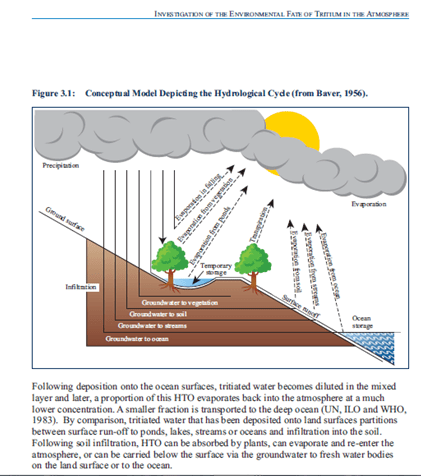
Source: Minister of Public Works and Government Services Canada (2009, December). Investigation of the Environmental Fate of Tritium in the Atmosphere: Part of the Tritium Studies Project INFO-0792. Canadian Nuclear Safety Commission (CNSC). ISBN 978-1-100-13928-9
LET US LEARN ABOUT TRITIUM FROM THE US Environmental Protection Agency http://www.epa.gov/radiation/radionuclides/tritium.html
How are people exposed to tritium?
People are exposed to small amounts of tritium every day, since it is widely dispersed in the environment and in the food chain. People who live near or work in federal weapons facilities or nuclear fuel cycle facilities may have increased exposure. People working in research laboratories may also come in contact with tritium.
How does tritium get into the body?
Tritium primarily enters the body when people swallow tritiated water. People may also inhale tritium as a gas in the air, and absorb it through their skin.
What does tritium do once it gets into the body?
Tritium is almost always found as water, or “tritiated” water. Once tritium enters the body, it disperses quickly and is uniformly distributed throughout the body. Tritium is excreted through the urine within a month or so after ingestion. Organically bound tritium (tritium that is incorporated in organic compounds) can remain in the body for a longer period.
Tritium atoms can exchange with any hydrogen atoms. If the hydrogen atom is part of an organic molecule, the tritium becomes ‘organically bound’ and is transported with the molecule rather than moving freely like water.
Health Effects of Tritium
As with all ionizing radiation, exposure to tritium increases the risk of developing cancer. However, because it emits very low energy radiation and leaves the body relatively quickly, for a given amount of activity ingested, tritium is one of the least dangerous radionuclides. Since tritium is almost always found as water, it goes directly into soft tissues and organs. The associated dose to these tissues are generally uniform and dependent on the tissues’ water content.
Tritium in us all….
RESOURCES
[i] Yoshida ‘Fukushima No. 1 Can’t Keep its Head Above Tainted Water.’ Japan Times, http://www.japantimes.co.jp/news/2013/05/21/reference/fukushima-no-1-cant-keep-its-head-above-tainted-water/#.UZpke8oQNX9, date accessed 21 May 2013
[ii] S. Kimura (6 April 2013) ‘120 Tons of Contaminated Water Leaks at Fukushima Nuclear Plant’, The Asahi Shimbun, http://ajw.asahi.com/article/0311disaster/fukushima/AJ201304060038, date accessed 7 April 2013.
[iii] Yoshida ‘Fukushima No. 1 Can’t Keep its Head Above Tainted Water.’
[iv] R. Mackey and R. Somaiya (1 November 2011) ‘Japanese Official Drinks Water From Fukushima Reactor Buildings’, The New York Times, http://thelede.blogs.nytimes.com/2011/11/01/japanese-official-drinks-water-from-fukushima-reactor-buildings/, date accessed 3 November 2011.
Source : http://majiasblog.blogspot.fr/2017/08/tritium-in-us-all.html
Radioactive Hot Particles in Japan: Full Radiation Risks not Recorded

Radioactively-Hot Particles in Japan; New Study Shows Full Radiation Risks are not Recorded
The article details the analysis of radioactively hot particles collected in Japan following the Fukushima Dai-ichi meltdowns. Based on 415 samples of radioactive dust from Japan, the USA, and Canada, the study identified a statistically meaningful number of samples that were considerably more radioactive than current radiation models anticipated. If ingested, these more radioactive particles increase the risk of suffering a future health problem…
http://www.fairewinds.org/newsletter-archive//press-release-radioactively-hot-particles-in-japan

Radioactively-hot particles detected in dusts and soils from Northern Japan by combination of gamma spectrometry, autoradiography, and SEM/EDS analysis and implications in radiation risk assessment
by Marco Kaltofen (Nuclear Science and Engineering Program, Department of Physics, Worcester Polytechnic Institute) and Arnie Gundersen (Fairewinds Energy Education), Dec 2017 :
Radioactively-hot particles detected in dusts and soils from Northern Japan… Radioactive particles from Fukushima are tracked via dusts, soils, and sediments; Radioactive dust impacts are tracked in both Japan and the United States/Canada; Atypically-radioactive particles from reactor cores are identified in house dusts… After the March 11, 2011, nuclear reactor meltdowns at Fukushima Dai-ichi, 180 samples of Japanese particulate matter (dusts and surface soils) and 235 similar U.S. and Canadian samples were collected and analyzed… Samples were collected and analyzed over a five-year period, from 2011 to 2016.

Detectable levels of 134Cs and 137Cs were found in 142 of 180 (80%) Japanese particulate matter samples… U.S. and Canadian samples had detectable 134Cs and 137Cs in one dust sample out of 32 collected, and four soils out of 74… The mean in Japan was skewed upward due to nine of the 180 (5%) samples with activities > 250 kBq kg− 1 [250,000 Bq/kg]… 300 individual radioactively-hot particles were identified in samples from Japan; composed of 1% or more of the elements cesium, americium, radium, polonium, thorium, tellurium, or strontium.

Some particles reached specific activities in the MBq μg− 1 level and higher [1,000,000,000,000,000 Bq/kg]… Some of the hot particles detected in this study could cause significant radiation exposures to individuals if inhaled. Exposure models ignoring these isolated hot particles would potentially understate human radiation dose.

http://audioslides.elsevier.com/viewersmall.aspx?doi=10.1016/j.scitotenv.2017.07.091&source=0
Olympic games in Fukushima: Is it safe?

 Fukushima city is going to host Olympic baseball and softball games in 2020.
What is the level of radio-contamination there? This is the question on everybody’s mind, spectators and players from all over the world. Is it really safe?
Baseball and softball games will take place in Azuma Sports Park in Fukushima city.


Fukushima prefecture provides the information below on the radiation measurements of the Park.

Measurements of the airborne radiation dose in the baseball stadium: No 13-16
Those of the softball stadium: No 4
The lines above and below indicate the value of the radiation dose at 1cm and 5cm above the ground.
We notice that, as usual, Fukushima prefecture gives only measurements in terms of radiation dose. Based on this information, one might think that it would be relatively safe to play there or to attend the games. However, monitoring only the radiation dose is not enough for radioprotection. The radiation dose is an indication of external irradiation exposure. In this case, the measures of radioprotection will be to stay away from the radioactive objects or not to stay in their vicinity for a long time. But the radiation dose does not provide information to avoid the risk of internal irradiation. For this latter, it is necessary to monitor surface contamination density or concentration, in this case, of soil (in terms of Becquerels/m2 or Bq/kg), as well as the concentration of radioactive substances in the air (Bq/m3). The radioprotection measures against internal irradiation would be wearing protective gear and masks to avoid the radioactive substances from adhering to the skin and/or entering the body.
Here is some information provided by Yoichi OZAWA of « Fukuichi Area Environmental Radiation Monitoring Project », the group of which we have published several soil contamination maps in this blog. OZAWA took measurements on July 27 at the request of the ARD German TV channel team which was visiting Fukushima.

Contamination concentration and density of 5cm surface soil around the Azuma Baseball Stadium
Point A : The entrance of the « Torimu no Mori» where children play.
Radiation dose at 1m above the ground : 0.12 μSv/h
Radiation dose on the ground : 0.19µSv/h
Surface concentration : 605 Bq/kg
Surface density : 47,300 Bq/m2
Point B : In front of the Multi-purpose Fields.
Radiation dose at 1m above the ground : 0.10 μSv/h
Radiation dose on the ground : 0.22µSv/h
Surface concentration : 410 Bq/kg
Surface density : 31,200 Bq/m2
To interpret these figures, let us remind you that in Japan, according to the Ordinance on Prevention of Ionizing Radiation Hazards, places where the effective dose is likely to surpass 1.3mSv in 3 months (approximately 0.6µSv/h of airborne radioactivity) or the contamination density to exceed 40,000Bq/m2 are designated as a « Radiation Control Zone » and public entry must be severely restricted. People under 18 years old are not allowed to enter, and even adults, including nuclear workers, cannot stay more than 10 hours. It is prohibited to eat, drink or stay overnight. To leave the zone, one has go through a strict screening to check for radioactive substances leaving the zone, a measure to protect the individual person as well as the environment.
We do not have the measures of surface density of the baseball nor softball stadiums, but in answering the question of the above German TV team, the information was given as to the decontamination work and radiation dose. There had been decontamination work, and the airborne radiation dose was about 0.04µSv/h in the baseball stadium.
Even when decontamination work has been carried out in the stadium, the mountains and woods behind the park have not been decontaminated, and wind and rain bring the radioactive substances towards the park. Besides, as we can see above, other places in the park are highly contaminated when we look at the surface contamination. They represent high risks of internal irradiation. Moreover, according to recent research, radioactive particles disseminated by the Fukushima Daiichi nuclear accident are mostly insoluble in water. This characteristic makes the health hazard much worse than in the case of the usual water soluble Cesium (see English transcription of NHK documentary on Insoluble Radioactive Particles in this blog). We believe that this Park should not be open to the public, especially to children.
The small type of insoluble radioactive particles – also called Cesium balls -, are dispersed in the Tokyo metropolitan area. People who visit this area should be careful and should take adequate radioprotection measures especially when it is windy and the radioactive particles can be re-disseminated.
All in all, we believe that there is far too much risk for the players and spectators to participate in the Olympic games in Fukushima. Fukushima should not host the Olympic games. Furthermore, we are against holding the Olympic games in Tokyo.
___
Read also :
See the publication of August 4 2017 in the FB of Oz Yo
https://fukushima311voices.wordpress.com/2017/08/07/olympic-games-in-fukushima-is-it-safe/
Groundwater level plunges near Fukushima reactor
The reason they didn’t divert the groundwater around Daiichi is because they need it to keep all the missing stuff cool & contained, relatively speaking …
“A sharp fall in the groundwater level just outside reactor buildings could cause contaminated water to leak from inside the buildings.”

The operator of the Fukushima Daiichi nuclear power plant says the groundwater level briefly plummeted near a building that houses one of the crippled reactors.
Tokyo Electric Power Company, or TEPCO, says the fall was observed in a monitoring well about 11 meters southwest of the No.4 reactor building on Wednesday.
The utility says the groundwater level temporarily sank roughly 1 meter below the level of contaminated water inside the reactor building.
The firm says the groundwater rose above the usual level 23 minutes later.
A sharp fall in the groundwater level just outside reactor buildings could cause contaminated water to leak from inside the buildings.
TEPCO says it assessed the density of radioactive substances in the well water on Thursday and has confirmed no leak of contaminated water took place.
TEPCO stopped pumping out water from the well and reported the case to relevant local governments and the Nuclear Regulation Authority.
The company says it is conducting an investigation, suspecting that improvement work on another well 6 meters away may have caused the drop.
The utility publicized the drop on Thursday, one day after the phenomenon was recorded. The firm apologized for the delay in disclosure, saying it initially decided a problem had developed with the well’s water gauge as the water level in a nearby well remained unchanged.
The No.4 reactor building experienced a hydrogen explosion, but not a meltdown, during the 2011 accident.
Taiwan’s Atomic Energy Council Establishes First Food Testing Lab for Japanese Food Imports
Taiwan communicates on the control of foodstuffs from Japan. I note that these are the same limits, concerning Cesium, in the European Union … (according to the last regulation dated 13/07/2017).
In the EU, it’s been a long time since Iodine 131 is no longer controlled.
The article does not mention “other foodstuffs”, for which the maximum import limit in the EU is 100 Bq / kg.

AEC lab to test food imports for radiation
The AEC said the new facility can test up to 1,700 samples per month and would run tests on food samples sent by customs offices in northern Taiwan
The Atomic Energy Council (AEC) yesterday announced that it has established the nation’s first food testing laboratory for radioactive contamination in response to calls from civic groups following last year’s public hearings on the issue of Japanese food imports.
The facility is the first of its kind to obtain certification from the Taiwan Accreditation Foundation (TAF), AEC Department of Radiation Protection Director-General Liu Wen-hsi (劉文熙) said.
The council had already been testing food products for radiation, but the new laboratory would be a separate branch entirely dedicated to testing food, Liu said.
Last year, the Ministry of Health and Welfare’s plan to lift a ban on food imports from Japan’s Gunma, Tochigi, Ibaraki and Chiba prefectures led to a public outcry, amid fears that food from these areas were affected by the Fukushima Dai-ichi nuclear power plant disaster in March 2011.
At the public hearings, many experts and civic groups questioned the capability of the nation’s ability to detect radioactive contamination in food products.
The council said it receives about 1,400 food samples from the ministry each month and that the new laboratory would be able test up to 1,700 samples per month.
The council received 2,200 food samples in a single month following the Fukushima Dai-ichi disaster, but the monthly average of food samples received for the rest of 2011 was about 1,600, Liu said.
The number of samples sent to the council has not increased significantly over the past few years, the council added.
The new laboratory in Taoyuan’s Longtan District (龍潭) is equipped with five high-purity germanium detectors and employs 12 specialists, increasing resources by one detector and two staff members, Liu said, adding that the laboratory will be testing samples sent by the customs offices in northern Taiwan.
A smaller laboratory run by the council in Kaohsiung tests samples from Taichung and Kaohsiung ports, and is waiting for TAF certification for food testing, he added.
The ministry has determined the maximum allowable level of radioactive residue in foods for three isotopes — iodine-131, cesium-134 and cesium-137 — in the Standards for the Tolerance of Atomic Dust and Radioactivity Contamination in Foods (食品中原子塵或放射能污染容許量標準).
For dairy products and baby foods, the limit is set at 55 becquerels (Bq) of iodine-131, 50Bq of cesium-134 and 50Bq of cesium-137 per kilogram of food, while beverages and bottled water can contain up to 100Bq of iodine-131, 10Bq of cesium-134 or 10Bq of cesium-137 per liter.
As iodine-131 and cesium-134 have shorter half lives, the council is more concerned with cesium-137 contamination in food imported from Japan, Liu said.
http://www.taipeitimes.com/News/taiwan/archives/2017/08/01/2003675708
Nuclear fuel debris to be collected from 2021

A government advisory body has compiled a draft blueprint for recovering nuclear fuel debris from the No. 1 to 3 reactors that melted down at Tokyo Electric Power Company Holdings Inc.’s Fukushima No. 1 power plant, it has been learned.
According to the draft from the Nuclear Damage Compensation and Decommissioning Facilitation Corporation, the recovery project will prioritize collection of debris that has piled up at the bottom of the reactors, installing a robot arm into the reactor containment vessels from the side and controlling it remotely as its main operation.
The aim is to start the project in 2021. All the decommissioning work is expected to be completed sometime from 30 to 40 years after the disaster occurred.
The draft was presented Monday at an expert panel meeting held by the Economy, Trade and Industry Ministry in Iwaki, Fukushima Prefecture, to discuss ways to decommission reactors and get rid of contaminated water. The government will decide sometime in September, based on the blueprint, on a means to remove debris from each reactor.
Fuel penetrated pressure vessels that contain reactor cores, causing debris to form at different levels on the bottom of the containment vessels of the Nos. 1 to 3 reactors.
It was decided to recover the fuel from the side because that will allow work to retrieve fuel from spent pools located in the upper part of the reactor buildings to be conducted at the same time. If recovery was attempted from above, the robot arm would have to reach down to the bottom of the containment vessels, about 30 meters away. The distance would be only about 10 meters if the arm is installed from the side, making it easier to work on the project. The draft deems it feasible to recover debris from the side to get things started.
Details will be discussed in the future, but the draft suggests making use of holes in the containment vessels’ wall or boring new ones, from which the robot arm can be installed to be operated remotely.
■ Fuel debris
A substance created when atomic fuel such as uranium reaches high heat, begins to melt with metal fuel cladding and the material of the reactor’s structure, and then consolidates. The shape, hardness and content of debris vary depending on how it was formed, so it can resemble rocks, pebbles or sand. When recovering it, care must be taken not to trigger recriticality.
Radioactive Contamination of Oceans: Sellafield, La Hague, Fukushima
Frankly speaking, I find it amazing that the people and the media talk so much about Fukushima Daiichi having leaked contaminated water into the Pacific Ocean since March 2011, and about Tepco possible future release of the tritiated water accumulated on site into the Pacific Ocean.
Whereas nobody ever talks about how much contaminated water the Sellafield nuclear fuel reprocessing site on England’s west coast has been releasing into the Irish Sea (then from there flowing into the Atlantic Ocean), and how much contaminated water the La Hague nuclear fuel reprocessing site on France west coast has been releasing into the English Channel (then from there flowing into the Atlantic Ocean.
If you think that Fukushima Daiichi is contaminating the Pacific Ocean since 2011, why are aren’t you aware that Sellafield and La Hague have been contaminating the Atlantic Ocean for decades already?
Both sites having large pipes underwater going far from the land into the sea, both releasing their contaminated water at sea now for decades, with the gracious authorization of the IAEA.
https://en.wikipedia.org/wiki/Sellafield
https://en.wikipedia.org/wiki/La_Hague_site
It might be because few people actually know about it, or because it is easier to point the finger to somebody else far away than at home. Of course it also serves the political and economic interests of both England and France to make their people mindful of what’s happening over there in Fukushima while keeping them blind about what’s happening in their own backyards, their media editors knowing very well what issues are to be avoided as too sensitive to be handled.
Of course I am not saying that the radioactive contamination of the Pacific Ocean by Fukushima Daiichi should not be published, not looked into, not adressed.
What I am saying is that the radioactive contamination of the Atlantic by Sellafield and La Hague in parallel should be also published, looked into, as much adressed, not swept under the carpet, and the people well informed about it, especially as this has been going on for decades authorized by the IAEA.
A few related articles about Sellafield :
“There is more radioactive plutonium in the sediments off the Sellafield plant in the Irish Sea than at the underwater Russian Novaya Zemlya nuclear weapons test site, according to Greenpeace.
The environmental group yesterday released further data arising from its ongoing survey of the Irish Sea. It has been measuring radioactive contamination in sediments and seaweed along British and Irish coasts for several weeks. Last week it visited Dundalk bay, retrieving seaweed as part of this activity. The data released yesterday related to the plutonium and caesium content of sediment taken adjacent to a Sellafield waste-discharge pipe two kilometres off the Cumbrian coast.”
June 1988 : Irish Sea radioactivity `worse than at nuclear site’ https://www.irishtimes.com/news/irish-sea-radioactivity-worse-than-at-nuclear-site-1.161463
“A record number of radioactive hotspots have been found contaminating public beaches near the Sellafield nuclear complex in Cumbria, according to a report by the site’s operator.
As many as 383 radioactive particles and stones were detected and removed from seven beaches in 2010-11, bringing the total retrieved since 2006 to 1,233. Although Sellafield insists that the health risks for beach users are “very low”, there are concerns that some potentially dangerous particles may remain undetected and that contamination keeps being found.”
July 2012 : Record number of radioactive particles found on beaches near Sellafield https://www.theguardian.com/environment/2012/jul/04/radioactive-particles-beaches-sellafield
“Greenpeace has warned that the dumping of the reprocessing plant’s liquid waste has made the Irish Sea among the most contaminated waters in the world, even though Ireland itself produces no nuclear energy. Irish fishermen have been angered by catches of unsaleable mutated fish and by findings that they have been exposed to low-level radiation.”
Jan 2014 : Irish free to sue British nuclear operators over contamination http://www.independent.co.uk/news/uk/home-news/irish-free-to-sue-british-nuclear-operators-over-contamination-9039178.html
“Radioactive waste from the Sellafield nuclear plant in Cumbria is contaminating shellfish hundreds of kilometres away on the west coast of Scotland, according to a new scientific study.
Scottish researchers discovered traces of radioactive carbon discharged from Sellafield in the shells of mussels, cockles and winkles as far north as Port Appin in Argyll, 160 miles from the notorious nuclear plant.”
December 2015 : Scottish shellfish are contaminated by radioactive waste from Sellafield http://www.heraldscotland.com/news/14157272.Scottish_shellfish_are_contaminated_by_radioactive_waste_from_Sellafield/
A few related articles about La Hague :
According to the ACRO, in general, “there is more tritium in the Channel than in the Pacific waters near the Fukushima power station”. (They certainly should know as they regualarly monitor and analyze the contamination near La Hague, and they have repeatedly traveled to Fukushima to cooperate with the Iwaki Mother’s Radiation Lab to measure contamination there). http://www.lemonde.fr/planete/article/2013/03/28/concentration-anormale-en-tritium-relevee-dans-la-mer-a-proximite-de-la-hague_3149613_3244.html#UGUVieKghcxVdjVv.99
“The tritium rejected at La Hague is 1,000 times higher than what is allowed at the nearby Flamanville nuclear plant.” https://www.franceculture.fr/emissions/lsd-la-serie-documentaire/lombre-des-centrales-nucleaires-44-des-poubelles-radioactives
Conclusion from my friend Pierre Fetet (Fukushima’s blog) :
“There are several differences between La Hague and Fukushima (for Sellafield, I do not know enough):
At La Hague, for example, there is an authorization to reject 50,000 billion Bq of Tritium per day.
While in Fukushima, it is not known at all how much is continuously discharged into the sea in terms of radioactivity, except that it is 300 tons per day of contaminated water and that is not authorized by anyone.
The big difference is that in France that crime is allowed but confidential and that in Fukushima that crime is suffered and mediatized.
But you’re right Hervé, people are not aware and remain uninformed of what is really going on.”
For information: Releases by La Hague
 Annual Radionuclide Releases Report in terabecquerel (1 terabecquerel = 1 000 000 000 000 becquerels )
Special credits to Pierre Fetet and Javale Gola
Installation of Unit 3 fuel removal cover dome roof at Fukushima Daiichi
Tokyo Electric Power Co. shows its installation work to cover the upper part of the No. 3 nuclear reactor building that was blown off by the March 2011 hydrogen explosion at the Fukushima No. 1 nuclear power plant.
OKUMA, Fukushima Prefecture–Tokyo Electric Power Co. showed reporters its progress in installing a new roof above Fukushima No. 1 nuclear plant’s No. 3 reactor building on Aug. 2, ahead of work to remove spent nuclear fuel from a storage pool.
The company demonstrated how it is carrying out the work, which is necessary because the upper section of the reactor building was blown off in a hydrogen explosion in the nuclear disaster at the plant in March 2011.
The roof project marks a step toward removing nuclear fuel assemblies in the spent nuclear fuel storage pool in the building.
 A photograph taken from an Asahi Shimbun helicopter shows a section of the half-tubular shaped roof being installed over the No. 3 reactor building at the Fukushima No. 1 nuclear power plant on Aug. 2.
To prevent the spread of radioactive material, TEPCO started to set up the half-tubular shaped cover to shield the damaged reactor building at the end of last month.
 A section of the roof is lifted by a crane to place it on top of the No. 3 nuclear reactor building at the Fukushima No. 1 nuclear power plant on Aug. 2.
 An artist’s rendition of the completed roof that will shield the upper part of the No. 3 nuclear reactor building that was blown off in the March 2011 hydrogen explosion at the Fukushima No. 1 nuclear power plant.
The 566 nuclear fuel assemblies currently lying in the pool will become a significant risk if another major disaster strikes the area.
TEPCO is expected to start removing the fuel from around mid-fiscal 2018.
Early on Aug. 2, part of the roof measuring around 17 meters high and weighing 37 tons was lifted to the top floor of the reactor building with a large crane.
Workers connected the new part of the cover to another section that had been installed at the end of July, completing one eighth of the roof. When finished, it will be about 60 meters long.
Dedicated removal machines are needed to retrieve the fuel from the storage pool. The machines that had been used at the plant prior to the accident were removed because they were severely damaged by the hydrogen explosion.
http://www.asahi.com/ajw/articles/AJ201708020046.html
Source : Tepco
2017.7.31 Installation of Unit 3 fuel removal cover dome roof at Fukushima Daiichi Nuclear Power Station
http://www.tepco.co.jp/en/news/library/archive-e.html?video_uuid=z2v3h93c&catid=61785
Installation of Unit 3 spent fuel removal cover dome roof at Fukushima Daiichi Nuclear Power Station (On-site demonstration) Photos taken on: Aug 2, 2017
http://www.tepco.co.jp/en/news/library/archive-e.html?video_uuid=w8a3j0h4&catid=69631
7 summers later, weeds engulf Fukushima’s abandoned areas
The startling effects of the passage of time come into sharp focus in aerial images taken of Fukushima’s “difficult-to-return zones” in the seventh summer since the March 2011 nuclear disaster.
The bird’s-eye view pictures were captured in abandoned areas near the crippled Fukushima No. 1 nuclear power plant in Okuma and Futaba in Fukushima Prefecture.
The disaster unfolded after the magnitude-9.0 Great East Japan Earthquake spawned a tsunami that devastated coastal areas of the Tohoku region, including Tokyo Electric Power Co.’s Fukushima No. 1 plant.
The Okuma outlet of Plant-4, a large shopping mall located 3 kilometers away from the nuclear plant along National Route No. 6, had been bustling with visitors before the disaster.
Today, weeds grow from the cracks of the asphalt-surfaced mall parking lot, slowly creeping through the expanse of space.
One striking image shows the exterior of the TEPCO-owned condominium building, which housed its employees in Futaba, is becoming covered with rampant weeds that have reached the second floor.
Another photo shows cars that cannot be recovered are partially buried, appearing as if they are sinking into a sea of green.
1 This Month


Shut down the radiation-damaged Heysham nuclear reactors now
To see nuclear-related stories in greater depth and intensity – go to https://nuclearinformation.wordpress.com

Say No to NASA’s Reckless Nuclear Reactor on the Moon
Say No to NASA’s Reckless Nuclear Reactor on the Moon
-
Archives
- October 2026 (247)
- September 2026 (339)
- August 2026 (330)
- July 2026 (355)
- June 2026 (287)
- May 2026 (306)
- April 2026 (356)
- March 2026 (251)
- February 2026 (267)
- January 2026 (308)
- December 2025 (358)
- November 2025 (359)
-
Categories
- 1
- 1 NUCLEAR ISSUES
- business and costs
- climate change
- culture and arts
- ENERGY
- environment
- health
- history
- indigenous issues
- Legal
- marketing of nuclear
- media
- opposition to nuclear
- PERSONAL STORIES
- politics
- politics international
- Religion and ethics
- safety
- secrets,lies and civil liberties
- spinbuster
- technology
- Uranium
- wastes
- weapons and war
- Women
- 2 WORLD
- ACTION
- AFRICA
- Atrocities
- AUSTRALIA
- Christina's notes
- Christina's themes
- culture and arts
- Events
- Fuk 2022
- Fuk 2023
- Fukushima 2017
- Fukushima 2018
- fukushima 2019
- Fukushima 2020
- Fukushima 2021
- general
- global warming
- Humour (God we need it)
- Nuclear
- RARE EARTHS
- Reference
- resources – print
- Resources -audiovicual
- Weekly Newsletter
- World
- World Nuclear
- YouTube
-
RSS
Entries RSS
Comments RSS

