Fukushima dome roof takes shape, but radiation remains high

Construction continues on a domed roof on top of the No. 3 reactor building at the Fukushima No. 1 nuclear power plant.
High radiation levels are still limiting recovery work at the Fukushima No. 1 nuclear plant, a stark reality that reporters saw firsthand when they observed efforts to remove risk factors there.
Media representatives were invited into the plant in early December to see construction work, with the building of a domed roof over the No. 3 reactor building as the main focus.

However, they were only allowed to stay on top of the roof for 20 minutes due to high radiation levels.
The roof is being put together directly above the storage pool for spent fuel. The dome is designed to prevent the spewing of radioactive materials when the fuel is actually removed from the pool.
The original roof of the No. 3 reactor building was severely damaged by a hydrogen explosion in the days following the March 11, 2011, Great East Japan Earthquake and tsunami, which led to the crippling of the Fukushima No. 1 plant.

Spent fuel still remains in the storage pools located on the top floors of the No. 1 to No. 3 reactor buildings.
Plans call for removing the spent fuel first from the No. 3 reactor building.
Although the dome will help prevent the spread of radioactive materials, building parts and other debris as well as some equipment have still not been completely removed from the storage pool, which holds 566 fuel rods.
The collapsed roof and walls were removed to allow for the construction of the domed roof, which began in the summer. The domed roof is about 17 meters high, and a crane was also installed under it in November.

Plans call for the removal of the spent fuel from the No. 3 building to begin in the middle of the next fiscal year.
Internal radiation exposure levels were measured before media representatives headed to the No. 3 reactor building. They were also required to don protective clothing as well as a partial face mask covering the mouth and nose from about 100 meters from the building.
Radiation levels close to the building were 0.1 millisieverts per hour.
An elevator installed into the scaffolding next to the reactor building took the media representatives to the roof, which had been covered with metal plates.
The so-called operating floor looked like any other newly constructed building roof, a sharp contrast to the twisted metal parts that covered the building shortly after the nuclear accident.
Tokyo Electric Power Co., the plant’s operator, captured video footage from within the reactors for the first time in July. Debris that appears to be melted nuclear fuel was found in various parts of the containment vessel.
To the south of the No. 3 reactor building stands the No. 4 reactor building, from where all the spent nuclear fuel has been removed.
To the north is the No. 2 reactor building, which avoided a hydrogen explosion. Beyond the building, cranes and other large equipment are working in preparation for the removal of debris from the No. 1 reactor building.
TEPCO officials cautioned media representatives about standing too long right next to the storage pool, which could be seen located about six meters below the roof. Debris was found within the pool while insulating material floated on the pool surface.
The radiation level near the pool was 0.68 millisieverts per hour. While that was a major improvement from the 800 millisieverts per hour recorded in the immediate aftermath of the nuclear accident close to seven years ago, it was still too high to allow for a stay of longer than 20 minutes.
Vietnam’s ex-president admits Fukushima disaster played role in ditching foray into atomic power

HO, CHI MINH CITY – Vietnam last year abandoned plans to build its first nuclear power plants with Japanese and Russian assistance due to heightened concern over the safety of atomic power following events including the Fukushima disaster, according to former President Truong Tan Sang.
“The situation in the world had changed,” Sang, 68, said in an interview in Ho Chi Minh City on Thursday. “Due to the fluctuations of the world situation, the Vietnamese people were very worried, especially the people in the area where the nuclear power plants were to be located. They had reactions. Therefore, we had to temporarily halt (the plans).”
The interview was his first with a foreign media outlet since stepping down from the post in April last year.
In scrapping the plans to build two multibillion-dollar nuclear plants in November last year, the government cited the country’s tight financial situation, claiming at the time that safety was not an issue.
On Vietnam’s territorial row with China in the South China Sea, Sang said his country welcomes the concerns of countries in and outside the region to contribute to ensuring peace and stability in the strategic waterway.
“We protect our interests on the basis of international law, and at the same time we also respect the interests of the countries concerned on the basis of international law,” he said.
“Japan is very close to Vietnam’s view,” he added, expressing hope for Tokyo’s continued support for its stance in the dispute.
On the economic front, he praised Japan for its active promotion of globalization, especially after U.S. President Donald Trump withdrew from the Trans-Pacific Partnership, a free trade agreement signed by 12 nations, including Vietnam and Japan.
“(Prime Minister) Shinzo Abe was one of the first leaders to promote and connect remaining countries together. As a result, at the APEC meeting in Danang recently, the TPP 11 meeting successfully took place,” he said.
On bilateral relations, he said the relationship between the two countries is “very good. There is no obstacle.”
“The extensive strategic partnership in all areas has been strengthened, bringing clear benefits,” he said.
By taking advantage of Japan’s advanced technology and Vietnam’s abundant natural and human resources, he expressed hope for greater cooperation in areas such as high-quality infrastructure, high-tech agriculture and renewable energy.
“Vietnam learns from the experience and realities of countries around the world to perfect the organizational model of our political system,” he said, indicating the necessity of reform of Vietnam’s ruling Communist Party and government based on global trends and the domestic situation.
Image shows extent of damage to reactor at Fukushima plant

Severely damaged parts of a device once used to move control rods are stuck in a hole inside the pressure vessel of the No. 3 reactor at the Fukushima No. 1 nuclear plant. (Provided by International Research Institute for Nuclear Decommissioning)
An image taken by an underwater robot shows corroded tubes stuck in a hole created by melted fuel in the pressure vessel of the No. 3 reactor at the Fukushima No. 1 nuclear plant.
The image offers clues on the extent of the damage caused when fuel rods in the reactor melted through the bottom of the pressure vessel after the disaster at the nuclear plant unfolded in March 2011.
Tokyo Electric Power Co., operator of the plant, sent the specially designed robot into the reactor in July. The company earlier released images taken by the robot that showed ‘what is believed’ to be melted nuclear fuel debris.
In the image released on Nov. 30, TEPCO identified the severely corroded and damaged tubes as parts of a device used to move control rods. Normally, that device is located inside the pressure vessel.
TEPCO on Nov. 30 also said it would conduct another study inside of the containment vessel of the No. 2 reactor at the plant in January. The containment vessel surrounds the pressure vessel.
A telescopic stick more than 10 meters long and equipped with a camera will be used for the survey.
Marine radioecology after the Fukushima Dai-ichi nuclear accident: Are we better positioned to understand the impact of radionuclides in marine ecosystems?

Highlights
• Marine radioecology studies at the FDNPP coast: process-based modelling and field investigations
• Dynamic modelling of transfer between seawater, sediments and the biological compartments
• New data on submarine groundwater discharges and ocean circulation of radionuclides
• We formulate a strategy for marine radioecology based on processes-based research.
• We highlight the need for more ecology knowledge in marine radioecology.
Abstract
This paper focuses on how a community of researchers under the COMET (CO-ordination and implementation of a pan European projecT for radioecology) project has improved the capacity of marine radioecology to understand at the process level the behaviour of radionuclides in the marine environment, uptake by organisms and the resulting doses after the Fukushima Dai-ichi nuclear accident occurred in 2011. We present new radioecological understanding of the processes involved, such as the interaction of waterborne radionuclides with suspended particles and sediments or the biological uptake and turnover of radionuclides, which have been better quantified and mathematically described.
We demonstrate that biokinetic models can better represent radionuclide transfer to biota in non-equilibrium situations, bringing more realism to predictions, especially when combining physical, chemical and biological interactions that occur in such an open and dynamic environment as the ocean. As a result, we are readier now than we were before the FDNPP accident in terms of having models that can be applied to dynamic situations.
The paper concludes with our vision for marine radioecology as a fundamental research discipline and we present a strategy for our discipline at the European and international levels. The lessons learned are presented along with their possible applicability to assess/reduce the environmental consequences of future accidents to the marine environment and guidance for future research, as well as to assure the sustainability of marine radioecology. This guidance necessarily reflects on why and where further research funding is needed, signalling the way for future investigations.
Greenpeace: Takahama & Sendai reactors must be shut down immediately following Kobe Steel scandal

Tokyo, 1 December 2017 – On 30 November, Kansai Electric and Kyushu Electric announced that they are delaying the restart of four nuclear reactors for approximately two months due to ongoing investigations into Kobe Steel components. Greenpeace is calling for the immediate shutdown of operating reactors, owned by these same utilities, that may also have defective Kobe Steel components at the Takahama and Sendai plants.
While Kansai Electric has delayed operation of Ohi 3 and 4 reactors, it continues to operate its two reactors at Takahama. Similarly, Kyushu Electric has delayed operation of Genkai 3 and 4, while continuing to operate its two reactors at Sendai.
“If Kansai Electric and Kyushu Electric are delaying restart of the Ohi and Genkai reactors due to the need to conduct investigations, how can they justify continued operation of the reactors at Takahama and Sendai? The NRA has so far failed in its responsibilities as a regulator to get to grips with this rapidly evolving scandal. It must set aside nuclear industry interests and prioritize inspections. That includes shutting down operating reactors that may have defective parts until and unless safety can be guaranteed.” said Kazue Suzuki, Energy Campaigner Greenpeace Japan.
More than a month ago, Greenpeace Japan warned that there were potentially major safety risks with Kobe Steel components installed in reactors that warranted strong intervention by the NRA.[1] On 24 October, Greenpeace Japan, along with other citizens groups, submitted evidence to the NRA of Kobe Steel’s extensive supply chain to the nuclear industry, demonstrating the pervasiveness of the potential problems.[2] We called on the agency to take urgent action to launch a comprehensive investigation into the supply and widespread use of potentially flawed Kobe Steel products in the Japanese nuclear industry. Included in the demands were calls for the suspension of restart plans for the Ohi, Genkai reactors, and shutdown of the four reactors Takahama and Sendai.
As of today, the NRA has yet to issue detailed written instructions to all reactor operators to investigate the use of potentially faulty Kobe Steel components. Instead, submissions have been made by 6 of the 11 nuclear utilities and lack any substantial information and analysis.
In one example, On 13 October, it was confirmed that Shinko Metal Products Co., owned by Kobe Steel, supplied tubes to the Tokyo Electric Power Company (TEPCO) for use in heat exchangers at the Fukushima Daini nuclear plant but failed to conduct required inspections.[3 & 4]
For further information:
[1] The letter was signed by Green Action, Mihama-no-kai, Citizens Nuclear Information Center, Citizen’s Watch on Nuclear Regulator, Friends of the Earth Japan, and Greenpeace Japan
[2] The Kobe Steel Group Supply Chain to the Nuclear Industry And Safety Implications (Greenpeace Japan Briefing Paper)
[3] See the TEPCO’s announcement (in Japanese)
[4] For more information on the risks of faulty steel in these components, see: “Irregularities and anomalies relating to nuclear reactor primary coolant circuit components installed in Japanese nuclear power plants”
Contacts:
Chisato Jono, Communications Officer, Greenpeace Japan, email: chisato.jono@greenpeace.org, mob: +81 (0) 80-6558-4446
Shaun Burnie, senior nuclear specialist, Greenpeace Germany, email: sburnie@greenpeace.org, mob: +49 151 643 20548 (Germany)
The Japanese Government Is Lying to the International Community: the Radiological Situation in and around Fukushima is NOT Safe
A report from NIRS (Nuclear Information and Resource Service, in USA)
The Japanese government has created foreign language websites which provide the information about radiology in general and the radiological situation in Fukushima. Journalists around the world, our friends and acquaintances living abroad are continually asking us whether the information that these Japanese central and local government websites present to the international community is correct or not. The following is our answer.
Appeal from a Japanese Anti-nuclear Activist Etsuji Watanabe
Nov.29 2017 Revised (Oct.12 2017)
Etsuji Watanabe: Member of the Japanese anti-radiation citizen-scientist group ACSIR (Association for Citizens and Scientists Concerned about Internal Radiation Exposures)
Special thanks to Mrs Yuko Kato, Mr Ruiwen Song, Ms Nozomi Ishizu, Mrs Kurly Burch, Ms Jennifer Alpern, and Mark Bennett Yuko Kato: Evacuee from Fukushima, member of the Kansai plaintiff group for compensation against TEPCO and government Ruiwen Song: Taiwanese freelance journalist.
The Japanese government has created foreign language websites which provide the information about radiology in general and the radiological situation in Fukushima. Journalists around the world, our friends and acquaintances living abroad are continually asking us whether the information that these Japanese central and local government websites present to the international community is correct or not. The following is our answer.
[Question 1]
The stories uploaded on these websites give people the impression that worrying about radiation is unnecessary. As for this impression, has Fukushima now really become a safe place to live or visit?
[Answer]
First of all, Japanese anti-nuclear activists and evacuees from contaminated areas in Fukushima and Kanto, have been warning people all over the world NEVER to trust what the Japanese government is saying about both radiology in general and the specific radiological health effects caused by the Fukushima Dai-ichi nuclear power plant disaster (hereafter Fukushima accident) following the Great East Japan Earthquake and Tsunami on March 11th, 2011.
Prime-minister Shinzo Abe and the Japanese government as a whole including Fukushima prefectural government have repeatedly declared that “with regard to health-related problems (of the Fukushima accident), I (Abe) will state in the most emphatic and unequivocal terms that there have been no problems until now, nor are there any at present, nor will there be in the future.” (Abe’s statement at a news conference). See the Japanese government website here.
This claim is completely fabricated and false. In making these claims, the Japanese government is blatantly ignoring the vast number of studies in radiological sciences and epidemiology that have been accumulating historically. By engaging in this behavior, the Japanese government has been systematically deceiving the public, both nationally and internationally.
Just think of the amount of radioactivity released during the Fukushima accident. As you know, one of the standards used to assess the extent of radioactive releases and longtime human health effects is the levels of cesium 137 (Cs137) released into the environment. Based on the Japanese government data (which is an underestimate), the Fukushima accident released 168 times the Cs137 discharged by the atomic bomb dropped on Hiroshima. This amount is almost the equivalent to the total atmospheric nuclear explosions conducted by the United States on the Nevada test ground. The Nevada desert is not designated as a residential area, but the Japanese government has recommended evacuated residents return to live in areas with radiation levels of up to 20 mSv/year. By removing economic support for evacuees, the Japanese government has forced many people who had evacuated from these areas to return.
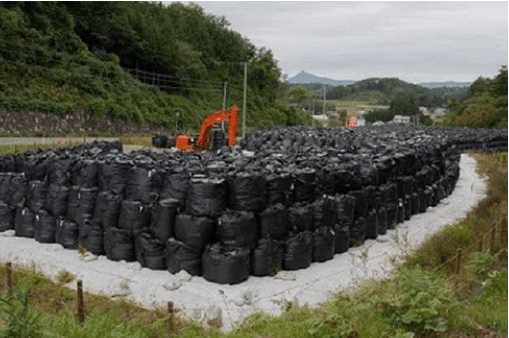
We estimate that in the Fukushima accident approximately 400-600 times the Cs137 were released into the atmosphere by the atomic bomb blast in Hiroshima. Roughly 20% of the Cs137, or 80-120 Hiroshima-equivalents, were deposited on Japan. Of this, the decontamination efforts have only been able to retrieve five Hiroshima-equivalents. The waste from decontamination efforts is typically stored all over Fukushima mostly in mountainous heaps of large plastic bags. This means that 75-115 Hiroshima-equivalents of Cs137 still remain in Fukushima, surrounding prefectures, and all over Japan.
In addition, the Japanese government is now planning to reuse the retrieved contaminated soil under 8000Bq/kg in public works projects all over Japan. This self-destructive program has now been partially started without any announcements as to where the contaminated soil are and will be reused, under the pretext of “avoiding damage caused by harmful rumors”. This project is tantamount to scattering lethal fallout of Cs137 equivalent to about 5 times that of Hiroshima bomb all over Japan. The Japanese government is literally behaving like a nuclear terrorist.
Do you really imagine that Fukushima prefecture and surrounding areas, contaminated as they are to levels similar to the Nevada test site, is really a safe place for people to permanently live, or for foreign tourists to visit and go sightseeing?
Regrettably, we must conclude that it is not, for either residents or tourists the situation in Fukushima is not safe.

[Question 2]
These websites also point out that the international annual dose limit for the public is at 1mSv, but this level is easily exceeded by only one CT-scan, insinuating that this 1mSv standard is set too low and thus not a useful indicator.
[Answer]
CT-Scans are often cited as if they had no radiation risks, But this is not true. A recent study clearly shows that every CT-scan (about 4.5mSv irradiation) increases the risk of cancers in children by 24%. See the website here.
In Fukushima the allowable level of radiation per year for residents is now 20mSv. Can you imagine having 4-5 CT-scans every year?

[Question 3]
One of the websites states: “In Fukushima, the indoor radiation doses are now so reduced that no radioactive cesium can be found in the air. Therefore, no radioactive particles can invade the human body during breathing.” What do you think of this statement?
[Answer]
The Japanese government also ignores the long-term peril caused by “hot particles” ――micron-and- nano-sized radioactive particulates――which, if inhaled or absorbed into the human body, may lead to many kinds of cancers and other diseases including cardiac failure. We should consider internal irradiation to the cells near the radiation sources to be 500 times more dangerous than external irradiation because particles inside the body radiates very near or even inside cells, causing intensive damage to DNAs and other cell organs such as mitochondria.
[Question 4]
These websites explain that there exists not only artificial but also natural radioactivity, thus people are living in an environment surrounded by radiation all the time in everyday life.
[Answer]
One of the main tactics that the Japanese government often uses to propagate the “safety of low level irradiation” is to compare artificial radioactivity with natural radioactivity. But this logic is a methodological sleight of hand. It is crystal-clear that even exposure to natural radioactivity has its own health risks. Cancers sickened and killed people long before artificial radioactivity was used. For example, Seishu Hanaoka, one of the founders of Japan’s medicine, carried out 152 breast cancer surgeries from 1804 to 1836.
Both kinds of radioactivity have their own health risks. Risks caused by artificial radioactivity should not be compared but be added to the natural radioactivity risks as they both lead to the accumulation of exposure.
For example, potassium 40 (K40) is a typical natural radioactive nuclide. According to the Japanese government, the average internal exposure dose for adults from K40 is about 4,000Bq/year or 0.17mSv/year. See the website here (in Japanese).
The ICRP risk model (2007) allows us to estimate the approximate risk posed by K40. The calculation shows that K40 is responsible for approximately 4,000 cancer cases and 1,000 deaths every year. If the same amount of radiation was added to that of K40 in the human body by artificial sources, the cancers and mortalities would be doubled to 8,000 and 2,000 a year, respectively. Based on the ECRR (2010) model, which criticizes the ICRP risk model as a severe underestimate, these figures should be multiplied by 40, reaching 320,000 and 80,000, respectively.
The extract you cite from the Fukushima government website is completely fake: “In Fukushima, the indoor radiation doses are now so reduced that no radioactive cesium can be found in the air. Therefore, no radioactive particles can invade the human body during respiration”. Reports from civic radiation measurement stations refute this claim. For example, dust collecting paper packs of vacuum cleaners used in Iwaki City, Fukushima prefecture, are radiologically measured and 4,800-53,900Bq/kg radioactive cesium was detected in Oct-Dec 2015. See the website here (in Japanese).
[Question 5]
One of the websites says that the Fukushima prefecture has conducted whole-body counter screenings of the 170,000 local population so far but cesium was rarely detected.” Does this mean that we can safely consume food from Fukushima, and Fukushima residents are no longer being exposed internally to radiation?
[Answer]
This is a typical example of demagogy by the Japanese government: vague expressions lacking specific data, using the words “safe and secure” without clear explanation. In reality, the government has not publicized any data indicating serious irradiation of the population. For example, you mentioned the Fukushima prefectural government website saying that whole-body counter screenings of 170,000 members of the local population have found radioactive Cs only in very few cases. However, the fact that no specific number is given makes the statement suspicious.
These statistics, more than likely, exclude many firefighters or other municipal employees who, at the time of accident, helped local residents evacuate from a lot of contaminated areas surrounding the defunct Fukushima plant. These people were subjected to serious radiation doses.
Civic groups’ efforts for the disclosure of information has recently prompted city officials near the defunct plant to disclose the fact that it conducted whole-body counter check-ups on about 180 firefighters, nurses and municipal employees. According to Koichi Ohyama, a member of the municipal assembly of Minami Soma, the screening conducted in July, 2011, showed almost all of these people tested positive in Cs. The maximum Cs137 dose among the firefighters was as high as 140,000 Bq. This data reveals a part of the reality of irradiation but it is only a tiny part.

[Question 6]
The government websites suggest that no health effects from irradiation have been reported in Fukushima. Is this true? Or have any symptoms appeared that indicate an increase in radiation-induced diseases in Fukushima?
[Answer]
One example is the outbreak of child thyroid cancer, but the Japanese government has been denying the relationship with irradiation from radioactive iodine released from the Fukushima disaster.
Japan’s population statistics reflect the health effects from the Fukushima disaster radioactivity. The following data clearly show that diseases increasing in Fukushima are highly likely to have been radiation-induced.

[Question 7]
The Fukushima prefecture website says, “After the Fukushima accident, the Japanese government has introduced the provisional standards for radioactive iodine and cesium. The Fukushima prefectural government subsequently strictly regulated distribution and consumption of food with levels of radioactivity exceeding the provisional standards. Now we have had this new much stricter standard. The distribution and consumption of food exceeding this new standard has been continuously regulated; therefore any food on the market is safe to consume.” Is it true?
[Answer]
As for food contamination, the Japanese government has also tried to cover up the real picture. First, the current government standard for radioactivity in food, 100Bq/kg, is dangerously high for human health, especially for fetuses, infants, children and pregnant women. Even six and a half years after the accident, the Agriculture Ministry of Japan as well as many civic radioactivity measurement stations all over the country have reported many food contamination cases, although the frequency is evidently reduced. See the website here.
The Japanese government has underestimated the danger presented by internal irradiation. But, we must consider two important factors. (1) The wide range of difference in personal radio-sensitivity. According to Professor Tadashi Hongyo (Osaka University Medical Faculty), the maximum difference is as wide as 100 times in terms of biological half-life of Cs137. (2) Recent studies denying that the so-called biological half-life decrease curve actually exists. According to the new model, daily food contamination can cause concentrations to accumulate as time passes. Even a daily 1Bq internal radiation dose from food cannot be safe for human health (details below).
Our recommendation is to be cautious of food or produce from Fukushima and the surrounding areas, and, even if contamination levels are said to have now generally decreased, to avoid jumping to the conclusion that all the food is fit to eat.

[Question 8]
We would like to ask about the situations in prefectures surrounding Fukushima. A television program once reported, “As for the safety of Tochigi and Gunma prefectures, few people are raising concern about health effects of radiation.” Is it true that the prefectures somewhat distant from the Fukushima Daiichi plant are now safe with no human risk?
[Answer]
Regarding the radioactive contamination in prefectures surrounding Fukushima, you can refer to the following website.
This article examines the contamination in the Tokyo metropolitan area, but conditions are the same or more serious in Tochigi or other prefectures north of Tokyo, nearer to the defunct Fukushima Daiichi plant.
Another example is the statistics of stillbirth and neonatal mortality in Fukushima and the surrounding five prefectures (Tochigi, Gunma, Ibaragi, Miyagi, Iwate) shown here.
Perinatal mortality in not only Fukushima prefecture but also neighboring prefectures rose 15.6% just 10 months after the accidents. This clearly indicates the existence of some kind of human health damage from radiation.

[Question 9]
We would like to ask about the decontamination efforts by famers living in Fukushima and neighboring prefectures. Should we think highly of the farmers measuring the amount of radiation deposited on the surface of soil to create radiation maps for farms, or washing the radiation from the surface of every single tree off the radiation with high-pressure washers? The farmers said that while these methods have been shown to be radiologically effective, their produce did not sell well, because consumers are still feeling anxious about health risks. Does the problem of radioactive food contamination in Japan just end up in whether each consumer personally believes it safe or not?
[Answer]
We must raise a question that, despite the government’s decontamination efforts, a huge amount of radioactive materials deposited in mountainous areas remain untouched. Now they are re-dispersing and re-depositing over wide areas of Fukushima and surrounding prefectures via winds, cars, trains, river water, pollen, spores, emissions from incinerators, in the form of radioactive dusts and particulates, among many others. For an example, see the following website.
So I regret to say that, although these farmers’ endeavors you mentioned are very precious and respectable, they are not sufficient to completely eliminate the risk of radiation exposure from food. The problem exists objectively in the nuclear materials deposited on and in soil, algae, plants, houses, buildings, forests, animal and human bodies, not subjectively in the consumers’ sentiment or psychology.

[Question 10]
Japanese experts have recently pitched a cultivation method that can remove cesium by intensive use of potassium fertilizer. Is this method effective at all? Do you have any doubt about their claims?
[Answer]
They seem to be among those experts who have been criticizing the general public’s tendency to demand “zero irradiation risk” as an obstacle to Fukushima reconstruction.
As you know, cesium (Cs) has chemically similar characteristics to potassium (K). So it is true that higher levels of application of potassium fertilizer lowers the plant’s absorption, and therefore concentration, of radioactive Cs, decreasing Cs137/134 concentrations in produce, often to below the government standard of 100Bq/kg. But the following problems remain: (1) This procedure can prevent Cs transfer from the soil to produce only partly, not completely; (2) This process raises the potassium concentration in the produce and therefore heightens the burdens on certain human organs such as kidneys, the heart and the nervous system, causing new health risks; (3) Heightened concentration of potassium also leads to the heightened concentration of radioactive K40, so the reduced risk of radioactive Cs lead to an increased risk of internal irradiation by K40.
[Question 11]
Even if cesium concentration was reduced by applying more potassium fertilizer than usual, strontium contamination would remain. In Japanese government’s international press campaign as to the Fukushima accident, almost nothing has been said about strontium. If you have any information on strontium contamination, let us know.
[Answer]
We regret that the information about strontium that you are asking for is very limited and searching for it is also a challenge for us. The Japanese government and research institutes under the government have reported very limited data regarding strontium contamination. But it is important that the Japanese government admits the fact of strontium contamination within 80km from the defunct Fukushima plant. See the website here.
Did you know that the US Department of Energy data on the strontium contamination of soil in Japan and its visualization (in Japanese) can be seen on the websites here?
[Question 12]
Some Japanese experts say, “the Japanese government has declared that no health effects from irradiation below 100mSv (or 100mSv/year) have been confirmed.” Some farmers have established a private food standard of 20Bq/kg, much lower than the Japanese government standard of 100Bq/kg. Do you think that doses under 100mSv or under 20Bq/kg are safe and secure?
[Answer]
As you mentioned, the Japanese government claims that no scientific studies verify that irradiation of 100mSv or less poses a threat to human health, suggesting that irradiation under 100mSv has no risk. This, however, is false. The government is fabricating this information. In fact, very many scientific studies have already confirmed and proven health effects induced by irradiation under 100mSv. For example, see the websites below.
The Japanese government is using the term “100mSv” in a deliberately ambiguous and confusing manner. The expression 100mSv can have three meanings: (1) a one-time irradiation dose, (2) cumulative irradiation doses, or (3) annual irradiation doses. So 100mSv is not the same as, nor equal to the 100mSv/year that you mentioned in parenthesis. The latter amounts to a 1Sv in cumulative dose over 10 years (which is an up to 10% lethal dose), and 5Sv over 50 years (which is a 50% lethal dose). The present government standard for evacuees to return, 20mSv/year, means that living there for 5 years leads to a cumulative dose of 100mSv, at which the Japanese government admits clear health risks.
Regarding 20Bq/kg as some farmers’ private food standard, it is critical to pay serious attention to the extraction process of Cs from tissues. Japanese-Canadian non-organic biochemist Eiichiro Ochiai points out in his book “Hiroshima to Fukushima, Biohazards of Radiation” (2014) that, based on the Leggett model, the Cs concentration injected in tissues at one time diminishes relatively quickly for about 10 days in most tissues. After that, processes slow down, tending to become steady. He writes: the decrease of the overall Cs level in the body does not follow an exponential decay curve (p.83). This means that consecutive intake of Cs, even in very low levels, results in the accumulation of Cs in the body. (Incidentally, Ochiai’s book can be downloaded for free from the website below.)
Regarding the Leggett model, see the website below.
Yuri Bandazhevsky considers over 10Bq/kg of radioactive Cs concentrations in the body to be unsafe because even this low level can possibly cause abnormal electrocardiographic pattern in babies, metabolic disorders, high blood pressure, cataracts, and so on.
Therefore, we can conclude unequivocally that neither the irradiation under 100mSv nor the privately set 20Bq/kg food standard are safe and secure.
PDF Download
No way to find hot spots with dosimeter at 1m from the ground
Special thanks for their very important work to Kurumi Sugita of the Fukushima 311 Voices Blog and to Mr Yoichi Ozawa of the citizen’s measurement group named the “Fukuichi Area Environmental Radiation Monitoring Project“.
We have published several articles in this blog saying that to protect the population the Japanese goverment should take into account the soil contamination as well as the radiation dose in the air. The policy to open the evacuation zones and encourage the population to return to live there (with the end of financial compensation and relocation aid) is based only on the airborn radiation dose measurements (the evacuation order is lifted when the radiation dose is under 20mSv/year). We have been saying that this is very dangerous, even criminal, for the air radiation dose rate (indicating the amount of radioactive dose received by a person within a certin period time) is useful with a well-identfied fixed source of radiation, but is not adequate to reveal the overall environmental contamination after a nuclear accident. It doesn’t account for the internal radiation exposure induced health hazards (note 1).
Now we would like to point out another problem related to hotspots: it is nearly impossible to find hotspots by the usual measuring practice of the airborn radiation dose rate (in sieverts per unit of time). To illustrate this difficulty, we are translating here a Facebook post of Mr Yoichi Ozawa of the citizen’s measurement group named the “Fukuichi Area Environmental Radiation Monitoring Project“.
Here are the radiation dose rates, captured vertically above a highly radioactive substance (“black substance” or “black dust”) of 4,120,000 Bq/kg, measuring 79 μ Sv/h.
Below are measurements at different distances from the ground.
5cm:9.112 μSv/h
50cm:0.630 μSv/h
1m:0.251 μSv/h

Conclusion: it is impossible to discover micro-hotspots right under your feet when you walk around measuring radiation doses at 1m of distance from the ground.
Measuring device:
Aloka TCS172B
Measurements carried out by Mr Yoichi Ozawa.
For 0cm from the ground, Aloka TCS172B, which cannot measure over 30µSv/h, was replaced by Polimaster PM1703M and Radex RD1706. The value is the average of the measurements of these two devices.
Here is the video of the measurement.
As we can see from the graph above, the value in terms of Sieverts decreases drastically with the distance from the ground. At 1m, which is the usual reference height to measure the radiation dose rate, the value becomes very small even with the soil of over 4 million Bq/kg, which is absolutely enormous (note 2).
Some readers might be familiar with the image of a Japanese citizen measuring radioactivity with a device at about 1m from the ground. This practice, almost unknown before the Fukushima Daiichi nuclear accident, has become widespread among citizens, although it has become rather a rare practice nowadays as many people have more or less become accustomed to live with radiation. Besides the fact that it is hard to live a life worrying about radiation around the clock and some people prefer to stop thinking about it, this “normalisation” of radiation is strongly enforced by a governmental security campaign. One of the methods employed is to focus on the external irradiation risk, neglecting the internal irradiation risk, by spreading the knowledge and data only in terms of the radiation dose in the air (measured by Sieverts), at the expense of other measurements such as the radiocontamination density in soil (surface contamination density in terms of Becquerel/unit of surface).
One of the now well-known problems of radiocontamination of the environment is that the contamination is not homogeneous, but dispersed with what is called a hot spot. This is a serious problem for the population, as the absorption of radioative particles contained in these hot spots can cause internal irradiation related health damage. And as we see above, it is extremely difficult to detect these hotspots, from 1m and above, even with the extremely highly contaminated substance such as “black dust”.
It is widespread belief among the public that if the value of the airborn radiation dose at 1m from the ground is under 0.23µSv/h (note 3), it is safe. This value, diffused by the authorities as well as by media, is indeed applied as the lower limit to carry out decontamination work. Yet, as we have seen, even with the extremely highly contaminated substance such as “black dust”, at 1m, the radiation dose is only 0.25µSv/h, that is to say, only slightly over the limit of the 0.23µSv/h, which is believed to be the “safety level”.
It is unfortunate to say that for most of the residents taking the measurements of the airborn radiation dose by themselves, the values they observe have become rather an “encouraging” factor to continue living there or to return to live, than an alarming factor, as these values do not reveal but rather conceal the presence of hotspots which can cause internal radiation exposure induced health damage.
It is difficult to find hotspots anyway. So when the soil contamination is high (see the concentration maps in this blog, for Namie, Minamisoma), it is better to keep the zone closed, continuing to aid the evacuated people.
Note 1: In opposition to the external radiation exposure which occurs when the human body is exposed to an external source, the internal radiation exposure is an exposure from inside the body due to the incorporation of radioactive particles through ingestion, inhalation or adhesion to skin.
Note 2: This extremely high level of contamination is understandable, for what is measured here is the infamous “black substance” or “black dust”, a kind of Cyanobacteria, about which we invite you to listen to podocast of Marco Kaltofen with English transcription.
Note 3: In fact, the 0.23µSv/h value is problematic in itself. This is based on the 1mSv/year value following the ICRP (International Commission on Radiological Protection) recommendations on the public health. However, the 0.23µSv/h value is not the result of a simple division of 1mSv by 365 days x 24 hours. The calculation of 0.23µSv/h presupposes that people stay inside for 16 hours/day and that the radiation is reduced by 60% because of the building structure. Then, the background of 0.04µSv/h is added. (1000µSv÷365÷(8 + 〈16×0.4〉) + 0.04 But in the real life in rural areas such as Fukushima, people spend more time outdoors. Besides, some recent research has shown that in some cases the radiation dose can be higher indoors than outdoors because of the infiltration of hot particles. Thus, the reality is much more complex to apply uniformly the value of 0.23µSv/h as a safety threshhold. Lastly, many people in Fukushima were victimes of the initial exposure right after the accident. For such population, any exposure, whatever the quantity is, is to be avoided.
Japan’s Kyushu Elec likely to delay nuclear plant restart due to Kobe Steel checks

* Delay would be another hitch in reboot of Japan’s nuclear sector
* Kyushu spokesman says firm has not yet changed restart schedule
* Kobe steel has been reeling from data-falsification scandal
TOKYO, Nov 29 (Reuters) – Japan’s Kyushu Electric Power Co will likely delay the restart of a nuclear plant by several months as it makes checks related to the data-fabrication scandal that has engulfed Kobe Steel Ltd , the Nikkei newspaper reported on Wednesday.
A delay would be a further hitch in the protracted reboot of Japan’s nuclear sector, which was shut down in the wake of the Fukushima disaster in 2011. The government and industry want reactors restarted to cut electricity bills, but swathes of the public oppose returning to atomic energy.
Four reactors are operating out of 42 commercially viable units, and Kyushu Electric has been planning to restart two of its reactors at its Genkai plant in southern Japan by next March.
A Kyushu Electric spokesman on Wednesday told Reuters that the firm had not yet changed the schedule for the Genkai restart, but added that the utility had told the country’s atomic regulator in mid-November that checks on the use of Kobe Steel products would take about a month.
A delay would mark the first direct impact on reactor restarts from the Kobe Steel scandal, raising worries over similar delays in restarts at other nuclear plants, the Nikkei said. The paper cited a senior company official as the source for its information on the possible delay in the Kyushu restart.
Japan’s third-largest steelmaker, which supplies producers of cars, planes, trains and other products across the world, said in October that about 500 of its customers had received products with falsified specifications. The company is also a supplier to the nuclear industry, providing casings for uranium fuel rods and for spent fuel cooling units.
The No.3 and No.4 reactors at Genkai plant in southern Japan have met the regulator’s safety requirements imposed after the Fukushima disaster, and the company had been aiming to restart the No.3 reactor in January and No.4 unit in March.
Checks by nuclear operators have so far found that some Kobe Steel parts are used at their nuclear plants, but that there are no safety issues as the supplied products were not made at factories that engaged in fabrication.
Checks are continuing and utilities are prioritising operating units and those in final stages before restart.
Kansai Electric Power is planning to restart two units at its Ohi plant west of Tokyo by March and is making checks to see whether they have parts supplied by Kobe Steel that have falsified data.
The utility so far has no plan to delay the restart process, a spokesman told Reuters on Wednesday.
Read also related:
Kobe Steel scandal: ‘look the other way’ culture of corporate Japan, faked data for over a decade
Kobe Steel scandal: ‘look the other way’ culture of corporate Japan, faked data for over a decade

The Kobe Steel scandal: What we know so far
It’s the latest big scandal to rock corporate Japan.
Kobe Steel (KBSTY), a century-old industrial giant, has admitted to falsifying data on products sold to top customers like Boeing (BA) and Toyota (TM).
It says as many as 500 companies could be affected, including manufacturers of Japan’s famous bullet trains.
Here’s the lowdown on the crisis that’s rippling through major industries around the globe:
What happened?
Essentially, Kobe employees faked reports to make it look as though products met the specifications requested by customers when in fact they didn’t.
The scandal initially concerned copper and aluminum parts, but has spread to steel products, too. It has raised doubts about thousands of tons of material shipped over a period of more than 10 years.
For the aluminum and copper parts, false data was given about their strength and durability.
Which industries?
Kobe steel sells metal to all kinds of different businesses. Some of the main industries to which it has supplied the suspect products include aviation, automobiles, railways and nuclear power.
Who’s affected?
In the aerospace industry, Boeing and Japan’s Mitsubishi (MHVYF) both used Kobe parts made with falsified data in their aircraft. But the two companies insisted they don’t believe the parts present a safety concern.
Japanese automakers Toyota (TM), Honda (HMC) and Nissan (NSANF) acknowledged they had used affected Kobe materials but were still assessing the consequences for their vehicles.
Ford (F) has said it found aluminum parts in the hood of its Mondeo model in China, but can’t confirm if they were sourced during the affected period.
Other big companies — including GM (GM), Mazda (MZDAF) and plane-maker Airbus (EADSF) — said they haven’t found any suspect parts so far but are combing their supply chains regardless.
The future of Kobe Steel is unclear, but it looks bleak right now. Its stock has nosedived 40% since the revelations first emerged.
Some analysts have warned the company could go bust, and others have suggested it could be broken up and sold off to rivals.
Kobe hasn’t put a number on the likely size of the financial hit from the scandal. The firm’s CEO has said it will bear the costs of any product recalls by its customers. He is also leading an internal probe into what happened.
Doesn’t this sound familiar?
Japan Inc has amassed a growing pile of embarrassing scandals in recent years.
They include Takata’s deadly airbags, Mitsubishi Motors’ fudged fuel-efficiency tests and Toshiba’s damaging debacles over its accounting and nuclear power business.
Japan’s Kobe Steel May Have Faked Data for Over a Decade
Kobe Steel Ltd. said it will co-operate with the U.S. Department of Justice after the agency requested documents related to the fake data scandal that risks engulfing Japan’s third-biggest steelmaker.
Kobe has said some 500 companies worldwide are in a supply chain tainted by admissions that it falsified certifications on the strength and durability of metals going back to 2007, including automotive giants Ford Motor Co. and General Motors Co. and the U.S.’s biggest plane maker, Boeing Co. The besieged Japanese company said in a statement it can’t yet quantify the impact of the crisis on its earnings.
The DOJ’s involvement means the company is “going to have to go overboard to be cleaner than clean,” said Alexander Medd, managing director of Bucephalus Research Partnership Ltd. in Hong Kong. “This is going to require a complete mental shift and rebuilding of trust.” Japan’s Ministry of Economy, Trade and Industry has also asked the company for a report on the scandal including causes and remedies.
Kobe’s global review of its units will probably reveal that data falsification began even longer than 10 years ago, according to a company executive, asking not to be named as the information isn’t public. The Nikkei newspaper reported Tuesday that irregularities over quality control at Kobe’s plants in Japan date back decades, citing a person it didn’t identify.
As the steelmaker works to contain the fallout, it has briefed analysts that short-term liquidity isn’t an issue as it seeks to generate cash including via asset sales.
Kobe Steel is also considering the sale of its real estate unit, the executive said. Jefferies Japan Ltd. analyst Thanh Ha Pham said that, while the company has enough cash and funding to cover short-term needs, it’s looking to raise money by lowering working capital and through asset sales, according to a note that followed a briefing with Kobe’s management on Monday.
Last week saw Kobe’s stock collapse 41 percent as investors rushed to punish the latest instance of corporate malfeasance in Japan, following similar misconduct around data at companies such as Mitsubishi Motors Corp. and Asahi Kasei Corp. It has since pared those losses, closing 3.1 percent higher in Tokyo on Tuesday for a two-day gain of 6 percent.
Kobe Steel could face losses of as much as 200 billion yen ($1.8 billion) in a worst-case scenario arising from its misconduct, according to Nomura Securities Co., while Japan Credit Rating Agency has placed the company’s A rating on watch for a possible downgrade.
A QuickTake Q&A explainer on the Kobel Steel data scandal
Nomura’s tally assumes customers would be forced to recall products and then have Kobe assume the cost, and that it will have to pay compensation, including to investors, credit analyst Shintaro Niimura said in a report Monday. The bank estimates that about 30 percent of Kobe’s aluminum and copper, two of the metals subject to data falsification, is bought by automakers.
Capital Adequacy
Still, with about 700 billion yen in capital, the worst case would only put a dent in Kobe’s capital-adequacy ratio, which would fall from 30 percent to 23 percent, according to Niimura. He cautioned that losses could widen if evidence comes to light that the scandal has affected more products than reported so far by Kobe, which on Friday added another nine to the list, including core steel products, to make 16.
The units implicated in the crisis make the steel, copper, aluminum and other materials that account for over half the company’s revenue.
Kobe’s property unit, Shinko Real Estate Co., had fixed assets of 89.9 billion yen, according to a March filing. The company is considering a number of sales options for the business, which leases and sells real estate, including a full divestment, according to the executive, although he said the sale isn’t linked to the company’s wider problems.
None of Kobe’s customers has so far raised specific safety concerns or recalled products. Jefferies’ Pham cited management as saying that customer feedback, including from beverage can producers and railway companies, is that no immediate recalls are required and products involved are not a safety concern.
Some of Japan’s biggest automakers — Toyota Motor Corp., Nissan Motor Co. and Subaru Corp. — are investigating whether any car parts contain falsified materials from Kobe, according to company spokespeople. Toyota supplier Denso Corp. is also checking its products, while Tokyo Metro Co. and Seibu Railway Co. are investigating if Kobe’s aluminum parts are used in their trains.
Kobe Steel declined to comment on the details of the analyst meeting on Monday. A spokeswoman said it’s investigating past records to determine the cause of the falsifications.
Scandal-hit Kobe Steel has a ‘look the other way’ culture, they say in hometown
KOBE, Japan (Reuters) – The fresh university graduate, eager to make a good impression on the job at one of Kobe Steel Ltd’s (5406.T) main plants in Japan, punched the wrong measurements into machines making steel pipes, causing a large batch to come out too short.
“I thought I was going to be fired,” recalled the former employee nearly 40 years later. But Shinzo Abe, now Japan’s prime minister, stayed on the job at Japan’s third-largest steelmaker for three years before entering politics in 1982.
Abe has called the steel industry the backbone of the nation. Kobe Steel, a 112-year-old company in south-central Japan’s Hyogo prefecture, has risen from wartime devastation and natural disaster but its past is littered with examples of corporate misconduct.
Its admission last month that workers had tampered with product specifications for at least a decade is the latest in a string of scandals that has battered Japan’s reputation as a manufacturing powerhouse.
Clients around the world, including top carmakers and airplane manufacturers, have been scrambling to check whether the safety or performance of their products have been compromised.
Workers, executives and shopowners in Kobe, a gritty, industrial city bordered by sloping hills where cattle are bred for the famed Kobe beef, said they were concerned but not surprised by the scandal.
Kobe Steel, which has apologized for the tampering, declined comment for this article.
“The corporate culture was to look the other way even while you saw what was going on,” said a retired employee who worked at the company’s flagship steel plant, Kobe Works – a symbol of the city’s quick recovery from a 1995 earthquake that killed more than 5,000 people. The company’s other main plant in the area is Kakogawa Works, in the nearby city of Kakogawa.
“They were supposed to be instilling a culture that paid attention when improprieties were discovered,” the former employee said. “In the end they didn’t create such a corporate culture. That’s management’s responsibility.”
The company initially said some workers had falsified data on contract specifications for a relatively small amount of aluminum and copper products, but it later admitted the problem had spread.
In 2006, Kobe Steel admitted falsifying soot-emissions data from the blast furnaces at Kobe Works and Kakogawa Works.
The latest scandal reflects “exactly the same set-up”, said Shoichi Tarumoto, who was then mayor of Kakogawa. “It looks like nothing has changed at Kobe Steel.”
PAST PROBLEMS
Kobe Steel has admitted taking part in bid-rigging for a bridge project in 2005, and failing to report income to tax authorities in 2008, 2011 and 2013. The company exceeded established limits for ground and water pollution in 2006.
Illegal political funding to candidates in local assembly elections in 2009 prompted the resignations of the then CEO and chairman. And last year Kobe Steel admitted a subsidiary falsified data on stainless-steel products.
A senior official in local government who has dealt with the company for years said: “Kobe Steel always scouts the backstreets for shortcuts. That’s their nature.”
Although its local dominance has waned, Kobe Steel remains one of only two Kobe-based companies, along with Kawasaki Heavy Industries Ltd (7012.T), that have revenues over 1 trillion yen ($9 billion) a year. The Kakogawa Works is that city’s biggest company, vital as a local taxpayer and employer.
More than a third of the Kobe Steel group’s 6,123 domestic customers are concentrated in Hyogo or neighboring Osaka, according to credit-research firm Teikoku Databank. More than half its customers are small and midsize Japanese companies.
The other clients are spread around the world and include top automobile manufacturers, airplane makers, railways and nearly any industry that uses steel, aluminum or copper in any form.
No safety issues have been found so far because of the tampering, but Kobe Steel has withdrawn its forecast for its first annual profit in three years. Whatever the eventual economic impact, the scandal is already affecting morale in Kobe city.
“If Kobe Steel suffers a blow, this is the area that will be most affected,” said Tsuyoshi Matsuda of Teikoku Databank’s Kobe office.
Kobe Steel acknowledges some customers have shifted orders to other suppliers. Major banks are instructing their Kobe area branches to keep close watch on the credit management at companies that do business with the steelmaker, bankers say.
“HEAVY MOOD”
The scandal “isn’t an open topic on the job,” said a worker in his 30s, finishing the night shift around 8 a.m. at Kobe Works, a hulking jumble of rusting pipes, risers and tanks.
“Nobody says it out loud, but I think people are worried,” he said. “It’s a heavy mood.”
Shinzaike, the local train station closest to Kobe Works, is home to several bar-restaurants that count the company’s employees among their best customers. Since the latest scandal erupted, business has dried up, traders said.
“Looks like they’re holding back from going drinking,” said a pub owner.
Reservations for year-end parties would normally be starting now, but there haven’t been any yet, he added.
Abe, who worked at both the Kobe and Kakogawa works, has called his years at Kobe Steel “the starting point of my adult life.”
Last year, according to media reports, he urged young people entering the workforce to follow his example of learning from mistakes at Kobe Steel.
“I got through it without incident,” he said. “I want you not to be discouraged by a few mistakes but rather do the best you can.”
Kobe Steel blames data scandal on focus on profit, lack of controls
TOKYO (Reuters) – Kobe Steel Ltd said on Friday a lack of quality controls and a focus on profits was behind the widespread data tampering that has shaken up the supply chains of car and plane makers around the world.
Japan’s third-largest steelmaker, which has posted losses in the last two business years, promised to automate more of its operations and reorganize its quality control systems to recover from one of the nation’s biggest corporate scandals.
The 112-year-old company admitted last month that workers had tampered with product specifications, causing global automakers, aircraft manufacturers and other companies to check whether the safety or performance of their products had been compromised.
No safety issues have so far been identified from the data cheating, which mainly involves falsely certifying the strength and durability of products.
Kobe Steel was ordered last month by the Ministry of Economy, Trade and Industry (METI) to provide a detailed explanation of the data cheating and say what steps it would take to prevent future abuses.
“Improving our management and corporate governance and instilling a culture where employees can say anything are imperative,” Chief Executive Officer (CEO) Hiroya Kawasaki said at a press briefing after submitting its report to the government. “This is my utmost priority and I will work on these with unflagging resolve,” he said.
Kawasaki said his “ultimate management responsibility” will be decided after recently appointed outside investigators report back to the company.
“Given the magnitude of the scandal, we expect upper management to get the boot,” Thanh Ha Pham, an analyst at Jefferies in Tokyo, wrote in a note on Friday, without saying when that might happen.
Multiple workers and managers at nine production sites were involved in tampering data on specifications of products, the company said in its internal report.
Some of the fabrication of data went on for 10 years, Managing Executive Officer Koji Yamamoto said, though he could not say when exactly it started.
The company is in talks with fewer than 10 customers who want to recover the costs of safety inspections, Managing Executive Officer Yoshihiko Katsukawa said.
“Clarifying your company’s thinking on the causes of this incident is a meaningful step towards restoring trust,” Akihiro Tada, director general of METI’s manufacturing industries bureau, told Kawasaki as he arrived to deliver the report.
Kobe Steel, also subject of a U.S. Justice Department inquiry as well, has had a Japanese government-sanctioned seal of quality revoked on some of its products and lost customers.
As of Friday, the company said 474 out of 525 affected customers found no safety issues or their products were deemed safe by Kobe Steel, up from 470 earlier this week.
The company has said it cannot yet fully state what impact the tampering will have on its finances. Last week, it pulled its forecast for its first annual profit in three years for the 12 months through next March.
Kobe Steel’s shares have fallen by nearly a fifth since it revealed the data fabrication a month ago.
The company’s shares rose nearly 2 percent on Friday, while the Nikkei 225 fell 0.8 percent.
Kobe Steel Blames Plant Managers for Quality Control Scandal
TOKYO — When a roll of aluminum produced at a Kobe Steel factory fell short of customers’ exacting demands for qualities like strength, plant managers were supposed to make a painful but necessary decision: Start again and make a new, better roll of metal, even if it cost the company time and money.
But for at least a decade, according to an internal company report released on Friday, those managers took an easier way out, manipulating test data on some products to avoid expensive do-overs.
The report by the Japanese steel maker is its first public accounting of the causes of a data falsification scandal that has shaken the company and prompted around 500 of its customers around the world — including manufacturers of cars, trains and aircraft — to scramble to verify their products’ safety.
The report, produced by Kobe Steel without input from regulators or other outside parties, concluded that the company had erred by elevating the pursuit of short-term profit over the maintenance of scrupulous quality standards. That failing, it said, was exacerbated by lax oversight by senior executives and an “insular” corporate culture that discouraged employees from questioning improper but long-established practices.
“There was a climate where employees on the ground couldn’t speak up. Even if they did speak up, it wouldn’t make a difference,” Kobe Steel’s chief executive, Hiroya Kawasaki, said at a news conference. “As long as the revenue was coming in, management wasn’t interested.”
Mr. Kawasaki said that the practice of misrepresenting not-quite-perfect metals was at least a decade old but that, because records going back further than that were incomplete, it might have been going on longer.
A second report on the scandal, by a commission of outside experts, will be completed by the end of December, he said.
In a series of announcements beginning last month that have rattled corporate Japan, Kobe Steel acknowledged faking data about the quality of aluminum, copper and other products to make it appear as though they met standards promised to customers when in fact they did not.
The metals still met basic safety requirements, according to the company and customers who have reviewed their purchases from Kobe Steel. Nonetheless, the episode has reverberated through global supply chains and dealt a fresh blow to Japan’s reputation for scrupulous, dependable manufacturing.
The report published on Friday outlined several changes the company plans to make to prevent cheating, including automating record keeping for product tests and requiring multiple employees to verify that test results are accurate.
The report faulted what it said was Kobe Steel’s excessively segmented structure, saying that the company’s seven separate divisions — which produce products ranging from aluminum used by automakers to steel for the construction industry — had become insulated fiefs where problems could fester.
Top managers escaped direct blame for the scandal: The report said there was no evidence that they were aware of the data falsification, though it criticized executives for setting unreasonable production targets and then failing to scrutinize how subordinates met them, or at least appeared to meet them.
“The fact that management did not grasp what was happening on the front lines is in itself a major problem,” it said.
Kobe Steel quality scandal driven by pursuit of profits and demanding corporate culture
Scandal-hit Kobe Steel’s troubles were driven by a relentless focus on profits and the company’s regimented corporate culture, which led to more than decade of faked quality guarantees on its products.
Japan’s third largest steel-maker said it “sincerely and deeply apologised for the enormous amount of worry and trouble we have caused” as the findings of an investigation into its problems emerged.
A 27-page document detailing what went inside Kobe – which has been loss-making for the two years – said failed quality controls were behind testing data being altered.
The report said that “a severe management environment” with demanding profit targets had contributed to the scandal.
The investigation into the issues which affected more than 500 customers – including those in the aerospace, transport and nuclear industries – was ordered by Japanese government.
Customers of Kobe included Toyota and Nissan, along with international clients such as Boeing, General Motors and Daimler. The scandal – which affects aluminium, copper and steel products – has sent Kobe’s customers racing to check components acquired from the company, though no safety problems have yet been identified.
In the wake of the report, Kobe has promised to transform itself with more automation and better quality controls.
In an update on checks into the affected products on Friday, Kobe said 474 of the 525 affected customers had not identified problems or Kobe had satisfied itself the products were safe.
News of the scandal saw shares in Kobe plunge as much as 40pc and Hiroya Kawasaki, president of Kobe, admitted that “trust in our company has fallen to zero”.
Customers have been deserting the business, causing Kobe to scrap financial forecasts. Naoto Umehara, executive vice-president, signalled the scandal could kill the company, warning Kobe “may incur extraordinary losses”.
Reports of the malfeasance at Kobe is just the latest of a string of scandals that have rocked corporate Japan, with companies including Nissan, Toshiba and Olympus also having been revealed to have suffered huge issues.
A Call for Working Together to Enact the Chernobyl Law in Japan
By Masami Ueno (Director of Fukushima-Iseshima Association)
Fukushima-Isehima Association is a Non-Profit Organization located in Mie Prefecture in Japan. We have been helping the evacuees (be it forced or volunteered) from Fukushima to settle in Mie Prefecture and providing the children of Fukushima with recuperation programs in Mie since March 2011. We also send fresh vegetables to families in Fukushima.
Our activities mentioned above have been supported by generous donations and grants. However, after six years have passed, we have realized that what private organizations—like ours—can do is limited. Yet, our activities are still necessary for many people since radiation continues to be released into the air every day as the result of the Fukushima nuclear disaster. Then, the question is how we can tackle with such an unprecedented scale of disaster. To be honest, we are at a loss. However, there are two important precedents we should follow.
The first instance is the Chernobyl Law that was established by the government of the former Soviet Union for the people affected by the 1986 Chernobyl nuclear disaster in order to protect their lives and health from radiation. The Chernobyl Law is also the first law in the world that manifests the universal human rights to the life of the people affected by the radiation disaster. We believe that Japan must enact the law equivalent to the Chernobyl Law.
Another instance is Japan’s Freedom of Information Law that was established by the government of Japan in 1999. This law was the product of the accumulated efforts made by the citizens all over Japan; those citizens requested their own local governments and members of the city councils to enact the Freedom of Information Law at the municipal levels. This citizen movement eventually led to the enactment of this law at the national level. We can establish Japan’s Chernobyl Law by following this history and experience of the civil actions that eventually realized the Freedom of Information Law in Japan.
We would like to work together with many of you toward the enactment of Japan’s Chernobyl Law in order to protect our health and lives from the radiation disaster.
Please take a moment to read the following. We hope that you support our idea and join our effort to establish Japan’s Chernobyl Law.
Five years after the Chernobyl nuclear accident, the so-called “Chernobyl Law” was established by the former Soviet Union; it was then succeeded by the governments of Ukraine, Russia and Belarus after the dissolvement of the Soviets.
All these governments have guaranteed the right to evacuation for the residents living in the contaminated areas by radiation, while providing the people living in the areas to which the evacuation orders were issued with the social security. The three countries are not necessarily in a sound economic situation; consequently, they are not able to fulfill all the compensations stimulated by the law. Nonetheless, the Chernobyl Law is still significant for human history as it identifies the government as the primary responsible for the nuclear disaster and guarantees the unconditional right to evacuation for the residents living in areas where one’s exposure to radiation would exceed 1 mSv/year.
On the other hand, the Japanese government raised the standard of public dose limit for radiation exposure from 1 mSv to 20 mSv per year after the Fukushima nuclear accident, and continues to maintain the same dose limit as the safety standard, which turns to be the criteria for the government to lift the evacuation order today.
Furthermore, the Fukushima Health Management Survey Committee has renounced the possibility of causal relation between the increasing number of thyroid cancers among the Fukushima children and radiation, and has never taken a drastic measurement for the health problems among the residents of Fukushima.
Japan’s radiation risk management policy considerably differs from that of the three former USSR countries, which set up 1 mSv/ year as the public dose limit for radiation exposure and provide the social security for the people who are diagnosed as a possible victim of the radiological consequences of the Chernobyl nuclear accident.
Immediately after the Chernobyl nuclear accident, the government of the former Soviet Union raised the standard of the public dose for radiation exposure from 1 mSv to 100 mSv/year; and some experts insisted that 100 mSv/year was ‘safe’ even around the period where the Chernobyl Law was being established. However, the public dose limit was reversed to 1mSv/year, which is the international standard, because the nuclear power plant workers, who had dealt with the accident, fiercely opposed to the government’s policy of 100 mSv as the post-Chernobyl public dose limit.
We, the citizens in Japan, too, experienced the nuclear catastrophe that reminded us of the dignity of life.
We must speak out and take actions in order to establish Japan’s Chernobyl Law.
May 2017
Please contact us if you like to work with us to draft a model plan and formulate a procedure to enact the law at the municipal level. The below is our contacts:
Email:
ueno_masami_1108@yahoo.co.jp(Masami Ueno)
noam@m6.dion.ne.jp(Toshio Yanagihara)
Fukui Governor OK to Restart Kansai Electric’s Oi Nuclear Plant Reactors N°3 & N°4

The No. 3 and No. 4 reactors at Kansai Electric Power Co.’s Oi nuclear plant in Oi, Fukui Prefecture
Fukui gives OK to restart of Kansai Electric’s Oi nuclear plant
FUKUI–Kansai Electric Power Co. has cleared all hurdles toward restarting two reactors at its Oi nuclear power plant early next year after gaining the consent of the prefectural governor here Nov. 27.
The utility plans to resume operations of the No. 3 and No. 4 reactors in January and March, respectively.
“I have agreed to the restart after taking into account the position of the Oi town government and Fukui prefectural assembly, as well as the response by the central government and the operator of the plant concerning our request to have an interim storage site for spent nuclear fuel to be built outside the prefecture,” Governor Issei Nishikawa told reporters here the same day.
Nishikawa signed off on Kansai Electric’s request following similar moves by the town government of Oi, which hosts the Oi nuclear plant, the town assembly and the prefectural assembly.
In response to the governor’s request concerning the storage site, Shigeki Iwane, president of Kansai Electric, has already pledged to offer a proposed alternative site next year.
Industry minister Hiroshige Seko, too, vowed that the central government will be involved in drawing up the plan.
Nishikawa pushed for the construction of the interim storage facility outside the prefecture as a condition to agreeing to the restart of the Oi plant.
Five reactors are now operating in Japan after clearing new nuclear regulations established in the aftermath of the 2011 Fukushima nuclear disaster.
Two of the reactors are at Kansai Electric’s Takahama plant in Fukui Prefecture.
The Fukui District Court, citing safety concerns, ordered a halt to the operations of Oi’s No. 3 and No. 4 reactors in May 2014.
But Kansai Electric appealed the decision and has since been gearing up to restart the units.
Fukui Gov. OKs restart of 2nd plant in prefecture
FUKUI, Japan (Kyodo) — Fukui Gov. Issei Nishikawa on Monday gave the go-ahead for Kansai Electric Power Co. to restart two reactors at its Oi nuclear power plant in the central Japan prefecture.
With Fukui also hosting Kansai Electric’s Takahama plant where two reactors have already resumed operation, the planned restart of the Nos. 3 and 4 reactors at the Oi complex would make the prefecture the first since the 2011 Fukushima nuclear disaster to have two active nuclear power plants.
The governor conveyed the decision to Economy, Trade and Industry Minister Hiroshige Seko over the phone Monday.
The Osaka-based utility plans to bring the No. 3 reactor back online in mid-January and restart the No. 4 unit in mid-March.
The two reactors located on the Sea of Japan coast resumed operation in July 2012 under tentative nuclear safety standards set by the then-Democratic Party of Japan government while all other reactors in the country remained idle for checks following the meltdowns at the Fukushima Daiichi complex.
The two reactors at the Oi complex went offline in September 2013 for regular checkups and cleared the Nuclear Regulation Authority’s safety review based on the country’s post-Fukushima screening standards in May.
The Fukui governor’s approval of the restart came after Kansai Electric President Shigeki Iwane said Thursday the utility would decide by the end of 2018 where to set up a storage facility for spent nuclear fuel.
The governor had been requesting the utility’s construction plan for the facility.
Speaking at a press conference, Nishikawa said he has come to the decision after “comprehensively considering opinions of our town and prefectural assemblies as well as responses of the government and the plant operator to an idea of setting up an interim storage facility outside our prefecture.”
The central government is yet to pick a final disposal site for nuclear waste, including spent fuel.
Chief Cabinet Secretary Yohihide Suga said in a separate press conference it is “extremely meaningful” that the plan to restart the two reactors in Oi has now received approval from the hosting prefecture’s governor.
Suga, however, declined to clarify the government’s stance on the opposition voiced by Taizo Mikazuki, governor of neighboring Shiga Prefecture.
About 20 antinuclear activists gathered in front of the Fukui prefectural government office Monday to show their opposition to the decision.
Jiku Miyazaki, a 73-year-old temple master in Oi, expressed concerns about whether residents can safely evacuate if a nuclear accident occurs.
“Under the current conditions, we won’t be able to evacuate,” Miyazaki said, citing troubles residents encounter when typhoons strike the region.
“We want them to take measures in view of the possibility of the two nuclear plants having accidents at the same time.”
Some residents hope for the economic benefits that an influx of plant workers could promise local businesses.
A man in his 50s said, “Our life here is depending on (the plant). As long as the governor judges it is safe, we need it to be restarted or we will be in trouble.”
Japan is poised to release into the Pacific one million tons of radioactive water contaminated by the Fukushima Daiichi nuclear plant
Fukushima’s radioactive water grows by 150 tons a day and Japan doesn’t know what to do with it. Scientists vs fishermen and locals conflict.

Japan is poised to flood the Pacific with one million tons of nuclear water contaminated by the Fukushima power plant
Japan urged by experts to gradually release radioactive water into Pacific Ocean
Comes more than six years after tsunami overwhelmed Fukushima nuclear plant
The water is stored on site in around 900 large and densely packed tanks
But if the tank breaks, the contents may not be able to be controlled
The Japanese government is being urged by experts to gradually release radioactive water in to the Pacific Ocean more than six years after a tsunami overwhelmed the Fukushima nuclear power plant.
The water is stored on site in around 900 large and densely packed tanks and could spill should another major disaster strike.
The government has been urged to release the water into the ocean as all the radioactive elements of the water except tritium – which has been said to be safe in small amounts – have been removed through treatment.
But if the tank breaks, the contents may not be able to be controlled.
Local fishermen are extremely hesitant to this solution because many consumers are still uncertain to eat fish caught off Fukushima, despite tests that say the fish is safe to eat.
Today only about half of the region’s 1,000 fishermen go out and just twice a week because of reduced demand.
Fumio Haga, a drag-net fisherman, said: ‘People would shun Fukushima fish again as soon as the water is released.’
Lab technicians mince fish samples at Onahama port in Iwaki, pack them in a cup for inspection and record details such as who caught the fish and where.
Packaged fish then sold at supermarkets carry official ‘safe’ stickers.
Only three kinds of fish passed the test when the experiment began in mid-2012, 15 months after the tsunami.
Over time, that number has increased to about 100.
The fish meet what is believed to be the world’s most stringent requirement: less than half the radioactive cesium level allowed under Japan’s national standard and one-twelfth of the US or EU limit, said Yoshiharu Nemoto, a senior researcher at the Onahama testing station.
The amount of radioactive water at Fukushima is still growing, by 150 tons a day.
The reactors are damaged beyond repair, but cooling water must be constantly pumped in to keep them from overheating.
That water picks up radioactivity before leaking out of the damaged containment chambers and collecting in the basements.
There, the volume of contaminated water grows, because it mixes with groundwater that has seeped in through cracks in the reactor buildings.
After treatment, 210 tons is reused as cooling water, and the remaining 150 tons is sent to tank storage.
During heavy rains, the groundwater inflow increases significantly, adding to the volume.
The water is a costly headache for Tokyo Electric Power Co, the utility that owns the plant.
To reduce the flow, it has dug dozens of wells to pump out groundwater before it reaches the reactor buildings and built an underground ‘ice wall’ of questionable effectiveness by partially freezing the ground around the reactors.
Another government panel recommended last year that the utility, known as TEPCO, dilute the water up to about 50 times and release about 400 tons daily to the sea – a process that would take almost a decade to complete.
Experts note that the release of radioactive tritium water is allowed at other nuclear plants.
Testimony of a mother who evacuated from Tokyo
Listen to her testimony (in English).
She evacuated from Tokyo to Kobe in west Japan to protect her daughter.
The contamination does not stop at the Fukushima department border. Tokyo is also contaminated.
Transcription (note 1):
I am standing here to tell you that the Fukushima nuclear catastrophe is not over.
I evacuated to Kansai (note2), three years after the Fukushima nuclear power plant accident.
Where do you think I evacuated from?
I evacuated from Tokyo!
Do you know that Tokyo has serious radioactive contamination?
Tens of millions of people in east Japan live with radioactive contamination now.
I have a daughter who was 5 years old at the time of the accident.
She became very sick one year after the accident.
In fact, my daughter became so sick that she could not live a normal life at all.
However, when she stayed in a place where there was no radioactive contamination, my daughter became so well. But when we returned to Tokyo, my daughter became sick again.
We did not have the option to stay in Tokyo, we just fled from Tokyo and came here.
Living in east Japan means living with many radioactive materials, and it is not a place where people can live healthily.
We are calling for evacuation to west Japan.
We are evacuees from eastern Japan.
Our existence will not be broadcasted on radio waves or published in newspapers. So, I am telling you about it now.
After the accident, we were told that radiation was not a problem, health damages would not occur.
But it was not true.
Many of us have evacuated from east to west due to various health problems.
Many people are getting sick today in east Japan.
People are dying without noticing that it is due to radiation.
Many Japanese can not face this nuclear catastrophe.
Please try to know what is going on in Japan now.
We are telling the world that the nuclear disaster is far from being over.
Note 1: We thank Ms Yoko Chase for her proofreading of the text prepared by Ms Yoko Shimozawa.
Note 2: The region in west Japan, including large cities such as Osaka, Kyoto and Kobe.
Fukushima ‘ice wall’ linchpin not living up to high hopes

Although 34.5 billion yen ($309 million) in taxpayer money has funded an “ice wall” to keep out groundwater from the Fukushima No. 1 nuclear power plant site, the frozen barrier may not be meeting hopes and expectations.
In particular, the wall has been vulnerable to heavy rain brought by typhoons.
Reducing the volume of radiation-contaminated water is vital to proceeding with the removal of melted fuel from the reactors at the Fukushima No. 1 plant so it can be decommissioned.
But officials of Tokyo Electric Power Co., the operator of the plant, are still not completely sure if the ice wall is performing as designed.
Heavy rain appears to pose a major problem because the ice wall has so far proved incapable of stopping groundwater when typhoons have passed near the plant.
In theory, the ice wall should serve as a dam to prevent groundwater from the mountainside of the plant from flowing into the reactor buildings.
The total length of the wall is about 1,500 meters, and the wall surrounds the reactor and turbine buildings of four reactors at the No. 1 plant. Pipes have been buried about 30 meters deep at one-meter intervals.

Liquid at temperatures of minus 30 degrees have been poured into the pipes to freeze the surrounding ground. Freezing of the final section of the wall began on Aug. 22, but TEPCO officials on Nov. 22 still stopped short of offering an assessment of whether the ice wall was actually working as planned.
Utility officials have said that after about two months, ground temperatures where the freezing had begun have fallen below 0 degrees.
The estimated volume of groundwater that has leaked into the reactor and other buildings was 190 tons a day at the start of 2016, but it had decreased to 110 tons a day by early October.
However, the situation changed dramatically when two typhoons passed by in late October.
The groundwater level rose rapidly and the average daily flow of groundwater into the building basements for October was estimated to be 310 tons. That was close to the 400 tons that was flowing into the building basements before any measures were implemented to deal with the contaminated water.
There was no realistic expectation of building a ice wall that would keep out all groundwater because the pipes had to be buried in a way that would avoid underground piping from the reactors that were already in place. That meant there were underground portions that could not be frozen.
Masashi Kamon, a professor emeritus at Kyoto University who specializes in environmental geotechnics, said TEPCO should have considered a number of measures to stem the flow of groundwater from the long-term perspective of eventually removing the melted fuel from the reactors.
Another measure that is receiving more attention of late is pumping up groundwater from the 42 wells located around the reactor buildings and releasing it into the ocean. TEPCO plans to double the number of pumps and processing capacity of decontamination facilities by early 2018.
But other measures will likely have to be considered before work can begin to remove melted fuel from the reactor cores. The first step would be to remove as much as possible the highly radioactive water that remains in the reactor building basements. Such water poses a huge risk to the workers who will have to enter the buildings to remove the fuel.
Toyoshi Fuketa, chairman of the Nuclear Regulation Authority, said the ice wall was a measure implemented when the situation was much more serious, but that now is the time for calmer consideration about whether that investment of time and money was the proper one.
Japan still at a stalemate as Fukushima’s radioactive water grows by 150 tons a day

A Tepco official wearing radioactive protective gear stands in front of Advanced Liquid Processing Systems during a media tour at the Fukushima No. 1 nuclear power plant in November 2014.
ONAHAMA, FUKUSHIMA PREF. – More than six years after a tsunami overwhelmed the Fukushima No. 1 nuclear power plant, Japan has yet to reach consensus on what to do with a million tons of radioactive water, stored on site in around 900 large and densely packed tanks that could spill should another major earthquake or tsunami strike.
The stalemate is rooted in a fundamental conflict between science and human nature.
Experts advising the government have urged a gradual release to the Pacific Ocean. Treatment has removed all the radioactive elements except tritium, which they say is safe in small amounts. Conversely, if the tanks break, their contents could slosh out in an uncontrolled way.
Local fishermen are balking. The water, no matter how clean, has a dirty image for consumers, they say. Despite repeated tests showing most types of fish caught off Fukushima are safe to eat, diners remain hesitant. The fishermen fear any release would sound the death knell for their nascent and still fragile recovery.
“People would shun Fukushima fish again as soon as the water is released,” said Fumio Haga, a drag-net fisherman from Iwaki, a city about 50 kilometers (30 miles) down the coast from the nuclear plant.
And so the tanks remain.
Fall is high season for saury and flounder, among Fukushima’s signature fish. It was once a busy time of year when coastal fishermen were out every morning.
Then came March 11, 2011. A magnitude 9 offshore earthquake triggered a tsunami that killed more than 18,000 people along the coast. The quake and massive flooding knocked out power for the cooling systems at the Fukushima nuclear plant. Three of the six reactors had partial meltdowns. Radiation spewed into the air, and highly contaminated water ran into the Pacific.
Today, only about half of the region’s 1,000 fishermen go out, and just twice a week because of reduced demand. They participate in a fish testing program.
Lab technicians mince fish samples at Onahama port in Iwaki, pack them in a cup for inspection and record details such as who caught the fish and where. Packaged fish sold at supermarkets carry official “safe” stickers.
Only three kinds of fish passed the test when the experiment began in mid-2012, 15 months after the tsunami. Over time, that number has increased to about 100.
The fish meet what is believed to be the world’s most stringent requirement: less than half the radioactive cesium level allowed under Japan’s national standard and one-twelfth of the U.S. or EU limit, said Yoshiharu Nemoto, a senior researcher at the Onahama testing station.
That message isn’t reaching consumers. A survey by the Consumer Affairs Agency in October found that nearly half of Japanese weren’t aware of the tests, and that consumers are more likely to focus on alarming information about possible health impacts in extreme cases, rather than facts about radiation and safety standards.
Fewer Japanese consumers shun fish and other foods from Fukushima than before, but 1 in 5 still do, according to the survey. The coastal catch of 2,000 tons last year was 8 percent of pre-disaster levels. The deep-sea catch was half of what it used to be, though scientists say there is no contamination risk that far out.
Naoya Sekiya, a University of Tokyo expert on disaster information and social psychology, said that the water from the nuclear plant shouldn’t be released until people are well-informed about the basic facts and psychologically ready.
“A release only based on scientific safety, without addressing the public’s concerns, cannot be tolerated in a democratic society,” he said. “A release when people are unprepared would only make things worse.”
He and consumer advocacy group representative Kikuko Tatsumi sit on a government expert panel that has been wrestling with the social impact of a release and what to do with the water for more than a year, with no sign of resolution.
Tatsumi said the stalemate may be further fueling public misconception: Many people believe the water is stored because it’s not safe to release, and they think Fukushima fish is not available because it’s not safe to eat.
The amount of radioactive water at Fukushima is still growing, by 150 tons a day.
The reactors are damaged beyond repair, but cooling water must be constantly pumped in to keep them from overheating. That water picks up radioactivity before leaking out of the damaged containment chambers and collecting in the basements.
There, the volume of contaminated water grows, because it mixes with groundwater that has seeped in through cracks in the reactor buildings. After treatment, 210 tons is reused as cooling water, and the remaining 150 tons is sent to tank storage. During heavy rains, the groundwater inflow increases significantly, adding to the volume.
The water is a costly headache for Tokyo Electric Power Company Holdings Inc., the utility that owns the plant. To reduce the flow, it has dug dozens of wells to pump out groundwater before it reaches the reactor buildings and built an underground “ice wall” of questionable effectiveness by partially freezing the ground around the reactors.
Another government panel recommended last year that the utility, known as Tepco, dilute the water up to about 50 times and release about 400 tons daily to the sea — a process that would take almost a decade to complete. Experts note that the release of tritiated water is allowed at other nuclear plants.
Tritiated water from the 1979 Three Mile Island accident in the United States was evaporated, but the amount was much smaller, and still required 10 years of preparation and three more years to complete.
A new chairman at Tepco, Takashi Kawamura, caused an uproar in the fishing community in April when he expressed support for moving ahead with the release of the water.
The company quickly backpedaled, and now says it has no plans for an immediate release and can keep storing water through 2020. Tepco says the decision should be made by the government, because the public doesn’t trust the utility.
“Our recovery effort up until now would immediately collapse to zero if the water is released,” Iwaki abalone farmer Yuichi Manome said.
Some experts have proposed moving the tanks to an intermediate storage area, or delaying the release until at least 2023, when half the tritium that was present at the time of the disaster will have disappeared naturally.
1 This Month




No Nuclear in Cwm Llynfi! Stop the nuclear power station near Maesteg.
To see nuclear-related stories in greater depth and intensity – go to https://nuclearinformation.wordpress.com
-
Archives
- September 2026 (144)
- August 2026 (330)
- July 2026 (355)
- June 2026 (287)
- May 2026 (306)
- April 2026 (356)
- March 2026 (251)
- February 2026 (267)
- January 2026 (308)
- December 2025 (358)
- November 2025 (359)
- October 2025 (375)
-
Categories
- 1
- 1 NUCLEAR ISSUES
- business and costs
- climate change
- culture and arts
- ENERGY
- environment
- health
- history
- indigenous issues
- Legal
- marketing of nuclear
- media
- opposition to nuclear
- PERSONAL STORIES
- politics
- politics international
- Religion and ethics
- safety
- secrets,lies and civil liberties
- spinbuster
- technology
- Uranium
- wastes
- weapons and war
- Women
- 2 WORLD
- ACTION
- AFRICA
- Atrocities
- AUSTRALIA
- Christina's notes
- Christina's themes
- culture and arts
- Events
- Fuk 2022
- Fuk 2023
- Fukushima 2017
- Fukushima 2018
- fukushima 2019
- Fukushima 2020
- Fukushima 2021
- general
- global warming
- Humour (God we need it)
- Nuclear
- RARE EARTHS
- Reference
- resources – print
- Resources -audiovicual
- Weekly Newsletter
- World
- World Nuclear
- YouTube
-
RSS
Entries RSS
Comments RSS
 nuclear-news