The planet’s largest ecosystems could collapse faster than we thought
 The planet’s largest ecosystems could collapse faster than we thought https://www.ehn.org/ecosystems-collapse-2645447028.html?rebelltitem=1#rebelltitem1
Massive, vital ecosystems that have existed for thousands of years could breakdown in just a few decades, according to a new study, Brian Bienkowski 11 Mar, 20
If put under the kind of environmental stress increasingly seen on our planet, large ecosystems —such as the Amazon rainforest or the Caribbean coral reefs—could collapse in just a few decades, according to a study released today in Nature Communications.
In the case of Amazon forests, stressors could cause collapse in just 49 years. In Caribbean coral reefs, it could take as little as 15 years.
“The messages here are stark,” said lead researcher John Dearing, a professor in physical geography at the University of Southampton, in a statement.
Those estimates come from Dearing and colleagues who examined data on how 42 natural environments—small and large, and on both land and water—have transformed. They found that larger ecosystems may take longer than small ones to collapse, but the rate of their decline is much more rapid.
Ecosystem stress can come in many forms such as climate change, deforestation, overfishing, pollution and ocean acidification.
Humanity now needs to prepare for changes in ecosystems that are faster than we previously envisaged through our traditional linear view of the world, including across Earth ‘s largest and most iconic ecosystems, and the social–ecological systems that they support,” the authors wrote.
Larger ecosystems are made up of smaller “sub-systems” of species and habitats, which provide some resilience against rapid change. However, once these smaller systems start to collapse, the new study finds the large ecosystems as a whole fall apart much faster than previously expected.
Researchers pointed to the destructive Australian and Amazon rainforest wildfires as recent examples of this dangerous fast rate of collapse.
“These findings are yet another call for halting the current damage being imposed on our natural environments that pushes ecosystems to their limits,” Dearing added.
See the full study in Nature Communications.
Joe Biden to encourage nuclear power, and Bernie Sanders is not all that anti nuclear
 Bernie’s nuclear plan, explained, By KELSEY TAMBORRINO Politico Newsletter 03/10/2020 Bernie’s nuclear plan, explained, By KELSEY TAMBORRINO Politico Newsletter 03/10/2020 BREAKING DOWN BERNIE’S NUCLEAR PLAN: Sen. Bernie Sanders has pledged to secure 100 percent of U.S. electricity from renewable sources by 2030, and he’d do so in part by ending new licenses to nuclear power plants. But his opposition to nuclear energy may not be as radical as his critics fear, Pro’s Gavin Bade reports this morning. Sanders’ campaign says he would not order the vast majority of existing reactors in the U.S. to shut down, and campaign aides privately acknowledge that Sanders will lack the tools to bring an end to nuclear power within the next decade.Sanders’ opposition to nuclear power stands in contrast to former Vice President Joe Biden, who promises to “identify the future of nuclear power,” including new waste disposal systems and small, modular reactors that the industry hopes will be safer and easier to deploy. The nuclear issue could affect upcoming Democratic primaries in states like Illinois, New Jersey, Ohio and Connecticut, where state nuclear subsidies keep plants running and employ thousands of union jobs. Sanders’ allies say the candidate would prioritize phasing out natural gas and coal-fired power before shutting any nuclear generators. The campaign declined to give further detail on how it would ensure nuclear plants are not replaced by gas, but emphasized Sanders’ call for a complete phase-out of fossil fuels and a ban on hydraulic fracking for gas. …..https://www.politico.com/newsletters/morning-energy/2020/03/10/bernies-nuclear-plan-explained-785957 |
|
The lies about nuclear waste dumping in Scotland – from U.S. nuclear submarines
We were lied to in the past about dumping of nuclear waste https://www.thenational.scot/politics/18295704.lied-past-dumping-nuclear-waste/
By Iain Ramsay, Greenock & Inverclyde 11 Mar 20, QUITE a few years back, when I was a local SNP candidate here in Inverclyde, the local small boat owners and fishermen’s association approached me with their worries and problems, which resulted in me taking up the cudgels on their behalf.One of their spokesmen, who had a prawn fishing boat, was the late Brian Penny, who explained the problem and gave me the astounding fact that all the sea life had died in the Holy Loch.
The obvious cause of this was the USA nuclear submarine base of Polaris submarines, which must be discharging or dumping nuclear waste into the loch. With the help of the Greenock Telegraph we made a complaint to the far-off powers in Westminster who (according to them) sent a naval investigation team and took samples of sand, and water from the Loch, and assuring all concerned, that there was no need for any worry, as their tests had shown that the Loch was clean and no contamination was found.
 So who was to be believed, our local men who worked the river, or the boffins from the Anglo/Brit Navy? It was their expert word against our on-the-spot working fishermen. The result was that, as usual, nothing happened, until long after the USA navy left, the commander of the Holy Loch base retired and confessed to dumping tons of radio active waste into the loch.
Along with this admission was his statement that the base would have been illegal in America, as such nuclear bases have got to be more than 20 miles from the nearest town.This Holy Loch base was bang in the middle of the river Clyde, and only two miles from Greenock, the second-largest town in Scotland.
This confession by this former USA commander made the Royal Navy tests a total lie. No such tests were made. Proof of the pudding resulted in a permanently based dredger, working for well over a year on the very spot where the American commander’s mother ship was moored. I hope since that panic clean-up, sea life may have made a comeback, although some types of nuclear waste are a danger for a hundred years or more. I hope the USA were back charged for this long and hazardous clean-up, or did we taxpayers foot that bill also?
This doesn’t end the story of contamination, and if anything is only the beginning of a long line of attacks on our fragile environment. The English-flag-flying Royal Navy have taken over where the Yankees left off. Just across the river we have a nuclear submarine base, which not only admits to discharging radioactive waste from Faslane into the Gairloch but announces that this will increase by 50% when the new nuclear subs arrive.
The fact is, the only enemy attack we have to thole right now is from this highly dangerous Cobalt-60 and Tritium cocktail, a GIFT from the Royal Navy. However if you look up GIFT in a German dictionary, it means poison or venom. There are no contingency plans for our children’s health, when only less than two miles away we have a unique seawater swimming pool in Gourock which will eventually filter this contamination through, to be shared by all.
No, to Mr Donald Doull, the base commander, don’t install that new pipeline which will spew out this dangerous filth into our beloved Clyde. Rather fill your navy tankers with the effluent, and sail it down to the River Thames, when opposite the Westminster Parliament discharge this contaminated water into the river. Let’s see how long the Londoners would tolerate such muck spreading on their patch. You will find the English are not as gullible as to accept your stupid comment that this waste is of an acceptable radioactive level. Acceptable by whom, may I ask?
Groups question the viability of the three coastal sites for UK’s new nuclear plants
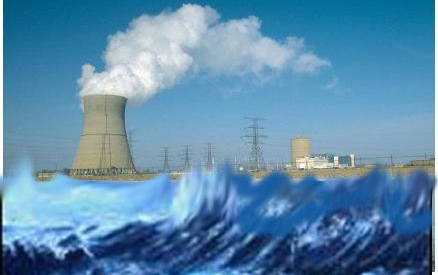 Hinkley, Sizewell and Bradwell, Stop Hinkley 10th March 2020, A meeting between representatives of groups opposing new nuclear development, the Office for Nuclear Regulation (ONR) the independent nuclear safety regulator, and the Environment Agency discussed how the ONR regulates against external hazards.
2018. According to minutes of meetings held by ONR’s group of climate
change experts, projections of sea level rise for the year 2100 contain
“considerable uncertainty” and ” small changes to UK storm systems can
alter the height of storm surges significantly”. Crucially, sea level has a
huge effect on the severity of storm surges. An increase in sea level of
one metre could mean that a storm of a severity currently expected only
once every thousand years is likely to occur once every decade. The meeting
took place in Bridgwater on 28th January 2020. Stop Hinkley was joined by
Together Against Sizewell C (TASC) and Blackwater Against New Nuclear Group
(BANNG). The groups are questioning the viability of the three coastal
sites which are all vulnerable to the impacts of flooding, storm surges and
coastal processes which will inevitably intensify in coming years.
U.S. Department of Energy’s plans could mean delay in Hanford nuclear waste clean-up
|
Nuclear waste cleanup efforts in Washington could be delayed https://triblive.com/news/world/nuclear-waste-cleanup-efforts-in-washington-could-be-delayed/, ASSOCIATED PRESS | Wednesday, March 11, 2020 RICHLAND, Wash. — The Department of Energy has announced priority plans for environmental cleanup nationwide and indicates a slower process for the decommissioned nuclear site in Washington state, a report said.
The focus at the Hanford Site will be to start treating waste at the $17 billion vitrification plant, but the report does not detail other work at the 580-square-mile site, the Tri-City Herald reported Tuesday. The report does not mention moving radioactive capsules to safer storage and cleaning up a radioactive spill under one of the buildings a mile north of Richland. “It is shocking that DOE would propose to delay projects like the cesium-strontium capsules and the 324 Building contamination, which pose such great risks to the workers and public,” said Tom Carpenter, executive director for Hanford Challenge, a watchdog and worker advocacy group. The “Environmental Management Vision 2020-2030: A Time of Transition and Transformation” report may also signal delays and decreased commitment to current plans for up to 10 years, including cleanup of contaminated groundwater flowing toward the Columbia River, the newspaper said. “Proactively addressing these hazards before they pose an imminent risk is critically important, and frankly, they can’t wait until sometime in the 2030s,” said David Reeploeg, the Tri-City Development Council vice president for federal program. A budget request for upcoming year by President Donald Trump’s administration proposes cleaning up 56 gallons of radioactive waste held in underground tanks at the site. Reeploeg added that he was pleased there is some commitment to treat tank waste. Hanford produced plutonium for nuclear weapons during the Cold War and World War II. |
|
Fukushima – Invisible Fallout documentary from CRIIRAD March 2020
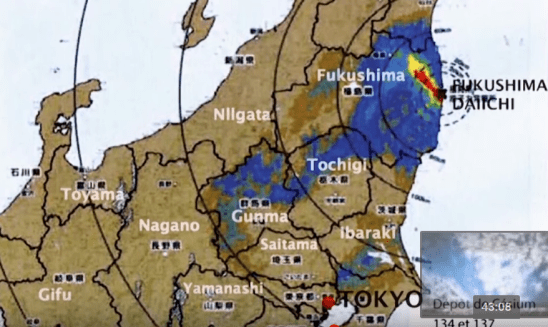
Nuclear disasters like those of Chernobyl and Fukushima cause massive releases of radioactive substances to the environment and lasting contamination of large areas. They are accompanied by lies about the severity of the contamination and the extent of the health risks. The manipulations are all the easier since the radioactivity cannot be seen. Given its aging nuclear fleet, France is particularly affected by nuclear risks.
Written and produced by the association CRIIRAD (Independent Research and Information Commission on RADioactivity) and directed by Cris Ubermann, the film “Invisibles Retombées” is based on the missions carried out by the CRIIRAD laboratory in Japan, to make this invisible radioactivity palpable and the consequences for the populations affected by the fallout. It reports on meetings with residents of contaminated areas and measurements of radiation levels carried out alongside them.
Press – Contact : bruno.chareyron@criirad.org
Renewable energy push for Fukushima
|
Nine years since nuclear disaster, Fukushima looks to hydrogen as recovery efforts chug along, https://www.straitstimes.com/asia/east-asia/nine-years-since-nuclear-disaster-fukushima-looks-to-hydrogen-as-recovery-efforts11 Mar, 20 TOKYO – Fukushima is staking its future on renewable energy, taking the lead in a country that is not just squarely wedded to coal-fired power, but also reluctant to give up nuclear energy.This despite the anniversary on Wednesday (March 11) of the devastating triple tragedy nine years ago.
One of the world’s biggest renewable-based hydrogen power facilities was opened in Fukushima last Saturday, in the town of Namie that is home to just 1,100 people, or 5 per cent of the pre-disaster population. Many municipalities in the hardest-hit coastal areas of north-east Japan remain ghost towns, despite exclusion orders being gradually lifted, as former residents do not return. The full decommissioning of the crippled Fukushima Daiichi nuclear power plant is expected to continue until 2040 at best, while local fishermen despair over the increasing likelihood that water from the plant will be released into the Pacific Ocean. Japanese experts say all radioactive particles, except harmless tritium, would have been removed in the treatment process. Still, there are concerns that the move will further hurt a region already suffering from “toxic rumours” that have reduced demand for its produce despite stringent testing standards. Much of Japan observed a minute of silence at 2.46pm on Wednesday as emotions remain raw, especially among those directly affected by the catastrophe. It was the fateful time, down to the minute, when a magnitude 9.0 earthquake triggered 14m-high monster waves that caused nuclear meltdowns in three reactors at the Fukushima Daiichi plant. It was one of the world’s worst nuclear tragedies. Latest National Police Agency figures show a death toll of 15,899 people, with 2,529 missing. Another 3,739 people died owing to disaster-related causes, the Reconstruction Agency said. As many as 470,000 people fled their homes at the peak of the nuclear disaster, but more than 47,000 still have not returned. While many official memorial ceremonies were either scaled down or cancelled because of the coronavirus outbreak, Prime Minister Shinzo Abe vowed that the government will continue providing “seamless support to rebuild the lives of victims”. This involves not just physical infrastructure – including homes and retail businesses – to improve the living environment, but also support for new industries like that of renewables. The initial plan was to abolish the Reconstruction Agency in March 2021. But after 32 trillion yen (S$424.5 billion) was spent on rebuilding, the government decided to keep the organisation for another 10 years. Meanwhile, the Japanese government and Fukushima Daiichi operator Tokyo Electric Power Company (Tepco) continue to face civil lawsuits from Fukushima evacuees, although the sole criminal case arising from the disaster ended in a “not guilty” verdict last year. There are about 30 such civil lawsuits throughout the country. In the latest decision in favour of the plaintiffs, the Sapporo District Court on Tuesday ordered the government and Tepco to pay 52.9 million yen in damages to 89 people who evacuated to Hokkaido. Another judgment, by the Sendai High Court, is expected on Thursday. Still, Mr Abe has branded the upcoming Olympic Games as the “Reconstruction Olympics” to show the world how the region has recovered. The Olympic torch relay, which will pass through all 47 of Japan’s prefectures, is set to flag off on March 26 from the J-Village soccer training facility. It is just 20km from the nuclear plant and viewed as one of Fukushima’s key symbols of reconstruction. But environment group Greenpeace Japan had flagged in a report on Monday that typhoons like Hagibis, which battered the region last year, had created new radiation hot spots in areas that were previously cleared by the authorities. “It is vital to constantly monitor radiation levels and carry out decontamination work,” said Greenpeace representative Kazue Suzuki. Its survey found 40 hot spots with radiation levels more than four times the government’s decontamination standard of 0.23 microsievert per hour, including one with 71 microsieverts per hour near the J-Village complex. Long-term Fukushima residents, including Mr Nobuyoshi Ito, who lives in Iitate Village, have yielded similar results in grassroots surveys. “Perhaps, for runners passing through, the exposure is not very high, but the situation is still not ideal for those who have returned and are exposed to the radiation 24 hours a day, 365 days a year,” the 76-year-old said. “No matter how much money has been put into this, it is evident that full reconstruction or recovery back to how lives were before the disaster is not possible,” Mr Ito added. “That is the reality of a nuclear disaster.” |
|
Fukushima Anniversary SPECIAL: Voices From Japan 2020 – Tokyo Shimbun Reporter Takeshi Yamakawa
 Signs outside the Fukushima Exclusion Zone. In 2019, total of 26 English caution signs were placed in 12 places in exclusion zones to prevent foreigners from trespassing in radioactive areas. YouTubers and the Netflix show “Dark Tourism” have trespassed in high radiation areas and illegally entered shops and homes, prompting the local authorities to post signage in English.
(Photo courtesy of U. G. Kaneko)
March 6, 2020
Nuclear Hotseat Voices from Japan: #Fukushima 9th Anniversary SPECIAL. Interview with Takeshi Yamakawa from the Tokyo Shimbun #Nuclear Power Reporting Team; first-hand impressions of the Exclusion Zone from Voices from Japan investigative reporter Yuji Kaneko; and commentary by co-producer Beverly Findlay-Kaneko. Produced and hosted by Libbe HaLevy.
Contaminated water at nuclear plant still an issue ahead of Tokyo Olympics
March 10, 2020
Work to deal with contaminated water at Japan’s Fukushima nuclear power plant continues as the Olympic Games approach.
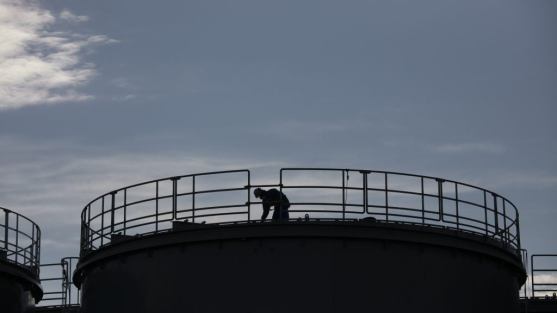
Inside a giant decontamination facility at the destroyed plant, workers in hazmat suits monitor radioactive water pumped from three damaged reactors.
The decontamination process is a key element of a contentious debate over what should be done with the nearly 1.2 million tons of still-radioactive water being closely watched by governments and organisations around the world ahead of this summer’s Tokyo Olympics.
The plant’s operator, Tokyo Electric Power Company, or Tepco, says it needs to free up space as work to decommission the damaged reactors approaches a critical phase.
It is widely expected that Tepco will gradually release the water into the nearby ocean following a government decision allowing it to do so.
Radioactivity on the move 2020: Recontamination and weather-related effects in Fukushima
9 March 2020
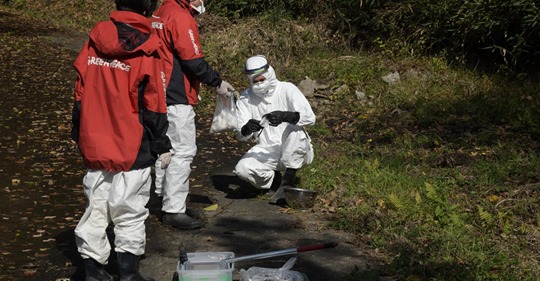
Tokyo, Japan – Greenpeace Japan’s latest extensive radiation survey
has found evidence of recontamination caused by 2019’s Typhoon 19 (Hagibis) and Typhoon 21 (Bualoi), which released radioactive caesium from the forested mountains of Fukushima Prefecture.
The survey, which was conducted over three weeks in October and November of 2019, observed concentrated radiation levels throughout Fukushima Prefecture. These localised areas were where radioactivity was observed at higher levels than in previous years, as well as a reduction in levels in some areas, and recontamination elsewhere.
The survey identified high-level hotspots throughout Fukushima Prefecture, including in Fukushima City. This ongoing and complex radiological emergency in parts of Fukushima Prefecture runs directly counter to the narrative of the Japanese government which continues to push its propaganda of normalization in Fukushima and the effectiveness of its massive decontamination program.
Typhoons no. 19 & 21 deposited large volumes of rain across Japan, including in Fukushima Prefecture. In recent years, scientists have been reporting the effect of heavy rainfall leading to increased migration of radioactivity from mountainous forests through the river systems.
“The results of our 2019 radiation survey demonstrate the complex and persistent nature of radionuclide mobilization and recontamination in areas of Fukushima Prefecture. The mountainous forest regions of Fukushima prefecture, which have never been decontaminated, will continue to be long-term sources of recontamination. The findings from our recent radiation survey definitively disprove the myth of a ‘return to normal’ in parts of Fukushima.” said Kazue Suzuki, Energy Campaigner of Greenpeace Japan.
The main findings of the Greenpeace Japan investigation include:
- Hotspots measured in all areas surveyed; including Okuma, Naraha (J-Village), as well in Fukushima City.
- Significant variations in radiation levels from previous years in certain zones that cannot be explained by radioactive decay.
- Likely remobilization of radioactivity in the soil and weather-related effects resulting from heavy rainfall was also identified in the reopened area of Iitate, with significant changes in radiation levels comparing across the five year period for which we have data.
- Along the Takase river in the newly reopened area of Namie, and where the government claims it is safe to live, 99% of radiation levels averaged 0.8 μSv/h with a maximum of 1.7 μSv/h, with 99% exceeded the government’s long-term decontamination target of 0.23 μSv/h measured at 1 meter and were twenty (20) times higher than pre-2011 levels.
- In a period of four hours, the survey team identified forty-six (46) hot spots in the around Fukushima City central station, eleven of which equaled or exceeded the Japanese government decontamination long term target of 0.23 μSv/h measured at 1 meter; including observed levels of radiation that 137 times higher than the background radiation levels measured in the Fukushima environment prior to the 2011 nuclear disaster.
- In an area close to a former school and kindergarten in the reopened area of Namie, annual dose rates would be between 10-20 mSv based on the Japanese government methodology and between 17-33 mSv based on sustained exposure over a full year; which are between 10 and 33 times above the international recommended maximum exposure for the public.
- Near the new town hall in the newly reopened area of Okuma, and within a few hundred meters of the planned Olympic torch route, radiation hotspots were measured to be of 1.5 µSv/h at 1 meter and 2.5 µSv/h at 10cm (62 times above the background levels of 0.04 µSv/h before the nuclear accident in March 2011).
- The evidence from earlier typhoons and resulting data strongly suggest that there was a substantial increase in downstream contamination from October 2019. Greenpeace intends to return later this year to further investigate and substantiate the hypothesis of major weathering effects in Fukushima.
“The radiation hotspots we found in public areas along the pavements and streets of central Fukushima City, including tens of meters from the entrance to the Shinkansen train line to Tokyo, highlight the ongoing scale of the nuclear disaster in 2011. The hotspots we found are at a level that they would require a special license to be transported and in the category of Dangerous Goods. The government is using the Olympics as a platform to communicate the myth that everything has returned to normal in Fukushima. They falsely claim that radiation has either been decontaminated or is under control. Our radiation survey clearly shows that the government propaganda is not true.” said Shaun Burnie, Senior Nuclear Specialist of Greenpeace Germany.
Mizue Kanno, a resident of Namie who cooperated on the Greenpeace radiation survey said, “I hope the world knows the real situation in Fukushima. Radioactivity is washing down from the mountains due to heavy rain and flowing into the decontaminated areas. The radiation levels found around my house are higher than ever before. Once a nuclear accident happens, it looks like this, and soon we are going to have the Olympics and pretend that everything is okay. It’s not. ”
ENDS
Notes:
Full report in English, here
Photos and videos, here
https://www.greenpeace.org/international/press-release/29250/radioactivity-on-the-move-2020/
The price of staying
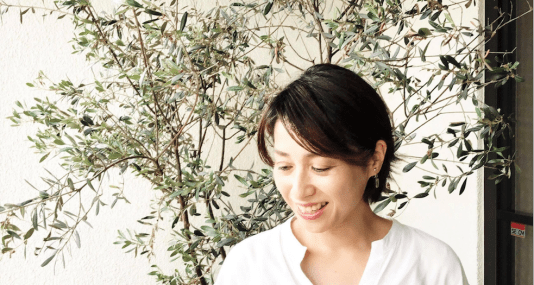
Evacuation was not mandatory for these now suffering Fukushima victims
By Akemi Shima
This is a statement of opinion that I, a resident of the city of Date, Fukushima Prefecture, presented to the Tokyo Regional Court as part of an on-going lawsuit.
“We had the desire to raise our children in an environment close to nature and enriching. That’s why we moved from Fukushima City to buy land in the town of Date, where we currently live, to build a house. Loan repayments were heavy but, we lived simply and we were happy.
“Eight years after the construction of our house, on March 11, 2011 the accident of the power plant occurred, and our family life was turned upside down. My husband and I were 42 years old, my son was in elementary school 4th grade (12 years old) and my daughter was in elementary school 3rd grade (10 years old).
“At that time, I had no knowledge about nuclear or radioactive substances. If I had had some knowledge in this area, by running away from it we probably could have avoided being irradiated. I am burdened by this regret. Without any financial leeway, with my sick children and my parents who are here, I could not resolve myself to get away from Date.
“From the 11th of March all life lines were cut and I had to go to the water stations where I took the children. To find food we had to walk outside sometimes soaked in the rain. After several days as we still had no water, we had to go to the town hall to use the toilet, where the water was not cut. It was then that I saw a group of people dressed in white protective suits entering the town hall. We thought that they were probably coming to help the victims of the tsunami. But now, I understand that the radioactive pollution was such that protections were necessary and we, without suspecting anything, were exposed.
“It was the time for the graduation ceremonies at the elementary school and we went there on foot. I think the information we were given was false and because of that we were irradiated. At the time I was convinced that if we were really in any danger, the state would warn us. I later learned that the doses of radioactivity in the air after the accident were 27 to 32 μSv (micro sieverts) per hour. There was no instruction about any restriction to go outdoors. And that is extremely serious.
“In June 2011, I went to the funeral of my husband’s grandmother. I took my children with me. On the way we noticed that the radiation level was very high and that inside the car the dosimeter showed in some places 1.5 micro-sievert per hour. The officials of that area had asked the nearby residents to not cause problems even if the radioactivity was high. From what I heard, the reconstruction vehicles had to be able to continue to use that road. Likewise, the Shinkansen bullet train and the Tohoku highway were not to be closed for these reasons. Despite a level that exceeded the allowable dose limits, instead of being alerted to the dangers, we were assured that we were safe.
“The risk of this exposure was not communicated to us. In June 2011 my son had so many heavy nosebleeds that his sheets were all red. The children with the same symptoms were so numerous that we received a notice containing recommendations through the school’s “health letter”. During a medical examination at the school, my son was found to have a heart abnormality and had to be monitored by a holter. My son, who was 12 at the time of the accident, was also suffering from atopic dermatitis. During the school spring break he had to be hospitalized after his symptoms worsened. Today we still cannot identify the symptoms that cause him to suffer.
“One year after the accident, my daughter complained of pain in her right leg. In the hospital, an extra-osseous osteoma was diagnosed and she had to undergo bone excision the following year. In her first year of junior high school in the winter term, she could not get up in the morning. She had orthostatic dysfunction. In agreement with her we decided that she would go to school three times a week in a system with flexible hours.
“My husband’s favorite hobby was fishing, but since the nuclear accident, it’s now out of question to go to the sea or to the river.
“Before the accident, we were growing flowers in our garden and we also had a vegetable garden. In the summer, we had family barbecues and we would put up a tent so the kids could sleep outside. Now it’s absolutely impossible.
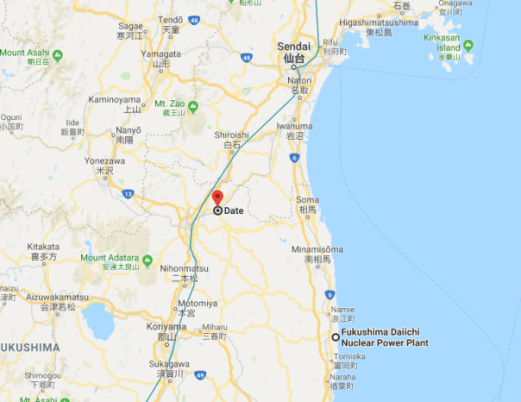 Date is about 60 kilometers from the ruined Fukushima Daiichi nuclear reactors.
“In this highly contaminated environment today, cell DNA would be severely damaged. In addition, the effects of exposure we have already experienced are indelible even if we move now. Whenever I think that children are particularly vulnerable to radiation, my heart is torn apart. As a parent, as an adult, it is heartbreaking and unbearable.
“I am also concerned about the current situation of the Fukushima Daiichi nuclear power plant. My daily routine is to watch out for natural disasters such as earthquakes and to check the condition of the Fukushima Daiichi nuclear power plant. Because today I will not hesitate to evacuate. I changed my job so I could get to my kids quickly if necessary. I had to give up a full time job and it is financially difficult, but the priority is to be able to leave quickly at any time. After verifying all sorts of information, I realized that the government’s announcements were different from reality.
“Living in a radioactive environment requires you to be vigilant tirelessly, whether for shopping, eating, or drinking water, and evaluate the situation yourself to make choices. We had to make up our minds to accept an abnormal lifestyle so that we could continue to live on a daily basis.
“Whatever I do, all pleasure has disappeared from my life. I discovered that there were some hotspots of more than 10 μSv per hour near my home on the way to my children’s school. I reported it to the town hall, but they did not do anything. The reason given is that there is no temporary storage to store it. I had to remove the contaminated soil myself and I stored it in my garden. The city of Date decided on its own decontamination policy and also introduced a standard of 5mSv per year at the end of 2011.
“In my case I wanted to reduce the radioactive pollution as soon as possible and I decontaminated my garden myself. The city encouraged people to decontaminate on their own. I did it too. And that represented 144 bags. The following year I did again. The radioactive debris bags resulting from the decontamination until March 2014 remained in my garden for two years, and were then taken to the temporary storage area.
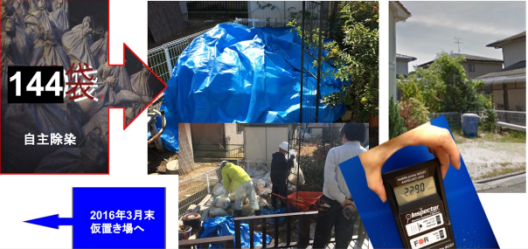 Akemi Shima had to decontaminate her own radioactive garden.
“But since then, the other decontamination bags have not been accepted and are still in my garden. So we do not want to go there anymore. The contamination of our carport amounted to 520 000 Bq (becquerels) 5 years ago, with 5 μSv / h, but it did not fit the criteria required for cleaning. Decontamination only includes the ground around the home, but the roof and the gutters are not supported. As a result, we can not leave our Velux windows open.
“Claiming to be concerned about the health of the inhabitants, the town of Date provided all residents with dosimeters. We were then invited to undergo examinations, during which our data was collected. Without the authorization of the residents, this data has been entrusted to external researchers who have written reports. These reports have been prepared on the basis of personal information obtained illegally, and furthermore falsification of the data is suspected.
“Based on inaccurate data the report concluded that even at doses of 0.6 to 1 μSv / h per hour in the air, the individual dose received would be less than 1 mSv (millisievert) per year and therefore it was not necessary to decontaminate. This is an underestimation of exposure, and clearly a violation of human rights against the population. This case is still ongoing.
“In this same region, leukaemias and rare cancers of the bile ducts are appearing. I cannot help thinking that before the accident it did not exist.
“Even today, while the state of nuclear emergency is still official, this abnormal situation has become our daily life. I fear that the “reconstruction” advocated by the state, violates the fundamental rights of residents and that this unacceptable life is now considered normal. Our lives are at a standstill.
“This suffering will continue. My deepest wish is that through this lawsuit, the responsibility of the State and Tepco that caused the accident be recognized.”
The half lives of the abandoned

Daily life in Fukushima’s radioactive environment
By Cindy Folkers
“Whatever I do, all pleasure has disappeared from my life…we are living with a narrow range of activities.”
Akemi Shima was a resident of Date (duh-tay) City when the reactors at Fukushima exploded, spewing radioactive particles into the air, across the land, and into the waters. (She tells her story in her own words this week as well. See here.)
Her family had moved there years earlier to live closer to nature. It was supposed to be healthy. But for residents of Date City, still blanketed nine years later by radioactive contamination, the struggle for protection of health continues amid accusations of scientific error, betrayal and abandonment.
Shima, now 50, has been living through these accusations and her children’s health issues, while trying to keep her family safe in a contaminated land that has caused fractures within her community. Her experience is not only shared by other victims of Fukushima, but is a cautionary tale for any communities that have nuclear reactors in their midst. We share pieces of her story here for the first time in English.
“The victims have been unable to talk about the damage. … I don’t want to cry. I don’t want to be dismissed… Let me say that something is wrong.”
Instead of establishing mandatory evacuation zones based on contamination level, the government of Japan limited mandatory evacuation to 20 km from the destroyed reactors. Date City had highly contaminated areas but was 60 km away. Therefore, the residents were left to their fate as the City, under direction from the national government, had decided to recommend specific “spots” for evacuation. “Spots” actually meant individual houses and the recommendation to evacuate was based on a number of inconsistent and confusing criteria. This caused division among residents because a “recommended spot” (house) was eligible for evacuation aid, while a house that was often next door received none.
 Evacuation map. Pink area denotes “difficult to return” zones, dots where evacuation orders have been lifted.
While only areas exceeding 20 mSv/year were under recommended evacuation and supposedly only for households with children, in reality exceptions were made. Shima’s family did not evacuate at first because they were not ordered to and she was told her house was safe. It was only later she realized that the workers who came to her town hall wearing white protective suits – while she and her children wore regular clothes and took no precautions – were shielding themselves from radioactivity.
Shima ultimately decided she couldn’t voluntarily relocate because of the medical and familial bonds she had in the community. For those who stayed – like Shima – little warning was given about the need to, or how to, protect against radioactivity. Even after measuring levels that were higher than normal, government officials told residents they were safe and they shouldn’t make trouble.
“…from fall to winter, one week out of every month, all the skin on [my son’s] body turned reddish black; he couldn’t move, and had to stay in bed. He repeatedly experienced having his skin peel off, heal, [and] then peel off again. That continued for approximately 3 years [after the catastrophe began]. Sometimes, he ended up being hospitalized.”
Shima’s son and daughter had eczema, a common skin condition for children in Japan. It worsened considerably soon after the catastrophe. Her son suffered symptoms associated with radiation exposure, including heavy nosebleeds. Nosebleeds were so widespread among Date City’s children that recommendations for treating them were featured in a school health newsletter.
Even though evacuation recommendations were lifted about one year later for certain areas in Date City, many people were hesitant to return to the contaminated zone. The issue of resettlement had not been resolved and studies of human health remained controversial.
Beginning in August 2012, residents in Date City were issued badges to measure their radiation doses and invited to undergo examinations. They were told this was because the town wanted to monitor their health. However, outside researchers published studies using residents’ badge data without their knowledge or permission – a violation of ethical guidelines for human subject research. These studies became mired in distrust, bad science and charges of scientific misconduct.
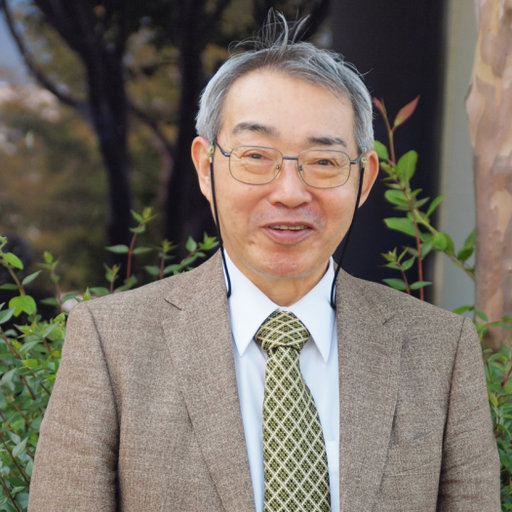 Shin-ichi Kurokawa, professor emeritus of The High Energy Accelerator Research Organization.
Akemi Shima participated in the badge study, and noticed some scientifically questionable practices and assumptions that were later detailed in a paper she co-authored with Shin-ichi Kurokawa, Professor Emeritus of The High Energy Accelerator Research Organization.
In 2019, the University of Tokyo and Fukushima Medical University cleared their researchers — the authors of the controversial badge data studies — of scientific misconduct, a charge requiring intent. However, scientific inconsistencies, mathematical miscalculations and concerns over invalid conclusions remain.
“During my [first] three years in Fukushima, I stopped accepting certain words… ‘Kizuna’, ‘Reconstruction’, and ‘Reputational damage’. In the process of reconstruction and prevention of reputational damage, even the truth has become invisible, and what has happened is just as if it had never happened.”
Kizuna or “ties that bind” is a phrase mobilized by the Japanese government from the earliest days of the disaster to claim that inquiries about radiation harm will hurt the community and therefore people should remain quiet, no matter the suffering.
To rebuild life in Date City, the prefectural government, at the urging of the national government and the International Commission on Radiological Protection (ICRP), attempted to enshrine the reckless notion of “rehabilitation” – the idea that one can live with radioactive contamination and that health and recovery responsibilities reside with individuals and communities, not industry or government. Adopting a “rehabilitation/recovery” regime mandates that residents’ concerns about health impacts and continuing exposure are downplayed or brushed aside altogether, even by institutions that should be trustworthy.
A year after the nuclear catastrophe began, Shima’s daughter, already under periodic heart monitoring for an unrelated childhood condition which had now passed, had a benign bone tumor removed from her leg. Her daughter had trouble getting up in the morning and was diagnosed with a condition related to chronic fatigue syndrome. At this time, Shima also had her children examined by Fukushima Prefecture as part of the Fukushima Health Management Survey established by Fukushima Medical University to track health after the catastrophe began. When the prefecture examined Shima’s 11-year old daughter she was told there were no abnormalities. However, after a second examination, doctors from a different clinic found two thyroid cysts. Her 13-year old son had one cyst detected by the prefecture, but upon the second screening, also at a different facility, two were found.
Other families tell of inconsistent test results between Fukushima Prefecture exams and those conducted at other institutions. Shima relates how examinations varied at the different institutions with the prefecture examination taking a few seconds to a few minutes while the second clinic took more than 10 minutes. Such a short time will miss lesions that could lead to cancers, according to a doctor at the clinic who performed the reexaminations. The prefectural clinics authorized by FMU to conduct exams refuse to hand over personal medical data to the patient without a cumbersome request system and payment for materials reproduction, further stoking mistrust among exposed inhabitants.
Additionally, prefecture experts claim that thyroid cancers after Chernobyl didn’t appear until four or five years after exposure. They therefore conclude the circumstances will be the same for Fukushima, despite what appear to be increases in metastatic thyroid cancers. Shima has noticed the appearance of other rare types of cancers as well that are not receiving the attention that thyroid cancer has.
“Responsibility for the nuclear accident is neglected, and everything else is “self-responsibility”. “I know well…[t]he limits of decontamination.”
Akemi Shima and other residents feel abandoned; first because they were told it was safe to stay; and now because they are largely left with responsibility for cleaning up TEPCO’s radioactive legacy. If Date City residents want levels lower than 5 mSv/year, they have to do the cleanup themselves; despite the ICRP recommended 1 mSv per year level; and despite levels below 4 mSv being associated with increases in childhood cancers and impairment of neural development during pregnancy.
“Living in a radioactive environment requires you to be vigilant tirelessly, whether for shopping, eating, or drinking water, and evaluate the situation yourself to make choices. We had to make up our minds to accept an abnormal lifestyle so that we could continue to live our daily lives.”
Shima points out that even if short-lived radiocesium has completely decayed, the level of radioactivity is still 10 times what it was before the catastrophe. It will likely remain so for generations, as demonstrated by the radiological contamination from Chernobyl. Shima relates how even higher doses are dismissed by officials. They claim that those areas are passed through, not lived in. But these officials do not account for children playing in those areas.
“I believe that we were tossed in all directions and set against one another, so that the victims themselves would be unable to discuss the harm.” “Our lives are at a standstill. This suffering will continue.”
International radiation committees and national regulatory bodies are establishing recommendations that will make living with increased radiation exposure from nuclear disasters seem okay. In Japan, staying silent is encouraged. In the wake of the ongoing Fukushima disaster, the government of Japan has raised the radiation exposure limit from the ICRP-recommended 1 mSv per year to 20mSv per year. Japan has also been cutting payments to Fukushima refugees in a bid to force them to resettle the contaminated areas they initially left; and ICRP has hosted dialogues across the country (one was held in Date City) encouraging residents to live with radiation rather than leave, claiming such action is “resilient” and community-minded (kizuna).
International radiation committees are claiming health examinations of children cause stress and should only be conducted for thyroid exposures at certain doses. These doses are higher than those associated with disease. Despite claiming that living in a radioactive environment is extremely difficult, ICRP still encourages it.
In the US, the Environmental Protection Agency has released guidance allowing much larger environmental doses of man-made radiation with very little assurance when the exposures will cease. Women and children are not spared.
Living with radioactive contamination divides communities into those that want to raise awareness of the danger radioactivity poses, and those who do not want to discuss it for fear of social discrimination and ostracization. Akemi Shima’s lived experience, and her public testimonies about it, should serve as a warning to anyone living with a nuclear reactor in their midst.
The author would like to thank Norma Field, professor emerita, University of Chicago, for help with content, translation and communication.
A message from Mr. Sumio Konno, a former nuclear engineer in Japan.
[ Voices from Japan: 9 years after the Fukushima nuclear disaster ] 2020 March video project by Manhattan Project for a Nuclear-Free World English subtitle by John Baldwin, Karen Rogers, Mari Inoue, Rachel Clark, Stephan Ready, Tarak Kauff, Tony Sahara, Yoko Chase
Soil from decontamination work kept in communities

March 8, 2020
Nine years after the Fukushima Daiichi nuclear accident, more than half of the waste created by decontamination work is still kept near residents’ homes.
About 14 million cubic meters of soil and vegetation has been collected in clean-up operations in areas affected by the nuclear accident in Fukushima Prefecture, except for heavily contaminated off-limit areas.
The environment ministry plans to transfer all such waste to intermediate storage facilities near the crippled nuclear power plant by March 2022.
As of the end of February, only about 6.3 million cubic meters, or around 45 percent of the total waste, had been transferred to the facilities.
The rest was stored at school compounds, parks, and temporary storage sites.
Environment Minister Shinjiro Koizumi told reporters on Friday that the waste needs to be removed from the locations as quickly as possible so that local residents can feel secure.
What ‘Fukushima 50’ can teach us about crises
 A scene from “Fukushima 50” the recent film adaptation of “On the Brink : The Inside Story of Fukushima Daiichi.”
March 7, 2020
After the March 11, 2011, earthquake and tsunami crippled the Fukushima No. 1 nuclear power plant, much of the foreign press focused on what it dubbed the “Fukushima 50” — a small band of workers whose life-or-death actions prevented a catastrophic meltdown.
Author Ryusho Kadota interviewed many of these frontline workers (which he found to number 69, not 50). He also spoke with Fukushima No. 1 plant manager Masao Yoshida, who headed the emergency response team, and former Prime Minister Naoto Kan, who took an active — and controversial — role in the government’s reaction to the disaster.
Based on his reporting, Kadota wrote the 2012 nonfiction novel “Shi no Fuchi o Mita Otoko,” published in translation as “On the Brink: The Inside Story of Fukushima Daiichi.” Filled with drama, such as the desperate struggle of workers to open plant vents to avoid radiation-spewing explosions, “On the Brink” has since become a feature film, “Fukushima 50,” that stars Ken Watanabe as Yoshida.
In a recent interview at the Tokyo headquarters of publisher Kadokawa, Kadota says he told the filmmakers to “adapt (the book) freely.”
“In fact, when I first read the script, I told them that there wasn’t enough drama in it,” Kadota says. “I wanted them to add more.”
The film departs from the book most notably in the matter of names: The only character with the name of a real person is Watanabe’s Yoshida.
“The book (in Japanese) is quite long — 400-some pages — and the movie is only two hours, so they made composite characters out of two or three actual people,” Kadota explains. “But Yoshida, I thought, should be Yoshida. And the film as a whole is close to the truth.”
 Inside scoop: Following the 3/11 triple disaster, author Ryusho Kadota interviewed many of the frontline workers at the Fukushima No. 1 nuclear power plant, whose life-or-death actions prevented an even greater catastrophe.
And the truth, as the film graphically illustrates, is that Japan came terrifyingly close to nuclear apocalypse, narrowly averted by the heroic efforts of frontline workers, as well as Yoshida’s decision to ignore orders from officials at Tokyo Electric Power Co., the plant’s owner, to stop cooling the reactors with seawater. They were concerned about damage to the reactors, but with nothing else to adequately cool them, Yoshida knew it was either seawater — or a Chernobyl-like disaster.
Domestic media, Kadota says, were less aggressive than their foreign counterparts in ferreting out the facts.
“They didn’t report on what was actually happening,” he says.
Instead, he says, domestic coverage became divided into two camps, with one bashing nuclear power and other supporting it. The bashers, he says, “didn’t know what was going on inside (the plant) — and that motivated me. I knew I had to find out. I’m not in one camp or the other. I believe our mission as journalists is to report the truth, wherever it leads.”
To this end, Kadota spent 16 months interviewing more than 90 subjects. His conclusion: “Japan is what it is today because they were successful in opening the vents in the No. 1 plant. If they hadn’t succeeded, we would be doing this interview in Osaka. You wouldn’t be able to live in eastern Japan — the middle third of the country.”
The reason for that success, Kadota believes, is that workers were willing to risk their lives to save the plant — and their communities.
Some similarities are apparent with the situation in Japan at present, as doctors, nurses and other medical workers are battling the novel coronavirus. The government has come under criticism for its response to the crisis, as had Kan and Tepco in the wake of the disaster at the Fukushima nuclear plant.
“I have to write a book about this crisis as well,” Kadota says. “The government’s response has been terrible, just as it was back then.”
He refers to the passengers aboard the Diamond Princess cruise ship, who became infected in large numbers after government health officials decided to enforce an onboard quarantine.
“I feel sorry for them,” Kadota says. “The way they were treated was problematic to say the least.”
He mentions infectious disease specialist Kentaro Iwata, whose video about his inspection of conditions aboard the Diamond Princess went viral after he posted it online on Feb. 18 (he has since deleted the upload).
“(Iwata) said he wasn’t afraid when he dealt with Ebola in Africa because protective measures there were perfect, but he was deathly afraid aboard the Diamond Princess because it was so chaotic,” Kadota says. “I can totally relate to that.”
But Kadota is most angry, he says, at what he describes as “Japan’s lack of a national security mind-set.”
“Yoshida knew he had to cool the reactors with seawater to protect the lives of the Japanese people and avoid the destruction of eastern Japan,” Kadota says. “But the Prime Minister’s Office didn’t see it that way.” A Tepco adviser to Kan told Yoshida to stop injecting seawater into the reactor, since the prime minister was concerned that seawater might cause the melted fuel rods to resume criticality. Kan later denied interfering with Yoshida’s decision to cool the reactors with seawater.
“We have much the same situation now,” Kadota says. “We have (Prime Minsiter Shinzo) Abe, not someone like Masao Yoshida, as prime minister.
“The prime minister’s most important duty is to protect the citizens of the nation,” Kadota says. “That’s first and foremost. But some people forget that.”
One who does have that sense, Kadota notes, is Masahisa Sato, an outspoken member of the Upper House and a former state minister for foreign affairs.
“He’s been saying from the start of this that Japan should prohibit entry to anyone from China,” Kadota says. “And I’ve been saying it myself.”
Kadota also says Japan needs an equivalent to the Centers for Disease Control and Prevention, the U.S. government agency in charge of public health.
“They have a staff of 14,000 with a national mission to keep infections from spreading,” he says. “Japan has nothing like it.”
What it does have now, he notes, is a shortage of face masks and other supplies for protection against the coronavirus.
“Yesterday I retweeted a post from a friend who said someone had sneezed on his neck in a crowded train,” Kadota says. “What can you do? You can’t get rid of the crowded trains and you can’t find masks anywhere in the city. So people are on crowded trains, morning after morning.
“Doesn’t all this make you angry?” he asks. I tell him it does.
However, the big takeaway from “On the Brink” is not that Japanese officialdom has an enraging habit of bumbling in major disasters; it’s that heroes do exist here and can make a huge, life-saving difference, especially if officialdom supports them rather than stymies them. Kadota has yet to find many heroes in the current crisis, but he’s only just begun.
1 This Month
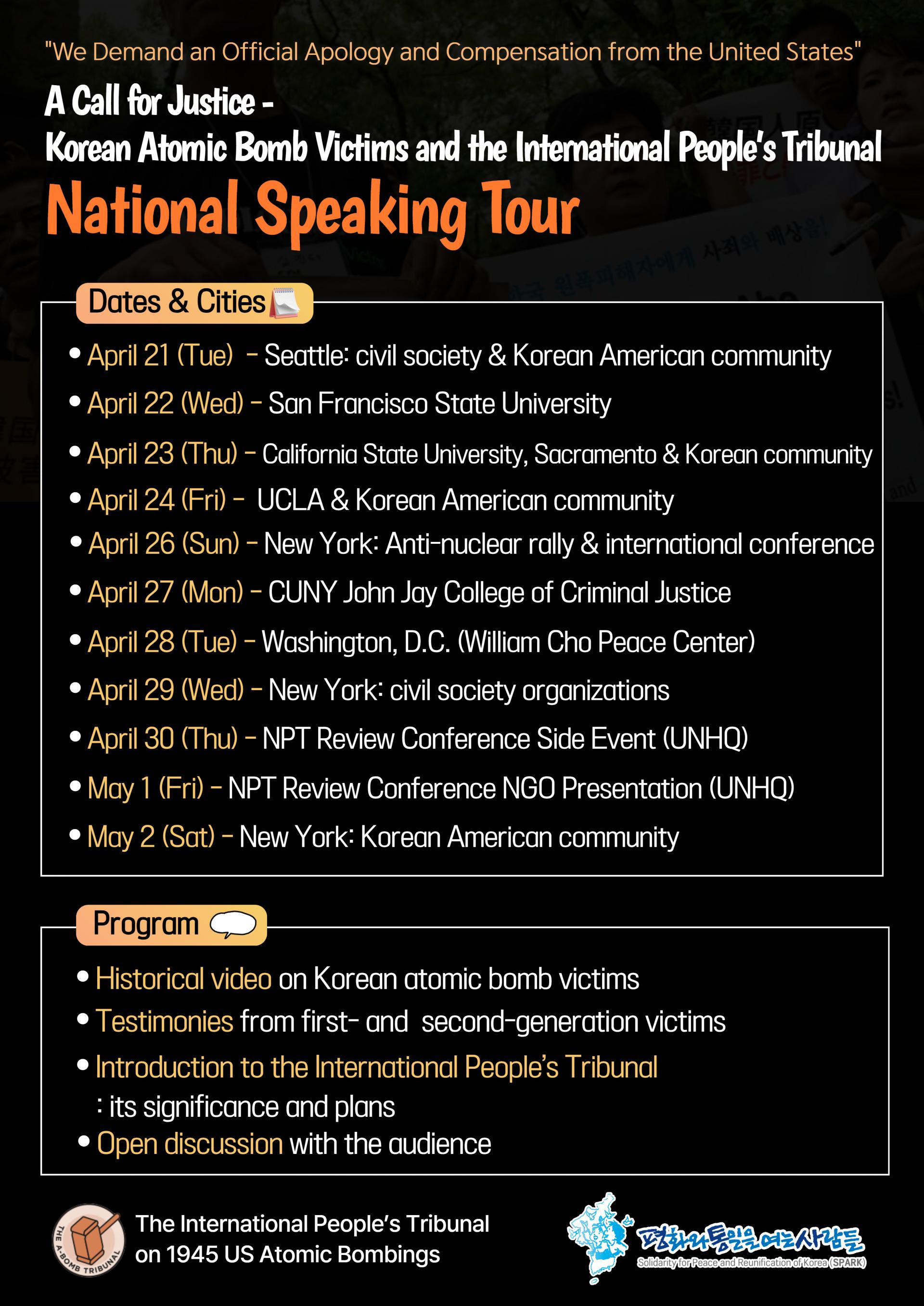

Pine Ridge Uranium is the real threat, not Tehran- Tell Burgum: Stop the Extraction.
Chernobyl: The Lost Tapes – A good documentary on Chernobyl on SBS available On Demand for the next 3 weeks– https://www.sbs.com.au/ondemand/tv-program/chernobyl-the-lost-tapes/2352741955560
To see nuclear-related stories in greater depth and intensity – go to https://nuclearinformation.wordpress.com
-
Archives
- April 2026 (288)
- March 2026 (251)
- February 2026 (268)
- January 2026 (308)
- December 2025 (358)
- November 2025 (359)
- October 2025 (376)
- September 2025 (257)
- August 2025 (319)
- July 2025 (230)
- June 2025 (348)
- May 2025 (261)
-
Categories
- 1
- 1 NUCLEAR ISSUES
- business and costs
- climate change
- culture and arts
- ENERGY
- environment
- health
- history
- indigenous issues
- Legal
- marketing of nuclear
- media
- opposition to nuclear
- PERSONAL STORIES
- politics
- politics international
- Religion and ethics
- safety
- secrets,lies and civil liberties
- spinbuster
- technology
- Uranium
- wastes
- weapons and war
- Women
- 2 WORLD
- ACTION
- AFRICA
- Atrocities
- AUSTRALIA
- Christina's notes
- Christina's themes
- culture and arts
- Events
- Fuk 2022
- Fuk 2023
- Fukushima 2017
- Fukushima 2018
- fukushima 2019
- Fukushima 2020
- Fukushima 2021
- general
- global warming
- Humour (God we need it)
- Nuclear
- RARE EARTHS
- Reference
- resources – print
- Resources -audiovicual
- Weekly Newsletter
- World
- World Nuclear
- YouTube
-
RSS
Entries RSS
Comments RSS
 nuclear-news