Tracing Individual Perceptions of Media Credibility in Post-3.11 Japan

Abstract
The 3.11 disaster revealed many shortcomings in Japan’s mass media organisations and government, the most prominent arguably being the poor handling of the disaster by central government and TEPCO, including miscommunication and delays in releasing accurate data on the dispersal of radioactive materials. The lack of transparency in mass media coverage of the nuclear meltdown and levels of radiation resulted in growing distrust among the public, who turned to online sources and social media to confirm or challenge information provided by the mass media.
Based on in-depth interviews with 38 Japanese individuals, this study explores individual perceptions of media credibility in a disaster context and in the present, elaborating how changes in trust in media intersects with the changes and dynamics in media use and how the 3.11 disaster continues to influence media use and perceptions of credibility today. The main findings of the study suggest that in the wake of the unprecedented national disaster, Japanese media users moved from using traditional mass media as their sole source of news to a personalised, inter-media environment which integrates both online and traditional modes of communication without replacing traditional media players. This further facilitated the practice of seeking and evaluating information and media credibility through new media forms of connectivity such as social media platforms and news websites.
Keywords: 3.11 disaster, communication gap, inter-media environment, mass media, media credibility, social media
Information needs and communication gaps
The 3.11 disaster in Japan is the epitome of an unforeseen, catastrophic and intrinsically disruptive event. On 11 March 2011, the northeast coast of Japan was struck by a powerful earthquake, which caused a chain-reaction of events: a devastating tsunami, continuous aftershocks and tremors, and damage to nuclear reactors in the Fukushima Daiichi Nuclear Plant, resulting in nuclear meltdown and considerable dispersion of radioactive materials into the environment. In all phases of the disaster, Japan’s media played a crucial role in how people communicated and coped with a complex catastrophe. Nine years after 3.11, social recovery, reconstruction in disaster-stricken areas and delays in decommissioning the Fukushima Daiichi Nuclear Plant, which could take decades, remain ongoing concerns for Japanese public.
Trust is a critical component of disaster communication, and it is often tested in situations such as natural disaster and crisis (Mehta, Bruns, & Newton, 2017), where citizens’ demand for credible information increases. The exposure to inconsistent news and media reports can significantly alter people’s perceptions of media credibility (Gaziano & McGrath, 1987). Furthermore, in a disaster situation, the fragility of media is exposed (Endo, 2013) and people seek different ways to find the information they need and look for trusted media sources to reduce uncertainty and ambiguity (Lachlan et al., 2014a). During crises and natural disasters, many people rely on Twitter for its ease of access, timely updates and real-time information, and ability to identify users’ specific needs and concerns. However, despite social media’s critical role in communicating risk and disaster response, their fast and immediate dissemination comes with the risk of incomplete, misleading or inaccurate information. Another reason for questioning social media credibility is the shifting role of “gatekeepers” from producers to consumers (Westerman et al., 2014), which is why many people seek information from official and checked sources (Lin et al., 2016).
The 3.11 disaster was both a “natural” and a “man-made” disaster (Kingston, 2012). This overlap between natural and complex disaster setting, with high levels of uncertainty, amplified the critical need for credible, up-to-date and timely information on rapidly evolving events necessary for effective disaster management. Within the complex 3.11 media landscape, social media served as a new information tool and an essential medium for up-to-date, real-time news when other communication systems were not working, even as television remained a widely used medium in the first moments of the disaster (Jung, 2012).1 However, the complexity of what came to be known as the “Triple Disaster,” especially the nuclear meltdowns and the diffusion of radioactive materials, altered this significantly. The opaque nature of mass media reports and the communication gap between local and central government alongside contradictory announcements by Tokyo Electric Power Company (herein TEPCO)2 and media institutions, and the contradictory or insufficient information from the government, contributed to profound public distrust towards government and mainstream media institutions (Funabashi & Kitazawa, 2012; Hobson, 2015). Delivering information to the general public about levels of radiation was especially problematic shortly after the explosion in the nuclear plant. The inability of government, TEPCO, and national media to accurately communicate information and educate the public (Hobson, 2015) subsequently created confusion among citizens who, without prior knowledge on the levels of radiation, could not understand whether the reported levels of radiation were dangerous or not, or whether and how best to leave the area. This study has been driven by data collected from participants highlighting the lack of transparency in mass media coverage of the meltdown and levels of radiation, which led many to turn to alternative sources of information as the disaster was unfolding and to connect with a variety of sources and communities. In this context, individual perceptions of media credibility and confidence in Japanese media were significantly shaped and reconfigured by the 3.11 disaster and its changing media environment.
The erosion of public trust in Japan
In the years following the 3.11 disaster, Japanese people have been expressing declining levels of trust in media institutions and government. According to the 2018 Edelman Trust Barometer, public distrust at the global level is on the rise, with 20 out of 28 countries polled being categorised as ‘distrusters.’ The survey from Edelman shows that Japan belongs to the category of ‘distrusters’ with continuously low levels of institutional trust; the most recent report shows 32 percent for media and 37 percent for the government (see Table 1.1.). Japanese trust in social institutions, including NGOs, media, government and business institutions is 11 percent lower than the global average in 28 countries surveyed, 37 percent versus 48 percent, placing Japan at the bottom of the list as the world’s least trustful, after US (43 percent), Germany (41 percent), Australia (40 percent), Canada (49 percent), and UK (39 percent). The report also shows overall distrust in both mass media and social media in Japan, with an insignificant gap of 4 percent between trust in journalism (41 percent) and social media platforms (37 percent). Thus, it is necessary to highlight factors that led to such low media credibility in Japan.
Table 1.1. Trust in media and government institutions in Japan 2010–2018
 Source: 2010-2018 Edelman Trust Barometer Global Report
According to the World Press Freedom Index reports released in the period 2010–2018, it is evident that media freedom in Japan has been on the decline since 2012. With regard to the changes in ranking over eight consecutive years, Japan fell from being 11th on the list in 2010, to ranking 67th in 2018 (see Table 1.2.). From the time of 11 March 2011, there have been significant developments and changes in Japan’s government and political landscape, which also affected media institutions. Ever since the current Prime Minister Abe Shinzo’s administration took office in 2012, media freedom in Japan has been declining (see Table 1.2.).
Table 1.2. World Press Index Report 2010–2018: Japan
 Source: World Press Freedom Index 2010-2018, Reporters Without Borders
According to the media advocacy group Reporters Without Borders, Abe’s administration poses a threat to media independence by its interference in the editorial policies of Japan’s public broadcasting service, and its dismissal of journalist reports that are critical of the ruling party, taking little account of the citizens’ right to information. Since the State Secrecy Law was launched in Japan in 2013, “investigative journalism has declined in Japan, as the government became legally entitled to designate sensitive information (such as national defense and Fukushima-related issues) as state secrets. The public’s right to information has become restricted.” (Oishi & Hamada, 2019, p.116).
Numerous studies of the 3.11 disaster raise pressing issues in Japanese journalism including mass media’s heavy dependence on government, thereby lacking independent and critical perspective in coverage of the disaster (Galbraith & Karlin, 2016; Gill, Slater, & Steger, 2013; Kingston, 2012; McNeill, 2013). After 3.11, due to the closed kisha club system,3 in which only professional journalists affiliated with the government are permitted to attend press conferences, freelance and foreign journalists faced many discriminatory measures taken by TEPCO and the Japanese government. They were prevented from attending press conferences and denied access to direct information (Segawa, 2011). Similarly, Pacchioli (2013) highlights the difficulty in understanding the risks and overall severity of the disaster because of lack of government explanation of the issues, while Friedman (2011) discusses the problem of a shortage of specialist reporters with technical knowledge about nuclear disaster and radiation risks. The lack of communication from the government’s side led to the promotion of the view in mass media that the situation in Fukushima Daiichi Nuclear Plant was stable and under control (McCarthy, 2014, p. 185). Concerning this, McNeill (2014) argues that mass media sanitised news on the disaster to suppress panic and maintain a good image of the state, by limiting and often suppressing investigative reporting, to broadcast homogenised content. Furthermore, some studies argue that NHK did not report on nuclear disaster thoroughly, despite being the only television station with nuclear specialists among its journalists. Instead, it relied on TEPCO and government information sources, rather than utilising the expertise of independent sources (Ito, 2012; Yamakoshi, 2015). Although the focus of this study is Japan, a recent comparative analysis shows that Japan is not unique in respect to low media credibility and decreased trust in social institutions and media. Nancy Snow (2017) draws parallels between the post-3.11 Japan under the Abe administration and the post-9/11 propaganda and opinion control by the Bush administration to show how governments utilize manipulative media and public relations strategies to control opinion and rhetoric in times of national crises and wars.
Previous research has shown that levels of trust in media have significantly decreased since the 3.11 disaster (Aldrich, 2012; Newman, Fletcher, Levy, & Nielsen, 2016). A recent study by the Disaster and Media Research Group is one of the first attempts to assess the media’s lessons learned from media coverage of the Great East Japan Earthquake through qualitative in-depth interviews with representatives from Japanese mainstream national media outlets (Okumura, N., Hayashi, K., Igarashi, K., & Tanaka, A., 2019). The extant studies on the 3.11 disaster focus predominantly on questions of how and why media lacks credibility, and the general lessons learned after 3.11 with regard to trust in government institutions and mainstream media, utilizing different types of data, but rarely examining users’ perceptions of media credibility in the context of the 3.11 disaster and the present day. This makes invaluable investigation of individual media experiences through voices of media users in the context of the complex, inter-media environment that emerged with the 3.11 disaster. This study explores this issue through qualitative analysis of individual trust in mass media and social media concerning the 3.11 disaster and the present day.4
Furthermore, in addition to experiences gained by media executives and general surveys about trust levels in Japan, knowledge of how media users trust different media platforms and sources may have implications for how these media will evolve to better support disaster communication in the future. Having in mind that people heavily rely on media in the time of disasters and crises for timely and reliable information and that there is an anticipated risk of another major inland earthquake in the Tokyo metropolitan area, it is essential to utilise lessons learned from both sides, media representatives and media users, to prepare for future disasters.
Research Methodology
This study employs a qualitative approach to develop an in-depth understanding of changes and dynamics in participants’ media use in the context of the 3.11 disaster. Open-ended, in-depth interviews were designed to prompt individual participants to reflect on their experiences, convey opinions and provide insight into specific matters (Creswell, 2013). Analyses of the individual experiences with using media garnered from the interviews is positioned within the context of the immediate 3.11 disaster and the point of reflection, thus enabling us to understand the dynamics of the individual’s media usage.
Having in mind that the aim of this study is not to seek statistical generalisability, a snowball sampling method was used to select participants for the study. During two-months-long fieldwork in Tokyo,5 I interviewed 38 Japanese nationals, who were recruited by utilising my professional connections to reach some of the first participants, who subsequently provided referrals for further interviews. Drawing on the notion that the small sample size in qualitative research enhances data richness and a variety of participants (Moser & Korstjens, 2018), I intentionally selected participants differing in age (25–59), who could provide diverse perspectives on media use and credibility. Participants represented a wide range of occupations including managers, office workers, freelancers, consultants, dentists, students, professors and others. Table 1.3. shows basic demographic information about the interviewees, along with a brief overview of their main source of news during 3.11 disaster.
In the recruitment process, I avoided interviewing participants from the Tohoku region as it was directly affected by the triple disaster, and participants’ media usage patterns were disrupted and limited by the severity of the disaster, loss of electricity, evacuation and displacement. Further, digital engagement of people in the severely affected region was limited due to demographics and geography (Slater, Nishimura, & Kindstrand, 2012). I spoke to participants living in Tokyo, the neighbouring cities of Kawasaki, Yokohama, Saitama and surrounding areas who were less affected by the earthquake and tsunami than people on the north coast of Japan, but who could still feel the effects of the disaster, such as infrastructure disruptions, food and water shortages, electricity outages, mobile network failure and many others. Commuter trains, subways and bullet trains were all shut down due to the earthquake. Phone signals were mostly dead, preventing calls and messages from getting through for hours after the earthquake, so people formed lines in front of public phone booths. However, internet services were available in the areas with undamaged infrastructure, so people in Tokyo were able to use email, Skype, Line, Facebook or Twitter to establish contact with family and friends. Many Tokyo residents remain fearful about the impact of the nuclear disaster, as there were several hot spots with high levels of radioactive caesium in the metropolitan Tokyo area (Oishi & Hamada, 2019, p.114)
As the study uses the case of the 3.11 disaster to examine individual perceptions of media credibility, by looking at individuals’ recounting of media habits and experiences in using different media forms: TV, newspapers and online media (social media, news websites), the main population of interest for the study is media users who lived in a densely populated urban environment in Japan at the time of the 3.11 disaster, and who actively used some or all the above-mentioned media forms. As shown in Table 1.3, most participants whom I interviewed are residents of Tokyo, the city with the highest population density in Japan (Statistics Bureau of Japan, 2019).6 Extensive reliance on a Tokyo sample allows for an adequate investigation of individual attitudes and perceptions of trust in a media-saturated environment and exploration of variations in individual media use in high-density urban environments, and is driven by the notion that Tokyo is the city with Japan’s highest rate of mobile phone subscription, the highest mobile Internet penetration (63.3 percent), and second highest Internet penetration rate (71.9 percent) (Slater et al., 2012, p. 98). Given their heavy use of text messaging and internet, mobile phones play a significant role in the dissemination of news and disaster-related information in Japan. This is consistent with the research aim of reaching Japanese individuals, who can provide evidence of their changing notions of trust and current attitudes towards diverse media forms, including new digital technologies and platforms.
Table 1.3. Basic demographic information about participants (name, gender, age, city/region where participants resided during 3.11 and at the time of interviews) and the media platforms that they used in the three main phases of the 3.11 disaster


 Note: In the ‘Media Use’ column, media sources are listed in the order of their importance to the participant as an information source in the immediate aftermath of the 3.11 disaster
This article aims to trace changes and dynamics in the individual’s media use in relation to shifting levels of trust in media, in the context of post 3.11 Japan, through participants’ retrospective reconstruction of their past experiences. To do this, I first examine participants’ perceptions of the credibility of media they utilised in the context of the immediate and aftermath phases of 3.11, to understand the implications their perceptions have for shifts and changes in their media use habits. Then, I examine participants’ current perceptions of media they use and changes in general information seeking. The comparison of the immediate phase with the present-day phase revea;s how participants’ notions of media credibility fluctuate and intersect with everyday media use, and why participants assign higher credibility to certain media forms.
Rethinking media credibility and changing media use
Familiarity, gatekeeping and live images
The primary source of news for most participants immediately after the 3.11 earthquake was television, often complemented with social media and news websites, but occasionally used as a sole source of news. More than half of the total number of interviewed participants (38), recount using TV as their first source of news. Familiarity is one of the main reasons why it is considered highly credible, and most participants referred to TV as a common medium to which they turn in an emergency such as a natural disaster. The term “shūkan” (habit) was used to explain this. For example, one of the interviewees, Shinji,7 perceives TV as the primary medium for obtaining crucial information in a time of natural disaster:
“At least it is my habit to first turn on NHK, and if there is an earthquake, it has become customary to watch NHK. For now, it seems that many Japanese people have this habit of turning to NHK.”8
Another participant, Atsushi, similarly assumes that many people turned to NHK for the first news on the disaster: “The primary source of information for most people at that time was probably TV.”9
The notion of NHK as a familiar source of news in a time of emergency such as the 3.11 disaster, comes from the established role of NHK as official public institution mandated to report on major national events including disasters and safety warnings and designated to contribute to disaster prevention and crisis management through its broadcasts. In addition to broadcasting national events, NHK has long been established as a national medium, providing a wide range of news at fixed times as well as well researched features. NHK significantly underpins the habitual use of TV in Japan (Yoshimi, 2003). The centrality of NHK in delivering timely and accurate news on the disaster as it unfolded strengthened participants’ high levels of trust in the public broadcaster. In contrast, commercial broadcasters are only moderately trusted due to their perceived sensationalism and imbalance in reporting. In the context of 3.11, the focus of commercial broadcasters was primarily on sensationalist reporting which could bring higher ratings, such as screening high-impact images of the earthquake and rescue operations (Tanaka, 2013). NHK, as a public institution mandated to disaster prevention, focused more on keeping the public informed about safety measures, tsunami warnings, evacuation sites, to protect lives and property and help people in the disaster area (Tanaka, 2013).
In this way, besides prompt and balanced coverage of the 3.11 disaster, participants like Shinji and Atsushi refer to NHK as a habitual source for the first news and updates, which indicate that participants’ perception of NHK as credible comes from a positive personal experience and trust earned over many years.
Another overarching theme emerging from the interviews is that participants express confidence in the credibility of traditional mass media sources over social media due to the gatekeeping process through which information is filtered for publication and broadcasting (Newman & Fletcher, 2017). In explaining the reason behind the preference for television as a source of information during the 3.11 disaster, Chieko compares TV and social media (Facebook):
“Of course, Facebook provides information, but precisely because it is Facebook, I do not know whether the information is accurate or not because it is written by individuals. It is good as a communication tool, but I am not sure if it is appropriate for information dissemination. That is why I trust TV… The information dissemination is at least based on pre-established rules, so in such cases, I can probably trust it.”10
Some participants, like Sana, refer to the free flow of personally posted information found on various social media platforms, which significantly separates social media from traditional mass media forms in terms of source credibility:
“Because something that’s posted and shared on social media differs depending on the individual’s perspective and feelings, I think mass media is more reliable for confirming the facts without involving emotions.”11
While social media is considered useful for collecting local and personal information, more than half of participants associate the credibility of news with professionally produced information that is filtered, verified, accurate, clearly communicated and fair. This corresponds to professional integrity and work of media producers, journalists, and reporters, particularly from NHK and mainstream press. The convenience of and open access to social media means that the diffusion of rumours is more rapid than in traditional mass media. This can cause significant confusion, as was the case with the rumour tweets about the chemically contaminated rain that circulated in the wake of the great 2011 earthquake (Takayasu et al., 2015). In the disaster context, rumours on Twitter often contained ambiguous information and private opinions about various topics concerning safety and danger that induced anxiety or calls to action. When tweets with such content are retweeted, rumours spread (Umejima, Miyabe, Aramaki, & Nadamoto, 2011). Participants like Yoshi associate the credibility of news with professionally produced information and the gatekeeping process, which is essential to prevent rumours and misinformation:
“In terms of social media, after all, there is a flow of rumours, because there is no filtering… social media is not bad, but its negative side is indeed spreading rumours.”12
Similarly, Ryota discusses social media credibility referring to the information coming from unofficial sources, which are more likely to circulate opinionated and biased information and cause confusion:
So there are heaps of individual opinions there, and people with different standpoints have different opinions, but because it is not organised, there are too many extreme opinions…13
Keeping in mind the problem of rumours and the absence of gatekeepers in social media to check the accuracy and quality of information, it is evident that participants have more confidence in mass media sources, television and newspapers than in social media. This is because they perceive TV, particularly NHK, as official sources of news, less open to manipulation, at least when it comes to facts obtained through live broadcast.
Besides familiarity, the power of visuals, raw videos and moving images was essential for perceiving television as a highly reliable medium (McLuhan, 1964). This is evident from the repetitiveness in the use of the word: “eizō” (映像) when participants explain their preference for television in the immediate aftermath of the earthquake, tsunami and nuclear explosion. The word “eizō” is translated as “video image” or “screen image.” It was concurrently used across participants of varying ages, in the context of reliance on television and confidence in television’s credibility.
One of the interviewed participants, Fuji, explains she mainly watched television for its live coverage of the evolving disaster, and the constant flow of information which she can easily access on TV. More importantly, Fuji notes that her preference for television during the 3.11 disaster over other media forms comes from the perspective that video can best capture the real nature of a disaster. As an example, she mentions live footage of a helicopter flying over the Fukushima nuclear plant shortly after the explosion on 17 March 2011, which helped her understand the situation immediately after the nuclear disaster:
“Yes, I thought it was reliable. A video image does not lie. Rather than saying I believe it or not, I have to accept that video image is a fact. It is not that I can trust what people in the company are saying, but I took it as a fact because the person is in position to say that this kind of thing occurred in the nuclear power plant.”14
The helicopter footage was mentioned by other participants, like Takuya as one of the more effective ways to understand the evolving nuclear disaster:
“The good side of television is still video image, isn’t it? Real-time… Horrible images are coming in real-time…”15
As Takuya’s statement shows, live, closeup images of a hydrogen explosion and later of the helicopter dropping water on the nuclear plant, helped people visualise the disaster and understand its scope. The vividness of video images was often contrasted with a photograph, when discussing the role of TV in the immediate phase of the 3.11 disaster.
For example, when I asked Hana if she trusted TV during the 3.11 disaster, she explained: “It was quite like a movie, how can I say… flowing, because the media conveyed what was happening, and not the instant picture.”16 In case of such a complex disaster as 3.11, it is these “moving” video images and the immediacy of broadcast that gave participants the confidence to make sense of information overload and believe that what they are seeing is a true representation of the situation unfolding. Döveling et al. (2011) argue that the visual proximity of the camera can convey the emotional tone of a disaster, thereby reducing the uncertainty and perception of media as unreliable, or only moderately credible. Live performance and images on the TV screen are perceived as more “convincing” than text on something which has already happened, and the familiarity with events comes from the “reality effect” which live television facilitates (Gripsrud, 1999).
Immediately after the 3.11 earthquake, a live video stream from the disaster area was continuously broadcast in a small square at the top of the screen, while the main TV screen showed news commentators and presenters speaking in the studio. The continuous flow of disaster news enabled participants to visualise the disaster and evaluate live news as highly credible. As one participant, Ryota, explains:
“I found it reliable because there was a real-time video stream as soon as the earthquake happened. One good thing was that close, real-time information was continuously appearing.”ʼ17
These examples suggest that there was no suspicion of immediate live TV broadcast of the disaster, and no particular suspicion of newspaper and other media platforms at that time. Participants’ scepticism in news arose later, in the aftermath of the 3.11 nuclear disaster, including suspicion of government statements in TV broadcasts and print publications. Further, participants’ confidence in news and the high levels of trust come from the notion that the moving image and audio-visual material show actual information through the simultaneous reception of the same news and the sense of witnessing the disaster as it happened.
Growing scepticism and selective media use
Following the 3.11 nuclear disaster, participants report a lack of trust in television and/or newspaper reports, stemming from the overall perception that the nuclear disaster was poorly covered and that unbalanced, partial, inconsistent reports and media censorship, were caused by the media’s affiliations with the government and kisha clubs. Indeed, the reporting, or lack thereof, of the nuclear meltdown was the main trigger for a strong distrust towards mass media including NHK. Participants mainly refer to the lack of impartial coverage of the nuclear disaster, the poorly communicated information on levels of radiation, the censoring of information on the nuclear meltdown, and the propaganda that the situation is under control. For example, Atsushi, who was following TV news immediately after the great earthquake and tsunami, explains that it was hard for him to understand the news after the nuclear disaster: “I watched TV, but I didn’t understand anything. It has been explained, but with a long explanation, I didn’t understand the meaning at all…”18
While participants generally agree that television delivered useful, real-time, factual information on the earthquake and tsunami, their suspicions arose after the 3.11 nuclear disaster. Kenjiro used television as his primary source of news on the 3.11 disaster, perceiving NHK as extremely useful for its instant and live updates in the immediate aftermath of earthquake and tsunami. However, after the explosion at the nuclear plant, Kenjiro complemented television watching with internet and international media sources, because he felt that Japanese mass media was hiding critical information on the radiation levels and overall risks of the nuclear disaster:
“In the foreign media there was like a map showing where radioactive substances would be dispersed given the wind direction, but I wonder why Japanese media did not do the same. I think I lost confidence in Japanese media after that. Information was given in foreign media… Japanese media did not release information… everyone was really worried.”19
Although Kenjiro felt that NHK was neutral in covering the necessary information on the earthquake and tsunami, without the sensationalist dimension found on some commercial TV stations, he is convinced that the Japanese mass media, including NHK, did not utilise the SPEEDI system20 to release accurate data on radiation levels, which could help people evacuate to safe areas. He concludes that the Japanese mass media failed to release critical data and fulfil their responsibility to provide detailed, unbiased and independent coverage of the disaster. This made him question its reliability and turn to alternative sources—international media and the internet:
“The power of the state suppresses mass media …, media is being watched carefully. If you report on something unwanted, you will be dismissed. There is no independence, which is dangerous.”21
Scepticism towards mediated information and gradual loss of trust and growing disappointment in Japanese mass media was also voiced by other participants, who felt that accurate and critical information was not adequately communicated to the public. Negative responses towards repetitive and biased coverage of the disaster led to participants’ perception of mass media as only moderately reliable. Kensuke, who was following TV news from the start of the triple disaster, became sceptical of the mass media, due to repetitive and biased coverage:
“I didn’t trust information about the nuclear power plant. It seemed to be controlled. The bad thing was…there was a lot of anxiety about the nuclear plant, and I don’t know which side of the story I received… (continues in English) (they exaggerated news on nuclear disaster, treating nuclear disaster as a political issue… I feel they didn’t show the truth; the mass media has a position like left and right wing … mass media belongs to the government side, it shows good news, people doing their job).”22
Consequently, participants’ shifting perceptions of media credibility led to changing media use with utilisation of online media sources to complement mass media use due to uncertainty and gradual loss of trust in mass media.
The changing role of social media in the context of the 3.11 disaster is seen in its potential to provide new visual representations of the calamitous national disaster, with user-generated videos and images that could help viewers gain alternative knowledge of events as they unfold. In some cases, growing distrust towards mass media institutions resulted in higher social trust and/or increasing utilisation of different (online) sources which can provide critical information on radiation or nuclear disaster not provided by mass media. In such an environment, where participants feel that they cannot rely on mass media sources, especially at the time of the 3.11 nuclear disaster, social media provided some with an alternative channel which offered multiple views and perspectives on matters of life and death. In this sense, participants like Atsushi, perceive social media and the internet as a vital tool for safety and security. He notes that: “At that time, there was Facebook and it was really useful.”23
This notion of social media as alternative source of information is especially prominent in Hideki’s reference to 2channel,24 an online bulletin-board service, which helped him evaluate the accuracy of local information by comparing other users’ comments and reactions, as they offer a broad range of alternatives and views about his local community in Fukushima:
Many people have comments about the people of Fukushima prefecture. They had comments which never appeared in the news, such as that people in Fukushima are exposed to radiation every day and that the food there is contaminated and cannot be eaten…That was what other people were thinking… I used 2channel to find out what other people think.25
Takuya started utilising Facebook to circulate information on radiation levels in his hometown in Saitama, a city located about 18 miles north of central Tokyo, that he measured himself with a Geiger counter. He says that Japanese mass media is biased and strongly linked to political parties and sponsored by advertising agencies, which significantly affects its impartiality and the neutrality of its content. Therefore, Takuya found it necessary to check information on different sources and decide which is credible, as he notes: “There is nothing that can be done.”26 This phrase “shōganai,” was used by another participant. Daichi, who felt sceptical about the news in media after the nuclear explosion:
“TV was the most…I watched TV all the time. I was a bit suspicious, in particular, I was thinking whether the (situation in) Fukushima nuclear power plant was true. I didn’t really know if what was said on TV was true, I didn’t know if it was safe, if I needed to evacuate or if I shouldn’t go outside.”27
For Daichi, the most significant impact of mass media (particularly TV) was its unbalanced coverage of the disaster, which he found to be overwhelming, saying that he could not have a calm attitude towards media TV broadcast of the disaster, but like Takuya concluded that nothing could be done about it:
“At that time, because I wasn’t calm, I couldn’t take a calm attitude towards the media. I watched TV, shocked, and there was nothing much to look at…There’s nothing that can be done about the media.”28
The phrase “shōganai” reflects the view that Japanese mass media is unlikely to re-think the focus of reporting and broadcast and provide fair and balanced coverage, which is free of government and corporate (TEPCO) influence, especially in a time of disaster when there is much negative content. The use of shōganai indicates that Takuya and Daichi resigned themselves to the limitations of traditional mass media, and that making radical changes in their media consumption patterns is beyond their control. However, the following section offers personal accounts of media utilization and opinions across wide range of age groups, as an evidence of progressive changes in the traditionally established patterns of media use in the aftermath of 3.11.
Building trust through inter-media use
The changing levels of trust in mass media and general scepticism concerning news in the wake of the nuclear disaster had significant implications for the participants’ approach to media use and reliance on media. Within Japan’s broader mediascape, a new inter-media environment emerged in the aftermath of the 3.11 disaster. Inter-mediality is defined as the interconnectedness of social media and traditional mass media, in which their role and influence develop in a complementary manner (Endo, 2013, p. 5). Inter-media use among participants in a wide range of age groups, from their 20s to their 50s, was caused by participants’ sceptical attitude towards the credibility of mass media and online media, as they incorporated both traditional and social media to evaluate news content and develop independent judgment. Within this new inter-media environment, the generational divide is gradually decreasing, as younger participants in their 20s and 30s increasingly migrate to new digital platforms for news, and older participants in their 40s and 50s slowly gravitate to online media as a back-up and additional source of news.
The first significant change in participants media use triggered by the 3.11 disaster is the reliance on cross-media use or combination of older and newer media for better evaluation of credibility, accuracy and up-to-date information. A minority of participants who find social media to be moderately credible are those who used social media as their primary source of news during 3.11, for real-time updates and facts or for checking on what their friends were talking about, to verify credibility of information. For example, besides watching television at work immediately after the quake, Toshi (age group 20-29) utilised a variety of official sources on Twitter. As he did not have a TV at home, Toshi accessed breaking news and mass media reports on the earthquake on Twitter, for its immediate and real-time nature and ability to provide instant updates and deliver accurate reports on earthquake intensity and aftershocks. Reflecting on 3.11, Toshi explains that he only trusted immediate, real-time reports on earthquake and tsunami, which he accessed on Twitter. He noticed changes in the way he used Twitter to continuously access updates and news from trusted news media sources on earthquake intensity, aftershocks and other critical information:
“Twitter use, as I thought, has increased, and I looked at it for a long time…because it is fast and information immediately comes in…When the earthquake happened, I immediately looked at Twitter and saw that the earthquake was at that seismic intensity and that something absolutely terrible had happened…”29
Toshi relied on cross-media use to access credible and verified information and facts about the earthquake, which could help him realise the severity of the disaster, indicating new media trends in Japan, as mass media use extended to digital platforms. Similarly, Hideki (male, 20-29), who was in Fukushima at the time of 3.11, started checking YouTube for real-time footage posted by other users, useful for understanding the situation and providing alternative sources of information on the complex disaster. Hideki positively acknowledges the real-time feature of this social media platform:
“I started using YouTube videos to sort out what happened at that time. Since many people took videos with cameras from various places, I could find out what I did not know, so I started watching videos on YouTube. I think social media is really useful…After all, I think it is useful because we could receive information from social media when the TV station was damaged and couldn’t broadcast… ”30
In this case, user-generated and real-time videos of the disaster coming from “back-up” sources (other social media users) helped Hideki gain alternative information on the disaster and evaluate accuracy by comparing different sources. Furthermore, these unofficial communication channels, regarded as “backchannels” (Sutton et al., 2008, p. 625) served as a vital source of information, rather than merely an alternative source of information, for participants who could not access TV news.
However, the need for information was not the only reason for participants’ reliance on online sources. I have argued elsewhere that, in the context of the 3.11 disaster, social media platforms served as a space where individuals can experience and express closeness in time of crisis, creating and maintaining new forms of affective communities in digital space through a combination of user consumption and production of media content (see Petrovic, 2019, p. 92). Another reason for participants’ reliance on social media, which emerged from interviews, is the familiarity of sources in online and offline space. Participants explain that they put their trust in the comments and feedback provided by their friends, or same-community users, as a guide to what is relevant and credible. People believe that interactivity around information facilitates their understanding of the reliability of stories, as others offer feedback and alternatives (Newman & Fletcher, 2017). The discussion and sharing of news among friends or more generally among other social media users’ help participants understand the severity of the situation and realise whether the information is a fact or a rumour. After watching dramatic news reports, due to information overload, participants explained that they found it necessary to confirm what they had seen on television with others, and share information about earthquake intensity, the scope of the disaster and many other concerns. This could help them cope with uncertainty and anxiety. For example, Mayumi (30-39) recalls that she discussed the news from TV with friends and family, to understand the complexity of the disaster:
“Even if it was said to be confusing, earthquake, tsunami, nuclear power plant… the opinion of friends and family was very valuable… well, the next week it was really quite difficult (to watch), just watching that, but because there was no other choice I turned on the TV and watched it.”ʼʼ31
Most participants who were living in Tokyo at the time of 3.11 felt that Tokyo was in danger of being directly affected by radiation. Furthermore, the safety of food and water became real issues for Tokyo residents with the passage of time and concerns about radiation. All participants note that immediately after watching the news about the nuclear plant, they discussed the information they gathered from the media, either among family, friends and neighbours or in the digital community of users who follow the same news or join the same online groups, as a guide to establish reliable information. The main concerns discussed in online or offline space were related to the nuclear plant: the seriousness of the disaster, the location of safe zones, radiation effects, and the safety of food and water due to radiation. When I asked Ryota (male, 50-59) whether he discussed disaster news with friends and others, he explained:
“We talked about the damage, and whether we could help in any way, and how the nuclear disaster would end… and because there was a story on radiation, where should we go and which food and vegetables are unsafe…”32
Similarly, Saki (30-39) explains that even though she did not join any online groups or post information on social media, she was actively involved in a discussion with friends and family about the rumours and contradictory information on radiation effects they heard on TV:
“We talked about the accuracy of information and what to believe. In particular, information about the radiation is completely different depending on the medium and each day. I think about this even today. After all, I think it is controlled and that someone controls it. Especially TV…”33
Another participant, Hana (40-49), who was in Osaka, talked to her friends from Malaysia who followed the same broadcast, discussing the difference between international and Japanese mass media coverage. After that discussion, Hana found it challenging to decide which coverage was more reliable:
“At that time, a friend living in Malaysia told me that the way of reporting is very different in Japan and overseas. In Japan, it is fragmented due to such damage, but there is no such thing abroad, it is quite different…I wonder which one is better…”34
These participants’ responses indicate that they turned to their friends, family or community of media users to establish what news is reliable and relevant. This demonstrates how discussing information with their immediate community of audience members or social media users contributed to the formulation of perceptions and evaluation of media credibility.
In the context of 3.11, participants conclude that trust comes from comparing multiple sources in the emerging inter-media environment and relying on personal judgment to determine its credibility. This indicates that the complexity of the 3.11 disaster triggered a combined media use in the form of inter-media, integrating both old and new media technologies to critically analyse and evaluate news content and develop independent judgment. These findings suggest an overall understanding that television is more professional and competent than online media in delivering accurate and reliable news, as participants tend to seek information from official and checked sources, still having confidence in the professional integrity of journalism and live broadcasts above the random sources and unregulated flow of information on social media. At the same time, findings of the study show that in the inter-media environment that emerged with the 3.11 disaster, the interplay of traditional mass media and online media spheres facilitates the evaluation of media credibility and development of personal opinion.
Present-day notions of trust in media
The 3.11 disaster altered some participants’ views towards media and government institutions, changing perceptions of media credibility, which consequently led to changes in media use, mainly concerning the inclusion of online media, social media and news websites within one’s media routine. Sixteen participants recall using online media, social media or news websites, during and shortly after the 3.11 disaster. Interviews show a significant increase in participants who use online media, from 16 to 31, thereby showing that at the time of interviews, six years after the 3.11 disaster, online media, social media and news websites were afforded a similar level of importance as traditional mass media in participants’ everyday media use.
Familiarity with the source is an essential factor in how respondents perceive the credibility of online media. Post 3.11, participants still tend to communicate with friends and people they already know, which gives them more confidence to regard the information that comes from familiar sources as credible. As one of the lessons learned from the 3.11 disaster, participants explain they became more cautious when accessing information posted by unknown sources and random individuals, as they perceived it as running a higher risk of being misinformation, a poor-quality message or fake news. For example, discussing his post 3.11 media orientation and news consumption, Takashi (age group 20-29) explains that if he is not familiar with the person who posted information, he cannot find it credible, because there is a risk of misinformation or rumours. He goes on to explain that:
“Since there are times when I don’t know the source on social media, it might be a rumour On mass media, I try only to listen to facts.”35
Similarly, Hiroshi (30-39) who often uses Twitter, tend to communicate with people he already knows, which gives him more confidence to regard the information that comes from familiar sources, or in the case of his explanation below, Twitter influencers, as credible to some extent:
There are many people on Twitter. There are some you can trust, and others that you definitely cannot. Some of them are acting as influencers, and what they say and the things they introduce, they’ve checked them out to a certain extent, so they have a track record. Rather than saying whether I can trust Twitter or not, there are people whom I can trust, so Twitter is suitable for making direct contact with them.36
Therefore, Hiroshi and Takashi’s responses indicate that reliability depends not on the medium itself, but on the source. For example, familiarity with the source leads to credibility, in the case of family and friends. Sources of information that have a “track record” (jisseki) or that are “factual” (jijitsu) are also considered trustworthy.
Social media is still perceived as less credible than mass media, without significant changes in participants’ levels of trust since the 3.11 disaster. Low trust in social media still comes from a perception of biased, incomplete, misleading or inaccurate information, caused by its unregulated flow of information, immediacy and unchecked sources. Although many believe that social media can to some extent overcome or complement mass media shortcomings, social media is still seen as less credible than television and newspapers. The minority of participants (three) who still turn to TV as their only source of news, refer to the habitual use and familiarity of an established pattern of television watching.
As mentioned earlier in the article, Kenjiro (50-59) believes there is a strong link between Japanese mass media and the government and maintains that greater independence in reporting is essential. Due to the poor television coverage of the 3.11 nuclear disaster, he said he lost trust in Japanese mass media, including NHK and commercial broadcasters. However, years after the disaster, because of his long-established habit of watching television, Kenjiro still perceives it is the most reliable medium for news. He especially credits NHK for its factual reports, but also mentions that there are times when some issues and events are not reported:
“TV watching has become a habit because the latest news is delivered at a fixed time. I don’t think that is all, but I trust NHK to some extent. However, I think there are times when some things are not reported.”37
One of the rare younger participants who choose mass media forms over social media, like Michiko (female, 20-29) and Miyuki (female, 20-29) both make a note that their perception of traditional mass media (television and newspaper) as credible, comes from habitual use:
Miyuki: “I’ve watched it (TV) ever since I was little, so there is no need to doubt it.”38
Michiko: “I think newspaper is the most reliable media. When I was a child, I think my parents have taught me to read newspapers, and reading newspaper became ordinary…”39
These comments indicate that changing media habits in terms of incorporating social media in their accustomed media environment becomes difficult for three participants whose media habits still tied to traditional media and news that comes on TV at a scheduled time, or gets delivered directly to their home.
Most participants seem to agree that the major media outlets, such as NHK television news and national dailies such as the Asahi and Yomiuri, separate fact from fiction, but there are mixed opinions about whether such outlets are critical and transparent enough due to their tight link with political parties. When discussing their preference for online and international media sources, Toshi (male, 20-29), Kaori (female, 50-59) and Haruna (50-59) refer to a lack of critical coverage and transparency, as the primary reason for not trusting these sources. One of their comments was:
Toshi: “It is difficult…I don’t trust it at all. I think that Japanese media has not done much of the critical articles in journalism, and I know the world’s press ranking, I know it is low in Japan…”40
After the nuclear disaster, Atsushi (male, 40-49) started doubting news from mass media, realising it is biased and controlled, without providing alternative views and reliable information. For Atsushi, media bias that emerged post 3.11 nuclear disaster is the main reason for his distrust in mass media or as he explicitly says a few times in the interview: “I hardly ever watch TV or read newspapers because it is full of lies!”41
When it comes to media bias, the problem of political and institutional bias comes into consideration when discussing the credibility of Japanese mass media. Another participant, Wataru (male, 40-49), explains that his main decision to cancel his subscription to the Asahi and Yomiuri Shimbun comes from the view that major Japanese newspapers are tightly linked with political parties, and that this has significantly affected the coverage of 3.11 nuclear disaster.
Although there is a consensus that mass media forms provide verified and general information, online media sources are also thought to offer different perspectives on events, thereby suggesting that trust comes from a combination of multiple sources. One participant, Mei (female, 20-29), talks about how she views the information provided by mass media and online media as being different. She explains that mass media delivers official information at the macro level, while online media, especially social media, offers individual perspectives and opinions, which she sees as micro-level information. Mei stresses the importance of comparing both sources to see different viewpoints. Although she thinks Japanese mass media is not biased, she does say that it is essential to decide for yourself which source you will trust. In a similar way, Sana (female, 20-29) drew this comparison to highlight the importance of personal judgement in evaluating news content and the credibility of sources:
After all, I think that mass media have high reliability because many people put effort into it and information is organised to some extent. On the other hand, because there are all kinds of people put together, information on social media is fast, but I think that it is necessary to judge whether it is reliable information by yourself.42
In this way, participants’ comments suggest gradual changes in their media usage patterns, but more importantly, development in communication and civil society in Japan, where the user feels increasingly empowered to question, challenge and confirm the credibility from multiple media forms and sources. This opposes to the previously discussed notion of “shōganai,” as participants refuse to accept traditional modes of communication as their sole source of news and favour sifting through and evaluating information from diverse platforms and relying on critical thinking and personal judgement.
Six years on from the 3.11 disaster,43 fewer than ten percent of those interviewed rely on online and/or social media as a news source and trust them to deliver reliable and quality news. This group of participants in their 30s or 40s use curated (matome) websites as their primary source of news because they provide both sides of any issue, and rarely follow news on traditional mass media, due to the view that the information is biased and only partially reliable. Participants generally agree that the reliability depends on the source, especially when it comes to online media, and they make a clear distinction between random individual posts on social media platforms and news circulated on curated websites like Yahoo News and NewsPicks. Curated news websites aggregate top news stories from major media outlets, providing in-depth information and allowing users to leave comments on news articles.
Interviews show that more trust is placed in news portals and curated (matome) websites than on social media, as all 13 participants who use them express high or partial trust and confidence, due to an overall feeling that the adopted news content from major news outlets is more credible than the individually posted information. Figures also show that low credibility is registered only among participants who use social media, with 18 of them who perceive social media as not credible at all and 6 participants who partially trust it. Within the broad category of online media, curated (matome) websites are perceived as more trustworthy than social media platforms, because they enable users to express their opinions, provide additional information, and think about each issue through comments provided by other users, which significantly contributes to the information validation process. Eiji (male, 30-39) uses both social media (Facebook) and news websites, but for credible news, he entirely relies on curated (matome) websites, particularly NewsPicks.44 The main reason behind his preference for NewsPicks is the ability it affords him to see news of his interest in one place, but more importantly to read other users’ comments on articles, which facilitate Eiji’s judgment of whether the news is credible.
Similarly, Naoko (female, 30-39) first referred to NewsPicks when explaining which media form she enjoys the most: “There is NewsPicks, where there is various news and where various people and experts comment on news… I think that is very interesting, so I read the news.”45
She continues to explain that she regularly uses NewsPicks, because she can see the comments of other people who frequently access news of similar interest, which helps her realise there are different perspectives on the story:
“Since it sometimes happens that I don’t know which information and news alone is right on NewsPicks, it is fun to be able to see news and how various people are watching it.”46
In other words, Naoko checks NewsPicks not only for its news content, but to read other users’ comments and feedback on the news and compare information to decide what is reliable. The awareness of other users who share the same present and experience of the 3.11 disaster gives the user more confidence that rumours and fake news will be quickly corrected, and in the veracity of stories checked through other users’ feedback and comments. More importantly, the interactive nature of online news portals enables participants to gain more comprehensive experience and general perception of news, drawing on other users’ insights and different viewpoints to form their own opinion and evaluate media credibility. This suggests that aligning with a community of users who comment on curated news significantly contributes to their higher evaluation of its credibility. Furthermore, the increasing use of and reliance on digital news websites, complementing or coexisting with traditional mass media in inter-media environment which emerged with the 3.11 disaster, highlights that the internet in post-3.11 Japan, in addition to traditional mass media, plays a significant role in shaping public opinion.
Among thirteen participants who partially trust online media, ten of them belong to the 40–49 and 50–59 age groups and believe they can trust curated (matome) websites and get quick updates on information in their areas of interest. This group of participants still uses traditional mass media such as television or printed newspapers as a part of their media routine, complementing it with online news sources. When I asked Ryota (male, 50-59) to talk about his media use today and main source of information, he explained: “I use internet as much as TV. After watching it (news) on TV, I often check it again on the internet.”47 He concludes that the careful selection of news is critical, which clearly explains why he uses both the Internet and television in his regular media routine. Participants’ combined media use is driven by the notion that they cannot rely on any medium entirely, but through comparing traditional and new digital sources, they can receive different perspectives and evaluate medium credibility.
Comparatively, participants’ low trust in online media mainly comes from the participants’ general view that information on social media comes from different individual sources, often agenda driven, biased with personal feelings and sometimes too opinionated to be perceived as credible. Figures also show that the age of participants with low levels of trust in social media ranges from the 20s to the 50s. Thus, findings suggest there is a general awareness among participants that social media is not a credible news source.
Conclusion
Based on in-depth interviews, this article aimed to examine how Japanese media users perceive media credibility within the new inter-media environment that emerged in the aftermath of the 3.11 disaster. As my study demonstrates, where online and traditional modes of communication converge and intersect, individual notions of trust guide their engagement with different media platforms and information sources. This was highlighted as individuals began to question the credibility of television news coverage of the disaster amidst claims of bias and lack of critical reporting. While 26 participants mainly used television immediately after the earthquake and tsunami, sixteen people turned to online media in the wake of disaster, utilising different social media platforms or/and curated matome websites in combination with TV to search for supplementary information, and found the new media space also offered alternative sources of knowledge on the 3.11 nuclear disaster. Trust in online media comes from the new visuality facilitated by user-generated images and real-time videos of the disaster, which helped participants gain alternative knowledge on the disaster, and a means of comparing different media sources. Whereas trust in the television image comes from habitual engagement with the NHK live news in a time of emergency, with 26 participants describing television as highly or partially credible, confidence in online media stems from familiarity with its sources. That is, participants explain they put their trust in the comments and feedback provided by their family, friends, or same-community users, as a guide to what is relevant and credible. However, the number of participants who trust online media is comparably low, with only three participants who explain they find social media or news websites to be credible source of news.
The 3.11 disaster exposed many issues concerning Japanese mass media: bias, lack of investigative reporting (Gill et al., 2013; Kingston, 2012; McNeill, 2014), the cartelised media system (Freeman, 2000) and others. Participants’ responses show that the 3.11 disaster did not trigger radical changes in their media use, as the increasing use of online sources, have not replaced the traditional mass media. Even though recent statistics show low levels of trust in media institutions in Japan (Edelman Trust Barometer Report 2018), participants trust television more than online media due to belief in the authenticity of traditional news formats. High levels of trust and reliance on television come from the familiarity and habit of television watching, and the sense of liveness and immediacy provided by NHK. This is further buoyed by confidence in professionally produced and regulated news, fact-checking and sourcing, as opposed to the unregulated flow of information on social media. However, in a time of national emergency and mediatised disaster when bias and lack of critical reporting are highlighted, participants turn to online media in search of diverse perspectives and alternative views. In these more volatile times, but also as time calms a bit post-3.11 disaster, these new media patterns remain intact as participants actively turn to a combination of older and newer media platforms and demonstrate personalised media use. In this study, as one of the main effects of the “triple” disaster on overall perceptions of media credibility, we see Japanese media users who are no longer confined to traditional media systems, but are predominantly active, media-literate, inquisitive, and critical media consumers, who are motivated to use new digital media, search for news and navigate their way through complex media environment. They rely on personal judgment in alignment with a familiar community of audience and users to evaluate media credibility. This has implications for our understanding of “trust” in news sources in the inter-media environment. I argue that trust comes from combined media use, in other words, the interplay of traditional and new modes of communication which facilitate an individual’s evaluation of media credibility and guide his/her media engagement.
The participants’ combined media use is almost evenly spread across four different age groups, suggesting that people of varying ages (20–59) are slowly embracing and adjusting to the new inter-media environment. Japanese media society is moving towards more community-oriented online communication, where the digital divide between older and younger generations slowly decreases. Since 3.11, younger generations—those in their 20s and 30s—have migrated to digital platforms and increasingly come to use online sources, while older generations—aged 40–49 and 50–59—recognised the significance and affordances of different online media, mainly matome websites and social media platforms, which they slowly incorporated into their media routine as one of the news sources. The increasing use of and confidence in matome websites, such as NewsPicks and YahooNews, show that the internet in Japan, in addition to traditional mass media, plays a significant role in shaping public opinion. The examples of the changing dominance of traditional mass media and new media competition, presented in this paper, is an evidence of a general change in Japan, where after 3.11 people of different age groups utilise new platforms to evaluate traditional media sources, as a guidance for challenging media credibility. With the rise of online media and the individual’s routine exposure to an abundance of opinions and information, the inter-media environment is becoming more complex and less controllable, in terms of its reliability and transparency of sources. Participants’ experiences with using media in a disaster context demonstrate a great need for balanced reporting on a disaster, which in their opinion should be informational, affective, and more critical, to increase levels of trust in mass media. Considering that the mass media cross-ownership and lack of diversity in reporting made a significant impact on national media framing of 3.11 disaster and public perceptions of media credibility, it would be worth further unpacking individual perceptions of the credibility of different Japanese broadcasters, public and commercial, and newspapers (local, regional, national). This could be one avenue for further research.
Moving forward, having in mind the impact of perceptions of media credibility on individuals’ media habits, our aim should be to examine how, alongside rapid changes in new media technologies and developments in the interplay of old and new media forms, both online and traditional mass media will evolve and reshape news habits and attitudes and contribute to disaster communication.
Reference list
Aldrich, D. (2012). Building resilience: social capital in post-disaster recovery. Chicago: University of Chicago Press.
Döveling, K., von Scheve, C., & Konijn, E. A. (2011). The Routledge handbook of emotions and mass media. London; New York: Routledge.
Edelman (2018) 2018 Edelman Trust Barometer Global Report
Endo, K. (2013). Social Journalism in the Inter-media Society: Results from the Social Survey on the Great East Japan Earthquake and the Fukushima Nuclear Power Plant Disaster. Journal of Contemporary Eastern Asia, 12(2), 5–17.
Freeman, L. (2000). Closing the Shop: Information Cartels and Japan’s Mass Media Princeton, N.J.: Princeton University Press.
Friedman, S. M. (2011). Three Mile Island, Chernobyl, and Fukushima: An analysis of traditional and new media coverage of nuclear accidents and radiation. Bulletin of the Atomic Scientists, 67(5), 55–65.
Funabashi, Y., & Kitazawa, K. (2012). Fukushima in review: A complex disaster, a disastrous response. Bulletin of the Atomic Scientists, 68(2), 9–21.
Galbraith, P. W., & Karlin, J. G. (2016). Media convergence in Japan. Kinema Club.
Gaziano, C., & McGrath, K. (1986). Measuring the Concept of Credibility. Journalism Quarterly, 63(3), 451–462.
Gill, T., Slater, D. H., & Steger, B. (2013). Japan Copes with Calamity: Ethnographies of the Earthquake, Tsunami and Nuclear Disasters of March 2011. Peter Lang.
Gripsrud, J. (1999). Television and common knowledge. New York: Routledge.
Hobson, C. (2015). Rebuilding Trust after Fukushima. Fukushima Global Communication Programme Working Paper Series 4 (March): 1–7. United Nations University Institute for the Advanced Study of Sustainability.
Ito, M. (2012). Terebi ha Genpatsujiko wo Dou Tsutaetanoka [How Television Covered the Fukushima Nuclear Power Plant Crisis]. Tokyo: Heibonsha.
Jung, J.Y. (2012). Social media use and goals after the Great East Japan Earthquake. First Monday, 17(8).
Kaigo, M. 2017. Social Media and Civil Society in Japan. Singapore: Palgrave Macmillan.
Kingston, J. (2012). Natural disaster and nuclear crisis in Japan: response and recovery after Japan’s 3/11. London; New York: Routledge.
Kuga, K. (2016). Japan’s press clubs: an impregnable fortress of information. Media Asia, 43(1), 14-17.
Kvale, S., & Brinkmann, S. (2009). InterViews: Learning the Craft of Qualitative Research Interviewing (2nd ed.). Los Angeles: Sage Publications.
Lachlan, K., Spence, P. R., Edwards, A., Reno, K., & Edwards, C. (2014a). If you are quick enough, I will think about it: Information speed and trust in public health organizations. Computers in Human Behavior, 33, 377–380.
Lachlan, K., Spence, P. R., & Lin, X. (2014b). Expressions of risk awareness and concern through Twitter: On the utility of using the medium as an indication of audience needs. Computers in Human Behavior, 35, 554–559.
Lin, X., Spence, P. R., & Lachlan, K. (2016). Social media and credibility indicators: The effect of influence cues. Computers in Human Behavior, 63, 264-271.
McLuhan, M. (1964). Understanding media: the extensions of man. New York: McGraw-Hill.
McNeill, D. (2013). Truth to Power: Japanese Media, International Media and 3.11 Reportage. Asia-Pacific Journal – Japan Focus, 11(10).
McNeill, D. (2014). Japan’s contemporary media. In J. Kingston (Ed.), Critical issues in contemporary Japan (pp. 80–92). London; New York: Routledge, Taylor & Francis Group.
Mehta, A., Bruns, A., & Newton, J. (2017). Trust, but verify: social media models for disaster management. Disasters, 41(3), 549–565.
Moser, A., & Korstjens, I. (2018). Series: Practical Guidance to Qualitative Research. Part 3: Sampling, Data Collection and Analysis. European Journal of General Practice, 24(1), 9–18.
Newman, N., & Fletcher, R. (2017). Bias, Bullshit and Lies: Audience Perspectives on Low Trust in the Media. SSRN Electronic Journal.
Newman, N., Fletcher, R., Levy, D. A. L., & Nielsen, R. K. (2016). Reuters Institute Digital News Report. Reuters Institute for the Study of Journalism, University of Oxford.
Newman, N., Fletcher, R., Kalogeropoulos, A., Levy, D. A. L., & Nielsen, R. K. (2017). Reuters Institute Digital News Report. Reuters Institute for the Study of Journalism, University of Oxford.
Oishi, N. & Hamada, I. (2019). Silent Exits: Risk and Post-3.11 Skilled Migration from Japan to Australia. Social Science Japan Journal, 22(1): 109–125.
Okumura, N., Hayashi, K., Igarashi, K., & Tanaka, A. (2019). Japan’s media fails its watchdog role: Lessons learned and unlearned from the 2011 earthquake and the Fukushima disaster. Journalism.
Pacchioli, D. (2013). Communicating Disaster. Oceanus, 50(1), 24–26.
Petrovic, S. (2019). A Sense of Communal Belonging in Digital Space: The Case of the 3.11 Disaster. New Voices in Japanese Studies, 11, 74-98.
Reporters Without Borders. (2018). World Press Index report 2011-2018. Retrieved September 27, 2018.
Segawa, M. (2011). Fukushima residents seek answers amid mixed signals from media, Tepco and government. Report from the radiation exclusion zone. Asia-Pacific Journal-Japan Focus, 9(16).
Slater, D. H., Nishimura, K., & Kindstrand, L. (2012). Social media in disaster Japan. In J. Kingston (Ed.), Natural Disaster and Nuclear Crisis in Japan. (pp. 94–108). Routledge, New York.
Snow, N. (2017). Japan’s Global Information War: Propaganda, Free Speech and Opinion Control Since 3/11. In J. Kingston (Ed.), Press Freedom in Contemporary Japan. (pp. 274-284). Routledge, New York.
Sutton, J. N., Palen, L., & Shklovski, I. (2008, May). Backchannels on the front lines: emergency uses of social media in the 2007 Southern California wildfires. Paper presented at the Fifth International, ISCRAM Conference, Boulder, CO.
Takayasu, M., Sato, K., Sano, Y., Yamada, K., Miura, W., & Takayasu, H. (2015). Rumor diffusion and convergence during the 3.11 earthquake: A Twitter case study. PLoS one, 10(4).
Tanaka, T. (2013). NHK’s Disaster Coverage and Public Value from Below: Analyzing the TV Coverage of the Great East Japan Disaster. Keio Communication Review, 35, 91–104
Umejima, A., Miyabe, M., Aramaki, E., & Nadamoto, A. (2011). Tendency of Rumor and Correction Re-tweet on the Twitter during Disasters. IPSJ SIG Notes, 4, 1–6.
Westerman, D., Spence, P. R., & Van Der Heide, B. (2014). Social Media as Information Source: Recency of Updates and Credibility of Information. Journal of Computer-Mediated Communication, 19(2), 171–183.
World Press Freedom Index 2010-2018, Reporters Without Borders.
Yamakoshi, S. (2015). Re-examining the Journalistic Function of Public Service Broadcasting in Japan: A Discourse Analysis of Television News Coverage on the Fukushima Nuclear Crisis. Keio Communication Review, 37, 5–14.
Yoshimi, S. (2003). Television and Nationalism: Historical Change in the National Domestic TV Formation of Postwar Japan. European Journal of Cultural Studies, 6(4), 459–487.
Notes
Government, nuclear industry badly in need of a reality check
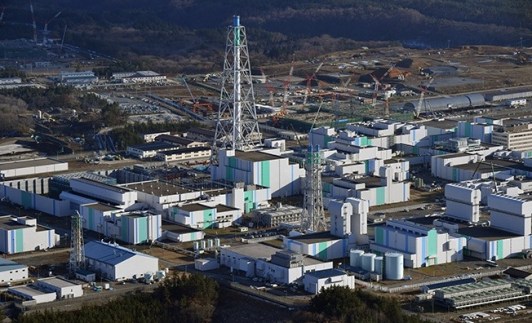 Japan Nuclear Fuel Ltd.’s spent nuclear fuel reprocessing facility in Rokkasho, Aomori Prefecture
May 15, 2020
In his 1991 book “Rokkashomura no Kiroku” (Record of Rokkasho village), journalist Satoshi Kamata documented the displacement of residents for a planned large development project in the northern village.
Kamata reproduced an essay written by an elementary school pupil, whose school was earmarked for closure because of the megaproject.
“I detest development more than I could ever say,” the youngster wrote.
The villagers were promised a rosy future, with rows of factories turning their rural community into a vibrant urban center. But none of that happened, and the school closed in 1984.
“All that talk about the factories was a lie,” the child lamented. “I truly hate being made to feel so sad and lonely.”
Instead of this development project that never materialized, the village of Rokkasho in Aomori Prefecture ended up hosting a facility for reprocessing spent nuclear fuel.
A series of delays held up the project for years, but the Nuclear Regulation Authority finally ruled the plant’s safety measures acceptable under its new standards on May 13.
The Rokkasho plant was meant to be the “nucleus” of the nation’s nuclear fuel recycling program of the future, with the purpose of minimizing nuclear waste by reusing spent fuel.
The reprocessed fuel was to be burned in fast-breeder reactors, but efforts to develop a viable fast-breeder reactor have gone nowhere. Attempts to use the reprocessed fuel in conventional nuclear reactors have also stalled.
The whole project has effectively become a proverbial pie in the sky.
But neither the government nor utilities would acknowledge this reality and review the project, apparently because they fear the issue of nuclear waste will become the focus of attention.
I wonder how long they are going to keep their heads in the sand without addressing the thorny problem of how to dispose of nuclear waste.
Here’s a riddle: What cannot be seen when your eyes are open, but can be seen when your eyes are closed? The answer is a dream.
Where the nuclear fuel recycling program is concerned, I imagine the nation’s nuclear community must be dreaming or hallucinating.
Japan should end its nonsensical effort to recycle nuclear fuel
 A view of the under-construction reprocessing plant, seen from the Obuchi-numa swamp in Rokkasho, Aomori Prefecture, on May 12.
May 14, 2020
Japanese nuclear regulators have endorsed the safety of a contentious plant to reprocess spent nuclear fuel.
The Nuclear Regulation Authority (NRA) on May 13 approved a draft report on the safety inspection of the reprocessing plant being built in Rokkasho, Aomori Prefecture, by Japan Nuclear Fuel Ltd.
The report says the plant meets the new nuclear safety standards introduced after the 2011 Fukushima nuclear disaster. The NRA’s decision represents a big step forward toward bringing the long-delayed Rokkasho reprocessing plant online.
Japan’s policy program to establish a nuclear fuel recycling system to recover plutonium from spent nuclear fuel to be reused in reactors, however, is already bankrupt beyond redemption. Operating the reprocessing plant simply does not make sense because of the many problems it entails with regard to nuclear proliferation, cost effectiveness, energy security and other important policy issues.
Prime Minister Shinzo Abe’s administration should change its policy concerning nuclear fuel recycling. It would be irresponsible to maintain this unsustainable national policy aimlessly simply because of the NRA’s verdict that the plant meets the new safety standards.
TROUBLE-PLAGUED PLANT
The government and the electric power industry have been promoting the concept of recycling separated plutonium back into the fuel of reactors as a valuable “semi-homemade” energy source for a nation without much natural resources.
The Rokkasho reprocessing plant, the core facility for this strategy, was originally scheduled to be completed in 1997, but the deadline has been delayed as many as 24 times due to a series of technological glitches and other problems.
The plant started a trial run in 2006, but the process was plagued by malfunctions and suspended after the catastrophic accident at the Fukushima No. 1 nuclear power plant in 2011.
The NRA, which was created after the accident, spent six years carefully assessing the safety of the reprocessing plant. It was the body’s first safety screening mission for a nuclear fuel reprocessing facility.
Despite the nuclear watchdog’s effective endorsement of its safety, the plant still has a long way to go before it becomes ready for full-scale operation. The details of its design will be scrutinized while the work to install required safety measures has yet to be carried out.
It is unclear whether the plant will be completed in fiscal 2021, the new deadline set by the operator. Winning the consent of the local community is another challenge that has to be overcome before the plant can come on stream.
At nuclear power plants across the nation, growing amounts of spent nuclear fuel are waiting to be shipped to the reprocessing plant. At some nuclear plants, there is not much room left in the spent fuel pools. The power industry warns that there could be disruptions in power generation unless the reprocessing plant starts operating.
The Rokkasho plant is designed to reprocess up to 800 tons of spent fuel annually to extract plutonium. It is true that the facility would help prevent a situation where there is no room left in the pools.
UNUSABLE PLUTONIUM
The plant, when it operates at full capacity, could extract as much as seven tons of plutonium from spent reactor fuel a year. The problem is that there will be few plausible ways to use the material.
The plan to develop a fast neutron reactor that can burn and breed plutonium, which was supposed to be the key technology for plutonium consumption, has gone awry after it was decided that Japan’s “Monju” prototype sodium-cooled fast-breeder reactor should be decommissioned following a sodium leak accident.
There is no plan to develop a new demonstration fast-breeder reactor to succeed the Monju.
The Japanese government then considered participating in France’s Advanced Sodium Technical Reactor for Industrial Demonstration (ASTRID) project to build a prototype sodium-cooled nuclear reactor. But the idea was dropped after the French government decided to scale down and possibly pull the plug on the project.
Japan’s plan to burn so-called MOX (mixed oxide) fuel, which is usually plutonium blended with natural uranium, in existing nuclear reactors has also failed to make progress as fast as the government expected. Currently, only four reactors are using MOX fuel, far less than the industry’s target of operating 16 to 18 MOX reactors.
In short, there is little prospect for massive consumption of plutonium in this nation, at least in the near future.
Japan has a stockpile of 46 tons of weapons-usable plutonium, enough for producing 6,000 atomic bombs. Japan has made an international commitment to reducing its plutonium stock.
If Japan starts extracting plutonium from spent nuclear fuel through reprocessing, the international community will become doubtful of its commitment to reducing its plutonium stockpile despite being the only country to have suffered the devastation of atomic bombings.
Japan could even be suspected of harboring an ambition to develop and possess nuclear weapons in the future.
The government plans to limit the amount of plutonium extracted from spent fuel to less than the volume consumed at the MOX reactors.
But reprocessing spent reactor fuel to recover plutonium simply does not make sense in the first place when the amount of material stored in Japan should be slashed.
SHIFTING FINANCIAL BURDEN IS UNACCEPTABLE
The nuclear fuel recycling policy is also losing its economic rationale as well due to ballooning costs.
Even ordinary nuclear power generation is losing its competitiveness against other energy sources because of higher costs. The cost of building the reprocessing plant is now estimated at 2.9 trillion yen ($27.13 billion), four times higher than the original estimate. The total amount to be shelled out for the project, including operational and scrapping costs, is projected to be nearly 14 trillion yen.
Most major industrial nations have given up on the idea of nuclear fuel recycling as not being worth the cost. All the other countries that are still pursuing this path, including China and Russia, are nuclear powers. Most of these projects are strategic state-financed efforts that disregard costs.
But the reprocessing and MOX reactor projects in Japan are private-sector businesses. The costs involved have to be passed onto consumers through higher electricity bills.
The government and the industry should not be allowed to continue pursuing this unreasonable nuclear fuel policy at the expense of consumers.
In many other parts of the world, renewable energy sources are fast gaining ground, eroding the share of nuclear power.
In addition to sharp declines in costs, the fact that solar and wind power is a purely “homemade” energy source for any country is accelerating the trend.
If Japan really places a high policy priority on energy security, it would make much more sense for it to expand “purely homemade” energy sources than promote a “semi-homemade” one.
But the government continues sticking to the nation’s traditional nuclear power policy, putting a damper on growth in renewable energy production.
If the government decides to scuttle the nuclear fuel recycling agenda, it will immediately face the sticky challenge of deciding how to dispose of spent nuclear fuel.
But the project should not be kept alive through irresponsible collusion between the government and the power industry to avoid tackling this challenge.
Political leaders should make the tough decision as soon as possible to put the nation on a path toward a new energy future.
Taiwan green groups urge Japan not to discharge radioactive water
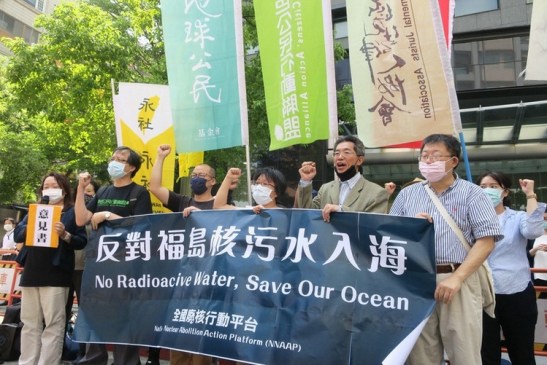 A coalition of environmental protection groups chants slogan in front of the Taipei office of Japan’s de facto embassy in Taiwan, the Japan-Taiwan Exchange Association, on May 13, 2020
May 14, 2020
TAIPEI (Kyodo) — A coalition of environmental protection groups in Taiwan on Wednesday urged the Japanese government to refrain from releasing radioactive water from the wrecked Fukushima nuclear plant into the ocean.
Chanting the slogan “No to dumping radioactive water into the ocean,” representatives of the organization presented a petition to the Taipei office of Japan’s de facto embassy in Taiwan, the Japan-Taiwan Exchange Association, in the morning.
National Nuclear Abolition Action Platform spokeswoman Tsuei Su-hsin emphasized that they did not come to protest, but rather to urge the Japanese government to refrain from making decisions to cut costs at the expense of the environment.
“There are safer and more sustainable alternatives,” Tsuei said.
The Japanese government and the operator of the Fukushima Daiichi nuclear power plant at the time are currently considering ways to safely dispose of the more than 1 million tons of water contaminated with radioactive materials after being used to cool the melted fuel cores at the plant.
A decision needs to be made soon as space for storing the water, which has been treated but is still contaminated with low-toxicity radioactive tritium, is fast running out.
Methods being discussed include releasing the water into the Pacific Ocean and evaporating it, both of which the government says will have minimal effect on human health.
A panel of experts advising the government on a disposal method has recommended releasing it into the ocean. The government is soliciting opinions from the public before it makes a decision in the summer. Based on past practice, it is likely to accept the recommendation.
Tsai Ya-ying, an activist and lawyer of the Wild at Heart Legal Defense Association, said as Japan is a signatory of the U.N. Convention on the Law of the Sea, it is obligated to take all measures within the Convention that are necessary to prevent, reduce and control pollution of the marine environment from any source.
Discharging the water into the ocean could amount to a violation of the Convention, she said.
Liu Jyh-jian, president of the Taiwan Environmental Protection Union, urged the Japanese government to make a decision that is friendly to both the environment and to mankind.
He added that if the tritium enters the food chain, it is bound to cause harm to humans in the long run.
Tsai Chung-yueh, deputy secretary general of Citizen of the Earth, voiced concern that the Japanese government may be too preoccupied with fighting COVID-19 to make a decision that is environmentally sustainable.
The contaminated water is increasing by about 170 tons per day. Space is expected to run out by summer 2022.
Local Japanese fishermen and residents have expressed concerns about releasing the water on food and the environment.
Widespread concerns remain as well, with many countries and regions still restricting imports of Japanese agricultural and fishery products in the wake of the 2011 disaster that was triggered by a major earthquake and tsunami.
https://mainichi.jp/english/articles/20200513/p2g/00m/0in/112000c
Tepco prepares to survey Fukushima Daiichi unit 2 fuel pool
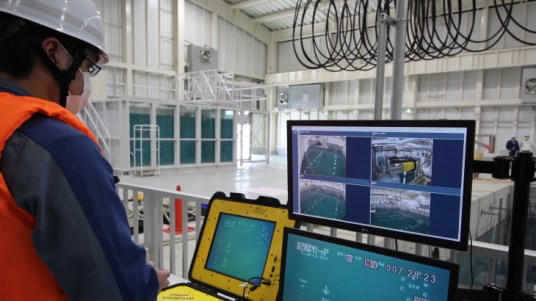 A worker receives training on using the submersible ROV
14 May 2020
Tokyo Electric Power Company (Tepco) has carried out training in the operation of a submersible remotely operated vehicle (ROV) that will be used to investigate the used fuel pool of unit 2 at the damaged Fukushima Daiichi nuclear power plant. The investigation is scheduled to begin in mid-June.
The company said it plans to start removing the 587 fuel assemblies from the unit’s used fuel pool between fiscal year 2024 (ending March 2025) and fiscal year 2026 (ending March 2027). “However, prior to commencing fuel removal, we must first ascertain whether or not there are any obstructions above the fuel or inside the cask pit, and we must also ascertain the condition of the skimmer surge tank,” Tepco said.
Dose levels on the operating floor of unit 2 are high thereby making it difficult to access, Tepco noted. It has yet to conduct an internal investigation of the unit’s used fuel pool, but it has made progress with the cleanup of equipment, etc. that remains on the operating floor and it is now possible to access the area near the storage pool. Tepco has also now deemed it possible to safely install investigation equipment.
Tepco held training sessions at the Fukushima robot test field in Minami-Soma City for eight employees between 13 and 15 May on operation of the submersible ROV. It says the design of equipment for the removal of the fuel from unit 2’s storage pool will be reviewed according to the results of the investigation.
https://world-nuclear-news.org/Articles/Tepco-readies-to-survey-Fukushima-Daiichi-unit-2-f
Gamma data missing from Hinckley radiation monitoring – EURDEP June 2020
Whilst perusing EURDEP radiation mapping after the Stack collapse and release of dust that happened earlier today
See
I caught these 2 screenshots From the same tab;

The readings are low (The ones that can be read..
Oddly, What might have triggered the deletion of data?
Were they using contaminated crushed concrete?
Documented in any case
Awaiting further data.
Source to EURDEP monitoring https://remap.jrc.ec.europa.eu/Simple.aspx
Also might add this nightmare scenario to the UK nuclear threats (internal)
Will Sellafields nuclear waste waft to Ireland? Or waft somewhere else? #nuclearban
Regards Shaun aka arclight2011
Will Sellafields nuclear waste waft to Ireland? Or waft somewhere else? #nuclearban
…Prof Chris Busby first consulted the online NOAA Hy-Split atmospheric projection software with the same date as the EPA report and got a completely different scenario showing most of Ireland being covered with meandering waves of highly radioactive particles and gases….
REPOST due to images being hacked from page on previous version and also here is a Sellafield update; Sellafield’s 11000 cubic metres of nuclear waste – UK’s storage problem https://nuclear-news.net/2020/06/08/sellafields-11000-cubic-metres-of-nuclear-waste-uks-storage-problem/
Introduction by Shaun McGee (aka arclight2011)
Published exclusive to nuclear-news.net (Creative Commons applies)
2 February 2018
The Irish Sellafield nuclear accident fallout projection report has some issues, in my opinion.
In December 2016 the Irish Environmental Protection Agency (EPA) published in Irish Media Sources a report on radioactive fallout from a “worse case” scenario.

At the time, I was in contact with the Irish EPA concerning new evidence that shows a larger health effect from radiation sources and I was trying to challenge the pro nuclear bias that underestimated the health and environmental problems using mechanisms from the EURATOM nuclear treaty in Europe. I have to say that the Irish EPA were forthcoming in their many responses to my inquiries but eventually we reached a stale mate as the EPA claimed that the specific Isotopes relevant to the Euratom Treaty are not to be found in Ireland with the exception of Iodine 131 which they claimed was unlikely to be a health problem. They said that other fission (from a nuclear reactor) isotopes were not found on the island of Ireland.
The 2016 report from the Irish EPA (link) shows, what I think, is a minimal dispersion of radioactive fallout with little impact to health or the environment. However, there are other reports of fallout plumes from the Sellafield site that show much worse contamination than the 2016 EPA report posits and I requested Prof Chris Busby (who had been involved with Irish activists and government groups concerning Sellafield) to do a report (Full report below) on the problems that seemed to be highlighted with the Irish EPA report.
Prof Chris Busby first consulted the online NOAA Hy-Split atmospheric projection software with the same date as the EPA report and got a completely different scenario showing most of Ireland being covered with meandering waves of highly radioactive particles and gases. He then consulted 2 other reports, one of which the Irish Government commissioned that was completed by 2014 using the European gold standard software fallout projection model that showed a large plume covering large sways of Ireland (reaching the south west coast).
It would seem that the 2016 report completely runs counter to the 2014 and earlier report as well as the Hy-Split projection whilst using the same date as the 2016 Irish report.
So the issue of the types of accident that the Irish EPA thought to be worse case scenario. A direct hit by a Meteorite was seen to be plausible but if a meteorite hit sellafield then much of the nuclear site would be lofted high into the atmosphere and more evenly spread around the globe. This would fudge the numbers for plumes that are moving nearer the ground.
No where in the report was the more likely and and more dangerous scenario of terrorists attacking the spent fuel pools causing low altitude fallout over many weeks that would cause a larger pollution incident that would effect local countries to the UK border such as Ireland, Norway etc.In fact such concerns have been reported in main stream media sources as well as government/private think tanks.
Thanks to Prof Chris Busby for taking the time off his busy schedule to compile a response to the Irish EPA report on Sellafields projected damage to Ireland.
Please feel free to leave a comment belowif you agree or disagree with any of the points raised, a discussion about this issue needs to be had.
Shaun McGee (aka arclight2011)
………………………………………………………………………………..
Conclusion to report
The EPA 2016 report is unsafe and cannot be relied upon by the public, the media or administrators. The anonymous authors have shown extraordinary bias in every aspect of the report. They made elementary mistakes in their source term listing of isotopes, by including those which had short half-lives and will clearly not have been present in any significant concentration. They omitted a whole series of nuclides which are present in the tanks and the fuel pools. They choose a source term which is demonstrably too low based on available data, they choose a worst-case accident which involves only one HAST tank and only Caesium-137. They omit mentioning the spent fuel pools which are a highly likely site of a major coolant loss and subsequent fire or explosion. Their air modelling results are extremely unusual with implausibly narrow plumes, whilst a NOAA HYSPLIT model for the same day shows a completely different dispersion covering most of highly populated Ireland. Their surface contamination levels are 200 times lower than a previous computer model by Dr Taylor, which they must have had access to, and they fail to calculate the increased levels of cancer in the exposed population. This has been rectified here.
Historic releases from Sellafield to the Irish Sea have caused measurable increases in cancer and leukemia in coastal populations of Ireland. There is no doubt that the existence of Sellafield represents a potential catastrophic danger to the Irish Republic. A serious accident there could destroy the country and also most of Britain. As the Chernobyl accident effects showed, and the Fukushima accident effects will reveal (and in the case of Thyroid cancer have revealed) the ICRP risk model is unsafe for explaining or predicting health effects from such contamination. The Authors of the EPA 2016 report should be sanctioned in some way for producing such a travesty of the real picture, especially since they will have had access to the earlier study and modelling by Peter Taylor and the details of the COSYMA model employed by him.
Christopher Busby
August 17th 2017
Using recognised plume projection software for same day
UK version given to Irish EPA for same day


…………………………………………………………………….
The health impact on Ireland of a severe accident at Sellafield.
A criticism of the report “Potential radiological impact on Ireland of postulated severe accidents at Sellafield” Anon. (Radiological Protection Institute of Ireland: September 2016) with a re-assessment of the range of health outcomes.
Christopher Busby PhD
There are things we know that we know. There are known unknowns. That is to say there are things that we now know we don’t know. But there are also unknown unknowns. There are things we do not know we don’t know.
Donald Rumsfeld
Murphy’s Law is an adage or epigram that is typically stated as:
Anything that can go wrong will go wrong.
[https://en.wikipedia.org/wiki/Murphy%27s_law]
Introduction
The nuclear complex at Sellafield in Cumbria, UK, has always represented a real danger to the Republic of Ireland. There has been and remains a chronic danger to the people of the East Coast of Ireland. First, radioactivity released from Sellafield under licence to the Irish Sea, particularly in the 1970s did not, as had been hoped, dilute and disperse in the sea, but instead became attached to sediment particles along the coasts and inlets of Ireland (e.g. Carlingford Lough, Drogheda) and the particles represented a cause of cancer and illnesses in coastal populations and those exposed through eating fish and shellfish. A court case (Herr and Ors. Vs BNFL) was supported by the Irish State and my organisation was funded by the Irish State for 3 years from 1998 to examine the contamination and health issue. Green Audit examined the cancer rates in small areas in North and mid Wales, and also in Ireland by distance from the contaminated coasts. Results were published in Busby 2006 and showed that there had been a significant 30% increase in cancer and leukemia in coastal populations of the Irish Sea [1]. The second issue of continuing interest is the danger of a serious accident at Sellafield at a time when the wind direction is from the East and airborne material passes across Ireland. This issue became more urgent and of interest to the Irish public after the Fukushima Daiichi reactor explosions and melt-downs in Japan in 2011. However, the potential outcome of such an accident had been part of a report by Peter Taylor [2] written in 1999 for McGuill and Company, the solicitors representing the Herr and Ors vs. BNFL case which was abandoned by the Irish State for reasons which remain unclear.
In September 2016, a report was produced by the EPA Office of Radiological Protection entitled Potential radiological impact on Ireland of postulated severe accidents at Sellafield. [3]. This anonymous report has serious shortcomings and errors which will be addressed here. A more realistic assessment of the potential impact of a serious accident at Sellafield on the Republic of Ireland will be presented here using the radiological risk models both of the International Commission on Radiological Protection (ICRP, [4]) and also the Model of the European Committee on Radiation Risk (ECRR [5]).
2. The baseline assumptions of maximum release.
2.1 The EPA worst case.
The EPA report discussed some possible accidents involving releases of radionuclides. It examined some potential sources of radionuclides but not others. It chose a number of possible scenarios, but excluded others. In general terms (and referring to Murphy’s Law, appropriately in this case of Ireland) it could not assess accidents which are totally unforeseen. Therefore, also in general, we should consider a worst case-scenario in which most of the radioactivity inventory of the Sellafield site becomes airborne at a time when the weather patterns were most unfavourable for Ireland.
For example, in Busby 2007 [1] the Windscale reactor fire was examined in some detail. At the time of the fire, which continued for some days, the main releases were initially offshore towards Ireland. This is contrary to the discourse promoted by the British Radiological Protection Board in 1974. It is, however confirmed by Air Ministry historical data. But the point is that at the time a cold front laying North East to South West was moving from Ireland towards England across the Irish Sea. This meant the releases from the fire and heavy radioactive rain fell along the front. This rain fell on the Isle of Man, and historical mortality data show a large increase in the death rate after this event. There have also been reports of significant birth effects (Downs Syndrome cluster) in County Louth reported by the Irish GP Patricia Sheehan, who died in an automobile accident shortly after beginning to follow this up.
In order to estimate the effects of a worst case, initially there must be a choice of the source term, that is, the quantity and radionuclide identity of the material released to the atmosphere.
The EPA report decided that this could be modelled as the contents of one of the 21 High Active Storage Tanks (HAST). The true content of one of these is unknown, probably also to the operators BNFL. The estimate for the contents was taken from a report by Turvey and Hone [6]. This is shown in Table 1 below where I note a number of concerns. In Table 2 I provide examples of some hazardous radionuclides not listed in the EPA source term table. In Table 3 I copy the source terms used by the British 1976 Royal Commission (the Flowers Report) [7]. Note that all these estimates are for a single or multiple HAST tanks on the tank farm and exclude explosions of the spent fuel ponds which could dry up and suffer prompt criticality. This could result from a domino scenario (see below).
Table 1 EPA assumed release source term. (E-notation, thus 1 x 10¹⁴ is written 1 E+14_
|
Radio nuclide |
Total activity Bq |
Half Life |
Comment |
|
Zr-95 |
1.4 E+15 |
64days |
All decayed away; almost none there |
|
Nb-95 |
5.8 E+14 |
35 days |
Daughter of Zr-95; all decayed away; none there |
|
Ru-106 |
1.33 E+16 |
366 days |
All decayed away; almost none there |
|
Sb-125 |
1.6 E+15 |
2.7 years |
All decayed away; almost none there |
|
Cs-134 |
1.04 E+16 |
2.0 years |
All decayed away; almost none there |
|
Cs-137 |
5.26 E+17 |
30 years |
Significant |
|
Ce-144 |
9.65 E+15 |
284 days |
All decayed away; almost none there |
|
Eu-154 |
4.41 E+15 |
8.5years |
Minor significance now |
|
Eu-155 |
3.39 E+15 |
5 years |
Minor significance now |
|
Sr-90 |
3.6 E+17 |
28.8 years |
Highly Significant; DNA seeker |
|
Am-241 |
2.72 E+15 |
432 years |
Highly Significant alpha; decays to Np-237 alpha; daughter of Plutonium-241 |
|
Cm-242 |
4.57 E+13 |
162 days |
All decayed away; almost none there |
|
Cm-243 |
1.92 E+14 |
32 years |
Highly Significant alpha; decays to Plutonium-239, so there must be approximately the same or more Plutonium-239 (fissionable) in the mix |
2.2 Concerns about the source term table of the EPA 2016 report
Table 1 gives the source terms employed by the EPA report. It lists 13 isotopes. The table is an astonishing example of bad science, produced either through bias or ignorance. Since the table is apparently taken from another report by Turvey and Hone 2000, we can perhaps blame them for the original mistakes. I have included a column showing the half-lives of their isotopes. The main concerns are as follows:
It is perfectly clear than all but four of the thirteen will have physically decayed away by 2016. For example, a half life of Zr-95 of 65 days, at 1980 would by now have had 36 x 365 days to decay. This is 202 half-lives. There would be virtually none left of the listed quantity.
A significant number of seriously hazardous radionuclides which must be in the tanks are not listed. In particular we have Plutonium-239, Plutonium- 238, Plutonium-241, Uranium and other actinide alpha emitters including Neptunium-237, Radium-226, Carbon-14 and Tritium.
The overall total activity tabulated the EPA report is about 4 times less than the quantity in a HAST tank given in the report of the UK Royal Commission 1976 (Flowers) and the 1977 Windscale Enquiry which totalled 1.8 x 10¹⁸ Becquerels of Caesium-137 plus 1.4 x 10¹⁸ Bq of Strontium-90 plus 1.1 x 10¹⁸ Bq of Ruthenium-106 [8].
Why did the EPA report reduce the quantities assumed by the earlier reports? Why did it omit the dangerous actinides Uranium, Plutonium and Neptunium with the exception of Americium-241? Why did it omit a whole range of other radionuclides like Tritium and Carbon-14?
Table 2 Some Missing isotopes from the EPA Source term with longer half-lives or present as daughters
|
Isotope |
Half Life |
|
|
U-238 |
4.5 E+9y |
Alpha |
|
U-235 |
7.1 E+8y |
Alpha |
|
U-234 |
2.4 E+5y |
Alpha |
|
Th-230 |
8 E+4y |
Alpha |
|
Ra-226 |
1599y |
Alpha |
|
Pu-238 |
86.4y |
Alpha |
|
Pu-239 |
2.4 E+4y |
Alpha |
|
Pu-241 |
14.4y |
Decays to Am-241 listed by EPA |
|
Np-237 |
2.1 E+6y |
Am-241 daughter |
|
Mn-54 |
312d |
Activation |
|
Co-60 |
5.27y |
Activation |
|
Y-90 |
64h |
In equilibrium with Sr-90 |
|
H-3 |
12.3y |
Life component; radioactive water |
|
C-14 |
5730y |
Life component |
Table 3 HAST tank content according to Windscale Enquiry 1977 and Royal Commission 1976
Isotope
Quantity(Bq)
Cs-137
1.8 E+18
Sr-90 + Y-90
2.8 E+18
Ru-106
1.1 E+18
2.3 The more accurate source terms for HAST tanks
Taylor 1999 [2] based his calculations on only Cs-137 and assumed a source term of 1 x 10¹⁸ Bq. Therefore, his results (which I will review below) should be adjusted by a factor of 1.8 on the basis of the Table 3 results, but particularly also modified upwards by the presence of the Sr-90/Y-90 and the actinides, the Plutonium, Uranium, Radium and Americium, which, though they are present in smaller quantities each carry a weighting of 20 due to their alpha biological effectiveness. Thus the quantity of 2.72 E+15 listed by EPA in Table 1 has the effect (in Sieverts) of 5.44 E+16 due to its alpha emission.
2.4 The spent fuel pools
In addition to HAST tank scenarios, there has been reported the existence [ 9: http://www.theecologist.org/News/news_analysis/2611216/leaked_sellafield_photos_reveal_massive_radioactive_release_threat.html%5D in a very dangerous state, a series of concrete spent fuel pools containing hundreds of tons of spent fuel. Loss of integrity of these tanks (drying up) would result in meltdown and prompt criticality with explosive distribution and burning of the spent fuel elements.
The approximate activity inventory of a spent fuel assembly for a Boiling Water Reactor is available from Alvarez 2014 [10] and the EIA for a Pressurized Water reactor fuel assembly from the Swedish Forsmark High Level Waste repository documents [11]. Therefore these are not exactly the same as the assemblies in the Sellafield pools. However, they will not be very different. The radioactive elements and their activity is given in Table 5 [Ref 5,6] .
Trump’s dangerous idea on nuclear testing – top Democrats demand answers
 Top Democrats demand answers on Trump administration’s ‘unfathomable’ consideration of nuclear testing The Hill BY REBECCA KHEEL – 06/08/20 A group of top House Democrats is demanding answers from the Trump administration on reported conversations within the administration on whether to resume nuclear testing.“It is unfathomable that the administration is considering something so short-sighted and dangerous, and that directly contradicts its own 2018 Nuclear Posture Review,” the lawmakers wrote in a letter Monday to Energy Secretary Dan Brouillette and Defense Secretary Mark Esper
The posture review, the lawmakers wrote, “which this administration often cites as inviolable, makes clear that ‘the United States will not resume nuclear explosive testing unless necessary to ensure the safety and effectiveness of the U.S. nuclear arsenal.’
The letter was signed by House Armed Services Committee Chairman Adam Smith (D-Wash.) and House Appropriations Committee Chairwoman Nita Lowey (D-N.Y.), along with Reps. Jim Cooper (D-Tenn.), chairman of the Armed Services Subcommittee on Strategic Forces; Marcy Kaptur (D-Ohio), chairwoman of the Appropriations subcommittee on energy and water; and Pete Visclosky (D-Ind.), chairman of the Appropriations Subcommittee on Defense.
The Pentagon declined to comment………
The lawmakers demanded answers to questions by June 22, as well as a briefing by June 25. Questions include under what legal authority and funding testing is being considered, whether the intelligence community is analyzing what the effects of a test would be on U.S. allies and adversaries, and whether there has been any independent assessment requested by the Energy or Defense departments on the need, cost and effect of resuming nuclear testing. https://thehill.com/policy/defense/501687-top-democrats-demand-answers-on-trump-administrations-unfathomable
Nuclear testing ban to be introduced in U.S. Congress
 Reps. Steven Horsford and Dina Titus announce nuclear testing ban legislation, 8 NewsNow by: Kaitlyn Olvera Jun 8, 2020, LAS VEGAS (KLAS) — Congressman Steven Horsford and Congresswoman Dina Titus have introduced a nuclear testing ban. The Preserving Leadership Against Nuclear Explosives Testing (PLANET) Act, introduced Monday, would prevent President Donald Trump from restarting nuclear weapons testing in Nevada.
This legislation “would prevent the Trump administration from restarting explosive nuclear weapons testing by restricting funds for fiscal year 2021 and all previous years from being used for such a purpose,” a release about the legislation stated.
The Washington Post reported the Trump administration had a discussion about conducting a nuclear test with top security officials on May 15, in response to accusations that Russia and China were performing low-yield nuclear tests. This is a claim both countries have denied.
Specifically, the PLANET Act would, according to Rep. Horsford’s office:
- Prohibit the use of funds appropriated in Fiscal Year 2021 or from any previous year to prepare for or to conduct an explosive nuclear test that produces any yield
- Allow for stockpile stewardship activities that are consistent with U.S. law – such as certifying the safety, security and reliability of the U.S. nuclear stockpile – so long as those activities are consistent with the “zero-yield” scope of the Comprehensive Test Ban Treaty (CTBT)…… https://www.8newsnow.com/news/local-news/reps-steven-horsford-and-dina-titus-announce-nuclear-testing-ban-legislation/
This week’s nuclear and climate news
Going back to “normal”? But “normal” IS the problem. The world waits, to see how the plans of nations to get over , recover, from the pandemic period are actually going to work. Not too well, in some cases. New Zealand shines.
The nuclear lobby is enthusiastically promoting itself as a saviour in helping deal with the pandemic. Does anyone believe this spin? Meanwhile nuclear nations, led by USA, turn to a renewed burst of spending on nuclear weapons.
Time to transfer funds from weapons to making vaccines.
The world is sleepwalking toward a period free of nuclear arms control.
New report calls out banks that make nuclear weapons investments.
Loophole in the Nuclear Non-Proliferation Treaty (NPT): small military nuclear reactors lack safeguards.
Species are becoming extinct at an accelerating rate.
The most effective leader in the world – Jacinda Adern, Prime Minister of New Zealand.
Some bits of good news – For the First Time, U.S. Renewable Energy Surpasses Coal Every Day For An Entire Month. Coronavirus Cooking Survey’ Finds That People Are Eating Healthier and Wasting Less
USA.
- Nuclear detection helicopter Flies Mission Around Washington D.C. Amid Unrest .
- Top Democrats promote bill to ban live nuclear tests. Trump wants a nuclear test – adding to the sickness of the world. If he wins election, Joe Biden would restore Iran nuclear deal. Trump tells Iran they should get “a better deal” with him now, before the U.S. election.
- Many $billions for U.S. Air Force’s new nuclear weapons.
- USA nuclear-missile program data leaked, as contractor hit with Maze Ransomware.
- U.S. taxpayers bearing the crushing cost of nuclear waste. Legal challenge to “Interim” storage of nuclear wastes, before permanent disposal determined. Anxieties over the risks of spent nuclear fuel storage at San Onofre. Kentucky’s radioactive disaster site Paducah.
- Emergency preparedness at San Onofre Nuclear Plant – agreement approved. Beyond Nuclear files Federal Lawsuit Challenging High-Level Radioactive Waste Dump. Radioactive waste imported from Estonia for iconic Bears Ears, Utah?
- An American nuclear reactor flooded by an extreme rainfall event – during the pandemic.
- U.S. Nuclear Regulatory Commission will run environmental study BEFORE relicensing South Carolina nuclear fuel plant.
- Exhumed AREVA – now “Framatome” acquires BWX Technologies’ US nuclear services business.
UK. Climate Experts Predict ‘Grim Future’ For Nuclear Power . UK’s Sizewell nuclear plan in doubt, due to cost and China’s involvement? China is reconsidering building nuclear reactors in Britain. Deep concern over environmental cost of planned Sizewell C nuclear station. Caring about Cancer? A UK and Irish perspective. Most UK pension providers are investing in nuclear weapons companies. Choosing nuclear narrows future energy choices.
FRANCE. Huge police squadron paid by nuclear industry to monitor residents of Bure. French state-controlled utility EDF has to inspect valve leaks at Flamanville, Taishan, Finland nuclear sites. EDF terminates nuclear electricity supply contracts. High rate of cancers among Mururoa nuclear veterans’ families. France goes back to its restrictive nuclear compensation law affecting Polynesian nuclear test survivors.
RUSSIA. Russian city Severodvinsk, (near site of nuclear accident) sealed off due to Covid-19. Russia will now allow use of atomic weapons against non-nuclear strike. Anti–nuclear resistance in Russia: problems, protests, reprisals. The Mayak nuclear reprocessing plant: Rosatom’s dirty face- and the courageous opposition. Uranium mining protests in Russia. Activists, despite government oppression, campaign for decommissioning of Russia’s aging nuclear reactors . Nuclear submarine accidents contaminating Russia’s Far East.
INDIA. Nuclear power plants in the path of oncoming Cyclone Nisarga.
GERMANY. German Parliament in debate on basing of nuclear weapons. Discussion on Poland, Germany hosting nuclear weapons.
CZECH REPUBLIC. Czech Fiscal Council warns on the long-term risk of financing a new nuclear reactor.
IRAN. Iran challenges Donald Trump to return to nuclear deal.
NORTH KOREA. Kim Jong Un unlikely to use nuclear weapons – an alternative leader of N Korea might be worse.
ITALY. Latina plant, the last of Italy’s 4 nuclear power stations to be dismantled.
EUROPE. The European Union plus France, Germany and the UK “deeply regret” US decision on Iran sanctions. Desperate nuclear lobby tries to con the European Commission with its bogus claim about climate solving.
CHINA. China’s nuclear power ambitions face delays, waste problems, and the growing success of renewables.
ISRAEL. Nuclear Weapons: The Reason Why Even Iran Fears Israel.
AUSTRALIA. Australia’s nuclear-free, anti-uranium movement adapts to this pandemic period – presenting a series of webinars – “Yellowcake Country“.
Nuclear arms meeting planned, USA and Russia, – arms control expert is not enthusiastic
 US and Russia to meet for nuclear arms negotiations this month Jennifer Hansler, CNN June 8, 2020 Washington US and Russian officials will meet later this month for nuclear arms negotiations, a top US arms control official announced Monday.
 |
ReplyForward
|
Number two executive of the defunct SCANA Corpto plead guilty to fraud conspiracy in nuclear plant failure
|
Top SCANA ex-official to plead guilty to fraud conspiracy in nuclear plant failure https://www.thestate.com/news/local/crime/article243356621.html, BY JOHN MONK
JUNE 08, 2020 The number two executive of the defunct SCANA Corp. — whose top officials engineered the biggest business failure in South Carolina history: the $10 billion V.C. Summer nuclear plant fiasco — has agreed to plead guilty to criminal conspiracy fraud charges in connection with the nuclear failure, according to a document filed Monday in U.S. District Court in Columbia.
The upcoming guilty plea of Stephen A. Byrne, 60, is a centerpiece of a Monday filing involving his alleged criminal actions. He will need to have his guilty plea formally accepted by a U.S. District Court judge before it becomes official. Byrne is charged with conspiring to commit mail fraud, the document said. The document is a motion requesting a stay in a Securities and Exchange civil fraud lawsuit against Byrne and SCANA’s former CEO, Kevin Marsh. That civil lawsuit was filed in February. One big difference between civil and criminal proceedings is that in a criminal proceeding, a defendant can be subject to a prison term. The document alleges that “through intentional and material misrepresentations and omissions, Byrne and others deceived regulators and customers to maintain financing for the (nuclear) project and to financially benefit SCANA.” The Monday filing said there is “an ongoing criminal investigation” and indicated more criminal charges against other former SCANA top officials may be in the offing. |
|
|
Chinese Foreign Ministry urges US to avoid nuclear testing
BEIJING, June 8. /TASS/. China urges the United States to abide by its international obligations and abandon plans to carry out nuclear tests, Chinese Foreign Ministry Spokesperson Hua Chunying said at a briefing on Monday.
“We insist that the United States should strictly abide by its obligations to end nuclear testing… and we hope that it will listen to the international community,” the Chinese diplomat pointed out. “The US should abandon plans that could undermine global stability and strategic order,” she added……… https://tass.com/world/1165339
Sellafield’s 11000 cubic metres of nuclear waste – UK’s storage problem
 Plans for 11,000m³ of nuclear waste, In Cumbria, 8 June 20 A DECISION on whether Sellafield can continue storing 11,000 cubic metres of nuclear waste in one of its Seascale buildings is due to be made tomorrow (Tuesday).Sellafield was granted permission to build a five-storey building in 1992 for interim storage of encapsulated intermediate-level waste. Plans for 11,000m³ of nuclear waste, In Cumbria, 8 June 20 A DECISION on whether Sellafield can continue storing 11,000 cubic metres of nuclear waste in one of its Seascale buildings is due to be made tomorrow (Tuesday).Sellafield was granted permission to build a five-storey building in 1992 for interim storage of encapsulated intermediate-level waste.
However the permission expires at the end of 2021, due to a condition imposed at the time by Copeland council. The nuclear firm now wants to have permission to continue storing the waste, as a more permanent solution is not yet available. The county council’s development control and regulation committee will discuss the application at a meeting at 10am. A report prepared for the authority said: “The building is required to be retained for the continued storage of intermediate-level waste (ILW) which is required to be stored until alternative facilities come on line. “The alternative storage solution is likely to be the Geological Disposal Facility (GDF), which is currently out to consultation on host site availability, and until such time as the GDF is made available a suitable interim storage place for ILW is required…… Both Seascale and Ponsonby parish councils have objected to the proposal. The report said that the Seascale authority wanted Sellafield to submit a full planning application. “When constructed these [facilities] had a 50-year life and Copeland put a time limit of 30 years to allow time for future storage options; these amendments need a full planning application. “Seascale Community are living with what are described as health and quality of life risks and this needs to be taken into account.”…….. The meeting is due to take place virtually. For more information on how to join the meeting, visit the council’s site cumbria.gov.uk https://www.in-cumbria.com/news/18502494.plans-11-000m-nuclear-waste/ |
|
NEW REPORT CALLS OUT BANKS THAT MAKE NUCLEAR WEAPONS INVESTMENTS
 NEW REPORT CALLS OUT BANKS THAT MAKE NUCLEAR WEAPONS INVESTMENTS https://futureoflife.org/2019/06/06/new-report-calls-out-banks-that-make-nuclear-weapons-investments/ By Kirsten Gronlund
Despite the 2017 international Treaty on the Prohibition of Nuclear Weapons, weapons companies continue to build them. Facilitating this production is a massive amount of investment capital contributed by private financial institutions.
Don’t Bank on the Bomb’s new report, Shorting our security: Financing the companies that make nuclear weapons, identifies which banks are investing in nuclear weapons producers, and how much they’re investing. The aim of the report is to end the production of nuclear weapons by increasing the stigma associated with these investments.
Many nuclear weapons producers engage in commercial activity other than weapons production, and investors have no way of ensuring how their investments will be used. Thus, “the report shows investments in those nuclear weapon producers at the group level, regardless of the other activities of the company or the percentage of turnover it derives from nuclear weapons-related activities.”
The report finds that over 748 billion USD was invested in the top 18 nuclear weapons companies between January 2017 and January 2019. Investments in these companies have grown by 42% compared to Don’t Bank on the Bomb’s previous analysis, up from 325 billion USD. This is due in large part to a 40% increase in Boeing’s share prices; since the conclusion of this analysis, the Boeing 737Max airplane crash has negatively affected the company.
The 748 billion USD represents investments by 325 financial institutions, headquartered in 28 countries. In the previous analysis, only 25 countries hosted institutions with investments in nuclear weapons producers. Since that analysis, 94 institutions representing at least 55,507 million USD in investments ended their contributions. However, this loss is more than offset by the 90 institutions that have since made first-time investments totaling 107,821 million USD. Over half the total investment capital came from just the top 10 investors.
Who is investing the most?
The top 10 investors are all US companies. Their total investments, in millions USD, are listed below.
| NAME | 2019 REPORT | 2018 REPORT | CHANGE | % CHANGE |
|---|---|---|---|---|
| Vanguard | 66,048 | 35,267 | 30,781 | 87% |
| BlackRock | 61,200 | 38,381 | 22,819 | 59% |
| Capital Group | 59,096 | 36,739 | 22,357 | 61% |
| State Street | 52,835 | 33,370 | 19,465 | 58% |
| Verisight (now known as Newport Group, formerly Evercore) | 31,509 | 13,712 | 31,509 | 130% |
| T. Rowe Price | 31,234 | 8,896 | 22,228 | 251% |
| Bank of America | 29,033 | 25,851 | 3,182 | 12% |
| JPMorgan Chase | 23,962 | 29,679 | -5,717 | -19% |
| Wells Fargo | 20,261 | 13,497 | 6,764 | 50% |
| Citigroup | 17,017 | 16,489 | 528 | 3% |
Search here to find out if your bank is investing in nuclear weapons.
Who stopped investing?
Below are the ten largest investors that no longer have investments in the top 18 weapons producers.
| NAME | COUNTRY | MILLIONS USD |
|---|---|---|
| Children’s Investment Fund Management | UK | 1,469 |
| Marathon Asset Management | Canada | 635 |
| William Blair & Company | USA | 474 |
| Mackie Research Financial | USA | 223 |
| Discovery Capital Management | USA | 174 |
| ABP | Netherlands | 104 |
| Blue Harbour Group | USA | 97 |
| Manning & Napier | UK | 82 |
| Teacher Retirement System of Texas | USA | 73 |
| Glenmede | USA | 70 |
Who started investing?
Below are the ten new investors with the highest investments.
| NAME | COUNTRY | MILLIONS USD |
|---|---|---|
| Unum Group | USA | 31,508.7 |
| WBC Holdings | USA | 20,260.8 |
| SMBC Group | Japan | 8,201.5 |
| Dassault Family | France | 6,772.5 |
| Janus Henderson | UK | 6,104.9 |
| United Overseas Bank | Singapore | 4,314.4 |
| AXA Equitable | USA | 3,733.7 |
| Point72 Asset Management | USA | 3,546.3 |
| Strategic Incoe Management | USA | 2,704.8 |
| Development Bank of Japan | Japan | 1,973.0 |
Where is the money going?
Total investments in each company are listed in millions USD.
| NAME | 2019 REPORT | 2018 REPORT | CHANGE | % CHANGE |
|---|---|---|---|---|
| Aecom | 19,048 | 20,101 | -1,054 | -5% |
| Aerojet Rocketdyne | 4,791 | 2,685 | 2,107 | 78% |
| Airbus | 44,455 | 30,691 | 13,764 | 45% |
| BAE Systems | 22,814 | 25,986 | -3,172 | -12% |
| Bechtel | 4,000 | 7,000 | -3,000 | -43% |
| Boeing | 254,296 | 87,010 | 167,286 | 192% |
| BWX Technologies | 8,987 | 5,865 | 3,122 | 53% |
| Fluor | 17,465 | 18,276 | -812 | -4% |
| General Dynamics | 72,630 | 45,437 | 27,193 | 60% |
| Honeywell | 78,397 | 86,806 | -8,408 | -10% |
| Huntington Ingalls Industries | 12,568 | 9,915 | 2,653 | 27% |
| Jacobs Engineering (includes CH2M Hill) | 15,563 | 11,616 | 3,947 | 34% |
| Larsen & Toubro | 14,855 | 15,905 | -1,050 | -7% |
| Lockheed Martin | 77,543 | 79,118 | -1575 | -2% |
| Northrop Grumman (includes Orbital ATK) | 53,023 | 52,507 | 516 | 1% |
| Safran | 24,661 | 18,105 | 6,556 | 36% |
| Serco | 2,265 | 3,653 | -1,389 | -38% |
| Thales | 21,080 | 5,269 | 15,811 | 300% |
| GRAND TOTAL | 748,440 | 525,945 | 222,495 | 42% |
1 This Month
23 April – WEBINAR – Why new nuclear reactors are the wrong tools for decarbonization Thursday, April 23 • 1 AM – 2 AM AEST
World Nuclear Power. Reactors 1951-2026, 75 Years of Nuclear Power.
Interactive Map– https://dv.worldnuclearreport.org/
Chernobyl: The Lost Tapes – A good documentary on Chernobyl on SBS available On Demand for the next 3 weeks– https://www.sbs.com.au/ondemand/tv-program/chernobyl-the-lost-tapes/2352741955560

of the week–London Campaign for Nuclear Disarmament

Tell the Ukrainian Government to Drop Prosecution of Peace Activist Yurii Sheliazhenko
To see nuclear-related stories in greater depth and intensity – go to https://nuclearinformation.wordpress.com
-
Archives
- April 2026 (231)
- March 2026 (251)
- February 2026 (268)
- January 2026 (308)
- December 2025 (358)
- November 2025 (359)
- October 2025 (376)
- September 2025 (257)
- August 2025 (319)
- July 2025 (230)
- June 2025 (348)
- May 2025 (261)
-
Categories
- 1
- 1 NUCLEAR ISSUES
- business and costs
- climate change
- culture and arts
- ENERGY
- environment
- health
- history
- indigenous issues
- Legal
- marketing of nuclear
- media
- opposition to nuclear
- PERSONAL STORIES
- politics
- politics international
- Religion and ethics
- safety
- secrets,lies and civil liberties
- spinbuster
- technology
- Uranium
- wastes
- weapons and war
- Women
- 2 WORLD
- ACTION
- AFRICA
- Atrocities
- AUSTRALIA
- Christina's notes
- Christina's themes
- culture and arts
- Events
- Fuk 2022
- Fuk 2023
- Fukushima 2017
- Fukushima 2018
- fukushima 2019
- Fukushima 2020
- Fukushima 2021
- general
- global warming
- Humour (God we need it)
- Nuclear
- RARE EARTHS
- Reference
- resources – print
- Resources -audiovicual
- Weekly Newsletter
- World
- World Nuclear
- YouTube
-
RSS
Entries RSS
Comments RSS
 nuclear-news