As pandemic costs rise, USA plans costly,dangerous nuclear weapons tests
 US may spend billions on a nuclear bargaining chip https://www.mercurynews.com/2020/06/10/letter-us-may-spend-billions-on-a-nuclear-bargaining-chip/ Mary Perner US may spend billions on a nuclear bargaining chip https://www.mercurynews.com/2020/06/10/letter-us-may-spend-billions-on-a-nuclear-bargaining-chip/ Mary PernerLivermore, Board President, Tri-Valley CAREs Tri-Valley CAREs sent Congress a letter on reports US may conduct its first nuclear weapon tests since 1992, Public interest organizations, including Tri-Valley CAREs, sent Congress a letter recently responding to reports senior White House officials discussed conducting the first U.S. nuclear weapon test explosion since 1992.The proposal, a chest-thumping gesture aimed at Russia and China, is likely to spur the two countries and other nuclear states to conduct their own nuclear tests. The groups urged Congress to “demand prohibition on use of any funds to resume or prepare to resume such a test.” Sen. Ed Markey, D-Mass., has drafted a bill using similar language. Nuclear testing sickened and killed military personnel involved in detonations, as well as civilians in the fallout pathways. Now officials consider spending billions on a high-risk nuclear bargaining chip, while the costs of the pandemic and unemployment continue to rise. |
|
Grave climate risks to Sizewell C nuclear project – all too close to the sea
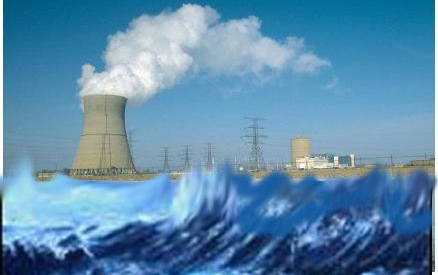  Times 10th June 2020, As if big nuclear power plants weren’t already toxic enough. To the usual Times 10th June 2020, As if big nuclear power plants weren’t already toxic enough. To the usuallist — exploding costs, endless delays, ruinously pricey electricity and a vast clean-up bill — Sizewell C brings another joy. And not just that it’s being partly built by CGN of China: odd reward for the crackdown on Hong Kong. No, it’s that Sizewell C is in a “dangerous location”. Or so says Nick Scarr from the Nuclear Consulting Group, a collection of academics and experts. The consulting engineer has examined the plans from France’s EDF and CGN to build the 3,200MW nuke on the Suffolk coast from the perspective of coastal erosion and climate change. And, assuming he’sright, his paper is alarming — unless you’re relaxed about the risk of the plant being encircled by sea.
Sizewell C will be bigger and closer to the sea than the site’s existing reactors. Mr Scarr takes issue with EDF claims that it’ll be effectively protected by the offshore Sizewell-Dunwich bank and a coralline crag, so creating a “natural wave break”. He points to studies showing waves are getting through in storms, while at the Sizewell C site the crag is more gravelly than desired.
With decommissioning of the plant not due until 2150, Mr Scarr believes EDF and CGN are paying far too little attention to forecasts from the Met Office and the Intergovernmental Panel on Climate Change. Not least the notion that once-a-century “extreme sea level events”, are “projected to occur much more frequently by 2050”. He says the once in 10,000 year flood risk that “EDF trumpets” is “just 0.71m above the historical 1953 flood level”. This is only Mr Scarr’s opinion, but he says his paper has been “approved” by Professor Andrew Plater of Liverpool
University: a leading coastal geomorphologist. So what’s EDF’s
response? Well, it reckons Mr Scarr’s analysis of the effects of the sandbank and crag is both confused and wrong. It also says it has evaluated
the likely effect of climate change. “The design of the power station, including its sea defence and the raised platform it will be built on, will protect Sizewell C from flooding,” EDF insists. It says it’ll take an “adaptive approach”, raising the sea defences “during the lifetime of Sizewell C if needed”. Mr Scarr says such an approach only works for
construction projects such as painting the Forth Bridge every year, not sea defences for a nuclear plant. Indeed, he reckons it’s “clear evidence” that the location cannot “offer the criteria necessary for long-term safety of the project”. https://www.thetimes.co.uk/edition/business/sizewell-c-debate-turns-a-bit-salty-gvvzhp7rf |
Our existential threat – our extinction
 Externalities Are Our Existential Threat, Medium, 10 June 20, It’s the “ex’s” we need to worry about the most. Externalities that create an existential threat. The ultimate threat: Our extinction.
An externality is defined by the Oxford English Dictionary as “a side effect or consequence of an industrial or commercial activity that affects other parties without this being reflected in the cost of the goods or services involved”. Externalities in a global context are the consequence that everyone bears for everyone else’s actions. Externalities result in us all bearing the consequences of living out of synchronization with Nature, but unfortunately in most cases the poor and the vulnerable pay a higher price, disproportionate to their contribution to the cause.
The negative externality consequences of most human economic activity are unaccounted; seemingly off loaded free of charge to the ecosphere. But Nature has a balance sheet — these unaccounted, costs of doing business, that are charged to Nature, are turned into debts. These debts will be settled at a later date and not in a manner of our choosing. The challenge for us is that in many cases the debts are slow to become obvious to everyone, remaining invisible or disguised for a prolonged period. Linking cause and effect is very complex and spans long periods of time, often not directly attributable. It is like a very slow moving train crash — you barely notice it happening but you’ll know when it hits, and then it’s too late. We are all aboard that slow train right now.
In developed countries, we are fortunate to not have to face the poverty, war, famine, diseases that affected humans in the pre-industrial and early industrial times. Capitalism has been an amazing wealth creating and poverty reducing system. Most of us cannot even comprehend how fortunate we are. However, there is a downside to the considerable progress we have made since the industrial revolution; the unintended consequences. Never before were humans able to have an impact on future generations aside from culture or knowledge that was passed on. Today that is different — our actions are determining the fate of billions of people, those currently alive and those not yet born. Unfortunately, we have been brewing trouble……
capitalism can only operate in the best interests of society if it is governed well. It is the good governance part that we have been lacking — unfortunately we have a corrupted, crony capitalism that stems from problems with our democratic system. Quite simply, we seem to be unable to elect leaders who actually care about the long term interests of the people. Our entire political system is deeply corrupted by money — elected officials represent those who contribute to their campaigns, not their constituents, and that’s dominated by the very wealthy, corporations and special interest organizations, not the typical citizen. This is something that needs mainstream understanding as it is the root of all society’s problems and why they are never sensibly addressed.
The common theme is that we have proved ourselves to be incapable of acting in our collective best interests. Together we are all on that metaphorical slow train, steaming towards a cliff edge with no one in the driver’s seat attempting to steer us away from inevitable catastrophe…… Continue reading
USA – resuming nuclear tests would wreck the Nuclear Non-Proliferation Treaty (NPT), with no military or strategic benefit
 The Trump Administration’s Nuclear Test Delusions, Just Security, by Ambassador Thomas Graham Jr. June 10, 2020 Even as the Trump administration continued to struggle to contain the coronavirus in mid-May, White House officials preoccupied themselves with manufacturing a wholly unnecessary threat. On May 15, senior national security officials at an interagency meeting reportedly discussed the possibility of abandoning the longstanding U.S. moratorium on nuclear-weapons testing that has been in place for nearly three decades and is now accepted by the entire world, even North Korea. According to a May 22 report in the Washington Post, the proponents of ending the moratorium argued in the meeting that the United States should resume testing because Russia and China were conducting low-level nuclear-weapons tests, allegations that appear to be based on no evidence.Such tests would bring no military or strategic benefit to the United States. Instead, they would undermine the foundational global agreement that has curbed the spread of nuclear weapons worldwide for more than 50 years, the Nuclear Non-Proliferation Treaty (NPT). The Trump Administration’s Nuclear Test Delusions, Just Security, by Ambassador Thomas Graham Jr. June 10, 2020 Even as the Trump administration continued to struggle to contain the coronavirus in mid-May, White House officials preoccupied themselves with manufacturing a wholly unnecessary threat. On May 15, senior national security officials at an interagency meeting reportedly discussed the possibility of abandoning the longstanding U.S. moratorium on nuclear-weapons testing that has been in place for nearly three decades and is now accepted by the entire world, even North Korea. According to a May 22 report in the Washington Post, the proponents of ending the moratorium argued in the meeting that the United States should resume testing because Russia and China were conducting low-level nuclear-weapons tests, allegations that appear to be based on no evidence.Such tests would bring no military or strategic benefit to the United States. Instead, they would undermine the foundational global agreement that has curbed the spread of nuclear weapons worldwide for more than 50 years, the Nuclear Non-Proliferation Treaty (NPT).
Such low-level tests would be of little military benefit to Russia and China either, as there is scant information for them to gain that they do not already possess. Thus, even if such tests occurred, they would not represent any kind of significant security threat to the United States. The only conceivable benefit for the United States of resuming a nuclear-weapons testing program would be to create an opportunity for President Donald Trump to somehow distort the value of it and use it as another meaningless political ploy to bolster his campaign for re-election in November……. In 1961, the United Nations unanimously passed the “Irish” Resolution (introduced by Ireland), which called on all states to conclude an international agreement prohibiting the proliferation of nuclear weapons to additional countries. In 1965, another resolution was passed by the U.N. General Assembly calling on nations to negotiate an international treaty to prevent the further proliferation of nuclear weapons, which became the Nuclear Non-Proliferation Treaty (NPT). China had just completed an initial nuclear-weapons test program, bringing the number of declared nuclear weapon states to five: the United States, the Soviet Union, the United Kingdom, France, and China. This new treaty would be based on five principles, among them a commitment to ultimately abolish nuclear weapons and, in the interim, a balance of obligations among the five nuclear-weapons states and other state parties that thus far had no nuclear weapons. This balance required interim steps toward nuclear disarmament, short of elimination — seen in the depths of the Cold War as a distant objective — in exchange for a commitment that all parties would be permitted to pursue peaceful uses of nuclear energy. The principal interim step was considered to be the worldwide termination of nuclear-weapons tests. (Although the Limited Test Ban Treaty had been negotiated in 1962, led by President John F. Kennedy, and nuclear-weapon tests were prohibited everywhere except underground, by 1968, many tests were being conducted underground.) The NPT was signed in 1968. It was to last for 25 years, after which on a one-time basis, the parties would decide by majority vote how much longer it would exist. The non-nuclear-weapons states in the treaty negotiations had urged the inclusion of a reference to interim steps in the agreement, especially an accord to ban nuclear testing, which became the Comprehensive Nuclear-Test-Ban Treaty (CTBT). The CTBT was looked upon by the non-nuclear-weapons states as the price to be paid by the five states holding nuclear weapons for the others giving up their rights to develop such armaments. Thus, a ban on nuclear testing was essential to the strategic bargain of the NPT. The United States and the Soviet Union would not agree to any interim step in the text of the NPT, with one exception: a reference to the CTBT in the preamble. The two nations also promised that interim steps, including the CTBT, would be negotiated at the treaty review conferences that were required under the agreement every five years……. U.S. President Bill Clinton was the first to sign, and ultimately, the CTBT was signed by 184 states, of which 168 have ratified it. But the Treaty requires that all 44 of those states that had nuclear facilities of any kind on their territories in 1996, called Annex 2 states, must ratify the treaty before it enters into force. Of these Annex 2 states, 36 have ratified—states such as Germany, Japan, Britain, France, and Russia. The eight that have not ratified are the United States and seven others that are more or less waiting for the United States to move forward. Despite having led the negotiations, the United States has been unable to ratify the treaty. The reason is that the Republican Party turned against arms control and disarmament and, ultimately, against peace and diplomacy themselves. . This from a party that once stood at the forefront of arms control and disarmament, with major initiatives such as President Ronald Reagan agreeing with Soviet President Mikhail Gorbachev at Reykjavik to eliminate all nuclear weapons and President George H.W. Bush concluding four such agreements, more than any other president. The Clinton administration submitted the CTBT to the Senate for advice and consent to ratification in 1997. Two years later, in 1999, it was rejected by the Republican-led Senate—led by two senators from the right—Senators Jesse Helms (R-NC) and Jon Kyl (R-AZ). Ever since, Republicans in the Senate have blocked ratification, but the Clinton, Bush, and Obama administrations informally observed the treaty’s terms. The United States also has abided by Article 18 of the Vienna Convention on the Law of Treaties, which obligates a state not to defeat the object and purpose of a treaty that it has signed and that is pending ratification unless and until such state has made its intention clear not to become a party. The United States is not a party to the convention, but has recognized its authority. Thus, it is obligated not to do nuclear-weapons testing of any kind unless it clearly states its intention not to ratify. Doing such a test would certainly defeat the object and purpose of the CTBT, and the United States has made no indication that it intends never to ratify the CTBT. Republican Party, Once Leading on Arms Control, Backs Away In the last decade, elements in the Republican Party have tried to promote the elimination of this obligation and reopen the door to an underground nuclear-weapons testing program. First, Republicans made an argument for years that the United States was observing a CTBT standard of not testing weapons of any yield even though Russia and China never agreed to do the same. But the negotiating record showed Russia and China stating clearly that they recognize the CTBT is a “zero-yield treaty,” and the strength of that record wore down this argument. ……. Now Republicans are back again with a similar argument, only this time adding China. They allege — once again without evidence — that both Russia and China are doing low-level nuclear-weapons tests and benefiting from doing so. Perhaps someone will also bring up again the non-argument that Russia and China have the capability to do this. Apparently one senior official at the recent White House meeting asserted that a demonstration by the United States that it could “rapid test” could be useful in a trilateral nuclear negotiation with Russia and China, a seemingly fruitless position that Trump is trying to pursue in withholding an extension of the New START agreement between the United States and Russia that expires early next year. China has made it clear that it will not participate in such a negotiation. Biden found the idea “delusional.” Notably, the reaction to the report that the Trump administration is considering a resumption of testing was not positive in significant domestic circles either. In its editorial, the Las Vegas Sun also said, “The state endured four decades of nuclear tests – more than 1,000 in all, before testing ceased in 1992 via an international moratorium. We and our downwind neighbors in Utah endured nuclear fallout in above-ground tests during the 1950s and 1960s, and our desert remains irradiated by underground tests conducted later. “We will fight any effort to reopen the door to that dark era…” It is difficult to imagine a greater threat to U.S. national security than for the United States to pursue a nuclear-weapons test program at the present time. Such action would defeat the object and purpose of the CTBT, which means the United States would be turning its back on the essential glue that holds the NPT together. The likely result would be that the NPT would gradually come apart. Other states such as Iran, Saudi Arabia, Brazil, Turkey, and Egypt would use the U.S. tests as an excuse to develop their own test programs and to acquire nuclear weapons for a national arsenal. Eventually, in an era when many countries may feel less and less secure as climate change erodes their remaining national assets such as arable land and fresh water, they might see nuclear weapons as more and more attractive. Once the door kept closed by the NPT is opened, we would enter a nightmare world, a risk foreseen by past American statesmen. https://www.justsecurity.org/70654/the-trump-administrations-nuclear-test-delusions/ |
|
Continuing court battle against proposed nuclear waste site near Carlsbad
|
Legal battle continues against proposed nuclear waste site near Carlsbad, Carlsbad Current Argus, Adrian Hedden, Carlsbad Current-Argus June 10, 2020 A planned nuclear waste repository near Carlsbad was challenged in federal court, as opponents sought to appeal a decision by the federal government to reject contentions to the project that would see spent nuclear fuel rods stored temporarily at a location near the Eddy-Lea county line. Beyond Nuclear filed its appeal on June 4 in the U.S. Court of Appeal for the District of Columbia, questioning the federal Nuclear Regulatory Commission’s April 23 decision to reject challenges to Holtec International’s application for a license to build and operate a consolidated interim storage facility (CISF) that would hold nuclear waste at the surface until a permanent, deep geological repository was available to hold the waste permanently. The facility would store up to 173,000 metric tons of the waste. Such a permanent repository does not exist, and Beyond Nuclear — a non-profit organization that addresses nuclear issues nationwide — worried one wouldn’t be available until 2048. The group also pointed to another NRC order in October 2018 where the NRC deemed contentions inadmissible but argued against both decisions that it said upheld a regulatory process that violated federal law. The licensing process itself was illegal, read NRC’s court filing, because it considered the possibility that the U.S. Department of Energy would take ownership of the waste — a move illegal under federal law unless a permanent repository is available to hold the waste. “This NRC decision flagrantly violates the federal Administrative Procedure Act (APA), which prohibits an agency from acting contrary to the law as issued by Congress and signed by the President,” said Mindy Goldstein, an attorney for Beyond Nuclear. “The Commission lacks a legal or logical basis for its rationale that it may issue a license with an illegal provision, in the hopes that Holtec or the Department of Energy won’t complete the illegal activity it authorized. The buck must stop with the NRC.”…….. https://www.currentargus.com/story/news/local/2020/06/10/federal-appeal-filed-against-nuclear-waste-site-proposed-near-carlsbad/5317995002/ |
|
Seeking ways to remove carbon from the air
 Entrepreneurs tasked with removing carbon pollution from the air https://www.yaleclimateconnections.org/2020/06/entrepreneurs-tasked-with-removing-carbon-pollution-from-the-air/ Entrepreneurs tasked with removing carbon pollution from the air https://www.yaleclimateconnections.org/2020/06/entrepreneurs-tasked-with-removing-carbon-pollution-from-the-air/
‘Visionary leaders and entrepreneurs can really have a hand in scaling these carbon removal solutions.’ Carbon emissions from power plants, transportation, and industry cause global warming. But reducing that pollution may not be enough to avoid the worst effects of climate change. Some scientists say the world must also remove carbon that’s already in the atmosphere.Giana Amador is cofounder of the nonprofit Carbon180. She says that a number of industries already have strategies to soak up carbon pollution. “We can farm in ways that store more carbon in the soil. We can plant more trees,” she says. “And there are also technologies that are basically big fans that use chemical reactions to capture carbon directly from the air and separate that out into a pure stream of CO2 that can then be either sequestered underground or used in products like cements and plastics.” But to meet climate goals, these solutions need to scale up dramatically. To help, Amador’s nonprofit has started a fellowship. It helps entrepreneurs launch businesses that – within a decade – can remove a billion tons of carbon dioxide from the atmosphere each year. “We think that visionary leaders and entrepreneurs can really have a hand in scaling these carbon removal solutions,” Amador says. |
|
Delay to community vote on nuclear waste dump for South Bruce, Ontario
 South Bruce council says no to immediate vote on nuclear waste plan, CTV News, Scott Miller, CTV News London Videographer 10 June 20, South Bruce council says no to immediate vote on nuclear waste plan, CTV News, Scott Miller, CTV News London Videographer 10 June 20,
TEESWATER, ONT. — South Bruce Mayor Robert Buckle says now is not the time to have a community vote on the possibility of burying nuclear waste near Teeswater.
“Due to the medical crisis we have right now, we cannot have a referendum. Furthermore, we have to make sure that people in South Bruce are familiar with all the pros and cons, because this project is going to have a tremendous effect on our community, not only now but for generations,” he says. The decision on where to bury Canada’s high-level nuclear waste is down to the Municipality of South Bruce, near Teeswater, and Ignace, in Northern Ontario. The Nuclear Waste Management Organization (NWMO) is looking for a home for 5.2 million used nuclear fuel bundles, that remain dangerously radioactive for centuries. About 1,300 acres of land north of Teeswater has been optioned by the NWMO, as a potential site to bury the waste, forever. Michelle Stein is a local farmer who lives directly beside the proposed site. She is leading a local group opposed to the plan. Protect our Waterways – No Nuclear Waste presented a petition to South Bruce council with 1,500 local signatures against the project Tuesday night. They’re asking council for a community vote on the nuclear waste plan as soon as possible. “We’re trying to let them know that it’s time for them to listen to their constituents. There’s a lot of us who are not willing to host the nuclear dump. And it’s time the community gets a vote to decide what’s going on,” Stein says. Hundreds took part in a rolling protest of the nuclear waste plan after presenting the petition Tuesday night……. Stein says an online petition in opposition of the project. has garnered over 10,000 signatures from across Canada. https://london.ctvnews.ca/south-bruce-council-says-no-to-immediate-vote-on-nuclear-waste-plan-1.4977788 |
|
Russia has nuclear-powered icebreakers. Trump wants USA to have them, too
 Trump Orders Coast Guard To Look Into Building Nuclear-Powered Icebreakers Like Russia. The Trump Orders Coast Guard To Look Into Building Nuclear-Powered Icebreakers Like Russia. The  memo also calls for examining possible defensive armament options to protect these ships against near-peer threats. The Drive, BY JOSEPH TREVITHICK, JUNE 9, 2020 US. President Donald Trump issued a memorandum on Arctic and Antarctic security today that called on the U.S. Coast Guard to explore the possibility of buying nuclear-powered icebreakers, a type of ship that only Russia operates. The same document orders an assessment of what kind of defensive weapons any future icebreakers might carry, specifically to defend against possible threats from “near-peer competitors,” such as Russia or China. The Coast Guard’s tiny existing icebreaking fleets have been in increasingly desperate need of replacement for years now and the service finally awarded a contract for its first new heavy icebreaker, a conventionally-powered design, in decades just over a year ago. memo also calls for examining possible defensive armament options to protect these ships against near-peer threats. The Drive, BY JOSEPH TREVITHICK, JUNE 9, 2020 US. President Donald Trump issued a memorandum on Arctic and Antarctic security today that called on the U.S. Coast Guard to explore the possibility of buying nuclear-powered icebreakers, a type of ship that only Russia operates. The same document orders an assessment of what kind of defensive weapons any future icebreakers might carry, specifically to defend against possible threats from “near-peer competitors,” such as Russia or China. The Coast Guard’s tiny existing icebreaking fleets have been in increasingly desperate need of replacement for years now and the service finally awarded a contract for its first new heavy icebreaker, a conventionally-powered design, in decades just over a year ago.
Trump issued the new Memorandum on Safeguarding U.S. National Interests in the Arctic and Antarctic Regions on June 9, 2020. Despite its more general name, the document is centered entirely on buying icebreakers and related issues. The memo directs the Department of Homeland Security, by way of the Commandant of the Coast Guard, and in cooperation with the Secretary of Defense, Secretary of the Navy, and the Secretary of Energy, to conduct a study of the “benefits and risks of a polar security icebreaking fleet mix that … are appropriately outfitted to meet the objectives of this memorandum.” This is part of a larger assessment of icebreaking requirements that the Secretary of Homeland Security, with help from the Secretary of State, the Secretary of Defense, the Secretary of Commerce, and the Director of the Office of Management and Budget, is now also instructed to conduct……..
nuclear propulsion is costly and complex, and employing it on icebreakers could raise concerns about potential operational and environmental risks for ships that will be primarily operating in regions well known for experiencing extreme weather. Environmental activists have long expressed these concerns with regard to Russia’s nuclear icebreaking fleets, as well as its new floating nuclear powerplants. Taymyr alone has suffered a number of radiation leaks over the years. https://www.thedrive.com/the-war-zone/33971/trump-orders-coast-guard-to-look-into-building-nuclear-powered-icebreakers-like-russia
|
|
The last major treaty for nuclear weapons control now hangs in the balance
|
Nuclear might crux of push for new pact. Treaty expiration would end caps on arms; U.S. envoy says Russia meeting set Northwest Arkansas Democrat Gazette by PAUL SONNE AND ROBYN DIXON, 10 June 20, THE WASHINGTON POST The last major treaty limiting U.S. and Russian nuclear might hangs in the balance as the Trump administration pushes to replace it with an arms-control pact that also includes China five months before the U.S. presidential election.The New START accord, which restricts the number of deployed strategic nuclear warheads and certain launch platforms, is set to expire in February. If the Trump administration declines to extend it and the caps disappear, the United States and Russia will be left without any significant limits on their nuclear forces for the first time in decades.
Russia has said it is willing to extend the New START pact unconditionally. But the Trump administration has balked, saying the treaty signed by former President Barack Obama in 2010 is outdated, insufficient and overly advantageous for Moscow. …….. The result is a game of nuclear brinkmanship in the waning days of the Trump administration’s first term…… https://www.nwaonline.com/news/2020/jun/10/nuclear-might-crux-of-push-for-new-pact/ |
|
USA’s failing nuclear industry will not be saved by new plan to stockpile uranium
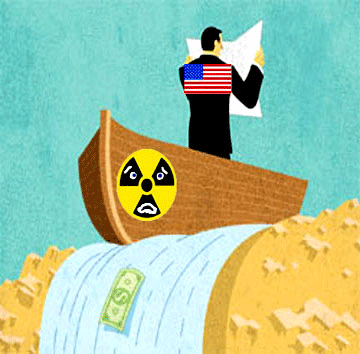 Will More Uranium Really Solve America’s Nuclear Crisis? Oil Price, By Haley Zaremba – Jun 10, 2020, “…….. Even though the United States is responsible for a whopping third of all nuclear energy production worldwide, the country is quickly losing ground as nuclear plants struggle to turn a profit. Hit hard by the influx of cheap oil and natural gas from the domestic shale revolution, the nuclear energy industry in the U.S. is now being pummeled once again by COVID-19, and this time, many experts are wondering whether the industry can weather the storm.
French nuclear watchdog demands EDF fix faults at 5 reactors
French nuclear watchdog demands EDF fix faults at 5 reactors, Montel News, MURIEL BOSELLI, Paris 10 June 20, France’s nuclear safety authority has served EDF with a formal notice to repair deviations and reinforce five reactors at its 5.4 GW Gravelines nuclear power plant by the end of October – work that would not require shutdowns.
The notice concerned deviations in five out of the plant’s six reactors. Operator EDF had already made changes to equipment around reactor 5, ASN said on Wednesday. https://www.montelnews.com/en/story/french-nuclear-watchdog-demands-edf-fix-faults-at-5-reactors/1121918
March 2011 Disaster Museum Opens in Fukushima Prefecture

May 30, 2020
Iwaki, Fukushima Pref., May 30 (Jiji Press)–A museum to pass down memories and lessons left by the March 2011 earthquake and tsunami to future generations opened on Saturday in Iwaki, Fukushima Prefecture, hit hard by the disaster.
“We’ll use it as a base to cultivate awareness for disaster prevention in order to develop a community that will be strong enough to overcome disasters,” Iwaki Mayor Toshio Shimizu said in a ceremony to celebrate the opening of the Iwaki 3.11 Memorial and Revitalization Museum.
Yukinaga Suzuki, 67, head of the local district, expressed hope that visitors will understand how tragic the disaster was through video materials and learn about it to ensure that there are no victims in the future.
Displays at the museum show the damage caused by the tsunami and how the northeastern Japan city accepted people forced to evacuate due to the triple meltdown at Tokyo Electric Power Company Holdings Inc.’s <9501> Fukushima No. 1 nuclear plant, which occurred shortly after the quake and tsunami.
The museum also displays a blackboard and desks used at a local junior high school that was demolished after being damaged in the disaster.

Federal appeals court upholds dismissal of Fukushima nuclear disaster claims
May 26, 2020
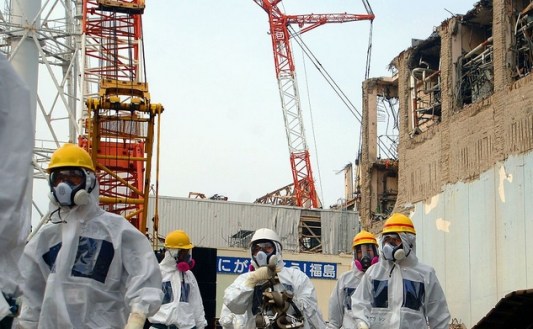
The US Court of Appeals for the Ninth Circuit on Friday rejected an appeal brought by US servicemembers seeking damages for alleged radiation exposure from the March 2011 nuclear disaster at the Fukushima Daiichi Nuclear Power Plant in Japan.
The lawsuit, filed in federal district court in California, aims to hold both Tokyo Electric Power Company (TEPCO) and General Electric (GE) liable for radiation to which the servicemembers were allegedly exposed while assisting with the humanitarian relief effort in the region. TEPCO owns and operates the Fukushima plant; GE manufactured the plant’s reactors.
Each of the companies sought dismissal of the claims against it. Citing a Japanese statute called the Act on Compensation for Nuclear Damage (Compensation Act), GE argued that only TEPCO could be held liable for the plaintiffs’ alleged injuries. TEPCO, for its part, argued that the district court lacked jurisdiction to hear the case and that even if the court had jurisdiction, international comity concerns shielded TEPCO from prosecution. The district court agreed with both companies and granted their respective motions to dismiss.
In its review of the district court’s ruling, the Ninth Circuit conducted a three-part choice-of-law analysis to determine whether the Japanese Compensation Act should be applied in the instant case. First, the court observed that the Compensation Act would limit liability exclusively to TEPCO, whereas the laws of California would allow the plaintiffs to pursue claims against GE. Moving on to the next step in the analysis, the court found that both Japan and California had a legitimate interest in the application of their respective laws. The court concluded in the third part of its analysis that Japan’s interest in protecting the Japanese nuclear industry outweighed California’s interest in ensuring compensation for injured California residents. In light of this conclusion, the Ninth Circuit affirmed the district court’s decision to dismiss the claims against GE.
Finally, the Ninth Circuit held that the district court did not abuse its discretion when it ruled that international comity concerns compelled dismissal of the remaining claims against TEPCO. Although consideration of the international comity doctrine involves several factors, the court noted in particular that the Japanese government had voiced strong opposition to continuation of the proceedings in the United States, while the US government had expressed no comparable objection to adjudication of the claims in Japan.
Fukushima’s radioactive water problem
Water should be stored at nuclear site, not dumped in the Pacific

By Linda Pentz Gunter
We are republishing this story this week, as the Japanese government is now threatening the imminent dumping of the radiologically contaminated water, stored at the Fukushima nuclear site, into the Pacific Ocean. The article below provides the background on this issue and the alternative choices. Our Japanese activist friends are urging us all to sign onto their petitions — there is one for groups to sign and one for individuals — asking the Japanese government not to dump 1.2 million cubic meters of radioactive water into the ocean. Japan civil society groups and Fukushima fishing unions are strongly opposed to this needless ocean discharge. Groups please sign here. Individuals please sign here.
Original article, published September 15, 2019, follows:
Last week, Japan’s then environment minister, Yoshiaki Harada, made news with a pronouncement that wasn’t news. The storage tanks at the stricken Fukushima Daiichi nuclear site, filled with radioactive water, were reaching capacity. By 2022 there would be no room for more tanks on the present site. Japan would then have to dump the radioactive water stored in the tanks into the Pacific Ocean, he said.
Although likely unrelated to those remarks, a day later, Prime Minister Shinzo Abe dispatched 19 of his cabinet ministers, including Harada. Harada was replaced as environment minister by rising star, Shinjiro Koizumi, the son of former primer minister, Junichiro Koizumi. Both father and son are opposed to nuclear energy, and on his first day in office, the younger Koizumi told reporters that he believed Japan should end its use of nuclear energy and close its nuclear power plants.
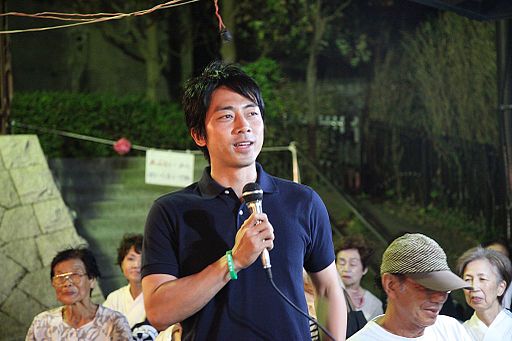 Shinjiro Koizumi, Japan’s new environment minister, says Japan should cease using nuclear power.
“I would like to study how we scrap them, not how to retain them,” Reuters reported him saying. This is a surprising position from someone inside the fervently pro-nuclear Abe government and it remains to be seen whether he will be allowed to translate his position into policy.
Dumping Fukushima Daiichi’s accumulated radioactive water has long been the plan proposed by Tepco, the site owner. Fukushima fishermen, along with some scientists and a number of NGOs from around the world, continue to object.
We addressed this issue briefly on a recent TRT broadcast (see video below).
Cooling water is needed at the Fukushima site because, when Units 1, 2 and 3 lost power, they also lost the flow of reactor coolant, causing their cores to overheat. The fuel rods then melted, and molten fuel dripped down and burned through the pressure vessels, pooling in the primary containment vessels. Units 1, 3 and 4 also suffered hydrogen explosions. Each day, about 200 metric tons of cooling water is used to keep the three melted cores cool, lest they once more go critical. Eventually the water becomes too radioactive and thermally hot to be re-used, and must be discarded and stored in the tanks.
As Greenpeace International (GPI) explained in remarks and questions submitted during a consultative meeting held by the International Maritime Organization in August 2019:
“Since 2011, in order to cool the molten cores in the Tokyo Electric Power Company Fukushima Daiichi reactor units 1-3, water is continuously pumped through the damaged Reactor Pressure Vessels (RPVs) and circulated through reactor buildings, turbine buildings, the Process Main Building and the “High Temperature Incinerator Building” and water treatment systems.
“As a result, the past eight years has seen a relentless increase in the volume of radioactive contaminated water accumulating on site. As of 4 July 2019, the total amount of contaminated water held in 939 storage tanks at the Fukushima Daiichi plant (units 1-4) was 1,145,694 m3 (tonnes). The majority of this, 1,041,710 m3, is contaminated processed water. In the year to April 2019, approximately 180 m3/day of water was being circulated into the RPVs of units 1-3.”
In addition to the cooling water, the tanks also house water that has run down from the nearby mountains, at a rate of about 100 tons each day. This water flows onto the site and seeps into the reactor buildings. There, it becomes radioactively contaminated and also must be collected and stored, to prevent it from flowing on down into the sea.
The water tank crisis is just one of multiple and complex problems at the Fukushima Daiichi site, including the eventual need to extract the molten fuel debris from inside the stricken reactors. Decommissioning cannot begin until the water storage tanks are removed.
Tepco has tried to mitigate the radioactive water problem in a number of ways. The infamous $320 million ice wall was an attempt to freeze and block inflow, but has had mixed results and has worked only intermittently. Wells were dug to try to divert the runoff water so it does not pick up contamination. The ice wall has reportedly reduced the flow of groundwater somewhat, but only down from 500 tons a day to about 100 tons.
In anticipation of dumping the tank water into the Pacific Ocean, Tepco has deployed an Advanced Liquid Processing System that the company claims can remove 62 isotopes from the water — all except tritium, which is radioactive hydrogen and therefore cannot be filtered out of water. (Tritium is routinely discharged by operating commercial nuclear power plants).
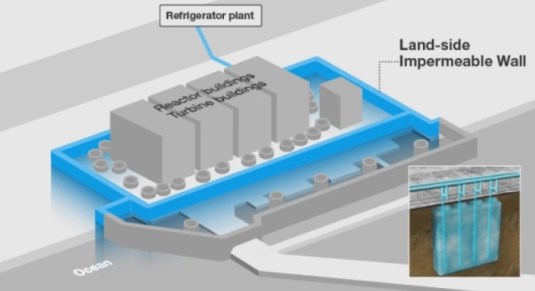 Tepco’s “Land-side Impermeable Wall” (Frozen soil wall).
But, like the ice wall, the filtration system has also been plagued by malfunctions. According to GPI, Tepco admitted only last year that the system had “failed to reduce radioactivity to levels below the regulatory limit permissible for ocean disposal” in at least 80% of the tanks’ inventory. Indeed, said GPI, “the levels of Strontium-90 are more than 100 times the regulatory standard according to TEPCO, with levels at 20,000 times above regulations in some tanks.”
The plan to dump the water has raised the ire of South Korea, whose fish stocks would likely also be contaminated. And it has introduced the question of whether such a move is a violation of The Conventions of the Rights of the Child and the Universal Declaration of Human Rights, as was raised in a joint written statement by the International Association of Democratic Lawyers and Greenpeace International, before the UN Human Rights Council currently in session.
So what else could or should Tepco do, if not dump the water offshore and into the ocean? A wide consensus amongst scientific, environmental and human rights groups is that on-site storage for the indefinite future is the only acceptable option, while research must continue into possible ways to extract all of the radioactive content, including tritium.
Meanwhile, a panel of experts says it will examine a number of additional but equally problematic choices, broadly condensed into four options (each with some variations — to dilute or not to dilute etc):
- Ground (geosphere) injection (which could bring the isotopes in contact with groundwater);
- Vapor release (which could infiltrate weather patterns and return as fallout);
- Releasing it as hydrogen (it would still contain tritium gas); and
- Solidification followed by underground burial (for which no safe, permanent storage environment has yet been found, least of all in earthquake-prone Japan).
Arnie Gundersen of Fairewinds, recommends a chemical injection processes (drilling mud) — also used by the oil industry — to stop the flow of water onto the site entirely. But he says Japan has never considered this option. GPI contends that Japan has never seriously researched any of the alternatives, sticking to the ocean dumping plan, the cheapest and fastest “fix.”
All of this mess is of course an inevitable outcome of the choice to use nuclear power in the first place. Even without an accident, no safe, permanent storage solution has been found for the high-level radioactive waste produced through daily operation of commercial nuclear power plants, never mind as the result of an accident.
According to Dr. M.V. Ramana, by far the best solution is to continue to store the radioactive water, even if that means moving some of the storage tanks to other locations to make more room for new ones at the nuclear site. The decision to dump the water, Ramana says, is in line with Abe’s attempts to whitewash the scene before the 2020 Tokyo Olympics and claim, as he has publicly in the past, that everything at Fukushima is “under control.” (Baseball and softball games will be played in Fukushima Prefecture and the torch relay will start there, all in an effort to pretend there are no dangerous nuclear after-effects remaining in the area.)
“The reason that they keep saying they need to release it is because they might have to move some of this offsite and that goes against the Abe government’s interest in creating the perception that Fukushima is a closed chapter,” Ramana wrote in an email. “So it is a political decision rather than a technical one.”
As with all things nuclear, there are diverging views on the likely impact to the marine environment and to human health, from dumping Fukushima’s radioactive water into the ocean. These run the gamut from “a little tritium won’t hurt you” to “the Pacific Ocean is dead thanks to Fukushima” — both of which are wildly untrue. (Tritium can bind organically inside the body, irradiating that person or animal from within. The many problems in the Pacific began long before Fukushima and are likely caused by numerous compounding factors, including warming and pollution, with Fukushima adding to the existing woes.)
 The effect on deep sea creatures of radioactive ocean dumping could be long-lasting.
What is fact, however, is that scientists have found not only the presence of isotopes such as cesium in fish they tested, but also in ocean floor sediment. This latter has the potential to serve as a more long-term source of contamination up the food chain.
But it is also important to remember that if this radioactive water is dumped, it is not an isolated event. Radioactive contamination in our oceans is already widespread, a result of years of atmospheric atomic tests. As was reported earlier this year, scientists studying deep-sea amphipods, retrieved from some of the deepest trenches in the ocean — including the Mariana Trench which reaches 36,000 feet below sea-level and is deeper than Mount Everest is high — detected elevated levels of carbon-14 in these creatures.
“The levels closely matched abundances found near the surface of the ocean, where the amount of carbon-14 is higher than usual thanks to nuclear bomb tests conducted more than half a century ago,” reported Smithsonian Magazine.
Weidong Sun, co-author of the resulting study, told Smithsonian Magazine that “Biologically, [ocean] trenches are taken to be the most pristine habitats on Earth”.
How chilling, then, to realize that our radioactive irresponsibility has reached the lowest depths, affecting creatures far removed from our rash behaviors.
Consequently, the decision by the Japanese government to release yet more radioactive contamination into our oceans must be viewed not as a one-off act of desperation, but as a contribution to cumulative contamination. This, added to the twin tragedies of climate crisis-induced ocean warming and plastics and chemicals pollution, renders it one more crime committed on the oceans, ourselves and all living things. And it reinforces the imperative to neither continue nor increase our reckless use of nuclear power as an electricity source.
Why the Japanese government’s plan to dump radioactive water into the ocean needs to be stopped.
1 This Month
23 April – WEBINAR – Why new nuclear reactors are the wrong tools for decarbonization Thursday, April 23 • 1 AM – 2 AM AEST
World Nuclear Power. Reactors 1951-2026, 75 Years of Nuclear Power.
Interactive Map– https://dv.worldnuclearreport.org/

Chernobyl: The Lost Tapes – A good documentary on Chernobyl on SBS available On Demand for the next 3 weeks– https://www.sbs.com.au/ondemand/tv-program/chernobyl-the-lost-tapes/2352741955560

of the week–London Campaign for Nuclear Disarmament


Tell the Ukrainian Government to Drop Prosecution of Peace Activist Yurii Sheliazhenko
To see nuclear-related stories in greater depth and intensity – go to https://nuclearinformation.wordpress.com
-
Archives
- April 2026 (231)
- March 2026 (251)
- February 2026 (268)
- January 2026 (308)
- December 2025 (358)
- November 2025 (359)
- October 2025 (376)
- September 2025 (257)
- August 2025 (319)
- July 2025 (230)
- June 2025 (348)
- May 2025 (261)
-
Categories
- 1
- 1 NUCLEAR ISSUES
- business and costs
- climate change
- culture and arts
- ENERGY
- environment
- health
- history
- indigenous issues
- Legal
- marketing of nuclear
- media
- opposition to nuclear
- PERSONAL STORIES
- politics
- politics international
- Religion and ethics
- safety
- secrets,lies and civil liberties
- spinbuster
- technology
- Uranium
- wastes
- weapons and war
- Women
- 2 WORLD
- ACTION
- AFRICA
- Atrocities
- AUSTRALIA
- Christina's notes
- Christina's themes
- culture and arts
- Events
- Fuk 2022
- Fuk 2023
- Fukushima 2017
- Fukushima 2018
- fukushima 2019
- Fukushima 2020
- Fukushima 2021
- general
- global warming
- Humour (God we need it)
- Nuclear
- RARE EARTHS
- Reference
- resources – print
- Resources -audiovicual
- Weekly Newsletter
- World
- World Nuclear
- YouTube
-
RSS
Entries RSS
Comments RSS
 nuclear-news