Yoshida’s Dilemma: if it wasn’t for one man, it could have been much worse

Street Artist 281_Antinuke Uses Art for His Message
“I feel immense pain, and my art is how I scream.” This man uses street art to remind people that Fukushima’s nuclear disaster is far from over.
An Interview with 281_Anti Nuke
October 1, 2013
The stickers went up a few months after Japan’s triple disaster in 2011—an earthquake and tsunami that took twenty thousand lives, and an ongoing nuclear crisis that threatens more. They first appeared along the shabby backstreets of Shibuya, in downtown Tokyo, a place that offers some of the very few canvasses for graffiti in a city not given to celebrating street art. The British expat photographer and filmmaker Adrian Storey couldn’t ignore them. “Being a foreigner, there was a sort of brief period after 3/11 when there was this sense of community in Tokyo that I haven’t felt before,” Storey says. “Then it kind of went away, and people just went back to shopping. I was drawn to the stickers because I realized it was a Japanese person behind them, and they actually cared about what was happening. I started photographing every sticker I found.”
Some stickers are small, eight inches or so in height. Others are the size of a stunted adult or a large child. In fact, children are featured in many of them, especially the motif of a young girl in a raincoat above the caption “I hate rain,” with the trefoil symbol for radiation stamped between “hate” and “rain.” On other stickers, silhouettes of the bombs dropped on Hiroshima and Nagasaki are suspended in white space beside the logo for the Tokyo Electric Power Company, the government-allied conglomerate responsible for the operation and maintenance of the severely damaged Fukushima nuclear power plants. Sometimes the stark black lines and blotches resemble Rorschach tests. You look and see nothing, then look again and see Japanese Prime Minister Shinzo Abe’s face, his mouth suffocated by an American flag.
The artist behind them calls himself 281_Anti Nuke, and he has become a cult phenomenon among Tokyo locals. The numerals refer to an athletic jersey he wore in high school. “It’s just nostalgia,” he says. “Memories of my happier times.” Tagged as the “Japanese Banksy,” he is an unlikely manifestation of Japan’s shredded identity: a contemporary artist of dissent in a country that rarely tolerates protest and barely supports modern art. His real name is Kenta Matsuyama, though few Japanese know that, since it appears only in the fine print on his manager’s English-language Web site. He is a fortysomething father born and raised near Fukushima, the site of Japan’s most pressing nuclear disaster. We meet in the heart of Shibuya, in a second-story café overlooking the most famous intersection in Japan—a crowded network of diagonal crosswalks that is featured in nearly every film set in Tokyo.
We are hiding in plain sight. “These people,” he says, gesturing toward the window and the masses below, “they only vote for the winner; they only think about the winner. They have no concept of real strength. They feel satisfied just knowing that the party they voted for won.” (That party, the archconservative, U.S.-friendly, and pro-nuclear Liberal Democratic Party, crows about a mandate after sweeping recent elections.) He is wearing a tight-fitting gray hoodie, pitch-black jeans and sunglasses, and a white surgical mask. It’s not always easy to hear him through the mask, so he tugs it down a bit when his speech quickens in anger. “Maybe it’s true that there’s no political party you can count on, but it’s more than that. It’s fear. It’s Japanese people never doubting their leaders. Looking out at Shibuya, I’m sure that nobody out there remembers the idea of radiation anymore. People abroad know more about the crisis in Fukushima than the Japanese. The Japanese are trying to forget. I want to make them remember.”
Anti Nuke is an active Twitter user, but when he first started posting his art, he received death threats so virulent that last year he temporarily took down his Twitter and Facebook accounts and started hiding all of his personal information. Even now, his Web site is often hacked. In public, when he is not cloaked by hoodie, sunglasses, and mask, he wears a full-body hazmat suit. As for his method: “Stickers are better than graffiti,” he says, “because they are faster to apply. You just stick them on and run off. And I use very simple English to be direct, without nuances. Like, ‘I hate rain.’ In Japanese, it’s ‘Watashi wa ame ga kirai.’ So in Japanese, you really need to talk about who hates rain, and why, and in what context. But in English it’s more iconic. There’s more room for the imagination, and that’s powerful.”
281_Anti Nuke’s work is about to reach more people via exhibitions in the New York and Los Angeles, and a documentary film about his art directed by Storey will début in festivals next year. “His mission is personal,” says Storey. “He wants people to think about the same things he’s thinking about, but, like he said to me many times, it’s about the future of his children. It’s the future of everybody’s children in Japan. He doesn’t want to make a name for himself.”
Perhaps. But donning hoodies, shades, and surgical masks, not to mention the occasional hazmat suit, is an odd strategy for anonymity. “It’s fine if I become famous if it helps communicate this huge problem,” Anti Nuke concedes. “There are bigger problems in Fukushima than we know now. I’m sure of that. I’ve communicated with people there. I have family there. The Japanese government will not save them, and since the survivors cannot escape, Fukushima people hate Tokyo people for the electricity they use and cannot conserve.”
He insists that he is not anti-American, just pro-truth. “I love the American people, but I want them to help save Japan. This time, it’s the Japanese people who are to blame. We’re not aware, and we are actively trying to forget. We need foreigners to save us from ourselves.”
http://www.newyorker.com/culture/culture-desk/an-interview-with-281_anti-nuke
https://fr.pinterest.com/0xf2xv5378195w/281_antinuke/
Real cost of Fukushima disaster to reach $626 billion. Think tank estimate triple that of government

A Tokyo-based think tank estimates that the complete cost of dealing with the Fukushima disaster could reach ¥70 trillion.
Fukushima nuclear disaster aftermath cost estimated at Y70 trillion
TOKYO —The total cost to deal with the Fukushima Daiichi nuclear plant disaster has been estimated at 70 trillion yen ($626 billion), over three times more than the government calculation, a study by a private think tank showed Saturday.
The Japan Center for Economic Research said total costs at the Fukushima nuclear complex operated by Tokyo Electric Power Company Holdings Inc could rise to between 50 trillion and 70 trillion yen. It compares with the roughly 22 trillion yen a government panel estimated in December.
“If costs rise, the public burden could greatly increase. The country’s nuclear policy needs to be reviewed,” the JCER said.
Initially in the wake of the Fukushima disaster, the government expected the costs to total 11 trillion.
But a study by the Ministry of Economy, Trade and Industry showed the figure could be double the sum estimated in 2013.
Following that, the government decided to raise electricity rates to secure the money necessary to cover compensation payments, increasing the national burden.
Among the costs, the bill for compensation has been estimated at 8 trillion yen by the ministry. The JCER also adopted the figure.
The JCER, however, estimated costs for decontamination work at 30 trillion yen, compared with the government’s figure of 6 trillion yen, after the think tank made a calculation under a presumption that radioactive substances are disposed of at a facility in Rokkasho village in Aomori Prefecture.
The government is seeking a way to treat waste in Fukushima Prefecture, including radioactive soil, of which the amount could add up to roughly 22 million cubic meters, but where and how it will be disposed of has yet to be decided. Costs related to the procedure are not included in the government’s calculation.
Costs for decommissioning crippled reactors, which is expected to take 30 to 40 years, were estimated by the center at 11 trillion yen, compared with the government’s 8 trillion yen.
Expenses to treat contaminated water that remains in tanks at the plant were estimated by the center at 20 trillion yen unless the toxic water is released in the ocean after being diluted as nuclear regulation authorities recommend.
Real cost of Fukushima disaster will reach ¥70 trillion, or triple government’s estimate: think tank
A private think tank says the total cost of the Fukushima disaster could reach ¥70 trillion ($626 billion), or more than three times the government’s latest estimate.
In a study Saturday, the Japan Center for Economic Research said costs of dealing with the heavily damaged Fukushima No. 1 nuclear plant run by Tokyo Electric Power Company Holdings Inc. could rise to between ¥50 trillion and ¥70 trillion.
In December, the government estimated the costs would reach roughly ¥22 trillion.
“If costs rise, the public burden could greatly increase. The country’s nuclear policy needs to be reviewed,” JCER said.
The government’s initial expectations pegged the costs at ¥11 trillion.
But a study by the Ministry of Economy, Trade and Industry said that the final figure could turn out to be double the sum estimated in 2013.
Following that, the government decided to raise electricity rates to secure the money needed to cover compensation payments to the evacuees.
According to METI’s estimates, the bill for compensation payments will be ¥8 trillion, a figure the JCER decided to adopt.
The JCER, however, estimates the cost of the decontamination work will hit ¥30 trillion, or five times more than the government’s estimate of ¥6 trillion. The think tank based this calculation on a presumption that radioactive substances will be disposed of at a nuclear facility in the village of Rokkasho in Aomori Prefecture.
The government is seeking a way to treat radioactive soil and other waste in Fukushima Prefecture that could grow to roughly 22 million cu. meters, but where and how to dispose of it has yet to be decided.
Costs related to this procedure are not included in the government’s calculations.
In the meantime, JCER estimates that the cost of decommissioning the crippled reactors, which is expected to take 30 to 40 years, will reach ¥11 trillion. The government’s estimate is ¥8 trillion.
JCER also estimates that treating the contaminated water stored in hundreds of tanks at the plant will cost ¥20 trillion unless it is dumped into the ocean after being diluted as recommended by regulators.
Fukushima Bill

Six years after Japan’s Fukushima nuclear disaster, Westinghouse and Toshiba join Tokyo Electric Power in a fight for survival.
Six years after Japan’s Fukushima nuclear accident three global nuclear corporations are fighting for their very survival.
The bankruptcy filing by Westinghouse Electric Co. and its parent company Toshiba Corp. preparing to post losses of ¥1 trillion (US$9 billion), is a defining moment in the global decline of the nuclear power industry.
However, whereas the final financial meltdown of Westinghouse and Toshiba will likely be measured in a few tens of billions of dollars, those losses are but a fraction of what Tokyo Electric Power Co. (Tepco) is looking at as a result of the Fukushima nuclear disaster.
If the latest estimates for the cost of cleaning up the Fukushima plant prove accurate, Tepco faces the equivalent of a Toshiba meltdown every year until 2087.
In November 2016, the Japanese Government announced a revised estimate for the Fukushima nuclear accident (decommissioning, decontamination, waste management and compensation) of ¥21.5 trillion (US$193 billion) – a doubling of their estimate in 2013.
But the credibility of the government’s numbers have been questioned all along, given that the actual ‘decommissioning’ of the Fukushima plant and its three melted reactors is entering into an engineering unkown.
This questioning was borne out by the November doubling of cost estimates after only several years into the accident, when there is every prospect Tepco will be cleaning up Fukushima well into next century.
And sure enough, a new assessment published in early March from the Japan Institute for Economic Research, estimates that total costs for decommissioning, decontamination and compensation as a result of the Fukushima atomic disaster could range between ¥50-70 trillion (US$449-628 billion).
Rather than admit that the Fukushima accident is effectively the end of Tepco as a nuclear generating company, the outline of a restructuring plan was announced last week.
Tepco Holdings, the entity established to manage the destroyed nuclear site, and the Nuclear Damage Compensation and Decommissioning Facilitation Corporation (NDF) are seeking ways to sustain the utility in the years ahead, confronted as they are with escalating Fukushima costs and electricity market reform.
The NDF, originally established by the Government in 2011 to oversee compensation payments and to secure electricity supply, had its scope broadened in 2014 to oversee decommissioning of the Fukushima Daiichi plant on the Pacific Ocean coast north of Tokyo.
The latest restructuring plan is intended to find a way forward for Tepco by securing a future for its nuclear, transmission and distribution businesses. If possible in combination with other energy companies in Japan.
But the plan, already received less than warmly by other utilities rightly concerned at being burdened with Tepco’s liabilities, is premised on Fukushima cost estimates of ¥21.5 trillion — not ¥50-70 trillion.
To date Tepco’s Fukushima costs have been covered by interest-free government loans, with ¥6 trillion (US$57 billion) already paid out. Since 2012 Tepco’s electricity ratepayers have paid ¥2.4 trillion to cover nuclear-related costs, including the Fukushima accident site.
That is nothing compared to the costs looming over future decades and beyond and it comes at a time when Tepco and other electric utilities are under commercial pressure as never before.
The commercial pressure comes from electricity market reform that since April 2016 allowed consumers to switch from the monopoly utilities to independent power providers.
Prior to the deregulation of the retail electricity market, Tepco had 22 million customers. As the Tepco president observed late last year “The number (of customers leaving Tepco) is changing every day as the liberalization continues … We will of course need to think of ways to counter that competition.”
Countering that competition shouldn’t mean rigging the market, yet Tepco and the other utilities intend to try and retain their decades long dominance of electricity by retaining control over access to the grid. This is a concerted push back against the growth of renewable energy.
Current plans to open the grid to competition in 2020, so called legal unbundling, are essential to wrest control from the big utilities.
The message of unbundling and independence, however, doesn’t seem to have reached the Ministry of Economy, Trade and Industry (METI) that oversees the electricity industry.
Current plans would allow Tepco to establish separate legal entities: Tepco Fuel & Power (thermal power generation), Tepco Energy Partner (power distribution) and Tepco Power Grid (power transmission).
Tepco Holdings will retain their stock and control their management, meaning the same monopoly will retain control of the grid. Where Tepco leads, the other nine electric utilities are aiming to follow.
Leaving the grid effectively still under the control of the traditional utilities will throw up a major obstacle to large scale expansion of renewable energy sources from new companies.
Such businesses will be ‘curtailed’ or stopped from supplying electricity to the grid when the large utilities decide it’s necessary, justified for example to maintain the stability of the grid.
The fact that ‘curtailment’ will be permitted in many regions without financial compensation piles further pain onto new entrants to the electricity market, and by extension consumers.
Further, METI plans to spread the escalating costs of Fukushima so that other utilities and new power companies pay a proportion of compensation costs. METI’s justification for charging customers of new energy companies is that they benefited from nuclear power before the market opened up.
The need to find someone else to pay for Tepco’s mess is underscored by the breakdown of the Fukushima disaster cost estimate in November.
When put at ¥22 trillion estimate, ¥16 trillion is supposed to be covered by Tepco. The Ministry of Finance is to offer ¥2 trillion for decontamination, and the remaining ¥4 trillion is to be provided by other power companies and new electricity providers.
The question is how does Tepco cover its share of the costs when it’s losing customers and its only remaining nuclear plant in Japan, Kashiwazaki Kariwa (the worlds largest), has no prospect of restarting operation due to local opposition?
What happens when Fukushima costs rise to the levels projected of ¥50-70 trillion?
The policy measures being put in place by Tepco, other utilities and the government suggests that they know what is coming and their solution for paying for the world’s most costly industrial accident will be sticking both hands into the public purse,
http://www.atimes.com/article/tepcos-fukushima-expensive-industrial-accident-history/
Tepco’s Fukushima: the most expensive industrial accident in history

(MENAFN – Asia Times) Six years after Japan’s Fukushima nuclear accident three global nuclear corporations are fighting for their very survival.
The bankruptcy filing by Westinghouse Electric Co. and its parent company Toshiba Corp. preparing to post losses of 1 trillion (US9 billion), is a defining moment in the global decline of the nuclear power industry.
However, whereas the final financial meltdown of Westinghouse and Toshiba will likely be measured in a few tens of billions of dollars, those losses are but a fraction of what Tokyo Electric Power Co. (Tepco) is looking at as a result of the Fukushima nuclear disaster.
The DailyBrief Must-reads from across Asia – directly to your inbox
If the latest estimates for the cost of cleaning up the Fukushima plant prove accurate, Tepco faces the equivalent of a Toshiba meltdown every year until 2087.
In November 2016, the Japanese Government announced a revised estimate for the Fukushima nuclear accident (decommissioning, decontamination, waste management and compensation) of 21.5 trillion (US193 billion) – a doubling of their estimate in 2013.
But the credibility of the government’s numbers have been questioned all along, given that the actual ‘decommissioning’ of the Fukushima plant and its three melted reactors is entering into an engineering unkown.
This questioning was borne out by the November doubling of cost estimates after only several years into the accident, when there is every prospect Tepco will be cleaning up Fukushima well into next century.
And sure enough, a new assessment published in early March from the Japan Institute for Economic Research, estimates that total costs for decommissioning, decontamination and compensation as a result of the Fukushima atomic disaster could range between 50-70 trillion (US449-628 billion).
If confirmed over the coming years, it will be the most expensive industrial accident in history with even greater implications for the people and energy future of Japan.
Rather than admit that the Fukushima accident is effectively the end of Tepco as a nuclear generating company, the outline of a restructuring plan was announced last week.
Tepco Holdings, the entity established to manage the destroyed nuclear site, and the Nuclear Damage Compensation and Decommissioning Facilitation Corporation (NDF) are seeking ways to sustain the utility in the years ahead, confronted as they are with escalating Fukushima costs and electricity market reform.
The NDF, originally established by the Government in 2011 to oversee compensation payments and to secure electricity supply, had its scope broadened in 2014 to oversee decommissioning of the Fukushima Daiichi plant on the Pacific Ocean coast north of Tokyo.
The latest restructuring plan is intended to find a way forward for Tepco by securing a future for its nuclear, transmission and distribution businesses. If possible in combination with other energy companies in Japan.
Map of Japan’s nuclear plants. Photo: Japan Atomic Industries Forum Inc, 2016.
But the plan, already received less than warmly by other utilities rightly concerned at being burdened with Tepco’s liabilities, is premised on Fukushima cost estimates of 21.5 trillion — not 50-70 trillion.
To date Tepco’s Fukushima costs have been covered by interest-free government loans, with 6 trillion (US57 billion) already paid out. Since 2012 Tepco’s electricity ratepayers have paid 2.4 trillion to cover nuclear-related costs, including the Fukushima accident site.
That is nothing compared to the costs looming over future decades and beyond and it comes at a time when Tepco and other electric utilities are under commercial pressure as never before.
The commercial pressure comes from electricity market reform that since April 2016 allowed consumers to switch from the monopoly utilities to independent power providers.
In the ten months to February 2017, the main electric utilities lost 2.5 million customers, with Tepco alone losing more than 1.44 million. Hence, profits have fallen off a cliff.
Prior to the deregulation of the retail electricity market, Tepco had 22 million customers. As the Tepco president observed late last year “The number (of customers leaving Tepco) is changing every day as the liberalization continues … We will of course need to think of ways to counter that competition.”
Countering that competition shouldn’t mean rigging the market, yet Tepco and the other utilities intend to try and retain their decades long dominance of electricity by retaining control over access to the grid. This is a concerted push back against the growth of renewable energy.
Current plans to open the grid to competition in 2020, so called legal unbundling, are essential to wrest control from the big utilities.
The message of unbundling and independence, however, doesn’t seem to have reached the Ministry of Economy, Trade and Industry (METI) that oversees the electricity industry.
Current plans would allow Tepco to establish separate legal entities: Tepco Fuel & Power (thermal power generation), Tepco Energy Partner (power distribution) and Tepco Power Grid (power transmission).
Tepco Holdings will retain their stock and control their management, meaning the same monopoly will retain control of the grid. Where Tepco leads, the other nine electric utilities are aiming to follow.
Leaving the grid effectively still under the control of the traditional utilities will throw up a major obstacle to large scale expansion of renewable energy sources from new companies.
Such businesses will be ‘curtailed’ or stopped from supplying electricity to the grid when the large utilities decide it’s necessary, justified for example to maintain the stability of the grid.
The fact that ‘curtailment’ will be permitted in many regions without financial compensation piles further pain onto new entrants to the electricity market, and by extension consumers.
Further, METI plans to spread the escalating costs of Fukushima so that other utilities and new power companies pay a proportion of compensation costs. METI’s justification for charging customers of new energy companies is that they benefited from nuclear power before the market opened up.
The need to find someone else to pay for Tepco’s mess is underscored by the breakdown of the Fukushima disaster cost estimate in November.
When put at 22 trillion estimate, 16 trillion is supposed to be covered by Tepco. The Ministry of Finance is to offer 2 trillion for decontamination, and the remaining 4 trillion is to be provided by other power companies and new electricity providers.
The question is how does Tepco cover its share of the costs when it’s losing customers and its only remaining nuclear plant in Japan, Kashiwazaki Kariwa (the worlds largest), has no prospect of restarting operation due to local opposition?
What happens when Fukushima costs rise to the levels projected of 50-70 trillion?
The policy measures being put in place by Tepco, other utilities and the government suggests that they know what is coming and their solution for paying for the world’s most costly industrial accident will be sticking both hands into the public purse.
Shaun Burnie is a senior nuclear specialist with Greenpeace Germany, Tokyo. He has worked on nuclear issues worldwide for more than three decades, including since 1991 on Japan’s nuclear policy.
http://menafn.com/1095358564/Tepcos-Fukushima-the-most-expensive-industrial-accident-in-history
Study: S. Korean nuclear disaster would hit Japan the hardest

The projected spread of radioactive cesium-137 from a disaster at the No. 3 reactor’s spent fuel pool of the Kori nuclear plant in Busan, South Korea (Provided by Kang Jung-min)
A serious nuclear accident in South Korea could force the evacuation of more than 28 million people in Japan, compared with around 24 million in the home country of the disaster.
Japan would also be hit harder by radioactive fallout than South Korea in such a disaster, particularly if it occurred in winter, when strong westerly winds would blow radioactive substances across the Sea of Japan, according to a simulation by the Natural Resources Defense Council, a Washington-based think tank.
The simulation, based on a scenario of an unfolding crisis at the Kori nuclear power plant in Busan, South Korea, was led by Kang Jung-min, a South Korean senior researcher of nuclear physics, and his colleagues.
At events in Japan and South Korea, Kang, 51, has repeatedly warned about East Asia’s vulnerability to a severe nuclear accident, saying the region shares the “same destiny” regardless of the location of such a disaster.
The Kori nuclear complex is home to seven of the country’s 25 commercial reactors, making it one of the largest in South Korea. Its oldest reactor–and the first in the country–went online in 1978.
Spent nuclear fuel at the Kori plant is cooled in on-site storage pools next to reactors.
But the operator of the plant has ended up storing spent fuel in more cramped conditions than in the past because waste keeps accumulating from the many years of operations.
An estimated 818 tons of spent fuel was being stored at the pool of the Kori No. 3 reactor as of the end of 2015, the most at any reactor in the country.
That is because the No. 3 pool has also been holding spent fuel from the No. 1 and No. 2 reactors since their fuel pools became too crowded.
Storing spent fuel in such a manner greatly increases the risk of a nuclear accident, Kang warned.
Kang’s team simulated the series of likely events that would follow if the No. 3 reactor lost power in a natural disaster or an act of terrorism.
With no power, the spent fuel at the No. 3 reactor could not be cooled. The cooling water would evaporate, exposing the fuel rods to air, generating intensive heat and causing a fire.
Hydrogen gas would then fill up the fuel storage building, leading to an explosion that would result in the release of a large amount of vaporized cesium-137 from the spent fuel.
Assuming that the catastrophe occurred on Jan. 1, 2015, the researchers determined how highly radioactive cesium-137 would spread and fall to the ground based on the actual weather conditions over the following week, as well as the direction and velocity of winds.
To gauge the size of the area and population that would be forced to evacuate in such a disaster, the team took into account recommendations by the International Commission on Radiological Protection, a private entity, and other organizations.
The results showed that up to 67,000 square kilometers of land in Japan–or much of the western part of the country–would fall under the evacuation zone, displacing a maximum of 28.3 million people.
In South Korea, up to 54,000 square kilometers would need to be vacated, affecting up to 24.3 million people.
The simulation also found that 18.4 million Japanese and 19 million Koreans would remain displaced for even after 30 years, the half-life of cesium-137, in a worst-case scenario.
Radioactive materials from South Korea would also pollute North Korea and China, according to the study.
Nineteen reactors in South Korea are located in the coastal area facing the Sea of Japan, including those at the Kori nuclear power plant.
Kang said the public should be alerted to the dangers of highly toxic spent fuel, an inevitable byproduct of nuclear power generation.
One ton of spent fuel contains 100,000 curies of cesium-137, meaning that 20 tons of spent fuel would be enough to match the estimated 2 million curies of cesium-137 released in the 1986 Chernobyl disaster.
An average-size light-water reactor produces about 20 tons of spent fuel in one year of operation.
East Asia is home to one of the world’s largest congestions of nuclear facilities, Kang said.
Japan, China and South Korea, which have all promoted nuclear energy as state policy for decades, together host about 100 commercial reactors.
A number of nuclear-related facilities are also concentrated in North Korea, particularly in Yongbyon, north of Pyongyang.
If a severe accident were to occur in China, the pollution would inevitably spill over to South Korea and then to Japan.
“That is why people should take serious interest in not just their own country’s nuclear issues, but also in neighboring countries,” Kang said. “Japan, China and South Korea should cooperate with each other to ensure the safety and security of spent fuel and nuclear facilities.”
He said the risks of a fire would be reduced if spent fuel were placed at greater intervals in storage pools.
“Ideally, spent fuel should be moved to sealed dry casks and cooled with air after it is cooled in a pool for about five years,” he said.
Nuclear Energy Has No Future in Japan, Former PM Says

Former Japanese prime minister Naoto Kan speaking at his lecture “The Truth about the Nuclear Disaster in Fukushima and the Future of Renewable Energy” on Tuesday at Statler Auditorium.
About a year after taking office in 2010, Naoto Kan, the prime minister of Japan at the time, had his worst nuclear nightmare.
Once the Great East Japan Earthquake hit, a tsunami followed and led to the meltdown of the Fukushima Daiichi nuclear plant.
Kan detailed his reaction to the meltdown and the reasons behind his drastic change in position — from strong support of nuclear power to opposing its use — at a packed Statler Auditorium on Tuesday.
While Japanese politicians have extensive experience responding to earthquakes and tsunamis, no one knew how to respond to an accident of this scale and the response mechanism was underprepared, Kan said.
“Not a single person could shed light on what its consequences might be,” he said in Japanese at Tuesday’s lecture, a transcript of which was provided to The Sun.
While the Nuclear and Industrial Safety Agency was built to equip the prime minister with specialized knowledge of nuclear disasters, Kan was surprised to learn that the director-general of NISA was a Tokyo University graduate with a degree in economics.
“How can we fathom the appointment of an economist to be director-general of an agency charged with responding to nuclear accidents?” Kan asked.
What was clear to Kan, however, having majored in applied physics at the Tokyo Institute of Technology, was that it would quickly become an unprecedented disaster.
“I knew that if the cooling systems were disabled, a meltdown would occur,” he said.
Realizing that even the electricity company known as Tokyo Electric Power Company that was responsible for the power plant did not have a grasp on the exact situation, Kan braced the dangers and made a personal visit to the disaster site himself on the morning after the incident.
“I went to Fukushima because I felt that I would need to have an accurate knowledge of the situation at the power plant to determine the radius of evacuation,” he said.
The week following the disaster, a series of accidents occurred: Three reactors had experienced hydrogen explosions.
Goshi Hosono, his special advisor, informed Kan about multiple “worst-case scenarios” — including the need for a forced evacuation within a 170-kilometer radius of the site and a voluntary evacuation within 250 kilometers.
Tokyo was within that range.
That plan involved the evacuation of an unprecedented 50 million people.
“Unimaginable hardship and confusion would ensue,” he said. “Yet there was nothing imaginary about this forecast. We were a hair’s breadth away from this actuality.”
While Japan had lost about 30 of its firefighters at the site during the week, Kan was shocked by TEPCO’s simultaneous request to let its employees leave the Fukushima site.
“Abandoning the reactors would mean that the situation would worsen in a matter of hours,” he said. “If the 10 reactors and 11 spent fuel pools were abandoned, Japan itself would be decimated. My own view was that to abandon the site was unthinkable.”
Kan saw TEPCO as responsible for the accident and, without TEPCO’s technicians, the situation was impossible to keep in control. He demanded that TEPCO remain on site, even if that meant putting lives at risk.
To hold TEPCO accountable, Kan established the Integrated Response Center, which facilitated communication between TEPCO and the Japanese government. This coordination allowed helicopters to pump water into the Unit 2 reactor as a measure against spreading radioactivity.
“Had venting of the Unit 2 reactor been delayed and pressure risen within its containment vessel, explosions would have erupted that shattered the entire reactor like a rubber balloon and we would have confronted my worst-case scenario,” Kan said.
Kan credited the success of avoiding the “worst case scenario” to TEPCO, Self-Defense Force members, firefighters, the police and some luck.
But, reflecting on the root cause of the accident, Kan placed part of the blame on TEPCO, claiming “TEPCO courted disaster by never formulating a contingency plan.”
Evaluating Japan’s current nuclear energy use plan, Kan was critical of the Liberal Democratic Party’s continued support for restoring nuclear power plants.
While Kan, before his resignation, had proposed reaching zero dependence on nuclear energy by 2030, the LDP chose to restore 44 reactors to operation, he said.
“However, the Japanese population at large is against this policy,” Kan said.
Under Kan’s leadership, Japan was able to deflect the worst-case scenario, but the former prime minister was quick to admit that the water contaminated by radiation from the vessels has been leaking.
Kan maintained doubt of TEPCO’s ability to complete incineration of the radioactive debris in 40 years.
“My guess is that at Fukushima the process will take more than 100 years,” he said.
Kan’s personal experience in Fukushima led him to advocate for using renewable sources — solar power, wind power and biomass — instead of relying on nuclear power and fossil fuels.
“I took my last months as Prime Minister proposing to the Diet [the Japanese parliament] a bill for the establishment of the FIT system,” he said. “Since the introduction of the FIT system, the use of renewable energy and especially solar power has grown in Japan.”
More specifically, Kan promoted combining agriculture with supplying renewable energy.
“Sunlight can be shared between crops and solar panels,” he said. “If this practice spreads, Japan could supply over half its energy supply from farmlands.”
Kan called on nations to reduce use of nuclear energy and invest in renewable energy.
“The use of renewable, natural energy and the end of reliance on nuclear energy and fossil fuels, can open a path to a peaceful world,” Kan said. “It is my intention to continue to commit myself without respite toward the achievement of this goal.”
http://cornellsun.com/2017/03/28/nuclear-energy-has-no-future-in-japan-former-pm-says/
“THE STATE OF FUKUSHIMA: Sixth Anniversary 3.11 Nuclear Disaster. Evacuation Orders Being Lifted – Ethical or Not?”

THE STATE OF FUKUSHIMA: Sixth Anniversary 3.11 Nuclear Disaster
Evacuation Orders Being Lifted – Ethical or Not?
by Kerry Anne O’Connor, California native, Tokyo Resident
“The Fukushima accident has shown that people cannot coexist with nuclear power. I believe the only way to preserve human life is to completely turn away from nuclear power.”—Kenzaburo Oe, Nobel Prize-winning Novelist.
On March 11, 2011 at 2:46pm, it felt like the world was ending! Frightened people were screaming in terror. Shattered glass was flying everywhere. The memories of that day are tattooed on my brain and will never be erased.
Many cities damaged in the Great East Japan Earthquake and Tsunami disaster are on their way to slow recovery. One disaster area, however, may never have its place on the map again. The triple meltdown at the Fukushima Daiichi Nuclear Power Plant forced the evacuation of 170,000 people. Six years later 84,000 residents still cannot safely return to their homes in Fukushima due to the high levels of radiation. They are the forgotten ones their stories swept under Japan’s 2020 Tokyo Olympics carpet.
Since March 12, 2011, the day the Fukushima evacuation orders were put into effect, residents near the power plant were woken up in the middle of the night and told to board buses, destination unknown. They were told not to bring personal belongings, including their pets. Thinking they would return soon, pet owners left two to three days’ worth of food and water. Some tied their pets to their homes, some let the animals run loose. The residents never returned. The animals tied to their homes perished.

Animal rescue missions in the exclusion zones near the crippled power plant commenced under the supervision of Animal Rescue Nyander Guard in Fukushima (nyan=meow in Japanese). Staff and volunteers entered the contaminated restricted areas to rescue as many endangered pets as they could. Dogs and cats were easy to transport. Farm animals, however, had no escape and most were euthanized. One woman who ran a dairy farm cried profusely, “You can’t just carry a cow out like a dog. I had fifty dairy cows. They were my babies! I was forced to abandon them!”
Today, Nyander Guard still searches for animals left wandering inside the exclusion zones having saved over 760 animals since April 2011. Six years of unrelenting devotion has helped to reunite pets with their owners, find new families for abandoned animals and shelter those who are still homeless awaiting adoption.
March 11, 2017, marked the 6th anniversary of the ongoing Fukushima Nuclear meltdown. It was also the day I went into the exclusion zones to measure radiation levels and document farmlands that are now nuclear wastelands. Much to my shock, I learned that some areas where the evacuation orders will be lifted at the end of this month are actually higher in radiation than in the exclusion zones!
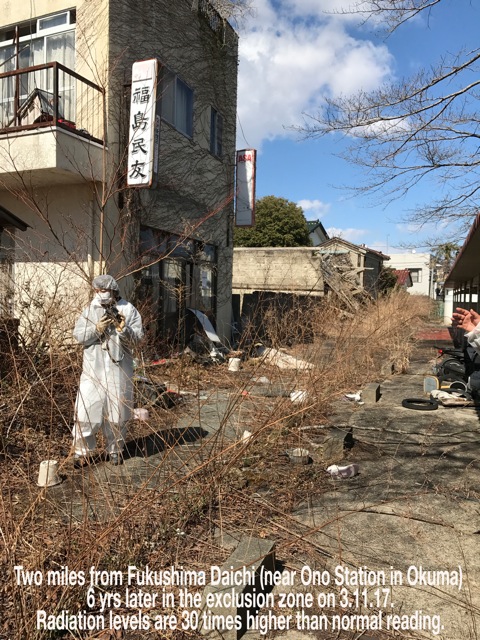
In its haste to reassure the world community that the 2020 Tokyo Olympics are going forward as scheduled with soccer and other games planned for Fukushima, the Japanese government is now forcing people back into heavily contaminated areas. A majority of the returning evacuees may not be well informed about the dangers they face, due to Japan’s Secrecy Law adopted in late 2013 – imposing new legislation to penalize the unauthorized publication of information about the crippled nuclear power plant of up to ten-years-long imprisonment. As a result people and particularly press are intimidated and kept from telling the truth.
The community of Santa Barbara is invited to attend a free public exhibit and presentation at the Karpeles Manuscript Library Museum Auditorium, 1-4pm, Saturday, April 8th featuring the work of volunteers of Nyander Guard. Akira Honda, shelter owner and founder, will also be in attendance to give firsthand details of the traumatic animal rescues in the exclusion zones in the aftermath of the nuclear meltdown. Further accounts of the State of Fukushima will not only be eye opening but also a timely reminder of the 31st Anniversary of Chernobyl Disaster – April 26th, where much of the land there still remains abandoned due to high radiation levels.
In Chernobyl, “Obligatory Resettlement Zones” were areas with over 5mSv/year of radiation, which is the same amount in some parts of Fukushima that will soon open up. Sadly, many pets will still remain at their desolate homes in these areas, living lonely lives with hardly any human contact. On their routine “Animal Watch,” Nyander Guard feeds and cares for these voiceless victims. Being reunited with them on March 11th reaffirmed how unforgiveable and horrific this disaster has become.
Disasters like Chernobyl and Fukushima remind the world how dangerous nuclear power is and how they have devastated humans, animals and lands. This is a worldwide problem affecting us all. By raising awareness of the tragedies innocent people and their loved ones continue to endure, we might be able to unite globally and share our individual stories for the sake of humanity and future generations.
Please sign these two important petitions :
From Greenpeace : Defend the human rights of Fukushima survivors
https://act.greenpeace.org/page/6288/petition/1
From FFAN-Fukushima Fallout Awareness Network : NO 2020 Olympics in Radioactive Fukushima:
https://www.change.org/p/no-olympics-or-paralympics-in-radioactive-fukushima
Exhibit:
THE STATE OF FUKUSHIMA: Sixth Anniversary 3.11 Nuclear Disaster Karpeles Exhibit Part II
This coming Saturday, April 8 at 1PM – 4PM PDT
At the Karpeles Manuscript Library Museum,
21 W Anapamu St, Santa Barbara, California 93101
Tel : +1 805-962-5322
Kerry Anne O’Connor, California born Tokyo resident and volunteer for Animal Rescue Nyander Guard – in Fukushima, Japan will be Santa Barbara Saturday, April 8th for a follow up to the Exhibit and presentation of March 11th in commemoration of the 6th Anniversary of #Fukushima Nuclear Disaster. On 3.11 this year, Kerry was in Fukushima measuring radiation levels and documenting farmlands that are now nuclear wastelands. Among her shocking discoveries, she learned that some areas where the evacuation orders will be lifted at the end of this month are actually higher in radiation than in the exclusion zones.
The community of Santa Barbara is invited to attend this free public exhibit and presentation featuring the work of volunteers of Nyander Guard. Akira Honda, shelter owner and founder, will also be in attendance to give firsthand details of the traumatic animal rescues in the exclusion zones in the aftermath of the #nuclear meltdown which forced 170,000 people to be evacuated; and six years later 84,000 residents still cannot return to their homes due to high radiation levels. Kerry’s further accounts of the “State of Fukushima” will not only be eye-opening but also a good reminder of the 31st Anniversary of #Chernobyl Disaster – April 26 where much of the land there is still abandoned due to high radiation levels.
Media Contact: Kerry O’Connor, 805-482-1745 kerry_in_hachioji@yahoo.co.jp
11,000 Wikileaks documents related to Fukushima

4131 files on Fukushima 2011
https://wikileaks.org/gifiles/?q=Fukushima+2011&mfrom=&mto=&title=¬itle=&date=&nofrom=¬o=&count=50&sort=0&file=&docid=&relid=0#searchresult
4062 files on reactor 2011
https://wikileaks.org/gifiles/?q=Reactor+2011&mfrom=&mto=&title=¬itle=&date=&nofrom=¬o=&count=50&sort=0&file=&docid=&relid=0#searchresult
2470 files on meltdown 2011
https://wikileaks.org/gifiles/?q=Meltdown+2011&mfrom=&mto=&title=¬itle=&date=&nofrom=¬o=&count=50&sort=0&file=&docid=&relid=0#searchresult
262 files on cesium 2011
https://wikileaks.org/gifiles/?q=Cesium+2011&mfrom=&mto=&title=¬itle=&date=&nofrom=¬o=&count=50&sort=0&file=&docid=&relid=0#searchresult
282 files on iodine 2011
https://wikileaks.org/gifiles/?q=Iodine+2011&mfrom=&mto=&title=¬itle=&date=&nofrom=¬o=&count=50&sort=0&file=&docid=&relid=0#searchresult
344 files on Uss Ronald Reagan
https://wikileaks.org/gifiles/?q=Uss+ronald+2011&mfrom=&mto=&title=¬itle=&date=&nofrom=¬o=&count=50&sort=0&file=&docid=&relid=0#searchresult
Columban missionary backs bishops against nuclear industry after harrowing visit to Fukushima clean-up

Evacuated: An evacuee rests in a gymnasium serving as an evacuation centre in Yamagata, Japan, in March 2011. Residents from the vicinity of Fukushima Dai-ichi nuclear power plant were sheltered at the gym, as officials and workers struggled to contain the situation at the badly damaged nuclear facility.
A COLUMBAN missionary has witnessed a massive contamination clean-up in the Japanese region surrounding Fukushima, where a 2011 earthquake and tsunami triggered a nuclear power plant meltdown.
Fr Paul McCartin, recently visited the Fukushima region, six years after the nuclear disaster, and ahead of a government evacuation order being lifted at the end of this month, which will allow people to return home.
Arriving by bullet train at the town of Kouriyama, 60km west of Fukushima Number One Nuclear Power Plant, Fr McCartin said the first surprise was the large radiation monitor in front of the station.
“Over the next three days I saw similar monitors in cities, beside country roads and along expressways,” Fr McCartin, the Columban Justice, Peace and the Integrity of Creation co-ordinator in Japan, said.
He has worked in Japan since 1979 and visited the Fukushima last September.
“I had taken face masks but our guides gave us better ones,” he said.
“We were told to make sure we washed our hands and around our mouths before eating.
“I was given a small radiation monitor to wear around my neck.
“Over the two-and-a-half days I was exposed to 8.1 micro Sieverts, an ‘acceptable’ amount.”
The Sievert is a measure of the health effect of low levels of ionising radiation on the human body.
As Fr McCartin drove through the Fukushima countryside, he found houses barricaded, roads closed and warnings from officials amidst a massive clean-up.
“I was restricted. There were roadblocks with security personnel,” he said.
“I was advised not to hike in Fukushima as there is a lot of radiation in the mountains, especially at the base of mountains as rain washes it down.
“Buildings and roads are being washed down, and contaminated soil and vegetation being removed.”
He said topsoil to a depth of five centimetres was being removed and replaced with soil from unaffected areas.
“There are large collections of industrial waste bags all over the place. There must be hundreds of thousands, if not millions,” he said.
At the end of March, Japan is set to lift evacuation orders for parts of Namie, located 4km from the wrecked Fukushima Daiichi nuclear plant, as well as three other towns.
More than half of Namie’s former 21,500 residents have decided not to return.
Namie, and other nearby centres are now ghost towns, dilapidated, and for many, they conjure horrific memories.

Tsunami damage: Facilities near the seawater heat exchanger building at Tokyo Electric Power Company’s Fukushima Daini nuclear power plant Unit 3 reactor on April 2, 2011, days after an earthquake and tsunami hit the area in north-east Japan.
A government survey showed last year, there were lingering concerns over radiation and the safety of the nuclear plant, which is being decommissioned.
Beyond radiation risks, an unexpected nuisance looms – hundreds of wild boars have descended from surrounding hills and forests into the deserted towns.
The creatures have roamed across the radioactive contaminated region.
In Namie, wild boars occupy the empty streets and overgrown backyards foraging for food.
In the nearby town of Tomioka, local hunters have captured an estimated 300 boars.
Following his visit last September, Fr McCartin is concerned about the spread of contaminated material.
“Low-level waste is being recycled,” he said.
“Highly contaminated waste is being burned.
“So far only one per cent of high-level waste has been burned.
“More incinerators are being constructed.
“Contaminated waste is being used in the wall being built along the shore to prevent another tsunami hitting the area.
“In fact, there is so much radioactively contaminated waste that local facilities can’t handle it, so ‘low-level waste’ is being transported to many distant places for disposal.
“Contaminated fishing gear and nets are being disposed of in the town where I live.
“In this way, radiation is being spread to many parts of the country.
“It would seem to make sense to keep it where it is and avoid unnecessarily contaminating the rest of the country.”
Fr McCartin said the Japanese media was muzzled from challenging the government on Fukushima and the hazards of nuclear power.
The efforts of individual journalists reporting on the issue were often dismissed.
“A Catholic in Yokohama told me last year that after his daughter wrote a piece on Fukushima for the newspaper she works for, her boss told her, ‘No more on Fukushima’,” he said.
“The government has threatened to shut down any media organisation that publishes something the government doesn’t like.
“In the last year or so three forthright and prominent media personalities have been sacked or not had their contracts renewed.”
Fr McCartin said he supported a call by Japanese Catholic bishops to abandon the nuclear power industry.
“I believe that if the government transferred a small fraction of the trillions of dollars it throws at the nuclear industry to the renewable energy industry, the country would be awash in safe energy in a very short time,” he said.
Japan Political Pulse: The truth about Fukushima nuclear disaster compensation

Of the unknown number of children who have been bullied for being from Fukushima Prefecture, where a nuclear disaster is still ongoing at a power station six years since its outbreak, one boy who evacuated to Yokohama was bullied and extorted by his classmates of 1.5 million yen in total.
Now in his first year of junior high school, the boy wrote when he was in sixth grade, “My classmates said, ‘You get compensation, right?’ That annoyed me, but I was frustrated with myself for not standing up against them.”
Ironically, news reports say that because the family voluntarily evacuated from Fukushima Prefecture, they are not eligible for the high levels of compensation from the operator of the stricken nuclear plant, Tokyo Electric Power Co. (TEPCO), that some victims are entitled to receive.
Those who evacuated from Fukushima Prefecture due to the nuclear crisis can be largely categorized into two groups. The first are those who were forced to leave their homes under evacuation orders from the central government, because they lived in areas where annual cumulative radiation levels exceeded 20 millisieverts, or otherwise faced extenuating circumstances as determined by the state. Such people receive a certain lump sum from TEPCO as compensation.
The second group comprises people who lived in areas with radiation levels that did not prompt government evacuation orders, but who evacuated voluntarily out of concern for the health of themselves and their children. As a general rule, these people are not eligible for compensation from TEPCO.
In the case of forced evacuations, TEPCO conducts individual interviews with evacuees to assess the value of their property and homes. But this is strictly to compensate for the assets that people have lost.
What has often attracted attention but remains commonly misunderstood, is the monthly 100,000 yen per person that evacuees are said to be receiving as compensation for emotional suffering. Those who evacuated without orders to do so from the government are not eligible for this, either.
Meanwhile, the provision of compensation for emotional suffering to state-ordered evacuees whose homes are in areas where evacuation orders are set to be lifted will be stopped in March 2018. Whether or not such evacuees will return to their homes in Fukushima Prefecture once the no-go orders are lifted, they face the harsh reality that they will be cut off from government assistance. The government is rushing to rebuild infrastructure, and appeal to the world that they are lifting evacuation orders. But whether to return or to relocate is a difficult decision, especially for families with children.
People who evacuated from Fukushima Prefecture have not only been exposed to radiation, but to prejudice and misunderstanding regarding compensation that they may or may not have received.
The false rumor that compensation recipients are enjoying the high life from compensation payments has spread. We can’t deny that some probably indulged in the momentary influx of money and bought property or a fancy car. But because of that, the internet has been teeming with rumors that compensation recipients are tax thieves or calls for them to go back where they came from. And there’s no doubt that such a backdrop of online defamation and scandalmongering emboldened the children who bullied the boy in Yokohama.
The truth is, the family of the boy in Yokohama had evacuated Fukushima Prefecture voluntarily. They received a little over 1 million yen from TEPCO, but the parents said in an interview with an NHK new program, Close Up Gendai, that the money was put toward rebuilding their lives. Voluntary evacuees are exempt from paying rent due to the Disaster Relief Act, but many must restart new lives amid unstable finances.
The abovementioned boy moved to Yokohama with his family when he was in second grade. Shortly thereafter, classmates called him by his name, with the word for “germs” added on to the end. He soon found himself the victim of physical abuse such as hitting and kicking, and once he reached fifth grade, classmates demanded he give them money.
“I was so scared I didn’t know what to do,” the boy wrote. He stole from his parents and gave away a total of 1.5 million yen.
His parents, and other parents of children at the school who realized that something was going on, alerted the school. The school conducted an investigation, but took the bullies’ claims that the boy had given them money willingly at face value, and did nothing to remedy the situation for two years.
I, too, only learned the truth about the case just recently, but I believe the school’s misguided judgment was likely based on ignorance and prejudice toward compensation given to Fukushima Prefecture evacuees.
The boy’s mother had been traveling back and forth between Yokohama and Fukushima. He knew how much his parents were struggling, so he remained silent about the bullying.
What moved the case into a new direction were notes the victim had written in the summer of sixth grade. A message calling on bullying victims not to kill themselves also written by the now first-year junior high school student who attends an alternative school, was also released to the public.
Compensation is given to some victims of the Fukushima nuclear disaster. But there is still too little compassion toward and understanding of the various misunderstandings, discrimination and divisions that disaster victims face.
http://mainichi.jp/english/articles/20170326/p2a/00m/0na/003000c
About the documentary film “Fukushima the silent voices”

Chiho Sato and Lucas Rue, the film directors
Yesterday, Saturday March 18. 2017, I went to watch for the second time The silent Voices, a documentary film directed by Chiho Sato and Lucas Rue, a screening organized by the French-Japanese Asuka association, an association founded by Kyoko Kugawa-Albu after the March 11. 2011 with the purpose to inform the general public about the Fukushima catastrophe.
I was very happy to meet again and spend some time with the two young movie directors, a very nice, sincere and talented couple, and with Kyoko Kugawa-Albu an antinuclear friend of mine.
This second time watching the movie confirmed my first impression, this movie is definitely the best documentary which has been made about Fukushima in the past 6 years, and you can believe it as I have watched many.
It is the best because of its unique approach, as Chiho Sato is herself from Fukushima she has been able like no one else to enter the intimacy of the Fukushima people by interviewing her own family members and her family close friends.
Chiho Sato was able to make them open up and talk about what usually nobody wants to talk about, as to talk about the catastrophe and its consequences has become kinda taboo among the Fukushima people, who never talk about it as different opinions could caused conflict, antagonism and create divisions. So after 6 years of an ongoing unresolved nuclear catastrophe, today nobody talks about it and everyone keeps it buried deep inside.
Chiho Sato for the first time succeeded to make those silent voices to talk, about the problems resulting from the catastrophe in their everyday life, their present and future inner fears.
Watching it for the second time, convinced me that I really need to write an article about it, to come in the coming weeks, because this film contains some very important testimonies that everyone should hear.

How nuclear apologists mislead the world over radiation
George Monbiot and others at best misinform and at worst distort evidence of the dangers of atomic energy

A girl is screened in Iitate, about 40km from the damaged Fukushima nuclear plant, where high levels of radiation have been detected.
From Monday 11 April 2011
Soon after the Fukushima accident last month, I stated publicly that a nuclear event of this size and catastrophic potential could present a medical problem of very large dimensions. Events have proven this observation to be true despite the nuclear industry’s campaign about the “minimal” health effects of so-called low-level radiation. That billions of its dollars are at stake if the Fukushima event causes the “nuclear renaissance” to slow down appears to be evident from the industry’s attacks on its critics, even in the face of an unresolved and escalating disaster at the reactor complex at Fukushima.
Proponents of nuclear power – including George Monbiot, who has had a mysterious road-to-Damascus conversion to its supposedly benign effects – accuse me and others who call attention to the potential serious medical consequences of the accident of “cherry-picking” data and overstating the health effects of radiation from the radioactive fuel in the destroyed reactors and their cooling pools. Yet by reassuring the public that things aren’t too bad, Monbiot and others at best misinform, and at worst misrepresent or distort, the scientific evidence of the harmful effects of radiation exposure – and they play a predictable shoot-the-messenger game in the process.
To wit:
1) Mr Monbiot, who is a journalist not a scientist, appears unaware of the difference between external and internal radiation
Let me educate him.
The former is what populations were exposed to when the atomic bombs were detonated over Hiroshima and Nagasaki in 1945; their profound and on-going medical effects are well documented. [1]
Internal radiation, on the other hand, emanates from radioactive elements which enter the body by inhalation, ingestion, or skin absorption. Hazardous radionuclides such as iodine-131, caesium 137, and other isotopes currently being released in the sea and air around Fukushima bio-concentrate at each step of various food chains (for example into algae, crustaceans, small fish, bigger fish, then humans; or soil, grass, cow’s meat and milk, then humans). [2] After they enter the body, these elements – called internal emitters – migrate to specific organs such as the thyroid, liver, bone, and brain, where they continuously irradiate small volumes of cells with high doses of alpha, beta and/or gamma radiation, and over many years, can induce uncontrolled cell replication – that is, cancer. Further, many of the nuclides remain radioactive in the environment for generations, and ultimately will cause increased incidences of cancer and genetic diseases over time.
The grave effects of internal emitters are of the most profound concern at Fukushima. It is inaccurate and misleading to use the term “acceptable levels of external radiation” in assessing internal radiation exposures. To do so, as Monbiot has done, is to propagate inaccuracies and to mislead the public worldwide (not to mention other journalists) who are seeking the truth about radiation’s hazards.
2) Nuclear industry proponents often assert that low doses of radiation (eg below 100mSV) produce no ill effects and are therefore safe. But , as the US National Academy of Sciences BEIR VII report has concluded, no dose of radiation is safe, however small, including background radiation; exposure is cumulative and adds to an individual’s risk of developing cancer.
3) Now let’s turn to Chernobyl. Various seemingly reputable groups have issued differing reports on the morbidity and mortalities resulting from the 1986 radiation catastrophe. The World Health Organisation (WHO) in 2005 issued a report attributing only 43 human deaths directly to the Chernobyl disaster and estimating an additional 4,000 fatal cancers. In contrast, the 2009 report, “Chernobyl: Consequences of the Catastrophe for People and the Environment”, published by the New York Academy of Sciences, comes to a very different conclusion. The three scientist authors – Alexey V Yablokov, Vassily B. Nesterenko, and Alexey V Nesterenko – provide in its pages a translated synthesis and compilation of hundreds of scientific articles on the effects of the Chernobyl disaster that have appeared in Slavic language publications over the past 20 years. They estimate the number of deaths attributable to the Chernobyl meltdown at about 980,000.
Monbiot dismisses the report as worthless, but to do so – to ignore and denigrate an entire body of literature, collectively hundreds of studies that provide evidence of large and significant impacts on human health and the environment – is arrogant and irresponsible. Scientists can and should argue over such things, for example, as confidence intervals around individual estimates (which signal the reliability of estimates), but to consign out of hand the entire report into a metaphorical dustbin is shameful.
Further, as Prof Dimitro Godzinsky, of the Ukranian National Academy of Sciences, states in his introduction to the report: “Against this background of such persuasive data some defenders of atomic energy look specious as they deny the obvious negative effects of radiation upon populations. In fact, their reactions include almost complete refusal to fund medical and biological studies, even liquidating government bodies that were in charge of the ‘affairs of Chernobyl’. Under pressure from the nuclear lobby, officials have also diverted scientific personnel away from studying the problems caused by Chernobyl.”
4) Monbiot expresses surprise that a UN-affiliated body such as WHOmight be under the influence of the nuclear power industry, causing its reporting on nuclear power matters to be biased. And yet that is precisely the case.
In the early days of nuclear power, WHO issued forthright statements on radiation risks such as its 1956 warning: “Genetic heritage is the most precious property for human beings. It determines the lives of our progeny, health and harmonious development of future generations. As experts, we affirm that the health of future generations is threatened by increasing development of the atomic industry and sources of radiation … We also believe that new mutations that occur in humans are harmful to them and their offspring.”
After 1959, WHO made no more statements on health and radioactivity. What happened? On 28 May 1959, at the 12th World Health Assembly, WHO drew up an agreement with the International Atomic Energy Agency (IAEA); clause 12.40 of this agreement says: “Whenever either organisation [the WHO or the IAEA] proposes to initiate a programme or activity on a subject in which the other organisation has or may have a substantial interest, the first party shall consult the other with a view to adjusting the matter by mutual agreement.” In other words, the WHO grants the right of prior approval over any research it might undertake or report on to the IAEA – a group that many people, including journalists, think is a neutral watchdog, but which is, in fact, an advocate for the nuclear power industry. The IAEA’s founding papers state: “The agency shall seek to accelerate and enlarge the contribution of atomic energy to peace, health and prosperity through the world.”
Monbiot appears ignorant about the WHO’s subjugation to the IAEA, yet this is widely known within the scientific radiation community. But it is clearly not the only matter on which he is ignorant after his apparent three-day perusal of the vast body of scientific information on radiation and radioactivity. As we have seen, he and other nuclear industry apologists sow confusion about radiation risks, and, in my view, in much the same way that the tobacco industry did in previous decades about the risks of smoking. Despite their claims, it is they, not the “anti-nuclear movement” who are “misleading the world about the impacts of radiation on human health.”
• Helen Caldicott is president of the Helen Caldicott Foundation for a Nuclear-Free Planet and the author of Nuclear Power is Not the Answer
[1] See, for example, WJ Schull, Effects of Atomic Radiation: A Half-Century of Studies from Hiroshima and Nagasaki (New York: Wiley-Lis, 1995) and DE Thompson, K Mabuchi, E Ron, M Soda, M Tokunaga, S Ochikubo, S Sugimoto, T Ikeda, M Terasaki, S Izumi et al. “Cancer incidence in atomic bomb survivors, Part I: Solid tumors, 1958-1987” in Radiat Res 137:S17-S67 (1994).
[2] This process is called bioaccumulation and comes in two subtypes as well, bioconcentration and biomagnification. For more information see: J.U. Clark and V.A. McFarland, Assessing Bioaccumulation in Aquatic Organisms Exposed to Contaminated Sediments, Miscellaneous Paper D-91-2 (1991), Environmental Laboratory, Waterways Experiment Station, Vicksburg, MS and H.A. Vanderplog, D.C. Parzyck, W.H. Wilcox, J.R. Kercher, and S.V. Kaye, Bioaccumulation Factors for Radionuclides in Freshwater Biota, ORNL-5002 (1975), Environmental Sciences Division Publication, Number 783, Oak Ridge National Laboratory, Oak Ridge, TN.
https://www.theguardian.com/environment/2011/apr/11/nuclear-apologists-radiation

Japan court shocks nuclear industry with liability ruling
Court sends a shockwave through Japan’s nuclear establishment with ruling on Fukushima accident.

A writing inside Ukedo elementary school, damaged by the March 11, 2011 tsunami, is seen near Tokyo Electric Power Co’s (TEPCO) tsunami-crippled Fukushima Daiichi nuclear power plant in Namie town, Fukushima prefecture, Japan, March 1, 2017.
Japan’s atomic power establishment is in shock following the court ruling on Friday that found the state and the operator of the Fukushima nuclear plant liable for failing to take preventive measures against the tsunami that crippled the facility.
The reason for the shock is the ruling has wide-ranging implications for Japan’s entire nuclear power industry and the efforts to restart reactors throughout the country.
Judges in the Maebashi District Court in Gunma prefecture ruled that Tokyo Electric Power Co. (Tepco) and the government were aware of the earthquake and tsunami risks to the Fukushima Daiichi plant prior to the 2011 triple reactor meltdown, but failed to take preventative measures.
The decision was welcomed by the 137 Fukushima citizens who filed the lawsuit in 2014. What needs to be remembered is a further 28 civil and criminal lawsuits in 18 prefectures across Japan are pending. They involve more than 10,000 citizens and include a shareholder claim seeking compensation of 5.5 trillion yen (US$49 billion).

Map of Japan’s nuclear plants
Tepco is already a de facto bankrupt, has been effectively nationalized and now faces the unprecedented challenges of how to remove three melted reactors at the Fukushima plant.
Six years after the disaster it still faces unanswered questions about the precise causes of the accident, questions that have generated public opposition to Tepco restarting reactors at another plant in Kashiwazki-kariwa in Niigata prefecture, on the opposite coastline to Fukushima.
Beside the court ruling being yet another blow to Tepco’s efforts to recover from the Fukushima nuclear disaster, the judgement will be highly disruptive to plans by the government and utilities to restart nuclear reactors in Japan.
In the court ruling, the judges found that science-based evidence of major risks to the nuclear plant was “foreseen” but ignored and not acted upon by Japan’s government and Tepco.
The evidence included a 2002 government assessment that concluded there was a 20% risk of a magnitude 8 or greater earthquake off the coast of northeastern Japan within 30 years. This includes the sea bed area off the Fukushima Daiichi plant.
Further, the plaintiffs cited a 2008 internal Tepco report ‘Tsunami Measures Unavoidable’ which included the likelihood of a potential 15.7 meter tsunami hitting the Fukushima nuclear site.
The court ruled that if the government had used its regulatory powers to make Tepco take countermeasures, such as installing seawalls, against such an event, the nuclear disaster could have been avoided.
While the judges in Gunma prefecture have concluded that ignoring evidence of risk can have devastating consequences, that does not seem to be the approach of the nuclear utilities or the Nuclear Regulation Authority (NRA).
Over the last four years, the NRA has demonstrated a tendency to ignore evidence of risks to nuclear plants that have made applications to restart reactors shut down after the Fukushima disaster, and to bend to the demands of the nuclear power companies and the government.
A total of 26 reactors have applied for NRA review, of which seven have passed and four more will likely be approved this year.
In each case, the NRA has failed to apply a robust approach to assessing risks. It has chose to screen out seismic faults that threaten nuclear plants, failed to follow recommendations from international safety guidelines, and accepted selective evidence on volcanic risks.
In the case of the three forty-year old reactors at Takahama and Mihama, the NRA approved the reactors, while granting the utility an exemption from demonstrating that the reactors primary circuit can meet the 2013 post Fukushima revised safety guidelines, until a later date.
All of these safety issues have the potential when things go wrong — see Fukushima — to lead to severe accidents, including reactor core meltdown.
District courts have issued injunctions against reactor restarts in Fukui prefecture, and in a historic ruling in March 2016 a court in Shiga prefecture ordered the immediate shutdown of the Takahama 3 and 4 reactors.
An appeal court is scheduled to rule on the above in the coming weeks and while it is anticipated that the reactor owner Kansai Electric will likely win, the prospects of further legal action remains.
Next month, for example, the former deputy chair of the NRA, Kunihiko Shimazaki will testify in a lawsuit against the operation of the Ohi reactors owned by Kansai Electric in western Japan.
Shimazeki, emeritus professor of seismology at Tokyo University and the only seismologist to have been an NRA commissioner, has challenged the formulas used by the regulator in computing the scale of earthquakes, which he believes underestimates potential seismic impact by factor of 3.5.
Last July the NRA dismissed Professor Shimazeki’s evidence.
Six years after the start of the Fukushima Daiichi accident, only 3 of Japan’s reactors are currently operating out of the 54 available in 2011.
For any business that runs the risk of its principal cash-generating asset being shut down at any point and for an extended period through legal challenges, the future does not look bright — unless you are granted approval to disregard the evidence.
The utilities are hemorrhaging money and therefore run the risk of following the same path as Tepco prior to 2011 in prioritizing cost savings over safety.
Such an approach directly led to the bankruptcy of Tepco, one the worlds largest power companies, and liabilities of at least 21 trillion yen.
The nuclear industry and current government of Prime Minister Shinzo Abe understand that to allow robust evidence of safety risks, in particular seismic, to determine the future of operation of reactors would mean the end of nuclear power in Japan.
Citizens from Fukushima with their lawyers and now supported by the judges, have moved Japan one step closer to that eventual scenario.
Shaun Burnie is a senior nuclear specialist with Greenpeace Germany. He has worked on nuclear issues worldwide for more than three decades, including since 1991 on Japan’s nuclear policy. sburnie@greenpeace.org
http://www.atimes.com/article/japan-court-shocks-nuclear-industry-liability-ruling/
Robots Go Into The Fukushima Nuclear Plant Site, But Don’t Come Out

In 2011, a 9.0 magnitude earthquake off the coast of Japan caused a massive tsunami, which in turn led to the meltdown of three nuclear reactors at the Fukushima Nuclear Power Plant in Fukushima, Japan. As a result, the site went on to release radioactive material for the next three days, becoming only the second such disaster in history–after Chernobyl in 1986–to be classified a Level 7 event on the Nuclear Event Scale.
So perhaps it should come as no surprise that, just past the tragedy’s six year anniversary, Tokyo Electric Power Co. (Tepco) has made little progress in cleaning up the disaster site.
While Tepco has spent much of its time containing radiation and attempting to minimize groundwater contamination, its current mission is to locate and retrieve 600 tons of melted nuclear fuel rods lost somewhere in the radioactive wreckage. As the levels of radiation are still too high for human exposure, this task has fallen to robots. Yet so far, even the robots have failed repeatedly to locate the melted fuel rods; instead, they are dying within the reactors they were sent in to survey.

The latest device to meet its end was a scorpion-shaped robot built by Toshiba, which entered one of the reactors last month but stalled just 10 feet short of its target in a matter of hours. While it was ultimately undone by the failure of its left roller-belt, the robot was exposed to far higher than expected levels of radiation, which likely interfered with its electronics and prevented it from sending photos that could have shed some light on the location of the melted fuel rods.
Despite being manufactured using special radiation-hardened materials to protect its circuits from exposure, the levels of radiation it encountered within the reactor far exceeded the robot’s tolerance. Two prior robot missions had to be aborted as well after one got stuck and another failed to locate any melted fuel for several days.
Despite the setbacks, Tepco believes it is getting closer to locating the melted fuel, and hopes to begin removal by 2021, but admits it is a long-term project. The Japanese government estimates that it will take upwards of 40 years and $70.6 billion to complete the clean-up.
According to MIT nuclear science professor Jacopo Buongiorno, “the roadmap for removing the fuel is going to be long, 2020 and beyond. The re-solidified fuel is likely stuck to the vessel wall and vessel internal structures. So the debris have to be cut, scooped, put into a sealed and shielded container and then extracted from the containment vessel. All done by robots.”
But that begs the question: what robots?
None of those they’ve sent in so far has done the trick. What if the technology required to create the chips and robots that are radiation-hardened yet not too weighed down by protective shielding hasn’t even been invented yet? Bloomberg reports that Toshiba intends to send a new robot into Reactor 3 next year at this time to continue the search, but it is still in the development phase, and Toshiba has not yet made design details public.
The good news is that with a 40 year time horizon, the likelihood of technology catching up with Tepco’s needs is fairly good. But when will the site be clean enough so that more people may return to their homes? In the meantime, radioactive boars have been making themselves quite at home there.
http://secondnexus.com/technology-and-innovation/fukushima-robots-keep-dying/
1 This Month

of the week – Shut Down Drone Warfare!


Tell the Ukrainian Government to Drop Prosecution of Peace Activist Yurii Sheliazhenko

Petition to revoke the licensing of the Near Surface Nuclear Disposal Facility (NSDF) at Chalk River. https://www.ourcommons.ca/petitions/en/Petition/Details?Petition=e-7247
To see nuclear-related stories in greater depth and intensity – go to https://nuclearinformation.wordpress.com
-
Archives
- April 2026 (103)
- March 2026 (251)
- February 2026 (268)
- January 2026 (308)
- December 2025 (358)
- November 2025 (359)
- October 2025 (376)
- September 2025 (257)
- August 2025 (319)
- July 2025 (230)
- June 2025 (348)
- May 2025 (261)
-
Categories
- 1
- 1 NUCLEAR ISSUES
- business and costs
- climate change
- culture and arts
- ENERGY
- environment
- health
- history
- indigenous issues
- Legal
- marketing of nuclear
- media
- opposition to nuclear
- PERSONAL STORIES
- politics
- politics international
- Religion and ethics
- safety
- secrets,lies and civil liberties
- spinbuster
- technology
- Uranium
- wastes
- weapons and war
- Women
- 2 WORLD
- ACTION
- AFRICA
- Atrocities
- AUSTRALIA
- Christina's notes
- Christina's themes
- culture and arts
- Events
- Fuk 2022
- Fuk 2023
- Fukushima 2017
- Fukushima 2018
- fukushima 2019
- Fukushima 2020
- Fukushima 2021
- general
- global warming
- Humour (God we need it)
- Nuclear
- RARE EARTHS
- Reference
- resources – print
- Resources -audiovicual
- Weekly Newsletter
- World
- World Nuclear
- YouTube
-
RSS
Entries RSS
Comments RSS
 nuclear-news