Resilience in Retrospect: Interpreting Fukushima’s Disappearing Consequences

By John Downer
1. Introduction
The third anniversary of the 2011 Fukushima meltdowns occasioned a new round of US media scrutiny. Among the leitmotifs of this coverage was a story that pertained less to the disaster itself than to the US Nuclear Regulatory Commission’s (NRC’s) efforts to manage the public’s perception of it. Particularly notable in this regard were a slew of internal NRC emails obtained by NBC reporters via the Freedom of Information Act, which shone a light on the regulator’s response to the unfolding crisis. The emails suggest a systematic effort to obfuscate or downplay implications of the accident that might be detrimental to the nuclear industry’s credibility at home: a high-level decision to disavow prior NRC concerns about the seismic vulnerability of US plants, for instance, and a policy of ignoring questions about the potential effects of meltdowns on US soil. NBC’s revelations could not have been surprising to most seasoned nuclear observers. As early as July 2011, the Wall Street Journal
was reporting on private NRC emails suggesting that the industry and its regulators were actively hiding evidence that many US reactors were at risk from earthquakes that had not been anticipated in their design. At the same time in the UK, The Guardian published an archive of internal UK government emails that showed the nuclear industry working closely with civil servants to downplay the Fukushima accident and keep it from delaying proposed plants.
It is easy to see why US and UK nuclear regulators would be concerned by a disaster in Japan. The entire logic of Western nuclear policy, planning and legislation is premised on the idea that meltdowns like Fukushima’s are either: a) literally impossible, or b) so unlikely as to be beyond political consideration. The US, for example, takes the latter approach. By invoking quantitative risk assessments, it formally categorizes meltdowns as ‘hypothetical’ events that are ‘theoretically possible’ but too improbable to warrant genuine policy consideration – much like alien invasions or catastrophic meteorite-strikes. This determination then underpins almost all its discourse around nuclear power. It is implicated, for instance, in formal cost-benefit analyses, which ignore the possibility of accidents when weighing the economics of different energy options (e.g. OECD 2010). It is implicated in its emergency response planning, which is framed around small leaks rather than Fukushima-scale meltdowns. It is implicated in planning decisions, such as the in the ‘clustering’ of multiple reactors in single sites where the failure of one can imperil the others (as was the case in Japan). It is even evident in a substantial body of its social science research, which routinely treats ‘nuclear risk’ as an established property, to be contrasted, or reconciled, with public perceptions of that risk.
The understanding that meltdowns will not (or cannot) occur is so foundational to this discourse that the appearance of three reactor meltdowns in a single week (all at the Fukushima site) could have unequivocally upended the way industrial societies conceive and manage nuclear risks. The accident’s outsized dramas – which upstaged even the momentous earthquake and tsunami that instigated it – only seemed to confirm the intolerability of nuclear disasters, while simultaneously undermining assertions that such disasters were too improbable to merit consideration. Long-standing critics of nuclear power could hardly have looked for a clearer vindication of their fears. It would have been easy to imagine that that atomic energy would have little future post-2011.
For all this, however, the credibility of nuclear energy proved surprisingly resilient to Fukushima. Some nations retreated from reactors after the accident. Japan, for instance, was gripped by a groundswell of public opposition to atomic power, while Germany resolved to
abandon reactors entirely. In most instances, however, dreams of ‘nuclear renaissance’ lived on.
Prior to Fukushima, 547 reactors were either proposed, planned or under construction throughout the world; a year later, this number had increased to 558. In early 2012, the NRC issued approvals for four new reactors – the first since the Three Mile Island accident in 1979. Around the same time, Britain and France signed a formal agreement paving the way for a new generation of reactors in both countries. In these nations and more, the expert and public consensus on nuclear energy ‘escaped’ the touch of Fukushima, just as it escaped that of Windscale in 1957, Three Mile Island in 1979, Chernobyl in 1986, and countless other brushes with disaster.
The durability of the nuclear industry’s credibility speaks to the flexibility of risk as a concept, and to the nature of the structures in which it is embedded. It was achieved, in large part, through the promulgation of narratives that framed the disaster in two ways:
i)By arguing that Fukushima was ‘exceptional’, and, as such, did not undermine reliability calculations proving that meltdowns should be beyond consideration. and/or…
ii)By arguing that Fukushima showed meltdowns were more ‘tolerable’ events than formal risk assessments had previously imagined (thereby implying that the reliability of reactors is less essential and inviolable).
These narratives – which internal correspondences, such as those released by NBC and The Guardian show being framed – were constructed and disseminated at the highest levels, shaping policy discourse and reverberating throughout the mainstream media. This chapter will discuss their logic and their consequences. Section 2, below, begins by briefly outlining and then critiquing the argument that Fukushima was ‘exceptional’. It argues that Fukushima reveals more significant and generalizable vulnerabilities than narratives of the disaster usually suggest. Section 3 is the heart of the chapter. In three parts – each focusing on different ways of construing the disaster Ñ it outlines and critiques the argument that Fukushima was ‘tolerable’.
The accident, it concludes, was more costly and alarming than publics are encouraged to believe. The concluding section of the chapter consists of two parts. The first asserts that it is reasonable to construe Fukushima’s public portrayal as a form of denial, and tackles the thorny question of agency. Drawing on two sociology literatures – ‘Agnotology’ and ‘Science and Technology Studies’ (STS) – it offers different perspectives on how and why narratives about Fukushima have come to be misleading, and considers their relative implications. The second and final part draws on the conclusions of the first to reflect on nuclear resilience. Outlining five ways in which protecting the credibility of nuclear experts from disasters undermines the practices that protect people, it argues that the resilience of nuclear authority compromises the resilience of nuclear infrastructures.
To read more :
Fire crews finally extinguish Fukushima blaze in no-go zone as officials battle “radiation rumors”
The official line is don’t you worry about radiation, it is only radiation rumors!!!
 Ground Self-Defense Force personnel work on putting out fire in a forest in Namie, Fukushima Prefecture on May 4
FUKUSHIMA – A wildfire near the Fukushima No. 1 nuclear plant has finally been extinguished after a 12-day battle waged by firefighters and Self-Defense Force troops in special protective gear left 75 hectares of tainted forest scorched, and local officials scrambling to quash radiation rumors.
The wildfire, which was started by lightning, broke out in the town of Namie on April 29 and spread to the adjacent town of Futaba, which co-hosts the meltdown-hit power plant. It was declared extinguished on Wednesday.
Since the area has been a no-go zone since the March 2011 nuclear crisis, residents are basically banned from returning to large portions of the two irradiated towns.
A local task force said that no one was injured by the wildfire and that there has been no significant change in radiation readings.
Because a large swath of the area scorched hadn’t been decontaminated yet, firefighters donned protective gear in addition to goggles, masks and water tanks. They took turns battling the blaze in two-hour shifts to avoid heatstroke.
Ground Self-Defense Force troops and fire authorities mobilized close to 5,000 people while nine municipalities, including the Tokyo Metropolitan Government, provided helicopters.
The Fukushima Prefectural Government denied online rumors saying the fire was releasing radioactive material into the air from trees and other plant life that absorbed fallout from the power plant, which also lies partly in the town of Okuma. It published data on its website showing no significant change in radiation readings.
“We will let people not only in the prefecture, but also in other parts of Japan know about the accurate information,” a prefectural official said.
The Kii Minpo, a newspaper based in Wakayama Prefecture, said in its May 2 edition that once a fire occurs in a highly contaminated forest, “radioactive substances are said to spread the way pollen scatters,” explaining how radiation can get blown into the air.
The publisher said it received around 30 complaints, including one from a farmer in Fukushima, who criticized the evening daily for allegedly spreading an unsubstantiated rumor.
The daily issued an apology a week later in its Tuesday edition.
“We caused trouble by making a large number of people worried,” it said.
Atsushi Kawamoto, head of the news division, said that while story may have caused some people anxiety, the newspaper will continue to report on matters of interest to its readers.
“That there’s public concern about the spread of radiation is true,” Kawamoto said.
On Tuesday, reconstruction minister Masayoshi Yoshino emphasized that unspecified radiation readings have been unchanged since before the fire.
“We will provide accurate and objective information,” he said.
Commenting on the fact that there are no fire crews in the no-go zone, Yoshino said the Reconstruction Agency will consider what kind of support it can offer there the next time a major fire breaks out.
Wildfires in Fukushima: reliable data or disinformation?


A Campaign to Tackle “Misinformation” about Radioactive Contamination
Masahiro Imamura, Minister for Reconstruction, wants to launch a large-scale campaign, to correct the incorrect information about radioactive contamination of agricultural, forestry and fisheries products from Fukushima Prefecture; as an effort to tackle the issue of “misinformation about radioactive contamination” crippling Fukushima foods. That means more propaganda to come, more lies to hide the real risks of radiation to the people’s health. As if propaganda, to brainwash the people with a large-scale campaign would be the solution to make radiation disappear.

Reconstruction chief Masahiro Imamura
Reconstruction chief praises efforts in Tohoku, flags information campaign on radiation risks
Minister for reconstruction Masahiro Imamura has praised efforts to rebuild the devastated Tohoku region but says a large-scale information campaign is needed to share accurate information about radiation six years after the March 2011 meltdowns at the Fukushima No. 1 nuclear power plant.
Imamura outlined the plan in a recent interview in response to what he said was incorrect information about radioactive contamination of agricultural, forestry and fisheries products from Fukushima Prefecture.
It also comes as a growing number of children who evacuated from the prefecture fall victim to bullying.
Massive amounts of radioactive substances were emitted from the plant soon after it was knocked out by massive tsunami from the 9.0-magnitude March 11, 2011, Great East Japan Earthquake, which hit hardest in Fukushima and the nearby prefectures of Miyagi and Iwate.
Asked about the degree of progress in reconstructing areas hit by the disaster, Imamura said, “Acquisition of land and other procedures needed for the restoration of damaged infrastructure initially took time, but the pace of construction work was very rapid once it was launched.”
“From now, we should focus on the rebuilding of Fukushima,” he said, noting that medium- to long-term measures should be promoted, including decommissioning the Fukushima No. 1 plant and decontaminating areas polluted with radioactive fallout.
“We want to encourage evacuees to return to their hometowns in Fukushima by presenting future visions for the communities through improving the living environment and accelerating the revival of local industries,” Imamura added.
On how to tackle the incidences of bullying targeting evacuated Fukushima children, Imamura said, “We’ll strengthen information-sharing about radiation. All government agencies should jointly work to compile and launch a campaign for that purpose, while obtaining cooperation from private companies.
“This is an issue for not only children, but adults,” he said. “We’ll prepare documents and other materials that are easy to understand in order to eliminate prejudice against evacuated people.”
Imamura said the campaign would also be an effort to tackle the issue of “misinformation about radioactive contamination crippling Fukushima foods.”
“I’ll seek cooperation from Prime Minister Shinzo Abe as well,” he said.
Imamura said he believed the Reconstruction Agency’s efforts to date to rebuild areas affected by the March 2011 disaster have been praised to a certain degree. Still, he pointed to the importance of re-examining whether information on what affected areas need has been properly conveyed to the Reconstruction Agency and other government bodies.
Imamura said Japan’s aging population and low birthrate were also contributing to shrinking communities across the nation — something he described as a structural problem.
“It’s important to build a system that generates profits through stepped-up use of information technology and the modernization of factory equipment, even if human resources are limited,” he said.
“We need to check again whether communities will be able to smoothly help one another in times of disaster, although lessons from the March 2011 disaster were effectively utilized in a series of powerful earthquakes that mainly hit Kumamoto Prefecture in April last year, and the October 2016 strong quake in Tottori Prefecture,” Imamura added.
http://www.japantimes.co.jp/news/2017/03/21/national/reconstruction-chief-praises-efforts-tohoku-flags-information-campaign-radiation-risks/#.WNJEq6KmnIV
Rebuilding Fukushima through Soccer
To expose children to possible radioactive nanoparticles without any protection just for the sake of propaganda to show that everything is safe and back to normal in Fukushima is irresponsible and criminal! All in the name of the recovery and reconstruction campaign organized by the Japanese government to welcome all the tourists to come to “clean” beautiful Japan for the 2020 Tokyo Olympics! Olympics to which Fukushima produce will be used to prepare the meals fed to the visiting athletes! All in the name of promotion and economic reconstruction! Alternate facts, total denial of reality being substituted to real facts and dangers. A total insanity!

A former soccer training facility close to Japan’s crippled Fukushima Daiichi Nuclear Plant has been used as a staging point for recovery work since the 2011 nuclear disaster, but that’s about to change.
Temporary dormitories for workers stand where there used to be a soccer field at the facility, called J-Village. The area is filled with memories for Shigenari Akashi, who worked as a coach for a junior youth team there for more than 10 years.
“National tournament finals used to be held here. Children from all over the country would practice hard, aspiring to play here,” Akashi says.
J-Village was Japan’s first national soccer training center. It opened in 1997 and over the years saw more than a million visitors. The complex was even used to train the national teams of Japan and Argentina.
But the nuclear disaster changed everything. The facility is just 20 kilometers from the plant, so Tokyo Electric Power Company rented it to set up an operational base for containing the accident.
“I was in shock and at a loss for words when I saw the Self-Defense Forces’ tanks here, and the gravel laid on the natural turf for the parking lot,” says Akashi.
At the end of last year, the moment he had been waiting for finally arrived as TEPCO began work to return the facility to its original form.
Fukushima Prefecture has even bigger plans — tt wants to build Japan’s first “all-weather soccer field” at the site. Part of the facility is scheduled to open in the summer of 2018.
The Japan Football Association has given the project its full support. The Japanese national team will use the new J-Village as its training base for the 2020 Tokyo Olympics.
But there are bigger challenges than rebuilding. There are fears over radiation levels — in some areas they’re still higher than international standards recommend. So the J-Village operator has a plan.
“The construction work will focus on largely replacing the soil, a technique we expect will reduce radiation levels more than usual decontamination methods,” says Eiji Ueda, who is executive vice president at the facility. “We can emphasize how safe it is by hosting national teams from Japan or perhaps abroad for training.”
A town near J-Village was evacuated because of the disaster. Residents got the green light to move back a year and a half ago but few have returned as most of the evacuees still live in a neighboring city.
Akashi and his co-workers have been giving soccer classes for children, including some who lived near J-Village. But there are mixed feelings about playing there again.
“I want to use the new J-Village, but I live far away now, so it will be hard to go there very often,” says a boy at the facility.
“We still have the lingering memory of it being used as the staging ground for decommissioning work,” says one father.
For Akashi, he’s got a specific goal in mind.
“In reviving J-Village, we want to give back local people a gathering place and their sense of pride. We believe this will also help to revive Fukushima as a whole,” he says.
The clock on the J-Village scoreboard is stopped at 2:46 p.m., the moment the earthquake struck. The deep rift created over the last 6 years will need to be filled so that the clock can move forward once more.
https://www3.nhk.or.jp/nhkworld/en/news/editors/3/rebuildingfukushimathroughsoccer/
Fukushima peach exports recover in Southeast Asia, sparking hope for other produce???

The original article was published by Fukushima Minpo, local Fukushima Newspaper, which promotes “recovery”.To export your contaminated fruits to other countries is plainly criminal.
Fukushima peaches are making inroads into Southeast Asian markets in what prefectural officials see as a model case of recovery in its farm produce.
Fukushima grabbed the top share of Japanese peach exports to three Southeast Asian countries last year — 73.9 percent in Thailand, 76.8 percent in Malaysia and 55.9 percent in Indonesia.
In terms of volume, Fukushima exported a combined 30.6 tons of peaches to the three countries plus Singapore in 2016, surpassing the 23.9 tons logged in 2010 — the year before the triple meltdown at the Fukushima No. 1 power plant shattered trust in its farm produce in March 2011.
Given the improved figures, the Fukushima Prefectural Government now believes the measures it took to combat harmful rumors are paying off. It hopes to revive sales channels for other produce by using the recovery of peach exports as a base.
The prefectural government announced the export data at the end of January based on the Finance Ministry’s trade statistics for 2016 and other figures compiled by the Fukushima headquarters of the National Federation of Agricultural Cooperative Associations, or JA Zen-Noh.
Fukushima is the nation’s No. 2 peach-growing prefecture after Yamanashi and has been dubbed a “fruit kingdom” for the wide variety grown, including cherries, grapes, pears and apples.
Its peach exports peaked at 70 tons in 2008, thanks mainly to Taiwan and Hong Kong, but import bans imposed from the Fukushima disaster saw the peach trade collapse to zero in 2011.
According to the prefecture’s public relations office, Fukushima was quick to review its sales strategy and shift focus to Southeast Asia, where some countries eased import restrictions on its produce at an early stage.
A decision to promote the sweetness and freshness of Fukushima peaches was also a major factor in grabbing the hearts of consumers, the office said.
Despite the success in Thailand, Malaysia and Indonesia, it may take time before other countries in the region follow suit.
In Singapore, for example, Fukushima peaches last year had a market share of only 12 percent among all peaches the city-state imported from Japan.
The prefecture is hoping that the improvements in the three countries will help persuade other markets, such as Hong Kong and Taiwan, that its peaches are safe.
The recovery of the fruit’s reputation overseas has provided great encouragement to the prefecture’s peach growers, including Shigeyoshi Saito, 58, of the city of Date.
“Along with other items, peaches are a main pillar of Fukushima’s farm produce,” he said. “I hope their good reputation in Southeast Asia will spread the word to the entire world.”
Convenient Acccounts of Fukushima Radiation Exposure Ignore Glaring Issue

Every time I read something about the Fukushima disaster my blood pressure rises.
For example, recent efforts to represent (hypothesized) remnants of melted fuel rods in unit 2 as evidence of containment is revealed as misleading when one considers the size of the reactor (larger than a bus) and the amount of fuel contained within unit 2’s:
Justin McCurry January 30, 2017, Possible nuclear fuel find raises hopes of Fukushima plant breakthrough. The Guardian, https://www.theguardian.com/environment/2017/jan/31/possible-nuclear-fuel-find-fukushima-plant
Operator says it has seen what may be fuel debris beneath badly damaged No 2 reactor, destroyed six years ago in triple meltdown
Hopes have been raised for a breakthrough in the decommissioning of the wrecked Fukushima Daiichi nuclear plant after its operator said it may have discovered melted fuel beneath a reactor, almost six years after the plant suffered a triple meltdown.
Tokyo Electric Power (Tepco) said on Monday that a remote camera appeared to have found the debris beneath the badly damaged No 2 reactor, where radiation levels remain dangerously high. Locating the fuel is the first step towards removing it. The operator said more analysis would be needed before it could confirm that the images were of melted uranium fuel rods, but confirmed that the lumps were not there before Fukushima Daiichi was hit by a powerful earthquake and tsunami on 11 March 2011.
The amount of fuel contained of fuel in those reactors was substantial. If TEPCO had found all, or most, of the melted reactor fuel they would know it.
According to a November 16 report by Tepco titled, ‘Integrity Inspection of Dry Storage Casks and Spent Fuel at Fukushima Daiichi Nuclear Power Station,’[i] as of March 2010 the Daini site held 1,060 tons of spent uranium fuel. The total spent uranium fuel inventory at Daiichi in March 2010 was reported as 1,760 tons. The 2010 report asserts that approximately 700 spent fuel assemblies are generated every year.[ii] The report specifies that Daiichi’s 3,450 assemblies are stored in each of the six reactor’s spent fuel pools. The common spent fuel pool contains 6291 assemblies. The amount of MOX fuel stored at the plant has not been reported.
I suspect that TEPCO knows that most of the fuel is gone from unit 2’s reactor containment and that what remains is a fraction of the total load, which was either dispersed in the explosions or has left the building.
But what bothers me even more than obfuscation around missing fuel are misleading accounts of radiation exposure.
Case in point: The article published in CNBC below last week alleges that Fukushima radiation exposure was “far lower” than previously found:
Robert Ferris. Jan 24, 2017. Fukushima radiation levels far lower than previously thought, study finds. CNBC.Com, http://www.cnbc.com/2017/01/24/fukushima-radiation-levels-far-lower-than-previously-thought-study-finds.html
Radiation levels remaining from the 2011 disaster at Japan’s Fukushima Daiichi nuclear plant appear to be a small fraction of what previous measurements suggested, according to a recently published study that followed levels in tens of thousands of people living near the site of the accident.
Science magazine highlighted the research Monday, calling it the first study to measure individual radiation levels in locals following a major nuclear disaster. The study was published in the peer reviewed Journal of Radiological Protection in December.
I’ve seen this type of headline before so I was immediately suspicious. I pulled up the journal article and found a glaring issue that problematizes the validity of this conclusion that radiation levels were lower than previously calculated.
Here is the glaring issue ignored in the CNBC’s optimistic headline: The radiation monitoring badges were provided to residents in August of 2011. The disaster and radiation exposure began March 11, 2011.
Consequently, RESIDENTS WERE NOT GIVEN BADGES TO MEASURE EXPOSURE UNTIL FULLY 5 MONTHS AFTER exposure, a fact that is acknowledged in the title of the research article but ignored in the news coverage:
Makoto Miyazaki and Ryugo Hayano. 2017. Individual external dose monitoring of alltizens of Date City by passive dosimeter 5 to 51 months after the FukushimaNPP accident (series): 1. Comparison of individual dose with ambient dose rate monitored by aircraft surveys. J. Radiol. Prot. 37 1(http://iopscience.iop.org/0952-4746/37/1/1) http://iopscience.iop.org/article/10.1088/1361-6498/37/1/1/pdf
For the measurement of individual external doses, Date City distributed individual dosim-eters (radio-photoluminescence (RPL) glass dosimeters: Glass Badge) to kindergarten-, elementary- and junior high school-children in August 2011. The target group was subsequently enlarged as the production capacity of the supplier increased, and the measurements are still ongoing
How is it possible to conclude that exposure was lower than previously thought when the evidence for that claim is generated from a study that excludes the first 5 months of exposure?
Truth has an especially slippery feel when it comes to Fukushima….
????????????????????????????????????????????????????????????
REFERENCES
[i] It is worth noting that although this report was produced on 10/26/2010, the file properties indicate the document was modified on 3/13/2011: Integrity Inspection of Dry Storage Casks and Spent Fuels at Fukushima Daiichi Nuclear Power Station (16 November 2010), http://www.nirs.org/reactorwatch/accidents/6-1_powerpoint.pdf
[ii] Integrity Inspection of Dry Storage Cask.
http://majiasblog.blogspot.fr/2017/02/convenient-acccounts-of-fukushima.html
Fukushima ice cream sales “immune” to fears of radiation
“If you tell a lie big enough and keep repeating it, people will eventually come to believe it. The lie can be maintained only for such time as the State can shield the people from the political, economic and/or military consequences of the lie. It thus becomes vitally important for the State to use all of its powers to repress dissent, for the truth is the mortal enemy of the lie, and thus by extension, the truth is the greatest enemy of the State.” Paul Joseph Goebbels (29 October 1897 – 1 May 1945) was Adolf Hitler‘s Propaganda Minister in Nazi Germany.
The town of Koriyama in Fukushima Prefecture was one of the towns most severely hit by the Fukushima Daiichi March 2011 plume. Though not evacuated as it is located outside of the 30km radius evacuation zone decided by the Japanese government, it remains quite contaminated and has many radioactive hotspots.
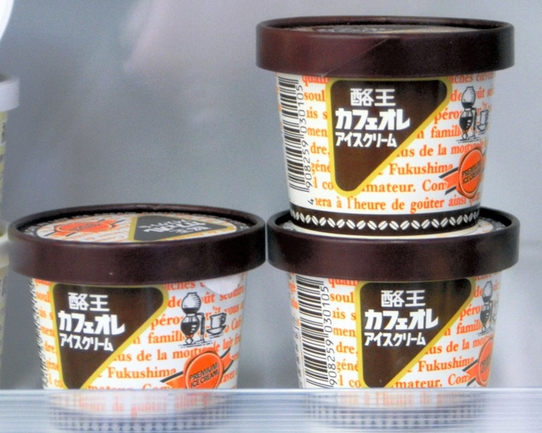
Winter sales have been strong for Rakuou Cafe au Lait Ice Cream produced in Fukushima Prefecture.
KORIYAMA, Fukushima Prefecture–A dairy company here that has withstood fears and rumors about radiation has produced a hot-selling item in the middle of winter.
Within two weeks in November, the initial 6,000 cups of Rakuou Cafe au Lait Ice Cream, produced by Rakuounyugyou Co. in Koriyama, were nearly sold out.
The company, founded in 1975, shipped out an additional lot of around 18,000 cups in December, but this supply has also run short.
Rakuounyugyou shipped 25,000 more cups, mostly to outlets in Fukushima Prefecture, in mid-January, and plans to ship an additional 24,000 within this month.
“Perhaps our ice cream is being seen as more of a premium product,” a sales official at the company said.
Rakuounyugyou’s Rakuou Cafe au Lait, a mild-flavored lactic drink containing at least 50 percent raw milk from Fukushima Prefecture, has an entrenched fan base both in and outside the prefecture.
The company maintained its sales levels in the aftermath of the 2011 Fukushima nuclear disaster, while its competitors suffered losses due to radiation fears and rumors among the public.
Rakuounyugyou developed the ice cream product to commemorate the 40th anniversary of the release of Rakuou Cafe au Lait. The ice cream contains at least 10 percent Rakuou Cafe au Lait and at least 10 percent milk.
“We exercised trial and error because we absolutely didn’t want to disappoint fans of our Cafe au Lait,” the sales official said.
The ice cream was initially sold mainly at sightseeing facilities and expressway service areas in Fukushima Prefecture. Demand was high even though the company did little in the way of a sales campaign.
The spreading popularity of the product can be attributed to Twitter.
Tweets about the ice cream can sound like a hunt for a rare Pokemon on the “Pokemon Go” game app.
“Where could I get one?” one post said. “I got one!” said another.
It is not the first time the social networking service has helped the dairy company; tweets of encouragement spread in the aftermath of the nuclear disaster.
“Be what may, the Rakuou Cafe au Lait tastes so good,” said one particularly popular tweet at that time.
Cafe au Lait is being shipped to a growing number of retailers, most of them in the greater Tokyo area. Sales of the product are up 10 percent from pre-disaster levels.
“Word of our ice cream has also been spread by our fans,” the sales official said. “We are so grateful that we are reduced to tears.”
http://www.asahi.com/ajw/articles/AJ201701290010.html
Project Ethos Works with the Japanese Government on all Public Relations Propaganda
I am sharing here with you a sample of Japanese Government propaganda, a video about Fukushima, claiming that everything is now fine.
By watching this propaganda video, you can imagine, you will get an idea of the intensity of propaganda that the Japanese government is subjecting its people with, thru all the government controlled mainstream media, claiming that all is very safely and controlled for everyone’s safety by a safety conscious government absolutely caring for its people safety. Nice, isn’t it?
Propaganda from PM Abe’s government forcefully pushing innocent victims back to live in highly contaminated areas, trying to make believe all is ok just in time for the coming 2020 Olympics. Like when they previously sent children to clean off radiation off route 6 just for propaganda’s sake !
Amazing, Chernobyl is still horribly contaminated after over 30 years, but Fukushima radiation is the new self cleaning kind that just vanishes after 5 years? And that while there are ongoing reactions that are still completely uncontained.
Well isn’t that special. What a load of crap ! How stupid do they think we are to buy this crap?
From what I’ve seen, people should not even be living in certain parts of Tokyo and its vicinity.
I despise with much passion all the ETHOS scoundrels and all those Japanese government criminals. Shame on you. Your pride and your denial will be your downfall.
Long live Fukushima , Long live the Children of Fukushima!

Japan’s Fukushima Prefecture has been making tremendous progress in its revitalization since the 2011 Great East Japan Earthquake.
The area continues to undergo recovery efforts, residents are returning to their everyday lives, and food from Fukushima is being enjoyed all over Japan under strict safety regulations.

The March 2011Great East Japan Earthquake caused an enormous tsunami that overwhelmed the Fukushima Daiichi Nuclear Power Station.
A continuous water injection cooling system has now stabilized the plant’s reactors and reduced radiation emissions dramatically.

Food grown in Fukushima…

… is widely available and popular across Japan.

All food produced in Fukushima must first pass a test for radiation to be sold on the market.

The standards set by the Japanese government are much stricter than the international standards.

Thanks to these rigorous safety standards, Fukushima rice is enjoyed throughout Japan.

A joint research project was conducted in 2014 by high school students in Fukushima and overseas under the supervision of experts.

The survey found that the radiation exposure levels of students in Fukushima were almost the same as in Europe.

The total area of Fukushima prefecture subject to evacuation orders has been progressively reduced since 2014, as decontamination efforts have lowered radiation to safe levels,

allowing people to return to their homes.

A lot of work still has to be done before the area fully recovers,

but every day we are making progress toward a brighter future.
Watch this new video to learn more:
Japan – The Government of Japan Facebook page
https://www.facebook.com/JapanGov/videos/1262473720476424/?hc_ref=PAGES_TIMELINE
Shame on TEPCO For Taking Kids into Fukushima Exclusion Zone for Damage Control Campaign
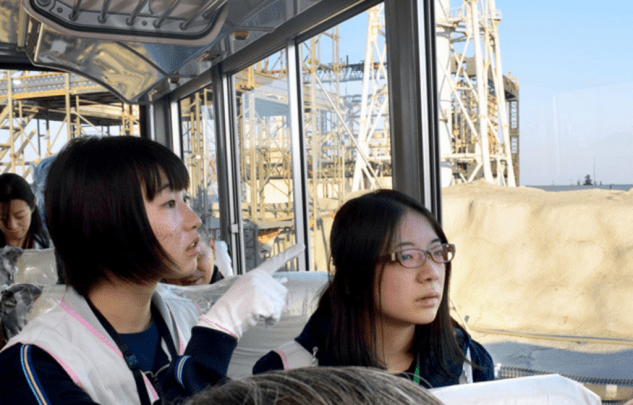
On November 18, 2016, Tokyo Electric Power Company, a.k.a. TECPCO, took a group of 13 students wearing dosimeters from Fukushima High School into the exclusion zone around the hobbled Fukushima Daiichi Power Plant for an educational tour. It is the opinion of the EnviroNews World News Editorial Board that this is unacceptable, and should not happen again until all radiation is cleaned up at the site.
The Asahi Shimbun reported, “It was the first tour by youngsters since the disaster as plant operator Tokyo Electric Power Co. had deemed the radiation risk was too high.”
To be clear, epidemiology and medical science have firmly established there is no “safe” amount of radiation to be exposed to — period — end of story. With each subsequent exposure, no matter how small, the bombarded organism experiences an increase in cancer risk.
Knowing that science has firmly established that there is no “safe” limit of radiation to be exposed to, it is the opinion of the EnviroNews World News Editorial Board that TEPCO should be ashamed of itself for taking a class of high school students into the still radioactive exclusion zone around the crippled power plant as part of what has been a continuous damage control campaign since the accident’s inception. Furthermore, TEPCO should apologize to the families, and commit publicly to not take any more children into the exclusion zone until all radioactivity has been removed.
FUKUSHIMA’S EXCLUSION ZONE: STILL A VERY DANGEROUS PLACE
The exclusion zone around the demolished Fukushima Daiichi power plant is a dangerous place. But when a person goes there, the invisible dangers that lurk don’t threaten to kill or maim right away — the hazardous radioactive rays and particles around Fukushima threaten to kill or harm them at some point years down the road — and those same radioactive exposures can also predispose and mutate their unborn children and grandchildren with birth defects, disease and cancer.
The gestation period of cancers from radiation ranges from as low as four years, to as high as fifty years or more. If an 80-year-old person is exposed to radioactivity, it is likely that other causes, either natural or unnatural, will lead to their demise before maladies caused by radiation will. However, for a very young person subjected to radioactivity, this is not the case, and for this reason, again, TEPCO should be ashamed of itself for taking children who may want to later have children themselves, into the exclusion zone for a publicity stunt. A physical trip to the location is not necessary to educate youth about the Fukushima accident, or nuclear power in general. To make a physical trip to the site with children is highly irresponsible. Less risky means of education must be used instead.
TEPCO AND JAPAN’S CONTINUOUS DAMAGE CONTROL CAMPAIGN
To suggest that TEPCO has been engaging in a continuous campaign of damage control and coverup is not a stretch at all. Earlier this year, TEPCO finally confessed publicly that it lied to the press and the entire world immediately following the meltdowns, downplaying the severity, and not admitting full meltdowns had occurred until several months later, when in fact, the company knew within hours that meltdowns were underway. This blatant lie put many thousands at risk and hampered evacuation strategies. Shortly after the company’s admission, former TEPCO Chairman Tsunehisa Katsumata, and two former Vice Presidents, Sakae Muto and Ichiro Takekuro were indicted for “professional negligence resulting in deaths and injury.”
Japan as a country, also has a serious PR problem with the ongoing Fukushima crisis — and that PR issue translates into economic problems, hence, Japan has done anything possible to slap a happy face on the disaster from the get-go.
Though it’s possible to display many examples of this, the country’s fervent and costly effort to host the 2020 Olympics, despite many concerns about Fukushima from the international community, may be the grandest. Japan has done much to stifle and stymie the voices of anti-nuclear protestors, while maintaining everything is “under control” at the rubbled plant. Nothing could be further from the truth.
It is the opinion of the EnviroNews World News Editorial Board that TEPCO, and the Japanese government, should come fully clean, relinquish their pridefulness, and engage the international community for help in the cleanup effort.
FUKUSHIMA: A SPEWING NUCLEAR DRAGON STILL ON THE LOOSE
To be clear on another point: the crisis at Fukushima Daiichi is in no way under control — quite the opposite. It is still out of control in many regards. For example, the radioactive waste water pileup problem at Fukushima is beyond critical, as over 1,100 massive storage tanks have engulfed nearly the entire area, filling the crumpled nuke site to the brim with deadly radioactive water. The operator has on multiple occasions had to discharge large amounts of tainted H2O out to sea. Secondly on this point is the fact that deadly uranium and plutonium contaminated water have been leaching into the ocean from under the reactor buildings on a continuous basis due to groundwater seepage.
Japan is a country that has been torn to shreds by radiation poisoning, possibly more than any other. Furthermore, Japan is one of only a couple dozen or so nations on earth suffering population decline, but scarily, Japan’s population is starting to contract at an alarming speed due to a low birth rate. The last thing organizations need to be doing is risking the genetic integrity and fertility of Japan’s youths by taking them to nuclear meltdown ground zeros. TEPCO should hang its head in front of the media, apologize, and agree to engage in no further publicity stunts that endanger the country’s children.
NUCLEAR COMPANIES SHOULD BE LIMITED, OR KEPT OUT OF SCHOOL-BASED NUCLEAR EDUCATION ENTIRELY
On another relevant topic, EnviroNews has long taken issue with nuclear companies being invited to participate in the educational process on nuclear issues, as our research has shown that children’s opinions are easily swayed when “educated” on the topic by nuclear companies. Many of the campaigns we’ve seen represent borderline indoctrination on the pros of nuclear power, while typically failing to mention catastrophes and the practically boundless risks and uncleaned waste sites still plaguing the planet today. Teachers and administrators should use more discretion on a topic as controversial as nuclear, and recognize that the industry’s propaganda campaigns know no boundaries.
One of many examples of these industry-driven “nukewashing” campaigns was witnessed by EnviroNews when EnergySolutions, a nuclear waste disposal company stationed in Utah, “educated” a class of students in Salt Lake City about the “benefits” of radiation. Before the event around three-quarters of the class was opposed to nuclear energy, but when surveyed again after EnergySolutions was finished, around three-quarters of the students had changed their stance to a pro-nuclear position. Naturally, the teacher failed to bring in an educator from any anti-nuclear groups who would paint a different picture entirely. Sadly, the U.S. Government, via the Department of Energy (DOE), has also gotten involved in the nukewashing with a curriculum based program called, the Harnessed Atom.
With that stated, it is the further opinion of the EnviroNews World News Editorial Board that nuclear companies should be kept out of the educational process on nuclear issues entirely — or at least limited to situations where anti-nuke organizations are allowed to present opposing views on the dangers and downsides of nuclear simultaneously.
“The tour made me realize that we should arm ourselves with accurate information if we want to change people’s perceptions of Fukushima as a scary place,” said Keika Kobiyama, a first-year student in the Fukushima High School tour group. Sadly Keika, the leaking radioactive nightmare at Fukushima Daiichi is still a very “scary place,” and should be recognized as such — and if TEPCO told you otherwise, the company is, well, full of radioactive crap.
Project ETHOS: Living in the Nuclear Garden, a Crime Against Humanity(Part I)

In the words of a recent opinion column, * the planners for mutilated life (life also called half-life **) claim that contamination dangerous in principle, would turn into harmless in real life. This is a lie of extreme violence, an insult to the relatives of victims and survivors, in order to restrict evacuations and protection measures, thus exposing people affected with terrible health damage. It’s a crime.
So it is to stem the horror of the effects of contamination by camouflaging it, by pretending that we can escape danger by confronting it, by managing our fear.
Because in effect it is indeed to block any heresy attempt questioning the religion of the atom, and for that to discreetly fill hospital with patients and cemeteries with victims, rather than to evacuate and to treat populations of lands which became uninhabitable. Therefore no question to recognize the inhumanity and the terrible dangers of the atom.
In what follows we will see how and why everything is done to hide an atomic crime and what it costs to the affected populations, with great responsibility of the French nucleocracy and especially of two of its main representatives Jacques Lochard and Gilles Hériard Dubreuil.
*Tribune libre collective de : Cécile Asanuma-Brice, Jean-Jacques Delfour, Kolin Kobayashi, Nadine Ribault et Thierry Ribault.
http://sciences-critiques.fr/tchernobyl-fukushima-les-amenageurs-de-la-vie-mutilee/
**Michael Ferrier, « Fukushima – Récit d’un désastre » 2012.
Children are particularly affected by nuclear disasters, only one treatment is available : pectin.
Growing children are particularly vulnerable facing contamination by radionuclides dispersed in the environment whether by atomic disaster until thousands of kilometers, or by the multiple incidents that dot the operation of nuclear facilities. What to do to protect the multitude of sick or weakened children living in contaminated territories? Principal victims, their situation worsens from year to year, depending on the content of Césium137 and Strontium 90 in their bodies. It is cesium that lodges itself in all organs (a bit like potassium) which is easier to measure in order to assess the need for treatment. Only pectin, known to enable the removal of heavy metals including these radionuclides, can relieve these young people.
Experience in Belarus show that cures of three weeks of vitamin apple pectin can reduce the cesium, therefore reducing the damages. Those cures can be renewed every three months and must be accompanied by safeguards in the selection and preparation of food.

But the nuclear lobby has blocked the spread of pectin cures.
Incredible as it may seem, apple pectin is a true opponent of nuclear lobby. It is the only explanation for the war the nuclear lobby is conducting against apple pectin. In fact those who are responsible for ensuring protection against the effects of nuclear, claim that the patients are only victims of stress and irrational fears which annihilate the immune system. For the ICRP * and the CEPN ** to recognize that pectin cure, known for its ability to remove cesium and strontium, is effective in improving the health of children, is to recognize that they are contaminated. Thus in the name of the nuclear religion hundreds of thousands of young people are condemned to an amputated life .
It is criminal on the part of our state agencies to propose to Belarus and Japan who are only asking for that, the application of Ethos-Core program which role is to stifle the effects of radioactivity, to save the image of the nuclear industry and of the country, and that to the expense of victims abandoned to their fate. And we can be sure, it will be the same in our home country in case of nuclear disaster, everything will be done to downplay the effects, to hide the reality of the risks and human damages, the goal being to save the nuclear industry regardless of the price, in the name of the identity and the “greatness” of France. …
Let us demand that pectin be provided to second generation children of Chernobyl, almost all sick, and to the first generation children of Fukushima. In view of the nuclear catastrophe that threatens us more and more, also demand that pectin be available for distribution in France, such as iodine for the thyroid.
It is through studies conducted within the framework of the Ethos and Core projects that the strategy of the nuclear lobby has been defined, we must explain what it is so as to understand what is happening in Belarus, in Japan and what is planned for us ….
The Franco-European Ethos project : The ETHOS project was implemented by a research team involving four scientific organizations:
CEPN is a a non-profit organisation created in 1976 to establish a research and development centre in the fields of optimisation of radiological protection and comparison of health and environmental risks associated with energy systems. This program was initially strongly focused on the development and application of the principle of optimization of radiological protection. Over the past few years, however, the group’s research programme has also been directed towards the involvement of stakeholders in radiological risk assessment and management, and spreading the radiological protection culture. The studies are undertaken by a group of around fifteen engineers and economists. The research programme is evaluated by a Scientific Council. The association currently has four members: the French public electricity generating utility (EDF), the Institute of Radiological Protection and Nuclear Safety (IRSN), the French Alternatives Energies and Atomic Energy Commission (CEA) and AREVA.
Agro ParisTech (officially French Institut des sciences et industries du vivant et de l’environnement, or Paris Institute of Technology for Life, Food and Environmental Sciences) is a French university-level institution, also known as a “Grande Ecole“. It was founded on January 1, 2007, by the merger of three life sciences grandes écoles. AgroParisTech is the merger of three graduate institutes of science and engineering located around Paris. https://en.wikipedia.org/wiki/Agro_ParisTech
The University of Technology of Compiègne (French: Université de Technologie de Compiègne), or UTC is a public research university located in Compiegne, France. It was founded in 1972 by Guy Deniélou and is described as the first experimental technological university in France. https://en.wikipedia.org/wiki/University_of_Technology_of_Compi%C3%A8gne
Mutadis that coordinates, was founded in 1990, Mutadis is a multidisciplinary research and intervention team specialised in sustainable development issues and governance of high-risk activities to society at territorial, national and international levels. http://www.mutadis.org/en/
Ethos Project was presented as to sustainably improve the living conditions of people affected by the long-term presence of radioactive contamination following the Chernobyl accident. This is actually several successive programs, always financed by Europe and France, Ethos 1 and 2, Core, Sage (hereinafter called the “Ethos Project” or even “Ethos” for short). They have been tested on populations living in contaminated territories in Chernobyl, in villages located southeast of Belarus, about 200 km from Chernobyl.
The official purpose was to study how to help people living in territories contaminated by radioactivity. The real purpose is to pretend that we can live there, when observing basic precautions, especially as everything is done to convince that there is little contamination, and can adapt. These campaigns are supported by french “experts” (Gilles Hériard Dubreuil, Jacques Lochard) and international experts, members of organizations responsible for the safety of nuclear power.
These intervenors deny the reality of dangerous contamination. Their criminal strategy will even announce that the damages suffered by the inhabitants are not due to radioactivity, but to the fear and phobia of nuclear power that make them weak and sick. So any therapy such as distribution of pectin, has no place to be … All suiting well the government of that country eager to get rid of this sordid affair.
And it is the same in Japan where Jacques Lochard prevails there to promote the revival of nuclear power under French tutelage in needs of this valued customer…
It will be the same for us after a disaster, it is planned to evacuate the least possible of inhabitants, and to persuade those who remain that it is without risk… For that even to impose a very large received dose standard: In France, the current standard is 1 mSv / year, but if there is an accident, it will be 20 mSv / year and if you are unfortunate enough to live too close to the disaster, it will be 100 mSv / year. Food contamination threshold is also expected to be multiplied in all European countries so as not to hinder trade and exports (business as usual).
The epidemic of fatal or disabling diseases that develop later with pain does not matter to our leaders, health and genetic damages are deferred in time, the crime of the approach will be diluted, especially as the inhabitants will be held responsible for the effects of the disaster of which they are nevertheless victims…
Does not the Ethos project constitute a crime against humanity, to which the responsible are the International Commission on Radiological Protection (ICRP) and the CEPN?
Some figures to clearly see the issues: (see press release of the Criirad of 10.03.2016). Under normal circumstances, the maximum dose limit applicable to the public is 1 mSv / year and this amount is already at a high level of risk… if 66 million French received a dose of 1 mSv, this exposure would cause indeed ultimately probably more than 22,000 radiation-induced cancers, not counting all non-cancer diseases, malformations and genetic diseases. If we multiply these numbers by 20 or 100, the risk levels identified by the authorities are staggering.
It also underlines the very high number of those who will be exposed to lower doses, but which are nonetheless unacceptable: infants, children, teens could receive quite legally dose of 10 mSv / year, that is to say doses that can only be considered for nuclear workers.
More reference levels are high and more the costs of protective measures for people and compensations for damages are alleviated. The choice of the authorities is quite coherent, indeed the nuclear industry is exempt from the application of the polluter-pays principle: for the most part, the health and economic consequences of the disaster will be borne by the victims and the State. The decision to set such high dose thresholds is the result of 20 years of efforts of the nuclear lobby, and more specifically of the French nuclear lobby (CEPN). Rather than offering compensation to start a new life in a healthy environment, they direct the victims to be resilient and adapt to the new reality: that of a contaminated environment. This is obviously all to benefit the nuclear industry. The major nuclear accidents are not disasters anymore but manageable risks.
To be convinced of the crime of applying the ethos program, see these documents:
– Tribune libre collective de : Cécile Asanuma-Brice, Jean-Jacques Delfour, Kolin Kobayashi, Nadine Ribault et Thierry Ribault http://sciences-critiques.fr/tchernobyl-fukushima-les-amenageurs-de-la-vie-mutilee/
And the video (30 min) ‘Save Japan Kids’, a presentation about Ethos Fukushima subtitled in French by Japanese freelance journalist Mari Takenouchi, struggling with Japan Justice for her questioning of the ETHOS project, aiming to maintain and to bring back the people of Fukushima in contaminated areas.http://www.youtube.com/watch?v=ccYPtQwPx78
Notes:
* -The International Commission on Radiological Protection (ICRP) is an NGO that makes recommendations on the safety measures to be taken on sensitive installations. It bases its recommendations on the basis of the information provided by the United Nations Scientific Committee on the Effects of Atomic Radiation, UNSCEAR. The mandate of UNSCEAR is to report to the Member States of the United Nations on the effects and dangers of radiation in the environment. It is within this body that the official doctrine is developed without any scientific criticism or questioning, the WHO (World Health Organization) having abdicated all competence in the field of radioactivity.
Almost all international regulations, standards and national regulations are based on recommendations aimed above all at not hindering the atomic industry.
* -The CEPN, Center for the Study of the Evaluation of Nuclear Protection, represents the French nuclear lobby. The CEPN is a “false nose” of the CEA where it has its headquarters (in Fontenay aux Roses near Paris), it is an association that brings together: EDF, AREVA, CEA, IRSN!
The members of these structures are all from the same mold, co-opted or appointed out of any democratic process, They are interchangeable. Jacques Lochard is director of the CEPN and vice-president of the ICRP.
Translated from French by Hervé Courtois (Dun Renard)
Vivre dans le jardin nucléaire avec Ethos, un crime contre l’humanité.
Fukushima Cover Up

It is literally impossible for the world community to get a clear understanding of, and truth about, the Fukushima nuclear disaster. This statement is based upon The Feature article in Columbia Journalism Review (“CJR”) d/d October 25, 2016 entitled: “Sinking a Bold Foray Into Watchdog Journalism in Japan” by Martin Fackler.
The scandalous subject matter of the article is frightening to its core. Essentially, it paints a picture of upending and abolishing a 3-year attempt by one of Japan’s oldest and most liberal/intellectual newspapers, The Asahi Shimbun (circ. 6.6 mln) in its effort of “watchdog journalism” of the Fukushima nuclear disaster. In the end, the newspaper’s special watchdog division suffered un-preannounced abrupt closure.
The CJR article, whether intentionally or not, is an indictment of right wing political control of media throughout the world. The story is, moreover, extraordinarily scary and of deepest concern because no sources can be counted on for accurate, truthful reporting of an incident as powerful and deadly dangerous as the nuclear meltdown at Fukushima. Lest anybody in class forgets, three nuclear reactors at Fukushima Diiachi Nuclear Power Plant experienced 100% meltdown, aka The China Syndrome over five years ago.
The molten cores of those reactors melted down to a stage called corium, which is a lumpy hunk of irradiating radionuclides so deadly that robotic cameras are zapped! The radioactivity is powerful, deadly and possessed of frightening longevity, 100s of years. Again for those who missed class, TEPCO (Tokyo Electric Power Company) has no idea where those masses of sizzling hot radioactive goo are today. Did they burrow into the ground? Nobody knows, but it is known that those blobs of radioactivity are extraordinarily dangerous, as in deathly, erratically spewing radioactivity “who knows where”?
Fukushima is a national/worldwide emergency that is the worst kept secret ever because everybody knows it is happening; it is current; it is alive; it is deadly; it has killed (as explained in several prior articles) and will kill many more as well as maim countless people over many decades (a description of radiation’s gruesomeness follows later on in this article).
Yet, the Abe administration is talking to Olympic officials about conducting Olympic events, like baseball, in Fukushima for Tokyo 2020. Are they nuts, going off the deep end, gone mad, out of control? After all, TEPCO readily admits (1) the Fukushima cleanup will take decades to complete, if ever completed, and (2) nobody knows the whereabouts of the worlds most deadly radioactive blobs of sizzling hot masses of death and destruction, begging the question: Why is there a Chernobyl Exclusion Zone of 1,000 square miles after one nuclear meltdown 30 years ago, but yet Fukushima, with three meltdowns, each more severe than Chernobyl, is already being repopulated? It doesn’t compute!
The short answer is the Abe administration claims the radioactivity is being cleaned up. A much longer answer eschews the Abe administration by explaining the near impossibility of cleaning up radioactivity throughout the countryside. There are, after all, independent organizations with boots on the ground in Fukushima (documented in prior articles) that tell the truth, having measured dangerous levels of radiation throughout the region where clean up crews supposedly cleaned up.
The Columbia Journalism Review article, intentionally or not, paints a picture of “journalism by government decree” in Japan, which gainsays any kind of real journalism. It’s faux journalism, kinda like reading The Daily Disneyworld Journal & Times.
Based upon the CJR article: “The hastiness of the Asahi’s retreat raised fresh doubts about whether such watchdog journalism— an inherently risky enterprise that seeks to expose and debunk, and challenge the powerful—is even possible in Japan’s big national media, which are deeply tied to the nation’s political establishment.”
Japan’s journalists belong to “press clubs,” which are exclusively restricted to the big boys (and girls) from major media outlets, where stories are hand-fed according to government officialdom, period. It is the news, period! No questions asked, and this is how Asahi got into trouble. They set up a unit of 30-journalists to tell the truth about Fukushima and along the way won awards for journalism, until it suddenly, abruptly stopped. A big mystery ensues….
According to the CJR article, “The Investigative Reporting Section [Asahi] proved an instant success, winning Japan’s top journalism award two years in a row for its exposure of official cover-ups and shoddy decontamination work around the nuclear plant.”
Furthermore, according to the CJR article: “The abrupt about-face by the Asahi, a 137-year-old newspaper with 2,400 journalists that has been postwar Japan’s liberal media flagship, was an early victory for the administration of Prime Minister Shinzo Abe, which had sought to silence critical voices as it moved to roll back Japan’s postwar pacifism, and restart its nuclear industry.”
And, furthermore, the truth be told: “In Japanese journalism, scoops usually just mean learning from the ministry officials today what they intend to do tomorrow,’ says Makoto Watanabe, a former reporter in the section who quit the Asahi in March because he felt blocked from doing investigative reporting. ‘We came up with different scoops that were unwelcome in the Prime Minister’s Office.”
It comes as no surprise that Reporters Without Borders lowered Japan’s rating from 11th in 2010 (but one has to wonder how they ever got that high) to 72nd in this years annual ranking of global press freedoms, released on April 20, 2016.
Koichi Nakano, a professor of politics at Sophia University in Tokyo, says: “Emasculating the Asahi allowed Abe to impose a grim new conformity on the media world.”
When considering the awards Asahi won during its short foray into investigative journalism, like Japan’s equivalent of the Pulitzer Prize in 2012 for reporting about a gag-order on scientists after the Fukushima disaster and the government’s failure to release information about radiation to evacuating residents, now that Asahi has been forced to put a lid on “investigative journalism” and it must toe the line in “press clubs,” any and all information about the dangers or status of Fukushima are ipso facto suspect!
The world is dead silent on credible information about the world’s biggest disaster! (Which causes one to stop and think… really a lot.)
The evidence is abundantly clear that there is no trustworthy source of information about the world’s biggest nuclear disaster, and likely one of the biggest dangers to the planet in human history. However, time will tell as radiation exposure takes years to show up in the human body. It’s a silent killer but cumulates over time. Fukushima radiation goes on and on, but nobody knows what to do. To say the situation is scandalous is such a gross understatement that it is difficult to take it as seriously as it really should be taken. But, it is scandalous, not just in Japan but for the entire planet.
After all, consider this, 30 years after the fact, horribly deformed Chernobyl Children are found in over 300 asylums in the Belarus backwoods deep in the countryside. Equally as bad but maybe more odious, as of today, Chernobyl radiation (since 1986) is already affecting 2nd generation kids.
According to USA Today, Chernobyl’s Legacy: Kids With Bodies Ravaged by Disaster, April 17, 2016: “There are 2,397,863 people registered with Ukraine’s health ministry to receive ongoing Chernobyl-related health care. Of these, 453,391 are children — none born at the time of the accident. Their parents were children in 1986. These children have a range of illnesses: respiratory, digestive, musculoskeletal, eye diseases, blood diseases, cancer, congenital malformations, genetic abnormalities, trauma.”
It’s taken 30 years for the world, via an article in USA Today, to begin to understand how devastating, over decades, not over a few years, radiation exposure is to people. It is a silent killer that cumulates in the body over time and passes from generation to generation to generation, endless destruction that cannot be stopped!
http://www.counterpunch.org/2016/10/31/fukushima-cover-up/
To Censor Fukushima, Japanese Government Emasculated Watchdog Journalism
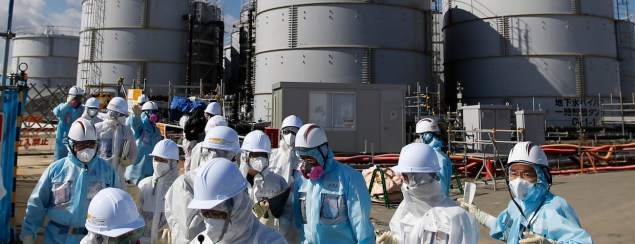
Members of the media, wearing white protective suits and masks, walk after they receive a briefing from Tokyo Electric Power Co. employees during a tour of the tsunami-crippled Fukushima Daiichi nuclear power plant on February 10, 2016.
It seemed like compelling journalism: a major investigative story published by The Asahi Shimbun, Japan’s second largest daily newspaper, about workers fleeing the Fukushima nuclear plant against orders.
It was the work of a special investigative section that had been launched with much fanfare to regain readers’ trust after the triple meltdown at the Fukushima Daiichi nuclear power plant in March 2011, when the Asahi and other media were criticized for initially repeating the official line that the government had everything safely under control.
The team had been producing award winning journalism for three years, but the story on the workers would be the last for some of its ace reporters. And its publication in May 2014 would come to mark the demise of one of the most serious efforts in recent memory by a major Japanese news organization to embrace a more independent approach to journalism.
The hastiness of the Asahi’s retreat raised fresh doubts about whether such watchdog journalism—an inherently risky enterprise that seeks to expose and debunk, and challenge the powerful—is even possible in Japan’s big national media, which are deeply tied to the nation’s political establishment.
The editors at Asahi, considered the “quality paper” favored by intellectuals, knew the culture they were facing, but they saw the public disillusionment in Japan that followed the nuclear plant disaster as the opportunity launch a bold experiment to reframe journalism.
No more pooches
On the sixth floor of its hulking headquarters overlooking Tokyo’s celebrated fish market, the newspaper in October 2011 hand-picked 30 journalists to create a desk dedicated to investigative reporting, something relatively rare in a country whose big national media favor cozy ties with officials via so-called press clubs. The clubs are exclusive groups of journalists, usually restricted to those from major newspapers and broadcasters, who are stationed within government ministries and agencies, ostensibly to keep a close eye on authority. In reality, the clubs end up doing the opposite, turning the journalists into uncritical conduits for information and narratives put forth by government officials, whose mindset the journalists often end up sharing.
The choice to head of the new section was unusual: Takaaki Yorimitsu, a gruff, gravelly-voiced outsider who was not a career employee of the elitist Asahi, and had been head-hunted from a smaller regional newspaper for his investigative prowess. Yorimitsu set an iconoclastic tone by taping a sign to the newsroom door declaring “Datsu Pochi Sengen,” or “No More Pooches Proclamation”—a vow that his reporters would no longer be kept pets of the press clubs, but true journalistic watchdogs.
The Investigative Reporting Section proved an instant success, winning Japan’s top journalism award two years in a row for its exposure of official coverups and shoddy decontamination work around the nuclear plant.
The new section gave reporters a broad mandate to range across the Asahi’s rigid internal silos in search of topics, while also holding to higher journalistic standards, such as requiring using the names of people quoted in stories instead of the pseudonyms common in Japanese journalism.
The Investigative Reporting Section proved an instant success, winning Japan’s top journalism award two years in a row for its exposure of official coverups and shoddy decontamination work around the nuclear plant, which was crippled when a huge earthquake and tsunami knocked out vital cooling systems. The section’s feistier journalism offered hope of attracting younger readers at a time when the 7 million-reader Asahi and Japan’s other national dailies, the world’s largest newspapers by circulation, were starting to feel the pinch from declining sales.
“The Asahi Shimbun believes such investigative reporting is indispensable,” the newspaper’s president at the time, Tadakazu Kimura, declared in an annual report in 2012. The new investigative section “does not rely on information obtained from press clubs, but rather conducts its own steadfast investigations that require real determination.”
That is why it was all the more jarring when, just two years later, the Asahi abruptly retreated from this foray into watchdog reporting. In September 2014, the newspaper retracted the story it had published in May about workers fleeing the Fukushima plant against orders, punishing reporters and editors responsible for the story, slashing the size of the new section’s staff and forcing the resignation of Kimura, who had supported the investigative push.
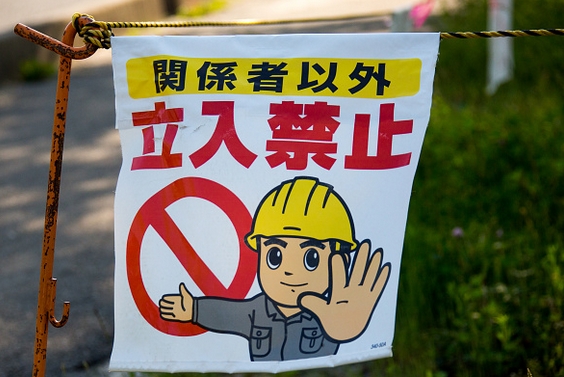
IITATE, JAPAN – MAY 23: No entry sign in the contaminated area after the daiichi nuclear power plant irradiation, fukushima prefecture, iitate, Japan on May 23, 2016 in Iitate, Japan.
A newspaper-appointed committee of outside experts later declared that the article, which the Asahi had trumpeted as a historic scoop, was flawed because journalists had demonstrated “an excessive sense of mission that they ‘must monitor authority.’”
While the section was not closed down altogether, its output of major investigative articles dropped sharply as the remaining journalists were barred from writing about Fukushima.
Emasculating the Asahi
The abrupt about-face by the Asahi, a 137-year-old newspaper with 2,400 journalists that has been postwar Japan’s liberal media flagship, was was an early victory for the administration of Prime Minister Shinzo Abe, which had sought to silence critical voices as it moved to roll back Japan’s postwar pacifism, and restart its nuclear industry.
“In Japanese journalism, scoops usually just mean learning from the ministry officials today what they intend to do tomorrow,” said Makoto Watanabe, a former reporter in the section who quit the Asahi in March because he felt blocked from doing investigative reporting. “We came up with different scoops that were unwelcome in the Prime Minister’s Office.”
Abe and his supporters on the nationalistic right seized on missteps by the Asahi in its coverage of Fukushima and sensitive issues of World War II-era history to launch a withering barrage of criticism that the paper seemed unable to withstand. The taming of the Asahi set off a domino-like series of moves by major newspapers and television networks to remove outspoken commentators and newscasters.
Political interference in the media was one reason cited by Reporters Without Borders in lowering Japan from 11th in 2010 to 72nd out of 180 nations in this year’s annual ranking of global press freedoms, released on April 20, 2016.
“Emasculating the Asahi allowed Abe to impose a grim new conformity on the media world,” said Koichi Nakano, a professor of politics at Sophia University in Tokyo and a leading critic of the administration on press freedom issues. “Other media know that once Asahi gave in, they were exposed and could be next. So they gagged themselves.”
But government pressure fails to fully explain the Asahi’s retreat. Some Asahi reporters and media scholars say the government was able to exploit weaknesses within Japanese journalism itself, particularly its lack of professional solidarity and its emphasis on access-driven reporting. At the Asahi’s weakest moment, other big national newspapers lined up to bash it, essentially doing the administration’s dirty work, while also making blatant efforts to poach readers to shore up their declining circulations.
The knockout blow, however, came from within the Asahi itself, as reporters in other, more established sections turned against the upstart investigative journalists. The new section’s more adversarial approach to journalism had earned it wide resentment for threatening the exclusive access—enjoyed by the Asahi as part of the mainstream media—to the administration and the powerful central ministries that govern Japan.
Media scholars say reporters in elite national newspapers like the Asahi have a weak sense of professional identity; most did not attend journalism school and spend their entire careers within the same company. Until recently, a job at a national daily was seen as a safe career bet rather than a calling, as the Asahi and its competitors offered salaries and lifetime job guarantees similar to banks and automakers.
This result is that many Japanese journalists are unable to resist pressures that officials can put on them via the press clubs. Journalists who are deemed overly critical or who write about unapproved topics can find themselves barred from briefings given to other club members. This is a potent sanction when careers can be broken for missing a scoop that appeared in rival newspapers. This is what some Asahi journalists in the press clubs say happened to them as the Investigative Section angered government officials with its critical stories.
“When the chips were down, they saw themselves as elite company employees, not journalists,” said Yorimitsu, who after the Fukushima article’s retraction was reassigned to a Saturday supplement where he writes entertainment features.
Unable to weather the storm
It was a bitter reversal for a section that had been launched with high expectations just three years before. Yorimitsu described the new section as the newspaper’s first venture into what he called true investigative journalism. He said that while the Asahi had assembled teams in the past that it called “investigative,” this usually meant being freed from the demands of daily reporting to take deeper dives into scandals and social issues. He said the new section was different because his journalists not only gathered facts, they used them to build counter narratives that challenged versions of events put forward by authorities.
“Until 2014, the newspaper was very enthusiastic about giving us the time and freedom to expose the misdeeds in Fukushima, and tell our own stories about what had happened,” recalled Yorimitsu. “We were telling the stories that the authorities didn’t want us to tell.”
Yorimitsu had been hired in 2008 in to take charge of a smaller investigative team that the Asahi had created in 2006, when it was first starting to feel the pinch from the Internet. From a peak of 8.4 million copies sold daily in 1997, the Asahi’s circulation had slipped below 8 million by 2006, according to the Japan Audit Bureau of Circulations. (By late 2015, it had dropped to 6.6 million.) The team of 10 reporters was an experimental effort to win readers. “We realized that in the Net era, independent, investigative journalism was the only way for a newspaper to survive,” said Hidetoshi Sotooka, a former managing editor who created the original team.
However, it was not until Fukushima, Japan’s biggest national trauma since its World War II defeat in 1945, that the newspaper wholeheartedly embraced the effort, tripling the number of journalists and elevating it to a full-fledged section, putting it on par organizationally with other, more established parts of the paper.
Under Yorimitsu, the section’s crowning achievement was an investigative series called “The Promethean Trap,” a play on the atomic industry’s early promise of becoming a second fire from heaven like the one stolen by Prometheus in Greek mythology. The series, which appeared daily beginning in October 2011, won The Japan Newspaper Publishers and Editors Association Prize, Japan’s equivalent of the Pulitzer Prize, in 2012 for its reporting on such provocative topics as a gag-order placed on scientists after the nuclear accident, and the government’s failure to release information about radiation to evacuating residents. The series spawned some larger investigative spin-offs, including an exposé of corner-cutting in Japan’s multi-billion dollar radiation cleanup, which won the prize in 2013.
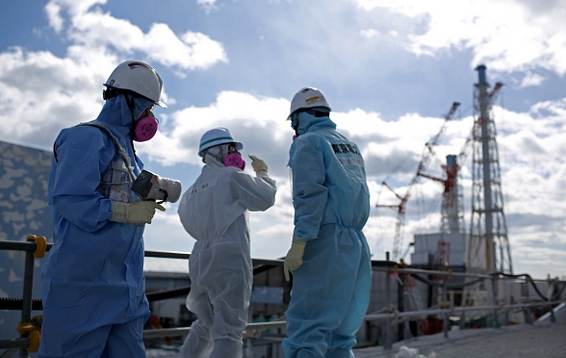
OKUMA, JAPAN – FEBRUARY 25: A TEPCO employee uses a radiation monitor as they show a member of the media a destroyed reactor at Fukushima Daiichi nuclear power plant on February 25, 2016 in Okuma, Japan. Five years on, the decontamination and decommissioning process at the Tokyo Electric Power Co.’s embattled Fukushima Daiichi nuclear power plant continues on February 25, 2016 in Okuma, Japan. March 11, 2016 marks the fifth anniversary of the magnitude 9.0 earthquake and tsunami which claimed the lives of 15,894, and the subsequent damage to the reactors at TEPCO’s Fukushima Daiichi Nuclear Power Plant causing the nuclear disaster which still forces 99,750 people to live as evacuees away from contaminated areas.
These were promising accomplishments for a new section, but they also led to resentment in other parts of the newspaper, where the investigative team was increasingly viewed as prima donnas, and Yorimitsu’s “no more pooches” proclamation as an arrogant dismissal of other sections’ work.
At the same time, the Investigative Section also was making powerful enemies outside the newspaper by exposing problems at Fukushima. This became particularly apparent after the pro-nuclear Abe administration took office in December 2012, when other media started to cut back on articles about the nuclear accident.
“We were being told that the Prime Minister’s Office disliked our stories and wanted them stopped,” Watanabe recalled, “but we thought we could weather the storm.”
They may have been able to if the new section had not given its opponents an opening to strike. But on May 20, 2014, running under the banner headline “Violating Plant Manager Orders, 90 Percent of Workers Evacuated Fukushima Daiichi,” the front-page article made the explosive claim that at the peak of the crisis, workers had fled the nuclear plant in violation of orders to remain from plant manager, Masao Yoshida. The article challenged the dominant narrative of the manager leading a heroic battle to contain the meltdowns and thus save Japan.
The reporters behind the story, Hideaki Kimura and Tomomi Miyazaki, had obtained a transcript of testimony that Yoshida gave to government investigators before his death from cancer in 2013. The 400-plus-page document, drawn from 28 hours of spoken testimony by Yoshida, had been kept secret from the public in the Prime Minister’s Office. Unearthing the testimony was an investigative coup, which the Asahi unabashedly played up in ad campaigns. It might have stayed that way, had not the Asahi opened up the floodgates of public criticism by clumsily setting off a completely unrelated controversy about its past coverage of one of East Asia’s most emotional issues.
That uproar began on Aug. 5, 2014 when the Asahi suddenly announced in a front-page article that it was retracting more than a dozen stories published in the 1980s and early 1990s about “comfort women” forced to work in wartime Japanese military brothels. The newspaper was belatedly admitting what historians knew: that a Japanese war veteran quoted in the articles, Seiji Yoshida, had fabricated his claims of having forcibly rounded up more than 1,000 Korean women.
The comfort women retractions appeared to be an attempt by the Asahi to preempt critics in the administration by coming clean about a decades-old problem. Instead, the move backfired, giving the revisionist right ammunition to attack the Asahi. The public pillorying, led by Abe himself, who said the reporting “has caused great damage to Japan’s image,” grew so intense that the magazine of the Foreign Correspondents Club of Japan ran a cover story: “Sink the Asahi!”
It was at the peak of this maelstrom, when the Asahi was on the ropes, that criticism of its Fukushima scoop erupted. In late August, the Sankei Shimbun and the Yomiuri Shimbun, both pro-Abe newspapers on the right, obtained copies of Yoshida’s secret testimony, and wrote reports challenging the version of events put forth by the Asahi. “Asahi Report of ‘Evacuating Against Orders’ At Odds With Yoshida Testimony,” the Yomiuri, the world’s largest newspaper with 9 million readers, declared in a front-page headline Aug. 30. Other media, including the liberal Mainichi Shimbun, followed with similar efforts to discredit the Asahi.
According to these stories, the Asahi’s epic scoop had gotten it wrong by implying that the plant workers had knowingly ignored Yoshida’s orders. The newly obtained copies of his testimony showed that his orders had failed to reach the workers in the confusion. The other newspapers accused the Asahi of again sullying Japan’s reputation, by inaccurately portraying the brave Fukushima workers as cowards. (Whether the Asahi got the story wrong is debatable, since its article never actually stated that workers knowingly violated Yoshida’s orders; however, it did fail to include the manager’s statement that his orders had not been properly relayed—an omission that could lead readers to draw the wrong conclusion.)
The fact that two pro-Abe newspapers had suddenly and in quick succession obtained copies of the Yoshida transcript led to widespread suspicions, never proven, that the Prime Minister’s Office leaked the documents to use against the Asahi. True or not, the newspapers seemed willing to serve the purposes of the administration, perhaps to improve their access to information, or to avoid suffering a similar fate as the Asahi.
The other papers also saw the Asahi’s woes as a chance to steal readers. The Yomiuri stuffed glossy brochures in the mailboxes of Asahi subscribers, blasting it for tarnishing Japan’s honor, while praising the Yomiuri’s coverage of the comfort women. This attempt to poach readers ultimately backfired as both newspapers lost circulation.
“Rather than stand together to resist government pressure, they allowed themselves to be used as instruments of political pressure,” said Jiro Yamaguchi, a political scientist at Tokyo’s Hosei University.
Despite peer pressure, Asahi journalists say the newspaper initially intended to defend its Fukushima scoop, going so far as to draw up a lengthy rebuttal that was to have run on page one in early September. As late as Sept. 1, Seiichi Ichikawa, the head of the Investigative Section at the time, told his reporters that the newspaper was ready to fight back. “The government is coming after the Special Investigative Section,” Ichikawa said in a pep talk to his team, according to Watanabe and others who were present. “The Asahi will not give in.”
The Asahi’s decision to punish its own journalists will discourage others from taking the same risks inherent in investigative reporting.
The rebuttal was never published. Instead, President Kimura surprised many of his own reporters with a sudden about face, announcing at a press conference on Sept. 11 that he was retracting the Fukushima-Yoshida article. Reporters say the newspaper’s resolve to defend the piece crumbled when journalists within the newspaper began an internal revolt against the article and the section that produced it.
This was compounded by a sense of panic that gripped the newspaper, as declines in readership and advertising accelerated markedly after the scandals. Fearing for the Asahi’s survival, many reporters chose to sacrifice investigative journalism as a means to mollify detractors, say media scholars and some Asahi journalists, including Yorimitsu.
The Asahi’s official line is that the story was too flawed to defend. The paper’s new president, Masataka Watanabe, continues to talk about the importance of investigative journalism, and some current and former Asahi journalists say investigative reporting will make a comeback.
However, scholars and former section reporters say the setback was too severe. They say the Asahi’s decision to punish its own journalists will discourage others from taking the same risks inherent in investigative reporting. Worse, they said the Asahi seemed to lapse back into the old, access-driven ways of Japan’s mainstream journalism. “The Asahi retreated from its experiment in risky, high-quality journalism, back into the safety of the press clubs,” said Tatsuro Hanada, a professor of journalism at Waseda University in Tokyo. Hanada was so dismayed by the Asahi’s retreat that he established Japan’s first university-based center for investigative journalism at Waseda this year. “It makes me think that the days of Japan’s huge national newspapers may be numbered.”
http://www.cjr.org/the_feature/asahi_shimbun_japan_journalism.php
Paper sludge that polluted sea cleans up soil in Fukushima
Another one after so many others. Always nice to read so as to reduce the anxiety of the Fukushima people who have to live with that contamination.
But does it truly works? Or is it just another soothing story cooked by the ETHOS project whose only intent is to make people stay put in the contaminated areas, the costs of evacuation being too high…

A heap of sludge produced in papermaking
FUJI, Shizuoka Prefecture–Charcoal from paper mill sludge that once polluted the ocean here southwest of Tokyo could be used to restore contaminated land near the crippled Fukushima No. 1 nuclear power plant.
An experiment in 2011 showed that the charcoal is effective in reducing radioactive substances in soil and preventing the absorption of cesium by plants, said research leader Ai Van Tran.
Tran, 68, a doctor in agricultural science, was conducting the research for the Corelex Group that includes Corelex Shin-ei Mfg. Co., which has the largest share of recycled toilet paper in Japan.
“We would be delighted if our byproduct, which was once a source of environmental pollution, is useful in decontamination. It will also contribute to reducing the waste from papermaking, so it is killing two birds with one stone,” said Satoshi Kurosaki, the president of the Corelex Shin-ei.
In making recycled paper, about 30 percent of the raw material remains as sludge. In 2002, the Corelex Group developed “blacklite,” a type of activated carbon produced by burning paper sludge. It has a variety of useful properties such as soil conditioning, deodorizing, underfloor humidity control, melting snow and more.
The company produces blacklite from the paper sludge generated at a paper mill in Hokkaido, and it is used at golf courses and farms on the island.
After the radioactive fallout from the accident at the Fukushima No. 1 nuclear plant contaminated a vast area, the team, led by Tran, suggested conducting a trial to use the absorbent property of blacklite to decontaminate the soil.
Between May and October 2011, the company rented about 1,000 square meters of rice fields in Iitate, Fukushima Prefecture. It is one of the most heavily contaminated areas. The team grew rice in soil containing blacklite, and compared the amount of radioactivity in the rice with crops grown on soil with no blacklite.
The result was clear.
The rice harvested from the paddies that contained blacklite had just one-35th of the amount of radioactive cesium that was found in the rice grown on untreated soil. The cesium concentration in the treated soil was about half that in the untreated soil.
Also, the rice in the paddies with blacklite showed much better growth than the other crop.
As the ingredients of blacklite is industrial waste, it only costs about 500 yen ($4.80) for a 30-liter bag.
The enormous amount of soil removed from the surface of the ground in Fukushima Prefecture in the decontamination effort has been bagged and piled up at a temporary storage site. It is waiting to be transferred to an interim storage facility, which is still under construction.
It is expected to take a significant amount of time to process this soil and concerns have been raised over radiation leakage in the meantime.
Tran, who is originally from Vietnam, and his team have acquired the patent for a new method to contain radiation by mixing contaminated soil with blacklite and then sealing it in a tank made of concrete.
It is believed that the soil is gradually decontaminated when an ion exchange process occurs between the mineral in blacklite and the radioactive cesium in the soil.
Tran’s paper on his team’s experiments attracted attention in the United States, and he has been invited to speak at an international conference on nuclear chemistry scheduled for December in Texas.
The research is still in its early stages, but the Corelex Group has contacted the economy ministry to ask whether blacklite can be used in the decontamination project in Fukushima in the future.
http://www.asahi.com/ajw/articles/AJ201610260012.html
At UN Seminar, Fukushima Governor Appealed that Fukushima is Safe.

On October 19, 2016, Governor Masao Uchibori, the Fukushima prefecture governor, took part in a seminar at the United Nations headquarters in New York, a seminar about the reconstruction of Eastern Japan from the 2011 earthquake.
He declared that though there were rumors saying that many people can’t live anymore in Fukushima since the nuclear accident in March 2011, it was not fact. The evacuation zone was only 5 % of the Fukushima prefecture. He also emphasized that life in Fukushima was back in the same way as it was before the 2011 earthquake in 95 % of the prefecture.
1 This Month

of the week – Shut Down Drone Warfare!


Tell the Ukrainian Government to Drop Prosecution of Peace Activist Yurii Sheliazhenko

Petition to revoke the licensing of the Near Surface Nuclear Disposal Facility (NSDF) at Chalk River. https://www.ourcommons.ca/petitions/en/Petition/Details?Petition=e-7247
To see nuclear-related stories in greater depth and intensity – go to https://nuclearinformation.wordpress.com
-
Archives
- March 2026 (244)
- February 2026 (268)
- January 2026 (308)
- December 2025 (358)
- November 2025 (359)
- October 2025 (376)
- September 2025 (257)
- August 2025 (319)
- July 2025 (230)
- June 2025 (348)
- May 2025 (261)
- April 2025 (305)
-
Categories
- 1
- 1 NUCLEAR ISSUES
- business and costs
- climate change
- culture and arts
- ENERGY
- environment
- health
- history
- indigenous issues
- Legal
- marketing of nuclear
- media
- opposition to nuclear
- PERSONAL STORIES
- politics
- politics international
- Religion and ethics
- safety
- secrets,lies and civil liberties
- spinbuster
- technology
- Uranium
- wastes
- weapons and war
- Women
- 2 WORLD
- ACTION
- AFRICA
- Atrocities
- AUSTRALIA
- Christina's notes
- Christina's themes
- culture and arts
- Events
- Fuk 2022
- Fuk 2023
- Fukushima 2017
- Fukushima 2018
- fukushima 2019
- Fukushima 2020
- Fukushima 2021
- general
- global warming
- Humour (God we need it)
- Nuclear
- RARE EARTHS
- Reference
- resources – print
- Resources -audiovicual
- Weekly Newsletter
- World
- World Nuclear
- YouTube
-
RSS
Entries RSS
Comments RSS
 nuclear-news