Death of doctor in Fukushima disaster zone hospital throws patients’ futures into question

A photo from the website of Takano Hospital shows its building in the town of Hirono, Fukushima Prefecture.
A 120-bed hospital in the town of Hirono, Fukushima Prefecture, which has been on the frontline of efforts to restore communities annihilated by the March 2011 quake, tsunami and nuclear calamity, has been thrown into crisis following the unexpected death last week of its aging and sole full-time doctor.

Dr. Hideo Takano, 81-year-old director of the privately run Takano Hospital, died from burns after a fire broke out at his home on the hospital grounds on the night of Dec. 30. The police are investigating the cause of the fire, but it is being treated as an accident.
Hirono Mayor Satoshi Endo told The Japan Times on Friday that the town is doing its best to keep the hospital and its 100 inpatients — about 50 bed-ridden elderly patients and 50 people in its psychiatric ward — alive.
The town plans to pay for the accommodation and transportation costs of volunteer doctors who will fill Takano’s shifts through the end of January. After that, the hospital’s fate is uncertain.
Set up in 1980 originally as a psychiatric hospital some 20 km south of the crippled Fukushima No. 1 nuclear power plant, the facility has played a central role in maintaining the welfare of residents not only in town, but across the Futaba region as the only hospital operating since the nuclear disaster.
The crisis prompted many of the town’s residents and even its government to evacuate. Hirono’s evacuation orders were lifted in September 2011 and residents have been slowly making their way back, but the town’s population — currently about 3,000 — remains less than 60 percent of pre-3/11 levels. The population is expected to climb back to 4,000 by April, Endo said.
In the more than five years since the disaster began, Takano Hospital didn’t close for a single day because the late director decided its frail inpatients could not be evacuated.
Because the other five hospitals in the region shut down, Takano Hospital is the only institution providing medical care not only to its residents, but also to 3,500 or so workers residing there for decontamination and decommissioning work related to the core meltdowns.
Mayor Endo stressed that the hospital needs to survive as it is part of the town’s basic infrastructure and will be necessary if residents are to return.
“The hospital has played a huge role in the community by ceaselessly providing care,” Endo said. “If it goes, these patients will have no other place to go.”
Takano, who was a psychiatrist, had been a “super-human” figure, tirelessly tending to the needs of patients despite his advanced age, said Akihiko Ozaki, a 31-year-old surgeon at Minamisoma Municipal General Hospital some 60 km north.
Ozaki is spearheading a drive to save Takano Hospital, and thanks to the efforts of him and others, the hospital has secured about 25 doctors from across the country to work as unpaid volunteers through the end of the month.
But the hospital still urgently needs a permanent full-time doctor to fill Takano’s shoes, Ozaki said.
“Technically speaking, a hospital operating without a director is illegal,” Ozaki said. “Patients will suffer, as a system based on various different doctors coming and going is incapable of providing continuous care. We need a new full-time doctor as soon as possible.”
But it will be no easy task to find a replacement, Ozaki said, adding that the hospital was barely afloat under Takano, who worked for little pay and had next to no time off.
Mio Takano, his daughter and head manager of the hospital, said the facility has struggled financially since 3/11. She said government officials have long spurned her calls for help on the grounds that taxpayer money cannot be used by a private hospital.
Takano said that the quake changed everything and that the hospital’s running costs have surged because it needs to hire more staffers to maintain the same quality of care.
Before the quake, many nurses could ask parents or in-laws to take care of their children, she explained. But the disaster forced many families to separate and workers with children can no longer rely on elderly family members, she said, noting that the hospital thus needs to hire more people to work night and weekend shifts.
“Such lifestyle changes have meant it is more costly to keep the same level of care,” she said.
Takano added that, nearly six years on, the nuclear disaster is far from over.
“This is not a problem of an aging doctor dying in an accident, throwing a hospital into crisis. Situations like ours could happen to any other hospitals in areas that host nuclear power plants.”
A pair of earthquakes of M5.3 and M5.8 struck Fukushima and Ibaraki prefectures early Thursday
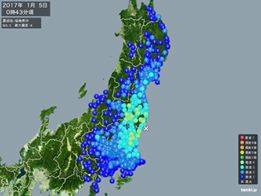
Strong quakes jolt eastern Japan
TOKYO (Kyodo) — A pair of earthquakes with a preliminary magnitude of 5.3 and 5.8 struck Fukushima and Ibaraki prefectures in eastern Japan early Thursday, the Japan Meteorological Agency said. No tsunami warning was issued.
The temblors occurred at around 12:44 a.m. and 2:53 a.m., originating at depths of about 60 and 30 kilometers off the coast of Fukushima. They measured up to 4 on the Japanese seismic scale of 7 in southern Fukushima and northern Ibaraki.
After the quakes, no abnormalities were detected at two nuclear power plants — the crippled Fukushima Daiichi and idled Fukushima Daini, according to the operator, Tokyo Electric Power Company Holdings Inc.
Fukushima was hard hit by the March 11, 2011 earthquake-tsunami and nuclear crisis.
http://mainichi.jp/english/articles/20170105/p2g/00m/0dm/001000c
Pair of strong late-night quakes jolt Fukushima, Ibaraki
A magnitude-5.3 earthquake and another of magnitude-5.8 struck Fukushima and Ibaraki prefectures early Thursday, the Meteorological Agency said. No tsunami warning was issued.
The earthquakes occurred at 12:44 a.m. and 2:53 a.m., originating at depths of about 60 km and 30 km off the coast of Fukushima, respectively. They measured up to 4 on the Japanese seismic scale to 7 in southern Fukushima and northern Ibaraki.
After the quakes, no abnormalities were detected at the crippled Fukushima No. 1 nuclear plant and the nearby idled Fukushima No. 2 plant, according to Tokyo Electric Power Company Holdings Inc.
Fukushima was hit hard by the March 11, 2011, earthquake-tsunami and nuclear crisis.
Environment Ministry deleted some of its remarks from minutes on contaminated soil meet
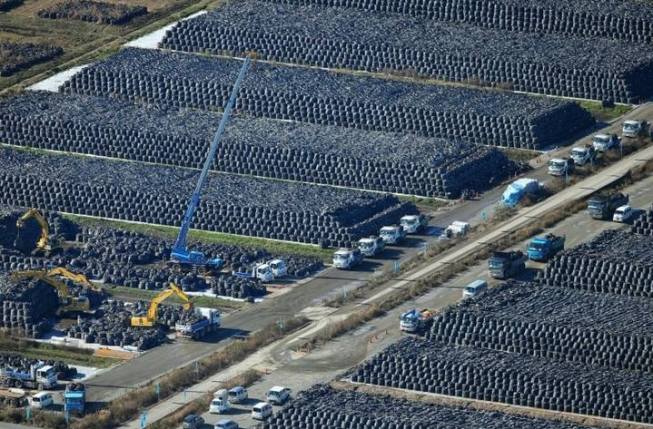
The Ministry of the Environment deleted some of its remarks made in closed-door meetings on reuse of contaminated soil stemming from the Fukushima nuclear disaster from the minutes of the meetings, it has been learned.
When the ministry posted the minutes on its website, it said it had “fully disclosed” them. The deleted remarks could be taken to mean that the ministry induced the discussions. The remarks led the meetings to decide on a policy of reusing contaminated soil containing up to 8,000 becquerels of radioactive cesium per kilogram. An expert on information disclosure lashed out at the ministry’s handling of the minutes, saying, “It is extremely heinous because it constitutes the concealment of the decision-making process.”
The meetings were called the “working group to discuss safety assessments of impacts of radiation.” The meetings were attended by about 20 people, including radiation experts, officials of the Environment Ministry and the Japan Atomic Energy Agency (JAEA) and others. The meetings were held six times from January to May in 2016.
The meetings discussed the reuse of radioactively contaminated soil generated when areas affected by the Fukushima nuclear crisis were decontaminated.
Initially, the meetings themselves were unpublicized. But because requests for information disclosure on the meetings were filed one after another, the Environment Ministry posted the minutes and relevant data on its website in August. As a matter of clerical procedures, the ministry said at that time that everything was disclosed.
The minutes that were disclosed contain “draft minutes” that were prepared before becoming official documents, but the Mainichi Shimbun obtained an “original draft” that was prepared even before then. Comparing the disclosed minutes with the original draft, the Mainichi found multiple cases of remarks being deleted or changed. According to the original draft, an Environment Ministry official said at the fourth meeting on Feb. 24, “With the assessments of soil with 8,000 becquerels, there have been cases in which the annual radiation dose slightly exceeds 1 millisievert in times of disasters and the like. But it will be good if it stays within 1 millisievert.” But the remark was deleted from the disclosed minutes.
Soil contaminated with radiation exceeding 8,000 becquerels is handled as “designated waste,” but discussions were held on reusing of contaminated soil containing 8,000 becquerels of radioactive cesium per kilogram during a series of meetings. In the Feb. 24 meeting, the JAEA showed an estimate that workers engaged in recovery work on a breakwater made of contaminated soil of 8,000 becquerels that has collapsed in a disaster would be exposed to radiation exceeding 1 millisievert per year — the maximum dose allowed for ordinary people. Based on the estimate, there was a possibility of the upper limit for reusing contaminated soil being lowered, but the Environment Ministry official’s remark promoted experts and others to call for s review to make a new estimate, with one attendee saying, “If it collapses, it will be mixed with other soil and diluted.”
A fresh estimate that the annual radiation dose will stay at 1 millisievert or lower was later officially presented, and the Environment Ministry officially decided in June on a policy of reusing contaminated soil containing up to 8,000 becquerels of radioactive cesium per kilogram.
http://mainichi.jp/english/articles/20170105/p2a/00m/0na/007000c
Tragic death in a fire of its only full-time doctor at Hirono, Fukushima hospital. Volunteer doctors sought.
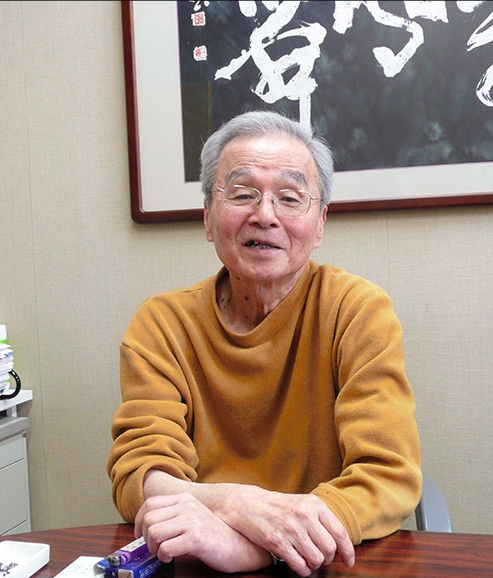
Hideo Takano, doctor and director of Takano Hospital
Lone doctor who stayed in town after Fukushima crisis dies in fire
HIRONO, Fukushima Prefecture–The tragic death in a fire of its only full-time doctor at a hospital here has dealt another crisis to this tiny community, which is still struggling to rebuild from the Fukushima nuclear disaster.
Hideo Takano, 81, director of Takano Hospital, died on Dec. 30, threatening the future of the hospital and possibly the community of 2,800 residents.
Hirono Mayor Satoshi Endo on Jan. 3 stepped up his pleas for assistance from the central and prefectural governments.
“We would like to prevent the collapse of local medical services,” Endo said at a news conference. “We, as a local government, need to respond to the dedication of Takano.”
Under the law, a private medical facility must have at least one full-time doctor on staff.
Takano’s one-story wooden house, on the same site as the hospital, caught fire on the night of Dec. 30. Police found his body inside the home.
Takano and another doctor at the hospital had treated inpatients as full-time physicians before the triple meltdown in March 2011, which was triggered by the Great East Japan Earthquake and tsunami on March 11 the same year.
The hospital is situated around 20 kilometers from the crippled Fukushima No. 1 nuclear power plant. It offers the only medical inpatient facility in Futaba county, which, alongside Hirono, includes towns co-hosting the Fukushima No. 1 plant and damaged Fukushima No. 2 nuclear plant.
When the town government ordered all its residents to evacuate on March 13, 2011, Takano and many of his staff chose to remain to treat inpatients at the hospital. They deemed it too risky to transport aged and frail patients elsewhere when the entire prefecture was in disarray.
Most of the inpatients at the hospital are senior citizens from Hirono, and many of them were bed-ridden.
Hirono had a population of slightly more than 5,000 before the nuclear disaster. But only a little more than half of the residents have returned to live in the town after the evacuation order was lifted a year later.
As of the end of last December, there were 102 inpatients at Takano Hospital, although the size of the staff shrank to about one-third of the pre-disaster level. Part-time doctors have joined Takano in treating patients after the disaster, but he was the only full-time physician on staff there.
“Takano used to say nothing makes him happier than treating patients,” said one of the hospital staff, describing his commitment.
According to the Hirono officials, part-time doctors continued seeing patients at the hospital until Jan. 3 after Takano’s death.
The town managed to secure temporary doctors for the hospital after that date through cooperation from Minami-Soma, a city about 60 km to the north.
Physicians from the municipal Minami-Soma General Hospital also have pitched in and formed a group to assist Takano Hospital. More than 20 doctors have signed up to provide volunteer services, including those from Chiba, Shizuoka and Nagano prefectures.
Although there is a medical clinic in Hirono, some residents say it is not sufficient to meet the health-care needs of residents in the town on its own.
http://www.asahi.com/ajw/articles/AJ201701040034.html
Volunteer doctors to be sought for Fukushima hospital after director dies in fire
HIRONO, Fukushima — The body of a man found in a home here after a fire was identified as that of a doctor who continued to treat patients in an area affected by the Fukushima nuclear disaster, local police announced on Jan. 3. The doctor’s death prompted the local town to seek volunteer doctors from across the country.
Hideo Takano, 81 — who was head of Takano Hospital in the town of Hirono in Fukushima Prefecture — died as a result of the fire which partially burned his home on Dec. 30. The corpse was confirmed to be that of Takano by Futaba Police Station, following DNA testing.
The doctor was particularly noted for his bravery following the Fukushima No. 1 nuclear power plant meltdowns in March 2011 — because he decided not to flee, and continued to attend to his patients’ needs at the only hospital close to the power plant, within Futaba county, that remained operational after the accident.
Currently, Takano Hospital treats patients who have returned to the area, as well as people involved in nuclear reactor decommissioning work, but the hospital now faces a staff shortage problem following the death of Dr. Takano, who was the only full-time doctor at the institution.
With this in mind, the Hirono Municipal Government announced on Jan. 3 that it will bring in doctors until Jan. 9 from nearby medical institutions such as Minamisoma City General Hospital, also in Fukushima Prefecture. The doctors will help treat approximately 100 inpatients, in addition to providing outpatient care. Furthermore, a group to support the hospital, called “Takano Byoin o shiensuru kai,” has been set up by voluntary doctors at the hospital, and there have also been appeals on Facebook, asking for support from doctors.
The Hirono Municipal Government plans to recruit volunteer doctors from across Japan — in an attempt to maintain the town’s medical care system — and has offered incentives such as free accommodation and travel. A representative at the town hall stated that, “Takano Hospital patients reside far and wide across Futaba,” and that the town will request support from both the Fukushima Prefectural Government and the central government.
Takano Hospital has set up a commemorative page on its website in memory of Dr. Takano — who devoted his life to medical care in the region — stating that it plans to “carry on the will of Dr. Takano and continue to provide medical care in the region.”
The Facebook page of “Takano Byoin o shiensuru kai,” or a group to support Takano Hospital:
https://www.facebook.com/savepatientakano/
http://mainichi.jp/english/articles/20170104/p2a/00m/0na/004000c
Gun control heartburn: Radioactive boars are amok in Fukushima

The “most adaptable animals that you’ll ever find” are running rampant across parts of rural Japan in the wake of the 2011 nuclear catastrophe and strict gun laws aren’t helping.
The Fukushima Daiichi nuclear disaster, in which a boiling water reactor nuclear power plant largely went Chernobyl after a tsunami knocked it offline has left Japan with a host of problems to include radiation-induced health impacts, some 200,000 displaced locals and possible exposure of groundwater to melted down nuclear fuel for decades to come.
Oh yeah, and the wild hogs.
According to an article in The Washington Post last April, the boar population, lacking natural predators is booming. Worse, thousands of the animals roam an area where highly radioactive caesium-137, which has a half-life of 30 years, has been confirmed.
Most agree that the best way to eradicate the rapid population of would-be Orcs is through hunting, but in gun control-friendly Japan, that is easier said than done.
“Something that complicates wild boar management in Japan is the exceptionally restrictive ownership, use, and access to firearms,” says Dr. Mark Smith, a forestry and wildlife professor at Auburn University, told Outside online. “This includes not only the general populace, but also with researchers, wildlife biologists, and natural resource managers.”
According to the Australian-based Small Arms Survey, the rate of private gun ownership in Japan is 0.6 per 100 people with only 77 handguns in circulation and just 0.8 percent of Japanese households containing one or more legal guns, most often shotguns.
Smith went to Japan to study the problem in 2013.
“Although [recreational] hunting does occur in Japan, it is very limited,” says Smith, “and hunter numbers are declining by the year, so there are fewer and fewer hunters out there harvesting wild boar.”
Plus there is the problem with the meat. In short, there is no good way to make caesium-137 infused pork a balanced part of your complete meal without the diner glowing in the dark, no matter how much BBQ sauce you use.
In Japan, they have to incinerate the carcasses (at 1,771 degrees Fahrenheit) then obliterate the fragments left over with hammers and box them up. Carefully.
Furthermore, the animals are very smart.
“They are the most adaptable animals that you’ll ever find: we call them the ‘opportunistic omnivore,’” says Smith.
http://www.guns.com/2017/01/03/gun-control-heartburn-radioactive-boars-are-amok-in-fukushima/
Landscapes I saw

A short poem at the beginning of the year.
Accumulated dust can make mountains.

Here are the pictures that show reality.
Taken on January 2nd 2017.

These black bags are full of soil and fallen leaves gathered in the course of the decontamination work.
These bags last from 3 to 5 years.
What do we do now?

Over the mountain of black bags lies Odaka station.
Now anybody can get on and off the train.

Source: Akiyoshi Imazeki, Odaka Station, Minamisoma-shi, Fukushima Prefecture
Doctor who stayed in Fukushima after meltdowns thought to have died in fire
HIRONO, Fukushima — A doctor who chose to stay in an area affected by the Fukushima nuclear crisis and continued to provide medical services may have died in a fire at his home here, police said.
At around 10:30 p.m. on Dec. 30, a fire broke out at the home of Hideo Takano, 81, director of Takano Hospital in Hirono, Fukushima Prefecture. Part of the wooden structure was destroyed in the blaze, local police said.
The body of a man was found in one of the rooms. Investigators believe the corpse is that of Takano, whom they have been unable to contact, and are trying to confirm the identity of the body.
A security guard at the hospital, located on the same grounds as Takano’s home, noticed smoke coming out of the home and alerted a local fire station. Takano had lived alone at the address.
A hospital official told the Mainichi Shimbun that until recently, Takano had treated patients as usual.
Takano Hospital is situated about 22 kilometers south of the crippled Fukushima No. 1 Nuclear Power Plant. Takano chose to stay home and continued to treat inpatients at his hospital even after the town of Hirono was designated as a zone in which residents were urged to prepare for evacuation following the outbreak of the nuclear disaster. He also examined local residents and those engaged in the decommissioning of the nuclear plant.
http://mainichi.jp/english/articles/20161231/p2a/00m/0na/011000c
Fukushima Trucks Spreading Unmeasurable Amount of Radiation
In Yamada, Futaba District, Fukushima, trucks carrying waste after decontamination work, go by spreading unmeasurable amount of radiation.
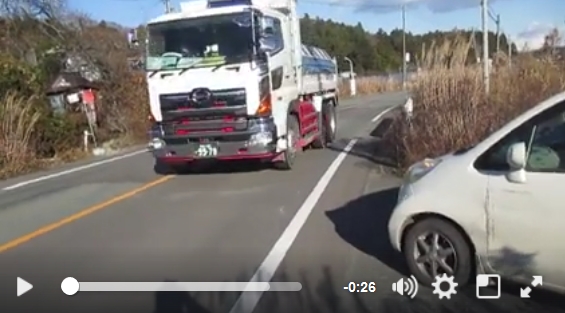

The Geiger counter hits 9.99 microSv/h which is its limit!


Recovery effort? Is n’t it better to relocate the entire residents elsewhere safe? In Japan, there are many villages and small towns where they suffer with depopulation.
What they do now is just to keep feeding big contractors, not helping affected people…..


Source: Oz Yo
Mountain of Light by Gen’yū Sōkyū – excerpt
As a writer and priest in Fukushima, Sōkyū grapples with the aftermath of the 2011 nuclear disaster in this short story about a son organising a funeral for his father, who collected radiation-contaminated waste
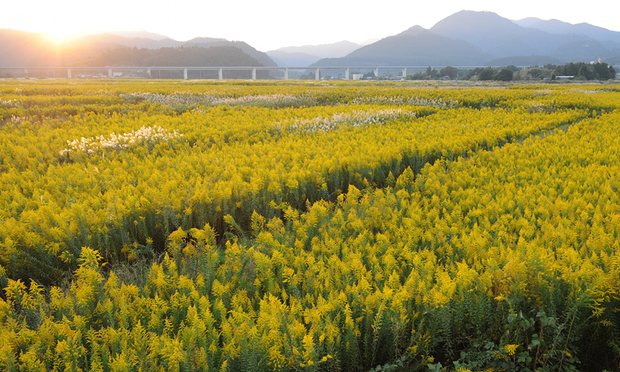
Rice fields in Fukushima, no longer cultivatable after the evacuation zone was dissolved in August 2012.
Akutagawa Prize winner Gen’yū Sōkyū has an unusual vocation among litterateurs: he is the chief priest of a temple in Fukushima, where nuclear disaster struck following the earthquake and tsunami of March 2011. Both a leader and a major voice in reconstruction efforts, Gen’yū uses fiction to grapple with the catastrophe, and in this story, Mountain of Light, he imagines (perhaps even hopes for) a future of provincial ascendance and “Irradiation Tours”. In this excerpt, the narrator relates his coming to terms with his father’s devotion in collecting the community’s “irradiated” — their radiation-contaminated waste, in other words.
—The editors at Asymptote
The next time I saw Dad was at Mom’s funeral. He himself would die three years later at ninety-five—twenty-five years after our last conversation—of old age, not cancer. After my mother’s cremation, he spoke to me.
“Your ma had a hard time of it, but it was all worthwhile. Thanks to the irradiated, we managed to live meaningfully, right up to the end, and that’s no joke. When my time comes… you’ll burn me on top of that mountain, right?”
His hearing wasn’t so good by that time, so while I said “Don’t be stupid,” apparently what he heard was “Okay, I’ll do it,” although I didn’t realise this until much later. He held my hands in front of Mom’s altar and said “Thank you” over and over again… It might’ve been a misunderstanding, but that was the first time he had ever shown me gratitude.
My brother and sister-in-law had only offered incense at the crematorium, and were no longer there. He was a consultant to an electronics manufacturer, and even though he said he had a meeting to attend, I was sure they had left out of fear. I too had debates with the missus about the effects of low-level exposure, almost every night. Eventually we stopped speaking, and came to see each other as “contaminated.” We’d separated by then. And that’s when I finally realised that we were both being completely ridiculous.
I’m sure all of you will agree—I mean, think about it, academics had all these opposing theories and no one was willing to budge. Some people said that anything up to one hundred thousand times the intensity of background radiation is fine, look at astronauts, they’re fine—and then others demanded that we spend trillions of yen on decontamination to scrape off fertile soil with low-level radiation. The Hormesis and Prophylaxis camps, yeah, that’s what they were called. Both sides wanted the other to calm down and talk things through, but like me and the ex, they just couldn’t do it. You could say my divorce was the result of a proxy war, haha.
People—organisations are even worse—go to terrifying lengths to save face. The ICRP, that’s the International Commission on Radiological Protection, they of all people should’ve created spaces for discussion, but showed no intention of doing so. And then public opinion was set on throwing every last baby out with the bathwater: if nuclear reactors were bad, then all radiation was bad too. In short, no one was calm.
But as you know, after the power plant accident, it was the ICRP who recommended raising the radiation exposure limit by twenty to a hundred times of the normal value. After that was rejected, they just stayed silent, same as me and the ex. Even now I have no idea who’s right. But what’s certain is that the radioactive potassium and carbon and whatnot in our bodies emit a fair amount of radiation, with or without the reactors. Somebody weighing sixty kilos would put out, oh, five thousand becquerels or so. Anyway, the Commission never officially changed their stance on low-level exposure after that. And now we have all of you taking part in this Irradiation Tour, coming to see the mountain my old man made. Radon hot springs are popular once more, and Fukushima’s population is even growing rapidly.
What was I… oh, right—that was quite a ramble—I was telling you about Dad’s request.
For the record, it wasn’t cancer. He might’ve said “Cancer wouldn’t be bad,” but in the end he had a prolonged bout of the autumn flu and kicked the bucket, just like that.
I got the news from my cousin, and when I came back Dad was already laid out in the main room, around there. Yes, right there, where the blond man is sitting, haha. I lifted the white cloth, and saw my old man looking solemn for the first time. It was as if he’d taken off the okame mask—I had never seen that face before, honest.
I spent the whole night thinking. I recalled what Dad said at Mom’s funeral, and I wasn’t sure what to do about his cremation. But the answer soon came to me. You see, my mother’s remains had disappeared from the altar.
Since Mom died eight years ago, I’d started coming back home a little more often. I’d retired from my job, and I didn’t have a family of my own. I wasn’t that worried about Dad living alone, rather I’d come to believe his mountain may have been some kind of miracle.
On one of those visits, he’d told me about their dog’s death, and how he had buried it atop that mountain. Sitting by my old man’s pillow, I looked over at the altar and noticed that while my mother’s picture was there, her remains were not. I put the pieces together and went outside. It was a still, humid night at the beginning of summer.
The sound of insects filled the air. It was my first time ever on that mountain. I realised, halfway up, that it had become much taller than before. It was even taller than it is now, nearly thirty metres, I’d wager. As I went up the winding path, I was aware of the dosimeter packed in my bag, but you know, I didn’t take any measurements. I think my feet were a bit shaky, but I wasn’t scared of anything anymore. Dad did the same thing every day, and he lived peacefully until the age of ninety-five, just like Mom.
Now and then, I felt his presence. Staring at the ground as I climbed, in the dim light of the moon, it seemed my old man was saying “It’s okay, it’s okay” and smiling overhead.
As I expected, there were two pieces of natural stone at the top, set about one metre apart. At some point, Dad had made and maintained a grave for Mom and another for their dog up there. And that’s why this mountain is like one of those burial mounds.
Looking around, I saw the neon signs of the neighbouring town twinkling like countless stars. Of course, the stars in the sky were also countless, and so beautiful. Perhaps Dad built the mountain with the knowledge of this view. I was suddenly reminded of him saying the word “meaningfully” at Mom’s funeral. The last words I’d heard Mom say also seemed to echo in my ear: “Someone come by?”
Thinking back later, the mountain seemed to be glowing faintly that time too, but I couldn’t distinguish it from the silvery moonlight.
I went to the temple the next morning and asked the priest to carry out the funeral at my home. I had the newspapers run not just a death notice, but a full obituary too. My old man had single-handedly taken on the irradiated of this town as well as other parts of the prefecture, so I felt the public ought to know about his death. I might’ve been a little carried away.
The funeral was an incredible affair.
I was very grateful for the hundred-odd wreaths, and the not one but five priests, but this wasn’t your regular congregation—this was a mob. The prefectural governor came, five or six mayors came too. Pretty sure there were over two thousand attendees. But the real highlight came during the cremation, after everyone had gone home.
The priest from my family temple was actually very supportive. When I told him about my old man’s request, he said “Let’s do it. We’ll perform the cremation on top of that mountain.” After the ceremony, the guys from the neighbours’ association carried Dad’s coffin up the mountain. As our ancestors did, we gathered kindling, placed a board on the kindling, and laid the coffin on the board. Straw from nearby rice fields, once considered hazardous, was piled up high on the coffin. It was starting to get dark, and the fire burned beautifully, it did. By that time, the Hormesis school of thought was already pretty mainstream, so I wasn’t surprised by the hundred or so people who had stayed behind to watch from the foot of the mountain. What I didn’t expect was what happened after those people had left. I’d invited the priest into the house, and as we were drinking, I heard a massive bang. I went outside to take a look, and the whole mountain was smouldering, not just the area around my old man’s body.
“It’s okay.”
That wasn’t my old man, it was the priest standing next to me.
After all, the mountain was made up of countless trees, branches, grass, all perfectly flammable. The priest probably also knew that the temperature would go up to five, six hundred degrees at most, and as long as it didn’t go over seven hundred degrees the caesium wouldn’t disperse.
“Is that true?”
“Yes, it’s okay, it’s okay, all of it will stay in the ashes.”
The priest came across as a salesman—no, I hear he used to work at an incinerator, maybe that was it—he spoke with complete assurance. I have no idea which of them first came up with the “it’s okay” mantra. Anyway, we made a makeshift table and continued drinking outside, sitting on upturned beer crates.
That’s when we finally saw it. Where the sky was turning into night, the air had a kind of sheen, it seemed to be lit from some deeper layer. It was the mountain, giving off a pale purple fluorescence. Now and then flames peeked out, smoke billowed up, but the purple aura that encompassed the whole shone with a light that would repel darkness forever. It was as if the cloud bearing the noble Amitābha had descended before our eyes.
The mountain continued to smoulder for several days, gradually shrinking and becoming more compact. And every night, the whole mountain would emit a soft light. No one knows why. All sorts of experts came and investigated the thing, but it’s still a mystery. After the usual forty-nine days of mourning, Dad’s bones were buried close to Mom’s gravestone, and since then the light seems to have become stronger, haha, but that’s probably my eyes playing tricks on me.
Look, there it is, you’ll start to see it as night falls. On your feet, everyone, and let’s ascend the Mountain of Light.
It’s okay, no need to rush. Radiation’s not as strong as it was five years ago, but there’s still plenty to soak up.
Sorry, one more thing—I said earlier that this mountain’s also a burial mound, so first, I’d like all of you to put your hands together in prayer for a moment.
Thank you.
Okay then, please put on your shoes and head outside. Now, now, no pushing. I know you can’t wait to get all the exposure you can, but as in all things, sharing is caring. More and more foreigners visiting these days, but I still don’t have any materials in English, sorry about that. PU-RI-I-ZU KA-MU A-GE-I-N, haha.
Ah, just look at that. You wouldn’t think such beauty could come from this world. Translucent, pure, noble, and absolutely toxic. If it were the colour of lapis lazuli, I guess it’d herald the coming of Bhaiṣajyaguru the Medicine Buddha instead of Amitābha. Wow, even the souvenir store’s neon sign is reflected in the sky—we’re looking at the Pure Land of the East here, everyone.
All right, everyone. Please follow me, single file. The staff will give you detailed instructions, please do as they say. It’s okay, it’s okay. Everyone gets the same exposure. Yes, this is the eighty millisievert course. Hey, you there, no sneaking off to get two rounds in, that’s a violation. Good grief, you guys… Those of you who haven’t changed into your white robes, it’s okay, take your time. Right, we’re heading out now, nice and easy… rokkonshōjō, the sky is clear, rokkonshōjō the mountain shines…
Translated from Japanese by Sim Yee Chiang.
For more of Gen’yū, read one of his early reactions to the events of March 2011 here, translated and published in the July 2011 issue of Asymptote.
****
- Gen’yū Sōkyū is a novelist and essayist, as well as the 35th chief priest of the Fukuju-ji Zen Buddhist temple in the town of Miharu, Fukushima. Born and raised in Miharu, he started writing novels while reading Chinese literature and drama at Keio University, Tokyo. His second novel, Chūin no hana (Flowers in Limbo), was awarded the prestigious Akutagawa Prize in 2001. His work, which explores the application of Buddhist or Zen teachings in everyday contexts, has been translated into French, German, Korean and Chinese. As an influential leading writer and committee member of the government’s Reconstruction Design Council, Gen’yū is currently a major voice in national reconstruction after the massive earthquake that hit Japan in 2011. His website can be found here.
- Sim Yee Chiang is a contributing editor at Asymptote. He was born in Singapore, received an undergraduate education and a master’s in English from Stanford University, and researched issues of English-Japanese and Japanese-English literary translation under the auspices of the University of Tokyo, where, seduced by the praxis itself, he now hopes to contribute to the exponentially growing mass that is world literature.
10 More Thyroid Cancer Cases Diagnosed in Fukushima
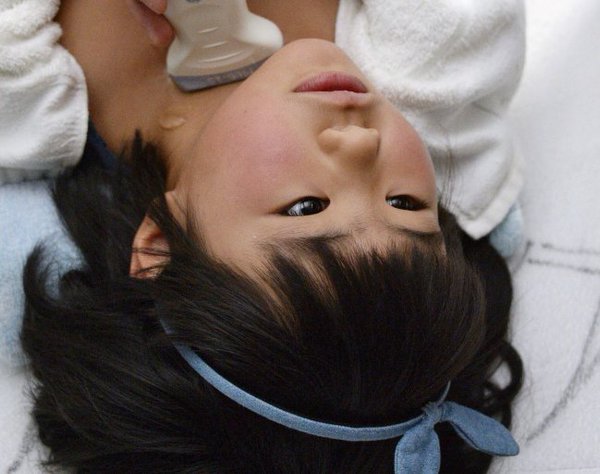
FUKUSHIMA — Ten more people were diagnosed with thyroid cancer as of late September this year in the second round of a health survey of Fukushima Prefecture residents, which began in April 2014, a committee overseeing the survey disclosed on Dec. 27.
The number of people confirmed to have cancer during the second round of the survey stands at 44, while the overall figure including cases detected in the first round stands at 145.
The first round of checks — covering people aged 18 or under who were living in the prefecture at the time of the outbreak of the nuclear disaster at the Fukushima No. 1 Nuclear Power Plant — began in 2011. The second round covers about 380,000 people, including children who were born in the year following the outbreak of the disaster. The survey’s third round began in May this year.
Some have pointed to the danger of “excessive diagnoses” during health checks in which doctors find cases of cancer that do not require surgery, which could place a physical and mental burden on patients. There have accordingly been calls for the Fukushima Prefectural Government to scale down the scope of its health survey.
During a meeting of the oversight committee in Fukushima on Dec. 27, Hokuto Hoshi, deputy head of the Fukushima Medical Association, requested that the prefectural government set up a third-party organization to independently gather scientific knowledge on thyroid cancer. “Scientific discussion should be conducted independently,” he said.
http://mainichi.jp/english/articles/20161228/p2a/00m/0na/008000c
Fund to help young people with thyroid cancer

A private fund in Japan has begun providing financial assistance for young people diagnosed with thyroid cancer after the 2011 Fukushima nuclear accident.
The 3.11 Fund for Children with Thyroid Cancer offers a lump sum of 100,000 yen, or 850 dollars, to help pay for treatment for patients up to the age of 25. The first payments were made to 35 people on Monday.
The fund’s name refers to March 11th, 2011, when a massive earthquake hit northeastern Japan, triggering tsunami that crippled a nuclear plant in Fukushima Prefecture.
People in Fukushima and 14 other prefectures in eastern Japan are eligible to apply.
Fund officials say that 9 of the 35 recipients are not residents of Fukushima Prefecture. They say that in at least one case, the cancer had spread to the lungs when the diagnosis was made.
They are soliciting applications for the assistance as well as donations.
An official says the fund hopes to offer support to as many people as possible, adding that the cost of treatment weighs heavily on some families.
Evacuees Trapped by the Return Policy
The policy to return the population to the still contaminated areas is in progress in spite of the evacuees’ protests.
In three months, at the end of March 2017, the evacuation order will be lifted except for the “difficult-to-return” zones. In parallel, the housing aid for the so-called “auto-evacuees” from the areas situated outside of the evacuation zones will come to an end. The “psychological damage compensation” for the forced-evacuees will finish at the end of March 2018.
In this context, the local governments’ employees are going around the temporary housing, offered freely to “auto-evacuees” (1), in door-to-door visits to apply pressure to expel the inhabitants. It is difficult to see in this act anything other than harassment and persecution.
In November, Taro YAMAMOTO, Member of Parliament in Japan, posed a series of questions at the Special Commission for Reconstruction. We shall cite some extracts. (See Fukushima 311 Watchdogs for the full translation).
***
Taro YAMAMOTO
Here are some testimonies.
“I am afraid of the investigators of the Tokyo Metropolitan Prefecture visiting door to door. I hide under the cover for fear of hearing the ringing at the door. When I opened the door, the investigator stuck his foot into the door so that I could not close it. With a loud voice so that all the neighbors could hear, he shouted at me “you know very well that you can only live here until March”. I know, but I cannot move. “
The next person. “The Tokyo Metropolitan Prefecture demands that we move out in a fierce and haughty manner. We had to leave our home because of the accident at the nuclear power plant. I do not understand why they are expelling us again.”
“Constant phone calls, visits without notice, and they shout at me asking what my intention is. They send documents to file, and leave passing notices in the mailbox. I am completely exhausted, physically and psychologically. “
END OF QUOTE
***
The same kind of persecution is deployed inside Fukushima prefecture.
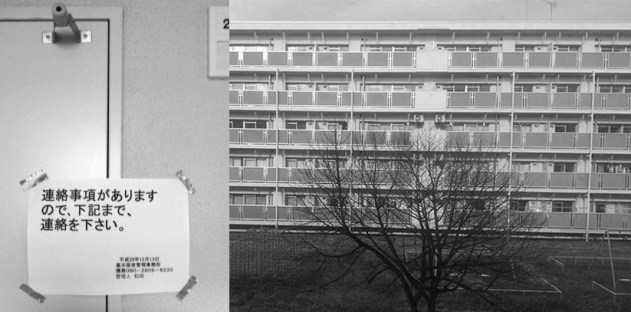
You can see the photo of the notice taped on the apartment door of Mr. Yôichi OZAWA in the social housing for job seekers in mobility, used as temporary housing offered free of charge to nuclear accident victims, situated in Hara-machi district of Minamisoma town.
Mr. OWAZA left his home at 22km from the Fukushima Daiichi Nuclear Power Plant where the radioactivity was too high. In spite of the contamination, his home was not included in the evacuation zone, which stopped 20km from the NPP. Thus, he is considered as “auto-evacuee”, jishu-hinansha, and as such subject to the same harassment as the “auto-evacuees” in the Metropolitan regions of Tokyo or in West Japan.
Because of this zoning based on the geographic distance from the crippled NPP that divides Minamisoma town, the evacuees of Hara-machi district are subject to expulsion persecution, whereas those of Odaka district are exempt from such acts.
The door picture was posted in the Facebook of Mr. Tatsushi OKAMOTO on December 24th 2016 with the text below.
On the notice we can read:
Please contact us, for we have things to communicate to you.
December 13th 2016
Kuroki Housing Management Office
Cellphone #: XXXX
Manager: XXXX
Here is the paper taped on the door of a house for evacuees.
It is shocking, this way of taping the notice.
They treat us like a non-paying renter or as if we are not paying our taxes!
No consideration of the dignity of the person.
It is like the Yakuza’s way of collecting money!
Currently in Fukushima, the victims are facing a double or triple suffering.
Who is to be blamed? What have we done to deserve this, we, the victims?
_______
(1) Minashi kasetsu jyûtaku. Rental housing managed by private or public agencies offered to evacuees of which the rent is taken in charge by the central or local government.
_____
Reference links
山本太郎公式ホームページの質問書き起こし Texte of questions of Taro Yamamoto in his official HP (in Japanese)
山本太郎の質問の英訳とフランス語訳の記事
English translation of Taro Yamamoto’s questions
山本太郎議員が使った、ふくいち周辺環境放射線モニタリングプロジェクトの汚染地図(日本語)
Contamination map used by Taro Yamamoto (in English)
Read also:
Harassment of Evacuees by Prefectural Housing Authorities to evict them for March 2017
Source :
Welcome to Naraha, a ghost town in Fukushima’s shadow where dolls have replaced the people
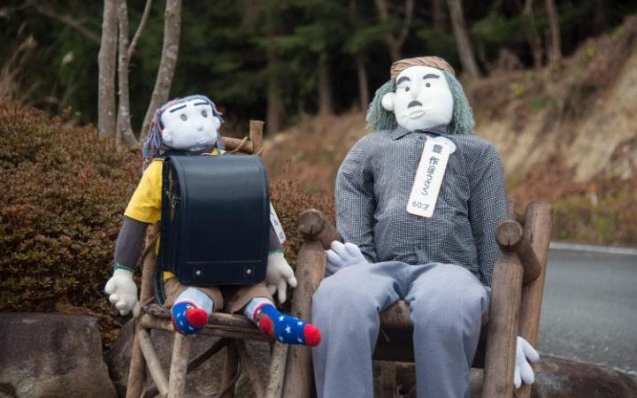
Dolls are positioned at the entrance to a cafe in Naraha
At first glance, the Japanese town of Naraha appears normal, if a little quiet.
There are a handful of residents dotted about the place – a few in the post office, and some others in the bank – though several are oddly still.
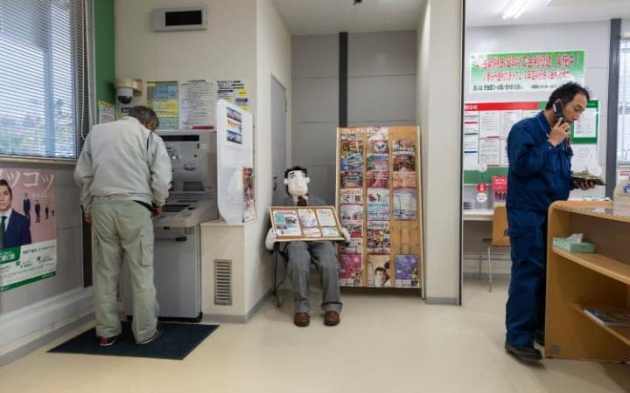
A doll is positioned by the ATM inside the post office in Naraha Town, Fukushima Prefecture, Japan
There are some youngsters loitering around too, but the older residents say they don’t mind as they never cause any trouble.
In fact, they say, it is nice to have some new faces around a town still struggling to come to terms with the Fukushima nuclear disaster, which brought the community to its knees.
Even if they are only dummies.
The life-sized mannequins are the work of a group of elderly women who have taken it upon themselves to “repopulate” their town, after most of its inhabitants fled during the March 2011 disaster, which took place just 12 miles away.
These days most of Naraha former residents are scattered across the country.
A Marine Food Web Bioaccumulation model for Cesium 137 in the Pacific Northwest
From November 2014
Abstract
The Fukushima nuclear accident on 11 March 2011 emerged as a global threat to the conservation of the Pacific Ocean, human health, and marine biodiversity. On April 11 (2011), the Fukushima nuclear plant reached the severity level 7, equivalent to that of the 1986-Chernobyl nuclear disaster. This accident was defined by the International Atomic Energy Agency as “a major release of radioactive material with widespread health and environmental effects requiring implementation of planned and extended countermeasures”.
Despite the looming threat of radiation, there has been scant attention and inadequate radiation monitoring. This is unfortunate, as the potential radioactive contamination of seafoods through bioaccumulation of radioisotopes (i.e. 137Cs) in marine and coastal food webs are issues of major concern for the public health of coastal communities. While releases of 137Cs into the Pacific after the Fukushima nuclear accident are subject to high degree of dilution in the ocean, 137Cs activities are also prone to concentrate in marine food-webs.
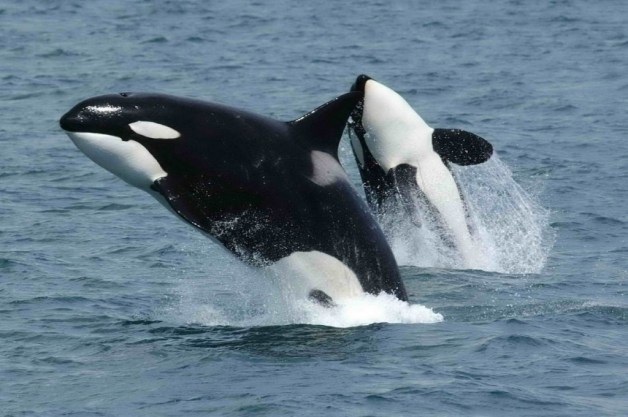
With the aim to track the long term fate and bioaccumulation of 137Cs in marine organisms of the Northwest Pacific, we assessed the bioaccumulation potential of 137Cs in a North West Pacific foodweb by developing, applying and testing a simulation time dependent bioaccumulation model in a marine mammalian food web that includes fish-eating resident killer whales (Orcinus orca) as the apex predator.
The model outcomes showed that 137Cs can be expected to bioaccumulate gradually over time in the food web as demonstrated through the use of the slope of the trophic magnification factor (TMF) for 137Cs, which was significantly higher than one (TMF > 1.0; p < 0.0001), ranging from 5.0 at 365 days of simulation to 30 at 10,950 days.
From 1 year to 30 years of simulation, the 137Cs activities predicted in the male killer whale were 6.0 to 182 times 137Cs activities in its major prey (Chinook salmon, Oncorhynchus tshawytscha).
Bioaccumulation of 137Cs was characterized by slow uptake and elimination rates in upper trophic level organisms and dominance of dietary consumption in the uptake of 137CS.
This modeling work showed that in addition to the ocean dilution of 137Cs, a magnification of this radionuclide takes place in the marine food web over time.
Fukushima dad finds remains of daughter, but no closure for 3/11
My deep respect for this father courage and perseverance to search for his child beyond his pain and the tragedy. It must be awful to search for the remains of your beloved daughter like he did for 6 years. I have been repeatedly hearing about his relentless search over and over again during these past 6 years. I am happy for him that he finally found her.
My own daughter was very lucky, at the time the tsunami hit the place where they lived on the north-east coast of Iwaki city, right by the sea, they were all in town, far from their house and the seashore. They lost their house but no life.
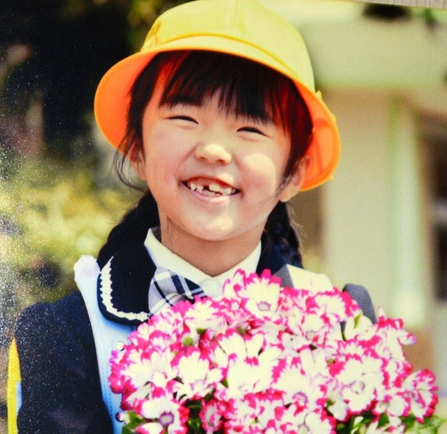
Yuna Kimura was 7 years old when the 2011 Great East Japan Earthquake and tsunami struck.
OKUMA, Fukushima Prefecture–A man’s painstaking search over nearly six years has finally uncovered remains of his 7-year-old daughter who disappeared in the 2011 tsunami.
But the discovery has not brought closure for the father, Norio Kimura, who plans to keep sifting through the debris on the coast of this town in the shadow of the ruined Fukushima No. 1 nuclear power plant.
“I am glad, but only small parts of her have been recovered,” said Kimura, 51. “I will continue my search until I find everything.”
A breakthrough in his private search for daughter Yuna came on Dec. 9, when a volunteer found a scarf she was wearing on the day the tsunami struck. It was near the coast only a few hundred meters from where Kimura’s home once stood in Okuma.
A further search of the area uncovered parts of neck and jaw bones among the tsunami debris.
A DNA test conducted by Fukushima prefectural police showed the remains were of Yuna. Kimura was informed of the test result on Dec. 22.
However, he said he still has no intention of submitting a document to officially certify her death until the rest of her body is found.
Yuna was the last resident of Okuma officially listed as missing.
Kimura’s house was located about 4 kilometers south of the Fukushima No. 1 nuclear plant and 100 meters from the coast. The tsunami spawned by the Great East Japan Earthquake on March 11, 2011, destroyed the home and swept away Yuna, Kimura’s wife, Miyuki, then 37, and his father, Wataro, then 77.
The bodies of Miyuki and Wataro were recovered that year. But Yuna remained missing.
The meltdowns at the nuclear plant forced Kimura to evacuate from Okuma and halt his search for Yuna.
Although the Self-Defense Forces, firefighters, police and volunteers conducted searches along the coast of the Tohoku region, radioactive fallout prevented extensive checks around Okuma in the early days of the recovery effort.
Most parts of the town are still located in the government-designated “difficult-to-return zone” because of high radiation levels. Access is limited to former residents, but only for short periods.
Kimura resumed his personal search for Yuna at the end of 2011, when the government allowed those limited-period returns to Okuma.
After settling in Hakuba, Nagano Prefecture, with his mother and surviving daughter, Kimura frequently made round trips of about 1,000 kilometers in his search for Yuna. He often wore protective clothing against radiation in his endeavor.
Yuna’s remains were found in an area where Kimura discovered a shoe in June 2012 that his daughter was wearing on the day of the disaster.
Kimura said he intends to increase his trips to Okuma and focus his search on the area where Yuna’s bones were discovered.
“I do hold anger toward TEPCO, which caused the nuclear crisis, and the government, which was not committed enough to the body-recovery effort,” Kimura said. “I am mortified that it took nearly six years to find her.”
http://www.asahi.com/ajw/articles/AJ201612260050.html
1 This Month
19 February – VIRTUAL EVENT-Decision Time: AI and Our Nuclear Arsenal
12:45 p.m. Central / 1:45 p.m. Eastern
To see nuclear-related stories in greater depth and intensity – go to https://nuclearinformation.wordpress.com
-
Archives
- February 2026 (141)
- January 2026 (308)
- December 2025 (358)
- November 2025 (359)
- October 2025 (376)
- September 2025 (258)
- August 2025 (319)
- July 2025 (230)
- June 2025 (348)
- May 2025 (261)
- April 2025 (305)
- March 2025 (319)
-
Categories
- 1
- 1 NUCLEAR ISSUES
- business and costs
- climate change
- culture and arts
- ENERGY
- environment
- health
- history
- indigenous issues
- Legal
- marketing of nuclear
- media
- opposition to nuclear
- PERSONAL STORIES
- politics
- politics international
- Religion and ethics
- safety
- secrets,lies and civil liberties
- spinbuster
- technology
- Uranium
- wastes
- weapons and war
- Women
- 2 WORLD
- ACTION
- AFRICA
- Atrocities
- AUSTRALIA
- Christina's notes
- Christina's themes
- culture and arts
- Events
- Fuk 2022
- Fuk 2023
- Fukushima 2017
- Fukushima 2018
- fukushima 2019
- Fukushima 2020
- Fukushima 2021
- general
- global warming
- Humour (God we need it)
- Nuclear
- RARE EARTHS
- Reference
- resources – print
- Resources -audiovicual
- Weekly Newsletter
- World
- World Nuclear
- YouTube
-
RSS
Entries RSS
Comments RSS
 nuclear-news