3 Towns Evacuation Orders Lifted, Return of Residents Slow

A road remains blocked Thursday evening in the town of Tomioka near the crippled Fukushima No. 1 nuclear plant. An evacuation order for Tomioka residents will be lifted Saturday.
Evacuation orders lifted for three more Fukushima areas but residents slow to return
FUKUSHIMA – Japan on Friday lifted its evacuation orders for the village of Iitate and two other areas that had been enforced due to the nuclear disaster at the Fukushima No. 1 nuclear power station.
The move came six years after Tokyo Electric Power Company Holdings Inc.’s power station suffered meltdowns after the huge earthquake and tsunami in March 2011, triggering evacuation orders in many places in Fukushima Prefecture, including Iitate and the other two areas.
Residents of Iitate, the town of Namie and the Yamakiya district in the town of Kawamata, totaling some 22,100 at the end of February, can now return home, except in a handful of places included in no-go zones where radiation levels are still too high.
With the evacuation order set to be removed for the town of Tomioka on Saturday, Okuma and Futaba, the host towns of the crippled power station, will be the only Fukushima municipalities without an area where an evacuation order has been lifted.
Meanwhile, municipalities where evacuation orders have been removed have their own problems: a slow return of residents.
The central government and affected municipalities have channeled their efforts into improving commercial facilities, transportation systems and other infrastructure, hoping to attract residents, old and new.
In Tomioka, a ¥2.4 billion emergency hospital will be created, reflecting strong calls for medical institutions.
The return of residents has remained slow, however, with many returnees being elderly. In the five municipalities whose evacuation orders had already been lifted, only 14.5 percent of residents came back.
In Iitate, Namie and Kawamata’s Yamakiya district, the share of residents who said they want to go back to their hometowns in joint surveys mainly by the Reconstruction Agency stood at 33.5 percent, 13.4 percent and 43.9 percent, respectively.
The central government will begin work to revive areas in the no-go zones spanning seven municipalities. According to the government’s plan, each of the seven will have a reconstruction base for work to decontaminate local areas tainted with radioactive substances from the Tepco power station and build infrastructure.
Decontamination costs will be borne by the central government. It aims to lift evacuation orders in the no-go zones within about five years.
“The government is resolved to fully lift the evacuation orders (in the no-go zones), even if it takes a long time,” Prime Minister Shinzo Abe has recently said.
But a concrete path to the goal is not in sight.

People pray in silence in front of a memorial for the victims of the 2011 disaster in Namie, Fukushima Prefecture, early on March 31. The tsunami-struck Ukedo district remains empty in the background.
Most Fukushima evacuation orders end save for no-go zones
More than six years after the nuclear accident, evacuation orders for areas in two towns and one village in Fukushima Prefecture were lifted after midnight on March 30, allowing residents to finally return home.
The number of residents affected tops 32,000, including the population of Tomioka, where the same order is scheduled to be lifted on April 1.
That will result in the government’s evacuation order issued right after the March 2011 accident at the Fukushima No. 1 nuclear power plant being lifted for almost all affected areas, apart from highly contaminated areas designated as a “difficult-to-return zone.”
However, less than 20 percent of people had returned to areas where the order had already been withdrawn earlier, and not many residents from areas close to the nuclear plants are willing to go back.
On March 31, the order for parts of Namie and Kawamata towns and Iitate village was lifted.
In the coastal Ukedo district in Namie, about seven kilometers north of the No. 1 plant, about 30 people, including Namie residents and the town mayor, gathered at a memorial for the 182 victims from the town before the dawn, hours after the lifting of the evacuation order.
Just after 5:30 a.m., they held a minute of silent prayer.
“I would like to achieve complete recovery until the ban (on the difficult-to-return zone in the town) is lifted entirely for Namie, while cooperating with the residents,” said Namie Mayor Tamotsu Baba.
In Namie, Iitate and Tomioka, the entire population had been living outside their homeland.
After the nuclear crisis unfolded, spawned by the Great East Japan Earthquake and tsunami, the government issued evacuation orders to 11 municipalities, for the total population of about 81,000.
Since then, one by one, the authority had lifted bans on areas that met certain safety criteria–estimated annual radiation doses totaling 20 millisieverts or less, and infrastructure and lifelines were reconstructed.
In Okuma and Futaba, where the Fukushima No. 1 nuclear plant is sited, the evacuation order remains in effect for all residents.
From now on, the government’s priority will shift to encouraging evacuees’ return and assisting them on becoming financially independent, while withdrawing in stages their compensation and accommodation payments.
In the government’s fiscal 2017 budget, a fund of 23.6 billion yen ($212 million) was set aside for restoring the local health-care system and facilities in the area impacted by the 2011 Great East Japan earthquake and tsunami, and nuclear crisis.
Restoring the essential services for living is part of the plan to encourage evacuees to return to their homes.
Japan Lifts Evacuation Orders for 3 Fukushima Areas

Fukushima, March 31 (Jiji Press)–Japan on Friday lifted its evacuation orders for the village of Iitate and two other areas that had been enforced due to the nuclear disaster at the Fukushima No. 1 nuclear power station in northeastern Japan.
The move came six years after Tokyo Electric Power Company Holdings Inc.’s <9501> power station suffered meltdowns after the huge earthquake and tsunami in March 2011, triggering evacuation orders in many places in Fukushima Prefecture, including Iitate and the other two areas.
Residents of Iitate, the town of Namie and the Yamakiya district in the town of Kawamata, totaling some 22,100 at the end of February, can now return home, except in a handful of places included in no-go zones where radiation levels are still too high.
With the evacuation order set to be removed for the town of Tomioka on Saturday, Okuma and Futaba, the host towns of the crippled power station, will be the only Fukushima municipalities without an area where an evacuation order has been lifted.
Meanwhile, municipalities where evacuation orders have been removed have their own problems: a slow return of residents.
Japan further scales down evacuation zones around Fukushima plant

FUKUSHIMA, Japan (Kyodo) — The government on Friday lifted the remaining evacuation orders for large parts of areas less seriously contaminated by the radiation due to the 2011 Fukushima Daiichi nuclear power plant disaster.
The government lifted evacuation orders that had affected some parts of the towns of Kawamata and Namie as well as the village of Iitate. A large part of the town of Tomioka will also be released from the evacuation order Saturday.
The move will scale down the evacuation zones to about one-third of what they had originally been. But it is uncertain whether many residents will return to their homes amid radiation fears, while the most seriously contaminated areas around the disaster-hit Fukushima Daiichi nuclear power plant remain a no-go zone.
Initially, 11 municipalities — many of which are located within a 20-kilometers radius of the crippled nuclear complex — had been subject to the evacuation orders. They were later rezoned into three categories based on their radiation levels, with the most seriously contaminated land defined as the difficult-to-return areas.
Through radiation cleanup work and efforts to rebuild infrastructure, the government said in 2015 that it aimed to remove by the end of the current fiscal year through Friday all the evacuation orders except for those issued to the difficult-to-return zones.
But the government failed to do so in the towns of Okuma and Futaba, which host the Fukushima Daiichi nuclear plant owned by Tokyo Electric Power Company Holdings Inc.
Okuma and Futaba have some areas not designated as highly toxic, but both towns will remain under full evacuation orders due to insufficient infrastructure, according to government officials.
The areas where evacuation orders will be lifted by Saturday had a registered population of about 32,000, or 12,000 households, around the end of February. Even after the move, seven municipalities will be partially or fully subject to evacuation orders.
As for the difficult-to-return zones, the government plans to create areas where they will conduct intense decontamination and lift the evacuation orders for those areas in about five years’ time.
The number of Fukushima people who fled from their homes in the wake of the 2011 earthquake and tsunami disaster, which also triggered the nuclear crisis, stood at about 77,000 people as of March. The maximum number was about 165,000 marked in May 2012.
http://mainichi.jp/english/articles/20170331/p2g/00m/0dm/015000c
Fukushima decontamination near-complete in evacuated areas, so they claim
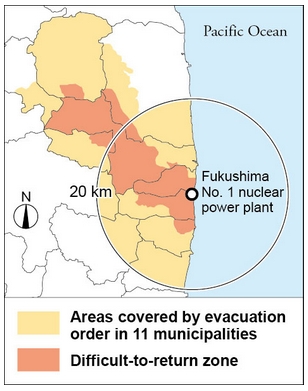
SIX YEARS AFTER: Fukushima decontamination near-complete in evacuated areas
Decontamination work in areas covered by the evacuation order from the 2011 Fukushima nuclear disaster is expected to conclude this month, paving the way for evacuees from the affected communities to return home.
With the project’s completion, the government’s focus will shift to the cleanup of heavily contaminated areas near the crippled Fukushima No. 1 nuclear power plant and infrastructure building.
The areas covered in the Environment Ministry’s decontamination project constitute those in 11 municipalities, including Okuma and Futaba, the two towns co-hosting the nuclear complex.
The decontamination project got under way there in fiscal 2012 to remove soil, fallen leaves and other materials contaminated by radioactive substances primarily in residential areas, roads, and rice paddies and fields.
But the areas collectively known as the difficult-to-return zone where annual radiation doses were estimated to exceed 50 millisieverts as of the end of 2011 and still estimated at more than 20 millisieverts five years after the disaster were excluded from the decontamination work in those 11 local governments.
The cleanup in nine municipalities has already been completed, while the project in the remaining two is expected to finish this month, according to the government.
The completion of the project comes after the Cabinet approved a policy to finish decontamination by the end of March 2017 at a meeting in March 2016.
The evacuation order for Okuma and Futaba will remain in place even though the cleanup project will soon be over.
But the government expects to lift the order for people from the remaining nine municipalities, except for residents from the difficult-to-return zone, by April 1.
That will make the total area remaining under the evacuation order 30 percent of the size six years ago.
According to the ministry, decontamination operations have been carried out in 99 local governments in and outside of Fukushima Prefecture, costing about 2.6 trillion yen ($23.56 billion) over the past five years.
Although the government initially covers the costs of decontamination, it sends the bill to Tokyo Electric Power Co., the plant’s operator.
Despite the cleanup project, many evacuees will likely remain anxious about radiation exposure when they return because forests and woods except for those close to residential areas have not been decontaminated.
The government envisages setting up hubs for rebuilding the difficult-to-return zone by carrying out an intensive cleanup to make the areas habitable by 2022.
Remembering 6th Anniversary of Fukushima March.11.2017

Kimberly Roberson, speaking as a parent and an activist/organizer does not mince her words. They are heart, mind and soul piercing. She is in our faces about the horrific dangers of nuclear power – especially for our babies and children. Her purpose is to inform and rouse to action all those not already involved and aware. “Startling clear to me: radioactive fallout from nuclear power and food do not mix, and children are especially at risk”.But as parents, aunts, uncles, grandparents and caregivers we have a responsibility to our children. And remember, radiation from nuclear fallout is transgenerational, meaning that it has been proven to damage DNA for generations to come. The bigger picture after all is really about food safety and human health.
I marked every page in the book as I was reading. I am focusing on food in this review because that is a major issue for both Roberson and me. What are we doing to our babies and children when we give them milk? Alarmed, I read from Roberson that “strontium 90 has been detected in the U.S. milk supply, as well as other radioisotopes linked directly to Fukushima”.Radioactive strontium is attracted to the body, much like calcium, only rather than nourishing bones it causes cancer. Children’s cells divide and multiply at an accelerated pace which makes the youngest especially vulnerable to radiation.”
Roberson tells us, “The late Dr. Rosalie Bertell, PhD and Gray Nun of the Sacred Heart was an accomplished scientist who warned in No Immediate Danger; Prognosis for a Radioactive Earth not only of the damage to the person coming in contact with radioactive fallout in their food and water, but also to their children, grandchildren, and great grandchildren suffering mutations in their DNA as well.”
Roberson continues, again alarmingly, “Probably the one question that perplexed so many of the people I was working with was how could the biggest industrial and nuclear accident in world history be allowed to continue to affect our food supply unchecked .” [emphasis mine]. That continues to this day.
Roberson puts it this way, “One thing I’ve realized in the past two years is to always consider the source”The list goes on and on. Grass fed beef, free range poultry, miso [see the paper I wrote about miso “Fukushima, Miso Soup and Me” ], nori, strawberries”pesky questions, but we all need to be asking them.” Begin today, now, all the time, to ask this question about everything you eat and drink. This is urgent: what is the country of origin?
From my experience working on the many issues about food and drink safety since Fukushima, here are some questions we must understand and work to change since Fukushima: What food and drink does the USA import from Japan? How was and is our food here in the USA contaminated from Fukushima? Who tests the food in each country, including the USA? How do they test it? Is how the food is tested adequate? Who decides? How honest are our labelling laws? [Not honest at all; but that requires a whole other paper.] Thank goodness the Trans-Pacific Partnership (TPP) has been defeated by the actions of we the people and as immoral and misleading as our food labeling laws are here in the USA, at least it willl still be mandatory to put counrty of origin on our food. What Trump will do, who is now talking about “binary arrangements” instead of the TTP, remains to be seen.
Be wary also, Roberson warns us, of “fish oil, carrageenan, and sea salt [which] all come from ocean waters.” I say, please read all labels. Use pink salt from the Himalayas, not sea salt. This pink salt from the Himalayas sometimes is called sea salt – but from oceans millions of years ago. I eat nothing from the ocean. There is really only one ocean. Look at any map. You might want to read a paper I have written called “The Pacific Ocean Does Not Belong to Japan: It Belongs to All of Us.”
Also pay attention to iodine and where it comes from, continues Roberson. Iodine often comes from kelp “but where is the kelp sourced? Much of the kelp spanning the California coastline has shown significantly increased levels of Iodine-131 since Fukushima began. Not exactly the kind of iodine I want in children’s gummy vitamins.”
While we are here talking about food and drink, note also that most non-mercury fillings that your dentist puts in your mouth come from Japan!!! As does most bonding material at your dentist’s office. Instead, there is a company in Germany – Grandio – where dentists, not you, can get non-mercury fillings. Please ask your dentist to do so for you.
Since Fukushima, I myself do not knowingly eat or drink any food or beverages that come from Japan. My first question about anything that goes into my mouth always is – what is the country or countries of origin? I am an organic vegan now, since Fukushima, and before that was an organic vegetarian for 40 years. For those who eat organic, Roberson notes, “And trust me, radioactive fallout does not distinguish if it lands on conventional or organic items. You may be asking why is radioactive fallout alllowed in organic food but irradiation is not? The answer is because the regulations are not yet in place to test from nuclear accidents and nuclear power production. That clearly needs to change.” She wrote Silence Deafening; Fukushima Fallout, A Mother’s Response in 2013. It is now 2016. Nothing has changedI love this from Roberson, “Perhaps Dr. Seuss said it best in The Lorax, ‘Unless someone like you cares a whole awful lot, Nothing is going to get better. It’s not.”
On my birthday two years ago, before I read Roberson’s book, I went to the Dr. Zeuss museum in Springfield, MA and read that quote there for the first time and bought myself a Lorax then. Consider buying a Lorax for a constant reminder and keep her with you = in mind, heart, body, soul. You can buy a Lorax through The Manhattan Toy Store.
A final truth telling from prophet Roberson, “Another lesson learned. Much of what happens to protect our food and water or anything else for that matter starts with us.”
LEASE SIGN FFAN’S [FUKUSHIMA FALLOUT AWARENESS NETWORK] URGENT PETITION No Olympics or Paralympics in Radioactive Fukushima “Children are our most beloved and cherished gift and they are also the most vulnerable to the generational damage of man-made radiation in air, food, soil and water. Around the world children who are currently adolescent and possibly younger are in training to compete at the 2020 Summer Olympics and Paralympics in Japan. Their parents most likely have no idea that some of the venues are near the most devastating and ongoing nuclear and industrial disaster in world history, Fukushima Daiichi.
Sheila Parks, Ed.D., is a former college professor. She had a spiritual awakening many years ago and left her career to do peace and justice work full time. She is the founder of the grassroots group On Behalf of Planet Earth (found on FB).
http://portside.org/2017-03-27/remembering-6th-anniversary-fukushima-march112017
Some Fukushima municipalities lack nuclear evacuation plans as no-entry orders lifted

Of the 11 municipalities in Fukushima Prefecture which came under evacuation orders after the 2011 Fukushima No. 1 nuclear plant meltdowns, five do not have evacuation plans in case a nuclear accident occurs again, even though no-entry orders are gradually being lifted.
The central government requests local municipalities located near nuclear power plants to draw up evacuation plans in case of a nuclear emergency. According to central government policy, local governments should issue immediate evacuation orders to residents living within 5 kilometers of a plant in case of a “full-scale emergency” — situations including the loss of cooling power at nuclear reactors.
As a basic rule, those living between 5 and 30 kilometers from a plant are subject to indoor evacuation, and when a radiation dose of 20 microsieverts per hour is detected, evacuation should be completed within one week. Immediate evacuation is recommended when the dose hits 500 microsieverts per hour.
A representative of the village of Katsurao, whose residents have started moving back, told the Mainichi Shimbun that the municipal government has not created its evacuation plan because “there are only two officials in charge of the matter.” The official added, “We don’t have expert knowledge (about nuclear evacuations) and we can’t handle it with all the other work we have to do. Neither the state nor the Fukushima Prefectural Government is giving us advice.”
An official from the village of Iitate, where the evacuation order will be lifted at the end of March, said in addition to a workforce shortage, “it’s difficult to make a plan before examining how many residents will come back.” The city of Tamura, whose residents have started coming back, and the towns of Futaba and Okuma, where it remains unknown when residents will be able to return, do not have evacuation plans.
Meanwhile, the towns of Namie and Tomioka have mapped out their plans, which take the basic principle of evacuating all townspeople in case of a full-scale emergency — more drastic measure than central government policy requires — saying that just following the state’s evacuation policy will not protect their residents’ safety. Namie Mayor Tamotsu Baba told the Mainichi, “Residents don’t believe they would be safe if they remain inside a building.”
With regard to local evacuation plans, a support team for nuclear accident victims at the Cabinet Office points out that while such plans are not requirement for the state to lift evacuation orders, local governments should prepare disaster prevention measures.
The stricken Fukushima No. 1 nuclear plant is different from other nuclear stations in the country as decommissioning work is in progress for all its six reactors. At the same time, a rough road is expected for the project to remove melted fuel, and the estimated hourly radiation dose inside No. 2 reactor is as much as 650 sieverts.
According to an opinion poll by the Reconstruction Agency targeting residents of the city of Tamura, 61.5 percent of those who said they wanted to live in other municipalities than Tamura cited concerns over decommissioning work and management of the nuclear plant as reasons for not wanting to come back.
Hirotada Hirose, professor emeritus at Tokyo Woman’s Christian University and an expert in nuclear disaster prevention, commented, “The condition of melted nuclear fuel (at the Fukushima plant) is unknown and aftershocks are still continuing in Fukushima Prefecture. It’s a problem that evacuation orders are being lifted while local governments have not come up with their evacuation plans.”
http://mainichi.jp/english/articles/20170327/p2a/00m/0na/012000c
Japan ponders recycling Fukushima soil for public parks & green areas

Workers move big black plastic bags containing radiated soil. Fukushima prefecture, near Fukushima Daiichi nuclear power plant.
Soil from the Fukushima prefecture may be used as landfill for the creation of “green areas” in Japan, a government panel has proposed, facing potential public backlash over fears of exposure to residual radiation from the decontaminated earth.
The advisory panel of the Environment Ministry on Monday proposed reusing soil that was contaminated during the Fukushima nuclear meltdown of 2011 as part of future landfills designated for public use, Kyodo news reported.
In its proposal, the environmental panel avoided openly using the word “park” and instead said “green space,” apparently to avoid a premature public outcry, Mainichi Shimbun reported.
Following an inquiry from the news outlet, the Ministry of the Environment clarified that “parks are included in the green space.”
In addition to decontaminating and recycling the tainted earth for new parks, the ministry also stressed the need to create a new organization that will be tasked with gaining public trust about the prospects of such modes of recycling.
To calm immediate public concerns, the panel said the decontaminated soil will be used away from residential areas and will be covered with a separate level of vegetation to meet government guidelines approved last year.
In June last year, the Ministry of the Environment decided to reuse contaminated soil with radioactive cesium concentration between 5,000 to 8,000 becquerels per kilogram for public works such as nationwide roads and tidal banks.
Under these guidelines, which can now be extended to be used for the parks, the tainted soil shall be covered with clean earth, concrete or other materials.
Such a landfill, the government said at the time, will not cause harm to nearby residents as they will suffer exposure less than 0.01 mSv a year after the construction is completed.
The Fukushima Daiichi nuclear power plant suffered a blackout and subsequent failure of its cooling systems in March 2011, when it was hit by an earthquake and a killer tsunami that knocked out the facility, spewing radiation and forcing 160,000 people to flee their homes. Three of the plant’s six reactors were hit by meltdowns, making the Fukushima nuclear disaster the worst since the Chernobyl catastrophe in 1986.
https://www.rt.com/news/382515-japan-recycling-fukushima-soil/#.WNoJ3cpBs98.facebook
Gov’t proposes reusing Fukushima’s decontaminated soil on green land
The Environment Ministry on Monday proposed reusing decontaminated soil from disaster-hit Fukushima Prefecture as landfill for parks and green areas.
At a meeting of an advisory panel, the ministry also called for launching a new organization to map out plans on how to gain public understanding about the reuse of decontaminated soil, ministry officials said.
The proposals come at a time when Fukushima Prefecture faces a shortage of soil due to the decontamination work following the 2011 nuclear meltdown.
http://english.kyodonews.jp/news/2017/03/465656.html
Radiation brings fear, and kids let it all out

Kids say the cruellest things: A girl bullied at school with the taunt ‘You’ve got the radiation!’ (right) sits at her home in Chiba Prefecture, where she moved after fleeing Fukushima Prefecture in the wake of the March 2011 nuclear disaster
Radiation is a fearful thing. Colorless, odorless, undetectable except by special instruments, it’s one of those evils you can dismiss from your mind altogether, until the special instruments start registering. Then suddenly it’s everywhere, or seems to be — a ubiquitous and ineradicable contaminant.
Children, as we all know, say and do the damnedest things. They mean no harm, they just know not what they do, sometimes. Their innocence is terrifying. Sometimes innocence looks anything but innocent. But all societies recognize it.
Children are not legally responsible for their actions. Parents and teachers may punish them in order to teach them responsibility. But it’s a long process. Until it’s complete, the evil they do, when they do evil, gets filed under “mischief,” in recognition of the spirit in which it was — probably — committed.
When Tokyo Electric Power Co.’s Fukushima No. 1 nuclear power plant cracked under the strain of a tsunami six years ago and irradiated large swaths of Fukushima Prefecture, refugees streamed out of the stricken area, settling where they could. Forty thousand of them remain out-of-prefecture, 5,100 in Tokyo. Most of them will never go home again. Will they ever be at home where they are?
Josei Seven magazine raises the issue of “nuclear bullying.” Children too young, one might think, to even know the word “radiation” picked it up under the circumstances, and flung it with what seems like gleeful malice at disoriented new classmates who had enough to cope with already. Six years on, says Josei Seven, they’re still flinging it.
“It started immediately,” says one refugee, recalling her son’s transfer to a Tokyo elementary school in the immediate aftermath of the disaster. “‘Fukushima kids are weird,’ they’d shout at him. Kids would crawl under his desk and jab his feet with pencils. In the mornings he began saying he wasn’t feeling well. At the time, frankly, I was too traumatized myself to take much notice.”
Lawyer Yukio Yamakawa, director-general of the Tokyo Disaster Support Network, takes up the story with an account of other children he’s spoken to. What starts with name-calling (“Hey, Radioactive!” “Hey, Bacteria!”) easily escalates into what’s hard not to call torture. One kid is forced to drink a bottle of ink. Another has his shoes tossed into the toilet. A third is met in the corridor by classmates poised as if brandishing guns: “Radiation! Bang! Bang!” A fourth suffers extortion of what adds up over time to ¥1.5 million: “You can afford it, your family gets (disaster victim) compensation payments!”
Yamakawa reports this taunt making the rounds: “Fukushima kids won’t live past junior high school anyway, so you may as well die now.”
“Tanaka-san,” as we’ll call the mother cited above, began to fear her son might commit suicide. A poem he wrote contained the line, “Oh, to be able to go to heaven.” Fully focused now, she transferred the boy to another school. The peace that followed was short-lived. Name-calling, exclusion — it started all over again. The homeroom teacher was well-intentioned and put a stop to it — what she could see of it. What went on behind her back was beyond her control. A lot did, its viciousness increasing.
“I’d been bullied myself as a child,” Tanaka says, incidentally reminding us that the problem is neither new nor necessarily nuclear-related. “I understood what he was going through.”
She transferred him again. That seems to have ended the ugliest persecution, but, once a victim, you don’t simply get over it. The boy as a small child had dreamed of being a botanist when he grew up. Now he simply says, “I have no dreams.” Fukushima No. 1 destroyed much that is quantifiable — lives, property, livelihoods — and much that isn’t.
What to make of little kids who inflict this torment on other little kids? Can innocence itself be evil? Or fictitious? One hypothesis Josei Seven raises is that children merely absorb what they hear from their parents. Lacking critical faculties and adult inhibitions, they act where grown-ups merely talk.
The energy and imagination they put into it make it hard not to suspect they enjoy it. Enjoyment of other people’s sufferings is a well-attested human trait, exploited for mass entertainment at least as far back as the Roman circuses. Nothing has happened since to root it out of us, and if radiation stimulates it today, in that respect at least it breaks no new ground.
Naked fear is a factor too. Radiation, unseen, unheard, is the most fearful of stalkers. Might school kids seriously believe their Fukushima classmates are contagious? If so, the rational response would be to stay away from them, but fear and hatred merge, short-circuiting rationality and generating “Radiation, bang, bang!”
Radiation today, tuberculosis a century ago, different causes producing similar effects. Novelist Ayako Miura (1922-1999), herself a sufferer, made what might be called “tuberculosis bullying” a sub-theme of her novel “Shiokari Toge” (Shiokari Pass), set in late-19th-century Hokkaido: “It was an age when sufferers of tuberculosis were so hated and feared that they were even forced to leave the neighborhood.” A character who innocently brings up the subject arouses horror in his listener: “Mr. Nagano, even if you only mention the name of that dreadful disease it makes your lungs rot!”
“Radiation, bang, bang!” Last July a 26-year-old man slipped into a facility for disabled patients in Kanagawa Prefecture and slaughtered 19 of them, his apparent intention being to free the world from the scourge of disability. Disability, bang, bang. In February Satoshi Uematsu was declared fit to stand trial. A psychiatric evaluation found in him symptoms of a personality disorder but not of incapacity to distinguish right from wrong.
The disorder in question, writes psychiatrist Rika Kayama in the weekly Spa!, amounts to an extreme form of self-love. “Of course,” she writes, “we all love ourselves; we all at one time or another fantasize about being king or queen of the world …” We’d all, in short, be insane, more or less, if we let our fantasies rule our actions. Most of us know when to stop.
Uematsu’s self-love, Kayama hypothesizes, took the form of a conviction of having a mission, a destiny to fulfill. Maybe we all have that too, to some degree. Adults usually stifle it. Children often don’t.
SYMPOSIUM: Locals, experts discuss radiation risks, solutions, future in Iitate

FUKUSHIMA–Even after six years, lingering concerns over radiation loom large over the lives of evacuees from a village in northeastern Tohoku ravaged by the Great East Japan Earthquake and nuclear disaster in 2011.
Residents have agonized over whether to return to their homes in the village of Iitate, one of the most heavily contaminated areas, since evacuation orders are to be lifted on March 31.
Masanobu Akaishizawa, 67, head of an administrative district of Iitate, expressed his concerns at a recent symposium held here in mid-February.
“Experts say radiation doses don’t affect us as long as we stay home,” he said. “But I wonder about the quality of my life if I can neither go to the mountains nor the river.”
Iitate was in the direct path of radioactive materials that spewed from the Fukushima No. 1 nuclear power plant, operated by Tokyo Electric Power Co., following the triple meltdown due to the earthquake, tsunami as well as the government and TEPCO’s shortcomings on March 11, 2011.
Ahead of the lifting of the evacuation order for most of the village of Iitate on March 31, researchers and journalists, who have conducted field surveys since immediately after the accident, shared their views on radiation effects on health and avoiding health risks with villagers at the symposium.
The symposium, titled “Think about the future of Iitate villagers,” was hosted by the Iitate-mura Society for Radioecology, which comprises academics and citizens who committed themselves to continue their support for residents through their expertise.
During the session, Tetsuji Imanaka, a researcher at the Kyoto University Research Reactor Institute, estimated the annual average radiation exposure to residents if they immediately return to the area after the evacuation orders are lifted. He put the figure at approximately 5 millisieverts of radiation.
“How can residents come to terms with the health risks caused by radiation exposure? That’s the issue,” Imanaka said.
Katsumi Furitsu, a doctor at the Hyogo College of Medicine, highlighted the government’s responsibility.
Furitsu has conducted research in the areas devastated by the crippled Chernobyl nuclear plant in Ukraine, site of the world’s worst nuclear accident in 1986.
“Low-dose radiation exposure also has health risks in accordance with the amount,” Furitsu said.
“Offering appropriate health management and medical benefits (for the disaster victims who have been exposed to radiation) is the government’s minimum responsibility just like it issued ‘hibakusha’ (A-bomb victims) health books in Hiroshima and Nagasaki,” Furitsu emphasized.
Hibakusha health books have been awarded to those certified by the government as radiation victims of the 1945 atomic bombings, making them eligible for special health-care benefits, including allowing them access to free medical assistance.
Such a book could also become a powerful weapon to force the government to take responsibility for Fukushima evacuees for future damage to their health potentially related to radiation exposure.
Villagers expressed, however, concern that this could lead to possible future discrimination.
“We understand the necessity of issuing the radiation exposure record books to protect victim’s health,” said one resident. “But high school girls have fears and worries about possible future discrimination that is likely to be caused by possessing the books by posing such questions as, “Can we get married?” or “Can we have children?”
In response to those poignant voices from the disaster victims, Furitsu said, “In Hiroshima and Nagasaki, the same concerns were expressed. However, unjustified discrimination occurred not because of the health book, but because those who should take responsibility didn’t take it.”
“The government should take measures that help residents who had been burdened with unnecessary risks,” Furitsu said, referring to such matters as providing health management, medical benefits, education and other activities to raise awareness of discrimination against disaster victims, especially if they have been exposed to low-dose radiation.
Yoshinobu Ito, 73, a farmer who moved to Iitate before the disaster, was especially worried about the risk radiation could have on children when they return to the village.
He released the results of measurements of radiation levels around his house that he has taken since the Fukushima nuclear disaster.
“Although the levels of radiation dose have dropped, they are still 10 times higher than the figures before the disaster. Even if I return to Iitate, rebuilding agriculture is a hardship,” said Ito.
The effects of radiation also cast a shadow over Japanese cattle farmers such as Kiyomi Shigihara, 62, of Nagadoro in the southernmost section of Iitate. Nagadoro was designated as the only “difficult-to-return zone” in the village.
With regard to the government policy of decontaminating only reconstruction base areas and then lifting an evacuation order after five years, Shigihara said, “Under these circumstances, even if I return home, there’s nothing I can do.”
Unable to repress his emotions, Shigihara wiped tears from his eyes.
80% of families not going back to Fukushima after housing aid ends

Eighty percent of households who fled but were not forced to evacuate from Fukushima Prefecture after the 2011 nuclear disaster do not intend to return even after their free housing allowance ends this month.
According to the survey results released March 21, 3,722 households, or 80 percent of 4,673 households who had evacuated outside the prefecture, said they had no intention of returning.
As for the 4,010 households who fled but remained inside the prefecture, 949 households, or 24 percent, gave the same response, while 67 percent, or 2,674 households, planned to eventually return to their hometowns.
The statistics are based on responses from 8,683 households that evacuated out of 12,000 contacted by the Fukushima prefectural government.
The central and prefectural governments have provided free housing for evacuees from outside the designated evacuation zone since the nuclear accident triggered by the Great East Japan Earthquake and catastrophic tsunami.
It was announced in June 2015 the housing program would end this month.
Prefectural officials said part of the reason for the high ratio of people unwilling to return to Fukushima Prefecture is partly because they are uninformed about the rebuilding situation.
“Their resolve to stay away from the prefecture is firm due to concerns about radiation and other factors in the first place,” an official said. “In addition, it appears that they don’t have good access to information on what is going on in the prefecture.”
The number of people that had evacuated to locales inside and outside of Fukushima Prefecture on a voluntary basis totaled 30,000 as of October 2015.
Support groups have demanded the continuation of the housing program.
Whereas 97 percent of the total households contacted, or 11,896, replied that they have already decided on where they would live from April, 2 percent, or 227 households, responded otherwise as of March 10.
A Campaign to Tackle “Misinformation” about Radioactive Contamination
Masahiro Imamura, Minister for Reconstruction, wants to launch a large-scale campaign, to correct the incorrect information about radioactive contamination of agricultural, forestry and fisheries products from Fukushima Prefecture; as an effort to tackle the issue of “misinformation about radioactive contamination” crippling Fukushima foods. That means more propaganda to come, more lies to hide the real risks of radiation to the people’s health. As if propaganda, to brainwash the people with a large-scale campaign would be the solution to make radiation disappear.

Reconstruction chief Masahiro Imamura
Reconstruction chief praises efforts in Tohoku, flags information campaign on radiation risks
Minister for reconstruction Masahiro Imamura has praised efforts to rebuild the devastated Tohoku region but says a large-scale information campaign is needed to share accurate information about radiation six years after the March 2011 meltdowns at the Fukushima No. 1 nuclear power plant.
Imamura outlined the plan in a recent interview in response to what he said was incorrect information about radioactive contamination of agricultural, forestry and fisheries products from Fukushima Prefecture.
It also comes as a growing number of children who evacuated from the prefecture fall victim to bullying.
Massive amounts of radioactive substances were emitted from the plant soon after it was knocked out by massive tsunami from the 9.0-magnitude March 11, 2011, Great East Japan Earthquake, which hit hardest in Fukushima and the nearby prefectures of Miyagi and Iwate.
Asked about the degree of progress in reconstructing areas hit by the disaster, Imamura said, “Acquisition of land and other procedures needed for the restoration of damaged infrastructure initially took time, but the pace of construction work was very rapid once it was launched.”
“From now, we should focus on the rebuilding of Fukushima,” he said, noting that medium- to long-term measures should be promoted, including decommissioning the Fukushima No. 1 plant and decontaminating areas polluted with radioactive fallout.
“We want to encourage evacuees to return to their hometowns in Fukushima by presenting future visions for the communities through improving the living environment and accelerating the revival of local industries,” Imamura added.
On how to tackle the incidences of bullying targeting evacuated Fukushima children, Imamura said, “We’ll strengthen information-sharing about radiation. All government agencies should jointly work to compile and launch a campaign for that purpose, while obtaining cooperation from private companies.
“This is an issue for not only children, but adults,” he said. “We’ll prepare documents and other materials that are easy to understand in order to eliminate prejudice against evacuated people.”
Imamura said the campaign would also be an effort to tackle the issue of “misinformation about radioactive contamination crippling Fukushima foods.”
“I’ll seek cooperation from Prime Minister Shinzo Abe as well,” he said.
Imamura said he believed the Reconstruction Agency’s efforts to date to rebuild areas affected by the March 2011 disaster have been praised to a certain degree. Still, he pointed to the importance of re-examining whether information on what affected areas need has been properly conveyed to the Reconstruction Agency and other government bodies.
Imamura said Japan’s aging population and low birthrate were also contributing to shrinking communities across the nation — something he described as a structural problem.
“It’s important to build a system that generates profits through stepped-up use of information technology and the modernization of factory equipment, even if human resources are limited,” he said.
“We need to check again whether communities will be able to smoothly help one another in times of disaster, although lessons from the March 2011 disaster were effectively utilized in a series of powerful earthquakes that mainly hit Kumamoto Prefecture in April last year, and the October 2016 strong quake in Tottori Prefecture,” Imamura added.
http://www.japantimes.co.jp/news/2017/03/21/national/reconstruction-chief-praises-efforts-tohoku-flags-information-campaign-radiation-risks/#.WNJEq6KmnIV
About the documentary film “Fukushima the silent voices”

Chiho Sato and Lucas Rue, the film directors
Yesterday, Saturday March 18. 2017, I went to watch for the second time The silent Voices, a documentary film directed by Chiho Sato and Lucas Rue, a screening organized by the French-Japanese Asuka association, an association founded by Kyoko Kugawa-Albu after the March 11. 2011 with the purpose to inform the general public about the Fukushima catastrophe.
I was very happy to meet again and spend some time with the two young movie directors, a very nice, sincere and talented couple, and with Kyoko Kugawa-Albu an antinuclear friend of mine.
This second time watching the movie confirmed my first impression, this movie is definitely the best documentary which has been made about Fukushima in the past 6 years, and you can believe it as I have watched many.
It is the best because of its unique approach, as Chiho Sato is herself from Fukushima she has been able like no one else to enter the intimacy of the Fukushima people by interviewing her own family members and her family close friends.
Chiho Sato was able to make them open up and talk about what usually nobody wants to talk about, as to talk about the catastrophe and its consequences has become kinda taboo among the Fukushima people, who never talk about it as different opinions could caused conflict, antagonism and create divisions. So after 6 years of an ongoing unresolved nuclear catastrophe, today nobody talks about it and everyone keeps it buried deep inside.
Chiho Sato for the first time succeeded to make those silent voices to talk, about the problems resulting from the catastrophe in their everyday life, their present and future inner fears.
Watching it for the second time, convinced me that I really need to write an article about it, to come in the coming weeks, because this film contains some very important testimonies that everyone should hear.

Wild Mushrooms to be Blamed for the Spread of Cesium in Fukushima!
Let me introduce this pro-nuclear article and pro-revitalization; because it directs the spotlight on a scientific study _ itself hijacked? Or does “it find only what is sought”? … on the causes of the increase in cesium 137 in the air and that without reminding the reader of the slightest rule of prudence, which would be, however, the least of all things. Worse, instilling lies like “even if one inhaled the air not far from these mushrooms, it will never have any effect on health”.
The scientific conclusion is twofold: wild mushrooms absorb cesium, concentrate it and then release it into the atmosphere via their spores. This would explain why, so they pretend, in the mountains northwest of Namie, in a difficult return zone, the Cs137 radioactivity measured in the atmosphere is multiplied by 5 in summer compared to winter, whereas elsewhere it is the reverse, in the city of Fukushima for example, (they say) Cs increases in winter …
In the end, the “scientists” say and repeat that in any case, the levels of Cs that circulate in the atmosphere because of these damn mushrooms, “it’s three times nothing” (sic!), and the Asahi will put, at the end of the article, a BIG lie:
“Last summer, levels of cesium concentration in the atmosphere, in the mountains and forests of Namie, which are planned to be decontaminated (sic!), were almost identical to those measured 1 km further in an area that had been decontaminated … ”
Note from the author who wishes to stay anonymous: Decontamination is impossible.
The propaganda spiel to prepare the public opinion for the lifting of the evacuation orders in ALL the zones, including those most uninhabitable, is in full swing!

SIX YEARS AFTER : Wild mushrooms to blame for the spread of cesium in Fukushima
Radioactive cesium released after the Fukushima No. 1 nuclear power plant’s triple meltdown in 2011 is continuing to contaminate the environment through wild mushrooms, scientists say.
It turns out that the fungi absorb cesium and then release it through their spores after concentrating it.
But the amount of cesium in the environment is minuscule and poses no threat to human health, say the researchers, who are primarily with the Meteorological Research Institute of the Japan Meteorological Agency, Ibaraki University, and Kanazawa University.
The new findings indicate that cesium is released into the environment again by mushroom spores in mountains and forests in zones designated as difficult to return to because of high contamination levels after the nuclear accident triggered by the March 2011 earthquake and tsunami disaster.
Radiation levels in the air are measured at monitoring posts and disclosed to the public. Those measurements are taken at a designated height to measure radiation from the ground and in the atmosphere.
In a separate effort, a team of scientists from the Meteorological Research Institute and other bodies measured the radioactivity concentration of cesium-137 by collecting airborne particles 1 meter above ground in Fukushima Prefecture.
The team’s survey showed that cesium levels in a mountainous area in the northwestern part of the town of Namie rise five times in summer compared with winter. The region is part of the difficult-to-return zone.
The increased cesium level during summer is equivalent to less than one ten-thousandth of the radiation dose of 2.1 millisieverts, which the average individual is naturally exposed to each year.
The latest findings were in marked contrast to studies covering the prefectural capital of Fukushima and elsewhere that showed cesium levels were higher in winter than summer.
Initially, the researchers considered the possibility of cesium on the ground’s surface being kicked up by clouds of dust. But they found no clear association between the cesium level and dust.
Teruya Maki, an associate professor of microorganism ecology at Kanazawa University, analyzed genes of airborne particles gathered in forests and mountains in the northwestern part of Namie from August to September 2015.
The results showed that many of the particles were derived from mushrooms.
Between June and October last year, more than 10 kinds of wild mushrooms were gathered on 10 occasions in the region’s forests and mountains. The radioactivity concentration levels in the spores measured up to 143 becquerels per gram.
When multiplying the cesium concentration per spore by the number of collected spores per cubic meter, the result roughly matched the measured cesium concentration for the area.
“Spores in which cesium was concentrated were likely released into the atmosphere, raising the airborne concentration,” said Kazuyuki Kita, an air environment science professor at Ibaraki University, who was involved in the analysis of cesium levels.
The amount of cesium contained in a spore of sampled mushrooms was extremely small.
“Even if people inhale the air in areas where mushroom spores containing cesium are spreading, that could never affect human health,” said Kazuhiko Ninomiya, a researcher of radiochemistry at Osaka University, who is a member of the research team.
The researchers are also trying to ascertain the extent to which the mushroom spores spread. They are planning more studies to figure out if the distances involved could be several kilometers.
Last summer, airborne cesium concentration levels for mountains and forests in Namie that have yet to be decontaminated were almost the same as those for an area 1 kilometer away that has been decontaminated on a trial basis.
That indicates cesium is likely spreading in the air, according to the scientists.
Stadium in Fukushima to be used as venue in 2020 Tokyo Olympics

TOKYO, March 17 (Xinhua) — Representatives from the organizers of the 2020 Tokyo Olympics and Paralympics said here Friday that the Fukushima Azuma Baseball Stadium in Fukushima Prefecture would be used as an additional venue for baseball and softball events during the 2020 Games.
In an effort to support areas in Japan hardest-hit by the quake, tsunami and nuclear disaster in March 2011, the International Olympic Committee (IOC) approved the use of the 30,000-seater Azuma Stadium, in Fukushima City, the organizers said.
The announcement came after the IOC agreed to the proposal earlier Friday in Pyeongchang, South Korea.
The 31-year-old Azuma Stadium in Japan’s northeast, which will now have to be renovated, won unanimous approval by the committee ahead of two other stadiums in Fukushima, including the Kaiseizan Stadium in Koriyama and the Iwaki Green Stadium.
The stadium will likely be used for Japan’s opening games, officials here said. They added that the location of the events is hoped to ensure the plight of the people of Fukushima remains in the international spotlight, as well as give hope to and encourage the people who live in the disaster-hit prefecture.
According to government statistics, around 150,000 people were displaced as a result of the multiple meltdowns, which took place at the Daiichi plant following an earthquake-triggered tsunami on March 11, 2011.
The ongoing disaster at the plant operated by Tokyo Electric Power Company Holdings Inc. (TEPCO), remains the world’s worst nuclear crisis since the 1986 Chernobyl accident.
http://news.xinhuanet.com/english/2017-03/18/c_136138788.htm
South Korea Expanded Japanese Fish Ban Over Fukushima Contamination

South Korea, on Friday, expanded its ban on Japanese fisheries products over concerns of contamination from the crippled Fukushima Daiichi Nuclear Power Plant (NPP). The government in Seoul accuses Japan of not providing enough information on the crisis.
Consumption of fish products in South Korea has dropped sharply in recent weeks as concerns grow that workers at the crippled Fukushima Daiichi NPP struggle to contain leaks.
Fukushima Daiichi operator Tokyo Electric Power Company (TEPCO) admitted that “up to 300 tons of mildly contaminated groundwater is making its way into the Pacific Ocean every day”; a situation that has been going on for years. Moreover, TEPCO recently admitted that “highly toxic water made its way into the Pacific Ocean”.
South Korea previously imposed an import ban on dozens of Japanese fisheries products produced in Fukushima and sever other prefectures following the meltdown of three reactors at the Fukushima Daiichi NPP following a massive earthquake and a subsequent tsunami in 2011.
The government in Seoul has now widened the ban to all fisheries products from Fukushima prefecture as well as the prefectures of Ibaraki, Gunma, Miyagi, Iwate, Tochigi, Chiba and Aomori. South Korea’s Ministry of Oceans and Fisheries issued a statement stressing that:
“The measure comes as our people’s concerns are growing over the fact that hundreds of tons of radiation-contaminated water leak every day from the site of Japan’s nuclear accident in Fukushima. … The government has concluded that the information provided by Japan so far has failed to make it clear how the incident will develop in the future. … Under the new measure, all fisheries products from this region will be banned regardless of whether they are contaminated or not.”
The Ministry also urged the government in Tokyo to immediately provide full and accurate information on leaks of contaminated water. A growing number of radiation and environmental health experts stress that the claim that dilution of the radioactive water in the “vast Pacific Ocean” would make it safe to ingest fish caught off shore is right-out wrong and misleading because:
-
The bio accumulation of radioactive nuclei in fish;
-
The ingestion of one single isotope may, depending on what isotope it is and where it is lodged in the human body, cause various forms of cancer.
-
Eating fish from a batch that passed a “Geiger counter” test is in other words still like “participating in a fishy cancer lottery”.
However, in Tokyo on Friday, Chief Cabinet Secretary Yoshihide Suga challenged South Korea over the ban and claimed:
“We are carrying out strict safe management on foods, including fishery products, based on international standards. We would like the South Korean government to respond, based on scientific evidence.”
What Suga conveniently omitted was that Japan, following the nuclear disaster in 2011, changed its regulations – apparently because Japanese experts suddenly realized that the human body (and the Japanese economy) can “safely tolerate much higher doses” than thought before the disaster. Moreover, the contamination in Japan is according to many independent observers so bad that one would have to probe each single food item separately to be “relatively safe”.
Earlier this week Japanese Prime Minister Shinzo Abe acknowledged global concerns over the “haphazard” management of the crisis by TEPCO and said his administration will step in with public money to get the job done. Abe didn’t specify how this “public money” should be spent, how much will be made available, how Japan wants to end the “haphazard approach” to the crisis, and maybe most importantly, who the recipient of this money would be.

In November 2015 former Japanese Ambassador to Switzerland, Mitshei Murata called on the President of the International Olympic Committee to move the 2020 Olympics from Tokyo or to cancel the games over together.
In May 2016 private activists in Japan accused Tokyo of “cooking data”. Radiation readings conducted by private activists, 40 km from the crippled Fukushima Daiichi nuclear power facility are about eight to ten times higher than those published by authorities, said Yoichi Tao who majored in physics.
Research by Toshihide Tsuda, professor of environmental epidemiology at Okayama University, showing that the rate of children suffering from thyroid cancer in Fukushima Prefecture was as much as 20 to 50 times higher than the national average as of 2014 is being dismissed as based on “over diagnosing”.
Moreover, Japan has introduced strict legislation that can be used to put anyone who publishes not officially approved data about Fukushima or anyone who “leaks” information rather than radiation behind bars for up to ten years. This includes investigative journalists.

In 2014 independent journalists like Mako Oshidori received a thinly-veiled threat from TEPCO when she reported about the death of Fukushima cleanup workers, and who stressed she was “intimidated by police“. Mako courageously reported that she discovered a TEPCO memo, in which the Fukushima Daiichi operator TEPCO instructs officials to “cut Mako-chan’s (questions) short, appropriately”. Mako Oshidori was enrolled in the School of Life Sciences at Tottori University Faculty of Medicine for three years.
Mako revealed that TEPCO and the government cover-up the death of Fukushima workers and that government agents began following her around after she began investigating the cover-up. Mako said:
“I heard about it from researchers who were my friends as well as some government officials. I will show you a photo I secretly took of the agent, so you know what kind of surveillance I mean. When I would talk to someone, a surveillance agent from the central government’s public police force would come very close, trying to eavesdrop on the conversation….
“I would like to talk about my interview of a nurse who used to work at (the) Fukushima Daiichi nuclear power plant (NPP) after the accident. .. He was a nurse at Fukushima Daiichi NPP in 2012. He quit his job with TEPCO in 2013, and that’s when I interviewed him. …
“As of now of now, there are multiple NPP workers who have died, but only the ones who died on the job are reported publicly. Some of them have died suddenly while off work, for instance, during the weekend or in their sleep, but none of their deaths are reported. …
“Not only that, they are not included in the worker death count. For example, there are some workers who quit the job after a lot of radiation exposure, such as 50, 60 to 70 mili Sieverts, and end up dying a month later, but none of these deaths are either reported, or included in the death toll. This is the reality of the NPP workers”.

TEPCO memo, advising to “cut short” Mako Oshidori’s questions, e.t.c
However, the new legislation that “empowered” the government to impose ten year prison sentences for “unauthorized” journalism and dissemination of unauthorized information about the Fukushima Daiichi NPP and related issues for reasons of “national security” has since then largely silenced Mako, and many other journalists, experts in health, environmental health, environmental studies, radiation studies …
Is Seoul “over reacting” and is Tokyo’s Chief Cabinet Secretary Yoshihide Suga right when he claims: “We are carrying out strict safe management on foods, including fishery products, based on international standards. We would like the South Korean government to respond, based on scientific evidence”? What evidence, sampled by whom, analyzed on the basis of ??? . …
https://nsnbc.me/2017/03/18/south-korea-expanded-japanese-fish-ban-over-fukushima-contamination/
1 This Month
19 February – VIRTUAL EVENT-Decision Time: AI and Our Nuclear Arsenal
12:45 p.m. Central / 1:45 p.m. Eastern
To see nuclear-related stories in greater depth and intensity – go to https://nuclearinformation.wordpress.com
-
Archives
- February 2026 (127)
- January 2026 (308)
- December 2025 (358)
- November 2025 (359)
- October 2025 (376)
- September 2025 (258)
- August 2025 (319)
- July 2025 (230)
- June 2025 (348)
- May 2025 (261)
- April 2025 (305)
- March 2025 (319)
-
Categories
- 1
- 1 NUCLEAR ISSUES
- business and costs
- climate change
- culture and arts
- ENERGY
- environment
- health
- history
- indigenous issues
- Legal
- marketing of nuclear
- media
- opposition to nuclear
- PERSONAL STORIES
- politics
- politics international
- Religion and ethics
- safety
- secrets,lies and civil liberties
- spinbuster
- technology
- Uranium
- wastes
- weapons and war
- Women
- 2 WORLD
- ACTION
- AFRICA
- Atrocities
- AUSTRALIA
- Christina's notes
- Christina's themes
- culture and arts
- Events
- Fuk 2022
- Fuk 2023
- Fukushima 2017
- Fukushima 2018
- fukushima 2019
- Fukushima 2020
- Fukushima 2021
- general
- global warming
- Humour (God we need it)
- Nuclear
- RARE EARTHS
- Reference
- resources – print
- Resources -audiovicual
- Weekly Newsletter
- World
- World Nuclear
- YouTube
-
RSS
Entries RSS
Comments RSS
 nuclear-news