Fukushima child evacuees get comedy classes to loosen up & combat trauma

In Fukushima, children are being taught to laugh out loud
In a lecture held on 21 March 2011 in Fukushima City, professor Shunichi Yamashita of Nagasaki University said that radiation did not affect people who were smiling. He would certainly be happy to know that comedy education is now being offered at schools in Fukushima schools as ways to make children laugh spontaneously.
 A member of the Penguin Nuts comic duo advises students who attend the Aizu-Wakamatsu city-run Daini Junior High School on how to write scripts for “manzai” stand-up comedy in November 2016.
AIZU-WAKAMATSU, Fukushima Prefecture–Comedy education is being offered at schools in this part of Japan that is still getting over the 2011 nuclear disaster, and that’s no joke.
The Okuma board of education in the prefecture has been giving serious attention to ways of making the children of evacuees laugh spontaneously to help them improve their communications skills and self-expression.
The special classes are now under way at three town-run elementary and junior high schools temporarily set up in Aizu-Wakamatsu, which is situated a safe distance from the stricken Fukushima No. 1 nuclear power plant.
An evacuation order remains in effect for all the residents of Okuma.
Okuma’s board of education set up a panel for comedy-based education for schools on April 28 as all the town’s children are still living as evacuees more than six years after the nuclear crisis triggered by the 2011 earthquake and tsunami disaster that ravaged northeastern Japan.
Working with Osaka-based Yoshimoto Kogyo Co., which represents artists and has many famous comedians on its books, the education board stated that it was committed to bringing “smiles” to the faces of more children uprooted from their homes.
The focus of the classes is on Japan’s “manzai” traditional style of stand-up comedy.
The children are taught by agency entertainers how to develop manzai scripts and perform by themselves in front of others.
The course runs for a total of eight hours.
A meeting of the panel held April 28 at the temporary branch office of the Okuma town government in Aizu-Wakamatsu was attended by school principals, parents and their children.
“Principals should make people laugh at least once a day,” said Toshihide Takeuchi, head of the education board.
“Teachers who cannot make students smile in classes will be arrested,” he deadpanned to laughter from the audience.
A key objective is to ease children’s anxieties.
“Many children feel exhausted at home,” Takeuchi said. “They appreciate what adults are doing to help them, but they also are evacuees. These children work very hard, trying to live up to adults’ expectations.”
Takeuchi expressed his hope that the comedy program will help children to laugh and relax.
The education board said it wanted children to realize that making a fool of others or running down someone perceived to have some sort of defect does not constitute “enjoyable laughing.”
Similar efforts are being made elsewhere in Fukushima Prefecture.
Elementary schools in the village of Iitate began offering special classes combining manzai with education during the last fiscal year.
Sixth-graders at three village-run elementary schools learned how to play the fool in manzai from performers of entertainer agency Shochiku Geino Co., also based in Osaka, last fall at temporary buildings in Kawamata, where many evacuees now reside.
Last year, the city-run Daini Junior High School and Kawahigashi Junior High School in Aizu-Wakamatsu also offered manzai classes based on a nine-hour education plan developed by a city-based nonprofit group called Aizu Engine that focuses on social education.
Penguin Nuts, a comic duo that works primarily in the prefecture, served as teachers along with others during the special classes. Students formed comic duos themselves and competed with each other to make people laugh.
The two schools said the “effects” of the comedy-based education are already apparent as more children feel able to express their opinions directly to teachers and classmates.
Even as Evacuation Orders are Lifted, Recovery Remains Distant Prospect for Many Fukushima Residents

Six years after the disaster at the Fukushima Daiichi Nuclear Power Station, the government has lifted evacuation orders on four municipalities around the plant, allowing residents to return home for the first time since the meltdowns. The author, who has been involved in reconstruction planning since the evacuation orders were first given, calls for a multiple-track plan to meet the complicated needs of those who return and evacuees who continue to live elsewhere as evacuees.
The Beginning of the End, or the Prelude to New Heartache?
The Japanese government on March 31 and April 1 of this year lifted evacuation orders for areas around the Fukushima Daiichi Nuclear Power Station it issued in the wake of the nuclear accident at the plant more than six years ago. The decision finally allowed some 32,000 residents of the four radiation-affected municipalities of Iidate, Kawamata, Namie, and Tomioka to return to their homes. Following the move, the only places still subject to evacuation orders are Futaba and Ōkuma (where the Daiichi plant is located) and parts of five neighboring towns and villages.

The Japanese media almost universally hailed the decision as a “major milestone” toward residents of affected areas rebuilding their lives. But this supposed milestone can be taken in two quite different ways. In much of the media there was an optimistic sense of a return to normalcy, resulting in the view that the evacuation orders lifting was a long-awaited new beginning in the recovery effort, and that residents would finally be able to start rebuilding their lives and communities. Another, more cynical view, however, is that it merely marked the start of new string of woes. Considering the challenges that face residents, in my opinion this second interpretation is closer to the truth.
The optimistic view is pushed by the national and prefectural authorities in charge of advancing recovery efforts in Fukushima, and is based on the following scenario.
1. Designate evacuation zones across areas affected by radiation, and provide support to evacuees in the form of temporary housing and compensation.
2. Decontaminate the affected areas.
3. Prepare to lift the evacuation orders as radiation levels fall.
4. Rebuild local infrastructure and reestablish local services, rebuilding health, welfare, and retail facilities where necessary.
5. Lift evacuation orders.
6. Evacuees return home.
For the thousands of evacuees forced to live away from their homes over the past six years, however, there is quite a different sense to the orders being lifted. Some people will decide to return home while others will remain where they are. No matter their decision, though, we must face the fact that new challenges await both groups.
Many of those most eager to return home are the elderly, but health and welfare provisions are still far from satisfactory in many areas. There are also lingering doubts for other members of the community, such as the future of the area’s farming, forestry, and fisheries. Local economies have been devastated, raising the question of employment and whether people will even be able to buy daily necessities, let alone support themselves long term.
The situation at the power plant also remains precarious and much work remains to be done. The problem of radioactive water has yet to be solved and a medium-term storage facility must be found for huge amounts of contaminated material. However, there is not even a timetable for when these will be accomplished. Faced with such uncertainty, many people will simply choose to remain where they are rather than risk returning home. However, this decision brings a different set of problems, as many of the support systems put in place to help evacuees will be cut off now that they are no longer prevented from going back.
In surveys carried out between 2014 and 2017 by the Reconstruction Ministry, the Fukushima Prefectural government, and the evacuated municipalities, more than half of residents of Futaba, Namie, Ōkuma, and Tomioka said they did not plan to return to their homes after the evacuation orders were lifted. In other areas where more than a year has already passed since evacuation orders were rescinded, the number of residents who have returned remains at 20% or less everywhere except Tamura. These sobering figures illustrate the steep road awaiting evacuees wishing to go home.
Assessing Conditions in the Affected Areas
The fact that authorities lifted evacuation orders despite so many issues still unresolved demonstrates a disregard for the challenges confronting residents. Now more than ever, we must consider and assess the uncertainties residents face and ascertain future challenges.
In the areas recently deemed fit again for human habitation, flexible containers filled with contaminated materials still lie in heaps at various temporary storage points, where they have been since clean-up operations began. While the plan is to eventually move these to medium-term storage facilities, I wonder if authorities when deciding to lift the evacuation order really understood the anxiety and stress placed on residents who must live their lives surrounded by mountains of contaminated debris.
 Containers of contaminated soil in temporary storage await safety checks in Minamisōma, Fukushima, on June 11, 2016.
The town of Hirono is situated 22 kilometers from Fukushima Daiichi. Following the disaster, the town’s medical services fell to the sole efforts of the head of the local hospital, Dr. Takano Hideo. However, the future of the hospital was thrown in doubt when Takano died in a fire late last year. Nakayama Yūjiro, a physician in Tokyo, assisted for a time, spending two months earlier this year as the hospital’s resident doctor.
Nakayama wrote a diary based on his experience, which was published in April 2017 by Nikkei Business online as Ishi ga mita Fukushima no riaru (The Reality of Fukushima: A Doctor’s View). In his account, Nakayama describes the ongoing tragedy of the disaster and discusses the numerous people who have died from conditions brought on by the stress of residing in temporary living conditions. He points to three main reasons for these deaths: Separation from family and loss of community; interruption of ongoing medical treatment; and change of environment. Nakayama’s experience illustrates how in indirect ways, the death toll from the disaster continues to rise.
Giving Up on the Dream of Going Home
The situation is worse still for people whose homes are subject to ongoing evacuation orders. Sasaki Yasuko, who was evacuated from her home in Namie, spent the time since the disaster in temporary housing in the town of Koori. In a 90-page record of her life as an evacuee called Osoroshii hōshanō no sora no shita (Under a Fearsome Radioactive Sky), she writes: “I don’t want to die in temporary housing. That’s all I ask. Everyone is talking about wrapping things up and bringing an end to the disaster—but I don’t want my life to end like this. . . . Since the disaster, there seem to be slogans everywhere I go that are meant to keep our spirits up. But what more can I do than what I’m already doing? I wish someone would tell me what I’m expected to do.”
I met Sasaki for the last time in the spring of 2013. She was still living in temporary housing and was working to complete a model of her home in Namie, desperately trying to recreate from memories a place she thought she would never see again. Around a month after that, I learned that she had been hospitalized and had passed away at the age of 84. I also heard that before entering the hospital, she had taken her model and smashed it to pieces.
 Sasaki Yasuko toward the end of her life, at work on a model of her abandoned home in Namie.
I had many other opportunities to talk to people whose homes are in areas “closed to habitation indefinitely.” Several of them told me that when they had tried to tidy up one of their short visits home, they found their houses in a state of chaos as a result of intrusions by boars and other wild animals. The residents asked the authorities to do something about it, saying, “Can’t you catch the boars, or at least hire someone to stop them from getting into our houses?” But no business could be persuaded to take the project on as everyone was too afraid of the high radiation levels.
Faced with difficulties and indignities like this, people’s eagerness to return home slowly withered. They say that the radiation tore everything up by the roots—history, culture, community—and they wonder if any amount of compensation can make up for such a loss. Robbed of their local heritage, many residents of affected areas continue to lament the cultural implications of the disaster.
The Need to Support Both Returnees and Evacuees
The authorities imagine a simplistic scenario where lifting the evacuation orders results in everyone returning home and living happily ever after. But life is not so simple, and this storyline does not include solutions for problems like those outlined above. As well as working to restore and rebuild the physical infrastructure in the evacuated towns and villages, the authorities need to work with residents to develop programs that will help them get their lives back on track. These programs need to have realistic outlooks of the future and must consider the hopes of the residents themselves.
From the initial days after the disaster, the message from the national government and Tokyo Electric Power Company, the operator of the Daiichi plant, has been: “Leave this to us.” This has permeated their attitude in establishing support efforts for evacuees in temporary housing, setting radiation safety standards, cleanup work, compensation negotiations, livelihood support, and reconstruction plans. Everything has been handled in an ad hoc fashion, leading to misunderstanding and anxiety and opening gaps between the authorities and those they are supposedly trying to help. For residents, all these actions are closely connected. There is still no process for building consensus and bridging the gulf that has formed between the authorities and the residents who should be playing a leading role in rebuilding their communities. It is in this context that the evacuation orders were lifted.
The authorities should make it a priority to draw up a less simplistic scenario that better reflects the reality on the ground. There must be a multiple-track plan balancing programs to rebuild communities and support returnees’ lives back home with measures that provide help to evacuees who choose to remain where they are. One idea worth considering would be a program that allowed evacuees to divide their lives between two areas for a bridging period, giving them time to rebuild their hometowns while remaining in temporary housing. One way this could be accomplished is to provide residences where evacuees could live on a part-time basis as they work to rebuild their communities and repair their damaged and neglected homes.
(Originally published in Japanese on May 9, 2017. Banner photo: A photographer snaps photos of somei-yoshino cherries in Tomioka, Fukushima Prefecture, on April 12, 2017. Most of the 2.2-kilometer stretch of cherry trees is barricaded off inside an evacuation area. Since this spring, the first 300 meters of the road have been opened to the public during the daytime. The district is now designated an “area closed to habitation provisionally.” © Jiji.)
http://www.nippon.com/en/currents/d00319/
High levels of radioactive material migrating down into soil around Fukushima

High levels of radioactive cesium remain in the soil near the Fukushima Daiichi nuclear power plant and these radionuclides have migrated at least 5 centimeters down into the ground at several areas since the nuclear accident five years ago, according to preliminary results of a massive sampling project being presented at the JpGU-AGU joint meeting in Chiba, Japan.
In 2016, a team of more than 170 researchers from the Japanese Geoscience Union and the Japan Society of Nuclear and Radiochemical Sciences conducted a large-scale soil sampling project to determine the contamination status and transition process of radioactive cesium five years after a major earthquake and tsunami caused a nuclear accident at the Fukushima Daiichi plant.
The team collected soil samples at 105 locations up to 40 kilometers (25 miles) northwest of the Fukushima Daiichi nuclear power plant in the “difficult-to-return” zone where entry is prohibited. The project seeks to understand the chemical and physical forms of radionuclides in the soil and their horizontal and vertical distribution.
The Japanese government has monitored the state of radioactive contamination in the area near the plant since the 2011 accident by measuring the air dose rate, but scientists can only determine the actual state of contamination in the soil and its chemical and physical forms by direct soil sampling, said Kazuyuki Kita, a professor at Ibaraki University in Japan, who is one of the leaders of the soil sampling effort.
Understanding the radionuclides’ chemical and physical forms helps scientists understand how long they could stay in the soil and the risk they pose to humans, plants and animals, Kita said. The new information could help in assessing the long-term risk of the radionuclides in the soil, and inform decontamination efforts in heavily contaminated areas, according to Kita, one of several researchers will present the team’s preliminary results at the JpGU-AGU joint meeting next week.
Preliminary results show high levels radioactive cesium are still present in the soil near the plant. The levels of radiation are more than 90 percent, on average, of what was found immediately following the accident, according to Kita.
Most of the radiocesium in the soil was found near the surface, down to about 2 centimeters, immediately following the 2011 accident. Five years later, at several sampling points, one-third to one-half of the radiocesium has migrated deeper into the soil, according to Kita. Preliminary results show the radiocesium moved about 0.3 centimeters per year, on average, deeper into the soil and soil samples show the radiocesium has penetrated at least 5 centimeters into the ground at several areas, according to Kita.
The team plans to analyze samples taken at greater depths to see if the radiocesium has migrated even further, he said.
“Most of the radioactive cesium remains after five years, but some parts of the radioactive cesium went from the surface to deeper soil,” he said.
Knowing how much radioactive contamination has stayed on the surface and how deep it has penetrated into the soil helps estimate the risk of the contaminants and determine how much soil should be removed for decontamination. The preliminary results suggest decontamination efforts should remove at least the top 6 to 8 centimeters of soil, Kita said.
The preliminary data also show there are insoluble particles with very high levels of radioactivity on the surface of the soil. Debris from the explosion fused with radiocesium to form small glass particles a few microns to 100 microns in diameter that remain on the ground, according to Kita. The team is currently trying to determine how many of these radiocesium glass particles exist in areas near the nuclear plant, he said.
“We are afraid that if such high radioactive balls remain on the surface, that could be a risk for the environment,” Kita said. “If the radioactivity goes deep into the soil, the risk for people in the area decreases but we are afraid the high radioactive balls remain on the surface.”
— Nanci Bompey is the manager of AGU’s public information office. This research is being presented Thursday, May 25 at the JpGU-AGU joint meeting in Chiba, Japan.
Ministry shows plan to recycle radioactive soil in Fukushima

The Environment Ministry demonstrates an experiment on recycling contaminated soil, shown in black in the center, in Minami-Soma, Fukushima Prefecture, on May 17.
MINAMI-SOMA, Fukushima Prefecture–In an apparent attempt to quell fears, the Environment Ministry on May 17 showed how it will recycle radioactive soil in construction projects to reduce the growing piles of widely abhorred contaminated debris.
In the demonstration to media representatives here, the ministry measured radioactivity levels of bags of soil collected in decontamination work around the stricken Fukushima No. 1 nuclear power plant, and sorted the earth from other garbage.
Using soil with readings up to 3,000 becquerels of radioactive cesium per kilogram, the ministry plans to create a 5-meter-tall mound measuring 20 meters by 80 meters. Such mounds could be used, for example, as foundations for seawalls and roads in Fukushima Prefecture and elsewhere.
Testing of the methods started on April 24.
After confirming the safety, the ministry wants to promote the use of the recycled soil.
Radioactive debris from the cleanup around the nuclear plant will be stored at interim facilities to be built in Futaba and Okuma, the two towns that host the nuclear plant. The government seeks to move the contaminated debris outside the prefecture for final disposal by 2045.
The government had a difficult time finding municipalities willing to take in the radioactive soil on an interim basis. And safety concerns have already been raised about the ministry’s plan to recycle the radioactive soil.
The cleanup has already collected about 16 million cubic meters of contaminated soil.
Anger as Fukushima to host Olympic events during Tokyo 2020 Games

An environmental activist wearing a gas mask takes part in a recent demonstration to mark the 6th anniversary of the Fukushima nuclear disaster
The decision to hold baseball and softball matches in the city of Fukushima as part of the Tokyo 2020 Olympic Games has been criticised as a cynical manoeuvre by the Japanese government to convince the world that the 2011 nuclear crisis is over.
The Tokyo Organising Committee of the Olympic and Paralympic Games announced on Friday that the Fukushima Azuma Baseball Stadium will host softball and baseball matches during the Games.
Venues in Tokyo will host the majority of the sporting events, which will take place six years after a magnitude 9 earthquake struck off Tohoku, triggering a tsunami that killed more than 18,000 people and the melt-down of three reactors at the Fukushima Dai-ichi nuclear plant, which is less than 50 miles from Fukushima City.
In a statement, the committee said it believes that “the hosting of events in Fukushima will support recovery efforts in the overall Tohoku region.
“Matches played in the Tohoku region will be further evidence of Tokyo 2020’s commitment to bring sporting events to the recovering areas and will demonstrate the power of sport”, it added.
The statement makes no mention of ongoing efforts at the Fukushima plant to bring the reactors under control and recover the nuclear fuel that has escaped from containment vessels. Authorities estimate it will take 40 years for the site to be rendered safe.
Work is also continuing to decontaminate areas that were beneath the nuclear plume immediately after the accident. According to government figures, around 120,000 people are still not able to return to their homes because of the disaster.
“It’s fine for athletes and spectators to go to Fukushima for a couple of days to compete, but the Japanese government is using this to claim that everything is back to normal and that he evacuees should go back to their homes”, said Aileen Mioko-Smith, an anti-nuclear campaigner with Kyoto-based Green Action Japan.
“It’s unconscionable”, she told The Telegraph. “To tell people that because the Games are being held in Fukushima that it is perfectly safe for people to go back to their homes, for farmers to go back into their fields, for children to play in the open air is just wrong”.
http://www.telegraph.co.uk/olympics/2017/03/17/anger-fukushima-host-olympic-events-tokyo-2020-games/
Radiation Checks After Fire
Japan’s Forestry Agency is checking for the possible spread of radioactive contamination following a forest fire near the crippled Fukushima Daiichi nuclear plant.
The fire started at the end of April and raged for almost 2 weeks. It destroyed 75 hectares in the area designated a no-go zone due to high radiation.
Officials and forest fire experts are inspecting the site looking for changes in radiation levels and the potential for landslides that could spread radioactive substances.
Fukushima Prefecture officials say they have not detected any major changes in radiation levels so far.
Inspections will continue for another day. The agency will publicize the results by the end of next month.
https://www3.nhk.or.jp/nhkworld/nhknewsline/nuclearwatch/radiationchecksafterfire/
Government Reporting on Nuclear Risks: Examining the Recent Forest Fires in Fukushima No-Go Zone

The forest fires in the exclusion zone in Fukushima, near the crippled Fukushima Daiichi nuclear power plant (FDNPP), were extinguished on May 10 after having burnt 75 hectares in 12 days, spreading from Namie to Futaba.
The wildfires raised a number of questions about the radiation related health hazards and the ways the information was treated by the Fukushima prefectural government and the mass media.
Fukushima prefecture maintained the attitude of under-evaluating the possible impact of the fire in regard to the dispersion of radioactive substances. Major media transmitted the Fukushima government’s official comments, and an exceptional local newspaper, Kii Minpo (Wakayama prefecture), had to apologize after having received complaints and criticism for its column alerting the local population to the dispersion of radioactive substances by the fire, and saying that the government as well as the national newspapers are too dismissive of the radioactive dispersal problem.
However, when it comes to the news source, the only one on which mass media as well as social media can rely for the moment is the radiation measurement results published by Fukushima Prefecture.
Before the results of the measurements by civil groups come out, they are the only values we have. But then, these results are accompanied by comments of the Fukushima prefecture. So there are measurements, but there is also their evaluation.
We will go through both of them to shed light on the facts but also on the government’s attitude to minimize or even ignore or deny the health hazard risks related to this fire which, if recognized, would question the lifting of the evacuation order, which authorizes the return of the population in the neighboring areas. This questioning would be very inconvenient for both the central and the local governments.
The relevant data in this kind of situation is the measurement of radioactive nuclides contained in the dust in the air. This is precisely what Fukushima prefecture published right after the breakout of the fire.
Nonetheless, this information is preceded by the airborne radiation dose measurement with the comment: “there is no change in the radiation dose” (see Graph 1&2, Table 1 of the picture below). This has certainly a strong effect to ease the worry of the population, and most of the media transmit the message that “there is no change in the radiation dose.” This comment hides the fact of significant changes in the contamination levels in the dust in the air seen in the last table, which isn’t accompanied by a graph which would more clearly show the changes.
However, in the context of environmental radio-contamination, where the internal irradiation risk has to be taken into account, looking only at the airborne radiation dose can be fatally misleading, as it is only a measurement to decide if you need to protect yourself against external radiation. But even TEPCO itself established its workers’ radioprotection policy based on the view that both external and internal radiation protections are necessary. On this point, please see our article “Forest fire in the exclusion zone in Fukushima: Why monitoring the radiation dose is not enough for radioprotection”, and in particular the table showing 12 zones which necessitate corresponding radioprotection methods. The 12 zones are defined by the combination of the different levels of both airborne radiation dose, in Sieverts/time, and the environmental contamination density in Becquerels (surfaces: Bq/cm2 and air: Bq/cm3).
Keeping this in mind, and also the fact that only Cesium 134 and 137 have been measured, let’s look at the change of the values (see images below of Info May 12, page 3) as well as the map of the monitoring stations in relation to the fire site (idem, page 4, the site being the big red circle).
We clearly see the increase in measurement values at 3 stations (#5, 6, 7) on May 8 and May 11.


However, as we have mentioned above, this table appears in page 3, after the data in the pages 1 and 2 which show the stability of the values. Of the above 4 tables and graphs only the last table shows significant increases in radioactive dust in the air. And there is no graph for the last table. Is that because it would clearly show great changes? The way in which data are presented can influence how you respond to a crisis.
What are the comments of Fukushima prefecture accompanying the results? The following may be a tedious process, but please be patient so that you can judge for yourself the Fukushima government’s attitude toward secondary dispersal of radioactive elements, which is revealed through these comments.
We will start with the comments of May 5.
Bold letter format, for emphasis, was added by the translator.

“According to the measurement results of the survey meters near Mount Jyuman, the scene of the fire, no change has been noted compared to the result of the day before (table 1).
As for the airborne radiation dose measurements, no change has been noted compared to the measurements of before the fire (Graph 1).
The measurement results of the dust in the air near the Mount Jyuman were between ND and 1.97mBq/m3 (table 2). The measures of the Yasuragi so (Elderly people’s home Yasuragi) in Namie and those of Ishikuma Community Center increased, but as the data are still scarce, we will continue to monitor the change as well as that of the airborne radiation dose.
As for the measurement values of the dust in the air by the monitoring posts installed by the prefecture (Translator’s note: since before the fire), no change in values has been noted in relation to those of before the fire.”
Here is the comment of May 9.

“Since May 5 portable monitoring posts have been installed at three places near Mount Jyuman, the site of the fire, and we measure those daily. Their results as well as the measurement results of the pre-existing survey meters do not show any change compared to those of the day before (Graph 1, Table 1).
The results of the measurement of the airborne radiation dose by the monitoring posts installed near the fire scene since before the fire do not show any significant change compared to values of before the fire (Graph 2).
On the other hand, the results of the measurement of Cs 137 in the dust in the air near the Mount Jyuman are between 1.35 and 7.63mBq/m3. We are not able to judge the cause for the moment, but in addition to the penetration of the fire to the sedimentary layer of fallen leaves, which is the peculiarity of this wildfire, strong winds of the west which interfered with the operation of the helicopter, was observed throughout the day, so the influence of the upheaval of the dust and the incineration ash in the vicinity of the measurement point cannot be denied.”
Finally, the comment of May 12.

“Yesterday (May 11), the measurement results of the dust in the air were between 0.80 and 15.55mBq/m3. (The maximum value before was that of May 8: 7.63mBq/m3). We are not able to judge the cause for the moment. With these data and the coming results of the survey conducted by the Forestry Agency, we will evaluate the influence to the surrounding area, taking into account experts’ opinions. As for the dust monitor installed with the pre-existing monitoring post since before the fire, no difference in the measurements is noted.
(For information)
The internal irradiation dose would be 0,0063 mSv/year if one inhales continuously the air containing 20mBq/m3 of Cs 137. This value corresponds to about 1/100 of 0,48 mSv/year* which is the internal irradiation dose due to the inhalation of radioactive substances existing in the natural environment. The value is sufficiently small.
*source: “The new edition of Daily Life Environmental Radiation (Radiation calculation of the national population) (Japan Nuclear Safety Research Association, December, 2011″
(end quote)
When we look at the wording, it is clear that the Fukushima prefecture consistently tries to deny the dispersion of radioactive materials and convey the information to minimize the risk of health damage without even mentionning the word “health”. With the quite spectacular increase to 15.55mBq/m3, no mention is made of a possible health hazard risk.
The last comment about the internal irradiation is added to reassure the population that there is minimal radiation risk due to the forest fires. Is this so ?
Let’s now look at two points to question these comments from the prefecture and the attitudes that they imply.
- Are the measurements significantly higher than those of before the fire ? Or is the increase insignificant?
- Are the radioactive substances in the ground likely to become airborne because of the fire and after the fire?
We will refer to two sources here. For the first point, we refer to the comments of M. Yoichi Ozawa of Fukuichi Area Environmental Radiation Monitoring Project, published in his FB page of May 10. For the second we will turn to the article by Shun Kirishima published in Syu Pre News on May 14.
According to the MEXT (Japanese Ministry of Education, Culture, Sports, Science and Technology), the average amount of Cs137 measured throughout Japan on 2010, that is to say before the accident of the FDNPP, was 0.00012 mBq/m3.
(Translator’s note: The report of the Ministry of Education, Culture, Sports, Science and Technology of 2010, Collection of articles of the 53rd research and study on the environmental radioactivity, p.20) (in Japanese).


The value of 7.63 mBq/m3 (Translator’s Note : the maximum value of May 8. The maximum value increased thereafter) measured this time during the forest fire in Namie is 63,583 times higher in relation to the above average value of the year 2010.
Another piece of data we can refer to comes from Kôhô Minamisoma (Newsletters from Minamisoma) which reports the measurement values of the dust in the air of the last two weeks of March 2017. Minamisoma city is located in the north of Namie. According to these data, the maximum value is 0.053 mBq/m3, and the average value is 0.021 mBq/m3. Even this average value is 100 times higher compared to the value of before the Fukushima Daiichi accident. This is already significantly high for health hazards.

The measurement values related to the forest fires in Namie are 10 – 100 times higher than the values of Minamisoma of March 2017, and several 10,000 times higher compared to those before the FDNPP accident.
The extinction of the fire does not mean that we are secure. When the air gets dry, the radioactive particles can become airborne and cause internal irradiation when ingested. Furthermore, the values cited above are only those of gamma rays of Cesium. We know that there are radioactive nuclides emitting alpha and beta rays. The internal irradiation of these radioactive nuclides is very dangerous.
(end quote)
Now let’s have a look of the article of Kirishima on the possibility of the scattering of the radioactive materials.
Extract :
In fact, was there no risk of radioactive material scattering with this wildfire? Professor Susumu Ogawa of the Nagasaki University Graduate School of Engineering says, “Cesium is definitely flying.”
“The fire site is such a contaminated area that people cannot live there. It seems that the leaves and soils under the trees were absorbed in large quantities of cesium. If there is a fire, since the melting point of cesium is 28°C, it becomes a gas by heat, and it is dispersed in the sky. Then, it is cooled and is blown in the wind like pollen while becoming a particle shape. How far it scatters after that depends on the wind speed and direction. If a strong west wind blows, it will fly to the Pacific Ocean, but the nearby settlements will be contaminated if the wind is weaker. “
In addition, Professor Hiroshi Okochi of the Waseda University Science and Engineering Institute points out the example of the Chernobyl nuclear power plant.
“Two years ago, in 2015, a large-scale fire occurred in the vicinity of the Chernobyl nuclear plant, and it is known that Cesium 137 was detected 10 times more than the reference value from the nearby monitoring post. Similarly, though we cannot know exactly before an investigation, there is the possibility of the scattering of radioactive materials in the forest areas in Fukushima also.”
Professor Okochi’s research group will begin an investigation near the fire site in Fukushima prefecture soon. It can be verified that radioactive scattering has occurred if the analysis of the dust taken from the air shows that it contains a particle named levoglucosan, which is generated when the plant is thermally decomposed with Cesium.
If the cesium is flying, the concern is how far it is dispersed and its effect on the human body.
According to the Fukushima prefecture, “the amount of cesium dust obtained by the measurement near the site is up to 7.63mBq/m3. This is a level that has almost no effect on health (Radiation management section)”. A milli Bq is 1/1000 of a Bq. The Prefecture’s stance is that there is no need to worry because it is a negligible amount. This implies that the Fukushima prefectural government would not take any particular action nor caution the surrounding residents.
On the other hand, Professor Ogawa points out that it is dangerous to judge only by the measurements of three monitoring emplacements.
“We cannot say definitely that ‘there is no fear of irradiation’, when we consider that a great amount of cesium can pour into a small place in a short period of time, as in the case of a hotspot. The same can be said for the evaluation saying that there is no scattering because there is no change in the values of the monitoring post. People living downwind should be careful. “
A strong wind blows often from the west to the east in Fukushima prefecture blowing over the Ohu mountain range. At five kilometers to the northeast from Mount Jyuman, there are areas in Namie where the evacuation orders were lifted, and people are living there.
(end quote)
So the measurements that are known already at this point are much higher compared to the values of the average of 34 prefectures before the nuclear accident, or those of the vicinity before the fires, and it is very probable that cesium is scattered by the fire.
The way that Fukushima prefecture presents the measurement data deliberately emphasizes the airborne radiation dose and its stability, hiding the fact that the measurements of radioactive dust in the air show strong variation. It also conveys the implicit message that if the airborne radiation dose is stable, in terms of Sieverts, there is no need to worry. However, as we have seen above, we have to take into account the environmental contamination also measured in terms of Bequerels. Since the FDNPP accident, the myth of security (that there can’t be any accident) seems to be replaced by a myth of Sieverts, which hides the risk of internal irradiation, while erasing the problems of hotspots and hot particles in the air.
Opening the area for its population to return to be exposed to such risks and furthermore without informing them about the risks and the measures to protect themselves can hardly be justified. It can be endangering many people.
____
Read more
Fire crews finally extinguish Fukushima blaze in no-go zone as officials battle radiation rumors, Japan Times, May 11, 2017
Taminokoe Shimbun 民の声新聞 (in Japanese), articles of May 2, 4, 8, 10, 12 and 16. The article of May 2 is published in our blog in English. (Wildfires in Namie, Fukushima 311 Voices, May 2, 2017)
Wildfires in Fukushima: reliable data or disinformation?, Fukushima 311 Voices, May 7, 2017
12日間もの長い間燃え続けた、福島県浪江町の山火事を巡る、報道と市民の態度について考えたこと (in Japanese), May 12, 2017
Test to recycle some screened soil from Fukushima
Japan’s Environment Ministry is studying the possibility of using some screened soil cleared from Fukushima Prefecture after the 2011 nuclear power plant accident in public works projects.
The Japanese government says, within the next 30 years, it plans to dispose of some 22 million cubic meters of soil and other waste that will be removed from the prefecture as part of the decontamination effort.
To make the job easier, the Ministry hopes to use soil with acceptable levels of radioactive material to build roads, embankments and parks.
The ministry began testing the feasibility of such projects last month at a temporary storage site in Minami Soma, Fukushima Prefecture. The process was shown to the media on Wednesday.
The experiment involves sifting the soil to remove rocks, leaves and branches, then entering it into a machine that measures the level of radioactive substances. The soil is then piled into mounds.
Ministry officials will monitor radiation levels in the air and groundwater around the mounds.
They plan to draw up guidelines for local governments and construction workers by April next year.
The ministry says it aims to use soil with up to 6,000 becquerels per kilogram of radioactive substances in roads and embankments, and up to 4,000 becquerels in parks.
But residents in Minami Soma have requested that for the experiment, the Ministry only use soil with up to 3,000 becquerels per kilogram.
As a result, the officials are unable to test whether soil with higher levels of contamination is safe for recycling.
The project also raises questions about the long-term monitoring of public works built with contaminated soil, and how the Ministry will win the support of people who live nearby.
https://www3.nhk.or.jp/nhkworld/en/news/20170517_23/
Forestry Agency to log and ship Fukushima trees in trial starting this fall
 An aerial photo taken in August 2015 shows a forest area near the Fukushima No. 1 power plant.
The Forestry Agency said Monday that it will resume felling and shipping trees in Fukushima Prefecture this fall on a trial basis.
Following the triple meltdowns at Tokyo Electric Power Company Holdings Inc.’s Fukushima No. 1 nuclear power plant in March 2011, logging was suspended in 12 municipalities in the prefecture.
But radiation levels appear to have declined enough to resume logging in some areas, the agency said.
For fiscal 2017, the agency plans to cut and ship trees in national forests in the town of Hirono and the village of Kawauchi.
The agency, which will pick contractors for the work later, said a local company has already expressed an interest.
Logged trees will be shipped after radiation checks. In the current fiscal year ending next March, the agency will also thin forests in the village of Katsurao and remove surplus trees in the town of Naraha, although they will not be shipped.
Forests in areas for which evacuation orders were issued following the nuclear meltdowns have become excessively overgrown as they have not been touched for six years. Work to thin forests is necessary as underbrush needed to maintain soil does not grow due to sunlight being blocked.
In order to prevent wood with contamination levels higher than national standards from going on sale, the agency intends to ship only trees logged in forests with radiation levels below 0.5 microsievert per hour.
Tepco plans to build a new incinerator to dispose of radioactive logs that have piled up in the premises, company officials said.
The logs amassed to about 78,000 cubic meters after the company felled trees to clear land in order to build containment tanks for contaminated water. Construction materials such as mortar was used to cover the soil to isolate radioactive materials.
The new incinerator is slated to begin burning logs in fiscal 2020 through March 2021 and the ashes will be moved to storage warehouses by fiscal 2026, according to the company.
The nuclear plant has an incinerator to burn protective gear worn by workers but the fast-growing pile of logs prompted the company to seek a new facility, which would be able to burn 95 tons of waste per day, they said.
Tepco plans to build four new warehouses to store debris and waste from the decommissioning of the nuclear plant in addition to the eight already in place, officials said.
Resident demands city of Fukushima take action after alleged decontamination fraud
 Cut bamboo pieces are arranged on a forest floor to make the location appear to have been a bamboo forest, for which companies involved in radiation decontamination work can charge more money.
FUKUSHIMA – A resident of the city of Fukushima filed a complaint Monday demanding the municipality seek the return of ¥12 million from a company that is alleged to have padded its bills for radiation decontamination work by submitting fake photos of bamboo forests, for which cleanup costs are higher.
The city admitted last week that the defunct company — part of a consortium — falsely reported that it worked on a project to clean up radioactive materials from a 2,500-sq.-meter bamboo forest in the city, located about 60 km northwest of the crippled Fukushima No. 1 nuclear plant.
According to the city, the fee for decontamination work in a normal forest is some ¥500 per sq. meter, but it can rise tenfold for work in bamboo forest where trees are much more difficult to fell.
The company, which closed its doors in March, is alleged to have placed already cut bamboo pieces into the ground on a slope of a hill to make it look like work in a bamboo forest had been completed. It then submitted photos of the site to the consortium.
“The legitimacy of disbursement of taxpayers’ money to radiation decontamination work and the city’s ability to check it have come into question,” the attorney for the male complainant said.
A whistleblower notified the city of the alleged wrongdoing in November, according to a city official.
The man who filed the complaint criticized the city for having failed to take action even after it learned of the allegation. The city is considering filing a criminal charge against the company.
In Fukushima, a land where few return
The evacuation orders for most of the village of Iitate have been lifted. But where are the people?
 The build-up of contaminated bags is slowly changing the landscape of Iitate, Fukushima Prefecture.
IITATE, FUKUSHIMA PREF. – Some day when I have done what I set out to do, I’ll return home one of these days, where the mountains are green, my old country home, where the waters are clear, my old country home.
— “Furusato,” Tatsuyuki Takano
A cherry tree is blooming in the spring sunshine outside the home of Masaaki Sakai but there is nobody to see it. The house is empty and boarded up. Weeds poke through the ground. All around are telltale signs of wild boar, which descend from the mountains to root and forage in the fields. Soon, the 60-year-old farmhouse Sakai shared with his mother and grandmother will be demolished.
“I don’t feel especially sad,” Sakai says. “We have rebuilt our lives elsewhere. I can come back and look around — just not live here.”
A few hundred meters away the road is blocked and a beeping dosimeter begins nagging at the bucolic peace. The reading here is a shade over 1 microsievert per hour — a fraction of what it was when Sakai’s family fled in 2011.
The radiation goes up and down, depending on the weather, Sakai says. In gullies and cracks in the road, and up in the trees, it soars. With almost everyone gone, the monkeys who live in the forests have grown bolder, stopping to stare at the odd car that appears instead of fleeing, as they used to.
A cluster of 20 small hamlets spread over 230 square kilometers, Iitate was undone by a quirk of the weather in the days that followed the nuclear accident in March 2011. Wind carried radioactive particles from the Fukushima No. 1 nuclear power plant, which is located about 45 kilometers away, that fell in rain and snow on the night of March 15, 2011. After more than a month of indecision, during which the villagers lived with some of the highest radiation recorded in the disaster (the reading outside the village office on the evening of March 15 was a startling 44.7 microsieverts per hour), the government ordered them to leave.
Now, the government says it is safe to go back. With great fanfare, all but the still heavily contaminated south of Iitate, Nagadoro, was reopened on March 31.
 A radiation monitoring post is installed in the village of Iitate on March 27, ahead of the lifting of an evacuation order for most areas of the village. The post bears the message ‘Welcome home.’
The reopening fulfills a pledge made by Mayor Norio Kanno: Iitate was the first local authority in Fukushima Prefecture to set a date for ending evacuation in 2012, when the mayor promised to reboot the village in five years. The village has a new sports ground, convenience store and udon restaurant. A clinic sees patients twice a week. All that’s missing is people.
Waiting to meet Kanno in the government offices of Iitate, the eye falls on a book displayed in the reception: “The Most Beautiful Villages in Japan.” Listed at No. 12 is the beloved rolling patchwork of forests, hills and fields the mayor has governed for more than two decades — population 6,300, famous for its neat terraces of rice and vegetables, its industrious organic farmers, its wild mushrooms and the black wagyu cow that has taken the name of the area.
The description in the book is mocked by reality outside. The fields are mostly bald, shorn of vegetation in a Promethean attempt to decontaminate it of the radiation that fell six years ago. There is not a cow or a farmer in sight. Tractors sit idle in the fields. The local schools are empty. As for the population, the only part of the village that looks busy is the home for the elderly across the road from Kanno’s office.
 A school sits deserted in Iitate, Fukushima Prefecture, in April.
“The village will never return to how it used to be before the disaster,” Kanno says, “but it may develop in a different way.”
Recovery has started, Kanno says, wondering whether returnees will be able to start building a village they like.
“Who knows? Maybe one day that may help bring back evacuees or newcomers,” Kanno says. “Life doesn’t improve if you remain pessimistic.”
Even for those who have permanently left, he adds, “it doesn’t mean that their furusato can just disappear.”
The pull of the furusato (hometown) is exceptionally strong in Japan, says Tom Gill, a British anthropologist who has written extensively about Iitate.
Yearning for it “is expressed in countless sentimental ballads,” Gill says. “One particular song, simply titled ‘Furusato,’ has been sung by children attending state schools in Japan since 1914.”
The appeal has persisted despite — or perhaps because of — the fact that the rural/urban imbalance in Japan is more skewed than in any other developed nation, Gill says; just 10 percent of the nation’s population live in the country.
This may partly explain the extraordinary efforts to bring east Fukushima back to life. By one study, more than ¥2.34 trillion has been spent decontaminating an area roughly half the size of Rhode Island.
There has been no official talk of abandoning it. Indeed, any suggestion otherwise could be controversial: When industry minister Yoshio Hachiro called the abandoned communities “towns of death” in September 2011, the subsequent outrage forced him to quit a week later.
Instead, the area was divided into three zones with awkward euphemisms to suggest just the opposite: Communities with annual radiation measuring 20 millisieverts or less (the typical worldwide limit for workers in nuclear plants) are “being prepared for lifting of evacuation order,” districts of 20-50 millisieverts per year are “no-residence zones” and the most heavily contaminated areas of 50 millisieverts or more per year, such as Nagadoro, are “difficult-to-return.”
In September 2015, Naraha, which is located 15 kilometers south of the Fukushima No. 1 nuclear plant, became the first town in the prefecture to completely lift the evacuation order imposed after the triple meltdown. Naraha has a publicly built shopping street, a new factory making lithium batteries, a kindergarten and a secondary school.
A team of decontamination workers has been sent to every house — in some cases several times. Of the pre-disaster 7,400 residents, about 1,500 mainly elderly people have returned, the local government says, although that figure is likely inflated.
In Iitate, the cost of decontamination works out at about ¥200 million per household. That, and the passage of time, has dramatically reduced radiation in many areas to below 20 millisieverts a year. However, Kanno says, the cleanup extends to only 20 meters around each house, and three-quarters of the village is forested mountains. In windy weather, radioactive elements are blown back onto the fields and homes.
“All that money, and for what?” asks Nobuyoshi Itoh, a farmer and critic of the mayor. “Would you bring children here and let them roam in the fields and forests?”

Nobuyoshi Itoh walks through a forest by his land in Iitate, Fukushima Prefecture.
Itoh opted to stay in one of the more heavily toxic parts of the village after everyone fled, with little apparent ill effect, although he says his immune system has weakened.
One of the reasons why Iitate was such a pleasant place to live before the nuclear crisis, he recalls, was its unofficial barter system. “Most people here never bought vegetables; they grew them,” he says. “I would bring someone potatoes and they would give me eggs. That’s gone now.”
At most, he says, a few hundred people are back — but they’re invariably older or retired.
“They alone will not sustain the village,” Itoh says. “Who will drive them around or look after them when they are sick?”
As the depth of the disaster facing Iitate became clear, local people began to squabble among themselves. Some were barely scraping a living and wanted to leave, although saying so out loud — abandoning the furusato — was often difficult. Many joined lawsuits against the government.
Even before disaster struck, the village had lost a third of its population since 1970 as its young folk relocated to the cities, mirroring the hollowing-out of rural areas across the country. Some wanted to shift the entire village elsewhere, but Kanno wouldn’t hear of it.
Compensation could be a considerable incentive. In addition to ¥100,000 a month to cover the “mental anguish” of being torn from their old lives, there was extra money for people with houses or farms. A five-year lump sum was worth ¥6 million per person — twice that for Nagadoro. One researcher estimates a rough figure of ¥50 million for the average household, sufficient to leave behind the uncertainties and worries of Iitate and buy a house a few dozen miles away, close enough to return for work or to the village’s cool, tranquil summers.

Masaaki Sakai stands outside his home in Iitate, Fukushima Prefecture.
Many have already done so. Though nobody knows the true figure, the local talk is that perhaps half of the villagers have permanently left. Surveys suggest fewer than 30 percent want to return, and even less in the case of Nagadoro.
Yoshitomo Shigihara, head of the Nagadoro hamlet, says many families made their decision some time ago. His grandchildren, he says, should not have to live in such a place.
“It’s our job to protect them,” Shigihara says. He lives in the city of Fukushima but returns roughly every 10 days to inspect his house and weed the land.
Even with so much money spent, Shigihara doubts whether it will bring many of his friends or relatives back. At 70 years of age, he is not sure that he even wants to return, he says.
“I sometimes get upset thinking about it, but I can’t talk with anyone in Fukushima, even my family, because we often end up quarreling,” he says. “People try to feel out whether the others are receiving benefits, what they are getting or how much they received in compensation. It’s very stressful to talk to anyone in Iitate. I’m starting to hate myself because I end up treating others badly out of frustration.”
Kanno has won six elections since 1996 and has overseen every step of Iitate’s painful rehabilitation, navigating between the anger and despair of his constituents and the official response to the disaster from the government and Tokyo Electric Power Company Holdings (Tepco), operator of the crippled nuclear plant.
 Ground Self-Defense Force members decontaminate areas tainted with radioactive substances in Iitate, Fukushima Prefecture, in December 2011.
He wants more money to complete decontamination work (the government claims it is finished), repair roads and infrastructure. Returnees need financial support, he says. However, it is time, he believes, to end the monthly compensation, which, in his view, induces dependency.
“If people keep saying that life is hard, they will not be able to recover,” he says. “What we need is support for livelihoods.”
A new system gives seed money to people who voluntarily come back to start businesses or farms.
“We don’t want to give the impression that we are influencing people’s decisions or forcing them to return,” the mayor says, using the phrase “kokoro ni fumikomu,” which literally means “to step into hearts.”
Yet, next year, thousands of Iitate evacuees will face a choice: Go back or lose the money that has helped sustain them elsewhere for six years. Evacuation from areas exposed to less than 20 millisieverts per year will be regarded as “voluntary” under the official compensation scheme.
This dilemma was expressed with unusual starkness last month by Masahiro Imamura, the now sacked minister in charge of reconstructing Tohoku. Pressed by a freelance reporter, Imamura tetchily said it was up to the evacuees themselves — their “own responsibility, their own choice” — whether or not to return.
The comment touched a nerve. The government is forcing people to go back, some argued, employing a form of economic blackmail, or worse, kimin seisaku — abandoning them to their fate.
Itoh is angry at the resettlement. For him, politics drives the haste to put the disaster behind.
“It’s inhuman to make people go back to this,” he says. Like the physical damage of radiation, he says, the psychological damage is also invisible: “A lot of people are suffering in silence.”
Itoh believes the government wants to show that the problems of nuclear power can be overcome so it can switch the nation’s idling nuclear reactors back on. Just four are in operation while the fate of 42 others remains in political and legal limbo. Public opinion remains opposed to their restart.
Many people began with high hopes in Iitate but have gradually grown distrustful of the village government, says Kenichi Hasegawa, a farmer who wrote a book titled “Genpatsu ni Furusato o Ubawarete” (“Fukushima’s Stolen Lives”) in 2012. Right from the start, he says, the mayor desperately tried to hide the shocking radiation outside his office.
“Villagers have started losing interest,” Hasegawa says.
Meetings called by the mayor are poorly attended.
“But they hold meetings anyway,” Hasegawa says, “just to say they did.”
Kanno rejects talk of defeatism. A tourist shop is expected to open in August that will attract people to the area, he says. Some villagers are paving entrances to their houses, using money from the reconstruction budget. As for radiation, everyone “has their own idea” about its effects. The lifting of the evacuation is only the start.
Itoh says he once trusted public officials but those days are long gone. By trying to save the village, he says, the mayor may in fact be killing it.
 Bags filled with contaminated waste sit in a field in the village of Iitate, Fukushima Prefecture, in March 2016.
http://www.japantimes.co.jp/news/2017/05/13/national/social-issues/fukushima-land-return/
Diet OK’s bill for Fukushima reconstruction
TOKYO (Jiji Press) — The Diet enacted Friday a bill aimed at accelerating the state-led reconstruction of Fukushima Prefecture from the nuclear disaster triggered by the March 2011 earthquake and tsunami, which hit particularly hard the Tohoku region.
The bill to revise the special law on rebuilding the prefecture was approved by a majority vote chiefly by lawmakers of the ruling coalition and the leading opposition Democratic Party at the day’s plenary meeting of the House of Councillors.
Under the revised law, state funds will be used to decontaminate desingated districts in no-go zones, where entry is banned in principle due to the high-level fallout from the triple meltdown at Tokyo Electric Power Company Holdings Inc.’s Fukushima No. 1 nuclear power plant.
The central government will intensively conduct the decontamination work and infrastructure projects in the designated districts so it can lift its evacuation order there in five years.
Previously, the government took the stance of making TEPCO pay the decontamination costs. But it decided to shoulder decontamination costs as far as the specified districts are involved.
The revised law also stipulates state support for local governments’ efforts to prevent bullying of school children fleeing from Fukushima to other prefectures, in the wake of such harassment happening in various parts of the country.
Fukushima mulls criminal complaint over fake forest decontamination work
FUKUSHIMA — The municipal government here is considering filing a criminal complaint against parties concerned for allegedly fabricating bamboo forest decontamination work to receive 10 times the normal compensation, it has been learned.
 One of the photos that a subcontractor submitted to the city shows a worker carrying a cut bamboo tree. This photo was used multiple times in work reports to make it appear as if the scene was from several different decontamination work sites.
City-commissioned decontamination work was conducted in this city’s Matsukawamachi district after the area was contaminated with radioactive materials emanating from the Fukushima No. 1 Nuclear Power Plant disaster. While about 500 yen per square meter is paid to decontaminate forests in affected areas, the reward shoots up to around 5,100 yen per square meter if bamboo forests are involved as it is necessary to cut thick bamboo groves before starting decontamination work.
According to the Fukushima Municipal Government, now-defunct Zerutech Tohoku, a third-tier subcontractor of a joint venture that undertook the decontamination work, fabricated photos to be attached to decontamination work reports as if bamboo trees were felled for the work. The reports were submitted to the city by way of the joint venture, based on which unduly higher amounts of compensation were paid to the organization.
 Short pieces of bamboo are seen sticking out from the ground in one of the photos that a subcontractor submitted to the city to make it look like bamboo trees had been felled.
The joint venture comprised three construction firms based in the city of Fukushima — Hikari Construction Co., Komata Construction Co. and Noko Kensetsu Co. The consortium undertook work to decontaminate areas totaling 185,000 square meters located within 20 meters from residential districts and farmland between September 2014 and March 2016, and received a total of some 620 million yen from the city, according to officials of the city’s decontamination work planning division.
The third-tier subcontractor in question, which was based in the prefectural city of Nihonmatsu, is accused of placing short pieces of bamboo in the ground and photographing them to make it appear as if bamboo trees were felled for decontamination work. The company also fabricated a photograph in which a worker is seen carrying a cut bamboo tree, and used the photo multiple times in work reports by making it appear as though the scene was from several different work sites.
The municipal government uncovered the misconduct in November last year following whistleblowing from a source close to the case, and has since been questioning joint venture officials.
“It was difficult to detect the deliberate falsifications because we checked the work based on papers,” said Takashi Tsuchida, head of the city’s decontamination work planning division.
https://mainichi.jp/english/articles/20170511/p2a/00m/0na/018000c
Fire crews finally extinguish Fukushima blaze in no-go zone as officials battle “radiation rumors”
The official line is don’t you worry about radiation, it is only radiation rumors!!!
 Ground Self-Defense Force personnel work on putting out fire in a forest in Namie, Fukushima Prefecture on May 4
FUKUSHIMA – A wildfire near the Fukushima No. 1 nuclear plant has finally been extinguished after a 12-day battle waged by firefighters and Self-Defense Force troops in special protective gear left 75 hectares of tainted forest scorched, and local officials scrambling to quash radiation rumors.
The wildfire, which was started by lightning, broke out in the town of Namie on April 29 and spread to the adjacent town of Futaba, which co-hosts the meltdown-hit power plant. It was declared extinguished on Wednesday.
Since the area has been a no-go zone since the March 2011 nuclear crisis, residents are basically banned from returning to large portions of the two irradiated towns.
A local task force said that no one was injured by the wildfire and that there has been no significant change in radiation readings.
Because a large swath of the area scorched hadn’t been decontaminated yet, firefighters donned protective gear in addition to goggles, masks and water tanks. They took turns battling the blaze in two-hour shifts to avoid heatstroke.
Ground Self-Defense Force troops and fire authorities mobilized close to 5,000 people while nine municipalities, including the Tokyo Metropolitan Government, provided helicopters.
The Fukushima Prefectural Government denied online rumors saying the fire was releasing radioactive material into the air from trees and other plant life that absorbed fallout from the power plant, which also lies partly in the town of Okuma. It published data on its website showing no significant change in radiation readings.
“We will let people not only in the prefecture, but also in other parts of Japan know about the accurate information,” a prefectural official said.
The Kii Minpo, a newspaper based in Wakayama Prefecture, said in its May 2 edition that once a fire occurs in a highly contaminated forest, “radioactive substances are said to spread the way pollen scatters,” explaining how radiation can get blown into the air.
The publisher said it received around 30 complaints, including one from a farmer in Fukushima, who criticized the evening daily for allegedly spreading an unsubstantiated rumor.
The daily issued an apology a week later in its Tuesday edition.
“We caused trouble by making a large number of people worried,” it said.
Atsushi Kawamoto, head of the news division, said that while story may have caused some people anxiety, the newspaper will continue to report on matters of interest to its readers.
“That there’s public concern about the spread of radiation is true,” Kawamoto said.
On Tuesday, reconstruction minister Masayoshi Yoshino emphasized that unspecified radiation readings have been unchanged since before the fire.
“We will provide accurate and objective information,” he said.
Commenting on the fact that there are no fire crews in the no-go zone, Yoshino said the Reconstruction Agency will consider what kind of support it can offer there the next time a major fire breaks out.
1 This Month
To see nuclear-related stories in greater depth and intensity – go to https://nuclearinformation.wordpress.com/
12 February – Webinar The Big Push: New Nuclear Projects in Canada
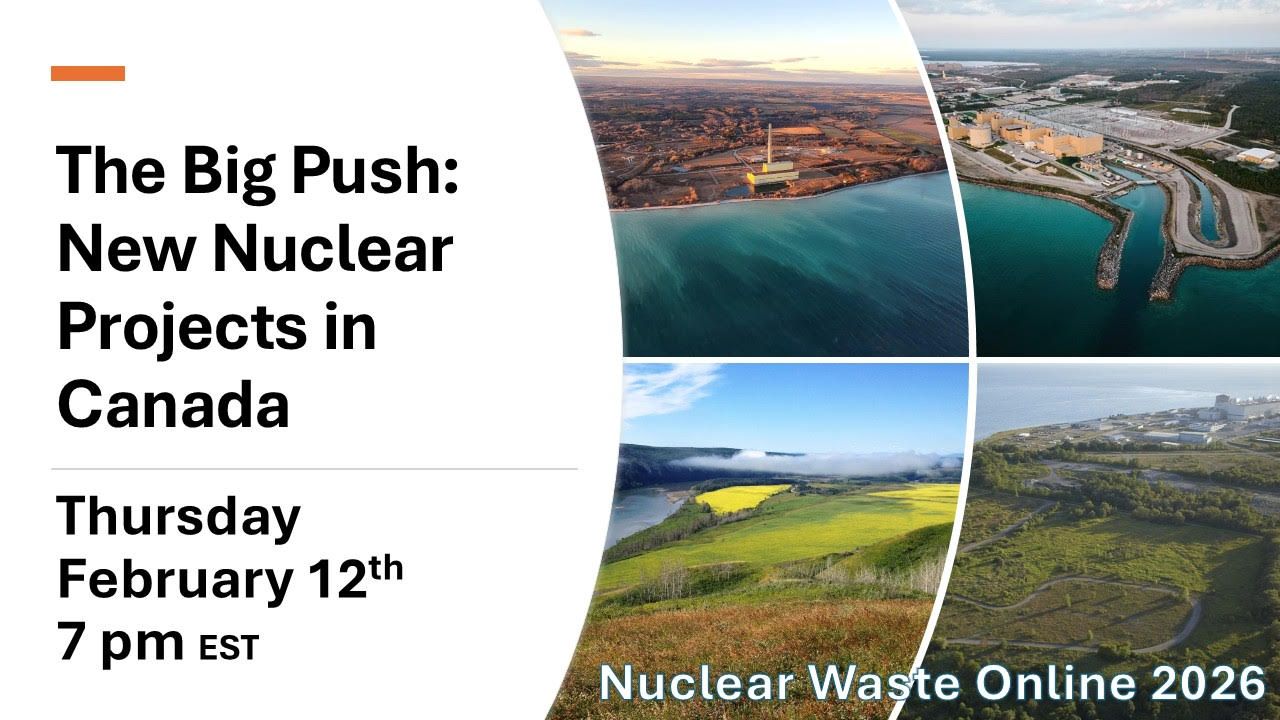
Thursday, February 12, 7 pm Eastern | 2nd of 4 sessions in the 2026 Nuclear Waste Online webinar series
Join a webinar on the push for new nuclear generation in Canada. Go to Northwatch.org to register or use the registration link https://us02web.zoom.us/webinar/register/WN_ZfWOf1GITqSRIZX8CB-A9w
-
Archives
- February 2026 (127)
- January 2026 (308)
- December 2025 (358)
- November 2025 (359)
- October 2025 (376)
- September 2025 (258)
- August 2025 (319)
- July 2025 (230)
- June 2025 (348)
- May 2025 (261)
- April 2025 (305)
- March 2025 (319)
-
Categories
- 1
- 1 NUCLEAR ISSUES
- business and costs
- climate change
- culture and arts
- ENERGY
- environment
- health
- history
- indigenous issues
- Legal
- marketing of nuclear
- media
- opposition to nuclear
- PERSONAL STORIES
- politics
- politics international
- Religion and ethics
- safety
- secrets,lies and civil liberties
- spinbuster
- technology
- Uranium
- wastes
- weapons and war
- Women
- 2 WORLD
- ACTION
- AFRICA
- Atrocities
- AUSTRALIA
- Christina's notes
- Christina's themes
- culture and arts
- Events
- Fuk 2022
- Fuk 2023
- Fukushima 2017
- Fukushima 2018
- fukushima 2019
- Fukushima 2020
- Fukushima 2021
- general
- global warming
- Humour (God we need it)
- Nuclear
- RARE EARTHS
- Reference
- resources – print
- Resources -audiovicual
- Weekly Newsletter
- World
- World Nuclear
- YouTube
-
RSS
Entries RSS
Comments RSS
 nuclear-news