Travel ban lifted on route leading to town near Fukushima plant
 A worker reopens a section of National Route 114 that runs through a “difficult-to-return” zone in Namie, Fukushima Prefecture, on Sept. 20.
NAMIE, Fukushima Prefecture–Motorists lined up early in the morning on Sept. 20 in front of a barrier on National Route 114 here, anticipating an event they had waited nearly six-and-a-half years to see.
And then it happened at 6 a.m. The barrier was removed, and a 27-kilometer section was finally reopened to the public, giving evacuated residents direct access to the eastern part of Namie, a town that lies just north of the crippled Fukushima No. 1 nuclear power plant.
Hisashi Suzuki, an 85-year-old Namie resident who now lives in Nihonmatsu, an inland city in Fukushima Prefecture, used the section to check on his home and family grave.
“Until now, we had to arrange for a thoroughfare pass beforehand, and we sometimes had to wait at checkpoints,” Suzuki said. “This is much more convenient.”
National Route 114, one of main arteries that connects the center of the prefecture with the Pacific coast, runs through much of Namie.
The 27-km section is still within the “difficult-to-return” zone because of high radiation levels, meaning the evacuees can visit their homes in the zone but not return on a permanent basis.
Houses along the road in the no-go zone are now covered in weeds and tangled in vines.
Access to the road section is limited to automobiles. Bicycles, motorcycles and pedestrians are not allowed to enter.
But with the road now reopened, municipalities in the area are hoping for an increasing flow in people, including evacuees visiting their homes and workers involved in reconstruction projects.
All 21,000 or so residents of Namie were ordered to evacuate the town after the nuclear disaster unfolded in March 2011. Many of those living on the coast fled west on National Route 114.
The route was closed in April 2011 because it lies within a 20-km radius of the nuclear plant.
Residents seeking to visit eastern Namie needed to obtain permission from the town government or had to take a cumbersome detour.
The evacuation order was lifted in March this year for the eastern part of the town, which was less contaminated because of the wind direction at the time of the triple meltdown at the plant.
Much of the mountainous western part of Namie is still designated as a difficult-to-return zone.
After receiving requests from the public and municipalities, authorities conditionally lifted the travel ban on the road to allow for convenient access from central Fukushima to eastern Namie.
The central government has set up barriers at 88 intersections on Route 114 to prevent thieves and other unapproved people from using side roads.
In August, a survey showed the radiation dosage on the surface of Route 114 was a maximum 5.53 microsieverts per hour, more than 20 times higher than the threshold level of 0.23 microsievert per hour that many municipalities consider would require decontamination work.
Stand in solidarity: Defend the human rights of Fukushima survivors

Disasters like Chernobyl and Fukushima remind the world how dangerous nuclear power is. But right now, the nuclear industry is trying to downplay the risks of a nuclear disaster. In Fukushima radiation exposure is still a very real threat despite failed “decontamination”.
The Japanese government is set to lift evacuation orders in heavily contaminated areas around Fukushima. It will cut compensation and housing support to survivors, who are still struggling six years later.
Their basic rights to health, housing, and environment are being violated. The government is desperately trying to minimize the disaster at the expense of survivors in an attempt to revive the dying nuclear industry and suffocate other cleaner energy sources. We must say no!
Sign now to demand the government provides fair compensation, housing support, and is fully transparent about the radiation risks.
We’ll deliver your signature to the Prime Minister so he hears the global wave of resistance against nuclear!
Nuclear Lessons Learned: US & Japan NONE!
From Majia’s blog
Japan’s Nuclear Regulatory Authority has bowed to pressure and is allowing TEPCO, a company with a culture that has been berated by this same agency, to re-start reactors:
EDITORIAL: NRA too hasty in giving green light to TEPCO to restart reactors (2017, September 14). The Asahi Shimbun, http://www.asahi.com/ajw/articles/AJ201709140030.html
Although the Nuclear Regulation Authority has decided to give the green light to Tokyo Electric Power Co. to restart nuclear reactors, we question the fitness of the utility, which is responsible for the accident at the Fukushima No. 1 nuclear power plant, to manage nuclear facilities. The NRA has been screening TEPCO’s application to resume operations of the No. 6 and No. 7 boiling-water reactors at its Kashiwazaki-Kariwa nuclear plant in Niigata Prefecture. The NRA on Sept. 13 acknowledged with conditions that TEPCO is eligible for operating nuclear plants after examining the company’s safety culture and other issues.
Meanwhile, Japan’s nuclear commission is calling not only for a return to nuclear (with at least 20% of its fuel mix targeted for nuclear), but has also endorsed MOX fuel in a move that defies reason, especially given the conditions of Fukushima reactor 3 (which was running MOX at the time of the accident):
Mari MARI YAMAGUCHI (2017, September 14 ) Japan commission supports nuclear power despite Fukushima. The Seattle Times, http://www.seattletimes.com/business/japan-commission-supports-nuclear-power-despite-fukushima/
TOKYO (AP) — Japan’s nuclear-policy-setting Atomic Energy Commission issued a report Thursday calling for nuclear energy to remain a key component of the country’s energy mix despite broad public support for a less nuclear-reliant society. The report approved by the commission calls for nuclear energy to make up at least 20 percent of Japan’s supply in 2030, citing the government energy plan. It says rising utility costs from expensive fossil fuel imports and slow reactor restarts have affected Japan’s economy. The resumption of the nuclear policy report is a sign Japan’s accelerating effort to restart more reactors. “The government should make clear the long-term benefit of nuclear power generation …
The report also endorsed Japan’s ambitious pursuit of a nuclear fuel cycle program using plutonium, despite a decision last year to scrap the Monju reactor, a centerpiece of the plutonium fuel program, following decades of poor safety records and technical problems. Japan faces growing international scrutiny over its plutonium stockpile because the element can be used to make atomic weapons.
And to top it all off, Japan is now setting up its first “restoration hub” in Futaba:
Noriyoshi Otsuki (2017, September 15). First ‘hub’ set up in Fukushima no-entry zone to speed rebuilding. The Asahi Shimbun, http://www.asahi.com/ajw/articles/AJ201709150058.html
An area in the no-entry zone of Futaba, a town that co-hosts the crippled Fukushima No. 1 nuclear power plant, became the first government-designated “rebuilding hub” after the 3/11 disaster. The designation on Sept. 15 means decontamination will speed up and infrastructure restored so the evacuation order in the town center can be lifted by spring 2022. Most of Futaba is currently located in a difficult-to-return zone because of high radiation levels. Rebuilding efforts have not started there yet, even six-and-a-half years since the nuclear accident unfolded.
As noted in the article, Futaba is located in the difficult to return zone. Here is a screenshot from TEPCO’s 2016 report on air monitoring in the Futaba evacuation zone:


The air dose in Futaba is very high, with the highest reading reported at 9.6 microsieverts an hour.
Locating the first restoration hub in Futaba, located in close proximity to the still-unstable plant, seems like a propaganda move, rather than a thoughtful risk decision.
Fukushima is still belching radioactivity (especially from unit 3), as illustrated in this screenshot from yesterday:

The plant is still at risk from earthquakes and lifequefaction.
I must conclude from this series of news reports that neither Japan nor the US are capable of learning when it comes to nuclear policy making.
http://majiasblog.blogspot.fr/2017/09/nuclear-lessons-learned-us-japan-none.html
Low 134Cs/137Cs ratio anomaly in the north-northwest direction from the Fukushima Dai-ichi Nuclear Power Station

Highlights
- • We present new data of 134Cs/137Cs around Fukushima Daiichi Nuclear Power Station.
- • The entire area of the low 134Cs/137Cs ratio anomaly around the FDNPS is revealed.
- • The low 134Cs/137Cs ratio anomaly is coincident with a plume trace.
- • The anomaly occurs in the area which had been contaminated before March 13, 2011.
Abstract
A low 134Cs/137Cs ratio anomaly in the north-northwest (NNW) direction from the Fukushima Dai-ichi Nuclear Power Station (FDNPS) is identified by a new analysis of the 134Cs/137Cs ratio dataset which we had obtained in 2011–2015 by a series of car-borne surveys that employed a germanium gamma-ray spectrometer.
We found that the 134Cs/137Cs ratio is slightly lower (0.95, decay-corrected to March 11, 2011) in an area with a length of about 15 km and a width of about 3 km in the NNW direction from the FDNPS than in other directions from the station.
Furthermore, the area of this lower 134Cs/137Cs ratio anomaly corresponds to a narrow contamination band that runs NNW from the FDNPS and it is nearly parallel with the major and heaviest contamination band in the west-northwest.
The plume trace with a low 134Cs/137Cs ratio previously found by other researchers within the 3-km radius of the FDNPS is in a part of the area with the lower 134Cs/137Cs ratio anomaly that we found.
Our result suggests that this lower 134Cs/137Cs ratio anomaly is the area which was contaminated before March 13, 2011 (UTC) in association with the hydrogen explosion of Unit 1 on March 12, 2011 at 06:36 (UTC) and it was less influenced by later subsequent plumes.
http://www.sciencedirect.com/science/article/pii/S0265931X17301947
First ‘hub’ set up in Fukushima no-entry zone to speed rebuilding
 Bags of contaminated soil are stored near JR Futaba Station in Futaba, Fukushima Prefecture. The area has become part of the government-designated rebuilding hub.
An area in the no-entry zone of Futaba, a town that co-hosts the crippled Fukushima No. 1 nuclear power plant, became the first government-designated “rebuilding hub” after the 3/11 disaster.
The designation on Sept. 15 means decontamination will speed up and infrastructure restored so the evacuation order in the town center can be lifted by spring 2022.
Most of Futaba is currently located in a difficult-to-return zone because of high radiation levels. Rebuilding efforts have not started there yet, even six-and-a-half years since the nuclear accident unfolded.
The rebuilding hub covers about 560 hectares of land around Futaba Station, accounting for about 10 percent of the town’s total area. It is almost the same size as an interim storage facility for contaminated soil and other waste that will be built within the town.
The central government will start full-scale decontamination efforts in the hub zone, and plans to initially lift the evacuation order for the area around the station by the end of fiscal 2019 to allow an open thoroughfare and short stays by members of the public.
By spring 2022, the government plans to lift the evacuation order for the entire hub zone. It hopes to bring back 1,400 former residents to the zone by 2027, and also provide homes for about 600 people from outside the town, such as workers at the Fukushima plant.
In the difficult-to-return zone, radiation readings surpassed 50 millisieverts per annum right after the triple meltdown occurred at the plant in 2011. An evacuation order was issued to about 25,000 people in seven municipalities in Fukushima Prefecture, covering 33,700 hectares in total.
The difficult-to-return zones have been excluded from the government’s rebuilding efforts. But a related law was amended in May, and the government is now responsible for rebuilding areas that could be made habitable in the near future after decontamination, meaning a radiation reading of 20 millisieverts per year or less.
In late August, Futaba applied to the government to host a designated rebuilding hub. Other municipalities with difficult-to-return zones are now preparing applications for the program.
49% of Fukushima nuke disaster evacuees returning home to live are elderly: survey

Nearly half of people currently living in nuclear disaster-hit areas in Fukushima Prefecture where evacuation orders have been lifted are aged 65 or over, a survey conducted by the Mainichi Shimbun has found.
The population aging rate — the ratio of people in this age group to the population — in these areas is nearly twice the figure before the outbreak of the Fukushima No. 1 nuclear power plant disaster in March 2011, as many younger evacuees have not come back to their hometowns for fear of being exposed to radiation or have settled down in areas where they took shelter.
The regional communities in these areas could be endangered because their current population is less than 10 percent of the pre-disaster figure and households in these areas consist of smaller member numbers.
The Mainichi Shimbun surveyed nine cities, towns and villages in Fukushima Prefecture about the situations of areas where evacuation orders had been lifted by this past spring
As of July and August, 5,951 people in 2,970 households have returned to or newly moved into these areas. Of these people, 2,929, or 49.2 percent, are aged at least 65.
According to a national census conducted in 2010 — before the March 2011 disaster — the rate was 27.4 percent in all areas of these nine municipalities.
The latest figure is above the anticipated population aging rate in Japan for 2065, which the National Institute of Population and Social Security Research put at 38.4 percent.
Of all the nine municipalities, the population aging rate in the village of Kawauchi is the highest at 71.3 percent. The town of Naraha has the lowest figure, but it still stands at 37 percent.
The figures in Kawauchi and two other municipalities among these nine are higher than the 60.5 percent in the village of Nanmoku, Gunma Prefecture, which had the highest population aging rate of all municipalities in Japan in the 2015 census.
The number of people who currently live in the areas where evacuation orders have been lifted is less than 10 percent the number of people registered as residents just before the disaster, which was slightly above 60,000.
Members of a growing number of households in these areas are living separately. The average number of members per household is two, almost equal to the figure in Tokyo at 2.02 in the 2015 census, which is the smallest number among all 47 prefectures. In the 2010 pre-disaster census, the average figure in the nine municipalities had been 3.04.
An official of the city of Minamisoma, one of the nine municipalities, expressed concerns about the aging of its population. “There’ll be a growing number of cases where people living by themselves die alone and where an elderly family member has to look after another elderly member,” the official said.
In Minamisoma, only a limited number of medical institutions and nursing care facilities have reopened. “There’s a serious workforce shortage,” the official lamented.
Only about five of 94 members of volunteer firefighters in the village of Katsurao have returned home since the evacuation order was lifted.
An official of the Katsurao Municipal Government voiced fears about the shortage of volunteer firefighters. “We are worried that it will be difficult to mobilize these volunteers if a fire breaks out in the village. As long as there are not enough young people, it’ll be difficult to maintain the fire brigade in the village,” the official said.
Ritsumeikan University associate professor Fuminori Tanba, who was involved in the compilation of restoration plans in municipalities where evacuation orders were issued, noted, “The situation of areas affected by the nuclear crisis heralds the future situation of Japan where the birthrate is declining and the population is aging. Local governments need to join hands across broad areas in addressing challenges that cannot be tackled by a single municipality, such as nursing care and disaster management,” he said.
https://mainichi.jp/english/articles/20170909/p2a/00m/0na/004000c

Contaminated Fukushima Forests: 4µSv/h measured at 1 meter above ground
Measurement date September 6, 2017: Date City, Fukushima Prefecture
Dying Navy Sailors Push for Trial on Fukushima Meltdown

SAN DIEGO (CN) – Representing cancer-ridden Navy service members who say they were exposed to radiation on a humanitarian mission in Fukushima, former Sen. John Edwards urged a federal judge Thursday to set a date for trial.
Over a decade after serving as John Kerry’s running mate in the 2004 presidential election, Edwards now represents hundreds of Navy sailors who were aboard the USS Ronald Reagan as part of a humanitarian mission trip to Fukushima, Japan — bringing food and supplies to the city in March 2011 after it was devastated by an earthquake and ensuing tsunami.
“We have all these sailors whose case is now five years old, who have died or are in the process of dying right now,” said Edwards, whose firm Edwards Kirby is based in North Carolina.
Edwards noted that some of his other clients have seen their children born with birth defects. He said he made the trip from Raleigh to San Diego to “try to get this thing moving.”
Japan’s earthquake triggered a nuclear meltdown at the power plant run by Tokyo Electric Power Co., and Edwards’ clients say the radiation exposure has caused them to develop cancer and other illnesses.
The suit is one of two pending against TEPCo and General Electric in the Southern District of California — the first filed in 2012 and an additional lawsuit naming more than 150 sailors filed last month.
Thursday’s hearing before U.S. District Judge Janis Sammartino came after the Ninth Circuit ruled in June that the lawsuit could proceed in federal court, rejecting an effort to have the case sent to Japan.
Edwards urged Sammartino to bypass the procedural hurdles, “so we know there’s a deadline over there.”
“Instead of just staying still and going with the pleadings and the motions to dismiss, is there a way to get us a trial date and a structure,” Edwards asked.
“I hate to see these sailors and say we filed motions, went to the Ninth Circuit, went to Washington, and I hate to say I don’t know when [we’ll get our day in court],” Edwards said.
He asked for a May 2019 trial date.
TEPCo attorney Gregory Stone said the Japanese utility accepts responsibility for the radiation released but maintains the amount Navy service members were exposed to was negligible.
He thanked the service members present at the hearing for their efforts, but said that radiation exposure is not necessarily the cause of 300 to 400 sailors out of 70,000 on the humanitarian trip getting sick.
“It only indicates what epidemiologists tell us: people get sick at different times of their lives for different reasons,” Stone said.
“We don’t think the exposure was at a level sufficient to cause the injuries,” Stone continued, amid muttered comments from the audience. “They don’t agree with us and are probably talking about it now.”
GE attorney Michael Schissel said the length of the case and trial will be significantly impacted if GE remains a defendant in the case. Unlike TEPCo, GE is not admitting liability over the failure of its Boiling Water Reactors. Schissel said this would then require a liability phase at trial, significantly lengthening the process.
Sammartino called the case a “moving target” as the attorneys threw out different ideas for how best to approach setting deadlines and moving forward. She said she would issue an order setting dates.
In an interview with Courthouse News following the hearing, Edwards said they are pleased the case will be tried in America. If the case were in Japan, Edwards said there was a concern that the possibility of traveling across the world would cause his clients to lose hope.
“From the perspective of a lawyer, it’s a wonderful cause,” Edwards said. “Here are these completely innocent people whose lives have been taken away from some of them and they were there trying to help the Japanese people. It was such a just and righteous cause that they were there for and they’ve had their lives changed forever as a result of what happened.”
More sailors are coming forward every week, Edwards added, saying they expect the numbers to continue to go up as the word gets out about the lawsuits.
He said they want to make sure “the truth comes out” and that the “word gets out about the dangers and risks that exist not just in Japan, but in other parts of the world.”
https://www.courthousenews.com/dying-navy-sailors-push-trial-fukushima-meltdown/
Elimination of Fukushima evacuees from list slammed
 This woman in her 30s lives in Tokyo with her young children after fleeing her home in Fukushima Prefecture following the accident at the Fukushima No. 1 nuclear power plant in March 2011. Her husband remains in Fukushima Prefecture for his job.
The central government has made a large number of people who voluntarily fled the Fukushima area after the 2011 nuclear disaster disappear by cutting them from official lists of evacuees.
Critics are now condemning the move, which went into effect last April, saying it prevents government officials from fully grasping the picture of all who remain displaced to evaluate their future needs.
“Accurate data on Fukushima evacuees is essential in gaining a better understanding of their current circumstances and crafting measures to address their problems,” said Shun Harada, a sociology researcher at Rikkyo University in Tokyo, who contributes as an editor for an information publication for evacuees living in Saitama Prefecture.
“When only smaller than the real numbers are made available, difficulties facing evacuees could be underestimated and could result in terminating support programs for them,” he complained.
As of July, 89,751 evacuees were living across Japan after fleeing from the nuclear disaster, down by 29,412 from the March tally.
In April, the central government opted to cut “voluntary” evacuees who fled their homes due to fears of radiation despite being from outside the evacuation zone.
It came after the official program to provide free housing to the voluntary evacuees was stopped at the end of March, which was designed to facilitate a prompt return to their hometowns in Fukushima Prefecture. People from the evacuation zone are still eligible to the free housing program.
The central government’s Reconstruction Agency, set up to oversee rebuilding efforts in Japan’s northeastern region after the 2011 Great East Japan Earthquake, tsunami and nuclear disaster, releases the number of evacuees each month, based on figures compiled by local authorities.
The 29,412 drop in the number of official evacuees between March and July includes 15,709 in Fukushima Prefecture, 6,873 in Miyagi Prefecture, 2,798 in Iwate Prefecture, 780 in Tokyo, 772 in Kanagawa Prefecture and 577 in Saitama Prefecture.
Before the change in housing policy, agency statistics showed a monthly decrease in evacuee numbers of between 3,000 and 4,000 in the several months leading up to the end of March.
But the drop in numbers increased dramatically to 9,493 between March and April and 12,412 between April and May.
Kanagawa and Saitama prefectural officials say voluntary evacuees were responsible for most of the declines in their jurisdictions.
A large number of them are believed to be living in the same housing as before but are now paying their own rent.
A 43-year-old woman who has been evacuating in Saitama Prefecture since fleeing from Iwaki, Fukushima Prefecture, with three other family members said she is angered by the central government’s treatment.
“We cannot return to Fukushima Prefecture due to fears of the effects of radiation,” she said. “I feel like I have been abandoned by the state by being denied evacuee status.”
An official with the Tokyo-based Japan Civil Network for Disaster Relief in East Japan, a private entity that functions as a liaison unit for a nationwide network of groups supporting victims of the disaster six years ago stressed the need for local authorities to have an accurate understanding of the circumstances surrounding evacuees.
“Of the evacuees, the elderly and single-parent households tend to be left in isolation and many of them are likely to become qualified to receive public assistance in the near future,” the official said. “Local officials need to know they are evacuees (from Fukushima).”
The official added that it will become difficult for support groups to extend their help if voluntary evacuees are taken out of the official tally.
But the Reconstruction Agency said it will not reconsider the definition of evacuees.
http://www.asahi.com/ajw/articles/AJ201708280053.html
No-go zones keep kin from burying deceased Fukushima evacuees at ancestral gravesites
 Buddhist monks offer prayers for victims of the March 11, 2011, earthquake and tsunami in Namie, Fukushima Prefecture, in March 2014.
In Fukushima, 3/11 fallout forcing remains to be stored at temples, ancestral gravesites to be moved
FUKUSHIMA – The remains of Fukushima’s deceased evacuees are being left in limbo because radiation is preventing them from being buried.
In municipalities that remain off-limits because of the fallout from the triple core meltdown at the Fukushima No. 1 power plant in March 2011, the inability of residents to return has put burials for their loved ones on hold.
Instead, many relatives are opting to leave remains in the hands of temples or moved their family graves out of their hometowns.
Choanji, a temple in a no-go zone in the town of Namie, is keeping the remains of about 100 people at a branch facility that was set up in the prefectural capital after the nuclear crisis began.
At the branch, a swordsmanship training room was renovated to enshrine remains that should have been buried in Namie.
“Evacuees don’t want to bury the remains of family members in places with high radiation levels,” said the branch’s chief priest, Shuho Yokoyama, 76.
A 66-year-old resident of Minamisoma visited the temple branch on Aug. 12 for the Bon holidays to pray for her elder sister, who died after evacuating the area.
Her remains are kept there because her family’s grave is located in a no-go zone in Namie; the remains of her sister’s husband, who died before the disaster, are already in the family grave.
“I am sorry that she is separated from her husband. I want their remains to be buried together,” the woman said.
To enter the no-go zone, residents need to submit applications to the municipal government in question.
The woman is unhappy with the system as she wants permission to enter the areas freely, at least during Bon, the traditional period for commemorating one’s ancestors. Since the disaster began, she has been unable to visit the grave of her brother-in-law.
At Choanji, 20 percent of some 500 families in the congregation have moved their ancestors’ graves to other areas.
Isao Kanno, 50, who hails from Namie but now lives in Tokyo, was in the area just before the remains of his father, who died two months before the meltdowns, were scheduled to be interred.
“I can’t be evacuated alone and bury the remains in the grave” in a no-go zone, Kanno said. “I’m considering moving the grave somewhere else.”
Some, however, worry their hometown ties could fade if they move their graves.
“Despite being designated a no-go zone, it is my hometown,” said a 57-year-old Tokyo resident who left the remains of one of his relatives at the temple branch.
“It is the land of my ancestors, so I’ve never considered moving the grave,” he said.
Radioactive Hot Particles in Japan: Full Radiation Risks not Recorded

Radioactively-Hot Particles in Japan; New Study Shows Full Radiation Risks are not Recorded
The article details the analysis of radioactively hot particles collected in Japan following the Fukushima Dai-ichi meltdowns. Based on 415 samples of radioactive dust from Japan, the USA, and Canada, the study identified a statistically meaningful number of samples that were considerably more radioactive than current radiation models anticipated. If ingested, these more radioactive particles increase the risk of suffering a future health problem…
http://www.fairewinds.org/newsletter-archive//press-release-radioactively-hot-particles-in-japan

Radioactively-hot particles detected in dusts and soils from Northern Japan by combination of gamma spectrometry, autoradiography, and SEM/EDS analysis and implications in radiation risk assessment
by Marco Kaltofen (Nuclear Science and Engineering Program, Department of Physics, Worcester Polytechnic Institute) and Arnie Gundersen (Fairewinds Energy Education), Dec 2017 :
Radioactively-hot particles detected in dusts and soils from Northern Japan… Radioactive particles from Fukushima are tracked via dusts, soils, and sediments; Radioactive dust impacts are tracked in both Japan and the United States/Canada; Atypically-radioactive particles from reactor cores are identified in house dusts… After the March 11, 2011, nuclear reactor meltdowns at Fukushima Dai-ichi, 180 samples of Japanese particulate matter (dusts and surface soils) and 235 similar U.S. and Canadian samples were collected and analyzed… Samples were collected and analyzed over a five-year period, from 2011 to 2016.

Detectable levels of 134Cs and 137Cs were found in 142 of 180 (80%) Japanese particulate matter samples… U.S. and Canadian samples had detectable 134Cs and 137Cs in one dust sample out of 32 collected, and four soils out of 74… The mean in Japan was skewed upward due to nine of the 180 (5%) samples with activities > 250 kBq kg− 1 [250,000 Bq/kg]… 300 individual radioactively-hot particles were identified in samples from Japan; composed of 1% or more of the elements cesium, americium, radium, polonium, thorium, tellurium, or strontium.

Some particles reached specific activities in the MBq μg− 1 level and higher [1,000,000,000,000,000 Bq/kg]… Some of the hot particles detected in this study could cause significant radiation exposures to individuals if inhaled. Exposure models ignoring these isolated hot particles would potentially understate human radiation dose.

http://audioslides.elsevier.com/viewersmall.aspx?doi=10.1016/j.scitotenv.2017.07.091&source=0
7 summers later, weeds engulf Fukushima’s abandoned areas
The startling effects of the passage of time come into sharp focus in aerial images taken of Fukushima’s “difficult-to-return zones” in the seventh summer since the March 2011 nuclear disaster.
The bird’s-eye view pictures were captured in abandoned areas near the crippled Fukushima No. 1 nuclear power plant in Okuma and Futaba in Fukushima Prefecture.
The disaster unfolded after the magnitude-9.0 Great East Japan Earthquake spawned a tsunami that devastated coastal areas of the Tohoku region, including Tokyo Electric Power Co.’s Fukushima No. 1 plant.
The Okuma outlet of Plant-4, a large shopping mall located 3 kilometers away from the nuclear plant along National Route No. 6, had been bustling with visitors before the disaster.
Today, weeds grow from the cracks of the asphalt-surfaced mall parking lot, slowly creeping through the expanse of space.
One striking image shows the exterior of the TEPCO-owned condominium building, which housed its employees in Futaba, is becoming covered with rampant weeds that have reached the second floor.
Another photo shows cars that cannot be recovered are partially buried, appearing as if they are sinking into a sea of green.
Blast from the Past: Plutonium Contamination from Fukushima Daiichi Unit 3

From Majia’s blog
I was reviewing my notes regarding plutonium found at Fukushima and I found this news story worth remembering:
Amina Khan (of the Los Angeles Times). (March 8, 2012). Plutonium near Fukushima plant poses little risk, study says Published: Thursday, March 8, 2012 http://www.heraldnet.com/article/20120308/NEWS02/703089849
The levels of radioactive plutonium around Japan’s Fukushima Daiichi nuclear power plant aren’t much higher than the amount of plutonium remaining in the environment from Cold War-era nuclear weapons tests, and it probably poses little threat to humans, a new study indicates.
The paper, published Thursday in the journal Scientific Reports, provides the first definitive evidence of plutonium from the accident entering the environment, the authors say. It examines the area within a roughly 20-mile radius of the plant and details the concentration of plutonium isotopes deposited there after explosions ripped open multiple reactors.
At the three sites examined, the levels for certain isotope ratios were about double those attributed to residual fallout from above-ground nuclear tests conducted by the U.S. and former Soviet Union at the dawn of the Cold War….
Robert Alvarez, who has served as a senior policy adviser in the U.S. Energy Department, said he would have been surprised if researchers had not found evidence of plutonium contamination near the plant. “They were irradiating plutonium in Unit 3, which experienced the biggest explosion,” he said. In fact, the explosion was so massive that investigators found fuel rod fragments a mile away, leading to speculation that a supercritical fission event may have also occurred, Alvarez said.
The article is referring to a study by Zheng et al. Here is my synopsis of the study’s findings:
A study released in Scientific Reports published by Nature titled ‘Isotopic evidence of plutonium release into the environment from the Fukushima DNPP accident’ by Zheng et al found that a wide array of highly volatile fission products were released, including 129mTe, 131I, 134Cs, 136Cs and 137Cs, which were all found to be ‘widely distributed in Fukushima and its adjacent prefectures in eastern Japan.’[i]
The study also found evidence of actinides, particularly Pu isotopes, on the ground northwest and south of the Fukushima DNPP in the 20–30 km zones. The study called for long-term investigation of Pu and 241Am dose estimates because of findings of ‘high activity ratio of 241Pu/239+240Pu (> 100) from the Fukushima DNPP accident.’
The study concluded that in comparison to Chernobyl, the Fukushima accident ‘had a slightly higher 241Pu/239Pu atom ratio, but lower ratio of 240Pu/239Pu.’ Unit 3 was seen as the likely source for the high Pu detections.
[i] J. Zheng, K. Tagami, Y. Watanabe, S. Uchida, T. Aono, N. Ishii, S. Yoshida, Y. Kubota, S. Fuma and S. Ihara (8 March 2012 ) ‘Isotopic Evidence of Plutonium Release into the Environment from the Fukushima DNPP Accident,’ Scientific Reports, 2, http://www.nature.com/srep/2012/120308/srep00304/full/srep00304.html.
http://majiasblog.blogspot.fr/2017/07/blast-from-past-plutonium-contamination.html
No human rights in terrifyingly contaminated Namie in Fukushima
The evacuation orders of the most populated areas of Namie, Fukushima were lifted on March 31, 2017.
We are publishing the most recent soil surface density map of Namie created by a citizen’s measurement group named the “Fukuichi Area Environmental Radiation Monitoring Project“(http://www.f1-monitoring-project.jp/index.html). Their members are mainly from Tokyo metropolitan region.
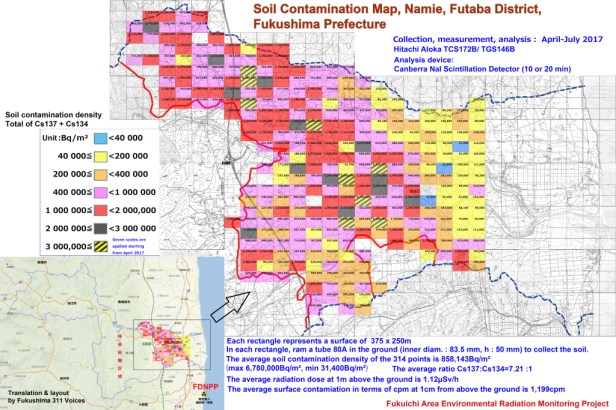
Their map is simply terrifying. This is far much higher level of radio-contamination than in the Radiation Control Zone. Any area becomes designated as such when the total effective dose due to external radiation and that due to radioactive substances in the air is likely to exceed 1.3mSv per quarter – over a period of three months, or when the surface density is likely to exceed 40,000Bq/m2. In the Radiation Control Zone, it is prohibited to drink, eat or stay overnight. Even adults, including nuclear workers, are not allowed to stay more than 10 hours. To leave the zone, one has to go through a strict screening.
Namie’s radio contamination is far over these figures! The average soil contamination density of the total of 314 points where the soil was collected and measured is 858,143Bq/m². The maximum value was 6,780,000Bq/m², and the minimum was only 31,400Bq/m²!
And people, including infants and pregnant women, are told to go back to these areas to live, because it is supposed to be safe. Basically the Japanese government does not recognize the fundamental human right to live in a healthy environment. The population is facing a tough future, for the compensation will be cut off soon, and the housing aid by the central government finishes at the same time. As for the auto-evacuees who fled from areas which are not classified as evacuation zones but are nevertheless radio-contaminated, they had only very little compensation and the housing aid was cut off at the end of March 2017. Continuing to live as nuclear refugees is becoming more and more difficult. We consider that this is a violation of basic environmental human rights.
Let us not forget to thank the members and volunteers of the Fukuichi Area Environmental Radiation Monitoring Project team. They are mostly elderly people over 60 years old. However, that doesn’t mean that they can be exposed to radiation. We thank them and pray for their health.
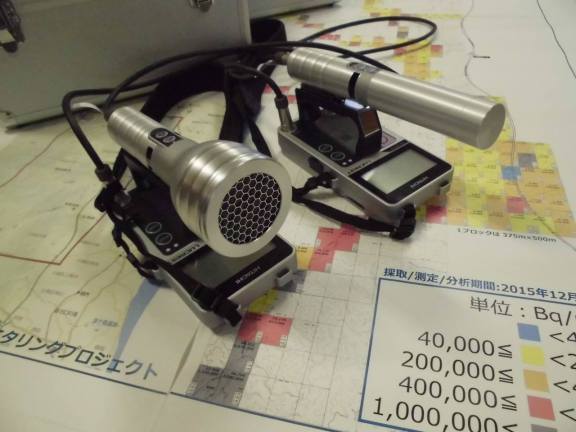 Measurement devices
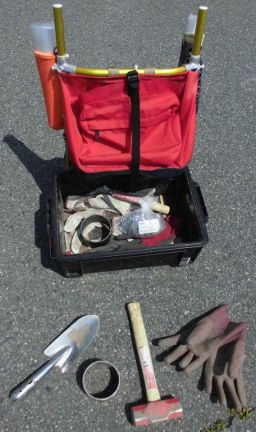 Kit for soil collection
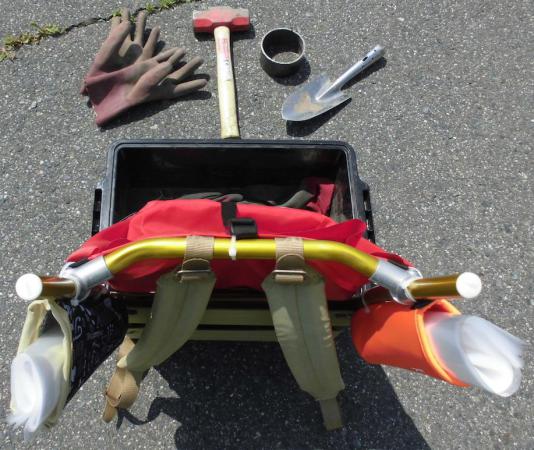 Kit carried on the back
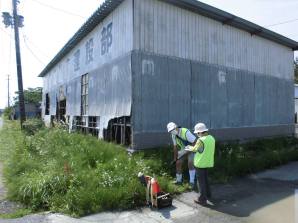
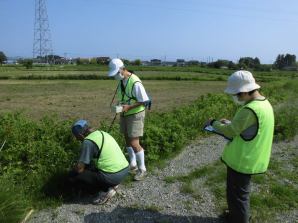
 Collected soil samples
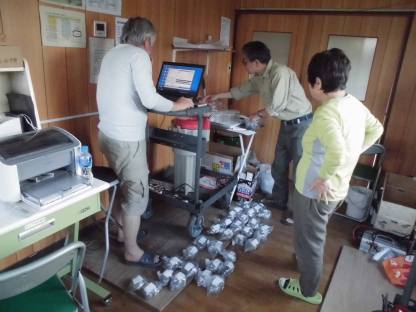 Analysing the soil samples
You might think that Japanese just endure their fate without complaining. This is not true. Many people are fighting and protesting. Let us cite, among numerous on-going trials, the one called the “Trial to require the withdrawal of the 20mSv dose as the limit for evacuation” filed by residents of Minamisoma city in Fukushima, who are against the lifting of the evacuation order when the radiation dose decreases below 20mSv/year. Let us remind you that the Japanese government has adopted 1mSv/year, the internationally recognized dose limitation for public recommended in 1990 by ICRP (International Commission on Radiological Protection), and this is still the limit for the public all over Japan EXCEPT in Fukushima. This is one of the reasons why many people from Fukushima ask themselves: “Is Fukushima really a part of Japan?” or “Are we the people abandoned by the State?”
Related articles of this site :
The scandalous deficiency of the health scheme in Fukushima
Incredible contamination in Namie, Fukushima
1 This Month
To see nuclear-related stories in greater depth and intensity – go to https://nuclearinformation.wordpress.com/
12 February – Webinar The Big Push: New Nuclear Projects in Canada
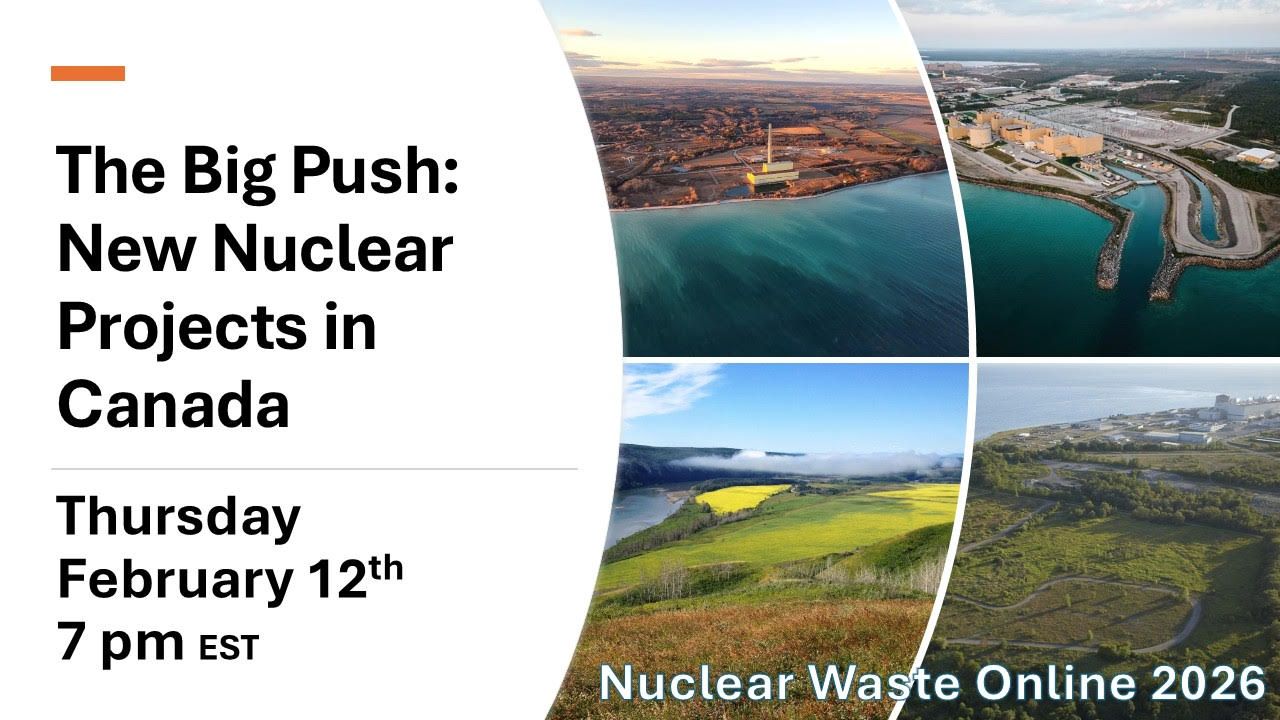
Thursday, February 12, 7 pm Eastern | 2nd of 4 sessions in the 2026 Nuclear Waste Online webinar series
Join a webinar on the push for new nuclear generation in Canada. Go to Northwatch.org to register or use the registration link https://us02web.zoom.us/webinar/register/WN_ZfWOf1GITqSRIZX8CB-A9w
-
Archives
- February 2026 (127)
- January 2026 (308)
- December 2025 (358)
- November 2025 (359)
- October 2025 (376)
- September 2025 (258)
- August 2025 (319)
- July 2025 (230)
- June 2025 (348)
- May 2025 (261)
- April 2025 (305)
- March 2025 (319)
-
Categories
- 1
- 1 NUCLEAR ISSUES
- business and costs
- climate change
- culture and arts
- ENERGY
- environment
- health
- history
- indigenous issues
- Legal
- marketing of nuclear
- media
- opposition to nuclear
- PERSONAL STORIES
- politics
- politics international
- Religion and ethics
- safety
- secrets,lies and civil liberties
- spinbuster
- technology
- Uranium
- wastes
- weapons and war
- Women
- 2 WORLD
- ACTION
- AFRICA
- Atrocities
- AUSTRALIA
- Christina's notes
- Christina's themes
- culture and arts
- Events
- Fuk 2022
- Fuk 2023
- Fukushima 2017
- Fukushima 2018
- fukushima 2019
- Fukushima 2020
- Fukushima 2021
- general
- global warming
- Humour (God we need it)
- Nuclear
- RARE EARTHS
- Reference
- resources – print
- Resources -audiovicual
- Weekly Newsletter
- World
- World Nuclear
- YouTube
-
RSS
Entries RSS
Comments RSS
 nuclear-news