Prosecutors innocent TEPCO over radioactive water leakage into the ocean
The court said there is no evidence that proves that radioactive water flew out of the Fukushima nuclear power plant to the ocean. I hope this would finally convince those who haven’t been convinced that the state of Japan denies truth and violates peoples lives. Its time to get rid of Abe et al.
Prosecutors drop TEPCO case over radioactive water leakage
FUKUSHIMA–The Fukushima District Public Prosecutor’s Office announced on March 29 that it will not prosecute Tokyo Electric Power Co. or its executives for violating an environmental pollution law.
The decision came two and a half years after a group of plaintiffs, including residents of Fukushima Prefecture, filed a criminal complaint against TEPCO, operator of the crippled Fukushima No. 1 nuclear power plant, and its 32 current and former executives.
The group sought to bring charges against the utility and its executives for allowing radioactive contaminated water to be discharged into the sea.
In its decision, the prosecutors said there was “insufficient” evidence to press charges against TEPCO and some of its executives, including Naomi Hirose, company president. The remaining executives, the prosecutors said, “had no authority or responsibility to set measures to avoid the leakage in the first place,” therefore, the accusation has “no grounds.”
“The Fukushima police investigated the case for almost two years. It is extremely disappointing,” said Ruiko Muto, 62, the head of the plaintiff’s group, at a news conference in Tokyo on March 29. “We wanted them to look into the case further. We can’t accept this decision.”
The group is planning to appeal to the Committee for the Inquest of Prosecution. The group will meet with its lawyers on March 30 and decide on whether it will pursue further action.
http://ajw.asahi.com/article/0311disaster/fukushima/AJ201603300068
Charges ruled out for Tepco figures over Fukushima No. 1 radioactive water spillage into sea
FUKUSHIMA – Public prosecutors decided on Tuesday not to indict Tokyo Electric Power Co. President Naomi Hirose and other current and former executives of the utility over radioactive water leaks from the crippled Fukushima No. 1 nuclear power plant into the ocean.
Sufficient evidence was not found, the Fukushima District Public Prosecutor’s Office said.
In September 2013, a civic group filed a criminal complaint against 32 current and former Tepco executives, including Hirose and Tsunehisa Katsumata, former chairman of the operator of the northeastern nuclear power plant, saying tainted water leaked from storage tanks into the ocean due to their failure to take preventive measures.
Through its investigation, the Fukushima Prefectural Police concluded that some 300 tons of stored radioactive water had flowed into the sea as of July 2013 because Tepco executives neglected to monitor the tanks or take leak-prevention measures, and sent the case to the prosecutors last October.
The prosecutors said there was no evidence supporting the allegation that the leaked tainted water was carried into the sea by groundwater at the plant, which suffered meltdowns following the massive earthquake and tsunami in March 2011.
The group said it will ask for a prosecution inquest panel’s investigation.
Land acquisition for Fukushima dump site may reach 70% by 2020: ministry
FUKUSHIMA – The Environment Ministry will likely be able to acquire about 40 to 70 percent of the site it plans to use as an interim storage facility for radioactive soil and other waste from the Fukushima nuclear disaster by fiscal 2020.
The estimate is part of a five-year road map for building the facility that was presented Sunday to a council in the city of Fukushima representing the prefecture and local municipalities.
The 1,600-hectare (3,953-acre) site straddles the towns of Okuma and Futaba, home to Tokyo Electric Power Co.’s heavily damaged Fukushima No. 1 nuclear plant, where a triple meltdown was triggered by tsunami spawned by the March 2011 Great East Japan Earthquake.
If 640 to 1,150 hectares are acquired, 5 million to 12.5 million cu. meters of radiation-tainted waste can be stored there. By fiscal 2020, the ministry aims to finish transporting radioactive soil now being stored at schools or residential areas.
Environment Minister Tamayo Marukawa told reporters after the meeting that the ministry’s calculations are based on a realistic approach, adding it will continue lobbying local landowners to support the project.
To complete the project, the ministry will have to negotiate with 2,365 landowners whose property is on the targeted 1,600-hectare site. As of Friday, the ministry had visited about 1,240 of them and acquired a mere 22 hectares from 82 of them.
The negotiations are taking longer than expected due to the need to calculate official compensation. The planned facility is slated to store up to 22 million cu. meters of radioactive waste for decades.
By the end of the month, about 50,000 cu. meters of waste are expected to be transported to a provisional storage facility set up at the site.
In fiscal 2016 starting April 1, the ministry plans to transfer about 150,000 cu. meters to the site and increase the amount in stages, depending on progress with the land acquisition process.
How long shall we accept Japan to pollute our skies with incineration of radioactive materials?
I regret that so much energy, so much money was wasted into the making of this « beautiful » documentary, produced by NHK for the 5th year Anniversary, to spin and to twist the truth so as to make it more acceptable to the eyes of the victims themselves and to the eyes of the world, to brainwash world opinion about the present ongoing situation at Fukushima Daiichi and in Fukushima prefecture.
Of course it is fully expected as it is coming from NHK, which is to Japan what the Pravda newspapers was to the Soviet era, the Japanese central government nationwide propaganda organ.
Using foreigners to give more credibility to their delivered spiel is quite slick, those foreigners shills remind me a lot of some of the French collaborators working for the German Gestapo during the the German Occupation of France in exchange of material benefits, those will not be the first nor the last.
Beside the whole positive reconstruction spin, there is only one point that will should remember and take seriously : the whole reconstruction-decontamination program of the Japanese government is entirely based on incineration.
They tell us that their incineration technology will keep contained 99,9% of the radionuclides , that none will end up into our skies.
Why should we trust them, during the last 5 years they haven’t be very trustworthy nor straightforward to say the least.
How long are we gonna accept, tolerate Japan, to pollute our skies, our commonly owned and shared living environment, with their radioactive mess ?
Fukushima Prefecture has become a familiar name worldwide as a result of the nuclear accidents in 2011. Ever since then, the world has been concerned about what’s happening regarding radioactive contamination in the prefecture. To answer that question, the program will squarely face what’s been going on in Fukushima since the accidents.
French documentary filmmaker Keiko Courdy, who has been covering Fukushima since the nuclear accidents, will appear as a guest, along with experts on radiation, and the situation in Fukushima today will be explained in an easy-to-understand manner.
Various people who have appeared on TOMORROW will also take part. The program considers the future of Fukushima by featuring those who continue striving to overcome many hardships. They include villagers who have been carrying out decontamination work in the evacuation zones, hoping to return to their homes, and young people who are showing remarkable progress in re-energizing Fukushima’s farming with their new ideas.
Available until April 11, 2016
http://www3.nhk.or.jp/nhkworld/en/vod/tomorrow/20160326.html
Interim storage schedule set for contaminated soil
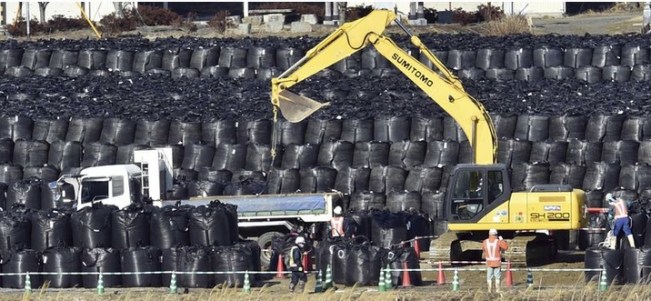
The Environment Ministry has compiled its first project schedule for the interim storage of soil and other matter contaminated by the 2011 disaster at the Fukushima No. 1 nuclear power plant, sources said.
The ministry estimates that by fiscal 2020, it will have acquired between 640 and 1,150 hectares of land, which could store 5 million to 12.5 million cubic meters of contaminated soil.
This is the first concrete schedule the government has created. It is expected to be presented to local government officials at a Sunday meeting in Fukushima Prefecture .
.
If things go as planned, the government would acquire 40 percent to 70 percent of the land expected to be needed, which could store from 20 percent to slightly over 50 percent of the contaminated soil. However, it is unclear whether things will proceed as planned.
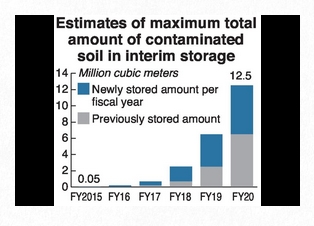
There is currently estimated to be about 10 million cubic meters of contaminated soil in Fukushima Prefecture, which could eventually rise to 22 million cubic meters.
The national government wants to purchase about 1,600 hectares straddling the municipalities of Okuma and Futaba in the prefecture as an interim storage facility.
However, as of the end of February only 18.5 hectares, or about 1 percent of the land, had been acquired.
Still, about 960 of the 2,365 landowners have given approval for the government to conduct surveys to estimate compensation. A ministry official said, “The pace of purchases is expected to pick up.”
If between 100 and 460 hectares are acquired every year starting in fiscal 2016, the ministry’s estimate of 640 to 1,150 hectares would be reached by the end of fiscal 2020.
As land is acquired, more contaminated soil can be brought to the interim storage facility.
The ministry estimates that if 2 million to 6 million cubic meters are brought to the facility in fiscal 2020, that would bring the total amount to 5 million to 12.5 million cubic meters by the end of that fiscal year,
http://www.the-japan-news.com/news/article/0002835558

These Fukushima residents are determined to reclaim their land from nuclear radiation

By G. Sundarrajan
Two years ago, when I visited Fukushima as part of a Greenpeace team, what deeply impressed me about the local residents was their resilience. They were ordinary citizens of a town devastated by a nuclear disaster, yet the bond they shared with their soil ran so deeply that they kept hoping to go back to Fukushima.
It was at once their dream and their challenge. They couldn’t stop talking about how good and simple life was back in Fukushima till the disaster struck. I was amazed by the fact that they wanted to go back to their homes though they knew the town would not be as they had left it.
It was from such a deep bond, from that sense of love, that the will to fight against nuclear energy emerged. “We are the lessons you need to learn” most of them told me.
It was the same kind of love, and bond, that I found in them when three survivors of Fukushima visited Chennai on March 23. Running around with them in Chennai I realized they still carry their love for their land and have now found ways to reconnect. Even if it means doing what is prohibited and what could endanger their lives.

For 62-year-old Masami Yoshizawa, it is about rearing 300-odd cows that are under a government kill order. As the manager of Ranch of Hope, Yoshizawa decided to defy government orders and rear the cattle so they ‘would be a living testimony to what Fukushima had undergone.’ The kill order was issued because after the radioactive contamination, the livestock was not a commercial success.
But rearing them in a no-entry zone, Yoshizawa feels the sight and sound of the cattle offers a ray of hope to an otherwise devastated land. “The government wants to kill them because it wants to erase what happened here, and lure Japan back to its pre-accident nuclear status quo. I am not going to let them,” he says.

The farm was started by his father four decades ago and Yoshizawa wouldn’t give it up easily – something that is in the residents of Fukushima. “I live 14 kms away from where the accident took place. There were four explosions on four days. I could have left like many of my neighbours. At least 80 people committed suicide in my town because they didn’t want to leave Fukushima. But I have decided to be a living lesson for the rest of my life” he says.
It is exactly the same emotion that guided 28-year-old Mizuho Sugeno to come back to Fukushima and resume her organic farming. Sugeno had just completed her studies and was practicing organic farming for about a year when the disaster struck.
“I lived 47 kms away from the power plant and evacuated for about a week. I came back and founded Seeds of hope. What else could I do?” she asks.

Besides distributing Sugeno’s organic produce, Seeds of Hope demonstrates successful methods to prevent crops from absorbing radiation. “Farms were abandoned and people were left behind. I was advised not to go back to Fukushima but I didn’t just come back. I began planting seeds. I felt the power of the soil could be restored by planting seeds.”
But deep down Sugeno had her own misgivings. She was not sure if it would really be possible to continue with agriculture.
“I spent a lot of time on it and finally found out that there was scientific proof (as well as measures and methods to take) about no soil-to-plant transfer of radio cesium in soil that has been cultivated organically over a long period of time. I was able to reduce the radiation level detected in crops down to a reading that falls below the minimum capability of the sensor,” Sugeno says.
She began to get certain results and ship crops with no radioactive contamination.
“This was our land and it was from here that we had reared cattle and cultivated fruits for several years. Now we are doing it as a form of protest. Our strawberry rice cake – a delicacy you will find only in Fukushima – has become a symbol of protest. Even now we are looked at with disbelief outside Fukushima. But again, like they say, we shall overcome”
Sugeno gets a complete body check-up once every six months, “just to be on the safer side”. For the moment, it is important that she is in good health to make Fukushima heard everywhere. “After all, we are the lessons you still need to learn,” she says again, with that wry smile.
G. Sundarrajan is an environmental and anti-nuclear activist and is a volunteer with Poovulagin Nanbargal.
“City” of Waste: Fukushima Cleanup Now Up to 10.7 Million 1-ton Bags of Radioactive Waste
By Matt Agorist
The fifth anniversary of the Fukushima disaster was on Friday, March 11. Since that fateful day in 2011, the Japanese government and the United States have continued to deny the lingering effects of this catastrophic event.
An estimated $21 billion has been spent on cleanup efforts since 2011, including funding for a team of remote activated robots capable of going to high-dose radiation areas of the plant where humans cannot enter and survive.
However, it has now emerged that at least five of these robots have been lost to the dangers that lurk in Fukushima Daiichi’s severely damaged nuclear reactors and waste treatment buildings.
Authorities in Japan want locals to think “nothing happened,” documentary director Jeffrey Jousan told RT.
“The government prints the number of people who died as a result of the 2011 disaster in the newspapers every day. [In some other prefectures], the [death toll] amounts to 300-400 people in each prefecture, but in Fukushima it is over 8,000 people,” Jousan, a US director and producer who has been living and working in Japan since 1990, said.
“It is very telling about the situation in Fukushima. It is hard for everyone who is affected by the tsunami, who lost their homes and lost their families. But [in Fukushima], people are not able to go back home, they are unable to work because people won’t buy food from Fukushima, farmers cannot farm anymore. It is affecting people, and more people are dying because of that.
According to the Fukushima prefectural government, Japan Ministry of Internal Affairs, the Tokyo Electric Power Co., the Nuclear Regulation Authority, the Federation of Electric Power Companies and the Woods Hole Oceanographic Institution, the numbers associated with this disaster are staggering.
- 164,865: Fukushima residents who fled their homes after the disaster.
- 97,320: Number who still haven’t returned.
- 49: Municipalities in Fukushima that have completed decontamination work.
- 45: Number that have not.
- 30: Percent of electricity generated by nuclear power before the disaster.
- 1.7: Percent of electricity generated by nuclear power after the disaster.
- 3: Reactors currently online, out of 43 now workable.
- 54: Reactors with safety permits before the disaster.
- 53: Percent of the 1,017 Japanese in a March 5-6 Mainichi Shimbun newspaper survey who opposed restarting nuclear power plants.
- 30: Percent who supported restarts. The remaining 17 percent were undecided.
- 760,000: Metric tons of contaminated water currently stored at the Fukushima nuclear plant.
- 1,000: Tanks at the plant storing radioactive water after treatment.
- 7,000: Workers decommissioning the Fukushima plant.
- 26,000: Laborers on decontamination work offsite.
- 200: Becquerels of radioactive cesium per cubic meter (264 gallons) in seawater immediately off the plant in 2015.
- 50 million: Becquerels of cesium per cubic meter in the same water in 2011.
- 7,400: Maximum number of becquerels of cesium per cubic meter allowed in drinking water by the U.S. Environmental Protection Agency.
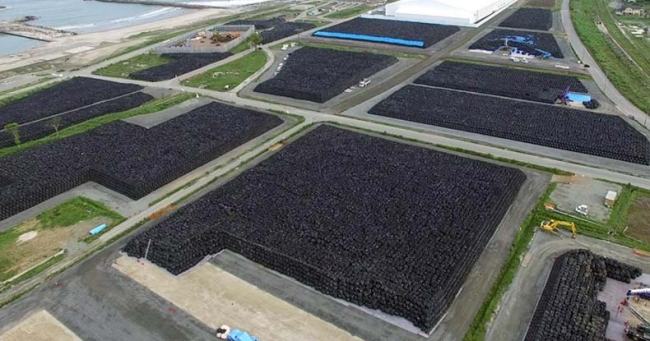
But perhaps the most staggering number of all of these statistics is the fact that the waste is being temporarily stored right next to the waterfront in a Wall-E style. The visual representation of the failure of this nuclear power plant is shocking.
Along the shore at the temporary storage site at Tomioka are 10.7 million 1-ton container bags containing radioactive debris and other waste collected in decontamination outside the plant.
Last year, a drone was flown over the ever-expanding city of waste. After watching the video, we know how ridiculous the government’s claims are that ‘we have nothing to worry about.’
650Bq/Kg of I-131 still measured from sewage sludge of Fukushima
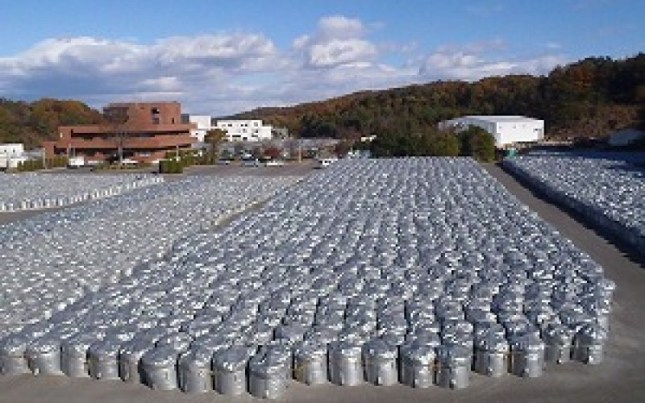
Radioactive sewage sludge storaged at sewage plant. Posted by Fukushima prefectural government.
This proves for the xth time that something is still fissioning at Fukushima Daiichi, releasing unstoppingly Iodine 131, and that ongoing since 311…..And never mind the theory that it would come from some medical iodine, if it would be the case certainly it would then measure at a much lesser level….
High level of I-131 was measured for 11 days this January in dry sewage sludge, Fukushima prefectural government announced on 2/26/2016.
According to the prefectural government, the sewage plant is in Da-te District of Fukushima prefecture.
The highest density was 648.1 Bq/Kg. It was continuously detected from 1/21 to 1/31/2016. The data of February has not been published yet.
Along with I-131, Cs-134/137 density also increase and became the highest, which was 111 Bq/Kg on the same day when I-131 density became the highest.
Both of the highest densities were detected about 1 week after the rain (57.0 mm) to strongly implies the possibility that the discharged radioactive material is carried by the wind and fall with rain.
http://www.pref.fukushima.lg.jp/uploaded/attachment/153121.pdf
650Bq/Kg of I-131 still measured from sewage sludge of Fukushima
Tepco executives get a taste of citizens’ wrath

Three Tokyo Electric Power Co. executives are now facing criminal prosecution for negligence in failing to anticipate a monster tsunami that cut off electricity and inundated back-up emergency generators, causing a cessation of cooling in the Fukushima No. 1 nuclear plant reactors that precipitated three meltdowns in March 2011. How were they to know?
At the time, Tepco kept insisting that the 15-meter-high tsunami was sōteigai (inconceivable), an act of nature that absolved them of all responsibility. And, just in case the public was not buying this grand shirk, malicious rumors disingenuously scapegoated Prime Minister Naoto Kan, in a failed attempt to shift blame to him. Subsequently, Kan has been vindicated while Tepco remains guilty in the court of public opinion.
In mid-2012, Tepco released the results of its own investigation into the nuclear accident and, with unseemly chutzpah, absolved itself of all responsibility. It was so embarrassing in its exculpatory excesses, and thoroughly contradicted by all three of the other major investigations into the Fukushima debacle, that Tepco disavowed this whitewash in October 2012, conceding allegations of numerous failures; this mea culpa was at the insistence of a panel of international experts hired by the utility.
The court case will focus on what could have been done that Tepco knew about to better manage the risks inherent in the operation of nuclear reactors in a seismically active area with a history of devastating tsunami. As much as Tepco would like to paint this as a “black swan” once-in-a-thousand-year event — something of such low probability of occurrence that it would be a costly fool’s game to prepare for it — Tohoku’s tsunami coast was fairly recently battered in 1896 (8.5 magnitude with waves reaching 38.2 meters) and in 1933 (magnitude 8.4 with waves cresting at 28.7 meters). So it would seem that anyone operating a nuclear reactor on that coastline would have looked into the seismicity of the area and prepared accordingly.
In fact, Tepco did so in 2009 when it conducted in-house computer simulations suggesting the possibility of a 15.7-meter tsunami slamming the site of the Fukushima No. 1 nuclear plant. That information was actually provided to the Nuclear and Industrial Safety Agency (NISA) four days prior to the Great East Japan Earthquake, meaning that it was information considered vital enough to submit to the watchdog agency.
Interestingly, in February 2011 the Fukushima reactors were granted an extension to their 40-year operating license, passing a NISA safety review. But NISA was sharply critical of Tepco and called for the urgent replacement and relocation of backup diesel generators that had stress cracks and were located below, and between, the reactors and the ocean, leaving them vulnerable to inundation. In addition, NISA scolded Tepco for its lax safety practices, a clear reference to the 2002 scandal when a whistleblower revealed that the utility had falsified the repair and maintenance records for all of its nuclear reactors.
NISA, as part of the Ministry of Economy, Trade and Industry, was implicated in the attempted cover-up of that scandal and stands accused of regulatory capture, meaning it was co-opted by the utilities — a watchdog with neither bark nor bite. By not conducting rigorous oversight to ensure safety, NISA is thus also complicit in Tepco’s lack of a culture of safety, pinpointed by three major investigations as a cause of what they declared was a man-made nuclear accident.
Thus one wonders why no bureaucrats are being prosecuted. Haruki Madarame, then chairman of the Nuclear Safety Commission, testified in the Diet on Feb. 15, 2012: “Though global safety standards kept on improving, we wasted our time coming up with excuses for why Japan didn’t need to bother meeting them.” He also pointed out that back in the early 1990s, Tepco was told about the risk of a station blackout that might lead to reactor meltdowns and was urged to develop a defense in depth, meaning more backup electricity sources just in case. Tepco stonewalled safety regulators, asserting that the current systems were adequate.
So the nuclear accident at Fukushima was precipitated by natural disaster, but poor risk management and institutionalized complacency about risk were major factors increasing the likelihood of an accident and fumbling crisis response. The myth of 100-percent safety propagated by the “nuclear village” of atomic energy advocates made it taboo to question safety standards and militated against sober risk assessment and robust disaster emergency preparedness.
Not everyone was surprised by the nuclear disaster. In 1975, nuclear chemist Jinzaburo Takagi and others established the Citizens’ Nuclear Information Center (CNIC), which ever since has issued regular reports on power plant safety issues. Fukushima was the nightmare scenario that CNIC had long been predicting. In a 1995 interview, Takagi spoke about the risks of a meltdown in the event of multiple failures, as happened in Fukushima in March 2011. He correctly warned about the possibility of large radioactive releases from a meltdown resulting from a breakdown in the emergency core cooling system and the failure of back-up diesel generators.
“It’s inexcusable that a nuclear accident couldn’t be managed because a major event such as the tsunami exceeded expectations,” said Yotaro Hatamura, chariman of the government’s Third Party Panel Investigation Committee, blasting Tepco’s hubris in 2012. He added that risk management means anticipating worst-case scenarios — not wishing risk away.
Hatamura pointed out that the utility was ill-prepared for the crisis, dismissing the possibility of a total loss of power, and that its workers made critical errors in shutting off automated emergency cooling systems and wrongly assumed part of the cooling system was working when it was not. These workers and their managers were inadequately trained to cope with an emergency situation and according to the panel, lacked basic knowledge concerning the emergency reactor cooling system. Their mishandling of emergency procedures contributed to the crisis.
Tepco chose to ignore centuries of geological evidence and failed to act on fresh and compelling evidence about tsunami risk, a blind spot that left the plant needlessly vulnerable. It also successfully lobbied the government’s Earthquake Research Committee on March 3, 2011, to soften a public advisory warning that a massive tsunami could hit the Tohoku coast because it might cause misunderstanding. This PR approach to risk management promoted an unjustified insouciance that cost Japan dearly. Alas, Tepco was also cutting corners, balking at the $1 billion price tag of building a higher seawall to cope with the higher tsunami projections — a bargain in retrospect.
While it is unlikely that the Tepco Three (former chairman Tsunehisa Katsumata and two former vice presidents, Sakae Muto and Ichiro Takekuro) will be convicted for irresponsibly minimizing risk in ways that endangered local residents or for cutting costs that compromised public safety, the trial will make the nuclear village squirm as the public revisits the folly of wishing risk away — and understands it is happening all over again.
Fukushima’s invisible victims
By
It’s been a while since we last discussed the Fukushima Daiichi triple meltdown. That is not for lack of issues; it is primarily for lack of any meaningful progress in the ongoingdisaster.
We have just passed the fifth observance of the first catastrophic day, March 11, 2011 and pretty much all of nuclear safety expert Arnie Gundersen’s grim predictions of what we would learn in the aftermath have come to pass.
What Arnie could not have predicted iin 2011 is how unwilling both TEPCO and Japan’s government officials have been to learn from this disaster, and how persistent the effort would be to suppress important radiological and epidemiological information.
Without accountability, deaths of citizens who lived near the doomed reactors following the triple meltdown have simply been attributed to the stress of evacuation, and supposedly no one has been harmed by radiation. In an unbelievable extrapolation of a convenient myth, there has been a major government effort, supported by the atomic power industry, to increase allowable levels of radiation exposure and dismiss the need for future costly evacuations as harmful and unnecessary.
It was only a little over a week ago, that anyone in an official position at TEPCO was finally held accountable under the law. I find it unbelievable that only three individuals can be held responsible for the cascade of unaddressed design flaws, corruption, lax regulation, human error and human arrogance that all contributed to making a bad situation much, much worse.
Now we are learning of an even more egregious breach of the public trust and social justice at Fukushima.
Individuals who have exhibited symptoms of radiation poisoning and other illnesses are apparently being shunned by some of their neighbors and dismissed by the medical establishment without appropriate care and without acknowledgment in their medical records.
This mistreatment specific to radiation victims is apparently not without precedent in Japanese history.
On his current speaking tour of Japan, Arnie Gundersen has had the privilege of speaking with a small group of survivors of the 1945 bombing at Hiroshima who share a unique perspective on what may lie ahead for the people of Fukushima
Hiroshima survivor, Tomiko Matsumoto, 85, recalls being a schoolgirl following that inhuman bombing. Of the 80 students at her school, only thirty survived the blast. Tomiko could be said to have been one of the “lucky” ones, but mere survival is a pretty poor kind of ‘luck.’
Still traumatized by the mental and physical horrors of the blast experience, she recalls that there was no proper care provided for the injured who were regarded with suspicion and hostility by their neighbors and callous indifference or unfeeling curiosity by their occupiers, upon whom they depended for any care that they could get.
The discrimination must have been the hardest for a young girl with no surviving family to bear:
“I was shocked because I was discriminated against by Hiroshima people. We lived together in the same place and Hiroshima people know what happened but they discriminated against each other. ..I was shocked.”
“There were so many different kinds of discrimination. People said that girls who survived the bomb shouldn’t get married. Also they refused to hire the survivors, not only because of the scars, but because they were so weak. Survivors did not have 100 percent energy.”
“There was a survivor’s certificate and medical treatment was free. But the other people were jealous. Jealous people, mentally discriminated. So, I didn’t want to show the health book sometimes, so I paid. Some of the people, even though they had the health book, were afraid of discrimination, so they didn’t even apply for the health book. They thought discrimination was worse than paying for health care.”
The mistreatment and insensitivity experienced by survivors continued into Tomiko’s adulthood. She was the victim of employment discrimination and personal shame.
Though she was lucky enough to bear children, both of her daughters are sterile and one suffers from anemia. Doctors have dismissed the possibility that the family’s health issues might be linked to her exposure to radiation from the atomic bomb blast.
It may be precisely because of their uniquely traumatic history of nuclear attack that modern Japanese society is ill-prepared to challenge the current meme being promoted by TEPCO and the Abe government, that no one was harmed by the triple meltdown at Fukushima and there is no cause for concern about using atomic power as an energy source.
Having emerged from beneath the cloud of WWII, they want to view themselves under the lens of success and progress, not to revisit the shameful legacy of nuclear radiation sickness that they had hoped to leave behind.
Sadly, neither TEPCO nor the Abe government and functionaries right down to the regional level can be trusted to reveal the truth about radiation from Fukushima Daiichi and how it’s shadow has now been irreversibly cast over the Prefecture, marring the future of Japan.
So survivors of Fukushima, like those of Hiroshima before them are left to face unfolding health issues and despair in the friendless vacuum of their own thoughts and care.
(I am pleased to be a non-technical member of the Fairewinds Energy Education crew, but my posts on GMD are mine alone and do not necessarily reflect the views of Fairewinds.)
TEPCO says 5.3 tons of tainted water leaked at nuclear plant
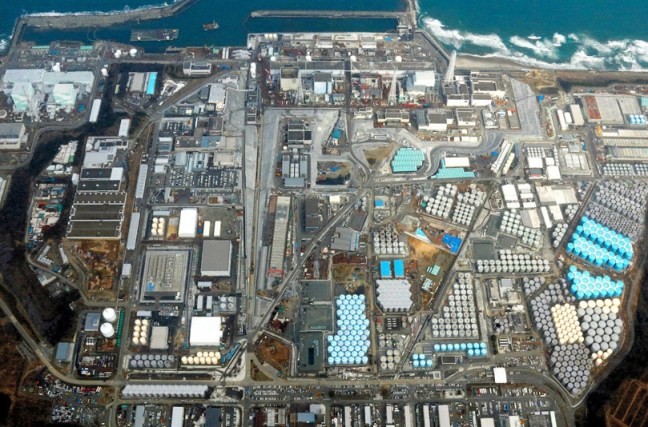
An estimated 5.3 tons of water contaminated with radiation leaked from a pipe in a building housing cesium removal equipment at the stricken Fukushima No. 1 nuclear power plant, the facility’s operator said.
The leaked water contained 383,000 becquerels of radioactive cesium per liter and 480,000 becquerels of beta ray-emitting radioactive substances per liter.
Tokyo Electric Power Co. said March 23 the water has not flowed outside the high temperature incinerator building. TEPCO said it was in the process of pumping up the water for storage.
The utility said workers doing remodeling work earlier in the day cut off a pipe inside the incinerator building. When workers subsequently operated radioactive material removal equipment in another building, contaminated water leaked from the cut section of the pipe to the floor of the incinerator building.
TEPCO said it is trying to determine the cause of the incident, adding that workers had confirmed that they closed a valve before cutting off the pipe to prevent water leakage
http://ajw.asahi.com/article/0311disaster/fukushima/AJ201603240048
State ignored predictions 10 years before 3/11 tsunami, says seismologist
The March 2011 tsunami that crippled the Fukushima No. 1 nuclear power plant was foreshadowed almost 10 years earlier, but government interference meant the threat was not acted on, seismologist Kunihiko Shimazaki has said.
Shimazaki said a July 2002 prediction by the Headquarters for Earthquake Research Promotion stated an earthquake as big as one in 1896 that caused monster tsunami had a 20 percent chance of occurring somewhere near the Japan Trench within 30 years.
The trench lies in the Pacific and stretches off the Sanriku area in the Tohoku region to the Boso Peninsula off Chiba Prefecture.
The 1896 tsunami triggered by the temblor that struck off Sanriku killed some 22,000 people.
The prediction by the government panel covered areas including waters off Fukushima Prefecture, home to the Fukushima No. 1 plant, which suffered a triple reactor meltdown due to damage from the tsunami unleashed by the March 11, 2011, magnitude-9.0 earthquake that hit Fukushima and other parts in the Tohoku region.
“Compared with earthquakes that occur in active faults once in thousands of years, the probability (of 20 percent in 30 years) is surprisingly high and cannot be ignored,” Shimazaki, who played a central role in drawing up the long-term tsunami prediction and is now professor emeritus at the University of Tokyo, said.
However, he said that just before the release of a report on the prediction, the secretariat of the research headquarters added a paragraph stressing the uncertainty of the forecast.
“An official of the Cabinet Office responsible for anti-disaster measures insisted on having a different committee discuss long-term tsunami prediction,” he said. “This was something that had never happened before, and I felt pressure.” He added, “It was puzzling and frightening.”
Shimazaki said the Central Disaster Prevention Council (CDPC) of the Cabinet Office ended up making tsunami assumptions that were far removed from the prediction by the Headquarters for Earthquake Research Promotion.
The CDPC assumed that only the northern part of the Tohoku region would be hit by tsunami, based on the premise that a recurrence of the 1896 Sanriku earthquake would occur in the same place, explained Shimazaki.
Huge tsunami around the same location near the Japan Trench have occurred at intervals of hundreds of years, and only about 100 years have passed since the 1896 earthquake, he noted.
The CDPC, which is tasked with devising anti-disaster measures based on the government-affiliated research body’s long-term predictions, chose to focus on the low probability and turned its eyes away from waters off the southern part of the Tohoku region, including Fukushima and Ibaraki Prefecture, just south of Fukushima, Shimazaki said.
He admitted that it is difficult for seismologists to predict earthquakes and tsunami with perfect accuracy, saying that while temblors do take place repeatedly in the same area they occur in somewhat different locations.
But Shimazaki added, “We can make assumptions about the location, timing and size to some extent, within certain ranges.
“Such assumptions were made, but were not utilized for the Fukushima No. 1 plant,” he said.
Shimazaki, 70, has also served as chairman of the Coordinating Committee for Earthquake Prediction and acting chairman of the Nuclear Regulation Authority. At the NRA, he played a major role in the work to create the country’s stricter nuclear plant safety standards based on lessons from the Fukushima No. 1 disaster.
Last July, he appeared in court as a witness for plaintiffs suing the central government and Tepco over the nuclear disaster.
“A lot of people died in the quake and tsunami,” Shimazaki said. “I’m also responsible for failing to reduce the damage.”
Stressing that such a disaster that claimed so many lives must never be repeated, Shimazaki said, “We must find out why it happened, but the causes are not being pursued.”
“The mistakes will be repeated if nothing is done,” he said as he explained why he decided to speak in court.
He also said assumptions of tsunami occurring on the Sea of Japan side of the country, announced by a land ministry working group in 2014, were not sufficient.
“If a catastrophic disaster happens again, they might again claim that it was beyond their assumptions,” he said. “That can’t be permitted.”
Although five years have passed since the nuclear meltdowns, Shimazaki said he doubts anything has changed.
“I see lack of clarity and responsibility in committees of experts organized by the state,” he said.
“In the world of science, we can together look for facts and can reach agreement to a certain extent. That is not the case when the state is involved, and mistakes will be repeated if we are not aware of the difference.”
Science is used for decision-making by the state, but scientists do not challenge how this is done, he said.
“They have to say ‘no’ if they think something is wrong, but they are not doing this,” Shimazaki said, adding that the lack of clarity around responsibility remains in five years.
2,029,900,000 Bq of Cs-134/137 leaked as contaminated water in Fukushima plant
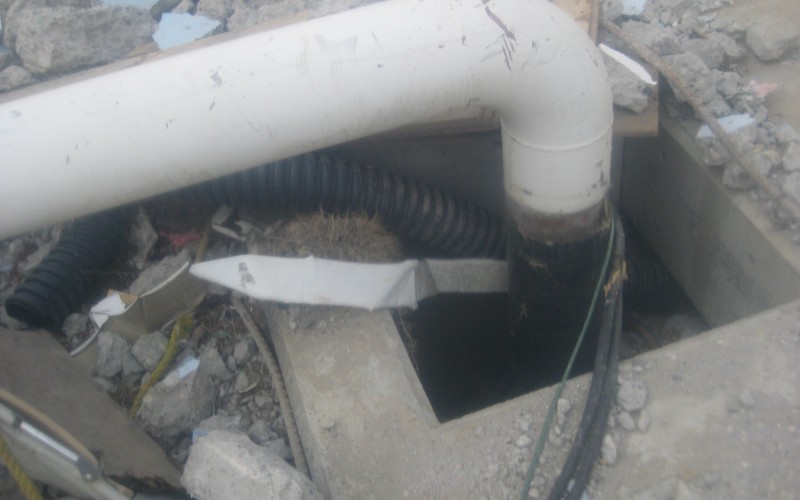
According to Tepco, a leakage detector of waste incineration building went off around noon of 3/23/2016.
Tepco reports the leaked volume was 5.3 t. The leaked contaminated water was from the cesium absorption facility to contain extremely high density of Cs-134/137.
From Tepco’s announcement, Cs-134/137 density was 383,000,000 Bq/m3.
All β nuclides to include Sr-90 was 480,000,000 Bq/m3.
At the moment of the press release, Tepco had not completed removing the leaked water but they state the building is designed to retain contaminated water inside.
The pipe from the cesium absorption facility was cut off due to a construction however somebody turned on the facility to cause the large leakage.
http://www.tepco.co.jp/cc/press/2016/1270693_7738.html
http://www.tepco.co.jp/cc/press/2016/1270654_7738.html
2,029,900,000 Bq of Cs-134/137 leaked as contaminated water in Fukushima plant
Incineration of radioactive waste begins at Fukushima nuclear plant
Tokyo Electric Power Co. (TEPCO) has begun incinerating radioactively contaminated clothing and other waste on the grounds of the disaster-hit Fukushima No. 1 Nuclear Power Plant in an effort to reduce the volume of waste.
A three-story incineration facility has been built on the north side of the plant grounds. Every day around 7,000 people work at the Fukushima plant, creating a massive amount of waste in the form of used radiation suits, gloves and boots. Pre-disaster incineration equipment was destroyed by the March 2011 Great East Japan Earthquake and tsunami, which led to the construction of the new facility.
As of the end of last year some 70,000 metric tons of this kind of waste was being held in storage containers. TEPCO estimates that by the year 2028, 358,000 tons of such waste will have been produced, but claims it can reduce the volume of the waste to as little as about one-fiftieth of its original size by incinerating it.
Radioactive materials contained in the smoke from the incinerator will be removed by filters on the exhaust pipes. The resulting ash will be sealed in specialized barrels, and TEPCO says there will be little danger from radioactive exposure.
However, in addition to the aforementioned waste there were, as of July last year, around 83,000 tons of lumber from trees cut down to make way for tanks storing contaminated water and 155,000 tons of other waste such as power plant debris from the hydrogen explosions that occurred there. These additional kinds of waste are expected to grow to 695,000 tons by 2028, and will not be processed at the incineration facility.
While TEPCO plans to construct facilities to burn this lumber and to break down debris in the future, these are not expected to all be operational until around fiscal 2020.
http://mainichi.jp/english/articles/20160321/p2a/00m/0na/004000c
TEPCO refuses to reimburse ¥20.1 billion in claims from Tohoku

Out of ¥53.1 billion in expenses incurred by six prefectures in the Tohoku region in response to the disaster at Tokyo Electric Power Co.’s Fukushima No. 1 nuclear power plant, TEPCO has still not agreed to reimburse ¥20.1 billion, The Yomiuri Shimbun has learned.
The prefectures have resorted or will resort to alternative dispute resolution (ADR) procedures to compel TEPCO to pay, but taxpayers may end up footing the bill in the end.
Different interpretations
Regarding compensation for damage caused by nuclear power plants, the government’s Dispute Reconciliation Committee for Nuclear Damage Compensation released preliminary guidance in August 2011 on what expenses TEPCO should reimburse local governments for.
This included the cost of damage to water and sewer services contaminated by radioactive material, and the cost of supporting victims on TEPCO’s behalf.

However, the guidance included a section stating that “depending on circumstances, additional expenses may be recognized as damage that should be reimbursed.” This spurred Fukushima Prefecture, where the nuclear power plant is located, and other prefectures to request compensation from TEPCO for various expenses incurred in responding to the disaster.
Fukushima Prefecture has so far demanded ¥37.1 billion from TEPCO.
The company paid ¥20.9 billion for expenses including the relocation of a prefectural high school and support for the reopening of small and medium-sized businesses, but has refused to pay for the salaries of prefectural government employees of the contamination response section established after the disaster. It has also refused to pay for such costs as ad campaigns intended to repair the image of the tourism industry, which has been damaged by the nuclear disaster.
Neighboring Yamagata Prefecture, which accepted a large number of evacuees from Fukushima Prefecture, had requested ¥1.1 billion as of last September. It has received reimbursement for such things as radiation inspections of agricultural and livestock products and the salaries of additional teachers in response to the influx of evacuated children, but this figure is less than one-third of the total request.
Miyagi Prefecture has only reached agreement on roughly ¥1.7 billion, about half of its request. Last March, Yamagata and Miyagi prefectures appealed to the nation’s Dispute Reconciliation Committee for Nuclear Damage Compensation for ADR. According to an official of Miyagi Prefecture, “the settlement will take some more time.”
Akita and Aomori prefectures have been denied 80 percent to 90 percent of their requests to cover expenses such as the production of ads to promote tourism and subsidies to purchase radiation measurement equipment. They have also applied for ADR, and Fukushima Prefecture intends to pursue this approach soon.
Iwate Prefecture has received an additional ¥256.7 million through ADR, but has not agreed on close to ¥900 million in other expenses yet.
The prefectural governments have made expenditures from their general budgets for the disaster response expenses, and explained to members of their assemblies that “expenses would be billed to TEPCO and offset as income at a later date.” However, as unsettled claims increase, the costs are becoming a burden on the prefectures.
Municipalities in the six Tohoku prefectures, as well as Chiba and Gunma prefectures and elsewhere outside Tohoku, have made similar compensation claims to TEPCO, but the two sides are far from agreement over payments.
A TEPCO spokesperson told The Yomiuri Shimbun: “We are processing and compensating claims for damage that meet the appraisal standards. For other expenses, we are making appropriate decisions as we consult with relevant parties about their circumstances.”
It is likely, however, that the different sides will fail to agree even through ADR.
The prefectures can fight on through civil lawsuits, but if they lose, both the legal expenses and disaster response expenses will have to be paid through taxpayer money
Here comes now Radioactive Organic!
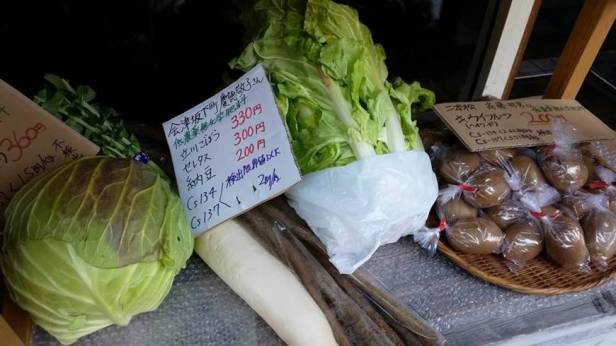
Close monitoring: At Orgando, a restaurant and mini-market in Tokyo, organic produce grown by Fukushima farmers is labeled with the amount of radioactive isotopes it contains to ease consumers fears. | © ORGANDO
Fukushima’s organic farmers still battle stigma
“All publicity is good publicity.” Nowhere does this specious PR maxim ring more hollow than in Fukushima Prefecture. As if the horrors of the 2011 Great East Japan Earthquake and the meltdown at the Fukushima No. 1 nuclear plant weren’t traumatic enough, the region’s economic and agricultural recovery has been severely hampered by the reputational damage it has suffered since 3/11. If you think that’s difficult, try farming organically in Fukushima.
Falling prices and an aging agrarian population have made things tough for farmers all over Japan, but the presence of the word “Fukushima” on a supermarket label is often enough to discourage shoppers from buying produce, organic or not, grown in the area. Regardless of how far from contaminated areas it was grown — Fukushima is Japan’s third-largest prefecture — the region’s produce can’t easily shake the stigma of radiation.
An important hub in the network of NGOs, government bodies and corporate benefactors trying to change the prefecture’s image has been Orgando, a cafe and mini-market in Tokyo’s Shimokitazawa neighborhood, run with the backing of the Fukushima Organic Agriculture Network. For the past three years, Orgando has built a devoted following by serving Tokyo residents the best of Fukushima’s seasonal organic produce, in particular the crops that Fukushima is perhaps most known for: peaches, apples and rice. The menu changes daily, making creative use of the ingredients that come in, and the walls are proudly decorated with profiles of the 30 or so farmers who have grown the food. Sadly, as with many post-3/11 schemes, Orgando was only guaranteed official financial support until the five-year post-disaster milestone and is set to close March 20.
Orgando has played a valuable role in forging links between local producers and urban consumers, and dispelling the idea that all the region’s produce is dangerously contaminated — fruit and vegetables sold in the store are clearly labeled to show the levels of cesium isotopes they contain. Official food-safety guidelines stipulate 100 becquerels of radioactive isotopes per kilogram as the acceptable limit for adults, with 50 becquerels/kg for dairy produce and infant food, and 10 becquerels/kg for drinking water. The daikon, carrots and strawberries on offer this week contain no detectable cesium, while, according to their labels, bags of beans contained 6 becquerels/kg, a negligible dose of radiation compared to our daily exposure from soil and cosmic rays.
Allaying fears about contamination was one of the themes discussed during a February event in Tokyo focused on the role organic agriculture could play in Fukushima’s recovery, organized by Ryo Suzuki of Japan Civil Network.
“People mistakenly think that everything from Fukushima is dangerous,” Norio Honda of Genki ni Narou Fukushima — an NPO promoting local revival — said at the event.
Setsuko Maeda, of agricultural collective Tanemaki Project Network agrees.
“Fukushima isn’t only about radiation,” she says. “Our farming and fisheries are full of vitality, and it’s important not to forget that.”
The event gathered representatives from organizations such as Oxfam Japan, A Seed Japan and travel agency JTB, to speak about the challenges facing organic producers in the prefecture, along with some of the major success stories. The atmosphere was convivial, and the presentations were interspersed with opportunities to sample Fukushima produce, including octopus, meat, potatoes, peaches and apple juice, and high-grade junmai sake made from local organic rice, fittingly named Kiseki or “miracle.”
Another major theme was bioremediation, the use of crops to cleanse contaminated soil of radioactive isotopes. One plant that has previously been used to reduce levels of cesium and strontium isotopes in soils around Chernobyl is rapeseed. The Green Oil Project aims to re-create these results in the Futaba district around the Fukushima No. 1 nuclear plant. Water-soluble cesium isotopes are sequestered in the plant’s tissues, which are fermented to produce biogas methane. The canola oil extracted from the seeds has a cesium content below the detectable limit of 0.03 becquerels/kg. To promote the initiative, local high school students created Yuna-chan, a cute mascot whose name combines the kanji for oil and rapeseed to market the organic oil. U.K. cosmetics company Lush, a keen supporter of organic produce, has also agreed to take a portion of the oil for use in its beauty products.
Ultimately, though, human connections were seen as most crucial to giving Fukushima produce the audience it deserves, and to generating an interest in farming among young people.
“It’s about exchange,” says Akihiro Asami, secretary general of the Fukushima Organic Agriculture Network. “Producers can come to Tokyo, but I want consumers to visit Fukushima, and not just meet selected farmers but ordinary residents, too. If they sample rural life there, they’ll want to get more involved to support those communities.”
Event-organizer Suzuki is positive about what the future holds: “By 2020, I really think the knowledge accumulated through the activities of farmers and NPOs in Fukushima will be ready to benefit sustainability and rural development not just in Japan, but around the world.”
-
Archives
- October 2026 (120)
- September 2026 (339)
- August 2026 (330)
- July 2026 (355)
- June 2026 (287)
- May 2026 (306)
- April 2026 (356)
- March 2026 (251)
- February 2026 (267)
- January 2026 (308)
- December 2025 (358)
- November 2025 (359)
-
Categories
- 1
- 1 NUCLEAR ISSUES
- business and costs
- climate change
- culture and arts
- ENERGY
- environment
- health
- history
- indigenous issues
- Legal
- marketing of nuclear
- media
- opposition to nuclear
- PERSONAL STORIES
- politics
- politics international
- Religion and ethics
- safety
- secrets,lies and civil liberties
- spinbuster
- technology
- Uranium
- wastes
- weapons and war
- Women
- 2 WORLD
- ACTION
- AFRICA
- Atrocities
- AUSTRALIA
- Christina's notes
- Christina's themes
- culture and arts
- Events
- Fuk 2022
- Fuk 2023
- Fukushima 2017
- Fukushima 2018
- fukushima 2019
- Fukushima 2020
- Fukushima 2021
- general
- global warming
- Humour (God we need it)
- Nuclear
- RARE EARTHS
- Reference
- resources – print
- Resources -audiovicual
- Weekly Newsletter
- World
- World Nuclear
- YouTube
-
RSS
Entries RSS
Comments RSS

