Autoradiograph: radioactivity after the 3/11 quake
By Masamichi Kagaya (Photographer) and Dr. Satoshi Mori (University of Tokyo)
As a consequence of the Great East Japan Earthquake and ensuing tsunami on March 11, 2011, the cores of the first to third nuclear reactors at the Fukushima Daiichi Nuclear Plant underwent meltdowns as external power for the cooling pumps was lost. As a result, a huge amount of radioactive particles was released into the air. These particles were carried by southeasterly winds to Iitate Village, Fukushima City, and Nakadori, a central region of Fukushima Prefecture, leaving high levels of radioactive contamination in their wake. The particles were further carried along multiple routes creating radioactively contaminated areas in regions from Ibaraki to Tokyo and Kanagawa Prefecture, as well as in Northern Kanto and the Tohoku Region (Northeastern Japan).
Whether we are in Tokyo, Fukushima, or even in front of the damaged nuclear reactor buildings, we are exposed to radiation that we are unaware of. It is too small to see, it cannot be heard and it is odorless. Therefore, despite living in a region contaminated with radioactive particles, to this day, we are not consciously aware of the radiation. NaI (TI) scintillation detectors and germanium semiconductor detectors are used to measure the amount of radioactive contamination in soil, food, and water in units called Becquerels (Bq). Radioactivity is further measured in Sieverts (Sv), which is an index of the effects of radioactive levels in the air, doses of exposure, and so on. Nevertheless, from such values, it is impossible to know how the radioactive particles are distributed or where they are concentrating in our cities, lakes, forests, and in living creatures. These values do not enable us to “see” the radioactivity. Thus, radioactive contamination has to be perceived visibly, something that can be done with the cooperation of Satoshi Mori, Professor emeritus at Tokyo University. Professor Mori is using autoradiography to make radioactive contamination visible.
Today, dozens of radiographic images of plants created by Professor emeritus Mori since 2011 are on display together with radiographic images of everyday items and animals. This collection of radiographic images (autoradiographs) is the first in history to be created for objects exposed to radiation resulting from a nuclear accident. I hope that visitors will come away with a sense of the extent of contamination in all regions subject to the fallout — not just those in and around Fukushima. At the same time, I hope that this exhibition will remind visitors of the large region extending from the Fukushima Daiichi Nuclear Power Plant to Namie Town, Iitate Village and the dense forests of the Abukuma Mountain Area that, to this day, remain restricted areas. The radiation affects animals that continue to live in these areas and be exposed to heavy radiation, as well as the 140,000 people that had to evacuate and who lost personal assets (homes, property, work, interpersonal relationships). These people are in addition to the victims who directly breathed in the radioactive materials, subjecting them to internal exposure — victims that include anyone from the residents near the plant to people in Tokyo and the Kanto Region.
Although what can be done is limited, new progress has made it possible to record the otherwise invisible radioactivity and make it visible. The history of needless nuclear accidents occurring in the United States, the Soviet Union (Russia) and Japan over the last several decades may still potentially be repeated elsewhere in the world, but hopefully future generations will see the cycle be broken. Through exhibitions and other means of disseminating knowledge about radioactivity, future generations may learn to leave behind dependence on nuclear power and be free from the dangers of nuclear accidents and nuclear waste.
http://www.chinapost.com.tw/asia/japan/2016/04/10/463030/Autoradiograph-radioactivity.htm
Massive amounts of radiation continue daily to enter Japan’s water and air, and the Pacific Ocean
Nuclear engineer Arnie Gundersen on Fukushima@5, Mar 7, 2016 (emphasis added): Massive amounts of radiation continue to enter Japan’s water and air, and the Pacific Ocean, daily… Due to its triple meltdowns and the unmitigable radioactive releases, Fukushima Daiichi will continue to bleed radiation into the Pacific Ocean for more than a century… There is no road map to follow with directions to stop the ongoing debacle…
Nuclear engineer Arnie Gundersen on KPFA, Mar 30, 2016: [Univ. of California] Berkeley’s nuclear program has been in the forefront of the pro-nuclear propaganda for decades, and since Fukushima has been aggressively downplaying the significance of it. So, whatever comes out of Berkeley, I just attribute to a very pro-nuclear faculty… [Woods Hole Oceanographic Institution is] measuring 1,000 miles offshore [of the US West Coast] and… picking up 10 becquerels per cubic meter [Bq/m3]. At my point, that’s when my alarm bells go off is 10 [Bq/m3]… That plume is still coming, the Pacific is a huge place and to think that a disaster on the opposite side of the world can be detected and begin to contaminate California, I think that the monumental shattering conclusion [is] radiation knows no borders… So this ‘dilution is the solution to pollution’ is what I think Berkeley believes in. What you can be sure of is that somebody’s going to die from the radiation that’s in the Pacific, but you just won’t know who it is – and they’re counting on that. The nuclear establishment is saying, ‘Well, we can smear that out in a broader epidemiological study.’
Nuclear engineer Arnie Gundersen on CCTV, Apr 5, 2016: We’re looking at newspaper coverage from the last couple of weeks and it’s clear that the plant continues to hemorrhage.
Fairewinds Japan Speaking Tour Series No. 1, Feb 12, 2016:
- Nuclear engineer Arnie Gundersen: [T]he Fukushima power plants… continues to bleed into the Pacific every day. But what no one is paying any attention to is that the entire mountain range that runs 100 miles up and down this coast is also contaminated. And as much radiation is pouring out… into the Pacific from the mountain range because it’s so contaminated, as from the Fukushima site… in fact, they’ve got an entire state pouring radiation into the Pacific. So what’s in the Pacific? Off of California, they’re finding radiation at what I would consider significant levels… in a cubic meter of ocean water, they’re finding 10 radioactive decays every second… So a cubic meter of water, if you’re in a dark room, would have 10 flashes of light every second, and that’s going to go on for 300 years. So we have contaminated the biggest source of water on the planet, and there’s no way to stop it.
- Maggie Gundersen, founder of Fairewinds: So are you saying that the contaminated water problem is hopeless? Is there nothing we can do to slow it down?
- Arnie Gundersen: It used to be that scientists believed dilution is the solution to pollution. But I think we’re finding with the biggest body of water on the planet, that you can’t dilute this stuff. And we’re going to begin to see this bio-accumulation, which is all the fish that are in the ocean are going to uptake the cesium and the strontium and become more and more and more radioactive…
Radioactivity at buried tank up in Daiichi plant

The operator of the crippled Fukushima Daiichi nuclear plant says the level of radioactivity near one underground wastewater tank at the plant is more than 100 times earlier readings.
Tokyo Electric Power Company says the tanks were built 3 years ago to store highly radioactive wastewater produced within the crippled plant. But all of the tanks soon went out of use due to repeated leaks of contaminated water.
The utility pumped most of the water out of them, but has been checking radioactivity levels of groundwater near the tanks.
On Wednesday, equipment detected 8,100 becquerels of beta-ray-emitting radioactive substances per liter of water. On Thursday, it went up to 9,300 becquerels.
A week ago, the level was only 87 becquerels.
TEPCO says it doesn’t know why the sharp rise took place. It says some highly radioactive water remains in the tank, but it is isolated with waterproof measures.
TEPCO says it will continue to analyze groundwater samples around the tank, and also compare them with data on the contaminated water left in part of the tank.
http://www3.nhk.or.jp/nhkworld/en/news/20160408_03/
Very pertinent comments and photos from Ray Masalas regarding the said “buried tank”:
I see the Japanese media is once again lying to protect Tepco. These were not tanks. They were in ground pools with sloped sides that were dug on site, lined with thin poly and filled with highly radioactive water. {See pic below} With a lining as thick as 2 garbage bags they leaked into the ground fast. Whether they transfered these tons of radioactive water to steel tanks or not, I’ll leave up to you to believe or not believe. At the same time they were building enclosed concrete ditches running down the west hill to sea. From the flyover footage I’d guess that there were about a dozen of these pits up on the west hill.

Sept 013. One of the “tanks” they spoke of.
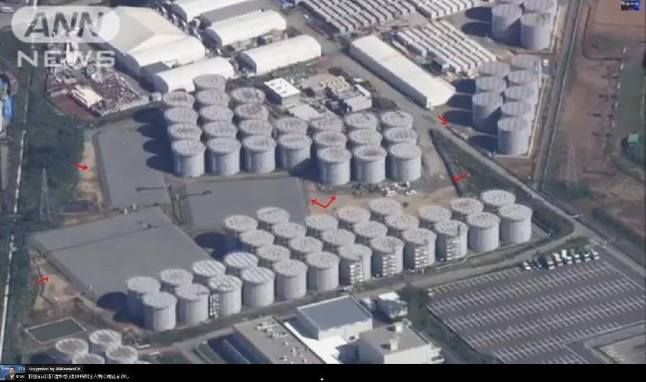
After they said that the transferred the radioactive water to steel tanks these empty pits magically got lids. My guess is that they dumped then refilled.

The enclosed concrete ditches running down to the sea were built at the same time. Dec 013
Freezing of soil near Fukushima plant going well, says TEPCO

Rainwater is discharged from newly constructed drainage outlets into the plant’s harbor during a media tour at the Fukushima No. 1 nuclear power plant on April 4.
The freezing of soil around the Fukushima No. 1 nuclear power plant to block the flow of groundwater is proceeding “largely smoothly,” the plant operator said April 4.
Tokyo Electric Power Co. started making a frozen underground wall in late March around the No. 1 to No. 4 reactors at the plant, which suffered a triple meltdown triggered by the March 2011 earthquake and tsunami.
The final part of the construction process to freeze the soil was unveiled to the media for the first time April 4 during a visit to the site by Yosuke Takagi, state minister of the economy.
To build the frozen soil wall to prevent groundwater flowing into the four reactor buildings and becoming contaminated with radioactive substances, the utility inserted 1,568 pipes to a depth of 30 meters and 1 meter apart.
The company is now circulating liquid with a temperature of minus 30 degrees through the pipes to first freeze the soil on the side of the sea so as not to drastically change the groundwater level at the plant.
As of April 4, the soil temperature had dropped to minus 4 to 6 degrees at some locations, according to TEPCO.
“While we need to keep making efforts to control the temperature deliberately, we can say that the project is proceeding largely smoothly so far,” the company spokesman said.
The utility also unveiled new drainage outlets for the K drainage channel to discharge water into the plant’s harbor and block it from being released into the outer ocean.
The construction of the new outlets was completed March 28. Radiation-contaminated rainwater coming through the K drainage channel had previously often flown into the outer ocean when it rained.
150 Fukushima No. 1 workers who got maximum radiation dose at start of crisis can now return to plant
Some 150 people who worked at the crippled Fukushima No. 1 nuclear power plant whose cumulative radiation dose exceeded 100 millisieverts will be able to return to the facility starting April 1.
By law, nuclear plant operators are required to record and manage the radiation exposure of each worker over a five-year term to ensure their dosage doesn’t exceed safe limits.
According to Tokyo Electric Power Co., 150 Tepco workers and 24 subcontractor workers who dealt with the meltdown disaster that occurred right after the March 11, 2011, earthquake and tsunami were exposed to radiation exceeding the limit. As of March 1, 129 of the Tepco employees were still working at the utility. They were moved to other divisions based on the government directive.
Since the five-year term for the workers ended in March, Tepco said it hopes experienced hands will return to engage in the decommissioning of the plant to contribute to safety at the site.
But Tepco said it will not push them to return and said those who wish to go back will be managed under a new exposure regime designed to limit a worker’s lifetime radiation dosage to 1,000 millisieverts in line with recommendations made by the International Commission on Radiological Protection.
Last year, the Ministry of Health, Labor and Welfare created the new regime, which requires nuclear plant operators to set individual limits for workers based on their age and past exposure to radiation.
‘Ice Wall’ Is Japan’s Last-Ditch Effort To Contain Fukushima Radiation
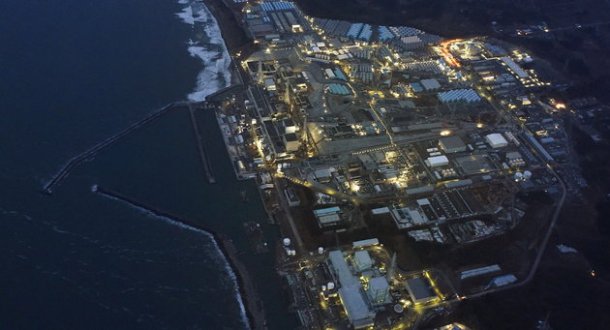
Tokyo Electric Power Co.’s (TEPCO) tsunami-crippled Fukushima Daiichi nuclear power plant is illuminated for decommissioning operation in the dusk in Okuma town, Fukushima prefecture, Japan, in this aerial view photo taken by Kyodo March 10, 2016, a day before the five-year anniversary of the March 11, 2011 earthquake and tsunami disaster.
• The nearly mile-long structure consists of underground pipes designed to form a frozen barrier around the crippled reactors.
• The $312 million system was completed last month, more than a year behind schedule.
• Nearly 800,000 tons of radioactive water are already being stored onsite.
Japanese authorities have activated a large subterranean “ice wall” in a desperate attempt to stop radiation that’s been leaking from the Fukushima Daiichi nuclear power plant for five years.
The wall consists of a series of underground refrigeration pipes meant to form a frozen soil barrier around the four reactors that were crippled during the 2011 Tohoku earthquake and tsunami.
Construction of the $312 million government-funded structure was completed last month, more than a year behind schedule, the Associated Press reports. The nearly mile-long barrier is intended to block groundwater from entering the facility and becoming contaminated.
Tokyo Electric Power Co., or TEPCO, which owns the plant, activated the system Thursday, a day after obtaining approval from Japan’s Nuclear Regulation Authority.
In a video detailing the ice wall’s design, TEPCO said the technology has been successfully used to prevent water intrusion during the construction of tunnels, but this is the first time it has been used to block water from entering a nuclear facility.
“We will create an impermeable barrier,” the company said, “by freezing the soil itself all the way down to the bedrock that exists below the plant. When groundwater flowing downhill reaches this frozen barrier it will flow around the reactor buildings, reaching the sea just as it always has, but without contacting the contaminated water within the reactor buildings.”
TEPCO says the ice wall will be activated in stages over the next several months and is one of several measures the company is taking to reduce the amount of water being contaminated on the site.
Nearly 800,000 tons of radioactive water are already being stored in more than 1,000 industrial tanks at the nuclear plant, according to the AP.
While hopes are high that the ice wall will prove successful in stopping additional radioactive water from seeping into the Pacific Ocean, Shunichi Tanaka, chairman of the Nuclear Regulation Authority, urged caution.
“It would be best to think that natural phenomena don’t work the way you would expect,” he told reporters Wednesday, according to the AP report.
The activation of the ice wall comes just weeks after a TEPCO official reported that robots designed to access the dangerous interior of the plant and seek out the melted fuel rods were “dying” from the high levels of radiation.
The video below details how the ice wall is expected to work.
Telling the Story of Fukushima
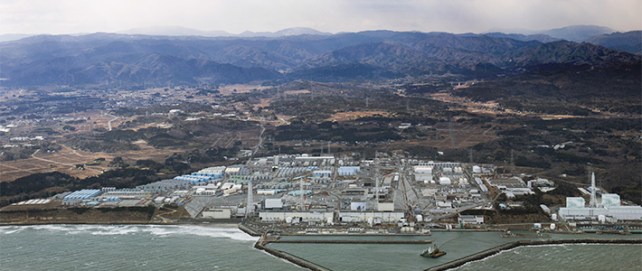
Different Approaches to Remembering 3/11 at the Prefecture’s Museums
Five years after the March 11 earthquake and tsunami touched off a triple meltdown at the Fukushima Daiichi nuclear power plant, the disaster is no longer just a current event—it is also a part of Japan’s history. But how should that history be told? Government and civil society groups have different answers, and they are starting to emerge in a battle of museums.
A Tale of Two Museums
In a flurry of caption writing and message tweaking, Fukushima prefectural government officials are currently putting the finishing touches on a major new exhibit about the disaster at the Fukushima Daiichi Nuclear Power Station. Starting this summer, the exhibit will be permanently displayed at the ¥20 billion Fukushima Prefectural Center for Environmental Creation in the town of Miharu. Plans are in the works to send every fifth-grade student in the prefecture on a field trip to view it. The goal, according to the organizers, is to “address the worries and concerns of Fukushima residents, further understanding of radiation and environmental problems, and deepen awareness of environmental recovery.”
Some 40 kilometers away, in a small post-and-beam hall in the city of Shirakawa, a group of local citizens are planning a very different kind of exhibit. Their displays focus on the ways in which the government exacerbated the disaster and disregarded the rights of Fukushima residents in its aftermath. They will be exhibited at the Nuclear Disaster Information Center, which was built in 2013 using ¥30 million yen in donations from the public, with the goal of ensuring Fukushima and its lessons are not forgotten.
These two projects represent divergent understandings of how the Fukushima nuclear disaster should be remembered. Given their vastly unequal resources and reach, they also raise questions about the appropriate role of government in memorializing the disaster that rocked Japan and the world five years ago.
“People who have suffered from the Fukushima disaster have doubts about whether a public facility like the Center for Environmental Creation can truly communicate the lessons of an accident for which the national and prefectural governments bear partial responsibility,” says Gotō Shinobu, an associate professor at Fukushima University, who is involved in planning the alternative exhibit in Shirakawa.
A Familiar Story
The quiet battle over historical interpretation that is playing out in Fukushima has a precedent in the seaside city of Minamata, Kumamoto Prefecture, the site of one of the most devastating industrial disasters in world history. Thousands of people living in the area were killed or severely sickened by mercury after Chisso Corporation dumped industrial waste from its chemical plant into the bay over the course of several decades, contaminating fish and shellfish and poisoning the people who ate them. Fifty years later, public and private museums in the area are still telling different versions of that history.
One version can be found at the Minamata Disease Municipal Museum, which was established in 1993 with the goal of “handing down the lessons and experiences of Minamata Disease,” according to its mission statement. Videos and panels in the ¥6 billion facility relate the history and science of the disaster, and victims are on hand to share their personal experiences. But Endō Kunio, a board member and employee of the nonprofit victims’ support organization Sōshisha, says the museum fails to communicate the disaster’s true lessons. “Simply lining up events does not equate to history,” he says. “The facts of what happened are there, but the museum doesn’t say much about their meaning.”
Since 1988, Sōshisha has run its own museum, which displays fishing gear, protest flags, and other artifacts in a converted mushroom-cultivation shed. Among its founding principles is the goal of recording the struggles of the victims and the culpability of government and industry. “Our starting point is the perspective that Minamata Disease resulted from criminal activities on the part of Chisso Corporation and the national government,” says Endō. That perspective has shaped the low-budget museum into a symbol of resistance against the sanitization of painful historical events.
Fukushima Fault Lines
The divide in Fukushima falls along similar lines. The exhibit at the prefectural center will include a timeline of events since the meltdowns, a “radiation lab” explaining the science of radiation and measures to reduce exposure, and a large display on efforts to increase renewable energy and sustainability in the prefecture, according to an overview released last year. Although the exhibit advocates for a “Fukushima that does not depend on nuclear power,” reporting by the Tokyo Shimbun has pointed out that its planning board included several members with close ties to the nuclear industry.
In 2014, shortly after planning began, a citizen’s group with antinuclear leanings called the Fukushima Action Project sent a letter to the prefectural authorities expressing concern over the exhibit. The group requested, among other things, that the center not minimize the health risks of radiation. Since then, FAP representatives have met eight times with prefectural officials to discuss the content of the exhibits. According to meeting transcripts posted on the group’s website, they expressed concerns this January that the exhibit still does not adequately address the severe and ongoing water pollution caused by the disaster or the huge amounts of radioactive waste generated by the cleanup.
Fukushima prefectural officials, meanwhile, note that the exhibit does not touch on government or industry culpability, the fact that radiation exposure limits were raised after the disaster, or the pollution and waste problems because “these issues are not pertinent to the goals of the exhibit.” The facility’s goal, they explain, is “supporting educational activities related to radiation and the environment”; in response to public concerns about the exhibit, they state only that the exhibit content was determined by a panel of experts.
Nagamine Takafumi, the director of the Nuclear Disaster Information Center, is also deeply skeptical about the public museum. “We believe the goal of the Fukushima Prefectural Center for Environmental Creation is to create a myth of radiation safety,” he said. He and his colleagues are currently planning two permanent exhibits for their center. One, designed by Fukushima University’s Gotō, will compare global teaching materials on nuclear power and highlight the Ministry of Education’s pronuclear bias before the disaster. The other will examine the failure of all but a few municipalities in Fukushima to distribute potassium iodide pills immediately after the accident, which would have lowered residents’ risk of developing thyroid cancer.
A Third Perspective
Another private, but less politically driven, museum operates from an outbuilding at an abandoned school in the village of Kawauchi, about 25 kilometers inland from the nuclear plant. Called the Kangaeru Shirōkan, which translates roughly to “a museum for feeling, thinking, and understanding,” the free facility displays protective bodysuits, radiation meters, photographs, town newsletters, and other artifacts of the meltdown.
The museum was founded in 2012 by Nishimaki Hiroshi, a local journalist who moved to the area from Saitama Prefecture nine years ago. He says that in the months following the disaster, he wanted to do something constructive, but felt immobilized by the scale and complexity of the meltdown’s aftermath. When novelist and longtime friend Taguchi Randy suggested he open a museum, he acted on the idea.
The displays include scant explanatory text, and Nishimaki is rarely on site to act as a guide. His says his goal is simply to present the reality as locals have experienced it so that it will not be forgotten. “The government does bear some responsibility for what happened, but I don’t think of the displays as a way to attack them,” he says. Still, he has avoided government funding in order to maintain complete freedom in what he exhibits.
An Inevitable but Unequal Divide
It is hardly surprising that views of environmental catastrophe differ in private and public museums. Government actors partially responsible for a disaster are unlikely to be objective in planning a museum to memorialize it, and civic organizations that include disaster victims are equally unlikely to put aside their own experiences when interpreting the same events. In the case of the Fukushima disaster, divergent views on nuclear power further shape the messages presented in museums.
Public and private projects of historical interpretation can in this sense complement one another. Yet there is little chance the majority of the public will be exposed to both perspectives. As Gotō points out, the budget of the public museum is over 600 times that of the private one he is involved with, and visits to the private museum are not a part of any official school curriculum.
Last year, national and local officials met to discuss another large, government-funded museum focused on the nuclear disaster, this one planned to open on the prefecture’s coast some time in the coming decade. Although they haven’t asked, Minamata’s Endō has a piece of advice for them.
“It is all-important that the story of what happened be told by the people who live in that place,” he says. “When government officials and civil society groups interpret for them, it becomes something different.”
Contaminated water, fuel extraction stand in way of decommissioning Fukushima plant
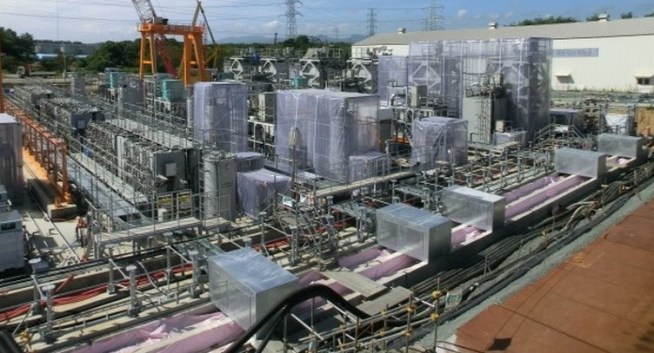
The Advanced Liquid Processing System (ALPS) is seen in September, 2012
With about five years having passed since the start of the Fukushima No. 1 Nuclear Power Plant disaster, nuclear workers still lack a method of treating the around 1,000 tanks of contaminated water stored on site, and the start of work to remove melted nuclear fuel from the plant remains at least five years away.
“Until the contaminated water issue is solved, decommissioning of the reactors remains far off. We have to stop the water,” says Tetsuo Ito, professor of nuclear energy safety engineering at the Kinki University Atomic Energy Research Institute. Akira Ono, chief of the Fukushima plant, says, “We’re still at step one” of the decommissioning process, which is estimated to take until 2041 to 2051.
Tokyo Electric Power Co. (TEPCO), the plant’s owner, is treating the contaminated water with its Advanced Liquid Processing System (ALPS), which can remove 62 varieties of radioactive material. However, ALPS cannot remove radioactive tritium, and because of this the treated water is stored in tanks. Tritium is extremely difficult to separate from water, because even if one of the hydrogen atoms in a water molecule is replaced by tritium, the chemical properties such as the boiling point barely change.
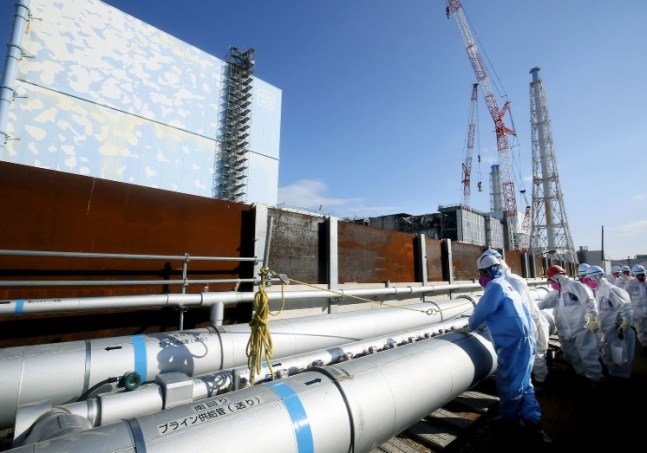
Pipes for an underground frozen wall to block contaminated water leakages are seen on the landward side of the Fukushima No. 1 Nuclear Power Plant, on Feb. 23, 2016.
The International Atomic Energy Agency (IAEA) has advised that tritium-containing water be released into the ocean, because its effect on the human body is very limited. Tritium-containing water is created even during the normal operation of a nuclear power plant, and it is released into the ocean in accordance with waste-disposal standards. However, there is local opposition to doing this at the Fukushima plant because of worries about its effects on the reputation of the local fishing industry, and no decision has been made on what to do with the water.
Tritium has a half-life of 12.3 years, so storing the water until the radiation naturally lessens is another option, but there is the risk of leaks during that time if the tanks’ conditions deteriorate.
As for decommissioning the plant reactors, at the end of 2011 the national government put together a roadmap that estimated the decommission work would take 30 to 40 years. To decommission the No. 1 through 3 reactors at the plant, 1,573 units of spent fuel will have to be removed from the spent fuel pools of these reactors, and 1,496 units’ worth of fuel that melted from the reactors will have to be removed. Safe removal of the melted fuel represents the largest problem.
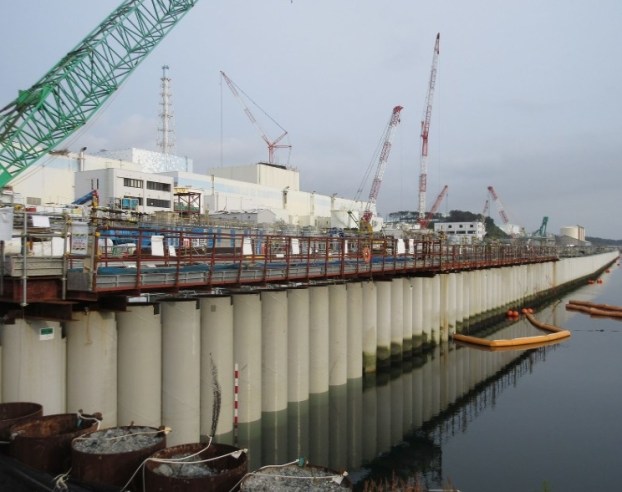
A wall constructed on the seaward side of the Fukushima No. 1 Nuclear Power Plant to prevent leakages is seen on Sept. 24, 2015.
The national government and TEPCO intend to decide on a plan for the fuel’s extraction in the first half of fiscal 2018, and start extraction efforts at one of the reactors within the year 2021. Toyoshi Fuketa, a member of the Nuclear Regulation Authority (NRA), argues that nuclear fuel that is too difficult to take out should be stored on-site, saying, “There is the option of just removing as much (of the melted fuel) as possible, and hardening the rest (to seal off its radiation).”
The cost for decommissioning the reactors is already estimated at 2 trillion yen, and this could grow if the decommissioning schedule is delayed.
While the No. 1 through 3 reactors at the plant were shut down at the time of the Great East Japan Earthquake on March 11, 2011, they lost all power due to the proceeding tsunami and, with no way to cool the nuclear reactors, they experienced a meltdown. The tsunami measured at up to 15.5 meters, and emergency underground power supplies were flooded and failed to function.
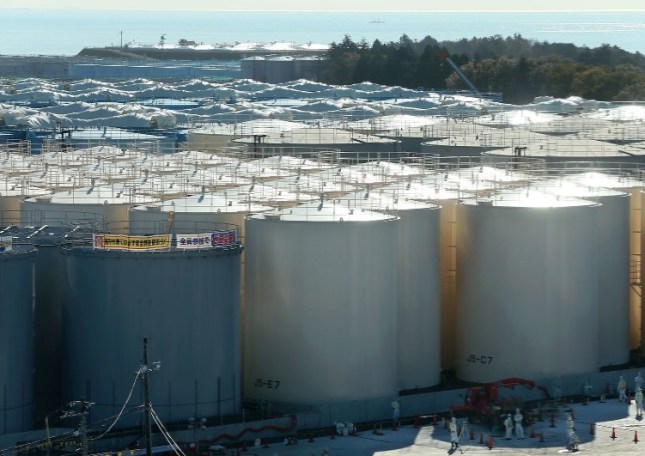
Tanks for holding contaminated water are seen on the grounds of the Fukushima No. 1 Nuclear Power Plant, on Nov. 5, 2015
The No. 1 reactor was equipped with a cooling system called Reactor Core Isolation Cooling (IC), but this didn’t activate, and on March 12 at 3:36 p.m. the No. 1 reactor suffered a hydrogen explosion. Then, on March 14 at 11:01 a.m. the No. 3 reactor also experienced a hydrogen explosion. The No. 4 reactor was already offline at the time of the disaster for a regular inspection, but hydrogen from the adjacent No. 3 reactor leaked in, and it suffered a hydrogen explosion as well at 6:14 a.m. on March 15. The No. 2 reactor was not hit by a hydrogen explosion, but among the No. 1 through 3 reactors it is thought to have leaked the most radiation. The disaster is rated a 7 on the International Nuclear Event Scale, the same as the Chernobyl disaster.
Masao Yoshida, the late chief of the Fukushima plant who headed up the frontline disaster-response efforts, testified to a government panel investigating the disaster, “We (who were on-site) imagined it as the destruction of eastern Japan. I really thought we were dead.”
Four reports on the disaster were put together, from the national government, the Diet, TEPCO and elsewhere in the private sector. They differ on points such as why the IC in the No. 1 reactor did not activate. The Diet probe raised the possibility that the IC system’s piping was damaged in the earthquake, but the national government’s investigative panel denied that earthquake damage was the cause. Due to the high radiation levels in the reactor buildings, there has not yet been an on-site investigation to better understand what happened.
http://mainichi.jp/english/articles/20160403/p2a/00m/0na/010000c
Fukushima Daiichi Contaminated Waste to Be Recycled into Construction Materials
Japan to Recycle Waste Collected during Fukushima Decontamination
TOKYO – The Japanese government announced Wednesday it will recycle the material collected during the decontamination of the Fukushima nuclear plant for construction purposes if radiation levels are found to be sufficiently low.
The government plans to store the waste collected from the radiation-affected region and use it as construction material in places outside the prefecture in northeastern Japan, within 30 years, reported state broadcaster NHK.
According to the country’s environment ministry, residue showing less than 8,000 becquerel per kg could be used in future to pave roads, build anti-tsunami walls and in other public works.
Over 90 percent of the material, accumulated since the 2011 disaster, could be re-used if the contaminated elements are removed, according to the authorities, who are, however, yet to develop the technology to separate waste with high radiation levels.
Currently, Fukushima authorities store the radioactive waste at two depots close to the plant, which can store up to 30 million tons.
The waste will remain at these storage sites for the next 30 years, to be later transferred to a definitive storage place, whose location remains to be determined, and to be used in public works if cleared of high radiation levels.
The Fukushima crisis has been the worst nuclear accident in history after the 1986 Chernobyl disaster in Ukraine.
The nuclear plant, which suffered a meltdown in the aftermath of the earthquake and subsequent tsunami that struck the country on March 11, 2011, is now being dismantled, a task that will take at least four decades to complete.
http://www.laht.com/article.asp?ArticleId=2408901&CategoryId=12395
Manga convey realities of living in Tohoku disaster areas
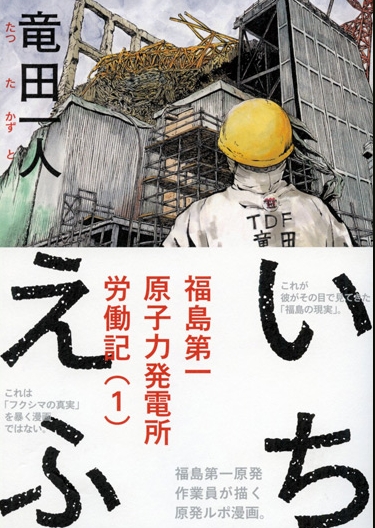
Although words of praise poured in for Kazuto Tatsuta’s manga about the Fukushima nuclear disaster, some comments said he was a spy for Tokyo Electric Power Co.
The artist, who went to great lengths to show the true situation around TEPCO’s Fukushima No. 1 nuclear plant, scoffed at the notion.
“As for nuclear power generation, I have never taken stances of ‘promotion,’ ‘opposition’ or ‘neutral.’ I just wanted to convey the changes of the place (at the nuclear plant) in real time,” he said.
His manga series, “Ichiefu Fukushima Daiichi Genshiryoku Hatsudensho Rodoki” (1F; Records of labor at Fukushima No. 1 nuclear power plant), was one of several that started after the triple disaster struck five years ago.
Some of them initially offered messages of encouragement to the disaster victims. But they gradually changed to depict the realities of the situation in the northeastern Tohoku region and the disaster victims’ extraordinary experiences.
Tatsuta’s series, carried in the weekly magazine Morning, was based around the sites of demolition work at the nuclear plant.
He was working at a company of an acquaintance near Tokyo when the Great East Japan Earthquake struck on March 11, 2011. Tatsuta looked for a job in areas affected by the disaster, and ended up working at a rest station of the nuclear plant as an employee of the sixth-layer subcontractor in June 2012.
In 2013, Tatsuta started “Ichiefu” to show the daily lives of workers at the plant.
His work drew much attention and acclaim. But some said the artist was underestimating the dangers of nuclear power generation. The series ended in October 2015.
Yoko Hano depicted the daily post-disaster lives of a different group–senior high school students in Fukushima Prefecture.
She started the serialized manga “Hajimari no Haru” (Spring as a beginning) because she also wanted to convey the truth. The comic is currently carried under the title of “Happy End?” in the Monthly Afternoon magazine.
Hano, who is from Nishigo in Fukushima Prefecture, now lives in Shirakawa, also in the prefecture.
“From the time immediately after the outbreak of the disaster, I saw false information from the media that was slipshod in confirming facts,” she said. “A person in my neighborhood was cornered by the situation caused by the disaster and committed suicide. I thought that unless accurate information is offered, our local communities will be destroyed.”
The protagonists in her manga learn about agriculture. They vow to reconstruct their hometowns and start taking action despite being shaken by nuclear accident.
“Here (in Fukushima Prefecture), there are many themes I should tackle throughout my life. I think that people who are making a living with jobs related to expression and speech should migrate to Fukushima,” Hano said.
In the serialized manga “Gogai! Iwate Chaguchagu Shinbunsha” (Extra edition! Iwate Chaguchagu newspaper company), the protagonist is a female reporter with a local newspaper in Iwate Prefecture.
Its creator, Aruto Asuka, who lives in Ichinoseki in the prefecture, began to carry the manga in the comic magazine Be Love, published twice a month, in 2009. Initially, it focused on the people, seasonal traditions and industries of the prefecture.
Then, the Great East Japan Earthquake and tsunami struck in 2011.
The manga now features the reality of the prefecture that was hit hard by the disaster.
Ichinoseki, an inland area, escaped serious damage. However, “that produced big conflicted feelings in my mind,” Asuka recalled.
In a special edition titled “Sanriku no Umi” (Sea of Sanriku), which was carried in the third volume of the book version of the manga, the protagonist visits the coastal district of Koishihama in Ofunato, Iwate Prefecture, for news coverage, and meets a young fisherman and his wife again.
The wife is pregnant but hesitant to give birth because of her feelings for a relative who lost her child and other family members in the disaster.
“I also have feelings of guilt about the fact that I am alive without suffering from any damage,” Asuka said. “I will not forget the various feelings of people (in the affected areas).”
http://www.asahi.com/ajw/articles/AJ201604010061.html
Ice wall at Fukushima plant switched on, but will it work?
by MARI YAMAGUCHI Mar. 31, 2016
TOKYO (AP) — The operator of Japan’s destroyed Fukushima nuclear plant switched on a giant refrigeration system on Thursday to create an unprecedented underground ice wall around its damaged reactors. Radioactive water has been flowing from the reactors, and other methods have failed to fully control it. The decontamination and decommissioning of the plant, damaged by a massive earthquake and tsunami in 2011, hinge of the success of the wall.
Q. WHAT IS AN ICE WALL?
A. Engineers installed 1,550 underground refrigeration pipes designed to create a 1.5-kilometer (0.9-mile) barrier of frozen soil around four damaged reactor buildings and their turbines to control groundwater flowing into the area and prevent radioactive water from seeping out. The pipes are 30 meters (100 feet) deep, the equivalent of a 10-story building. Engineers say coolant in the pipes will freeze the surrounding soil to minus 30 degrees Celsius (minus 22 Fahrenheit), creating the wall over several months.
Q. WHY IS AN ICE WALL NEEDED?
A. The cores of three of the damaged reactors melted during the accident and must be cooled constantly with water to keep them from overheating again. The cooling water becomes radioactive and leaks out through damaged areas into the building basements, where it mixes with groundwater, increasing the volume of contaminated water. Nearly 800,000 tons of radioactive water have been pumped out, treated and stored in 1,000 tanks that now occupy virtually every corner of the Fukushima plant, interfering with its decontamination and decommissioning and adding to the risk of further leaks of water into the nearby ocean.
Q. ARE THERE RISKS?
A. Construction officials say the coolant is environmentally safe. There were doubts that the huge refrigeration system could effectively freeze the soil while groundwater continues to flow in the area. The operator, Tokyo Electric Power Co., says results from a test of part of the wall last summer were mixed but suggest the system has sufficient capability. Experts are also concerned that an ice wall cannot be adjusted quickly in an emergency situation, such as a sudden increase in the flow of contaminated water, because it takes several weeks to freeze or melt. Electrical costs for running the refrigeration system could be steep. TEPCO says the wall, once formed, can remain frozen for up to two months in the event of a power failure.
Q. WHO MADE THE ICE WALL?
A. The 35 billion yen ($312 million) project was funded by the government and built by Kajima Corp., which has used similar technology in smaller projects such as subway construction. The wall was delayed by technical uncertainties and was finished last month, a year behind schedule.
Tepco starts freezing soil around Fukushima plant reactors
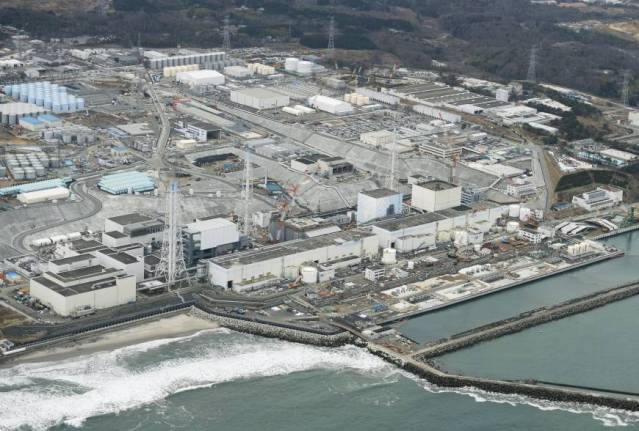
Tokyo Electric Power Co. said Thursday it has started freezing soil around damaged nuclear reactor buildings at the disaster-hit Fukushima plant, aiming to reduce the flow of groundwater into the highly contaminated facilities.
The Nuclear Regulation Authority on Wednesday gave Tepco permission to create a coolant-filled ice wall and start freezing soil on the east sea-facing side of the plant followed by 95 percent of the west side facing the mountains.
The work is expected to take more than three months to complete.
The plant was crippled by a massive earthquake and tsunami in March 2011.
In June 2014, Tepco installing equipment needed to establish the ice wall around the No. 1 to No. 4 reactors.
The work was completed in February, with the government funding some ¥35 billion ($309 million) of the project.
The utility plans to seek permission to extend the wall to cover the entire west side as well as the south and north sides of the plant after collecting data.
The 1.5-kilometer-long and 30-meter-deep wall is designed to stem a massive flow of groundwater from entering the basements of the reactor buildings and mixing with leaked toxic water.
The complete freezing is expected to take eight months if all goes smoothly.
Chief Cabinet Secretary Yoshihide Suga said the government “hopes the ice wall will stem the flow of groundwater into the facilities at an early date.”
Tepco and the government initially aimed to complete freezing the entire wall by the end of fiscal 2015, but the schedule was delayed due to prolonged discussions on safety measures.
The wall is expected to reduce the amount of groundwater flowing into the facilities every day to about 50 tons from more than 100 tons currently.
Still, the effectiveness of the ice wall, which would be the world’s largest ground freezing project, remains unclear.
The NRA warned earlier that if the groundwater level within the wall is reduced excessively by stemming the flow from outside, highly contaminated water within the buildings could seep out.
Tepco said it will stop the freezing work or inject water into wells around the reactor buildings if the groundwater level inside the wall is likely to become too low.
Increased Strontium in Sardines since Fukushima Accident?

Dogs fed sardines show high Strontium levels
by Dr. Peter Dobias, DVM
Why you might want to cut out small fish from your dog’s diet
I have had two dog patients with severely elevated levels of the element strontium. The interesting part is that these two dogs were fed a high amount of sardines and I highly suspect that strontium is coming from this source.
Strontium acts in the body the same way as calcium and deposits in bones. Sardines and other small fish are eaten whole with the bones and that is why they are more likely a source of this toxic element.
The reason why I am concerned is that the radioactive isotope strontium 90 is a toxic carcinogen and it has been released in Japan’s Fukushima disaster.
Here is an example of the results:

As a veterinarian, I source from almost three decades of experience, but still I like to see the proof. Hair testing for minerals and toxic elements has been really helpful because it is highly accurate and shows what is happening in different groups of dogs.
In the course of many years of testing, I have learned that dogs who eat fish-based foods have elevated mercury levels and sardines appear to be the cause of increased strontium. Since the Fukushima nuclear accident strontium is continuously being released into the oceans and not much is being done to inform the general public.
Sadly, I have noticed that dogs who have epilepsy have higher than average levels of strontium and mercury, which made me recommend against feeding fish and sardines to dogs, despite their nutritional benefits. Fish is not what it used to be.
http://peterdobias.com/blogs/blog/11014105-dogs-fed-sardines-show-high-strontium-levels
NRA approves TEPCO’s plan to freeze underground walls of soil at Fukushima plant

NRA approves TEPCO’s plan to freeze underground walls of soil at Fukushima plant
The Nuclear Regulation Authority (NRA) decided on March 30 to approve Tokyo Electric Power Co. (TEPCO)’s plan to gradually freeze underground walls of soil around the crippled Fukushima No. 1 nuclear plant, starting with shields on the ocean side.
With the NRA’s approval, TEPCO, the operator of the crippled Fukushima nuclear complex, is to begin work as early as March 31 to freeze the walls built around the buildings of reactors Nos. 1 through 4 at the plant. The walls are designed to prevent underground water from flowing into the reactor buildings. But such a large-scale “wall of ice” has not been introduced anywhere in the world and it is unclear how much underground water the frozen shields will be able to prevent from flowing into the crippled nuclear complex.
Under the project to build the frozen soil walls, coolant chilled to a temperature of minus 30 degrees Celsius is to circulate through 1,568 pipes that are driven into the ground to a depth of around 30 meters, to create a “wall of ice.” The project is aimed at preventing underground water from entering the reactor buildings and reducing the amount of contaminated water being generated. If the project goes as planned, work to freeze the walls is expected to be completed in about eight months. TEPCO estimates that the walls will help the utility reduce the inflow of underground water to several dozen tons per day from the current 150 to 200 tons.
TEPCO is to gradually freeze the walls, starting with the one (about 690 meters) on the ocean side first, while leaving seven sections (a total of about 45 meters) on the mountain side unfrozen. TEPCO had initially planned to freeze all of the walls at once. But if the levels of underground water around the reactor buildings drop drastically, contaminated water remaining in the reactor buildings could flow out. So the NRA called for the gradual freezing of the walls. TEPCO then accepted the NRA’s suggestion.
The frozen-soil wall project is considered to be a key measure to deal with contaminated water along with the so-called “subdrain” project designed to reduce the amount of water being contaminated by removing underground water from wells around the reactor buildings. TEPCO started inserting pipes into the ground in June 2014 and completed its preparations to begin freezing the walls in February this year.
http://mainichi.jp/english/articles/20160330/p2a/00m/0na/012000c
TEPCO given OK on freezing soil at Fukushima plant
The Nuclear Regulation Authority gave the go-ahead to Tokyo Electric Power Co.’s plan to freeze the soil around the reactors at the crippled Fukushima No. 1 nuclear power plant from the seaside on March 30.
The aim of the frozen soil wall is to block the flow of groundwater into the reactor buildings to prevent it from becoming contaminated with radioactive substances.
The utility has already inserted 1,568 pipes to a depth of 30 meters in the ground around the No. 1 to No. 4 reactor buildings. The plan is to circulate liquid with a temperature of minus 30 degrees through the pipes to freeze the surrounding soil.
TEPCO’s plan is to first freeze the entire wall on the seaside and about half of the wall on the mountain side.
The effects of completing the frozen wall on the seaside are expected to show after about six weeks with water being prevented from flowing through. Then, the frozen portions on the mountain side will be gradually increased. When 95 percent of the wall is frozen, TEPCO will suspend the freeze, leaving cracks in seven places to allow some water through.
The utility predicts that with 95 percent of the entire soil wall frozen, about half of the groundwater will be blocked.
To freeze the entire wall on the mountain side, TEPCO will have to gain further approval from the NRA.
Initially, the electric power company planned to freeze soil only on the mountain side. However, the NRA pointed out that if groundwater is totally blocked from the mountain side, the level of water within the frozen soil near the reactors could become too low and with nothing outside to stop it, highly contaminated water inside the reactor buildings could more rapidly flow out.
Because of that, TEPCO decided in February that it will freeze the soil mainly from the seaside and collect data on the level of groundwater and, after that, it will freeze the entire wall.
“It is important to collect sufficient data in a continuous manner and implement the freezing while keeping watch,” said NRA chairman Shunichi Tanaka.
The plan to create the frozen soil wall was developed by an economy ministry committee in May 2013 as an important part of measures to decrease the volume of contaminated water. The work to insert pipes into the ground was completed in February.
http://ajw.asahi.com/article/behind_news/social_affairs/AJ201603300074
1 This Month


of the week– Nuclear Reactor Information Task Force

14 May – online event From Bombs to Data Centres: the Face of Nuclear Colonialism
To see nuclear-related stories in greater depth and intensity – go to https://nuclearinformation.wordpress.com
-
Archives
- May 2026 (187)
- April 2026 (356)
- March 2026 (251)
- February 2026 (268)
- January 2026 (308)
- December 2025 (358)
- November 2025 (359)
- October 2025 (376)
- September 2025 (257)
- August 2025 (319)
- July 2025 (230)
- June 2025 (348)
-
Categories
- 1
- 1 NUCLEAR ISSUES
- business and costs
- climate change
- culture and arts
- ENERGY
- environment
- health
- history
- indigenous issues
- Legal
- marketing of nuclear
- media
- opposition to nuclear
- PERSONAL STORIES
- politics
- politics international
- Religion and ethics
- safety
- secrets,lies and civil liberties
- spinbuster
- technology
- Uranium
- wastes
- weapons and war
- Women
- 2 WORLD
- ACTION
- AFRICA
- Atrocities
- AUSTRALIA
- Christina's notes
- Christina's themes
- culture and arts
- Events
- Fuk 2022
- Fuk 2023
- Fukushima 2017
- Fukushima 2018
- fukushima 2019
- Fukushima 2020
- Fukushima 2021
- general
- global warming
- Humour (God we need it)
- Nuclear
- RARE EARTHS
- Reference
- resources – print
- Resources -audiovicual
- Weekly Newsletter
- World
- World Nuclear
- YouTube
-
RSS
Entries RSS
Comments RSS
 nuclear-news