Japan Political Pulse: ‘Operation Tomodachi’ members need support amid radiation fears
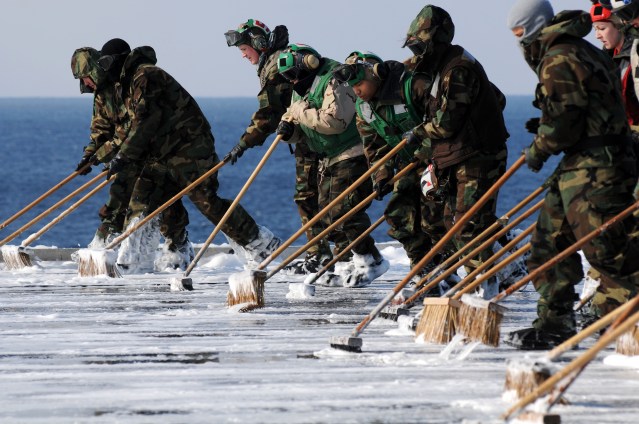
Many readers have offered support for a lawsuit filed by former U.S. servicemen and others claiming they were affected by radiation during “Operation Tomodachi,” a U.S. Armed Forces operation to assist Japan in the wake of the March 2011 Great East Japan Earthquake and tsunami. These readers reacted to last week’s installment of the Japan Political Pulse column that mentioned former Prime Minister Junichiro Koizumi’s activities to support the lawsuit.
It has not yet been proven if there is a causal relationship between so-called second-hand exposure to radiation and health problems. Critics say emotional support for those who claim their health was affected by indirect exposure to radiation without scientific proof is irresponsible. Emotional support is important but objective facts should also be clarified.
Eight former U.S. soldiers who participated in Operation Tomodachi (friend) launched the lawsuit in California in December 2012. The number of plaintiffs has since surpassed 450.
In March 2011, 16 U.S. military vessels engaged in the operation, including the aircraft carrier Ronald Reagan, were exposed to radiation off Fukushima Prefecture. These vessels and the servicemen aboard them were engaged in the operation amid a radioactive plume from the tsunami-hit Fukushima No. 1 Nuclear Power Plant.
According to the lawsuit, the plaintiffs have been suffering from such illnesses as leukemia, testis cancer, colon bleeding, ringing in their ears and a decline in eyesight since they returned home after participating in the operation.
They are suing Tokyo Electric Power Co., the operator of the nuclear plant, Toshiba Corp., Hitachi Ltd., and other Japanese and U.S. atomic power station manufacturers, demanding that a 1 billion dollar (some 100 billion yen) fund be set up to help the plaintiffs receive medical examinations and treatment.
The plaintiffs are hoping that their suit will be tried in the United States, while TEPCO is demanding that the case be heard in Japan.
In June 2015, TEPCO’s appeal over the jurisdiction over the trial was accepted, and a state appeal court is deliberating on the matter.
The aforementioned development of the case is based on interviews with former Prime Minister Koizumi, who met with some of the plaintiffs, and officials at the Foreign Ministry and the Agency for Natural Resources and Energy. TEPCO declined to comment on the matter on the grounds that the trial is ongoing.
Under the civil discovery system established by U.S. law, those involved in civil lawsuits can be forced to disclose evidence. Those who refuse to comply could be imprisoned or slapped with a huge fine for contempt of court. Critics say TEPCO demands that the suit be tried in Japan for this reason.
One cannot help but wonder what the company does not want to be exposed. There is a possibility that documents carrying information on the cause of the nuclear plant accident, TEPCO’s initial response to the disaster and observed data on aerial radiation levels — which is different from what the utility has explained — could be hidden. However, this is just a presumption without basis.
There is also an amicus curiae (court adviser) system, under which individuals or organizations appointed by courts provide information or express opinions on legal matters relating to individual court cases.
A former legislator has phoned the Mainichi Shimbun and raised questions about last week’s installment of this column, which quoted a magazine article as saying that an adviser from the Japanese government stated that U.S. forces are responsible for servicemen’s exposure to radiation while engaging in Operation Tomodachi.
Law360, a U.S.-based website specializing in information on legal affairs, lists the “Government of Japan” as the entity to which one of those who appeared in the oral proceeding on the lawsuit on Sept. 1 as court advisers belongs.
A senior official of the Agency for Natural Resources and Energy said, “The government isn’t aware of such a figure.” However, it would be no surprise if an adviser were to appear in court and develop a persuasive legal theory to pursue ways to evade legal responsibility on behalf of defendants.
Jonathan Woodson, assistant secretary of defense for health affairs who examined plaintiffs’ assertions in 2014 at the request of U.S. Congress, stated there is no objective evidence that the plaintiffs’ health hazard was caused by their exposure to radiation.
The March 13, 2016 issue of Stars and Stripes, a U.S. daily specializing in U.S. military information, covered Woodson’s report along with a comment by Shinzo Kimura, associate professor of radiation hygiene at Dokkyo Medical University, that the possibility that the plaintiffs’ symptoms were caused by their radiation exposure cannot be ruled out.
There is a long way to go before the causes of the plaintiffs’ illnesses can be clarified. However, there is no denying that many people are suffering from illnesses after participating in Operation Tomodachi.
Donations to a fundraising drive launched by former Prime Minister Koizumi are accepted at the Tokyo-based Johnan Shinkin Bank. Koizumi will deliver a speech on the matter at a lecture meeting in Tokyo on the evening of Nov. 16. Those who want to listen to his speech are required to make reservations by calling the Japan Assembly for Nuclear Free Renewable Energy at 03-6262-3623. The admission fee of 10,000 yen per person will be fully donated to former U.S. soldiers who are suffering from illnesses.
http://mainichi.jp/english/articles/20161011/p2a/00m/0na/019000c
Govt. Mulls Ways to Promote Fukushima Produce
The Japanese government plans to create ways to encourage consumers to buy food from Fukushima Prefecture. The area still suffers from the perception that its foodstuffs are unsafe due to the 2011 Fukushima Daiichi nuclear power plant accident.
Reconstruction Minister Masahide Imamura and senior government officials held a meeting on Friday.
The officials reported that a lot produce and processed foods from Fukushima are forced to be sold at prices lower than their pre-accident levels.
They explained farmers and food producers from the region face numerous challenges, such as fewer sales routes and reluctance to buy their products.
They decided to offer benefits to consumers who purchase the food.
Imamura stressed simply advertising won’t be enough and he wants the officials to create a framework that will entice consumers. He noted giving them rewards in a point system is one idea.
Promoting Fukushima Rice and Sake
On the Issue of Japan, Fukushima and Rice
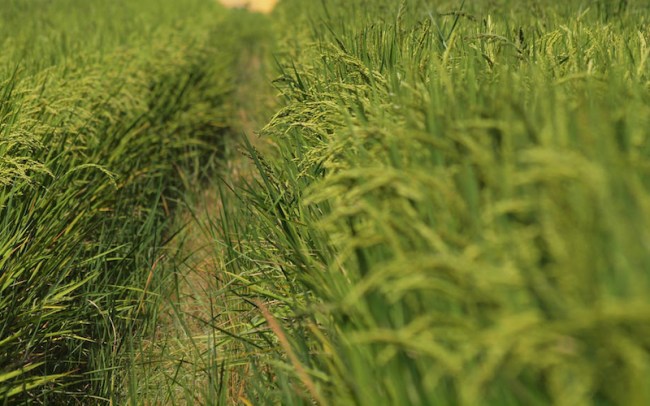
In Japan, rice is life. The word for “life” is also the word for “meal” or “food.” The importance of rice to the Japanese people cannot be overstated. The word for rice has been called “emotive.” Damage to Japan’s rice crops goes beyond simple damage to the diet. To be confronted with a shortage of rice calls forth powerful feelings of deprivation in the Japanese. Japanese rice, irradiated by the events of “3/11,” is in danger.
“3/11” is what the Japanese call the series of deadly disasters which struck northern Japan in March of 2011; the earthquake, tsunami, and the Fukushima Daiichi nuclear power plant meltdown. Northern Japan was devastated and recovery will take many decades.
When the Fukushima Daiichi nuclear power facility was badly damaged by irradiation, local crops, including batches of rice grown in Fukushima, found to be badly affected by radiation, were swiftly removed from the market.
Five years after the quake, Fukushima rice producers still have difficulty marketing their produce. But the Japanese government, working in tandem with nonprofits and private organizations, has developed a positive and creative response to the Fukushima food crisis.
The Rice Peace Project Seminar, held on September 19, 2016 in New York, was inspired by the initiatives of a Japanese government supported campaign working together with non-profits, corporate projects, and organizations, including the NPO Project 88.
The NPO Project 88, which takes name from the 88 processes of rice production, mobilizes Japanese high-quality rice as an emergency relief food. Developing tasty, nutritious, non-GMO, low pesticide, and allergen-free, organic and gluten-free rice products is also central to NPO Project 88’s mission, helping to spread peace and disaster-relief in the world through rice.
The Rice Peace Project Seminar, held to publicize the efforts of the NPO Project 88, featured three speakers from Japan. Mrs. Akie Abe, spouse of Prime Minister Shinzo Abe, Mr. Hiroshi Sakurai, President of the sake brewery Asahi Shuzo, and Ms. Nari Takahashi, President of NPO Project 88. The speeches were followed by a sushi tasting prepared by Sushi Chef Yoichi Akashi of Kappo Akashi using Eco-rice as well as a tasting of “Dassai” sake, the sake Prime Minister Abe offered President Obama during the U.S. President’s 2014 visit to Japan.
Jeff Santos, CEO of the Santos Media Group who hosted the seminar, introduced Mrs. Akia Abe. Santos described Mrs. Abe as an activist. Abe is actively engaged in supporting the NPO Project 88 and in promoting Fukushima’s agricultural industry by creating Yamato No Kokoro sake from rice produced in Fukushima.
Mrs. Akie Abe said that in 2011, in the wake of the Tohoku earthquake, she realized the importance of supporting Japanese food production, especially rice. With the encouragement of US Ambassador to Japan, Caroline Kennedy, Abe began to support the production of Fukushima rice and sake,
Abe described the production of rice in Japan as highly political. She said that 150 years ago, after extensive warring between the Chochu and Aizu clans. the two prefectures began to cultivate rice for sake and to brew sake, jointly. The joint effort was successful and the two prefectures now live in harmony.
Abe said that for Japanese, now as always, rice and sake are spiritual foods. “In Japan, we like to get our hands dirty [working the land.] We are a part of nature. We owe our gratitude to nature. It is my pleasure to work with rice producers and sake producers.”
She closed with a warm invitation: “Please enjoy the sushi and sake tasting today and please also come to Japan to enjoy them!”
Hiroshi Sakurai, President of Sake Brewery Asahi Shuzo, opened with praise for Japanese sake in general and Asahi Shuzo’s sake in particular. “Sake has to be ‘oishii’ (delicious) If it is not delicious what is the point of creating it? And our sake is especially ‘oishii!’”
Sakurai said that he wanted to show two world leaders enjoying Japanese sake, Prime Minister Abe and US President Barack Obama. Sakurai’s photo array displayed pictures from the U.S. President’s 2014 visit to Japan.
Sakurai said that his company, Asahi Shuzo, had partnered with the king of rice producers, Yamada Nishiki, accounting for 6.5 percent of total rice production in Japan. He has a staff of 100 and his employees are the best. Production is entirely by hand- they do not use machines. Production is around the clock, 24/7, to produce “oishii” sake.
Sakurai said that rice production in Japan is very eco- friendly. They recycle all that remains from rice production, such as rice husks, used to make sembei, or rice milk.
In closing, he said: “We are eager to promote our sake and we hope you enjoy the tasting.”
Nari Takashashi, President of NPO Project 88. Ms. Takahashi said that rice was the first food served to Fukushima quake victims. It was sometimes all that aged survivors could eat. And for those who could not eat plain rice she and her company developed soft rice cakes. They were very popular, as were their cream puffs.
Takahashi said that some kids with allergies couldn’t eat even the rice cookies or cream puffs. So she developed allergy-free cookies made with rice powder and delivered to the schools. Kids loved them.
Takahashi said that the application for allergy free products goes well beyond Fukushima. Survivors of the Kumamoto quake this past April are their next potential customers. She believes there is a huge market for these products world wide, especially to disaster survivors and to millennials.
After this spirited set of speeches, it was no surprise that the sushi and sake tastings were extraordinary.
http://intpolicydigest.org/2016/10/06/on-the-issue-of-japan-fukushima-and-rice/
Radiation Brain Moms and Citizen Scientists: The Gender Politics of Food Contamination after Fukushima
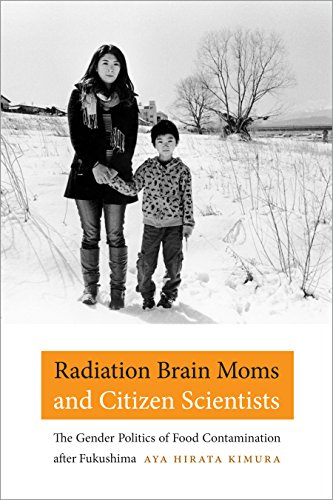
by Aya Hirata Kimura (Author)
Following the Fukushima Daiichi Nuclear Power Plant disaster in 2011 many concerned citizens—particularly mothers—were unconvinced by the Japanese government’s assurances that the country’s food supply was safe. They took matters into their own hands, collecting their own scientific data that revealed radiation-contaminated food. In Radiation Brain Moms and Citizen Scientists Aya Hirata Kimura shows how, instead of being praised for their concern about their communities’ health and safety, they faced stiff social sanctions, which dismissed their results by attributing them to the work of irrational and rumor-spreading women who lacked scientific knowledge. These citizen scientists were unsuccessful at gaining political traction, as they were constrained by neoliberal and traditional gender ideologies that dictated how private citizens—especially women—should act. By highlighting the challenges these citizen scientists faced, Kimura provides insights into the complicated relationship between science, foodways, gender, and politics in post-Fukushima Japan and beyond.
Editorial Reviews
Review
“Riveting and smart, Radiation Brain Moms and Citizen Scientists tracks the efforts made by citizens in post-Fukushima Japan to ensure the safety of their food from radioactive contamination. In the face of state neglect and criticism from fellow Japanese, these initiatives display a ‘soft’ boldness (versus activist politics). Interweaving stories of citizen scientists and ‘radiation brain moms’ with sharp theoretics that deconstruct the entanglements of science, neoliberalism, and postfeminism at work, this book is at once powerful and timely.”
(Anne Allison, author of Precarious Japan)
“Based on careful research, extensive fieldwork, and a judicious use of political and feminist theory, this book’s relevance to political and social developments extends beyond Japan’s borders. It is a reminder of the ongoing effects of the Fukushima disaster in Japan at a time when these effects are being increasingly ignored by the global media. A timely and important book, Radiation Brain Moms and Citizen Scientists will appeal to scholars of contemporary Japanese society as well as science and technology studies scholars, especially those interested in the gender dimensions of science and technology.”
(Tessa Morris-Suzuki, author of Borderline Japan: Foreigners and Frontier Controls in the Postwar Era)
About the Author
Aya Hirata Kimura is Associate Professor of Women’s Studies at the University of Hawai’i at Manoa and the author of Hidden Hunger: Gender and Politics of Smarter Foods.
Fire destroys Fukushima nuclear disaster evacuee housing
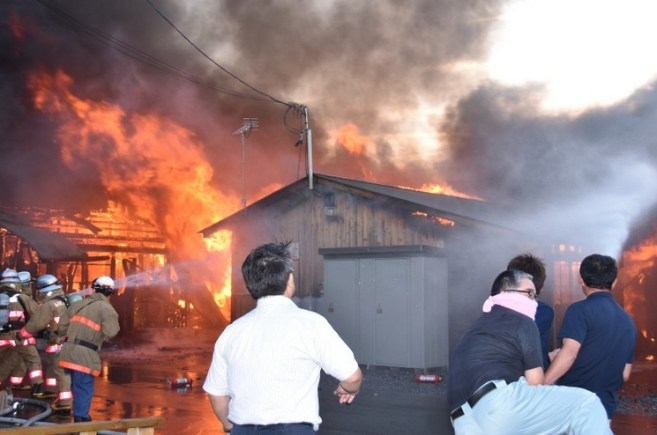
Fueled by strong winds, fire engulfs temporary housing at the Yoshima industrial park in Iwaki, Fukushima Prefecture, on Oct. 6, 2016.
IWAKI, Fukushima — A fire on Oct. 6 destroyed temporary housing for residents of Okuma, Fukushima Prefecture, who evacuated here due to the Fukushima No. 1 Nuclear Power Plant disaster, police said.
The fire broke out at around 4:25 p.m. and destroyed 19 homes in four single-story, prefabricated wooden buildings at the Yoshima industrial park in Iwaki. According to prefectural police, a 16-year-old boy was treated for smoke inhalation. The Okuma Municipal Government will supply the five households that lost their residences with housing elsewhere.
There were 72 households living in 86 of the 31-building complex’s 122 residences. Some 90 percent of Okuma residents’ original homes are within a nuclear disaster no-go zone around the Fukushima plant, and it is unknown when those living in the Yoshima industrial park might be able to return to the town.
Sho Tsukamoto, 29, an employee of a construction company who lost his residence and his possessions in the fire, said, “I even lost the picture of my dead father and other photos of my family that I brought from Okuma.”
http://mainichi.jp/english/articles/20161007/p2a/00m/0na/006000c
Eastern Japan Soil Becquerel Measurement Project Map

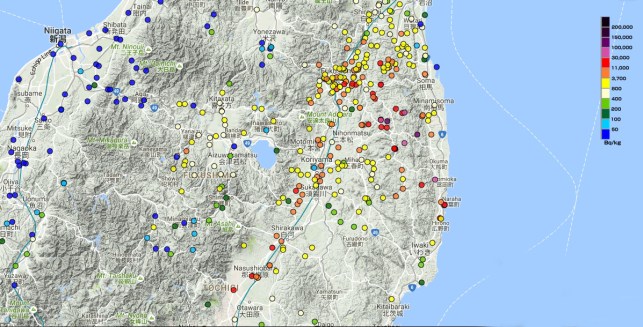


Iwaki City
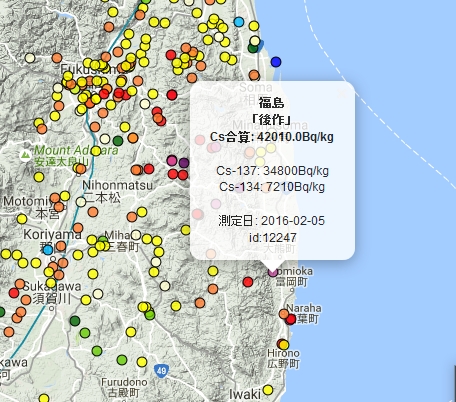
Tomioka
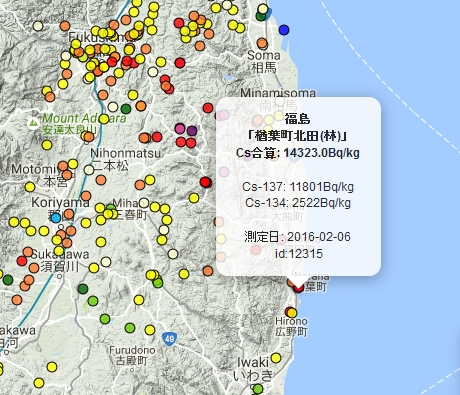
Naraha
Source Minna no Data website:
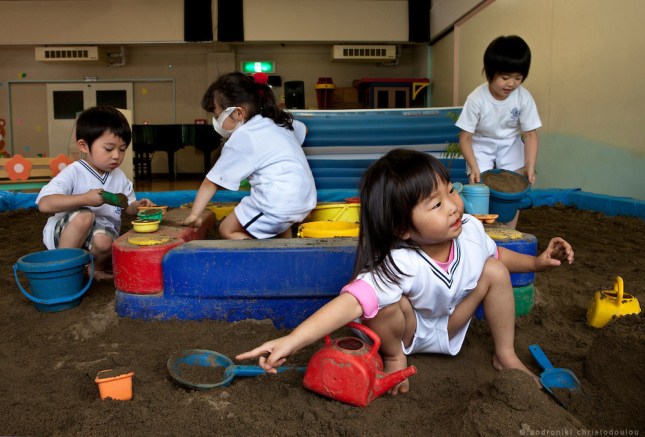
Bioaccessibility of Fukushima-Accident-Derived Cs in Soils and the Contribution of Soil Ingestion to Radiation Doses in Children
Abstract
Ingestion of contaminated soil is one potential internal exposure pathway in areas contaminated by the Fukushima Daiichi Nuclear Power Plant accident.
Doses from this pathway can be overestimated if the availability of radioactive nuclides in soils for the gastrointestinal tract is not considered.
The concept of bioaccessibility has been adopted to evaluate this availability based on in vitro tests.
This study evaluated the bioaccessibility of radioactive cesium from soils via the physiologically-based extraction test (PBET) and the extractability of those via an extraction test with 1 mol/L of hydrochloric acid (HCl).
The bioaccessibility obtained in the PBET was 5.3% ± 1%, and the extractability in the tests with HCl was 16% ± 3%. The bioaccessibility was strongly correlated with the extractability. This result indicates the possibility that the extractability in HCl can be used as a good predictor of the bioaccessibility with PBET.
In addition, we assessed the doses to children from the ingestion of soil via hand-to-mouth activity based on our PBET results using a probabilistic approach considering the spatial distribution of radioactive cesium in Date City in Fukushima Prefecture and the interindividual differences in the surveyed amounts of soil ingestion in Japan.
The results of this assessment indicate that even if children were to routinely ingest a large amount of soil with relatively high contamination, the radiation doses from this pathway are negligible compared with doses from external exposure owing to deposited radionuclides in Fukushima Prefecture.
Fukushima rice at Matsuri (Japanese cultural) festival in Trafalgar Square, London
Rice was among a number of products from Fukushima being promoted at the festival today, in order to help the recovery of the region. Young women were making their way through the throng holding up huge peaches and apples from Fukushima.
Members of Kick Nuclear London, Japanese Against Nuclear and friends handed out a few hundred copies of the following leaflet to visitors at the festival this afternoon :
Kick Nuclear has created a web page for those who want to find out more: https://kicknuclear.com/fukushima-rice/


Meet the nuclear cattle of Fukushima
(CNN)Some families have at least one relative who’s either odd or eccentric. Others boast family members of a more unusual kind.
That’s what one filmmaker discovered in 2011 when he heard of a group of former farmers in Fukushima‘s nuclear exclusion zone, fighting to keep their radiation-affected cows alive, though they brought them no profit.
“The farmers think of these cows as family. They know that these cows can’t be sold, but they don’t want to kill them just because they’re not worth anything,” Tamotsu Matsubara, who made a film called ‘Nuclear Cattle’ (Hibaku Ushi) on their plight, told CNN.
It costs around 2,000 dollars to maintain each cow for a year. The farmers featured in Matsubara’s film are among those who refused to obey the Japanese government’s initial requests to euthanize cows in the exclusion zone.
“[These farmers] really want them to serve a greater purpose for humans and for science,” explained Matsubara.
Nuclear Cattle
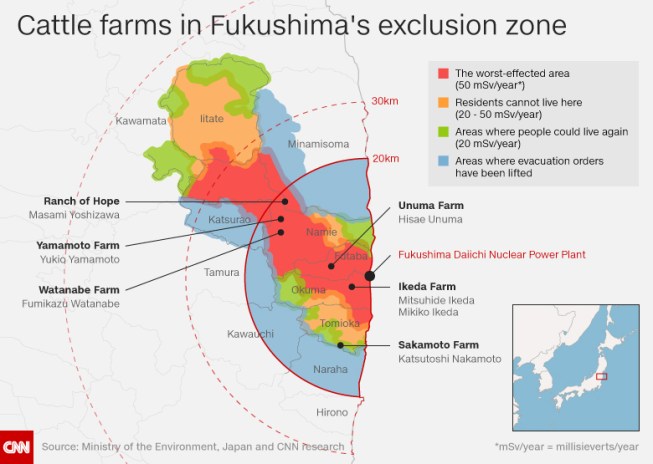
On March 11 2011, a 15-meter tsunami triggered by a 8.9-magnitude earthquake, disabled the Fukushima Daiichi nuclear power plant in Fukushima, causing a nuclear accident.
Residents within a 20 km radius of the facility were forced to evacuate their homes and leave behind their livelihoods and possessions.
Before leaving, some farmers released their cows so they could roam free and survive in the nuclear fallout-affected area. 1,400, however, died from starvation, while the government euthanized 1,500 more.
Since 2011, Matsubara has documented both the relationship six farmers have with their surviving herds as well as an ongoing study examining the effects radiation has on large mammals.
A greater scientific purpose
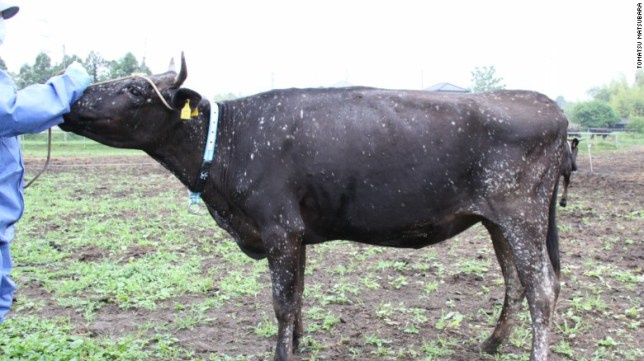
A cow from within Fukushima’s 20 km exclusion zone with an abnormal white spot outbreak.
The farmers — who return two or three times a week to their former farms — initially kept their cows alive just out of love. But since 2013, Keiji Okada, an animal science expert at Iwate University, has been carrying out tests on them.
Okada established the Society for Animal Refugee & Environment post-Nuclear Disaster, a non-profit with researchers from Kitazato, Tohoku and Tokyo university. The researchers are funded through their universities, and say their project is the first to look into the effects of radiation on large animals.
“Large mammals are different to bugs and small birds, the genes affected by radiation exposure can repair more easily that it’s hard to see the effects of radiation,” Okada, told CNN.
“We really need to know what levels of radiation have a dangerous effect on large mammals and what levels don’t,” he added.
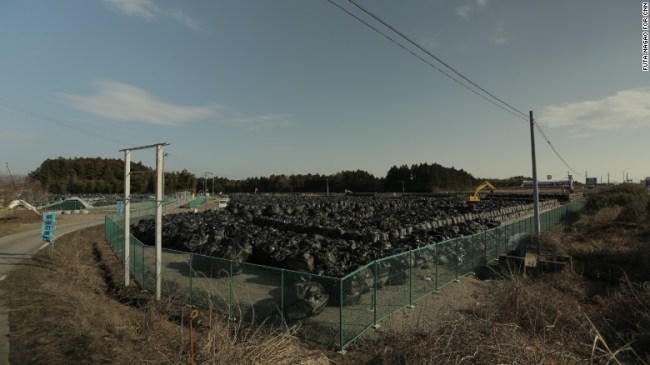
A mountain of black bags filled with contaminated soil sits piled on a roadside in Tomioka, Fukushima. A massive national project to remove topsoil and vegetation contaminated by the Fukushima nuclear disaster will produce at least 22 million square meters of radioactive waste.
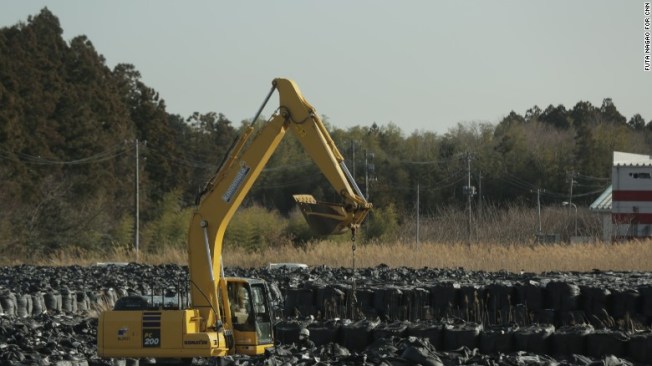
Colossal quantities of contaminated material have been collected from the Fukushima site and surrounding area. What will be done to dispose them still remains to be seen.
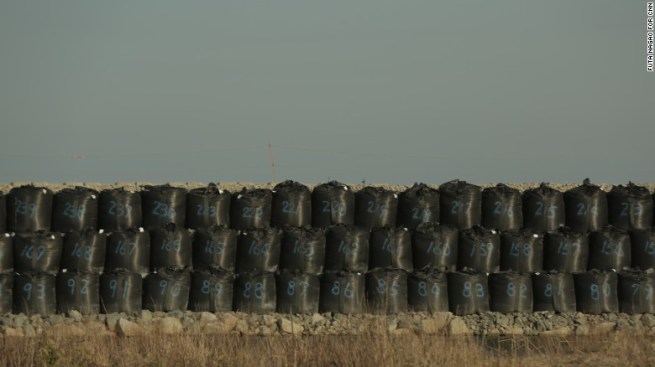
One of hundreds of temporary storage sites for contaminated material.

A giant, 780-meter sea wall under construction near the Fukushima Daiichi nuclear plant is designed to prevent contaminated water on the site from seeping into the ocean
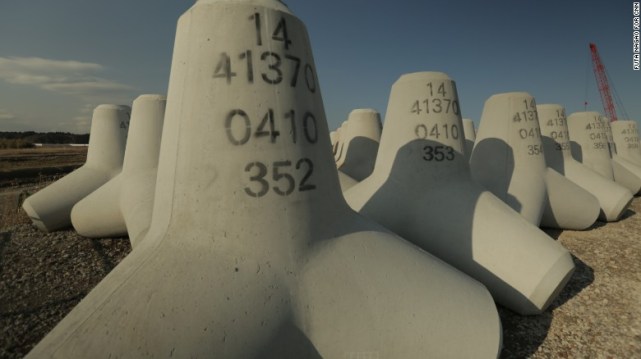
Tetrapods piled up at Udedo port in Namie, Fukushima, waiting to be used for a 7 meter high, 3 kilometer long breakwater along the coast line.
Prior to the wall’s construction, radioactive water and materials readily seeped into the ocean, threatening local fishing stocks and causing potentially irreversible damage to the sea floor.
So far, the cows living within the exclusion zone haven’t shown signs of leukemia or cancer — two diseases usually associated with high levels of radiation exposure. Some, however, have white spots on their hides. Their human minders suspect that these are the side-effects of radiation exposure.
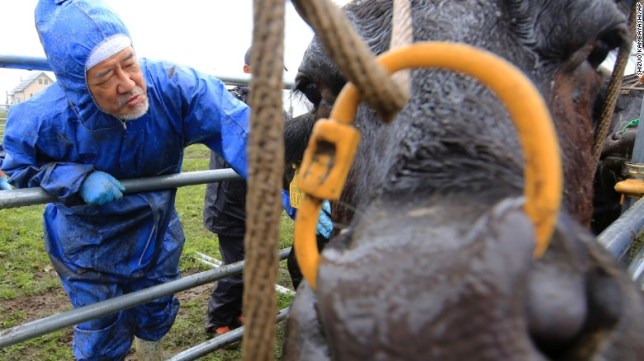
Keiji Okada, associate professor of veterinary medicine and agriculture at Iwate University, examines a cow at Ikeda Ranch in Okuma town, 5 kilometers (3 miles) west of Japan’s crippled Fukushima Dai-ichi nuclear power plant.
As Japan continues to confront its nuclear past, present and future, Okada said his group’s study would keep the country prepared in the event of another disaster.
“We need to know what levels of radiation are safe and dangerous for large mammals, and have that data ready so that the euthanization of livestock can be kept to the minimum,” added Okada.
The ‘cows of hope’
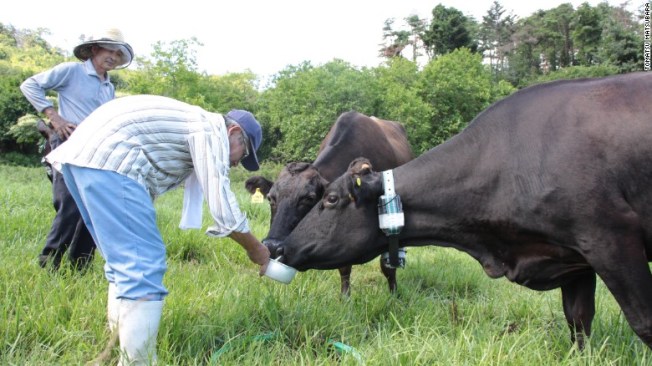
Elderly farmers feeds their radiation-affected cows in the exclusion zone.
Since 2011, the Japanese government has taken measures to decontaminate radiation-affected zones within Fukushima by stripping surface soil from contaminated zones and by cleansing asphalt roads and playgrounds.
Evacuation notices have also lifted on some towns in Fukushima. Taichi Goto, a spokesperson from the Ministry of the Environment’s Office for Decontamination told CNN that Namie, a town currently in the exclusion zone, was scheduled to be decontaminated by March 2017. Yet critics point that the state’s measures still aren’t enough.
Matsubara acknowledged the government’s decontamination work but asserted that it was impossible for them to clear the mountainous areas west of the exclusion zone.
While some farmers have slowly started to rebuild their lives by starting new businesses in decontaminated areas in Fukushima, the campaign to keep alive irradiated cows within the exclusion zone continues.
“These cows are the witnesses of the nuclear accident,” Masami Yoshikawa, who lives in Namie town in the heart of the exclusion zone, states in Nuclear Cattle.
“They’re the cows of hope.”
http://edition.cnn.com/2016/09/27/asia/japan-fukushima-nuclear-cows/index.html
Tokyo Electric Power : Financial Assistance from the Nuclear Damage Compensation and Decommissioning Facilitation Corporation
On September 23, we received a funding grant of 104.1 billion yen from the Nuclear Damage Compensation and Decommissioning Facilitation Corporation (hereinafter referred to as NDF) based on the revision of the Special Business Plan which was approved on March 31, 2016.
This financial assistance was given in response to the 56th request we made in order to cover the compensation payouts due by the end of October 2016. The amount of the payouts to be paid by that time had been estimated to exceed the sum of the compensation we had received in accordance with the ‘Act on Contract for Indemnification of Nuclear Damage Compensation’ (188.9 billion yen) and the financial assistance that the NDF has provided (6,229.9 billion yen).
With financial assistance from the NDF, we are determined to continue to pay the compensation with courtesy and compassion to all of those who have been afflicted by the nuclear damage.
Debris recovery operation in sea carried out for first time since Fukushima nuclear disaster
The Japan Today article cites it as tsunami debris but it would also include debris from the reactor explosions at the plant. Pieces from these explosions have been found as far inland as Naraha. Why this work had not been done sooner was not mentioned.
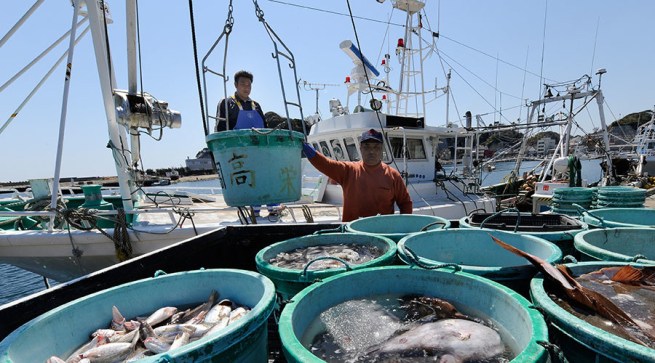
Japan performs tsunami debris cleanup off Fukushima 1st time since nuclear disaster
Local fisheries have begun a debris cleanup near the Fukushima plant for the first time since the tsunami-triggered nuclear disaster. However a plan to start trial fishing next year may face a setback as a nearly-completed ice wall is failing to halt water contamination.
On March 11, 2011, a magnitude-9 earthquake struck northeastern Japan at 2:46pm local time, unleashing a deadly tsunami. Less than an hour after the earthquake, the first of many tsunami waves hit Japan’s coastline. The tsunami waves reached heights of up to 39 meters (128 feet) at Miyako city and reached as far as 10 km (6 miles) ashore in Sendai, destroying everything in its wake. More than 15,000 people died.
At the Fukushima Daiichi Nuclear Power Plant, the tsunami caused a cooling system failure resulting in a nuclear meltdown and the release of radioactive materials. The waves forced the failure of electrical power and backup generators, leading the plant to lose its cooling capabilities. The retreating water sucked a vast amount of rubble into the depths of the Pacific Ocean, contaminating the traditional fishing grounds of the local companies.
Five years after the disaster a cleanup effort to remove the debris has finally been launched by collectives of local fishermen, who aim to start trial fishing expeditions within the area from 5 kilometers (3 miles) to 20 km (12 miles) off the wrecked plant.
On Monday Soma-Futaba Fisheries Cooperative Association send out 32 fishing boats to recover debris from the ocean floor. That fleet is focusing their efforts on the North side of the nuclear power plant.
On Tuesday, the Iwaki City Fisheries Cooperative Association also sent in their fleet to help with the cleanup efforts of the southern side of the contaminated segment.
Once the debris is pulled out and delivered to shore, the unloading of the waste is handled by the industrial waste treatment company. The rubble is then sent to a temporary storage facility where after an inspection for radioactive reading, cleared waste is disposed of in an industrial manner. It is as of yet unclear how the contaminated waste will be treated.
The cleanup work of the seabed endorsed by the Fisheries Agency is scheduled to last at least until February of next year. Fishing on a trial basis can start as early as March.
However such a prospect seem problematic as the recently-completed ice wall around the crippled station has failed to meet expectations, with contaminated groundwater still seeping into the sea.
The $320 million Land-Side Impermeable Wall was built to halt an unrelenting flood of groundwater into the damaged reactor buildings and consequent flow of the contaminated water into the ocean.
But on Tuesday the Japanese government and plant operator Tokyo Electric Power Co. reported that 1.5 km (1 mile) barrier frozen barrier failed to produce the intended results, Nikkei reported.
While gaps still remain in some sections of the ocean-facing side of the wall, TEPCO believes that the inflows that penetrate the contaminated reactor are concentrated at seven unfrozen sections on the inland side.
A similar concern was voiced last month by the operator which claimed that 99 percent of the wall’s is mostly solid and frozen. However, a remaining one percent showed temperatures of the barrier above the freezing point, meaning that the contamination is not fully contained.
TEPCO has been repeatedly facing criticism for the handling of the Fukushima crisis. Despite the ongoing problems encountered following the meltdowns, the company has set 2020 as the goal for ending the plant’s water problem.
The problem of water contamination however is just one of many surrounding the dismantling and decommissioning of the Fukushima plant debris which is estimated to take at least 40 years.
“We will continue to move forward with the decommissioning and contaminated water management in a transparent way, visible to the world, and will also share with the international community the lessons learned from this accident,” Hirotaka Ishihara, state minister of the cabinet office of Japan, told the International Atomic Energy Agency’s 60th General Conference earlier this week.
“We are also making ongoing efforts to ensure the safety of food produced in Japan,” he added. “Recognizing that many countries have already lifted restrictions on food imports from Japan, we encourage the international community to implement import policies based on scientific evidence.”
https://www.rt.com/news/360879-fukushima-fishery-cleanup-debris/#.V-s-7I2uaW0.facebook
Debris recovery operation in sea carried out for first time since Fukushima nuclear disaster
FUKUSHIMA — For the first time since the 2011 nuclear crisis at the Fukushima Daiichi power plant, the removal of debris in seawater located up to 20 km from the plant site has finally started.
The recovery operation, which began Monday, focuses on the removal of rubble in seawater within 5 to 20 km of the wrecked plant, Sankei Shimbun reported.
Five and a half years after the disaster, fishing has yet to be carried out in these waters while tsunami debris on the ocean floor near the Fukushima plant has remained untouched.
With an aim to start trial fishing operations within this targeted cleanup area, the Soma-Futaba Fisheries Cooperative Association employed 32 fishing boats to recover debris such as driftwood and gill nets on Monday.
Following suit, from Tuesday, the Iwaki City Fisheries Cooperative Association started debris removal operations and will continue the cleanup efforts until February of next year.
East Japan Soil Measurement Project of Minna no Data Site

About This Project
It’s time to cooperate
When we started up MDS (Minna no Data Site, Everyone’s Data Site) we constructed inclusive and shared system on measuring data of food as the first stage, as there were many people who were concerned about food intake.
However, we planned to launch the measuring data of soil as a second stage after intensively equipped the system on food.
In autumn 2014, after one year from opening of MDS, we start up to platform soil measurement data. We, as citizens, try to start to map the status of soil contamination spread over East Japan.
The following is the reason why we stand up to start the East Japan Soil Becquerel Measurement Project. Objectives, outline and methodology of the project is explained.
Outline
In the Project, the method of collection is standardized in order to make comparison of data from multiple measurement laboratories. The Manual for Collection is developed by considering the easiest method of measurement within the limits of keeping accuracy, because many citizens conduct collection and measurement by themselves.
Collected soil is measured by the participating measuring laboratories of MDS. The result becomes open to the public and the report is sent to the collector.
Objectives
Radioactivity contamination by the accident of Tepko Fukushima Nuclear Power Plant is long term lasting.
The soil contamination map of broader areas is needed to understand contamination of neighborhood by measurement and comparison of data.
Though central and local governments conduct soil researches, those researches are insufficient because the value is lower by measuring deep place, or they measure only air dose.
As they decide the spot of measurement by mesh, the data what citizens want to know is lacking.
In our Project, we aim to grasp status of contamination where citizens make living every day. For example, place where children frequently play, where people pick wild grass, or where farmers work is being measured.
The Project aims that people can access necessary information as much as possible by utilizing data and database and by accumulating information which one can find at a glance and can search at ease.
We hope the result would be used as a tool for action for everyone.
Methodology
■ The depth of collection is from 0 to 5 cm, because most of cesium stays within 5 cm from surface of the earth.
Collection of soil should be conducted when it does not rain for several days, in order to avoid weight error caused by water. Less than 10 percent of moisture content is desirable.
■ Spot for collection is set at higher dose spot by measuring rate of air dose (1m、5cm).
The extreme high spot such as micro hot spots and concentrated environment are excluded.
■ Collection is made by a method to compare results of each place.
■ Samples are measured at the participating laboratories of MDS.
・Measurement accuracy of those laboratories is ensured by the MDS original examination.
・The results are accumulated in the common database.
■ The result sof measurement are open to public on MDS. MDS has Japanese and English site.
■ Mapping of data is planned after gathering enough results.
■ Trial calculation of amount of radioactivity by a square meter is planned to be conducted. (Becquerel/ Kg →Becquerel /square meter)
Target areas:17prefectures in east-Japan
Tohoku : Aomori Iwate Akita Miyagi Yamagata Fukushima
Kanto : Ibaragi Tochigi Gunma Saitama Chiba Tokyo Kanagawa
Chubu : Yamanashi Nagano Shizuoka Nigata
* In Iwate, the Soil Project Iwate had implemented measurement at more than 300 spots in 2012 and 2013.
The project activity will be made starting from requested districts. Individuals, groups and any organization such as school and daycare can participate in measurement of proposed spots. Proposing more than 5 spots are desirable.
The measurement spots will be decided after consultation basically in the same municipality.
★ How to support us:
Collection of samples, payment of 2,000yen for measurement of one sample, payment of actual postage for samples.
★ How to feed back :
Sending result of measurement of the spots including spectrum, Reading and downloading data at MDS.
Support our site and project!
To those of you who are viewing this site from overseas, Thank you for visiting ”Minna no Data Site” (Combined Database of Independent Radioactivity Measurement Labs) .
MDS has stacked the data measured by the independent radioactivity measurement laboratories in response to the Fukushima Daiichi nuclear power plant accident, As of September 2014, the number of the food data became nearly 10,000.
For the benefit of those who worry about radioactive contamination of Japan from overseas, we opened the English site. We have started “East Japan soil measurement project” since October 2014 in addition to the food data.
From the fact that government has not done the adequate soil contamination survey for the citizens, this project promotes measuring soils of the places like parks, vacant lots, and educational facilities which are closely related to children’s daily life.
This project is based on the method of “Iwate soil measurement project “(2012- 2013) by citizens of Iwate Prefecture. If the method for collecting the soil is different, the results of monitoring vary greatly.
By using an easy-to-understand manual of the standardized method, you are able to compare, review and analysis the data from different locations. We will publish the measurement results of soil on this site.
We record the status of the radioactive contamination of Japan carefully from the standpoint of citizens, and hope that it will help people who are living with anxiety. For the people overseas, we are preparing the English version of data to show where and how much radioactively contaminated.
To run this project, big budget for measurement cost and update cost of web systems are required. There are 300 locations in each 17 prefectures in Eastern Japan, and each place costs about 4,000 yen.
Although it is planned to reduce costs and to ask for volunteers as much as possible, still the costs such as measurement costs, project management costs and Web systems costs are expected to some extent also.
It is a project of the scale that no one even challenged yet. We rely on your generosity to help funding for this project. We would appreciate your support from abroad. Thank you for your cooperation and support.
The information page of “East Japan soil measurement project” is currently in preparation. It will be published shortly.
◎Donate by the bank transfer
Postal Transfer:
Postal Transfer Account : 10090-85754261
Account Name: Minna no data site Unei Iinkai
Bank Account
Yuucho Bank Branch : Zero Zero Eight (Branch 008):
Interim : 8575426
Account Name: Minna no data site Unei Iinkai
Remittances in either USD or EUR can be made from overseas banks,.
Please note that remittances to Japan cannot be made from certain financial institutions.
For details, please ask your local bank.
http://en.minnanods.net/#mds_indx_srch
http://en.minnanods.net/soil/soil_support.html
High levels of radioactive cesium pooling at dams near Fukushima nuke plant
Once radionuclides enter the eco-system, they move around carried by wind and water. They can’t “go away.” They can’t be “decontaminated.” They can only be moved, the biggest force moving them is nature, not clean up crews.
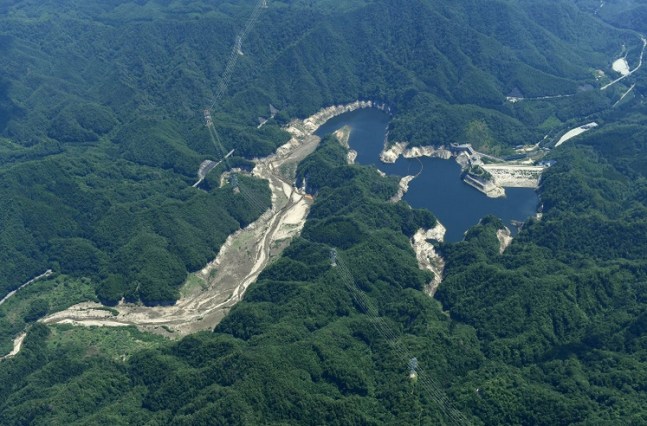
Ogaki Dam in Namie, Fukushima Prefecture, as seen from a Mainichi Shimbun helicopter in July 2016, contains high concentrations of radioactive cesium exceeding the limit set for designated waste.
High levels of radioactive cesium pooling at dams near Fukushima nuke plant
High concentrations of radioactive cesium have been accumulating at the bottom of 10 major dams within a 50-kilometer radius from the disaster-stricken Fukushima No. 1 Nuclear Power Plant, a survey by the Environment Ministry has found.
Radioactive cesium emanating from the 2011 nuclear disaster is pooling at those dams, which are used to hold drinking water and for agricultural use, after the substances flew into there from mountains, forests and rivers. The radiation levels at the bottom of those dams top those set for designated waste at over 8,000 becquerels per kilogram.
While the Environment Ministry plans to monitor the situation without decontaminating the dams on the grounds that radiation levels in dam water is not high enough to affect human health, experts are calling for the ministry to look into measures to counter any future risks.
The ministry began a monitoring survey on those dams and rivers downstream in September 2011 to grasp the moves of radioactive substances flowing into them from mountains and forests that are not subject to decontamination work. The survey samples water at 73 dams in Tokyo, Iwate and seven other prefectures about once every several months.
Among them, there were 10 dams in Fukushima Prefecture where the average concentration of cesium in the surface layer of bottom soil measured between fiscal 2011 and 2015 topped the regulated levels for designated waste. Those dams include Ganbe Dam in the village of Iitate with 64,439 becquerels per kilogram of cesium, Yokokawa Dam in the city of Minamisoma with 27,533 becquerels, and Mano Dam in Iitate with 26,859 becquerels.
Meanwhile, the surface water at those 10 dams contained 1-2 becquerels per liter of cesium, which is below the drinking water criteria at 10 becquerels.
While the total amount of cesium deposited at the bottom of those dams is unknown from the environment ministry’s survey, a separate study conducted at Ogaki Dam in the town of Namie by the Ministry of Agriculture, Forestry and Fisheries’ Tohoku Regional Agricultural Administration Office estimated in December 2013 that there was a combined 8 trillion becquerels of cesium 134 and cesium 137 at the dam. The figure came about after estimating the amount of accumulated cesium every 10-meter-square area based on cesium levels in sedimentary soil sampled at 110 locations at the bottom of the dam, which is for agricultural use.
The National Institute for Environmental Studies in Tsukuba, Ibaraki Prefecture, will shortly begin a full-scale survey on cesium concentrations at several dams.
“At the moment, it is best to contain cesium at those dams. If we dredge it, the substance could curl up and could contaminate rivers downstream,” said an Environment Ministry official.
http://mainichi.jp/english/articles/20160926/p2a/00m/0na/007000c
Anxiety soars as cesium builds up in Fukushima dams
Dams surrounding the stricken Fukushima No. 1 Nuclear Power Plant operated by Tokyo Electric Power Co. (TEPCO) have become de facto storage facilities for high concentrations of radioactive cesium as the element continues to accumulate.
With no effective countermeasures in sight, the government insists that water from the dams is safe, but to local residents, the government’s stance comes across as the shelving of a crucial problem.
“It’s best to leave it as it is,” an official from the Ministry of the Environment says, with the knowledge that in 10 dams in Fukushima Prefecture, there is soil containing concentrations of cesium over the limit set for designated waste — or over 8,000 becquerels per kilogram.
According to monitoring procedures carried out by the ministry, the levels of radioactive cesium detected in the dams’ waters, at 1 to 2 becquerels per liter, are well below the maximum amount permitted in drinking water, which is 10 becquerels per liter. The air radiation doses in the dams’ surrounding areas are at a maximum 2 microsieverts per hour, which the ministry says “does not immediately affect humans, if they avoid going near the dams.” This information is the main basis behind the central government’s wait-and-see stance. For the time being, the cesium appears to have attached itself to soil and is collected at the bottom of the dams, with the water above it blocking radiation from reaching and affecting the surrounding areas.
In a basic policy based on a special law, passed in August 2011, on measures for dealing with radioactive material following the onset of the Fukushima nuclear disaster, the Environment Ministry stipulates the decontamination of areas necessary from “the standpoint of protecting human health.” The ministry argues that as long as high concentrations of cesium at the bottom of multiple dams in Fukushima Prefecture do not pose imminent danger to human health, there are no legal problems in the ministry refraining from taking action.
“If the dams dry up due to water shortages, we just have to keep people from getting close to them,” the aforementioned ministry official says. “If we were to try to decontaminate the dams, how would we secure water sources while the work is in progress? The impact of trying to decontaminate the dams under the current state of affairs would be greater than not doing anything.”
This stance taken by the central government has drawn protests from local residents.
“The Environment Ministry only says that it will monitor the dams’ water and the surrounding areas. They say, ‘We’ll deal with anything that comes up,’ but when asked what they plan to do if the dams break, they have no answers. It’s painful to us that we can only give town residents the answers that the Environment Ministry gives us,” says an official with the revitalization division of the Namie Municipal Government. The central government is set to lift evacuation orders for a part of the Fukushima Prefecture town of Namie in spring of 2017.
According to a Ministry of Agriculture, Forestry and Fisheries survey, Ogaki Dam, an agricultural dam in Namie, was estimated to have sediment totaling approximately 8 trillion becquerels of cesium as of December 2013. The agriculture ministry plans to re-survey the dam’s accumulated cesium amounts and water safety before the water is used for agricultural purposes. Agricultural and fishery products from Fukushima Prefecture are tested to ensure that radioactive substances that they contain are below the maximum permissible amounts stipulated by law before they are shipped for distribution.
Still, one town official worries how revelations of high levels of radioactive material in local dams will affect consumers. “No matter how much they are told that the water is safe, will consumers buy agricultural products from Namie, knowing that there is cesium at the bottom of local dams?”
A 57-year-old vegetable farmer from Namie who has been evacuated to the Fukushima Prefecture city of Iwaki says, “The central government keeps on emphasizing that the dams are safe, but doesn’t seem to be considering any fundamental solutions to the problem. If this state of affairs persists, we won’t be able to return to Namie with peace of mind, nor will it be easy to resume farming.”
http://mainichi.jp/english/articles/20160926/p2a/00m/0na/011000c
Fukushima Possibly Turning into Another “Exotic” Tourist Destination
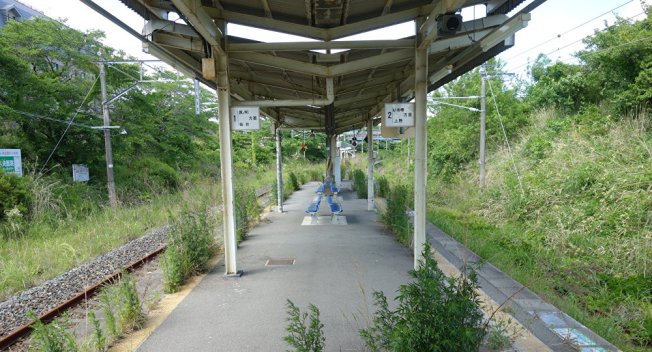
Just like Chernobyl before it, the radioactive exclusion zone surrounding the crippled Fukushima nuclear plant is starting to attract tourists, possibly turning into another of the world’s “exotic” tourist destinations.
Unlike the Chernobyl nuclear disaster which happened over 30 years ago, the Fukushima Daiichi nuclear plant catastrophe is practically a recent event. On March 11, 2011 a tsunami that followed the Tohoku earthquake smashed into the plant, causing several meltdowns and the release of radioactive material resulting in the second nuclear disaster in history to be given the Level 7 event classification of the International Nuclear Event Scale.
Yet even though the scars left by this disaster are still fresh, it seems that there are already people who consider the radioactive zone surrounding the Fukushima nuclear plant a tourist attraction.
The first project aimed at transforming the crippled Fukushima nuclear plant into a tourist attraction was presented to the Japanese authorities in 2012, only a year after the disaster, by philosopher Hiroki Azuma, the author of the Chernobyl Dark Tourism Guide, and his group of fellow enthusiasts.
According to Azuma’s vision, people should’ve been allowed to visit the area and see the process of the Fukushima plant’s decontamination with their own eyes; and by 2036 visitors should be able to approach the plant without the need to wear protective suits
Unfortunately, the prefectural administration torpedoed the idea, arguing that the word ‘tourism’ should never be applied to the catastrophe site.
But even though Azuma’s project was not to be, there are already plenty of companies organizing tours in the disaster area.
Hiroshi Miura, head of one such enterprise called NPO Nomado, told Sputnik that he first started working as a tour guide for people visiting his home city of Minamisoma, located 16 miles north of the Fukushima nuclear plant, back in 2012.
“In October 2012 I established a non-commercial organization Nomada and continued my business by creating a ’20 Kilometers Away From Fukushima-1′ tour. By 2014, just by myself, I had over 5,000 clients. In 2015 other guides and volunteers started working with me, and over 10,000 people participated in our tours,” he said.
Miura also added that the current situation at the nuclear plant is barely discussed by the media, except for the local prefectural outlets, and that the place where he used to live, located only 12 kilometers away from Fukushima Daiichi, remains in the same state as it was right after the tsunami, as no decontamination or recovery operations were conducted there.
Yuta Hirai, another tour guide working in Fukushima, also told Sputnik that there are people from all walks of life interested in visiting the site of the tragedy: scientists, students, former residents, and a considerable number of foreign tourists.
He also believes that tourism could play an important role in helping the Fukushima prefecture to recover from the ordeal of 2011.
“I believe it is important for the prefecture residents to understand that people from without are paying attention to them. They have mixed feelings about the incident, like ‘I want to forget but I don’t want to be forgotten.’ If we learn our lesson from what happened, if we understand that it must not happen again, then it could help the people of Fukushima to believe in themselves. There’s a tendency to pay greater attention to opinions from without rather than to opinions from within. So if more people from other prefectures see the situation with their own eyes, feel it and talk about it, then perhaps the current depressing situation in Fukushima may change for the better,” he said.
Reconstruct ‘difficult-to-return zones’ in keeping with residents’ wishes
In consideration of the feelings of evacuees who want to return home, it is important to promptly present a specific picture of how towns affected by the nuclear disaster will be reconstructed.
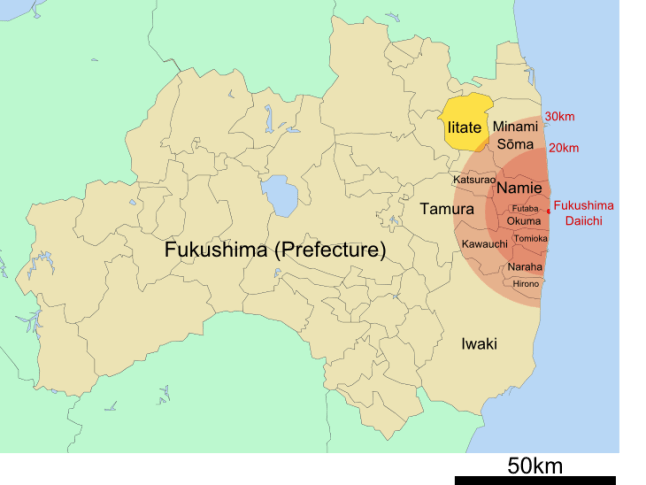
Regarding the “difficult-to-return zones” designated following the disaster at Tokyo Electric Power Company Holdings, Inc.’s Fukushima No. 1 nuclear power plant, the government has announced a policy of designating priority areas and carrying out full-scale decontamination work there starting next fiscal year.
Entry remains strictly restricted for the difficult-to-return zones, where the yearly dose of radiation was higher than 50 millisieverts as of March 2012. This is the first time for the government to announce a policy of allowing evacuees to eventually return home in the zones.
The zones spread over seven municipalities around the Fukushima plant, including the towns of Okuma, Futaba and Namie.
The latest policy is characterized by the government establishing “reconstruction bases” that center around town offices and railway stations, and drawing up development plans exclusively for the base areas. The government will implement the development of infrastructure, including roads, concurrently with the decontamination work. It aims to lift the evacuation orders for residents in the year 2022, making it possible for evacuees to return home.
To decontaminate the entire area within the difficult-to-return zones will require a sizable amount of money. It is an appropriate measure to move ahead with the decontamination work by narrowing down the target area from the viewpoint of pursuing efficiency.
In areas where the radiation dose is relatively low, namely areas where residence is restricted and where preparations are being made for the lifting of evacuation orders, evacuation orders have already been rescinded for five municipalities. Another four municipalities have also taken such measures as allowing residents to return home for long-term stays, with the aim of lifting the evacuation orders next spring.
Limited progress in returns
However, in areas where evacuation orders have already been lifted, there has not been as much progress in residents’ return as was hoped. Even in the town of Naraha, for which evacuation orders were lifted last autumn and which is considered a model case for residents’ return, only about 10 percent of residents have come back.
There has not been sufficient development of bases closely linked to people’s daily life, such as medical institutions and commercial facilities. This can be a primary factor in evacuees’ reluctance to return home. Younger generations also have strong concerns about their jobs and their children’s education following their return.
Even if residents of the difficult-to-return zones were able to return, that would be six years from now. It would be difficult for residents to plan for their daily life.
At the moment, matters such as where the reconstruction bases can be located and the details of development plans have yet to be decided. It is important to show residents early on how their hometowns would be reconstructed, so as to fulfill evacuees’ wishes of returning home.
Many evacuees have given up on returning home and rebuilt their lives within or outside Fukushima Prefecture. According to a survey taken last year by the Reconstruction Agency, only 11 percent of evacuees from Okuma and 13 percent of those from Futaba — the towns straddled by the plant — said they want to return home.
How should towns be reconstructed to induce evacuees to consider returning? Each municipality is urged to carefully take up the wishes of evacuees and reflect them in the development plans.
As Fukushima’s reconstruction progresses, the government needs to continue doing its utmost in assisting the prefecture so as not to have the difficult-to-return zones become “left-behind areas.”
1 This Month

of the week – Shut Down Drone Warfare!


Tell the Ukrainian Government to Drop Prosecution of Peace Activist Yurii Sheliazhenko

Petition to revoke the licensing of the Near Surface Nuclear Disposal Facility (NSDF) at Chalk River. https://www.ourcommons.ca/petitions/en/Petition/Details?Petition=e-7247
To see nuclear-related stories in greater depth and intensity – go to https://nuclearinformation.wordpress.com
-
Archives
- April 2026 (57)
- March 2026 (251)
- February 2026 (268)
- January 2026 (308)
- December 2025 (358)
- November 2025 (359)
- October 2025 (376)
- September 2025 (257)
- August 2025 (319)
- July 2025 (230)
- June 2025 (348)
- May 2025 (261)
-
Categories
- 1
- 1 NUCLEAR ISSUES
- business and costs
- climate change
- culture and arts
- ENERGY
- environment
- health
- history
- indigenous issues
- Legal
- marketing of nuclear
- media
- opposition to nuclear
- PERSONAL STORIES
- politics
- politics international
- Religion and ethics
- safety
- secrets,lies and civil liberties
- spinbuster
- technology
- Uranium
- wastes
- weapons and war
- Women
- 2 WORLD
- ACTION
- AFRICA
- Atrocities
- AUSTRALIA
- Christina's notes
- Christina's themes
- culture and arts
- Events
- Fuk 2022
- Fuk 2023
- Fukushima 2017
- Fukushima 2018
- fukushima 2019
- Fukushima 2020
- Fukushima 2021
- general
- global warming
- Humour (God we need it)
- Nuclear
- RARE EARTHS
- Reference
- resources – print
- Resources -audiovicual
- Weekly Newsletter
- World
- World Nuclear
- YouTube
-
RSS
Entries RSS
Comments RSS
 nuclear-news