Radioactive soil turns up at Fukushima high school
FUKUSHIMA–Highly radioactive soil that should by law be removed by the central government has been left dumped in the corner of a schoolyard here because the construction of a local storage site for waste has been stalled.
Students at the school were not given an official warning that the radioactive soil was potentially hazardous to their health.
When a teacher scooped up soil samples at the site and had their radiation levels measured by two nonprofit monitoring entities–one in Fukushima and another in Tokyo–the results showed 27,000-33,000 becquerels of radioactive cesium per kilogram.
The law stipulates that the central government is responsible for disposing of waste measuring more than 8,000 becquerels per kilogram.
But as a central government project to build an interim storage site for highly radioactive waste near the nuclear power plant has been stalled, the school appears to have no alternative to indefinitely keeping it in the schoolyard.
Principal Seiichi Takano at Fukushima North High School said the school does not plan to take extra safety measures with regard to the storage of the polluted dirt, saying the waste is not believed to be outright dangerous.
“The prefectural board of education has not set any criteria for us to conclude at what levels of radiation are hazardous to people,” he said.
The fallout is a result of the nuclear disaster at the Fukushima No. 1 power plant, which unfolded following the Great East Japan Earthquake and ensuing tsunami on March 11, 2011.
Before the cleanup operation at the school in the city’s Iizaka district on May 24-25, the teacher who took the samples called on school officials to take precautionary measures and issue an alert for students.
“Since it is highly radioactive, we should remind students and staff of the potential danger while taking a step to prevent the spread of polluted dust during cleanup,” said the teacher.
Highly radioactive dirt, which was mixed with tree branches and plants amounted to 20 cubic meters, according to cleanup workers. It was packed in bags and dumped in an area near the parking lot for bicycles used by students.
School officials say they plan to bury the bags by digging deep holes on the school premises to temporarily store them, but they have no idea when they will finally be removed.
The polluted dirt in the latest cleanup first came to the attention of school officials in March when a preliminary survey detected 1.6 microsieverts per hour of radiation at a point 1 meter from the surface of the ground near the bicycle parking lot. The survey is routine before any cleanup gets under way in earnest.
A cleanup operation is conducted with the aim of lowering radiation exposure to below 0.23 microsieverts per hour, a long-term goal the central government has set to limit residents’ annual additional exposure to a maximum of 1 millisievert.
In the previous decontamination operation, the school’s playground was cleaned in August 2011 before classes were resumed for that academic year after a break after the nuclear accident.
A large amount of contaminated soil–far more radioactive than in the current incident–is still buried in the schoolyard for temporary storage.
Cleanup resumed only this spring for the rest of the school premises and its neighborhood in line with a general cleanup plan in Fukushima.
An official with the prefectural board of education said it is not considering additional safety measures concerning the storage of polluted soil kept at the school.
“We are going to ensure safety by taking an approach similar to the existing one before the polluted soil is transported to the interim storage facility,” said a board official.
Fairewinds in the News: Gendai Business Online Feature Article
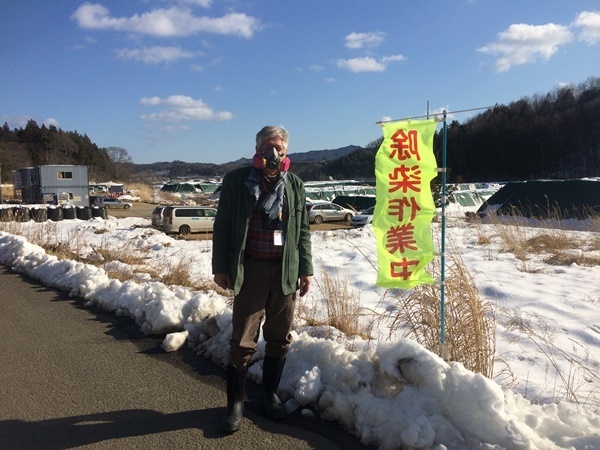
Gendai Business Online’s top ranked article is an exclusive interview with Fairewinds Chief Engineer Arnie Gundersen titled, American nuclear expert warns: “There is a possibility that now in Fukushima recontamination is occurring.” With more than 10,000 likes on Facebook, this Japanese article delves into the truth about nuclear contamination from Fukushima Daiichi as uncovered by Arnie Gundersen during his most recent trip to Japan. Fairewinds, with the help of Japanese translators, provides you with an English translation:
On a mid-February morning, just before the 5th anniversary of the triple meltdown at Fukushima Daiichi, a group of young girls in the city of Minami-Soma rode their bikes to school past a shocked and saddened pedestrian. That upset observer was Arnie Gundersen, nuclear reactor expert and Chief Engineer with Fairewinds Associates. Mr. Gundersen has 45 years of experience as a design, operations, and decommissioning nuclear engineer. He has engaged in research of the effects of the meltdown at Three Mile Island (TMI) and conducts independent research of the triple meltdown at Fukushima Daiichi. Mr. Gundersen is in ongoing conversations with both the US and Japanese media concerning the dangers of nuclear reactors and nuclear power operation. Invited by “Peace News Japan” and several other civil groups, Mr. Gundersen visited the Fukushima prefecture five years after the catastrophe at Fukushima Daiichi.
“What surprised me at this visit to Japan [his third since the meltdowns] is that the decontaminated area is contaminated again,” Mr. Gundersen said while explaining why it was such as sad shock to witness the girls on their bicycles. “This was not what I had expected. I had thought that we would not find such high doses of radiation in the decontaminated area. But, sadly, our results prove otherwise.”
During his Japan visit, Mr. Gundersen collected samples of dust from the rooftop of Minami-Soma city town hall, the floor mat of a 7-Eleven convenience store, and the roadsides of Minami-Soma city. Although the official data cannot be released before the publication of formal scientific papers, it is evident that high doses of radiation, usually found in nuclear waste, was detected from these samples.
“This means that highly radioactive dust is flying around the city. In other words, the decontaminated land is contaminated again. Little girls are affected by the radiation 20 times as much as adult men. The Japanese government’s standard of 20 mSv is based on exposure assessments for adult men. The girls on their bicycles are actually being affected by a radiation dose equivalent to as much as 400 mSv.”
Mr. Gundersen also pointed out that human lungs are heavily affected by internal exposures to radiation.
“At this visit, I wore a radiation proof mask that can filter out 99.98% of radiation for six hours. I sent my filter to the lab, and they found a high dose of Cesium. But, unfortunately, the Japanese government only cares about the number on a Geiger counter and does not consider the internal exposure. This has resulted in a hazardous downplay of this kind of data and human lungs are affected by the serious internal exposure.”
Why is the recontamination happening? One of the reasons is that the government did not decontaminate thoroughly. Mr. Gundersen witnessed first-hand the poor decontamination of the prefecture.
“In the house I visited, only half of the garden area was decontaminated because only that half fell into the category of a contaminated area. It should not be like that. The other half would be contaminated too. Furthermore, one person discovered highly radioactive dust in their driveway where decontamination had occurred. So, of course, this person notified the related offices but the related offices told them that it was not necessary to decontaminate the driveway again because it had already been done once. It’s unbelievable. This person’s house is located near a ravine and the opposite side of the ravine is designated a non-habitable zone.”
Another reason for recontamination is that the radiation from the mountains are coming back to the city by way of wind and rain. Mr. Gundersen noted the extreme radioactive contamination of the mountains.
“We tracked wild monkeys in the mountains and found a high dose of radiation in their feces. I received the meat of a wild pig as a gift and since I could not bring it back to the US [it is illegal to bring meat back to the United States from Japan], tested the meat on a Geiger counter. The meat showed 120 counts/min. I think that the Japanese government should spend more money to decontaminate the mountains but they don’t appear to have that kind of political will. I also worry that contamination in the rivers is not monitored as rain from the mountains flow down into the rivers.”
Due to the heavy radiation contamination of the mountains, vegetables grown in that area exceed the government’s standard by 1500 Bq. These vegetables were sold at the MichinoEki in Tochigi prefecture, and the bamboo shoot grown in this contaminated region was used for elementary school lunches in Utsunomiya. These school lunches contained more than twice as much radiation as the government’s standard.
Recontamination is happening due to poor decontamination and residents of Kawauchi village in Fukushima prefecture claim that the decontamination in the forests is not enough. However, the government continues to push for the end of people’s relocation and force the return to recontaminated areas.
“If I had a little child, I would never let them live there,” Mr. Gundersen pointedly states.
Mr. Gundersen also found that Tokyo remains contaminated. He measured dust collected from the sidewalk in front of MITI (Ministry of International Trade and Industry) and found a high dose of radiation. That dust is in the air that will be inhaled by the visitors and athletes of the 2020 Olympic Games. Needless to say, the current residents are inhaling it every day. “Mr. Abe should not take the advice from IAEA, MITI and TEPCO seriously,” Mr. Gundersen insists. “Instead, he should have an independent organization conduct research and listen to the advice from them.”
Over double density of Cesium-134/137 as safety limit detected from served school lunch in Utsunomiya city

According to Utsunomiya city government, they detected over double density of Cs-134/137 as safety level from school lunch after serving it to the students this May.
It was bamboo shoot contained in the school lunch of 5/10/2016 as an ingredient.
It was already served and consumed by 560 students and teachers at an elementary school when they obtained the analysis result.
It was 234 Bq/Kg in total of Cs-134/137 (food safety limit is 100 Bq/Kg). The city government comments no health problem was reported related to the contaminated bamboo shoot.
http://www.city.utsunomiya.tochigi.jp/oshiraselist/19078/035312.html
http://www.city.utsunomiya.tochigi.jp/dbps_data/_material_/localhost/gakkoukenkou/20160614.pdf
Advisory lifted for most of evacuated village of Katsurao close to crippled Fukushima nuclear power plant
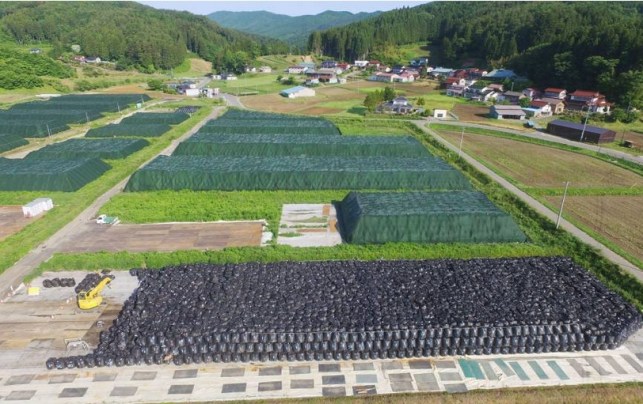
Radioactive waste contained in thousands of black plastic bags are placed in rice paddies in the village of Katsurao, Fukushima Prefecture, where an evacuation advisory was lifted for most of the village Sunday.
FUKUSHIMA – The government Sunday lifted its evacuation advisory for most of Katsurao, a village near the crippled Fukushima No. 1 nuclear power plant in Fukushima Prefecture.
This is the first time that an evacuation advisory has been lifted for an area tainted with relatively high levels of radiation with annual doses projected at between more than 20 millisieverts and less than 50 millisieverts.
The government’s move allows 1,347 people in 418 households to return home for the first time since the March 2011 disaster at the plant, operated by Tokyo Electric Power Company Holdings Inc.
But only a few people are expected to return home for the time being due to inconveniences in everyday life in the village. Municipal bus services remain suspended while shops have yet to resume operations.
The village government plans to offer free taxi services for elderly people so that they can go to hospitals and commercial facilities outside the village.
Earlier this month, the village’s chamber of commerce and industry started services to deliver fresh foods and daily necessities to homes.
The evacuation advisory remains in place for 119 people in 33 households from the remaining Katsurao area where annual radiation doses are estimated at over 50 millisieverts.
Evacuation lifted for Fukushima village; only 10% preparing return
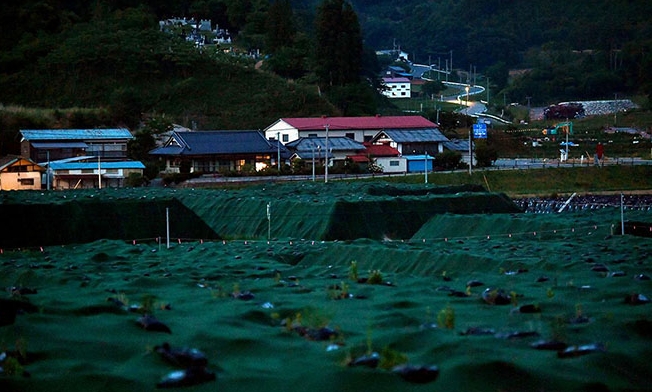
Lights appears at only a few houses in Katsurao, Fukushima Prefecture, on June 11, the eve of the government’s lifting of the evacuation order following the 2011 nuclear accident. Waste from decontamination operations is covered with sheets in the foreground. (Yosuke Fukudome)
The government on June 12 lifted the evacuation order for Katsurao, a village northwest of the crippled Fukushima No. 1 nuclear power plant, but most of the residents appear reluctant to return home.
The lifting of the order covers more than 90 percent of the households in Katsurao. The entire village was ordered to evacuate after the crisis at the Fukushima plant started to unfold on March 11, 2011.
Katsurao is the fourth municipality in Fukushima Prefecture that had the evacuation order lifted, following the Miyakoji district in Tamura, the eastern area of Kawauchi village and Naraha.
Government officials said cleanup and other efforts have reduced radiation levels in Katsurao to a point that poses little problem. The lifting of the evacuation order means that 1,347 people from 418 households, out of 1,466 people from 451 households in Katsurao, can return to their homes to live in the village.
But only 126 people from 53 households, or 10 percent of those eligible to return, have signed up for a program for extended stays in the village to prepare for their return, according to Katsurao officials.
The officials said they believe that many evacuees would rather go back and forth between temporary housing and their homes in Katsurao for the time being, given the situation in the village.
Medical institutions and shops have yet to resume operations in Katsurao. And nearly half of the rice paddies there are being used for the temporary storage of radioactive waste produced in the cleanup operation.
Local officials say they have no idea when the waste can be moved out of the village for permanent storage.
Among the Katsurao residents eligible to return are those with homes in the government-designated “residence restricted zone,” where the annual radiation dose was projected at more than 20 millisieverts and up to 50 millisieverts as of March 2012.
This was the first time evacuees from such a zone have been permitted to return home.
Only the “difficult-to-return zone” carries a higher annual radiation dose.
The government plans to lift evacuation orders for other parts of the prefecture by the end of March 2017, except for the “difficult-to-return zone,” where the annual radiation dose was estimated at 50 millisieverts or higher as of March 2012.
The additional lifting of the evacuation orders would allow 46,000 of 70,000 displaced residents to return to their homes to live.
Demolition work delay hinders Fukushima villagers’ homecoming
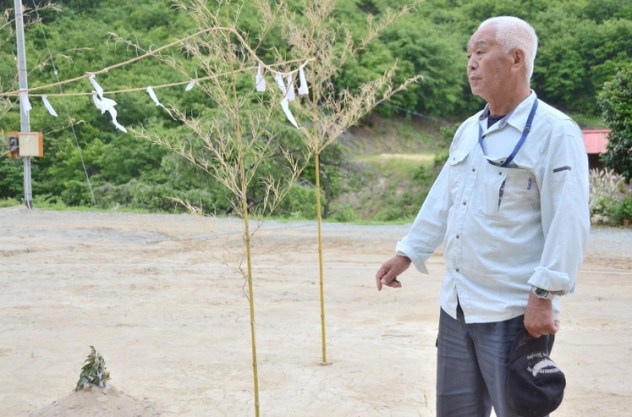
Farmer Hidenori Endo is seen at the empty lot where his home used to stand in Katsurao, Fukushima Prefecture, on June 6, 2016.
FUKUSHIMA — Though the nuclear disaster evacuation order for the Fukushima Prefecture village of Katsurao is set to be lifted on June 12, just 14 percent of demolition work needed before homes can be rebuilt has been completed.
The village currently comprises three evacuation statuses: “areas preparing for the lifting of evacuation orders” with annual accumulated radiation doses of 20 millisieverts or less; “restricted residency zones” with annual accumulated radiation doses from over 20 millisieverts to 50 millisieverts; and “difficult-to-return zones.” As of June 12, the 1,347 residents from 418 households in the former two categories will be allowed to move back home. A return schedule for the 119 residents from 33 households with homes in areas in the last category has yet to be determined as radiation levels remain high.
A survey by the village government showed that nearly 50 percent of residents wished to return home. However, as of June 8 only 126 people, or less than 10 percent of residents, had registered to stay overnight in preparation for their complete return.
The Environment Ministry began demolishing houses in 2012 for those who wanted to rebuild their homes in 11 Fukushima Prefecture municipalities subject to nuclear disaster evacuation orders. Of 347 demolition requests in Katsurao, only 14 percent have been completed. Officials say that field research and paperwork are taking time. Overall, a little less than 40 percent of requested work has been done in all 11 municipalities.
Eight municipalities — including Katsurao and the city of Minamisoma, where evacuation orders are to be lifted on July 12 — are requesting the central government to speed up demolition work as the delay is hindering residents’ return to their hometowns. A senior Katsurao village official says locals have been complaining about the demolition work not advancing as planned.
The Environment Ministry hopes to complete about 90 percent of demolition work by March 2017 by streamlining paperwork, but many residents are expected to be unable to return home even after evacuation orders are lifted, as it will take time to rebuild houses after the demolition is completed.
A ministry official explained that there are people who will be able to return home immediately after the evacuation order is lifted, and that it would be inappropriate to keep the orders in place until all the demolition work is done. At the same time, the official said that the ministry will give those who wish to return priority in the demolition work schedule.
Fukushima University social welfare professor Fuminori Tamba, who helped map out disaster recovery plans for municipalities under evacuation orders, pointed out that the lack of progress in demolitions is problematic, since securing housing is the minimum requirement for residents to return. He added that the availability of housing should be considered when lifting evacuation orders.
Katsurao farmer and cattle rancher Hidenori Endo, 74, applied for demolition of his decaying home and barn last summer. Tired of waiting, Endo paid a private firm nearly 10 million yen to tear down the buildings in May.
“I wanted to go home as soon as possible,” Endo said.
He now lives in a temporary housing unit in the town of Miharu, about 30 kilometers from his Katsurao home. Endo travels an hour by car daily to his property to restart his farming business, but taking good care of his cattle is difficult to do going back and forth. To reboot his business, Endo first needs to rebuild his home. Construction work is to begin this summer, but he does not yet know when the work will be completed, and will have to live in the temporary housing for at least another year.
The central government has set prerequisites, such as infrastructure development and operation of everyday services, for lifting nuclear crisis evacuation orders. However, housing is not included in these criteria.
“Even if I could go shopping, there isn’t much I could do if there was no place to live. It’s not right to be unable to return to home even with the evacuation order gone,” Endo lamented.
http://mainichi.jp/english/articles/20160611/p2a/00m/0na/016000c
Another evacuation order lifted in Fukushima
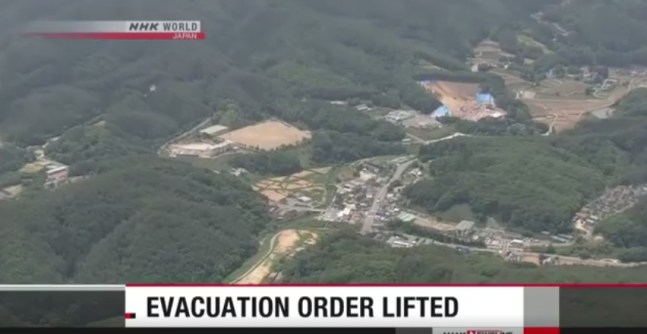
The Japanese government has lifted its evacuation order for most parts of a village near the crippled nuclear plant in Fukushima. Katsurao Village became the 4th such municipality after the 2011 nuclear disaster.
Officials lifted the restriction on Saturday midnight except some areas where the radiation level remains high. All of over 1,400 residents there were forced to evacuate. Now most of them are allowed to return home.
According to a survey the village conducted last year, nearly half of the respondents said all or at least parts of their family want to return home when the order is lifted.
Local authorities say they will work to ease concerns over radiation and provide medical services. They will also ask shops to reopen there to sell foods and everyday essentials.
The evacuation order remains in 9 municipalities in Fukushima. This is forcing more than 90,000 people to continue living away from home.
http://www3.nhk.or.jp/nhkworld/en/news/20160612_04/
Villagers divided over lifting of order
People from Katsurao have had mixed responses to the lifting of the evacuation order.
Residents who have decided to return to the village include Rinko Matsumoto and her husband.
Matsumoto planted corn seedlings on Sunday in front of her home. She used to eat home-grown corn with her children and grandchildren when they were all living together before the accident.
She says she is happy to be returning home, but that she will miss family members who have no plans of coming back anytime soon.
Akira Miyamoto and his wife spent the day tending roses in their garden and playing with their dog.
Miyamoto says this is the day Katsurao Village has come back to life. He says he wants to enjoy living there surrounded by nature.
Yoshio Matsumoto is one of the former residents who have decided not to return.
Matsumoto lives in temporary housing in another municipality. He says he is not going back home because he is worried about radiation and few of his neighbors are returning.
He says his home has been decontaminated many times, but windy or rainy weather causes radiation levels to rise.
New technologies using zeolite composite fibers to prevent radioactive cesium pollution in Fukushima rivers

The authors have developed and applied new technologies using zeolite composite fibers to prevent radioactive Cs pollution of water in Fukushima, Japan.
During approximately four years in the area, decontamination has been conducted to reduce radioactive cesium (Cs) in the field. However, water contaminated with extra-diluted radioactive Cs has prevented residence within about 30 km of the damaged nuclear facilities. Great efforts at decontamination work should be undertaken to alleviate social anxiety and to produce a safe society in Fukushima.
Decontamination using fiber-like decontamination adsorbents was examined in actual use for radioactive Cs in water in Date city in 2013 and in Okuma town in 2015.
This report describes preparation and properties of the fiber-like decontamination adsorbents. Furthermore, this report is the first describing results of radioactive Cs decontamination using a fiber-like adsorbent for water with extra-low-level concentrations of radionuclides.
Even four years after the accident, results strongly suggest the decontamination still distributed in Fukushima area, depending on the distance of the nuclear power plant. Evidence indicates the importance of preventing extension of radioactive Cs further downstream to human residential areas.
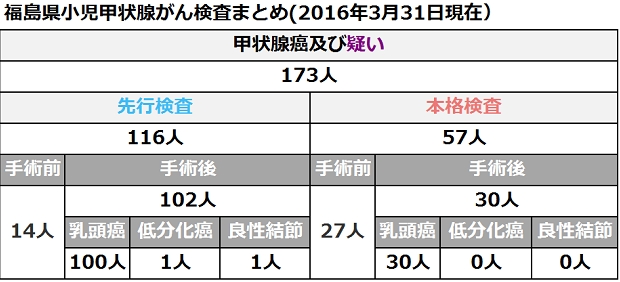
173 Children Thyroid Cancers in Fukushima Prefecture
As a reminder, elsewhere, children thyroid cancer occurs in only about one or two of every million children per year by some estimates. This shows an incidence of thyroid cancer multiplied by more than a hundred.
According to the latest Fukushima prefectural survey report, published on June 6, 2016, the number of childhood thyroid cancers increased from 163 three months and a half ago to 169 now, as 6 persons more were found affected with thyroid cancer.
Then the Fukushima Medical University professor Akira Ozuru verbally reported 3 additional cases, making now the number of thyroid cancers 172.
Therefore in the last 3 months and half, 9 additional cases have been further detected, which brings now the total number of children affected with thyroid cancer up to 172.
Here below in this first picture you may see the evolution of the number of children thyroid cancers and its evolving ratio to the Fukushima population from December 31, 2013 to March 31, 2016.

We can see that they are become higher at every announcement.
This time March 31, 2016 it became one in 1746 children.
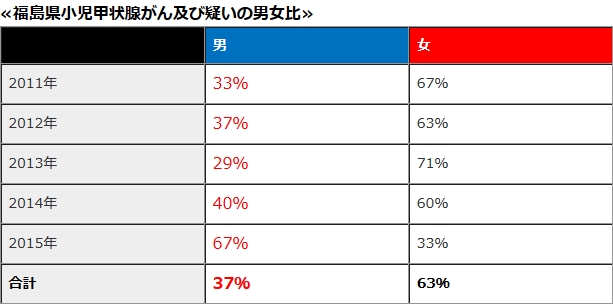
In the next picture we see the male-to-female ratio of Fukushima Prefecture childhood thyroid cancer and suspicion of thyroid cancer. The stats proving that girls (women) are indeed getting more affected than the boys (men) by radiation, as well expected.
As you may see in the next picture the thyroid cancer ratio to population differs depending on each municipality.
Red color – 1 in 999
Orange color – 1 in 1000 to 1999
Yellow color – 1 in 2000 to 2999
Green color – 1 in 3000 to 3999
Blue color – 1 in 4000 to 6999

Source: http://www.sting-wl.com/fukushima-children9.html
Translated by D’un Renard
Upper House Election 2016 / ‘Stagnant recovery’ hangs over Fukushima

From The Yomiuri Shimbun, a pro-government Japanese newspaper
Large black bags piled up like stone walls are a common sight in Fukushima Prefecture.
The bags are filled with contaminated soil left over from the decontamination work carried out in the wake of the 2011 disaster at the Fukushima No. 1 nuclear power plant.
The bags of soil are being provisionally stored at about 130,000 spots throughout the prefecture, including in schoolyards and parks.
It has been more than five years since the Great East Japan Earthquake, yet these “temporary” storage sites can even be found in the city of Fukushima.
On May 28, Justice Minister Mitsuhide Iwaki, 66, of the Liberal Democratic Party held a meeting for his supporters at a hotel in the city center. Iwaki represents them in the House of Councillors.
“I want to tell the whole world how safe and secure Fukushima is. The Tokyo Olympics and Paralympics in four years are a big chance. I want to show how Fukushima has recovered from the major damage it received,” he said at the meeting, drawing applause from about 250 supporters.
Posters hung around the venue read, “Running flat out toward a true recovery.”
There were about 10.3 million cubic meters of contaminated soil as of the end of last year, enough to fill eight Tokyo Domes. The government wants to move as much as 60 percent of this to interim storage facilities being built in Okuma and Futaba by the time the Olympics are held in Tokyo in fiscal 2020, to give an impression the recovery is making progress.
However, only about 2 percent of the land needed for the sites has been acquired. House of Councillors member Teruhiko Mashiko, 68, of the Democratic Party criticized the delay in moving the contaminated soil at the opening of a campaign office in Koriyama, also on May 28.
“Is the way the LDP is handling things acceptable? Contaminated soil is just being left to sit in schoolyards and parks and beside private houses,” he said.
Mashiko does not dispute the need for interim storage facilities, but since negotiations with about 2,000 landowners are moving slowly, he has proposed nearly doubling the current number of staff from 110 to at least 200 workers.
The number of House of Councillors seats to be contested in the Fukushima constituency this time was cut from two to one in 2013, pitting Iwaki and Mashiko, who currently each hold a seat, against each other. In the 2010 upper house election, Iwaki won a seat but finished second, about 2,700 votes behind Mashiko. This time, Mashiko is set to run as “a joint candidate” backed by opposition parties, so there is a much stronger sense of crisis among Iwaki’s campaign team.
At a meeting on June 5 of the LDP’s prefectural election committee, the chairman of the Election Strategy Committee, Toshimitsu Motegi, urged members of the prefectural assembly and others to join the fray.
“When two sitting lawmakers go up against each other, one must lose his seat. Treat this campaign like it is your own election,” he said.
The Cabinet of Prime Minister Shinzo Abe has said the recovery from the disaster is one of its highest priorities. Abe himself visited Fukushima on June 3. If one of his Cabinet members were to be defeated in such a key electoral district, “It would be seen as a rejection of the recovery policies the government has promoted,” a veteran member of the prefectural assembly said.
The DP has its burdens as well. When the disaster struck, the DP’s predecessor, the Democratic Party of Japan, was in power, and the administration’s scattershot response confused operations on the ground. At the launch of his campaign, Mashiko apologized for the party’s track record.
“We put everything we had into the recovery, but the path was steep. I’m terribly sorry,” he said.
In a survey of 200 Fukushima Prefecture residents who were evacuated, conducted in March by The Yomiuri Shimbun, 80 percent said the recovery was behind schedule. “Even if decontamination is completed, the mountains of contaminated soil remain. Many residents say they don’t want to return,” said Norio Kanno, mayor of Iitate, which had to be fully evacuated after the nuclear disaster.
Will either party be able to accelerate the recovery that is still not being felt in many areas hit by the disaster? Voters will likely view both the LDP and the DP with a critical eye.
Final disposal within 30 years
Decontamination has been completed for almost 90 percent of the about 420,000 houses and other buildings targeted for clean-up in Fukushima Prefecture. The evacuation orders for most of the city of Minami-Soma and two villages in the prefecture are expected to be lifted in June or July. However, it has yet to be decided when the evacuation orders will be lifted for Okuma and Futaba, where the damaged nuclear plant is located, and other municipalities with high radiation levels. Storage facilities for the contaminated soil generated by the decontamination effort are intended to be only an interim solution. Legislation has been passed demanding that a final solution outside the prefecture be found within 30 years.
Numerous other issues also need to be dealt with, including decommissioning the damaged nuclear reactors.
Work on developing robots that can collect the melted nuclear fuel in the reactors has only just begun, meaning the decommissioning process could take as long as 40 years. Work on building an “ice wall” by freezing the ground around the reactor buildings is almost completed. This is expected to stop the inflow of groundwater into the site, which should reduce the amount of contaminated water that is generated.
Decontamination worker’s dead body found full of scars
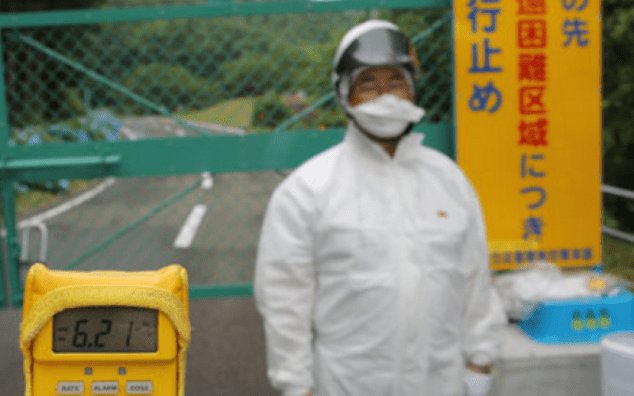
According to Fukushima prefecture police, a decontamination worker’s dead body was found in the company area that he was working for on 5/16/2016.
The body is assumed to be the man in 40s, who had been missing since last Autumn.
Police found it in the gravel pit of the company area. The company undertakes decontamination works in Iwaki city. From juridical autopsy, intracranial injury was possibly the cause of death. There were several scars on the face and body.
The company president and 5 other employees and former employees were arrested for suspicion of abandonment of dead body.
No more details are reported.
http://irresponsibility.seesaa.net/archives/20160517-1.html
http://matomejapan.doorblog.jp/archives/60130534.html
Ministry of the environment to decide to reuse contaminated soil for road and coastal levee nationwide
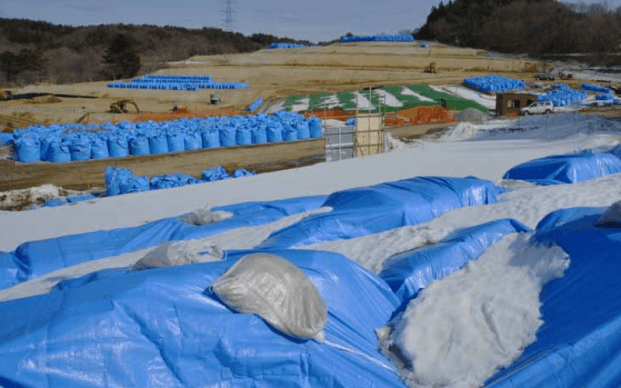
On 6/7/2016, the experts study group of MOE (Ministry of the Environment) admitted to reuse the contaminated soil to public works.
The contaminated soil is from decontamination. Cesium density is supposed to be 5,000 ~ 8,000 Bq/Kg to be recycled. It will be reused for road and coastal levee all around Japan.
The government of Japan decontaminated the ground and spreads it to the entire country.
The ministry is planned to make an official announcement soon.
This March, MOE was stating they would reduce the radiation level with the technology that they didn’t have yet. It is not clear if they developed the technology already.
Radioactive soil to be used to build roads set to spark uproar

A public outcry is expected when radioactive earth from the 2011 Fukushima nuclear disaster is recycled and used to construct roads and in other building projects.
“Fierce resistance would likely arise if the contaminated earth were used in prefectures other than Fukushima Prefecture,” said an official at an Environment Ministry study meeting on June 7.
But Shinji Inoue, senior vice environment minister, said the ministry will proceed with recycling despite expected opposition.
“We are set to promote the reuse (of contaminated earth) by endeavoring to gain public understanding across the country, including Fukushima Prefecture,” he said after the meeting.
Polluted earth will be covered by either clean earth, concrete, asphalt or other material to minimize radiation exposure to construction workers and residents living near the facilities built using radioactive soil.
Twenty-two million cubic meters, the equivalent of 18 Tokyo Dome stadiums, is the amount of contaminated soil expected to be produced in total from the cleanup work in areas around the crippled Fukushima No. 1 nuclear power plant and elsewhere in the prefecture. It is unclear how much of the polluted soil will be used in building projects.
Ministry officials decided at the meeting that the soil to be recycled will be restricted to that in which radioactivity measures 8,000 becquerels or less per kilogram.
The recycling is aimed to cut the amount of radioactive soil to be shipped to other prefectures for final disposal.
If the soil has more than 8,000 becquerels of radioactivity per kilogram, the central government is obliged under law to safely dispose of it.
The ministry envisages the use of contaminated earth for raising the ground level in the construction of roads, seawalls, railways and other public works projects.
It can also be used to cover waste at disposal sites.
The 22 million cubic meters of soil is to be kept at the interim storage site to be built near the crippled nuclear plant in Fukushima Prefecture. After being kept there for about 30 years, it is scheduled under law to be dumped outside the prefecture.
Fukushima woman speaks out about her thyroid cancer
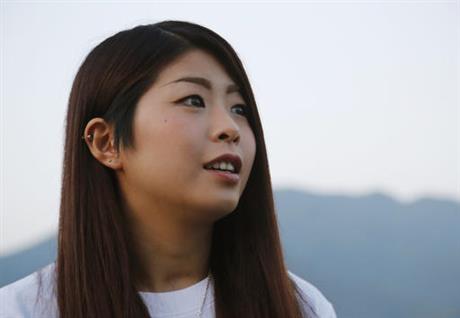
KORIYAMA, Fukushima Prefecture–She’s 21, has thyroid cancer, and wants people in her prefecture in northeastern Japan to get screened for it. That statement might not seem provocative, but her prefecture is Fukushima, and of the 173 young people with confirmed or suspected cases since the 2011 nuclear meltdowns there, she is the first to speak out.
That near-silence highlights the fear Fukushima thyroid-cancer patients have about being the “nail that sticks out,” and thus gets hammered.
The thyroid-cancer rate in the northern Japanese prefecture is many times higher than what is generally found, particularly among children, but the Japanese government says more cases are popping up because of rigorous screening, not the radiation that spewed from Fukushima No. 1 power plant.
To be seen as challenging that view carries consequences in this rigidly harmony-oriented society. Even just having cancer that might be related to radiation carries a stigma in the only country to be hit with atomic bombs.
“There aren’t many people like me who will openly speak out,” said the young woman, who requested anonymity because of fears about harassment. “That’s why I’m speaking out so others can feel the same. I can speak out because I’m the kind of person who believes things will be OK.”
She has a quick disarming smile and silky black hair. She wears flip-flops. She speaks passionately about her new job as a nursery school teacher. But she also has deep fears: Will she be able to get married? Will her children be healthy?
She suffers from the only disease that the medical community, including the United Nations Scientific Committee on the Effects of Atomic Radiation, has acknowledged is clearly related to the radioactive iodine that spewed into the surrounding areas after the only nuclear disaster worse than Fukushima’s, the 1986 explosion and fire at Chernobyl, Ukraine.
Though international reviews of Fukushima have predicted that cancer rates will not rise as a result of the meltdowns there, some researchers believe the prefecture’s high thyroid-cancer rate is related to the accident.
The government has ordered medical testing of the 380,000 people who were 18 years or under and in Fukushima prefecture at the time of the March 2011 tsunami and quake that sank three reactors into meltdowns. About 38 percent have yet to be screened, and the number is a whopping 75 percent for those who are now between the ages of 18 and 21.
The young woman said she came forward because she wants to help other patients, especially children, who may be afraid and confused. She doesn’t know whether her sickness was caused by the nuclear accident, but plans to get checked for other possible sicknesses, such as uterine cancer, just to be safe.
“I want everyone, all the children, to go to the hospital and get screened. They think it’s too much trouble, and there are no risks, and they don’t go,” the woman said in a recent interview in Fukushima. “My cancer was detected early, and I learned that was important.”
Thyroid cancer is among the most curable cancers, though some patients need medication for the rest of their lives, and all need regular checkups.
The young woman had one cancerous thyroid removed, and does not need medication except for painkillers. But she has become prone to hormonal imbalance and gets tired more easily. She used to be a star athlete, and snowboarding remains a hobby.
A barely discernible tiny scar is on her neck, like a pale kiss mark or scratch. She was hospitalized for nearly two weeks, but she was itching to get out. It really hurt then, but there is no pain now, she said with a smile.
“My ability to bounce right back is my trademark,” she said. “I’m always able to keep going.”
She was mainly worried about her parents, especially her mother, who cried when she found out her daughter had cancer. Her two older siblings also were screened but were fine.
Many Japanese have deep fears about genetic abnormalities caused by radiation. Many, especially older people, assume all cancers are fatal, and even the young woman did herself until her doctors explained her sickness to her.
The young woman said her former boyfriend’s family had expressed reservations about their relationship because of her sickness. She has a new boyfriend now, a member of Japan’s military, and he understands about her sickness, she said happily.
A support group for thyroid cancer patients was set up earlier this year. The group, which includes lawyers and medical doctors, has refused all media requests for interviews with the handful of families that have joined, saying that kind of attention may be dangerous.
When the group held a news conference in Tokyo in March, it connected by live video feed with two fathers with children with thyroid cancer, but their faces were not shown, to disguise their identities. They criticized the treatment their children received and said they’re not certain the government is right in saying the cancer and the nuclear meltdowns are unrelated.
Hiroyuki Kawai, a lawyer who also advises the group, believes patients should file Japan’s equivalent of a class-action lawsuit, demanding compensation, but he acknowledged more time will be needed for any legal action.
“The patients are divided. They need to unite, and they need to talk with each other,” he said in a recent interview.
The committee of doctors and other experts carrying out the screening of youngsters in Fukushima for thyroid cancer periodically update the numbers of cases found, and they have been steadily climbing.
In a news conference this week, they stuck to the view the cases weren’t related to radiation. Most disturbing was a cancer found in a child who was just 5 years old in 2011, the youngest case found so far. But the experts brushed it off, saying one wasn’t a significant number.
“It is hard to think there is any relationship,” with radiation, said Hokuto Hoshi, a medical doctor who heads the committee.
Shinsyuu Hida, a photographer from Fukushima and an adviser to the patients’ group, said fears are great not only about speaking out but also about cancer and radiation.
He said that when a little girl who lives in Fukushima once asked him if she would ever be able to get married, because of the stigma attached to radiation, he was lost for an answer and wept afterward.
“They feel alone. They can’t even tell their relatives,” Hida said of the patients. “They feel they can’t tell anyone. They felt they were not allowed to ask questions.”
The woman who spoke to AP also expressed her views on video for a film in the works by independent American filmmaker Ian Thomas Ash.
She counts herself lucky. About 18,000 people were killed in the tsunami, and many more lost their homes to the natural disaster and the subsequent nuclear accident, but her family’s home was unscathed.
When asked how she feels about nuclear power, she replied quietly that Japan doesn’t need nuclear plants. Without them, she added, maybe she would not have gotten sick.
Ash’s video interview: https://www.youtube.com/playlist?list=PLpmdZYCRIZfvTtTE1sbY3ynaGsfDYmNWn
Thirty children diagnosed with thyroid cancer in Fukushima nuclear crisis survey
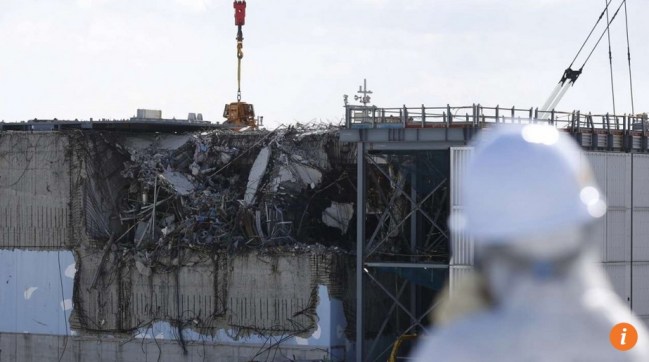
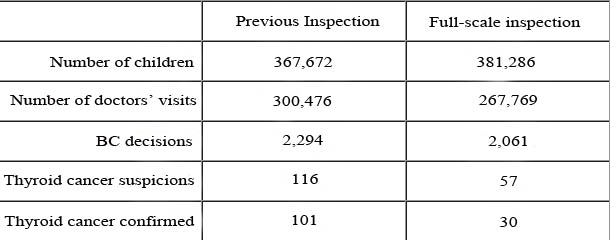
A survey begun in April 2014 to check the impacts of the 2011 Fukushima nuclear crisis has found that 30 children have so far been diagnosed with thyroid cancer and 27 are suspected of having the disease, a prefectural government panel said on Monday.
Most of them were thought to be problem free when their thyroid glands were checked during the first round of the survey conducted over a three-year period through March 2014.
The first survey covered about 300,000 children who were under the age of 18 and living in the northeastern Japan prefecture when the nuclear plant disaster was triggered by a huge earthquake and subsequent tsunami in March 2011.
The number of children diagnosed with thyroid cancer in the second round was up from 16 as reported at the previous panel meeting in February.
Hokuto Hoshi, head of the panel and a senior member of the Fukushima Medical Association, maintained his earlier view of the correlation between the cancer figures and radiation, saying based on expertise acquired so far, it is “unlikely” that the disease was caused by radiation exposure.
But Hoshi said: “Concerns have been growing among Fukushima residents with the increase in the number of cancer patients. We’d like to further conduct an in-depth study.”
When the results of the first and the ongoing second round of the heath survey are combined, the number of children diagnosed with thyroid cancer totals 131 and 41 are suspected of having it.
According to the Fukushima Medical University and other entities involved in the health checks, the 57 children in the second round of the survey either confirmed or suspected to have thyroid cancer were age 5 to 18 at the time of the triple reactor meltdown and the sizes of their tumours ranged from 5.3mm to 35.6mm.
The examiners were able to estimate how much external radiation exposure 31 of those children had over the four months immediately after the catastrophe, with the maximum being 2.1 millisieverts. Eleven children were exposed to less than 1 millisievert.
1 This Month

of the week – Shut Down Drone Warfare!


Tell the Ukrainian Government to Drop Prosecution of Peace Activist Yurii Sheliazhenko

Petition to revoke the licensing of the Near Surface Nuclear Disposal Facility (NSDF) at Chalk River. https://www.ourcommons.ca/petitions/en/Petition/Details?Petition=e-7247
To see nuclear-related stories in greater depth and intensity – go to https://nuclearinformation.wordpress.com
-
Archives
- April 2026 (68)
- March 2026 (251)
- February 2026 (268)
- January 2026 (308)
- December 2025 (358)
- November 2025 (359)
- October 2025 (376)
- September 2025 (257)
- August 2025 (319)
- July 2025 (230)
- June 2025 (348)
- May 2025 (261)
-
Categories
- 1
- 1 NUCLEAR ISSUES
- business and costs
- climate change
- culture and arts
- ENERGY
- environment
- health
- history
- indigenous issues
- Legal
- marketing of nuclear
- media
- opposition to nuclear
- PERSONAL STORIES
- politics
- politics international
- Religion and ethics
- safety
- secrets,lies and civil liberties
- spinbuster
- technology
- Uranium
- wastes
- weapons and war
- Women
- 2 WORLD
- ACTION
- AFRICA
- Atrocities
- AUSTRALIA
- Christina's notes
- Christina's themes
- culture and arts
- Events
- Fuk 2022
- Fuk 2023
- Fukushima 2017
- Fukushima 2018
- fukushima 2019
- Fukushima 2020
- Fukushima 2021
- general
- global warming
- Humour (God we need it)
- Nuclear
- RARE EARTHS
- Reference
- resources – print
- Resources -audiovicual
- Weekly Newsletter
- World
- World Nuclear
- YouTube
-
RSS
Entries RSS
Comments RSS
 nuclear-news