Chinese parents seek refunds for Japan trip, citing radiation concerns

Families of 40 choir members cancel Tokyo trip after travel advisory from Chinese embassy
Parents of a children’s choir in southern China are seeking refunds for a trip to a singing competition in Japan that they cancelled over concerns of radiation leaks.
Their requests to refund the training, travel and accommodation fees, which add up to 19,800 yuan (US$2.900)for each child, have been denied by the singing training centre of the Guangzhou Opera House, with which the choir is affiliated, Television Southern of Guangdong reported.
The concerned parents said each family paid fees to the training centre in January for training, visas, insurance and accommodation for the trip to Japan for an international choir competition in August.
Forty students signed up for the trip, the report said.
Many parents became worried a month later when the Chinese embassy in Tokyo issued a reminder of record-high radiation from the Fukushima nuclear plant, which has been leaking radioactivity since being badly damaged by an earthquake and tsunami in 2011.
The embassy statement cited a spokesperson from the Chinese Foreign Ministry in Beijing and urged Chinese tourists in Japan to make appropriate arrangements. The request for refunds was denied by the training centre, who insisted that parents would have to pay 20 per cent of costs, or about 4,000 yuan, to cancel the trip.
Many parents said that was unacceptable as health concerns should be of priority to the training centre as well as the families.
Some parents rallied in front of the training centre to raise attention to the issue, the report said.
The head of the choir said in a statement that the group was non-profit and he would personally ask for a full refund from the Opera House.
He said he had arranged a meeting to negotiate for the parents on Thursday.
Japan has become a popular travel destination for Chinese tourists in recent years after it eased visa rules for mainland tourists, who have flooded to their near neighbour where they spend up large on items that range from luxury watches to toilet seats.
Columban missionary backs bishops against nuclear industry after harrowing visit to Fukushima clean-up

Evacuated: An evacuee rests in a gymnasium serving as an evacuation centre in Yamagata, Japan, in March 2011. Residents from the vicinity of Fukushima Dai-ichi nuclear power plant were sheltered at the gym, as officials and workers struggled to contain the situation at the badly damaged nuclear facility.
A COLUMBAN missionary has witnessed a massive contamination clean-up in the Japanese region surrounding Fukushima, where a 2011 earthquake and tsunami triggered a nuclear power plant meltdown.
Fr Paul McCartin, recently visited the Fukushima region, six years after the nuclear disaster, and ahead of a government evacuation order being lifted at the end of this month, which will allow people to return home.
Arriving by bullet train at the town of Kouriyama, 60km west of Fukushima Number One Nuclear Power Plant, Fr McCartin said the first surprise was the large radiation monitor in front of the station.
“Over the next three days I saw similar monitors in cities, beside country roads and along expressways,” Fr McCartin, the Columban Justice, Peace and the Integrity of Creation co-ordinator in Japan, said.
He has worked in Japan since 1979 and visited the Fukushima last September.
“I had taken face masks but our guides gave us better ones,” he said.
“We were told to make sure we washed our hands and around our mouths before eating.
“I was given a small radiation monitor to wear around my neck.
“Over the two-and-a-half days I was exposed to 8.1 micro Sieverts, an ‘acceptable’ amount.”
The Sievert is a measure of the health effect of low levels of ionising radiation on the human body.
As Fr McCartin drove through the Fukushima countryside, he found houses barricaded, roads closed and warnings from officials amidst a massive clean-up.
“I was restricted. There were roadblocks with security personnel,” he said.
“I was advised not to hike in Fukushima as there is a lot of radiation in the mountains, especially at the base of mountains as rain washes it down.
“Buildings and roads are being washed down, and contaminated soil and vegetation being removed.”
He said topsoil to a depth of five centimetres was being removed and replaced with soil from unaffected areas.
“There are large collections of industrial waste bags all over the place. There must be hundreds of thousands, if not millions,” he said.
At the end of March, Japan is set to lift evacuation orders for parts of Namie, located 4km from the wrecked Fukushima Daiichi nuclear plant, as well as three other towns.
More than half of Namie’s former 21,500 residents have decided not to return.
Namie, and other nearby centres are now ghost towns, dilapidated, and for many, they conjure horrific memories.

Tsunami damage: Facilities near the seawater heat exchanger building at Tokyo Electric Power Company’s Fukushima Daini nuclear power plant Unit 3 reactor on April 2, 2011, days after an earthquake and tsunami hit the area in north-east Japan.
A government survey showed last year, there were lingering concerns over radiation and the safety of the nuclear plant, which is being decommissioned.
Beyond radiation risks, an unexpected nuisance looms – hundreds of wild boars have descended from surrounding hills and forests into the deserted towns.
The creatures have roamed across the radioactive contaminated region.
In Namie, wild boars occupy the empty streets and overgrown backyards foraging for food.
In the nearby town of Tomioka, local hunters have captured an estimated 300 boars.
Following his visit last September, Fr McCartin is concerned about the spread of contaminated material.
“Low-level waste is being recycled,” he said.
“Highly contaminated waste is being burned.
“So far only one per cent of high-level waste has been burned.
“More incinerators are being constructed.
“Contaminated waste is being used in the wall being built along the shore to prevent another tsunami hitting the area.
“In fact, there is so much radioactively contaminated waste that local facilities can’t handle it, so ‘low-level waste’ is being transported to many distant places for disposal.
“Contaminated fishing gear and nets are being disposed of in the town where I live.
“In this way, radiation is being spread to many parts of the country.
“It would seem to make sense to keep it where it is and avoid unnecessarily contaminating the rest of the country.”
Fr McCartin said the Japanese media was muzzled from challenging the government on Fukushima and the hazards of nuclear power.
The efforts of individual journalists reporting on the issue were often dismissed.
“A Catholic in Yokohama told me last year that after his daughter wrote a piece on Fukushima for the newspaper she works for, her boss told her, ‘No more on Fukushima’,” he said.
“The government has threatened to shut down any media organisation that publishes something the government doesn’t like.
“In the last year or so three forthright and prominent media personalities have been sacked or not had their contracts renewed.”
Fr McCartin said he supported a call by Japanese Catholic bishops to abandon the nuclear power industry.
“I believe that if the government transferred a small fraction of the trillions of dollars it throws at the nuclear industry to the renewable energy industry, the country would be awash in safe energy in a very short time,” he said.
A Campaign to Tackle “Misinformation” about Radioactive Contamination
Masahiro Imamura, Minister for Reconstruction, wants to launch a large-scale campaign, to correct the incorrect information about radioactive contamination of agricultural, forestry and fisheries products from Fukushima Prefecture; as an effort to tackle the issue of “misinformation about radioactive contamination” crippling Fukushima foods. That means more propaganda to come, more lies to hide the real risks of radiation to the people’s health. As if propaganda, to brainwash the people with a large-scale campaign would be the solution to make radiation disappear.

Reconstruction chief Masahiro Imamura
Reconstruction chief praises efforts in Tohoku, flags information campaign on radiation risks
Minister for reconstruction Masahiro Imamura has praised efforts to rebuild the devastated Tohoku region but says a large-scale information campaign is needed to share accurate information about radiation six years after the March 2011 meltdowns at the Fukushima No. 1 nuclear power plant.
Imamura outlined the plan in a recent interview in response to what he said was incorrect information about radioactive contamination of agricultural, forestry and fisheries products from Fukushima Prefecture.
It also comes as a growing number of children who evacuated from the prefecture fall victim to bullying.
Massive amounts of radioactive substances were emitted from the plant soon after it was knocked out by massive tsunami from the 9.0-magnitude March 11, 2011, Great East Japan Earthquake, which hit hardest in Fukushima and the nearby prefectures of Miyagi and Iwate.
Asked about the degree of progress in reconstructing areas hit by the disaster, Imamura said, “Acquisition of land and other procedures needed for the restoration of damaged infrastructure initially took time, but the pace of construction work was very rapid once it was launched.”
“From now, we should focus on the rebuilding of Fukushima,” he said, noting that medium- to long-term measures should be promoted, including decommissioning the Fukushima No. 1 plant and decontaminating areas polluted with radioactive fallout.
“We want to encourage evacuees to return to their hometowns in Fukushima by presenting future visions for the communities through improving the living environment and accelerating the revival of local industries,” Imamura added.
On how to tackle the incidences of bullying targeting evacuated Fukushima children, Imamura said, “We’ll strengthen information-sharing about radiation. All government agencies should jointly work to compile and launch a campaign for that purpose, while obtaining cooperation from private companies.
“This is an issue for not only children, but adults,” he said. “We’ll prepare documents and other materials that are easy to understand in order to eliminate prejudice against evacuated people.”
Imamura said the campaign would also be an effort to tackle the issue of “misinformation about radioactive contamination crippling Fukushima foods.”
“I’ll seek cooperation from Prime Minister Shinzo Abe as well,” he said.
Imamura said he believed the Reconstruction Agency’s efforts to date to rebuild areas affected by the March 2011 disaster have been praised to a certain degree. Still, he pointed to the importance of re-examining whether information on what affected areas need has been properly conveyed to the Reconstruction Agency and other government bodies.
Imamura said Japan’s aging population and low birthrate were also contributing to shrinking communities across the nation — something he described as a structural problem.
“It’s important to build a system that generates profits through stepped-up use of information technology and the modernization of factory equipment, even if human resources are limited,” he said.
“We need to check again whether communities will be able to smoothly help one another in times of disaster, although lessons from the March 2011 disaster were effectively utilized in a series of powerful earthquakes that mainly hit Kumamoto Prefecture in April last year, and the October 2016 strong quake in Tottori Prefecture,” Imamura added.
http://www.japantimes.co.jp/news/2017/03/21/national/reconstruction-chief-praises-efforts-tohoku-flags-information-campaign-radiation-risks/#.WNJEq6KmnIV
Asking the tough questions on Fukushima
What a load of spun crap, to be polite: “Moreover, the government is lifting the evacuation order for any areas where annual radiation levels are “no more than” 20 mSv. The International Commission on Radiological Protection told the government that once the situation had stabilized in the affected areas, people could return if radiation dropped to between 1 and 20 mSv, but the lower the better. Exposure to 20 mSv for a short period may not be a problem, but it could have harmful effects in the long run.”

In the thick of it: Industry Minister Yosuke Takagi (right) is exploring a variety of options to boost agricultural areas near the crippled Fukushima No.1 nuclear power plant.
In January, regional newspaper Fukushima Minpo interviewed Yosuke Takagi, state minister of economy, trade and industry. While talking about reconstruction plans for areas near the crippled Fukushima No. 1 nuclear power plant, Takagi mentioned resurrecting Dash-mura (Dash Village), a farm created from scratch by boy band Tokio for its Nippon TV series “The Tetsuwan Dash.”
The location of Dash-mura was always secret, lest Tokio’s fans descend on the project and destroy its rustic purity. But following the reactor accident caused by the Great East Japan Earthquake, it was revealed that the farm was in an area declared off-limits due to its proximity to the plant. It was promptly abandoned.
A different news outlet, Fukushima Minyu, clarified that the revival of Dash-mura is “nothing more than a personal idea of Takagi’s,” but that he intends to discuss it with related parties. An 80-year-old farmer who once worked with Tokio on the project told Minyu that bringing back the farm would be a great PR boost for the area’s agriculture, which is obviously Takagi’s aim. The show’s producer, however, after hearing of Takagi’s comment, tweeted that he knew nothing about the news, adding cryptically that “Dash-mura is no one’s thing.”
The Huffington Post called the Ministry of Economy, Trade and Industry to ask if it had any intention of reviving Dash-mura. A representative only “confirmed” that Takagi had “made such a comment” and said METI had no “definite plan” to that end but might “study it.”
Nevertheless, the idea fits in with the government’s goal of getting former residents to move back to the area. Last week, authorities announced they would further reduce the evacuation zone at the end of the month, which means it will have shrunk by 70 percent since April 2014. The concern is that few people want to return. Some have already made lives for themselves elsewhere and see a lack of opportunity in their old communities.
Many also remain suspicious of the government’s assurances that radioactivity has dropped to a safe level. There is still debate among experts as to whether or not the radiation in the area is dangerous. The government says that the problems caused by the accident are now “under control,” and affected residents can soon go back to their old lives.
One media outlet who has challenged this assumption is TV Asahi’s “Hodo Station.” On March 9, the nightly news show sent its main announcer, Yuta Tomikawa, to Iitate, a village located about 40 km from the crippled nuclear facility. All 6,000 residents were eventually evacuated after the accident.
Standing in front of rows of black plastic bags, Tomikawa reported that, according to the government, decontamination efforts have been a success. A safe annual radiation level is 1 millisievert, but a local dairy farmer told Tomikawa that his own readings showed five times that level, adding that 70 percent of Iitate is wooded and forest land had not been decontaminated yet.
Moreover, the government is lifting the evacuation order for any areas where annual radiation levels are “no more than” 20 mSv. The International Commission on Radiological Protection told the government that once the situation had stabilized in the affected areas, people could return if radiation dropped to between 1 and 20 mSv, but the lower the better. Exposure to 20 mSv for a short period may not be a problem, but it could have harmful effects in the long run.
Tomikawa did not say that people who returned to Iitate would be in danger, but he did imply that the government is manipulating numbers in an attempt to persuade evacuees to return to their homes.
The web magazine Litera wrote that TV Asahi is the only mainstream media outlet to question the government line in this regard. Actually, Nippon TV did something similar, albeit indirectly. Last month, it rebroadcasted an episode of its “NNN Document” series about the married manzai (stand-up comedy) duo Oshidori Mako-Ken’s efforts to come to terms with the Fukushima meltdowns and their aftermath.
The couple belongs to the large Osaka-based entertainment company Yoshimoto Kogyo, but ever since the disaster Mako has attended about 500 related news conferences, making a nuisance of herself by plying Tokyo Electric Power Company Holdings employees and government officials with questions the mainstream media don’t usually ask.
In order to gain access to the news conferences, she offered stories to the weekly magazine Spa! Her editor there told Nippon TV that Mako is now respected or resented by a lot of full-time journalists, partly because she’s a geinojin (entertainer) who has proved her mettle as a reporter, but mainly because of her hard-line queries, which put her interlocutors on the spot.
Following the disaster, Mako became suspicious when she saw people fleeing Tokyo in large numbers but heard nothing about it on the news. In order to make sense of the situation she’d watch unfiltered news conferences about the disaster on the internet. She realized only independent reporters asked tough questions, so she started attending them herself as a proxy for average people who didn’t understand what was going on. The more officials obfuscated, the more she studied.
She’s now recognized by some foreign press as one of the most informed persons on the subject — she even received a letter of encouragement from Pope Francis — and yet she’s shunned by the Japanese press. Nevertheless, she has dedicated followers, including workers cleaning up the reactor who often feed her questions to ask of officials. She’s won awards for her work, but from citizens groups, not media groups.
Nowadays, Mako and Ken do more free lectures on Fukushima No. 1 than they do comedy shows. One of their main themes is that media reports tend to confuse the public rather than inform them, but that’s really the fault of the government, which would like nothing better than for people to feel as if nothing ever happened.
No Return to Normal in Fukushima
Just 6 years ago Fukushima was struck by a deadly earthquake, and then a nuclear disaster. For the survivors, there’s been no return to normal.
Fukushima laden with piles of radioactive soil that can’t be moved into storage

Masaaki Sakai faces his home, which remains standing in the Fukushima Prefecture village of Iitate, on Feb. 15, 2017. In some spots the level of radiation exceeds 1 microsievert per hour, and Sakai has decided to have the structure demolished. (Mainichi)
FUKUSHIMA — As decontamination planned in the wake of the Fukushima nuclear disaster nears an end this fiscal year, focus is shifting to the massive amount of radioactively tainted soil that has piled up during decontamination work. But the construction of interim storage facilities that are supposed to hold this waste within Fukushima Prefecture for up to 30 years before it is finally disposed of has been delayed.
As of the end of February, only about 20 percent of the 16,000 hectares earmarked for interim storage has been acquired through land contracts. It thus appears inevitable that provisional and onsite storage that was only supposed to last for three years will drag on for a long time. The situation casts doubt on the prospects of finding a final resting place for the waste outside Fukushima Prefecture within 30 years.
Six years after the disaster at the Fukushima No. 1 Nuclear Power Plant, the Fukushima Prefecture village of Iitate remains completely evacuated. With the exception of a so-called “difficult to return zone” in the south of the village, the central government plans to lift the evacuation order upon completion of decontamination work at the end of March.
Masaaki Sakai, 39, who now resides in the city of Fukushima, has a home in the Komiya district of Iitate, right next to the village’s “difficult to return” zone. A dosimeter during a recent visit showed the area around the 60-year-old, snow-covered farmhouse stood at more than 1 microsievert per hour. The level equates to more than 5 millisieverts per year — five times the 1 millisievert exposure limit for a regular person.
Sakai points out that level of radiation is sometimes higher. “Today the level is low because there is snow,” he says. In the near future he plans to have his home pulled down, as the deadline for applying for the government to cover the cost of doing so is approaching.
“Even if I want to return to Iitate, if they say, ‘Decide now’ then the only thing I can do is decide not to return,” he murmurs.
One of the reasons behind Sakai’s decision not to return is the radioactively contaminated soil that remains in the village. Walking around the village, one can see mounds with green covers over them, concealing flexible containers that hold contaminated soil. According to the Ministry of the Environment, the amount of tainted soil stored temporarily like this, as of the end of January, totals roughly 2.4 million cubic meters for the village of Iitate alone, or enough to fill the Tokyo Dome baseball stadium twice.
So far, however, only about 6,000 cubic meters of soil have been transported to interim storage facilities, while the amount due to be transported next fiscal year stands at about 22,000 cubic meters. At this pace, under a simple calculation, it would take over 100 years to transport all of the waste to interim storage facilities.
“There’s no way I’m going to live surrounded by mountains of contaminated soil,” Sakai says.
Makeshift storage of radioactive soil in areas that have not been evacuated also looks likely to be prolonged. In areas that aren’t under evacuation orders, it is the local municipalities, not the government, that handle the decontamination work. In five municipalities including the cities of Fukushima and Koriyama, the contaminated soil left after decontamination work is mostly buried onsite.
Six years have passed since the outbreak of the Fukushima nuclear disaster, and in many cases people have asked for the waste to be removed so they can extend or rebuild their homes or resume farming activities, but the delay in building interim storage facilities means the only solution for the time being is to change the spot where the waste is buried.
It costs several hundred thousand yen to rebury waste in a single case, but until now the Ministry of the Environment has not allowed funds to be used for the reburying of such waste, on the premise that it is supposed to be stored for only a short period of time. Local bodies have still billed the central government by quietly tacking on the cost to the fee for other decontamination work, but this will become more difficult to do next fiscal year when decontamination work is completed.
In January, the Ministry of the Environment adopted a new policy of granting funds for the reburying of waste if the original location hindered the construction of a new home. An official at one local body commented that the move was a relief, but there are outstanding issues. As a rule, the government collectively bills Tokyo Electric Power Co. (TEPCO), operator of the Fukushima No. 1 Nuclear Power Plant, for the cost of decontamination work, but it is unclear whether TEPCO has to pay for the reburial of tainted soil.
Separately, decontamination work has also been carried out in prefectures besides Fukushima — extending to 57 municipalities in seven prefectures, including Tochigi and Miyagi. The amount of contaminated soil in these cases stands at about 320,000 cubic meters. In about 95 percent of cases, the soil is stored onsite. But since interim storage facilities are designed for contaminated soil from Fukushima Prefecture alone, it has not even been decided what should be done with this waste.
http://mainichi.jp/english/articles/20170309/p2a/00m/0na/019000c
After Fukushima disaster, Japanese mothers don lab coats to measure radiation

IWAKI, Japan, March 9 (Thomson Reuters Foundation) – At a laboratory an hour’s drive from Japan’s Fukushima nuclear plant, a woman with a white mask over her mouth presses bright red strawberries into a pot, ready to be measured for radiation contamination.
Six years after a massive earthquake off the coast of Japan triggered meltdowns at three of Fukushima’s reactors, local mothers with no scientific background staff a laboratory that keeps track of radiation levels in food, water and soil.
As some women divide the samples between different bowls and handmade paper containers, others are logging onto computers to keep an eye on data – findings that will be published for the public to access.
The women on duty, wearing pastel-coloured overalls, are paid a small salary to come in for a few hours each day, leaving them free to care for their children after school.
“In universities, data is handled by qualified students, who have taken exams qualifying them to measure radiation. Here, it’s done by mothers working part-time. It’s a crazy situation,” laughed Kaori Suzuki, director of Tarachine, the non-profit organisation that houses the mothers’ radiation lab.
“If a university professor saw this I think they would be completely shocked by what they see.”
Tarachine was set up 60 km (40 miles) down the coast from the Fukushima plant, in the city of Iwaki. After the magnitude 9 quake struck on March 11, 2011, triggering a tsunami, authorities declared a no-go zone around the plant.
Iwaki lay outside its 30 km radius, with lower radiation levels compared to the rest of Fukushima prefecture.
But with public announcements advising locals to stay indoors in the aftermath of the worst nuclear calamity since Chernobyl, the “invisible enemy” of radiation has continued to worry the mothers working at the lab.
“As ordinary citizens we had no knowledge about radiation at all. All we knew was that it is frightening,” said Suzuki.
“We can’t see, smell or feel radiation levels. Given this invisibility, it was extremely difficult for us. How do we fight it? The only way is to measure it.”
To supplement readings by the Japanese government and the Tokyo Electric Power Company (TEPCO) that manages the nuclear plant, Tarachine publishes its own findings every month.
With donations from the public that helped them buy equipment designed to measure food contamination, the mothers measure radioactive isotopes caesium 134 and 137, and collect data on gamma radiation, strontium 90 and tritium, all of which were released during the Fukushima disaster.
Strontium-90 gravitates toward the bones when absorbed by breathing it, drinking it in water, or eating it in food. It can remain for years, potentially causing bone cancer or leukaemia.
Tritium goes directly into the soft tissues and organs of the human body. Although it is less harmful to humans who are exposed to small amounts of tritium every day, it could still be a hazard for children, scientists say.
The mothers say other parents trust the lab’s radioactivity readings in local food more than those from the government.
“This issue is part of everyday life for these mothers, so they have the capability to spot certain trends and various problems rather than just accumulating expert knowledge,” said Suzuki.
To handle potentially dangerous materials, the mothers have to study for exams related to radiation and organic chemistry.
“At the beginning I was just completely clueless. It gave me so much of a headache, it was a completely different world to me!” said Fumiko Funemoto, a mother of two, who measures strontium 90 at the lab.
“But you start to get the hang of it as you’re in this environment every day.”
As the lab only accepts items for testing from outside the exclusion zone, most results show comparatively low radiation levels.
But Suzuki says this is an important process and is especially reassuring to the parents of young children. The women also measure radiation levels in sand from the beach, which has been out of bounds to their children.
“If the base is zero becquerels (unit of radiation), and there is, say, 15 or 16 becquerels of caesium, that’s still higher than zero. That means there is slightly more risk,” Suzuki said.
“There are also times when you’re like, ‘Oh, I thought levels were going to be high there – but it’s actually ok’. The importance lies in knowing what’s accurate, whether it’s high or low … unless you know the levels, you can’t implement the appropriate measures.”
Since official screenings began following the nuclear accident, 174 children in Fukushima prefecture have been diagnosed with – or are suspected of having – thyroid cancer, according to figures from Fukushima’s local government.
Despite the International Atomic Energy Agency (IAEA)reporting in 2015 that an increase in thyroid cancer is unlikely, the mothers insist there is value in their work.
The first pictures from inside the nuclear plant were released by TEPCO in January, announcing it may have found nuclear fuel debris below the damaged No. 2 reactor – one of three affected by the 2011 disaster.
“In general, the issue of nuclear power is not really talked about much these days. It was talked about after the accident for about a year or so, but today, conversations mentioning words like ‘radiation’ don’t happen anymore,” Funemoto said.
“But I think the reality is different. The radiation isn’t going to go away. That’s why I’m doing this. So many places are still damaged. This idea that it’s safe and that we shouldn’t be anxious doesn’t really add up.”
Ai Kimura, another mother agrees. “My parents think I’m a bit paranoid. They keep saying, ‘it’s okay isn’t it?” she said.
“But what if there’s a chance that in 10 or 20 years time, my own child gets thyroid cancer? And I could have done my bit to minimise the risks. My children are mine and I want to do whatever I can to protect them.”
http://uk.reuters.com/article/japan-women-radiation-idUKL8N1G66K0
Ocean survey 1.5 km off the coast of Fukushima Daiichi
Results collected in an ocean survey 1.5 km off the coast of Fukushima:
Cesium 137 – 51.6 Bq/kg
Cesium 134 – 16.5 Bq/kg
Strontium 90 – 1.92 Bq/kg
Gov’t plan to cut back radiation tests on produce draws mixed reactions

The national government suggested it would scale back radiation tests on produce from Tokyo and 16 other prefectures affected by the Fukushima nuclear disaster, at a citizen-oriented event in Tokyo on Feb. 2, drawing mixed reactions from those in attendance.
A draft policy was put together by government bodies including the Ministry of Agriculture, Forestry and Fisheries and the Consumer Affairs Agency and calls for allowing reduction of the tests from the 2017 fiscal year. The plan was influenced by the fact that there are now almost no cases of agricultural products that exceed the regulatory limit for radioactive cesium of 100 becquerels per kilogram. Under the draft policy, the Tokyo Metropolitan Government or any of the affected prefectural governments whose agricultural products were at half or less of the limit for the past three years could choose to scale back their tests.
Representatives from consumer groups and Fukushima producers were present at the Feb. 2 meeting. There were many voices of opposition against the draft policy, saying it was too early to cut back the tests, or that the requirement for scaling them back should be stricter than half or less of the regulatory limit. On the other hand, another attendee said that over the last five years the tests had cost around 4 billion yen and the money should “be spent toward more meaningful goals.”
According to the testing results from fiscal 2011 through fiscal 2015, during the first two years the percentage of products like vegetables, fruits, tubers and meats from these areas with radioactive cesium in excess of the regulatory limit was between 0.1 percent and 5.9 percent, but since 2013 no excessive radiation has been detected.
The central government plans to hold an event to exchange ideas on the matter on Feb. 17 and get a better understanding of public opinion, before deciding on whether to actually downsize the testing.
http://mainichi.jp/english/articles/20170203/p2a/00m/0na/004000c
Up to 4.20µSv near the Fukushima Tetsuzan water dam
This short article is dedicated to a pro-nuke troll, whose alias is Octo.
Octo, should I indulge the reader, is usually present at the chat of the “Fukushima Diary” blog. He enjoys pushing his propaganda of how nuke is safe.
How Tepco is doing a terrific job at Fukushima Daiichi and is in total safety control of everything.
How radiation is now very low in Fukushima How the fish and seafood is now safe etc.
Everyone is believing his crap *cough*, but he, like all of the other bewildered, confused and baffled Japanese *experts? never gives up.
Watching this video, I am thinking about him and his continuous lies, and also all those other Japanese pro-nuke trolls that I encountered on internet in the past few years.
This video was shot last November 2016 South of Soma, it is the mountain trail to reach the Tetsuzan dam, a place approximately 20km from the Fukushima Daiichi nuclear plant.
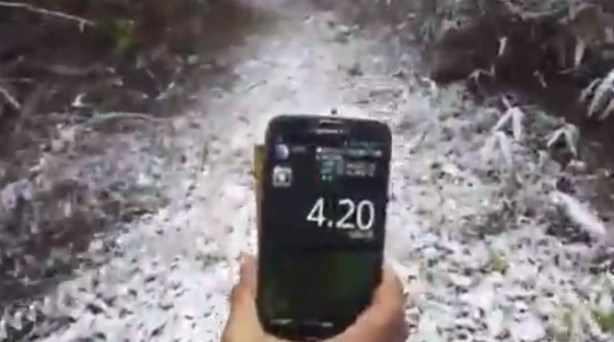
I think all those disinformation spinners paid by Tepco, Dentsu or Government, whose job is to spread lies about the Fukushima disaster on blogs, forums and Facebook, should all go living up there, as they claim it is now completely safe.
They should breath the good air from Fukushima, eat everyday very safe Fukushima rice and vegetables, and of course eat also plenty of safe fish and seafood, and drink plenty Fukushima safe water.
I would give them only one word of advice :
“Don’t forget to smile,
Smile a lot everywhere and everyday, so that the radiation won’t affect you.”
Special credit to the Fukuichi Citizen Radiation Monitoring Project
Fukushima Daiichi Nuclear Disaster Tests Pacific Ocean’s Ecosystem

By Cole Hambleton
On Friday March 11, 2011, following a major earthquake, a 15-meter tsunami disabled the power supply and cooling of three reactors at the Fukushima Daiichi power plant, causing a nuclear accident. All three reactor cores largely melted in the first three days, but were stabilized in the following weeks with seawater. By July 2011, they were being cooled with recycled water from a new treatment plant. An official “cold shutdown condition” was eventually achieved in mid-December 2011.
In November 2011, the Japanese Science Ministry reported that long-lived radioactive cesium had contaminated 11,580 square miles of the land surface of Japan – of which approximately 4,500 square miles (an area almost the size of Connecticut) was found to have radiation levels that exceeded Japan’s pre-earthquake allowable exposure rate of 1 millisievert (mSV) per year.1,2
The Fukushima Daiichi nuclear disaster also produced the largest discharge of radioactive material into the Pacific Ocean in history. Fifteen months after a quantity of radioactive cesium were deposited into the Pacific Ocean, 56% of all fish catches off the coast of Japan were found to be contaminated. 3 Fishing continues to be banned off the coast of Fukushima up to 20 kilometers from the nuclear plant, where 40 percent of bottom-dwelling fish were recently found to have radioactive cesium levels higher than current Japanese regulatory limits for human consumption. Contamination levels are also still unacceptably high in the base levels of the food chain, including algae and plankton. With contamination being found through the whole food chain, scientists believe that the long-term effects on the Japanese human population’s diet will be significant.4
What Has Been Released Into the Pacific Ocean?
Many different radioactive elements are contained in the water leaking from Fukushima. Plutonium 239, which can cause death if inhaled in microgram-sized doses, is found in the released water and can bio-accumulate in the food chain leading to leukemia and bone cancers if ingested by humans. Both short-lived radioactive elements, such as iodine-131, and longer-lived elements such as cesium-137 with a half-life of 30 years, that have been found in the discharged water can be absorbed by phytoplankton, zooplankton, kelp, and other marine life and then can be transmitted up the food chain, to fish, marine mammals, and humans. Other radioactive elements, including plutonium, which has been detected outside the Fukushima plant, also pose a threat to marine life. 5
Capacity of Ocean to Recover?
The Chernobyl accident in 1986 gave scientists a small amount of information on what to expect during a nuclear meltdown on land, but the world has not experienced a meltdown that affects the ocean. 6 Scientists generally agree that oceans have the unparalleled ability to dilute most contaminants to manageable levels and eventually break down those contaminants over time.
Unfortunately, the types of contaminants released due to the Fukushima disaster are substantially different from the more common oil or other chemical spills experienced by the world’s oceans. How the radioactive materials released from the Fukushima plant will behave in the ocean will depend on their chemical properties and reactivity.
If the radionuclides are in soluble form, they will behave differently than if they are absorbed into particles. Soluble iodine will disperse rapidly. But if a radionuclide reacts with other molecules or gets deposited on existing particulates – minerals, for example – they can be suspended in the water or, if larger, may drop to the sea floor where the water is not circulated or blended as often as the water closer to the surface. 7
If the contaminants make it to the ocean floor, they may be able to avoid being broken down by natural processes for a longer period of time. This type of pollution has never been seen before so the long-term consequences are not fully understood. Scientists are currently monitoring the ocean and land contamination. 8
While most scientists believe that the ocean’s powers of dilution will eventually spread the contamination in its suspended and soluble states over time and return the ocean to normal levels of radioactivity, those same scientists do not agree on the amount of time that this dilution will require. As Fukushima continues to dump contaminated water into the ocean, for the sake of the Pacific Ocean food chain, we must hope that the dilution occurs sooner rather than later.
1 About a month after the disaster, on April 19, 2011, Japan chose to drastically increase its “safe” radiation exposure levels from 1 mSV to 20 mSV per year, 20 times higher than the U.S. limit. This allowed the Japanese government to downplay the dangers of the fallout and avoid evacuation of many badly contaminated areas.
2http://www.psr.org/environment-and-health/environmental-health-policy-institute/responses/costs-and-consequences-of-fukushima.html
3 Roslin, Alex. “Post-Fukushima, Japan’s Irradiated Fish Worry B.C. Experts.” Straight.com 19 Jul. 2012. Web. 6 Nov. 2012 <http://www.straight.com/article-735051/vancouver/japans-irradiated-fish-worry-bc-experts>
4http://www.bloomberg.com/news/articles/2011-07-24/threat-to-japanese-food-chain-multiplies-as-cesium-contamination-spreads
5http://e360.yale.edu/feature/radioactivity_in_the_ocean_diluted_but_far_from_harmless/2391/
6http://www.world-nuclear.org/info/Safety-and-Security/Safety-of-Plants/Chernobyl-Accident/
7http://e360.yale.edu/feature/radioactivity_in_the_ocean_diluted_but_far_from_harmless/2391/
8http://e360.yale.edu/feature/radioactivity_in_the_ocean_diluted_but_far_from_harmless/2391/
Fukushima seafood: radioactive cesium not detected (i.e., less than the detection limit value) in 95.0 percent of 8,502 specimens
Here’s a correction on last week’s Kyodo News report on Fukushima seafood contamination.
Kyodo said that 95% of the more than 8,000 fish tested had contamination levels that were “hardly detectible”. Japan’s Atomic Industrial Forum reports, “…radioactive cesium was not detected (i.e., less than the detection limit value) in 8,080 specimens, or some 95.0 percent of the total.”
Not detected is considerably different from hardly detectible. JAIF adds that the specimens were taken from the Pacific Ocean within a 20 kilometer radius of F. Daiichi.
(Comment – With severe “radiophobia” infecting millions of Japanese, it is imperative that popular news outlets report accurately. Kyodo News ought to post a correction.)

All Fukushima Seafood Tested in 2016 Falls Below Cesium Standard Value
After the March 2011 accident at the Fukushima Daiichi Nuclear Power Plants, Fukushima Prefecture has been conducting tests on fish and shellfish in coastal waters. It was revealed recently that the concentration of radioactive cesium in all the fish and shellfish collected during tests in 2016 fell below the national standard value of 100Bq/kg. It was the first time since the nuclear accident that all such seafood from Fukushima fell below the standard value in a single calendar year.
According to the prefectural Fisheries Experiment Station, the number of specimens tested in 2016 was 8,502. Among those, radioactive cesium was not detected (i.e., less than the detection limit value) in 8,080 specimens, or some 95.0 percent of the total. The last time that the reference value had been exceeded was in March 2015, after which no instances have been registered.
The inspections, which started in April 2011, include fish and shellfish taken from the sea within a 20-km radius from the Fukushima Daiichi site. The proportion of fish and shellfish exceeding the reference value has been decreasing year by year, as follows: 39.8 percent in 2011, 16.5 percent in 2012, 3.7 percent in 2013, 0.9 percent in 2014, and 0.05 percent in 2015.
Test operations are continuing in limited sea areas in the coastal waters off Fukushima, including fish species in which it is difficult to incorporate radioactive substances.
http://www.jaif.or.jp/en/all-fukushima-seafood-tested-in-2016-falls-below-cesium-standard-value/
Fukushima, the Gift That Keeps on Giving

Radiation from Fukushima has now officially entered the food chain, can it be fixed?
Fukushima, as you may recall, was an accident at a Japanese nuclear complex back in 2011. A combination of an earthquake and a tsunami damaged the facility, allowing radioactive water to pour into the ocean. In fact, ABC news reported that — “The 2011 quake of magnitude-9 was the strongest quake ever recorded in Japan, and it generated a tsunami that knocked out the Fukushima plant, causing the worst nuclear crisis since Chernobyl a quarter of a century earlier.”
Since then, there have been various plans to stabilize the situation, but all have failed. Robots sent in to find the cores have failed. The National Post wrote that — “It takes two years to build them. Each operator trains for a month before picking up their controls. And they get fried by radiation after working for just 10 hours.” That’s right. In just 10 hours, the robots are so damaged, they don’t work. In fact, the article continued by writing — “The reason the robots need to get inside core is that officials need to locate the plant’s melted (and still very radioactive) fuel rods before they can plan on what to do next”.
Wait, you might be asking yourself, what about the ice wall? Well, RT reported that — “In March, (a Japanese) construction company began building the frozen wall of earth around the four damaged nuclear reactors and had completed most of the 1.5-km (1 mile) barrier. TEPCO hoped that the frozen earth barrier would thwart most of the groundwater from reaching the plant and divert it into the ocean instead.
However, little or no success was recorded in the wall’s ability to block the groundwater during the five-month-period. The amount of groundwater reaching the plant has not changed after the wall was built.” That’s right. This plan has also failed.
And while media has effectively been silent on the issue, it does pop up from time to time, such as this article in Science World Report — “(a) Woods Hole chemical oceanographer, tracked down the radiation plume in the seawater. He proposed that the (contaminated) seawater crossed the Pacific Ocean and reached (America’s) west coast.” In fact, that article revealed that — “the seawater samples collected last winter from the Tillamook Bay and Gold Beach in the west coast indicated the presence of low levels of nuclear radiations. Thankfully, the levels were calculated too low to cause any harmful impact on the human or animal population of the region.” But that is missing the point – radiation has now officially entered the food chain.
Although the article in Science World Report notes that the levels were low, it should also be noted that their samples were all the way across the ocean. What if they took a sample in other places? Surely, logic would dictate that it would become stronger, the closer one gets to Japan.
It should also be noted that radioactive water continues to pour into the ocean on a daily, hourly, and by the minute basis. That hasn’t stopped. It is happening right now. It happens while you sleep. It happens while you are awake. It happens even if no one is talking about it and has been happening for more than 5 years, and there is no plan to stop it.
Fukushima Trucks Spreading Unmeasurable Amount of Radiation
In Yamada, Futaba District, Fukushima, trucks carrying waste after decontamination work, go by spreading unmeasurable amount of radiation.
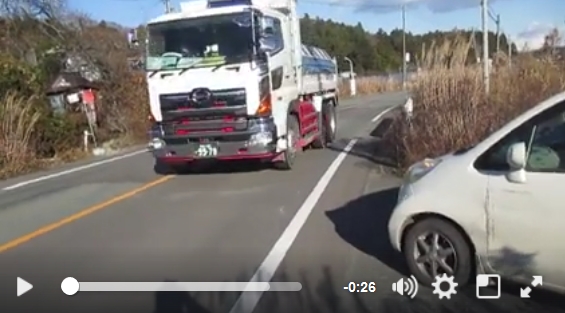

The Geiger counter hits 9.99 microSv/h which is its limit!


Recovery effort? Is n’t it better to relocate the entire residents elsewhere safe? In Japan, there are many villages and small towns where they suffer with depopulation.
What they do now is just to keep feeding big contractors, not helping affected people…..


Source: Oz Yo
Mountain of Light by Gen’yū Sōkyū – excerpt
As a writer and priest in Fukushima, Sōkyū grapples with the aftermath of the 2011 nuclear disaster in this short story about a son organising a funeral for his father, who collected radiation-contaminated waste
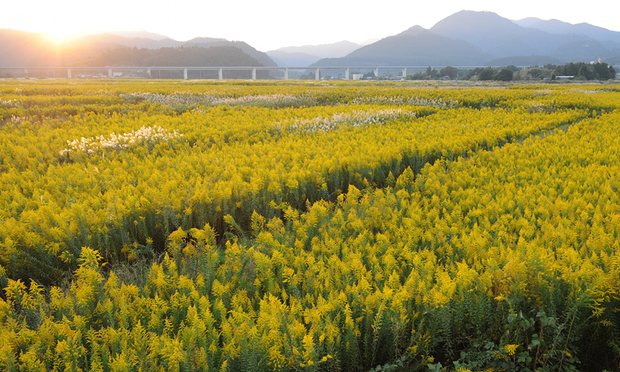
Rice fields in Fukushima, no longer cultivatable after the evacuation zone was dissolved in August 2012.
Akutagawa Prize winner Gen’yū Sōkyū has an unusual vocation among litterateurs: he is the chief priest of a temple in Fukushima, where nuclear disaster struck following the earthquake and tsunami of March 2011. Both a leader and a major voice in reconstruction efforts, Gen’yū uses fiction to grapple with the catastrophe, and in this story, Mountain of Light, he imagines (perhaps even hopes for) a future of provincial ascendance and “Irradiation Tours”. In this excerpt, the narrator relates his coming to terms with his father’s devotion in collecting the community’s “irradiated” — their radiation-contaminated waste, in other words.
—The editors at Asymptote
The next time I saw Dad was at Mom’s funeral. He himself would die three years later at ninety-five—twenty-five years after our last conversation—of old age, not cancer. After my mother’s cremation, he spoke to me.
“Your ma had a hard time of it, but it was all worthwhile. Thanks to the irradiated, we managed to live meaningfully, right up to the end, and that’s no joke. When my time comes… you’ll burn me on top of that mountain, right?”
His hearing wasn’t so good by that time, so while I said “Don’t be stupid,” apparently what he heard was “Okay, I’ll do it,” although I didn’t realise this until much later. He held my hands in front of Mom’s altar and said “Thank you” over and over again… It might’ve been a misunderstanding, but that was the first time he had ever shown me gratitude.
My brother and sister-in-law had only offered incense at the crematorium, and were no longer there. He was a consultant to an electronics manufacturer, and even though he said he had a meeting to attend, I was sure they had left out of fear. I too had debates with the missus about the effects of low-level exposure, almost every night. Eventually we stopped speaking, and came to see each other as “contaminated.” We’d separated by then. And that’s when I finally realised that we were both being completely ridiculous.
I’m sure all of you will agree—I mean, think about it, academics had all these opposing theories and no one was willing to budge. Some people said that anything up to one hundred thousand times the intensity of background radiation is fine, look at astronauts, they’re fine—and then others demanded that we spend trillions of yen on decontamination to scrape off fertile soil with low-level radiation. The Hormesis and Prophylaxis camps, yeah, that’s what they were called. Both sides wanted the other to calm down and talk things through, but like me and the ex, they just couldn’t do it. You could say my divorce was the result of a proxy war, haha.
People—organisations are even worse—go to terrifying lengths to save face. The ICRP, that’s the International Commission on Radiological Protection, they of all people should’ve created spaces for discussion, but showed no intention of doing so. And then public opinion was set on throwing every last baby out with the bathwater: if nuclear reactors were bad, then all radiation was bad too. In short, no one was calm.
But as you know, after the power plant accident, it was the ICRP who recommended raising the radiation exposure limit by twenty to a hundred times of the normal value. After that was rejected, they just stayed silent, same as me and the ex. Even now I have no idea who’s right. But what’s certain is that the radioactive potassium and carbon and whatnot in our bodies emit a fair amount of radiation, with or without the reactors. Somebody weighing sixty kilos would put out, oh, five thousand becquerels or so. Anyway, the Commission never officially changed their stance on low-level exposure after that. And now we have all of you taking part in this Irradiation Tour, coming to see the mountain my old man made. Radon hot springs are popular once more, and Fukushima’s population is even growing rapidly.
What was I… oh, right—that was quite a ramble—I was telling you about Dad’s request.
For the record, it wasn’t cancer. He might’ve said “Cancer wouldn’t be bad,” but in the end he had a prolonged bout of the autumn flu and kicked the bucket, just like that.
I got the news from my cousin, and when I came back Dad was already laid out in the main room, around there. Yes, right there, where the blond man is sitting, haha. I lifted the white cloth, and saw my old man looking solemn for the first time. It was as if he’d taken off the okame mask—I had never seen that face before, honest.
I spent the whole night thinking. I recalled what Dad said at Mom’s funeral, and I wasn’t sure what to do about his cremation. But the answer soon came to me. You see, my mother’s remains had disappeared from the altar.
Since Mom died eight years ago, I’d started coming back home a little more often. I’d retired from my job, and I didn’t have a family of my own. I wasn’t that worried about Dad living alone, rather I’d come to believe his mountain may have been some kind of miracle.
On one of those visits, he’d told me about their dog’s death, and how he had buried it atop that mountain. Sitting by my old man’s pillow, I looked over at the altar and noticed that while my mother’s picture was there, her remains were not. I put the pieces together and went outside. It was a still, humid night at the beginning of summer.
The sound of insects filled the air. It was my first time ever on that mountain. I realised, halfway up, that it had become much taller than before. It was even taller than it is now, nearly thirty metres, I’d wager. As I went up the winding path, I was aware of the dosimeter packed in my bag, but you know, I didn’t take any measurements. I think my feet were a bit shaky, but I wasn’t scared of anything anymore. Dad did the same thing every day, and he lived peacefully until the age of ninety-five, just like Mom.
Now and then, I felt his presence. Staring at the ground as I climbed, in the dim light of the moon, it seemed my old man was saying “It’s okay, it’s okay” and smiling overhead.
As I expected, there were two pieces of natural stone at the top, set about one metre apart. At some point, Dad had made and maintained a grave for Mom and another for their dog up there. And that’s why this mountain is like one of those burial mounds.
Looking around, I saw the neon signs of the neighbouring town twinkling like countless stars. Of course, the stars in the sky were also countless, and so beautiful. Perhaps Dad built the mountain with the knowledge of this view. I was suddenly reminded of him saying the word “meaningfully” at Mom’s funeral. The last words I’d heard Mom say also seemed to echo in my ear: “Someone come by?”
Thinking back later, the mountain seemed to be glowing faintly that time too, but I couldn’t distinguish it from the silvery moonlight.
I went to the temple the next morning and asked the priest to carry out the funeral at my home. I had the newspapers run not just a death notice, but a full obituary too. My old man had single-handedly taken on the irradiated of this town as well as other parts of the prefecture, so I felt the public ought to know about his death. I might’ve been a little carried away.
The funeral was an incredible affair.
I was very grateful for the hundred-odd wreaths, and the not one but five priests, but this wasn’t your regular congregation—this was a mob. The prefectural governor came, five or six mayors came too. Pretty sure there were over two thousand attendees. But the real highlight came during the cremation, after everyone had gone home.
The priest from my family temple was actually very supportive. When I told him about my old man’s request, he said “Let’s do it. We’ll perform the cremation on top of that mountain.” After the ceremony, the guys from the neighbours’ association carried Dad’s coffin up the mountain. As our ancestors did, we gathered kindling, placed a board on the kindling, and laid the coffin on the board. Straw from nearby rice fields, once considered hazardous, was piled up high on the coffin. It was starting to get dark, and the fire burned beautifully, it did. By that time, the Hormesis school of thought was already pretty mainstream, so I wasn’t surprised by the hundred or so people who had stayed behind to watch from the foot of the mountain. What I didn’t expect was what happened after those people had left. I’d invited the priest into the house, and as we were drinking, I heard a massive bang. I went outside to take a look, and the whole mountain was smouldering, not just the area around my old man’s body.
“It’s okay.”
That wasn’t my old man, it was the priest standing next to me.
After all, the mountain was made up of countless trees, branches, grass, all perfectly flammable. The priest probably also knew that the temperature would go up to five, six hundred degrees at most, and as long as it didn’t go over seven hundred degrees the caesium wouldn’t disperse.
“Is that true?”
“Yes, it’s okay, it’s okay, all of it will stay in the ashes.”
The priest came across as a salesman—no, I hear he used to work at an incinerator, maybe that was it—he spoke with complete assurance. I have no idea which of them first came up with the “it’s okay” mantra. Anyway, we made a makeshift table and continued drinking outside, sitting on upturned beer crates.
That’s when we finally saw it. Where the sky was turning into night, the air had a kind of sheen, it seemed to be lit from some deeper layer. It was the mountain, giving off a pale purple fluorescence. Now and then flames peeked out, smoke billowed up, but the purple aura that encompassed the whole shone with a light that would repel darkness forever. It was as if the cloud bearing the noble Amitābha had descended before our eyes.
The mountain continued to smoulder for several days, gradually shrinking and becoming more compact. And every night, the whole mountain would emit a soft light. No one knows why. All sorts of experts came and investigated the thing, but it’s still a mystery. After the usual forty-nine days of mourning, Dad’s bones were buried close to Mom’s gravestone, and since then the light seems to have become stronger, haha, but that’s probably my eyes playing tricks on me.
Look, there it is, you’ll start to see it as night falls. On your feet, everyone, and let’s ascend the Mountain of Light.
It’s okay, no need to rush. Radiation’s not as strong as it was five years ago, but there’s still plenty to soak up.
Sorry, one more thing—I said earlier that this mountain’s also a burial mound, so first, I’d like all of you to put your hands together in prayer for a moment.
Thank you.
Okay then, please put on your shoes and head outside. Now, now, no pushing. I know you can’t wait to get all the exposure you can, but as in all things, sharing is caring. More and more foreigners visiting these days, but I still don’t have any materials in English, sorry about that. PU-RI-I-ZU KA-MU A-GE-I-N, haha.
Ah, just look at that. You wouldn’t think such beauty could come from this world. Translucent, pure, noble, and absolutely toxic. If it were the colour of lapis lazuli, I guess it’d herald the coming of Bhaiṣajyaguru the Medicine Buddha instead of Amitābha. Wow, even the souvenir store’s neon sign is reflected in the sky—we’re looking at the Pure Land of the East here, everyone.
All right, everyone. Please follow me, single file. The staff will give you detailed instructions, please do as they say. It’s okay, it’s okay. Everyone gets the same exposure. Yes, this is the eighty millisievert course. Hey, you there, no sneaking off to get two rounds in, that’s a violation. Good grief, you guys… Those of you who haven’t changed into your white robes, it’s okay, take your time. Right, we’re heading out now, nice and easy… rokkonshōjō, the sky is clear, rokkonshōjō the mountain shines…
Translated from Japanese by Sim Yee Chiang.
For more of Gen’yū, read one of his early reactions to the events of March 2011 here, translated and published in the July 2011 issue of Asymptote.
****
- Gen’yū Sōkyū is a novelist and essayist, as well as the 35th chief priest of the Fukuju-ji Zen Buddhist temple in the town of Miharu, Fukushima. Born and raised in Miharu, he started writing novels while reading Chinese literature and drama at Keio University, Tokyo. His second novel, Chūin no hana (Flowers in Limbo), was awarded the prestigious Akutagawa Prize in 2001. His work, which explores the application of Buddhist or Zen teachings in everyday contexts, has been translated into French, German, Korean and Chinese. As an influential leading writer and committee member of the government’s Reconstruction Design Council, Gen’yū is currently a major voice in national reconstruction after the massive earthquake that hit Japan in 2011. His website can be found here.
- Sim Yee Chiang is a contributing editor at Asymptote. He was born in Singapore, received an undergraduate education and a master’s in English from Stanford University, and researched issues of English-Japanese and Japanese-English literary translation under the auspices of the University of Tokyo, where, seduced by the praxis itself, he now hopes to contribute to the exponentially growing mass that is world literature.
1 This Month

of the week – Shut Down Drone Warfare!


Tell the Ukrainian Government to Drop Prosecution of Peace Activist Yurii Sheliazhenko

Petition to revoke the licensing of the Near Surface Nuclear Disposal Facility (NSDF) at Chalk River. https://www.ourcommons.ca/petitions/en/Petition/Details?Petition=e-7247
To see nuclear-related stories in greater depth and intensity – go to https://nuclearinformation.wordpress.com
-
Archives
- March 2026 (244)
- February 2026 (268)
- January 2026 (308)
- December 2025 (358)
- November 2025 (359)
- October 2025 (376)
- September 2025 (257)
- August 2025 (319)
- July 2025 (230)
- June 2025 (348)
- May 2025 (261)
- April 2025 (305)
-
Categories
- 1
- 1 NUCLEAR ISSUES
- business and costs
- climate change
- culture and arts
- ENERGY
- environment
- health
- history
- indigenous issues
- Legal
- marketing of nuclear
- media
- opposition to nuclear
- PERSONAL STORIES
- politics
- politics international
- Religion and ethics
- safety
- secrets,lies and civil liberties
- spinbuster
- technology
- Uranium
- wastes
- weapons and war
- Women
- 2 WORLD
- ACTION
- AFRICA
- Atrocities
- AUSTRALIA
- Christina's notes
- Christina's themes
- culture and arts
- Events
- Fuk 2022
- Fuk 2023
- Fukushima 2017
- Fukushima 2018
- fukushima 2019
- Fukushima 2020
- Fukushima 2021
- general
- global warming
- Humour (God we need it)
- Nuclear
- RARE EARTHS
- Reference
- resources – print
- Resources -audiovicual
- Weekly Newsletter
- World
- World Nuclear
- YouTube
-
RSS
Entries RSS
Comments RSS
 nuclear-news