South Korean Gov’t opts not to disclose radiation test result of Japanese fishery goods
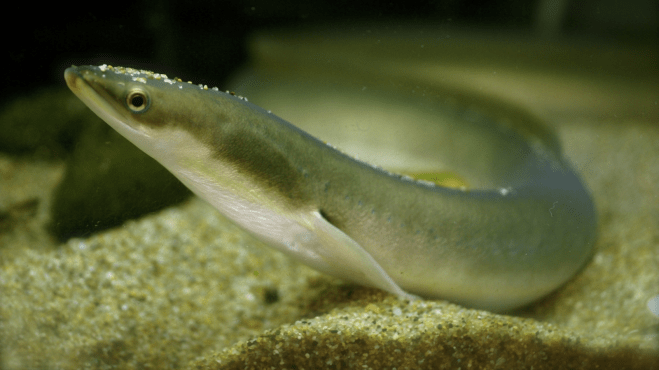
Japanese eel
Gov’t opts not to disclose radiation test result of Japanese fishery goods
The government has rejected calls to disclose the results of radiation level checks conducted on fishery goods caught near Japan, a civic group said Wednesday.
The Ministry of Food and Drug Safety on Tuesday dismissed the information disclosure request filed by the Lawyers for a Democratic Society, the group said.
“As the information is related to a case pending at the World Trade Organization, (the disclosure) could lead to a leakage of our strategy to Japan,” the ministry was quoted by the group as saying.
The lawyers association, however, countered that the reason provided by the authorities was groundless since the government has to submit its findings to the WTO and Japan anyways.
Tokyo filed a formal complaint with the World Trade Organization against Seoul’s import ban of its fishery goods.
South Korea has banned imports of all fishery products from eight Japanese prefectures, including Fukushima, where the 2011 earthquake and tsunami caused the meltdown of a nuclear reactor, marking the worst nuclear accident since the Chernobyl disaster.
The import ban was imposed in September 2013 after reports that massive amounts of radioactive materials and contaminated water from the Fukushima reactor were being dumped in waters surrounding Japan. This caused serious safety concerns here, that not only affected Japanese imports but the local fishery sector as a whole. (Yonhap)
http://www.koreaherald.com/view.php?ud=20160406000394
S. Korea Will Not Share Fukushima Fish Tests
South Korea’s Ministry of Food and Drug Safety has rejected a petition from a civil society group to release the results of radiation testing on fish caught near Japan following the Fukushima Daiichi reactor meltdown.
In 2013, South Korea imposed a ban on the importation of fisheries products from eight Japanese prefectures near Fukushima. Tokyo objected, and petitioned the World Trade Organization for relief, claiming that the ban was unfair to Japanese exporters. The Ministry of Food and Drug Safety has already submitted the results of its testing to the WTO and to Japan as part of the dispute, and advocates claimed that it should be made public as well.
The ministry disagreed. “As the information is related to a case pending at the World Trade Organization (WTO), [it] could lead to a leakage of our strategy to Japan,” it said in a statement on Tuesday.
A study of radioactive cesium levels in fish off of Fukushima in 2011 by Pavel Povinec and Katsumi Hirose found that consuming 100 kg of the affected seafood per year (four times the Japanese annual average) would result in approximately the same radiation dose as the world average for background exposure – and roughly the same as the level of exposure from consuming the naturally occuring radioactive polonium in 100 kg of any other seafood.
“Radiation doses from ingestion of marine food are under control, and they will be negligible,” the authors concluded.
However, a study published in February by Hiroshi Okamuraa and Shiro Ikedab found that while radioactive cesium levels were overall quite low among most species in Japan, they were unequally distrubuted, with some much more likely to be contaminated than others, especially larger predators towards the top of the food chain. Additionally, effects are regional and vary between freshwater and marine species, the authors said: areas nearer and to the south of the reactor are more affected, and freshwater fish – notably whitespotted char and Japanese eel – are more likely to show higher levels of contamination.
http://maritime-executive.com/article/s-korea-will-not-share-fukushima-fish-tests
Fukushima+5, Part 7. These women are pissed.
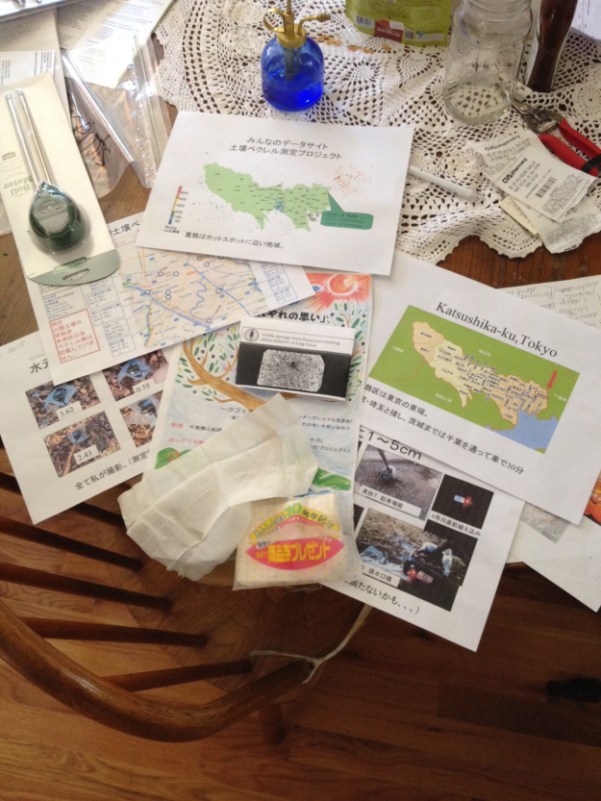
The post-Fukushima period is generating oceans of data, but much of it is useless. These women generate their own, but also want more solid data than the government has been willing to provide.
By Mary Olson
Don’t get me wrong: These women are pissed! (My word not theirs.) And they have every right to express that, even in Japan, at least according to its constitution.
I cannot leave Japan without peeling back the layer of sticky rice and sweet bean paste that keeps the victims of Tepco’s iodine, cesium and strontium on their feet.
One woman from Fukushima, who I met in Kyoto, said to me: “I am not as good as a guinea pig! They take tests from a guinea pig, but they don’t even test me.” She has thyroid cancer. There is a bias, since Chernobyl, toward focusing on thyroid cancer in children as a radiation impact. This is in part since they have less of a prior history of exposures, but in fact, radioactive iodine can cause cancer in people of any age.
This woman is asking to be studied. For me there are long and interesting questions about the moral and ethical basis of studying any victim…but this woman wants data. The post-Fukushima period is generating oceans of data, but much of it is useless, either for a study, or for the victims. This woman tells me that readings from a “full-body count” measuring Becquerels in her body, taken at an evacuation center in 2011 was destroyed after two years. She cannot get it. It is gone. She is more than pissed.
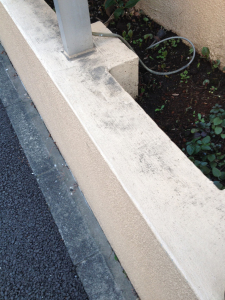
Fairewinds’ Arnie Gundersen dubbed this sort of urban particulate “Dark Matter” and often found that it contains radioactive particles. It’s not clear if these were directly deposited by a plume from the Fukushima meltdown or were perhaps released by post-tsunami incineration of debris.
I feel (or maybe project) other women would explode if they could, but they hold it together for their children.
This is the “triple bind” created by Tepco’s allies in the Japanese federal and (most) state governments:
First: One’s entire life is disrupted by radioactive contamination; any official support comes through cooperation;
Second: One’s children (and some Mamas) are having symptoms of radiation impact but the doctors are told* not to identify radiation in any diagnosis;
Third: The official message from over 400 government-paid Post-Tepco Meltdown staff psychologists is: the only harm to the children will come from the mother’s anxiety about radiation, which is unfounded, and results in stress to her and her family. Stress is bad.
This last point we can all agree on, but the word “stress”, has been appropriated by the “There is No Problem, the Radiation is Safe” story line. Now “stress” means a mother who is no longer cooperative with a government that would require her to move home to Fukushima Prefecture and support the use of local foods in the school lunch program, or face personal condemnation. There is no one to buy her home if she chooses not to.
This makes it a quadruple bind.
I support these Mamas by carefully, and slowly, stating, at each speaking event that if I were a mother I would leave contaminated zones and take my children with me. This does not touch, however, the incredible pressure on them from all sides to conform to the official line; talk about stress!
At one last Tokyo “Mama Meeting” or “tea party” as we have called the sessions with women concerned about radiation, these Mamas are not refugees. They are women monitoring hot spots here in Tokyo.
One woman has four children who bop in and out, cared for on the side. This mom is not at all happy with me, or maybe anyone from the U.S., having anything to say about her situation. I quickly shift to listen-mode and agree with her often. Another mom is much younger. She has done quite a bit of reading and has decided that internal emitters from food contamination are her big concern. I agree with her too. Another mom is interested in learning how to clean up hot spots…and has produced detailed maps with photos of her detector reading as high as 126 millirems per hour on hot spots at a park in Tokyo. Her readings in the same area were repeated over many months.
This group seems more engaged and active than any other Mama Tea Party group I have met with. The feeling fits with the large NGO events that I am doing at the end of this trip. The same day as the Tea Party I went on to the National Diet Building to speak at a large (and lively) event hosted by the Citizen’s Nuclear Information Center, which covered it here.
During this tea party it slowly begins to dawn on me that the bottom of pretty much the entire Japanese food chain is aquatic. I have a dim memory of hearing decades ago, when a U.S. fast-food chain selling fried chicken opened in Japan for the first time, it did not pass the “quality” check done by the chain’s U.S. corporate executives. The chicken tasted like fish. The eggs I have been eating for the past 2 weeks in Tokyo also taste, faintly, of fish. I share this with the Mama concerned about food. Color drains from her face. It is overwhelming to think of meats, dairy and eggs being at risk from possible radioactive sea-water contamination. She says “It makes me tired.” I say “yeah, especially when you factor in fish-fertilizer and all the soy products.”
So, in the end, we know, we all live in Fukushima…
My last day in Japan I was thinking about the old adage that Crisis = Opportunity. Years ago (1999), I traveled to Australia to help fight a global nuclear waste dump called the “Pangea Project” that was targeting Australia for all the world’s irradiated fuel rods. Over breakfast in Perth, in the home of a Green Party member of the Australian Parliament, I ventured an opinion: “The Pangea Project is an existential threat to your nation. You should work for a Constitutional Amendment to ban international waste from entering your waters or your land.” I was truly shocked, as a naive American, to hear the reply: “Australia does not have a constitution.” Unfortunately this ugly global dump threat has reared its head, targeting Australia again. (NIRS Action Alert coming soon!)
Here, now, in Japan, once again, in my view: this nation is facing an existential threat from radioactivity. So, I ask Steve Leeper, one of my hosts, “Does Japan have a constitution?” Steve explains that it does, the Peace Constitution, written post-WWII, by an American woman (under the aegis of a famous US General.). Established in 1947, under U.S. Occupation.
As I scan the Constitution of Japan, it is amazing how detailed it is in enunciating the rights of individuals…though ‘Free Speech’ appears as Article 21, not “first amendment.” I have often felt in these past weeks a common thread between my Japanese friends and my friends back home, south of the Mason/Dixon Line. It hits me: they are both warrior people who fought hard and had to accept defeat. From the same victor: Yankees.
Freedom cannot be given. It must be taken. I sincerely hope that the Mama’s rise, peacefully, to claim the provisions of this constitution (or a new one) for themselves, their children, and all of Japan.
BIG CRISIS = BIG OPPORTUNITY.
*Medical suppression: I heard first-hand accounts from three physicians. One at a prestigious clinic refused to take the “hint” that he should not mention radiation in his diagnoses of patients and had his hospital privileges revoked. Two other women doctors in private practice are persevering in their care for all their patients, including those with symptoms clearly from radiation exposure. One of them openly calls their medical association as “sell-outs” to the “nuclear mafia.” I met these doctors, but I am not “naming these names…” and that is a comment too.
http://safeenergy.org/2016/04/05/japan-diary-2016-fukushima5-part-7/
GroundTruth Films: Fukushima Diary
Signs covering Fukushima Station are a distraction from the fact that 100,000 people are still displaced in the Prefecture.
Burn clothes: Wear ‘em, toss ‘em. That’s the spirit in which Beth Balaban and I packed for our final filming trip to Fukushima for Son of Saichi. We also brought burn pillows, burn shoes, burn socks, burn slippers, burn blow up mattresses… Safe to say, nothing in our suitcases is coming home with us.
On our previous three trips we’ve stayed outside the evacuated contamination zone, traveling in and out for brief periods daily. This time we’re staying inside Yamakiya, a village evacuated after the earthquake, tsunami and nuclear power plant meltdown five years ago. And even though radiation levels here aren’t of the sci-fi-turn-your-skin-neon-green variety, scientists we’ve talked to admit that even after being part of the nation’s $10 billion clean-up effort, it’s still not a place they’d want to live.
Yamakiya’s evacuation didn’t come right away after the March 2011 disaster. It came a few months later when prevailing winds and seasonal rainfall took a toxic road trip, traveling like the Shinkansen over hills and valleys, and along Rte. 114 past the home of Hidekazu Ouichi, a lifelong farmer and son of Saichi, a Hiroshima survivor.
We’re here now because Hidekazu got word from the government late last year that he could – finally – move back home April 1st. But when he picked us up from the Fukushima train station, we found out the government has changed its mind again about lifting the evacuation orders. No, they now say, he can’t move back until September.
He’s moving back anyway. Another 31 families are, too. (Most former residents are rejecting any offer to live here.)
On the 30-minute drive to Yamakiya, I realize I’m more worried about what’s measured in pixels and decibels than becquerels or microsieverts. There’s a television screen embedded in the dashboard of Hidekazu’s new Toyota, and Japan’s national obsession – cute, quirky mascots – are on full display. Eyes on the road, Hidekazu!

Now that he’s home, Hidekazu finds it hard to break his lifelong habits and those of his ancestors. The family farm has always been land to live off, always a place of sustenance, and it’s difficult for him to see it any other way.
That’s why we’re not surprised when he opens the freezer to show us feet from a wild boar he and his friends caught in the backyard. A ghost town for the past five years, this area became overrun with wild animals – especially boar which Hidekazu says have gotten so used to gallivanting around town that “they roam freely inside abandoned houses, and come right up like a dog and wag their tails at you.”
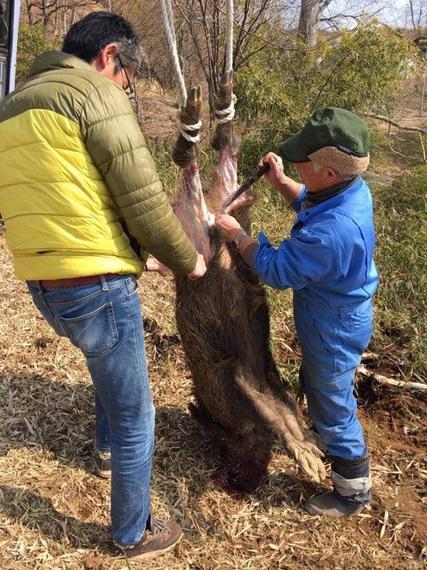
The boar pre-freezer.
The bad news is that wild boar – tasty as their feet might be – eat mushrooms which are among the most contaminated plants in Yamakiya’s forest. Cesium builds up inside the body of boars because of it. When Hidekazu tested this boar to see just how radiated it was, he measured 12,000 becquerels. (One becquerel is defined as the decay of one atom of a radioisotope per second. So if your Geiger counter detects the radiation of one decay coming from a sample – say, a boar – in one second, then that sample has one becquerel of radiation.) 12,000 becquerels is astronomically higher than the 500 allowed by the government.

Crew member and animator Christian Schlaeffer puts his Geiger counter to the frozen boar feet.
Hidekazu offered to cook the feet up for us for dinner. We politely declined.
Oh, who am I kidding? We told him he was crazy and there wasn’t a chance in hell we’d eat it, and neither should he! But if our previous trips have told us anything, it’s that Hidekazu will eventually convince us to eat or drink something that will surprise us and amuse him. I suspect it’s just a matter of time before the killer bee liquor comes out of the cabinet.
http://www.huffingtonpost.com/beth-murphy/groundtruth-films-fukushi_b_9605966.html
Tainted Fukushima towns stuck in time as decon crews plug away
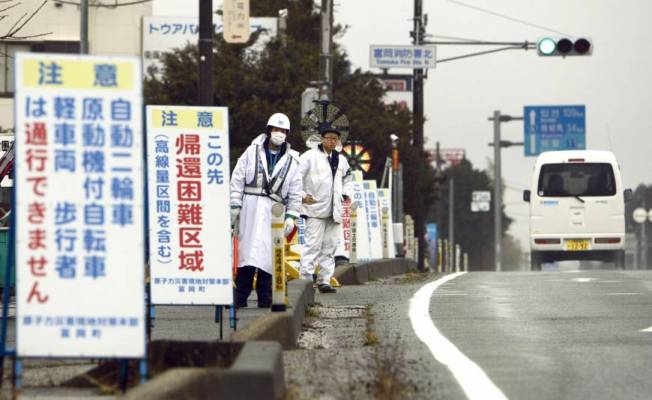
Police and security officers keep watch along National Route 6 leading to the off-limits zone in Tomioka, Fukushima Prefecture, on March 9
FUKUSHIMA – Five years after the nuclear disaster triggered by the huge earthquake and tsunami, reconstruction has made little progress in parts of Fukushima Prefecture. A Kyodo News reporter drove National Route 6 northward to the crippled Fukushima No. 1 nuclear plant to witness the lingering effects of the calamity.
In the town of Hirono, in the southeast, many shops and buildings remain empty. North of Hirono is the town of Naraha, most of which lies within the 20-km-radius hot zone around Tokyo Electric Power Co.’s radiation-leaking power plant.
The nuclear disaster forced Hirono to move its operations to other municipalities in the prefecture, while Naraha was designated an evacuation zone.
Now the towns have a radiation level below 1 millisievert per year — a level the government is trying to achieve in other areas via decontamination — and residence restrictions and evacuation orders have been lifted, with Hirono’s town office returning to its original place.
However, many residents are reluctant to go back to their homes. So far only 48 percent of Hirono’s population and 6 percent of Naraha’s have returned.
Yet hotels and other lodgings were busy accommodating out-of-prefecture workers seeking decontamination and construction work. All 275 rooms at a hotel in Hirono built for the reconstruction support scheme three years ago are “almost fully reserved for the next month,” the front desk clerk said.
A worker in his 50s who came from Tokyo to oversee decontamination work said he earns more than ¥16,000 ($145) per day. Another man staying at the hotel said he was on a three-week contract and received ¥25,000 a day. Their lodging was paid for by their employers.
At night, there was only one pub open in Hirono.
“The shopping area is deserted, although schools have resumed,” said a woman who works there. Still, the pub was full, mainly with visitors not from Fukushima.
In Tomioka, parts of which are still designated as in the “difficult to return” zone, most retail buildings on both sides of the main road have been abandoned and are decaying. Bags of contaminated soil sit piled up near the shore — now a huge makeshift storage site.
In a similar zone in the town of Okuma, which co-hosts the plant, three men in white protective suits were conducting decontamination in a field under a cloud of dust.
Nearby, a large boar suddenly crossed the road.
Soon after the nuclear disaster struck five years ago, untended cows and dogs were seen wandering around looking for food, but now boars are a frequent site, local people say.
In a residential part of Okuma, quake-damaged roads have been fixed but houses are being left as they are. The only sounds are chirping birds and the wind.
At a railway station, radiation over 10 microsieverts per hour is detected just above a covered drain. Although radiation in the “difficult to return” zones in Okuma and neighboring Futaba — the two towns hosting the nuclear plant — is much lower than it was immediately after the meltdowns, there are many hot spots measuring over 5 microsieverts — dozens of times higher than the government’s goal.
A Futaba resident who was showing the area to foreign journalists said, “The word ‘reconstruction’ has no relevance to this town.”
In Minamisoma — farther north of the Fukushima No. 1 complex — some areas are still designated as restricted residential zones.
“The number of jobs, such as decontamination work, has increased, but most of them are taken by people coming from outside the prefecture. We can hardly say this place has been enlivened again,” said Masayoshi Kariura, a Catholic priest.
“The pileup of contaminated soil that is clearly visible is weighing heavily on the residents,” he said.
Radioactive sediment found in Fukushima rivers
Tokyo: Japanese researchers have detected relatively high levels of radioactive substances in sediment in multiple rivers running through Fukushima prefecture, the media reported on Friday.
The prefectural government in January surveyed the density of radioactive materials in soil and other sediment that has accumulated on the bottoms and banks of 72 rivers in the prefecture, public broadcaster NHK reported.
The study came in response to the 2011 nuclear accident at the Fukushima Daiichi power plant.
The researchers found up to 54,500 becquerels per kg of radioactive substances in the Maeda river in Futaba town, where the plant is situated, and 39,600 becquerels in the Hiru river in Fukushima city. They also detected more than 10,000 becquerels at five other locations in four municipalities.
The prefectural government plans to study restricting access to rivers with high concentrations of radioactive materials.
It also plans to urge the central government to remove contaminated soil and other sediment.
http://www.thejapannews.net/index.php/sid/242732285

Past References
Overview of active cesium contamination of freshwater fish in Fukushima and Eastern Japan
- Received: 13 March 2012
- Accepted: 05 April 2013
- Published online: 29 April 2013
Abstract
This paper focuses on an overview of radioactive cesium 137 (quasi-Cs137 included Cs134) contamination of freshwater fish in Fukushima and eastern Japan based on the data published by the Fisheries Agency of the Japanese Government in 2011. In the area north and west of the Fukushima Nuclear plant, freshwater fish have been highly contaminated. For example, the mean of active cesium (quasi-Cs137) contamination of Ayu (Plecoglossus altivelis) is 2,657 Bq/kg at Mano River, 20–40 km north-west from the plant. Bioaccumulation is observed in the Agano river basin in Aizu sub-region, 70–150 km west from the plant. The active cesium (quasi-Cs137) contamination of carnivorous Salmondae is around 2 times higher than herbivorous Ayu. The extent of active cesium (quasi-Cs137) contamination of Ayu is observed in the entire eastern Japan. The some level of the contamination is recognized even in Shizuoka prefecture, 400 km south-west from the plant.
Introduction
The serious accidents of the Fukushima Nuclear Power Plant have been contaminating a vast area in eastern Japan1, home of 60 million people. Consumption of freshwater fish is an important part of the aquatic pathway for the transfer of radionuclides to the freshwater ecosystem creatures including humans2. Therefore the contamination of freshwater fish of aquatic bioaccumulation is an important problem3,4. In the case of the Chernobyl Accident, the transfer of radionuclides to fish has been studied in European countries5,6,7. Most attention was focused on Belarus, the Russian Federation and Ukraine, because of the higher contamination of water bodies in these areas8,9. However, in the case of Fukushima, there is little information about freshwater ecosystem contamination in 2011. Therefore, this paper focuses on an overview of active cesium 137 (quasi-Cs137) contaminations of freshwater fish in Fukushima and eastern Japan based on 2011 data published by the Fisheries Agency of the Japanese Government10.
Results
Highest contaminated area in fukushima prefecture
Fukushima Prefecture is located in the northeastern part of the Main Island of Japan (Fig. 1). It is divided into three sub-regions by its mountainous topography, i.e., Hamadori, Nakadori and Aizu (from east to west). Hamadori is the coastal region facing the Pacific Ocean and separated from Nakadori (central basin) by the Abukuma Highlands. The westernmost Aizu is mountainous with the Aizu Basin in the center. There still is a rich natural environment maintained throughout the prefecture with three national parks, one quasi-national park and eleven prefectural parks present. The mountain ranges form headwaters and basins of many rivers such as the Abukuma River and the Aga River. The Abukuma Highlands is designated as one of the prefectural parks and rich in endemic wildlife including the indigenous forest green tree frog (Rhacophorus arboreus) and salamanders (Hynobius lichenatus, Hynobius nigrescens). There the Ayu (Plecoglossidae: Plecoglossus altivelis altivelis), Salmon (Salmonidae: Oncorhynchus masou, Salvelinus leucomaenis) and carp (Cyprinidae: Tribolodon hakonensis, Cyprinus carpio, Carassius.sp) are very popular freshwater fish for fishing and angling.

Blue is water system: Aga river basin is west area of Fukushima, Abkuma river basin is center of Fukushima. Green is mountain chain or highland where heights is more 1,000 m. Yellow is high contaminated area by nuclear accidents.
The Fukushima Nuclear Power Plant is located in Hamadori. Due to the topography with the Pacific Ocean in the east and the Abukuma Highlands in the west, the areas in the north to the west of the plant are highly contaminated. Such areas include Iidate Village and Date City. The Mano River which flows through Iidate Village in the upstream and Minami-souma City. Two months after the accident, the Ministry of Land, Infrastructure and Transport surveyed the Mano River11. The survey results of the contamination level of the bottom soil are Cs134: 6,900 Bq/kg and Cs137: 7,800 Bq/kg in Mano River of Minamisouma city at Majima bridge on 29/5/2011. While the area downstream and the Abukuma River in Date City found higher contamination. Two months after the accident, the Ministry of Environment surveyed the Abukuma River of Date city. The survey results of the contamination level of the bottom soil are Cs134: 11,000 Bq/kg and Cs137: 12,000 Bq/kg in Abukuma River of Date city at Taisho bridge on 24/5/2011.
The contamination level of radioactive cesium (quasi-Cs137) of the Ayu, annual and herbivorous species, captured in these rivers or their tributaries between May and September 2011 was measured. The cesium bioaccumulation of those captured in the Mano River was mean 2,657 Bq/kg (n = 3, median 2,900 Bq/kg, range 1,770–3,300 Bq/kg) and the Abukuma River at Date city was mean 1,770 Bq/kg, (n = 11, median 1,170 Bq/kg, range 650–2,080 Bq/kg ).
The bioaccumulations of Aga river basin (West Fukushima)
The Aga River Basin encompasses the entire Aizu region in west Fukushima. The river water flows through from the Aizu region to the Sea of Japan. As it lies over 70 km to the west of the nuclear power plant and both the Abukuma Highlands and Oou montain chain are in between, the Cs137 contamination level here was lower than Mano river and the Abukuma river basin. Two months after the accident, Fukushima prefecture surveyed the Agano River (Aga river Basin) of Aizu and South Aizu region12. The survey results of the contamination level of bottom soil were Cs134: 29 Bq/kg and Cs137: 33 Bq/kg in Agano River of Aizu region at Miyako bridge on 27/5/2011, Cs134: 29 Bq/kg and Cs137: 34 Bq/kg in Agano river of Minami-Aizu region at Tajima bridge on 27/5/2011.
In the aga river basin, the bioaccumulation of fish are well recognized. Fig. 2 shows the quasi-Cs137 contamination and bioaccumulation levels of three fish families captured in the basin, i.e., Plecoglossidae (Plecoglossus altivelis n = 18), Cyprinidae (Tribolodon hakonensis n = 25, Cyprinus carpio n = 5, Carassius sp. n = 11)and Salmonidae(Oncorhynchus masou n = 12, Salvelinus leucomaenis n = 13) between April and December 2011. Since p-value = 0.008 ≤ 0.05 of Kruskal-Wallis Test, at the p = 0.05 level of significance, there exists enough evidence to conclude that there is a difference among the three families based on the active cesium contamination level. The median of herbivorous Plecoglossidae shows the lowest level among the three families (n = 18, mean 50.64 Bq/kg, median = 46.00 Bq/kg, range 12.00–90.00 Bq/kg). Then the median of omnivorous Cyprinidae shows about 1.6 times (n = 41, mean 79.80 Bq/kg, median 72.00 Bq/kg, range 15.00–210.00 Bq/kg) and the mean of carnivorous Salmonidae about 1.9 times higher (n = 25, mean 96.24 Bq/kg, median 89.00 Bq/kg, 17–200 Bq/kg) than Plecoglossidae.

The box plots indicate inter-quartile ranges of these data. Bars are into the each box indicate the each median.
The widespread contamination in eastern Japan
To the south west of Fukushima prefecture, there lies the Kanto region which as well as containing the metropolitan prefecture of Tokyo also comprises Ibaraki prefecture, Tochigi prefecture, Gunma prefecture, Saitama prefecture, and Chiba prefecture. In the area, there is the Tone river basin that is the one of biggest river basins (16,840 km2) in Japan. Therefore, there are not only many source points of water springs and many rivers and streams but also high density water network systems of irrigation canals and urban water systems. Freshwater fish inhabit all types of water systems. As a result, the level of freshwater contamination can be taken as an index of the environmental contamination of the freshwater ecosystem. The isogram map (Fig. 3) shows an average of quasi-Cs137 for each prefecture about contamination levels of the Ayu (Plecoglossus) captured in between May and September 2011.
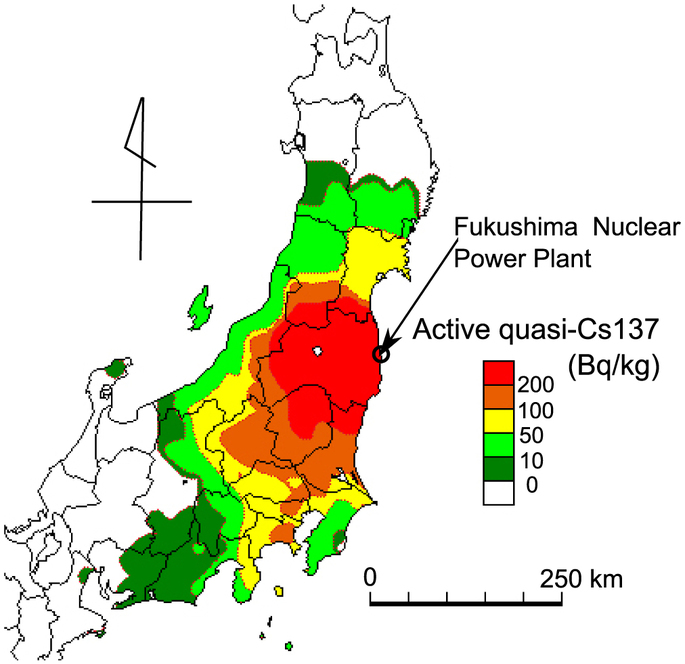
Each isogram center points are each prefecture’s capital city.
The relation between distance from power plant and contamination level
We found a relation between the distance from the power plant and the quasi-Cs137 contamination level of freshwater fish. According to the result of inverse regression analysis about quasi-Cs137 contamination levels related to the distance from the nuclear power plants of each prefectural capital city, the equation is: Y = 27339.82−1 × −75.13 (Y = Cesium, X = The Distance from the plants to each prefecture’s capital city, Signif F = 0.009 < 0.05, Adjusted R Square 0.50). In areas within a radius of 100 km from the nuclear plant, active cesium contamination levels of the Ayu are more than 200 Bq/kg. In those between a radius of 100 km and 200 km, it is around 60–200 Bq/kg. In those between a radius of 200 km and 300 km in which Tokyo is included, it is 20–60 Bq/kg. Therefore, it is estimated that contamination of freshwater fish is extended to all prefectures in eastern Japan. The contamination is recognized as far as Shizuoka prefecture, 400 km south-west from the plant.
Discussion
The Japanese freshwater system is very high density as developed rice water paddy field, irrigation canal, urban water-system network. Therefore, we have to think that the contamination of freshwater fish is widespread not only in river basins but also all over the ground included all types of water-systems, for example, agricultural and urban water systems. The isogram map shows the contamination tendency quite well. The contamination levels of the freshwater fish provide insufficient data and the knowledge of the path about bioaccumulation. So, we will have to survey a more wide spread area and monitor bioaccumulation in each species level.
In this paper we show the relation between distance and contamination levels by inverse regression analysis. The results indicate the effects of quasi radioactive cesium 137 by the Fukushima accident look like less serious than those of the Chernobyl accident. However, contamination levels are possibly higher than the Chernobyl as the cesium is concentrated by the water systems in limitation region. Water paddy field look like shallow pond saved mud included cesium 137. Moreover, the cesium137 will distribute and concentrate by high density irrigation canal and urban water-system. For example, the highly contaminated Taisho river bottom soil Cs134: 4,335 Bq/kg, Cs137: 5,456 Bq/kg was found at 1/11/2011 at Kitakashiwa bridge of Kashiwa city in Tokyo metropolitan area, 200 km south-west from the plant13. Therefore we must carefully and continuously monitor the contamination to the freshwater ecosystem and human health.
Methods
Data 2011 of radioactive cesium of freshwater fish was analyzed by each local government according to the emergency food survey manual of radioactive substance14. The purpose of this manual is they avoid feeding high contaminated food it was defined by food security of emergency condition. Therefore, it is not aimed at collecting accurate data. As a result, this data did not distinguish between cesium137 and cesium134. Therefore, the analysis of this paper calculated by quasi-Cs137 included Cs134. They used germanium semiconductor machine when they measured the radioactive cesium contamination of freshwater fish. The measure time is from 10 minute to 1 hour. The calibration is only Cs137 in per week. The range of radioactive cesium applied only Cs137 regression equation. The result, when the case included Cs134 is relatively much, the numerical value become over estimation. The sample of freshwater fish was collected by each prefectural government by emergency policy of food security. In the survey, the fish sample collected 5–10 kg in one survey station. The measure is using wet condition fish. Ayu and small fish was measured hole body, while big fish measured the part of food portion.
References
1.
Monitoring information of environmental radioactivity level, MEXT and DOE Airborne Monitoring, Ministry of Education, Culture, Sports, Science & Technology in Japan, http://radioactivity.mext.go.jp/en/list/203/list-1.html (2013).
2.
Joanna, B. et al. Radiocesium in Fish from the Savannah River and Steel Creek: Potential Food Chain Exposure to the Public. Risk Analysis Vol. 21, No.3, 545–559 (2001).
3.
McCreedy, C. D., Jagoe, C. H., Glickman, L. T. & Brisbin Jr, I. L. Bioaccumulation of cesium-137 in yellow bullhead catfish (Ameiurus natalis) in habiting an abandoned nuclear reactor reservoir. Environmental Toxicology and Chemistry 16, 328–335 (1997).
4.
Rowan, J. R. & Rasmussen, J. B. Bioaccumulation of radiocesium by fish: The influence of physicochemical factors and trophic structure. Canadian Journal of Fisheries and Aquatic Science 51, 2388–2410 (1994).
5.
Hakanson, L., Anderson, T. & Nilsson, A. Caesium-137 in perch in Swedish lakes after Chernobyl-present situation, relationships and trends. Environmental Pollution 58, 195–212 (1989).
6.
Ugedal, O., Forseth, T., Jonsson, B. & Njastad, O. Sources of variation in radiocesium levels between individual fish from a Chernobyl contaminated Norwegian lake. Journal of Applied Ecology 32, 352–361 (1995).
7.
Elliott, J. M. et al. Sources of variation in post-Chernobyl radiocesium in fish from two Cumbrian lakes (north-west England). Journal of Applied Ecology 29, 108–119 (1992).
8.
Long-Term Observation of Radioactivity Contamination in Fish around Chernobyl. RYABOV I N Vol 79, 112–122 (2002).
9.
Environmental consequences of the Chernobyl accident and their remediation : twenty years of experience report of the Chernobyl Forum Expert Group ‘Environment’. Vienna: International Atomic Energy Agency (2006).
10.
Results of the inspection on radioactivity materials in fisheries products, Fisheries Agency, http://www.jfa.maff.go.jp/e/inspection/index.html. (2012).
11.
Urgent radionuclides monitoring report in public water system area of Fukushima prefecture (in Japanese), Ministry of Environment, http://www.env.go.jp/water/suiiki/urgent/result201106.pdf. (2011).
12.
Urgent environmental radionuclides monitoring report in public water system area of Fukushima prefecture at 4/6/2011(in Japanese), Fukushima Prefecture, http://www.pref.fukushima.jp/j/koukyouyousuiikimonitaring.pdf. (2011).
13.
Final report of the highly contamination spot in Kashiwa city (in Japanese), Ministry of Environment, http://www.env.go.jp/press/press.php?serial=14647. (2012).
14.
The survey manual “Guide: Emergency Preparedness for Nuclear Facilities”, Nuclear Safety Commission, June, 1980-final revised in 2010. (2010).
Sources :
- Received: 13 March 2012
- Published online: 29 April 2013
Overview of active cesium contamination of freshwater fish in Fukushima and Eastern Japan
http://www.nature.com/articles/srep01742
- Received: 21 November 2013
- Published online: 16 January 2014
Initial flux of sediment-associated radiocesium to the ocean from the largest river impacted by Fukushima Daiichi Nuclear Power Plant
http://www.nature.com/articles/srep03714
- Received: 15 May 2014
- Published online: 12 February 2015
Future projection of radiocesium flux to the ocean from the largest river impacted by Fukushima Daiichi Nuclear Power Plant
http://www.nature.com/articles/srep08408
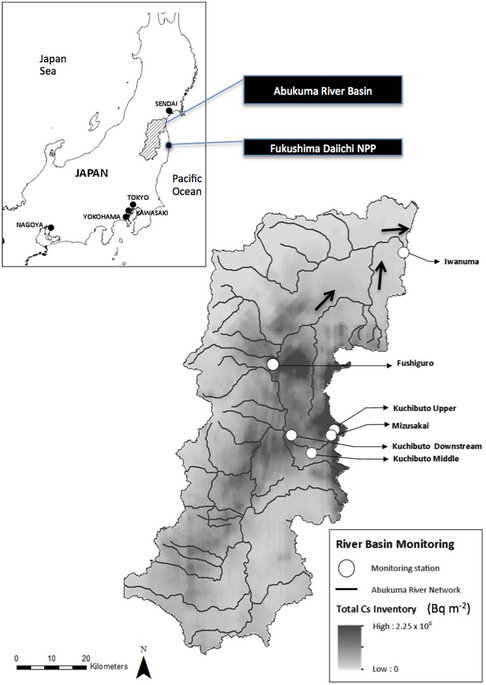
Map of the Abukuma river basin showing monitoring locations and the total radiocesium inventory
Increased Strontium in Sardines since Fukushima Accident?

Dogs fed sardines show high Strontium levels
by Dr. Peter Dobias, DVM
Why you might want to cut out small fish from your dog’s diet
I have had two dog patients with severely elevated levels of the element strontium. The interesting part is that these two dogs were fed a high amount of sardines and I highly suspect that strontium is coming from this source.
Strontium acts in the body the same way as calcium and deposits in bones. Sardines and other small fish are eaten whole with the bones and that is why they are more likely a source of this toxic element.
The reason why I am concerned is that the radioactive isotope strontium 90 is a toxic carcinogen and it has been released in Japan’s Fukushima disaster.
Here is an example of the results:

As a veterinarian, I source from almost three decades of experience, but still I like to see the proof. Hair testing for minerals and toxic elements has been really helpful because it is highly accurate and shows what is happening in different groups of dogs.
In the course of many years of testing, I have learned that dogs who eat fish-based foods have elevated mercury levels and sardines appear to be the cause of increased strontium. Since the Fukushima nuclear accident strontium is continuously being released into the oceans and not much is being done to inform the general public.
Sadly, I have noticed that dogs who have epilepsy have higher than average levels of strontium and mercury, which made me recommend against feeding fish and sardines to dogs, despite their nutritional benefits. Fish is not what it used to be.
http://peterdobias.com/blogs/blog/11014105-dogs-fed-sardines-show-high-strontium-levels
Look At The Millions Of Bags Of Radioactive Dirt That Japan Has No Plan For

Five years after the meltdowns at the Fukushima Daiichi nuclear plant, Japan still faces another four decades or more of cleanup. One of many problems is what to do with the massive amount of contaminated soil from the site—which is now in a growing pile of bags stacked on former farms in Fukushima.
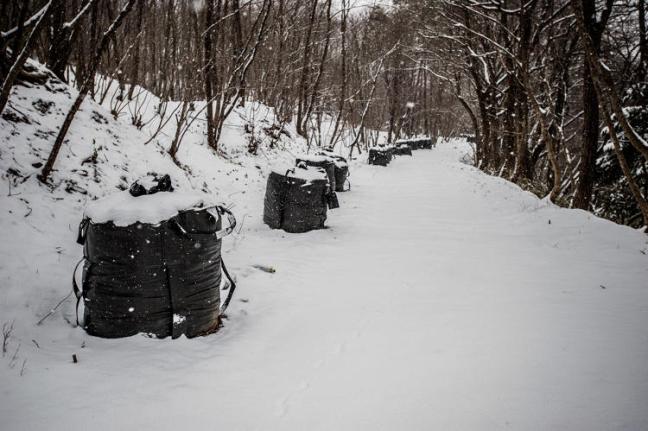
A new photo series from Japan-based photographer James Whitlow Delano documents the sprawl of nuclear waste.
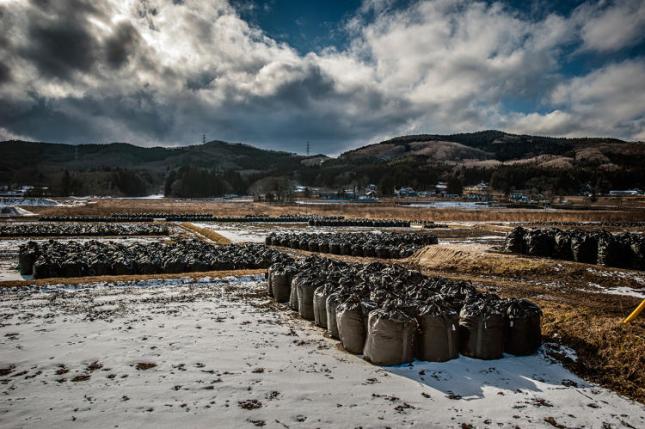
As of 2015, the government reported that there were more than 9 million bags in the prefecture. Some of it will be moved inside the no-entry zone next to the nuclear plant, which is so radioactive that the government has given up on decontamination for the moment. But Japan is also sending radioactive waste to other parts of the country.
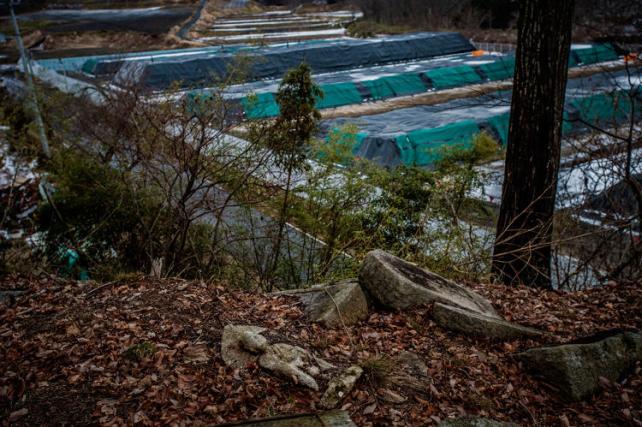
“The Japanese government decided early on in the decontamination process that all prefectures in Japan should share the burden of storing radioactive waste with Fukushima Prefecture,” says Delano, who has been photographing the disaster since it happened in 2011. “This resulted in firm pushback by communities in other prefectures that are adjacent to sites that were selected.”
They have reason to be concerned: In September of 2015, when there were floods in Nikko, Japan, hundreds of bags of radioactive soil were washed into the local river.
Even in Fukushima itself, in villages where many residents may not be able to return for a decade or more, no one wants a radioactive dump next to their former homes. The dumps are supposed to be temporary and moved in 30 years, but people are skeptical that will happen. “They feel like the presence of the site will be like the last nail in the coffin for their communities,” he says. “So, no one wants this contaminated soil.”
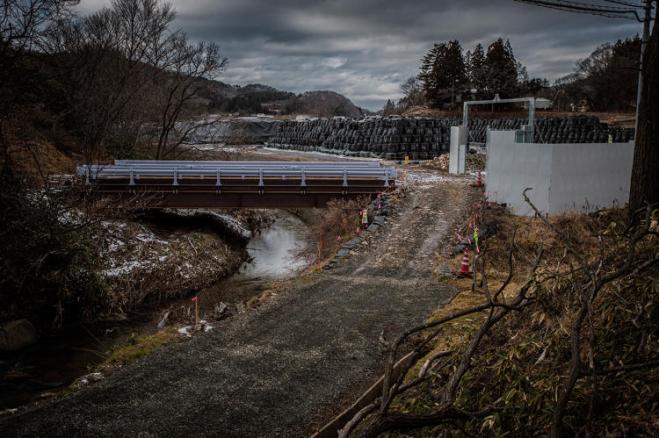
In some areas, a few people have started moving back. “When I used to sneak inside the old 20-kilometer-radius nuclear no-entry zone, I would enter a neighborhood in Minami Soma that was half inside the zone and half outside and hop the barrier to document the absence of humanity,” says Delano. “About one and a half years after the earthquake and tsunami, the no-entry zone was readjusted to reflect the actual radiation levels, instead of being an arbitrary 20-kilometer radius. That meant that the whole neighborhood would be decontaminated and prepared for families to return, if they wanted to do so.”
Some resident returned, but now the fields next to the neighborhood are being cleared for a dump filled with bags of contaminated soil. “People fear the presence of this soil and the dust that every breeze will carry into their neighbor,” he says. “It creates fear and doubt. Many families, especially those with young children, are not returning to this region of Fukushima Prefecture.”

Delano was reluctant to spend much time in the area himself, and carried a Geiger counter and wore a mask while he worked. “I always do my work and get out,” he says. “For example, one hot spot I found in 2012 would expose you to the equivalent of an additional year of natural radiation exposure within 24 hours, if you were to sit there. For obvious reasons, I did not linger there.”
For him, the disaster was personal—he’s lived in Japan for two decades and has Japanese family. Even in Tokyo, the food supply has been affected, and foods are now labeled with the prefecture where they were grown. “You can be careful, but once you go to a restaurant or buy a bento box lunch, all bets are off,” he says.
He also wanted to show how much the area—which was once a peaceful, Vermont-like region of farms—has changed. “It is some of the most beautiful country in Japan,” he says. “This natural beauty only reinforces the sense of loss.”
Protesters slam ‘radiation-exposed’ Japanese sake festival
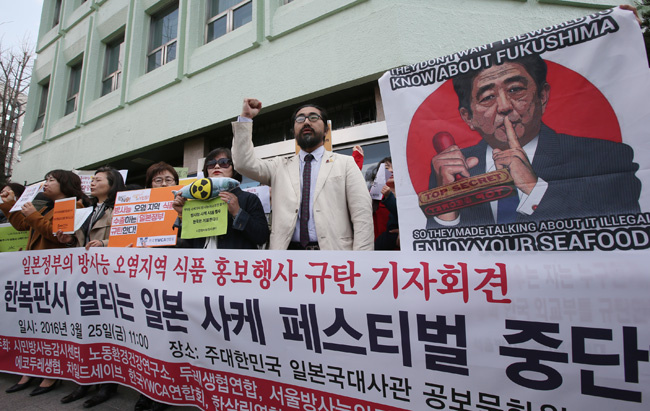
Civic groups protest in front of the Japanese Embassy in Jongno-gu, Seoul, demanding to stop the Seoul Sake Festival 2016 that may bring sakes contaminated with radiation from the Fukushima nuclear plant disaster five years ago.
By Ko Dong-hwan
Civic groups protested against a Japanese sake festival in Seoul on Friday, in a bid to prevent visitors from tasting possibly dangerous alcohol produced in areas near the Fukushima nuclear plant disaster five years ago.
Eleven civic groups held a press conference in front of the Japanese Embassy in Jongno-gu, demanding that Japan stop the Seoul Sake Festival 2016.
“Seven of the participating Japanese breweries made their liquor in areas near Fukushima, where our government has warned of possible danger from radiation,” a protester said. “The breweries must have made their liquor using water and rice from the areas. Such liquors will jeopardize our health.”
Three breweries in Miyagi Prefecture, as well as from Iwate Prefecture, Ibaraki Prefecture, Gunma Prefecture and Tochigi Prefecture participated in the festival. The Korean government stopped importing seafood from those areas in September 2013 to prevent possible radioactive contamination.
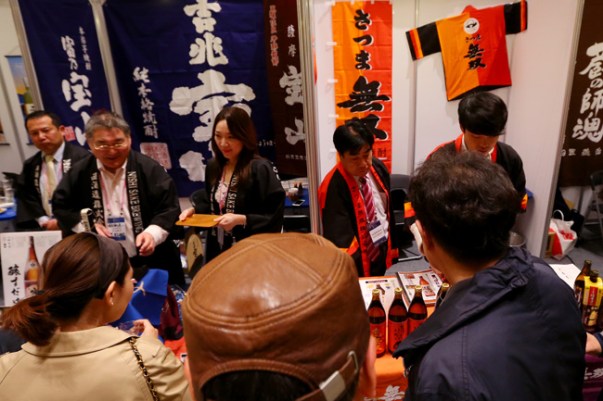
One hundred Japanese breweries introduced about 400 sakes at COEX, eastern Seoul, from Saturday to Sunday.
In March 2011, Fukushima 1 Nuclear Power Plant was hit by an earthquake-triggered tsunami. The impact caused a meltdown and release of radioactive material.
The Japanese embassy, according to Hankook Ilbo, said, “The festival organizers didn’t check whether the participating breweries were from areas that possibly were compromised by radioactive contamination, but all the food and liquor in the festival were tested in Japan and Korea.”
One hundred Japanese breweries introduced about 400 sakes at COEX, eastern Seoul, from Saturday to Sunday.
http://m.koreatimes.co.kr/phone/news/view.jsp?req_newsidx=201227
Japan urges China to lift import ban on farm products in place since March 2011
BEIJING – Japan urged China on Monday to scrap its import restrictions on agricultural, forestry and fisheries products and food that have been in place since the March 2011 Fukushima nuclear disaster.
Kazuyoshi Honkawa, vice minister of agriculture, forestry and fisheries, made the request at a bilateral subcabinet-level dialogue in Beijing on agricultural issues.
The two countries reopened the dialogue for the first time in six years, after suspending talks due to deteriorated bilateral ties.
After the nuclear disaster at Tokyo Electric Power Co.’s crippled Fukushima No. 1 plant, China prohibited all imports of agricultural, forestry and fisheries products and food from 10 prefectures , including Fukushima, Miyagi and Ibaraki.
Honkawa asked Chinese Vice Agriculture Minister Qu Dongyu to urge authorities to lift the import ban. The embargo is administered by China’s General Administration of Quality Supervision, Inspection and Quarantine.
Honkawa said he did not receive a clear answer on the issue from the Chinese ministry.
After the dialogue, he told reporters that the rapidly growing Chinese market is very attractive for Japanese agriculture, forestry and fisheries industries, suggesting his ministry’s aim of expanding farm exports to China.
Economic relations between Japan and China have been on the mend in recent months.
At talks last November, Prime Minister Shinzo Abe and Chinese Premier Li Keqiang agreed to restart a high-level economic dialogue that brings together the two countries’ key economic officials at an early date this year. In December, Japan and China held economic partnership talks led by vice ministerial officials for the first time in more than five years.
Here comes now Radioactive Organic!
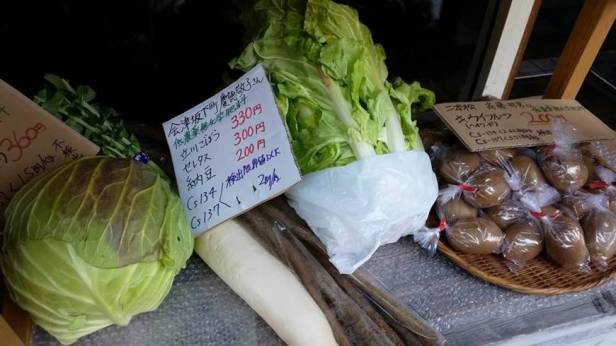
Close monitoring: At Orgando, a restaurant and mini-market in Tokyo, organic produce grown by Fukushima farmers is labeled with the amount of radioactive isotopes it contains to ease consumers fears. | © ORGANDO
Fukushima’s organic farmers still battle stigma
“All publicity is good publicity.” Nowhere does this specious PR maxim ring more hollow than in Fukushima Prefecture. As if the horrors of the 2011 Great East Japan Earthquake and the meltdown at the Fukushima No. 1 nuclear plant weren’t traumatic enough, the region’s economic and agricultural recovery has been severely hampered by the reputational damage it has suffered since 3/11. If you think that’s difficult, try farming organically in Fukushima.
Falling prices and an aging agrarian population have made things tough for farmers all over Japan, but the presence of the word “Fukushima” on a supermarket label is often enough to discourage shoppers from buying produce, organic or not, grown in the area. Regardless of how far from contaminated areas it was grown — Fukushima is Japan’s third-largest prefecture — the region’s produce can’t easily shake the stigma of radiation.
An important hub in the network of NGOs, government bodies and corporate benefactors trying to change the prefecture’s image has been Orgando, a cafe and mini-market in Tokyo’s Shimokitazawa neighborhood, run with the backing of the Fukushima Organic Agriculture Network. For the past three years, Orgando has built a devoted following by serving Tokyo residents the best of Fukushima’s seasonal organic produce, in particular the crops that Fukushima is perhaps most known for: peaches, apples and rice. The menu changes daily, making creative use of the ingredients that come in, and the walls are proudly decorated with profiles of the 30 or so farmers who have grown the food. Sadly, as with many post-3/11 schemes, Orgando was only guaranteed official financial support until the five-year post-disaster milestone and is set to close March 20.
Orgando has played a valuable role in forging links between local producers and urban consumers, and dispelling the idea that all the region’s produce is dangerously contaminated — fruit and vegetables sold in the store are clearly labeled to show the levels of cesium isotopes they contain. Official food-safety guidelines stipulate 100 becquerels of radioactive isotopes per kilogram as the acceptable limit for adults, with 50 becquerels/kg for dairy produce and infant food, and 10 becquerels/kg for drinking water. The daikon, carrots and strawberries on offer this week contain no detectable cesium, while, according to their labels, bags of beans contained 6 becquerels/kg, a negligible dose of radiation compared to our daily exposure from soil and cosmic rays.
Allaying fears about contamination was one of the themes discussed during a February event in Tokyo focused on the role organic agriculture could play in Fukushima’s recovery, organized by Ryo Suzuki of Japan Civil Network.
“People mistakenly think that everything from Fukushima is dangerous,” Norio Honda of Genki ni Narou Fukushima — an NPO promoting local revival — said at the event.
Setsuko Maeda, of agricultural collective Tanemaki Project Network agrees.
“Fukushima isn’t only about radiation,” she says. “Our farming and fisheries are full of vitality, and it’s important not to forget that.”
The event gathered representatives from organizations such as Oxfam Japan, A Seed Japan and travel agency JTB, to speak about the challenges facing organic producers in the prefecture, along with some of the major success stories. The atmosphere was convivial, and the presentations were interspersed with opportunities to sample Fukushima produce, including octopus, meat, potatoes, peaches and apple juice, and high-grade junmai sake made from local organic rice, fittingly named Kiseki or “miracle.”
Another major theme was bioremediation, the use of crops to cleanse contaminated soil of radioactive isotopes. One plant that has previously been used to reduce levels of cesium and strontium isotopes in soils around Chernobyl is rapeseed. The Green Oil Project aims to re-create these results in the Futaba district around the Fukushima No. 1 nuclear plant. Water-soluble cesium isotopes are sequestered in the plant’s tissues, which are fermented to produce biogas methane. The canola oil extracted from the seeds has a cesium content below the detectable limit of 0.03 becquerels/kg. To promote the initiative, local high school students created Yuna-chan, a cute mascot whose name combines the kanji for oil and rapeseed to market the organic oil. U.K. cosmetics company Lush, a keen supporter of organic produce, has also agreed to take a portion of the oil for use in its beauty products.
Ultimately, though, human connections were seen as most crucial to giving Fukushima produce the audience it deserves, and to generating an interest in farming among young people.
“It’s about exchange,” says Akihiro Asami, secretary general of the Fukushima Organic Agriculture Network. “Producers can come to Tokyo, but I want consumers to visit Fukushima, and not just meet selected farmers but ordinary residents, too. If they sample rural life there, they’ll want to get more involved to support those communities.”
Event-organizer Suzuki is positive about what the future holds: “By 2020, I really think the knowledge accumulated through the activities of farmers and NPOs in Fukushima will be ready to benefit sustainability and rural development not just in Japan, but around the world.”
Continuous Leaking Of Radioactive Strontium, Cesium From Fukushima To the Ocean

Scientists from the Universitat Autònoma de Barcelona (UAB) investigated the levels of radioactive strontium and cesium in the coast off Japan in September 2013. Radioactive levels in seawater were 10 to 100 times higher than before the nuclear accident, particularly near the facility, suggesting that water containing strontium and cesium isotopes was still leaking into the Pacific Ocean.
March 11 will be the 5th anniversary since the nuclear accident in Fukushima, Japan. The Tohoku earthquake and the series of tsunamis damaged the Fukushima Dai-ichi Nuclear Power Plant (FDNPP) causing a massive release of radioactivity into the atmosphere and the Pacific Ocean. Since then, the Tokyo Electric Power Company (TEPCO) and the Japanese authorities have focused on controlling the water flowing in and out of the FDNPP and on decontaminating the highly radioactive water used as coolant for the damaged reactors (about 300 m3 a day, cubic meter = 1000 L). This cooling water is then stored in tanks and, to some extent, being decontaminated.
A new study recently published in Environmental Science and Technology, uses data on the concentrations of 90Sr and 134,137Cs in the coast off Japan from the moment of the accident until September 2013, and puts it into a longer-time perspective including published data and TEPCO’s monitoring data available until June 2015. This study continues the work initiated after the accident in 2011 by some of the authors. These and other partners from Belgium and Japan are currently involved in the European FRAME project lead by Dr. Pere Masqué that aims at studying the impact of recent releases from the Fukushima nuclear accident on the marine environment. FRAME is encompassed within the European COMET project (https://wiki.ceh.ac.uk/display/COM/COMET-FRAME).
Seawater collected from the sea surface down to 500 m between 1 and 110 km off the FDNPP showed concentrations up to 9, 124 and 54 Bq·m−3 for 90Sr, 137Cs and 134Cs, respectively. The highest concentrations, found within 6 km off the FDNPP, were approximately 9, 100 and 50 times higher, respectively, than pre-Fukushima levels. Before the accident, the main source of these radionuclides was atmospheric deposition due to nuclear bomb testing performed in the 1950s and 1960s. The presence of 134Cs (undetectable before the accident) and the distinct relationship between 90Sr and 137Cs in the samples suggested that FDNPP was leaking 90Sr at a rate of 2,3 — 8,5 GBq d-1 (giga-Becquerel per day) into the Pacific Ocean in September 2013. Such a leak would be 100-1000 times larger than the amount of 90Sr transported by rivers from land to ocean. Additional risk is related to the large amounts of water stored in tanks that have frequently leaked in the past. These results are in agreement with TEPCO’s monitoring data which show levels of 90Sr and 137Cs up to 10 and 1000 times higher than pre-Fukushima near the discharge channels of the FDNPP until June 2015 (most recent data included in the study). The presence of 90Sr and 134,137Cs in significant amounts until 2015 suggests the need of a continuous monitoring of artificial radionuclides in the Pacific Ocean.
Continuous Leaking Of Radioactive Strontium, Cesium From Fukushima To the Ocean
Fukushima farmers grow flowers using polyester ‘soil’
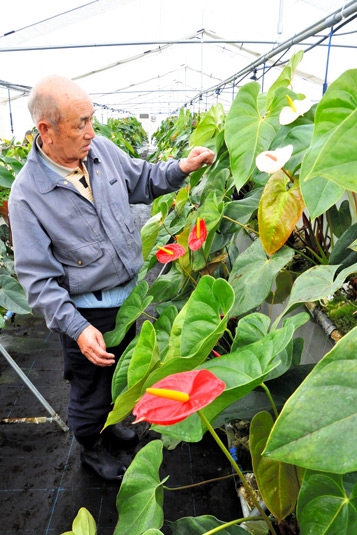
I don’t think that what may be good for flowers is also good for vegetables which are to go into the stomach of people…
Farmer Yukichi Takahashi, 76, checks anthurium flowers grown in “soil” made up of polyester fibers in Kawamata, Fukushima Prefecture.
KAWAMATA, Fukushima Prefecture–Farmers here have started growing flowers using polyester “soil” in the hope that the cultivation method will dispel concerns among consumers about radioactive contamination from the nuclear disaster.
The farmers are being helped by a team from Kinki University’s Faculty of Agriculture in Higashi-Osaka, Osaka Prefecture, and have started cultivating anthurium ornamental plants utilizing the soil, which is made up of filamentous polyester fabrics.
“This cultivation method allows us to grow plants without concern over the negative impact of the nuclear accident,” said Yukichi Takahashi, a 76-year-old farmer who is a key member of the project. “My dream is that our flowers will be used in bouquets to be presented to athletes on the podium during the 2020 Tokyo Olympics.”
In a test run, 2,000 anthurium plants, known for their colorful, heart-shaped flowers, were grown in a 30-meter-long greenhouse in the Ojima district of Kawamata, located about 50 kilometers northwest of the crippled Fukushima No. 1 nuclear power plant.
Local farmers who participate in the project will set up an agricultural corporation later this year with the aim of eventually starting full-fledged farming and shipment.
The project began in spring 2014 after the university researchers learned about the plight of local farmers when they visited to measure radiation levels in the town, which is located on a high plateau surrounded by mountains.
“By using polyester fabrics as a cultivation medium instead of ground soil, this new method will help protect Fukushima farmers from harmful rumors that may stem from consumers’ concerns over soil contamination,” said project leader Takahiro Hayashi, a professor of horticulture at the university, which is known for its advanced aquafarming and agricultural programs.
Kawamata once prospered through livestock and tobacco farming, but the nuclear disaster, triggered by the Great East Japan Earthquake and tsunami on March 11, 2011, dealt a heavy blow to the area’s agricultural industry by spreading a large amount of radioactive fallout.
A southeastern strip of the town is still designated as a “zone being prepared for the lifting of the evacuation order,” and local residents remain evacuated from the district in temporary housing and elsewhere.
While radiation levels in the town’s agricultural produce have passed safety tests, consumers’ lingering concerns over possible contamination have undercut market competitiveness.
http://ajw.asahi.com/article/0311disaster/recovery/AJ201603200015
Nuclear accidents make mutant bugs and birds
Biologist Timothy Mousseau has spent years collecting mutant bugs, birds and mice around Chernobyl and Fukushima. In a DW interview, he shares some surprising insights into the effects of nuclear accidents on wildlife.

DW: Professor Timothy Mousseau, did you collect these mutant firebugs [pictured at the top of the page]?
Timothy Mousseau: Yes, the firebugs are really an eye-opener. My research partner Anders Moller and I were visiting Chernobyl on April 26, 2011. We were wandering around Pripyat collecting flowers, to study their pollen, when Anders reached down to the ground and pulled up this little bug with red and black markings. He said: “Tim, look, it’s a mutant – it’s missing an eye spot!”
From then on we started collecting these little bugs in each place we visited, from the most contaminated parts of the Red Forest to relatively clean areas in abandoned villages. Eventually we had several hundred of these little critters. It was very obvious that deformed patterns were much more prevalent in areas of high contamination.
This is just one of many similar anecdotes about the deformed critters of Chernobyl. Literally every rock we turn over, we find a signal of the mutagenic properties of the radiation in the region.

A pair of great tit birds collected near Chernobyl – left is normal, the individual on the right has a facial tumor
Is there a threshold of radiation below which there’s no effect?
The impact of radiation on rates of mutation, cancer and mortality varies a good deal by species. But statistically, there’s a simple relationship with dose. Small dose, small effect; big dose, big effect. There doesn’t appear to be a threshold below which there’s no effect.
Interestingly, organisms living in nature are much more sensitive to radiation than lab animals – comparing mice raised in labs and mice in the wild, exposed to identical levels of ionizing radiation, the mortality rate among wild mice is eight or 10 times that of lab mice. It’s because lab animals are protected from most stressors – like cold or hunger.
Are plants and trees affected too?
Yes, we’ve collected a lot of deformed pollen. Seen a lot of deformed trees, too. Pines often show growth-form abnormalities, even in normal areas with no radionucleotide contamination. Sometimes it’s an insect infestation, sometimes a hard freeze at the wrong time – you can find such anomalies anywhere.
But in contaminated areas of Ukraine, we have a correlation between frequency of abnormality and the Chernobyl event. It’s pretty strong evidence. There was a recent paper showing a very similar phenomenon in Fukushima. The trees there are very young, but will likely also be twisted up in knots 30 years from now!

Mousseau’s field crew collecting pollen and insect samples on the left, with the Chernobyl reactor in the distance. Right, a mutant pine tree at Chernobyl
What are the long-term effects of radiation on animal or plant species in contaminated areas? They’ve had their genomes altered. Will mutants persist?
Well, in the long run, no. The thing is, some background rate of mutations happens constantly in every species, even in uncontaminated areas – albeit at a much lower rate than in areas contaminated by nuclear accidents. So most genetic variants have been tried already. The great majority are either neutral or slightly deleterious. If a mutation had any benefit to offer, it would already be there in the population.
So the long-term effect of nuclear accidents on biodiversity is … none?
Yes, that’s right. Over evolutionary time, we expect that populations will return to normal after the mutagen disappears. Radionucleotides decay, hot sites eventually cool down, mutations become less frequent again, and healthy animal and plant populations recolonize the sites. So the genetic status quo ante returns – except if mutations have occurred that permanently enhance fitness, but that’s very rare.
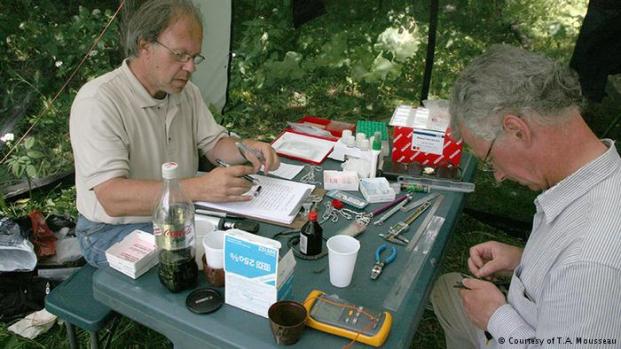
Mousseau (left) and colleague Anders Moller recording measurements in the field at Chernobyl
Some mutations might persist for a while if they’re adaptive during the hot phase. For example, there’s selection for animals whose cells produce a higher antioxidant load, which makes them more resistant to the effects of ionizing radiation. But that protection comes at a metabolic cost. After radiation levels die down, those variants will be selected back out of the population.
Where things get complicated is when the harmful mutations are recessive, that is, when it takes two copies [one for each chromosome] for the expression of the mutation. Many mutations fall into this category. They can accumulate in populations because they’re not expressed until two copies come into the same individual [one from the mother, the other from the father].
Because of this, populations can be affected by such mutations for many generations even after the mutagen is removed, and also, via dispersal, in populations that were never affected by the mutagen.
How can radioactive contamination interact with other problems that affect ecosystems, like habitat loss or climate change?
Certainly climate change is an additional stressor that is likely to interact with radiation to affect populations. We have demonstrated that while swallows in most places have moved their breeding dates forward in response to warming, in the Chernobyl area they are actually delayed. We hypothesize that this is due to the stress from the radioactive contaminants.
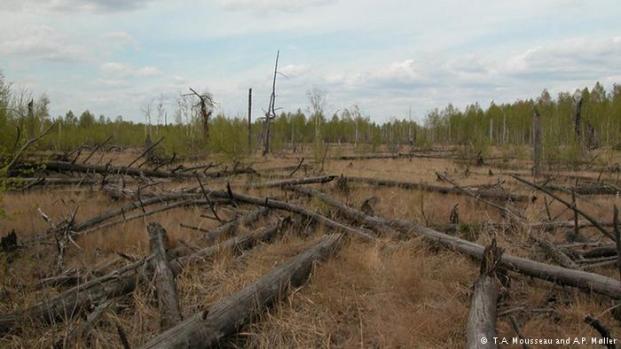
The Red Forest near Chernobyl in Ukraine presents a high risk of fire, as a lack of bacteria prevents the trees from decaying
The biggest fear at present is related to the observation of hotter and drier summers in Ukraine, and the resulting increase in number and size of forest fires. Last summer there were three large fires, and one of them burned through some very contaminated areas.
We have predicted that such events could pose a significant threat to both human populations and the environment via re-suspension and deposition of radionuclides in the leaf litter and plant biomass.
In addition to the threat of catastrophic wildfire spreading nuclear contamination, birds and mammals also move around. Do they absorb radioactive elements in their food and water in contaminated sites, carry them elsewhere, thus dispersing the contamination more widely?
Do animals move radionuclides? Yes! I did a study years ago that showed very significant amounts of radionuclides are exported every year by birds. But it seems unlikely that the amount is enough to cause measurable health effects – unless you’re eating the birds. It is known that some people living outside the Chernobyl Exclusion Zone are getting very significant doses from hunting the contaminated wild boar that leave the zone.
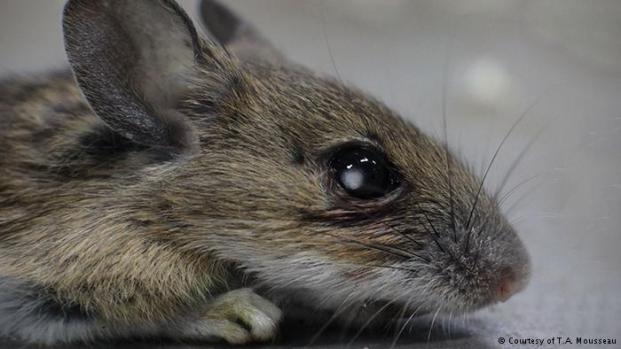
Mouse with cataract collected near Chernobyl – the more radioactive the site, the higher the frequency of defects
This year marks five years since the Fukushima accident, and 30 years since Chernobyl. How long will the contaminated zones around Chernobyl and Fukushima be mutagenic and dangerous?
Chernobyl was a nuclear fire and ongoing fission event for 10 days, with strontium, uranium and plutonium isotopes strewn into the landscape. They have long half-lives, so many areas will remain hazardous for centuries, even thousands of years.
Fukushima was largely a cesium event, and cesium radionucleotides have a relatively short half-life. The area will mostly naturally decontaminate itself within decades, at most within a couple hundred years.
Timothy Mousseau is a professor of biological sciences at the University of South Carolina in Columbia, South Carolina. He is one of the world’s leading experts on the effects of radionucleotide contamination from nuclear accidents on wild bird, insect, rodent, and plant populations.
Interview: Nils Zimmermann
No matter what BBC says: Fukushima disaster is killing people
Chris Busby – 14th March 2016

IAEA marine experts and Japanese scientists collect water samples in coastal waters near the Fukushima Daiichi Nuclear Power Station
The BBC has been excelling itself in its deliberate understatement of the Fukushima nuclear catastrophe, writes Chris Busby. While calling in pseudo experts to say radiation is all but harmless, it’s ignoring the science that shows that the real health impacts of nuclear fallout are around 1,000 times worse than claimed.
I am so ashamed of the BBC. It seems, as an institution, to be supporting and promulgating an enormous lie about the health effects of radioactive pollution. And not providing any balanced scientific picture.
On the 5th Anniversary of the catastrophe we saw Prof Geraldine Thomas, the nuclear industry’s new public relations star, walk through the abandoned town of Ohkuma inside the Fukushima exclusion zone with BBC reporter Rupert Wingfield-Hayes.
She was described as “One of Britain’s leading experts on the health effects of radiation”. Thomas is of the opinion that there is no danger and the Japanese refugees can come back and live there in the ‘zone’. Her main concern was how untidy it all was: “left to rack and ruin”, she complained, sadly.
At one point Rupert pulled out his Geiger Counter and read the dose of 3 microSieverts per hour. “What does that mean”, he asked, “how much radiation would it give in a year to people who came back here?”
Thomas replied, “About an extra milliSievert a year which is not much considering you get 2mSv a year from natural background. The long term impact on your health would be absolutely nothing.”
Now anyone who has a calculator can easily multiply 3 microSieverts (3 x 10⁻⁶ Sv) by 24 hours and 365 days. The answer is 26 mSv (0.026Sv) not “about 1mSv” as the “leading expert on the health effects of radiation” told the dumbfounded viewers.
Any real expert would not have made such a stupid mistake. But this woman is not a real expert, her CV shows she has published almost nothing in the way of original research, so we must ask how it is the BBC come to take her seriously.
Those who hate nothing so much as the truth
This recalled the day the first reactor exploded in 2011. I was in London, and the BBC asked me to come into the studio and comment. Also there was a nuclear industry apologist, Dr Ian Fells. Like Gerry Thomas he was unconcerned about the radiation: the main problem for him was that the lifts would not work. People would have to climb stairs, he complained.
I said then on that first day that this was a serious accident like Chernobyl but he and all the stooges that followed him told the viewers that it was no problem, not like Chernobyl, hydrogen explosion, no breach of containment pressure vessels etc. Some months later, looking back, it is clear I was correct on every point, but I never was invited back to the BBC.
I visited Japan, took sophisticated measuring equipment, obtained vehicle air filters, spoke to the Japanese people and advised them to take Calcium tablets to block the Strontium-90. My vehicle air filter measurements showed clearly that large areas of north east Japan were seriously contaminated including Tokyo.
This was too much for the nuclear industry: I was attacked in the Guardian newspaper by pro-nuclear Pauline-converted George Monbiot in an attempt to destroy my credibility. One other attacker was Geraldine Thomas. What she said then was as madly incorrect then as what she is saying now. But the Guardian would not let me respond.
The important evidence for me in the recent BBC clip is the measurement of dose given by Rupert’s Geiger counter, 3microSieverts per hour (3μSv/h). Normal background in Japan (I know, I measured it there) is about 0.1μSv/h. So in terms of external radiation, Ruperts’s measurement gave 30 times normal background.
Fukushima: we have a very serious problem
Is this a problem for health? You bet it is. The question no-one asked is what is causing the excess dose? The answer is easy: radioactive contamination, principally of Caesium-137. On the basis of well-known physics relationships we can say that 3μSv/h at 1m above ground represents a surface contamination of about 900,000 Bq per square metre of Cs-137. That is, 900,000 disintegrations per second in one square metre of surface.
And note that they were standing on a tarmac road which appeared to be clean. And this is 5 years after the explosions. The material is everywhere, and it is in the form of dust particles which can be inhaled. Invisible sparkling fairy-dust that kills hang in the air above such measurements.
The particles are not just of Caesium-137. They contain other long lived radioactivity, Strontium-90, Plutonium 239, Uranium-235, Uranium 238, Radium-226, Polonium-210, Lead-210, Tritium, isotopes of Rhodium, Ruthenium, Iodine, Cerium, Cobalt 60, the list is long.
The UN definition of radioactively contaminated land is 37,000Bq / square metre, and so, on the basis of the measurement made by the BBC reporter, the town of Ohkuma in the Fukushima zone (and we assume everywhere else in the zone) is still, five years after the incident, more than 20 times the level where the UN would, and the Soviets did, step in and control the population.
But the Japanese government want to send the people back there. It is bribing them with money and housing assistance. It is saying, like Gerry Thomas, that there is no danger. And the BBC is giving this criminal misdirection a credible platform. The argument is based on the current radiation risk model, that of the International Commission on Radiological Protection the ICRP.
Last month, my German colleagues and I published a scientific paper in the peer reviewed journal Environmental Health and Toxicology. It uses real-world data from those exposed to the same substances that were released by Fukushima to show that the ICRP model is wrong by 1,000 times or more.
This is a game changing piece of research. But were we asked to appear on the BBC, or anywhere else? No. What do our findings and calculations suggest will have happened in the five years since the explosions and into the future? Let’s take a look at what has happened since 2011.
And this is only the beginning …
The reactors are still uncontrolled five years after the explosions and continue to release their radioactive contents to the environment despite all attempts to prevent this. Concerning the melted fuel, there is no way to assess the condition or specific whereabouts of the fuel though it is clearly out of the box and in the ground. Robots fail at the extremely high radiation levels found.
Ground water flowing through the plant is becoming contaminated and is being pumped into storage tanks for treatment. High radiation levels and debris have delayed the removal of spent fuel from numbers 1, 2 and 3 reactor buildings. TEPCO plans to remove debris from reactor 3 and this work has begun. Then they are hoping to remove the fuel rods out of reactors 1 and 2 by 2020 and the work on removing debris from these 2 reactors has not begun yet.
Much of the radioactivity goes into the sea, where it travels several hundreds of km. up and down the coast destroying sea life and contaminating intertidal sediment. The radionuclides bind to fine sediment and concentrate in river estuaries and tidal areas like Tokyo Bay.
Here the particles are resuspended and brought ashore to be inhaled by those living within 1km of the coast. From work done by my group for the Irish Government on the contaminated Irish Sea we know that this exposure will increase the rate of cancer in the coastal inhabitants by about 30%.
The releases have not been stopped despite huge amounts of work, thought and action. The treated water is still highly radioactive and cannot yet be released. An ice wall designed to stop the flow of water getting to the plant is still not operational and the Japanese Nuclear regulator still has not given the go-ahead.
‘Son of Fukushima’ waiting to happen
This may be wise because an environment report showed that use of the ground water caused rapid subsidence and can destabilise the structures of the reactors. That is a real problem on site with 3 heavy spent fuel pools still full and largely inaccessible. Collapse of the buildings would lead to coolant loss and a fire or even explosion releasing huge amounts of radioactivity.
So this is one nightmare scenario: ‘Son of Fukushima’. A solid wall at the port side may have slowed the water down but diverting the water may cause problems with the ground water pressure on site and thus also threaten subsidence. Space for storing the radioactive water is running out and it seems likely that this will have to be eventually spilled into the Pacific.
Only 10% of the plant has been cleaned up although there are 8,000 workers on site at any one time, mostly dealing with the contaminated water. Run-off from storms brings more contamination down the rivers from the mountains. There are millions of 1-ton container bags full of radioactive debris and other waste which has been collected in decontamination efforts outside the plant and many of these bags are only likely to last a handful of years before degrading and spilling their contents. Typhoons will spread this highly contaminated contents far and wide.
TEPCO are also burning waste from the plant in a single incinerator. Further afield, contamination efforts to clean up the homes and roads are hampered by the torrential rains that are increasing because of global warming; the rain is bringing large amounts of contaminated soil back into these areas as well as the contaminated leaves and pollen from the forest areas that TEPCO are unable to clean.
Far off the shore there are natural areas that act as nurseries for many species of sea life. It has been found that intertidal marine species such as anemones, sponges, crustaceans, worms and bivalves within 30 km of the damaged reactors have disappeared altogether because of the 300 tons of highly radioactive water a day flowing out of the plant into the sea.
This water contains large amounts of tritium, making it radioactive; the effects of tritium on the larval stages of marine invertebrates has been studied in the UK. It was found at the University of Plymouth that levels involving doses of less than 1mSv of tritium inhibited the development.
Going global
Radioactivity from Fukushima has now migrated across the Pacific and is appearing on the West Coast of the USA. The scientific community there, like Gerry Thomas, subscribe to the flawed ICRP model, and since the levels of Caesium-137 measured are low, (maybe 10Bq/cubic metre of sea water), they say that there will be no health effects. But like Thomas they are wrong.
The problem is that ‘dose’ cannot be used to assess risk from internal radioactive particles. Dose is an average over large masses of tissue: but cancer begins in a single cell or local community of cells and these particles from Fukushima cause massive local doses. This is why there have been countless web reports of marine mammals with patchy sores or localised tumours. The question of the ongoing effect of this Fukushima radioactivity on the Pacific biota far from Japan remains open.
The effects on wild creatures in Japan are clear and have been studied. There have been peer-reviewed reports of genetic damage in birds and in insects; a major scientist studying these genetic effects at Fukushima and in the Chernobyl affected areas also is Tim Mousseau.
But whilst he can study plants and animals, no-one can study humans. There is a kind of closure on such data, with the Japanese government controlling it. The government is more interested in getting Fukushima ready for the Olympics and is using financial and cultural pressure to move families back into contaminated zones.
Japan is also exporting radioactive produce, and is using trade agreements to bully countries into accepting these poisons on the basis of the ICRP model. I was in Korea a few months back as an expert witness in a radiation case involving high levels of thyroid cancer near their nuclear sites. I was told about Japan using international trade laws to force its contaminated foods on to the Koreans, who were measuring the radioactivity and sending the stuff back. So watch out for radioactive items from Japan.
So what’s the evidence?
Let’s look at the only real health data which has emerged to see if it gives any support to my original estimate of 400,000 extra cancers in the 200km radius. Prof Tsuda has recently published a paper in the peer reviewed literature identifying 116 thyroid cancers detected over three years by ultrasound scanning of 380,000 0-18 year olds.
The background rate is about 0.3 per 100,000 per year, so in three years we can expect 3.42 thyroid cancers. But 116 were found, an excess of about 112 cases. Geraldine says that these were all found because they looked: but Tsuda’s paper reports that an ultrasound study in Nagasaki (no exposures) found zero cases, and also an early ultrasound study also found zero cases. So Geraldine is wrong. The thyroid doses were reported to be about 10mSv. On the basis of the ICRP model, that gives an error of about 2,000 times.
From the results of our new genetic paper we can safely predict a 100% increase in congenital malformations in the population up to 200km radius. In an advanced technological country like Japan these will be picked up early by ultrasound and aborted, so we will not actually see them, even if there were data we could trust.
What we will see is a fall in the birth rate and increase in the death rate. We know what has been happening and what will happen; we have seen it before in Chernobyl. And just like Chernobyl, the (western) authorities are influenced by or take their lead from the nuclear industry: the ICRP and the International Atomic Energy Agency, (IAEA) which since 1959 has taken over from the World Health Organisation as the responsible authority for radiation and health (Yes, really!).
They keep the lid on the truth using stupid individuals like Geraldine Thomas and, by analogy with New Labour: New BBC. Increasingly I could say ‘New Britain’ as opposed to the Great Britain of my childhood, a country I was proud of where you could trust the BBC. I wonder how the reporters like Rupert can live with themselves presenting these lies.
Fukushima is far from being over, the deaths have only just begun.
The BBC report: bbc.com/news/world-asia-35761141
The study: ‘Genetic Radiation Risks – A Neglected Topic in the Low Dose Dabate‘ by Busby C, Schmitz-Feuerhake I, Pflugbeil S is published in Environmental Health and Toxicology.
Chris Busby is an expert on the health effects of ionizing radiation. He qualified in Chemical Physics at the Universities of London and Kent, and worked on the molecular physical chemistry of living cells for the Wellcome Foundation. Professor Busby is the Scientific Secretary of the European Committee on Radiation Risk based in Brussels and has edited many of its publications since its founding in 1998. He has held a number of honorary University positions, including Visiting Professor in the Faculty of Health of the University of Ulster. Busby currently lives in Riga, Latvia. See also: chrisbusbyexposed.org, greenaudit.org and llrc.org.
Strontium 90 <0.2 bq/kg Found in British Columbia Wild Salmon
試料 名 Sample:
野生サーモン-シロザケ-メス
(フリーズドライ)
Wild Chum Salmon – female
(Freeze Dried)
採取 場所 Origin: Kilby Park, BC Canada
採取年月 Sampling date: 2014 年11月30日 (November 30, 2014)
測定日時 Date Tested : 2015 年3月31 日 (March 31, 2015)
測定時間 Duration : 57,600 秒(seconds)
試料容器 Container: 500mLマリ ネリ容器(Marinelli)
試料重量 Sample weight: 144.2g
乾燥前 Before dehydration: 2010g → 700g

測定日時 Date Tested : 2015 年9月15 日 (September 15, 2015)
測定時間 Duration : 10時間 (10hours)
試料重量 Sample weight: 25g
Tested by Iwaki Radiation Measuring Center, Trachine with SL300/SLL – coordinated by Citizen Radioactivity Measuring Station, Shinjyuku-Yoyogi
新宿代々木市民測定所いわき放射能市民測定室たらちね
測定時間 Duration : 4時間 (4hours)
試料重量 Sample weight: 0.105g
Tested by Iwaki Radiation Measuring Center, Trachine with SL300/SLL – coordinated by Citizen Radioactivity Measuring Station, Shinjyuku-Yoyogi
新宿代々木市民測定所いわき放射能市民測定室たらちね
But it’s not telling you a whole story about contamination….
1 This Month

of the week – Shut Down Drone Warfare!


Tell the Ukrainian Government to Drop Prosecution of Peace Activist Yurii Sheliazhenko

Petition to revoke the licensing of the Near Surface Nuclear Disposal Facility (NSDF) at Chalk River. https://www.ourcommons.ca/petitions/en/Petition/Details?Petition=e-7247
To see nuclear-related stories in greater depth and intensity – go to https://nuclearinformation.wordpress.com
-
Archives
- April 2026 (44)
- March 2026 (251)
- February 2026 (268)
- January 2026 (308)
- December 2025 (358)
- November 2025 (359)
- October 2025 (376)
- September 2025 (257)
- August 2025 (319)
- July 2025 (230)
- June 2025 (348)
- May 2025 (261)
-
Categories
- 1
- 1 NUCLEAR ISSUES
- business and costs
- climate change
- culture and arts
- ENERGY
- environment
- health
- history
- indigenous issues
- Legal
- marketing of nuclear
- media
- opposition to nuclear
- PERSONAL STORIES
- politics
- politics international
- Religion and ethics
- safety
- secrets,lies and civil liberties
- spinbuster
- technology
- Uranium
- wastes
- weapons and war
- Women
- 2 WORLD
- ACTION
- AFRICA
- Atrocities
- AUSTRALIA
- Christina's notes
- Christina's themes
- culture and arts
- Events
- Fuk 2022
- Fuk 2023
- Fukushima 2017
- Fukushima 2018
- fukushima 2019
- Fukushima 2020
- Fukushima 2021
- general
- global warming
- Humour (God we need it)
- Nuclear
- RARE EARTHS
- Reference
- resources – print
- Resources -audiovicual
- Weekly Newsletter
- World
- World Nuclear
- YouTube
-
RSS
Entries RSS
Comments RSS
 nuclear-news
