Japan urged by China to deal with Fukushima-affected food

Officers from the Beijing Food and Drug Administration check imported food at a supermarket on Thursday.
Report finds many e-commerce sites selling potentially unsafe products
The Chinese Foreign Ministry has urged the Japanese government to take more effective measures to handle the environmental aftermath of the Fukushima nuclear disaster and disclose information to ensure marine environmental safety and the safety of people in other countries.
Hua Chunying, spokeswoman for the Ministry of Foreign Affairs, made the comment on Thursday following exposure by China’s State television station that food products from areas affected by the nuclear disaster in Japan are being sold in China.
China’s top food regulator promised on Thursday to punish such irregularities involving food safety exposed in China Central Television’s annual World Consumer Rights Day program on Wednesday.
“We have demanded local food and drug supervision authorities investigate the irregularities and transfer criminal suspects to public security authorities,” the China Food and Drug Administration said.
Food and drug authorities must strengthen supervision over food safety and severely punish culprits, it said.
Food from areas affected by the 2011 Fukushima nuclear disaster have been sold on many e-commerce platforms in China and in some brick-and-mortar shops, including dairy, cereal, rice and wine, CCTV reported.
Although some of the products had labeling in Japanese that specified manufacturing locations such as Tokyo and Tochigi, they were covered by Chinese labels that only stated the manufacturing location as Japan, the report said.
China has banned the importation of food and animal feed from Tokyo and 11 prefectures, including Fukushima, Niigata-ken and Tochigi, since April 2011 to guard against risks, according to the General Administration of Quality Supervision, Inspection and Quarantine.
Major supermarkets and e-commerce platforms in Beijing started to inspect imported food products following the CCTV report and found no product from any of the 12 areas, Ji Ye, an official at Beijing Food and Drug Administration, said.
The administration is also conducting inspections of food enterprises in Beijing, including MUJI and 7-Eleven, and will recall any product that is imported from the affected areas, he said.
More than 13,000 online shops in China were suspected of selling food from these banned areas, according to the Shenzhen Market and Quality Supervision Commission, CCTV reported.
Law enforcement officers from the commission found nearly 20,000 packages of “Calbee” brand oatmeal, which is from Tochigi, at a company in Shenzhen, the report said.
Some supermarkets, including Japanese brand MUJI, are also suspected of violations, CCTV said.
MUJI said on Thursday that the two kinds of products, a cereal beverage and a muffin, are made in Fukui-ken and Osaka, which are not on the list of imports banned by China’s quality supervision authorities.
http://www.ecns.cn/2017/03-17/249602.shtml
http://www.pressreader.com/china/china-daily/20170317/281694024591810
Fukushima, Japan Ban On Fish Exports Over? After Nuclear Radiation Disaster, Countries Could Lift Embargo

After years of banning Japan’s fish and agriculture, many countries might be willing to give the nation a second chance and import its goods. The Fukushima Daiichi nuclear disaster in 2011 and the resulting radiation in the region caused 54 countries and regions to implement restrictions on certain Japanese goods.
That number has shrunken to 33, with more nations likely to follow suit and lift the ban, the Japan Times reported Wednesday.
“We are looking forward to the lifting of the South Korean import ban,” Masao Atsumi, a sea-squirt farmer in Miyagi prefecture, told the Japan Times.
South Korea, which received about 70 percent of Japan’s sea squirt exports, imposed a ban on fish imports from eight prefectures in Japan in 2013.
The European Union began easing its own restrictions on Japanese imports in 2016. China, Taiwan, Hong Kong, Macao, Singapore and Russia all continued to ban products from certain regions.
Lifting such restrictions could be a sign that Japan, still heavily burdened by the disaster six years later, was on the road to recovery. The nuclear meltdown left a zone of more than 300 miles surrounding the plant uninhabitable, causing the evacuation of 160,000 residents. Many of those residents were set to begin returning in the coming days.
Despite progress, serious problems have continued to pervade the region. Due to melted fuel debris, radiation in the nuclear plant recently reached the highest levels ever recorded inside, with experts calling it “unimaginable.” Radiation reached such elevated levels that the robots tasked with cleaning the reactor could not survive. Tokyo Electric Power Company, the group responsible for the cleanup, was still struggling to complete the $188 billion recovery process to decommission the plant, a project estimated to take decades.
The barren region left behind by the disaster also has a wild boar problem. Hundreds of the animals began invading towns surrounding the defunct plant after residents fled, scavenging for food and virtually taking over.
2020 Olympic food suppliers lack necessary food safety certification

As the organizers of the 2020 Olympics and Paralympics work on ensuring that food provided during the tournament will be safe, the games face a huge shortage of domestic food producers with the necessary food safety certification.
The certification in question is known as “Good agricultural practice,” or GAP for short. Ever since the London Olympics and Paralympics in 2012, the provision of GAP-certified food and drink to venues such as the Olympic Village has become increasingly important.
However, the number of producers in Japan who hold GAP certification is extremely low — partly due to high costs and a lack of knowledge about GAP among consumers. It is thought that less than 1 percent of food producers in Japan hold either the Global GAP or Japanese GAP certification.
This is an issue for producers because the organizing committee for the Tokyo 2020 Games is on the verge of finalizing criteria for food safety during the tournament — with much of the criteria expected to revolve around GAP certification.
In response to the current shortage of GAP-certified producers in Japan, an official close to the government commented, “If we keep going at this pace, there is a real danger than there won’t be enough domestically produced food available during the Games.” This would be a great shame because the country has a multitude of wonderful food and drink on offer, such as “wagyu” (Japanese beef) and Japanese tea.
Furthermore, it is expected that about 15 million meals will need to be provided during the 2020 Olympics, so naturally, it will be an excellent opportunity to showcase Japanese food to the rest of the world.
There is a modified version of GAP in Japan — based on Ministry of Agriculture, Forestry and Fisheries of Japan (MAFF) guidelines — but just five of Japan’s 47 prefectures, including Shimane and Tokushima, follow it.
A British version of GAP known as “Red Tractor” was introduced prior to the 2012 London Olympics and Paralympics. In total, 80 percent of food producers who supplied the tournament in London picked up the Red Tractor certification by 2010. Such a system may well provide inspiration for Japanese farmers.
GAP is an important certification because it helps stop the mixing in of any improper substances during the food production process. For example, under GAP regulations, pesticides must be stored safely in a locked room. Also, any fluorescent lighting close to agricultural produce should be covered accordingly.
However, although GAP certification is undeniably well-intended, farmers wanting to apply must pay an annual registration fee in the region of several thousand yen per year, and depending on the size of the farm, there is a screening fee in the region of 100,000 to 400,000 yen per year. In addition, awareness about GAP is low among distributors and consumers, and the fact that GAP certification would not be accepted as a reason for raising food prices means that there are several hurdles for producers.
The government does plan to provide some financial support in this area, but for the time being, awareness across Japan about GAP certification remains a pressing issue.
http://mainichi.jp/english/articles/20170305/p2a/00m/0na/001000c
Agency to probe reasons behind underpricing of Fukushima items

Prices of agricultural products and foodstuffs from Fukushima Prefecture declined after the nuclear plant accident in March 2011, and almost six years later, have yet to recover to pre-disaster levels.
Now the government is seeking to ascertain why these items are still being sold at lower prices, suspecting that wholesalers are deliberately underpricing products being shipped from the prefecture.
The Reconstruction Agency will survey wholesalers’ purchase prices of Fukushima-made food products, according to sources.
The agency believes crops and other items grown in the prefecture are being undersold because of the negative effects of groundless rumors stemming from the accident at the Fukushima No. 1 nuclear power plant. The latest decision is aimed at preventing the spread of those rumors.
The agency’s plan is expected to be included in a draft revision of the Law on Special Measures for the Reconstruction and Revitalization of Fukushima, to be submitted during the current Diet session.
Since the Great East Japan Earthquake and tsunami on March 11, 2011, triggered the nuclear accident, Fukushima-made foodstuffs have been shipped only after their radioactivity levels are confirmed to be below safety standards.
The levels for those agricultural and other products typically fall below detectable levels, meaning most foodstuffs from Fukushima Prefecture are completely safe to eat.
Despite the fact, trading prices of rice and beef produced in the prefecture are still nearly 10 percent lower than national averages, according to the agency.
The agency suspects that the prices have not recovered to their pre-disaster levels not only because consumers tend to avoid Fukushima-made articles, but also because they are “purchased at unreasonably low rates” at the time of shipping.
When prices to wholesalers of food products grown in the prefecture are lower than pre-disaster rates, farmers can be compensated for the difference by Tokyo Electric Power Co., operator of the Fukushima No. 1 nuclear plant.
“Some wholesalers may knock down the price, misusing the compensation system,” said a source at the Reconstruction Agency.
To prevent the abuse of the compensation system, the special measures law will be amended to include a plan to conduct “a survey to make clear why they (Fukushima-made products) are suffering from sluggish sales.”
Based on the revised law, the agency will survey the prices farmers are selling their crops for to wholesalers, how much consumers are paying for the agricultural products and other trading prices of foodstuffs from Fukushima Prefecture.
After identifying the reason for the lower prices, the agency will offer instructions and advice to wholesalers and other related parties.
http://www.asahi.com/ajw/articles/AJ201702150001.html
Fukushima peach exports recover in Southeast Asia, sparking hope for other produce???

The original article was published by Fukushima Minpo, local Fukushima Newspaper, which promotes “recovery”.To export your contaminated fruits to other countries is plainly criminal.
Fukushima peaches are making inroads into Southeast Asian markets in what prefectural officials see as a model case of recovery in its farm produce.
Fukushima grabbed the top share of Japanese peach exports to three Southeast Asian countries last year — 73.9 percent in Thailand, 76.8 percent in Malaysia and 55.9 percent in Indonesia.
In terms of volume, Fukushima exported a combined 30.6 tons of peaches to the three countries plus Singapore in 2016, surpassing the 23.9 tons logged in 2010 — the year before the triple meltdown at the Fukushima No. 1 power plant shattered trust in its farm produce in March 2011.
Given the improved figures, the Fukushima Prefectural Government now believes the measures it took to combat harmful rumors are paying off. It hopes to revive sales channels for other produce by using the recovery of peach exports as a base.
The prefectural government announced the export data at the end of January based on the Finance Ministry’s trade statistics for 2016 and other figures compiled by the Fukushima headquarters of the National Federation of Agricultural Cooperative Associations, or JA Zen-Noh.
Fukushima is the nation’s No. 2 peach-growing prefecture after Yamanashi and has been dubbed a “fruit kingdom” for the wide variety grown, including cherries, grapes, pears and apples.
Its peach exports peaked at 70 tons in 2008, thanks mainly to Taiwan and Hong Kong, but import bans imposed from the Fukushima disaster saw the peach trade collapse to zero in 2011.
According to the prefecture’s public relations office, Fukushima was quick to review its sales strategy and shift focus to Southeast Asia, where some countries eased import restrictions on its produce at an early stage.
A decision to promote the sweetness and freshness of Fukushima peaches was also a major factor in grabbing the hearts of consumers, the office said.
Despite the success in Thailand, Malaysia and Indonesia, it may take time before other countries in the region follow suit.
In Singapore, for example, Fukushima peaches last year had a market share of only 12 percent among all peaches the city-state imported from Japan.
The prefecture is hoping that the improvements in the three countries will help persuade other markets, such as Hong Kong and Taiwan, that its peaches are safe.
The recovery of the fruit’s reputation overseas has provided great encouragement to the prefecture’s peach growers, including Shigeyoshi Saito, 58, of the city of Date.
“Along with other items, peaches are a main pillar of Fukushima’s farm produce,” he said. “I hope their good reputation in Southeast Asia will spread the word to the entire world.”
All Fukushima seafood samples pass safety tests for radioactivity
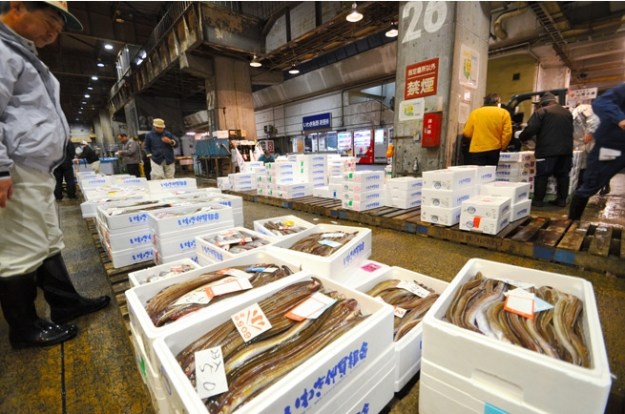
Fish caught during test fishing operations are sold at the Iwaki City Central Wholesale Market on Jan. 13. (Kazumasa Sugimura)
IWAKI, Fukushima Prefecture–For the first time, radioactivity levels were lower than the government’s safety limit in every seafood sample caught off Fukushima Prefecture for an entire year, officials said.
The Fukushima Prefectural Fisheries Experimental Station said 8,502 fish and shellfish samples were tested in 2016, and all recorded radioactivity readings under the safety standard of 100 becquerels per kilogram.
Ninety-five percent of them tested below the detection limit of around 15 becquerels per kilogram.
It was also the first time more than 90 percent of samples were below the detection threshold since the disaster at the Fukushima No. 1 nuclear plant started in March 2011, according to the officials.
People in the local fishing industry hope the numbers will help lead to a return to normal operations, although they say it is difficult to gauge the impact of harmful rumors about Fukushima seafood because prices depend on multiple factors, including quantity and quality.
“Test fishing is, after all, test fishing,” said Yuji Kanari, a managing director with seafood wholesaler Iwaki Gyorui KK. “Turning that into full fishing operations like before (the disaster) will emerge as a major challenge this year.
“I hope that local consumption of locally produced goods that was disrupted by the nuclear disaster will soon be back.”
The hauls from test fishing, which began in June 2012, have grown from year to year.
Preliminary figures show last year’s catch at 2,072 tons, up 560 tons from 2015, but still only 7.9 percent of the annual catch of 26,050 tons averaged over the decade preceding the 2011 disaster.
Ninety-four species are eligible for this year’s test fishing, which the Soma-Futaba fisheries cooperative association started on Jan. 10 and the Iwaki city fisheries cooperative association began on Jan. 12.
http://www.asahi.com/ajw/articles/AJ201702030003.html

Gov’t plan to cut back radiation tests on produce draws mixed reactions

The national government suggested it would scale back radiation tests on produce from Tokyo and 16 other prefectures affected by the Fukushima nuclear disaster, at a citizen-oriented event in Tokyo on Feb. 2, drawing mixed reactions from those in attendance.
A draft policy was put together by government bodies including the Ministry of Agriculture, Forestry and Fisheries and the Consumer Affairs Agency and calls for allowing reduction of the tests from the 2017 fiscal year. The plan was influenced by the fact that there are now almost no cases of agricultural products that exceed the regulatory limit for radioactive cesium of 100 becquerels per kilogram. Under the draft policy, the Tokyo Metropolitan Government or any of the affected prefectural governments whose agricultural products were at half or less of the limit for the past three years could choose to scale back their tests.
Representatives from consumer groups and Fukushima producers were present at the Feb. 2 meeting. There were many voices of opposition against the draft policy, saying it was too early to cut back the tests, or that the requirement for scaling them back should be stricter than half or less of the regulatory limit. On the other hand, another attendee said that over the last five years the tests had cost around 4 billion yen and the money should “be spent toward more meaningful goals.”
According to the testing results from fiscal 2011 through fiscal 2015, during the first two years the percentage of products like vegetables, fruits, tubers and meats from these areas with radioactive cesium in excess of the regulatory limit was between 0.1 percent and 5.9 percent, but since 2013 no excessive radiation has been detected.
The central government plans to hold an event to exchange ideas on the matter on Feb. 17 and get a better understanding of public opinion, before deciding on whether to actually downsize the testing.
http://mainichi.jp/english/articles/20170203/p2a/00m/0na/004000c
Fukushima ice cream sales “immune” to fears of radiation
“If you tell a lie big enough and keep repeating it, people will eventually come to believe it. The lie can be maintained only for such time as the State can shield the people from the political, economic and/or military consequences of the lie. It thus becomes vitally important for the State to use all of its powers to repress dissent, for the truth is the mortal enemy of the lie, and thus by extension, the truth is the greatest enemy of the State.” Paul Joseph Goebbels (29 October 1897 – 1 May 1945) was Adolf Hitler‘s Propaganda Minister in Nazi Germany.
The town of Koriyama in Fukushima Prefecture was one of the towns most severely hit by the Fukushima Daiichi March 2011 plume. Though not evacuated as it is located outside of the 30km radius evacuation zone decided by the Japanese government, it remains quite contaminated and has many radioactive hotspots.
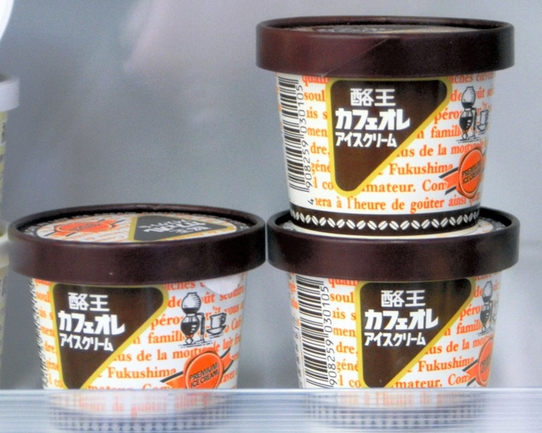
Winter sales have been strong for Rakuou Cafe au Lait Ice Cream produced in Fukushima Prefecture.
KORIYAMA, Fukushima Prefecture–A dairy company here that has withstood fears and rumors about radiation has produced a hot-selling item in the middle of winter.
Within two weeks in November, the initial 6,000 cups of Rakuou Cafe au Lait Ice Cream, produced by Rakuounyugyou Co. in Koriyama, were nearly sold out.
The company, founded in 1975, shipped out an additional lot of around 18,000 cups in December, but this supply has also run short.
Rakuounyugyou shipped 25,000 more cups, mostly to outlets in Fukushima Prefecture, in mid-January, and plans to ship an additional 24,000 within this month.
“Perhaps our ice cream is being seen as more of a premium product,” a sales official at the company said.
Rakuounyugyou’s Rakuou Cafe au Lait, a mild-flavored lactic drink containing at least 50 percent raw milk from Fukushima Prefecture, has an entrenched fan base both in and outside the prefecture.
The company maintained its sales levels in the aftermath of the 2011 Fukushima nuclear disaster, while its competitors suffered losses due to radiation fears and rumors among the public.
Rakuounyugyou developed the ice cream product to commemorate the 40th anniversary of the release of Rakuou Cafe au Lait. The ice cream contains at least 10 percent Rakuou Cafe au Lait and at least 10 percent milk.
“We exercised trial and error because we absolutely didn’t want to disappoint fans of our Cafe au Lait,” the sales official said.
The ice cream was initially sold mainly at sightseeing facilities and expressway service areas in Fukushima Prefecture. Demand was high even though the company did little in the way of a sales campaign.
The spreading popularity of the product can be attributed to Twitter.
Tweets about the ice cream can sound like a hunt for a rare Pokemon on the “Pokemon Go” game app.
“Where could I get one?” one post said. “I got one!” said another.
It is not the first time the social networking service has helped the dairy company; tweets of encouragement spread in the aftermath of the nuclear disaster.
“Be what may, the Rakuou Cafe au Lait tastes so good,” said one particularly popular tweet at that time.
Cafe au Lait is being shipped to a growing number of retailers, most of them in the greater Tokyo area. Sales of the product are up 10 percent from pre-disaster levels.
“Word of our ice cream has also been spread by our fans,” the sales official said. “We are so grateful that we are reduced to tears.”
http://www.asahi.com/ajw/articles/AJ201701290010.html
Fukushima to play direct role in pitching its produce in Tokyo-area supermarkets
There is no safe dose of radiation and any governmental propaganda saying otherwise is just criminal.
Especially when it comes to internal radiation from contaminated foods, much more harmful than external radiation. Internal radiation’s harm is much greater many times depending which organ or cellular tissue is affected.
Japanese government once more continues to sacrifice the health of its citizens to economic expediency.

To fight harmful rumors about Fukushima farm produce and to revive sales, the prefectural government plans to set up permanent sales spaces for susceptible products in major supermarkets in the Tokyo metropolitan area this summer.
The prefectural government has been trying to improve sales by emphasizing the results of radiation tests proving the products are safe. But supermarkets are still reluctant to sell Fukushima produce even six years after the triple core meltdown at the Fukushima No. 1 nuclear plant.
The prefectural government will now focus on establishing sales channels and making sure Fukushima-made produce is treated the same way as produce from other prefectures. It will provide funds to hire sales staff to promote the products and to offer perks to those who buy them.
To recover the sales channels lost after the 2011 meltdowns, prefectural officials have judged it necessary to directly support distribution in addition to publicizing the radiation tests to prove Fukushima produce is safe.
“We will take drastic measures to boost distribution of prefecture-made food products to recover and explore sales channels,” said Fukushima Gov. Masao Uchibori at his first news conference of the year on Jan. 4.
The prefecture plans to start the project in about 10 supermarkets in the Tokyo area before expanding to other stores after gauging public response. Fruit, vegetables, rice and meat produced in Fukushima will be sold at those locations and promoted by staff offering free samples. Prefectural officials may also try to generate interest by offering Fukushima products for free via lotteries.
The prefectural government plans to reach out to supermarket chains for proposals on how they would set up these dedicated promotional spaces. It believes retailers can benefit from the project because they can expect an increase in customers and sales by selling the produce with incentives attached.
Fukushima plans to invest part of the ¥4.7 billion in rumor-squelching funds allocated in the central government’s fiscal 2017 draft budget on projects aimed at improving its image.
“We will ask for the acceptance and cooperation of supermarkets so that sales sections and channels for Fukushima-made products lost after the Great East Japan Earthquake can be regained,” said an official of the Farm Produce Distribution Division.
Taiwanese Say No to Japan Nuke Food Imports
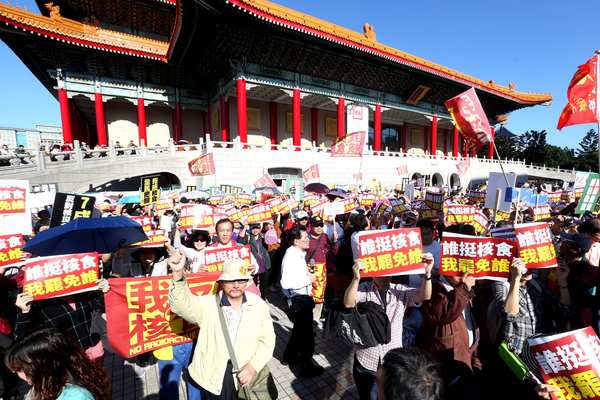
Thousands protest over ‘nuke food’
TAIPEI, Taiwan — Thousands took to the streets to protest the proposed lifting of a ban on food products from radiation-affected areas of Japan, following an inconclusive public hearing on the matter Sunday morning.
The Kuomintang (KMT)-organized march kicked off with remarks from KMT Chairwoman Hung Hsiu-chu (洪秀柱).
“We will not tolerate our children being endangered by food products contaminated by radiation,” Hung said.
Hung urged the crowd of protestors to convey their dissent to the government as they marched from Aiguo East Road near Chiang Kai-shek Memorial Hall and down Ketagalan Boulevard to the Ministry of Finance at Aiguo West Road.
Representatives from various demographics, including housewives, young parents and expecting parents, spoke out in turn before the march began.
The diversity of backgrounds represented at the march “reflected the 74 percent of all Taiwanese nationals who oppose lifting the ban on food imports from five Japanese regions affected by the 2011 Fukushima Daiichi nuclear disaster,” the march’s organizers claimed.
Expecting father Chen Hsiao-wei (陳孝威) expressed concerns that food imports from radiation-affected areas had already made their way into Taiwan.
Chen said he “did not understand any of the figures and numbers” presented by the government’s experts about the imports and only wanted to know why “Taiwanese people should eat these food products when the Koreans, Chinese, and Australians are not eating them.”
In a move that both served as a visual pun and was reminiscent of Latin America’s “pots and pans” protests, “new immigrants” — a term commonly used to refer to immigrants from Southeast Asia — attended the march with small pans and spatulas in hand to object to feeding their children potentially harmful food.
These mothers chose to “bravely speak out and bring their children to the march” to safeguard the welfare of the next generation, a representative of the new immigrant mothers told reporters.
A Failed Public Hearing
Earlier in the day, protestors and KMT legislators attended a public hearing at the Taipei Innovation City Convention Center in New Taipei City’s Xindian District.
The public hearing, which was intended to address the assessment and management of products from the five regions, failed to get past the explanation of the hearing’s rules after repeated outbursts from audience members.
Cabinet Spokesman Hsu Kuo-yung (徐國勇) later said that “some people deliberately showed up (to the hearing) to provoke hatred.”
After moderator Chu Tseng-hung (朱增宏) spent most of the morning asking for decorum, legislators and NGO representatives present decided it was best for the public hearing to be downgraded to an informal forum that would hold no legal weight.
KMT Legislator Kao Chin Su-mei (高金素梅) said procedures for the hearing were “unjust” and that incorrect information was being disseminated. “The government is using technical issues to continue to beat around the bush (on this issue),” Kao Chin said during the hearing.
KMT Legislator Wayne Chiang (蔣萬安) said people’s voices were being omitted. At the march in the afternoon, he told the crowds, “The public hearing was not conducted in accordance with the principle of procedural justice.”
Chiang questioned the need for a hearing on the import of food products from radiation-affected areas if the government had reiterated that it would not allow the import of any “nuke foods.”
Around noon it was decided that the hearing would be downgraded to an informal forum, which organizers of the march later called a “victory of the people.”
Hsu Fu (許輔), director of the Cabinet’s food safety office later said that the forum had achieved “real results” and hoped the format could be used in future policy discussions.
President’s Office Responds
The office of President Tsai Ing-wen office later accused the KMT of “twisting” the hearing.
Presidential Office spokesman Alex Huang (黃重諺) said a public hearing was one of the best “platforms for policy discussion” and that the KMT had managed to turn the hearing into “a show for their party’s own internal election.”
Huang stressed in his statement that the government had never wanted to open the country’s borders to radiation-contaminated food products. “Regardless of where the food products come from, the government holds the same attitude as every other country, which is that it would not import food contaminated by radiation.”
The presidential office spokesman further stated that the government would base their import policies on international professional standards and scientific evidence with no exception.
Radioactive Salmon in Canada
Earlier this month, a research team from Canada’s University of Victoria reported discovering radioactive salmon in the British Columbia region.
Research team leader Jay Cullen found that a sample of salmon from Okanagan Lake in British Columbia had tested positive for cesium 134, which is deemed “a footprint of Fukushima.”
In the years since the 2011 Fukushima disaster, there have been increasing concerns about radiation-contaminated food products originating from the region and contaminated water supplies from airborne radioactive fallout.
Last year, public outrage erupted after food from the Fukushima disaster site was found on British market shelves with false labels. The scare hit closer to home when Taiwan discovered that more than 100 radioactive food products, originating from Fukushima but falsely packaged as coming from Tokyo, had made it onto shelves in Taiwan.
With the issue of food from nuclear-affected regions under close scrutiny domestically, more and more countries and international media outlets are paying attention to the potential of radiation contamination from Fukushima.
At the march, KMT Vice-Chairman Hau Lung-pin (郝龍斌) took the opportunity to ask more people to sign the petition against lifting the food ban.
The petition has been signed by an estimated 78,000 people so far, with Hau stating in a previous interview that the number of signatures could reach 93,000 by year’s end.
KMT Legislator Lin Wei-jo (林為洲) said the brief suspension of plans to lift the ban was a direct result of nationals across Taiwan sending petitions in opposition.
http://www.chinapost.com.tw/taiwan/national/national-news/2016/12/26/487690/p2/Thousands-protest.htm
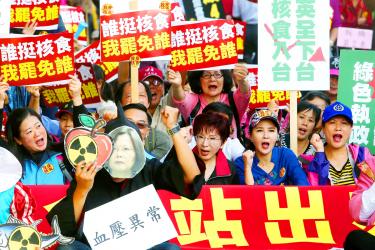
Chinese Nationalist Party (KMT) Chairwoman Hung Hsiu-chu, front third right, attends a demonstration along Taipei’s Ketagalan Boulevard yesterday against the proposed lifting of a ban on food imports from five Japanese prefectures.
KMT leads public protests over Japanese import ban
The Chinese Nationalist Party (KMT) yesterday took to the streets of Taipei, threatening to recall any lawmakers who voice support for the lifting of the nation’s import ban on Japanese food products from five Japanese prefectures, urging President Tsai Ing-wen’s (蔡英文) administration to provide the public with an explanation.
Taiwan imposed import restrictions on food products from Fukushima, Ibaraki, Tochigi, Gunma and Chiba prefectures following the meltdown at the Fukushima Dai-ichi nuclear power plant on March 11, 2011.
Addressing a rally against the relaxation of the ban outside the Chiang Kai-shek Memorial Hall MRT Station in the afternoon, KMT Chairwoman Hung Hsiu-chu (洪秀柱) accused Tsai’s administration of caving in to Japanese pressure and “forcing radiation-contaminated foods down the throats of Taiwanese.”
“We do not understand the Democratic Progressive Party’s [DPP] sudden flip-flop; we do not understand why the government is forcing people and their children to consume radiation-tainted food; and we do not understand … why we have to import radiation-contaminated food products just because of pressure from Japan,” Hung said.
Both Cesium 134 and 137 in Potato Chips
The ongoing Fukushima radiation contaminating the populace in Japan and abroad is still going unabated. Cleverly, authorities have succeeded in numbing millions of people to the danger of radiation from the Fukushima crisis.
Whether you are continously inhaling it (as they are incenarating radioactive waste under everyone noses for years now) or you are being dosed off in Cs 137 with some rains or snow, the most dangerous ways remains eating contaminated food. Even potato chips!
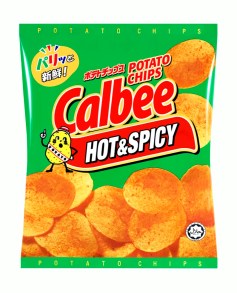
Kampu, a citizen food testing group found both cesium 134 and 137 in a potato chips bag. The chips were harvested and manufactured in 2015 with the potatoes coming from Ibaraki and Chiba prefectures. Both prefectures not included by the government in the areas having agriculture with risk of contamination.
The potato chip brand, Calbee is being sold in Japan and also globally including to the US. Calbee has a manufacturing plant in the US, so to determine what factory made a product may be a wise precaution.
So while the media prostitute and this lying led government is trying to tell everyone all Is ok, just know contaminated produces (at safe levels they will tell you ? when being caught) is openly being fed to you in restaurants (usually big chains in Japan thx Yoshinoya), convenience stores and super markets. It is also being sold all around the world.
Please note that these potato chips were harvested in Ibaraki and Chiba. .. not Fukushima. They are trying to tell you the contamination is limited to a few km away from the destroyed Nuclear Power Plant. It’s a damn lie and you should know better.
Anyway; Bon appetit!
Taiwan recalls 37 food products from Japan’s radiation-affected area
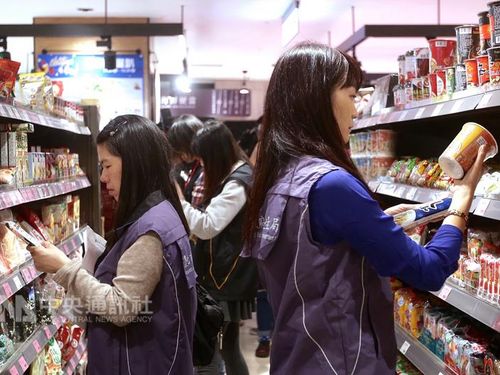
Taiwan recalls 37 food products from Japan’s radiation-affected area
Taipei, Dec. 16 (CNA) A total of 37 Japanese food products have been pulled from store shelves in Taiwan, after they were found to have come from Japan’s radiation-affected areas, Taiwanese authorities said Friday.
As of Thursday, 50,316 pieces of these products have been recalled, with many of them being soy sauce and wasabi packets that came with Japanese natto, or fermented soybeans, according to the Food and Drug Administration (FDA).
The FDA launched an inspection of food products from Japan on Dec. 12, after two brands of Japanese natto were found to contain packets of soy sauce from Ibaraki Prefecture, one of the five prefectures from which food imports have been banned.
Taiwan banned food imports from Fukushima, Ibaraki, Tochigi, Gunma and Chiba prefectures after the meltdown of the Fukushima Daiichi Nuclear Power Plant in March 2011.
Of the 37 products, 22 have tested negative for radiation contamination, while 15 are still being screened, according to the FDA.
Under Taiwan’s ban, even food products that test negative for radiation are restricted from being sold here, as long as they came from one of the five Japanese prefectures.
Among the recalled products is a brand of natto called “Hiruzen Nattou,” which was imported by Deep Cypress Co. (柏泓企業). The soy sauce and wasabi packets that were served with the product were found to have been made in Chiba Prefecture, said Wei Jen-ting (魏任廷), an official with the FDA.
The product was sold in supermarkets in department stores such as SOGO and Shinkong Mitsukoshi, Wei said.
Meanwhile, many of the 37 products were imported by Yumaowu Enterprise Co. (裕毛屋企業), according to the FDA.
Chiu Hsiu-yi (邱秀儀), director of the FDA’s Northern Center for Regional Administration, said the FDA will step up inspection of food imported from Japan and will ask importers and distributors to list the place of origin, including the prefecture, on the product label in Chinese.
If companies refuse to abide by the rules, the FDA said it will reveal their names to the public.
Failure to provide Chinese labeling could also result in a fine of between NT$30,000 (US$937) and NT$3 million, the FDA said, adding that the public can call the hotline 1919 to report such cases.
The recall of Japanese products comes amidst strong opposition to the Taiwanese government’s hopes of lifting the ban on food exports from at least some of the five affected areas if they are found to be free of radiation.
http://focustaiwan.tw/news/asoc/201612160020.aspx
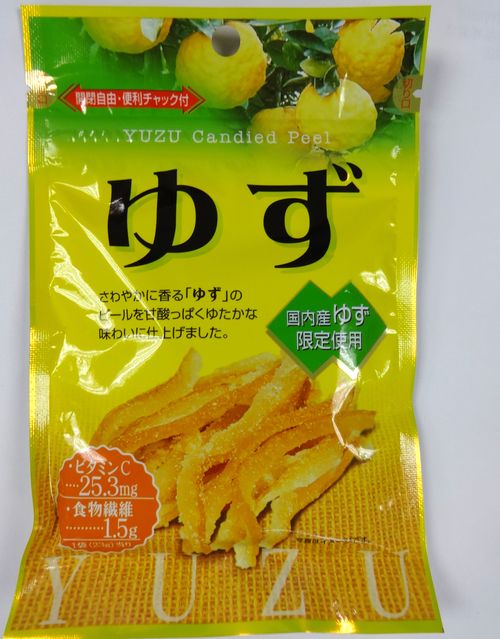
Unsourced Japanese snacks removed from shelves
Taipei, Dec. 16 (CNA) Two kinds of snacks sold at a shopping mart chain in Taoyuan were found to have come from unidentified source in Japan and have been ordered removed from shelves, health officials from Taoyuan City Government said Friday.
The officials said they launched an inspection of labels of origin on food imported from Japan on Dec. 9, checking a total of 707 food products in 273 shops.
On Thursday the Chinese labels of two snacks sold in Poya LivingMart identified them as having come Gifu prefecture, but the original labeling said they were from Tochigi prefecture, one of the radiation-affected areas from which food imports are banned in Taiwan.
After checking the manufacturer’s official website, the product was found to have been manufactured in Tochigi and Iwate, not Gifu.
Health officials have instructed the shop to stop selling the products immediately.
Poya Living Mart’s 11 outlets in Taoyuan have removed a further 214 packages of related food.
The incident came at a time of growing public concern over the safety of food products from five radiation-affected prefectures in Japan.
Taiwan banned food imports from Fukushima, Ibaraki, Tochigi, Gunma and Chiba prefectures in the wake of the Fukushima Daiichi nuclear power plant meltdown following a massive earthquake and tsunami in Japan on March 11, 2011.
Following reports that the government is planning to lift the ban on food imports from four of the radiation-affected prefectures, though not Fukushima, several brands of Japanese natto containing packets of soy sauce from Chiba and Ibaraki were recently found in local retail outlets. They were also ordered removed.
http://www.taiwannews.com.tw/en/news/3053224
Taiwan to hold off on plans for problematic Japanese food imports
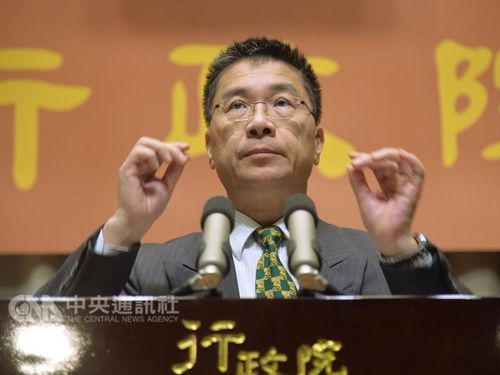
Cabinet spokesman Hsu Kuo-yung (徐國勇)
Taipei, Dec. 16 (CNA) The government is to put on hold a planned opening of food products from radiation-affected prefectures in Japan amid public misgivings about food safety, a Cabinet spokesman said Friday.
Hsu Kuo-yung (徐國勇) said in a news conference Friday that the Cabinet “has to first ensure a sound inspection and management mechanism,” before talking about any opening to food products from the affected areas of Japan.
Hsu pointed out that Premier Lin Chuan (林全) has stressed the importance of “rebuilding public trust in the government’s management of food safety,” after presiding over a cross-agency meeting the previous day.
The premier also said that “without a sound inspection and management mechanism, there can be no question of such an opening,” according to Hsu.
Taiwan banned food imports from Fukushima, Ibaraki, Tochigi, Gunma and Chiba prefectures in the wake of the Fukushima Daiichi nuclear power plant meltdown following a massive earthquake and tsunami in Japan on March 11, 2011.
Amid reports that the government is planning to lift its ban on food imports from the radiation-affected prefectures except for Fukushima, several brands of Japanese natto containing packets of soy sauce from Chiba and Ibaraki have recently been found in Taiwan.
Hsu said that although food products from Fukushima and the surrounding prefectures are banned, there are composite packaging foods, such as the condiment sashets in packages of instant noodles, that have not been subjected to scrutiny.
“The government will review the issue and plug the loopholes,” Hsu said.
Before establishing a sound management mechanism, the government will not make a decision, “and there is no timetable for any such opening,” Hsu said.
He said that there will be three more public hearings on imports of controversial Japanese food products, saying that holding the public hearings is significant in three ways.
They are aimed at establishing a model for future public hearings, then at clarifying false information, as the public has seen all kinds of rumors flying recently.
The public hearings will also be presided over by civic groups rather than by government officials as in previous hearings, in a bid to collect views from the public on how to plug loopholes for the reference of the government, he said.
Sheu Fuu (許輔), director of food safety office under the Executive Yuan, said that all questions raised by the civic groups will be discussed and clarified one by one.
The Cabinet held 10 public hearings on the safety of Japanese products around Taiwan from Nov. 12-14 after announcing them Nov. 10, but critics saw them as essentially being held for show to pave the way for lifting the ban.
Questions were raised about why the government seemed in such a rush to hold the hearings, and some of them ended in chaos amid protests.
Sheu said that if the public still cannot accept the situation after the three public hearings, the government will review the contentious points, and if it cannot resolve such points and effectively manage food safety, “it will not rule out the possibility of maintaining the current ban.”
‘Nuke food’ already here
FDA announced a national recall of a fermented soybean product on Sunday, after discovering that the product included a package of soy sauce originating from a “radiation-affected” region of Japan.
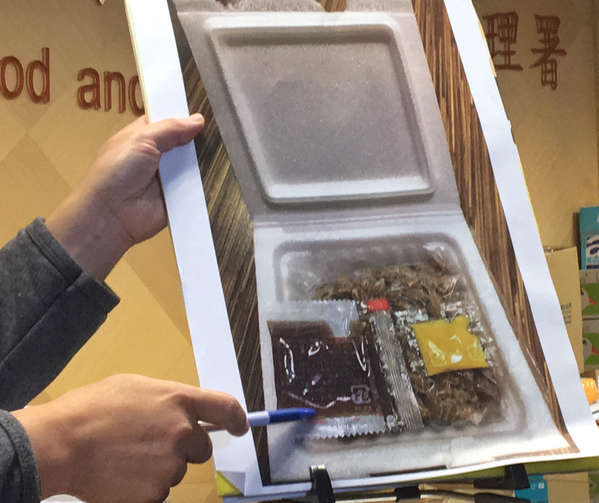
The Food and Drug Administration (FDA) announced a national recall of a fermented soybean product on Sunday, after discovering that the product included a small package of soy sauce originating from a radiation-affected region of Japan.
Radiation detection tests conducted by the Atomic Energy Council showed that the soy sauce had not been contaminated by nuclear substances, the FDA said.
But the discovery of the Ibaraki-sourced soy sauce had caught authorities off guard, highlighting a loophole in Taiwan’s five-year ban on food imports from five Japanese prefectures.
Food products from Fukushima, Gunma, Chiba, Ibaraki and Tochigi prefectures are banned over fears they may be contaminated with radioactive substances, following the meltdown of the Fukushima Daiichi nuclear power plant in 2011.
During a press conference on Sunday, FDA officials said they had asked all national retailers to recall products containing the soy sauce as a preventative measure. Any business that chose to keep the product in the market would be subject to a maximum NT$3 million penalty, health authorities said.
Officials said the soy sauce had been sold by food importer Taicrown Corporation (太冠國際) to downstream distributors including Japanese restaurant chain Yoshinoya, RT-Mart, shopping malls SOGO, Shinkong Mitsukoshi and Far Eastern.
The recalled fermented soybean product, called natto, had been manufactured by a Japanese company called KAJINOYA, FDA official Wu Ming-mei (吳明美) said.
Wu said the importer was in the process of collecting related information and would provide further details to the FDA before 5 p.m. on Monday.
According to media, Yoshinoya said its supplier provided safety certification for its imports, but that it had decided to pull the product from their menus regardless.
SOGO and Shinkong Mitsukoshi both said Taicrown Corporation had yet to offer any explanations and both offered refunds to customers that had purchased the product.
RT-Mart also issued a statement Sunday, stressing it had removed the natto product from its shelves last Friday after finding it suspicious during internal product inspections earlier that day.
Five other natto products imported by Taicrown have also been removed, and customers may receive refunds if they have any concerns, said RT-Mart.
The current administration is planning to gradually relax restrictions on Japanese food imports from the Fukushima nuclear disaster zones, but faced violent protests at public hearings last month.
http://www.chinapost.com.tw/taiwan/detail.asp?id=486491&grp=%27B%27
Taiwan: Food products from Japanese areas are not on sale
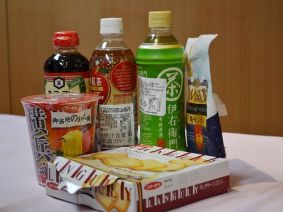
Food products from Japanese areas are not on sale: agency
The Food and Drug Administration yesterday rejected as rumors claims that food products produced in Japanese prefectures surrounding the Fukushima Dai-ichi nuclear power plant can be purchased in Taiwan, urging the public not to buy food products without Chinese-language labels.
The Council of Agriculture and the Ministry of Health and Welfare last month presented a two-stage plan to ease a ban on food imports, which was imposed in March 2011, from five Japanese prefectures near the site of the Fukushima nuclear disaster.
Taichung City Councilor Tuan Wei-yu (段緯宇) last week said that wine and snacks from the five prefectures could be purchased at department stores.
However, the Taichung Department of Health said that alcoholic products from the five prefectures can be imported if they have passed batch-by-batch radiation examinations, while the snacks Tuan used as examples were made in other prefectures.
One rumor that has recently spread across social networks claims that Japanese food products labeled as being made in Tokyo that have a “K” appended to the expiration date on their packaging are actually from Fukushima Prefecture.
The administration issued a statement clarifying that letters appended to expiration dates are in fact codes representing different areas for different food companies.
Consumers can check Japanese companies’ official Web sites to verify where products were made, the agency said, adding that, for example, an “A” appended to the expiration date on the packaging of products by Nissin Foods means they were made in Toride, Ibaraki Prefecture.
The administration urged people to only buy food products with Chinese-language labels, not believe everything they read online — especially information without reliable sources of scientific evidence — and avoid spreading false information.
http://www.taipeitimes.com/News/taiwan/archives/2016/12/04/2003660555
1 This Month

of the week – Shut Down Drone Warfare!


Tell the Ukrainian Government to Drop Prosecution of Peace Activist Yurii Sheliazhenko

Petition to revoke the licensing of the Near Surface Nuclear Disposal Facility (NSDF) at Chalk River. https://www.ourcommons.ca/petitions/en/Petition/Details?Petition=e-7247
To see nuclear-related stories in greater depth and intensity – go to https://nuclearinformation.wordpress.com
-
Archives
- March 2026 (244)
- February 2026 (268)
- January 2026 (308)
- December 2025 (358)
- November 2025 (359)
- October 2025 (376)
- September 2025 (257)
- August 2025 (319)
- July 2025 (230)
- June 2025 (348)
- May 2025 (261)
- April 2025 (305)
-
Categories
- 1
- 1 NUCLEAR ISSUES
- business and costs
- climate change
- culture and arts
- ENERGY
- environment
- health
- history
- indigenous issues
- Legal
- marketing of nuclear
- media
- opposition to nuclear
- PERSONAL STORIES
- politics
- politics international
- Religion and ethics
- safety
- secrets,lies and civil liberties
- spinbuster
- technology
- Uranium
- wastes
- weapons and war
- Women
- 2 WORLD
- ACTION
- AFRICA
- Atrocities
- AUSTRALIA
- Christina's notes
- Christina's themes
- culture and arts
- Events
- Fuk 2022
- Fuk 2023
- Fukushima 2017
- Fukushima 2018
- fukushima 2019
- Fukushima 2020
- Fukushima 2021
- general
- global warming
- Humour (God we need it)
- Nuclear
- RARE EARTHS
- Reference
- resources – print
- Resources -audiovicual
- Weekly Newsletter
- World
- World Nuclear
- YouTube
-
RSS
Entries RSS
Comments RSS
 nuclear-news