The United States claims to now have space weapons and to prepare to fight around the Moon

Voltaire International Newsletter
Fri, 18 Sep 2026, https://www.sott.net/article/508501-The-United-States-claims-to-now-have-space-weapons-and-to-prepare-to-fight-around-the-Moon
US Secretary of the Air Force Troy Meink said on September 14, 2026, at the National Harbor Air, Space & Cyber Conference that:
“The United States now has space control weapons in orbit capable of defending joint forces against hostile action.
“For more than a decade, we have expressed our concern about the development of space weapons by the Chinese, Russians and other countries. We are working to ensure our protection and our ability to operate in this environment, as we have done for decades.”
Contrary to Troy Meink’s statements, Russia and China have always claimed that they do not deploy weapons in space. By signing the 1967 Outer Space Treaty, the United States committed itself not to place weapons of mass destruction in Earth orbit.
Chairman of the Joint Chiefs of Staff General Dan Caine said at the end of the conference:
“Our task, my friends, is to adapt right now, so the Joint Force is prepared to fight, endure, and win in global contested environments, from the seabed to cislunar space.
“Our United States Space Force must provide unrivaled space superiority and sustain the associated networks, domain awareness, data advantage that the joint force needs to win in space both now and in the future.
“We must now assume that our forces will be tracked by autonomous systems, scrambled across the entire spectrum and tracked in real time.
“AI is already a reality and it is transforming the way the armed forces perceive, analyze, decide and act.”
Comment: USA has deployed first space-based weapon:
The United States now has an “on orbit” space weapon and will use it to protect American forces, Air Force Secretary Troy Meink announced Monday, in a not-so-subtle warning to China and Russia.
It marked the first time the United States has acknowledged it has its own offensive capability in space after years of warning that China and Russia have been practicing offensive maneuvers in orbit, such as using lasers or jamming that put U.S. satellites at risk.
Meink would not specify what type of weapon is now in space but hinted that it will be used for “space control.” A U.S. official said it could include the military taking out an enemy’s satellite if it’s being used to target American troops or a U.S. satellite.
The United States also is developing a web of space-based missiles that are envisioned as part of the future Golden Dome missile defense system.
Meink would not elaborate on why the disclosure of the new U.S. capability was being made now, saying only that “there’s a lot of factors that go into how we talk about these things. It’s important from a deterrence perspective.”
Iran sends peace terms to US

Tehran is awaiting US President Donald Trump’s response to its conditions for restarting negotiations, security chief Mohsen Rezaei has said
19 Sep, 2026 , https://www.rt.com/news/645996-iran-sends-peace-terms-us/
Iran has conveyed its peace terms to the US through Qatari mediators, the country’s top security official, Mohsen Rezaei, has said, arguing that it is in America’s interests to accept them.
The 60-day period provided under the US-Iranian memorandum of understanding to negotiate a settlement expired last month without a deal, while disrupted maritime traffic through the Strait of Hormuz continues to drive up energy prices.
“Seven conditions set by Iran for the start of any negotiations have been conveyed to the US administration. Tehran’s message is clear and unambiguous: If Washington wants to escape the predicament it has created for itself and avoid becoming further entangled in it, it has no choice but to recognize Iran’s rights and accept its conditions,” Rezaei wrote on X on Saturday.
In an interview with Al Jazeera, Rezaei, the secretary of Iran’s Supreme National Security Council, said the terms include “an end to the war on all fronts, the release of our frozen funds and an end to the naval blockade.”
Iranian officials previously said they are also seeking the withdrawal of US forces from the region and compensation for the US and Israeli strikes launched on February 28.
“Trump’s threats will not achieve any results. We are prepared for a decisive war,” Rezaei added.
US President Donald Trump said on Wednesday that “hopefully we are toward the end of the war” and suggested that Iran wants to make a deal. The following day, however, he once again threatened to “annihilate” the Iranian leadership if the conflict does not end on his terms.
The US military revealed on Friday that the nearly seven-month conflict has cost $43.6 billion, with nearly two-thirds of the bill going toward replenishing depleted munitions.
According to Bloomberg, widely reported ammunition shortages could delay arms deliveries to US allies by several years. Trump and Secretary of War Pete Hegseth have denied that the conflict has left the US short of missiles and bombs.
Canada issues notice about nuclear waste repository as possible national interest project
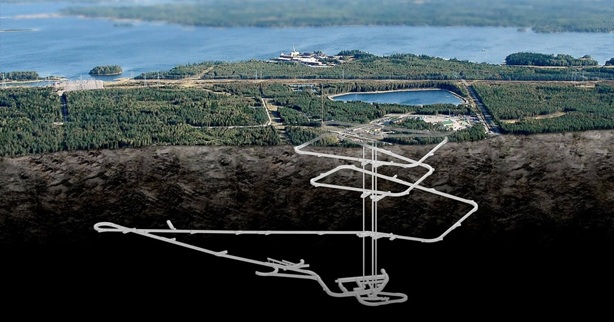
biggest concern with the potential fast-tracking of federal approvals is whether the long-term effects of nuclear waste transportation will be considered, as this is not mentioned in the Canada Gazette listing,
$26-billion project proposed near Ignace and Wabigoon Lake Ojibway Nation
Sarah Law· CBC News : Sep 22, 2026
Canada’s first deep geological repository (DGR) for nuclear waste may be designated as a project of national interest, meaning possible streamlining of federal approvals for the $26-billion endeavour.
The federal government first announced the possible designation for the project — proposed near Ignace and Wabigoon Lake Ojibway Nation in northwestern Ontario — in June. The site could see the country’s nuclear waste buried hundreds of metres underground.
Notice of the possible designation was published in the federal government’s official newspaper, the Canada Gazette, on Saturday.
The federal Building Canada Act “enables the government to streamline federal approval processes for projects determined to be in the national interest, helping such projects to move forward efficiently while protecting Canada’s environment and upholding the rights of Indigenous Peoples,” the Canada Gazette notice says.
Officials in Ottawa provided comments on the project in a news release on Friday.……………………………..
‘Federal government, think again’

The DGR has come under heavy scrutiny by environmental advocates and First Nation leaders over concerns with the storage, transportation and maintenance of nuclear waste.
We the Nuclear Free North is a coalition of groups that’s spoken out against the project for years.
Brennain Lloyd is project co-ordinator of Northwatch, which is part of We the Nuclear Free North.
Her biggest concern with the potential fast-tracking of federal approvals is whether the long-term effects of nuclear waste transportation will be considered, as this is not mentioned in the Canada Gazette listing, she explained.
“In the Gazette notice, the federal government describes the project as being a 160-year project — so that means we lose any assessment of the long-term safety issues, the long-term impacts of this project,” she said in an interview with CBC News on Monday……………………………………………………………………………………………………………………………………………………….
A public comment period on the potential designation of the DGR as a project of national interest is open until Oct. 26. People can email DGRComment-CommentaireDSCGP@mpo-bgp.gc.ca. https://www.cbc.ca/news/canada/thunder-bay/canada-dgr-project-national-interest-project-9.7352825
Trump administration dives into U.N. Secretary General race

Signs of the Times, Karen DeYoung, The Washington Post, Mon, 24 Aug 2026
The next leader of the United Nations could, for the first time, be a woman. But first she’ll need Trump’s approval.
This year, for the first time in its 80-year history, the United Nations may select a woman to serve as its secretary general. Of the eight candidates nominated so far for the position, five are women, and many U.N. members argue that it’s finally their turn.
But as the U.N. Security Council undertakes its months-long, ultrasecret selection process, hopefully making its choice before Portugal’s António Guterres reaches the end of his five-year term on Dec. 31, other factors are at play beyond gender.
The Trump administration, which has veto power on the council, is working overtime to ensure that the new leadership is in sync with its plans to continue cutting the U.N. budget and workforce. Beyond long-standing funding concerns, it wants to effect fundamental change across the global body, in particular the way it handles the three “pillars” of its charter — peace and security, development, and human rights — and adherence to international law.
“This institution desperately needs strong, effective leadership,” Mike Waltz, the U.S. ambassador to the U.N., told a Senate hearing this spring. U.S. priorities, he said, were “reform, reform, reform … and getting back to basics on peace and security will be at the top of our criteria.”
This summer, high-level officials at the U.S. mission to U.N. headquarters in New York have conducted multiple interviews with six of the candidates — two new ones emerged this month, and there may be further nominations before any final decision.
President Donald Trump has not commented on a report last month by the New York Post that he wants Gianni Infantino, head of the world soccer federation FIFA, to have the job. But “there are tons of rumors about an October surprise,” said a longtime U.N. insider, one of several who spoke on the condition of anonymity to discuss the secret voting process.
“They have until the end of December,” said a second person familiar with the process and its backroom machinations. The question, this person said:
“Does [Trump] come in at some point — everybody at the U.N. is waiting for this — and say, ‘I want … Infantino, [or] his daughter [or son-in-law Jared] Kushner.’ … Then the whole process gets set back as somebody figures out the politics of backing him down.”
One senior U.S. official acknowledged deep U.S. involvement but said that the interviews were more akin to “conversations,” adding that the administration does not have a preferred candidate among current or possible future nominees.
“We want the best candidate. Period. We’re not focused on anything that would limit the most talented people around the globe from putting their names up.”
While they may differ on how it is done, few member states disagree with the need for reform. Peter Yeo, senior vice president of the U.N. Foundation and a longtime expert on U.S.-U.N. relations, said:
“This particular race is different from all the others. Fundamental questions are being asked about the future role of the organization … what the U.N. does, what is its mandate, what programs it should be running, how it should be financed. It’s not just the United States asking.”
Trump, who has denigrated a host of international organizations, has sharply criticized the U.N. as ineffective, wasteful and out of tune with U.S. priorities. He has canceled U.S. membership and voluntary donations to many of its agencies — most prominently the World Health Organization — while U.S. humanitarian and development aid has been shunted away from international programs toward bilateral assistance that reflects “America First” priorities.
Annual member dues to the regular U.N. budget are assessed according to a formula that includes gross national product and population, and the U.S. has long been the biggest contributor. But until recently, the Trump administration had paid nothing while it pushed for severe budget cuts and organizational changes.
Early this year, as Guterres warned that the U.N. faced “imminent financial collapse,” the administration paid about $160 million of last year’s more than $800 million assessment, according to the U.S. official. On Aug. 4, following staff and budget cuts in which the U.S. was heavily involved, the administration notified Congress that it intends to pay $725 million of this year’s dues.
Technically, the secretary general is elected by a majority vote in the 193-member General Assembly. But only once, in 1950, has there been more than one person on the ballot delivered to the assembly by the 15-member Security Council. The council’s approval requires at least nine votes, though each of the five permanent members — the U.S., Russia, China, Britain and France — has veto power.
It has long been agreed that the secretary general should not be from one of the permanent five members, who already wield tremendous power with their vetoes, and that the position will rotate among different regions of the world. Since the U.N. was founded in 1945, some of the nine who have held the office, including Guterres, have served two consecutive five-year terms. Africa, Asia and Europe have had multiple chances, but only one secretary general has come from Latin America — Peru’s Javier Pérez de Cuéllar, who served from 1982 to 1991.
All five of the currently nominated women are Latin Americans, as is one of the three men. The other two men are from Africa. All are former U.N. or national officials in their home governments, or both, and most have campaigned strenuously for the job.
Beginning this summer, council members are periodically holding secret straw votes in which they “encourage,” “discourage” or offer no opinion on each candidate. In officially unreleased but widely disseminated results of the first vote, held in late July, the top three were Rebeca Grynspan, former Costa Rican vice president and former head of U.N. Trade and Development; Carolyn Rodrigues Birkett, former foreign minister and current U.N. ambassador from Guyana; and Rafael Mariano Grossi, an Argentine diplomat who has been director general of the U.N.’s International Atomic Energy Agency since 2019.
In a second straw vote Friday, all three were reportedly still out in front, but no one looked like a runaway……………………………………………………… https://www.sott.net/article/508526-Trump-administration-dives-into-U-N-Secretary-General-race
We oppose the U.S. call to ‘control and dominate space’.
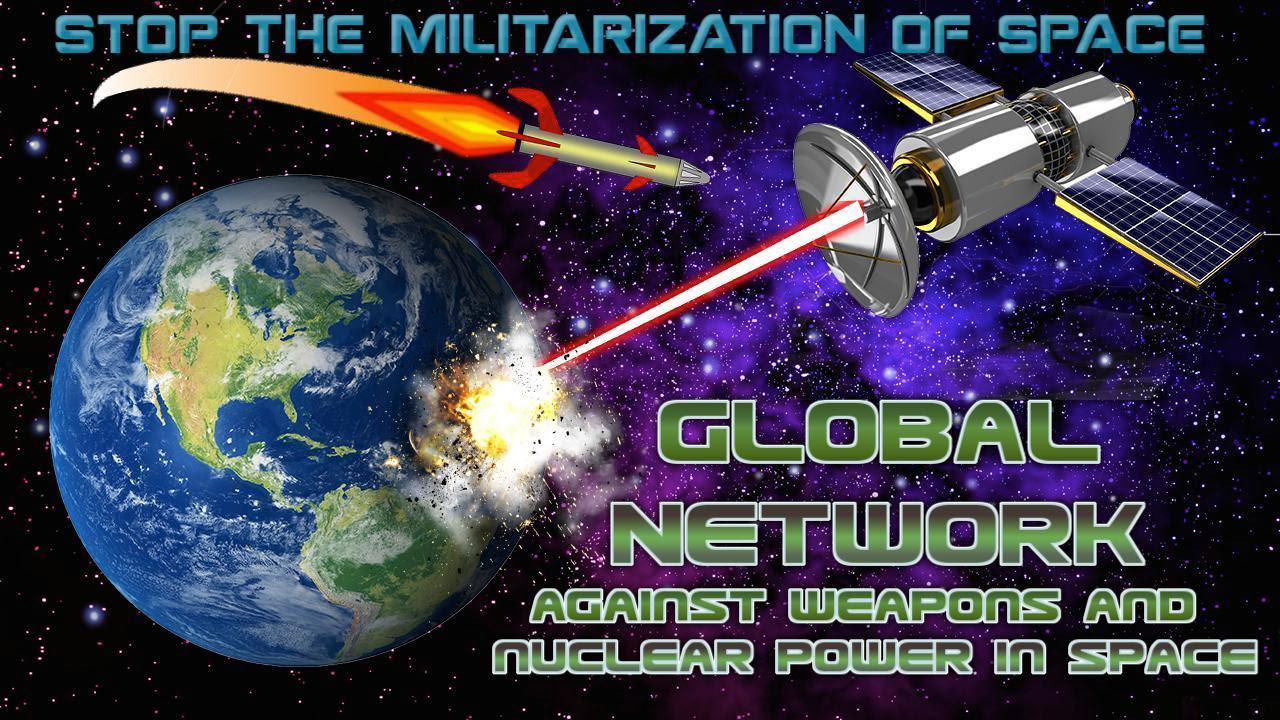
In the end, the taxpayers should be wondering who will pay for the trillions of dollars for these collective offensive space programs – especially when the US is already over $40 trillion in debt!
By the Global Network Against Weapons & Nuclear Power in Space Boards of Directors and Advisors.
| Global Network Against Weapons & Nuclear Power in Space, Sep 22, 2026 |
The disclosure by US Secretary of the Air Force Troy Meink that the US has deployed space weapons in Low Earth Orbit (LEO) confirmed what many had always thought and is a consequence of the competition between the USA and Russia-China over access to LEO. Whoever controls the increasingly limited parking spaces in LEO will be at a considerable advantage and will be able to see and direct weapons not only to targets in space but also on the Earth.
Elon Musk is being paid to fill up LEO with military satellites as fast as possible for the US.
The US Deep Space Advanced Radar Capability (DARC) with huge radars in Texas, Australia and possibly Wales — where grassroots opposition is massive — would be part of a system to guide anti-satellite weapons (ASATS) to hit targeted satellites in space.
In 1989 Apollo Astronaut Edgar Mitchell (the 6th person to walk on the moon) spoke at a peace in space rally organized by Bruce Gagnon at the now re-named Cape Canaveral Space Force Station. Mitchell told the assembled that a war in space would be the “one and only” because so much space junk would be created (on top of the existing huge debris field) that we would not be able to get a rocket thru the deadly space trash orbiting the Earth. He said it would be like trying to “get thru a piranha laced river” in the Amazon.
There is a name today for this phenomenon – the Kessler Syndrome. Much of life on Earth would grind to a halt as the satellites that make our high-tech world function would be smashed to bits.
Other options for the US appear to be space-based lasers and electro-magnetic guns to blind or fry spacecraft electronics.
The Trump administration’s proposed “Golden Dome” system is bringing lots of lucrative contracts to aerospace companies but is nowhere near likely to be completed by Trump’s end of term. The American Physical Society and the Congressional Budget Office also report it would cost trillions of dollars and would not likely be effective against Russian or Chinese hypersonic missiles.
However, Meink’s announcement could really be about attempting to make Golden Dome sound inevitable, thereby forcing Congress to appropriate the massive funds needed to secure the controversial project in the Pentagon’s space strategy.
One other long-term issue is the “mining the sky program.” The US and its fellow NATO allies want to move their 500-year western colonial domination to the Moon, Mars, and other celestial bodies for resource extraction. During a keynote speech at the Air, Space, and Cyber Conference, Joint Chiefs Chairman Gen. Dan Caine said, “the Joint Force is prepared to fight, endure, and win in global contested environments from the seabed to cislunar space”. Cislunar space is the space between the Earth and the Moon.
The plan is to establish nuclear powered mining colonies. Nuclear powered rocket engines are being developed to cut-in-half the amount of time it would take to get to Mars. The Department of Energy labs that fabricate these space nuclear devices have a long history of worker, air, and water contamination.
The 1989 Congressional study entitled “Military Space Forces: The Next 50 Years” called for the US to control the pathway off Earth to space (also called the Earth-Moon Gravity Well).
As the Space Command’s ‘Vision for 2020’ stated, the US must “control and dominate space” and “deny” others the use of space. Secretary of War Pete Hegseth has recently stated, “I’m not interested in orbital equity or parity. We demand orbital dominance plain and simple.” Those are fighting words.
In the end, the taxpayers should be wondering who will pay for the trillions of dollars for these collective offensive space programs – especially when the US is already over $40 trillion in debt! Long ago the aerospace industry identified the “entitlement programs” as their preferred source of funds to pay these enormous costs. By this they mean Social Security, Medicare, Medicaid, and the now tattered social safety net. Trump has announced that the already fiscally strapped states should take over Medicare and Medicaid due to recent war spending.
In 1989 Apollo Astronaut Edgar Mitchell (the 6th person to walk on the moon) spoke at a peace in space rally organized by Bruce Gagnon at the now re-named Cape Canaveral Space Force Station. Mitchell told the assembled that a war in space would be the “one and only” because so much space junk would be created (on top of the existing huge debris field) that we would not be able to get a rocket thru the deadly space trash orbiting the Earth. He said it would be like trying to “get thru a piranha laced river” in the Amazon.
There is a name today for this phenomenon – the Kessler Syndrome. Much of life on Earth would grind to a halt as the satellites that make our high-tech world function would be smashed to bits.
The 1967 UN Outer Space Treaty, signed and ratified by 118 states, including the US, calls for the peaceful use of outer space, prohibiting the deployment of any weapon of mass destruction and preventing anyone from claiming sovereign control. However, it does not prevent the stationing of other types of weapons in space. The US has repeatedly voted against a resolution, supported by China and Russia, for “no first placement of weapons in outer space”. Now we know why.
For many years the US and Israel have also voted against the annual call by China, Russia and others to negotiate a new treaty on PAROS – the Prevention of an Arms Race in Outer Space. The official position of the US has been, “There are no weapons in space, we don’t need a new treaty.
We see this as a spiritual disconnection in the minds and hearts of those “leaders” in Washington who believe that 4% of the global population living in the US should be the Masters of Space. It is a deep sickness.
Space should be a realm for exploration and inspiration, a place for humans to grow further in knowledge and wisdom. A few morally impoverished souls are ruining space even as they poison the earth. This will not end well.
The time has come for people in the US to rise up and demand their government halt the fascist march of the human race to annihilation.
AI hallucination of Chinese nuclear components almost led to US military attack

One source told CNN the AI-powered fiasco “almost started a war.”
some researchers suggest that it may be impossible to prevent LLMs (Large Language Models) from hallucinating altogether.
But the military’s overall use of AI seems to be accelerating.
Kyle Orland – Sep 19, 2026 , https://arstechnica.com/ai/2026/09/report-us-almost-boarded-chinese-ship-over-hallucinated-ai-arms-report/
The US narrowly avoided boarding a Chinese ship based on an “entirely false” US intelligence report generated with the help of AI tools, according to a CNN report.
That erroneous intelligence, submitted by a US Special Operations Command analyst, suggested the Chinese ship was transporting nuclear arms program components through the Middle East, according to “four sources familiar with the episode” cited by CNN. The US military was preparing to intercept and board the ship, with air support, before officials discovered a chatbot used in generating the report had “inaccurately identified the material the ship was carrying.”
One source told CNN the AI-powered fiasco “almost started a war.”
What’s the worst that can happen?
CNN’s report said the analyst in question used a chatbot to analyze intelligence reports regarding the Chinese ship’s manifest, leading to the near-disastrous result. That chatbot “fused together open-source intelligence with secret signals intelligence in government holdings,” and that information was packaged into an intelligence report that almost set off a disastrous chain of events, according to CNN.
The near-miss is one of the more potent and consequential instances of a hallucinating AI ruining the reliability of a professional report. Since “hallucinating” became the Cambridge Dictionary’s word of the year in 2023, we’ve seen prominent examples of non-fiction authors, journalists, academic researchers, judges, doctors, police departments, corporate call centers, and more getting taken in by AI tools that simply make something up when their training data doesn’t provide sufficient context. And despite some adorable attempts at “do not hallucinate” prompts, some researchers suggest that it may be impossible to prevent LLMs (Large Language Models) from hallucinating altogether.
One would hope the US military would be aware of these kinds of problems when relying on AI for analysis of intelligence reports. But the Department of Defense in January rolled out an “AI acceleration strategy” that sought to “make all appropriate data available across federated IT systems for AI exploitation, including mission systems across every service and component.”
“AI is only as good as the data that it receives, and we’re going to make sure that it’s there,” Defense Secretary Pete Hegseth said in rolling out that initiative.
Last December, the Department of Defense announced it would use Google’s Gemini for Government as the basis for its bespoke “GenAI.mil” platform. Last month, the department added Grok for Government as an option on the platform. Anthropic also offers a customized version of Claude for US spy work.
In June, a Pentagon representative bragged to Congress that they use generative AI to help create congressionally mandated reports, and that 1.5 million active DoD personnel have used the military’s generative AI tools.
In 2023, a State Department “Declaration on Responsible Military Use of Artificial Intelligence and Autonomy” stressed that “principled” use of AI by armed forces “should include careful consideration of risks and benefits, and it should also minimize unintended bias and accidents.” That report also urged that “accountable” use of AI systems must always involve “a human in the loop, a responsible human chain of command and control.”
In the years since then, though, we’ve seen fully autonomous attack drones used in the Russian conflict in Ukraine and tested by NATO-backed military contractors. In March, the Department of Defense blacklisted Anthropic over the company’s opposition to its models’ use in autonomous weapons systems, a move that a federal judge said last month was “unlawful retaliation in violation of the First Amendment.”
The reported near miss comes as extinction-level warnings from AI researchers have led to a newly prominent national conversation on AI safety, including calls for regulation and coordinated research “pacing” from leading frontier AI labs.
Swiss to vote on referendum against new nuclear power plants

the public has “clearly” spoken out three times in favour of a future based on renewable energy: through the adoption of the Energy Strategy 2050 in 2017, the Climate Protection Act in 2023 and the Electricity Act in 2024.
the public has “clearly” spoken out three times in favour of a future based on renewable energy: through the adoption of the Energy Strategy 2050 in 2017, the Climate Protection Act in 2023 and the Electricity Act in 2024.
20 September 2026, https://www.swissinfo.ch/eng/energy-transition/swiss-referendum-against-new-nuclear-power-plants/92088172
The Swiss are set to vote against the possibility of building new nuclear power stations. In a span of three months, more than 125,000 people signed the referendum petition against the government proposal that was approved by parliament in June.
“The success of this petition shows that the public rejects a return to nuclear power, a costly and dangerous technology that increases our dependence on uranium imports, particularly from Russia,” wrote the “No to New Nuclear Power Stations” coalition in a press release.
During the summer session, parliament had approved the government’s indirect counter-proposal to the “Stop the Blackout” (Electricity for All at All Times) popular initiative. The proposal aims to lift the ban on building new nuclear power stations in Switzerland.
With this proposal, the government and parliament are “ignoring the will of the people”, the coalition for the referendum protested. It points out that the public has “clearly” spoken out three times in favour of a future based on renewable energy: through the adoption of the Energy Strategy 2050 in 2017, the Climate Protection Act in 2023 and the Electricity Act in 2024.
For the referendum committee, “this approach is bearing fruit: Switzerland is increasingly meeting its energy needs through locally produced solar, wind and hydro power.” Conversely, the costs and risks associated with nuclear power are considered “too high”.
The “No to New Nuclear Power Stations” coalition brings together the Greens, the Social Democrats, the Green Liberals, part of the Centre Party and around thirty organisations such as WWF, Greenpeace, Pro Natura and Swissolar.
Designation of Nuclear Waste Management Organization’s Deep Geological Repository as Project of National Recklessness
| Ottawa – An announcement on Friday that the federal government has taken the next step to short-circuit the review of a contentious nuclear waste project is receiving pushback from critics and Indigenous leaders who are demanding a comprehensive and independent review before any federal approvals can be granted. |
We the Nuclear Free North, 20 Sept 26
Notice was posted in the Canada Gazette that the Nuclear Waste Management Organization’s (NWMO’s) Deep Geological Repository (DGR) project for all of Canada’s nuclear fuel waste is proposed for designation as a “Project of National Interest” under the Building Canada Act. This designation would guarantee project approval and would circumvent the Impact Assessment process. The Notice also proposes a reduced scope of the project, eliminating long-distance transportation and long-term safety from whatever evaluation the federal government might employ in developing their conditions for the approval.
Opposition to the project’s designation as a Project of National Interest centres around the recognition that if so designated, the project will not receive a comprehensive impact assessment and key areas of concern – namely transportation and long-term safety – will escape scrutiny.
“If the NWMO’s project was sound and they could make the safety case for their nuclear waste transportation and burial project there would be no hesitation on the part of the nuclear industry or the federal government to have it subject to a comprehensive and independent assessment”, commented Brennain Lloyd, project coordinator with Northwatch.
“This move to shield the deep geological repository scheme from scrutiny says it all – the NWMO’s concept can’t stand up to technical or public review. But limiting its review will not limit its impact.”
The proposal to designate the NWMO’s DGR as a project of national interest has been put forward by the federal government despite strong opposition expressed by Indigenous and non-Indigenous organizations, and evidenced by public protests, lawn signs, letters to newspapers and public agencies, and most especially by the more than 1,000 comments submitted by Canadians during the planning phase of the federal impact assessment’s, expressing either opposition to the project or significant concerns about how it would be carried out. The first phase of the federal review began in January and on July 3 the federal government announced the commencement of the impact assessment process.
Canadians fought hard to ensure that the project would receive a full impact assessment including a comprehensive examination of long-distance waste transportation,” said Wendy O’Connor, volunteer with Nuclear Free Thunder Bay.
“The Impact Assessment Agency agreed. That the federal government could now ignore Canadians’ wishes and sidestep the full assessment process Canadians were promised is shocking, unjust and unwise.”
“Considering the project’s novelty, scale, duration and potential for long-lived and irreversible effects from transporting and burying such an unprecedented volume of highly radioactive nuclear waste, it would be absolutely reckless for the government to fast track the approval of this project. The Impact Assessment Agency of Canada is the sole body with the mandate and expertise to evaluate the environmental, health, social, economic, cumulative, and rights-related impacts of major federal industrial projects. It must remain the lead authority for nuclear-related impact assessments,” said Mary Veltri of Environment North.
In May the federal government proposed in its ‘Getting Major Projects Built in Canada’ discussion paper that nuclear projects be vetted by the Canadian Nuclear Safety Commission (CNSC) rather than the Impact Assessment Agency of Canada. Canadians’ response was noted their resulting report, “What We Heard”. The report specifically mentions nuclear projects as one where opponents argued that having the assessment carried out by the sector regulator alone would weaken the scrutiny of cumulative effects, species at risk, and Indigenous rights, and diminish public participation.
The Notice in the Canada Gazette invites the public to comment on the proposal that NWMO’s DGR project be designated as a Project of National Interest. We the Nuclear Free North strongly urges Canadians to do so, and will be providing analysis and more information to support public engagement.
Comments may be emailed to DGRComment-CommentaireDSCGP@mpo-bgp.gc.ca, with a deadline of October 26.
Massive drone attack on Moscow marks new stage of US-NATO war with Russia

A de facto state of war now exists between Russia and the NATO powers……… Ukraine is attacking Russian cities with weapons paid for, jointly developed and often directly supplied by the NATO powers, which are also providing satellite imagery and targeting intelligence. Since June the European Union has put 8.5 billion euros into drones and missiles for Ukraine.
The greatest danger in the political situation is the chasm between the scale of the threat and the understanding of it among the population. Masses of people sense the danger, but they cannot believe that their governments would risk nuclear war. The governments are exploiting this incredulity. The media and political establishment are doing everything possible to prevent the population from knowing and understanding the dangers.
WSWS Editorial Board, 20 Sept 26
Ukraine attacked Moscow overnight Saturday in the largest strikes on the Russian capital in the war thus far. Moscow’s mayor said 450 drones headed for the city were shot down. Three people were killed in the Moscow region, and the refinery that normally supplies 40 percent of the city’s fuel was set on fire.
The attack followed Russia’s drone attack one week earlier on a passenger train at Yahodyn station in western Ukraine, about 2 kilometers (1.2 miles) from Poland, minutes after a train carrying former British Prime Minister Boris Johnson and security advisers of several European governments had passed through.
Ukrainian President Volodymyr Zelensky said Sunday that the attack had also included Ukraine’s Flamingo cruise missile and the Pelican, the country’s first domestically built ballistic missile. The Flamingo carries a 1,150-kilogram warhead, against 50 to 60 kilograms for the Liutyi drones Ukraine has relied on, and uses a guidance system provided by the French company Safran.
A de facto state of war now exists between Russia and the NATO imperialist powers, whose policy is relentless escalation.
Ukraine is attacking Russian cities with weapons paid for, jointly developed and often directly supplied by the NATO powers, which are also providing satellite imagery and targeting intelligence. Since June the European Union has put 8.5 billion euros into drones and missiles for Ukraine.
The financing and arming of attacks on Moscow go beyond recklessness. The European leaders know that a major Russian counterattack can follow, and their actions are intended to provoke just such retaliation. Polish Prime Minister Donald Tusk told his parliament on Thursday that intelligence on Russian plans for drone and missile strikes on countries supporting Ukraine is now “highly consistent and, unfortunately, convincing.” Two days later came the attack on Moscow.
Yet there are no calls by the leaders of any of the European NATO powers for negotiations, for a stepping back from the brink. European Commission President Ursula von der Leyen said on September 2 of Europe’s pressure on Russia: “We will increase it. And we will not stop.”
The NATO powers calculate that by escalating the war they can bring about the collapse of the government of Russian President Vladimir Putin. They may believe that it will not come to a nuclear exchange. But they are willing to risk one, and there is a logic to events that is independent of what any government intends.
What drives the imperialist powers to such actions? The answer lies in the social, economic and political crises of their own rule, for which they have no solution. The criminal intentions of those who carry out these policies are real enough. But they are themselves the product of the objective logic of imperialism.
The European powers face slow growth, lagging productivity and a widening technology gap with the United States and China, which Mario Draghi, the former president of the European Central Bank, has called “an existential challenge.” German imperialism plays the central role in the escalation. Berlin is the largest European financier of the war, and Chancellor Friedrich Merz has declared that there will be “no restrictions” on the range of the weapons used against Russia. Germany will raise its defense budget 32.7 percent next year, to €109.7 billion, while cutting €38.3 billion from healthcare and pensions by 2030.
Twice in the 20th century German imperialism marched east. In 1941, Hitler launched a war of annihilation against the Soviet Union for what he called Lebensraum, “living space,” the conquest of the land, resources and labor of the east, which cost 27 million Soviet lives. Eight decades after the defeat of the Third Reich, the German ruling class, confronting the erosion of its industrial base and export markets, again sees a way out of its crisis in the east.
The United States, for its part, is driven by a massive and unsustainable federal debt and a deepening crisis of the dollar system accelerated by the surge in borrowing costs. Interest on the $40 trillion debt cost $1.052 trillion in the first 11 months of the fiscal year, more than the Pentagon spent. The yield on the 10-year Treasury note closed Friday at 5.01 percent, its highest since July 2007. American imperialism is seeking to offset its economic decline by military means.
The escalation by the European powers is in part a response to the shift in American foreign policy under Trump. The administration’s attention is fixed, at least for now, on the war against Iran, which began on February 28, and on the conflict with China, whose president, Xi Jinping, arrives in Washington this week.
At the same time, dominant sections of the American ruling establishment are egging the Europeans on. Fifty-eight House Democrats voted on September 16 for a bill authorizing tariffs of up to 100 percent on the biggest buyers of Russian oil, and House Minority Leader Hakeem Jeffries, who voted “no,” objected that it was too weak. If the Democrats win control of Congress on November 3, they will pursue a still more aggressive program of war against Russia.
The US and European imperialist powers have arrived at a position analogous to that of the great powers in 1914. In the weeks after the assassination of the Austrian archduke at Sarajevo on June 28, 1914, the governments of Germany, Austria-Hungary, Russia, France and Britain concluded that war, with all its terrible consequences, was the least bad option before them. As in 1914, and as with Hitler in 1939, the ruling classes see war as a means of suppressing problems that they cannot solve. None of these governments is prepared to retreat, and there is no red line they are not willing to cross.
The governments have chosen escalation, but they do not control its consequences. If they could be shown what their cities will look like in two years, it would not stop them. Leon Trotsky, the co-leader of the Russian Revolution, wrote in the 1938 founding program of the Fourth International: “The bourgeoisie, of course, is aware of the mortal danger to its domination represented by a new war. But that class is now immeasurably less capable of averting war than on the eve of 1914.” This assessment is even more true today.
The war, now in its fifth year, was instigated by the NATO powers. Three decades of NATO expansion to Russia’s borders and the arming of Ukraine as a NATO proxy were aimed at provoking the conflict that began with Putin’s invasion in February 2022.
The Ukrainian regime, which is waging the war on behalf of the imperialist powers, faces perhaps the deepest crisis of all. The Zelensky dictatorship rules by martial law, holds no elections and has banned opposition parties. It fills its army by seizing men on the streets, and it faces mounting resistance to forced conscription in Lviv, Ternopil, Lutsk and other cities.
On August 10, a Ukrainian court sentenced the socialist Bogdan Syrotiuk, 27, to 15 years in prison for opposing the war and calling for the unity of Ukrainian and Russian workers against it.
The reactionary invasion of Ukraine was the response of a regime that is itself the product of the dissolution of the Soviet Union in 1991. The Russian government is a government of oligarchs who enriched themselves through the plunder of state property, and its policies have been bankrupt from the beginning. Putin’s strategy in invading Ukraine was to pressure the NATO powers, which he constantly called his “Western partners,” into an accommodation with Russia. Instead, they used the invasion as a pretext for a massive military escalation.
The greatest danger in the political situation is the chasm between the scale of the threat and the understanding of it among the population. Masses of people sense the danger, but they cannot believe that their governments would risk nuclear war. The governments are exploiting this incredulity. The media and political establishment are doing everything possible to prevent the population from knowing and understanding the dangers……………………………………….. https://www.wsws.org/en/articles/2026/09/21/sskp-s21.html
Walt Zlotow – How does US fund Israeli genocide? Let us count the billions
Walt Zlotow West Suburban Peace Coalition Glen Ellyn IL, 21 Sept 26, https://theaimn.net/how-does-us-fund-israeli-genocide-let-us-count-the-billions/
President Biden hopped on the Israeli genocide campaign to destroy Gaza and its Palestinian population the day after the October 7, 2023, Hamas attack on Isreal.
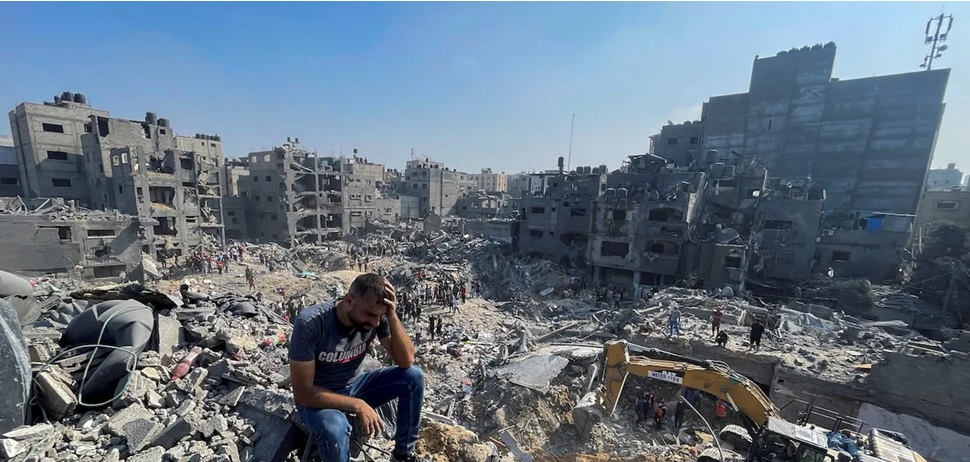
Approaching three years this October 8, Gaza’s 141 square miles are a pile of rubble covering up tens of thousands of dead Palestinians among the hundred thousand plus dead. The remaining 2.2 million survive agony in an ever tightening area as Israeli forces occupy over half of Gaza and shoot any Palestinian who get close to the Israeli zone.
None of this genocidal atrocity would have been possible without President Bidenn gifting Israel with over $20 billion in weapons to inflict the most grotesque genocide this century.
Even after the January 2025 ceasefire which released the remaining Israeli hostages, Israel continues to bomb and kill Palestinians daily.
Now President Trump, even tho running out of weapons to fight his lost war on Iran, plans to gift Israel with another $2.8 billion in 2,000 lbs. bombs to continue the slaughter of Palestinians in Gaza and Lebanese in Lebanon.
“The Trump administration’s proposed sale of 40,000 2,000-pound bombs, some of the most destructive munitions in our arsenal, raises grave, unresolved concerns about how these munitions could be used in densely populated areas of Gaza and Lebanon. The Trump administration has not provided sufficient assurances that these weapons will be used by the Netanyahu government in accordance with US law and with appropriate protections for civilians. I therefore will not clear this sale at this time.”
Rep. Meeks knows full well that the proposed $2.8 billion, just like the previous $20 plus billion from Biden, will be used to further obliterate Gaza and Southern Lebanon in furtherance of expanding Greater Israel.
Why Trump continues the weapons flow to Netanyahu after he suckered Trump into launching his disastrous attack on Iran will forever remain a mystery.
The US economy is facing disaster, possibly even collapse over Trump’s lost war against Iran. We’re not bombing Iran anymore because we’ve largely run out of weapons. Our debt has raced past $40 trillion. Inflation is out of control. Yet, Trump has enough loyalty to his masters in Israel to find $2.8 billion in genocide weapons for Israel to complete the project his predecessor enabled 3 years ago.
That is not ‘America First’. It is ‘Genocide First…America Last.’
Inside Gaza’s death trap of collapsing, bombed-out buildings
With more than 40,000 Palestinians sheltering in collapse-prone buildings and a “nightmare” winter approaching, Gaza’s Civil Defense warns of a preventable catastrophe unfolding in plain sight.
Mondoweiss, By Mohamed Al-Astal September 18, 2026 Mohamed Al-Astal is a Gaza-based journalist, reporting across radio, print, and digital for regional and international outlets. His work focuses on humanitarian and environmental issues, bringing ground-level reporting from inside Gaza to audiences worldwide
Amr Adas pulls the remains of his family’s clothes from the rubble of the Al-Sa’ada building, friends steadying him so he doesn’t collapse. The structure fell onto the displaced families sheltering inside it, including his wife and five children. He places each item into an empty flour sack. When he reaches the clothes of his two children — Bilal, 6, and Dunia, 12, who died when the building collapsed before dawn on Wednesday — he breaks into wails.
His screaming rises from the eastern side of the site, mixing with bulldozers clearing rubble from the west for a second consecutive day. Friends and neighbors try to calm him, some with words, some with Quranic verses on patience.
“This is not God’s will,” he shouts, to no one. “This is the world’s silence over our annihilation. It’s the lack of even the most minimal support in finding a safe shelter. It forces us to accept any place to stay in, no matter how dangerous.”
Adas, 37, kneels at the site where he was rescued, amid rubble and dust. He points to what was his children’s room. Two are dead; three survived: Sama, 14, with multiple injuries; Malak, 10, with a pelvic fracture; and Mennatullah, a year and a half old.
He recalls that when the collapse began at 2:45 a.m., he jumped to shield the infant, but his wife, Nawal, 32, had already covered her with her own body. He embraced them both as the building fell around them, screaming to his other daughters in the next room: “Come here, come here.”
“The building kept collapsing for a few minutes, and everything was falling on us, and I heard nothing but the sound of bricks and concrete,” Adas said. “I could hear the screams of my four children in the next room, but I couldn’t move, and I could barely say a few words hoping to reassure them.”
As the Al-Sa’ada building crumbled, Adas didn’t know at first whether it was an Israeli strike or a collapse. He heard neighbors calling, “Is anyone alive?” and answered once, “We’re here, save us,” before he could no longer speak. His wife kept calling out until rescuers arrived, directed light toward them, and lifted the rubble with their hands and simple tools. Adas said he had been pinned under stones and a concrete pillar.
Adas, a motorcycle mechanic before the war and unemployed ever since, said he accepted living in the bombed building because there was no other space. “The occupation destroyed my home in Zeitoun, east of Gaza City, which is now inside the danger zone, and there was no room anywhere else,” he said. “Some specialists told us the place was dangerous and at risk of collapse, but we had no other options. I feel enormous guilt for accepting this choice and losing two of my children, but I swear to God we had no alternative.”
‘A crime that happened with the knowledge of the entire world’
Muhammad al-Sawtari, 30, was also at the site searching for his family’s scattered belongings. His wife suffered moderate injuries and had to leave the hospital because she was nursing their two-month-old daughter, Misk. Their older daughter, Sham, 9, suffered serious injuries and was admitted to intensive care. Their two other daughters were also injured……………………………………………………………………………………………………………………………………………………………………………..
Civil Defense currently operates only 15 ambulance, firefighting, and rescue vehicles, down from around 75 before the war. It owns no bulldozers or heavy machinery. UN institutions have no alternative shelter to offer residents beyond tents, which residents consistently refuse. Civil Defense holds a detailed list of collapse-prone buildings, nearly all inhabited, whose residents refuse to evacuate without mobile homes, an alternative Israel refuses to allow into Gaza, according to UN institutions.
He said removing the collapse-prone buildings requires capabilities entirely unavailable now, but described a one-year plan achievable with around 50 pieces of heavy machinery, alongside a suitable alternative for the displaced families living in them.
Basal described the international community’s inaction as complicity. “Aren’t we in Gaza human beings who deserve life like everyone else?” he asked. “Why the silence and weakness in the face of the occupation? The world is complicit in these crimes.” https://mondoweiss.net/2026/09/inside-gazas-death-trap-of-collapsing-bombed-buildings/
I Still Believe Humanity Is Headed For A Mass Awakening
Caitlin Johnstone, Sep 20, 2026, https://www.caitlinjohnst.one/p/i-still-believe-humanity-is-headed?utm_source=post-email-title&publication_id=82124&post_id=216553662&utm_campaign=email-post-title&isFreemail=true&r=1ise1&triedRedirect=true&utm_medium=email
I still believe humanity is headed toward a mass awakening, as unfashionable as that is to admit here in the late 2020s.
The fashionable thing to say these days is that everything’s fucked and we are headed to our doom, and that if anything changes it will be because the insanity of our capitalist system causes our material conditions to deteriorate so drastically that we are forced into revolution to survive. That things are bad because we’re a rotten people with selfish hearts who haven’t forced the revolutionary changes the world needs because, deep down, we actually like things the way they are.
People who want to look cool and smart in revolutionary political circles tend to say that if a mass-scale transformation of human consciousness were going to happen, it would have happened by now. That everyone’s already basically aware that we live in an abusive, propaganda-saturated dystopia ruled by tyrants, therefore our continued compliance with status quo politics is a conscious and deliberate choice made by the overwhelming majority of the western world.
But here’s the thing: anyone who has taken a deep dive down the rabbit hole of human consciousness and come out the other side knows it doesn’t actually work that way. Not on a personal level, anyhow.
Anyone who has had an authentic transformational awakening after a prolonged period of spiritual seeking will have experienced a sloppy, awkward, tumble of a journey into eventual freedom from egoic delusion. It’s not pretty. It doesn’t happen the way the mind imagines it happening. It doesn’t unfold in linear fashion, and, while it might have significant climactic moments after which nothing is ever the same, it doesn’t unpack all at once. It’s a clumsy, two-steps-forward-one-step-back ordeal whose most prominent characteristic is an absence of control.
But it does eventually happen. After a chaotic, unpredictable, frequently uncomfortable internal adventure, there’s a freedom, clarity, gracefulness and joy the likes of which you never could have imagined before the avalanche began.
I see no reason to believe our collective awakening should be any different. It’s not going to be a neat and tidy affair. It’s not going to look like the hippies imagined back in the sixties, with a prevalence of psychedelic drugs leading to a swift societal movement away from egocentric psychology and dominator politics. But we’ll get there. We are in the process of getting there already.
We are already a much more conscious species than we were at the turn of this century. Our ability to network and share information has exploded in ways that have turned us into a fundamentally different sort of animal. Young people care about a genocide which poses no direct threat to them as passionately as their grandparents cared about a war in Vietnam which they were being personally drafted to fight in. Concepts like “trauma” and “inner healing” are now household terms that our parents and grandparents were only ever dimly aware of. Any skillful spiritual teacher who’s been helping people reach enlightenment for a few decades will tell you that humans are popping out of their egos far more readily and frequently than they used to be. I myself am seeing the people around me in my personal life awaken and heal in ways I’d never dared hope for a few years ago.
I’ve seen too much to believe we cannot become a conscious species. I am more convinced than ever that we are headed there already. It’s going to be a shambling, shuffling mess of a journey, but we’ll get there.
The human potential for spiritual enlightenment has long been an unaddressed elephant in the room in our estimations of what we can achieve as a species, but that elephant has been loudly clearing its throat as of late.
We can’t run from our true nature forever.
NATO is Working on a New Finnish-Russian War
Neutrality Studies, Sakari Linden, 17 Sept 26, https://www.youtube.com/watch?v=kvj1Ha2jveU
Neocons never give up. As project Ukraine is faltering, the forces of war are working on the next battlefield with Finland in their cross-hairs.
Sakari Linden, a board member of Finland’s Freedom Alliance Party and its foreign policy board, discusses Finland’s abandonment of neutrality, NATO membership, growing military tensions, economic consequences, media pressure, and the prospects for an independent and neutral Finnish foreign policy.
Funding crisis leaves UN nuclear watchdog begging for resources
September 17, 2026, https://pearlsandirritations.com/post/2026/09/funding-crisis-leaves-un-nuclear-watchdog-begging-for-resources/
The International Atomic Energy Agency faces a serious funding crisis as major contributors delay payments, putting nuclear safeguards, safety and security work at risk and exposing deeper problems with how the agency is financed.
The 180-plus members of the International Atomic Energy Agency (IAEA) are meeting this month in Vienna amidst an ongoing financial crisis. In June, IAEA Director General Rafael Grossi reported that if significant payments were not received soon, the agency would not be able to meet its legal obligations.
The cause? The failure of the wealthiest members to pay their assessed dues on time. Between them the United States and China account for 45 per cent of the IAEA’s annual budget – roughly US$250 million. Both have increasingly failed to make timely payments.
At risk are services vital to international peace and security.
The IAEA is best known for its nuclear safeguards system, underpinning the Nuclear Non-Proliferation Treaty (NPT). The key is on-site verification inspections and assessments in some 180 countries to confirm they are keeping their commitments not to acquire nuclear weapons. Some 800 highly trained IAEA inspectors conduct almost 3,000 in-field verification activities each year.
A major focus of safeguards attention has been Iran’s nuclear activities. The bombing of Iran’s facilities in June 2025 forced IAEA inspectors to leave the country. Nevertheless, safeguards inspections continue at the Russian-supplied Bushehr nuclear power plant, and inspectors remain ready to return to other facilities as soon as conditions allow.
Other vital responsibilities of the IAEA include the promotion of a strong global framework for nuclear safety and nuclear security.
Since the Chernobyl disaster, the international community has recognised that nuclear safety is a global challenge that requires international tools – many of which are provided by the IAEA. Since the start of the war in Ukraine, IAEA staff have been stationed at the Zaporizhzhia nuclear power plant under conditions of great risk, producing over 360 public reports on developments there.
And in our immediate region, the IAEA has actively monitored the discharge into the sea of the water used to cool the Fukushima reactors damaged in the 2011 tragedy, confirming that these discharges remain well below regulatory and operational limits.
Beyond its regulatory and standard-setting roles, the IAEA helps developing countries harness nuclear technologies for national development – especially in medicine but also in agriculture and industry.
The funding of international organisations has long been a contentious issue. From the 1960s, a shadowy alliance of the major (Western) contributors known as the Geneva Group consulted to restrain the costs associated with the rapid expansion of membership in these organisations.
In the 1980s, the Geneva Group started to impose a policy of ‘zero real growth’ in the United Nations system, regardless of their roles and relative importance. This later evolved into a policy of ‘zero nominal growth’, effectively requiring budgets to be cut each year to offset inflation.
Consequently, funds were being cut just as demands for services were increasing, driven by the growth in IAEA membership and the emergence of new and increasingly complex, resource-intensive inspection challenges, such as the inspections in Iraq and the safeguarding of Iran’s nuclear programme.
To meet these demands, the IAEA increased its reliance on voluntary contributions. For some governments, the insistence on reduced budgets was a policy pursued regardless of the real costs involved: where they considered particular programmes vital, they would provide voluntary payments outside the regular budget, known as ’extrabudgetary funding’. The United States has long been a major contributor of extrabudgetary funding, and China has also become a significant player.
Extrabudgetary funding requires careful management lest it distort the balance of interests among IAEA member states. It can also dilute the neutral international character of the IAEA’s activities and risk giving funding providers disproportionate influence over the organisation’s priorities and activities.
A first and immediate step is for the major contributors to resume making full and timely payments. Their current delays amount to bullying behaviour and risk unduly influencing the IAEA’s programs and priorities.
The only sanction against non-payment is the provision in the IAEA statutes that members more than two years in arrears will lose their right to vote in the IAEA’s governing bodies. To date, this provision has been sufficient to deter prolonged financial default. But financial uncertainty carries its own cost, including the cost of rescheduling planned activities, or, in some cases, not delivering them at all.
Other significant contributors, including those in our region – Japan, Korea and Australia – pay their contributions in full and on time, only to see their good international citizenship exploited by the two dominant players.
The Asia-Pacific is now the leading region in global nuclear affairs and should therefore take a lead in calling for a return to full and timely payments to the IAEA.
More broadly, it is time to reconsider the role of the Geneva Group. Zero-growth policies were blunt instruments which achieved a very limited purpose. A more nuanced approach is needed, one that allows differentiation among agencies as they evolve to meet changing global challenges and respond to the changing expectations and needs of the international community.
Over its 70 years of history, the IAEA has earned an enviable record as the world’s highly professional and respected nuclear watchdog. It has also proven its capacity to adapt to new demands, from the challenges posed by would-be nuclear proliferators to those arising from nuclear safety and security.
It is in our collective interests to ensure that the IAEA’s funding needs are assessed on their merits and that all its members meet their fair share of the costs in full and on time.
Polish Polarization Over Ukraine Is Likely The New Normal

Andrew Korybko, Aug 07, 2026, https://korybko.substack.com/p/polish-polarization-over-ukraine
What was once one of the most Ukrainophilic societies on earth in recent years is now becoming one of the most critical.
The spiraling Polish-Ukrainian dispute that was sparked by Zelensky’s state-level glorification of the Volhynia Genocide’s OUN-UPA culprits has polarized Poles over Ukraine in unprecedented ways that would have been unthinkable just several months ago. Nowadays nearly 60% of Poles oppose Ukraine’s membership in the EU, slightly over half no longer want to accept more Ukrainian refugees, and a little less than half want to stop arming Ukraine. All of this is directly due to their political tensions.
As difficult as it may be for astute observers to accept, few Poles knew about Ukraine’s glorification of the OUN-UPA till recently, and those who were aware of it were told by their ruling duopoly and “NGOs” that they’re a “Russian footwrap” (“Ruska onuca”) for believing this. It wasn’t till conservative President Karol Nawrocki threatened to revoke Poland’s highest honor from Zelensky, actually went through with it, and then Ukrainian society and the state viciously reacted that this finally became public knowledge.
Nawrocki raised the greatest awareness of Ukraine’s glorification of the OUN-UPA among his compatriots, around which time the conservative opposition with which he’s affiliated (he’s officially an independent) did the same for electioneering reasons ahead of fall 2027’s next Sejm elections. For background, they donated Poland’s entire stockpile to Ukraine and spent 4.91% of their country’s GDP on supporting it (mostly supporting refugees), all without any Volhynia-related political strings attached.
Shortly after, the ruling liberal coalition was then pushed by public pressure into hardening their own approach to Ukraine as well, but they too already discredited themselves on this issue. That’s why the two libertarian-nationalist opposition parties now have more support (26.3%) than the newly divided conservative one (24.3%) per reputable polling since they consistently advocated for strings-attached aid and condemned Ukraine’s cult of Bandera. They could all possibly form a coalition if this trend persists.
While it’s difficult to predict how fall 2027’s next Sejm elections will play out, the trend is that Poles are polarized over Ukraine like never before, and this will almost certainly remain a major political issue. The newfound awareness among them over Ukrainians’ support for the OUN-UPA genocidaires of their ancestors contributed to more of them feeling uncomfortable with so many of these refugees remaining in Poland. Highly publicized crimes by this community haven’t helped their reputation either.
On the foreign front, “Poland Finally Realizes The Geostrategic Challenge Posed By Ukraine”, namely as a German–backed rival for leadership over Central & Eastern Europe. Poles are also unsettled by Ukrainian trolling on social media, which includes justifying the Volhynia Genocide, and Ukraine’s plans to build a “national pantheon” that’ll likely inter the remains of OUN-UPA leaders. The negative impressions of Ukraine and its people that the latest developments have made upon them won’t be forgotten.
For these reasons, Polish polarization over Ukraine is likely the new normal, one that’ll also have far-reaching electoral consequences ahead of fall 2027’s next Sejm elections. What was once one of the most Ukrainophilic societies on earth in recent years is now becoming one of the most critical. Zelensky is entirely to blame for setting this process into motion with his unnecessary state-level glorification of the Volhynia Genocide’s OUN-UPA leaders aimed solely at boosting his people’s sagging morale.
1 This Month





PLEASE OPPOSE HR 8255 AND S.3639 – bills would accelerate satellite deployment, with no environmental review or safeguards – https://ncstd5li.quorum.us/campaign/169331/
To see nuclear-related stories in greater depth and intensity – go to https://nuclearinformation.wordpress.com
-
Archives
- October 2026 (67)
- September 2026 (339)
- August 2026 (330)
- July 2026 (355)
- June 2026 (287)
- May 2026 (306)
- April 2026 (356)
- March 2026 (251)
- February 2026 (267)
- January 2026 (308)
- December 2025 (358)
- November 2025 (359)
-
Categories
- 1
- 1 NUCLEAR ISSUES
- business and costs
- climate change
- culture and arts
- ENERGY
- environment
- health
- history
- indigenous issues
- Legal
- marketing of nuclear
- media
- opposition to nuclear
- PERSONAL STORIES
- politics
- politics international
- Religion and ethics
- safety
- secrets,lies and civil liberties
- spinbuster
- technology
- Uranium
- wastes
- weapons and war
- Women
- 2 WORLD
- ACTION
- AFRICA
- Atrocities
- AUSTRALIA
- Christina's notes
- Christina's themes
- culture and arts
- Events
- Fuk 2022
- Fuk 2023
- Fukushima 2017
- Fukushima 2018
- fukushima 2019
- Fukushima 2020
- Fukushima 2021
- general
- global warming
- Humour (God we need it)
- Nuclear
- RARE EARTHS
- Reference
- resources – print
- Resources -audiovicual
- Weekly Newsletter
- World
- World Nuclear
- YouTube
-
RSS
Entries RSS
Comments RSS

