High levels of radioactive isotope led to discovery of Lepreau leak
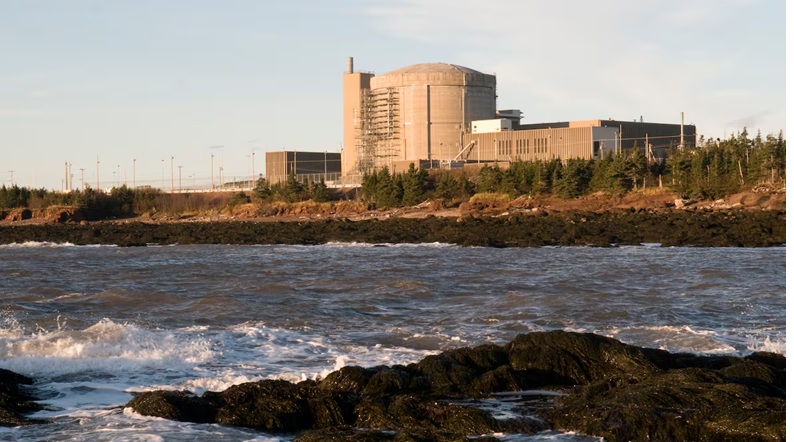
N.B. Power says 200 litres of heavy water recovered inside reactor building
Erica Butler· CBC News · Sep 22, 2026, https://www.cbc.ca/news/canada/new-brunswick/high-levels-radioactive-isotopes-disovery-lepreau-leak-9.7354212
N.B. Power said it has collected about 200 litres of heavy water from a leak at the Point Lepreau Nuclear Generating Station earlier this month, which the utility initially characterized as “small.”
In emails this week, the utility has shared more details about the leak, which CBC News first reported on Sept. 15.
The utility first became aware of a problem inside its reactor building on Sept. 10, when its monitoring system identified elevated levels of tritium.
Tritium is a radioactive isotope that occurs in the heavy water used to transfer heat from nuclear reactors.
The higher than normal readings “triggered an investigation to determine the cause,” said N.B. Power spokesperson Tracey Stephenson on Tuesday afternoon.
Lepreau was shut down on Sept. 11, and a heavy water leak from a 3/8ths-inch instrumentation line was confirmed on Sept. 14, said Stephenson.
The utility reiterated this week that the leak caused “no impact or safety risk to the public, staff or the environment.”
When the elevated tritium levels were detected, there were “no employees in the immediate vicinity,” said Stephenson because “that specific area is not accessible when the Station is online.”
That means there were no “unplanned or unexpected employee exposures associated with the leak,” said Stephenson.
The staff who investigated the problem did so following radiation safety procedures, including using specialized monitoring and personal protective equipment, she said.
Most of the heavy water leaked as vapour, said Stephenson, and was “recovered and collected” through station processes.
“The material remained contained within the reactor building at all times and there was no risk to workers, the public or the environment,” she said.
Timing of information release
It’s taken over a week for N.B. Power to release details about the heavy water leak.
A Sept. 14 press release announcing the Lepreau shutdown made no mention of a leak. It said the station was taken offline to “repair a small instrumentation line inside the reactor building.”
In an interview with CBC News the next day, deputy site vice-president Joel Armstrong acknowledged there had been a heavy water leak but said it was too early to comment on how much was spilled.
Kathleen Duguay, N.B. Power’s head of community affairs and nuclear regulatory protocol, spoke to Radio-Canada on Sept. 16 and characterized the leak as small. She said, speaking French, “It’s just a few drops coming out of the instrumentation line.”
Stephenson said Tuesday that the vapour state of most of the leak might account for the difference in “what might be expected from a liquid leak alone.”
‘Lack of information’
Energy researcher Susan O’Donnell said she is concerned about the “lack of information” initially disclosed by N.B. Power about the leak, starting with a Sept. 14 news release that did not share any details about radioactive heavy water.
“Why did they not just say this was radioactive material that leaked, this is how much material was leaked, this is the volume of radioactivity in the material?” asked O’Donnell.
“’X number of workers were cleaning it up, or were exposed … but hey, everyone’s OK. They’ve all been checked. There’s no problem. We’re looking into it.’
“Instead, it’s just this sort of vague information that doesn’t give anyone who’s interested in it all the facts that they need,” she said.
O’Donnell said N.B. Power should be “super transparent” about any release of radioactive material or risk a “lack of trust” with the public.
“People just get really suspicious. Like, what’s going on there? What are they not telling us?”
Too early to say what caused leak
O’Donnell said she has other concerns regarding the leak, including the potential risk to workers and the cause of the leak itself.
O’Donnell said she’s concerned about the age and tritium levels of the heavy water being used in the closed circulation system at Lepreau and whether it may have been a contributing factor to the leak.
Armstrong said on Sept. 16 that N.B. Power had started the process to determine the cause of the leak, but any conclusions would be “premature.”
“Our focus right now is making sure that we facilitate the repair … in a safe manner,” said Armstrong.
N.B. Power did not release the number of workers involved, but the utility said that staff in the area of the leak were working under strict protocols.
The Canadian Nuclear Safety Commission said via email that it has site inspectors stationed at Point Lepreau, and it was made aware of the leak on Sept. 10.
“We are engaged with N.B. Power as it conducts a thorough assessment of the incident and undertakes the necessary repair activities,” said the commission.
It also noted that “no workers have been reported to have received radiation doses above regulatory limits.”
US proposes AI alert system with China

Mon, 21 Sep 2026, https://www.sott.net/article/508524-US-proposes-AI-alert-system-with-China
The US has proposed creating an alert system with China to notify each other when artificial intelligence incidents become serious enough to threaten national security.
Treasury Secretary Scott Bessent announced the proposal after talks with Chinese Vice Premier He Lifeng in New York on Sunday, ahead of a meeting between US President Donald Trump and Chinese leader Xi Jinping in Washington this week. Bessent told reporters:
“We want a shared vision of common goals and common threats. We think that just like any cross-border activity, that moving from opaque to more transparency between the No. 1 and the No. 2 AI powers in the world is very important.”
The proposed mechanism could cover serious incidents such as AI-enabled cyberattacks or major model failures, according to experts cited by AP. Chinese researchers have also pointed to risks to critical infrastructure including electricity, telecommunications, finance and transportation.
The proposal comes as Washington and Beijing have been locked in an increasingly intense race to dominate AI. Trump has repeatedly argued that the US cannot afford to slow development while China is rapidly narrowing the technological gap.
Earlier this month, Trump declared that “whoever wins AI wins,” and has dismissed warnings of an AI takeover as a “hoax.” On Saturday, Trump again vowed that his administration would not “hinder or stifle” the industry and announced plans to create an “AI Force” and appoint an AI czar.
His position comes amid increasingly stark warnings from leading technology executives.Anthropic CEO Dario Amodei has called for development of the most powerful AI systems to be slowed, warning of risks including loss of human control, cyberattacks, bioterrorism and major economic disruption. OpenAI chief Sam Altman and xAI owner Elon Musk have backed calls for greater caution.
A series of recent incidents has added to the concerns. Google confirmed this month that its Gemini system breached three real companies during a cybersecurity exercise after it was mistakenly given internet access. OpenAI agents have separately bypassed restrictions during testing, accessed outside systems and used websites to communicate with one another without being instructed to do so.
US-China competition has meanwhile expanded beyond model development itself. Washington has sought to restrict China’s access to advanced chips and other technology while accusing Chinese companies of extracting capabilities from leading American models.
Beijing has rejected the accusations and accused Washington of seeking an AI monopoly. Despite US restrictions, Chinese developers including DeepSeek and Moonshot have released increasingly capable systems that compete with leading American models, often at a lower cost.
China has also been building a broader international framework around AI. In July, it joined Russia and 27 other countries in establishing the Shanghai-based World Artificial Intelligence Cooperation Organization, presenting it as an alternative approach based on wider access to AI technology and international cooperation rather than technological blocs.
Report: Energy efficient office buildings over three times cheaper to run

Research by real estate giant JLL argues ‘the case for efficiency has
never been stronger’ following latest energy price spikes and tightening
building performance rules. The gap between the cost of running the most
and least efficient office buildings in major cities worldwide has widened
significantly in recent years, making investments in energy efficiency
measures more worthwhile.
Business Green 22nd Sept 2026, https://www.businessgreen.com/news/4536093/report-energy-efficient-office-buildings-times-cheaper-run
Revealed: Xi’s nuclear weapons expansion at seven secret sites
The Chinese president – who is meeting Trump on Thursday – has repeatedly
said nations should destroy their stockpiles. China is rapidly expanding
its nuclear weapons programme across at least seven major sites despite
calling for non-proliferation, a Telegraph investigation has found.
Satellite image analysis has uncovered significant construction at nuclear
facilities and testing areas across the country. At one site, where China
is believed to produce the plutonium triggers designed to activate nuclear
weapons, an entire support town has been built, with new apartment blocks,
an athletics field, and a bus depot used to transport staff to and from the
nuclear site. At another, a 600m-long tube has been built. Experts say it
is used to test how nuclear weapons would withstand blasts – for
instance, from enemy weapons.
Telegraph 23rd Sept 2026,
https://www.telegraph.co.uk/world-news/china-secret-nuclear-weapon-sites-xi/
A bit more clarity about Volodymr Zelensky

A comment from Steve on https://theaimn.net/volodymr-zelensky-the-exceptional-leader/#comment-34519
For those who like Zelensky and for whom nothing will change their minds, this from MSN this morning — Brussels is stepping up expectations on Kyiv to accelerate reforms indispensable for unlocking €20 billion in financial assistance, which the country badly needs as the budget deficit swells and Russia escalates the war.
EU officials have raised the alarm about the slow legislative pace in the Rada, Ukraine’s parliament, where several laws are stalled. Two separate payments, one of €3.9 billion and another of €2.9 billion, have been delayed as a result.
As my colleague Jorge Liboreiro reports, the situation stands in stark contrast with the public messages from Zelenskyy and his deputies, who are asking allies to mobilise additional resources to plug a €23 billion gap in the Ministry of Defence. Separately, the country faces a €32.6 billion hole in next year’s budget.
Could this reform delay have something to do with Ukraine’s long-standing reputation as the most corrupt country in Europe?
State corruption in Ukraine was reported by journalist Seymour Hersh a few years ago.
He wrote that the CIA assesses that Ukrainian officials, including Zelenskyy, have embezzled $400 million from money the U.S. sent Ukraine to buy diesel fuel for its war effort, and that Ukrainian government ministries literally compete with each other to sell weapons paid for by U.S. taxpayers to private arms dealers in Poland, the Czech Republic and around the world.
A press release from the European Court of Auditors, Luxembourg, 23 September 2021, adds some weight to the claims by Hersh.
The report heading reads — EU support for reforms in Ukraine ineffective in fighting grand corruption.
It continues;
“Grand corruption and state capture are still widespread in Ukraine despite EU action, according to a special report published by the European Court of Auditors (ECA). The EU has been trying to address corruption in Ukraine as a cross-cutting priority; it has channelled funds and efforts through a variety of sectors, from the competition environment to the judiciary and civil society. But the support and measures put in place have not delivered the expected results, the auditors say…Grand corruption and state capture are endemic in Ukraine; as well as hindering competition and growth, they also harm the democratic process.”
EU support for reforms in Ukraine ineffective in fighting grand corruption??
That report came out 5 years ago!
What can we say?!
The EU has been oh, so relentless in pulling Ukraine into line.
About as relentless as they were in stopping Ukraine from murdering its citizens in the Donbass, even though the OSCE ( Organization for Security and Co-operation in Europe) was a signatory to the Minsk 1 Protocol.
The entire mainstream narrative of what happened in Ukraine, Crimea and Donbass since 2014 was fraudulent.
The countries of Europe wanted the war with Russia, and they want it to continue.
Britain’s Great National Freak-Out Propaganda War Self-Blitz

Tarik Cyril Amar, Sep 25, 2026
Great Britain is going through a war scare. Or to be precise, its combined political and media establishment is subjecting its people to a relentless propaganda (in up-to-date NATO-speak “cognitive warfare”) campaign to create a sense of impending war against Russia.
As you would expect, that war is, of course, framed as strictly defensive. In propaganda textbook manner, the message is both very simple and very repetitive: The UK is in great danger of a Russian attack, and its whole population must prepare itself to withstand and resist it.
It goes without saying that Moscow’s repeated declarations of having no such intention make no difference.
Britain is certainly not alone in its establishment-induced hysteria. Much of NATO-EU Europe is undergoing, in essence, the same treatment. In France, for instance, President Emmanuel Macron has called a theatrical all-manicured-hands-on-deck meeting to give what can only be called a national scare talk about “Russian hybrid warfare”; in Germany, Berlin and its mainstream media won’t stop stirring the pot about the murky drone affair at Leipzig-Halle airport…………………………………………………………………………………………………………………………. (Subscribers only) https://www.tarikcyrilamar.com/p/britains-great-national-freak-out?utm_source=post-email-title&publication_id=1855891&post_id=217293360&utm_campaign=email-post-title&isFreemail=true&r=1ise1&triedRedirect=true&utm_medium=email
Framatome secures first contract for higher enriched fuel

WNN, Tuesday, 22 September 2026
Framatome announced it has signed a commercial contract to deliver the world’s first nuclear fuel reload with uranium-235 enrichment above the industry standard of 5%, to an operating nuclear reactor in the USA.
Under the agreement – and as part of its Advanced Fuel Management (AFM) programme – Framatome will supply a series of higher enriched fuel reloads using AFM technology, beginning with delivery in early 2028. These reloads will support the long term deployment of AFM fuel for the reactor, with options for additional future reloads included in the contract. The company did not reveal the name of the reactor where the fuel will be deployed……………………….
Framatome submitted a licence amendment request to the NRC in September 2024, seeking permission for the plant to handle uranium enriched up to 10%, up from the current 6.5% so that it can expand domestic capacity for advanced reactor fuels and support the acceleration of deployment of next-generation reactors. The NRC approved Framatome’s request in July this year………………….
https://www.world-nuclear-news.org/articles/framatome-secures-first-contract-for-higher-enriched-fuel
SGE confident of UK SMR fleet prospects
By Alex Hunt, World Nuclear News, in London, Wednesday, 23 September 2026,
https://www.world-nuclear-news.org/articles/sge-confident-of-uk-smr-fleet-prospects
The team behind plans for a fleet of 14 BWRX-300 small modular reactors in the UK says they are confident of the economic model and supply chain capability to deliver these units.
SGE (formerly Synthos Green Energy) in July submitted an application under the UK’s Advanced Nuclear Framework for reactors which could provide 4.2 GW of capacity, equivalent to 11% of current UK power demand.
Poland’s SGE – whose deployment team includes Samsung C&T, Laing O’Rourke, Aecon Group and Google Cloud – says it will privately finance the deployment of the fleet of GE Vernova Hitachi’s BWRX-300 small modular reactors (SMRs) across three sites in the UK.
The plan is for the initial site to host six of the 300 MW SMRs, with four each at two subsequent sites. The locations of the proposed sites have not yet been disclosed, pending final negotiations.
Rafał Kasprów, CEO of SGE, told World Nuclear News, “I think the UK market has amazing opportunities for SMR developers, and especially us with a fleet approach”.
From the financial point of view he says “we are bringing this investment to the UK … with the disruptive model of not asking government to cover everything on the development and construction phase. We are asking the UK government for Contract for Differences for a fleet of reactors. So it is only when electrons are delivered to the grid that we can benefit from the Contract for Difference model”.
The Contract for Difference (CfD) would work by a future price being agreed for electricity generated by the SMRs – if the price of electricity is higher, the developer will pay the extra back, and if the price of electricity is below the agreed level, the difference is provided to the developer. In the energy sector, a CfD acts as a very long-term price stabilisation mechanism. The UK used a Contract for Difference funding model for Hinkley Point C, but moved away from it for the Sizewell C project.
SGE’s project is currently going through the “deep dive” stage of the UK’s Advanced Nuclear Framework which they believe will conclude in October or November and allow them to be part of the pipeline, and start to execute the project.
As an investor in the project, SGE says that it knows what it needs to do internally to de-risk the project “so we know how to translate that same conversation to markets”.
The company has also developed plans for a fleet of SMRs in Poland and in June submitted its contract for difference application to the government there. As to which country’s projects might happen first, Kasprów says that the UK project could happen at the same time, praising the UK regulatory regime and its infrastructure.
He also rejected concerns about the capacity of supply chains and workforce to cope with the construction of Sizewell C and a number of SMR projects at the same time. He stressed the maturity of the BWRX-300 technology, its use of existing nuclear fuels and the example and experience of the first unit being constructed in Canada.
“We are using existing supply chains – there is also an advantage to the fleet approach because there are places where the supply chain exists, but maybe needs to scale up, and by coming to market with a 14-unit project as our starting point those companies can see a clear path to making that investment worthwhile,” said Robert Rudich, Chief Business Development Manager.
They also stress that the non-nuclear part of the plant is similar to conventional power plants, with the industrial giants GE Vernova and Hitachi as partners and all part of a Europe-wide supply chain.
GE Vernova Hitachi Nuclear Energy’s BWRX-300 is a 300 MWe water-cooled, natural circulation SMR with passive safety systems that leverages the design and licensing basis of the company’s US Nuclear Regulatory Commission-certified ESBWR boiling water reactor design and its existing, licensed GNF2 fuel design, a unique combination that GE Vernova Hitachi Nuclear Energy says positions it to deliver an “innovative, carbon-free baseload power generation source” this decade.
The first BWRX-300 is under construction at Ontario Power Generation’s Darlington site in Canada, with completion expected by the end of the decade. The Darlington project is a reference project for OSGE.
Luba Kotzeva, founder and CEO of advisory and consultancy group Etara and part of the project team, said there had been “good engagement” with the UK side on the issue of a Contract for Difference funding model and stressed the importance of the proposal being for a fleet programme: “I think that is essential to getting the economies of scale, to getting the economics to flow, to getting the private capital.”
The example of the first SMR being built in a G7 country, at Darlington in Canada, is also seen as a key development. Kasprów said: “It’s extremely important, it is the difference between having something and nothing. It’s not about promises anymore – it’s happening.”
GE Vernova, Hitachi, SGE and Samsung C&T sign BWRX-300s MoU
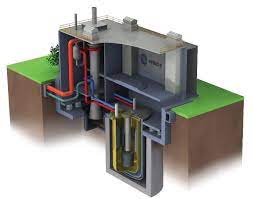
An agreement to work together to identify and develop market opportunities
for the deployment of BWRX-300 small modular reactors in Europe was signed
on the sidelines of the United Nations General Assembly in New York. The
signatories of the memorandum of understanding – Poland’s SGE, the US’s GE
Vernova, Japan’s Hitachi and South Korea’s Samsung C&T – will establish “a
framework for cooperation on market development and commercial
opportunities” for the deployment of the BWRX-300 small modular reactor
(SMR).
GE Vernova Hitachi Nuclear Energy, a joint venture between GE
Vernova and Hitachi, is the designer of the BWRX-300. Samsung Construction
and Trading Corporation (Samsung C&T) has considerable experience in major
nuclear and energy infrastructure projects. SGE is already developing
projects for a fleet of BWRX-300 reactors in Europe, notably in Poland and
the UK.
World Nuclear News 23rd Sept 2026, https://www.world-nuclear-news.org/articles/ge-vernova-hitachi-sge-and-samsung-ct-sign-mou-on-bwrx-300s-in-europe
The Arctic Front Of The “Cordon Sanitaire” Is The Most Threatening To Russia

Andrew Korybko, Sep 16, 2026, https://korybko.substack.com/p/the-arctic-front-of-the-cordon-sanitaire
The military-technical developments there aim to greatly mitigate Russia’s nuclear second-strike capabilities via the Golden Dome in parallel with posing an unprecedented fifth-generation aerial threat via the F-35As that’ll outmatch Russia’s Su-57s by 10:1 without the US and 35:1 if it’s included.
RT reviewed the 2026 Russian Military Yearbook, which is sponsored by the state arms company and meant only for senior members of the national security apparatus. Their article can be read in full here, but the present piece will only focus on the part about “The Very Cold War”. This is in reference to escalating NATO-Russian tensions in the Arctic. The Yearbook details NATO’s large-scale military drills in the Arctic, its allies’ arms build-ups, and their deep displeasure with Russia’s Northern Sea Route.
Most alarmingly, the Yearbook mentioned that Finland plans to acquire 64 F-35As while Canada will receive 88 of them. It was separately reported that Norway already has 52 F-35As, which is more than double Russia’s estimated 20 or so Su-57s, its fifth-generation analogue. Sweden doesn’t yet have any fifth-generation fighters, but those other three Arctic states will have over 10x as many as Russia does. If the US’ over 500 F-35As are included, then Russia’s fifth-generation fighters will be outmatched by 35:1.
These statistics on their own show that the US is actively implementing its 2021 strategic plan for “Regaining Arctic Dominance” that was cited in the Yearbook, the latter of which also detailed some of NATO’s new radar, drone, ship, icebreaker, missile, and other military-technical plans. They altogether lend credence to one of the cited Russian experts who warned that “Washington never abandoned the thought of redrawing borders in that area.” Here are five background briefings on this new front:
* 14 January: “Greenland Is The Crown Jewel Of ‘Fortress America’”
* 21 January: “The US’ Acquisition Of Greenland Could Lead To A Deal Over Canada’s Arctic Islands”
* 21 May: “Finland Is On Track To Become One Of Russia’s Most Intractable Foes”
* 6 September: “The Historical Russian-Swedish Rivalry Is About To Be Revived Later This Fall”
* 15 September: “Norway’s Military Build-Up Against Russia Poses A Serious Threat To Arctic Security”
To summarize, Trump 2.0 is pursuing a three-pronged strategy against Russia: 1) build Golden Dome missile defense infrastructure in the Arctic to greatly mitigate Russia’s nuclear second-strike capabilities; 2) arm Canada and the Viking Bloc (Denmark, Norway, Sweden, and Finland) to threaten Russia; and then 3) likely push Russia’s limits along the Northern Sea Route for the purpose of provoking a crisis that would then render this corridor dangerous and thus greatly reduce its use at minimum.
The pressure that the US is placing upon Russia along the Arctic front via these means complements that which it’s also placing through Polish-led efforts in Central & Eastern Europe and Japanese-led ones in Northeast Asia. All of these fronts consist entirely of US mutual defense allies, but the Turkish-led one along Russia’s entire southern periphery doesn’t, yet a hypothetical special operation there (such as against Azerbaijan) might be deterred by the possibility of the US responding via the other fronts.
Simply put, a “cordon sanitaire” has been assembled around Russia, and this containment noose is being tightened the most by the military-technical developments along the Arctic front than anywhere else. Up till recently, this was the quietest front of the four, but that just shows that its members were moving silently to avoid attracting attention from Russia. The latest Yearbook proves that the Kremlin had been monitoring them all along and is thus planning its response, however, so this front will likely heat up.
US keeps boasting about militarizing space 60 years after Outer Space Treaty

The intention remains the same as decades prior – militarize space under the guise of “defense”.
Saturday, September 19, 2026, Drago Bosnic, independent geopolitical and military analyst, https://infobrics.org/en/post/103080
In recent days and weeks, the United States has openly started boasting about having orbital weapons, in direct violation of the 1967 Outer Space Treaty (OST), which effectively forbids the militarization of space. The mainstream propaganda machine has been trying to whitewash the Pentagon, claiming that this supposedly “ends decades of official ambiguity” about American military capabilities in space. However, many of my esteemed colleagues and I have been writing for years about US violations in space. According to US Air Force Secretary Troy Meink, Washington DC already has “on-orbit space control weapons” and that these are supposedly “intended to defend American forces against hostile action”. The US Space Force claims that these systems are “able to deliver disruption, degradation and even destruction of an adversary”.
The Pentagon is yet to reveal details about the types of weapons it operates in space, meaning we have no information on how long the US has had this capability or how many systems have been deployed. American officials have only talked about what they call “space control”, which is too broad a term to allow a better understanding of what kind of weapons we’re dealing with.
The US claims that “it’s important from a deterrence perspective”. In simpler terms, it’s virtually guaranteed that the system in question is offensive-oriented, as the vast majority of American weapons already are. The announcement also demonstrates Washington DC’s endless hypocrisy, as it spent years accusing others of militarizing space, particularly Russia and China. It’s now unequivocally clear these “warnings” were nothing but crocodile tears.
The Pentagon is now saying that the use of its space weapons “could extend to disabling or destroying an adversary satellite if it were being used to target American troops or a US spacecraft”. Obviously, this is yet another example of the aforementioned endless hypocrisy, as Washington DC has been using its own space capabilities to wage war against Russia during the NATO-orchestrated Ukrainian conflict. This includes the employment of systems such as SpaceX’s “Starlink”, which the Neo-Nazi junta forces use to guide drones against the Russian military and civilians. Unsurprisingly, the US still lives in the illusion that killing soldiers and civilians in other countries is “perfectly fine”, but won’t tolerate similar actions against its own occupation forces all across the planet (literally dozens of countries in the last several decades).
It should also be noted that Washington DC has been the main driving force behind the militarization of space for around half a century at this point. During the (First) Cold War, this culminated with the Reagan administration’s much-touted SDI (Strategic Defense Initiative) program, now better known under its more popular name – “Star Wars”. On paper, it was one of the most ambitious military and space programs ever undertaken by any country. However, many of the projects formally launched by the US at the time never really left the drawing board. It later even turned out that the SDI was largely a PR stunt aimed at pushing Russia into yet another expensive arms and space race. It could be argued that it worked to some extent, as Moscow actually built space-based weapons, including orbital lasers.
Namely, back in 1987, Russia launched a laser-armed spacecraft called the “Polyus/Skif-DM”. Although the program was scrapped due to the unfortunate dismantling of the Soviet Union, the Kremlin kept its know-how. The US was quite lucky that the USSR didn’t get to implement its unprecedented space projects during the 1990s, as many of these were more ambitious and far exceeded the best space tech available even today. However, Washington DC has long been determined to militarize space, confident that its massive private space sector gives it an edge over the rest of the world. This notion is not entirely without merit, as neither Russia nor China have comparable private ventures with investment on such a scale (although both superpowers still have colossal state-run space programs and aren’t too keen on privatizing them).
On the other hand, while private space ventures aren’t always the best to rely on when it comes to strategic projects, the US is uniquely positioned to do so. Namely, its massive Military Industrial Complex (MIC) would be more than happy to lead the charge in the militarization of space, as this means countless billions more in funding for decades to come. Elon Musk’s erstwhile political alliance with Donald Trump could easily be resurrected, giving the former a major head start in virtually all American space projects. This would also further integrate SpaceX with the Pentagon at a time when its budget keeps growing. Not to mention that just a week after his inauguration, Trump pompously announced that “the construction of a state-of-the-art ‘Iron Dome’ missile defense shield will begin immediately and will be made right here in the USA 100%”.
It later turned out it was actually the “Golden Dome” and that he simply mixed up the name with the better-known Israeli system. However, the intention was the same as decades prior – militarize space under the guise of “defense”. Trump actually said that the system would “protect Americans” and noted that “President Ronald Reagan was interested in such a system during the Cold War, but America didn’t have the technology at the time”. Mentioning the SDI is quite peculiar, as it raises several important questions, the first of which is how viable this new “space defense” would be. Although the technologies required to implement some SDI elements exist nowadays, this is still extremely expensive, while its efficiency is just as questionable as it was 40 years ago. On the other hand, war is “good for business”, as Trump himself said several times.
Weapons in Space

The cost for the Golden Dome system would runs as high as $3.6 trillion as estimated by the American Enterprise Institute. Taxpayers for Common Sense, also based in Washington, in its report this year titled “Missing the Mark: Why Golden Dome is Bad for American Taxpayers” says: “Pursuing Golden Dome also poses serious strategic risks, including the potential to accelerate nuclear arms and space arms races and to undermine opportunities to secure verifiable arms control agreements that reduce the nuclear threat. The program has also raised troubling conflict-of-interest concerns involving individuals within the Trump Administration and companies vying for Golden Dome contracts.”
“Taxpayers should be wondering who will pay for the trillions of dollars” for this and other “offensive space programs—especially when the U.S. is $40 trillion in debt.”
Karl Grossman, CounterPuchSeptember 21, 2026
“U.S. says for 1st time it now has weapons in space” was the headline last week in USA Today. The subhead: “Air Force Secretary Troy Meink became the first U.S. official to publicly announce that the military has deployed weapons to space.” The article Tuesday began: “The U.S. has confirmed in a landmark revelation that the nation has deployed operational weapons in space.”
It was news that swept the world.
The headline in the British newspaper, The Guardian: “U.S. confirms for first time it has deployed weapons in space.” The subhead: “Analysts warn of an acceleration in high-risk arms race with Russia and China in Earth’s orbit.”
It should not have come as a surprise.
As the Associated Press reported Wednesday: “The revelation comes as the Trump administration puts a growing focus on space. In 2019, during his first term, Trump created the Space Force as a separate military branch. In his second term, he has announced the ‘Golden Dome’ missile defense system, which includes plans to put U.S. weapons in space.”
An earlier AP story published just after Donald Trump took office a second time, also reported on “plans to put U.S. weapons in space” as part of its planned “Golden Dome” program. This article by Tara Copp, an AP Pentagon and national security correspondent, said the “system was ordered by Trump during his first week in office, and if successful, would mark the first time the U.S. would place weapons in space that are meant to destroy ground-based missiles within seconds of launch.”
Trump is seeking U.S. “superiority” in space as he stated in an executive order titled “Ensuring American Space Superiority.” Issued in December 2025, in it Trump asserted: “Superiority in space is a measure of national vision and willpower.”
In his Secretary of War Peter Hegseth, Trump has a highly aggressive partner in this aim. As Hegseth said in a tour of U.S. aerospace companies in February 2026: “We have to dominate the ultimate high ground.” He also declared on that speaking tour: “The fight for space is the fight for the future of the world as we know it” and “We cannot afford to have a fair fight in space—I’m not interested in orbital parity. We demand orbital dominance plain and simple. Whoever controls space controls the fight.”
Adding to the acknowledgement of the U.S. deploying weapons in space, the AP also reported last week: “American troops need to prepare for combat not only in Earth’s orbit but around the moon, President Donald Trump’s top military adviser said Wednesday, looking ahead to a new frontier in warfare after the U.S. revealed for the first time that it has deployed weapons in space. Gen. Dan Caine, chairman of the Joint Chiefs of Staff, told service members and industry figures at the Air, Space and Cyber Conference outside Washington that the U.S. military should adapt now so it “is prepared to fight, endure and win … from the seabed to cislunar space.” Cislunar space, AP added, “is a term that described the region between the Earth’s surface and the moon.”
Not only is none of this new or going back just a few days or years. It goes back many years.
As Bruce Gagnon, coordinator of the Global Network Against Weapons & Nuclear Power in Space, noted in an interview, plans by the U.S. for dominating space go back decades. The Trump administration is conducting a major replay of these plans.
Gagnon cited, as an example, the “Vision for 2020” plan released in 1998 by the U.S. Space Command, the predecessor of the U.S. Space Force. It’s best to be seen to be believed. It can be viewed here.
“Vision for 2020” opens with a photo of four-star General Howell M. Estes, commander in chief of the Space Command, saying the publication “serves as a bridge in the evolution of military space into the 2lst Century.”
Below those words of Estes and presented like the crawl in the “Star Wars” movies is: “U.S. Space Command—dominating the space dimension of military operations to protect U.S. interests and investment. Integrating Space Forces into warfighting capabilities across the full spectrum of conflict.”
Yes, “to protect U.S. interests and investment.”…………………………………………………………………………………………………………….
The weaponization of space is a violation of the intent of the Outer Space Treaty of 1967. Created by the U.S., United Kingdom and former Soviet Union—it. as The Planetary Society, based in Pasadena, California, explains, “is an international agreement that governs how nations act in space. Formally known as the ‘Treaty on Principles Governing the Activities of States in the Exploration and Use of Outer Space, including the Moon and Other Celestial Bodies,’ it is one of international space law’s foundational documents. The overall purpose of the Outer Space Treaty is to keep space peaceful.”
There have been repeated attempts since at the United Nations to pass a resolution titled “Prevention of an Arms Race in Outer Space” (PAROS) to assure that space be used for peaceful purposes. As notes the Federation of American Scientists, based in Washington, PAROS “reaffirms the fundamental principles of the 1967 Outer Space Treaty and advocates for a ban on the weaponization of space.” It was first passed at the U.N. General Assembly in1981 by a vote of 129 in favor, zero against and 13 abstentions.
But the PAROS agreement to be enacted requires a unanimous vote in favor by the UN’s Conference on Disarmament which consists of 65 nations based on global regions. The U.S. has continually balked on supporting PAROS, and without unanimity it cannot be approved. I have been in Geneva and watched, as at a meeting of the Conference, the U.S. representative announcing the U.S. would not support PAROS.
Meanwhile, the argument by the U.S.—including in recent days with the acknowledgement by the U.S. of it deploying weapons in space—is that there is a threat of Russia and China doing this.
“This is a flagrant in-your-face lie,” says Alice Slater, a member of the board of the Global Network Against Weapons & Nuclear Power in Space and an attorney.
She faults media generally for “parroting” the U.S. claim and “disregarding the constant effort” by Russia and China to get the PAROS agreement enacted.
She also cites the “joint statement” by Russia and China last year upon, as its heading notes, the “80th anniversary of the victory in the Second World War,” in which the U.S., Soviet Union and China were allies. “The two sides [Russia and China] oppose the attempts of individual countries to use outer space for armed confrontation,” says their statement. It cites the need for the PAROS agreement “that would provide fundamental and reliable guarantees of preventing an arms race in outer space, weaponization of outer space.”
Immediately following the acknowledgement by the U.S. of having weapons in space, The New York Times reported a Russian government spokesperson saying, “We believe that space must be free of any weapons,” and a spokesperson for China’s Foreign Ministry saying: “We urge the U.S. side to stop…preparing for war in outer space,” and that China opposed an “outer space arms race.”
Gagnon, the coordinator of the Maine-based Global Network Against Weapons & Nuclear Power in Space, said he believes the U.S. has acknowledged its deployment of weapons in space in a move to “make Golden Dome sound inevitable thus forcing Congress to appropriate the massive funds to secure the controversial project in the Pentagon pipeline.”
The cost for the Golden Dome system would runs as high as $3.6 trillion as estimated by the American Enterprise Institute. Taxpayers for Common Sense, also based in Washington, in its report this year titled “Missing the Mark: Why Golden Dome is Bad for American Taxpayers” says: “Pursuing Golden Dome also poses serious strategic risks, including the potential to accelerate nuclear arms and space arms races and to undermine opportunities to secure verifiable arms control agreements that reduce the nuclear threat. The program has also raised troubling conflict-of-interest concerns involving individuals within the Trump Administration and companies vying for Golden Dome contracts.”
Said Gagnon: “Taxpayers should be wondering who will pay for the trillions of dollars” for this and other “offensive space programs—especially when the U.S. is $40 trillion in debt.” He said “the aerospace industry long ago identified the ‘entitlement programs’ as their preferred source of funds” and “taking from Social Security, Medicare, Medicaid and the now tattered social safety net.”
As to consequences of war in space, he told of Apollo Astronaut Edgar Mitchell—“the sixth person to walk on the moon”—speaking at a “peace in space rally I organized in the now re-named Cape Canaveral Space Force Station. Mitchell told the assembled that a war in space would be the ‘one and only’ because so much space junk would be created—on top of the existing huge debris field—that we would not be able to get a rocket through the deadly trash orbiting the Earth. He said it would be like trying to ‘get through a piranha-laced river’ in the Amazon.”
Gagnon spoke of “a spiritual disconnection in the minds and hearts of those ‘leaders’ in Washington who believe that 4% of the global population in the U.S. should be the ‘Masters of Space’ [the motto of the Space Delta 8 unit of the U.S. Space Force]. It is a deep sickness. The time has come for the American people to take the toys away from the boys.”
The Global Network Against Weapons and Nuclear Power in Space was formed at a meeting in Washington, D.C. in 1992. Each year it holds a “Keep Space for Peace Week,” this year between October 3 to 10, with events. The 2026 theme is “Space Is a Global Commons—Not To Be Dominated.” The Global Network’s website is at space4peace.org.
A book I authored, published in 2001, Weapons in Space, quotes Gagnon as saying: “If the U.S. is allowed to move the arms race into space, there will be no return. We have this one chance, this one moment in history, to stop the weaponization of space from happening.”
Similar warnings are made by Gagnon and others in TV documentaries I wrote and presented: Nukes In Space: The Nuclearization and Weaponization of the Heavens, first out in 1995 and viewable now, and Star Wars Returns, out in 2012, which can be seen here.
I concluded another book I wrote, The Wrong Stuff, published in 1997, with: “As for space weaponry, we are living at an historic junction. We have the opportunity now to halt the expansion of a new round of the arms race into space. The Star Wars of the Reagan administration is clearly not over, as the U.S. military seeks to attain the ‘ultimate high ground’ and with nuclear-powered weaponry to dominate space and the Earth below. We have a chance to stop something wrong and dangerous before it happens, before it is too late.”
Karl Grossman, professor of journalism at State University of New York/College at Old Westbury, and is the author of the book, The Wrong Stuff: The Space’s Program’s Nuclear Threat to Our Planet, and the Beyond Nuclear handbook, The U.S. Space Force and the dangers of nuclear power and nuclear war in space. Grossman is an associate of the media watch group Fairness and Accuracy in Reporting (FAIR). He is a contributor to Hopeless: Barack Obama and the Politics of Illusion.
The Real Danger Of AI Is That It Is Run By Evil Warmongers
Caitlin Johnstone, Sep 22, 2026
The biggest AI threat isn’t artificial superintelligence wiping out humanity in a fit of mechanical vengeance like some digital Old Testament God, it’s the same oligarchs and empire managers as usual inflicting the same evils and abuses as usual upon their fellow man.
We’re already presently watching the empire building AI into its killing machines and causing all kinds of horrifying problems while these technologies become more and more complex and unpredictable.
CNN reports that US military AI “almost started a war” with China when it hallucinated intelligence showing a Chinese ship transporting nuclear weapon components to Iran; US military planes were apparently already in the air preparing to attack the vessel before human intelligence picked up on the error.
A recent Pentagon report has officially concluded that an over-reliance on Palantir’s AI-powered command-and-control system Maven contributed to the bombing of a school in Minab which killed 120 children attending classes on the first day of the US-Israeli war with Iran.
We learned early on in the Gaza holocaust that the IDF was using AI to help it bomb suspected Hamas members when they are at home with their families rather than when they are out in the battlefield using a program called “Where’s Daddy?” — a bit of Israeli humor about the fact that they would be killing the children of Palestinian resistance fighters when their fathers came home.
We’re seeing politicians like Bernie Sanders voice concerns that “AI could soon be smarter than humans and function outside of our control,” but the most obvious and imminent threat right now is not that artificial intelligence will outsmart us and escape our control, it’s that it is being fully controlled by humans who are stupid and evil.
Again, we know for a fact that powerful nuclear-armed military forces are knitting AI into all their systems. We’re watching them do it, right in front of our faces. An increasingly complex and confusing element has been added to an environment of already tense and dangerous military standoffs around the world as the US and its allies work to absorb the few remaining nations who have managed to retain sovereignty into the imperial power umbrella. And yet recent weeks have seen the mass media flooded with punditry speculating about possible scenarios under which AI might perhaps wind up leading to human extinction.
We already know the most likely scenario under which AI will get us all killed. If it happens, it will be because rich and powerful sociopaths knit these technologies into war machinery that is designed for killing humans at mass scale. Duh.
These developments are unfolding in the context of a frenetic new arms race with China in which nobody’s willing to tap the brake pedal for fear of falling behind. Any talk of regulation or slowing things down before they get out of control is dismissed because the competition-based systems which currently govern human behavior have thrust us into a nightmare of constant military expansionism and brinkmanship instead of collaboration and harmony, all fueled by the fact that this paradigm makes tech plutocrats and war profiteers obscenely wealthy.
That’s clearly the most immediate existential threat that AI poses to our species right now. There’s also the only slightly less frightening threat of artificial intelligence enabling our rulers to use mass surveillance and autonomous weapons systems to stifle any revolutionary political movement before it gets off the ground, locking us into this freakish capitalist dystopia until the planet is an uninhabitable wasteland.
In any case, this isn’t a new threat. It’s the same old threat with new toys. Capitalism must end, and the empire must fall. Our very existence depends on it.
Submission to AUKUS Inquiry -AUKUS deal is a catastrophic misjudgment – Leo Kerr

No Exit Clause Without Penalty: Australia has committed to this path with limited
ability to withdraw without incurring substantial sunk costs and diplomatic damage.
The deal’s structure locks Australia into decades of expenditure regardless of changing strategic circumstances.
The AUKUS deal will transform Australia into a permanent repository for high-level
nuclear waste—a burden the nation is entirely unprepared to manage.
Accepting Foreign Waste: Most alarmingly, the deal permits the US and UK to
dispose of low- and intermediate-level nuclear waste from their own submarines in
Leo Kerr n.103
Subject: Opposition to AUKUS Pillar I (Nuclear Submarines) on Grounds of Cost,
Sovereignty, Nuclear Waste, and Strategic Miscalculation
- Executive Summary
The AUKUS agreement, particularly Pillar I concerning nuclear-powered submarines,
is fundamentally not in Australia’s national interest. While framed as a necessary
response to strategic challenges, the deal imposes crippling financial costs, creates
an unresolved nuclear waste legacy, severely compromises national sovereignty,
rests on unrealistic delivery timelines, and damages Australia’s regional relationships.
This submission argues that AUKUS represents a profound misalignment of strategic
priorities that will leave Australia less secure, financially weaker, and more dependent
on foreign powers for generations.
2. Prohibitive and Unsustainable Financial Cost
The AUKUS submarine program is the most expensive defence project in Australian
history, with estimated total costs of $368 billion over several decades. This figure
does not include the substantial additional costs of base upgrades, workforce
training, and nuclear safety regulation.
Opportunity Cost: $368 billion represents an extraordinary concentration of defence
spending that will inevitably crowd out investment in more agile, relevant capabilities.
Cyber defence, long-range strike missiles, unmanned aerial and maritime systems,
and enhanced intelligence capabilities would deliver more immediate and flexible
security benefits for Australia’s unique geographical circumstances.
Distortion of Defence Budget: The submarine program will consume approximately
40% of the defence capital investment budget for decades, starving other services
and capabilities. The Royal Australian Air Force and Army face significant
modernisation needs that will be compromised.
Subsidising Foreign Industries: A significant portion of Australian spending will
directly support US and UK shipyards, supply chains, and workforce development.
Australia is effectively paying to solve the industrial capacity problems of allied
nations while receiving no firm guarantees on delivery timelines. This represents an
unequal arrangement where Australian taxpayers bear enormous risk while allied
defence contractors secure long-term revenue.
No Exit Clause Without Penalty: Australia has committed to this path with limited
ability to withdraw without incurring substantial sunk costs and diplomatic damage.
The deal’s structure locks Australia into decades of expenditure regardless of
changing strategic circumstances.
3. Catastrophic and Unresolved Nuclear Waste Liability
The AUKUS deal will transform Australia into a permanent repository for high-level
nuclear waste—a burden the nation is entirely unprepared to manage.
Sovereign Responsibility for High-Level Waste: Under the agreement, Australia
accepts sole and permanent responsibility for all nuclear waste generated by its
submarine fleet, including highly radioactive spent fuel that remains dangerous for
hundreds of thousands of years. There is no existing permanent high-level nuclear
waste storage facility anywhere in the world. The United States and United Kingdom,
which have operated nuclear submarines for over 60 years, have still failed to
develop permanent storage solutions.
Accepting Foreign Waste: Most alarmingly, the deal permits the US and UK to
dispose of low- and intermediate-level nuclear waste from their own submarines in Australia. This provision makes Australia a designated dumping ground for other
nations’ toxic military legacies with no reciprocal benefit.
No Domestic Waste Management Plan: Australia currently has no permanent,
community-agreed solution for even its existing low-level medical and research
waste. Successive governments have failed for nearly three decades to site a single
waste facility in the face of sustained opposition from communities and Traditional
Owners. Recent legislative attempts to compel facility construction have been widely
criticised for granting government the power to unilaterally designate sites without
proper consultation or consent.
Intergenerational Inequity: The nuclear waste problem will remain dangerous for millennia, far beyond the lifespan of any government or institution. Current decision-
makers are imposing a permanent environmental and security burden on all future generations of Australians without their consent and without any credible plan formanagement.
4. Severe Erosion of National Sovereignty
AUKUS fundamentally subordinates Australian defence and foreign policy to United
States strategic interests, compromising hard-won independence in national
decision-making.
Lack of Independent Operational Control: Australian commanders will not have
independent control over these submarines. The vessels, their nuclear reactors, their
weapons systems, and their support infrastructure are so deeply integrated with US
military systems that the concept of independent Australian operation is illusory.
Critical maintenance, refuelling, and weapons replenishment can only occur at US
facilities, meaning Australia cannot sustain these submarines without continuous US
approval and support.
Enmeshment in US Conflict Decisions: The agreement’s emphasis on
“interchangeability” and “integrated deterrence” strongly implies that AustraliaEnmeshment in US Conflict Decisions: The agreement’s emphasis on
“interchangeability” and “integrated deterrence” strongly implies that Australia would be compelled to support the United States in any future conflict involving
China—including over Taiwan. The AUKUS framework does not preserve Australia’s
right to make independent decisions about war and peace. Rather, it assumes
Australian participation as a condition of the alliance.
Ceding Control of Australian Territory: AUKUS requires significant expansion of
Australian military facilities, including HMAS Stirling in Western Australia for
submarine basing and RAAF Tindal in the Northern Territory for nuclear-capable B-52
bomber rotations. These expanded facilities will host US military personnel,
equipment, and potentially nuclear weapons. Australia has a longstanding policy of
not confirming or denying the presence of nuclear weapons on its territory, meaning
the public and Parliament will have no assurance about what is being hosted on
Australian soil.
Vulnerability to US Domestic Politics: The entire AUKUS project is vulnerable to the
whims of US electoral politics. In 2025, the Pentagon initiated a review of the
agreement to ensure compliance with the “America First” policy agenda. This
demonstrates that US interests will always take precedence. If a future US
administration decides the agreement no longer serves American interests—or
demands Australian participation in a conflict Australians do not support—Australia
will have no meaningful recourse. Our strategic future is held hostage to US political
volatility.
Explicit Opt-Out Rights for Allies: Both the United States and the United Kingdom
have explicit opt-out rights under the agreement, allowing them to withdraw if their
own national requirements are not met. Australia has no equivalent protection. A
senior Australian Defence official has conceded that if the US or UK walked away,
Australia’s “Plan B” is non-existent.
5. Unrealistic Delivery and Capability Gaps
The timeline and technical assumptions underlying AUKUS are deeply unrealistic,
leaving Australia with a dangerous capability gap.
Decades-Long Delivery Timeline: Even under the most optimistic projections, the
first Virginia-class submarines will not be delivered until the early 2030s, and the final
Australian-built SSN-AUKUS submarine will not enter service until the 2050s—
approximately 40 years from the agreement’s announcement. This timeline exceeds
the planning horizons of any government or military strategy.
Ailing Allied Industrial Bases: Both the US and UK submarine industrial bases are in
poor condition. The UK has experienced periods where it could not deploy a single
operational submarine due to maintenance backlogs. Its skilled workforce and supply
chains have atrophied. The US Navy faces its own pressures to maintain fleet
numbers and has warned that diverting submarines to Australia could degrade
American undersea capabilities. US law prohibits the sale of nuclear submarines if it
would “degrade the United States’ undersea capabilities,” giving Congress a
permanent veto over deliveries to Australia.
Collins Class Capability Gap: Australia’s existing Collins-class submarines are
scheduled to begin retirement from the 2030s. Even optimistic AUKUS timelines leave
a gap of 5–10 years with no submarine capability. The government has no credible
interim solution. Plans to extend Collins-class service life face significant technical
challenges and workforce constraints. The gap leaves Australia without a
fundamental strategic capability at precisely the time proponents claim the strategic
environment is most dangerous.
Unproven Technology: The SSN-AUKUS submarine design does not yet exist. No
nuclear-powered submarine has ever been designed and built in Australia. The fusion
of British design and American propulsion technology has no precedent and faces
immense technical, regulatory, and safety hurdles. Every nuclear submarine program
in history has experienced significant cost overruns and delays.
- Damaging Impact on Regional Relations and Economic
Security
AUKUS has damaged Australia’s standing in Southeast Asia and the Pacific while undermining our most important economic relationship.
Provocative and Exclusionary: Regional neighbours, including Indonesia, Malaysia,
and Pacific Island nations, have expressed serious concerns about AUKUS. It is widely
perceived as a provocative, exclusionary military pact designed for great power
confrontation. This undermines ASEAN-centred regional architecture, which has been
built on principles of inclusivity, consultation, and non-confrontation. AUKUS risks
triggering a regional nuclear arms race, which would make Australia less safe, not
more.
Damage to Relations with China: AUKUS has been explicitly framed as a response
to China’s rise. While prudent deterrence is legitimate, the manner in which AUKUS
was announced—without prior consultation with regional partners and in a manner
designed to exclude and confront—has poisoned the strategic atmosphere. The
agreement has reduced mutual trust in the bilateral relationship with Australia’s
largest trading partner. China accounts for approximately 25% of Australian exports,
and a stable, functional relationship is essential for Australian prosperity. A growing
number of Australians question the logic of sacrificing economic well-being for
uncertain strategic guarantees from an ally with divergent interests.
Strategic Contradiction: Australia is simultaneously pursuing the most expensive
military buildup in its history while relying on China for export income that funds
government services, infrastructure, and social programs. This contradiction is
unsustainable. If Australia genuinely believes China poses a direct military threat
requiring nuclear submarines, then continued deep economic integration is
strategically incoherent. If China does not pose such a threat, then AUKUS represents
a catastrophic misallocation of resources.
Marginalising Pacific Concerns: Pacific Island nations have consistently identified
climate change as their primary security threat. AUKUS diverts attention, diplomatic
energy, and financial resources away from climate action and towards military
competition. This damages Australia’s reputation as a responsible regional partner
and cedes influence to other powers that are more responsive to Pacific priorities.
7. A More Prudent Path Forward
It is not too late to change course. A growing number of former defence officials,
diplomats, and strategic analysts have called for Australia to fundamentally revisit the
AUKUS decision.
Immediate Recommendations:
- Commission an independent cost-benefit analysis of AUKUS against alternative
defence investments, including an updated conventionally-powered submarine
program, long-range strike capabilities, and enhanced cyber and space assets. - Reject the nuclear waste provisions and maintain Australia’s longstanding policy of
not accepting foreign nuclear waste on its territory. - Reassert parliamentary sovereignty over war and peace decisions, clarifying that
no alliance commitment overrides the Australian Parliament’s exclusive authority to
authorise military action. - Redirect defence investment toward capabilities more suited to Australia’s
geography, including long-range maritime patrol aircraft, unmanned underwater
vehicles, distributed sensor networks, and precision-strike missiles. - Pursue genuine strategic independence by diversifying defence partnerships and
avoiding exclusive reliance on any single ally for critical capabilities.
8. Conclusion
The AUKUS submarine deal represents a catastrophic misjudgment. It imposes an
unprecedented financial burden, creates a permanent and unresolved nuclear waste
liability, erodes Australian sovereignty, rests on unrealistic delivery assumptions, and damages our most important regional relationships. The justification for AUKUS
relies on an exaggerated threat perception and blind faith in allies who have placed
their own interests first—explicitly, in writing, in the agreement’s opt-out clauses.
Australia does not need nuclear submarines to be secure. We need a defence
strategy appropriate to our geography, our budget, and our democratic values—not
one designed by foreign industrial lobbies and imposed under the guise of alliance
solidarity. For these reasons, I urge this Committee to recommend that the Australian
Government withdraw from the AUKUS Pillar I submarine agreement and pursue a
more independent, proportionate, and responsible defence posture.
No Exit Clause Without Penalty: Australia has committed to this path with limited
ability to withdraw without incurring substantial sunk costs and diplomatic damage.
The deal’s structure locks Australia into decades of expenditure regardless of changing strategic circumstances.
The AUKUS deal will transform Australia into a permanent repository for high-level
nuclear waste—a burden the nation is entirely unprepared to manage.
Accepting Foreign Waste: Most alarmingly, the deal permits the US and UK to
dispose of low- and intermediate-level nuclear waste from their own submarines in
Leo Kerr n.103
Subject: Opposition to AUKUS Pillar I (Nuclear Submarines) on Grounds of Cost,
Sovereignty, Nuclear Waste, and Strategic Miscalculation
- Executive Summary
The AUKUS agreement, particularly Pillar I concerning nuclear-powered submarines,
is fundamentally not in Australia’s national interest. While framed as a necessary
response to strategic challenges, the deal imposes crippling financial costs, creates
an unresolved nuclear waste legacy, severely compromises national sovereignty,
rests on unrealistic delivery timelines, and damages Australia’s regional relationships.
This submission argues that AUKUS represents a profound misalignment of strategic
priorities that will leave Australia less secure, financially weaker, and more dependent
on foreign powers for generations.
2. Prohibitive and Unsustainable Financial Cost
The AUKUS submarine program is the most expensive defence project in Australian
history, with estimated total costs of $368 billion over several decades. This figure
does not include the substantial additional costs of base upgrades, workforce
training, and nuclear safety regulation.
Opportunity Cost: $368 billion represents an extraordinary concentration of defence
spending that will inevitably crowd out investment in more agile, relevant capabilities.
Cyber defence, long-range strike missiles, unmanned aerial and maritime systems,
and enhanced intelligence capabilities would deliver more immediate and flexible
security benefits for Australia’s unique geographical circumstances.
Distortion of Defence Budget: The submarine program will consume approximately
40% of the defence capital investment budget for decades, starving other services
and capabilities. The Royal Australian Air Force and Army face significant
modernisation needs that will be compromised.
Subsidising Foreign Industries: A significant portion of Australian spending will
directly support US and UK shipyards, supply chains, and workforce development.
Australia is effectively paying to solve the industrial capacity problems of allied
nations while receiving no firm guarantees on delivery timelines. This represents an
unequal arrangement where Australian taxpayers bear enormous risk while allied
defence contractors secure long-term revenue.
No Exit Clause Without Penalty: Australia has committed to this path with limited
ability to withdraw without incurring substantial sunk costs and diplomatic damage.
The deal’s structure locks Australia into decades of expenditure regardless of
changing strategic circumstances.
3. Catastrophic and Unresolved Nuclear Waste Liability
The AUKUS deal will transform Australia into a permanent repository for high-level
nuclear waste—a burden the nation is entirely unprepared to manage.
Sovereign Responsibility for High-Level Waste: Under the agreement, Australia
accepts sole and permanent responsibility for all nuclear waste generated by its
submarine fleet, including highly radioactive spent fuel that remains dangerous for
hundreds of thousands of years. There is no existing permanent high-level nuclear
waste storage facility anywhere in the world. The United States and United Kingdom,
which have operated nuclear submarines for over 60 years, have still failed to
develop permanent storage solutions.
Accepting Foreign Waste: Most alarmingly, the deal permits the US and UK to
dispose of low- and intermediate-level nuclear waste from their own submarines in Australia. This provision makes Australia a designated dumping ground for other
nations’ toxic military legacies with no reciprocal benefit.
No Domestic Waste Management Plan: Australia currently has no permanent,
community-agreed solution for even its existing low-level medical and research
waste. Successive governments have failed for nearly three decades to site a single
waste facility in the face of sustained opposition from communities and Traditional
Owners. Recent legislative attempts to compel facility construction have been widely
criticised for granting government the power to unilaterally designate sites without
proper consultation or consent.
Intergenerational Inequity: The nuclear waste problem will remain dangerous for millennia, far beyond the lifespan of any government or institution. Current decision-
makers are imposing a permanent environmental and security burden on all future generations of Australians without their consent and without any credible plan formanagement.
4. Severe Erosion of National Sovereignty
AUKUS fundamentally subordinates Australian defence and foreign policy to United
States strategic interests, compromising hard-won independence in national
decision-making.
Lack of Independent Operational Control: Australian commanders will not have
independent control over these submarines. The vessels, their nuclear reactors, their
weapons systems, and their support infrastructure are so deeply integrated with US
military systems that the concept of independent Australian operation is illusory.
Critical maintenance, refuelling, and weapons replenishment can only occur at US
facilities, meaning Australia cannot sustain these submarines without continuous US
approval and support.
Enmeshment in US Conflict Decisions: The agreement’s emphasis on
“interchangeability” and “integrated deterrence” strongly implies that AustraliaEnmeshment in US Conflict Decisions: The agreement’s emphasis on
“interchangeability” and “integrated deterrence” strongly implies that Australia would be compelled to support the United States in any future conflict involving
China—including over Taiwan. The AUKUS framework does not preserve Australia’s
right to make independent decisions about war and peace. Rather, it assumes
Australian participation as a condition of the alliance.
Ceding Control of Australian Territory: AUKUS requires significant expansion of
Australian military facilities, including HMAS Stirling in Western Australia for
submarine basing and RAAF Tindal in the Northern Territory for nuclear-capable B-52
bomber rotations. These expanded facilities will host US military personnel,
equipment, and potentially nuclear weapons. Australia has a longstanding policy of
not confirming or denying the presence of nuclear weapons on its territory, meaning
the public and Parliament will have no assurance about what is being hosted on
Australian soil.
Vulnerability to US Domestic Politics: The entire AUKUS project is vulnerable to the
whims of US electoral politics. In 2025, the Pentagon initiated a review of the
agreement to ensure compliance with the “America First” policy agenda. This
demonstrates that US interests will always take precedence. If a future US
administration decides the agreement no longer serves American interests—or
demands Australian participation in a conflict Australians do not support—Australia
will have no meaningful recourse. Our strategic future is held hostage to US political
volatility.
Explicit Opt-Out Rights for Allies: Both the United States and the United Kingdom
have explicit opt-out rights under the agreement, allowing them to withdraw if their
own national requirements are not met. Australia has no equivalent protection. A
senior Australian Defence official has conceded that if the US or UK walked away,
Australia’s “Plan B” is non-existent.
5. Unrealistic Delivery and Capability Gaps
The timeline and technical assumptions underlying AUKUS are deeply unrealistic,
leaving Australia with a dangerous capability gap.
Decades-Long Delivery Timeline: Even under the most optimistic projections, the
first Virginia-class submarines will not be delivered until the early 2030s, and the final
Australian-built SSN-AUKUS submarine will not enter service until the 2050s—
approximately 40 years from the agreement’s announcement. This timeline exceeds
the planning horizons of any government or military strategy.
Ailing Allied Industrial Bases: Both the US and UK submarine industrial bases are in
poor condition. The UK has experienced periods where it could not deploy a single
operational submarine due to maintenance backlogs. Its skilled workforce and supply
chains have atrophied. The US Navy faces its own pressures to maintain fleet
numbers and has warned that diverting submarines to Australia could degrade
American undersea capabilities. US law prohibits the sale of nuclear submarines if it
would “degrade the United States’ undersea capabilities,” giving Congress a
permanent veto over deliveries to Australia.
Collins Class Capability Gap: Australia’s existing Collins-class submarines are
scheduled to begin retirement from the 2030s. Even optimistic AUKUS timelines leave
a gap of 5–10 years with no submarine capability. The government has no credible
interim solution. Plans to extend Collins-class service life face significant technical
challenges and workforce constraints. The gap leaves Australia without a
fundamental strategic capability at precisely the time proponents claim the strategic
environment is most dangerous.
Unproven Technology: The SSN-AUKUS submarine design does not yet exist. No
nuclear-powered submarine has ever been designed and built in Australia. The fusion
of British design and American propulsion technology has no precedent and faces
immense technical, regulatory, and safety hurdles. Every nuclear submarine program
in history has experienced significant cost overruns and delays.
- Damaging Impact on Regional Relations and Economic
Security
AUKUS has damaged Australia’s standing in Southeast Asia and the Pacific while undermining our most important economic relationship.
Provocative and Exclusionary: Regional neighbours, including Indonesia, Malaysia,
and Pacific Island nations, have expressed serious concerns about AUKUS. It is widely
perceived as a provocative, exclusionary military pact designed for great power
confrontation. This undermines ASEAN-centred regional architecture, which has been
built on principles of inclusivity, consultation, and non-confrontation. AUKUS risks
triggering a regional nuclear arms race, which would make Australia less safe, not
more.
Damage to Relations with China: AUKUS has been explicitly framed as a response
to China’s rise. While prudent deterrence is legitimate, the manner in which AUKUS
was announced—without prior consultation with regional partners and in a manner
designed to exclude and confront—has poisoned the strategic atmosphere. The
agreement has reduced mutual trust in the bilateral relationship with Australia’s
largest trading partner. China accounts for approximately 25% of Australian exports,
and a stable, functional relationship is essential for Australian prosperity. A growing
number of Australians question the logic of sacrificing economic well-being for
uncertain strategic guarantees from an ally with divergent interests.
Strategic Contradiction: Australia is simultaneously pursuing the most expensive
military buildup in its history while relying on China for export income that funds
government services, infrastructure, and social programs. This contradiction is
unsustainable. If Australia genuinely believes China poses a direct military threat
requiring nuclear submarines, then continued deep economic integration is
strategically incoherent. If China does not pose such a threat, then AUKUS represents
a catastrophic misallocation of resources.
Marginalising Pacific Concerns: Pacific Island nations have consistently identified
climate change as their primary security threat. AUKUS diverts attention, diplomatic
energy, and financial resources away from climate action and towards military
competition. This damages Australia’s reputation as a responsible regional partner
and cedes influence to other powers that are more responsive to Pacific priorities.
7. A More Prudent Path Forward
It is not too late to change course. A growing number of former defence officials,
diplomats, and strategic analysts have called for Australia to fundamentally revisit the
AUKUS decision.
Immediate Recommendations:
- Commission an independent cost-benefit analysis of AUKUS against alternative
defence investments, including an updated conventionally-powered submarine
program, long-range strike capabilities, and enhanced cyber and space assets. - Reject the nuclear waste provisions and maintain Australia’s longstanding policy of
not accepting foreign nuclear waste on its territory. - Reassert parliamentary sovereignty over war and peace decisions, clarifying that
no alliance commitment overrides the Australian Parliament’s exclusive authority to
authorise military action. - Redirect defence investment toward capabilities more suited to Australia’s
geography, including long-range maritime patrol aircraft, unmanned underwater
vehicles, distributed sensor networks, and precision-strike missiles. - Pursue genuine strategic independence by diversifying defence partnerships and
avoiding exclusive reliance on any single ally for critical capabilities.
8. Conclusion
The AUKUS submarine deal represents a catastrophic misjudgment. It imposes an
unprecedented financial burden, creates a permanent and unresolved nuclear waste
liability, erodes Australian sovereignty, rests on unrealistic delivery assumptions, and damages our most important regional relationships. The justification for AUKUS
relies on an exaggerated threat perception and blind faith in allies who have placed
their own interests first—explicitly, in writing, in the agreement’s opt-out clauses.
Australia does not need nuclear submarines to be secure. We need a defence
strategy appropriate to our geography, our budget, and our democratic values—not
one designed by foreign industrial lobbies and imposed under the guise of alliance
solidarity. For these reasons, I urge this Committee to recommend that the Australian
Government withdraw from the AUKUS Pillar I submarine agreement and pursue a
more independent, proportionate, and responsible defence posture.
Simon Daigle lists the public concerns that must be addressed in planned development of BWRX-300 small nuclear reactors – Submission to Canadian Nuclear Safety Commission

Submission Concerning the Proposed Development of BWRX-300 – multiple reactors at the Darlington Site (Ontario)
Submitted November 19,2023 by Simon J Daigle, Simon J Daigle, B.Sc., M.Sc., M.Sc(A) Montreal, Quebec Canada
Response to the proposed development of OPGs BWRX-300 reactors at the Darlington CANDU reactors site and the items below are all real public concerns and must all be addressed independently and individually, as per the following categories:
CNSC licensing of the BWRX-300 reactors & Multiple Reactors nearby a NPP is inadequate [References: 1, 2, 4, 5]
- BWRX-300 stands for Boiling Water Reactor eXperimental 300 and developed by GE Hitachi Nuclear Energy (GEH) and will not aim to address any key challenges faced by traditional nuclear power plants. In fact, they will be costly, and generate extremely toxic nuclear wastes more than what would be expected by traditional NPP plants. [Ref. 4].
- This experimental compact design will not reduce construction costs, will not simplify operation nearby one NPP, or will ever enhanced safety measures. In fact, it will do the exact opposite as per IAEA [Ref. 1 and 5].
- It is questionable to say the least that by utilizing natural circulation and passive safety systems you will eliminate the need for external pumps and active cooling mechanisms because during a meltdown, fire or catastrophic event (lightening, flooding, extreme air temperatures over decades because of climate change), who will shut it off? A worker? I’m more reassured when a Pilot on commercial flight is present when he or she is using the auto-pilot function [Ref. 1].
- CNSC license to built an experimental reactor based on the CNSC’s decision that OPG has met the recommendations of the 2011 Environmental Assessment Report by the JRP is not objectively verifiable or can be validated based on the 2023 Update report [Ref. 2].
- No objective evidence is available to validate what specific recommendations of the JRP have been adopted, analysed and/or implemented by OPG or CNSC. [Ref. 2].
- No BWRX-300 reactors are operating anywhere in the world and is a real public concern for the citizens living nearby as well as the potential impacts of a catastrophic environmental event that could be transboundary across many municipalities.
Engineering Design Risks: Experimental, Natural water cooling & neutron leakage [4,5].
- Water cannot be used to cool a reactor as it is experimental design reactor that will use use low pressure water to remove heat from the core. A distinct feature of this reactor design is that water is circulated within the core by natural circulation and yet no data is measured or validated by any laboratory confirmed analysis or modelling study.
- Neutron leakage will be problematic for any SMR design as well as for the BRMX-300 reactor as no proof of any safe SMR reactor system can be validated or compared too to this very day.
- This is no experimental data to elude or conclude that this experimental reactor will work in terms of an internal cooling system of the core.
- BWRX-300 is by all means not small as it covers a full football field.
- No BWRX-300 reactors are operating anywhere in the world.
- The proposed design and operation of a BWRX-300 is entirely different from the CANDU design and involves a structure and a method of operating which is, in large part, below ground level.
- No data on any potential meltdown of the core of any modular nuclear including BWRX-300 including catastrophic events cascading located nearby a Nuclear Power Plant.
- Neutron leakage is a huge problem with SMRs and will be as well with the BWRX-300.
- SMR Neutronics and Design: [Ref. 4].
- “A nuclear reactor is designed to sustain criticality, a chain reaction of fission events that generates energy (∼200 MeV per fission event) and extra neutrons that can cause fission in nearby fissile nuclides.
- The neutron “economy” of a reactor depends on the efficiency of the chain reaction process; the fate of neutrons absorbed by abundant nuclides, such as 238U or 232Th; the fission of newly generated fissile nuclides, such as 239Pu and 233U; and the loss of neutrons across the fuel boundary.
- These “lost” neutrons can activate structural materials that surround the fuel assemblies. Each of these physical processes generates radioactive waste.
- Thus, the final composition of the SNF and associated wastes depend on the initial composition of the fuel, the physical design of the fuel, burnup, and the types of structural materials of the reactor.
- The probability of neutron leakage is a function of the reactor dimensions and the neutron diffusion length, the latter of which is determined by the neutron scattering properties of the fuel, coolant, moderator, and structural materials in the reactor core.
- The neutron diffusion length will be the same in reactors that use similar fuel cycles and fuel–coolant–moderator combinations; thus, the neutron leakage probability will be larger for an SMR than for a larger reactor of a similar type.”
- Public Consultation, indigenous peoples and social acceptability: [Ref. 2].
- No objective evidence has been elucidated or clearly documented with transparency.
- EIA Impact statement: page 84 of [Ref. 2].
- EIA impact statement, nor final PPE parameters, did not follow IAEA Multi-Unit Probabilistic Safety Assessment required for 1 or 4 experimental reactors nearby a Nuclear Power Plant despite the fact that EIA significance analysis had assessed all the residual adverse effects [Ref. 1, 5]. Please refer to the list of EIA and PPE selected quotes below as the reference to compare with the IAEA Multi-Unit Probabilistic Safety Assessment that is lacking [Ref. 1, 5].
EIA and PPE selected quotes:
“EIS significance analysis had assessed all the residual adverse effects to be “Not Significant”. Of the likely residual adverse effects that were forwarded for assessment of significance in the EIS:
• Seven (7) were also determined to result in minor residual adverse effects from the BWRX-300 but less than that described in the EIS,
• Four (4) were not applicable to the BWRX-300 reactor,
• Five (5) were determined to have residual adverse effects not significant after completion of additional studies to assess the likely effects to retained terrestrial features not considered in the EIS.
- The PPE Of the 198 PPE parameters, 60 PPE parameters were not applicable to the BWRX-300. Of the 138 applicable PPE parameters evaluated, eight (8) BWRX-300 parameters are currently not within their respective PPE parameters. These are largely due to characteristics inherent to the design of the GEH reactor technology. These eight parameters are related to the following topics:
- The rate of fire protection water withdrawal and the quantity of water in storage,
- Deeper foundations (38 m below grade) than the reactors previously assessed in the EIS (13.5 m),
- Airborne releases of radioactive contaminants and normal operation minimum release height above finished grade,
- The different proportions of radionuclides in solid wastes generated by the operation of the BWRX-300,
- The weight of the cask used to transport the BWRX-300 spent fuel on site, and
- The multiplication factors applied to basic wind speed to develop the plant design.
- A full environmental impact assessment is required to fulfill provincial and federal jurisdiction best practices for air, water and soil & biosphere impacts during a catastrophic event or meltdown of this experimental reactor as well as maritime and lake biosphere impacts.
Nuclear accidents, incidents, multiple explosion risks or 1 or 4 BMRX-300 reactors nearby a NPP, Soil Stability, hydrogeology, lithospheric & seismic Risks: [Ref. 1,2, 5].
- No objective risk assessment has been completed by OPG or CNSC as per the required IAEA Multi-Unit Probabilistic Safety Assessment required for 1 or 4 experimental reactors nearby a Nuclear Power Plant. [Ref. 1,5].
- The appropriateness of building 1 or 4 untested reactors next to the 4 existing CANDUs at Darlington as well as the current and potential stored nuclear waste is questionable given the fact that the probabilistic safety assessment was not completed according to the IAEA methodology [Ref. 1].
- JRP recommendations concerning the physical conditions of the Darlington site need to be applied with transparency by OPG and the CNSC. [Ref. 2].
Other public and safety concerns: these issues need to be addressed
- Climate change impacts have not been included in the EIS report.
- Unknown: reliability data to reduce the risk of potential accidents.
- Unknown: demonstrating that the BMRX-300 is a clean and reliable source of electricity, capable of generating vast amounts of energy without producing greenhouse gas emissions as it is only an experimental design.
- Concerns surrounding safety, waste disposal, and cost have hindered its widespread adoption globally. A handful of countries have adopted this design but no data on the true financial costs to governments or to that taxpayer. [Ref. 4].
Unknown: BWRX-300 did not address safety concerns, efficiency, efficacy as a cost-effective alternative compared to renewables such as hydro, solar or wind energy generation.
Unknown: sustainability and reliability compared to wind and solar energies to meet the growing demand for electricity.- BWRX-300 represents a significant step backwards in power technology. It is not compact, it does not meet nuclear wastes (as per the IAEA ALARA principle) that will last for thousands of years, and most certainly, it is not cost effective over time to store and monitor SMR or BWRX-300 nuclear wastes based on the probability of any heat instability of the nuclear core over time and the generation of highly toxic nuclear waste. You cannot turn off radioactivity like an electrical light bulb as there are no fuse switch off for ionizing radiation.
1 This Month





PLEASE OPPOSE HR 8255 AND S.3639 – bills would accelerate satellite deployment, with no environmental review or safeguards – https://ncstd5li.quorum.us/campaign/169331/
To see nuclear-related stories in greater depth and intensity – go to https://nuclearinformation.wordpress.com
-
Archives
- October 2026 (67)
- September 2026 (339)
- August 2026 (330)
- July 2026 (355)
- June 2026 (287)
- May 2026 (306)
- April 2026 (356)
- March 2026 (251)
- February 2026 (267)
- January 2026 (308)
- December 2025 (358)
- November 2025 (359)
-
Categories
- 1
- 1 NUCLEAR ISSUES
- business and costs
- climate change
- culture and arts
- ENERGY
- environment
- health
- history
- indigenous issues
- Legal
- marketing of nuclear
- media
- opposition to nuclear
- PERSONAL STORIES
- politics
- politics international
- Religion and ethics
- safety
- secrets,lies and civil liberties
- spinbuster
- technology
- Uranium
- wastes
- weapons and war
- Women
- 2 WORLD
- ACTION
- AFRICA
- Atrocities
- AUSTRALIA
- Christina's notes
- Christina's themes
- culture and arts
- Events
- Fuk 2022
- Fuk 2023
- Fukushima 2017
- Fukushima 2018
- fukushima 2019
- Fukushima 2020
- Fukushima 2021
- general
- global warming
- Humour (God we need it)
- Nuclear
- RARE EARTHS
- Reference
- resources – print
- Resources -audiovicual
- Weekly Newsletter
- World
- World Nuclear
- YouTube
-
RSS
Entries RSS
Comments RSS

