Congress has the power to fix the Trump-Saudi nuclear deal
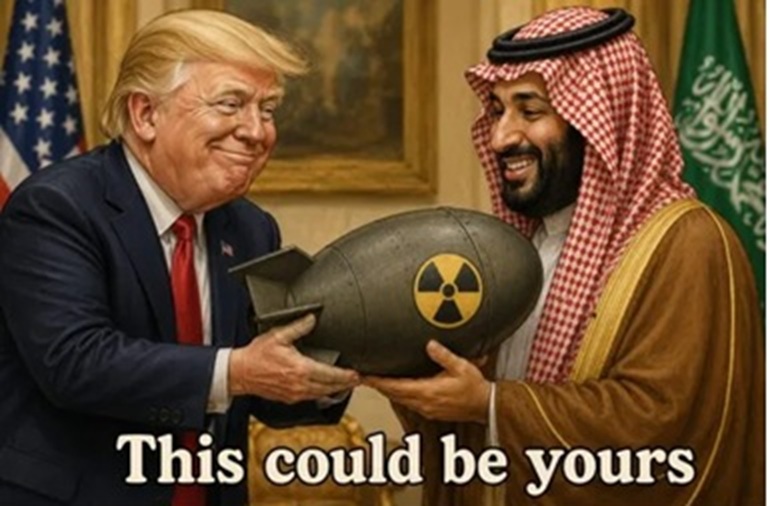
By Alan J. Kuperman, Bulletin of Atomic Scientists, October 13, 2026
Press reports claim that Congress cannot stop the Trump administration’s nuclear agreement with Saudi Arabia, despite significant proliferation concerns, because it will enter force automatically in a mere 90 days after its August 24 submittal to Capitol Hill. Democrats and a handful of dissenting Republicans could try to pass a disapproval resolution that was introduced recently in both houses. But President Donald Trump could veto it, and Republicans in Congress would not override that veto, which means the deal is essentially a fait accompli.
In reality, however, the prospects of Congressional action are not so bleak. Because of the US Atomic Energy Act’s fine print and the deal’s legal shortcomings, Congress has at least 9 months and considerable leverage to make things right.
Proliferation concerns. Three aspects of the Saudi deal are most objectionable. First, the agreement explicitly refers to uranium enrichment “technologies that could be deployed in the Kingdom of Saudi Arabia.” The danger is that any enrichment technology provided for peaceful purposes could also make weapons-grade uranium or be duplicated to do so secretly elsewhere in the country. Moreover, allowing Saudi enrichment could spur similar demands from other countries in the region and beyond, spreading the risks.
Second, the Saudis have refused to sign the Additional Protocol of the International Atomic Energy Agency (IAEA), which allows “environmental sampling” to detect illicit nuclear activity at sites “other than those” disclosed by the country. Riyadh instead has signed a bilateral safeguards agreement with Washington, which does not permit such inspections of undeclared facilities. This feeds suspicion that the Saudis are contemplating secret bomb plants.
Third, the Saudis have said repeatedly that if Iran were to get nuclear weapons, they would pursue them too, which would violate their promises under the Nuclear Non-Proliferation Treaty. This means their commitment in the US deal to exclusively “peaceful uses” is, at best, conditional.
An illegal deal? Fortunately for Congressional Democrats, the Atomic Energy Act does not allow nuclear agreements to enter force automatically unless they are fully compliant with the law’s nonproliferation requirements. If such an agreement violates even one of those requirements, according to Section 123d of the act, it “shall not become effective unless the Congress adopts, and there is enacted, a joint resolution stating that the Congress does favor such agreement.” The Saudi deal currently appears not to comply on four grounds……………………………………………………………………………………………………………………………….
https://thebulletin.org/2026/10/congress-has-the-power-to-fix-the-trump-saudi-nuclear-deal/
No comments yet.
1 This Month
23-25 October – on Zoom – World BEYOND War’s annual global conferenc


Shut down the radiation-damaged Heysham nuclear reactors now
To see nuclear-related stories in greater depth and intensity – go to https://nuclearinformation.wordpress.com

Say No to NASA’s Reckless Nuclear Reactor on the Moon
Say No to NASA’s Reckless Nuclear Reactor on the Moon

-
Archives
- October 2026 (202)
- September 2026 (339)
- August 2026 (330)
- July 2026 (355)
- June 2026 (287)
- May 2026 (306)
- April 2026 (356)
- March 2026 (251)
- February 2026 (267)
- January 2026 (308)
- December 2025 (358)
- November 2025 (359)
-
Categories
- 1
- 1 NUCLEAR ISSUES
- business and costs
- climate change
- culture and arts
- ENERGY
- environment
- health
- history
- indigenous issues
- Legal
- marketing of nuclear
- media
- opposition to nuclear
- PERSONAL STORIES
- politics
- politics international
- Religion and ethics
- safety
- secrets,lies and civil liberties
- spinbuster
- technology
- Uranium
- wastes
- weapons and war
- Women
- 2 WORLD
- ACTION
- AFRICA
- Atrocities
- AUSTRALIA
- Christina's notes
- Christina's themes
- culture and arts
- Events
- Fuk 2022
- Fuk 2023
- Fukushima 2017
- Fukushima 2018
- fukushima 2019
- Fukushima 2020
- Fukushima 2021
- general
- global warming
- Humour (God we need it)
- Nuclear
- RARE EARTHS
- Reference
- resources – print
- Resources -audiovicual
- Weekly Newsletter
- World
- World Nuclear
- YouTube
-
RSS
Entries RSS
Comments RSS


Leave a Reply