2011 Fukushima nuclear disaster museum to open in Futaba town
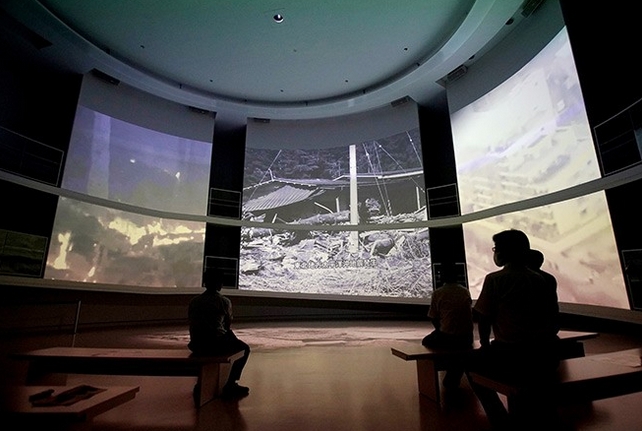
A theater at the museum of Great East Japan Earthquake and nuclear disaster that will open to the public on Sept. 20 in Futaba, Fukushima Prefecture
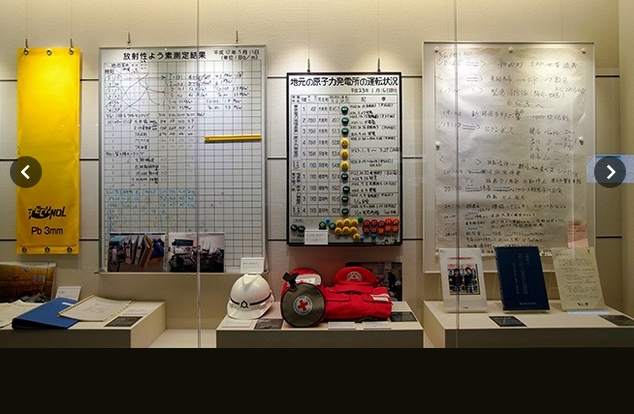
Whiteboards and other items that reveal the tense post-accident situation are on display at the new museum of the Great East Japan Earthquake and nuclear disaster in Futaba, Fukushima Prefecture.
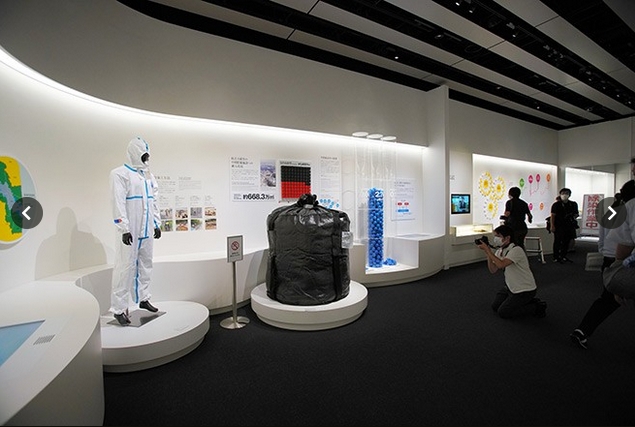
An exhibit about decontamination work after the 2011 accident at the new museum of the Great East Japan Earthquake and nuclear disaster in Futaba, Fukushima Prefecture
September 7, 2020
FUTABA, Fukushima Prefecture–A new 5.3 billion yen ($50 million) museum here is entrusted with the mission of keeping lessons from one of the world’s worst nuclear disasters alive.
The museum of the Great East Japan Earthquake and nuclear disaster in Futaba, Fukushima Prefecture, which co-hosts the crippled Fukushima No. 1 nuclear plant, is now complete and waiting to welcome visitors on Sept. 20.
It will feature firsthand accounts from survivors of the massive earthquake, tsunami and nuclear power plant accident, which devastated areas of Japan’s Tohoku region in March 2011, and an array of artifacts reflecting the events.
The museum’s collection includes roughly 150 items selected from the 240,000 items that the prefectural government collected after the triple disaster.
Exhibition floors are divided into six zones by themes such as “responses to the nuclear accident” and “challenges for reconstruction.”
A video detailing the natural disaster and subsequent meltdown at the Fukushima No. 1 nuclear power plant, operated by Tokyo Electric Power Co., will be shown on a giant screen.
Toshiyuki Nishida, an actor from the prefecture, narrates the video, in which he encourages viewers to reflect on lessons from the disaster.
Items left abandoned at a local elementary school after residents evacuated are on display, including a bookbag, a glove and a folding umbrella.
Another item, a can of food left behind at a deserted house, conveys just how dire the post-disaster situation was: a wild boar seeking sustenance tore it open.
A large photo of a now infamous signboard that used to be on display in the center of Futaba town to promote the safety myth of nuclear power is also among the exhibited items.
Twenty-nine people who survived the disaster in and out of the prefecture are scheduled to share their experiences with visitors at the museum.
The central government, in principle, was responsible for financing the museum’s construction, including funds spent on collecting items and curating materials.
Akira Imai, a former public policy professor at Fukushima University, lamented something missing from the museum.
“It seems there are not many exhibits focusing on the lack of preparedness before the nuclear accident,” he said.
In order to carry out its mission, “the museum should enhance its investigative and research division and reflect the cautionary tale of the accident in its exhibits,” Imai said.
(This article was written by Shoko Rikimaru and Shinichi Sekine.)
Fukushima Prefecture Announces New “High-Quality” Rice, Branding

September 4, 2020
With the announcement of a new variety of top-tier rice, Fukushima hopes to further unravel the unfair stigma of the 2011 tsunami.
On Monday, Fukushima Prefectural Governor Uchibori Masao stood before the gathered press and held aloft an indigo-blue print. The painterly, dark-blue brushstrokes depicted rice fields, mountains, and farmers planting and harvesting grains. Below, in the same vibrant indigo, were the words 「福、笑い」: Fuku, Warai, or “Luck, Laugh.” This was the just-announced official design for Fukushima Prefecture’s new high-quality rice cultivar. Fittingly for Fukushima (福島, literally “Lucky Island”), the brand would bear that same “lucky” kanji in its name.
The global image of Fukushima, of course, is not one most would describe as “lucky.” Indeed, the vast prefecture – Japan’s third-largest by area – is often intrinsically associated with the 3/11/2011 nuclear catastrophe at the Fukushima Daiichi nuclear power plant. Infamously, the disaster resulted in a zone of exclusion which forced 165,000 residents from their homes. Early government mismanagement of the crisis resulted in a Japanese populace who often distrusted official statements about local food safety. With the name “Fukushima” appended to the plant, the reputation of the entire prefecture and its people suffered.
This was doubly true for those who worked in Fukushima’s vaunted agricultural sector.
A Prefecture Recovering, an Industry Besmirched
Nearly a decade on from the disaster, the zone of exclusion has shrunk dramatically. Villages, once ghost towns, are reopening. Less than 3% of the prefecture remains off-limits. (In fact, at its greatest extent, the ZOE covered less than 6% of the prefecture.) Years of stringent testing have long proven Fukushima-grown produce to be safe. Yet, still, the stigma lingers. The South Korea Olympic Committee announced last year that it planned to bring radiation detectors and Korean-produced food to the (now-postponed) 2020 Tokyo Olympics. They aimed to avoid athletes consuming any Fukushima products.
Such fear-mongering has been especially difficult for farmers in Fukushima. This is in part because the prefecture was actually famous for its high-quality produce previous to the disaster, Fukushima produced 20.6% of the country’s peaches and 8.7% of its cucumbers. The prefecture’s real agricultural showstopper, however, is its rice.
Lucky Island, Lucky Rice
Fukushima is a mountainous land. In particular, parts of the western Aizu region have nary a flat plain in sight. Here, snowmelt from the mountain peaks runs down into regional rice paddies. This pure water helps to give Fukushima rice its high-quality flavor.
The soil, too, assists in producing good rice, as do the prefecture’s hot days and cold nights. Popular rice cultivars like Koshihikari and Hitomebore are grown, as well as numerous sake rice varieties. Fukushima rice is of such high-quality that it famously trades off taking first place with neighboring Niigata in national rice flavor competitions most years. Recently, Fukushima rice was honored three years running. The Japan Grain Inspection Association Rice Taste Rankings awarded multiple Fukushima rice brands its “Special A-Class,” leading the prefecture to take first place in 2017 through 2019.
The high-grade rice also yields high-quality sake (日本酒; nihonshu). The perfect combination of rice and water, paired with breweries with long years of experience, has resulted in some of the country’s best rice wines. Subterranean rivers flowing from Mt. Bandai; water sourced from the Abukuma-do cave; Aizu snowmelt; all these waters serve to help make Fukushima’s sake special. In 2018, Fukushima sake won the coveted National Research Institute of Brewing title for an unprecedented sixth year in a row. Breweries like Suehiro, Okunomatsu, and Kokken are just a few of its renowned sake producers.
Yet the perception of Fukushima rice – even that produced in Aizu, more distant from the nuclear disaster than parts of other prefectures – as being potentially contaminated continues to damage the Fukushima agricultural industry. Governor Uchibori almost certainly had this in mind as he sought to create excitement around Fukushima products with the announcement of the prefecture’s new cultivar.
The Birth of Fuku, Warai
Despite the timeliness of its announcement, the prefecture in fact first began designing this new rice strain 16 years ago. According to the rice brand’s official website, “Niigata no.88, descendant of Koshihikari, is its mother; prefectural cultivation-type Gunkei 627, descendant of Hitomebore, is its father.” Quality and taste-testing repeated since 2006. In 2019, the prefecture official decided to promote the rice. After the rice was announced, 6,234 Fuksuhimans submitted possible names for the cultivar; the government chose “Fuku, Warai” so that it might “bring a smile to the faces of those who produce it, those who eat it, and make them all happy.”
More than that, the prefecture announced an even loftier accomplishment. “Through these 14 months and years, we’ve put our all into creating the ideal rice. We’ve arrived at a new rice, brimming with “Fukushima Pride.”
In a promotional video produced by the prefecture, Sakuma Hideaki, head of the horticulture department of the Fukushima Agricultural Research Center, had the following to say regarding the new rice strain: In terms of its flavor, the grain is quite large and possesses a sweet quality. It has a distinct aroma. You could say it has a soft texture as well. These are special qualities that distinguish this rice from previous Fukushima Prefecture original products up until now.
Ritzy Rice
The new cultivar is being produced as a premium rice, meant to compete with the most luxurious rice strains in Japan. The aim is to have the rice on specialty store shelfs by next fall, following a special preview harvest conducted on 6/6 hectares by 13 specially-picked rice producers.
The new packaging announced on Monday was illustrated by Yorifuji Bunpei (寄藤文平), well-known for his “please do it at home” public service posters on the Tokyo metro. Koriyama-native Yanai Michihiko handled the art direction. Regarding the design, Governor Uchibori said, おいしさや魅力がより伝わるよう、関係者と力を合わせてプロモーションに取り組む。 We’ve put together this promotion by joining with those involved in order to properly convey [the rice’s] deliciousness and value.
With any luck, Fuku, Warai will help with the continued rehabilitation of Fukushima’s impressive agricultural industries. Better yet, it may indeed serve as yet another point of pride for the people of Fukushima.
Sources
(2020年09月01日). 福島県オリジナル米「福、笑い」パッケージ青基調 先行販売へ。Fukushima-Minyu Newspaper.
Official Fukushima Prefectural Fuku, Wari Website.
Sternsdorff-Cisterna, N. (2015). Food after Fukushima: Risk and Scientific Citizenship in Japan. AMERICAN ANTHROPOLOGIST, Vol. 117, No. 3, pp. 455–467,
There are 15 nuclear power plants in Fukui Prefecture.
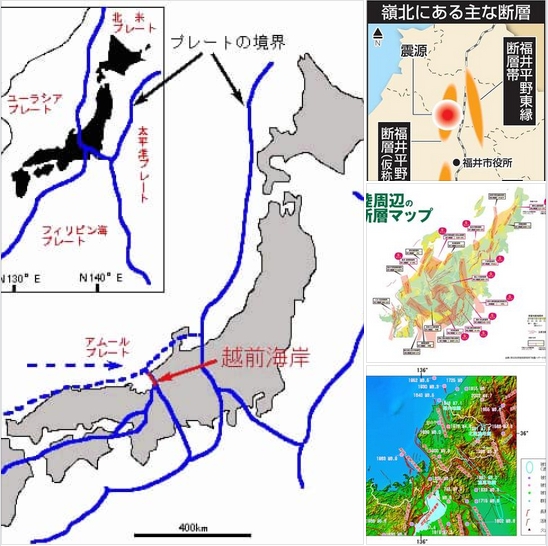
By Akihiko Tamai
Fukui SEISMIC INTENSITY 5 weak epicenter, fault expert, chain warning ′′ it can be connected to a big earthquake ′′
According to Professor Taku Okamoto (Earthquake) of fukui college of technology, there is a fault in the hirano part of the epicenter of the earthquake that observed the maximum SEISMIC INTENSITY OF 5 in Fukui Prefecture on the morning of September 4th It was possible to wake up In the future, if the earthquake of magnitude (M) 5 0 class is frequent, it is a chain with the surrounding fault, and it is pointed out that ′′ it can be connected to a big earthquake like the kumamoto earthquake 5
According to Professor Okamoto, the next wave that does not appear if it is not a fault-specific structure near the epicenter of this time is observed in the past earthquake, and in the west rim of fukui hirano, it is a fault that penetrates the confluence of the kuzuryu and hinogawa to the north It is said that there is a.
According to the Japan Meteorological Agency, this earthquake is a ′′ reverse fault type ′′ that is pushed from both sides and moves in the upper and lower direction. Professor Okamoto points out that the fault of the fukui hirano west rim may have caused the fault of the estimated fault and epicenter.
The Epicenter of this time is about 5 km away from the fukui hirano fault belt, which caused the fukui earthquake on June 28, 1948, and it is not directly related. Also, the earthquake of 4 or more seismic intensity that epicenter the north of the north of the north of the north of the north of the north of the north of the
The current situation is close to the earthquake of the shaking aftershocks, but in the future, if there is a similar earthquake as this time, there is a sabae fault in the south, so it is pointed out that ′′ chain leads to a big earthquake On Top of that, ′′ I need to carefully look at the progression of aftershocks activities for 1 OR 2 weeks
The earthquake is also called ′′ emergency earthquake breaking news is not in time In the future of aftershocks, I’m calling ′′ if you feel the tremor, I want you to lower your posture and take action to protect your head (Fukui Shimbun September 5)
Tokyo Olympics will be most costly Summer Games, Oxford study shows

In this June 3, the Olympic rings float in the water at sunset in the Odaiba section in Tokyo.
September 4, 2020
TOKYO
The Tokyo Olympics are already the most expensive Summer Games on record with costs set to go higher, a wide-ranging study from Britain’s University of Oxford indicates.
The Tokyo cost overrun already exceeds 200%, lead author Bent Flyvbjerg explained in an interview with The Associated Press. This is even before several billion more dollars are added on from the one-year delay from the COVID-19 pandemic.
Flyvbjerg is an economist at Oxford’s Said Business School. His entire study is available here, and it’s set to be published on Sept. 15 in the journal “Environment and Planning A: Economy and Space.” It’s titled “Regression to the Tail: Why the Olympics Blow Up.”
Tokyo, postponed until July 23, 2021, is only a small part of the focus. The study — the third in a series following editions 2012 and 2016 — looks at Olympic costs since 1960 and finds they keep increasing despite claims by the International Olympic Committee that costs are being cut.
Flyvbjerg cites many reasons for the rising costs and cost overruns, and offers solutions for the IOC. The vast majority of costs are picked up by governments with the IOC contributing only a small portion.
“The Olympics offer the highest level of risk a city can take on,” Flyvbjerg told AP. “The trend cannot continue. No city will want to do this because it’s just too expensive, putting themselves into a debt that most cities cannot afford.”
In his paper, Flyvbjerg cites Los Angeles Mayor Eric Garcetti, whose city is to hold the 2028 Olympics following Paris in 2024.
“Most cities, unless you have a government that’s willing to go into debt or pay the subsidy of what this costs, most cities will never say ‘yes’ to the Olympics again unless they find the right model,” he quotes Garcetti as saying.
By the right model, Garcetti means lower costs.
Tracking Olympic costs is difficult, a dense maze of overlap and debate. Politicians and organizers always argue over what are — and what are not — Olympic expenses.
Flyvbjerg writes: “Unfortunately, Olympics officials and hosts often misinform about the costs and cost overruns of the Games. … We therefore cannot count on organizers, the IOC, and governments to provide us with reliable information about the real costs, cost overruns, and cost risks of the Olympic Games.”
Flyvbjerg looks only at costs to operate the games — the operating costs and capital costs — the cost to build sports venues. He leaves out a third category, which is usually many times larger: renovating roads, building airports, and what he calls “sprucing up projects,” which also fall to taxpayers.
“Our estimates are conservative because there are lots of costs that are hidden that we can’t get into,” Flyvbjerg said. “And there are lots of costs we decided not to include because it’s too complex. We include the things we can get the most reliable numbers for and we do it in the same way for each city that we study.”
He also excludes the cost of debt, and the future cost of running sports venues after the Olympics leave, and inflation.
According to the Oxford numbers. Tokyo’s spending is at $15.84 billion, already surpassing the 2012 London Olympics, which were the most expensive summer games to date at $14.95 billion. He expects several billion more from the cost of the one-year delay.
Tokyo organizers say officially they are spending $12.6 billion. However, a national auditor says the actual costs are twice that high, made up of some expenses that the Oxford study omits because they are not constant between different Olympics.
Tokyo said the cost would be $7.3 billion when it won the bid in 2013.
“They (IOC) obviously don’t like our results, but it’s very difficult to counter a piece of rigorous research like this,” Flyvbjerg said. “And they haven’t done that, and they can’t do that. Our research is a problem for them.”
In an email to Associated Press, the IOC said it had not seen the latest Oxford study and declined to comment.It referenced another study by Mainz and Sorbonne universities.
This study also found Olympic cost overruns but said they were in line with other large-scale projects. Flyvbjerg’s study finds they are not.
Flyvbjerg said he has been in touch on and off with the IOC and had sent a colleague to an IOC workshop. He said a major reason for the rising costs is that the IOC does not pay for them. He also cited rising security costs, and moving the games around the world. He calls this the “Eternal Beginner Syndrome” with new host cities starting basically from scratch.
He’s said the IOC has tried recently to rein in costs, but the effort is “too little, too late.”
“They (IOC) define the specs but don’t pay for them,”Flyvbjerg said. “This is pretty similar to you and I giving the specs for a house that we are going to live in, but we don’t have to pay for it. How do you think we’d spend? We’d gold-plate it. This is what has happened over time.”
Flyvbjerg said he’s relish a chance to sit and talk with IOC President Thomas Bach. He calls himself a fan of the Olympics.
“It’s not that the IOC hasn’t been willing to talk, or I am not willing to talk,”he said. “We certainly are. We have communicated in writing to keep the IOC informed. But yes, we would like to sit down with Thomas Bach.”
https://japantoday.com/category/sports/oxford-study-tokyo-olympics-are-most-costly-summer-games
Video analysis prompts new theory on Fukushima explosion
Septembre 4, 2020
Experts revise their theory surrounding a hydrogen explosion at Fukushima Daiichi nuclear power plant in March 2011 based on Nippon TV’s reprocessing of footage an affiliate took of the event.
“KURENAI”Written by KUNIHIRO SUZUKI
Foreword
On March 11, 2011, a magnitude-9 earthquake and subsequent tsunami hit the Eastern Coast of Japan, which triggered the nuclear core meltdown of the Fukushima Daiichi Nuclear Power Plant. This is known as the Triple Disasters of 3.11. Even now, nine years later, the damaged power plants are continually releasing massive amounts of radioactive materials.
The Japanese government has changed the radiation safety standards. Restrictions of radiation exposure to residence was loosened to 20 times than before the disaster. The government has forcefully carried out repatriation policies for us to return home despite high levels of radiation contamination in the area. Few people have returned home. Once lively towns are now silent.
Inconsistency in evacuation policy after the nuclear disaster has left many local communities divided. In the name of the Olympic games, the government placed numerous policies in arbitrary manner, and as a result the people of Fukushima are left in pieces.
Overflowing memories were fiddled bluntly and drifting apart with nowhere to go

Only people continue on as if nothing happened

Convenient excuses alone cannot refill abandoned houses

Beautiful flowers painfully contrast with flexible container bags*, echoing hollowness
*Flexible container bags contain contaminated materials

Exposed to Mushubutsu*, what have the Seven Gods of Fortune witnessed, and what have they pondered?
*TEPCO claims that fallen-out radioactive materials belong to no one (Mushubutsu) and thus they are not responsible for it.
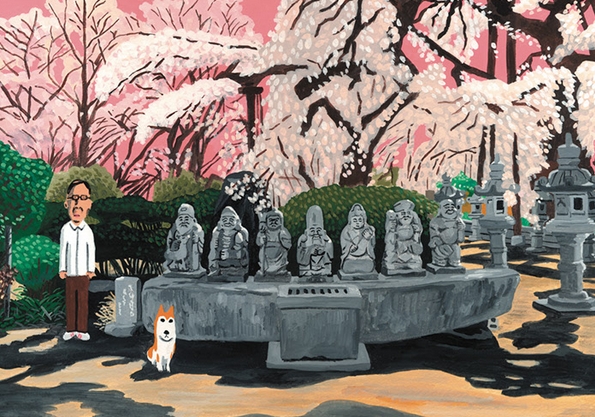
Evacuation orders have been lifted, and new nuclear facilities appear
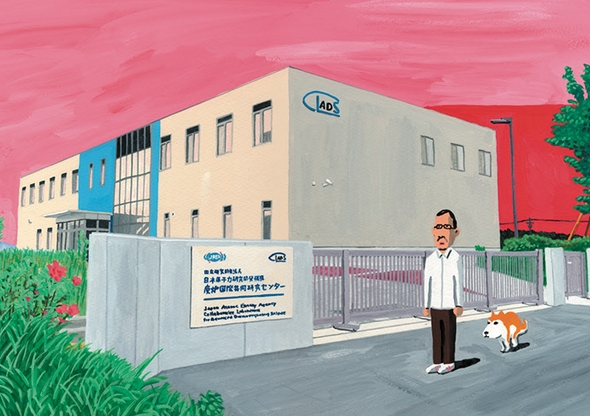
Cherry blossom festivals bring momentary liveliness

While childless villages are left to decay
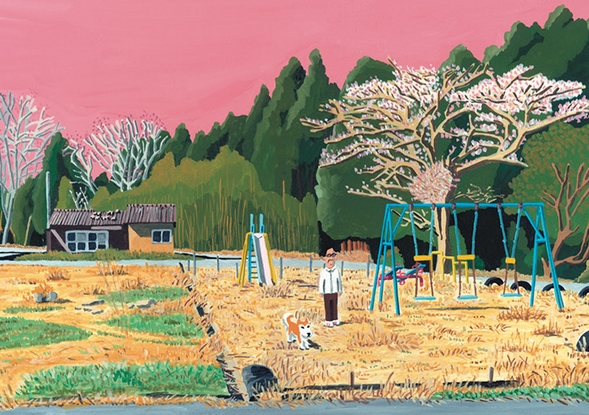
Under a clear blue sky, flowers flourish, birds squeal, wild animals and insects rejoice freedom
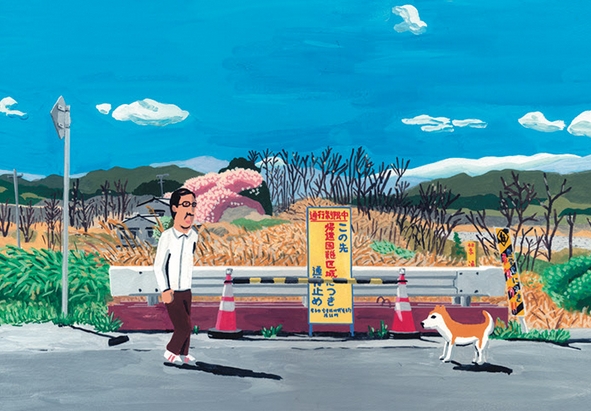
Because Mushubutsu is invisible, Because Mushubutsu is odorless
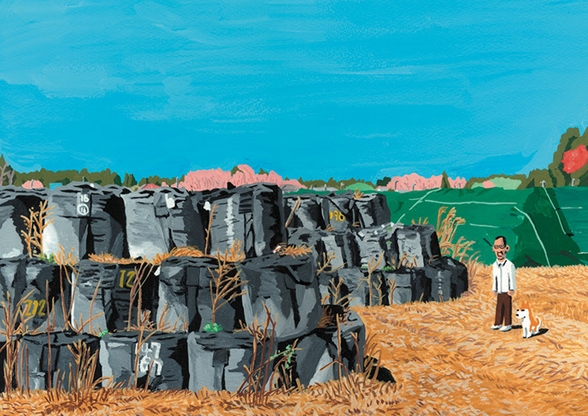
Villages with no more people, Villages with no sound, Villages left to decay, Villages to be abandoned
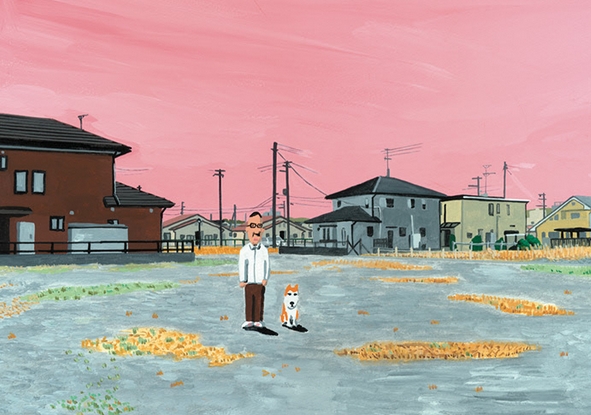
Is this heaven or hell? Mountains, rivers, grass and trees
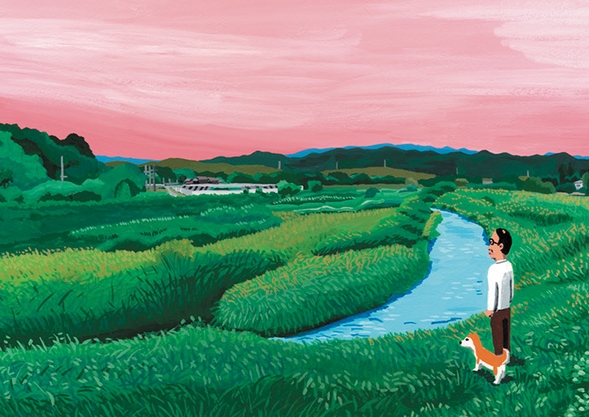
Only people are missing here

The broken nuclear plants that once tore so many hearts, continue puffing out fumes

Will it continue to tear us apart?

Please, no more.
Afterword
I got the idea of this book in April 2019, when I was on my way to a cherry blossom festival in Tomioka Town, Fukushima. The airborne radiation level of a street was 0.2~0.7 μSv, and the next street was 1.0μSv. The barricade divided the cherry blossom street. There were young children and elderly couples, families with their pets, full of smiles and happiness. But at the same time, there were those who worryingly gazed out beyond the barricade.
There were many street vendors lined up in the nearby middle school playground for the festival. There was even an informational booth from the Japan Atomic Energy Agency (JAEA). Next to the ground, there was a gymnasium. The gymnasium was left there as if frozen in time, in preparation for the graduation ceremony right before the earthquake hit. As I was walking through this chaotic town alone, I thought to myself, “I wish the sky would turn red.”
The 2020 Tokyo Olympics and Paralympics have also been called the “Recovery Olympics.” The governor of Fukushima has asserted that he will show the world “the light and the darkness” of Fukushima. But how is the “dark” side of Fukushima going to be revealed? To name one, the route of the torch relay seems to imply otherwise.
While chanting such optimistic terms like “ties” (kizuna), “Cheer up!” (ganbarou), “I’m doing well” (genkidesu), aren’t we trying to look away from tens of thousands of evacuees or those who have returned only to face a life of sorrow and pain?
As many people have begun to forget about the “darkness” in Fukushima, I feel obliged to keep drawing about it. Perhaps, the decommissioning of the reactors won’t be completed in my life time.
Nuclear waste disposal is a matter of environmental concern
Aug 31, 2020
It has been reported that the town of Suttsu in Hokkaido is considering applying for a two-year “literature research” into the possibility of storing high-level radioactive nuclear waste. A maximum of ¥2 billion in subsidies will be granted by the central government.
“The future of the town is financially precarious,” said Haruo Kataoka, the mayor of Suttsu, in an interview.
But the money that is thought to revive the town cannot reverse what the nuclear waste is likely to cause.
It is, in my opinion, never a financial issue, but a matter of environmental concern.
What is in question here is high-level radioactive nuclear waste, which can be dangerous for at least 200,000 years and therefore must be handled with the utmost care. It is indeed a problem that any country with nuclear power plants needs to address, however thorny it is. Any indiscreet decision is deemed extremely irresponsible and profoundly unethical.
“Financially precarious,” I must stress, is by no means comparable to environmentally threatening. Besides, it is specifically stated in a Hokkaido ordinance that nuclear waste is hardly acceptable in the prefecture.
Before a final disposal site is selected, or even before an application for research is submitted, the scientific facts ought to be thoroughly understood and the residents properly informed.
The span of recorded history is merely 5,000 years, while 200,000 years is far beyond human experience and comprehension. We certainly cannot live to see what is going to become of the nuclear waste, but I believe that we do not want to leave the thorny problem unaddressed to haunt our future generations.
Jive Sun
Sapporo
Your Man in the Public Gallery – Assange Hearing Day 8
 Your Man in the Public Gallery – Assange Hearing Day 8, Craig Murray September 10, 2020 The great question after yesterday’s hearing was whether prosecution counsel James Lewis QC would continue to charge at defence witnesses like a deranged berserker (spoiler – he would), and more importantly, why? QC’s representing governments usually seek to radiate calm control, and treat defence arguments as almost beneath their notice, certainly as no conceivable threat to the majestic thinking of the state. Lewis instead resembled a starving terrier kept away from a prime sausage by a steel fence whose manufacture and appearance was far beyond his comprehension. Perhaps he has toothache. PROFESSOR PAUL ROGERS The first defence witness this morning was Professor Paul Rogers, Emeritus Professor of Peace Studies at the University of Bradford. He has written 9 books on the War on Terror, and has been for 15 years responsible for MOD contracts on training of armed forces in law and ethics of conflict. Rogers appeared by videolink from Bradford. Prof Rogers’ full witness statement is here. Edward Fitzgerald QC asked Prof Rogers whether Julian Assange’s views are political (this goes to article 4 in the UK/US extradition treaty against political extradition). Prof Rogers replied that “Assange is very clearly a person of strong political opinions.” Fitzgerald then asked Prof Rogers to expound on the significance of the revelations from Chelsea Manning on Afghanistan. Prof Rogers responded that in 2001 there had been a very strong commitment in the United States to going to war in Afghanistan and Iraq. Easy initial military victories led to a feeling the nation had “got back on track”. George W Bush’s first state of the union address had the atmosphere of a victory rally. But Wikileaks’ revelations in the leaked war logs reinforced the view of some analysts that this was not a true picture, that the war in Afghanistan had gone wrong from the start. It contradicted the government line that Afghanistan was a success. Similarly the Wikileaks evidence published in 2011 had confirmed very strongly that the Iraq War had gone badly wrong, when the US official narrative had been one of success. Wikileaks had for example proven from the war logs that there were a minimum of 15,000 more civilian deaths than had been reckoned by Iraq Body Count. These Wikileaks exposures of the failures of these wars had contributed in large part to a much greater subsequent reluctance of western powers to go to war at an early stage. Fitzgerald said that para 8 of Rogers’ report suggests that Assange was motivated by his political views and referenced his speech to the United Nations. Was his intention to influence political actions by the USA? Rogers replied yes. Assange had stated that he was not against the USA and there were good people in the USA who held differing views. He plainly hoped to influence US policy. Rogers also referenced the statement by Mairead Maguire in nominating Julian for the Nobel Peace Prize:
Rogers stated that Assange had a clear and coherent political philosophy. He had set it out in particular in the campaign of the Wikileaks Party for a Senate seat in Australia. It was based on human rights and a belief in transparency and accountability of organisations. It was essentially libertarian in nature. It embraced not just government transparency, but also transparency in corporations, trade unions and NGOs. It amounted to a very clear political philosophy. Assange adopted a clear political stance that did not align with conventional party politics but incorporated coherent beliefs that had attracted growing support in recent years. Fitzgerald asked how this related to the Trump administration. Rogers said that Trump was a threat to Wikileaks because he comes from a position of quite extreme hostility to transparency and accountability in his administration. Fitzgerald suggested the incoming Trump administration had demonstrated this hostility to Assange and desire to prosecute. Rogers replied that yes, the hostility had been evidenced in a series of statements right across the senior members of the Trump administration. It was motivated by Trump’s characterisation of any adverse information as “fake news”. Fitzgerald asked whether the motivation for the current prosecution was criminal or political? Rogers replied “the latter”. This was a part of the atypical behaviour of the Trump administration; it prosecutes on political motivation. They see openness as a particular threat to this administration. This also related to Trump’s obsessive dislike of his predecessor. His administration would prosecute Assange precisely because Obama did not prosecute Assange. Also the incoming Trump administration had been extremely annoyed by the commutation of Chelsea Manning’s sentence, a decision they had no power to revoke. For that the prosecution of Assange could be vicarious revenge. Several senior administration members had advocated extremely long jail sentences for Assange and some had even mooted the death penalty, although Rogers realised that was technically impossible through this process. Fitzgerald asked whether Assange’s political opinions were of a type protected by the Refugee Convention. Rogers replied yes. Persecution for political opinion is a solid reason to ask for refugee status. Assange’s actions are motivated by his political stance. Finally Fitzgerald then asked whether Rogers saw political significance in the fact that Assange was not prosecuted under Obama. Rogers replied yes, he did. This case is plainly affected by fundamental political motivation emanating from Trump himself. James Lewis QC then rose to cross-examine for the prosecution. His first question was “what is a political opinion?” Rogers replied that a political opinion takes a particular stance on the political process and does so openly. It relates to the governance of communities, from nations down to smaller units………. https://www.craigmurray.org.uk/?fbclid=IwAR1SSVvRVbh8_y-5pargeR-U2E6JHQDcGUq_752VyejbktpjIbMY-g-MdnA |
“Event attribution science” assesses the big role of climate change in weather extremes

Wild weather this year shows growing impact of climate change, scientists say
‘Event attribution science’ assesses how big a role climate change plays in extreme weather events, https://www.cbc.ca/news/technology/extreme-weather-climate-change-1.5718546 Thomson Reuters · Sep 10, 2020 The planet is showing signs it’s in peril. In recent weeks, the world has seen ferocious wildfires in the U.S. West, torrential rains in Africa, weirdly warm temperatures on the surface of tropical oceans, and record heat waves from California to the Siberian Arctic.
This spate of wild weather is consistent with climate change, scientists say, and the world can expect even more extreme weather and higher risks from natural disasters as global emissions of greenhouse gases continue.
“We are seeing the emergence of some signals that would have had almost no chance of happening without human-induced climate change,” said Sonia Seneviratne, a climate scientist at Swiss university ETH Zurich.
For decades, scientists have warned of such events — but have been wary of saying that a particular storm or heat wave was a direct result of climate change. That’s now changing.
Advances in a relatively new field known as “event attribution science” have enabled researchers to assess how big a role climate change might have played in a specific case.
In determining that link, scientists assess simulations of how weather systems might behave if humans had never started pumping carbon dioxide into the air, and compare that with what is happening today. They also factor in weather observations made over the last century or more.
“What seemed like an established truth that you cannot attribute a particular extreme weather event to climate change is less and less true,” Seneviratne told Reuters.
Feeling the heat
The clearest examples are found in the growing frequency and intensity of heat waves worldwide.
Scientists needed only days to identify climate change as the key culprit in this year’s record temperatures in Siberia, with extreme heat drying out forests and peat across the Russian tundra, leading to massive wildfires.
Climate change links have also been found in the simultaneous summer heat waves that hit Europe, Japan and North America in 2018. Studies found that the chances of these events happening together would have been near zero without the industrial-era rise in planet-warming carbon emissions.
“When it comes to heat waves, we see that climate change is an absolute game-changer,” said Friederike Otto, a climate scientist at the University of Oxford who has helped to pioneer the field of attribution science.
As a heat wave hit the U.S. West Coast last month, Earth saw a new record high temperature of 54.4 Celsius (130 Fahrenheit) in Death Valley, which sits below sea level in California’s Mojave Desert. Weeks later, the region was still broiling, with the mercury soaring Sunday to a new record of 49 C for nearby Los Angeles County.
“It’s not so much that climate change is destabilizing historical weather patterns,” said Daniel Swain, a climate scientist at the University of California. “In many cases, it’s amplifying them.”
Hotter temperatures in turn sap the air of humidity and dry out forest and brush on land, creating perfect conditions for wildfires. In California, “the fires that we’re seeing are larger, and faster moving, and more intense than those you could have expected historically,” Swain said.
But attribution science has not explained everything. For example, researchers do not yet fully understand Europe’s heat waves.
“In Western Europe, the increase in heat waves is much stronger than the models predict, and we have no clue why,” said Geert Jan van Oldenborgh, an attribution science expert at the Royal Netherlands Meteorological Institute.
Wind, rain and floods
As average global temperatures have risen by about 1 C since pre-industrial times, changes in the atmosphere and oceans are also leading to more intense storms.
Hurricanes overall are getting stronger and spinning slower, as they pick up energy from the heat in the oceans. Researchers at the University of Bristol in the west of England published a study last month that found that climate change could make extreme hurricane rainfall in the Caribbean five times more likely, without rapid cuts in emissions.
In the United States, warm waters in the Gulf of Mexico boosted Hurricane Laura to a category 4 storm in the last hours before it slammed into Louisiana with 240 kilometre per hour winds. Governor John Bel Edwards described it as the most powerful hurricane to strike the state, surpassing even Katrina in 2005.
Tropical cyclones spinning out from the Indian Ocean are showing similar patterns. The region has long been considered a hot spot for cyclones, with some of the deadliest storms in recent history churning through the Bay of Bengal before slamming into India or Bangladesh.
Exceptionally high surface temperatures in the Indian Ocean, associated with climate change, helped Cyclone Amphan grow into a Category 5 storm in a record 18 hours before it tore into the Indian state of West Bengal in May, scientists say.
The following month, Cyclone Nisarga, initially forecast to be the first to batter Mumbai since 1948, made landfall 100 km south of the city, with winds gusting up to 120 kilometres per hour.
“Both of the cyclones were unprecedented,” said Roxy Mathew Koll, a climate scientist at the Indian Institute of Tropical Meteorology. “If we go back to what led to these kinds of extreme events, what we see is that very warm ocean temperatures have played a major role.”
Those warm ocean temperatures are also likely contributing to extreme rainfall and flooding in China, which this summer suffered its most punishing flood season in three decades.
“The extreme rainfall events are going to become more extreme. That is something we feel pretty confident about,” said Shang-Ping Xie, a climate scientist at the Scripps Institution of Oceanography in California.
Africa is feeling this now, following torrential rains and severe flooding. Tens of thousands have been left homeless by flooding from the Nile in Sudan. And in Senegal, more rain fell on a single day on Saturday than the country would usually see during three months of the rainy season, the government said.
“There’s a large and growing body of evidence that is telling us that human-caused climate change is affecting extreme events,” said James Kossin, a climate scientist at the U.S. National Oceanic and Atmospheric Administration. “It’s very rare that this is happening in a helpful way.”
Unprecedented wildfires in three American states
Oregon fires put 500,000 under evacuation orders as US blazes kill 15
Unprecedented fire conditions burn more than 900,000 acres
Firefighting resources are stretched thin in three states Guardian, Jason Wilson in Portland, Maanvi Singh in Oakland and Sam Levin in Los Angeles Fri 11 Sep 2020 More than 500,000 people in Oregon were under evacuation orders on Thursday as unprecedented wildfires rage across the state, amounting to more than 10% of the population, authorities said.
Wildfires searing through the American west have killed at least 15 people, leveled entire neighborhoods and forced stretched firefighting crews to make tough decisions about where to deploy.
The situation is especially acute in Oregon where fire conditions not seen in three decades have fueled huge blazes that have killed at least three people, destroyed at least five towns and forced the evacuation of communities from the southern border to the Portland suburbs.
On Thursday night, Donald Trump approved an emergency declaration in the state, enabling federal assistance to bolster local efforts.
Oregon’s governor, Kate Brown, said on Thursday that more than 900,000 acres have burned across the state in the last several days – nearly double the amount of land that usually burns in a typical year. “We have never seen this amount of uncontained fire across the state,” Brown said……..,.
Firefighters on the west coast are tackling blazes across three states……
By Wednesday evening, that city was blanketed with smoke from fires burning around its forested south-eastern fringe, and in rural areas to the south-west.
The explosion of fires across the region were stoked by dry winds, and a record heatwave – and fueled by widespread drought, which dried out vegetation into kindling.
The early part of the week saw gusts of up to 50mph in western areas, downing trees and power lines in Portland and other cities. The rare weather, more characteristic of winter storms in the region, was accompanied by historically low relative humidity.
California, which has been battling a barrage of fires since August, has within the last few weeks seen the first, third, fourth, ninth, 10th and 18th-largest wildfires in state history, according to the National Weather Service.
Even in the midst of its dry, hot, windy fire season, California has experienced wildfires advancing with unprecedented speed and ferocity. Since the middle of August, fires in California have killed 12 people, destroyed more than 3,600 buildings, burned old growth redwoods, charred chaparral and forced evacuations in communities near the coast, in wine country north of San Francisco and along the Sierra Nevada. Authorities said the August Complex fire is now officially the largest fire on record in the state’s history, having scorched more than 736 sq miles (1,906 sq km).
In some areas of the San Francisco Bay Area and to the east in the Sacramento Valley, smoke blocked out so much sunlight on Wednesday that it dropped the temperature by 20 to 30 degrees over the previous day, according to the National Weather Service.
The US Forest Service, which had taken the unprecedented measure of closing eight national forests in southern California earlier in the week, ordered all 18 of its forests in the state closed Wednesday for public safety.
Joe Biden, if President would re-enter nuclear deal with Iran

 Biden Says Iran Closer to Nuclear Weapons Under Trump, Would Re-Enter Deal. NewsWeek, BY DAVID BRENNAN ON 9/11/20 Democratic presidential nominee Joe Biden has claimed that Iran is now closer to a nuclear weapon that it was during President Barack Obama’s administration, criticizing President Donald Trump for walking away from the nuclear deal Biden wishes to resurrect.
At a virtual fundraiser hosted by the JStreet PAC on Thursday, Biden said he would seek to re-engage with Tehran though admitted this would not be easy after four years of antagonism.
On Thursday, Biden said Trump had made an Iranian nuclear weapon more likely despite his claims to the contrary. “Iran is closer to a weapon now than we were when we left office in 2017,” he said, according to a press pool report sent out by his campaign.
The former vice president defended the JCPOA, describing it as the “most intrusive inspection regime in history.”
Trump abandoned the Joint Comprehensive Plan of Action in May 2018, claiming the deal was too lenient and fulfilling a promise that became a key part of his foreign policy campaign strategy.
Trump withdrew despite other signatories urging him to reconsider and despite the International Atomic Energy Agency confirming that Tehran was complying with the agreement.
U.S.-Iran reactions have continued deteriorating since, with the two sides launching strikes against each other and flirting with an open conflict. Trump has maintained his “maximum pressure” campaign against Tehran, seeking to undermine the regime with crippling economic sanctions.
Trump withdrew despite other signatories urging him to reconsider and despite the International Atomic Energy Agency confirming that Tehran was complying with the agreement.
U.S.-Iran reactions have continued deteriorating since, with the two sides launching strikes against each other and flirting with an open conflict. Trump has maintained his “maximum pressure” campaign against Tehran, seeking to undermine the regime with crippling economic sanctions……… https://www.newsweek.com/joe-biden-iran-closer-nuclear-weapons-under-donald-trump-re-enter-deal-153121
Global population slowdown – good news for the planet’s ecology
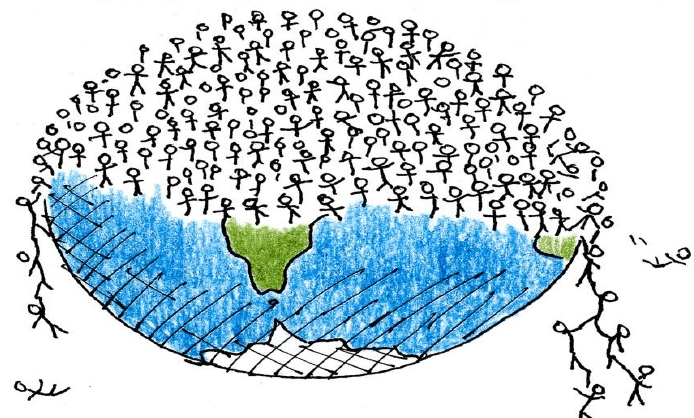
The best news of 2020? Humanity may never hit the 10 billion mark
- A new study in the Lancet finds our global population may never reach 10 billion.
- A population slowdown will pose challenges, but it could also give us a better chance of avoiding ecological collapse.
- Population slowdown is not a reason for concern, but rather for celebration. Thank birth control and women’s education.
While watching 2020 unfold has been like watching someone set themself on fire with a bucket of bacon grease and a firecracker, one morning I stumbled on something that made me smile, and then jump for joy: A new study found that the global human population might peak at just under 10 billion people in the 2060s before tapering off to 8.8 billion by 2100.
What miracle could achieve such a slowdown in human reproduction after a century of smack-yourself-in-the-face runaway growth? It’s not war, or nuclear holocaust, or plague (COVID-19, as tragic as its mishandling has been by certain governments, will do little to slow down population growth). It’s two things, both wonderfully non-violent: women’s education, and access to birth control.
The new findings, published in the medical journal The Lancet, differ from other population forecasts, most importantly by the United Nations Development Programme (UNPD) and the Wittgenstein Centre, by predicting that the global population will peak sooner than expected and fall quicker than anticipated (though still, by 2100, the Earth would house more humans than the 7.8 billion of us here today).
This was good news. No, no, this was freaking great news. Because if this research — which made some clever shifts in how it analyzed the data and predicted the future — could be believed, it could mean that Planet Earth, in all its ecological glory, might just survive our current devastating onslaught and begin to recover in the coming centuries. Assuming we, of course, actually deal with climate change. A big assumption.
However, no one else seemed to see it that way. Coverage of the paper’s findings looked more like Munch’s “The Scream.”
Perhaps the most ridiculous of these articles came from the BBC, which spent about 1,000 words freaking out over the idea that the human population won’t go on growing forever and societies might have to … adapt. Oh, no! Humans have never had to do that.
There is only a single mention of the environment in the BBC article……….
Will there be economic challenges? Sure. But I’d hazard the challenges posed by an aging population are going to be far easier to solve than those posed by a total breakdown of Earth’s ecological limits, something we’re already dangerously close to. When it comes to an older population, we already have potential solutions and examples to soften the impact, such as automation, robotics, policy shifts, new ideas like universal basic income, and evolving views around economics.
Maybe we don’t have to play the neoliberal capitalism game forever? Maybe we could increase funding for the care of the elderly instead of giving billionaires tax cuts or spending trillions on the military?……
While the research clearly bemoans the challenges of a world where women have fewer children, the alternative is quite simply ludicrous. Is the human population — already tearing the seams of our planetary ecological limits — supposed to just go on growing forever? Perhaps 10 billion humans just isn’t enough and we should aim for 20, 40, why not 100 billion people?
How to feed, house and clothe us all? Oh, no worries, by then I’m sure we’ll have terraformed Mars — easily done on a planet we have never set foot on — and invented light-speed travel to bounce around the galaxy. Ha! Let’s get back to reality: if we can’t even take care of the planet that cradles us, what chance do we have of making good on others?
The only alternative to endless population growth is population decline. And the only alternative to wrecking our Earth is treating it differently. And this, of course, highlights the problem with our obsession with GDP and never-ending economic growth. As has been pointed out by many conservationists (originally by the economist Kenneth Boulding in the 1960s), “Anyone who believes in indefinite growth…on a physically finite planet, is either mad or an economist.” …….
Just don’t tell the economists that.
Meanwhile, I’ll celebrate a little. Our incredible, nonviolent revolution of contraceptives, birth control, women’s rights, and education for girls might just prevent our species from destroying the world.
Citation: Vollset, S. E., Goren, E., Yuan, C., Cao, J., Smith, A. E., Hsiao, T., … Murray, C. J. (2020). Fertility, mortality, migration, and population scenarios for 195 countries and territories from 2017 to 2100: A forecasting analysis for the Global Burden of Disease study. The Lancet. doi:10.1016/s0140-6736(20)30677-2 https://news.mongabay.com/2020/09/the-best-news-of-2020-humanity-may-never-hit-the-10-billion-mark/
Scottish peace activist calls for timetable for the removal of nuclear weapons and submarines if independence is achieved
FRIDAY, SEPTEMBER 11, 2020 https://morningstaronline.co.uk/article/b/scottish-peace-activist-calls-timetable-removal-nuclear-weapons-and-submarines-if
A LEADING peace activist in Scotland has urged the government to produce a timetable for the removal of British nuclear weapons and submarines from their Scottish base if independence is achieved.
Isobel Lindsay, a long-time Campaign for Nuclear Disarmament campaigner, warned that the Westminster Parliament would attempt to “buy time” and maintain its Trident submarine base at Faslane on the west coast of Scotland in the event of a vote for independence.
Writing in pro-independence newspaper The National, Ms Lindsay said: “It is obvious what the Trident negotiating pitch of the UK
government will be in independence negotiations.
“Buy time, and as soon as they get a concession on that, they know they won’t have to worry. Scotland yields to pressure and they will keep on getting their lease extended.
“This is why a very clear and tight timetable for removal is essential from the start.”
Ms Lindsay said that before the 2014 referendum, a scenario was being prepared using the threat of vetoing Scotland’s EU membership as the bargaining chip for retaining Trident on the Clyde.
“That bargaining chip is no longer there, so there is talk about buying off the Jocks by paying for their lease,” she said.
“I think we know about being bought and sold.”
Faslane and the nuclear-weapons storage facility eight miles away at Coulport have been frequently targeted for protests by disarmament campaigners.
The SNP has said that support for independence is growing in the face of Westminster chaos and incompetence, with a Survation poll today putting support for independence at 53 per cent – the seventh poll in a row showing “Yes” ahead.
Big Oil is cheating the public on “recycling” of plastic
These commercials carried a distinct message: Plastic is special, and the consumer should recycle it.
It may have sounded like an environmentalist’s message, but the ads were paid for by the plastics industry, made up of companies like Exxon, Chevron, Dow, DuPont and their lobbying and trade organizations in Washington.
The oil industry makes more than $400 billion a year making plastic, and as demand for oil for cars and trucks declines, the industry is telling shareholders that future profits will increasinglycome from plastic.
an industry that didn’t want recycling to work. Because if the job is to sell as much oil as you possibly can, any amount of recycled plastic is competition.
Analysts now expect plastic production to triple by 2050.
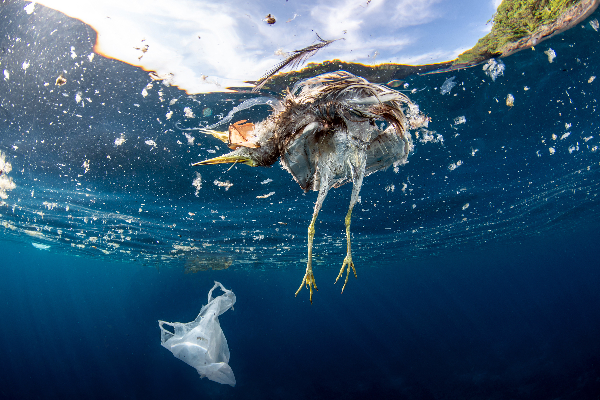 How Big Oil Misled The Public Into Believing Plastic Would Be Recycled, NPR, LAURA SULLIVAN,– 11 Sept 20 Laura Leebrick, a manager at Rogue Disposal & Recycling in southern Oregon, is standing on the end of its landfill watching an avalanche of plastic trash pour out of a semitrailer: containers, bags, packaging, strawberry containers, yogurt cups.
None of this plastic will be turned into new plastic things. All of it is buried.
“To me that felt like it was a betrayal of the public trust,” she said. “I had been lying to people … unwittingly.”
Rogue, like most recycling companies, had been sending plastic trash to China, but when China shut its doors two years ago, Leebrick scoured the U.S. for buyers. She could find only someone who wanted white milk jugs. She sends the soda bottles to the state.
But when Leebrick tried to tell people the truth about burying all the other plastic, she says people didn’t want to hear it.
“I remember the first meeting where I actually told a city council that it was costing more to recycle than it was to dispose of the same material as garbage,” she says, “and it was like heresy had been spoken in the room: You’re lying. This is gold. We take the time to clean it, take the labels off, separate it and put it here. It’s gold. This is valuable.”
But it’s not valuable, and it never has been. And what’s more, the makers of plastic — the nation’s largest oil and gas companies — have known this all along, even as they spent millions of dollars telling the American public the opposite.
“If the public thinks that recycling is working, then they are not going to be as concerned about the environment,” Larry Thomas, former president of the Society of the Plastics Industry, known today as the Plastics Industry Association and one of the industry’s most powerful trade groups in Washington, D.C., told NPR………. Continue reading
Fukushima’s citizen radiation testers still on the job.
Fukushima Has Turned These Grandparents Into Avid Radiation Testers, NPR, Kat Lonsdorf (@lilkat_bigworld) September 11, 2020 Takenori Kobayashi lugs a garbage bag full of soil across a parking lot to an unmarked office. His wife, Tomoko, holds the door to a tiny work space with lab equipment and computers set up. On the edge of Fukushima’s former nuclear exclusion zone, this is the place the couple likes to call their “grandma and grandpa lab.”
A handful of other residents help run the lab, and throughout the years, experts from nearby universities have come to teach them all about the different equipment and radiation science.
“All the grandparents here are radiation professionals now,” Takenori, 71, says with a smile……..
1 This Month

Tell Congress: Prevent Nuclear Catastrophe in Iran

Tell Congress: Prevent Nuclear Catastrophe in Iran

Read the Public Inquiry Report, the Commissioners’ report, Surrendering Australia: The AUKUS Deception is available to download for free at aukuspublicinquiry.com. Or just watch the replay of the National Press Club Luncheon.
To see nuclear-related stories in greater depth and intensity – go to https://nuclearinformation.wordpress.com
Say No to NASA’s Reckless Nuclear Reactor on the Moon
-
Archives
- November 2026 (269)
- October 2026 (302)
- September 2026 (339)
- August 2026 (330)
- July 2026 (355)
- June 2026 (287)
- May 2026 (306)
- April 2026 (356)
- March 2026 (251)
- February 2026 (267)
- January 2026 (308)
- December 2025 (358)
-
Categories
- 1
- 1 NUCLEAR ISSUES
- business and costs
- climate change
- culture and arts
- ENERGY
- environment
- health
- history
- indigenous issues
- Legal
- marketing of nuclear
- media
- opposition to nuclear
- PERSONAL STORIES
- politics
- politics international
- Religion and ethics
- safety
- secrets,lies and civil liberties
- spinbuster
- technology
- Uranium
- wastes
- weapons and war
- Women
- 2 WORLD
- ACTION
- AFRICA
- Atrocities
- AUSTRALIA
- Christina's notes
- Christina's themes
- culture and arts
- Events
- Fuk 2022
- Fuk 2023
- Fukushima 2017
- Fukushima 2018
- fukushima 2019
- Fukushima 2020
- Fukushima 2021
- general
- global warming
- Humour (God we need it)
- Nuclear
- RARE EARTHS
- Reference
- resources – print
- Resources -audiovicual
- Weekly Newsletter
- World
- World Nuclear
- YouTube
-
RSS
Entries RSS
Comments RSS

