Exelon Corp hanging on in hope that Illinois government will bail out 2 nuclear power stations
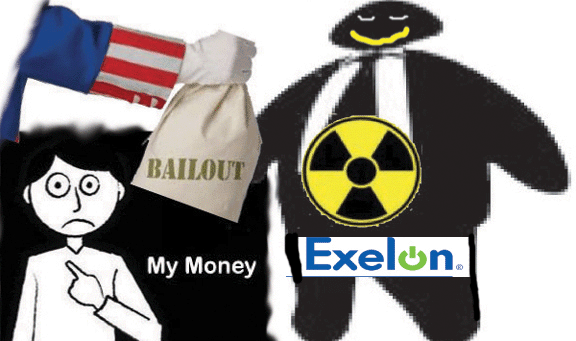
Illinois House inches closer to saving two nuclear plants, By Timothy Gardner WASHINGTON, Sept 7 (Reuters) – The Illinois House plans to consider an energy bill on Thursday, the House speaker said, that could prevent two Exelon Corp nuclear power plants from shutting in coming days and months.
The Illinois Senate on Sept. 1 passed a bill that contains more than $600 million in carbon mitigation credits for nuclear plants, which generate virtually emissions-free electricity. [as long as you don’t count the full dirty nuclear fuel chain]
………. U.S. nuclear plants have been struggling to compete with wind and solar farms and plants that burn low-cost natural gas. Exelon (EXC.O) has said it will close its Byron nuclear plant on Sept. 13 and its Dresden plant in November if a state or federal program does not come to the rescue.
Preventing nuclear plants from closing has been a priority for the administration of President Joe Biden, which has supported tax incentives for nuclear in federal infrastructure legislation and sees the plants as important to its goal of decarbonizing the power grid by 2035.
Exelon has said the federal incentives alone could not come fast enough to save the plants. The company said it has authorized uranium fuel shipments to Byron for use if the legislation passes. But Exelon said the fuel will be shipped to another plant if no action is taken and Byron will permanently shut. https://www.reuters.com/world/us/illinois-house-inches-closer-saving-two-nuclear-plants-2021-09-07/
TEPCO plan to discharge water relies on winning local trust

September 7, 2021
More than four months have passed since the government gave the green light to plans for Tokyo Electric Power Co. to release treated radioactive water from the crippled Fukushima No. 1 nuclear plant into the Pacific Ocean.
TEPCO, the plant’s operator, recently announced it would construct a tunnel to discharge the water about 1 kilometer offshore. At the same time, the government unveiled its strategy for responding to concerns the discharge could cause irreparable reputational damage to local businesses, the fishing industry, in particular.
Ever since the nuclear crisis triggered by the March 2011 earthquake and tsunami disaster, the utility has been pumping tons of water to cool melted nuclear fuel at the wrecked facility. Rain and ground water have added to the deluge with the result that the volume of radiation-contaminated water has continued to grow rapidly.
The water is stored in more than 1,000 tanks installed within the compound after being treated with special equipment to eliminate most of the highly radioactive materials. TEPCO said the tanks will reach capacity around spring 2023. The plant operator then intends to start releasing the treated water after first diluting it with seawater.
Under TEPCO’s plan, an undersea tunnel will be built to discharge the treated water. It said the tunnel will ensure that the treated water does not re-enter the on-site discharge equipment after it has been diluted.
This will be a gigantic construction project that will start with a geological survey of the seabed, something that must be approved by the Nuclear Regulation Authority.
TEPCO pledged to measure the concentration of tritium, a radioactive isotope of hydrogen produced as a byproduct in nuclear reactors which cannot be removed with filtering equipment, before the water is released into the ocean. This is a welcome effort to allay concerns among local businesses and communities, especially the fisheries industry.
The company, whose reputation has further been tarnished by a series of embarrassing revelations about security lapses, including those at the Kashiwazaki-Kariwa nuclear plant in Niigata Prefecture, needs to realize it has an obligation to take all possible steps to ensure the operation is conducted safely and be willing to disclose all related information and options.
No matter how cautiously the problem of tritium-tainted water is handled, the plan to release treated contaminated water into the sea is bound to trigger negative publicity and deter people from eating fish caught in local waters.
To deal with this challenge, the government decided to establish a fund to buy catches that can be put in frozen storage. The fund is framed as an emergency relief measure to assist fishermen and fisheries businesses expecting to face sharp drops in sales. It is a well-conceived proposal to help those affected by the nuclear disaster regain their livelihoods, in addition to providing cash to compensate for their economic losses.
But not all marine products are fit for freezing. Frozen fish tend to fetch lower prices compared with when they are sold fresh. How to secure viable operations of the proposed fund remains a key question, but the government has only said that details will be worked out by the end of the year.
Fisheries businesses may not be only targets of rumors that require compensation payouts. To ease anxiety among local businesses, TEPCO said victims alone will not be forced to bear the burden of proof. The company says it will assess economic losses by comparing prices and sales after it starts releasing the contaminated water into the sea with corresponding estimates for before the operation gets under way.
Still, local businesses remain concerned about whether they will receive appropriate compensation from the utility, which rejected out-of-court settlements with a number of plaintiffs in damages lawsuits proposed by the government’s Nuclear Damage Compensation Dispute Resolution Center. The government, which is effectively the utility’s largest shareholder, has a duty to supervise the company to ensure it offers compensation swiftly and appropriately to any new parties that suffer losses as a result of the water discharge operation.
TEPCO hopes to begin discharging the treated water in spring 2023. It has pledged not to “undertake any disposal measure without gaining the understanding of stakeholders.”
The company will not be able to move forward with the plan unless it first wins the trust of the local communities through sincere and honest talks.
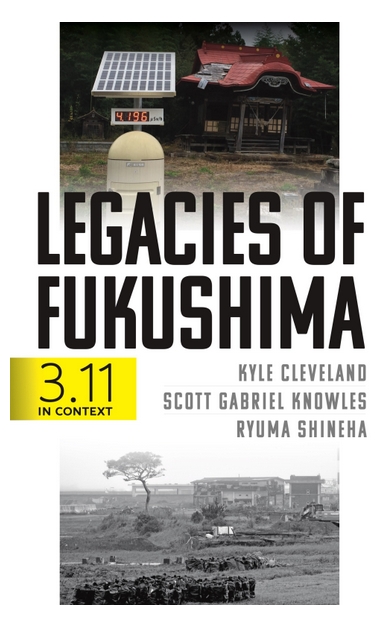
Legacies of Fukushima.
Introduction
Abstract: This special collection of papers reflects the work of contributing authors to the newly released book Legacies of Fukushima: 3.11 in Context (University of Pennsylvania Press, 2021). The edited volume addresses the Fukushima nuclear crisis in Japan, taking a multi-dimensional, cross-disciplinary approach to understanding this epic disaster. The book is an intersectional collaboration that is unique in that it incorporates the work of Japan-area scholars, journalists, nuclear experts and Science, Technology and Society (STS) scholars from Japan and abroad, who discuss the trajectory of the Fukushima nuclear disaster in the first decade since its inception. There are 19 authors whose work is included in the book; this special edition of selected papers for The Asia-Pacific Journal: Japan Focus evokes that work, and while they do not entirely represent the scope of the material included in the edited volume, these papers delve into issues that any disaster studies scholar or student of the Fukushima nuclear disaster will find compelling.
The 3.11 disasters were an implausible convergence of events, the massive 9.0 earthquake (the largest on historical record in Japan), a tsunami that took nearly 20,000 lives, which put the Fukushima Daiichi nuclear power plant underwater, leading to 3 nuclear reactors in meltdown, the most convoluted nuclear disaster in history. When the tsunami pushed ashore onto the coast less than an hour after the earthquake, it swamped the Daiichi plant, inundating the reactors and taking out the electrical backup generators, causing a total station blackout. With no power to run instrumentation or take remedial actions, the Daiichi nuclear power plant descended into chaos. The Fukushima crisis was the first multi-reactor meltdown and the only total station blackout (the only time this had happened in the history of nuclear energy). This “beyond-design-basis” event was unprecedented in the history of nuclear energy, and it was considered so unlikely that it left nuclear authorities wholly unprepared to deal with the crisis as it cascaded out of control. TEPCO (the utility that ran the doomed plant) has since maintained that they should not be held legally accountable because these conjoined events, taken together, were the ultimate “Black Swan” disaster. As Charles Casto, a former plant manager and high-ranking administrator in the U.S. Nuclear Regulatory Commission, who was the chief liaison for the U.S. government during the crisis and who worked closely with the operational staff at the Daiichi plant put it: it was comparable to having the San Francisco earthquake, the Three Mile Island nuclear accident and the Katrina hurricane all happening on the same day.1
Yet as unlikely as they would seem to be, the Tōhoku earthquake and tsunami were hardly unprecedented. Japan is roiled by earthquakes constantly, and while the magnitude of the 3.11 quake was unique, in the months that preceded and followed this event there were clusters of smaller quakes, many in the 7 magnitude (Richter Scale) range, that would be significant outside the context of the penultimate quake of 3.11. And the Sanriku coast in Northeastern Japan has been inundated by tsunami often enough that oral tradition among inhabitants of coastline communities has produced a cautionary mindset in which tsunami have always loomed large in the collective imagination. Under the harsh scrutiny of nuclear critics, scholars, journalists, and industry and governmental officials who were by necessity compelled to address its consequences, a more nuanced and critical perspective eventually took hold and Fukushima, much like Chernobyl, Three Mile Island and other nuclear disasters, seems now in retrospect to be all too predictable, and, avoidable.2
Scandals now buzz around Fukushima like parasites on a dead thing, and a withering indictment of nuclear energy in Japan prevails. Corporate collusion, precursors ignored, lessons unlearned, the failure of regulatory oversight, and a lack of accountability have become commonplace in discussions of the nuclear enterprise in Japan. This is not only a scathing indictment of the hubris that brought Japan to this point in the first place, but it reveals a lack of foresight and analytical rigor that sustained the nuclear authorities in their wishful thinking that such an outcome was unimaginable. March 11, 2011, was a day of reckoning and yet the manner in which the disaster has been addressed betrays a callous disregard for human suffering in the aftermath, as communities have been destroyed and people have been offered little solace nor justice by the institutional authorities who were charged with looking after their best interests.3
In an effort to restore its reputational damage, the government and nuclear industry alike have promoted a narrative of resiliency among those most egregiously affected, but the nuclear village itself has proven perhaps to be the most resilient of all: the government maintains a long-term nuclear agenda to restart most of the reactors, despite the humanitarian cost. Japan is invested in nuclear energy not only because it elevates the country’s status as a member of the league of nuclear nations, but has offered, in its most idealistic construct, a potentially significant portion of its overall energy output, with the economic benefits that would entail. By 2011 nuclear power comprised roughly 30% of Japan’s energy supply, but after the nuclear disaster the entire fleet of 54 reactors that were online in 2011 were shuttered to undergo testing and retrofitting under a newly established regulatory regime. Having replaced Japan’s Atomic Energy Commission, the Nuclear Regulatory Authority set stringent new standards, and deemed that 33 reactors are classified as operable. Of these only 9 units at 5 power plants (all in Western Japan) have restarted; another 16 are at various stages in the process of restart renewal. Two reactors are under construction but are stalled pending approval to move forward, and another eight reactors proposed to be deferred indeterminately. The government now plans for 20% of its energy supply to come from nuclear power by 2030 (at the time of this writing in summer, 2021 only 6.5% of Japan’s electricity is nuclear generated).4
As the government seeks to return nuclear energy to a semblance of its former self, throughout the Tōhoku region, and most especially in the evacuated villages in Fukushima adjacent to the Daiichi plant, a sense of foreboding remains and is unlikely to lift anytime soon. Much of the area most affected by the nuclear disaster is in a remote, mountainous region where agriculture and fisheries were major industries before the radioactive fallout irrevocably wrecked the Fukushima brand. A massive exit migration has depopulated towns (a process that was well underway in the economically stagnant rural areas, long before the Fukushima crisis accelerated this process), or resulted in an age stratified population that remains. Elderly landowners, with ancestral roots and property investments have remained, but those under 40, especially with young children, have sought safer domains, free of the worry of radiation exposure and with better long-term career prospects.
Moreover, not only has the agricultural economy and the Fukushima brand been irrevocably tainted by its association with radioactive fallout, but the shuttering of the nuclear plant itself has removed tens of thousands of jobs, as a skeleton staff remains to implement the plant decommissioning at Daiichi. In Tōhoku the nuclear plants had, in an earlier time, been the hub around which communities where organized, and the tertiary industries that helped feed the beast have diminished to such an extent that many men (and in this culture, the nuclear industry is notably gendered) have had to resort to being employed in the emergent massive decontamination industry, essentially now being paid to clean up their own back yards, while subjecting themselves to continuous radiation exposure in the process. Claims that the true radiation exposure incurred in the process are minimal are cold comfort to those who long ago lost faith in the honesty of institutional actors, and it does not forbode well for authorities in their efforts to repair the reputational damage, however well-meaning their actions may be.
Trust in institutional authority is not a renewable commodity. The government and nuclear authorities are now left to reap the whirlwind sown in the toxic breeze of March 2011, as radiation was released on an ill-informed local population, that only days before could never have imagined such a calamity. Although as a matter of the normal regulatory process disaster protocols were in place, these had never been tested in extremis, and there was little concern among those within the nuclear industry and the locals whose communities were dependent on the nuclear plant’s operations for their livelihood that such an event could happen.
In 2016 and again in 2018 I joined with several colleagues to interview the mayors of Namie, Tomioka, Kawauchi, Futuba and Minami-Soma, the evacuated towns most severely affected by the nuclear disaster as it unfolded in the first few weeks of the disaster. In far reaching interviews with the mayors and their administrative staff, the sense of abandonment and betrayal in those more dire times generated a level of animosity that was palatable. Years later, as the political discourse on Fukushima promoted heroic tropes of long-suffering TEPCO staff at the plant5 and the resiliency of locals who remained to rebuild their lives, these feelings had only deepened as the confusion lifted and was given perspective by time and revelations that had not been known until much later, as secrets were revealed and investigative panels painted a more 3-dimensional picture of what had really unfolded in those darkest days. A lack of real-time support during the evacuations, brusque, tone-deaf messaging by TEPCO and the Japanese government, economic finagling that protected TEPCO from ultimate financial and legal accountability and a lack of sheer decency and empathy for those who had suffered the most was burned into the memory of the victims of Fukushima.
These wounds will be slow to heal and leave scars upon the psyche and land that will remain in the lived experience and subsequent oral tradition of this region,6 irrespective of public relation ploys that attempt to downplay the impact of disaster and recast what is a still unfolding disaster into an artificially abbreviated narrative that celebrates recovery that is far from complete. As the 75-year anniversary of the atomic attacks on Hiroshima and Nagasaki were commemorated not long before the 10-year anniversary of the Tōhoku disasters, it has been a time for reflection for the survivors of these historic tragedies. These survivors carry the weight of history in their experiences and serve as a reminder that the cost of state actions echo in the trauma endured by Hibakusha and those whose lives were disrupted by these disasters.7
The Tōhoku disasters – and the Fukushima nuclear crisis in particular, which captured the world’s attention and resonated symbolically in a way the tsunami never could – served as a vehicle for Japan to reposition its national brand post-3.11. A decade into the still unfolding disaster, Japan hosted the Olympics in the summer of 2021, and the world’s attention returned to Fukushima, with the torch relay beginning inside the previous evacuation zone, and the baseball games being staged in Koriyama, the largest city nearby the Daiichi plant.
The Japan Olympics were essentially the ultimate consolation prize for the tragic events of 3.11, evoking sympathy for the loss of life, the destruction of a vast swath of infrastructure by the tsunami, and the toxic environment that people in Northeastern Japan have endured. By granting Japan the status of host nation, the IOC offered a symbolic gesture of good will toward Japan. Two generations after the 1964 Olympics helped usher Japan into the modern age, symbolically marking a pivot point in history following the devastation of WWII, which utterly devastated 67 Japanese cities through firebombing and the annihilation of Hiroshima and Nagasaki by atomic bomb attacks, the 2020 Olympics promised to cast Japan as an exemplar of long-suffering fortitude and civic-minded communitarian spirit. This was soft-power politics refracted through the prism of disaster and recovery rather than pop-culture consumerism.8 The Olympics hold out the prospect of being the ultimate exercise in soft-power and have often been employed as a form of nation building, an opportunity for the host country to showcase an idealized representation of itself. This was a difficult enough feat to achieve with resentment toward the government’s inept response to the events of 3.11 still lingering in the collective memory, but the emergence of the COVID-19 crisis in 2019 largely eclipsed the grand narrative of Fukushima as the COVID-19 pandemic and the 2020 Olympics became inexorably linked.
The opening ceremony of the Olympics were an eerily sedate and symbolically resonant reflection on how COVID-19 had disrupted the normal operations of the Olympics, evoking confusion and alienation from inter-personal relations upon which the sentiments of Olympian solidarity are grounded. It was as much a commentary on the organization of the games as it was on the higher values the IOC and host nations strive to promote to sustain the idealistic brand of the games.
By the time the Olympics were actually staged, the Japanese authorities had gone down a convoluted path of trying to manage a message that would sanctify the games and burnish Japan’s reputation. Originally this was directed toward the powerful associations attached to the “Fukushima Olympics,” which in the runup to the games was a central concern. Later, this would be almost entirely eclipsed by the COVID pandemic.
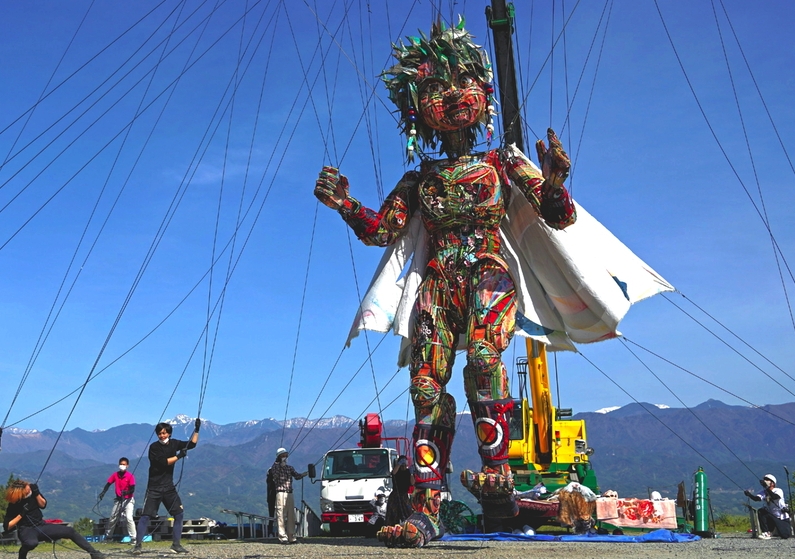
On The Tokyo Organising Committee of the Olympic and Paralympic Games website, MOCCO is characterized by its creators in this way:
“The local dialect where I was born in Miyagi includes the word ‘Odazumokko’, which refers to a popular person who is lively and mischievous. An example sentence is ‘the only son of the family who runs the stationery shop has always been an incorrigible odazumokko, but he’s made it to Tokyo and is doing shows there.’ The word ‘mokko’ originates from a word for carrying a basket, so we used this word for MOCCO to express that he travels bearing people’s thoughts and ideas.” (Kudō Kankurō, scriptwriter, director, actor)
“MOCCO appears abruptly out of nowhere. Neither adults nor children are afraid of him and while he might look a bit scary, it is kind of a cute scariness. There is lively talk about MOCCO all over and everyone has respect for him, which he fully realizes. Everyone knows that MOCCO carries with him dreams and hope, so while you’re having fun with him you should make a wish in your heart. Stomp stomp stomp, MOCCO is here!” (Arai Ryōji, picture book creator, illustrator).
“MOCCO is with you when you are happy or sad, and is somewhere in your tender memories. MOCCO is there when you don’t know what tomorrow holds. MOCCO is always together with everyone”. (Kameda Seiji, music producer of Tōhoku no Sachi).
The design was revealed in May 2019, but the full-motion final rendering of the puppet was performed in Iwate Prefecture, Tōhoku, 50 days before the anticipated start of the 2020 Olympics, and then debuted in Tokyo on July 17, 2020, and was thereafter put on display in Tokyo throughout the duration of the Olympics. Conceived as a collaborative project between children and the puppeteers, who discussed their artistic scribblings of the disaster with the puppet creators, MOCCO looks to be a skeletal bricolage of tsunami debris, rendered in human form. In its dramatic unveiling, MOCCO comes to life bellowing smoke from its mouth, knocking the puppeteers to the ground. Did they imagine this represented the radiation plume? Lacking the redeeming qualities of kitsch that animated the radiated lizard, MOCCO seems nothing less than a modern-day Godzilla for the 3.11 disasters. It immediately reminded me of the grotesquerie of Gunther von Hagen’s platinated human corpses, that were put on display in his exhibit “Human Body Worlds,” discomforting audiences around the world.
Although inspiration may have been provided by children whose lives were disrupted by the Tōhoku disasters, MOCCO seems less the product of an idealist vision of future hope and recovery than an embodiment of their nightmares of having lived through a disaster beyond their imagining. The French playwright Philippe Néricault, (a.k.a. Destouches), famously said: “La critique est aisée et l’art est difficile” (Criticism is easy and art is difficult) and so it is perhaps a cheap shot to parody the intentions of these well-meaning artists who brought this vision to life and paraded it in front of the victims of 3.11 in service of the grand notions of resilient nationalism. But art resonates in our collective unconscious in ways not easy to articulate, and it is hard to imagine that this 10-meter animated puppet comprised of tsunami flotsam on a skeletal frame would be a comforting presence for those who recall the vision of the devastation that lay strewn before them as the tsunami destroyed everything in its path.
Billed as “The Reconstruction Olympics,” Japan was selected as the Olympics host partly in sympathy for the impact the 3.11 disasters had on Japan (the most expensive set of conjoined disasters in world history) and as a form of nation branding in service of a narrative of resiliency, not only with regard to the people of Tōhoku who endured the worst of it, but also of the Japanese nation itself. It is ironic, but hardly surprising, that a kind of political alchemy has rendered the suffering of the victims of the nuclear disaster as a symbol of long-suffering fortitude, while implicitly endorsing the structure of collusive interests which sustain the nuclear village, which set the conditions for the disaster in the first place. For those on the receiving end of this, there has been a withering retrospective accounting of disaster management after 3.11 and hard-earned suspicions about the State’s ability to protect public health while promoting the reactor restarts under the guise of recovery on an Olympics timeline.
The Olympics long ago lost their idealistic luster as representing the epitome of “amateur” athletics and have become a marketing juggernaut and form of symbolic nation branding, providing incentive to hold the games irrespective of the long-term costs they lay at the feet of the hosts. Although the host nation may bask in the short-term glare of world attention and the adoration of their athlete stalking horses, the collusive interests between marketing conglomerates, the International Olympic Committee, and nation-states, they ultimately inherit the economic burdens created by cost overruns and infrastructure projects whose functional use is short-lived and cause for regret as the transient games are played out and the host nation is thereafter left to settle accounts.
At the time of the 10-year anniversary of the 3.11 disasters, competing discourses muddied the waters of institutional memory. The cruel timing of the emergence of the COVID viral pandemic, right on the cusp of the initial scheduling of the Olympics to start in the late summer of 2020, eclipsed the previous focus on Fukushima as the defining motif of these times. Having been saddled with the economic cost of the Tōhoku disasters (the most expensive in world history) the COVID-19 viral pandemic undermined the feel-good rhetoric of the Olympics, which had been branded as the “recovery” and “reconstruction” Olympics, an ode to the protracted efforts of the government to dig itself out of the scurrilous association with its inept response to the crisis. But with COVID-19 running rampant and Japan at the end of the line for vaccinations (with the lowest rate of implementation among affluent countries, in the single digits as of summer 2021), the Olympics were initially postponed and then reluctantly held in defiance of public sentiment (at one point nearly 80% of Japanese citizens opposed holding the Olympics) while Japan imposed a de facto immigration firewall against foreign contagion, a longstanding trope of Japan as an insular, island nation unnerved by the threat of foreign invasion. This was entirely antithetical to the notion of universal inclusion that defines the Olympic mission, and it undermined Japan’s efforts to construct an artifice of salutary resiliency in the face of adversity.
It is difficult to gaze upon the spectacle of the 2020 Japan Olympics being undone by the COVID-19 pandemic and not see this through the lens of the Fukushima disaster response.9 Karl Marx wrote that “Hegel remarks somewhere that all great, world-historical facts and personages occur, as it were, twice. He has forgotten to add: the first time as tragedy, the second as farce.”10
There are obvious parallels between the manner in which the Tōhoku disasters were handled and the Japanese government’s response to both the COVID-19 viral pandemic and the Olympics. These are all epic, culture-transforming events that are historic in scale, and they cast into stark relief all the deficiencies of the State in its inability to address disasters at this scale. Major disasters expose the weakness of governmental institutions to address multi-dimensional complex disasters effectively. While certain aspects of Japanese culture were complicit in this, culture alone cannot account for the systemic failure of institutions, especially when in calmer times these same institutions are held up as exemplars of bureaucratic competence. One of the most shocking things about the Tōhoku disasters is that it highlighted a yawning gap between the stereotype of Japanese hyper-competency and the abject failure of institutions to effectively address the immediate needs of the moment as these severe disasters wreaked havoc, and it exposed an inability to care for people in their darkest hours of need.
In the nuclear crisis, a lack of governmental coordination left local authorities to fend for themselves, playing catch-up in a reactive mode that left them feeling embittered and abandoned. With the COVID pandemic response, a similar dynamic has played out. Despite having experienced at close hand the SARS-COVID outbreak in 2002/2003—which, like the 2019 SARS-2-COVID pandemic, broke in China—and having been reminded by the glancing blow of the 2009 H1N1 (“Swine Flu”) and the MERS Coronavirus crisis of 2012, Japan remained woefully unprepared at a national level to deal with this emerging pandemic. Although comparatively benign “lock-downs” (largely in name only, with no strict enforcement sanctions) limited the spread of the virus, the Japanese authorities doggedly refused to implement wide-spread testing to monitor the pandemic progression, and relied primarily on a local level response whereby medical clinicians were left to their own devices to assess patients, often with no COVID testing to verify their diagnoses, except in the most extreme cases.11
Japan has no national level coordinating body for infectious disease (comparable to the WHO or Centers for Disease Control and Prevention in the U.S.), and thus little guidance was given to medical authorities as to what actions were necessary. The political messaging also reflected this, with the government providing periodic announcements while remaining obstinately reactive to the pandemic as it worked its way through the population. With the penultimate date of the Olympics approaching, the Japanese authorities dithered until they were eventually forced to concede to reality and cancel the Olympics. As the COVID pandemic was amplifying in 2020, this may have been the most prudent decision, but then having had this dress rehearsal and a year-long intermission before the Olympics were set to restart in the summer of 2021, the most obvious mitigating action of vaccinating the population was delayed. A couple of months shy of the start of the 2020 Olympics, Japan still had not implemented a wide-spread testing regime or distributed vaccines. Only 3% of the population had been vaccinated by this time – the lowest among affluent countries by far – and what vaccines that had been given targeted those over the age of 65.
Japan enforced a strict exclusionary policy of closing the borders for immigration, allowing only Japanese nationals and long-term residents with occupation-specific visas to enter the country. At the same time, it was obstinately committed to holding the games despite every indication that it would be a logistical shambles and public opinion polls showing that 80% of the population was opposed to holding the Olympics, it was prohibiting immigration, with the result being that no foreign fans were present. As the virus continued to spread, it was decided that even local Japan-based fans could not attend except in limited circumstances and venues. Japan had great incentive to act decisively on “best-policy” practices and had all the essential information to make informed decisions, both to package the Olympics in a coherent and safe manner, and to protect its population from this insidious disease. And yet, with a series of embarrassing off-brand mishaps that highlighted the tone-deaf messaging of the Tokyo Organising Committee, it let opportunity after opportunity slip by with an almost fatalistic concession to circumstances as though they were beyond their control. They weren’t. Now, as with Fukushima, it is a time of reckoning, and an occasion to reflect on lessons unlearned, a lack of institutional accountability and reform and the consequences of governmental dysfunction and neglect.
In his classic work on suicide, the sociologist Émile Durkheim discussed anomie, a state or condition of normlessness, in which social values and norms are disrupted by social change, leading to a state of moral confusion. This well characterizes the decade following the 3.11 disasters in Japan: the economic disruption, loss of faith in government and legal authority, the disorientation of survivors, a spike in suicide and a general malaise as the Tōhoku region recovers from the tsunami and the Fukushima area is decontaminated and warily reinhabited by returning evacuees. Written over a century ago, Durkheim’s work seems prophetic as it encapsulates the anomic times Japan has experienced through the 3.11 disasters and the COVID viral pandemic, with the sideshow of the Olympics failing to provide the grand narrative of recovery that might have helped redeem State authority and mark a transition point to a return to normalcy. In this light, Durkheim’s words seem not only an indictment of the pursuit of economic solutions to social problems, but a commentary on the 2011 triple-disasters on top of the de facto triple-disasters of 3.11, COVID and the Olympics. Durkheim writes:
“The sphere of trade and industry… instead of being still regarded as a means to an end transcending itself, has become the supreme end of individuals and societies alike. Thereupon the appetites thus excited have become freed of any limiting authority. By sanctifying them, so to speak, this apotheosis of well-being has placed them above human law. Their restraint seems like a sort of sacrilege. So long as the producer could gain his profits only in his immediate neighborhood, the restricted amount of possible gain could not overexcite ambition. Now that he may assume to have the entire world as his customer, how could passions accept their former confinement in the face of such limitless prospects?… From top to bottom of the ladder, greed is aroused without knowing where to find ultimate foothold. Nothing can calm it, since its goal is far beyond all it can attain. Reality seems valueless by comparison with the dreams of fevered imaginations; reality is therefore abandoned…”12
References
Aven, T. (2015) ‘Implications of black swans to the foundations and practice of risk assessment and management,’ Reliability Engineering & System Safety, 134, pp. 83-91.
Casto, C.A. (2018) Station blackout: Inside the Fukushima nuclear disaster and recovery. Radius Book Group.
Downer, J. (2014) ‘Disowning Fukushima: Managing the credibility of nuclear reliability assessment in the wake of disaster.’ Regulation & Governance, 8(3), pp. 287-309.
Durkheim, E. (1951) Suicide: A study in sociology. Translated by J. Spaulding and G. Simpson. The Free Press.
Erikson, K. T. (1995) A new species of trouble: The human experience of modern disasters. WW Norton & Company.
Funabashi, Y. (2021) Meltdown: Inside the Fukushima nuclear crisis. Brookings Institution Press.
Haruta, J., Horiguchi, S., Miyachi, J., Teruyama, J., Kimura, S., Iida, J., Ozone, S., Goto, R., Kaneko, M. and Hama, Y. (2021) ‘Primary care physicians’ narratives on COVID‐19 responses in Japan: Professional roles evoked under a pandemic,’ Journal of General and Family Medicine.
Johnson, D.T., Fukurai, H. and Hirayama, M. (2020) ‘Reflections on the TEPCO trial: Prosecution and acquittal after Japan’s nuclear meltdown’ The Asia‐Pacific Journal, 18(2), pp. 1-35.
Kadota, R. (2014) On the brink: The inside story of Fukushima Daiichi. Kurodahan Press.
Marx Engels Internet Archive. (1995) The Eighteenth Brumaire of Louis Bonaparte [Online]. Accessed: June 5, 2021.
Muto R., and Field, N. (2020) “This will still be true tomorrow: Fukushima ain’t got the time for Olympic games: Two texts on nuclear disaster and pandemic,” Asia-Pacific Journal: Japan Focus, 18(13), no. 2, pp. 1-20.
Ronalds, P. (2019) ‘The ruptures of rhetoric: Cool Japan, Tokyo 2020 and post-3.11 Tōhoku,’ The Japan Foundation: New voices in Japanese Studies, 11, pp. 26-46.
Sakaki, A. and Lukner, K. (2013) ‘Introduction to special issue: Japan’s crisis management amid growing complexity: In search of new approaches,’ Japanese Journal of Political Science, 14(2), pp. 155-176.
The Tokyo Organising Committee of the Olympic and Paralympic Games, 2020. [Online] Accessed July 6, 2021.
Notes
Casto, C.A., 2018.2
Funabashi, Y., 2021. 3
Johnson, D.T., Fukurai, H. and Hirayama, M., 2020. 4
World Nuclear Association, 2021. 5
Kadota, R., 2014. Kadota was the only journalist to interview Daiichi plant manager Yoshida Masao before his untimely death by cancer (not attributable to the Fukushima disaster, according to TEPCO). Kadota’s book promotes a narrative of epic heroism by “The Fukushima 50,” a self-selected group of operational staff at the plant who elected to stay on to fight the battle despite facing the prospect of lethal radiation doses if they remained. This was the basis for a major production film as well. 6
Erikson, K.T., 1995. 7
Ruiko, M., and Field, N., 2020.8
Ronalds, P., 2019.9
Sakaki, A. and Lukner, K., 2013.10
Marx Engels Internet Archive, 1995.11
Haruta, et al., 2021.12
Durkheim, E. 1951, p. 279.
Media Coverage of Fukushima, Ten Years Later.
Abstract: When taking up the unlearned lessons of Fukushima, one of the biggest may have been the need for more robust oversight of the nuclear industry. In Japan, the failure of the major national news media to scrutinize the industry and hold it accountable was particularly glaring. Despite their own claims to serve as watchdogs on officialdom, the major media have instead covered Japan’s powerful nuclear industry with a mix of silent complicity and outright boosterism. This is true both before and after the Fukushima disaster. In the decades after World War II, when the nuclear industry was established, media played an active role in overcoming public resistance to atomic energy and winning at least passive acceptance of it as a science-based means for Japan to secure energy autonomy.
During the Fukushima disaster, the media served government objectives such as preservation of social order by playing down the size of the accident and severity of radiological releases, resulting in widely divergent coverage from serious overseas media. While a short-lived proliferation of more critical and independent coverage followed the disaster, the old patterns returned with a vengeance after the installment of the pro-nuclear administration of Abe Shinzō. This article will examine the roots of the Japanese media’s failure to challenge or scrutinize the nuclear industry, and how this complicity has played out in the post-Fukushima era. It will use a historical analysis to look at how the current patterns of media coverage were actually established in the immediate postwar period, and the formation of public support for civilian nuclear power.
During my 15 years as a foreign correspondent in Tokyo, including a six-year stint as Tokyo bureau chief of The New York Times (2009-2015), I often covered the same news events as Japanese journalists, standing shoulder-to-shoulder at more press conferences than we’d care to count. While I admire many Japanese colleagues individually as journalists, I was frequently struck by the shortcomings of Japan’s big domestic media and Japanese journalism as an institution.
But never did I feel these structural weaknesses as keenly as I did in the tense weeks that followed the triple meltdown at the Fukushima Daiichi Nuclear Power Station.
In Minami-soma, a city 25 kilometers north of the stricken plant, where some 20,000 remaining residents were cut off from supplies of food, fuel and medicines, I discovered that journalists from major Japanese media were nowhere to be seen. They had withdrawn from Minami-soma, forbidden by their editors in Tokyo from approaching within 30 or 40 kilometers of Fukushima Daiichi.
By doing so, they had essentially abandoned the already isolated residents. But you would never know that from the media’s stories, which made no mention of their own pull out or the perceived risks that had prompted this retreat. Instead, the main newspaper articles uniformly repeated official reassurances that there was no cause for alarm because the radiation posed “no immediate danger to human health,” as the chief cabinet secretary at the time, Edano Yukio, so famously put it.1
The mismatch between word and deed—between what the newspapers were telling their audiences and what they were actually doing to protect their own journalists—was glaring. It turned out that this was only the first of several instances during the Fukushima disaster where I witnessed Japan’s major media adhering to the official narrative regardless of the facts on the ground. I refer to this phenomenon as “media capture,” borrowing from the more widely used term “regulatory capture,” which is used to describe a similar failure of government oversight of the nuclear industry.
Over the months and years that followed the meltdowns, I saw numerous instances of national media refusing to take a critical or distanced stance in their coverage of the nuclear industry and its government regulators. Instead, they repeatedly chose to internalize the official narratives and even adhere to the government-approved language. We saw this is the widely diverging narratives that started appearing in the serious foreign press versus the major domestic media as the accident worsened.
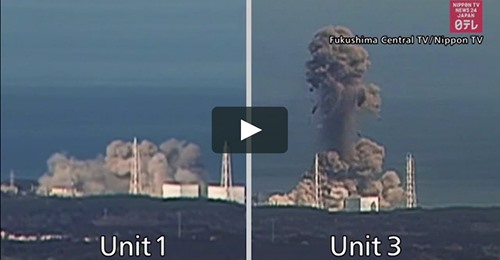
To cite a straightforward example, we started using the word “meltdown” within hours of the first reactor building explosion at the plant, reflecting the almost unanimous view of outside experts that a melting fuel core was the only realistic source of the hydrogen that caused the blast. However, the domestic national dailies and NHK avoided the word “meltdown” (in Japanese, merutodaun) for months, following the insistence of the Ministry of Economics, Trade and Industry (METI), the powerful government agency that both promoted and regulated Japan’s nuclear industry, that a meltdown had not been confirmed. The big Japanese media used other official euphemisms as well, including “explosion-like event” to describe the massive blast at the Unit 3 reactor building, which blew chunks of concrete hundreds of feet into the air.
In fact, I even had Japanese journalists calling me to berate me and my newspaper for using the M-word without METI’s permission. Readers of the Japanese national dailies didn’t see the M-word until mid-May, when METI and the plant’s operator, Tokyo Electric Power Co. or TEPCO, conceded in public that Fukushima Daiichi had indeed suffered a meltdown in mid-March—three meltdowns, in fact.
In the chapter that I wrote for Legacies of Fukushima: 3.11 in Context, I tried to explain some of the reasons why the civilian nuclear power industry could have such a peculiarly strong grip on the media and their narratives. The nuclear industry was a national project that was promoted by the powerful central ministries as a silver bullet for resource-poor Japan’s dependence on imported energy. This gave it an elevated status as the elite bureaucrats guided Japan’s postwar recovery and economic take-off.
I looked at the media’s dependence on Tokyo’s powerful central ministries, which takes its most visible form in the so-called kisha kurabu, or “press clubs.” These are arrangements that allow national media to station their journalists inside the ministries and agencies, where they are given their own room and exclusive access to officials. Much of the reporting by the major Japanese media starts in the kisha kurabu, where journalists gather to wait for the next press conference or off-record briefing from officials. The kisha kurabu system fosters a passive form of journalism, in which reporters become dependent on the ministry within which they are embedded. In pursuit of a scoop that can make or break a career, the journalists compete for handouts from ministry officials. All too often, they enter a Faustian bargain in which the journalists swap narrative control in exchange for exclusive access to information. The result is a passive form of access journalism that ends up repeating spoon-fed official narratives.
I also looked to the past at the emergence of newspapers like the Asahi Shimbun during the early to mid-Meiji era, when the national priority was to protect autonomy by finding a way to catch the industrialized West. I argued that this history baked into the mindset of Japanese journalists a feeling of responsibility for the fate of their nation, including its vital energy needs. It also led to an identification with the government, and particularly the elite officialdom, as protectors of Japan and its people from predatory foreign powers. This inclination to side with the state has continued in the postwar period, when journalists have clearly seen themselves as members of a national elite attached to a broader bureaucratic-led system.
One point that I wanted to underscore was that this media capture was not something so simple or venal as corruption. This is how it is often portrayed by critical Japanese writers, usually freelancers and book authors, who focus on the so-called Nuclear Village, a nexus of business, government, labor unions, academia and news media linked by the cash flowing out of the highly profitable nuclear plants. While money doubtlessly plays a role in many of these relationships, including perhaps the for-profit commercial TV broadcasters, I see no direct evidence that it sways the coverage of the national newspapers. These are privately held companies for whom advertising is a much less important revenue source than subscriptions (or the rent from their valuable real estate holdings in central Tokyo and Osaka).
Regardless of the cause, the result has been generations of postwar journalists who have consistently failed to serve as watchdogs on one of the nation’s most politically powerful industries.2 Starting in the 1990s, public scandals started plaguing the industry, and TEPCO in particular. In 2002, government inspectors announced that TEPCO had been routinely falsifying safety reports to hide minor incidents and equipment problems at reactors including several at Fukushima Daiichi. TEPCO eventually admitted to more than 200 such violations stretching back to 1977. Five years later, TEPCO revealed even more cover-ups of safety issues, which the company had failed to report in the previous inquiry.
Despite what was clearly a chronic and systemic failure of both internal compliance and government oversight, no one was arrested or charged, and the existing regulatory framework left unchanged. The media could have played a role of holding the regulators’ feet to the fire by exposing the structural problems behind this abysmal record of obfuscation and cover-ups. Instead, the watchdogs chose to remain largely silent, reporting on the government’s revelations, but making few efforts at independent investigative reporting.
Of course, such criticisms enjoy the benefits of hindsight, with the accident in 2011 making it easier to see these failures as part of a broader narrative that leads inevitably to Fukushima. But how about after 2011, when the severity of the disaster led to numerous calls for reform? During that time, the national media have also been held up to uncomfortable scrutiny by a jaded and distrustful public, who felt betrayed by their early coverage of the accident.
Unfortunately, ten years later, nothing seems to have changed.
This was apparent in mid-April of 2021, when the Japanese government announced a decision to release into the Pacific Ocean more than 1.2 million tons of radioactive water that has been building up in hundreds of huge metal tanks on the grounds of the Fukushima Daiichi plant. (The accumulation of contaminated water has plagued the plant from the early days of the disaster. TEPCO has resorted to some high-tech solutions with mixed results, including a mile-long “ice wall” of frozen dirt that failed to fully block the water, much of which flows into the plant from underground.)
The water stored in these tanks contains tritium, a radioactive isotope of hydrogen that is best known for its military use as the fuel for thermonuclear warheads (hence the term “hydrogen bomb”). On the spectrum of radioactive substances, tritium emits relatively low levels of radiation in form of beta particles. But it is a radioactive substance nonetheless, a fact that major media played down or even omitted by choosing, once again, to adopt the industry and government’s language to describe the dump. The main news stories in the major national newspapers and TV broadcasts used the official term for this water, which is shorisui, or “treated water.”
While technically correct, this term euphemistically glosses over the fact that this is not the same as, say, treated sewage water. Nor does treated water convey the fact that this water still contains a radionuclide that emits beta radiation.
One result was an interesting battle of words that pitted the mainstream media, which used the approved “treated water,” against journalists who were outside the press club’s inner circle. These publications and web sites chose to use clearer terms such as osensui, or “contaminated water.” The leftist daily Tokyo Shimbun, a smaller regional newspaper that has stood out for its more critical coverage of the nuclear disaster, compromised by calling the water osenshorisui, or “contaminated treated water.”3
More eye-opening was the fact that there were actually efforts to enforce use of the officially approved term. As many journalists discovered, there was an army of social media trolls at ready to pile onto anyone with the temerity to use more critical terminology, and particularly “contaminated water.” TEPCO and the government mobilized university experts and PR professionals to police the public sphere for use of words that were deemed “unscientific” and “ideological.”
Of course, the choice of the word “treated” is itself also highly political. It buttressed the larger message put forth by the government and the plant’s operator that the release of this water was no cause for alarm, but something very common and normal that nuclear plants around the world do all the time. By accepting the official terminology, the media were implicitly adopting this framing of the issue, which focused on the claim that the water could be diluted to the point of being harmless when dumped into the Pacific.
Scientifically, this is a valid claim. My point here is not to take sides. Rather, I am criticizing the large domestic media for failing to do the same: i.e., not take sides. By adopting the official narrative, the media were complicit in the government’s and TEPCO’s exclusion of other, also valid counterarguments. One of the biggest is the fact that this release is anything but normal. No nuclear plant has ever conducted an orchestrated release of such a huge quantity of tritium-laden water. (At the time of writing, the amount, 1.2 million tons, is enough to fill almost 500 Olympic-sized swimming pools.) Worse, the release is to be carried out in the same closed, opaque manner as the rest of Japan’s decade-long response to the disaster. Unless TEPCO and METI break with past precedent to allow full international oversight to verify that the water is as clean as they claim it is, we are left once again to trust actors who have consistently violated public faith.
Just as importantly, there are valid reasons to at least question whether the water is as clean as TEPCO says it is. The company has been telling us for years that it has installed state-of-the-art treatment and filtration technologies that scrub the water of every radioactive particle except tritium. However, in 2018, the plant operator suddenly revealed that 75% of the treated water at the plant still contained excessive amounts of other, more radioactive substances including strontium 90, a dangerous isotope that can embed itself in the living tissue of human bones.4
To be fair, TEPCO may be right in its assessment of the water’s safety. Even so, it is the job of conscientious journalists to take a skeptical attitude toward such claims until they can be independently verified. The media also need to remind why this is necessary, given the company’s and the industry’s history of cover-ups. My goal here is to fault the major domestic media for once again failing to do this, despite the bitter lessons of 2011. Adopting the language of METI and TEPCO privileges the official perspective over others. It shows that the journalists are internalizing the official framing of the event and how it should be discussed and understood.
Officialdom is thus allowed to set the boundaries of public debate, excluding more critical perspectives as “political,” “unscientific” or even “foreign.” The last characterization reflects the fact that the Chinese and South Korean governments raised some of the loudest objections to the release. The media have tended to frame these as the latest in a litany of self-serving complaints by Asian rivals that like to accuse Japan of failing to apologize for World War II-era atrocities. While Beijing and Seoul may have political motives for seizing on the water issue, this shouldn’t be a reason for journalists to avoid taking up more substantive criticisms about the release. Opposition has appeared in many other countries and reflects the failure of Japan to consult with other nations that share the Pacific Ocean, which will be the site of the mass water dump.
This is a failure by media, once again, to inform their readers of the existence of alternative narratives that take a dimmer view of the actions taken by Japan’s officialdom, or that point out where government interests diverge from those of Japan’s public. This is also a failure of a different sort: of media to protect their own intellectual independence. By uncritically adopting the official narratives, the journalists are relinquishing the right to frame in their issues. This surrendering of agency is the central fact of the media capture that I described above.
To be clear, Japan is not unique in suffering from the problem of media capture. The press in other democratic countries face similar challenges. In the United States, we use the term “access journalism” to describe the pitfalls of journalists, often in Washington, who trade autonomy for exclusive access to official sources. However, Japan’s version of access journalism is more extreme, producing a uniformly monolithic coverage closer to that in non-democratic societies. The most apt American equivalent may be the period of extreme patriotic fervor between the September 11, 2001, terrorist attacks and the March 2003 invasion of Iraq, when U.S. media failed to adequately challenge the erroneous claims of the Bush administration that Iraq was in possession of weapons of mass destruction.
In Japan’s ongoing Fukushima disaster, this lack of agency manifests itself as a failure to not only set the narrative, but even to decide what is newsworthy. Most of the coverage is essentially an act of regurgitating the information that was distributed at the ministry’s kisha kurabu. Since the news reports are based on information received from ministry officials, not surprisingly they usually showcase the actions of those officials. Both the pages of Japan’s national dailies and the evening news broadcasts of NHK are filled with stories of Japanese officialdom in action, solving some problem or punishing some wrongdoer. Most news reports are mini-dramas in which officials play the starring role. As such, they serve as demonstrations that agency lies in the elite bureaucracies at the center of the postwar Japanese state, and not the major media, which seems to serve as an appendage.
Even when critical stories appear, they are rarely the work of enterprising reporters unearthing facts that the powerful would rather keep covered. Rather, the revelations tend to come from official actors when they have decided to take action against malfeasance. One example was TEPCO’s cover-ups, mentioned earlier, which were exposed by nuclear regulators, not investigative reporters. A more recent example is revelations that started to become public in March 2021 of years of security lapses at the huge Kashiwazaki-Kariwa nuclear plant in Niigata, facing the Sea of Japan. Over the next two months, news stories dribbled out about workers who were able to access the sensitive areas around the plant’s nuclear reactors without proper ID. In one case in 2015, a man entered the reactor area using the ID of his father, who also worked at the plant. Once again, there lapses were not exposed by intrepid reporters but regulators themselves, who leaked them to prepare the public for their decision to reject TEPCO’s request to restart the plant.5
The lack of media agency is all the more glaring because there have been very notable exceptions. Japan’s journalists have shown that they are capable of true investigative reporting that can define and drive the public narrative. For a brief window of time during the early years of the Fukushima disaster, some major Japanese media experimented with more autonomous journalism. This began in the late summer of 2011, as public disillusionment in the domestic press’s compliant coverage grew. This prompted some media to try to re-engage readers with more hard-hitting reports that challenged the official claims.
The most notable of these efforts was launched by the Asahi Shimbun, Japan’s second-largest daily, which beefed up a new reporting group dedicated to investigative journalism. (By investigative journalism, I mean journalists taking the initiative to pry out hidden truths and assemble these into original, factual narratives that challenge the versions of reality put forth by the powerful.) The Asahi’s investigative division got off to a strong start by winning Japan’s most prestigious press award two years in a row. It scored what it trumpeted as its biggest coup in May 2014, when two of its reporters wrote a front-page story that exposed the dangerously poor crisis management at the plant as it teetered on the brink of catastrophe. The story revealed that the government had hidden testimony by the Fukushima Daiichi plant’s manager during the accident, Yoshida Masao, who later died of cancer. It also recounted what it said was the most explosive revelation of this secret testimony: that hundreds of workers and staff had fled the crippled plant at the most dangerous point in the disaster, despite the fact that Yoshida never gave them the order to leave.
However, the Asahi erred by giving the story a misleading headline, which left readers with the impression that the workers had fled in defiance of Yoshida’s order to stay. (In fact, Yoshida himself says in the testimony that his order didn’t reach these workers—a stunning breakdown in command and control that was lost in the subsequent blow up over the article.) This misstep gave critics the opening that they needed to try to discredit the entire story, and by extension the newspaper’s proactive coverage of the disaster. A host of critics, including the prime minister himself and the rest of the mainstream media, set upon the Asahi with unusual ferocity. After weeks of withering attacks, which essentially accused the newspaper of lacking patriotism and of belittling the heroic plant workers, the Asahi’s president made a dramatic surrender in September 2014, retracting the entire article, gutting the investigative team and resigning his own job to take responsibility for the fiasco.6
Thus marked the end of the Asahi’s short-lived foray into investigative journalism, which I have described in more detail in this journal.7 Suffice it to say here that when forced to make a choice, the Asahi, the nation’s leading liberal voice favored by the intelligentsia, chose to remain on the boat. To preserve the privileged insider status as a member of the kisha kurabu media, the newspaper chose to sacrifice not only its biggest reporting accomplishment of the disaster, but also the journalists who produced it, who were sent into humiliating internal exile. For years afterward, the newspaper shunned proactive reporting on Fukushima, staying within safe confines of the official storyline.
The Asahi’s biggest mistake was its failure to stand behind its journalists. Investigative reporting is by nature a highly risky undertaking, and one that pits a handful of underpaid journalists against some of the most powerful members of society. By not only failing to stand up for its investigative reporters but trying to scapegoat them by punishing them for the mistakes in coverage, the Asahi sent a chilling message to all mainstream journalists: Newspapers don’t have your back. In such an environment, what journalists in their right mind would want to challenge the powers that be?
Admirably, some of the Asahi’s investigative reporters did stand their ground even at the cost of their careers at the newspaper. Soon after the debacle, two of the investigative group’s top reporters quit to launch Japan’s first NGO dedicated to investigative journalism, which in 2021 was renamed Tokyo Investigative Newsroom Tansa.8 Another resigned to join Facta, a Japanese magazine dedicated to investigative coverage (and offering stories that cannot be found in the large national newspapers). These decisions to place principle over company and career underscore my broader point: The sources of Japan’s media capture are bigger than the individual reporters and embedded in the structure of media institutions and the practice in Japan of journalism itself.
The Asahi’s capitulation in 2014 marked the end of not just the Asahi’s but all the mainstream media’s efforts to create new, more critical narratives of the Fukushima disaster. These days, most reporting tends to fall into one of a few prepackaged, safely uncontroversial storylines. There is the Fukushima 50 narrative of successfully overcoming Japan’s biggest trial since World War II. Another is the “baseless rumors” (fuhyō higai) narrative, which casts fears of radiation as over-exaggerated, and usually the creation of women, leftists and foreigners.
Journalists have told me that the Asahi’s surrender created a powerful prohibition on critical coverage. Having seen what happened to Japan’s leading liberal newspaper, and the star reporters there who lost their careers, few journalists have the stomach to challenge the status quo. The result is a grim new conformity.
Adding to the pressure to toe the line has been the appearance post-Fukushima of another new, problem-plagued national project: the Tokyo Summer Olympics, originally scheduled for 2020. Coverage of the Olympics has again tended to adhere to official narratives, even as public misgivings grew in Prime Minister Suga Yoshihide’s decision to go forward with the Games a year later, in 2021, in the midst of the Covid-19 pandemic.
From the start, the government has used the Olympics to divert attention from Fukushima while proclaiming that the disaster is now in the past. While there has been critical coverage, it has been the exception and not the rule. Indeed, the media’s silence was deafening when the previous prime minister, Abe Shinzō, told the International Olympic Committee in Buenos Aires in September 2013 that the plant’s “situation was under control,” even as contaminated water was then still bleeding into the Pacific.
By failing to take the initiative in Fukushima, the media have ended up supporting official efforts to use the Games to put the lid back on the nuclear disaster. The Olympics have become yet one more means for Japan’s elites to regain control of the public sphere, or at least the part of it controlled by the big legacy media. (They have had less success asserting control over the much more anarchic and anonymous world of social media.)
The media’s reluctance to challenge the government has also been apparent during the Covid-19 pandemic. I’m still waiting for the investigative articles that expose the truth behind Tokyo’s biggest failures during the pandemic. The major media emitted barely a peep in response to the government’s blatantly discriminatory decision during the first six months of the pandemic to close Japan’s borders to all foreign nationals, including long-term residents, while allowing Japanese nationals to come and go. More importantly, I would be the first in line to read an investigative exposé into what delayed the roll out of vaccines in Japan.
All too often, coverage of COVID-19 ended up repeating the pattern that we saw in Fukushima. The media once again surrendered their biggest public asset: their power to challenge the official narrative and expose the facts that officials don’t want us to know. Instead, the major domestic media once again show themselves more interested in preserving their privileged insider status. By doing so, they once again do a disservice of their readers.
The need to serve their readers by finding an independent and critical voice should have been the media’s biggest takeaway from Fukushima. Instead, they appear to be merely repeating the mistakes of a decade ago.
References
Brown, A. and Darby, I. (2021) ‘Plan to discharge Fukushima plant water into sea sets a dangerous precedent’, The Japan Times, April 25 [Online]. Accessed: June 25, 2021.
Fackler, M. (2016) ‘Sinking a bold foray into watchdog journalism in Japan’, Columbia Journalism Review [Online]. Accessed: June 25, 2021.
Fackler, M. (2016) ‘The Asahi Shimbun’s failed foray into watchdog journalism’, The Asia Pacific Journal Japan Focus, 14(24) [Online]. Accessed: June 25, 2021.
Jomaru, Y. (2012) Genpatsu to media shinbun jānarizumu ni dome no haiboku [Nuclear Power and the Media: The Second Defeat of Newspaper Journalism]. Tokyo: Asahi Shimbun Shuppan.
Kyodo. (2021) ‘Another security breach at Tepco nuclear plant uncovered’, The Japan Times, May 9 [Online]. Accessed: June 25, 2021.
Ogawa, S. (2021) ‘Fukushima dai ichi genpatsu no osen shorisui, seifu ga kaiyō hōshutsu no hōshin o kettei e 1 3 nichi ni mo kanei kakuryō kaigi [Government Moving Toward Decision to Release the Fukushima Daiichi Nuclear Plant’s Contaminated Treated Water in the Ocean], Tokyo Shimbun, April 9 [Online]. Accessed: June 25, 2021.
Tansa. (2021) Tokyo investigative newsroom Tansa [Online]. Accessed: June 4, 2021.
Notes
SankeiNews (2011). “Edano kanbōchō kankaiken No1 ‘Tadachi ni kenkō shigai wa denai…’” [Chief Cabinet Secretary Press Conference Edano No1 ‘No Immediate Health Damage’]) [Online Video]. Accessed: August 23, 2011.2
Jomaru, 2012.3
Ogawa, 2021.4
Brown and Darby, 2021.5
Kyodo, 2021.6
Fackler, 2016.7
Fackler, 2016.8
Tansa, 2021.
10 years after
September 3, 2021
10th testimony of Fonzy, 10 years after the Fukushima nuclear disaster. Thanks to her for continuing to give us news! The vigilance, even if it is less assiduous, is always necessary.
Hello,
I have been silent for several years. I am fine, I still live in the same place, 280 km from the Fukushima Daiichi plant.
Since the accident of the power plant, 10 years have passed. I must confess that it is difficult to be always on the alert, or in a state of alert all the time. Little by little, I am letting go of the restrictions I had imposed on myself. There are still some things I continue to do, for example:
- Wearing a mask
In 2011, I wore an N95 mask every time I went to Tokyo, even in summer when it was 35 C. Since the N95 mask is expensive, I have been wearing a “normal” mask since 2012, and I still continue to this day. Right now, the mask is almost mandatory even in my neighborhood because of Covid 19.
- More mushrooms
Shiitake, button mushroom, oyster mushroom,… well all kinds of mushrooms are gone from the table. From time to time, I miss Shiitake, but it will not be fatal not to eat mushrooms. On the other hand, eating mushrooms could be…
- Buying products from southwestern Japan
I normally buy vegetables that are produced beyond 500 km from the Daiichi plant. The same goes for fruits. In other words, I buy broccoli from Kyoto, but not lettuce from Chiba (250 km). I used to avoid products from the south of Nagano (300 km from Daiichi) or Gifu (400 km from Daiichi), but now I occasionally buy fruits produced there.
- Eating in restaurants as little as possible
In the early years, I almost never ate in restaurants. When I was forced to attend a party with colleagues, I tried not to eat anything, as it was said that Fukushima products (which should not exceed the limit of 100 Bq/kg) were used in catering. Starting in 2015 or ’16, I began to dine once every two or three months in restaurants that I chose well and that served us products from Kyushu or Shikoku, regions that are in the southwest of Japan.
- Avoiding the rain
I used to like to walk without an umbrella in the rain, especially with a light rain. After Fukushima, as soon as I feel a drop, I open my umbrella. I always have my umbrella when it might rain later in the day. So I always pay close attention to the weather.
Now I tell you what I don’t do anymore.
- Mineral water
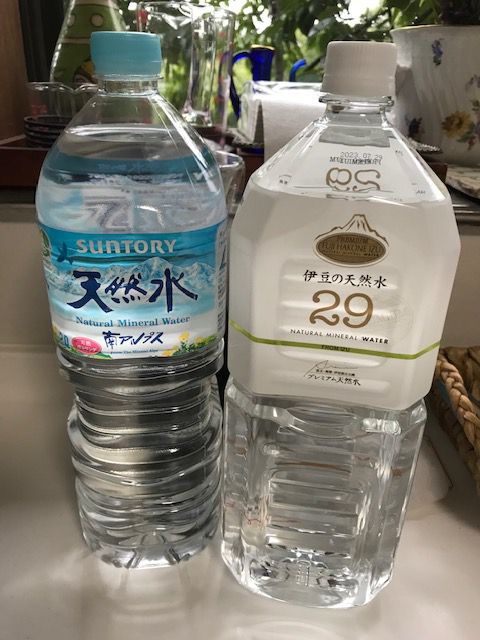
Until March 2021, we only drink mineral water, we only use mineral water to make soup, stew, in short everything that is to be eaten at home. However, the water bottles are heavy, we have to go to the supermarket quite often to buy a box of six bottles that we consume quite quickly. It’s not free either… So we decided to stop using mineral water for cooking. We still drink the mineral water whose radioactivity is measured.
Mineral water: cesium and iodine are measured by the gamma spectrometer (Photo Fonzy). The bottle on the left costs 0.6 euros, the bottle on the right 2.15 euros.
- Fish
For at least eight years after the accident we did not eat fish. However, my partner had colon cancer in 2019, and afterwards he preferred to eat “lightly”, so we resumed the habit of eating fish. I mostly buy fish from southwestern Japan, but occasionally I buy fish from a port near our home, because they are much fresher. I avoid fish from the shallow waters such as sole or turbot.
- Geiger counter
I walked around with my Geiger counter a lot in 2011, and a little less in 2012, and now … I don’t know where it is anymore, maybe in a drawer, but I haven’t seen it for years. I wonder if my friends who had one still use it.
- Anti-nuclear demonstrations
For two or three years after Fukushima, there were many anti-nuclear demonstrations organized not only in Tokyo but also throughout Japan. We shouted in front of the Tepco headquarters, in front of the Parliament, in the streets, we were very numerous at one time. There were activists who made anti-nuclear mobilizations every Friday night in front of the Parliament. This was a success for some time. I too participated often, especially in 2011 and 2012. However, they stopped their movement for good in March 2021 because there were, according to them, much less participants lately and they had no budget to continue. Now anti-nuclear demonstrations are very rare, although there are still some who mobilize from time to time. It seems to me that we Japanese are not very demonstrative. We’ll see…
- Convincing the others
Even though I talked to my friends and relatives about the risks of contamination and the dangers of nuclear power plants, it was almost impossible to convince them to be interested in this kind of problems.
That’s it. I do what I think I can do without too much stress. Still thinking about Fukushima is possible, but now we should have more imagination, because we don’t talk about it anymore. I thank those who continue to think about Fukushima despite so much geographical distance and so many years passed. Thank you for your solidarity.
Fonzy
Commemoration and Meaning: The Case of Fukushima
Robert Jay Lifton and Scott Gabriel Knowles
Abstract: Disaster commemoration serves as a moment to remember victims and honor survivors. In the case of 3.11, commemoration works differently. As a slow disaster, with radiation exposure and evacuation at the center of the story, 3.11 is not yet over. This places special importance on commemoration as a moment for memory, but also for ongoing commitments to research, justice, and health interventions for survivors.
Commemorations of disasters are necessary. They can provide survivors—and the world in general—a sense of where things stand in relation to destruction, the pain caused, and the relief time may have brought. Commemoration can also be a way to give meaning to the disaster itself. But those meanings can be misleading if they minimize the effects of disaster or pronounce shallow claims of recovery.
A case in point is the tenth-year commemoration of the Fukushima Daiichi nuclear meltdown of 2011. The Director General of the International Atomic Energy Agency marked the occasion by claiming that “The equipment reacted just as it was designed to do—it stopped!” He did admit that “the ensuing damage caused nuclides to be released into the environment,” but insisted that “scientists have found no evidence that this caused radiation-induced health effects.”1 The meaning he communicates is that there was a bit of a problem, it was immediately taken care of, some dubious materials might have leaked out, but nothing bad happened. There was no real disaster.
That is not the meaning the event holds for the 37,000 people who had to be evacuated, and have still not returned to Fukushima prefecture.2 Their meaning, and that of most thoughtful outside observers, starts with the vulnerability of the Fukushima Daiichi reactors to the extreme events of earthquake and tsunami. Survivor meaning would also turn on the unknown effects of the recent decision to deposit radioactive materials into the ocean.3 It would focus on the resistance by government and nuclear-industry officials to studies of future dangers from nuclear waste, and from radiation effects that could occur over decades and even centuries. Above all, that survivor meaning would include concerns about prevailing radiation levels as well as danger of future bodily effects on the part of people exposed.
At the heart of this meaning is the fear of what one of us (Lifton) has called “invisible contamination,” a fear of a poison that a survivor cannot see, smell, or feel, and whose effects are so lasting, even if they do not show up in one year—or in one generation—they may well do so in the next. As a Hiroshima survivor put it: “You may look healthy from the outside but all of a sudden something goes wrong and you are sick and you die.”4
Hiroshima survivors described their terror at witnessing and experiencing grotesque radiation symptoms: acute effects of severe diarrhea, bleeding from various bodily orifices, dreaded “purple spots” from bleeding into the skin, extreme weakness and frequent death. Delayed effects including increased incidence of leukemia during early post-bomb years, and later of cancer of the thyroid, stomach, lung, ovary, and uterine cervix. Since it is known that radiation can have genetic effects over the generations, there was much fear in Hiroshima about giving birth to abnormal children.

The full panoply of nuclear fear is a constant anywhere radiation danger is involved. Fear of invisible contamination has been widely identified in people exposed in Fukushima, as well as in many living far beyond that province—this includes evacuees, first responders, and doctors and nurses who stayed behind in Fukushima.5 Such fear also emerged at the American Three Mile Island disaster of 1979, where less radiation was released than at Fukushima.6 With the much greater disaster at Chernobyl in 1986, that fear has been pervasive and remains at a considerable level. The same fear occurred in Americans exposed to nuclear radiation in various other places: to plutonium waste at Hanford, Washington, in connection with the production of the Nagasaki bomb; to nuclear testing over decades at Rocky Flats, Colorado; and to Ground Zero at test sites in Nevada, from which G.I.’s were marched shortly after nuclear explosions. None of this should be dismissed as “hysteria” or “exaggerated psychological reactions.” We are speaking of the nuclear fear—the fear of invisible contamination—that results from substantial release of radiation, no matter what the source.
What does it mean to pass the 10th anniversary of 3.11 under such conditions? Disaster anniversaries sit on the calendar, they are predictable. Historians know that they can reliably look back at news coverage one, five, and ten years after any disaster to see how recovery proceeded, how the disaster was framed by different political regimes, and which victim support groups persisted while others disappeared. But history is not a stable element, and as such anniversaries sometimes re-ignite political battles over the meaning of a disaster. The commemoration of a disaster anniversary opens the possibility for cynical revision and exploitation by politicians and industry groups eager to declare that the past is now safely in the past. Commemoration meaning can be falsified by bureaucratic collusion between industry and government, which can contribute to denial, rejection, and cover-up of radioactive consequences. Such collusion is notorious in Japan. There were significant protests in Japan against the use of nuclear energy, but pro-nuclear forces prevailed, in part by insisting that there was a significant difference between the technology of nuclear power and that of nuclear weapons. This illusory distinction is restated by those who use moments of commemoration to promote nuclear energy.
The anniversary also demands a recapitulation of trauma, a command performance for survivors and families still grieving, as well as those who may have truly integrated the disaster into their lives and chosen no longer to publicly engage with it, if they ever did. A disaster like 3.11 has its own special complications, a combination of earthquake, tsunami, and radiation, affecting people of all ages, from fishermen to nuclear power plant workers—spread out over a large area, and with many thousands of bodies never recovered. There is not a coherent 3.11 experience for survivors. The harms were many, and variable, and this makes activism for victim support more complicated. Due to the radiation exclusion zone going into effect, many survivors have found themselves advocating for resources to return to empty towns and shattered homes they aren’t totally sure they want to live in again.
Nowhere is the timescale of disaster memory more unpredictable than in cases of radiation exposure. With Hiroshima survivors, for instance, every year brings new testimonials from survivors who tell their stories of August of 1945 for the first time. Similarly, as STS scholar Kyoko Sato has noted, there will most certainly be Fukushima survivors who will not share their truths for many years to come.7 In this way it may be possible that Fukushima memory could “puncture the nuclear mystique” that has gripped Japan since reactors were built in the 1960s.8 This can occur only if anniversary discussions give way to a greater focus on survivor-based memory. Victims’ families, and activists can find in such anniversaries the opportunity to bring their own memories and demands into discussion once again for new audiences. Memorial ceremonies, the reconvening of dormant support groups, educational outreach to students, even phone calls and emails from distant friends and family all serve positive roles for a disaster affected community, even ten years later. And the anniversary serves as a meeting ground for disasters past and present—any discussion of Fukushima now, for example, must take place in the context of the COVID-19 pandemic and the ongoing need for strong public health measures.
New dynamics are at play now as well that offer hope Fukushima memory might not recede so easily from the public mind once this year is over. Research and public policy insisting on post-traumatic mental health support (in Japan starting after the 1995 Great Hanshin-Awaji Earthquake) for survivors has been effective in countering the more traditional idea that disasters end once relief payments are made and buildings are rebuilt.9 We are increasingly recognizing that a disaster is a process, not a single event in time. Victims will suffer on the day, and in the aftermath. As we note in the recently published volume Legacies of Fukushima: 3.11 in Context, “the linked disasters of 3.11 were in crucial ways part of a much longer process, a slow disaster that connected the events of a disastrous era … traumas of the Japanese past: radiation exposure, tsunami flooding, seismic destruction, massive evacuation and loss of home and community.”10 Climate change can also be an important factor in causing and sustaining disasters.
Nuclear disaster commemorations can and must leave space for the new exploration of old harms—and they must be in sync with ongoing strategies of mental health service provision as well. Is this too much to ask in a Fukushima commemorative year marked by pandemic and climate change related disasters around the world? Not if disaster history is to be of any use at all in the struggle to reduce disaster risk and heal survivors. As Liz Maly and Mariko Yamazaki note in their recent review of Japanese disaster memorials, 3.11 demands special attention to the overlapping historical trajectories of loss and trauma in Japan. “Important issues for future consideration,” they note, “include comparisons across not only pre-3.11 museums about disasters caused by natural hazard events, but also Japanese precedents of how experiences and lessons from other human-made disasters are conveyed, including by the Nagasaki Atomic Bomb Museum, Hiroshima Peace Memorial Museum, and Minamata Disease Municipal Museum, which tells the story of industrial pollution and poisoning of the local community.”11
What’s needed now in this year of Fukushima commemoration is a turn towards the fusion of these ideas, grounded in the reality that nuclear fear demands. We should emphasize the healing function of commemoration. That includes enhancing the mourning process of survivors, instead of impairing that process by negating their pain. Survivors and victims’ families can find in such anniversaries the opportunity to bring their own memories and demands into discussion for new audiences. Memorial ceremonies can reintegrate sources of support and provide extensive educational outreach. By confronting painful disaster effects, there can emerge valuable forms of what can be called survivor wisdom. These anniversaries can also connect, psychologically and politically, with disasters past and present.
Commemoration events can serve as moments of collective renewal, with survivors in the vanguard.
References
COVIDCalls. (2021) Fukushima and the Pandemic: A 3.11 Memorial Episode with Sulfikar Amir, Kohta Juraku, Kyoko Sato, and Ryuma Shineha [Online video]. March 8. Accessed: July 18, 2021).
Cleveland, K, Knowles, S., and Shineha, R. (eds.) (2021) Legacies of Fukushima: 3.11 in Context. Philadelphia: University of Pennsylvania Press.
Honda, N., Kelman, I., Kikuchi, S., Kim., Y., Kobayashi, N., Nemoto, H., Seto, M., and Tomita, H. (2019) ‘Post-Disaster Mental Health and Psychosocial Support in the Areas Affected by the Great East Japan Earthquake: A Qualitative Study’, BMC Psychiatry, 19(261).
International Atomic Energy Agency. (2021) Ten-year Anniversary of the Fukushima Daiichi Nuclear Power Plant Accident: A Decade of Improving Nuclear Safety [Online] Accessed: June 15, 2021.
Lifton, R. (1968) Death in Life: Survivors of Hiroshima. 2nd edn. Chapel Hill: University of North Carolina Press.
Lifton, R. (1986) ‘Chernobyl, Three Mile Island, Hiroshima’, New York Times, May 18 [Online]. Accessed: July 18, 2021).
Loh, S.L. and Amir, S. (2019) ‘Healing Fukushima: Radiation Hazards and Disaster Medicine in Post-3.11 Japan’, Social Studies of Science, 49(3), pp. 333-354.
Maly, L. and Yamazaki, M. (2021) ‘Disaster Museums in Japan: Telling the Stories of Disasters Before and After 3.11’, Journal of Disaster Research, 16(2), pp. 146-156.
Normile, D. (2021a) ‘This Physician Has Studied the Fukushima Disaster for a Decade—and Found a Surprising Health Threat’, Science, March 4 [Online]. Accessed: July 18, 2021.
Normile, D. (2021b) ‘Japan Plans to Release Fukushima’s Wastewater into the Ocean’, Science, April 13 [Online]. Accessed: July 18, 2021.
Rich, M. and Inoue, M. (2021) ‘Ten Years After Fukushima Disaster, This Nurse May Be the Region’s Best Hope’, New York Times, March 9 [Online]. Accessed: July 18, 2021.
Notes
International Atomic Energy Agency, 2021.2
Normile, 2021a.3
Normile, 2021b.4
Lifton, 1991.5
Rich and Inoue, 2021; Amir and Loh, 2019.6
Lifton, 1986.7
COVIDCalls, 2021.8
Lifton in Cleveland, Knowles, and Shineha, 2021.9
Seto, et. al., 2019.10
Cleveland, Knowles, and Shineha, 2021.11
Maly and Yamazaki, 2021.
Nuclear news for the first week in September
While Afghanistan, and Covid-19 continue to be the main focus of news, climate change is getting a new kind of attention. I find it a worrying kind. When Rupert Murdoch’s Fox News, News Corps etc, were busily spouting climate change denialism, at least you knew what they were up to. Now, I fear that the world is going to be subjected to propaganda that is much more subtle. Just as Big Media and Big Business now ”support” action on climate change, I think that they will be spruiking technological fixes, ”clean coal” ”carbon capture and storage, ( perhaps even Big Renewables). On the coat-tails of this Big Fix movement rides the nuclear lobby. Nuclear is so far banned from participating in the COP26 Climate Summit in November. I wouldn’t be surprised if it wriggles its way in. World leaders like Biden, Johnson, Putin – all depend for their jobs, on the backing of big corporations. So – COP26 is already under threat.
On the positive side, quiet and thoughtful voices speak up for a more holistic approach to climate action, and a measured study on the world’s energy needs.
Covid-19 – Coronavirus worldwide, despite nearly 65,000 deaths and nearly 4.3 million cases in the past week, is leveling off with 8% declines for each category, with every continent dropping except Europe in fatalities.
NUCLEAR. While not much is actually happening, the activity is – under the radar – the ever-increasing push to convince the world that nuclear is ”clean and green and the way to go.”
Some bits of good news – India Today Group launches Good News Today, India’s first and only positive news channel. ”Good news” – as usual – very much individualistic stuff. I guess that the overall small drop in coronavirus cases is a small plus.
A New Online Youth Platform Promotes Nuclear Disarmament. After the Afghanistan war, the time for change is now. Oblivion and 9 Other Best Dystopian Films About Nuclear War.
How much energy do we need to achieve a decent life for all? Does technology really matter more than the natural landscape?
Greta Thunberg, critical of governments, may not attend COP26. COP26 – the need to scrutinise hidden climate agendas.
Formidable radiation dangers in travel to Mars. Radiation could restrict crewed Mars missions to less than four years . Cosmic radiation will probably prevent growing crops on Mars, Virgin Galactic ‘ignored red warning light’ in Branson’s race against Bezos to be first billionaire to space.
New Nuclear: What’s At Stake For Wildlife? – Webinar October 7.
International Uranium Film Festival free online screenings September 13 – 19.
AFRICA. Nuclear Disarmament: What the World can Learn from Africa.
JAPAN. Not Seeing the Contaminated Forest for the Decontaminated Trees in Fukushima. IAEA team in Japan to help prepare Fukushima water release. Fukushima radiation monitoring posts to be renewed-. New type of fallout from Fukushima Daiichi found a decade after nuclear disaster.
PACIFIC ISLANDS. Pacific environmentalists call on Japan not to empty radioactive wastewater into the Pacific.
USA.
- Hurricane Ida Forces Two Nuclear Plants in Louisiana to Shut Down or Reduce Power . Nuclear New Orleans: Another Fukushima? Post-Ida Dangers at Waterford Nuclear . Hurricane shuts down Louisiana nuclear power station.
- Since 9/11, US Has Spent $21 Trillion on Militarism at Home and Abroad. Global Cooperation, Not Endless War Should Be Future of US Foreign Policy. We can reduce the nuclear danger, contacting politicians, joining Back from the Brink.
- Advanced nuclear reactors need the government to create a market – nuclear loves socialism.
- Friends of the Earth and Sierra Club saw it coming – corruption is killing the nuclear industry. Westinghouse Electric Co has paid $21bn and will co-operate with federal investigators over South Carolina nuclear fraud.
- Illinois Senate passes bill to save nuclear plants. Illinois very soon to vote on a Bill for the state to prop up the nuclear industry. Illinois nuclear subsidy law – too late for Exelon’s Byron and Dresden nuclear plants.
- Uranium prices and the true financial and climate costs of the Megatons to Megawatts program. We mustn’t kick the radioactive nuclear waste can down the road any longer. It’s time to tackle the problem head-on. Nuclear waste – a heavy burden on the public of New Mexico. Highway safety concerns as DOE plans expanding nuclear waste transports to the Waste Isolation Pilot Plant (WIPP). Daunting costs of nuclear clean-ups.
- Downwinders Look to Renew and Expand Radiation Exposure Compensation Act.
UK. UK might have to move its nuclear submarines overseas, if Scotland gains independence. UK government scared that Scotland’s Nicola Sturgeon will use COP25 to further SCotland’s independence. Trident: Scots urged to write to UN to demand removal of nuclear weapons. The Faslane Peace Camp inspired the BBC drama Vigil https://www.youtube.com/watch?v=WRGZVM3f4SU Chaotic discussion on nuclear waste proposal for UK’s Allerdale region.
CANADA. More issues at Bruce power station raise concerns about aging nuclear infrastructure.
INDIA. Over 200kg uranium theft in India poses threats of nuclear terrorism.
AFRICA. A Just Recovery Renewable Energy Plan for Africa.
SOUTH AFRICA. As South Africa restarts nuclear plan, critics and advocates clash over its clean energy credentials. Walking the nuclear dog – a South African tale.
NORTH KOREA. U.S. says North Korea nuclear report shows “urgent need for dialogue” -official.
SOUTH KOREA. South Korea developing a missile as powerful as a nuclear weapon.
FRANCE. Chinon nuclear site again leaks coolants that turn into powerful greenhouse gases . An EDF employee contaminated in the Cruas-Meysse nuclear power plant.
POLAND. Two Billionaires Join Forces in Poland’s Nuclear Energy Push.
IRAN. Germany calls on Iran to resume nuclear talks . Iran’s new foreign minister Warns Tehran May Not Return to Nuclear Talks Until November. What’s next for the Iran nuclear deal? Analysts In Iran Pessimistic Over Nuclear Talks, Oppose Further Delays.
CHINA. China’s nuclear missile silo expansion: From minimum deterrence to medium deterrence. In China, wind and solar energy are the clear winners over nuclear.
ISRAEL. Israel’s ‘alarmist claims’ raise the stakes against Iran.
AUSTRALIA. The ANZUS treaty does not make Australia safer. Rather, it fuels a fear of perpetual military . New Australian law allows security agencies to spy on, and manipulate your data – mainstream media ignores this. threat
Murdoch’s News Corpse hasn’t seen the light on climate – they’re just updating their tactics.
Fukushima radiation monitoring posts to be renewed
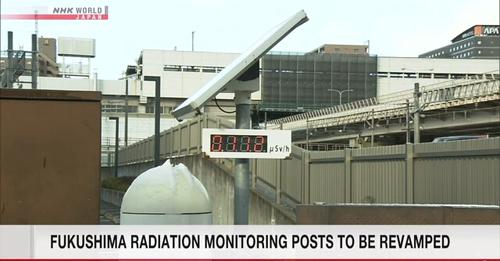
Japan’s nuclear regulators plan to retain radiation monitoring posts in Fukushima Prefecture by replacing old equipment with new.
About 3,000 monitoring posts were set up at schools and other locations across the prefecture following the March 2011 accident at the Fukushima Daiichi nuclear power plant.
The annual test and maintenance cost of the equipment is around 5.5 million dollars.
The Nuclear Regulation Authority decided in 2018 to remove about 80 percent of the monitoring posts, saying that radiation levels had remained low and the posts would likely reach their lifespan of about eight years.
But the authority reversed its decision after it met opposition from local residents.
It decided instead to retain the monitoring posts for the time being to ease local people’s concern about radiation levels and their health.
The authority plans to replace parts in radiation detectors and power supply sources with new ones in the next 10 years. About 300 posts will be renewed annually.
Some 450 monitoring posts containing parts that are hard to obtain will be replaced entirely.
The prefectural government of Fukushima says it wants the authority to continue to measure radiation levels.
New type of fallout from Fukushima Daiichi found a decade after nuclear disaster

15 Mar 2021
New, large and highly radioactive particles have been identified from among the fallout of the 2011 Fukushima Daiichi nuclear disaster in Japan. An international team of researchers has characterized the particles using nuclear forensic techniques and their results shine further light on the nature of the accident while helping to inform clean-up and decommissioning efforts.
This year marks the tenth anniversary of the Fukushima Daiichi disaster, which occurred as a result of a powerful earthquake that struck off of Japan’s east coast, generating a tsunami that reached some 14 m high when it reached the nearby shoreline. Breaching sea defences, the water from the wave shut down emergency generators that were cooling the reactor cores. The result was a series of nuclear meltdowns and hydrogen explosions that released a large amount of radioactive material into the surrounding environment — including microparticles rich in radioactive caesium that reached as far Tokyo, 225 km away.
Recent studies have revealed that the fall-out from reactor unit 1 also included larger caesium-bearing particles, each greater than 300 micron in diameter, which have higher levels of activity in the order of 105 Bq per particle. These particles were found to have been deposited in a narrow zone stretching around 8 km north-northwest from the reactor site.
Surface soil samples
In their study, chemist and environmental scientist Satoshi Utsunomiya of Japan’s Kyushu University and colleagues have analyzed 31 of these particles, which were collected from surface soil taken from roadsides in radiation hotspots.
“[We] discovered a new type of radioactive particle 3.9 km north northwest of the Fukushima Daiichi Nuclear Power Plant, which has the highest caesium-134 and caesium-137 activity yet documented in Fukushima, 105–106 Bq per particle,” Utsunomiya says.
Alongside the record-breaking radioactivity seen in two of the particles (6.1×10⁵ and 2.5×10⁶ Bq, after correction to the date of the accident) the team also found that they had characteristic compositions and textures that differed from those previously seen in the reactor unit 1 fall-out.
Reactor building materials
A combination of techniques including synchrotron-based nano-focus X-ray analysis and transmission electron microscopy indicated that one of the particles was found to be an aggregate of smaller silicate nanoparticles each with a glass-like structure. This is thought to be the remnants of reactor building materials that were first damaged in the explosion and then picked up caesium that had been volatized from the reactor fuel.
The other particle had a glassy carbon core and a surface peppered with other microparticles of various compositions, which are thought to reflect a forensic snapshot of the particles that were airborne within the reactor unit 1 building at the moment of the hydrogen explosion and the physio-chemical phenomena they were subjected to.
“Owing to their large size, the health effects of the new particles are likely limited to external radiation hazards during static contact with skin,” explained Utsunomiya — with the two record-breaking particles thought too large to be inhaled into the respiratory tract.
Impact on wildlife
However, the researchers note that further work is needed to determine the impact on the wildlife living around the Fukushima Daiichi facility — such as, for example, filter feeding marine molluscs which have previously been found susceptible to DNA damage and necrosis on exposure to radioactive particles.
“The half-life of caesium-137 is around 30 years,” Utsunomiya continued, adding: “So, the activity in the newly found highly radioactive particles has not yet decayed significantly. As such, they will remain [radioactive] in the environment for many decades to come, and this type of particle could occasionally still be found in radiation hot spots.”
Nuclear material corrosion expert Claire Corkhill of the University of Sheffield – who was not involved in the study – says that the team have offered new insights into the events that unfurled during the accident. “Although the two particles selected [for analysis] were small, a mighty amount of chemical information was yielded,” she said, noting that some of the boron isotopes the researchers identified could only have come from the nuclear control rods damaged in the accident.
Ongoing clean-up
“This work is important to the ongoing clean-up at Fukushima, not only to the decontamination of the local area, but in defining a baseline understanding of radioactive contamination surrounding the power plant, to ensure that any materials accidentally released during the fuel retrieval operations can be quickly identified and removed,” she adds.
With this study complete, the researchers are now using the particles to better understand the conditions involved in the reactor meltdown, alongside looking quantify the distribution of this fallout across Fukushima, with a focus on identifying resulting radiation hot spots.
“If we can find and remove these particles, we can efficiently lower the radiation dose in the local environment,” Utsunomiya concluded.
Does technology really matter more than the natural landscape?

After we published an article on Beyond Nuclear International about the habitat and ecosystem destruction that would be wrought by the construction of new nuclear power plants on the British coastline, a more serious challenges such as sea-level rise and radioactive contamination.
I understand his sense of urgency. Yet, these don’t seem like either-ors to me.
And I do think that “liking landscapes” is desperately important and their enjoyment a growing deprivation. If we have
never been outside, walked an ancient wood, felt awed by the delicate silvery curl of lichen on a branch, heard the eerie, commanding call of a hawk or the whispered rustlings of a small mammal scurrying through undergrowth to safe cover, why would we strive to save any of it? Who will be left to care, to “like landscapes” and all that fills them? So he
may be right that it sounds like a trivial obsession. But it ought to matter…..
Surely the importance of landscapes and all who live in them must be at least in part why we fight to end the use of nuclear power plants? And also because they will contaminate our world forever; because sea-level rise will subsume them at a terrible price for all of us. And because building, operating and decommissioning them involves making and leaving a pervasive and persistent mess the like of which we have not equalled anywhere else.
At the same time, even if we abandon the energy vices of nuclear power and fossil fuels — an urgent necessity — we recognize that we have not solved our destructive ways. Even renewable energy comes with extractive impacts and environmental justice violations. While we struggle to remediate these, we are all too aware that we have left it far too late. We were Once-lers from the beginning, our greed trumping conservation and efficient use of energy. We didn’t listen to the Lorax or hear the Peregrine’s warning call. Instead, we are in a race against time and our own folly. We are in the time of “UNLESS”.
Beyond Nuclear 5th Sept 2021
A New Online Youth Platform Promotes Nuclear Disarmament
A New Online Youth Platform Promotes Nuclear Disarmament, In Depth News, By Jamshed Baruah, 6 Sept 21,
GENEVA (IDN) — Worldwide youth are standing up for peace and nuclear disarmament and taking a wide range of innovative actions. The Youth Working Group of Abolition 2000 global network to eliminate nuclear weapons builds cooperation amongst these youth actions, brings youth voices into key UN and other disarmament processes. The group has launched a new online platform and youth action plan for a nuclear-weapons-free world: Youth Fusion.
Set up in conjunction with the Universal Declaration of Human Rights (UDHR) in 2020, the networking platform for young individuals and organizations focuses on youth action and intergenerational dialogue, building on the links between disarmament, peace, climate action, sustainable development and building back better from the pandemic. It informs, educates, connects and engages fellow students, activists and enthusiasts.
Against this backdrop, UN Secretary-General António Guterres in a message for International Youth Day, observed on August 12, said: “I urge everyone to guarantee young people a seat at the table as we build a world based on inclusive, fair, and sustainable development for all.” In fact, ‘Youth 2030’ sums up the organisation’s strategy. Ms. Jayathma Wickramanayake, the Secretary-General’s Envoy on Youth, appointed in June 2017 at the age of 26, has been working towards making the UN a home to the youth of the world.
Youth Fusion collaborated with the United Nations Office for Disarmament Affairs‘ (UNODA) #Youth4Disarmament, to mark the International Day against Nuclear Tests on August 29, 1991. The Day was unanimously proclaimed by the United Nations General Assembly at the initiative of the First President of the Republic of Kazakhstan Nursultan Nazarbayev. This historic decision sent a strong political message and contributed to international efforts that led to the adoption of the Comprehensive Nuclear-Test-Ban Treaty (CTBT) in 1996. 2021 marks 30 years of the closure of the Semipalatinsk nuclear test site.
Youth Fusion availed of the occasion to call on young people to #StepUp4Disarmament, by walking or running 8.29 kilometers or the approximate equivalent of 10.9,000 steps.
This campaign sought to raise awareness of the devastating health consequences of nuclear testing through the emphasis on physical activity, while also promoting Sustainable Development Goal 3 on ensuring good health and well-being for all at all ages.
Youth Fusion partnered with Docmine, a Swiss-based creative studio, in promotion of Nuclear Games, an innovative film and online platform addressing nuclear history and the risks and impacts of nuclear weapons and nuclear energy. It was launched together with a coalition of non-governmental organizations (NGOs), anti-nuclear activists and youth leaders with the opening ceremony of the Tokyo Olympics on July 23. [https://www.indepthnews.net/index.php/armaments/nuclear-weapons/4599-nuclear-games-for-the-young-coincides-with-tokyo-olympics]
As part of an ongoing project, Youth Fusion is highlighting the importance of inter-generational dialogue and of youth learning from the experience of those who have been long-time and effective leaders in the peace and disarmament fields. ………. https://www.indepthnews.net/index.php/armaments/nuclear-weapons/4706-a-new-online-youth-platform-promotes-nuclear-disarmament
IAEA team in Japan to help prepare Fukushima water release.
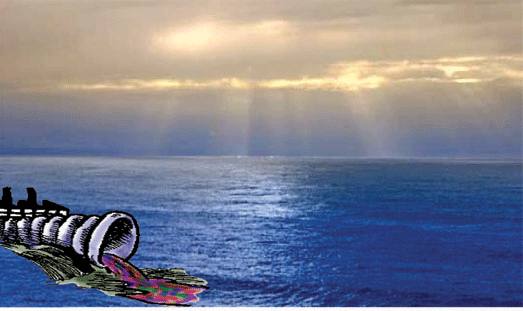
IAEA team in Japan to help prepare Fukushima water release
An International Atomic Energy Agency mission has arrived in Japan to help prepare for a decades-long release into the ocean of treated but still radioactive water from the wrecked Fukushima nuclear plantBy MARI YAMAGUCHI Associated Press7 September 2021 TOKYO — An International Atomic Energy Agency mission arrived in Japan on Monday to help prepare for a decades-long release into the ocean of treated but still radioactive water from the wrecked Fukushima nuclear plant, officials said.
The three-member team will meet with officials in Tokyo and travel to the Fukushima Daiichi plant to discuss technical details with experts until Friday, IAEA and Japanese officials said.
The team, headed by Lydie Evrard, head of the IAEA’s Department of Nuclear Safety and Security, is gathering information to prepare a review of the discharge plans.
The Japanese government and the plant’s operator, Tokyo Electric Power Company Holdings, announced plans in April to start releasing the water in the spring of 2023 so hundreds of storage tanks at the plant can be removed to make room for other facilities needed for its decommissioning.
The idea has been fiercely opposed by fishermen, residents and Japan’s neighbors, including China and South Korea.
The utility plans to send the water through an undersea tunnel and discharge it from a location about 1 kilometer (0.6 mile) away from the coastal power plant after further treating and diluting it with large amounts of seawater…….. https://abcnews.go.com/Technology/wireStory/iaea-team-japan-prepare-fukushima-water-release-79857833
Pacific environmentalists call on Japan not to empty radioactive wastewater into the Pacific
This year marks the 76th anniversary of the first use of nuclear weapons
for the purpose of war. As the world solemnly observes the tragic
anniversary of the bombings of Hiroshima and Nagasaki, we wish to highlight
the Pacific’s own and often overlooked nuclear history that followed.
Asguardians of the world’s largest ocean, we emphasise again our continuing
concern for our region and the irreparably damages on our people and the
environment from 318 nuclear weapons tests undertaken by the United States,
United Kingdom and France.
Today, we acknowledge that our region has still not healed from this trauma and that we did not consent. Given this legacy, we call on Japan to not repeat this brutality through its proposed act of
discharging over a million tonnes of radioactive wastewater from Fukushima.
Pasifika Environews 6th Sept 2021
A Just Recovery Renewable Energy Plan for Africa

Friends of the Earth Africa today launched ‘A Just Recovery Renewable Energy Plan for Africa’ which offers a practical and much-needed opportunity to change the trajectory of energy development, distribution, and access on the African continent.
The report stresses the urgency to democratise energy systems, reduce the power of transnational corporations and enable peoples and communities to access sufficient energy to live a dignified life. The report which was launched during a webinar with key climate justice voices demands a complete shift from current dirty energy systems to achieve 100% Renewable Energy in Africa.
The plan found that it is technically and financially feasible, with an annual investment requirement of around US$130 billion per year. It lays out clear targets for this vision, with over 300GW of new renewable energy by 2030, as agreed
by the African Union, and over 2000GW by 2050. It also shows that the finance and investment needed to achieve the 100% renewable energy goal can be done through public finance from the global North, ending tax dodging and dropping the debt.
All Africa 2nd Sept 2021
Walking the nuclear dog – a South African tale

Walking the nuclear dog – a South African tale, ESI Africa, By Chris Yelland, managing director, EE Business Intelligence, 6 Sept 21
Apparently, in government, there is an activity known as “walking the dog” – a strategy intended to keep self-serving politicians, officials and stakeholders quiet, and to calm them down when they are getting agitated and fidgety for some of the action.
Of course, there is some excitement at the prospect of sniffing out the territory on a brisk walk, with the anticipation that something big is on the cards. But this is inevitably short-lived, and things soon revert back to the normal and more leisurely state of inaction. Mission accomplished.
There are some examples of this in the coal and nuclear energy sectors of South Africa. The media and the public need to be careful not to be bamboozled by the noxious smoke and mirrors, sometimes radioactive, that emanate from these quarters in their excitement.
2,500MW of new nuclear power?
However, in the days following the board meeting, Nersa seemed to be acting very coy – firstly about clarifying exactly what it was that the board had concurred with, and secondly, whether this was even a concurrence by Nersa after all, as opposed to a conditional concurrence that was still subject to a number of suspensive conditions.
Of course, the independent Regulator was treading a very delicate line – to at least give the appearance that the noisy nuclear sector had got its way, while covering all political bases and legal angles, protecting its fragile reputation, and taking care not to become the scapegoat for scuppering the nuclear ambitions of a fractious Minister.
However, on 3 September 2021, Nersa finally succumbed to the growing pressure to release full details of its actual decision on 26 August 2021, with the reasons for the decision (RFD) to follow in due course. In so doing, the tricky game that Nersa was having to play became clearer.
Following a meeting by the board of the National Energy Regulator of South Africa (Nersa) on 26 August 2021, there were breathless public statements to the media by officials at the Department of Mineral Resources and Energy (DMRE) regarding a decision by the Regulator in respect of 2,500MW of new nuclear power in South Africa.
The Regulator was said to have “concurred” with a so-called Section 34 ministerial nuclear determination in terms of the Electricity Regulation Act (ERA). Some in the media fell for this hook, line and sinker. The nuclear energy sector was ecstatic, asserting that the procurement of 2,500MW of new nuclear power in South Africa would now commence.
Suspensive conditions?
Contrary to the public statements and media interviews by DMRE officials, written details of the board decision reveal that Nersa has in fact not yet concurred with the Section 34 determination per se, but that such concurrence is still subject to a number of suspensive conditions which have not yet been met.
The precise wording of Nersa’s decision of 26 August 2021 in respect of the suspensive conditions, indicate that the Energy Regulator has decided:
To concur with the commencement of the process to procure the new nuclear energy generation capacity of 2,500MW as per Decision 8 of the Integrated Resource Plan for Electricity 2019 – 2030 … subject to the following suspensive conditions:
Satisfaction of Decision 8 of IRP 2019 – 2030, which requires that the nuclear build programme must be at an affordable pace and modular scale that the country can afford because it is no regret option in the long term;
- Recognition and taking into account technological developments in the nuclear space; and
- To further establish rationality behind the 2,500MW capacity of nuclear. A demand analysis aimed at matching the envisaged load profile post 2030, with the generation profile that would be needed to match that load profile, is required. This will assist to determine the capacity and the scale at which the country would need to procure nuclear.
It is thus clear that Nersa is only concurring with Decision 8 of the current Integrated Resource Plan for Electricity, IRP 2019 – 2030, to “commence preparations for a nuclear build programme to the extent of 2,500MW”, with this itself being subject to the suspensive conditions listed.
The Regulator is not concurring with the commencement of a request for proposals (RFP) for new nuclear power in South Africa, nor is Nersa giving the green light to any new nuclear construction programme.
Not so fast please!
It goes without saying that any public procurement must still comply with the requirements of the Public Finance Management Act (PFMA) and the Constitution. As such, National Treasury remains a gatekeeper through the requirement for a positive outcome to a detailed cost-benefit analysis, and the requirement for National Treasury to establish the affordability of any such procurement.
It is still far from resolved as to the technology to be used for a nuclear new-build programme in South Africa. Would these be giant pressurised water reactors (PWRs) such as the Rosatom VVER 1200 units? Or small modular nuclear reactors (SMRs) that still have to be developed, piloted, commercialised, licenced and proven elsewhere in the world?
The suspensive conditions even indicate that the very rationality of a 2,500MW nuclear new-build programme still needs to be established through long-term demand forecasting for the period post-2030 in order to determine the mix of the generation capacity required to meet that demand.
Finally, as no new nuclear power is provided for in the current IRP in the years to 2030, it is clear that any new nuclear procurement can only commence, at the earliest, after an updated IRP has been considered by government’s “social partners”, approved by the Cabinet, and promulgated.
1,500MW of new, clean, coal-fired power?
A further example of “walking the dog” may be found in ongoing suggestions by the Minister and his officials at the DMRE that “clean coal” technologies can be deployed……………….
The 9,600MW nuclear fleet?
Yet another case of “walking the dog” was detailed in an article in Daily Maverick on 26 August 2021. In the article, former Deputy Finance Minister Mcebisi Jonas reveals that there was a general understanding in government that the 9600 MW nuclear deal with Russia, being pushed in 2017 by then-President Jacob Zuma and Energy Minister David Mahlobo, would be terrible for South Africa.
| According to Jonas, President Ramaphosa’s instruction was to “walk it” as long as possible. “He [Ramaphosa] said that by the time we have to make a decision, Zuma will be gone. He told us to find everything in the book to delay”.Does a question arise as to whether the upsides of dog walking really outweigh the downsides? It is hard to give a clear answer to this question, but it would seem that our President clearly prefers walking the dog to dealing firmly with self-serving elements within the party circle.However, a poorly-founded but nagging question keeps popping up as to what Vice-President DD Mabuza was really up to during his extended five-week leave of absence in Russia in July 2021?Putin would likely be a big, vicious dog, ready for a fight, and not easily controlled on the walk – actually more of a bear than a dog. And I would hate to be walking a grumpy bear. https://www.esi-africa.com/industry-sectors/generation/op-ed-walking-the-nuclear-dog-a-south-african-tale/ |
1 This Month
Tell Congress: Prevent Nuclear Catastrophe in Iran

Tell Congress: Prevent Nuclear Catastrophe in Iran

Read the Public Inquiry Report, the Commissioners’ report, Surrendering Australia: The AUKUS Deception is available to download for free at aukuspublicinquiry.com. Or just watch the replay of the National Press Club Luncheon.


Shut down the radiation-damaged Heysham nuclear reactors now
To see nuclear-related stories in greater depth and intensity – go to https://nuclearinformation.wordpress.com

Say No to NASA’s Reckless Nuclear Reactor on the Moon
Say No to NASA’s Reckless Nuclear Reactor on the Moon
-
Archives
- November 2026 (246)
- October 2026 (302)
- September 2026 (339)
- August 2026 (330)
- July 2026 (355)
- June 2026 (287)
- May 2026 (306)
- April 2026 (356)
- March 2026 (251)
- February 2026 (267)
- January 2026 (308)
- December 2025 (358)
-
Categories
- 1
- 1 NUCLEAR ISSUES
- business and costs
- climate change
- culture and arts
- ENERGY
- environment
- health
- history
- indigenous issues
- Legal
- marketing of nuclear
- media
- opposition to nuclear
- PERSONAL STORIES
- politics
- politics international
- Religion and ethics
- safety
- secrets,lies and civil liberties
- spinbuster
- technology
- Uranium
- wastes
- weapons and war
- Women
- 2 WORLD
- ACTION
- AFRICA
- Atrocities
- AUSTRALIA
- Christina's notes
- Christina's themes
- culture and arts
- Events
- Fuk 2022
- Fuk 2023
- Fukushima 2017
- Fukushima 2018
- fukushima 2019
- Fukushima 2020
- Fukushima 2021
- general
- global warming
- Humour (God we need it)
- Nuclear
- RARE EARTHS
- Reference
- resources – print
- Resources -audiovicual
- Weekly Newsletter
- World
- World Nuclear
- YouTube
-
RSS
Entries RSS
Comments RSS

