16-meter seawall planned for Fukushima Daiichi
September 14, 2020
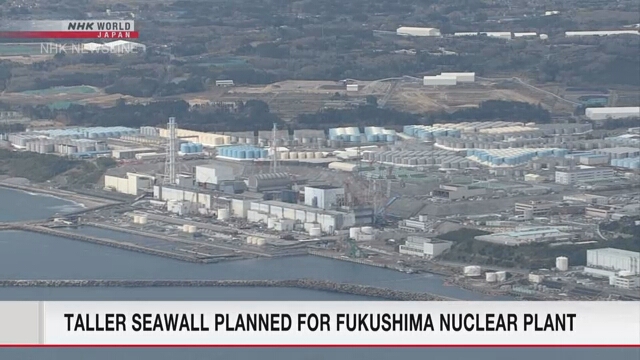
The operator of the damaged nuclear power plant in Fukushima, northeastern Japan, plans to build a taller seawall to help protect against future high seismic sea waves.
The move comes in response to the projection made in April by a government panel on the scale of tsunami that could be triggered by a massive quake along the Japan Trench in the deep sea off northeastern Japan.
The Tokyo Electric Power Company, or TEPCO, analyzed the projection and found that waves as high as 14.1 meters could engulf the Fukushima Daiichi plant compound, where the No.1 to No.4 reactors are located. It also found that waves of up to 15.3 meters high could hit south of the No. 4 reactor.
An 11-meter seawall is under construction on the ocean side of the plant compound. In an area south of the No. 4 reactor, another sea wall that is 12.8 meters high has already been completed.
TEPCO officials on Monday agreed to build another seawall measuring up to 16 meters high to protect these areas before the end of March 2023.
The wall is one of the anti-tsunami measures being taken by TEPCO as it decommissions the plant.
Work is under way to block the openings of the reactor buildings. Power supply vehicles are also deployed on higher ground to continue cooling spent nuclear fuel.
Nearly 1,000 tanks of radioactive wastewater are stored in the compound. TEPCO says the projected tsunami won’t reach the higher ground where these tanks are located.
“The nuclear plant took everything…”
“The nuclear plant took everything…” Kenichi Hasegawa was the local leader of Maeta District of Iitate Village, where even today mountains of bags of contaminated soil stand out. “The nuclear plant took everything. There used to be children here. When the kids were still here, we went to the hills together all the time. We picked many things, taught them all about it, it was natural. We can’t do anything like that any more. I mean, even the children are no longer here,” he says.
https://311mieruka.jp/index_en?fbclid=IwAR3zrBtrrkMhJ_gZeWTEzgt4RcTkehWePR7Q-Mzvg9fsW6Jk4Rq9vx3_snQ
Radioactive soil plan casts shadow over Fukushima village
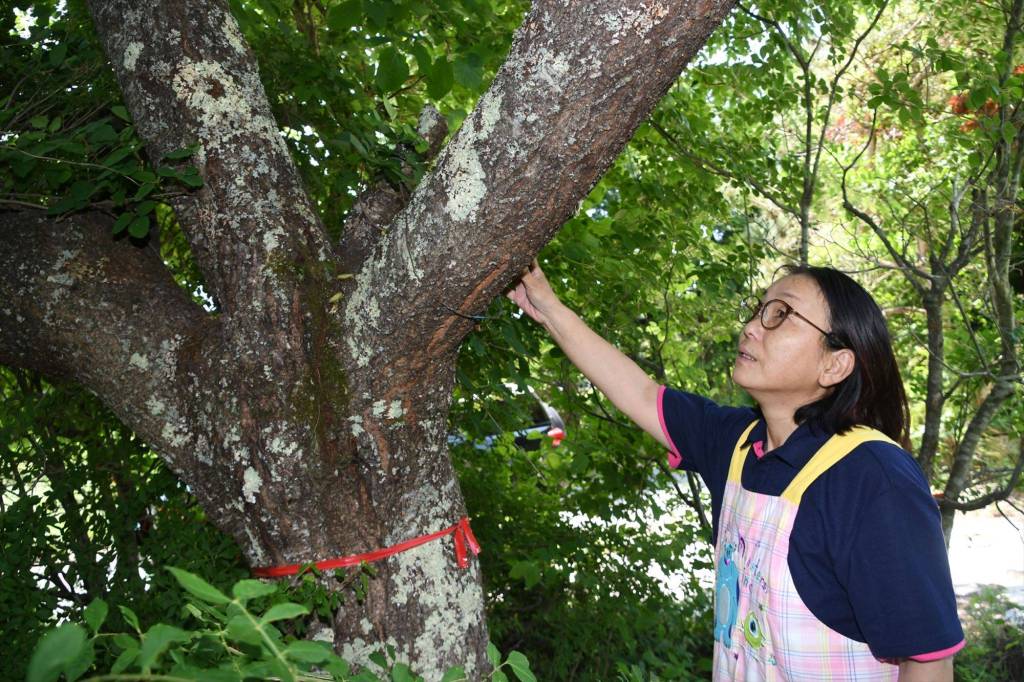
Keiko Shigihara used to make pickles out of flower petals from a cherry tree at her former home in Fukushima Prefecture.
Sep 11, 2020
Keiko Shigihara, 58, soaks up the summer sun as she looks over her property in the village of Iitate in Fukushima Prefecture, from where she evacuated after the meltdowns at the Fukushima No. 1 nuclear power plant following the March 2011 earthquake and tsunami.
The land where her home used to be is now an empty lot. Cherry trees and oak trees are the only things left.
Shigihara remembers the days when she used to make homemade salted cherry blossoms and rice cakes wrapped in oak leaves.
“It’s sad but there’s nothing to be done now except look forward,” said Shigihara, who evacuated to the city of Fukushima after the calamity.
Iitate’s Nagadoro administrative district, where her home was located, was designated a no-go zone due to its high radiation levels. But the Environment Ministry later designated the district as an area where radiation-tainted soil removed as part of the decontamination process would be reused to fill the land for farming.
The project is slated to begin by March 2021.
Shigihara was born in the town of Futaba, which is located on the coastline of Fukushima Prefecture — one of the areas hardest hit during the 2011 earthquake.
After graduating from high school in Futaba, she met Yoshiyuki, now 59, a native of Iitate, and the two married. She moved into his home, where her in-laws also lived, in Nagadoro in 1988 and helped out with farming. She raised her two daughters there, too.
The Nagadoro district, which is located in the southern part of the village, is a well-preserved area surrounded by mountains.
Different types of fish can be found in the nearby Hiso River, and Shigihara often made meals with fresh vegetables grown in the fields or plucked from the mountainsides.
“I bet you’re glad you married someone living in Iitate,” Shigihara’s late father-in-law used to say.
That peaceful lifestyle was upended in 2011. Life in evacuation, bleak as it was, continued for years, and the family did not know if they could ever return or what would happen to their home.
But, at the end of 2016, the government said, out of the blue, that it was planning to bury the contaminated soil to create arable land.
“Contaminated soil was supposed to be taken to an intermediate storage facility” where it’s preserved safely, Shigihara said. She was worried whether it was safe to bury it in the ground.
Naturally, the plan drew concern from local residents.
Deliberation between the central government, the village and its residents spanned a year.
Local residents were worried about whether it was possible for people to live there again if they were to go ahead with the project, or that a damaging reputation would haunt agricultural products harvested there.
But the government pressed on, saying it will be an experimental case to reuse contaminated soil in local areas. The government ensured it would also closely monitor radiation levels in the air and conduct tests to make sure the produce is safe.
In the end, locals gave in and the project was given the green light in November 2017.
In April 2018, 186 hectares of the Nagadoro administrative district’s 1,080 hectares were designated for the project. The village of Iitate proposed in May to lift evacuation orders.
At the end of last year, Shigihara’s cherished home was demolished for the plan. Watching it be torn down would have been too painful, so she waited to return until after it was done.
“Anything to help my hometown recover,” she said.
Fresh produce is being cultivated nearby and experiments have been conducted to plant crops on contaminated soil without adding a layer of uncontaminated soil.
In the long wait for Nagadoro’s residents to return home, the clock has finally begun moving again.
This section features topics and issues covered by the Fukushima Minpo, the prefecture’s largest newspaper. The original article was published Aug
https://www.japantimes.co.jp/news/2020/09/11/national/iitate-fukushima-contaminated-soil/
Fukushima Has Turned These Grandparents Into Avid Radiation Testers
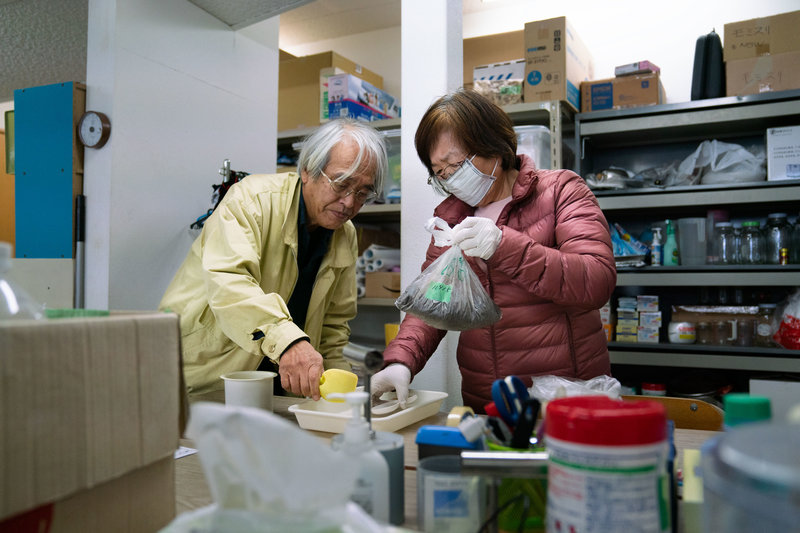
Takenori Kobayashi (left) and his wife Tomoko Kobayashi bring soil samples into what they refer to as a “grandma and grandpa lab” to test it for radiation, in Fukushima prefectures
September 11, 2020
Takenori Kobayashi lugs a garbage bag full of soil across a parking lot to an unmarked office. His wife, Tomoko, holds the door to a tiny work space with lab equipment and computers set up. On the edge of Fukushima’s former nuclear exclusion zone, this is the place the couple likes to call their “grandma and grandpa lab.”
It started as a makeshift operation in the city of Minamisoma the year after the 2011 nuclear disaster, when people — mostly elderly — returned to the area and were worried about high radiation levels in their food and soil.
“We’ve given up hope that our children and grandchildren will come back to live here,” Tomoko, 67, says. Most young people decided to start lives elsewhere rather than return, not wanting to take the risks with radiation. “But in order for them to come back and visit us,” she continues, “we need to know everything is safe. So we test it all.”
Citizen science like this flourished in Fukushima after the nuclear disaster in 2011, when a tsunami triggered explosions at the Daiichi Nuclear Power Plant. The wind carried radioactive material for miles, covering whole towns and neighborhoods with dangerous, yet invisible, particles. For weeks after the disaster, information was scarce and trust in the Japanese government plummeted. And now, almost a decade later, wide arrays of residents have taken it upon themselves to collect radiation data — from mothers worried about their kids to surfers monitoring beaches to individuals with Geiger counters in their homes — to help regain a sense of control.
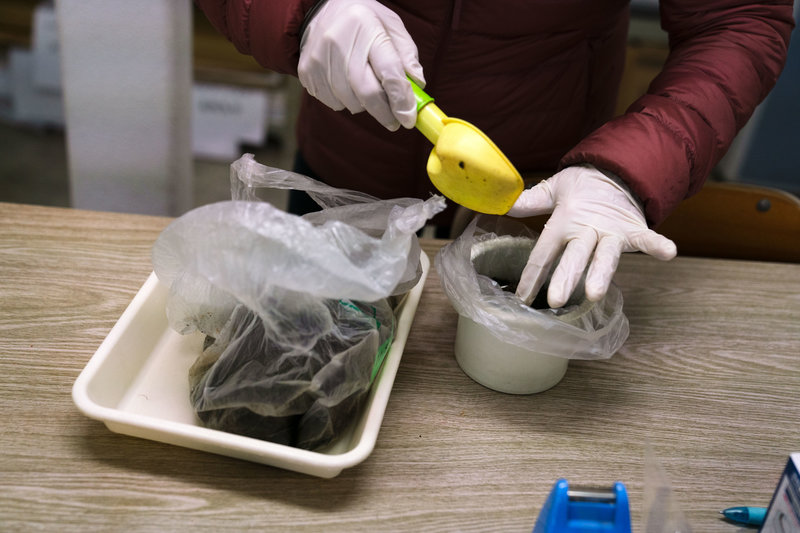
Tomoko measures soil into a container that will go through a donated gamma counter, a big cylindrical machine that measures radioactive particles.
Inside the lab, the Kobayashis pair get to work. One measures out soil into small containers, the other starts labeling — so coordinated and practiced, it’s almost like a dance. They put the samples through a donated gamma counter, a big cylindrical machine that measures radioactive particles. Today, they’re testing soil from a nearby farm.
A handful of other residents help run the lab, and throughout the years, experts from nearby universities have come to teach them all about the different equipment and radiation science.
“All the grandparents here are radiation professionals now,” Takenori, 71, says with a smile.
Before the disaster, he was an accountant, and Tomoko helped run a nearby inn that has been in her family for generations. When the disaster happened, they were forced to evacuate for five years. But when they were allowed to come back home in 2016, they reopened the inn — and learned everything they could about radiation.
“We never thought we’d be doing this. What normal person would expect this?” says Tomoko with a chuckle. “But anyone who faces this kind of situation has to become a scientist to survive.”
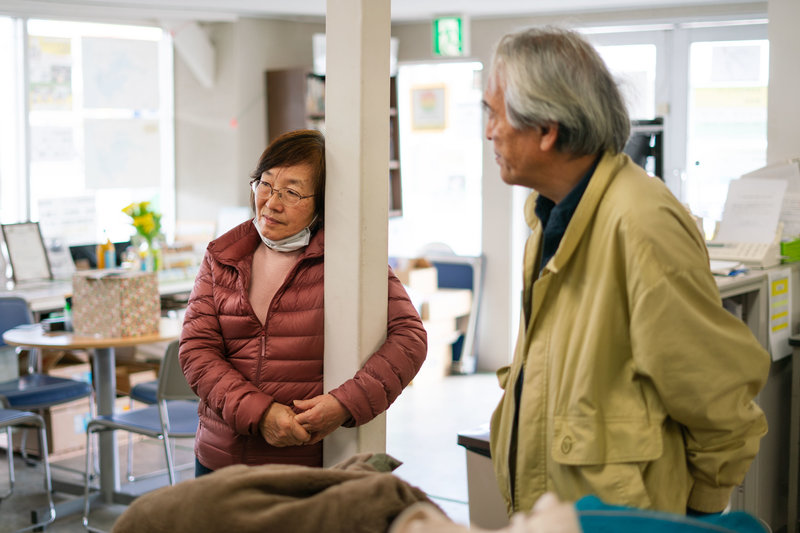
Tomoko and Takenori were forced to evacuate Minamisoma after the disaster, but after five years, they returned to reopen Tomoko’s family inn.
Takenori points to colorful radiation maps of the area hanging on the wall. The couple made them, along with a team of volunteers, using donated Geiger counters — hand-held devices used to measure radiation — over the past few years as more neighborhoods reopened to the public.
“It is important for us to visualize the invisible,” he says. “We needed to see it.”
The maps show that Fukushima’s radiation levels are decreasing, because of both natural decay of particles and large-scale Japanese government decontamination efforts. But there are still a lot of hot spots — places where radiation is worryingly high. The authorities have tried to ease concerns, testing food in supermarkets and setting up radiation monitors in public parks, outside train stations or flashing along highways, but trust in the government is still extremely low. Many residents say they still feel best collecting information themselves.
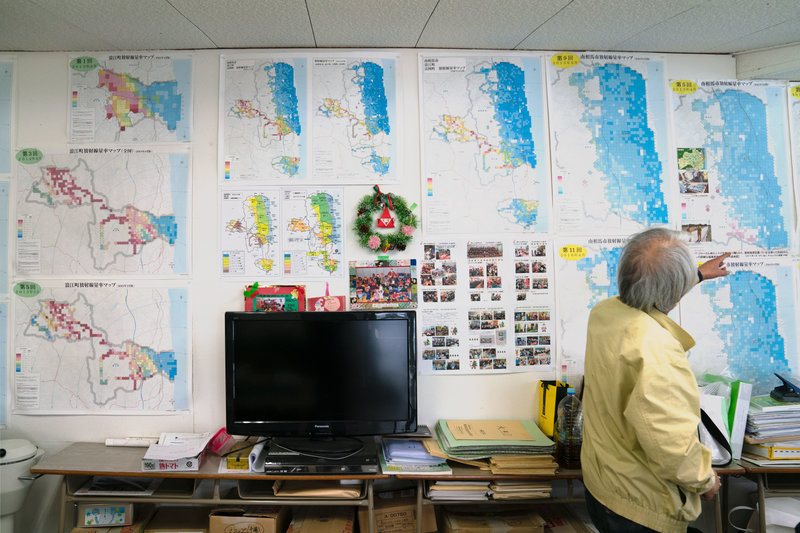
Maps hang on the wall of the lab where the Kobayashis do radiation testing. The maps, one part of their work, were created by a team of volunteers who took air measurements. The maps show that the radiation levels in Fukushima are decreasing.
One of the original citizen data operations in Fukushima is called Safecast. The nonprofit organization formed in the immediate days after the disaster, when it became clear that accurate radiation information was not available. Safecast started building and distributing radiation monitors in Fukushima, and then putting all the data online for public use.
Now, nearly a decade later, Safecast has hundreds of devices in the area around the Daiichi nuclear power plant, with dozens of local residents helping to take hundreds of readings a day. There’s even one hanging in the Kobayashis’ inn.
“We found that simply allowing people to take measurements themselves, and have a way to compare it to government data was really important for their peace of mind, for their sense of agency,” says Azby Brown, the lead researcher at Safecast.
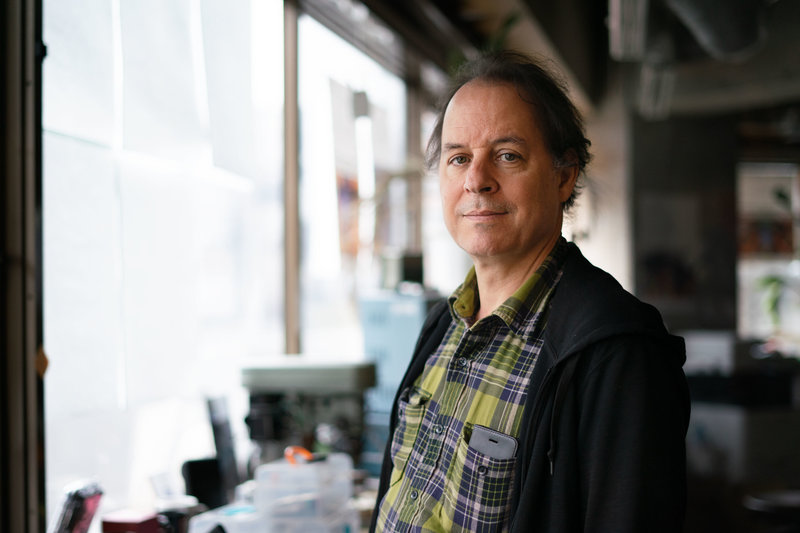
Azby Brown is the lead researcher at Safecast, an organization that formed in the immediate days after the disaster. It builds and distributes radiation monitors in Fukushima, and puts all the data online for public use.
Part of the reason people want to collect data themselves and compare it is because even after more information became available, it was often contradictory. The United Nations and the International Commission on Radiological Protection have published reports saying that radiation risks in Fukushima are low. Other organizations, like Greenpeace, dispute those findings. The Japanese government insists that the areas being reopened are safe. But many are quick to point out that the government raised the legal limit of radiation exposure in this part of Fukushima prefecture after the disaster — meaning that many of these areas wouldn’t necessarily be considered safe in other parts of Japan or the world.
Brown says that giving people the ability to collect and understand their own data can help them ease their anxiety and make decisions based on their personal comfort.
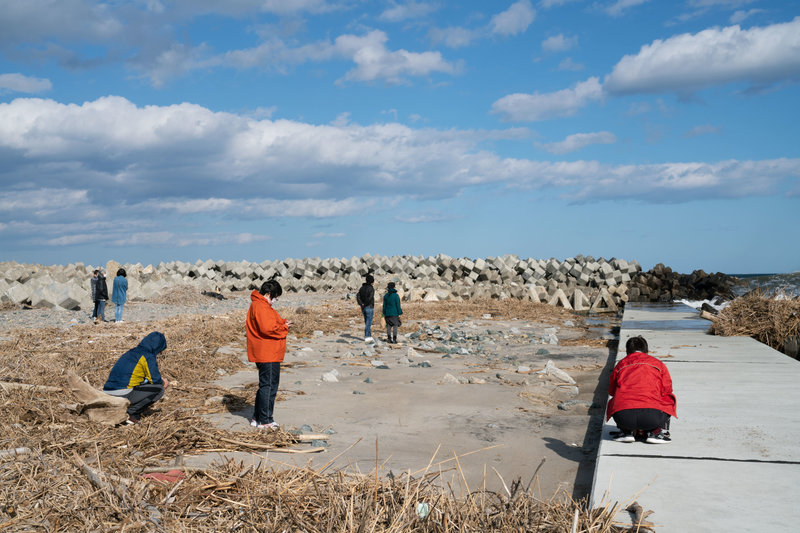
People stand near the ocean in Japan’s Fukushima prefecture, commemorating the ninth anniversary of the tsunami and nuclear disaster.
“Some people will look at the data and say, ‘Oh my God, I’m leaving,’ ” Brown says. “Other people will say, ‘Oh, you know, it’s not as bad as I feared, maybe I’ll stay.’ And yet others will say, ‘Well, it’s pretty bad, but now at least I know what I’m facing and I know how hard it’s going to be.’ “
That last option is ultimately how the Kobayashis felt when they decided to come back after their neighborhood was reopened in 2016. By that point, Tomoko had gotten a Geiger counter. She remembers how empowering it felt to know and understand the reading. It was low enough for the pair, something they both felt comfortable with.
“I was so relieved,” she says, “I knew I could come home.”
But now, Tomoko says, a new invisible threat has her worried — the coronavirus. She says a lot of the anxiety everyone is feeling now reminds her of how she felt back in 2011. She has stocked up the inn with cleaning supplies, hand sanitizer and cloth face masks. But the travel sector has plummeted during the pandemic.
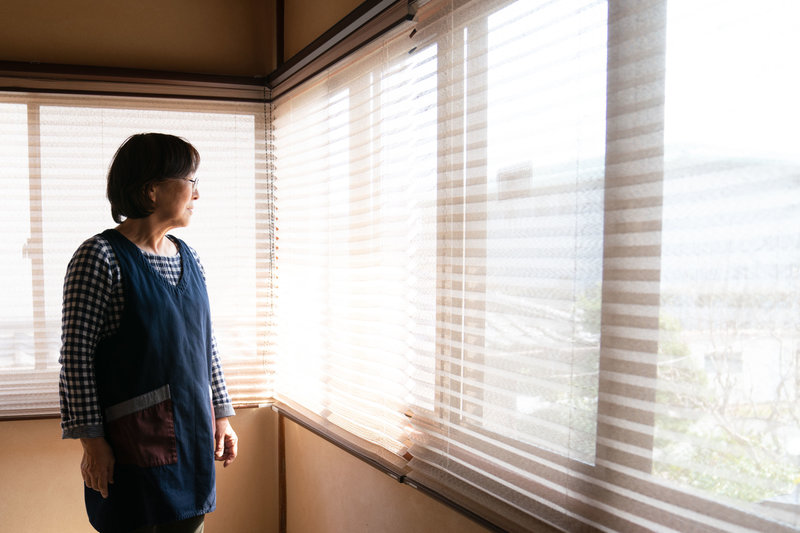
Tomoko stands at the inn in Fukushima prefecture that has been in her family for generations.
“Radiation is a bit similar to the virus,” she says sitting at the kitchen table of her inn. “It doesn’t have any smell, you can’t feel it, you can’t see it.”
Tomoko says she is, of course, aware that the two are very different, but the parallels have been striking to her. She remembers back in March and April, when she saw cities like London and New York looking abandoned and empty on TV. It reminded her of the towns in Fukushima, right after the disaster. It brought back a lot, she says.
“As long as you have a Geiger counter, you can detect radiation,” she says. “But with the virus, there is no Geiger counter.”
Tomoko says, like many of us, she’s eager for science to help find one.
Mr Sugeno Seiji, farming organically in Nihonmatsu City, Fukushima Prefecture
September 11, 2020
Through the nuclear power plant disaster, Mr Sugeno reaffirmed the values of farming. His words leave a strong impression: “The nuclear plant stole our hometowns, they create divisions. This must not be repeated.” “We people of Fukushima need to share our story. To change lifestyles, to change policies. To stand up to the government, to farm our fields, this is want we want to continue to do.”
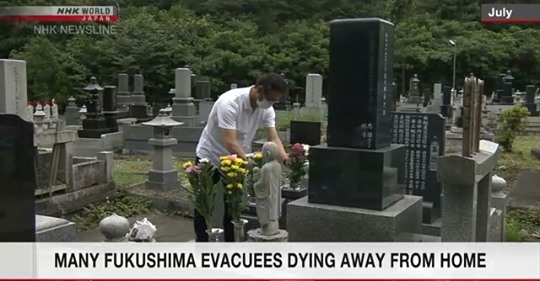
Many Fukushima evacuees die away from home
September 9, 2020
NHK has learned that more than 2,600 people have died over the ensuing years after being evacuated from their hometowns following the meltdowns at the Fukushima Daiichi nuclear power plant in March 2011.
NHK contacted local governments in Fukushima Prefecture and found that at least 2,670 people, about 10 percent of the original population, had died as of August. More than 26,500 people lived in seven municipalities near the plant. Where they lived have been designated no-entry zones for nearly nine and a half years because radiation levels remain high.
By municipality, 895 people from Okuma Town have died, 792 from Futaba Town, 576 from Namie Town, 362 from Tomioka Town, 32 from Iitate Village, 12 from Katsurao Village, and one from Minamisoma City.
The Japanese government is conducting decontamination work and rebuilding infrastructure in some areas with the aim to allow residents to return in two or three years.
But there is no concrete plan to make other parts, or 92 percent of the no-entry zone, habitable again, despite the strong hope of residents to return home.
2011 Fukushima nuclear disaster museum to open in Futaba town
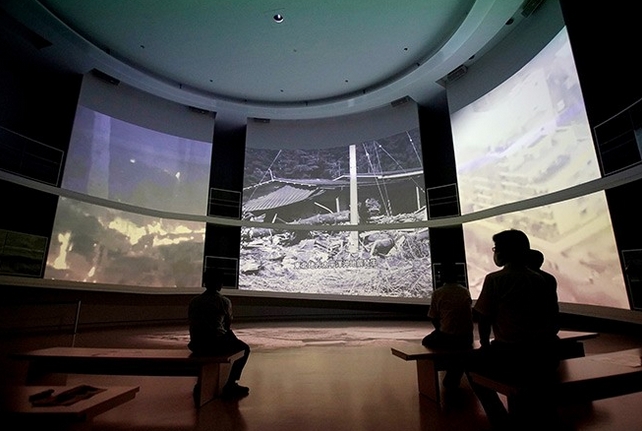
A theater at the museum of Great East Japan Earthquake and nuclear disaster that will open to the public on Sept. 20 in Futaba, Fukushima Prefecture
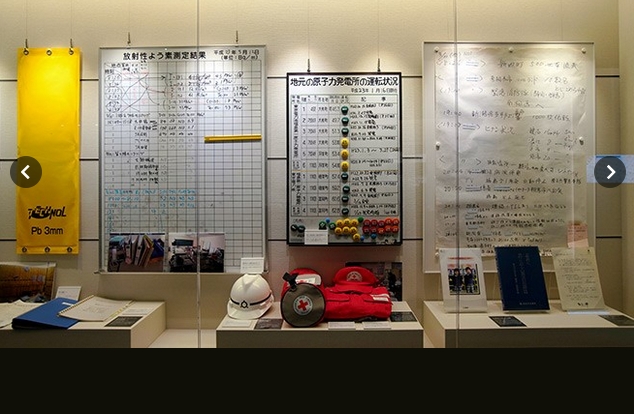
Whiteboards and other items that reveal the tense post-accident situation are on display at the new museum of the Great East Japan Earthquake and nuclear disaster in Futaba, Fukushima Prefecture.
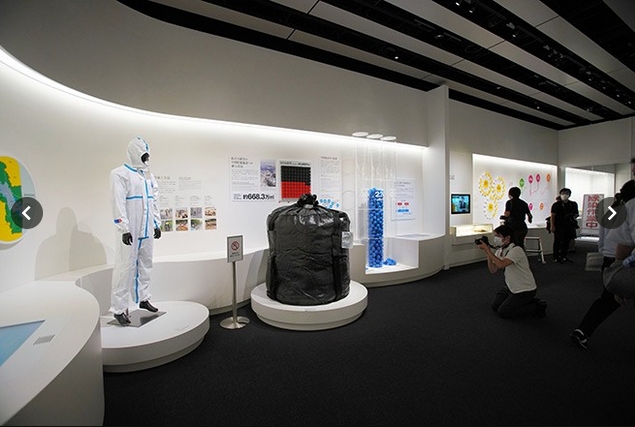
An exhibit about decontamination work after the 2011 accident at the new museum of the Great East Japan Earthquake and nuclear disaster in Futaba, Fukushima Prefecture
September 7, 2020
FUTABA, Fukushima Prefecture–A new 5.3 billion yen ($50 million) museum here is entrusted with the mission of keeping lessons from one of the world’s worst nuclear disasters alive.
The museum of the Great East Japan Earthquake and nuclear disaster in Futaba, Fukushima Prefecture, which co-hosts the crippled Fukushima No. 1 nuclear plant, is now complete and waiting to welcome visitors on Sept. 20.
It will feature firsthand accounts from survivors of the massive earthquake, tsunami and nuclear power plant accident, which devastated areas of Japan’s Tohoku region in March 2011, and an array of artifacts reflecting the events.
The museum’s collection includes roughly 150 items selected from the 240,000 items that the prefectural government collected after the triple disaster.
Exhibition floors are divided into six zones by themes such as “responses to the nuclear accident” and “challenges for reconstruction.”
A video detailing the natural disaster and subsequent meltdown at the Fukushima No. 1 nuclear power plant, operated by Tokyo Electric Power Co., will be shown on a giant screen.
Toshiyuki Nishida, an actor from the prefecture, narrates the video, in which he encourages viewers to reflect on lessons from the disaster.
Items left abandoned at a local elementary school after residents evacuated are on display, including a bookbag, a glove and a folding umbrella.
Another item, a can of food left behind at a deserted house, conveys just how dire the post-disaster situation was: a wild boar seeking sustenance tore it open.
A large photo of a now infamous signboard that used to be on display in the center of Futaba town to promote the safety myth of nuclear power is also among the exhibited items.
Twenty-nine people who survived the disaster in and out of the prefecture are scheduled to share their experiences with visitors at the museum.
The central government, in principle, was responsible for financing the museum’s construction, including funds spent on collecting items and curating materials.
Akira Imai, a former public policy professor at Fukushima University, lamented something missing from the museum.
“It seems there are not many exhibits focusing on the lack of preparedness before the nuclear accident,” he said.
In order to carry out its mission, “the museum should enhance its investigative and research division and reflect the cautionary tale of the accident in its exhibits,” Imai said.
(This article was written by Shoko Rikimaru and Shinichi Sekine.)
Fukushima Prefecture Announces New “High-Quality” Rice, Branding
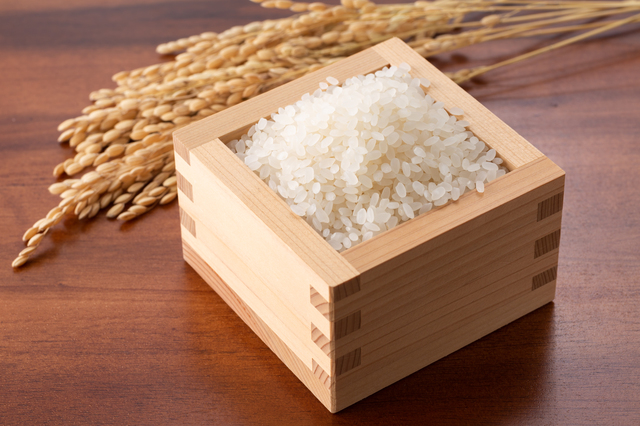
September 4, 2020
With the announcement of a new variety of top-tier rice, Fukushima hopes to further unravel the unfair stigma of the 2011 tsunami.
On Monday, Fukushima Prefectural Governor Uchibori Masao stood before the gathered press and held aloft an indigo-blue print. The painterly, dark-blue brushstrokes depicted rice fields, mountains, and farmers planting and harvesting grains. Below, in the same vibrant indigo, were the words 「福、笑い」: Fuku, Warai, or “Luck, Laugh.” This was the just-announced official design for Fukushima Prefecture’s new high-quality rice cultivar. Fittingly for Fukushima (福島, literally “Lucky Island”), the brand would bear that same “lucky” kanji in its name.
The global image of Fukushima, of course, is not one most would describe as “lucky.” Indeed, the vast prefecture – Japan’s third-largest by area – is often intrinsically associated with the 3/11/2011 nuclear catastrophe at the Fukushima Daiichi nuclear power plant. Infamously, the disaster resulted in a zone of exclusion which forced 165,000 residents from their homes. Early government mismanagement of the crisis resulted in a Japanese populace who often distrusted official statements about local food safety. With the name “Fukushima” appended to the plant, the reputation of the entire prefecture and its people suffered.
This was doubly true for those who worked in Fukushima’s vaunted agricultural sector.
A Prefecture Recovering, an Industry Besmirched
Nearly a decade on from the disaster, the zone of exclusion has shrunk dramatically. Villages, once ghost towns, are reopening. Less than 3% of the prefecture remains off-limits. (In fact, at its greatest extent, the ZOE covered less than 6% of the prefecture.) Years of stringent testing have long proven Fukushima-grown produce to be safe. Yet, still, the stigma lingers. The South Korea Olympic Committee announced last year that it planned to bring radiation detectors and Korean-produced food to the (now-postponed) 2020 Tokyo Olympics. They aimed to avoid athletes consuming any Fukushima products.
Such fear-mongering has been especially difficult for farmers in Fukushima. This is in part because the prefecture was actually famous for its high-quality produce previous to the disaster, Fukushima produced 20.6% of the country’s peaches and 8.7% of its cucumbers. The prefecture’s real agricultural showstopper, however, is its rice.
Lucky Island, Lucky Rice
Fukushima is a mountainous land. In particular, parts of the western Aizu region have nary a flat plain in sight. Here, snowmelt from the mountain peaks runs down into regional rice paddies. This pure water helps to give Fukushima rice its high-quality flavor.
The soil, too, assists in producing good rice, as do the prefecture’s hot days and cold nights. Popular rice cultivars like Koshihikari and Hitomebore are grown, as well as numerous sake rice varieties. Fukushima rice is of such high-quality that it famously trades off taking first place with neighboring Niigata in national rice flavor competitions most years. Recently, Fukushima rice was honored three years running. The Japan Grain Inspection Association Rice Taste Rankings awarded multiple Fukushima rice brands its “Special A-Class,” leading the prefecture to take first place in 2017 through 2019.
The high-grade rice also yields high-quality sake (日本酒; nihonshu). The perfect combination of rice and water, paired with breweries with long years of experience, has resulted in some of the country’s best rice wines. Subterranean rivers flowing from Mt. Bandai; water sourced from the Abukuma-do cave; Aizu snowmelt; all these waters serve to help make Fukushima’s sake special. In 2018, Fukushima sake won the coveted National Research Institute of Brewing title for an unprecedented sixth year in a row. Breweries like Suehiro, Okunomatsu, and Kokken are just a few of its renowned sake producers.
Yet the perception of Fukushima rice – even that produced in Aizu, more distant from the nuclear disaster than parts of other prefectures – as being potentially contaminated continues to damage the Fukushima agricultural industry. Governor Uchibori almost certainly had this in mind as he sought to create excitement around Fukushima products with the announcement of the prefecture’s new cultivar.
The Birth of Fuku, Warai
Despite the timeliness of its announcement, the prefecture in fact first began designing this new rice strain 16 years ago. According to the rice brand’s official website, “Niigata no.88, descendant of Koshihikari, is its mother; prefectural cultivation-type Gunkei 627, descendant of Hitomebore, is its father.” Quality and taste-testing repeated since 2006. In 2019, the prefecture official decided to promote the rice. After the rice was announced, 6,234 Fuksuhimans submitted possible names for the cultivar; the government chose “Fuku, Warai” so that it might “bring a smile to the faces of those who produce it, those who eat it, and make them all happy.”
More than that, the prefecture announced an even loftier accomplishment. “Through these 14 months and years, we’ve put our all into creating the ideal rice. We’ve arrived at a new rice, brimming with “Fukushima Pride.”
In a promotional video produced by the prefecture, Sakuma Hideaki, head of the horticulture department of the Fukushima Agricultural Research Center, had the following to say regarding the new rice strain: In terms of its flavor, the grain is quite large and possesses a sweet quality. It has a distinct aroma. You could say it has a soft texture as well. These are special qualities that distinguish this rice from previous Fukushima Prefecture original products up until now.
Ritzy Rice
The new cultivar is being produced as a premium rice, meant to compete with the most luxurious rice strains in Japan. The aim is to have the rice on specialty store shelfs by next fall, following a special preview harvest conducted on 6/6 hectares by 13 specially-picked rice producers.
The new packaging announced on Monday was illustrated by Yorifuji Bunpei (寄藤文平), well-known for his “please do it at home” public service posters on the Tokyo metro. Koriyama-native Yanai Michihiko handled the art direction. Regarding the design, Governor Uchibori said, おいしさや魅力がより伝わるよう、関係者と力を合わせてプロモーションに取り組む。 We’ve put together this promotion by joining with those involved in order to properly convey [the rice’s] deliciousness and value.
With any luck, Fuku, Warai will help with the continued rehabilitation of Fukushima’s impressive agricultural industries. Better yet, it may indeed serve as yet another point of pride for the people of Fukushima.
Sources
(2020年09月01日). 福島県オリジナル米「福、笑い」パッケージ青基調 先行販売へ。Fukushima-Minyu Newspaper.
Official Fukushima Prefectural Fuku, Wari Website.
Sternsdorff-Cisterna, N. (2015). Food after Fukushima: Risk and Scientific Citizenship in Japan. AMERICAN ANTHROPOLOGIST, Vol. 117, No. 3, pp. 455–467,
Video analysis prompts new theory on Fukushima explosion
Septembre 4, 2020
Experts revise their theory surrounding a hydrogen explosion at Fukushima Daiichi nuclear power plant in March 2011 based on Nippon TV’s reprocessing of footage an affiliate took of the event.
“KURENAI”Written by KUNIHIRO SUZUKI
Foreword
On March 11, 2011, a magnitude-9 earthquake and subsequent tsunami hit the Eastern Coast of Japan, which triggered the nuclear core meltdown of the Fukushima Daiichi Nuclear Power Plant. This is known as the Triple Disasters of 3.11. Even now, nine years later, the damaged power plants are continually releasing massive amounts of radioactive materials.
The Japanese government has changed the radiation safety standards. Restrictions of radiation exposure to residence was loosened to 20 times than before the disaster. The government has forcefully carried out repatriation policies for us to return home despite high levels of radiation contamination in the area. Few people have returned home. Once lively towns are now silent.
Inconsistency in evacuation policy after the nuclear disaster has left many local communities divided. In the name of the Olympic games, the government placed numerous policies in arbitrary manner, and as a result the people of Fukushima are left in pieces.
Overflowing memories were fiddled bluntly and drifting apart with nowhere to go

Only people continue on as if nothing happened

Convenient excuses alone cannot refill abandoned houses

Beautiful flowers painfully contrast with flexible container bags*, echoing hollowness
*Flexible container bags contain contaminated materials

Exposed to Mushubutsu*, what have the Seven Gods of Fortune witnessed, and what have they pondered?
*TEPCO claims that fallen-out radioactive materials belong to no one (Mushubutsu) and thus they are not responsible for it.
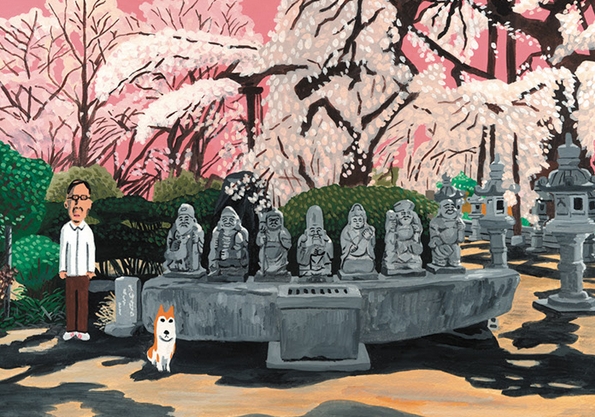
Evacuation orders have been lifted, and new nuclear facilities appear
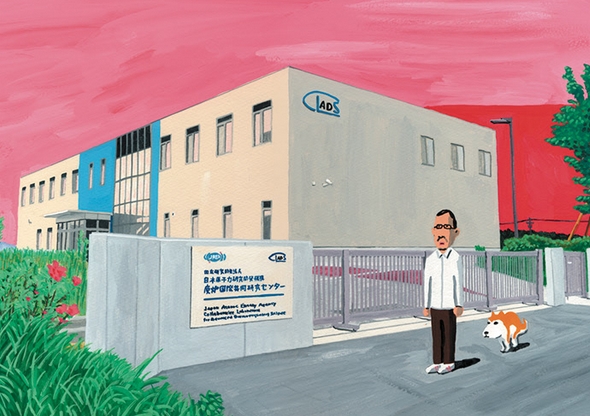
Cherry blossom festivals bring momentary liveliness
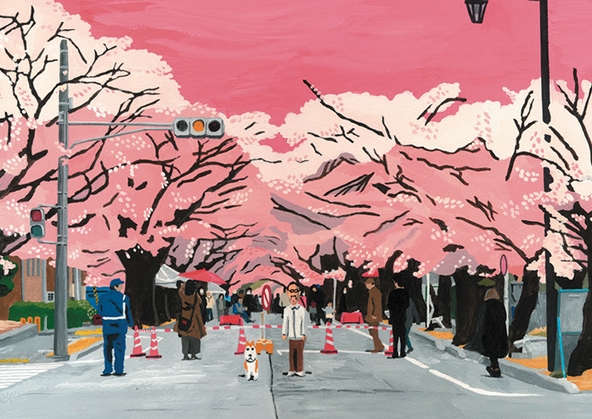
While childless villages are left to decay
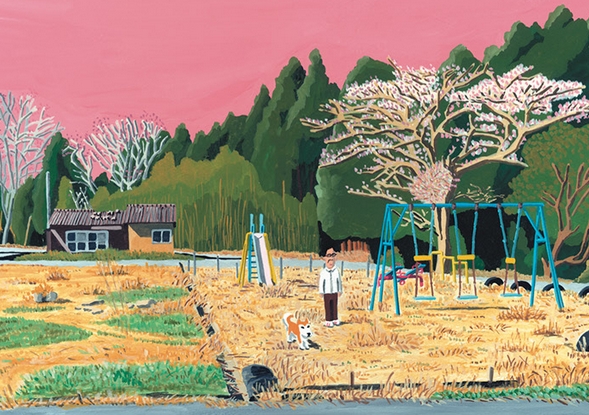
Under a clear blue sky, flowers flourish, birds squeal, wild animals and insects rejoice freedom
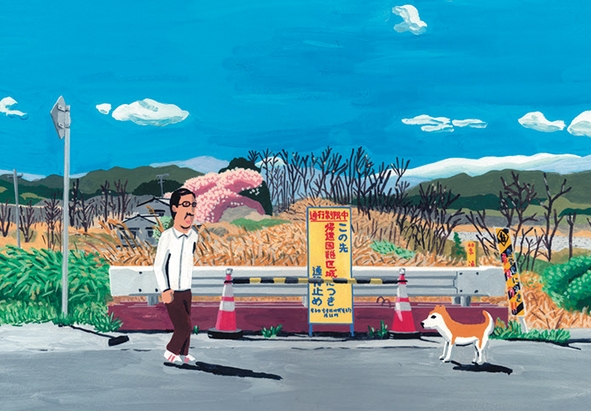
Because Mushubutsu is invisible, Because Mushubutsu is odorless
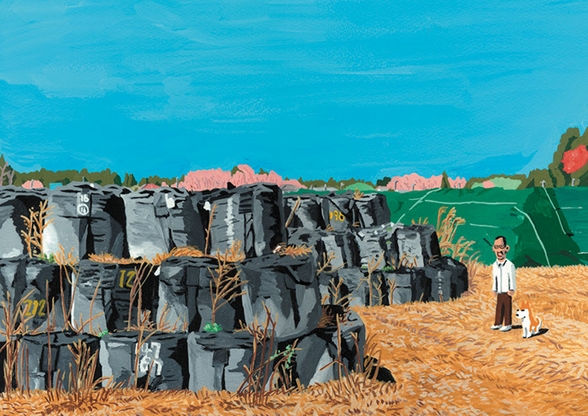
Villages with no more people, Villages with no sound, Villages left to decay, Villages to be abandoned
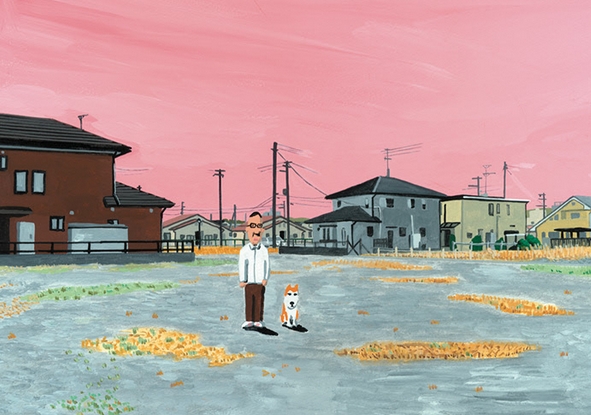
Is this heaven or hell? Mountains, rivers, grass and trees
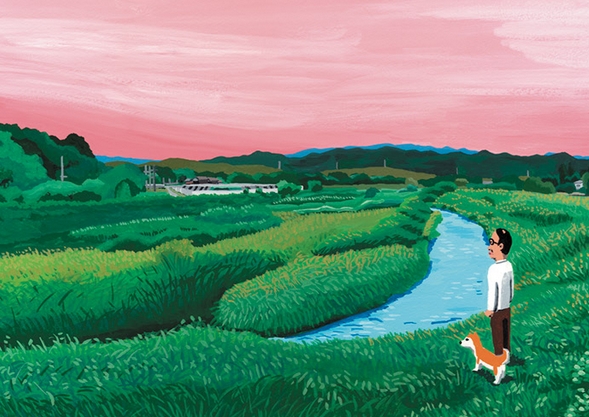
Only people are missing here

The broken nuclear plants that once tore so many hearts, continue puffing out fumes

Will it continue to tear us apart?

Please, no more.
Afterword
I got the idea of this book in April 2019, when I was on my way to a cherry blossom festival in Tomioka Town, Fukushima. The airborne radiation level of a street was 0.2~0.7 μSv, and the next street was 1.0μSv. The barricade divided the cherry blossom street. There were young children and elderly couples, families with their pets, full of smiles and happiness. But at the same time, there were those who worryingly gazed out beyond the barricade.
There were many street vendors lined up in the nearby middle school playground for the festival. There was even an informational booth from the Japan Atomic Energy Agency (JAEA). Next to the ground, there was a gymnasium. The gymnasium was left there as if frozen in time, in preparation for the graduation ceremony right before the earthquake hit. As I was walking through this chaotic town alone, I thought to myself, “I wish the sky would turn red.”
The 2020 Tokyo Olympics and Paralympics have also been called the “Recovery Olympics.” The governor of Fukushima has asserted that he will show the world “the light and the darkness” of Fukushima. But how is the “dark” side of Fukushima going to be revealed? To name one, the route of the torch relay seems to imply otherwise.
While chanting such optimistic terms like “ties” (kizuna), “Cheer up!” (ganbarou), “I’m doing well” (genkidesu), aren’t we trying to look away from tens of thousands of evacuees or those who have returned only to face a life of sorrow and pain?
As many people have begun to forget about the “darkness” in Fukushima, I feel obliged to keep drawing about it. Perhaps, the decommissioning of the reactors won’t be completed in my life time.
Evacuation orders for Fukushima radioactive areas to be lifted without decontamination
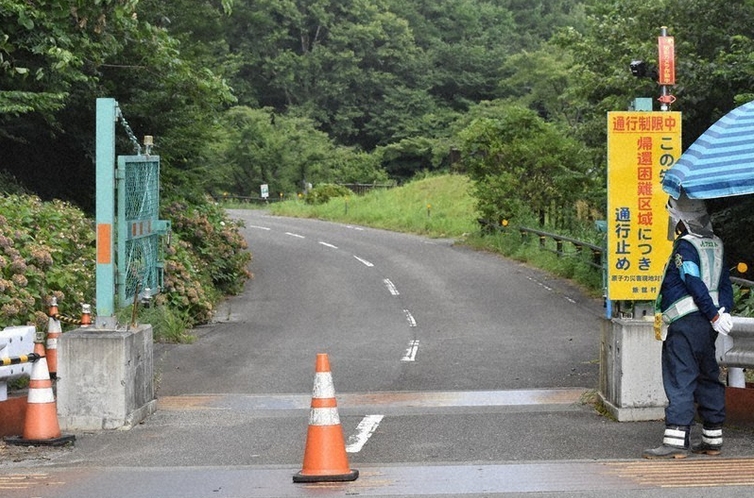 A gate to the Nagadoro district of the village of Iitate, Fukushima Prefecture, is seen in this picture taken on Aug. 24, 2020. The district was designated as a “difficult-to-return” zone in the wake of the Fukushima nuclear disaster.
August 27, 2020
TOKYO — The Japanese government is set to allow the lifting of evacuation orders for highly radioactive areas near the disaster-stricken Fukushima Daiichi Nuclear Power Station without decontamination work on condition that residents will not resettle there.
The government on Aug. 26 disclosed the policy to the Nuclear Regulation Authority (NRA) for the so-called “difficult-to-return” zones where residents have remained evacuated since the onset of the Fukushima nuclear disaster in 2011 due to high radiation doses in those areas in northeastern Japan. The NRA gave its consent to the government policy, paving the way for residents to enter areas outside the specified disaster reconstruction and revitalization base zones.
The government has heretofore made it a condition for lifting the evacuation orders that: the radiation exposure doses will not exceed 20 millisieverts per year; infrastructure necessary for daily lives is developed and sufficient decontamination work is performed; and consultations are held with local bodies and residents. The government previously designated parts of the difficult-to-return zones as disaster recovery bases, which mainly lie in areas where local residents lived, and planned to lift the evacuation orders by 2023 after decontamination work and infrastructure development.
Meanwhile, upon receiving a request from the village of Iitate in Fukushima Prefecture, the government has also been examining under which situations the evacuation directives can be lifted in areas outside the disaster recovery base areas.
At a regular meeting on Aug. 26, the government explained its line of thinking that the evacuation orders can be lifted on conditions including: the annual radiation exposure doses are confirmed to be no more than 20 millisieverts; residents’ radiation exposure doses are controlled by using personal dosimeters; and information to curb radiation exposure is provided. The government then sought the NRA’s opinion on the matter.
In response, the nuclear watchdog body evaluated the government’s new policy and offered a view that “it is in essence the same” as the current conditions for lifting the nuclear evacuation orders.
Upon receiving the NRA’s stamp of approval, the government is set to hold a meeting of the Nuclear Emergency Response Headquarters and formally decide on the prerequisites for removing the evacuation orders in areas outside the disaster recovery bases. Following the decision, municipal governments will look into whether to lift their evacuation orders for their local areas.
In Iitate village, the Nagadoro district has been designated as a difficult-to-return zone, dividing the village into a disaster recovery base and an area not designated as such. The Iitate Municipal Government is planning to develop a disaster restoration park in parts of a roughly 9-square-kilometer area that had few residents and falls outside the disaster recovery base, and requested the central government to allow the village to lift the evacuation order for the area at the same time as for the disaster recovery base.
https://mainichi.jp/english/articles/20200827/p2a/00m/0na/005000c
Japan should leave radioactive water in current storage tanks
Hajime Matsukubo, general-secretary of the Citizens’ Nuclear Information Center, says an ocean dump doesn’t make sense
 Hajime Matsukubo, general secretary of the Citizens’ Nuclear Information Center (CNIC)
Aug.17,2020
What’s the most practical and safest way to handle the radioactive water being stored at Fukushima? According to Hajime Matsukubo, general-secretary of the Citizens’ Nuclear Information Center (CNIC), the contaminated water should be left in the aboveground tanks where it’s currently being stored. In a recent email interview with the Hankyoreh, Matsukubo said it doesn’t make sense to release the water into the ocean just because the tanks are running low on space.
The CNIC is a Japanese NGO that was set up in 1975 under nuclear physicist Jinzaburo Takagi, a leading figure in the campaign against nuclear power in Japan. Matsukubo is an active researcher, lecturer, and publisher of materials related to the anti-nuclear movement. The interview is presented below.
Hankyoreh (Hani): When do you think the final decision will be made about dumping the contaminated water at Fukushima into the ocean?
Hajime Matsukubo: TEPCO [Tokyo Electric Power Company] says it will dilute the contaminated water before dumping it into the ocean, which means that a dilution facility would have to be built. Given the time required to get a building permit, I think the final decision will be made this summer or fall.
Japan wants an ocean dump because it’s the cheapest option
Hani: Why do you think the Japanese government is pushing so hard to dump the water into the ocean?
Matsukubo: Not only Japan but all countries that operate nuclear reactors end up with tritium as a byproduct, which they then release into the ocean or the atmosphere. I see this decision as an extension of that. Another factor is that releasing the water into the ocean is the cheapest option.
Hani: There seems to be considerable opposition to the plan in Japan as well.
Matsukubo: Many citizens are opposed to it. Pushback has been particularly strong from fishermen, who are likely to be harmed by the rumors [about the danger of the radioactive matter being released, which could cause people not to visit or eat food from Fukushima]. Lawmakers at city councils in Fukushima Prefecture have adopted a series of resolutions voicing concerns about releasing the contaminated water.
Hani: Do you think that negative public opinion in Japan is capable of changing government policy?
Matsukubo: Since the fishermen are direct stakeholders, I think their opposition will have a big impact. TEPCO has promised not to release the water without the consent of local communities in Fukushima. I think the key is opposing voices in Japan and increasing pressure from overseas.
Hani: Do South Korea or environmental groups in other countries have any way to sanction Japan for releasing contaminated water into the ocean?
Matsukubo: They could consider filing a lawsuit based on the UN Convention on the Law of the Sea. But a large amount of tritium is already being released from Korea’s nuclear plants, especially the Wolseong plant. It would be rather difficult to prove that contaminated water released from Fukushima Daiichi [No. 1] is having an impact.
There’s plenty of land that could be used for additional storage
Hani: What’s the most practical and safest way to deal with the contaminated water?
Matsukubo: The contaminated water at Fukushima should be left in the aboveground tanks where it’s currently being stored. [The government] says there’s no more room at Fukushima Daiichi, but there is. There’s a huge amount of land that could be used to store the radioactive wastewater. While the Ministry of Economy, Trade, and Industry says that land can’t be appropriated for other uses, the government [could and] should negotiate with the landowners. It’s absurd to dump radioactive water into the ocean because there’s not enough storage space in the tanks. Japanese NGOs are suggesting that the government continue storing the water in the aboveground tanks and seal them off with concrete. They’re warning the government that releasing the water into the ocean would create international problems.
S. Korea, Japan both need to reassess their reprocessing plans
Hani: Do you have a message for South Korea’s civic society?
Matsukubo: The Japanese government is pursuing a policy of creating a nuclear fuel cycle that would recycle plutonium and uranium from the spent nuclear fuel produced by reactors. This policy requires reprocessing plants that are currently under construction at Rokkasho, in Aomori Prefecture, which are supposed to begin operations in 2021. These plants will release a large amount of radioactive matter into the ocean and the atmosphere. In terms of tritium alone, the amount released will be 10 times worse than the contaminated water at Fukushima Daiichi. That’s a very serious problem, just as releasing the contaminated water would be.
In South Korea, the Korea Atomic Energy Research Institute is taking the lead in R&D projects related to reprocessing spent nuclear fuel. The problems with reprocessing plants don’t end here. Plutonium can be used as a raw material for making nuclear weapons. I think that South Korea and Japanese citizens need to join forces to shut down both countries’ reprocessing plans.
By Kim So-youn, staff reporter
http://english.hani.co.kr/arti/english_edition/e_international/958103.html
Japan pushes forward with plans to dump radioactive water into ocean, despite public opposition
Tokyo may dump contaminated water as early as September
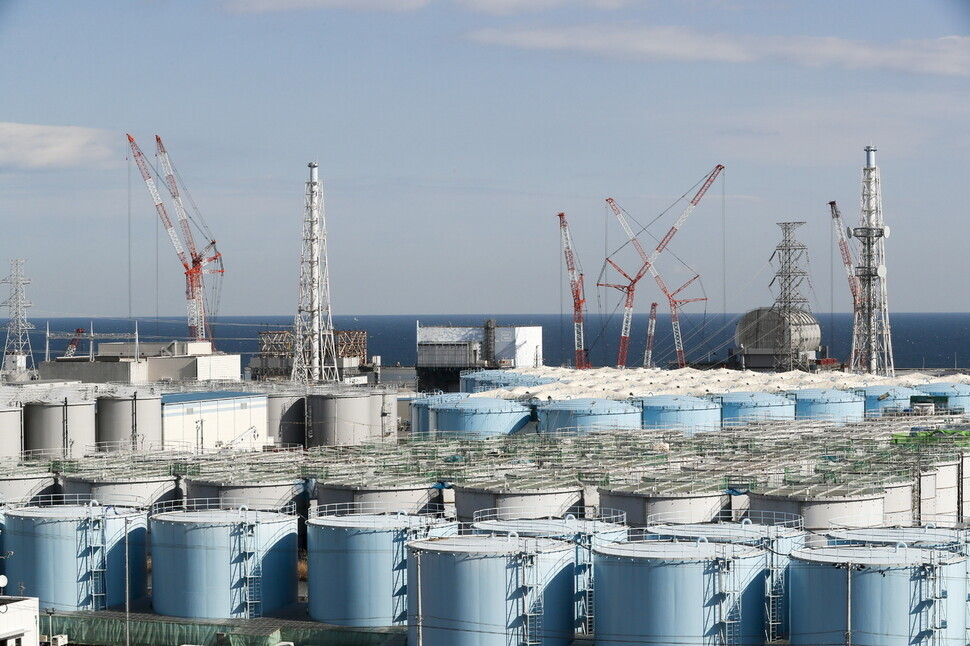 Storage tanks for water contaminated with radioactive matter from the Fukushima Daiichi Nuclear Power Plant.
Aug.17,2020
During the past three months, while the international community was focused on the COVID-19 pandemic, the Japanese government has held five public hearings as it moves forward with its decision to dump radioactive water from the Fukushima nuclear disaster into the ocean. After analyzing the transcripts and videos from the hearings, the Hankyoreh has concluded that the Japanese government will probably decide to dump the water as early as September or October, despite overwhelming public opposition to the plan, even in Japan. Since a study has found that the contaminated water could reach the eastern coast of South Korea within a year of being dumped, international groups focusing on the environment and experts in international law are calling for the South Korean government to take preemptive action in the area of international law.
Following an explosion during the 2011 Tohoku earthquake, the Fukushima Daiichi nuclear power plant was closed and is being decommissioned, a process that has taken nine years so far. But debate continues about how to deal with the growing volume of water contaminated with radioactivity, including the water used to cool the nuclear fuel and rainwater and groundwater that have seeped into the buildings. The contaminated water is currently being stored in tanks, but by the summer of 2022, the Japanese government says, the tanks will run out of space, necessitating the water’s release into the ocean.
The Japanese government, under Prime Minister Shinzo Abe, held video hearings about how to deal with the contaminated water on Apr. 6, Apr. 13, May 11, June 30, and July 17. These hearings were attended not only by representatives from the fishing, agriculture, and hospitality businesses and community leaders from Fukushima Prefecture but also the national tourist council and groups representing businesses and consumers. The government was represented by officials from 10 or so ministries, including the Ministry of Economy, Trade, and Industry, the Ministry of the Environment, and the Ministry of Foreign Affairs.
Radioactive matter detected in water even after decontamination
While reviewing the hearings, the Hankyoreh learned that radioactive matter has been detected even following decontamination efforts, that releasing the water would likely cement Fukushima’s stigma as an area tainted with radioactivity and have a serious impact on the fishing industry, and that there was widespread opposition to the idea among hearing attendees, who argued that the final decision shouldn’t be made until public opinion has been canvassed.
An August 2019 report by international environmental group Greenpeace about the contaminated water at Fukushima found that the water, once released, would flow through the East China Sea and be brought via the Kuroshio Current and the Tsushima Current to South Korea’s eastern shore within a year. Disregarding the concerns of the international community, the Japanese government released a draft of a plan this past March to dump the contaminated water at Fukushima into the ocean over the course of 30 years. Given the plan’s schedule, which involves the construction of a facility to dilute the contaminated water, its decision will likely be made by this October. Abe told the press in an interview in March that he wants to finalize a plan as quickly as possible.
The Japanese government intends to make its final decision after canvassing the opinions of Fukushima residents, related organizations, and ordinary citizens. But even in the Japanese public, there’s fierce opposition to dumping the contaminated water. The Hankyoreh’s analysis of the transcripts and videos from the five hearings show that most of the 37 participants were concerned about the plan to release the water.
“It’s human nature to avoid radioactive materials. It’s a serious problem that there’s still radioactivity even in the decontaminated water, which contradicts what TEPCO [Tokyo Electric Power Company] initially said,” said Hidenori Koito, the director of a trade association for the hospitality industry in Fukushima Prefecture.
80% of water contains radioactive matter beyond permissible levels
TEPCO claimed to have filtered out 62 kinds of radioactive material through the Advanced Liquid Processing System (ALPS) and all that’s left is tritium, which is technically difficult to remove from the contaminated water in the tanks. But a 2018 study found that 80% of the water processed using ALPS still contained more than the permitted level of radioactive matter that is deadly to the human body, including cesium, strontium, and iodine. While TEPCO has emphasized that it would decontaminate the water once more to ensure its safety prior to release, distrust has already surged.
Another criticism is that dumping the water would spoil the nine-year campaign by Fukushima residents to repair the area’s reputation. “If the contaminated water is released into the ocean, people will inevitably think there’s another radiation leak at Fukushima, given the nuclear accident that occurred there,” said Kimio Akimoto, president of a coalition of forestry associations in the prefecture.
Vehement opposition from fishermen
An even sterner stance was taken by fishermen, who depend upon the ocean for their livelihood. “It’s unacceptable for radioactive matter to be deliberately pumped into the ocean,” said Tetsu Nozaki, president of a coalition of fishery cooperatives in Fukushima Prefecture. The national coalition of fishery cooperatives voted on July 23 to “oppose” the planned release of contaminated water.
There are also concerns that the government is rushing the plan. “The Japanese public doesn’t know the details about the contaminated water yet. The final decision shouldn’t be made until people understand what it means to dump contaminated water into the ocean,” said Yuki Urago, secretary-general of a national coalition of consumers’ associations.
“Right now, the Japanese public is focused on COVID-19. It’s doubtful whether the issue of contaminated water at Fukushima can provoke a national debate in this situation,” said Yuko Endo, mayor of Kawauchi, a village in Fukushima Prefecture.
Japan took an unusually long opinion canvassing period
Before deciding on important policies, the Japanese government has a practice of canvassing opinions, a process known as the “public comment” period. The relevant ministry here, the Ministry of Economy, Trade, and Industry, began collecting comments on Apr. 6 and took the unusual step of extending that period three times, only wrapping it up at the end of last month. One reason the government may have extended the comment period is because of the overwhelming opposition to releasing the contaminated water into the ocean.
Last month, the UN Human Rights Council released a statement expressing “deep concerns” about “a report indicating that the Japanese government is accelerating its timeframe for releasing water contaminated with radioactivity at Fukushima.” South Korea, given its proximity to Japan and the ocean, has set up a government-wide task force under the Office of the Prime Minister to keep tabs on the Japanese government’s actions.
“We’re asking Japan to share adequate information while it’s processing the contaminated water at the Fukushima nuclear plant. We’re monitoring the situation from various angles to see what impact this will have on us,” explained an official from South Korea’s Ministry of Foreign Affairs.
By Kim So-youn, staff reporter
http://english.hani.co.kr/arti/english_edition/e_international/958099.html
Fukushima’s Contaminated Wastewater Could Be Too Risky to Dump in the Ocean
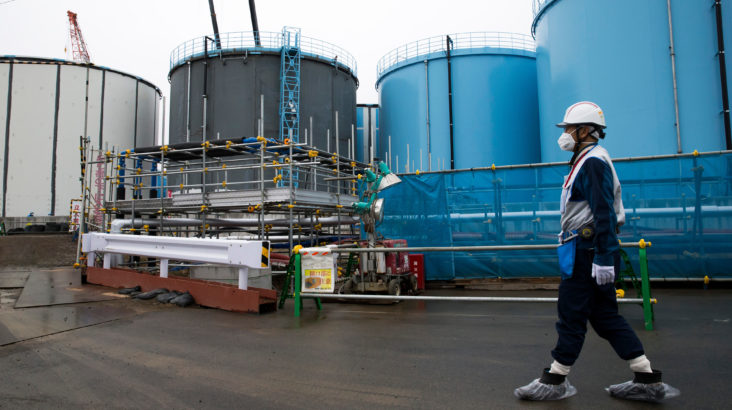 A person walks past storage tanks for contaminated water at the company’s Fukushima Daiichi Nuclear Power Plant
August 7, 2020
Almost a decade ago, the Tohoku-oki earthquake and tsunami triggered an explosion at Japan’s Fukushima Daiichi Nuclear Power Plant, causing the most severe nuclear accident since Chernobyl and releasing an unprecedented amount of radioactive contamination in the ocean. In the years since, there’s been a drawn out cleanup process, and water radiation levels around the plant have fallen to safe levels everywhere except for in the areas closest to the now-closed plant. But as a study from the Woods Hole Oceanographic Institution published in Science on Thursday shows, there’s another growing hazard: contaminated wastewater.
Radioactive cooling water is leaking out of the the melted-down nuclear reactors and mixing with the groundwater there. In order to prevent the groundwater from leaking into the ocean, the water is pumped into more than 1,000 tanks. Using sophisticated cleaning processes, workers have been able to remove some of this contamination and divert groundwater flows, reducing the amount of water that must be collected each day. But those tanks are filling up, and some Japanese officials have suggested that the water should dumped into the ocean to free up space.
The water in the tanks goes through an advanced treatment system to remove many radioactive isotopes. The Japanese utility company TEPCO, which is handling the cleanup processes, claims that these processes remove all radioactive particles from the water except tritium, an isotope of hydrogen which is nearly impossible remove but is considered to be relatively harmless. It decays in about 12 years, which is faster than other isotopes, is not easily absorbed by marine life, and is not as damaging to living tissue as other forms of radiation.
But according to the new study, that’s not the only radioactive contaminant left in the tanks. By examining TEPCO’s own 2018 data, WHOI researcher Ken Buesseler found that other isotopes remain in the treated wastewater, including carbon-14, cobalt-60, and strontium-90. He found these particles all take much longer to decay than tritium, and that fish and marine organisms absorb them comparatively easily.
“[This] means they could be potentially hazardous to humans and the environment for much longer and in more complex ways than tritium,” the study says.
Though TEPCO’s data shows there is far less of these contaminants in the wastewater tanks than tritium, Buesseler notes that their levels vary widely from tank to tank, and that “more than 70% of the tanks would need secondary treatment to reduce concentrations below that required by law for their release.”
The study says we don’t currently have a good idea of how those more dangerous isotopes would behave in the water. We can’t assume they will behave the same way tritium does in the ocean because they have such different properties. And since there are different levels of each isotope in each different tank, each tank will need its own assessment.
“To assess the consequences of the tank releases, a full accounting after any secondary treatments of what isotopes are left in each tank is needed,” the study said.
Buesseler also calls for an analysis of what other contaminants could be in the tanks, such as plutonium. Even though it wasn’t reported in high amounts in the atmosphere in 2011, recent research shows it may have been dispersed when the explosion occurred. Buesseler fears it may also be present in the cooling waters being used at the plant. That points to the need to take a fuller account of the wastewater tanks before anything is done to dump them in the ocean.
“The first step is to clean up those additional radioactive contaminants that remain in the tanks, and then make plans based on what remains,” he said in a statement. “Any option that involves ocean releases would need independent groups keeping track of all of the potential contaminants in seawater, the seafloor, and marine life.”
Many Japanese municipalities have been pushing the government to reconsider its ocean dumping plans and opt to find a long-term storage solution instead, which makes sense, considering exposure to radioactive isotopes can cause myriad health problems to people. It could also hurt marine life, which could have a devastating impact on fishing economies and on ecosystems.
“The health of the ocean — and the livelihoods of countless people — rely on this being done right,” said Buesseler.
Particles from Fukushima meltdown contained plutonium
 Local residents who live around the 20km exclusion zone around the Fukushima Dai-Ichi Nuclear Power Plant undergo a screening test for possible radiation at screening center on September 13, 2011 in Minamisoma, Fukushima Prefecture, Japan.
August 6th, 2020 Posted by Stanford
Microscopic particles emitted during the Fukushima nuclear disaster contained plutonium, according to a new study.
The microscopic radioactive particles formed inside the Fukushima reactors when the melting nuclear fuel interacted with the reactor’s structural concrete.
Nearly ten years after meltdown at the Fukushima Daiichi Nuclear Power Plant caused a nuclear disaster, the new information about the extent and severity of the meltdown and the distribution patterns of the plutonium have broad implications for understanding the mobility of plutonium during a nuclear accident.
“The study used an extraordinary array of analytical techniques in order to complete the description of the particles at the atomic-scale,” says coauthor Rod Ewing, co-director of the Center for International Security and Cooperation (CISAC) at Stanford University.
The researchers found that, due to loss of containment in the reactors, the particles were released into the atmosphere and many were then deposited many miles from the reactor sites.
Studies have shown that the cesium-rich microparticles, or CsMPs, are highly radioactive and primarily composed of glass (with silica from concrete) and radio-cesium (a volatile fission product formed in the reactors). But the environmental impact and their distribution is still an active subject of research and debate. The new work offers a much-needed insight into the Fukushima Daiichi Nuclear Power Plant (FDNPP) meltdowns.
The study used an extraordinary array of analytical techniques in order to complete the description of the particles at the atomic-scale.
The researchers used a combination of advanced analytical techniques, including synchrotron-based micro-X-ray analysis, secondary ion mass spectrometry, and high-resolution transmission electron microscopy, to find and characterize the plutonium that was present in the CsMP samples. They initially discovered incredibly small uranium-dioxide inclusions, of less than 10 nanometers in diameter, inside the CsMPs; this indicated possible inclusion of nuclear fuel inside the particles.
Detailed analysis revealed, for the first-time, that plutonium-oxide concentrates were associated with the uranium, and that the isotopic composition of the uranium and plutonium matched that calculated for the FDNPP irradiated fuel inventory.
“These results strongly suggest that the nano-scale heterogeneity that is common in normal nuclear fuels is still present in the fuel debris that remains inside the site’s damaged reactors,” says geochemist Satoshi Utsunomiya of Kyushu University, who led the team.
“This is important information as it tells us about the extent [and] severity of the meltdown. Further, this is important information for the eventual decommissioning of the damaged reactors and the long-term management of their wastes.”
With regards to environmental impact, Utsunomiya says, “as we already know that the CsMPs were distributed over a wide region in Japan, small amounts of plutonium were likely dispersed in the same way.”
This is important information for the eventual decommissioning of the damaged reactors and the long-term management of their wastes.
The team “will continue to experiment with the CsMPs, in an effort to better understand their long-term behavior and environmental impact,” says Gareth T. W. Law, a coauthor on the paper from the University of Helsinki. It is now clear that CsMPs are an important vector of radioactive contamination from nuclear accidents.”
“While the plutonium released from the damaged reactors is low compared to that of cesium; the investigation provides crucial information for studying the associated health impact,” says coauthor Bernd Grambow of Nantes/France.
Utsunomiya emphasizes that this is a great achievement of international collaboration. “It’s been almost ten years since the nuclear disaster at Fukushima,” he says, “but research on Fukushima’s environmental impact and its decommissioning are a long way from being over.”
The paper appears in Science of the Total Environment.
Additional researchers from Kyushu University, University of Tsukuba, Tokyo Institute of Technology, National Institute of Polar Research, University of Helsinki, Paul Scherrer Institute, Diamond Light Source, and SUBATECH (IMT Atlantique, CNRS, University of Nantes) contributed to the work.
Source: Stanford University via Kyushu University
Original Study DOI: 10.1016/j.scitotenv.2020.140539
https://www.futurity.org/fukushima-nuclear-disaster-plutonium-2417332-2/
1 This Month

of the week – Shut Down Drone Warfare!


Tell the Ukrainian Government to Drop Prosecution of Peace Activist Yurii Sheliazhenko

Petition to revoke the licensing of the Near Surface Nuclear Disposal Facility (NSDF) at Chalk River. https://www.ourcommons.ca/petitions/en/Petition/Details?Petition=e-7247
To see nuclear-related stories in greater depth and intensity – go to https://nuclearinformation.wordpress.com
-
Archives
- March 2026 (251)
- February 2026 (268)
- January 2026 (308)
- December 2025 (358)
- November 2025 (359)
- October 2025 (376)
- September 2025 (257)
- August 2025 (319)
- July 2025 (230)
- June 2025 (348)
- May 2025 (261)
- April 2025 (305)
-
Categories
- 1
- 1 NUCLEAR ISSUES
- business and costs
- climate change
- culture and arts
- ENERGY
- environment
- health
- history
- indigenous issues
- Legal
- marketing of nuclear
- media
- opposition to nuclear
- PERSONAL STORIES
- politics
- politics international
- Religion and ethics
- safety
- secrets,lies and civil liberties
- spinbuster
- technology
- Uranium
- wastes
- weapons and war
- Women
- 2 WORLD
- ACTION
- AFRICA
- Atrocities
- AUSTRALIA
- Christina's notes
- Christina's themes
- culture and arts
- Events
- Fuk 2022
- Fuk 2023
- Fukushima 2017
- Fukushima 2018
- fukushima 2019
- Fukushima 2020
- Fukushima 2021
- general
- global warming
- Humour (God we need it)
- Nuclear
- RARE EARTHS
- Reference
- resources – print
- Resources -audiovicual
- Weekly Newsletter
- World
- World Nuclear
- YouTube
-
RSS
Entries RSS
Comments RSS
 nuclear-news