Fukushima cleanup struggle focuses on what to do with contaminated water
Fukushima disaster shook the world, one of the biggest impediments to cleaning up the site in Northeastern Japan is coming from an unexpected source: The water.
 A waterlogged radiation and tsunami warning sign found on Fukushima beaches in 2013
March 13, 2020
Nine years after the Fukushima disaster shook the world, one of the biggest impediments to cleaning up the site in Northeastern Japan is coming from an unexpected source: The water.
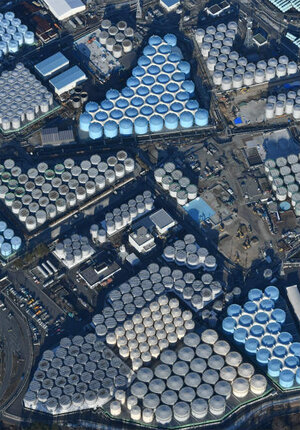
That water, specifically 1.2 million tons of it, is still radioactive. Stored in 1,000 special tanks on the site of the nuclear power plant’s ruins, it’s taking up needed space – which the Japanese government plans to free up by dumping it into the sea.
But local residents, especially fishermen are opposed to that plan, telling touring reporters on the nine-year anniversary of the disaster that the water release would further damage the already battered reputation of fisheries – where sales remain at only half of what they were before the catastrophe.
Under discussion are two possible ways of disposing of Fukushima’s contaminated water. According to a government report released earlier this year, one possibility is that technicians could dilute the water to levels below the allowable safety limits, and then release it into the sea in a controlled way. The other is to allow the water to evaporate over the course of several years.
The dilemma over what do with the water is part of the complicated aftermath of the 9.0 magnitude earthquake and subsequent tsunami that hit on March 11, 2011. A wall of water destroyed cooling capabilities at the Fukushima nuclear plant and three of its six nuclear reactors melted down, forcing the evacuation of 160,000 people.
In the days that followed the quake, the Fukushima-Daiichi plant was rocked by hydrogen explosions, which burst through the roofs of the three afflicted reactors, sending radioactive iodine, cesium and other fission by-products belching into the environment. Millions of liters of water were pumped from the ocean to cool the overheating reactors, cascading contamination into the sea.
 A clock stopped at the time the tsunami gushed in from the sea found in the destruction of a beach community in Fukushima.
Ever since then, the name of Fukushima has become synonymous with Chernobyl – the world’s other most notorious nuclear disaster – in connoting catastrophe, contamination and mass human evacuation.
Officials with Tokyo Electrical Power Co, or Tepco, say that the excess water they have collected must be disposed of so they can build facilities they need to begin the retrieval of radioactive debris within the reactors.
That wreckage is slated for removal by December 2021. Remote control cranes are being used to dismantle the cooling tower of the No 2 reactor, the first from which molten nuclear fuel was removed. Spent nuclear fuel stored in a pool at the No 3 reactor is being removed ahead of attempts to remove that reactor’s melted down fuel.
As the Associated Press reported, most above ground areas at the Fukushima plant can now be visited with minimal protective gear and a Geiger counter. The radioactive remains of the reactor buildings are, however, still off limits.
But areas underground beneath the plant remain extremely hazardous. Radioactive cooling water is leaking from the melted-down reactors and mixing with groundwater. The groundwater then must be pumped out to keep it from leaking into the sea. Other contaminated water – some of which was initially sprayed and dumped on the reactors while they were melting down – sit in other underground locations, leaking continuously into groundwater outside the plant.
Tepco has attempted to remove most radionuclides — like cesium and strontium – from the excess water, but the technology does not exist to cleanse it of tritium, a radioactive isotope of hydrogen. Coastal nuclear plants commonly dump water that contains tritium, which occurs naturally in nature, and Japanese officials insist it is harmless when ingested in small quantities.
But many are not pleased with Tepco’s assurances. Katsumi Shozugawa, a radiology expert at the University of Tokyo who has studied Fukushima’s groundwater, told the AP that long term, low-level radiation exposure in the food chain is poorly understood.
“At this point, it is difficult to predict a risk,” he told AP. “Once the water is released into the environment, it will be very difficult to follow up and monitor its movement. So the accuracy of the data before any release is crucial and must be verified.”
Starting the Olympic torch relay in Fukushima should remind us of the dangers of nuclear power
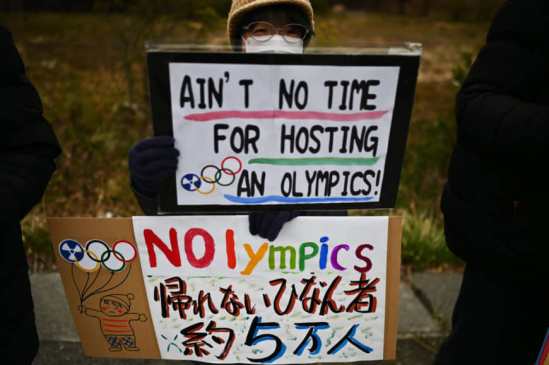 A woman protests against the Olympics and the government’s nuclear energy policy Feb. 29 in Naraha, Fukushima Prefecture, where the Olympic torch relay begins this month.
March 13, 2020
VANCOUVER – If the Tokyo Olympics are held on schedule, thousands of athletes will soon come to Japan. Considering the multiple reactors that melted down there nine years ago, in March 2011, the government’s decision to start the ceremonial torch relay in Fukushima Prefecture seems a bit odd, to say the least.
While radiation levels may have declined since 2011, there are still hot spots in the prefecture, including near the sports complex where the torch relay will begin and along the relay route. The persistence of this contamination, and the economic fallout of the reactor accidents, should remind us of the hazardous nature of nuclear power.
Simultaneously, changes in the economics of alternative sources of energy in the last decade invite us to reconsider how countries, including Japan, should generate electricity in the future.
Japan is not alone in having experienced severe nuclear accidents. The 1986 Chernobyl accident also contaminated very large areas in Ukraine and Belarus. As in Japan, many people had to be evacuated; about 116,000, according to the 2000 report of the U.N. Scientific Committee on the Effects of Atomic Radiation. Many of them never did return; 34 years after the accident, thousands of square kilometers remain closed off to human inhabitation.
Events such as these are, naturally, traumatic and result in people viewing nuclear power as a risky technology. In turn, that view has led to persistent and widespread public opposition around the world.
This is evident in Japan too, where opinion polls show overwhelming opposition to the government’s plans to restart nuclear plants that have been shut down. One poll from February 2019 found 56 percent of respondents were opposed to, with only 32 percent in favor of, resuming nuclear operations. Other polls show significant local opposition, one example coming out of Miyagi Prefecture. Even the Japan Atomic Energy Relations Organization, which aims to promote nuclear power, finds that only 17.3 percent prefer nuclear energy, with much larger majorities preferring solar, wind and hydro power.
There is also the immense cost of cleaning up after such accidents. Estimates for the Fukushima disaster range from nearly $200 billion to over $600 billion. In 2013, France’s nuclear safety institute estimated that a similar accident in France could end up costing $580 billion. In Japan, just the cost of bringing old nuclear power plants into compliance with post-Fukushima safety regulations has been estimated at $44.2 billion.
Even in the absence of accidents and additional safety features, nuclear power is already very expensive. For the United States, the Wall Street firm Lazard estimates an average cost of $155 per megawatt-hour of nuclear electricity, more than three times the corresponding estimates of around $40 per MWh each for wind and solar energy. The latter costs have declined by around 70 to 90 percent in the last 10 years. In the face of the high costs of nuclear power — economic, environmental and public health — and overwhelming public opposition, it is puzzling that the government would persist in trying to restart nuclear power plants.
To explain his support for the technology, Prime Minister Shinzo Abe claims that the country cannot do without nuclear power, especially in view of climate change concerns. The claim about the necessity of nuclear power makes little sense. Since 2011, the country has been generating only a fraction of the nuclear electricity it used to generate, and yet the lights have not gone off. Further, starting in 2015, Japan’s total greenhouse gas emissions have fallen below the levels in 2011, because of “reduced energy consumption” and the increase in “low-carbon electricity.” The latter, in turn, is because of an increasing fraction of renewable energy in electricity generation, a factor that could play an important role in the future.
Some, including the Global Energy Network Institute and a group of analysts led by Stanford University’s Mark Jacobson, argue that Japan could be 100 percent powered by renewable energy. Regardless of whether Japan reaches that goal, there is little doubt that Japan could be expanding renewable energy, and that increased reliance on renewables makes economic and environmental sense.
Instead, the Abe government seems to be involved in lowering incentives for the development of solar energy, and promoting nuclear power. Efforts by Abe to support the failing and flailing nuclear sector in Japan are indicative of the significant political power wielded by the “nuclear village,” the network of power companies, regulators, bureaucrats and researchers that controls nuclear and energy policy.
Moreover, Abenomics involves exports of nuclear components and technology, as well as conventional arms, as an important component. So far, despite many trips by Abe to various countries, Japan has yet to export any reactors in the last decade; a project with the most likely client, Turkey, collapsed because of high costs.
This suggests one possible explanation: Perhaps Abe realizes that before exporting nuclear reactors, he first has to shore up the domestic nuclear industry and prove that Japan has fully recovered from the 2011 nuclear disaster. But is that worth the risk?
Restarting nuclear reactors or constructing new ones, should that ever happen, only increases the likelihood of more nuclear accidents in the future and raises the costs of electricity. Regardless of who we cheer for at the Olympic Games, nuclear power does not deserve our applause.
After ‘miracle recovery’, Fukushima brewers look to the Games to push sake globally
Greedy bloody criminals, having no conscience to poison all the people with their radiation contaminated sake!!!
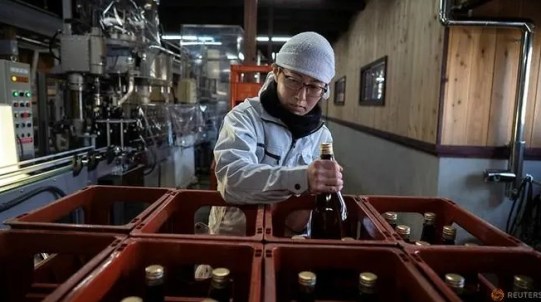 An employee of Miyaizumi Meijo Brewery picks up a sharaku sake prepared to be packed in crates during a new sake-brewing process in Aizu-Wakamatsu, Fukushima prefecture.
AIZU WAKAMATSU, Fukushima: The earth in Fukushima still trembled when Yoshihiro Miyamori drove in the dark towards his sake brewery. When he got back after midnight, he found smashed sake bottles and a crack in the wall of the building. It was Mar 11, 2011.
Miyamori was on his way to visit other sake-makers along Japan’s northeastern coast that day, and barely escaped the tsunami unleashed by a massive earthquake that razed towns and killed thousands, setting off nuclear meltdowns at the Fukushima power plant nearby.
“I needed some time to think about how I could recover from this,” Miyamori, 43, told Reuters on a recent tour of his “sakagura,” or sake brewery, Miyaizumi Meijo, in Fukushima’s city of Aizu Wakamatsu.
The breweries’ sales tanked by 66 per cent that month.
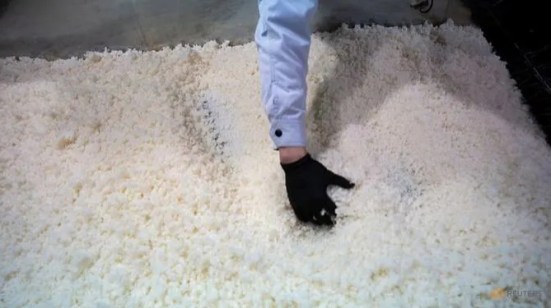 An employee of Miyaizumi Meijo Brewery works on rice soaking during a new sake-brewing process in Aizu-Wakamatsu, Fukushima prefecture.
“I know people outside Fukushima were concerned about safety of rice and water,” said Miyamori.
With the Tokyo Olympics less than five months away, many spectators, and even some Olympic committees, have expressed concerns about the food from Fukushima.
But nine years after the nuclear meltdowns, Fukushima sake has made a remarkable recovery, winning the most trophies at one of Japan’s most important sake competitions seven years in a row. And Miyaizumi Meijo’s flagship brand Sharaku has become one of Japan’s most famous.
“We just kept doing what we know best – making quality sake,” he said.
But Miyamori’s understated comments hide a sake obsessive who abandoned a safe job in Tokyo to take over his father’s struggling business at 26. He revolutionised the production, renovated the brewery and paid off nearly US$3 million in debt.
After taking over in 2003, Miyamori pushed to directly oversee the sake-making – an anomaly in a business where normally the production is outsourced to brewing teams led by the “toji”, or chief brewer.
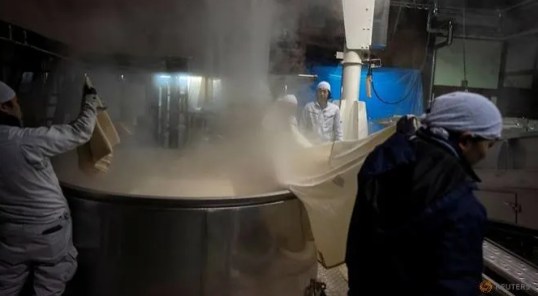 Employees of Miyaizumi Meijo Brewery work on rice steaming during a new sake-brewing process in Aizu-Wakamatsu.
He sparked a backlash from the staff after moving to use specially filtered water to wash rice for each bottle, leading to an eventual departure of the toji and most of the brewing staff.
“I wanted to be particular about every single small detail of making sake,” said Miyamori.
He opened up the previously secret production data to staff. Whiteboards covered with numbers and diagrams on temperature, rice condition and alcohol content are scattered throughout the premises to ensure workers know what goes inside each bottle.
Miyamori launched Sharaku, known for its crispness, well-balanced acidity and sweetness, in 2008. The brand started ranking high in the Sendai Sake Summit, a nation-wide competition, before the 2011 earthquake. It became No. 1 in the year of the disaster, greatly aiding the recovery.
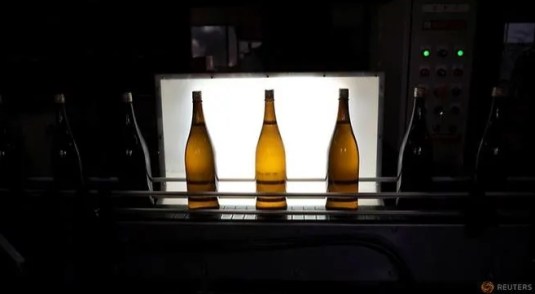 Sharaku sake of Miyaizumi Meijo Brewery pass through a filled bottle inspector during a new sake-brewing process in Aizu-Wakamatsu, Fukushima prefecture, Japan.
But Miyamori says he could not lead the rebound of the region’s sake on his own. He was first inspired to take over his father’s brewery after coming across Hiroki, a rival sake from the region, also led by a next-generation owner Kenji Hiroki, 53.
Now that his Sharaku has matched Hiroki in popularity, the two brewers drink together and tease each other about reviews of their alcohol.
Miyamori’s next rival is wine, he says, adding that he wants to use the Olympics to popularize sake globally.
Kenji Hiroki says of Miyamori, “you can brew better sake if you have a rival you can respect. Without Sharaku, Hiroki would not be as good as it is.”
Nagasaki citizen’s group prays for survivors of Fukushima nuclear disaster
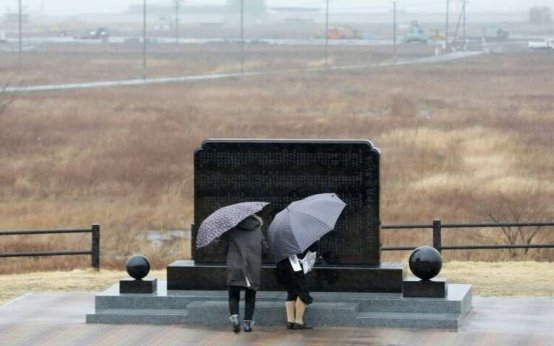
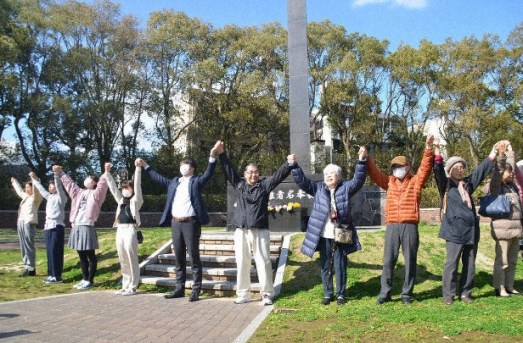 Citizen’s group members form a human chain in front of the hypocenter cenotaph during an event to pray for the restoration of Fukushima, hit by the 2011 meltdowns of the Fukushima Daiichi Nuclear Power Station, at the Hypocenter Park in the city of Nagasaki, on March 11, 2020
March 13, 2020
NAGASAKI — A citizen’s group in this southwestern Japan city destroyed by the 1945 U.S. atomic bombing held an event to pray for no more nuclear tragedies on March 11, the day of the meltdowns at the 2011 Fukushima Daiichi Nuclear Power Station.
A total of 15 participants, including atomic bomb survivors and high school students, gathered at the Nagasaki Hypocenter Park and offered a silent prayer at 2:46 p.m., the exact time the Great East Japan Earthquake struck, and formed a human chain in front of the hypocenter cenotaph.
The group was organized in 2013 and has interacted with people in Fukushima, which still struggles to recover from the nuclear disaster, to offer support from an area that has experienced the devastating destruction of nuclear weapons. Atomic bomb survivors and second-generation members have visited Fukushima and invited locals to visit Nagasaki for a lecture event.
Hiroko Sakaguchi, 70, a second-generation atomic bomb survivor, gave a speech at the March 11 event. “Many people still cannot return to their hometowns due to the nuclear accident. Even if buildings are rebuilt, that doesn’t mean real restoration. The disaster is still continuing there,” she said.
https://mainichi.jp/english/articles/20200312/p2a/00m/0na/020000c
Sendai High Court orders Tepco to pay more to Fukushima evacuees
 Plaintiffs and lawyers who filed a lawsuit seeking damages for having to evacuate after meltdowns at the Fukushima No. 1 nuclear power plant hold up banners Thursday in front of the Sendai High Court.
March13, 2020
SENDAI – A high court on Thursday ordered the operator of the crippled Fukushima No. 1 nuclear plant to pay ¥730 million in damages to evacuees from the 2011 tsunami-triggered meltdown, up ¥120 million from a lower court ruling.
In their appeal at the Sendai High Court, 216 plaintiffs, most of whom are evacuees from areas within 30 kilometers of the plant, maintained their claim for a total of ¥1.88 billion in compensation from Tokyo Electric Power Company Holdings Inc.
The latest ruling is the first to be handed down by a high court among 30 similar lawsuits filed nationwide by evacuees and victims seeking damages, either from the power company alone or both the utility and the state.
“Tepco knew around April 2008 that there was the possibility of a tsunami that could be high enough to reach the site of the Fukushima No. 1 power plant and might cause the failure of the safety functions intended to halt the nuclear reactor,” presiding Judge Hisaki Kobayashi said when handing down the ruling.
“The accident occurred while countermeasure construction had been postponed. From the victims’ point of view, this is the thing that Tepco should have the greatest amount of regret over,” he said. “Tepco’s lack of proper preparation is extremely regrettable and should be an important factor in calculating the amount of compensation.”
Also taking into account pain caused to the plaintiffs by the loss of their neighborhoods and hardships during evacuation, the court ordered additional compensation of ¥1 million each for evacuees mostly from areas once designated as restricted residence zones and ¥500,000 for those from former emergency evacuation preparation zones.
In the previous ruling at the Iwaki branch of the Fukushima District Court in March 2018, 213 out of 216 plaintiffs were awarded compensation of between ¥700,000 and ¥1.5 million per person, depending on where the victims were living.
Both the utility and the plaintiffs had appealed to the high court.
“It is a fair ruling,” said Tokuo Hayakawa, who leads the plaintiffs. “We cannot go back to our daily lives even if the evacuation orders are lifted.”
Tepco said in a release that it was considering how to respond to the latest ruling.
The value sought in the lawsuit had been lowered by the plaintiffs from ¥13.3 billion to avoid the possibility of a prolonged trial that could have raised court costs and may have undermined the amount of money they could receive at its conclusion.
The plaintiffs argued that the operator could have foreseen the accident caused by the tsunami based on the government’s 2002 long-term assessment of major quakes, and demanded compensation for their “loss of a hometown” in addition to the amount already paid by the power company.
Tepco maintains that it could not have predicted the tsunami, and has claimed that the damages have already been paid to evacuees in accordance with government guidelines on compensation.
Nine years after the Fukushima nuclear disaster: back to normal towards a bright future?
Translated by Hervé Courtois

Episode 1: radioactivity, return to the abnormal
March 9, 2020
A look back at the ninth anniversary of the Fukushima nuclear disaster – following the earthquake and tsunami of March 11, 2011. Today in Fukushima, the authorities are encouraging the return of refugees, without much success.
 The restaurant “Atom Sushi” in Tomioka, one year after the reopening of the village, has still not reopened.
The decontamination works will last more than 40 years but around the power plant, the exclusion zone is “only” 341 km², and the roads and villages formerly condemned are reopened one after the other by the authorities – anxious to a return to normal.
 Everywhere in the town of Fukushima, 80km from the power plant, they try to make people forget bad memories and make tourists coming back.
Except that villages like Iitate about fifty kilometers from the Fukushima Daiichi nuclear plant are still hopelessly empty.
 In the countryside near IItate, monitors are present everywhere in the landscape measuring radioactivity in microsieverts per hour.
How do we live there? The sociologist Cécile Asanuma-Brice, a researcher at the CNRS has been returning to the area every month for nine years. Ito-san travels the region with a Geiger counter and a shoulder strap dosimeter. Because as soon as we move away from the main axes, the future suddenly looks less bright.
 Nobuyoshi Ito returned to live in the previously evacuated area and collects data on environmental contamination
Episode 2: living with radioactivity
 Mr. Ito is always equipped with his dosimeter, to record the radioactivity accumulated in the reopened area.
Authorities are talking about a return to normal, and residents must get used to living with radioactivity. There are only two villages left in the 340 km² that are still too radioactive. Stations will be reopened in decontaminated pockets within these areas, but they will be fully automated to avoid irradiation of employees.
 Throughout the city of Fukushima, signs display the countdown of the days before the opening of the Olympic Games
And the Olympic flame will leave at the end of the month from the J village, about twenty kilometers from the power plant, and will even pass right by it – but according to a timed route to avoid too much exposure.
Everywhere they want to send the message that the page has been turned: “Forget the radiation, and think about the bright future of the Olympic Games”.

Except that to the rare refugees (no more than 20%) who returned to live in the reopened areas, it is something else that is been asked: to learn to live with radiation, on a daily basis.
 In the region, everywhere, radioactivity detectors are omnipresent, to reassure the population.
To get used to be living with a radioactivity detector. This is why the company Tepco, responsible for the Fukushima Daiichi nuclear plant, now speaks of “revitalizing” the area rather than about a return: it is because it had to be admitted that the original inhabitants would not return there.
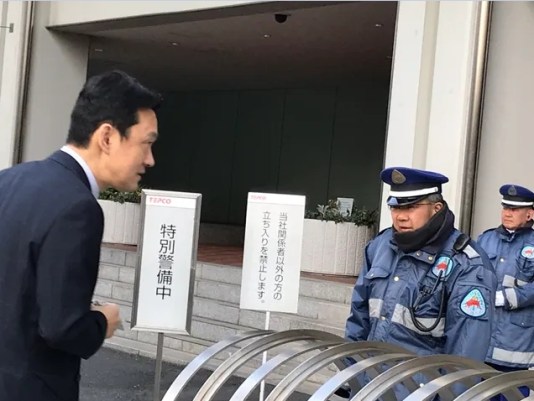 At Tepco’s headquarters in Tokyo, the company was nationalized after the disaster and announces 30 to 40 years of decontamination work.
Episode 3: Fukushima nine years later, it is impossible to turn the page
 On the Johoban highway that crosses the Fukushima area, an unbroken line of trucks transports radioactive waste to a disposal center. The soil measured at less than 8,000 becquerels per kilogram will be scattered everywhere.
March 11, 2020, 9 years to the day of the Fukushima disaster. And if the country has recovered from the magnitude 9.1 earthquake and tsunami that caused nearly 20,000 deaths, the area around the nuclear power plant is a wound that is far from being closed.
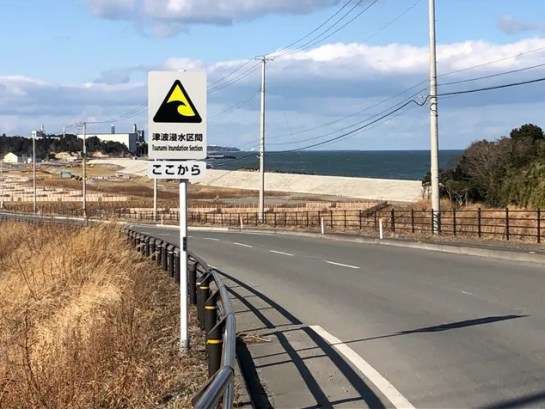 Along the Tohoku coast, a tsunami-proof wall blocks the horizon
The radioactivity is still there and the evacuated residents still do not return. More than 44,000 refugees are still missing even though. Despite the radiation that will be there to last, the authorities want at all costs to use the Olympics this summer as an opportunity to turn the page on this regrettable incident. And that’s kind of the message that Tepco wants to give, when it opened a few months ago in Tomioka, a brand new information center, an interactive museum located 10km from the nuclear plant, to tell its version of the story. And necessarily, their version of the story is a little biased.
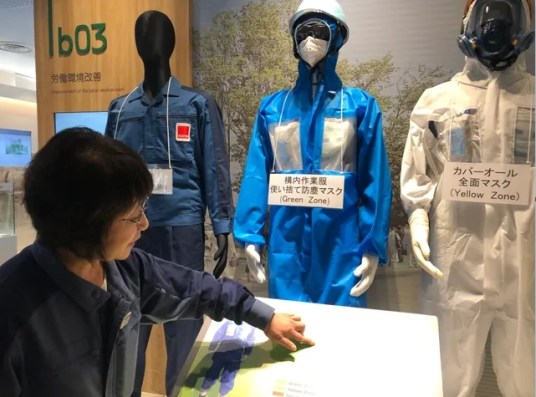 In Tomioka, Tepco has just opened a museum to tell its side of the story and highlight all its efforts to revitalize the area.
No more than 20% of the evacuees returned to live near the plant, and almost exclusively elderly people like Ms. Kimiko. 9 years later, we are still far from the revitalization of Fukushima.
 Mrs. Kimiko returned to live in Tomioka 10km from the nuclear plant three years ago, she no longer recognizes her environment.
Episode 4: mothers of Fukushima
Nine years after the earthquake, the nuclear disaster is not over. Many are not content with orders to return to normal, given the abnormality of daily life around Fukushima – punctuated by radioactivity measures and prohibited areas. And even outside this perimeter, many associations mainly led by women and mothers, act daily for more transparency.
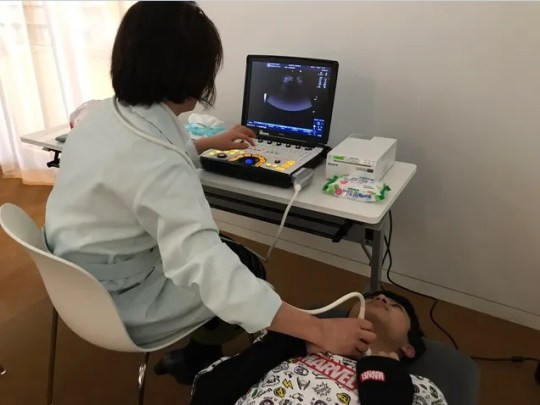 Kaoru Konta is a medical doctor, she detects thyroid cancer.
For example, the MamaBecq, with a “Becq” like Becquerel, who inspect schoolyards with their Geiger counters. Or the Happy Island association, which organizes free screening for thyroid cancer in children. Happy Island is a funny name for such association, but you know how to say “happy island” in Japanese? “Fukushima”.
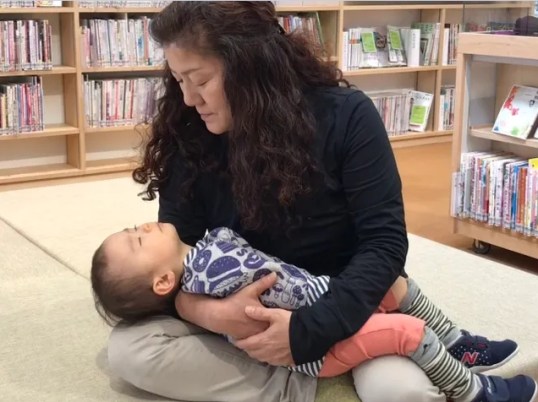 Marie Suzuki is president of the association “Happy Island”
Gov’t, TEPCO ordered to compensate Fukushima evacuees to Hokkaido

March 11, 2020
SAPPORO — A court ordered the government and the operator of the crippled Fukushima nuclear plant Tuesday to pay a combined 52.9 million yen in damages to 89 people who evacuated from their hometowns to Hokkaido after the 2011 nuclear disaster.
The Sapporo District Court ruling marked the seventh case where both the government and Tokyo Electric Power Company Holdings Inc were ordered to pay damages, out of 11 cases brought against the two parties. In the four other cases, only TEPCO was ordered to pay damages.
It was also the 15th decision handed down among around 30 similar damages suits filed across Japan over one of the world’s worst nuclear disasters, triggered by the massive earthquake and tsunami in March 2011.
A total of 257 plaintiffs, 90 percent of whom at the time were living in Fukushima city and other locations outside of areas given evacuation orders, had sought a combined 4.24 billion yen from the utility and the state.
“While (the ruling) is a sign of recognition of the government’s responsibility, it doesn’t reflect the actual lives that those who evacuated to Hokkaido have led,” a lawyer representing the plaintiffs told reporters after the court decision.
Following the ruling, TEPCO offered a “heartfelt apology for causing great trouble and worries” to those affected in Fukushima and other areas and said it will consider how to respond to the court decision after closely examining it.
At the court, the operator had said it had already paid damages to some of the plaintiffs and that the amount was adequate as it was based on the government guidelines. The utility also said it was not obligated to compensate the others as they had voluntarily evacuated.
The government has denied responsibility for the disaster, saying it could not have foreseen the flooding of the nuclear plant due to a tsunami.
The plaintiffs argued that TEPCO neglected to take preventive measures although it could have predicted earthquake and tsunami risks at the plant, and that the government did not enforce adequate safety measures despite approving power generation at the complex.
They also said that the psychological distress they suffered due to fears that radiation exposure had damaged their health, among other concerns, had impacted their ability to lead a normal life following the evacuation.
https://japantoday.com/category/national/gov%27t-tepco-ordered-to-compensate-fukushima-evacuees-to-hokkaido
Fukushima: How the ocean became a dumping ground for radioactive waste
The nuclear disaster at Fukushima sent an unprecedented amount of radiation into the Pacific. But, before then, atomic bomb tests and radioactive waste were contaminating the sea — the effects are still being felt today.
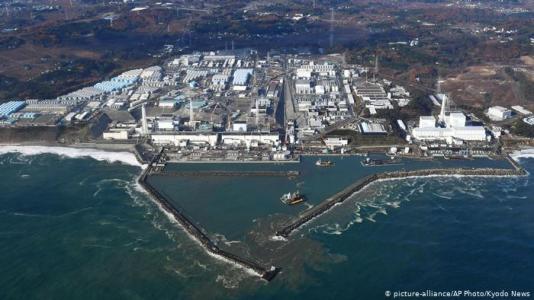
March 11, 2020
Almost 1.2 million liters (320,000 gallons) of radioactive water from the Fukushima nuclear power plant is to be released into the ocean. That’s on the recommendation of the government’s advisory panel some nine years after the nuclear disaster on Japan’s east coast. The contaminated water has since been used to cool the destroyed reactor blocks to prevent further nuclear meltdowns. It is currently being stored in large tanks, but those are expected to be full by 2022.
Exactly how the water should be dealt with has become highly controversial in Japan, not least because the nuclear disaster caused extreme contamination off the coast of Fukushima. At the time, radioactive water flowed “directly into the sea, in quantities we have never seen before in the marine world,” Sabine Charmasson from the French Institute for Radiological Protection and Nuclear Safety (IRSN) tells DW.
Radiation levels in the sea off Fukushima were millions of times higher than the government’s limit of 100 becquerels. And still today, radioactive substances can be detected off the coast of Japan and in other parts of the Pacific. They’ve even been measured in very small quantities off the US west coast in concentrations “well below the harmful levels set by the World Health Organization,” according to Vincent Rossi, an oceanographer at France’s Mediterranean Institute of Oceanography (MIO).
 The contaminated water in these storage tanks at Fukushima could be released into the sea as of 2022
 People observing a minute of silence for the victims of the 2011 earthquake and tsunami
But that doesn’t mean there’s no risk, says Horst Hamm of the Nuclear Free Future Foundation. “A single becquerel that gets into our body is enough to damage a cell that will eventually become a cancer cell,” he says.
A study from the European Parliament reached a similar conclusion. The research found that “even the smallest possible dose, a photon passing through a cell nucleus, carries a cancer risk. Although this risk is extremely small, it is still a risk.”
And that risk is growing. Radioactive pollution in the ocean has been increasing globally — and not just since the disaster at Fukushima.
Atomic bomb tests
In 1946, the US became the first country to test an atomic bomb in a marine area, in the Pacific Bikini Atoll. Over the next few decades, more than 250 further nuclear weapons tests were carried out on the high seas. Most of them (193) were conducted by France in French Polynesia, and by the US (42), primarily in the Marshall Islands and the Central Pacific.

But the ocean wasn’t just being used as a training ground for nuclear war. Until the early 1990s, it was also a gigantic dump for radioactive waste from nuclear power plants.
From 1946 to 1993, more than 200,000 tons of waste, some of it highly radioactive, was dumped in the world’s oceans, mainly in metal drums, according to the International Atomic Energy Agency (IAEA). Several nuclear submarines, including nuclear ammunition, were also sunk during this time.
Is the ocean a perfect storage site?
The lion’s share of dumped nuclear waste came from Britain and the Soviet Union, figures from the IAEA show. By 1991, the US had dropped more than 90,000 barrels and at least 190,000 cubic meters of radioactive waste in the North Atlantic and Pacific. Other countries including Belgium, France, Switzerland and the Netherlands also disposed of tons of radioactive waste in the North Atlantic in the 1960s, 70s and 80s.
“Under the motto, ‘out of sight, out of mind,’ the dumping of nuclear waste was the easiest way to get rid of it,” says Horst Hamm.
To this day, around 90% of the radiation in the ocean comes from barrels discarded in the North Atlantic, most of which lie north of Russia or off the coast of Western Europe.
“The barrels are everywhere,” says ecologist Yannick Rousselet of Greenpeace France. He was present in 2000 when the environmental organization used submarines to dive for dumped drums a few hundred meters off the coast of northern France, at a depth of 60 meters (196 feet).
“We were surprised how close they were to the coast,” Rousselet says. “They are rusty and leaking, with the radiation clearly elevated.”
 The radioactive pollution of the oceans began in 1946 when the US tested a nuclear bomb at Bikini Atoll Micronesia.
 Nuclear waste barrels dumped in the sea decades ago, a common practice in the Channel between France and England in the 1960s, are now rusty and are leaking radioactive substances
Germany also implicated
In 1967, Germany also dumped 480 barrels off the coast of Portugal, according to the IAEA. Responding to a 2012 request for information from the Greens about the condition of those barrels, the German government wrote: “The barrels were not designed to ensure the permanent containment of radionuclides on the sea floor. Therefore, it must be assumed that they are at least partially no longer intact.”
Germany and France don’t want to salvage the barrels. And even Greenpeace activist Yannick Rousselet says he sees “no safe way to lift the rusted barrels” to the surface. That means nuclear waste will likely continue to contaminate the ocean floor for decades to come.
For Horst Hamm, the long-term consequences are clear. The radiation will be “absorbed by the marine animals surrounding it. They will eventually end up caught in fishing nets, and come back to our plates,” he says.
In its 2012 response to the Greens, however, the German government described the risk to humans from contaminated fish as “negligible.”
Rousselet sees things differently: “The entire area along the coast is contaminated by radiation — not just in the sea, in the grass, in the sand, you can measure it everywhere.”
 The reprocess in plant in La Hague is still discharging radioactive water into the sea. Cancer rates have increased in the region, according to a report by the European Parliament
Radioactive dumping ground
The main reason behind the radiation along the northern French coastline isn’t the underwater barrels, but rather the nuclear fuel reprocessing plant at La Hague. It is located directly on the coast and “legally discharges 33 million liters of radioactive liquid into the sea each year,” says Rousselet. He thinks it’s scandalous.
In recent years, La Hague has also been the scene of several incidents involving increased radioactivity levels.
The dumping of nuclear waste in drums was banned in 1993 by the London Convention on the Prevention of Marine Pollution. But discharging liquid contaminated with radiation into the ocean is still permitted internationally.
Spike in cancer rates
According to a study by the European Parliament, statistics show cancer rates are significantly higher in the region surrounding La Hague. Cancer rates are also high near the nuclear processing plant in Sellafield in northern England. A study from 2014 concluded that the total amount of radioactivity discharged into the sea from the Sellafield plant over the years is equivalent to the amount released by the nuclear meltdown at Fukushima.
The report say a link to health effects “cannot be ruled out” even if there is no clear evidence to date of a link between illness and radioactive discharges from nuclear facilities.
“The exact effects of radioactive radiation are extremely difficult to measure and prove. We only know that it has an impact,” says Rousselet, adding that it’s crucial to walk away from everything that causes radioactive waste.

Dumping more waste at Fukushima
In Fukushima, the operating company of the Tokyo Electric Power Company nuclear plant claims that before the cooling water is discharged into the sea as planned, all 62 radioactive elements will be filtered down to safe levels — except for the isotope tritium. The advisory panel in Tokyo considers discharging the cooling water into the sea to be “safer” than other alternatives, such as evaporating the water.
Just how harmful tritium is to humans is a source of controversy. According to the plant operator, the concentration of tritium in the collection tanks is sometimes much higher than that of conventional cooling water from nuclear power stations.
“The local fishermen and residents cannot accept the discharge of water,” Takami Morita of the National Research Institute of Fisheries Science said in a press release. While fish pollution levels are below the harmful limit, demand for fish from the region has dropped to one-fifth of what it was before the disaster.
Releasing the cooling water into the sea “is a good method because of the diluting properties of the water,” Sabine Charmasson of the IRSN says. “There aren’t any real problems on the security side, but it’s difficult, because there are also social implications. It might be an appropriate method, but it’s never easy to release radioactive substances into the environment.”
In a press release, Greenpeace said: “There is no justification for additional, deliberate radioactive pollution of the marine environment or atmosphere.”
Safety of Fukushima nuke plant waste water focus of sea release debate
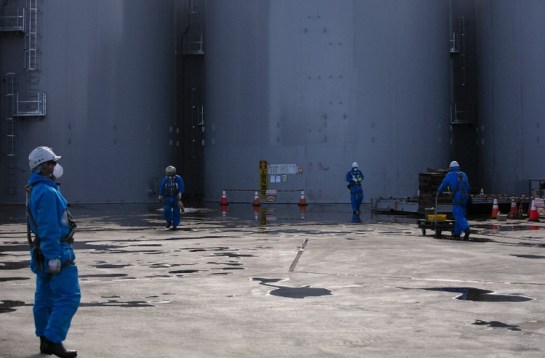
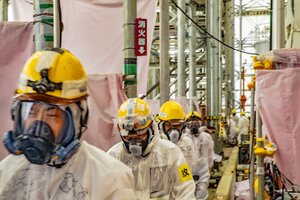
 In this Feb. 12, 2020 photo, a worker in a hazmat suit carries a hose at a water treatment facility at the Fukushima Daiichi nuclear power plant in Okuma, Fukushima Prefecture.
March 11, 2020
OKUMA, Japan (AP) — Inside a giant decontamination facility at the destroyed Fukushima nuclear power plant, workers in hazmat suits monitor radioactive water pumped from three damaged reactors, making sure it’s adequately — though not completely — treated.
Three lines of equipment connected to pipes snaking around in this dimly lit, sprawling facility can process up to 750 tons of contaminated water a day. Four other lines elsewhere in the plant can process more.
From there, the water is pumped to a complex of about 1,000 temporary storage tanks that crowd the plant’s grounds, where additional tanks are still being built. Officials say the huge tanks will be completely full by the summer of 2022.
The decontamination process, which The Associated Press viewed on a recent tour, is a key element of a contentious debate over what should be done with the nearly 1.2 million tons of still-radioactive water being closely watched by governments and organizations around the world ahead of this summer’s Tokyo Olympics.
The plant’s operator, Tokyo Electric Power Co., or TEPCO, says it needs to free up space as work to decommission the damaged reactors approaches a critical phase. It’s widely expected that TEPCO will gradually release the water into the nearby ocean following a government decision allowing it to do so. The company is still vague on the timing.
But local residents, especially fishermen, are opposed to the plan because they think the water release would hurt the reputation of already battered fisheries, where annual sales remain about half of the level before the nuclear accident, even though the catch has cleared strict radioactivity tests.
TEPCO Chief Decommissioning Officer Akira Ono says the water must be disposed as the plant’s decommissioning moves forward because the area used by the tanks is needed to build facilities for the retrieval of melted reactor debris.
Workers are planning to remove a first batch of melted debris by December 2021. Remote control cranes are dismantling a highly contaminated exhaust tower near Unit 2, the first reactor to get its melted fuel removed. At Unit 3, spent fuel units are being removed from a cooling pool ahead of the removal of melted fuel.
The dilemma over the ever-growing radioactive water is part of the complex aftermath of the magnitude 9.0 earthquake and tsunami that hit on March 11, 2011, destroying key cooling functions at the Fukushima Dai-ichi plant. Three reactors melted, releasing massive amounts of radiation and forcing 160,000 residents to evacuate. About 40,000 still haven’t returned.
Except for the highly radioactive buildings that house the melted reactors, most above-ground areas of the plant can now be visited while wearing just a surgical mask, cotton gloves, a helmet and a personal dosimeter. The area right outside the plant is largely untouched and radiation levels are often higher.
The underground areas remain a hazardous mess. Radioactive cooling water is leaking from the melted reactors and mixes with groundwater, which must be pumped up to keep it from flowing into the sea and elsewhere. Separately, even more dangerously contaminated water sits in underground areas and leaks continuously into groundwater outside the plant, experts say.
The contaminated water pumped from underground first goes through cesium and strontium removal equipment, after which most is recycled as cooling water for the damaged reactors. The rest is filtered by the main treatment system, known as ALPS, which is designed to remove all 62 radioactive contaminants except for tritium, TEPCO says.
Tritium cannot be removed from water and is ‘virtually’ harmless when consumed in small amounts, ‘according’ to Japan’s industry ministry and nuclear regulatory officials.
But despite repeated official reassurances, there are widespread worries about eating fish that might be affected if the contaminated water is released into the sea. Katsumi Shozugawa, a radiology expert at the University of Tokyo who has been analyzing groundwater around the plant, said the long-term consequences of low-dose exposure in the food chain hasn’t been fully investigated.
“At this point, it is difficult to predict a risk,” he said. “Once the water is released into the environment, it will be very difficult to follow up and monitor its movement. So the accuracy of the data before any release is crucial and must be verified.”
After years of discussions about what to do with the contaminated water without destroying the local economy and its reputation, a government panel issued a report earlier this year that narrowed the water disposal options to two: diluting the treated water to levels below the allowable safety limits and then releasing it into the sea in a controlled way, or allowing the water to evaporate in a years-long process.
The report also urged the government to do more to fight the “reputational damage” to Fukushima fishing and farm produce, for instance by promoting food fairs, developing new sales routes and making use of third-party quality accreditation systems.
TEPCO and government officials promise the plant will treat the water for a second time to meet legal requirements before any release.
At the end of the tour of the treatment facility, a plant official showed a glass bottle containing clear water taken from the processing equipment. Workers are required to routinely collect water samples for analysis at laboratories at the plant. Radiology technicians were analyzing the water at one lab, where AP journalists were not allowed to enter. Officials say the treated water will be diluted with fresh water before it is released into the environment.
Doubts about the plant’s water treatment escalated two years ago when TEPCO acknowledged that most of the water stored in the tanks still contains cancer-causing cesium, strontium and other radioactive materials at levels exceeding safety limits.
Masumi Kowata, who lives in Okuma, a town where part of the plant is located, said some of her neighbors are offering their land so that more storage tanks can be built.
“We should not dump the water until we have proof about its safety,” she said. “The government says it’s safe, but how do we know?”
 In this Feb. 12, 2020 photo, two workers wearing hazmat suits work at a water treatment facility at the Fukushima Daiichi nuclear power plant in Okuma, Fukushima Prefecture
 In this Feb. 12, 2020 photo, a worker removes a plastic layer covering his hazmat suit after working at a water treatment facility at the Fukushima Daiichi nuclear power plant in Okuma, Fukushima Prefecture.
 In this Feb. 12, 2020 photo, engineers analyze water samples in a lab at the Fukushima Daiichi nuclear power plant in Okuma, Fukushima Prefecture.
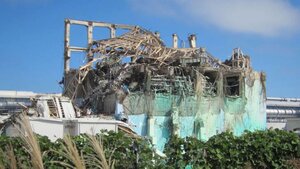
 In this Feb. 12, 2020 photo, the No. 1 and 2 reactor buildings, damaged by the 2011 earthquake and tsunami, are seen at the Fukushima Daiichi nuclear power plant in Okuma, Fukushima Prefecture.
https://mainichi.jp/english/articles/20200310/p2g/00m/0fe/094000c
Japanese environment ministry found solution to counter harmful rumors

Translated by Hervé Courtois
March 11, 2020
It is well known, there is no problem in Fukushima, the “situation is under control”, as the Japanese Prime Minister had declared to the Olympic committee. There are only harmful rumors!
Opposition to the discharge of contaminated water into the ocean: harmful rumors. Opposition to the reuse of contaminated land resulting from decontamination: harmful rumors. Low population return rate: harmful rumors.
The Japanese environment ministry has found the solution: put a potted plant with radioactive soil at its headquarters in Tokyo (source: direct link, copy). As he says, “This is one of the recycling demonstration efforts to eliminate misconception toward Fukushima.” This is one of the recycling demonstration efforts to eliminate misconception toward Fukushima.
These pots could be sold. The nuclear industry will surely be happy to offer them. It will be greener than goodies made in China. We look forward to aquariums with contaminated water from tanks …
Okay, there’s just 16 million cubic meters of earth and 1.2 million cubic meters of water to get rid like this …
Japan’s Nuclear Cover-up Continues, Nine Years after the Fukushima Disaster
March 10, 2020
Written by Arnie Gundersen
The six atomic power reactors at the Fukushima Daiichi nuclear site were severely damaged 9-years ago when a Richter 9 earthquake in the Pacific Ocean occurred at 2 p.m. on March 11, 2011 ravaging the nuclear reactors, flooding safety systems, and causing three atomic power meltdowns.
Fairewinds is using the 9th commemoration of the meltdowns at Fukushima to discuss how the government of Japan, TEPCO (Tokyo Electric Co), the International Atomic Energy Agency (IAEA), and the worldwide nuclear industries have perpetuated their coverup of the tragedy of the Fukushima meltdowns. These corporate and governmental groups and agencies have consistently misinformed the International Press, the citizens of Japan, and people around the world about the true consequences of the Fukushima Daiichi meltdowns.
The Government of Japan, the nuclear industry, and its regulators have “framed” what happened at Fukushima Daiichi and thereby have controlled the Fukushima narrative for 9-years. ‘Framing’ is choosing the right words to portray and control any narrative. George Lakoff and his co-authors explain how controlling that framework of words controls how people view an issue. You may read more in their book that discusses ‘framing’ any issue entitled “Don’t Think of an Elephant!: Know Your Values and Frame the Debate”.
The Fukushima atomic power meltdowns were not ‘accidents’ [none are]
“Accidents” cannot be avoided. However, an accident is when a deer jumps in front of your car or when a tree falls on someone’s home or car during a tornado. A nuclear meltdown is not an accident, it is a manmade disaster. The truth is that government officials in Japan, the US nuclear officials, other nuclear power and nuclear weapons incentivized countries, and the nuclear industries themselves continue to frame the Fukushima Daiichi disaster as an ‘accident’. Why? Because, if the mainstream media and people around the world believe the pro-nuke falsehood that nuclear meltdowns like Fukushima happen rarely if ever and meltdowns were never anticipated, then the majority of the media and the people it influences will look the other way as antiquated, outmoded, costly, and unsafe atomic power reactors are restarted or receive permits to extend their operating lives past their 40-year design lives.
The mainstream media continues to accept verbatim framing by the atomic power owners, corporations, and governments that nuclear meltdowns are accidents. Let’s stop it right here: the three meltdowns at the six atomic power reactor Fukushima Daiichi site were not accidents. Scientists, engineers, fabricators, machinists, government regulators, politicians, and energy corporations know the truth.
According to the official report of The Fukushima Nuclear Accident Independent Investigation Commission, published by the National Diet [the national legislature] of Japan and its Fukushima Nuclear Accident Independent Investigation Commission in 2012, the meltdowns in Fukushima Prefecture [State] could have been avoided:
THE EARTHQUAKE AND TSUNAMI of March 11, 2011 were natural disasters of a magnitude that shocked the entire world. Although triggered by these cataclysmic events, the subsequent accident at the Fukushima Daiichi Nuclear Power Plant cannot be regarded as a natural disaster. It was a profoundly manmade disaster – that could and should have been foreseen and prevented. And its effects could have been mitigated by a more effective human response.
Calling these meltdowns ‘accidents’ enables countries where nuclear power exists to continue operating this dangerous and no longer viable technology. If it was ever viable. Earlier in my career, I believed in and worked for the nuclear power industry. I was strongly against nuclear weapons, and I still am. I chose nuclear power engineering as a college sophomore because I believed that the peaceful use of the atom and would be a safe method of creating badly needed energy. Quite simply, I was wrong. Nuclear power plants, like those at Fukushima and Three Mile Island were designed by Americans and were predicated on the risk analysis predictions that failsafe systems designed into each atomic power reactor would safely shut down each reactor in an emergency, and that its containment systems would make sure that people and communities nearby would be protected from any releases of radioactivity.
At Fukushima Daiichi, every supposedly failsafe system failed and unprecedented amounts of highly radioactive microparticles were spewed into the air and were carried off by wind and weather [rain, snow, and snowmelt] to contaminate entire communities, valuable farmland, small cities, wide forests, small streams, rivers, groundwater, and all the way to the Pacific Ocean. Well, hold on, I am getting ahead of myself. Let’s seriously look at what happened in Japan following the Fukushima meltdowns, and as we do so, let’s also look at the lies that were told by nuclear power proponents as well as the coverups that continue today.
TEPCO [Tokyo Electric Power Corp] denied meltdowns were in progress
On the first day of TEPCO’s emergency at Fukushima, it was clear to me that the Fukushima Daiichi reactors were in jeopardy. I asked Maggie to hold all my calls so I could research what was happening in Japan following the earthquake. I was convinced that a meltdown was in progress. I spent that day and the next two researching all the information I could find about the exact design of those reactors and any record of vulnerabilities they might have. At the same time, Tokyo Electric (TEPCO) misinformed the government and regulators in Japan and also forbade its engineers, managers, and public liaisons to ever use the word ‘meltdown’. It was so incongruous that while the Fukushima Daiichi atomic reactors were exploding live on TV, the Japanese Government was vehemently denying the seriousness of the disaster. FOIA [Freedom of Information Act] requests to the United States Nuclear Regulatory Commission (US NRC) activated the release of numerous NRC emails proving that the US federal regulators were well-aware that meltdowns were in progress in Japan. To counteract the block on accurate information, Maggie organized the development of Fairewinds’ videos and podcasts to keep the world apprised of the real tragedy happening right before its eyes live on the internet and on television. People living in Japan flocked to Fairewinds website to watch our videos and listen to podcasts explaining what was actually happening in their own country.
Unfortunately, it was not until 2019 that TEPCO finally acknowledged its coverup and attempted to apologize to the people of Japan for refusing to tell people living there that the Fukushima Daiichi nuclear power reactors had actually melted down!
The head of Tokyo Electric Power Co. apologized Tuesday over his predecessor’s order to not use the term “core meltdown” to describe the situation at the Fukushima No. 1 nuclear plant in the early days of the March 2011 crisis. “It is extremely regrettable. People are justified in thinking it as a coverup,” Tepco President Naomi Hirose said at a news conference in Tokyo.
The nuclear industry downplayed the radioactive danger being unleashed
While the Japanese government kept denying that meltdowns had even occurred, the rest of the nuclear industry and the governments in the thrall of atomic lobbyists for the nuclear power and nuclear weapons industries actively downplayed the tragedy occurring right before our eyes.
In a brilliant analysis from the UK newspaper The Guardian, reporters uncovered a coordinated coverup that began within two-days of the onset of the Fukushima disaster:
British government officials approached nuclear companies to draw up a coordinated public relations strategy to play down the Fukushima nuclear accident just two days after the earthquake and tsunami in Japan and before the extent of the radiation leak was known.
Internal emails seen by the Guardian show how the business and energy departments worked closely behind the scenes with the multinational companies: EDF Energy, Areva and Westinghouse to try to ensure the accident did not derail their plans for a new generation of nuclear stations in the UK.
“This has the potential to set the nuclear industry back globally,” wrote one official at the Department for Business, Innovation and Skills (BIS), whose name has been redacted. “We need to ensure the anti-nuclear chaps and chapesses do not gain ground on this. We need to occupy the territory and hold it. We really need to show the safety of nuclear.”
On March 18, 2011, seven-days after the disaster began, US Department of Energy Secretary Chu said that Fukushima was at a Level-5 on the nuclear incident scale, which is similar to the level the US Government assessed at Three Mile Island (TMI), but not the level-7 that the world assessed for Chernobyl. On CNN that night, I was the first expert in the world to say publicly on mainstream media that Fukushima and its radioactive releases were already as bad as Chernobyl.
CNN’s John King: “Secretary Chu called it worse than Three Mile Island…”
Arnie: “I actually think it’s at Chernobyl level right now…100 time worse than the worst case we imagined a year ago.”

Every time Fairewinds released a video, podcast, newsletter or I appeared on television or radio, I was publicly slammed and called a liar and fear monger by the nuke industry that I had been directly been employed with for 20-years. I began my career first as a nuclear engineer and reactor operator and later progressed to become Senior Vice President of a nuclear power corporation – until I became a nuclear power whistleblower. After being fired for telling the truth, I took on the role of nuclear safety critic, which I have had for the last 30-plus-years. In Fairewinds opinion, these corporate coverups were obvious to anyone who focused on the real science of nuclear engineering and was not afraid to look behind the curtain, where the Wizard of Oz was manipulating the truth.
Only 11-months after the meltdowns, I was flown to Japan in February 2012 by Shueisha Publishing to unveil the publication of Fairewinds book [entitled Fukushima Daiichi: The Truth and the Way Forward] and to speak at various venues in Tokyo, including the Japanese Foreign Correspondents Press Club. Here is a portion of what I said:
I was an expert on the Three Mile Island nuclear accident, and I see in Fukushima the same mistakes that the Americans made at Three Mile Island. At Three Mile Island and at Fukushima, the plant management – the people in the plant – really understood the severity of the accident. But in both cases, 30 years apart, when the plant management contacted offsite management – it was General Public Utilities in the United States, and of course, it was Tokyo Electric in Japan – the process began to slow down.
What I saw on Three Mile Island was that the corporate office was trying to protect the corporate assets and they actually told the plant manager not to order an evacuation, despite the fact that the plant manager wanted an evacuation. And I see the same thing at Fukushima. I believe that the management onsite in the first day and the first week really understood the severity of it. But senior management working up the chain, for whatever their motivations were, failed to act quickly enough…. it seems to me like the lesson at Three Mile Island and the lesson at Fukushima really are institutional problems in that the corporate officers and corporate offices simply don’t respond quick enough. In addition to the internal problems between the plant and Tokyo Electric offices, there of course were the problems between Tokyo Electric and the Nation of Japan.
Following the triple meltdowns in 2011, I became acquainted with Naoto Kan, the Prime Minister of Japan at the time of the meltdown. At a venue where we were both keynote speakers, I told him that I thought he had not been given the correct information about the meltdowns. He replied,
“The information I received from both TEPCo and METI (Japan’s nuclear regulator) was neither timely nor accurate.”
Please think about the enormity of that single sentence! Any industry so powerful that it does not feel compelled to tell the truth to the leader of a nation is failing its country and their people.
What is a nuclear or radiological incident?
The distinction between a Level-5 [TMI] and a Level-7 [Chernobyl] ‘incident’ is not only a technical or a semantic issue. Downplaying the severity of the disaster as it unfolded deliberately jeopardized the safety of hundreds of thousands of citizens. The classification of an atomic or nuclear incident distinctly impacts emergency planning scenarios and disaster management.
- Lives are at stake!
- How quickly and which individuals should be evacuated?
- How far away from the nuclear reactor should people be evacuated?
- And in what direction should they be moved? So that people are not walking directly into the radioactive plume – as happened to some of the Fukushima evacuees and refugees.
When I was invited to speak at the Foreign Correspondents Press Club in Tokyo in February of 2012, I spoke about the human cost of delayed responses:
Of all of the people on the planet, the Japanese are the best at emergency planning because you have earthquakes and you understand that you need to respond in the case of an emergency. And so for the problem to happen in Japan tells me that worldwide, it is likely that other nations would respond in a very poor fashion. During the first week of the accident, I was on CNN and I said then that women and children should have been evacuated out to at least 50 kilometers. But …. if you don’t believe it’s a severity 7 accident, you’re not going to evacuate the women and children. So there’s a definite connection between understanding how severe the accident was at the Japanese government and Tokyo Electric home office level and their response in inadequately moving women and children away.
The bottom line is that in Japan during the Fukushima Daiichi meltdowns, the lives of women and children were sacrificed to create the appearance that TEPCO had the triple meltdowns under control.
Grossly underestimating the cost of the Disaster
People living and working in Japan and the country’s own citizens were clearly deceived about the severity of the meltdowns, the urgent need to evacuate, and the significant health impact for generations of families following the Fukushima disaster. And, these people were also deceived about the astronomical cost to dismantle the four severely damaged reactors at the Fukushima Daiichi site, protect the ocean and surrounding areas from the ongoing migration of radioactivity, and the total cost to complete the partial remediation of Fukushima Prefecture. I say partial remediation, because the remediation [the removal of radioactivity] will always be partial. So much radioactivity blew into the mountains, and the mountains and forests are so contaminated with highly radioactive isotopes including plutonium, that it will take tens of thousands of years for that radioactivity to dissipate [the industry term is decay away]. Every time in rains or the snow melts or the wind blows from or through the mountains, that radioactivity is spread farther away and also back into areas that were allegedly cleaned. The government informed people that these contaminated areas are clean and that they should now move back into their old communities and homes, and that the government stipends they had been receiving were ending and all the evacuee housing was being closed. What are people to do when they have no place to live and no money to live on except to go back to their old community?
A “lowball” price estimate showing that recovery from the meltdowns would be inexpensive was designed to show Japan’s citizens that the meltdowns were not that bad after all. Immediately following the meltdowns, Japan closed 44 atomic power reactors until the government had regained public trust. If every citizen in Japan had known that she or he would each face at least a $1,000 USD cleanup bill for just the Fukushima site alone, in addition to higher electric costs, it is extremely doubtful that the public would have accepted the reopening of any of its nukes. More than 70% of the citizens of Japan were against the continued operation of Japan’s nukes and demanded significant movement toward sustainable and renewable sources of energy production. Instead Japan’s nuclear industry, its government regulators, and its politicians deceived the public once again, so that the aging and decrepit nuclear reactors could begin generating electricity and profits would again start flowing to nuclear corporations, investors and the banks that bailed out the industry.
One month after the triple meltdowns, NPR [National Public Radio] interviewed Lake Barrett, a former NRC manager who is now employed by TEPCO. As I discussed on C-Span at the 40th Commemoration of the TMI disaster, Lake Barrett was the official NRC representative who originally underestimated by ten-fold (ten times) the radioactive releases that were emitted by the TMI meltdown. One month after the three Fukushima reactors exploded Lake told NPR [US National Public Radio]:
And containing and cleaning up the radioactive material could take at least 10 years, at a cost of more than $10 billion. Even though many of the details about what’s happening at the reactors are not known, experts can predict the tasks ahead for workers…. (Lake) Barrett says to count on cleanup costing $10 billion. Engineers can break the problem down to the basics, and they know how to do each individual step — but nobody’s ever tried a nuclear cleanup on this scale before.
When I heard Lake Barrett’s claim on NPR, I knew he was up to his old tricks of deceiving the public once again. Let’s put Lake Barrett’s lowball estimate in perspective. When atomic power reactors that released much less radioactivity than Fukushima are being decommissioned, it costs almost one billion dollars [$1,000,000,000] to decommission and dismantle each ‘clean’ reactor site. It is absolutely impossible that the three nukes that exploded at Fukushima and spewed radioactivity in an area the size of the State of Connecticut would cost only $10B USD to decommission and dismantle.
When I spoke at the Japanese Foreign Correspondents’ Press Club in Tokyo on February 2012, I began to correct the false narrative Barrett created on dismantlement costs:
I believe it will be about a quarter of a trillion U.S. to completely – over the next 20 or 30 years – to completely clean up after this accident.
My estimate was never published by the media, and I was severely criticized about my assessment while I was in Tokyo. Instead, because of his employment with the NRC, Lake Barrett’s estimate was taken as correct. Now at the 9-year post-disaster mark, we all know that even though my estimate was 25-times higher than Lake Barrett’s conjecture, my estimate was also too low. New cost estimates by TEPCO and the government of Japan now estimate that the cleanup costs will be twice as high as I suggested and 50-times higher than Lake Barrett’s estimate for NPR.

What would the reaction in Japan have been if people there had been informed, as they saw the steaming meltdowns at Fukushima on television and the internet every day? Would they, as citizens, want to be stuck with a bill in excess of $250 Billion dollars? Likely every nuclear plant would have been permanently closed and been replaced with renewable power as I, and my co-authors Reiko Okazaki and Maggie Gundersen, recommended in our 2012 book Fukushima Daiichi: The Truth and the Way Forward.

2020 Olympics
If the 2020 Olympics open in Japan this summer as scheduled, something that may not happened due to the spread of the coronavirus, the pièce de résistance of Japan’s Fukushima coverup will be unfolding in Tokyo. In 2011, even while the three Fukushima nuclear carcasses were emitting extensive radiation, Japan’s new Prime Minister Noda (he was between the ousted Prime Minister Naoto Kan, who was PM when the Fukushima Meltdowns occurred and today’s Prime Minister Abe), claimed that the three melted down Fukushima reactors were in ‘cold shutdown’, which they were not, in order to lay the groundwork for Japan’s Olympic bid. In order to bid as a host for the 2020 Olympics, Noda claimed “… we can consider the accident contained”. Fairewinds compared Noda’s ‘cold shutdown’ hypocrisy to former President George Bush crowing about ‘Mission Accomplished’ in Iraq, so that he could gain the support of the American people by calling the war already finished, when it had just begun.
In order for Japan to win its Olympic bid in 2013, two years later, Japan’s next Prime Minister Abe stated that the Fukushima disaster was ‘under control’. This statement was also a blatant lie that succeeded in winning the bid to hold the 2020 Olympics in Tokyo at the expense of the taxpayers and residents of Japan. Don’t take Fairewinds word for it! Read what Japan’s former Prime Minister, Junichiro Koizumi said to Reuters in September 2016. Entitled Abe’s Fukushima ‘under control’ pledge to secure Olympics was a lie: former PM, Reuters wrote,
Japanese Prime Minister Shinzo Abe’s promise that the crippled Fukushima nuclear plant was “under control” in his successful pitch three years ago for Tokyo to host the 2020 Olympic Games “was a lie”, former premier Junichiro Koizumi said on Wednesday.
Frequent readers of the Fairewinds newsletter will remember last year’s posts entitled Atomic Balm 1 and Atomic Balm 2 in which Fairewinds Energy Education described in detail the path of deception that Japan has used to take the world’s attention off of the lives of its own people, who are still being compromised by the Fukushima Daiichi nuclear tragedy. The 2020 Olympics puts the media focus onto something else – so that the world continues to believe that nuclear power reactors are still a safe form of generating electricity.
This nine year legacy of lies by the government of Japan, nuclear incentivized governments worldwide, and the atomic industry are a harbinger for the seemingly inevitable approach of the 2020 Tokyo Olympics. Hopefully mainstream media covering the summer games will finally see through this glamorous marketing scam and identify the fact that Fukushima Prefecture remains severely radiologically contaminated. Real people, who are citizens of Japan, are seeing their health and that of their families being compromised for generations as they are forced to return to radiologically contaminated areas. Entire families and their communities are facing significant health risks simply to enable corporate profiteering of those investors, energy producers, banks, and government officials associated with the ongoing operation of nuclear power plants in Japan and around the world.
Map of Soil Radioactivity in 17 Prefectures in Eastern Japan

Starting from March 11, 2020, Minna-no Data Site will be offering free use of Map of Soil Radioactivity in 17 Prefectures in Eastern Japan at the time of the Tokyo Olympics
https://en.minnanods.net/blog/pickup/entry-1473.html
And if you want further more information, here is another one that many people have been waiting for: https://minna-no-datasite.stores.jp/items/5e48c64ccf327f78ff411139?fbclid=IwAR0YJpnHw_2OXrchb9dvgXgXEPjoGkzZPqVfnub_CkQvSr3beVrdPAYiodQ
Fukushima Anniversary SPECIAL: Voices From Japan 2020 – Tokyo Shimbun Reporter Takeshi Yamakawa
 Signs outside the Fukushima Exclusion Zone. In 2019, total of 26 English caution signs were placed in 12 places in exclusion zones to prevent foreigners from trespassing in radioactive areas. YouTubers and the Netflix show “Dark Tourism” have trespassed in high radiation areas and illegally entered shops and homes, prompting the local authorities to post signage in English.
(Photo courtesy of U. G. Kaneko)
March 6, 2020
Nuclear Hotseat Voices from Japan: #Fukushima 9th Anniversary SPECIAL. Interview with Takeshi Yamakawa from the Tokyo Shimbun #Nuclear Power Reporting Team; first-hand impressions of the Exclusion Zone from Voices from Japan investigative reporter Yuji Kaneko; and commentary by co-producer Beverly Findlay-Kaneko. Produced and hosted by Libbe HaLevy.
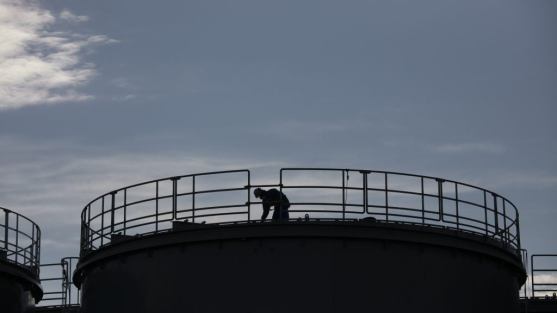
Contaminated water at nuclear plant still an issue ahead of Tokyo Olympics
March 10, 2020
Work to deal with contaminated water at Japan’s Fukushima nuclear power plant continues as the Olympic Games approach.
Inside a giant decontamination facility at the destroyed plant, workers in hazmat suits monitor radioactive water pumped from three damaged reactors.
The decontamination process is a key element of a contentious debate over what should be done with the nearly 1.2 million tons of still-radioactive water being closely watched by governments and organisations around the world ahead of this summer’s Tokyo Olympics.
The plant’s operator, Tokyo Electric Power Company, or Tepco, says it needs to free up space as work to decommission the damaged reactors approaches a critical phase.
It is widely expected that Tepco will gradually release the water into the nearby ocean following a government decision allowing it to do so.
Radioactivity on the move 2020: Recontamination and weather-related effects in Fukushima
9 March 2020
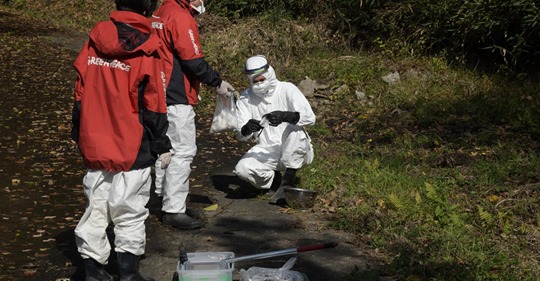
Tokyo, Japan – Greenpeace Japan’s latest extensive radiation survey
has found evidence of recontamination caused by 2019’s Typhoon 19 (Hagibis) and Typhoon 21 (Bualoi), which released radioactive caesium from the forested mountains of Fukushima Prefecture.
The survey, which was conducted over three weeks in October and November of 2019, observed concentrated radiation levels throughout Fukushima Prefecture. These localised areas were where radioactivity was observed at higher levels than in previous years, as well as a reduction in levels in some areas, and recontamination elsewhere.
The survey identified high-level hotspots throughout Fukushima Prefecture, including in Fukushima City. This ongoing and complex radiological emergency in parts of Fukushima Prefecture runs directly counter to the narrative of the Japanese government which continues to push its propaganda of normalization in Fukushima and the effectiveness of its massive decontamination program.
Typhoons no. 19 & 21 deposited large volumes of rain across Japan, including in Fukushima Prefecture. In recent years, scientists have been reporting the effect of heavy rainfall leading to increased migration of radioactivity from mountainous forests through the river systems.
“The results of our 2019 radiation survey demonstrate the complex and persistent nature of radionuclide mobilization and recontamination in areas of Fukushima Prefecture. The mountainous forest regions of Fukushima prefecture, which have never been decontaminated, will continue to be long-term sources of recontamination. The findings from our recent radiation survey definitively disprove the myth of a ‘return to normal’ in parts of Fukushima.” said Kazue Suzuki, Energy Campaigner of Greenpeace Japan.
The main findings of the Greenpeace Japan investigation include:
- Hotspots measured in all areas surveyed; including Okuma, Naraha (J-Village), as well in Fukushima City.
- Significant variations in radiation levels from previous years in certain zones that cannot be explained by radioactive decay.
- Likely remobilization of radioactivity in the soil and weather-related effects resulting from heavy rainfall was also identified in the reopened area of Iitate, with significant changes in radiation levels comparing across the five year period for which we have data.
- Along the Takase river in the newly reopened area of Namie, and where the government claims it is safe to live, 99% of radiation levels averaged 0.8 μSv/h with a maximum of 1.7 μSv/h, with 99% exceeded the government’s long-term decontamination target of 0.23 μSv/h measured at 1 meter and were twenty (20) times higher than pre-2011 levels.
- In a period of four hours, the survey team identified forty-six (46) hot spots in the around Fukushima City central station, eleven of which equaled or exceeded the Japanese government decontamination long term target of 0.23 μSv/h measured at 1 meter; including observed levels of radiation that 137 times higher than the background radiation levels measured in the Fukushima environment prior to the 2011 nuclear disaster.
- In an area close to a former school and kindergarten in the reopened area of Namie, annual dose rates would be between 10-20 mSv based on the Japanese government methodology and between 17-33 mSv based on sustained exposure over a full year; which are between 10 and 33 times above the international recommended maximum exposure for the public.
- Near the new town hall in the newly reopened area of Okuma, and within a few hundred meters of the planned Olympic torch route, radiation hotspots were measured to be of 1.5 µSv/h at 1 meter and 2.5 µSv/h at 10cm (62 times above the background levels of 0.04 µSv/h before the nuclear accident in March 2011).
- The evidence from earlier typhoons and resulting data strongly suggest that there was a substantial increase in downstream contamination from October 2019. Greenpeace intends to return later this year to further investigate and substantiate the hypothesis of major weathering effects in Fukushima.
“The radiation hotspots we found in public areas along the pavements and streets of central Fukushima City, including tens of meters from the entrance to the Shinkansen train line to Tokyo, highlight the ongoing scale of the nuclear disaster in 2011. The hotspots we found are at a level that they would require a special license to be transported and in the category of Dangerous Goods. The government is using the Olympics as a platform to communicate the myth that everything has returned to normal in Fukushima. They falsely claim that radiation has either been decontaminated or is under control. Our radiation survey clearly shows that the government propaganda is not true.” said Shaun Burnie, Senior Nuclear Specialist of Greenpeace Germany.
Mizue Kanno, a resident of Namie who cooperated on the Greenpeace radiation survey said, “I hope the world knows the real situation in Fukushima. Radioactivity is washing down from the mountains due to heavy rain and flowing into the decontaminated areas. The radiation levels found around my house are higher than ever before. Once a nuclear accident happens, it looks like this, and soon we are going to have the Olympics and pretend that everything is okay. It’s not. ”
ENDS
Notes:
Full report in English, here
Photos and videos, here
https://www.greenpeace.org/international/press-release/29250/radioactivity-on-the-move-2020/
1 This Month

of the week – Shut Down Drone Warfare!


Tell the Ukrainian Government to Drop Prosecution of Peace Activist Yurii Sheliazhenko

Petition to revoke the licensing of the Near Surface Nuclear Disposal Facility (NSDF) at Chalk River. https://www.ourcommons.ca/petitions/en/Petition/Details?Petition=e-7247
To see nuclear-related stories in greater depth and intensity – go to https://nuclearinformation.wordpress.com
-
Archives
- March 2026 (251)
- February 2026 (268)
- January 2026 (308)
- December 2025 (358)
- November 2025 (359)
- October 2025 (376)
- September 2025 (257)
- August 2025 (319)
- July 2025 (230)
- June 2025 (348)
- May 2025 (261)
- April 2025 (305)
-
Categories
- 1
- 1 NUCLEAR ISSUES
- business and costs
- climate change
- culture and arts
- ENERGY
- environment
- health
- history
- indigenous issues
- Legal
- marketing of nuclear
- media
- opposition to nuclear
- PERSONAL STORIES
- politics
- politics international
- Religion and ethics
- safety
- secrets,lies and civil liberties
- spinbuster
- technology
- Uranium
- wastes
- weapons and war
- Women
- 2 WORLD
- ACTION
- AFRICA
- Atrocities
- AUSTRALIA
- Christina's notes
- Christina's themes
- culture and arts
- Events
- Fuk 2022
- Fuk 2023
- Fukushima 2017
- Fukushima 2018
- fukushima 2019
- Fukushima 2020
- Fukushima 2021
- general
- global warming
- Humour (God we need it)
- Nuclear
- RARE EARTHS
- Reference
- resources – print
- Resources -audiovicual
- Weekly Newsletter
- World
- World Nuclear
- YouTube
-
RSS
Entries RSS
Comments RSS
 nuclear-news