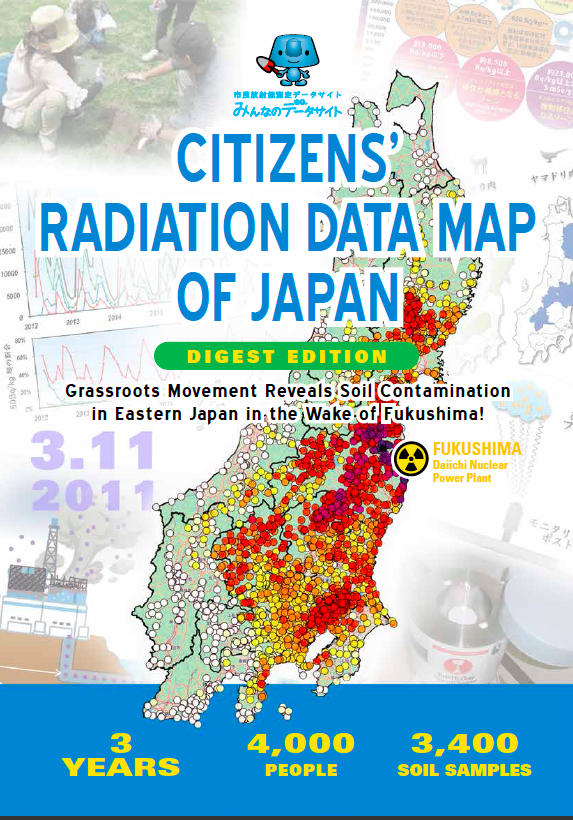
CITIZENS’ RADIOACTIVITY DATA MAP OF JAPAN
September 19, 2019
This booklet shows the actual amount of radioactive contamination caused by the March 2011 Fukushima Daiichi Nuclear Power Plant accident, as revealed by Japanese citizen scientists.
[ Table of Contents ]
Page 2 – 3: Why Measure in Becquerels?
Page 4 – 5: What is the East Japan Soil Becquerel Measurement Project?
Page 6 – 7: 2011 Radioactivity Map of 17 Prefectures in Eastern Japan
Page 8: 2020 Cesium Contamination Map
Page 9: 2010 Radioactivity Level Before the Fukushima Accident
Page 10 – 11: Estimate of Radioactive Cesium Contamination Over 100 Years
Page 12: What is Minna-no Data Site?
Page 13: Minna-no Data Site Measurement Accuracy Control
Page 14 – 15: Minna-no Data Site Participating Measurement Laboratories
Page 16: Glossary, Credits, and Acknowledgments
Specifications
Pages:16
Oversized book
500 yen (tax exclude)
About CITIZENS’ RADIATION DATA MAP OF JAPAN – Digest Edition
This booklet shows the actual amount of radioactive contamination caused by the March 2011 Fukushima Daiichi Nuclear Power Plant accident, as revealed by Japanese citizen scientists.
In the aftermath of the accident, citizens around Japan began to question the Japanese government’s initial radiation exposure assessment, the scope of their radioactivity measuring, and their method of information disclosure. With the aim of reducing citizen exposure to radiation, we established Minna-no Data Site, an independent nonprofit network of radioactivity measuring laboratories, to conduct extensive food measurements and release this information to the public.
More specifically, over a three-year period starting from October 2014, we measured the concentration of radioactivity (cesium 134 and cesium 137) in the soil (in Bq/kg) as part of the “East Japan Soil Becquerel Measurement Project” and publicized the results online as a collection of maps.
According to legislation enacted five years after the Chernobyl accident, Russia, Ukraine, and Belarus were responsible for measuring both air dosage (μSv/h) and soil concentration (Bq/m2).
And using these measurements, the authorities were required to establish criteria for relocation and compensation.
The Chernobyl legislation guarantees relocation and recuperation rights to residents from areas where the exposure dose was estimated to be above 1mSv/year.
In contrast, after the Fukushima Daiichi Nuclear Power Plant accident, soil measurements were more or less not conducted outside of Fukushima Prefecture, and the government has only published estimated numbers of the deposition amount of radioactive cesium and the air dose rate one meter above the ground. The soil concentration figures released by the government are nothing more than estimates, and because the method of display was just an approximation, it is impossible to correctly ascertain the actual amount of contamination
in areas where citizens actually live.
In order to address this unsatisfactory state of affairs, we solicited the cooperation of citizens from around the country to help us carry out this soil measurement project in an attempt to
fully grasp the total amount of radioactive fallout which fell on eastern Japan (excluding Hokkaido) as a result of the triple
meltdown at the Fukushima Daiichi NPP.
As a result of this investigation, we determined that the radioactive contamination was by no means limited to Fukushima Prefecture and that one hundred years from now there will still be several highly-contaminated areas where humans should not live.
Now, eight years after the accident, not only has the government yet to establish a criterion for radioactive concentration in the soil, but the authorities are continuing to enforce the policy of compelling people to return to their homes if the air dose rate goes below 20 mSv/year.
Seen from the standpoint of international standards of public health and radiological protection we cannot turn a blind eye to this unacceptable situation. With the Summer Olympics and Paralympics scheduled to be held in Tokyo in 2020, we decided to publish this booklet in order to respond to questions and concerns from people around the world about the current
state of radiation contamination in Japan.
This book is a digest version of our bestselling Japanese book, Illustration: 17 Prefecture Radioactivity Map & Close Analysis which was self-published in November 2018, and was awarded the Japan Congress of Journalists Prize in July 2019.
With the publication of this English booklet, we are hopingto inform people around the world about the actual amount of contamination in Japan, and at the same time, we are calling on the Japanese government to correct the following two problems:
CORRECTION OF THE DOUBLE STANDARD CONCERNINGRADIOACTIVE MATERIALS 100 Bq/kg AND 8,000 Bq/kg
With regards to the clearance rule for radioactive materials, prior to the Fukushima Daiichi Nuclear Power Plant accident if the level of radioactivity was more than 100 Bq/kg there was a strict storage obligation.
However, with regards to radioactive contaminants derived from the Fukushima accident, the government is permitting anything less than 8,000 Bq/kg to be incinerated or disposed of as ordinary waste; an irresponsible policy which leads to the unnecessary spread of radioactive materials.
We are calling on the Japanese government to correct this double standard and are demanding a return to the preaccident clearance level of 100 Bq/kg.
Also, with regards to soil contamination, we are asking the government to not rely simply on the air radiation dose (sieverts) as they have been doing up until now. Instead, we are calling on them to guarantee appropriate rights of evacuation and compensation that meet international standards based on zone classification depending on the soil concentration
of radioactive material.
RESTORING THE ANNUAL PUBLIC DOSE LIMIT FROM20 mSv TO THE PRE-ACCIDENT LEVEL OF 1mSv A YEAR.
The Japanese government has not yet cancelled the nuclear power accident state of emergency declaration, which was enacted on March 11th, 2011.
Based on this declaration, the public dose limit was raised from 1mSv/year to 20 mSv/year and the government is forcefully requiring evacuees to return to their homes in areas where the dose limit does not exceed 20 mSv/year.
We are calling on the authorities to abolish the 20mSv standard repatriation policy and to return to the pre-accident public standard annual dose limit of 1mSv.
Minna-no Data Site
September 2019
Citizens’ Radiation Data Map of Japan Digest Edition Project Team
Eight years after Fukushima nuclear disaster, Japanese court acquits trio of negligence over meltdown

‘What Corporate Impunity Looks Like’: Court Acquits Tepco Executives for Role in Fukushima Nuclear Disaster
Akihiro Yoshidome, an 81-year-old anti-nuclear campaigner from Tokyo, told AFP he was shocked by the court’s decision. “I had braced myself that we might not get a clean victory, but this is too awful,” Yoshidome said. “This shows Japanese courts don’t stand for people’s interest. This can’t be true.”
 Ichiro Takekuro, former vice president of Tokyo Electric Power Company (TEPCO), arrives at the Tokyo District Court on September 19, 2019.
Japanese legal system fails the victims of Fukushima Daiichi nuclear disaster ex-TEPCO executives found not guilty

Tokyo, 19 September – The legal system of Japan has once again failed to stand up for the rights of tens of thousands of citizens impacted by the 2011 Fukushima Daiichi nuclear disaster, Greenpeace said today. The Tokyo District Court prosecutors, in the only criminal case brought by thousands of Fukushima and other Japanese citizens,(1) ruled that former CEO Tsunehisa Katsumata, and two former Executive Vice Presidents, Sakae Muto and Ichiro Takekuro, were not guilty in failing to take action that could have prevented the nuclear accident. This is despite evidence presented to the court that they were aware between 2002-2008 that there was a risk of a 15.7 meter tsunami hitting the Fukushima Daiichi nuclear plant.
“A guilty verdict would have been a devastating blow not just to TEPCO but the Abe government and the Japanese nuclear industry. It is therefore perhaps not a surprise that the court has failed to rule based on the evidence. More than eight years after the start of this catastrophe, TEPCO and the government are still avoiding being held to full account for their decades of ignoring the science of nuclear risks,” said Shaun Burnie, Senior Nuclear Specialist at Greenpeace Germany (based in Tokyo currently).
The Japanese nuclear industry continues to refuse to act on warnings of seismic hazards at their vulnerable reactor sites, not least TEPCO at its one remaining nuclear plant in Niigata.(2)
The court proceedings, which began in 2017, resulted from persistent efforts by a citizens panel to hold TEPCO to account. The court heard irrefutable evidence that TEPCO executives deliberately ignored evidence of major earthquake risks at the Fukushima Daiichi plant. Between 2002 and 2008, predictions of the potential of 15.7 meter tsunami were known to TEPCO. This was ten meters higher than the existing seawall at Fukushima Daiichi. TEPCO, struggling at the time with major financial losses due to the shutdown of the Kashiwazaki Kariwa reactors following the 2008 Niigata earthquake,(3) refused to invest in protective measures, including raising the seawall height and installing additional emergency generators.
“Deliberately ignoring scientific evidence of the multiple safety risks to Japanese nuclear plants was one of the principal reasons for the Fukushima nuclear disaster. It remains the default setting for the industry today. The people of Japan will be confronted with the dangerous legacy of the Fukushima accident for many decades ahead and longer, so today’s ruling, while a setback, is only part of a long road to justice for the citizens of Fukushima and Japan that will help to prevent another nuclear accident,” said Burnie
Notes:
1 – website of citizen’s support for the court case ;
– 2 -“Technical issues of Japanese seismic evaluations from the point of global and Japanese standards”, Satoshi Sato, Greenpeace Japan, 2015 and Katsuhiko Ishibashi, Emeritus Professor at Kobe University, seismologist, member of NAIIC (the National Diet of Japan Fukushima Nuclear Accident Independent Investigation Commission), presentation to Foreign Correspondents’ Club of Japan, April 27, 2015 – see https://www.youtube.com/watch?v=3nV018TVMec
3 – TEPCO’s Atomic Delusion: Greenpeace Japan, 25 June 2018, see https://storage.googleapis.com/planet4-japan-stateless/2019/08/3d2e8976-atomic_delusion.pdf
Former Tepco executives found not guilty of negligence

Tsunehisa Katsumata (left), former chairman of Tokyo Electric Power Company Holdings Inc., arrives at the Tokyo District Court in Tokyo on Thursday.

‘It will take 300 years before contaminated water is safe to discharge into sea’

S. Korea slams Japan’s actions over Fukushima plant water crisis

Trial of Tepco executives over Japan’s Fukushima disaster heads to conclusion
 The Tokyo Electric Power Co. (TEPCO)’s Fukushima Daiichi nuclear power plant in Fukushima prefecture, is seen in these aerial view images taken in October 2008 (top) and on February 26, 2012, in this combination photo released by Kyodo on March 7, 2012, ahead of the one-year anniversary of the March 11 earthquake and tsunami
September 17, 2019
TOKYO (Reuters) – A Tokyo court will hand down a verdict later this week on whether three Tokyo Electric Power executives are liable for the 2011 Fukushima disaster, the only criminal case to arise out of the world’s worst nuclear crisis since Chernobyl in 1986.
The trial, which started in June 2017, was conducted by state-appointed lawyers after prosecutors decided not to bring charges against the executives of the company known as Tepco.
Former Tepco Chairman Tsunehisa Katsumata and onetime executives Sakae Muto and Ichiro Takekuro apologised during the first hearing at the Tokyo District Court for causing trouble to the victims and society, but pleaded not guilty.
The Fukushima Daiichi nuclear station, located about 220 km (130 miles) northeast of Tokyo, was rocked by a magnitude 9.0 earthquake and subsequent tsunami in March 2011, sparking three reactor meltdowns and prompting Japan to shut down its entire fleet of nuclear reactors.
Lawyers acting as prosecutors said the three executives had access to data and studies anticipating the risk to the area from a tsunami exceeding 10 metres (33 feet) in height that could trigger power loss and cause a nuclear disaster.
Lawyers for the defendants, however, said the estimates were not well established, and even experts had divisive views on how the Fukushima reactors would be affected by a tsunami.
The three former Tepco (9501.T) executives are the first individuals to face criminal charges for the Fukushima nuclear disaster, but a high bar for proof may prevent a conviction. Prosecutors had declined to bring charges, citing insufficient evidence, but a civilian judiciary panel twice voted to indict the executives, overruling the determination not to go to trial.
“If I were a gambling man I would certainly not bet on a conviction. The citizen-panel initiated trials do not have a good success rate,” Colin Jones, a professor at the Doshisha Law School in Kyoto, told Reuters.
“The charitable view would be that prosecutors don’t take cases unless they know they can win, so it shouldn’t be surprising that the cases they don’t want to take end up being losers,” he said.
Citizen judiciary panels, selected by lottery, are a rarely used feature of Japan’s legal system introduced after World War Two to curb bureaucratic overreach.
Indictments brought by the panels, however, have a low conviction rate. One review of eight of these cases by the Eiko Sogo Law Office found just one, equal to a 17 percent conviction rate, compared with an overall rate of 98 percent in Japan.
Japan’s government estimated in 2016 that the total cost of dismantling Tepco’s Fukushima Daiichi nuclear power plant, decontaminating the affected areas, and paying compensation would amount to around $200 billion (£161.26 billion).
More than 160,000 residents fled nearby towns in the aftermath of the March 2011 tsunami as radiation from the reactor meltdowns contaminated water, food and air.
Osaka mayor Ichiro Matsui offers to take in tainted Fukushima water and dump it into Osaka Bay

Fukushima fishermen concerned for future over release of radioactive water
Eight years after the triple disaster, Japan’s local industry faces fresh crisis – the dumping of radioactive water from the power plant
 Last year’s catch was just 16% of pre-crisis levels, partly because of the Japanese public’s reluctance to eat fish caught off Fukushima due to the radioactive water.
September 16, 2019
On the afternoon of 11 March 2011, Tetsu Nozaki watched helplessly as a wall of water crashed into his boats in Onahama, a small fishing port on Japan’s Pacific coast.
Nozaki lost three of his seven vessels in one of the worst tsunami disasters in Japan’s history, part of a triple disaster in which 18,000 people died. But the torment for Nozaki and his fellow fishermen didn’t end there. The resulting triple meltdown at the nearby Fukushima Daiichi nuclear power plant forced the evacuation of more than 150,000 people and sent a plume of radiation into the air and sea.
It also came close to crippling the region’s fishing industry.
Having spent the past eight years rebuilding, the Fukushima fishing fleet is now confronting yet another menace – the increasing likelihood that the nuclear plant’s operator, Tokyo Electric Power (Tepco), will dump huge quantities of radioactive water into the ocean.
“We strongly oppose any plans to discharge the water into the sea,” Nozaki, head of Fukushima prefecture’s federation of fisheries cooperatives, told the Guardian.
Nozaki said local fishermen had “walked through brick walls” to rebuild their industry and confront what they say are harmful rumours about the safety of their seafood. Last year’s catch was just 16% of pre-crisis levels, partly because of the public’s reluctance to eat fish caught off Fukushima.
Currently, just over one million tonnes of contaminated water is held in almost 1,000 tanks at Fukushima Daiichi, but the utility has warned that it will run out of space by the summer of 2022.
Tepco has struggled to deal with the buildup of groundwater, which becomes contaminated when it mixes with water used to prevent the three damaged reactor cores from melting. Although the utility has drastically reduced the amount of wastewater, about 100 tonnes a day still flows into the reactor buildings.
Releasing it into the sea would also anger South Korea, adding to pressure on diplomatic ties already shaken by a trade dispute linked to the countries’ bitter wartime history.
Seoul, which has yet to lift an import ban on Fukushima seafood introduced in 2013, claimed last week that discharging the water would pose a “grave threat” to the marine environment – a charge rejected by Japan.
Fukushima fisheries officials point out that they operate a stringent testing regime that bans the sale of any seafood found to contain more than 50 becquerels of radioactive material per kilogram – a much lower threshold than the standard of 100 becquerels per kilogram observed in the rest of Japan.
At Onahama’s testing centre, just metres from where the catch is unloaded, eight employees conduct tests that last between five and 30 minutes depending on the size of the sample. “Tepco has said that the water can be diluted and safely discharged, but the biggest problem facing us is the spread of harmful rumours,” Hisashi Maeda, a senior Fukushima fisheries official, said as he showed the Guardian around the facility.
Confirming Maeda’s fears, almost a third of consumers outside Fukushima prefecture indicated in a survey that dumping the contaminated water into the sea would make them think twice about buying seafood from the region, compared with 20% who currently avoid the produce.
Tepco’s Advanced Liquid Processing System removes highly radioactive substances, such as strontium and caesium, from the water but the technology does not exist to filer out tritium, a radioactive isotope of hydrogen that coastal nuclear plants commonly dump along with water into the ocean. Tepco admitted last year, however, that the water in its tanks still contained contaminants beside tritium.
Supporters of the discharge option have pointed out that water containing high levels of tritium, which occurs in minute amounts in nature, would not be released until it has been diluted to meet safety standards.
But Shaun Burnie, a senior nuclear specialist with Greenpeace Germany who regularly visits Fukushima, said a proportion of radioactive tritium had the potential to deliver a concentrated dose to cell structures in plants, animals or humans. “Dilution does not avoid this problem,” he said.
Burnie believes the solution is to continue storing the water, possibly in areas outside the power plant site – a move that is likely to encounter opposition from nuclear evacuees whose abandoned villages already host millions of cubic metres of radioactive soil.
“There is no short-term solution to the water problem at Fukushima Daiichi, as groundwater will continue to enter the site and become contaminated,” Burnie said. “A major step would be for the government to start being honest with the Japanese people and admit that the scale of the challenges at the site mean their entire schedule for decommissioning is a fantasy.”
‘No other option’
Government officials say they won’t make a decision until they have received a report from an expert panel, but there are strong indications that dumping is preferred over other options such a vaporising, burying or storing the water indefinitely.
Shinjiro Koizumi, the new environment minister, has not indicated if he shares his predecessor’s belief, voiced last week, that there is “no other option” but to discharge the water into the sea.
The International Atomic Energy Agency has recommended that Japan release the treated water, while Toyoshi Fuketa, the chairman of Japan’s Nuclear Regulation Authority, said a decision on its future must be made soon.
“We are entering a period in which further delays in deciding what measure to implement will no longer be tolerable,” Fuketa said, according to the Asahi Shimbun.
Putting off a decision could delay work to locate and remove melted fuel from the damaged reactors – a process that is already expected to take four decades.
Critics say the government is reluctant to openly support the dumping option for fear of creating a fresh controversy over Fukushima during the Rugby World Cup, which starts this week, and the buildup to the 2020 Tokyo Olympics.
Nozaki said he and other fishermen throughout Fukushima would continue the fight to keep the water out of the ocean. “Releasing the water would send us back to square one,” he said. “It would mean the past eight years have amounted to nothing.”
Radioactive water at Fukushima should be stored not dumped
Murky politics pollute the Pacific
Cooling water is needed at the Fukushima site because, when Units 1, 2 and 3 lost power, they also lost the flow of reactor coolant, causing their cores to overheat. The fuel rods then melted, and molten fuel dripped down and burned through the pressure vessels, pooling in the primary containment vessels. Units 1, 3 and 4 also suffered hydrogen explosions. Each day, about 200 metric tons of cooling water is used to keep the three melted cores cool, lest they once more go critical. Eventually the water becomes too radioactive and thermally hot to be re-used, and must be discarded and stored in the tanks.
As Greenpeace International (GPI) explained in remarks and questions submitted during a consultative meeting held by the International Maritime Organization in August 2019:
“Since 2011, in order to cool the molten cores in the Tokyo Electric Power Company Fukushima Daiichi reactor units 1-3, water is continuously pumped through the damaged Reactor Pressure Vessels (RPVs) and circulated through reactor buildings, turbine buildings, the Process Main Building and the “High Temperature Incinerator Building” and water treatment systems.
“As a result, the past eight years has seen a relentless increase in the volume of radioactive contaminated water accumulating on site. As of 4 July 2019, the total amount of contaminated water held in 939 storage tanks at the Fukushima Daiichi plant (units 1-4) was 1,145,694 m3 (tonnes). The majority of this, 1,041,710 m3, is contaminated processed water. In the year to April 2019, approximately 180 m3/day of water was being circulated into the RPVs of units 1-3.”
In addition to the cooling water, the tanks also house water that has run down from the nearby mountains, at a rate of about 100 tons each day. This water flows onto the site and seeps into the reactor buildings. There, it becomes radioactively contaminated and also must be collected and stored, to prevent it from flowing on down into the sea.
The water tank crisis is just one of multiple and complex problems at the Fukushima Daiichi site, including the eventual need to extract the molten fuel debris from inside the stricken reactors. Decommissioning cannot begin until the water storage tanks are removed.
Tepco has tried to mitigate the radioactive water problem in a number of ways. The infamous $320 million ice wall was an attempt to freeze and block inflow, but has had mixed results and has worked only intermittently. Wells were dug to try to divert the runoff water so it does not pick up contamination. The ice wall has reportedly reduced the flow of groundwater somewhat, but only down from 500 tons a day to about 100 tons.
In anticipation of dumping the tank water into the Pacific Ocean, Tepco has deployed an Advanced Liquid Processing System that the company claims can remove 62 isotopes from the water — all except tritium, which is radioactive hydrogen and therefore cannot be filtered out of water. (Tritium is routinely discharged by operating commercial nuclear power plants).
 Tepco’s “Land-side Impermeable Wall” (Frozen soil wall). (Image: Tepco)
But, like the ice wall, the filtration system has also been plagued by malfunctions. According to GPI, Tepco admitted only last year that the system had “failed to reduce radioactivity to levels below the regulatory limit permissible for ocean disposal” in at least 80% of the tanks’ inventory. Indeed, said GPI, “the levels of Strontium-90 are more than 100 times the regulatory standard according to TEPCO, with levels at 20,000 times above regulations in some tanks.”
The plan to dump the water has raised the ire of South Korea, whose fish stocks would likely also be contaminated. And it has introduced the question of whether such a move is a violation of The Conventions of the Rights of the Child and the Universal Declaration of Human Rights, as was raised in a joint written statement by the International Association of Democratic Lawyers and Greenpeace International, before the UN Human Rights Council currently in session.
So what else could or should Tepco do, if not dump the water offshore and into the ocean? A wide consensus amongst scientific, environmental and human rights groups is that on-site storage for the indefinite future is the only acceptable option, while research must continue into possible ways to extract all of the radioactive content, including tritium.
Meanwhile, a panel of experts says it will examine a number of additional but equally problematic choices, broadly condensed into four options (each with some variations — to dilute or not to dilute etc):
- Ground (geosphere) injection (which could bring the isotopes in contact with groundwater);
- Vapor release (which could infiltrate weather patterns and return as fallout);
- Releasing it as hydrogen (it would still contain tritium gas); and
- Solidification followed by underground burial (for which no safe, permanent storage environment has yet been found, least of all in earthquake-prone Japan).
Arnie Gundersen of Fairewinds, recommends a chemical injection processes (drilling mud) — also used by the oil industry — to stop the flow of water onto the site entirely. But he says Japan has never considered this option. GPI contends that Japan has never seriously researched any of the alternatives, sticking to the ocean dumping plan, the cheapest and fastest “fix.”
All of this mess is of course an inevitable outcome of the choice to use nuclear power in the first place. Even without an accident, no safe, permanent storage solution has been found for the high-level radioactive waste produced through daily operation of commercial nuclear power plants, never mind as the result of an accident.
According to Dr. M.V. Ramana, by far the best solution is to continue to store the radioactive water, even if that means moving some of the storage tanks to other locations to make more room for new ones at the nuclear site. The decision to dump the water, Ramana says, is in line with Abe’s attempts to whitewash the scene before the 2020 Tokyo Olympics and claim, as he has publicly in the past, that everything at Fukushima is “under control.” (Baseball and softball games will be played in Fukushima Prefecture and the torch relay will start there, all in an effort to pretend there are no dangerous nuclear after-effects remaining in the area.)
“The reason that they keep saying they need to release it is because they might have to move some of this offsite and that goes against the Abe government’s interest in creating the perception that Fukushima is a closed chapter,” Ramana wrote in an email. “So it is a political decision rather than a technical one.”
As with all things nuclear, there are diverging views on the likely impact to the marine environment and to human health, from dumping Fukushima’s radioactive water into the ocean. These run the gamut from “a little tritium won’t hurt you” to “the Pacific Ocean is dead thanks to Fukushima” — both of which are wildly untrue. (Tritium can bind organically inside the body, irradiating that person or animal from within. The many problems in the Pacific began long before Fukushima and are likely caused by numerous compounding factors, including warming and pollution, with Fukushima adding to the existing woes.)
 The effect on deep sea creatures of radioactive ocean dumping could be long-lasting.
What is fact, however, is that scientists have found not only the presence of isotopes such as cesium in fish they tested, but also in ocean floor sediment. This latter has the potential to serve as a more long-term source of contamination up the food chain.
But it is also important to remember that if this radioactive water is dumped, it is not an isolated event. Radioactive contamination in our oceans is already widespread, a result of years of atmospheric atomic tests. As was reported earlier this year, scientists studying deep-sea amphipods, retrieved from some of the deepest trenches in the ocean — including the Mariana Trench which reaches 36,000 feet below sea-level and is deeper than Mount Everest is high — detected elevated levels of carbon-14 in these creatures.
“The levels closely matched abundances found near the surface of the ocean, where the amount of carbon-14 is higher than usual thanks to nuclear bomb tests conducted more than half a century ago,” reported Smithsonian Magazine.
Weidong Sun, co-author of the resulting study, told Smithsonian Magazine that “Biologically, [ocean] trenches are taken to be the most pristine habitats on Earth”.
How chilling, then, to realize that our radioactive irresponsibility has reached the lowest depths, affecting creatures far removed from our rash behaviors.
Consequently, the decision by the Japanese government to release yet more radioactive contamination into our oceans must be viewed not as a one-off act of desperation, but as a contribution to cumulative contamination. This, added to the twin tragedies of climate crisis-induced ocean warming and plastics and chemicals pollution, renders it one more crime committed on the oceans, ourselves and all living things. And it reinforces the imperative to neither continue nor increase our reckless use of nuclear power as an electricity source.
For an in-depth look at this issue, read the January 2019 Greenpeace Germany briefing, TEPCO Water Crisis (in English.)
Plan to Release Radioactive Fukushima Wastewater Into Pacific Ocean Panned by Critics
“Another reason to not build nuclear power plants.”
 Greenpeace ship Rainbow Warrior sailing past the destroyed Fukushima Daiichi nuclear plant, five years after the plant’s accident.
“Amid invisible terror, we were witnesses”

Minister says Japan will have to dump radioactive water into Pacific

Fukushima: Japan will have to dump radioactive water into Pacific, minister says
More than a million tonnes of contaminated water lies in storage but power company says it will run out of space by 2022
The operator of the ruined Fukushima Daiichi nuclear power plant will have to dump huge quantities of contaminated water from the site directly into the Pacific Ocean, Japan’s environment minister has said – a move that would enrage local fishermen.
More than 1 million tonnes of contaminated water has accumulated at the plant since it was struck by a tsunami in March 2011, triggering a triple meltdown that forced the evacuation of tens of thousands of residents.
Tokyo Electric Power (Tepco) has struggled to deal with the buildup of groundwater, which becomes contaminated when it mixes with water used to prevent the three damaged reactor cores from melting.
Tepco has attempted to remove most radionuclides from the excess water, but the technology does not exist to rid the water of tritium, a radioactive isotope of hydrogen. Coastal nuclear plants commonly dump water that contains tritium into the ocean. It occurs in minute amounts in nature.
Tepco admitted last year that the water in its tanks still contained contaminants beside tritium.
Currently, more than 1m tonnes of contaminated water is held in almost 1,000 tanks at the Fukushima Daiichi site, but the utility has warned that it will run out of tank space by the summer of 2022.
“The only option will be to drain it into the sea and dilute it,” Yoshiaki Harada told a news briefing in Tokyo on Tuesday. “The whole of the government will discuss this, but I would like to offer my simple opinion.”
No decision on how to dispose of the water will be made until the government has received a report from a panel of experts. Other options include vaporising the liquid or storing it on land for an extended period.
Harada did not say how much water would need to be discharged into the ocean.
One recent study by Hiroshi Miyano, who heads a committee studying the decommissioning of Fukushima Daiichi at the Atomic Energy Society of Japan, said it could take 17 years to discharge the treated water after it has been diluted to reduce radioactive substances to levels that meet the plant’s safety standards.
Any decision to dispose of the waste water into the sea would anger local fishermen, who have spent the past eight years rebuilding their industry.
Nearby South Korea has also voiced concern over the impact it would have on the reputation of its own seafood.
Last month, Seoul summoned a senior Japanese embassy official to explain how Fukushima Daiichi’s waste water would be dealt with.
Ties between the north-east Asian nations are already at a low ebb following a compensation dispute over Koreans forced to work in Japanese factories during the second world war.
The government spent 34.5bn yen (£260m) to build a frozen underground wall to prevent groundwater reaching the three damaged reactor buildings. The wall, however, has succeeded only in reducing the flow of groundwater from about 500 tonnes a day to about 100 tonnes a day.
Japan has come under renewed pressure to address the contaminated water problem before Tokyo hosts the Olympics and Paralympics next summer.
Six years ago during the city’s bid for the games, the prime minister, Shinzo Abe, assured the international community that the situation was “under control”.
Minister calls for dumping Fukushima plant treated water into ocean
September 10, 2019
Japan’s environment minister called Tuesday for water contaminated with low-toxicity radioactive tritium at the crippled Fukushima nuclear plant to be discharged into the Pacific Ocean, potentially provoking controversy with South Korea that has expressed concerns about the idea.
“Although I’m not the minister in charge, I believe there’s no choice but to dump the water (into the ocean) and dilute it,” Environment Minister Yoshiaki Harada told a press conference, a day before Prime Minister Shinzo Abe’s planned Cabinet reshuffle.
Even after being treated, the water, used to cool reactor cores that suffered meltdowns at the plant following the 2011 earthquake and tsunami, remains contaminated with tritium.
But the water, currently stored in tanks at the Fukushima plant, is regarded by the government as relatively harmless to humans.
Seoul has expressed concern over the possibility that the water could be discharged into the ocean. Local fishermen are also opposed to the release of the water into the sea, fearing the potential impact on fish stocks.
The Japanese government has yet to decide on how to dispose of the accumulating water. The tanks storing the water are expected to be full by the summer of 2022, according to Tokyo Electric Power Company Holdings Inc., the operator of the Fukushima plant.
A nuclear expert from the International Atomic Energy Agency said in 2018 that a controlled discharge of such contaminated water “is something which is applied in many nuclear facilities, so it is not something that is new.”
Harada said his view was based on a visit to the Fukushima complex, where he saw a number of tanks storing the water, and the Nuclear Regulation Authority’s support for the water discharge.
In an apparent reference to South Korea, Harada added the most important thing for Japan is to “provide sincere explanations” to countries that may oppose Tokyo’s policy.
The environment minister made the remarks as he looked back on his time in the post since October last year.
In August, a government panel began discussing the possibility of long-term water storage. It has looked at other options such as discharging it into the sea and vaporization.
Toxic water produced by cooling debris and other processes at the Fukushima plant is purified using the Advanced Liquid Processing System, said to be capable of removing almost all radioactive materials except tritium.
Fukushima map with false data for foreigners

Via Cecile Brice
Risk communication: they do not hesitate to produce maps with false data for foreigners. What not to do to make believe that everything is fine.
In the picture, we do not see the number given to “Tepco-Fukushima”. No numbers, they removed all hot spots on their map …
-
Archives
- February 2026 (199)
- January 2026 (308)
- December 2025 (358)
- November 2025 (359)
- October 2025 (376)
- September 2025 (258)
- August 2025 (319)
- July 2025 (230)
- June 2025 (348)
- May 2025 (261)
- April 2025 (305)
- March 2025 (319)
-
Categories
- 1
- 1 NUCLEAR ISSUES
- business and costs
- climate change
- culture and arts
- ENERGY
- environment
- health
- history
- indigenous issues
- Legal
- marketing of nuclear
- media
- opposition to nuclear
- PERSONAL STORIES
- politics
- politics international
- Religion and ethics
- safety
- secrets,lies and civil liberties
- spinbuster
- technology
- Uranium
- wastes
- weapons and war
- Women
- 2 WORLD
- ACTION
- AFRICA
- Atrocities
- AUSTRALIA
- Christina's notes
- Christina's themes
- culture and arts
- Events
- Fuk 2022
- Fuk 2023
- Fukushima 2017
- Fukushima 2018
- fukushima 2019
- Fukushima 2020
- Fukushima 2021
- general
- global warming
- Humour (God we need it)
- Nuclear
- RARE EARTHS
- Reference
- resources – print
- Resources -audiovicual
- Weekly Newsletter
- World
- World Nuclear
- YouTube
-
RSS
Entries RSS
Comments RSS
 nuclear-news