nuclear-news

The News That Matters about the Nuclear Industry Fukushima Chernobyl Mayak Three Mile Island Atomic Testing Radiation Isotope

Few return to Fukushima schools after evacuation lifted

Fourteen public elementary and junior high schools in five municipalities near the Fukushima Daiichi NPP reopened their doors in April for the first time in seven years, but only 135 youngsters showed up. The figure represents just 3 percent of the 4,000 or so children who were enrolled at 21 local schools prior to the disaster…
Those municipalities where evacuation orders were lifted refurbished school buildings and constructed new swimming pools and gymnasiums to attract more children…
safe_image.php.jpeg
Three first-graders gather at their classroom on April 6 in Tomioka, Fukushima Prefecture, after a ceremony welcoming them to the elementary school.
 
Near-empty classrooms marked the start of the new academic year in municipalities where evacuation orders dating from the 2011 Fukushima nuclear disaster were recently lifted.
 
Fourteen public elementary and junior high schools in five municipalities reopened their doors in April for the first time in seven years, but only 135 youngsters showed up.
 
The figure represents just 3 percent of the 4,000 or so children who were enrolled at 21 local schools prior to the disaster.
The low return rate highlights the daunting task for officials trying to revitalize local communities, given fears that an absence of children offers only murky prospects of survival.
 
Municipalities where evacuation orders were lifted refurbished school buildings and constructed new swimming polls and gymnasiums to attract more children.
 
Schools reopened in Namie, Tomioka, Iitate and the Yamakiya district of Kawamata, where evacuation orders were lifted in spring 2017 with the exception of difficult-to-return zones, as well as in Katsurao, where most of the village was deemed safe to return to in 2016.
 
Those municipalities had set up temporary schools at locations where many residents evacuated.
 
After the lifting of the evacuation orders, the percentage of residents who have returned to their former communities range from 3.5 percent in Namie to 33.9 percent in Kawamata.
Most of the returnees are senior citizens.
 
Younger residents apparently are reluctant to return due to lingering concerns about radiation and also because many have made a fresh start in the areas where they moved to after the disaster.
 

April 9, 2018 Posted by | Fukushima 2018 | , , | Leave a comment

Contractor skimmed pay of Vietnamese trainees doing Fukushima cleanup work

waste
TOKYO — A construction firm siphoned off the danger allowances of Vietnamese technical trainees it sent to do cleanup work in the Fukushima nuclear disaster area, the Environment Ministry announced on April 6.
 
The firm, which assigned the technical trainees to radioactive decontamination and home demolition work, used false wage records in explaining that the allowances had been paid. The Ministry of Health, Labor and Welfare is investigating the firm for suspected violations of the Labor Standards Act.
 
The foreign trainee system is intended to bring foreign workers from developing countries to Japan to learn technical skills.
 
The Environment Ministry has confirmed that the construction firm skimmed off the trainees’ danger allowances in 2016 and 2017, when they worked at a demolition site in Kawamata, Fukushima Prefecture.
 
One of the trainees spoke about the pay-skimming at a news conference on March 14 this year. However, the construction firm had given Environment Ministry investigators the falsified wage records, and Environment Minister Masaharu Nakagawa stated on March 27 that the danger allowances had been paid.
 

April 9, 2018 Posted by | Fukushima 2018 | , , | Leave a comment

Arbitration ends for Fukushima damages claim

20180406_21_479972_L.jpg
April 6, 2018
A government body has given up trying to arbitrate between Tokyo Electric Power Company and more than 15,000 people seeking higher monthly compensation for the 2011 Fukushima nuclear disaster.
 
It was the largest arbitration case involving the nuclear accident.
 
Namie Town in Fukushima Prefecture filed a petition with the Nuclear Damage Compensation Dispute Resolution Center in 2013, on behalf of residents who were forced to evacuate after the disaster.
 
More than 15,000, or about 70 percent of the town’s population, signed the petition to demand more compensation from TEPCO, the operator of the damaged Fukushima Daiichi nuclear plant.
 
TEPCO’s monthly payment for each Namie resident was calculated at 100,000 yen, or about 934 dollars.
In March 2014, the dispute resolution center offered an arbitration plan that called for raising this amount by 50 percent. The town agreed to accept it.
 
But TEPCO maintains that increasing the compensation would have a significant impact on other evacuees. The center has repeatedly asked the utility to accept the plan.
 
On Friday, the dispute resolution center told the town of its decision to end the arbitration process.
 
The claimants are expected to consider whether to file a lawsuit against TEPCO. The town says more than 800 of the claimants are now dead.

April 9, 2018 Posted by | Fukushima 2018 | , , | Leave a comment

Seven years later: Contradictory responses to Fukushima

Nuclear safety is an oxymore, shut them all down!
fukushima_1.jpg
On March 11, 2011, the one-two punch from the Great East Japan Earthquake and the tsunami wave it triggered left workers at the Fukushima Daiichi nuclear plant in Japan powerless to prevent three reactors from melting down. In March 2017, the Japan Center for Economic Research estimated that the cleanup cost could range from $470 billion to $658 billion.
The conclusions Japanese and U.S. institutions made about why the Fukushima facility was so vulnerable to such an accident were strikingly similar. The commission created by Japan’s National Diet concluded that its “root causes were the organizational and regulatory systems that supported faulty rationales for decisions and actions.”
The U.S. National Academy of Sciences (NAS) committee that investigated the accident similarly concluded “that regulatory agencies were not independent and were subject to regulatory capture.” According to the NAS report, regulatory capture is “the processes by which regulated entities manipulate regulators to put their interests ahead of public interests.” It found that the plant’s owner “manipulated the cozy relationship with the regulators to take the teeth out of regulations.”
 
In response to the accident, Japan established an agency, the Nuclear Regulation Authority. The NRA is not a clone of the U.S. Nuclear Regulatory Commission (NRC), but it clearly is patterned after the U.S. agency, adopting many of its principles and policies to safeguard public health and safety.
Now, in an odd nuclear safety yin and yang, while Japan’s NRA strives to beef up its role as an effective, independent regulator, the NRC is backsliding towards becoming a cozy captive enforcing toothless regulations.
After the 9/11 terrorist attacks, the NRC upgraded nuclear plant security. The upgrades included increasing the frequency of “force-on-force” tests, which determine whether security staff can thwart an assault on a plant. A team of mock intruders visited each operating nuclear plant at least once every three years and simulated four sabotage attempts against the plant’s gates, guards and guns.
The force-on-force tests either demonstrated security was sufficient or identified weaknesses for correction before actual intruders could exploit them. But plant owners complained about the cost, so the NRC has reduced the number of force-on-force exercises from four to one and is even considering allowing the plant owners to conduct the tests themselves.
Plant owners also complain about the high cost of NRC safety inspections and have targeted some of the NRC’s most important inspections, such as of fire protection measures, for replacement with self-assessments.
Nuclear dentistry last year involving the Palo Verde nuclear plant in Arizona removed teeth from regulatory requirements. One of the two backup emergency power supplies for Palo Verde’s Unit 3 reactor blew up during a test. The plant’s NRC license allowed the reactor to continue operating for as long as 10 days with its backup power capability diminished. The repairs would take considerably longer than 10 days, however, so the plant owner asked the NRC for permission to continue operating for as long as 62 days. Despite the fact that NRC safety protocols prevent the agency from even considering requests for longer than 14 days, the NRC not only considered it, it granted it.
Granting the request also contradicted a formal agreement between the NRC and industry limiting how long a reactor can operate with less than the minimum amount of safety equipment specified in its operating license to 30 days. The agreement termed the 30-day limit a safety backstop, but it did not stop the agency from allowing the Palo Verde reactor to operate unsafely for twice that long.
It is admirable that the new Japanese nuclear power regulator is seeking to improve its safety oversight capability. But it is unfathomable that in the United States, the NRC is retreating from the regulatory front. There’s no doubt that uncompromising, effective regulation is not cheap. But Fukushima reminded the world of what was already well-known — that ineffective safety oversight can cost far more.
Americans deserve — and need — the nuclear regulator toward which Japan is striving.

April 9, 2018 Posted by | Fukushima 2018 | , | Leave a comment

Total tally for Fukushima decommission is $75 billion

DLYU0VgWsAARar7.jpg


April 2, 2018
The decommissioning of the Fukushima nuclear power plant will cost an annual $2 billion (220 billion yen) until 2021, an unnamed source told the Japan Times.
 
Half of the money will be used to tackle the radioactive water buildup at the site of the plant and for removing radioactive fuel from the fuel pools. A small amount of funds will be used to research ways of retreating melted fuel from the reactors that got damaged during the 2011 tsunami disaster.
 
The $6 billion for the three years is only part of the total estimated cost for taking Fukushima out of operation.
 
The total decommissioning tally came in at $75 billion (8 trillion yen), as estimated by the specially set up Nuclear Damage Compensation and Decommissioning Facilitation Corp (NDF). That’s four times more than the initial estimate of the costs around the NPP’s decommissioning.
 
Now the operator of Fukushima, Tepco, and the NDF are due to submit their financial plan for the facility to the government for approval by the energy industry minister.
 
In addition to the $6 billion allocated for the cleanup, Tepco will spend another $1.88 billion (200 billion yen) on preparing to start extracting the melted fuel from the three damaged reactors. This seems to be the biggest challenge for the cleanup efforts because of the still high radiation levels as well as technical difficulties.
 
Tepco is still reeling from the effects of the 2011 tsunami and resulting nuclear meltdown. Around 15,000 people died in March 2011, when a magnitude-9 quake caused a deadly tsunami and erased the coastline in the area of the nuclear power plant.
 
At the end of 2016, the Japanese government revised upwards the total costs of the disaster to $192 billion (21.5 trillion yen), stepping up pressure on Tepco to clean up its act and implement urgent reforms to its safety procedures.
 

April 7, 2018 Posted by | Fukushima 2018 | , | 2 Comments

Fukushima Jitters

Screen-Shot-2018-04-02-at-7.47.54-AM.png
April 2, 2018
by Robert Hunziker
Fukushima is full of nasty surprises, similar to John Carpenter’s classic film The Thing (1982), which held audiences to the edge of their seats in anticipation of creepy monsters leaping out from “somebody, anybody, nobody knows for sure,” but unlike Hollywood films, Fukushima’s consequences are real and dire and deathly. It’s an on-going horror show that just won’t quit.
Only recently, a team of international researchers, including a group of scientists from the University of Manchester/UK and Kyushu University/Japan made a startling discovery. Within the nuclear exclusion zone in paddy soils and at an aquaculture center located several miles from the nuclear plant, the research team found cesium-rich micro-particles.
Evidently, the radioactive debris was blown into the environment during the initial meltdowns and accompanying hydrogen blasts. Accordingly, the environmental impact of radiation fallout may last much longer than previously expected. (Source: New Evidence of Nuclear Fuel Releases Found at Fukushima, University of Manchester, Phys.org, Feb. 28, 2018)
According to Dr. Gareth Law, senior lecturer in Analytical Radiochemistry at the University of Manchester: “Our research strongly suggests there is a need for further detailed investigation on Fukushima fuel debris, inside, and potentially outside the nuclear exclusion zone. Whilst it is extremely difficult to get samples from such an inhospitable environment, further work will enhance our understanding….” Ibid.
Their discovery dispels the long-held view that the initial explosion only emitted gaseous radionuclides. Now, it is clear that solid particles with very long-lived radionuclides were emitted. The research team did not discuss the likely impact, as more analysis is necessary before drawing conclusions.
Decidedly, they’d best hurry up, as the Olympics are scheduled for 2020.
Still, this discovery smacks in the face the government’s and TEPCO’s statements about successful cleanup efforts and pressuring prior residents to return to homes in the exclusion zones.
In another recent development, lethal levels of radiation have unexpectedly popped up in leaks at the nuclear plant facility, as explained in an article by Jeff Farrell: Fukushima Nuclear Disaster: Lethal Levels of Radiation Detected in Leak Seven Years After Plant Meltdown in Japan, Independent/UK, Feb. 2, 2018.
TEPCO has discovered lethal levels of radiation leaking around the facilities, radiation that would kill a person within one-hour of exposure. Even though this is not entirely a surprise with 100% total meltdowns and tons of radioactive corium sizzling wildly underneath, irradiating like crazy. This is why radioactive water continues flowing into the Pacific Ocean, necessitated to cool white-hot sizzling corium. Nobody knows what the long-term effect will be for the ocean, but guaranteed, it cannot be good.
Furthermore and distressingly, Mycle Schneider of the World Nuclear Industry Status Report claims, “TEPCO does not have a clue” to decommissioning the plant. That’s not comforting, knowing that mistakes could circumnavigate the planet much worse than the current flow of radioactive water into the Pacific, thus turning into a global catastrophe of unspeakable proportions.
After all, according to the Japan Meteorological Agency, the country has 100,000 earthquakes every year. Who knows what can happen to rickety broken down nuclear reactors in a country that slip slides so easily, so readily, so often, totally unpredictably.
According to Schneider: “It’s a disaster of unseen proportions.” The radiation leaks, coupled with inappropriate storage of radioactive waste has global consequences. Schneider is aghast at the sloppiness and ignorance of TEPCO, in charge of handling the disaster.
“This is an area of the planet that gets hit by tornadoes and all kinds of heavy weather patterns, which is a problem. When you have waste stored above ground in inappropriate ways, it can get washed out and you can get contamination all over the place… This can get problematic anytime, if it contaminates the ocean there is no local contamination, the ocean is global, so anything that goes into the ocean goes to everyone… It needs to be clear that this problem is not gone; this is not just a local problem. It’s a very major thing.” (Schneider)
And remarkably, the Olympics are coming to Tokyo and Fukushima in 2020.
For the world’s best and clearest understanding of the power and imposing danger inherent with nuclear power, the following is a spectacular power point demonstration that discusses the ABCs of nuclear power: The Age of Nuclear Waste, From Fukushima to Indian Point, prepared for the Fukushima anniversary on March 11, 2017 by Gordon Edwards, Ph.D., president Canadian Coalition for Nuclear Resp0nsibiliy. It’s the best-ever most important-ever description of nuclear power, the process, and inherent dangers.
See a list of 211 man-made radionuclides (p.59 of the power point) contained in irradiated nuclear fuel, not found in nature, which should be a big tipoff of potential dangers inherent with irradiated isotopes… umm, not part of nature!
Gordon Edwards discusses the nuclear waste “word game” as follows: (1) Clean-up is moving nuclear waste from one place to another;(2) Decontamination is collecting and repacking, but not eliminating; (3) Nuclear Waste Disposal is abandoning nuclear waste “somewhere.” In short, there is no such thing as “getting rid of nuclear radiation waste.”
According to The Age of Nuclear Waste, From Fukushima to Indian Point, it’s impossible to dispose of nuclear waste!
Postscript: “It would be irresponsible and morally wrong to commit future generations to the consequences of fission power… unless it has been demonstrated beyond reasonable doubt that at least one method exist for the safe isolation of these wastes….” Sir Brian Flowers, UK Royal Commission on Environmental Pollution, London, 1976.

April 7, 2018 Posted by | Fukushima 2018 | , | Leave a comment

Seven years on, radioactive water at Fukushima plant still flowing into ocean, study finds

Fukushima Daiichi still leaking radioactivity into Pacific Ocean. That expensive Ice wall turned out to be a slushy. Keep trying. Better yet, shut down before meltdown.

n-fukushima-a-20180330-870x559.jpg
Fukushima Daiichi still leaking radioactivity into Pacific Ocean. That expensive Ice wall turned out to be a slushy. Keep trying. Better yet, shut down before meltdown.
More than seven years after the March 2011 Fukushima nuclear crisis, radioactive water is continuing to flow into the Pacific Ocean from the crippled No. 1 plant at a rate of around 2 billion becquerels a day, a study has found.
The amount of leaking cesium 137 has decreased from some 30 billion becquerels in 2013, Michio Aoyama, a professor at the Institute of Environmental Radioactivity at Fukushima University, said in his study, which was presented Wednesday at an academic conference in Osaka.
The study said the concentration of radiation — 0.02 becquerel per liter of seawater found in samples collected near a coastal town 8 km south of the No. 1 plant — is at a level that does not affect the local fishing industry.
The radioactive water is generated in a process to cool melted nuclear fuel at three damaged reactors at the complex. The reactors experienced core meltdowns after the March 2011 earthquake and tsunami.
“It can be assumed that there is a path from the complex to the ocean” through which contaminated water flows, Aoyama said.
The water accumulates in the basements of the buildings at the site after being used to cool the melted fuel.
Tokyo Electric Power Company Holdings Inc., the operator of the Fukushima complex, has been trying to prevent contaminated water from increasing within the facilities by building an underground ice wall in an effort to block ground water. It has also built a seawall aimed at preventing contaminated water from entering the ocean.

April 7, 2018 Posted by | Fukushima 2018 | , , , | 2 Comments

Russia lifts bans on Japanese seafood

20180327_13_474055_L.jpg
March 27, 2018
Russia lifts bans on Japanese seafood
The Russian government has eased import restrictions on Japanese seafood. It imposed bans after the 2011 Fukushima nuclear disaster on concerns of radioactive contamination.
Russia’s quarantine-control authorities say they have approved imports from 6 prefectures in regions around the Fukushima power plant.
The have also lifted a ban on seafood from Fukushima Prefecture. That’s on the condition the products carry an additional document that certifies they are free of contamination.
The Russian officials say their decision takes into account reports from the International Atomic Energy Agency and data from Japan’s monitoring of radioactive materials.
 
Russia lifts Japan seafood ban adopted after Fukushima crisis
TOKYO (Kyodo) — Russia has lifted its ban on Japanese seafood imports adopted in the wake of the Fukushima nuclear disaster due to concerns over radioactive contamination.
Moscow’s Federal Service for Veterinary and Phytosanitary Surveillance on Friday approved seafood imports from six prefectures in northeastern and eastern Japan — Iwate, Miyagi, Yamagata, Ibaraki, Chiba and Niigata.
It also said the country would accept products from Fukushima Prefecture that are accompanied by documentation showing they are free of contamination.
The move should give a boost to Japan’s fishing industry, which has faced international concern over the impact on marine life of the Fukushima Daiichi nuclear crisis triggered by the magnitude 9.0 earthquake and tsunami on March 11, 2011.
Russia banned fishery imports from over 200 companies in April of that year, before allowing products from Aomori Prefecture in July 2015.
According to Japan’s Fisheries Agency, more than 20 countries and regions, including China and South Korea as well as the European Union, still ban or partially ban imports of Japanese seafood products.

April 7, 2018 Posted by | Fukushima 2018 | , , | Leave a comment

Hong Kong will not lift post-Fukushima ban on some Japanese food

Capture du 2018-03-26 09-45-14.png
In meeting with Tokyo’s foreign minister, Chief Executive Carrie Lam says restrictions will stay in place for now, while government reaffirms commitment to enforcing sanctions against North Korea
 
Hong Kong leader Carrie Lam Cheng Yuet-ngor on Sunday rejected for the time being Tokyo’s official request that the city lift restrictions on Japanese food imports brought in after the Fukushima nuclear disaster, citing public safety.
 
The chief executive also reaffirmed that the city had been strictly enforcing sanctions against North Korea, during her meeting at Government House with Japanese foreign minister Taro Kono, as he wrapped up his two-day visit to Hong Kong on Sunday.
 
Lam expressed her reluctance to lift the food ban, after Kono raised the possibility during the meeting.
 
In the wake of the 2011 earthquake and nuclear disaster in Fukushima, Hong Kong banned the import of fresh produce and milk from the prefecture and the four neighbouring prefectures, while conducting targeted radiation testing on fresh produce from the rest of Japan.
 
“She emphasised that it is incumbent upon the [government] to safeguard public health and hence effective measures must be in place to ensure food safety and to maintain public confidence,” a statement issued by Lam’s office read.
 
“Under this premise, the Food and Health Bureau will maintain communication with the Japanese authorities to review the latest situation and adopt appropriate measures in relation to the import ban.”
 
Secretary for Food and Health Professor Sophia Chan Siu-chee said her department had been in touch with Japan’s agriculture ministry over the ban and that “food safety is the primary concern”.
 
Kono was the first Japanese foreign minister to visit Hong Kong for bilateral matters since the former British colony returned to Chinese rule in 1997, according to the Japanese foreign ministry. Earlier on Sunday, he visited the Aeon department store in Tai Koo, where he tasted food from Aizu in Fukushima, including rice, sake and ramen – exempted from the ban because they are not fresh produce.
 
“It is scientifically proven it is very safe and those people from Hong Kong who come to Japan [are] already eating spinach and cucumbers from Fukushima. And I think Hong Kong people who have been to Japanese restaurants have eaten Fukushima vegetables and fruit,” Kono told NowTV. 
“I would like to tell the Hong Kong people to come to Japan and enjoy the food in Japan.”
 
The city’s importers and legislators earlier urged Lam to be cautious about Tokyo’s request to lift restrictions on Japanese food imports, saying the government had to make sure all imports would not be contaminated with radiation.
 
Hong Kong is the largest export destination of Japanese agricultural, forestry and fishery products.
 
The two officials’ exchange came ahead of a North-South summit on the Korean peninsula next month, and US President Donald Trump’s possible meeting with the North’s leader Kim Jong-un before the end of May.
 
UN reports in recent weeks said Hong Kong companies were being used as fronts for North Korean businesses, to help it circumvent UN sanctions. Last month the US slapped sanctions on nine companies outside North Korea that were working on Pyongyang’s behalf. Two were based in mainland China and five in Hong Kong.
 
Lam took the opportunity to say her government was following the sanctions.
 
“Mrs Lam also reiterated to Mr Kono that Hong Kong has all along been strictly implementing the sanction measures decided by the United Nations Security Council on North Korea, and that Hong Kong will stay highly vigilant about activities and suspected cases that may violate the sanctions,” the statement read.
 
According to Japanese news agency Kyodo, both sides affirmed their collaboration in preventing North Korea from evading the sanctions. This was in response to incident in which a Hong Kong-registered tanker was found to have secretly transferred oil to a North Korean vessel in international waters last year.
 

March 26, 2018 Posted by | Fukushima 2018 | , , , | Leave a comment

Intensive campaign from Japanese diplomats to push other countries to lift their ban on Japanese contaminated produce

they say that food
Japan requests Hong Kong to lift ban on food from Fukushima, vicinity
March 25, 2018
HONG KONG (Kyodo) — Japanese Foreign Minister Taro Kono met with Hong Kong Chief Executive Carrie Lam on Sunday and requested the territory lift a ban on imports of agricultural products from Japanese prefectures near the Fukushima Daiichi nuclear power plant.
 
Hong Kong has banned imports of fruit and vegetables from Fukushima Prefecture and four surrounding prefectures, citing the nuclear disaster at the plant triggered by a massive earthquake and tsunami in March 2011.
 
The Japanese government hopes to enhance economic ties with the territory by paving the way for Hong Kong to lift the import ban. Tokyo also hopes Hong Kong’s action would lead China to relax similar restrictions, as Beijing has banned food imports from 10 Japanese prefectures.
 
Kono and Lam also affirmed cooperation in preventing North Korea from evading sanctions through ship-to-ship cargo transfers in international waters.
 
A Hong Kong-flagged vessel is believed to have secretly transferred oil to a North Korean vessel in October in a ship-to-ship transfer prohibited by the U.N. Security Council.
 
It is the first time in 21 years that a Japanese foreign minister has visited Hong Kong apart from international conferences. During their meeting, Kono and Lam also agreed to accelerate cooperation on tourism.
 

March 25, 2018 Posted by | Fukushima 2018 | , , | Leave a comment

Fukushima disaster interest payments to be shouldered by taxpayers now estimated to US$ 29,3 billion, up 58% from previous estimate

 n-fukucost-a-20180325-870x580.jpg
Workers are flanked by bags of radioactive debris along a road in the town of Tomioka, Fukushima Prefecture, In July 2016.
Estimated cost of Fukushima disaster might balloon to ¥218 billion
March 24, 2018
In more bad news for taxpayers, the Board of Audit says the cost of the Fukushima nuclear disaster could balloon to ¥218.2 billion, up 58 percent from the previous estimate of ¥126.4 billion.
The board released the latest estimate Friday in light of the government’s adoption of a Cabinet decision in December 2016 to raise the upper limit on financial assistance for Tokyo Electric to ¥13.5 trillion from ¥9 trillion.
The government is borrowing funds from financial institutions for delivery to Tokyo Electric Power Company Holdings Inc. through a public-private body to help it deal with compensation and other costs related to the triple core meltdown in March 2011.
The principal of the funds will be repaid from contributions by Tepco and other power companies to the body, called Nuclear Damage Compensation and Decommissioning Facilitation Corp., and from proceeds from the sale of Tepco shares it owns.
But the interest payments will be shouldered by taxpayers.
According to the latest estimate, if Tepco uses up the ¥13.5 trillion assistance limit, it will take 17 to 34 years for the government to finish repaying the funds, and interest payments will balloon to between ¥131.8 billion and ¥218.2 billion.

March 25, 2018 Posted by | Fukushima 2018 | , , | Leave a comment

Fukushima governor ‘pushes safety of prefecture’s food’ on Europe tour

n-fukushimafoods-a-20180324-870x579.jpg
Attendants of a reception held at the Japanese Embassy in London on Thursday are served sake from Fukushima Prefecture.
 
LONDON – Fukushima Gov. Masao Uchibori on Thursday kicked off a tour of Britain and France with the goal of publicizing the safety of food from the prefecture.
In London, Uchibori met with officials of British importing companies to promote Fukushima products and develop sales channels.
 
He also paid a courtesy call to Mark Field, the United Kingdom’s minister of state for Asia and the Pacific. Uchibori told Field that the people of Fukushima are profoundly grateful for the warm, generous support received from Britain since the March 2011 earthquake and tsunami and the subsequent meltdowns at the Fukushima No. 1 nuclear power plant. Before the meeting, Field enjoyed dried peaches from Fukushima given by the governor.
 
During a Thursday evening reception at the Japanese Embassy in London, some 200 Japanese and British guests tasted foods and drinks from Fukushima, including the prefecture’s specialty Ten no Tsubu rice dishes with wagyu, locally brewed sake and peach juice.
 
Uchibori’s tour was planned after the European Union in December lifted its restrictions on imports of some foods from Japan, including rice grown in Fukushima. The restrictions were imposed due to concerns over radioactive contamination from the nuclear disaster.
 

March 23, 2018 Posted by | Fukushima 2018 | , , , , | Leave a comment

45 Lawsuits in Fukushima District Courts

n-nuclear-a-20180322-870x552
A group of plaintiffs walk in front of Fukushima District Court in October 2017. The secretariat of the Nuclear Regulation Authority will increase its number of legal staff from this spring to deal with lawsuits.
Japan’s nuclear regulator to hire more legal staff to respond to Fukushima-related lawsuits
 
Japan’s nuclear regulator will increase its number of legal staff from this spring to deal with lawsuits related to the Fukushima crisis, sources close to the matter said Wednesday.
 
The secretariat of the Nuclear Regulation Authority will increase the number of staff at an office in charge of litigation to 22 in the fiscal year starting in April from the current 17. In fiscal 2012, when the body was launched, it only had five employees, the source said.
 
The secretariat said it was handling a total of 45 lawsuits as of March 1, of which 29 had been filed by over 10,000 plaintiffs nationwide including evacuees and victims of the Fukushima accident who are seeking damages from the state.
 
Among those 29 lawsuits, four of the five district courts that have already handed down rulings ordered the state to pay damages to the plaintiffs, rejecting the state’s claim that the accident “could not be foreseen.”
 
A lawyer representing the plaintiffs has criticized the expansion move, saying the state should not insist on fighting the lawsuits.
Izutaro Managi, a member of a lawyers’ group representing some 3,800 evacuees and accident victims in a lawsuit seeking damages from the state and the operator of the plant, Tokyo Electric Power Company Holdings, said, “The aim of the authority’s secretariat is to strengthen the state’s claim that it is not liable for causing the accident.”
“The state should rather reflect on the accident and accept its responsibility,” he said.
 
In addition to lawsuits related to the Fukushima evacuees and victims, the secretariat is also handling lawsuits filed by residents seeking to halt operations at nuclear plants or the construction of new ones.
 
New lawsuits could also be filed in the future as more nuclear power plants clear safety assessments by the authority to resume operations. Currently, 14 reactors at seven nuclear power plants have passed screenings under stricter regulations imposed after the Fukushima crisis triggered by the March 2011 earthquake and tsunami disaster.
 

March 23, 2018 Posted by | Fukushima 2018 | , , | Leave a comment

A Representative of Plaintiffs, Tokuo HayaKawa’s Statement in The Court
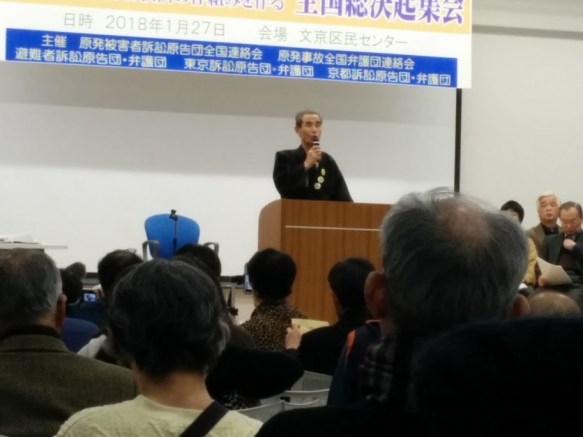
tokuo-hayakawa.jpgTokuo Hayakawa at the rally in Tokyo in January, 2018.


JIJI PRESS’s article

TEPCO Ordered to Pay 600 M. Yen to Fukushima Evacuees

The statement below is translated by Yoshihiro Kaneda. If it has mistakes, Yoshihiro Kaneda has responsibility for that.

Statement

2017 October 6th

To  The Iwaki branch of the Fukushima District Court

Plaintiff: Tokuo Hayakawa

1 I am the thirtieth chief priest of a mountain temple which has a history of over 600 years, but the temple will pass into nothingness in my lifetime. Ten parishioners already severed our relationship. I became a chief priest in 1977 and the temple was desolated even 30 years after the end of the World War 2 because we had about 100 parishioners.

I planed reviving original religious activities and events and improvement for the environment of the temple and was satisfied with its achievement that I did most of it for three decades and several years until March 11th. Especially, the improvement of the precincts, I exerted myself and I overlapped it with my thought which I wanted to live my late life with enjoying the beauty of nature. After retirement, I was comfortable and enjoyed the nature.

I was deprived of this achievement, satisfaction and enjoyment. I was deprived of happiness which I could earn by living for it. I lost my spiritual support to live the rest of my life. What was my life?


2 I am living this way now, but there were evacuees abandoned themselves to grief and then, they comitted suicide.

I heard about a married couple who lost their jobs due to the nuclear accident and heaved sighs repeatedly in Aizuwakamatsu. They strangled their disabled son and they hanged themselves along at the railroad of the Tadami Line.

There was a man,102 years old, who said “Do I have to move from here? I want to live here. I have lived too long.” The man had a rope around his neck and hanged himself.

A cattle farmer who was a 54-year-old man committed suicide, left a message on the wall of the cattle shed in Souma “if there was no nuclear power plant.”

The nuclear accident took a job from a person who was a hundred kilometers away and took an old man’s home, who has lived a hundred-year life and forced a man to kill himself, who had no idea how to pay back his debt because he could not earn money due to a ban on the shipment of milk.


There are many other people who committed suicide.

Our defense counsel won two epochal decisions by suing for the people who killed themselves at the Fukushima District Court.

The appeal of the man whose wife burnt herself to death was admitted. After the ruling, Tokyo Electric Power Company (TEPCO) officials came to his house to apologize but they lost words because the husband rejected point-blank and said “But my wife will never return,” on the scene.

 The wife lost her husband by suicide. Her appeal was admitted and officials of TEPCO went to her home to apologize. But she said “I don’t accept,” and the officials were amazed and silent.

One of the plaintiff’s statements stated that he barely stopped his suicide. I listened to all of the statements by the plaintiffs. While listening to each statement, I always presumed regrets of those who committed suicide.


3  The nuclear accident deprived all of regions and societies we lived, people’s lives and existences. We cannot ever fully recover from this problem again. We lost the places where we were born. The judges witnessed this themselves.

“If only there was no nuclear power plant,” “If only the nuclear accident did not happen.” Those words cannot pierce the heart of the officials of TEPCO. That is the true nature of TEPCO that has not changed after the accident. If they were human, these words would reach them.

Did our statements touch TEPCO? Or their hearts? I will continue to appeal until our victims’ lodgment reach the hearts of TEPCO officials. That is our regretful thought.


4  Through the trial, it became clear that the bottom cause of the accident was a top priority of profit seeking.

However, TEPCO does not admit their responsibility of the accident and, regarding our compensation, they said: “Go to law.” Can we forgive this injustice?

Originally, why did TEPCO build a nuclear plant in Fukushima? Can they explain? They cannot.

We are not only ones who are victims and evacuees by the nuclear accident and our regions are not the only victimized regions. Victims are struggling at the various regions and the evacuation areas. Among them, our plaintiffs are only forced evacuees and what rules the trial is the local Iwaki branch which is nearest court from the nuclear power plant which caused the accident. Those who will rule are the judges who live in Iwaki and have chances to meet the evacuees. We were facing the trial with feeling the significance of that. Our lawyers were aware of this profoundly.


5  “Due to the geographical and social conditions, a location of a nuclear power plant must be the place which does not have a big city in its neighboring region and the place which is sparsely populated.” (The Development Vision of the Futatba Atomic Energy District) “We confirmed that both towns of Okuma and Futaba were the best place to build the nuclear power plant. In the background that the confirmation went along well, there were facts such as that EPCO manipulated carefully after asking to build the nuclear power plant. (Coexistence and Co-evolution-With the Region-The Course of Fukushima Daiichi Nuclear Power Plant 45 years, A History of the first thirty years of Tokyo Electric Power Company)

These are the reason and the circumstance but “why must the location of the nuclear power plant be the place which is sparsely populated?” “why do they manipulate carefully?”

These questions suggest that TEPCO expects a danger and severe accident. If they explained the danger and severe accident to residents, there would be no sacrifices and victims who said if only there was no nuclear power plant.


6  TEPCO had various big and small accidents one after the other immediately after the Fukushima Daiichi Nuclear Power Plant started business operation and they hid the accident which might become a huge accident. Whenever the accident happened, they were designated their slow report and, furthermore, they falsified and fabricated the data and so on. That situation became normal and worsen. It was no wonder that a huge accident could happen at anytime without the earthquake and tsunami. That situation lasted 40 years. That was the Fukushima Daiichi Nuclear Power Plant.

On the other hand, TEPCO circulated an enormous quantity of various handouts and brochures, providing “safety myth” as the measure to local residents. Among those, there was a brochure, titled Calm and Lively Way. Support for Futaba Vigor Life! Futaba with ties: In order to tie strongly between the power plant and residents of Futaba County forever.

They ignored the safety measure we asked whenever strange things happened to the nuclear power plant. In the same breath, they distributed the handouts like that.


7  In 1972, the Association of Naraha Town Residents was formed with the resolution: “We protect beautiful natural mountains and rivers and peaceful lives of townspeople and lives of us and our posterity.” In 1973, the same associations were formed in Tomioka and Okuma. On September in the same year the prefecture association was formed with the agreement: “We are against nuclear and thermal power plants because we cannot obtain the confirmation of safety and those plants are not true regional development and those are against people’s will.” So we, both town and prefecture people were appealing its risk.

One year after the Chernobyl nuclear accident, the organizations of anti-nuclear residents all over Japan took a leading part and they formed “The Nuclear Power Plant Problem Residential Movement National Contact Center.” Since then, in order to establish measures for safety and emergency, we proposed and negotiated with the government and each electric power company every year.

We continued to warn them with publishing a pamphlet titled “Next Huge Accident Will Be in Japan” in 1992.


8  On February, 2005, TEPCO admitted the nuclear power plants in Fukushima could not be withstood by a tsunami in the Chilean Tsunami class becuase we had accused them. But they neglected one and all of our frequented drastic measure claims. Then, the huge accident happened. The Fukushima nuclear accident was an accident that was waiting to happen. Can we deny it?


9  According to “The Result of the Root Cause Analysis” in Summary of the Fukushima Nuclear Power Plant Accident and Nuclear Safety Reform Plan, published after the accident, on March 3, 2013, by TEPCO, TEPCO says “the fact of admitting a need of tsunami protection measures leads that the power plant at that time is not safe. As a result, we were convinced that we would be required nimious measures by Nuclear Regulatory Commission and local residents.”

These things like this are TEPCO’s 40 years history. In consequence, what a huge damage we got! This is our one word “if only there was no nuclear accident.”


10  On August 5th, 2015, Naomi Hirose, CEO of TEPCO was asked the question “Do you acknowledge that the accident was a man-made disaster as a perpetrator?” He answered firmly  “Honestly, I have never thought seriously whether the accident was a man-made disaster or natural disaster until now.” On December 8th, 2016, Yoshiyuki Ishizaki, the president of TEPCO Fukushima Revital Headquarter, said to one victim “the nuclear power plant is  a necessary evil.” They made incautious remarks that they have not understood the calamity of victims and the stricken area at all four and five years after the accident.


11  We dare to bring a case before the Iwaki branch which is the closest local court from the location of the stricken area and the nuclear power plant. It is because we assure only this local court can understand suffering of victims and also they can hand down the decision which will take the part of the victims.

If this local court will hand down a decision which overlooks our actual conditions of damage and the situations of the hometown, we, victims, will not be relieved. All the more, please, the court, according to the facts and truth, hand down a decision for which we are able to hold a hope to live. We and many victims are suffering the damage that “it is impossible to verbalize.”

The Mainichi’s article is below.
Another court orders TEPCO to pay damages to Fukushima evacuees

Source: http://www.absurdity.asia/2018/03/22/a-representative-of-plaintiffs-tokuo-hayakawas-statement-in-the-court/

March 23, 2018 Posted by | Fukushima 2018 | , , | Leave a comment

SEVEN YEARS AFTER: Only trickle of former residents returning home to Fukushima

evacuees return 22 march 2018.jpg
 
March 22, 2018
Close to a year after evacuation orders were lifted in four municipalities near the Fukushima No. 1 nuclear power plant, only 6.1 percent of evacuees have returned to live in their former communities.
 
According to a survey of displaced residents, the top reasons cited for not returning were the condition of their homes, concerns about radiation and the lack of hospitals and stores.
The Asahi Shimbun has conducted annual surveys of evacuees since June 2011 with Akira Imai, a senior researcher at the Japan Research Institute for Local Government.
 
In the latest survey, questionnaires were sent in mid-January to 329 individuals who participated in past surveys. Valid responses were received from 161 individuals now residing in 19 prefectures around Japan aged between 28 and 91.
Of the respondents, 114 were still living as evacuees.
 
Close to 70 percent of the respondents said the measures taken by the central and local governments leading up to the lifting of the evacuation order on March 31 and April 1, 2017, were insufficient.
 
Regarding those results, Imai said, “The lifting of the evacuation order was conducted without adequate consideration for the hopes of the evacuees to have their communities returned to their former condition.”
 
Last year’s lifting of the evacuation order covered areas of the four municipalities of Namie, Tomioka, Iitate and Kawamata that were outside the difficult-to-return zones.
 
In the joint survey, respondents were asked about measures taken by the central and local governments to decontaminate irradiated areas and construct social infrastructure. A combined 109 respondents said the measures were insufficient or somewhat insufficient.
 
They were asked their reasons for not returning.
Multiple answers were allowed, and the most popular response given by 59 people was because their homes were not habitable. Forty-eight people raised concerns about radiation exposure on their health.
 
The inconvenience of not having shops and hospitals nearby was cited by 56 people.
 
One 46-year-old resident of Namie who lives as an evacuee with her husband and two children in central Fukushima Prefecture has no plans to return because there are no hospitals in the community capable of looking after her oldest daughter, who has an illness that could require emergency care.
 
While the rates at which evacuees have returned to the four municipalities range between 3.5 percent and 31.1 percent, the rates have not necessarily increased dramatically in the other municipalities where evacuation orders were lifted before spring 2017.
 
While the rates are between 80 and 81 percent for Tamura and Kawauchi, it is only between 19 and 34 percent in the three other municipalities where the orders were lifted prior to spring 2017.
 

March 22, 2018 Posted by | Fukushima 2018 | , | Leave a comment



