Toxic masculinity, the nuclear lobby and its climate change confidence trick – theme for April 2021

In 2021, not only viruses, but also ideas, are sweeping around the world. There is a renewed global push for equality for women. A newly revitalised movement to end racism. The pandemic means that the health of each nation now depends on the health of all nations. The climate crisis is headed to affect the whole world.
Curiously absent from these global anxieties is the nuclear threat. Nuclear war could annihilate not only millions of people, but also our chances of a liveable climate. Nuclear pollution affects mainly indigenous peoples , just as nuclear weapons testing was cheerfully imposed by the rich nations on distant indigenous lands.
Nuclear wastes keep accumulating, with no solution as to where to put them. Governments are conned by gee-whiz nuclear salesmen into pouring our tax-payers’ money into dead end Small Nuclear Reactor shemes, and propping up old decrepit Big Nuclear Reactors.
If we’re really getting serious about world health, about equality for women, and indigenous rights – then why on Earth are we tolerating the continuation of the Toxic Masculine Nuclear Culture?
They’ll tell us that we can’t understand nuclear issues – only the toxic masculine nuclear experts can. So leave nuclear decision making to them?
They’ll bend over backwards to entice and promote women into the industry (preferably bimbos if at all possible). They’ll decry women’s ignorance, and some men’s too – people with strong knowledge of environment, history – all those soft humanities issues.
But they know, as we all do, that women overwhelmingly distrust nuclear power and nuclear weapons, and so do indigenous peoples.
As world leaders prepare for the COP Climate Conference in Glascow in November, the unscrupulous nuclear lobbyists are trying every bribe, every trick in the book, to get nuclear accepted as ‘clean’. They’re desperate, as nuclear power is a financial disaster – and they want the tax benefits and subsidies that go with being accepted as ”clean” ”sustainable”
The Global Nuclear Threat – theme for April 2021
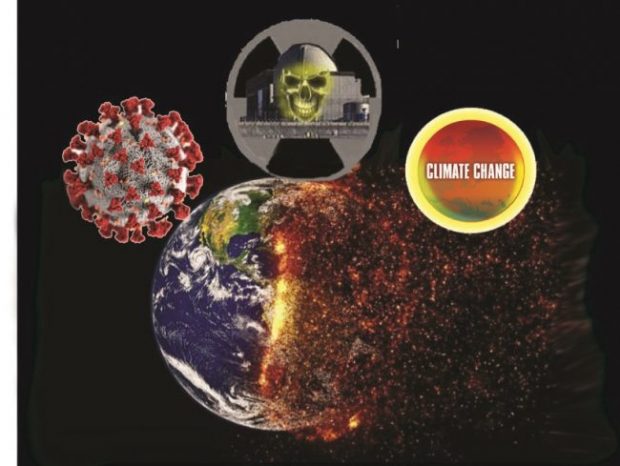
Leaders of nations are slow to wake up to what many normal people have known – we share this planet. Its big problems are global, and need to be addressed globally.
The pandemic is a telling illustration of this – squabbles over how it started, and over vaccines. But leaders are slowly realising that economic life will not really get going while Covid-19 is raging in other countries.
Climate change is an even more serious example, with its effects not all predictable. But poor countries take the brunt of what has been caused by rich countries.
Somehow, inexplicably lurking in the background is the terrible danger of the nuclear industry.
The nuclear industry is in a way more dangerous, more sinister than the other two – because it is very corrupt, and is managing to put it over governments – posing as the ”solution” to climate change.
A global cabal of toxic masculinity, this crooked industry is run by nuclear ‘cowboys’ – keen to take the safety risks, the weapons proliferation risks, the apocalyptic war risks, not only on earth but in space, and on other planets. And they manage this confidence trick at tax-payers’ expense. The nuclear nations beef up their weapons ‘ industry, with public funds that are not going to the health and well-being of their populations.
Fortunately there are international organisations that work for global action – a good example being ICAN – the International Campaign to Abolish Nuclear Weapons.
It is time for the nuclear-free organisations to work together, globally, to counteract the nuclear industry. That’s a hard call, as the nuclear industry has the money, the influence, the ruthless crookedness to impose its will on governments and media.
The nuclear free movement, with its predominantly indigenous members, lacks mopney and influence. Still, the nuclear-free movement has some powerful advantages – intelligent expertise, integrity and determination.
Olympic Games hype to deceive the world about Fukushima nuclear catastrophe – theme for March 21


SEPTEMBER 16, 2019 Tokyo Electric Power’s Fukushima Daiichi Nuclear Power Station, which experienced three massive meltdowns in 2011, is running out of room to store radioactive water. No surprise! But now, what to do about phosphorescent water?
*****
Addressing the issue, Japan’s environmental minister Yoshiaki Harada held a news conference (September 2019). Unfortunately, he proffered the following advice: “The only option will be to drain it into the sea and dilute it.” (Source: Justin McCurry in Tokyo, Fukushima: Japan Will Have to Dump Radioactive Water Into Pacific, Minister Says, The Guardian, Sept. 10, 2019)
“The only option”… Really?
Over the past 8 years, Tokyo Electric Power (TEPCO) has scrambled like a Mad Hatter to construct emergency storage tanks (1,000) to contain upwards of one million tonnes of contaminated radioactive water, you know, the kind of stuff that, over time, destroys human cells, alters DNA, causes cancer, or produces something like the horrific disfigured creature in John Carpenter’s The Thing! That’s the upshot of a triple nuclear meltdown that necessitates constant flow of water to prevent further melting of reactor cores that have been decimated and transfigured into corium or melted blobs. It’s the closest to a full-blown “china syndrome” in all of human history. Whew! Although, the truth is it’ll be a dicey situation for decades to come.
Ever since March 11, 2011, TEPCO has scrambled to build storage tanks to prevent massive amounts of radioactive water from pouring into the ocean (still, some lesser amounts pour into the ocean every day by day). Now the government is floating a trial balloon in public that, once the tanks are full, it’ll be okay to dump the radioactive water into the ocean. Their logic is bizarre, meaning, on the one hand, the meltdown happens, and they build storage tanks to contain the radioactive water, but on the other hand, once the storage tanks run out of space, it’s okay to dump radioactive water into the ocean. Seriously?
Meantime, the Fukushima meltdown brings the world community face to face with TEPCO and the government of Japan in an unprecedented grand experiment that, so far, has failed miserably. Of course, dumping radiation into the Pacific is like dumping radiation into everybody’s back yard. But, for starters, isn’t that a non-starter?
Along the way, deceit breeds duplicity, Continue reading
Hiroshima 1945, Fukushima 2011, – Japan’s nuclear horrors – theme for March 21
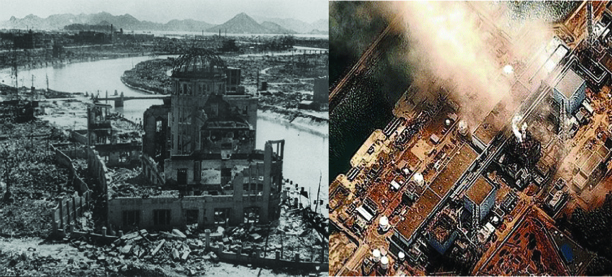
As World War 2 neared its end, with 20 million Russian soldiers killed, fighting with the Allies against Hitler, America’s government was already planning its military superiority over Russia.
What they needed was to demonstrate a weapon of huge mass destruction, that would frighten the Russians. Germany surrendered on 7 May 1945. Too late to try one out on Germany , but Japan was still in the war, (though near to giving up). So they had to hurry. Japan would be the test case – selecting the city of Hiroshima , both to test the effects of atomic bombing, and to show the Russians, on August 6th. To emphasise the USA’s military superiority, they plutonium bombed Nagasaki 3 days later.
After the war, how to get Japan ”on side” against Russia , and equally important, to show the Japanese that nuclear is really quite good.? USA helped Japan to now get an ‘economic miracle’, and better still, give Japan the benefit of ‘good nukes’.
To these crowded, seismically dangerous Japanese islands, USA promoted clusters of nuclear power stations. The nuclear industry’s image was miraculously enhanced – to Japan, and to the world.
BUT, 66 years later, Japan suffered another disastous nuclear blow, with the meltdown at the Fukushima nuclear power station. With the 10 year anniversary of this disaster, on March 11, the real cleanup is nowhere in sight, vast amounts of contaminated water are still accumulating, areas are uninahitable, and most evacuees don’t want to return. Radioactive pollution in forests is still a problem.
Sad to reflect that this one country, Japan, has suffered two great nuclear horrors – 75 years apart, with the tragic effects of both continuing. The world needs, not a celebratory, cosmetic, Olympic Games, but real international help for the people of Fukushima, and for the environmental remediation. Japan needs help to shut down the toxic nuclear industry and move to clean energy
Treaty on the Prohibition of Nuclear Weapons – theme for January 2021
The Treaty on the Prohibition of Nuclear Weapons, the first international ban on nuclear weapons, will take full legal effect on Jan. 22, 2021.
It joins the Chemical Weapons Convention and the Biological Weapons Convention as a treaty prohibiting weapons of mass destruction . It joins those international agreements that prohibit and eliminate weapons based on their humanitarian harm. The treaty has widespread support in the international community — 122 countries voted for its adoption in 2017, and these countries have continued to express their support for the treaty .
The Traty is not merely symbolic. It prohibits states parties from developing, testing, producing, manufacturing, transferring, possessing, stockpiling, using (or threatening to use) nuclear weapons, or allowing nuclear weapons to be stationed on their territory. It also prohibits states parties from assisting, encouraging, or inducing states to engage in any of these prohibited activities.
A NATO State may join the Treaty and remain in the alliance as long as that state renounces participation in the nuclear dimension of the alliance and indicates that it does not support activities prohibited by the treaty.
About compliance concerns in the Treaty. international treaties reinforce norms and provide a forum to discuss and condemn violations of international standards for peace and security.
The treaty will continue to grow and integrate into the international system well beyond its entry into force in January and first meeting of states parties. The norm established by previous weapons prohibitions impacted banks, companies, and government policies in countries that had not joined the treaty, and the same can be expected for the nuclear prohibition norm.
The Treaty on the Prohibition of Nuclear Weapons will impact the norm against nuclear weapons and in the meantime will provide concrete assistance for victims of nuclear weapons use and testing and contribute to remediating radiologically contaminated areas.
These notes adapted from https://warontherocks.com/2020/11/five-common-mistakes-on-the-treaty-on-the-prohibition-of-nuclear-weapons/
Politics in the age of pandemics, global heating, and nuclear danger – theme for November 20
For November, we’ve been focussed on international politics – because of these massive threats, and because of the importance to the world of the American election.
With the win of Joe Biden as President -elect, the nuclear lobby has been revitalised, and already their propaganda war is swinging into action. But this renewed nuclear threat is being either ignored or encouraged by the mainstream media. Everyone seems to be getting informed about the pandemic and the climate, but not about the equally grave nuclear threats. Which is why, from now on, this site will return to its original focus on matters nuclear.
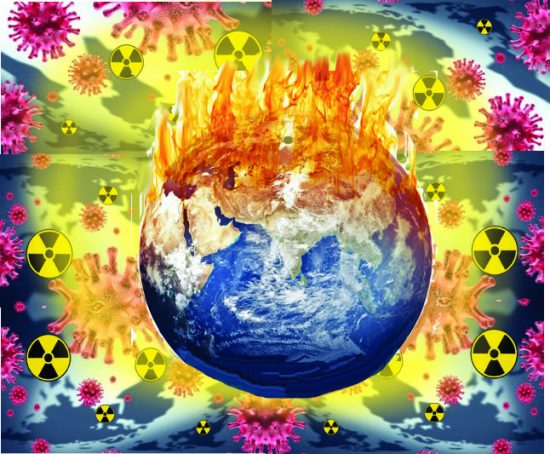
Tensions as Armenia- Azerbaijan conflict pauses. War in Syria grinds on. USA and China already in some sort of cold war. National pride and one-up-manship are perpetually on display among the leaders of countries. Nationalist and populist leaders seem to be in charge, with competitiveness and dog-eat-dog as their prevailing philosophy.
All this – when the global threats of pandemic, climate change, and nuclear danger clearly require co-operation between nations, if we are to have any hope for a decent future – indeed – perhaps any future, for the human species, and for the rest of the other species, too.
It is time for political leaders to pay attention to the efforts of global bodies, the United Nations, the World Health Organisation, and the many international agencies that work for the public good. What a timely winner for the Nobel Peace Prize was the United Nations World Food Programme!
As I write, the world watches in amazement the tortuous path of Joe Biden to the American electionpresidency. . The disastrous results of four years of the Trump presidency for the United States will take some fixing. A rational team in the White House could begin the change that the world needs – co-operation between the powerful nations to address the threats that now preoccupy the world’s people.
Antarctica – global heating and nuclear issues – polar theme for September 20

Antarctica is not in the news as much as the Arctic is, But global heating is affecting Antarctica too, and Antarctica has its nuclear issues.
Antarctica has made headlines several times this year due to extremely warmer than usual temperatures. It has been steadily heating up for decades. Antarctic ice shelves have lost nearly 4 trillion metric tons of ice since the mid-1990s, scientists say. Ocean water is melting them from the bottom up, causing them to lose mass faster than they can refreeze. As ice shelves melt, they become thinner, weaker and more likely to break. When this happens, they can unleash streams of ice from the glaciers behind them, raising global sea levels. Antarctica is also losing ice from melting ice sheets, and chunks of ice falling from glaciers.
Less studied than the Arctic region, Antarctic is now being investigated by Australian researchers, using robots to gather data from difficult to reach underwater areas. Satellite monitoring confirms the shelves’ melting trend.
Nuclear issues. From 6,000 nautical miles away, uranium mining in Australia is polluting the Antarctic. After 1945 atomic bomb testing sent radioactive pollution to the South Pole, as well as to everywhere else on the planet.
USA operated a small nuclear power plant at Antarctica’s McMurdo Sound. It was known as “nukey poo” because of its frequent radioactive leaks. It had 438 malfunctions – nearly 56 a year – in its operational lifetime, including leaking water surrounding the reactor and hairline cracks in the reactor lining. The emissions of low level waste water where in direct contravention of the Antarctic Treaty, which bans military operations as well as radioactive waste in Antarctica. After the reactor was closed down, the US shipped 7700 cubic metres of radioactive contaminated rock and dirt to California. Many USA naval workers there developed cancers.
Today, small nuclear reactors similar to this one, are being touted for remote areas in Australia and other countries. The history of this one in Antarctica, and 7 others elsewhere, was one of malfunctions, and closing down within a few years. This does not augur well for the small nuclear reactors being promoted today.
The Arctic – where global heating meets nuclear pollution – theme for September 20
Global heating is bringing massive changes to the Arctic, and at an accelerating pace. It is the warning system to the world, as sea ice melts, Greenland’s glaciers melt, swathes of frozen ground thaw, permafrost melts. The Arctic ocean will probably be ice-free in summer by 2040.
Crazily, Russians and Americans rejoice, seeing all this as the opportunity to exploit the region for oil and gas, the very things that are causing this unfolding climate nightmare. Apparently these governments are not concerned about the Arctic processes that bring changed global weather, with changed ocean currents, sudden extreme cold snaps. Global heating speeds up with feedback loops: as ice is lost , dark water absorbs more heat from the sun, melting permafrost releases methane and carbon dioxide into the atmosphere.
Arctic regions now experience repeated uncontrollable forest fires, bringing environmental and economic destruction.
Nuclear pollution. The Arctic is where the the two disastrous threats meet – climate change and nuclear radiation. This danger is happening with fires threatening Northern Russian radioactive sites, and with radiation released as buried nuclear items appear from under the ice. Russia’s dumping of nuclear submarines and other radioactive trash is now recognised as a danger to Arctic ecosystems.
There are 39 nuclear-powered vessels or installations in the Russian Arctic today with a total of 62 reactors. This includes 31 submarines, one surface warship, five icebreakers, two onshore and one floating nuclear power plant. These numbers are set to increase; . “By 2035, the Russian Arctic will be the most nuclearized waters on the planet.”
There were 2 fatal arctic accidents in 2019 – 14 sailors killed due to a fire on a nuclear-powered submarine, and an underwater nuclear-powered cruise missile exploded. Several serious submarine nuclear reactor accidents have occurred in Arctic waters, and a U.S. bomber with plutonium warheads crashed at Thule airbase on Greenland. In the Kara Sea, thousands of containers wit radioactive waste were dumped, together with 16 reactors.
Remembering Hiroshima and Nagasaki – time for the global Nuclear Ban Treaty – theme for August 20

August 6th and August 9th are the days that remind us of the horror of nuclear weapons. The failing and desperate nuclear industry would like us to forget about Hiroshima and Nagasaki. They’d like us to swallow their spin about new small nuclear reactors. (But new small nuclear reactors are just the latest gimmick to support the nuclear weapons industry, and put a friendly mask on it. They really have no other purpose.)
 In this time of pandemic and global heating, Trump’s USA, Putin’s Russia, and other nations, are putting obscene amounts of money into nuclear weapons. The U.N.’s Treaty on the Prohibition of Nuclear Weapons (passed by a vote of 122-1-1 at the United Nations in 2017) is looking ever more rational and necessary. It will enter into force when 50 nations have ratified it. It’s now up to 43 ratifications.
“The pandemic has taught us that all the world’s great needs and threats are linked. By reallocating bloated military spending and reorienting nations to resolve conflict through peaceful negotiation, people and governments throughout the world can more easily tackle the enormous economic and civil injustices that give rise to conflict and fuel the fire of climate change. Each victory in each arena must be used to feed progress elsewhere if humanity is to survive this century.
As we remember the victims of the atomic bombings 75 years ago and hear the stories of the survivors, we realize more than ever: we are all in this together. ” – Michael Christ, Executive Director, International Physicians for the Prevention of Nuclear War
Banning weapons of mass destruction, including nuclear ones – theme for August 2020

You might think that it’s naive to be talking about banning nuclear weapons, in this present climate of international tension. Yes, an international agreement to ban them is not going to get rid of nuclear weapons overnight, or indeed, anytime soon.
BUT – as things stand now, nuclear weapons, held by all the so virtuous States – USA, Britain, France, India, China Pakistan, Israel, (- and now North Korea) – are accepted as respectable , defensive, necessary.
The idea of the world recognising weapons of mass destruction as unacceptable is not new. It’s been done before.
Human beings, after all, are social animals, and their greatest successes have been achieved by co-operation. Years of co-operative effort by intelligent and thoughtful people have shed light on the humanitarian horror of mass killings, and mass sufferings of those who survived such attacks.
Under the auspices of he United Nations, the concerted efforts of so many have brought about the recognition that mass murder is unacceptable, and has been judged to be illegal. No, these threats have not been completely eliminated. But they have been vastly diminished, and no leader can get away with pronouncing them to be acceptable or necessary.

The United Nations Ban on the use of chemical and biological weapons in warfare was signed in 1925, and strengthened in 1997 in the the Chemical Weapons Convention (CWC)
The United Nations Biological Weapons Convention (BWC) came into force in 1975.
In both cases, these agreements outlawed the development, stockpiling, acquisition, retention, and production of these inhumane weapons, and reaffirmed the 1925 ban on their use.
These bans, agreed on by 178 nations (the BWC), 192 (the CWC) have been further developed over many years of successive conventions, the most recent being in November 2016.
There’s a wealth of information on the effects of nuclear weapons production and use – not just the immediate effects on victim communities, but the pervasive global effect on climate, agriculture and teh world’ s food supply.
Right now, we all live under a terrible threat of nuclear war. It is surely time to make a start on removing that threat. The United Nations Nuclear Weapons Ban Treaty is that start. The Treaty on the Prohibition of Nuclear Weapons is close to the number of 50 ratifications , required to make it international law.
Nuclear power, far too slow to affect global heating – theme for July 20
In recent themes I wrote about nuclear power being in fact a big contributor to global warming, and about how climate change will in fact finish off the nuclear industry.
But – let’s pretend that nuclear reactors really could reduce greenhouse gas emissions.
TIME: To do that, 1500 one thousand megawatt-electric new reactors would be needed within a few years to displace a significant amount of carbon-emitting fossil generation. A Massachusetts Institute of Technology Study on “The Future of Nuclear Power” projected that a global growth scenario for as many as 1500 one thousand megawatt-electric new reactors would be needed to displace a significant amount of carbon-emitting fossil generation. Average 115 built per year would reduce our CO2 use by only 16%.
But the new flavour of the month is Small Modular Nuclear Reactors (SMRs), which generate from 50 to 200 megawatts. So the world would need, quickly, to have a significant reduction of carbon emissions, i.e at least 7500 largish SMRs – or 30,000 smaller ones., (and these SMRs are already shown to be more costly than large ones,)

Meanwhile – if the nuclear “climate cure” were to be pursued, the enormous costs and efforts involved would take away from the clean, fast, and ever cheaper solutions of energy efficiency and renewable energy.
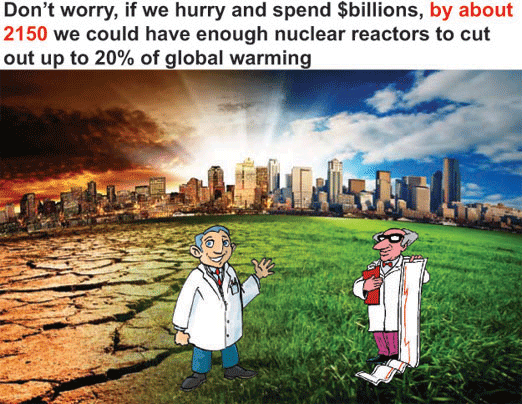
NUCLEAR’s WHOPPING CLIMATE LIE – theme for July 2020
 “If you tell a lie big enough and keep repeating it, people will eventually come to believe it. A lie told once remains a lie but a lie told a thousand times becomes the truth ”
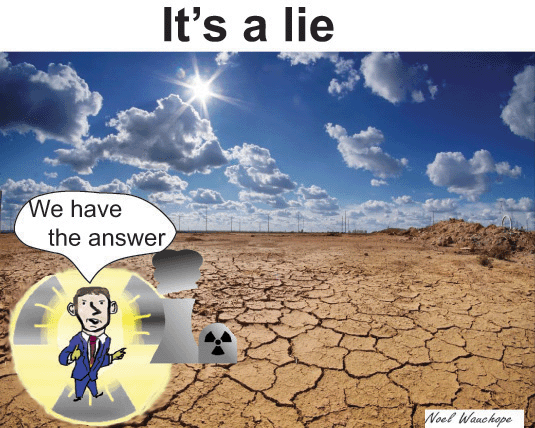
Dr Goebbels would be delighted with the nuclear lobby’s lie that nuclear power is zero carbon and will fix climate change. He would be even more delighted with the current success of this lie.
“Think of the press as a great keyboard on which the government can play.”
The failing nuclear industry is fighting for its life. It now pitches its salvation on its claim to halt climate change. Even if 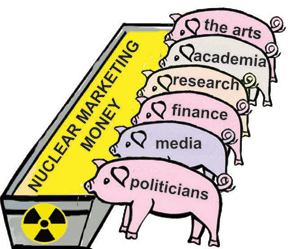
that were true (which it isn’t) the world would have to construct several thousand ‘conventional’ reactors, or several millions of Small Modular Reactors (SMRs) very quickly, within a decade or two.
How is it that politicians , media, academics have swallowed this lie?
Financial institutions funding nuclear weapons – theme for June 20

Nobody except a few erratic multi-billionaires is willing to gamble their money on “peaceful” nuclear power. Still, your taxes are going to so-called “commercial” nuclear power, if you live in a nuclear country.
But banks, pension funds, insurance companies and asset managers are investing in nuclear weapons – and you wouldn’t even know that your money is going there. Don’t Bank on the Bomb has listed institutions around the world with substantial investments in nuclear arms producers. Fo example From 2013 to 2016, United States 226 Financial Institutions made an estimated USD$ 344 billion available to 27 nuclear weapon producing companies .
International Campaign to Abolish Nuclear Weaspons, (ICAN) has identified financial organisations funding nuclear weapons The report Don’t Bank on the Bomb, updated annually by PAX, provides details of financial transactions with companies that are heavily involved in the manufacture, maintenance and modernization of US, British, French and Indian nuclear forces.
ICAN is appealing to financial institutions to stop investing in the nuclear arms industry, as any use of nuclear weapons would violate international law and have catastrophic humanitarian consequences. By investing in nuclear weapons producers, financial institutions are in effect facilitating the build-up of nuclear forces. This undermines efforts to achieve a nuclear-weapon-free world and heightens the risk that one day these ultimate weapons of mass destruction will be used again.
Engaging in dialogues with financial institutions about their investments in nuclear weapons companies can help to raise their understanding of the effects of nuclear weapons and their status under international law. Here are some tips for letter-writing:
- How to begin: Let the financial institution know who you are. Do you hold a bank account with them? Are you a member of their superannuation plan? Do you own shares in their company? Are you writing as a representative of a particular organization? Are you simply a concerned citizen?
- What to include: Inform the financial institution that you are aware of their investments in nuclear weapons companies. Specify which companies and briefly describe the activities these companies are engaged in. Outline why you believe that financing nuclear weapons is illegitimate.
- Ask for information: Inquire as to whether the financial institution has a policy on investing in the arms industry. If you are already aware that such a policy exists, ask the institution to explain how its investments in nuclear weapons companies can be justified under the terms of the policy.
- Call for action: Call on the financial institution to divest from all nuclear weapons companies. Explain that nuclear weapons are illegal to use and have catastrophic humanitarian consequences. End by making it clear that you expect a response. – Don’t Bank on the Bomb
The absolutely UNAFFORDABLE NUCLEAR industry – theme for June 2020
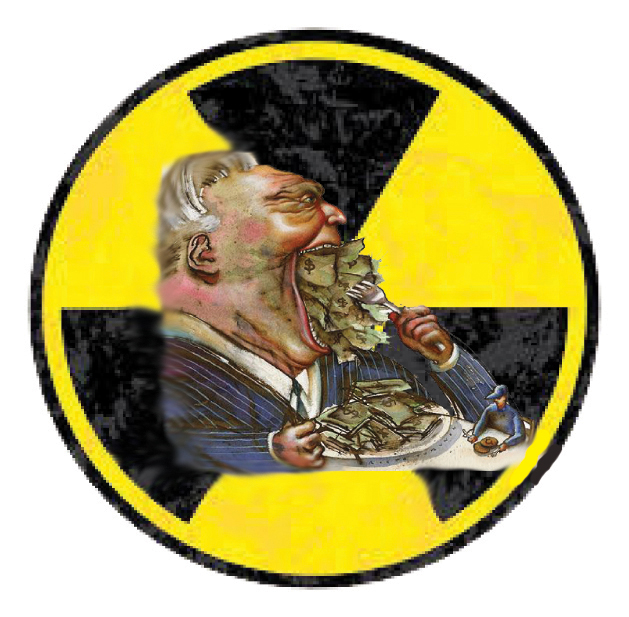
How many $trillions is the American government putting into the nuclear industry, especially nuclear weapons? With the USA essentially bankrupt, and the pandemic ushering it into an even more dire financial state – it’s a joke! Or, it would be a joke, if not for the hardship, suffering, poverty, brought upon its people, by this foolish financial extravaganza on behalf of a corrupt, dangerous and useless industry.
Russia, China, UK France, and soon Middle Eastern nations mindlessly follow this suicidal nuclear path.
The banking industry and other financial institutions join in the frenzy to feed this rapacioua evil of the nuclear industry.
Sadly so many jobs and community “benefits” are attached to it. It is going to take an enormous effort of brains, integrity, some sacrifice – to unravel the nuclear financial mess,.
But the world had better start unravelling it. Even without the worst outcome – nuclear war, this foul nuclear industry is going to devastate the finances of nations. and prevent action to stall global heating.
In this Covid-19 pandemic era, it is absolutely time to phase nuclear out, and help populations to transition to a cleaner world, where public money is spent on the things that people really need.
1 This Month

of the week – Shut Down Drone Warfare!


Tell the Ukrainian Government to Drop Prosecution of Peace Activist Yurii Sheliazhenko

Petition to revoke the licensing of the Near Surface Nuclear Disposal Facility (NSDF) at Chalk River. https://www.ourcommons.ca/petitions/en/Petition/Details?Petition=e-7247
To see nuclear-related stories in greater depth and intensity – go to https://nuclearinformation.wordpress.com
-
Archives
- March 2026 (237)
- February 2026 (268)
- January 2026 (308)
- December 2025 (358)
- November 2025 (359)
- October 2025 (376)
- September 2025 (257)
- August 2025 (319)
- July 2025 (230)
- June 2025 (348)
- May 2025 (261)
- April 2025 (305)
-
Categories
- 1
- 1 NUCLEAR ISSUES
- business and costs
- climate change
- culture and arts
- ENERGY
- environment
- health
- history
- indigenous issues
- Legal
- marketing of nuclear
- media
- opposition to nuclear
- PERSONAL STORIES
- politics
- politics international
- Religion and ethics
- safety
- secrets,lies and civil liberties
- spinbuster
- technology
- Uranium
- wastes
- weapons and war
- Women
- 2 WORLD
- ACTION
- AFRICA
- Atrocities
- AUSTRALIA
- Christina's notes
- Christina's themes
- culture and arts
- Events
- Fuk 2022
- Fuk 2023
- Fukushima 2017
- Fukushima 2018
- fukushima 2019
- Fukushima 2020
- Fukushima 2021
- general
- global warming
- Humour (God we need it)
- Nuclear
- RARE EARTHS
- Reference
- resources – print
- Resources -audiovicual
- Weekly Newsletter
- World
- World Nuclear
- YouTube
-
RSS
Entries RSS
Comments RSS
 nuclear-news