High costs and construction delays cast gloom over nuclear industry
Building projects’ high costs and construction delays raise questions about the industry’s sustainability. US News, By Jasper Scherer March 3, 2016 “……..Underway since getting NRC approval in 2012, the Vogtle plant project is three years behind schedule and billions of dollars over budget. The project was initially expected to cost $14 billion but could reach upward of $21 billion, Georgia Public Service Commission filings indicate.
in 2016, the industry faces stiffer competition from alternative energy sources. In 1977, for instance, solar panels cost $76.67 per watt, according to a Bloomberg New Energy Finance report. That figure had decreased to 73 cents by 2012 – less than 1 percent of the original per-watt cost. And aside from Three Mile Island, the 1986 Chernobyl disaster in Ukraine and the tsunami-induced accident at Japan’s Fukushima Daiichi plant in 2011 have damaged the industry’s image…….
Though the U.S. now operates 99 reactors, more than any other country by a wide margin (France is second with 58), it once had as many as 112. The number of operational reactors in the country has either declined or remained constant in every year since 1993, data from the U.S. Energy Information Administration show.
Dave Lochbaum, director of the Union of Concerned Scientists’ Nuclear Safety Project, points to an underlying challenge for power companies beyond the initial cost of building a nuclear plant: attempted repairs that fail and cost billions to fix. When workers inadvertently cracked the wall of the Crystal River nuclear plant in Florida in 2009 while trying to replace the plant’s steam generators, the plant shut down because it would have cost upward of $1 billion to repair the damages……..
Power companies hoping to upgrade their plants instead of building new ones face financial challenges. For instance, a four-month project at the Monticello Nuclear Plant in Minnesota to upgrade capacity and replace old equipment cost nearly twice its initial estimate. The upgrades cost a fraction of the price of building a new plant, but still blew past initial cost calculations……..
The NRC, which approves the design of reactors before granting them licenses to operate, is expected to receive applications for “design certifications” for small reactors during the next several years, according to the Nuclear Energy Institute. But Small Modular Reactors may not operate in the U.S. until 2025, the Department of Energy says. And they are not guaranteed to work.
“The biggest hurdle that SMRs face is that the reactors that are being built today in the United States – the five reactors that are in various stages of construction – are basically the next evolutionary step to the reactors we’re already operating,” Lochbaum says. “And the SMRs are pretty much different from that. They’re more revolutionary in their design, and that’s going to cause a problem for plant owners. It’s difficult to invest a lot of money in a technology that may have some unforeseen problems.”
The nuclear industry’s clock continues to tick because plants have finite lifespans. Reactors are typically designed to last around 40 years. Simple math illustrates a sobering reality for power companies: We will need to see a slew of costly reactor upgrades for the country’s aging plants to remain operable. http://www.usnews.com/news/special-reports/the-manhattan-project/articles/2016-03-03/another-chance-for-nuclear-power
Nuclear reactor outage caused by bird droppings
Bird poop apparently caused New York nuclear reactor outage http://www.cbsnews.com/news/bird-poop-apparently-caused-new-york-nuclear-reactor-outage/ALBANY, N.Y. — Bird poop was the likely cause of a December shutdown at a nuclear power plant outside New York City, according to the operator.
An Indian Point reactor safely shut down for three days starting Dec. 14 following an electrical disturbance on outdoor high voltage transmission lines, Entergy Corp. said. An outside expert is analyzing whether what’s technically called bird “streaming” was the culprit.
In a report to the Nuclear Regulatory Commission last month, the New Orleans-based company said the automatic reactor shutdown was apparently from bird excrement that caused an electric arc between wires on a feeder line at a transmission tower.
“If it has nowhere to send its electricity, the generator senses that and automatically shuts down,” Entergy spokesman Jerry Nappi said.
Plant managers told the NRC they were revising preventive maintenance for additional inspection and cleaning and installing bird guards on transmission towers.
Nappi said he couldn’t recall a similar incident in the past several years from birds at Indian Point, which is located along the Hudson River north of New York City. He didn’t immediately know what type of bird was suspected. No carcass was found, he said.
Nuclear Regulatory Commission spokesman Eliot Brenner said it’s not uncommon for wildlife to trigger electrical outages on transmission lines regardless of the generation source of the electricity. “Squirrels are the biggest offenders,” he said.
He didn’t know if the NRC was specifically tracking animal-related reactor outages. “They’re kind of few and far between, but certainly not unheard of,” he said.
A recent radioactive leak at the plant had prompted renewed calls for the site to be shut down, amid growing concerns about the potential damage a nuclear accident could cause in one of the most densely populated parts of the country. In the past year alone there have been a number of mishaps at Indian Point, including a power failure in the reactor core, a transformer fire, an alarm failure, and the escape of radiated water into groundwater. The plant sits about 25 miles north of New York City.
Neil Sheehan, a representative for the U.S. Nuclear Regulatory Commission, told CBS News last month that the NRC is continuing to review the recent tritium leakage at Indian Point.
“We recently sent a radiation protection specialist to the plant to assess the situation and learn more about what happened. He was assisted by our three Resident Inspectors assigned to the plant on a full-time basis,” he said in an email.
NRC is also currently reviewing Indian Point’s renewal license, which would authorize it to continue operating for another 20 years. But environmental groups say the region needs to utilize other options to meet its energy needs.
Death throes of the nuclear industry as renewables move towards 80 percent penetration in the U.S.
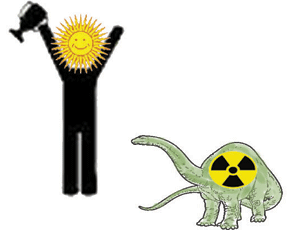 NUCLEAR POWER – A DINOSAUR IN A DEATH SPIRAL?, Dan Levitan, 29 Feb 16 ………….Mark Jacobson, director of the Atmosphere/Energy Program at Stanford University, has published state-specific plans showing how 100-percent renewables penetration would be achievable. The National Renewable Energy Laboratory, part of the U.S. Department of Energy, published its “Renewable Electricity Futures Study” in 2012 and explained a clear path to 80 percent penetration in the U.S. Others have shown similar routes forward.
When it comes to any energy source, it is cost that sits at the root of the discussion. Nuclear proponents argue that there are impediments to having a grid entirely run on renewables. Buongiorno, for example, says that the intermittency of solar and wind can realistically only be addressed by adding large amounts of electricity storage (in the form of large batteries or other newer tech such as compressed air) to the grid, and that would change the ongoing “renewable prices are plummeting” narrative.
“When I hear people say ‘Oh, the costs are coming down,’ the costs for generation may be coming down, but if installing that capacity forces me to have energy storage, you have to add those costs,” he says. Think of it like buying a car: The baseline price sounds okay, but it’s all the options and add-ons that’ll get you. Buongiorno says he expects the costs of nuclear construction will come down, and that when storage costs for renewables are factored in, nuclear — with its reliable, 24/7 output — starts to look much more attractive as an alternative.
Billions and Billions
When it comes to any energy source, it is cost that sits at the root of the discussion. Adding more nuclear to the grid could reduce some of the burden on renewables and storage, but the economics of nuclear itself could prove an insurmountable roadblock.
In general, the more experience accumulated with a given technology, the less it costs to build. This has been dramatically illustrated with the falling costs of wind and solar power. Nuclear, however has bucked the trend, instead demonstrating a sort of “negative learning curve” over time.
According to the Union of Concerned Scientists, the actual costs of 75 of the first nuclear reactors built in the U.S. ran over initial estimates by more than 200 percent. More recently, costs have continued to balloon. Again according to UCS, the price tag for a new nuclear power plant jumped from between US$2 billion and US$4 billion in 2002 all the way US$9 billion in 2008. Put another way, the price shot from below US$2,000 per kilowatt in the early 2000s up to as high as US$8,000 per kilowatt by 2008.
Steve Clemmer, the director of energy research and analysis at UCS, doesn’t see this trend changing. “I’m not seeing much evidence that we’ll see the types of cost reductions [proponents are] talking about. I’m very skeptical about it — great if it happens, but I’m not seeing it,” he says.
Some projects in the U.S. seem to face delays and overruns at every turn. In September 2015, a South Carolina effort to build two new reactors at an existing plant was delayed for three years. In Georgia, a January 2015 filing by plant owner Southern Co. said that its additional two reactors would jump by US$700 million in cost and take an extra 18 months to build. These problems have a number of root causes, from licensing delays to simple construction errors, and no simple solution to the issue is likely to be found.
In Europe the situation is similar, with a couple of particularly egregious examples casting a pall over the industry. Construction began for a new reactor at the Finnish Olkiluoto 3 plant in 2005 but won’t finish until 2018, nine years late and more than US$5 billion over budget. A reactor in France, where nuclear is the primary source of power, is six years behind schedule and more than twice as expensive as projected.
“The history of 60 years or more of reactor building offers no evidence that costs will come down,” Ramana says. “As nuclear technology has matured costs have increased, and all the present indications are that this trend will continue.”……….
Cousins to the fear of a massive meltdown are both the worry over nuclear weapons proliferation and concerns over waste disposal. Spent nuclear fuel is currently stored on the site of nuclear plants in pools of water or sealed in dry cask storage, anddecades-old arguments over geologic repositories are unlikely to be resolved any time soon. With regard to weapons, nuclear plants produce plutonium during the course of their reactions, which can be made into bombs if enough is accumulated; terrorism and theft are thus constant worries. Both of these issues work to extend the shadow of risk stretching out behind nuclear power, and both lack immediate solutions………….
[Small nuclear reactors ] Allison Macfarlane, director of George Washington University’s Center for International Science and Technology Policy and the former chairman of the U.S. Nuclear Regulatory Commission, notes that of the various companies working on these only one (NuScale Power) is currently expected to actually submit application materials to regulators in 2016 — a step that is still years removed from actual functioning reactors.
The danger of flying nuclear materials between UK and USA
MoD admits flying nuclear materials http://www.theguardian.com/uk-news/2016/mar/01/mod-admits-flying-nuclear-materials-between-uk-and-us
Campaigners highlight safety risks after defence minister admits there have been 23 such flights in the last five years, Guardian, Rob Edwards, 1 Marc 16 , Materials used in nuclear weapons have been flown between the UK and the US 23 times in the last five years, the Ministry of Defence has admitted.
Though the MoD does not give details, the flights are believed to have carried tritium, plutonium and enriched uranium, all vital ingredients of Tridentwarheads. They probably started or ended at the RAF base at Brize Norton in Oxfordshire.
The flights have alarmed politicians and campaign groups, who are worried about accidents causing widespread radioactive contamination. The MoD, however, insists that the transports complied with stringent safety rules.
The Guardian reported on 9 February that two MoD emergency exercises in 2011 and 2012 codenamed Astral Bend envisaged planes carrying nuclear materials crashing. One imagined a leak of enriched uranium and plutonium spreading up to five kilometres across south Wales.
That prompted a question about the nuclear flights in the House of Commons last week by the Scottish National party’s defence spokesman, Brendan O’Hara MP. In response, the government admitted the frequency of such flights for the first time. “In the last five years, 23 flights carrying defence nuclear materials were undertaken,” the defence minister, Penny Mordaunt, told MPs in a written answer.
“All flights were between the UK and the United States on fixed-wing aircraft under the control of UK armed forces.” Details of the cargoes were kept secret “as disclosure would or would be likely to prejudice national security,” she said.
O’Hara said: “This answer is alarming and highlights a practice most of the public are unaware of. The MoD need to outline what risk and safety assessments they made about these flights and precisely when and what areas of UK airspace were used. I fear the MoD does not have a great track record on transparency when it comes to nuclear issues – and this answer clearly begs more questions.”
Experts say that the UK and the US regularly exchange tritium, plutonium and enriched uranium under a mutual defence agreement. Anti-nuclear campaigners have tracked road convoys transporting nuclear materials between the nuclear bomb plants at Aldermaston and Burghfield in Berkshire and RAF Brize Norton.
The independent nuclear engineer, John Large, argued that the MoD’s air shipments would not comply with international safety regulations for civil nuclear transports. A crash could “contaminate large tracts of land with potential radiological consequences for unprotected members of the public”, he said.
Tom Clements, who heads a group monitoring a nuclear weapons plant at Savannah River in South Carolina, claimed that the MoD flights would not meet US standards for civil nuclear shipments. The flights had “disturbing” implications for the world’s attempts to reduce the proliferation of nuclear weapons, he said.
Peter Burt from the UK Nuclear Information Service, a not-for-profit group, highlighted the high risks of air shipments. “The RAF regularly fly nuclear materials over large urban areas such as Bristol, Cardiff, and Swansea, which raises serious questions about what would happen in the event of an accident involving one of these flights,” he said.
The MoD maintained that the air transports were safe. “The transport of defence nuclear materials is carried out to the highest standard in accordance with stringent safety regulations,” said an MoD spokeswoman.
“In over 50 years of transporting defence nuclear materials in the UK, there has never been an incident that has posed any radiation hazard to the public or to the environment.”
Danger of an aging nuclear power plant next to a natural gas pipeline.
There’s a proposed natural gas pipeline next to a nuclear power plant. What could go wrong? Grist By Katie Herzog on 29 Feb 2016 What’s scarier than an aging nuclear power plant? An aging nuclear power plant next to a natural gas pipeline.
That could be the new reality for the Indian Point Energy Center, a nuclear power station located in Westchester County, just 45 miles north of Manhattan. A proposed expansion of a natural gas pipeline across the power station’s property has environmentalists and other groups concerned that an accident could turn the power plant into an unrivaled disaster. It’s a bit like smoking next to a gas tank — a gas tank filed with nuclear fuel near one of the densest population centers on the planet.
Despite how ill-advised this sounds, the pipeline has already been approved by the Federal Energy Regulatory Commission. Why would they allow such a thing? Well, as the New York Times notes, approval was partly based on reviews carried out by the Entergy Corporation — which happens to be the same company that owns the plant.
New York Gov. Andrew Cuomo, a resident of Westchester County, is not having any of it. Cuomo recently directed his administration to conduct an independent safety analysis of the pipeline project after hearing that radioactive water had leaked from the aging plant and into the groundwater. This is just the latest strike against Indian Point by the Cuomo administration, which called for the plant’s closure last year. “The safety of New Yorkers is the first responsibility of state government when making any decision,” said the governor in a statement.
Cuomo isn’t alone. In Nov. 2015, a group of climate activists known as the Montrose 9 blocked construction of the pipeline, which would transport natural gas from Texas to Massachusetts. In addition to the activists’ concerns about the affects of burning natural gas on the climate, they targeted the Spectra-owned pipeline for its proximity to Indian Point, which the federal government previously listed among the nation’s worst power plants.
The Nuclear Regulatory Commission, however, seems unconcerned. ……http://grist.org/business-technology/theres-a-proposed-natural-gas-pipeline-next-to-a-nuclear-power-plant-what-could-go-wrong/
President Obama’s doublespeak on nuclear weapons
 Barack Obama’s Broken Nuclear Promise The president made non-proliferation a centerpiece of his administration. What happened?, Pacific Standard, JARED KELLER, 1 Mar 16 In the early days of his presidency, during a visit to Prague’s Hradčany Square, Barack Obama launched what observers saw as a centerpiece of his foreign policy: a doctrine for a nuclear free world. “The Cold War has disappeared but thousands of those weapons have not,” President Obama announced, pointing out the paradoxical twist of the modern nuclear dilemma—as the threat of global nuclear war has subsided, the risk of a singular nuclear attack has only intensified.
“More nations have acquired these weapons. Testing has continued. Black market trade in nuclear secrets and nuclear materials abound. The technology to build a bomb has spread. Terrorists are determined to buy, build, or steal one,” Obama continued. “Our efforts to contain these dangers are centered on a global non-proliferation regime, but as more people and nations break the rules, we could reach the point where the center cannot hold.”
Taken in the context of his other campaign promises—the closure of Guantanamo, (which has only truly blossomed in the twilight hours of his presidency) and the end of the two costly wars he inherited—Obama’s nuclear promise seemed both heroic and unimpeachable, especially given its tacit support by past foreign policy luminaries. Mere months after his Prague address, Obama was awarded the 2009 Nobel Peace Prize—a symbolic endorsement of his nascent doctrine—with the Nobel Committee specifically citing the “special importance to Obama’s vision of and work for a world without nuclear weapons.”………
The minute things went south with Russia, the United States went back on it’s promise to work toward a nuclear-free world.But six years later, in a book released last year, the former Pulitzer director wrote that the prize “didn’t have the desired effect” of helping to catalyze such change. He’s not wrong. The Obama administration certainly made historic steps in unifying the international community on the issue of nuclear weapons, particularly the historic nuclear deal between Iran and the P5+1 countries. But at the same time, despite promises to pursue new restrictions on nuclear technology and decrease the nation’s nuclear stockpile, the American military’s nuclear posture has remained largely static. Obama’s dream of non-proliferation is, it seems, long dead………
Obama’s nuclear budget has swollen in recent years. In his proposed $620.9 billion defense budget for 2017, Obama called for a $1.8 billion increase in nuclear spending “to overhaul the country’s aging nuclear bombers, missiles, submarines and other systems,” according to Reuters. The budget request allocates millions in taxpayer dollars for the development of a new nuclear-tipped cruise missile, replacing the military’s arsenal of air-launched missiles, and almost doubling the military’s nuclear cruise missile collection to nearly 1,000 missiles—all initiatives seemingly in contradiction to the 2010 Nuclear Posture Review and Obama’s early-term non-proliferation rhetoric. And this isn’t a sudden change, but the latest jump in nuclear arms spending at the cost of non-proliferation efforts since 2011, according to reporting from Mother Jones.
Data from the Center for Arms Control & Non-Proliferation shows a steady increase in nuclear spending in Obama’s defense budget since 2012, all while non-proliferation spending has been on the decline:
“What’s more problematic is the decrease in nuclear nonproliferation programs by over $100 million,” Global Zero executive director Derek Johnson wrote for the Hill. “These are highly functional programs dedicated to keeping the world’s nearly 16,000 nuclear weapons out of terrorist hands and locking down vulnerable nuclear material…. In a global security climate traumatized by the rise of ISIS, decreasing nuclear nonproliferation programs seems a dangerously misguided trade-off.”………
In retrospect, we should have known better. In his Nobel address, Obama didn’t just lay out a doctrine that would define his foreign policy; he delivered a masterclass in doublespeak, using the validation of his campaign rhetoric of a utopian, nuclear-free world while recognizing the permanent reality of modernrealpolitik and nuclear terrorism. And while the promise of a nuclear-free world is an inherently naïve proposition, his doctrine of just war was prescient: Obama has expanded the field of battle against terrorism with a deadly drone program while in turn touching off a “modernization” arms race with Russia, as the Interceptputs it.
The administration is trumpeting its success with Iran—and with good reason—but Obama’s record on nuclear weapons is hardly an affirmation of his Nobel Peace Prize. The dream of a world without nukes, it turns out, was always really just that: a dream, and nothing more. http://www.psmag.com/politics-and-law/broken-nuclear-promise-of-barack-obama
Engineers concerned at design flaw in US nuclear reactors
U.S. NRC engineers urge fix for nuclear power stations Reuters, By Timothy Gardner 1 Mar
A group of engineers within the U.S. nuclear power regulator is concerned that a design flaw in nearly all U.S. nuclear plants could endanger emergency core cooling systems. The group has urged the regulator to order power station operators to either fix the problem or face mandatory shutdowns.
Seven engineers in late February petitioned the Nuclear Regulatory Commission to order immediate enforcement actions against licensees of U.S. nuclear power plants, in a little-noticed, but public move.
The petition, filed under a standard NRC process, urges the agency to respond by March 21.
The engineers are concerned that a design flaw in nearly all U.S. nuclear facilities leaves them vulnerable to so-called open phase events in which an unbalanced voltage, such as an electrical short, could cause motors to burn out and reduce the ability of a reactor’s emergency cooling system to function. If the motors are burned out, backup electricity systems would be of little help, the petition said.
In early 2012 an unbalanced voltage event forced Exelon Corp’s Byron 2 reactor in Illinois to shut down automatically. The unit was shut for about a week.
Later that year, the NRC alerted nuclear power plant operators in a bulletin to a potential design vulnerability concerning open phase and collected feedback from the operators.
But the agency never ordered the plants to make changes to reduce any open phase vulnerabilities. The petition said 13 open phase events have occurred at U.S. and international nuclear plants over the last 14 years……http://www.reuters.com/article/usa-nuclear-regulator-idUSL2N1692BF
In 10 years – 100% renewable energy is doable
 100% Renewable Energy: What We Can Do in 10 Years Yes! Magazine It will take at least three decades to completely leave behind fossil fuels. But we can do it. And the first step is to start with the easy stuff. Richard Heinberg Feb 22, 2016
If our transition to renewable energy is successful, we will achieve savings in the ongoing energy expenditures needed for economic production. We will be rewarded with a quality of life that is acceptable—and, perhaps, preferable to our current one (even though, for most Americans, material consumption will be scaled back from its current unsustainable level). We will have a much more stable climate than would otherwise be the case. And we will see greatly reduced health and environmental impacts from energy production activities.
But the transition will entail costs—not just money and regulation, but also changes in our behavior and expectations. It will probably take at least three or four decades, and will fundamentally change the way we live.
Nobody knows how to accomplish the transition in detail, because this has never been done before. Most previous energy transitions were driven by opportunity, not policy. And they were usually additive, with new energy resources piling onto old ones (we still use firewood, even though we’ve added coal, hydro, oil, natural gas, and nuclear to the mix).
Since the renewable energy revolution will require trading our currently dominant energy sources (fossil fuels) for alternative ones (mostly wind, solar, hydro, geothermal, and biomass) that have different characteristics, there are likely to be some hefty challenges along the way.
Therefore, it makes sense to start with the low-hanging fruit and with a plan in place, then revise our plan frequently as we gain practical experience. Several organizations have already formulated plans for transitioning to 100 percent renewable energy. David Fridley, staff scientist of the energy analysis program at the Lawrence Berkeley National Laboratory, and I have been working for the past few months to analyze and assess those plans and have a book in the works titled Our Renewable Future. Here’s a very short summary, tailored mostly to the United States, of what we’ve found.
Level One: The Easy Stuff Continue reading
Indian Point nuclear plant’s 65,000% Spike In Radiation

 65,000% Spike In Radiation Outside New York Nuclear Plant Is Likely Worse Than Fukushima, Activist Post FEBRUARY 27, 2016 BY JAY SYRMOPOULOS Buchanan, NY — An uncontrollable radioactive flow from the Indian Point nuclear power plant continues leaking into groundwater, which leads to the Hudson River, raising the specter of a Fukushima-like disaster only 25 miles from New York City.
The Indian Point nuclear plant is located on the Hudson River, approximately 25 miles North of NYC, and serves the electrical needs of an estimated 2 million people. Last month, while preparing a reactor for refueling, workers accidentally spilled some contaminated water, containing the radioactive hydrogen isotope tritium, causing a massive radiation spike in groundwater monitoring wells, with one well’s radioactivity increasing by as much as 65,000 percent.
Entergy, the Louisiana-based company that owns the plant, chalked up the readings to “fluctuations that can be expected as the material migrates.” According to Entergy, the tritium contaminated water spill was contained within the plant, and never reached the Hudson or any other water source.
“There is no impact to public health or safety,” Entergy spokeswoman Patricia Kakridas told RT.
Of course, the tritium leak is the ninth in just the past year, four of which were serious enough to shut down the reactors. But the most recent leak, however, according to an assessment by the New York Department of State as part of its Coastal Zone Management Assessment, contains a variety of radioactive elements such as strontium-90, cesium-137, cobalt-60, and nickel-63, and isn’t limited to tritium contamination.
Despite the assurances from Entergy, the area around Indian Point is a “cancer cluster,” with the local rate of thyroid cancer rates registering at 66 percent higher than the national average, according to Joseph Mangano, Executive Director of the Radiation and Public Health Project (RPHP).
According to a report by RT: Continue reading
USA Energy Dept keen to reopen New Mexico Nuclear waste Station: others not so sure
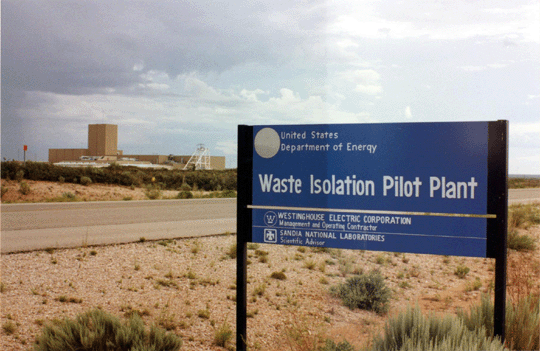 New Mexico Presses Ahead on Nuclear-Waste Plant Reopening Burial site’s closure caused by 2014 accident left waste piling up across the country, WSJ By JOHN R. EMSHWILLER Feb. 28, 2016
Despite a nine-month delay in the planned reopening of an underground nuclear-waste repository in New Mexico damaged by a radiation accident, progress is being made in resuming operations, said a top state official overseeing the effort.
In January, the Energy Department said it had pushed the reopening date of the federal facility near Carlsbad, N.M., to December from March. The closure caused by the February 2014 accident has left nuclear waste destined for the repository piling up at sites around the country……
Among the issues still being addressed, he said, are residual contamination from the accident and ensuring adequate and safe air flows in the complex.
While officials want to see WIPP reopen as soon as possible, “we have to make sure it is done right,” said Mr. Flynn, whose agency must give its approval before the site can accept waste again. He said he thinks December is a reasonable target date.
Not everyone is as sanguine. Given the remaining challenges, “I think it’s very unlikely the December date will be met,” said Don Hancock, director of the nuclear-waste safety program at the Southwest Research and Information Center, an Albuquerque, N.M., environmental group.
Earlier this month, U.S. Energy Secretary Ernest Moniz said he expects resumption of full operations at the repository to take a few years……..
The Energy Department has said it would cost about $240 million to bring WIPP back into operation and tens of millions of dollars more in additional capital costs, including revisions to the ventilation system.
WIPP, which began operations about 17 years ago, was designed to dispose of a specific type of nuclear waste from the atomic-weapons program. More than 171,000 waste containers are buried there………http://www.wsj.com/articles/new-mexico-presses-ahead-on-nuclear-waste-plant-reopening-1456655406
The end of the nuclear age – foreshadowed as Indian Point nuclear station leaks radioactivity
Indian Point Leak Foreshadows the End of the Nuclear Age, Fortune by David Z. Morris @davidzmorris
FEBRUARY 28, 2016, New York could be the next Fukushima as world governments roll back nuclear power.
The Indian Point nuclear power plant in New York State is leaking radioactive contaminant into nearby groundwater, and despite plant operator Entergy’s ELA 0.08% assurances that the leak has “no health or safety consequences,” Governor Andrew Cuomo called earlier this month for a full investigation by state environment and health officials.
The latest revelations add to a mounting list of recent accidents and problems at Indian Point, and Cuomo’s hard stance is nothing new, either. As of November of last year, Cuomo’s office actively opposed the continuing operation of Indian Point.
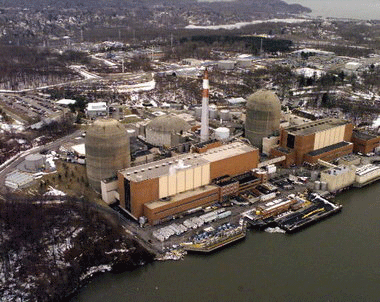
The plant’s problems are not isolated—leaks have been found at as many as 75% of U.S. nuclear plants. And closing Indian Point would put New York, and the U.S., in line with a sharp global move away from nuclear power following 2011’s meltdown at Japan’s Fukushima Daichi reactor. Japan shut down all of its nuclear plants after the disaster, and only began tentatively restarting a handful in 2015.
Countries including France and Germany have moved to similar phase-outs, with Germany in 2011 pledging to phase out all nuclear power by 2022. Austria and Spain have stopped all construction on new nuclear plants. The U.S. had not constructed a new nuclear power plant in nearly twenty years when, in October of 2015, a plant in Tennessee was given the go-ahead.
Nuclear plants represent huge threats to nearby areas, though the risk of a disaster at any one plant is small. While Stanford researchers have found that Fukushima’s fallout may directly cause only about 300 deaths worldwide, estimates of economic losses range from $250-$500 billion, stemming largely from the removal of 159,128 people from a zone the size of Connecticut—land which will be uninhabitable for centuries.
Fukushima prefecture had a population just short of two million at the time of the disaster. Indian Point sits just 25 miles north of New York City’s 8.5 million inhabitants, as well as real estate many times more valuable than that in northern Japan. During the Fukushima meltdown, the Japanese government established a 20 kilometer (12 mile) evacuation zone around the reactor—but the U.S. embassy recommended that Americans leave areas within 50 miles.
That suggests that a meltdown at Indian Point could lead to the evacuation of New York City. In addition to profound human costs, the immediate economic damage would run into many trillions of dollars. And it is no exaggeration to say that a threat to New York City is a threat to the entire U.S. economy, which it plays a key role in organizing……. http://fortune.com/2016/02/28/indian-point-end-of-nuclear-age/
Efficacy of compensation program for nuclear workers under scrutiny
 Feb 22, 2016. … Since Congress passed the Energy Employees Occupational Illness Compensation Program Act in 2000, the government has spent $12 billion in financial restitution for more than 100,000 workers whose onset of cancer, beryllium disease, neurological disorders and other ailments is a result of careers in the more than 300 nuclear facilities across the country. …
But the program has come under scrutiny lately. An investigation by the McClatchy DC news service found that fewer than half of the people who have applied for benefits have received them, and workers’ complaints are often suspended in the complex process of paperwork or court hearings, with some claims languishing in the system for up to 10 years.
Russia and USA Pointing Nuclear Missiles at Asteroids – bonanza for Lockheed Martin etc
Why Is Russia Pointing Nuclear Missiles at Asteroids?Motley Fool 28 Feb 16
Surprise! Russia’s not the only one painting a bull’s-eye on space rocks. “…….Solid-fueled nuclear missiles, being on launch alert 24/7, are admirably suited for a last-minute launch to blast an asteroid before it turns into a meteor. Russia’s ICBMs aren’t currently programmed to aim at targets above the Earth, however, and will need to be repurposed for such missions. That’s what Russia hopes to do — and with Apophis swinging ’round in just over a decade, Russia thinks the asteroid makes a tempting target for testing its redesign.
Such an ambitious goal will cost money. Indeed, according to website DigitalTrends.com, “millions … in federal money is set to pour into detection efforts” over the coming years.National Defense magazine puts the number at at least $50 million annually, citing the recently passed fiscal year 2016 budget. This naturally raises the question in investors’ minds:
Who will get the loot?
ND identifies several likely suspects who could win these funds, including big defense contractors Lockheed Martin (NYSE:LMT) and Raytheon (NYSE:RTN). Lockheed is the company in charge of building NASA’s Space Fence, designed to keep track of man-made junk orbiting Earth. Lockheed and Raytheon both bid on the contract in 2013 — but only Lockheed won it. Similarly, Lockheed Martin and Ball Aerospace (NYSE:BLL) helped to build NASA’s NEOWISE infrared telescope,specifically designed to detect and track NEOs.
Multiple historic contract wins in the field of space-object detection make Lockheed Martin a logical beneficiary of any new contracts coming out of the PDCO office. Granted, $50 million might not sound like much to a company like Lockheed (which pulled down $46 billion last year, and is NASA’s single biggest publicly traded contractor). It might seem even less significant, given that Lockheed won’t win all the contracts coming up for bid, and might have to share some of the loot with Raytheon, Ball, or others. But $50 million could be only the starting point.
ND calls $50 million “a drop in the bucket” compared to what it will ultimately cost to categorize all NEO threats, much less develop a means of defeating them. To cite just one example of contracts moving in that direction, in 2022, NASA aims to send a spaceship to asteroid 65803 Didymous in an ambitious experiment to try to push the object into a new orbit far from Earth’s own………http://www.fool.com/investing/general/2016/02/28/why-russia-pointing-nuclear-missiles-at-asteroids.aspx
Radiation research in children teeth in US
Radiation and Public Health Project
Tooth Donation Form/Kit
How to Send Teeth
- If not already clean, wash the teeth and let them dry.
- Wrap each tooth in paper and cushion with tissue or something similar.
- Print out the tooth donation form, fill it out, and send it with the teeth to:
Radiation and Public Health
P.O. Box 1260
Ocean City NJ 08226
Do not worry if you do not have all the information requested
There is some information we need in all cases:
- Where the mother lived when carrying the child.
- The child’s birthdate.
- Where the child lived the first year after birth.
If you can supply us with this information, don’t worry about the rest if you do not know the answers.
Important: If you have a tooth or teeth from more than one child, please fill out a separate form for each child and clearly mark which teeth came from which child. We cannot use teeth from more than one child when they are mixed together.
Would you like preprinted envelopes?
For envelopes with the teeth form pre-printed on them, email us (odiejoe@aol.com) with your name, address, and phone, and how many envelopes you need.
* For more than 10 envelopes and Group Networking, contact our Executive Director Joseph Mangano.(odiejoe@aol.com)
Tooth donation form: http://www.radiation.org/projects/tooth_donation_form.html
Source: http://www.radiation.org/projects/tooth_donation.html
‘uncontrollable radioactive flow’ from Indian Point nuclear station into the Hudson River
 New York City’s nuclear power plant leaking ‘uncontrollable radioactive flow’ into Hudson River, http://inhabitat.com/new-york-citys-nuclear-power-plant-leaking-uncontrollable-radioactive-flow-into-hudson-river/ Inhabitat, by Lacy Cooke, 27 Feb 16 New York governor Andrew Cuomo recently called for an investigation after Indian Point, a nuclear power plant on the Hudson River, reported a leak of radioactive material flowing into the groundwater. Now, new samples taken from the local groundwater show that contamination levels are 80% higher than previous samples, prompting experts to claim this leak is spreading in “a disaster waiting to happen” and calling for the plant to be shut down completely. The Indian Point nuclear power plant is located just 25 miles north of New York City, and it’s a crucial source of of power for over 23 million people living in the greater NYC metropolitan region.
Indian Point has experienced other leaks in the past, and the investigation may influence whether the power plant continues to operate in the future.
Via NY Daily News, CBS News, EcoWatch
-
Archives
- October 2026 (129)
- September 2026 (339)
- August 2026 (330)
- July 2026 (355)
- June 2026 (287)
- May 2026 (306)
- April 2026 (356)
- March 2026 (251)
- February 2026 (267)
- January 2026 (308)
- December 2025 (358)
- November 2025 (359)
-
Categories
- 1
- 1 NUCLEAR ISSUES
- business and costs
- climate change
- culture and arts
- ENERGY
- environment
- health
- history
- indigenous issues
- Legal
- marketing of nuclear
- media
- opposition to nuclear
- PERSONAL STORIES
- politics
- politics international
- Religion and ethics
- safety
- secrets,lies and civil liberties
- spinbuster
- technology
- Uranium
- wastes
- weapons and war
- Women
- 2 WORLD
- ACTION
- AFRICA
- Atrocities
- AUSTRALIA
- Christina's notes
- Christina's themes
- culture and arts
- Events
- Fuk 2022
- Fuk 2023
- Fukushima 2017
- Fukushima 2018
- fukushima 2019
- Fukushima 2020
- Fukushima 2021
- general
- global warming
- Humour (God we need it)
- Nuclear
- RARE EARTHS
- Reference
- resources – print
- Resources -audiovicual
- Weekly Newsletter
- World
- World Nuclear
- YouTube
-
RSS
Entries RSS
Comments RSS

