Hanford Nuclear Reservation ordered by federal judge to comply with new deadlines for nuclear waste clean-up
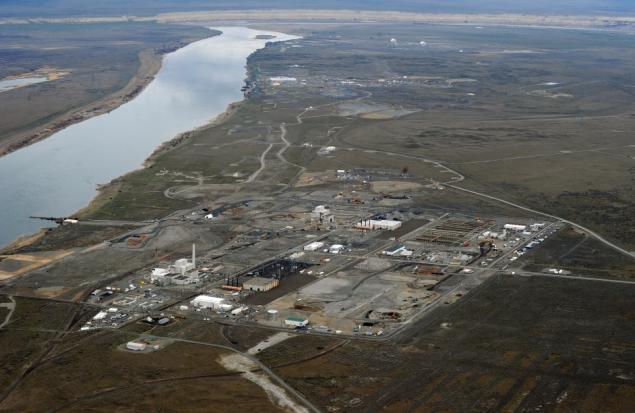
 Federal judge sets new deadlines for nuclear waste cleanup at Hanford http://www.bendbulletin.com/localstate/4113014-151/federal-judge-sets-new-deadlines-for-nuclear-waste# The Associated Press /Mar 13, 2016 SPOKANE, Wash. — A federal judge has set new deadlines for cleaning up nuclear waste at the Hanford Nuclear Reservation after Washington state went to court to prod the U.S. Department of Energy over the flagging efforts.
U.S. District Judge Rosanna Malouf Peterson issued the new deadlines in a 102-page order late Friday. Among them: A plant designed to treat low-activity radioactive waste must begin operating by 2022, and a plant to convert the most dangerous waste into glass for burial must be fully operating by 2036.
Washington and Oregon sued the U.S. Energy Department nearly a decade ago over missed cleanup deadlines, and after a settlement, Washington went back to court in 2014, leading to the judge’s order Friday.
Peterson criticized the Energy Department for what she described as a “total lack of transparency” as to the delays. She said that if the department had kept the states better apprised of the status of the cleanup efforts, the states could have sought further funding from Congress to help avert delays.
“The passage of time and the urgency of waste clean-up are inextricablylinked: the longer that DOE takes to satisfy its obligations under the Consent Decree the greater the likelihood of irreversible damage to the environment,” the judge wrote. “No party can ‘win’ this litigation. The public and environment only can ‘lose’ as more time passes without an operational solution to the radioactive waste problems at the Hanford Site.”
The government used the Hanford site during World War II and the Cold War to produce plutonium for nuclear weapons. Hanford’s 586 square miles house over 50 million gallons of nuclear waste in 177 underground tanks, many of which are leaking.
Washington Gov. Jay Inslee and Attorney General Bob Ferguson welcomed the court’s ruling, which they said Saturday will hold federal authorities accountable for the cleanup and which set firmer deadlines than the Energy Department wanted.
“Cleaning up the legacy waste at Hanford is the federal government’s legal and moral responsibility to the Tri-Cities community and the Pacific Northwest,” Inslee said. “I have been repeatedly frustrated by the delays and lack of progress toward meeting key milestones in waste cleanup and treatment. We cannot consider any further delays, and I am pleased that the court clearly agrees.”
Neo-Nuclearism as a Cargo Cult
Forgetting Fukushima, Denying Dai-ichi
By James Heddle
“Everyone is entitled to their own opinion. But everyone is not entitled to their own facts.” – Sen. Daniel Patrick Moynahan
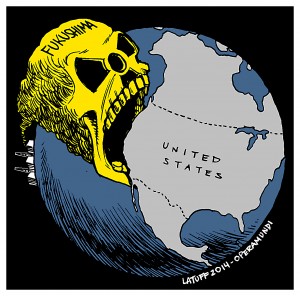
Fallout as Blowback
As the 5-year anniversary rolls around it’s clear to all who care to notice that the Fukushima triple meltdown nuclear disaster is still not ‘under control’ – as Prime Minister Abe claimed to the Olympic Committee in his successful bid to host the coming 2020 Games – but is still on-going, and will be far into the future.
That is to say, radioactive pollution will continue to pour into the oceanic, hemispheric and planetary environment with predictably negative, but unknown, effects on the health and DNA of all life forms in the biosphere.
There’s karmic irony here. The U.S. dropped the first atomic bombs on Japan, then used its political influence and propaganda prowess to sell the country nuclear power. Its corporations supplied the faulty reactors that melted down at Fukushima. Now, it is on the front line of receiving the fallout in the form of ongoing oceanic and atmospheric pollution carried eastward by winds and currents.
Faith-Based Nuclear Policy
Despite the obvious take-home lesson – i.e., that every nuclear facility, wherever its geographic location, constitutes a danger to the entire planet, and should be treated as such by the ‘international community’ – a New Nuclear Weapons race and a New Nuclear Power race are both currently in progress.
He began his presidency with the celebrated April 5, 2009 Prague Speech in which he stated “…clearly and with conviction America’s commitment to seek the peace and security of a world without nuclear weapons….” In practice Obama has embraced an ‘all of the above’ energy policy including heavy investments in new reactor construction and design development.
The recipient of an apparently aspirational Nobel Peace Prize has also committed a projected $1 trillion dollars over the coming decades to upgrading America’s nuclear weapons arsenal. https://www.revealnews.org/article/new-mexico-thrives-on-nuclear-bomb-despite-us-pledge-to-reduce-arsenal/
The program includes new ballistic missiles, a new manned bomber and a fleet of new missile-launching submarines. Termed – with no apparent sense of irony –‘the life-extension program,’ the plans clearly violate U.S. obligations under the Non-Proliferation Treaty (NPT).
In the domain of nuclear weaponry’s Siamese twin nuclear energy, there are those opinion-maker luminaries like James Hansen, James Lovelock, Stewart Brand, Bill Gates and George Monbiot who advocate for nuclear energy as a ‘carbon-free solution to climate change.’ Never mind that – as Stanford scientist Mark Jacobsen and his associates, as well as others, have conclusively shown – the entire nuclear fuel chain from mine to waste dump is more carbon intensive than wind and solar put together. Their work shows a transition to renewables is totally possible…without nuclear energy. http://thesolutionsproject.org/
The Atomic Church of the Last Gasp
Last week, alarmed at the failure of their repeated attempts to go through ‘proper channels,’ seven engineers at America’s Nuclear Regulatory Commission (NRC) – which President Obama himself has dubbed in 2007 ‘a moribund agency’ – filed a petition as private citizens. They stated that they have identified a long-undiscovered electrical flaw common to virtually all U.S. nuclear plants that could prevent cooling and allow a meltdown to occur. Their petition asks that the NRC mandate that plant operators either fix the problem or shut down the reactors. http://commondreams.org/views/2016/03/10/7-top-nrc-experts-break-ranks-warn-critical-danger-aging-nuke-plants
But the New Nuclearists avoid coming to terms with the risks and failures of the existing world fleet of aging, ill-designed reactors. They believe – without operational proof-of-concept – in a pie-in-the-sky, perpetually not-yet-but-soon-to-be-born generation of ‘new, small modular nuclear reactors (SMRs).’ They will consume and eliminate existing nuclear waste and be so ‘inherently safe’ you can bury them in your back yard. Any day now.
The blind faith with which latter-day nuclear advocates approach the issues of human, ecological and economic risk associated with nuclear technologies, reminds one of the Melanesian millenarian movement called ‘cargo cults,’ in which indigenous tribes, following charismatic figures, built wooden aircraft replicas on mountain tops in the vain hopes – despite repeated failures – to lure down the western cargo planes loaded with commodities they saw flying overhead.
Or, if the definition of ‘insanity’ is: ‘persisting in behavior which consistently fails,’ neo-nuclearism is clearly a form of collective insanity – atomic psychosis.
Recovering from Nuclear Delusion
The 20th century ‘nuclear dream’ of global full-spectrum dominance and energy too cheap to meter has become a 21st century nightmare. It is time to wake up. As retired top U.S. energy administrator S. David Freeman puts it in a recent interview, “We have to kill nuclear power before it kills us.” [Video interview here: https://www.youtube.com/watch?v=W1R4jc2wlGs
The facts of the failure of the nuclear dream are there, for any who are not blinded by ideology or self-interest to see: in addition to its history of totalitarianism, incompetence and global disasters, nuclear energy deployment is plagued by public opposition, investor disinterest, consistently mounting cost and schedule over-runs and dependence on dwindling water supplies. Energy consultant Amory Lovins sees nuclear energy “dying a slow death from an overdose of market forces.” Futurist Jeremy Rifkin agrees, “From a business perspective, its dead.”
Then there’s the energy-weapons-waste connection, the real ‘nuclear triad.’ Not only are nuclear energy and weapons production joined at the hip from birth, but they share a dysfunctional excretory system – of which more below.
Nine Realities of which Nuclear Millenarians Dare Not Speak
Those who advocate for nuclear energy as a response to climate change, or for new nuclear weapons in pursuit of ‘national security,’ must ignore or deny an overwhelming burden of facts from the history and legacy of these nuclear technologies so far.
Here are just a few:
Genocidal Impacts on Indigenous Peoples
• Uranium mining and the deadly radioactive wastes left behind continue to have devastating effects on Native Americans and Aboriginal Australians. In the U.S., thousands of abandoned open pit uranium mines contaminate drinking and irrigation water and the air breathed by tribes across the Great Planes and the Four Corners Area.
• Nuclear weapons testing has done lasting genetic and environmental damage to Pacific Islanders in the Marshall Islands and Polynesia.
Nuclear Disasters
The Guardian lists and ranks 33 serious incidents and accidents at nuclear power stations since the first one was recorded in 1952. Of those, six happened in the US, five in Japan and three apiece in the UK and Russia. That’s an average of nearly 5 per decade. http://www.theguardian.com/news/datablog/2011/mar/14/nuclear-power-plant-accidents-list-rank#data
But a report by Cornell University researchers Spencer Wheatley, Benjamin Sovacool, Didier Sornette entitled Of Disasters and Dragon Kings: A Statistical Analysis of Nuclear Power Incidents & Accidents has a database of 174 accidents worldwide since 1946.
They rate the accidents in 2013 dollars and define an accident as “an unintentional incident or event at a nuclear energy facility that led to either one death (or more) or at least $50,000 in property damage.”
They conclude
In fact, the damage of the largest event (Fukushima; March, 2011) is equal to 60 percent of the total damage of all 174 accidents in our database since 1946. In dollar losses we compute a 50% chance that (i) a Fukushima event (or larger) occurs in the next 50 years, (ii) a Chernobyl event (or larger) occurs in the next 27 years and (iii) a TMI event (or larger) occurs in the next 10 years. [emphasis added]
http://arxiv.org/abs/1504.02380
https://www.technologyreview.com/s/536886/the-chances-of-another-chernobyl-before-2050-50-say-safety-specialists/
US Nuclear Meltdowns
There have been 8 nuclear meltdowns so far in the U.S. Contrary to popular belief, the meltdown at Three Mile Island was not the worst. That dubious honor goes to the little-reported July 12, 1959 meltdown at the Santa Susana Field Laboratory located a couple of miles from the city of Simi Valley and only about 30 miles north of Los Angeles. The radioactive contamination of the surrounding communities and environment from that event have yet to be fully acknowledged or dealt with. One of the companies involved was Southern California Edison, the major owner of San Onofre.
Nuclear Weapons Incidents
As part of his research for his book on the nuclear arms race, Command and Control – Nuclear Weapons, the Damascus Accident, and the Illusion of Safety, Eric Schlosser used the Freedom of Information Act to discover that at least 700 “significant” accidents and incidents involving 1,250 nuclear weapons were recorded between 1950 and 1968 alone. The Business Insider has a useful interactive site based on Rudolph Herzog’s A Short History of Nuclear Folly on which you can track 32 nuclear weapons accidents since 1950. http://www.businessinsider.com/list-of-broken-arrow-nuclear-accidents-2013-5
In its Status of World Nuclear Forces, the Federation of American Scientists reports the existence of
approximately 15,350 warheads as of early-2016. Of these, more than 10,000 are in the military stockpiles (the rest are awaiting dismantlement), of which almost 4,200 warheads are deployed with operational forces, of which nearly 1,800 US, Russian, British and French warheads are on high alert, ready for use on short notice.
Approximately 93 percent of all nuclear warheads are owned by Russia and the United States who each have roughly 4,500-4,700 warheads in their military stockpiles. http://fas.org/issues/nuclear-weapons/status-world-nuclear-forces/
Former U.S. Sec. of Defense, William J. Perry says the situation is even worse:
“Today we still have over 20 thousand real world nuclear weapons. Enough to blow up everybody on the planet several times over. Those weapons pose the immediate problem of a danger of terrorism, the immediate problem of the possibility of nuclear war.
“The antagonism between Russia and the United States has reached a point now where I believe we are on the brink of a new nuclear arms race. It breaks my heart.
“Today, the danger of a nuclear catastrophe is actually higher than it was during the cold war. Let me say that again…”
http://www.planetarianperspectives.net/?p=2741
The Documented Human Death Toll From Chernobyl
In 2013, the book Chernobyl: Consequences of the Catastrophe for People and the Environment was published by the New York Academy of Sciences. Its lead author was the celebrated Russian biologist Dr. Alexey Yablokov, former environmental advisor to the Russian president.
Based on some 5,000 health data, radiological surveys and scientific reports in several languages, it concludes based on records now available, 985,000 people died, mainly of cancer, as a result of the 1986 Chernobyl accident between when the accident occurred and 2004. It projects that more deaths will continue follow.
It blows away the specious claim by the International Atomic Energy Agency – whose mission is to promote nuclear energy – that the expected death toll from the Chernobyl accident will be 4,000. The book shows that the IAEA is seriously under-estimating, in the extreme, the casualties of Chernobyl – good reason to doubt its pronouncements on Fukushima. http://www.globalresearch.ca/new-book-concludes-chernobyl-death-toll-985-000-mostly-from-cancer/20908
Health Impacts on U.S. Nuclear Workers
Irradiated, a December, 2015 McClatchy investigative report by Bob Hotakainen, Lindsay Wise, Frank Matt and Samantha Ehlinger, reveals that 70 years of U.S. atomic weaponry production has so far left at least 33,480 Americans dead, with more to come. http://media.mcclatchydc.com/static/features/irradiated/
A recent study by an international team of nine researchers looked at 308,297 workers in the nuclear industry from France, the United Kingdom, and the United States. Of 66,632 known deaths by the end of the study, 17,957 were due to solid cancers. The authors report “the risk per unit of radiation dose for cancer among radiation workers was similar to estimates derived from studies of Japanese atomic bomb survivors.” They conclude that their results “suggest a linear increase in the rate of cancer with increasing radiation exposure.” Translation: There is no ‘safe’ dose of nuclear radiation. http://www.bmj.com/content/351/bmj.h5359
Environmental & Biological Impacts of Nuclear Disasters
For years, evolutionary biologist Dr. Timothy Mousseau of the University of South Carolina, has been studying the impacts of both the Chernobyl and Fukushima disasters on animals and plants in the contaminated regions.
Studies published by Mousseau and Anders Møller of the Université Paris-Sud, and their collaborators detail the effects of ionizing radiation on pine trees and birds and small animals in the Chernobyl Exclusion Zone. “When you look for these effects, you find them,” says Mousseau.
He adds that, mirroring Chernobyl results, “A growing body of empirical results from studies of birds, monkeys, butterflies, and other insects suggests that some species have been significantly impacted by the radioactive releases related to the Fukushima disaster,” Read more at: http://phys.org/news/2014-08-biological-effects-fukushima-insects-animals.html#jCp
http://phys.org/news/2013-08-viewing-fukushima-cold-chernobyl.html#jCp
http://phys.org/news/2013-08-viewing-fukushima-cold-chernobyl.html#nRlv
https://www.youtube.com/watch?v=5xnj5QYBzLs
DNA and Genetic Damage from DU weapons
U.S. wars in Former Yugoslavia, Iraq, Afghanistan, and perhaps in other places as well, have seen the extensive use of so-called ‘depleted uranium’ ammunition -uranium armor penetrators. The super hard metal projectiles, fired from tanks and aircraft, can pierce the armor of tanks and combat vehicles, volatizing into deadly toxic particles that enter the bodies of all combatants and members of the surrounding populations. U.S. and NATO soldiers returning from the wars sicken and contaminate their loved ones. The populations forced to live in permanently contaminated former battle zones suffer chronic health problems and wide-spread genetic deformities that will be passed down through the generations.
http://www.bollyn.com/depleted-uranium/
https://stgvisie.home.xs4all.nl/PentagonPoison.html
Waste Storage From Here to Eternity
An Australian study estimates there are 390,000 tons of high-level nuclear waste in the world, and nearly 10 million cubic meters of intermediate-level waste — all of it produced from nuclear power generation. That amount is growing by approximately 10,000 tons annually. http://www.abc.net.au/news/2016-02-15/sa-nuclear-waste-dump-to-meet-‘global-need’-recommended/7167412
It is produced at every stage of the nuclear fuel chain, from uranium mining and enrichment, to reactor operation and the reprocessing of spent nuclear fuel.
Despite over seven decades of trying, no proven location or method of keeping the waste isolated from the environment has yet been found.
According to the Nuclear Energy Institute, by the middle of 2015, 30 countries worldwide were operating 438 nuclear reactors for electricity generation and 67 new nuclear plants were under construction in 15 countries. http://www.nei.org/Knowledge-Center/Nuclear-Statistics/World-Statistics
The inevitable decommissioning of the aging world reactor fleet will create huge amounts of radioactive wastes. Once they are closed down, most of the world’s nuclear sites will require monitoring and protection for centuries. Wherever and however it is eventually stored, most of the waste will remain hazardous for hundreds of thousands of years – longer than civilization has yet existed.
I rest my case.
Neo-Nuclearists are entitled to their own opinions…but not to their own facts.
Mainstream media fails to cover real health effects of Fukushima nuclear disaster
Pascale’s analysis initially characterized the risk to the general population in one of three ways: low, uncertain, or high. However, when examining the bases on which these characterizations were made, it was clear that all media characterizations of uncertain risk were subsequently interpreted as evidence of low risk.
“The mainstream media–in print and online–did little to report on health risks to the general population or to challenge the narratives of public officials and their experts,”

 News coverage of Fukushima disaster found lacking http://www.eurekalert.org/pub_releases/2016-03/au-nco031016.php American University sociologist’s new research finds few reports identified health risks to public
AMERICAN UNIVERSITY (WASHINGTON, D.C.) March 10, 2016 –– Five years after the 2011 Fukushima Daiichi nuclear disaster in Japan, the disaster no longer dominates U.S. news headlines, although experts say it is a continuing disaster with broad implications. A new analysis by American University sociology professor Celine-Marie Pascale finds that U.S. news media coverage following the disaster minimized health risks to the general population.
Pascale analyzed more than 2,000 news articles from four major U.S. outlets following the disaster’s occurrence from March 11, 2011 through March 11, 2013. Only 6 percent of the coverage–129 articles–focused on health risks to the public in Japan or elsewhere. Human risks were framed, instead, in terms of workers in the disabled nuclear plant. Pascale’s research has published in the flagship journal for the International Sociology Association,Current Sociology.
Disproportionate access
“It’s shocking to see how few articles discussed risk to the general population, and when they did, they typically characterized risk as low,” said Pascale, who studies the social construction of risk and meanings of risk in the 21st century. “We see articles in prestigious news outlets claiming that radioactivity from cosmic rays and rocks is more dangerous than the radiation emanating from the collapsing Fukushima Daiichi nuclear plant.”
Pascale studied news articles, editorials, and letters to the editor from two newspapers, The Washington Post and The New York Times, and two nationally prominent online news sites, Politico and The Huffington Post. These four media outlets are among the most prominent in the United States. They also are among the most cited by television news, talk shows, other newspapers, social media and blogs Pascale said.
Nuclear disasters have potentially large-scale and long-term consequences for people, environments, and economies around the globe. Given limited public knowledge about the details of nuclear energy and encumbered access to disaster sites, the media have disproportionate power around the globe to shape public knowledge, perception, and reaction to nuclear crises, Pascale said. Pascale’s article illustrates how systematic media practices minimized the presence of health risks, contributed to misinformation, and exacerbated uncertainties.
Pascale’s analysis initially characterized the risk to the general population in one of three ways: low, uncertain, or high. However, when examining the bases on which these characterizations were made, it was clear that all media characterizations of uncertain risk were subsequently interpreted as evidence of low risk. In two years of reporting, across all four media outlets, there were only a combined total of 17 articles reporting any noteworthy risk from the largest nuclear disaster in history.
Corporations and government agencies had disproportionate access to framing the event in the media, Pascale says. Even years after the disaster, government and corporate spokespersons constituted the majority of voices published. News accounts about local impact–for example, parents organizing to protect their children from radiation in school lunches–were also scarce.
Globalization of risk
Pascale says her findings show the need for the public to be critical consumers of news; expert knowledge can be used to create misinformation and uncertainty–especially in the information vacuums that arise during disasters.
“The mainstream media–in print and online–did little to report on health risks to the general population or to challenge the narratives of public officials and their experts,” Pascale said. “Discourses of the risks surrounding disasters are political struggles to control the presence and meaning of events and their consequences. How knowledge about disasters is reported can have more to do with relations of power than it does with the material consequences to people’s lives.”
While it is clear that the Fukushima Daiichi nuclear meltdown was a consequence of an earthquake and tsunami, like all disasters, it was also the result of political, economic and social choices that created or exacerbated broad-scale risks. In the 21st century, there’s an increasing “globalization of risk,” Pascale argues.
“People’s understanding of disasters will continue to be constructed primarily by media. How media members frame the presence of risk and the nature of disaster has enormous consequence for our well-being,” she said.
A Jewish Law insight on the ethics of keeping crumbling Indian Point nuclear power plant
 What Jewish Law Says About Crumbling Indian Point Nuclear Plant, Forward, Jay Michaelson 11 Mar 16, What does an ox’s propensity for violence have to do with a leaky nuclear reactor? One is an ancient, Jewish example of negligence; the other is a very contemporary one. But the ethical imperative is the same:
When there’s an imminent risk of danger to the public, it’s morally wrong to do nothing.
Let’s start with the present. Twenty-five miles north of New York City, the crumbling Indian Point nuclear power plant is leaking radioactive water. And yet what has been the government’s response? Forge ahead with a 42-inch natural gas pipeline right underneath that power plant.
Although The New York Times published an excellent op-ed on the plant this week, that article omitted the pipeline entirely, focusing only on the need to close Indian Point………
New York Governor Andrew Cuomo, to his credit, believes that it’s time to retire the Indian Point plant and, among other things, invest in renewables. So did that New York Times op-ed.
But it seems that one of those “other things” is Spectra Energy’s Algonquin Incremental Market project, a web of natural gas pipelines that stretches from New Jersey to Boston.
In other words, fracking. The AIM pipeline, if completed, will pipe fracked natural gas (that is, methane) from the Appalachians to New England. Cuomo has so far been silent on the AIM pipeline, giving it his tacit approval. FERC, the federal agency responsible for the pipeline, approved it in 2015.
Now, common sense would seem to disagree. Natural gas pipelines rupture all the time; there were 119 pipeline accidents in 2014. Right now, a gas storage leak outside Los Angeles is spewing 62 million cubic feet of methane into the atmosphereevery day. And the AIM pipeline would run just 105 feet away from the Indian Point plant. Twenty million people live within 50 miles.
The icing on the cake? Both the plant and the pipeline lie less than a mile from a fault line.
How is any of this possible?
First, for all the common-sense objections to a huge natural gas pipeline passing underneath a crumbling nuclear power plant on a fault line 25 miles north of the largest city in America, the fact is that both the pipeline and the plant have continually obtained regulatory approvals. And Spectra, the company building the pipeline, points out that it has older, smaller pipelines across the Indian Point property already, and they’ve operated without incident for decades……..
Here’s where that goring ox comes in. Jewish law is clear, in general and in detail, that it is negligent to create a risk to the public. If you let an ox loose, and it gores someone, you are responsible, because you placed the risk in the public domain.
The Indian Point plan is a modern-day ox. But as long as it remains open, or its waste remains on site, so is the Spectra Pipeline.
Indeed, the Pipeline-plus-Plant risk gets even worse. Perversely, the NRC includes terrorism in its purview, but only for the plant itself. The pipeline, meanwhile, has not been deemed a terrorist target at all, even though if you can blow up the pipeline, you might be able to blow up the plant……..
We need religious, as well as environmentalist, voices on this issue. We need to reframe our public discussion of environmental risk to include ethical, moral and religious traditions within it. And if we don’t, we may not be legally liable for what might happen, but I wouldn’t be able to sleep at night. http://forward.com/opinion/335647/what-jewish-law-says-about-crumbling-indian-point-nuclear-plant/#ixzz42dEdxuQo
The very rapid pace of solar energy growth in USA
 The US Solar Market Is Growing Ridiculously Fast http://www.motherjones.com/blue-
 marble/2016/03/us-solar-market-growing-ridiculously-fast By Tim McDonnell Mar. 9,At the end of 2015, the solar industry experienced something of a Christmas miraclewhen Congress unexpectedly extended a package of vital tax credits for renewable energy that were set to expire. Overnight, 2016 went from looking like it was certain to be a bust to looking like one of the biggest growth years on record.
New analysis from the energy market research firm GTM paints a picture of the awesome year solar installers in the United States have ahead of them. GTM predicts solar installations to jump 119 percent in 2016, adding 16 gigawatts of new solar by year’s end. (For reference, in 2011 there were only 10 gigawatts of solar installed total across the country.) Most of that is utility-scale solar farms, with the remainder coming from rooftop panels on homes and businesses.
This clean energy boost isn’t just a boon for the industry; as a result of the tax credit extension, greenhouse gas savings from solar and wind installations could add up by 2030 to the equivalent of taking every car in the country off the road for two years, a recent study found.
Miami-Dade County threatened by excessively saline water, due to Turkey Point nuclear plants
Nuclear Plant Threatens Miami-Dade’s Water. Mayor Says, ‘This Isn’t Flint’Updated March 10, 2016 [includes audio] npr, GREG ALLEN 10 Mar 16 A study shows excessive saltwater from Florida Power and Light’s nuclear plant is threatening Biscayne Bay and the aquifer that supplies much of Miami’s water “…….
Nuclear Regulatory Commissioners urgently call for correcting reactor cooling systems flaw

 Dangerous Flaw Threatens to Close Nation’s Nuclear Fleet Energy Matters, By Roger Witherspoon, 4 Mar 16
After four years of increasingly tense internal discussion, seven Nuclear Regulatory Commission engineers have formally petitioned the governing Commissioners to either order the nation’s nuclear power plants to immediately correct a design flaw governing their reactor cooling systems or order them all to shut down.
The flaw is in the original design of the electrical system, and has escaped notice for decades. According to the engineers’ petition, as well as a series of staff analyses on file at the NRC, the design flaw occurs in what is called a “single phase” condition in which little or no electricity is entering the plant to operate its backup cooling systems in the event of a blackout or other event cutting off power from the grid. The result is that the motors of backup generators are underpowered and this can cause their motors to burn out. When that happens, there is no way to keep the reactor core cool.
The seven members of the Electrical Engineering Branch in the Office of Nuclear Reactor Regulation, led by Acting Chief Roy K. Mathew, stated in the petition that “the staff determined that all nuclear facilities are susceptible to this design vulnerability except one plant, and recommended that the NRC take prompt regulatory action.”
As a result, the petition states, if the plants are not ordered to immediately redesign their electrical systems then the Commissioners should “issue Orders to immediately shutdown the operating nuclear power plants since the licensees are operating their facilities without addressing the significant design deficiency…and with inoperable electric power systems….”
The situation evolved from an unplanned shutdown in January 30, 2012 in Unit 2 of the Byron Station Nuclear Power Plant in Illinois. At the time, it was thought that the shutdowns resulted from a string of unfortunate coincidences. But further examination by the NRC’s electrical engineering branch found something more alarming…………
Officials from Exelon, which owns and operates Byron and 10 other nuclear power plants, as well as inspectors from the NRC initially thought that the shutdown was the result of a series of unfortunate coincidences. But On Feb. 28, 2012, there was a similar interrupted and undetected phase which caused a shutdown at Byron’s Unit 1. And, as in the earlier event, it disabled the plant’s cooling systems. That caused Mathews and the electric unit he led to investigate further and see if there had been any other shutdowns in which an undetected phase disruption disabled the cooling pumps. Their initial look found identical shutdowns at the Beaver Valley Power Station Unit 1 in Pennsylvania in November, 2007; and in New York, the James Fitzpatrick and the neighboring Nine Mile plants, which share a power substation, shut down in December, 2005.
The staff analysis concluded that the design of the electrical systems was “inadequate because it did not consider the possibility of the loss of a single phase… This situation resulted in neither the onsite nor the offsite electric power system being able to perform its intended safety functions” to provide electric power to the plant’s safety systems. Plants are required to have two separate sets of electrical power lines and monitors for their core cooling systems so that operators can still control the reactor even if one line, or train, is damaged by fire or another event.
The loss of a single phase of alternating current, the NRC staff found, “can potentially damage both trains of the emergency core cooling system.” In that case, there is nothing to prevent a meltdown………..
“In addition,” the staff assessment concluded, “the generic AP1000 plant operating procedures are under development and the licensees’ review of the generic procedures did not identify specific operator actions related to phase voltage verifications of the three phases.”
As a result, the electrical group concluded, all of the nation’s nuclear plants are violating the terms of their operating licenses and must either be brought into compliance or shut down.
According to NRC statutes, this is a major issue.
NRC regulations governing the operating licenses dictate that “the safety systems shall be designed so that, once initiated automatically or manually, the intended sequence of protective actions of the execute features shall continue until completion.”
The group’s petition states “any failures in an offsite power system or onsite power system must not disable the safety functions of emergency core cooling and vital safety systems to protect the health and safety of the public.”
With the current system, they assert, the plants are violating a mandatory condition of their operating licenses ( http://bit.ly/21OiouL ). As the issue was debated within the agency, the Mathews group cast a wider net and began looking at the root causes of shutdowns in the US and abroad, while pushing the agency to more forcefully addresses the design problem. To their surprise, they found 13 “open phase events” over a 14-year period, with the latest taking place at the Oconee Nuclear Power Station in South Carolina in December, 2015………… https://spoonsenergymatters.wordpress.com/2016/03/04/dangerous-flaw-threatens-to-close-nations-nuclear-fleet/
Florida Nuclear Station is leaking radioactive material into Biscayne Bay
 FPL nuclear plant canals leaking into Biscayne Bay, study confirms
Radioactive ‘tracer’ detected at up to 215 normal levels near canals
County commission set to discuss cooling canal problems Tuesday
Threat from pollution to public, marine life not addressed in report
A radioactive isotope linked to water from power plant cooling canals has been found in high levels in Biscayne Bay, confirming suspicions that Turkey Point’s aging canals are leaking into the nearby national park.
According to a study released Monday by Miami-Dade County Mayor Carlos Gimenez, water sampling in December and January found tritium levels up to 215 times higher than normal in ocean water. The report doesn’t address risks to the public or marine life but tritium is typically monitored as a “tracer” of nuclear power plant leaks or spills.
The study comes two weeks after a Tallahassee judge ordered the utility and the state to clean up the nuclear plant’s cooling canals after concluding that they had caused a massive underground saltwater plume to migrate west, threatening a wellfield that supplies drinking water to the Florida Keys. The judge also found the state failed to address the pollution by crafting a faulty management plan.
This latest test, critics say, raise new questions about what they’ve long suspected: That canals that began running too hot and salty the summer after FPL overhauled two reactors to produce more power could also be polluting the bay………
Over the last two years, problems with the canals have worsened exponentially. After the 2013 plant expansion to increase power output by 15 percent, the canals began running dangerously high. FPL officials blamed problems on an algae bloom that worsened after the canals were temporarily shut down during the project. But when a summer drought hit in 2014, temperatures spiked. At least twice, when temperatures soared to 102 degrees, the utility was nearly forced to power down reactors.
After obtaining permission from nuclear regulators to operate the canals at 104 degrees, the hottest in the nation, FPL officials began plotting a course to fix the canals by pumping in millions of gallons of fresh water from a nearby canal as well as increasing the amount of water drawn from the Floridan aquifer.
But the growing saltwater plume triggered regulatory scrutiny. After the county complained, the state ordered a new management plan, called an administrative order, to address problems……..
Over the last five years, the report said, cooling canal water typically has tritium at levels 60 to more than 800 times higher than in the bay. Tritium at the bottom of the bay close to the canals ranged from more than 130 to 215 times higher — high enough to suggest a consistent flow from the sprawling cooling system.
County staff concluded the findings are “the most compelling evidence” that canal water has spread into the bay.
Radioactive contamination “in a variety of marine products” harvested off USA’s West Coast
New Gov’t Report: Fukushima radiation found in US marine life — Investigators detect radioactive contamination “in a variety of marine products” harvested off West Coast — Effects of exposure need to be studied and understood in coming yearshttp://enenews.com/new-govt-study-finds-fukushima-radiation-marine-life-investigators-detect-radioactive-contamination-variety-marine-products-harvested-west-coast-effects-exposure-marine-life-be-studied-understoo?utm_source=feedburner&utm_medium=email&utm_campaign=Feed%3A+ENENews+%28Energy+News%29
U.S. Department of Commerce – NOAA National Marine Fisheries Service (pdf), Dec 2015 (emphasis added): Results of testing for Fukushima Radiation in northern fur seals on St. Paul Island, AK – In summer 2014, NOAA Fisheries in partnership with Colorado State University collected tissue from northern fur seals harvested from St. Paul Island for lab testing.
We detected very small amounts of Fukushima-derived radioactive material in the seal tissue…
Journal of Environmental Radioactivity, Feb 2016: Fukushima-derived radiocesium was detected in migratory northern fur seal… In July 2014, our investigative team traveled to St. Paul Island, Alaska to measure concentrations of radiocesium in wild-caught food… [O]ther investigators have detected Fukushima-derived radionuclides in a variety of marine products harvested off the western coast of North America. We tested… 54 northern fur seal… when composited, northern fur seal tissues tested positive for trace quantities of [Cesium-134 adn Cesium-137]. Radiocesium was detected at an activity concentration of 37.2 mBq 134Cs kg [fresh weight, not dried] and 141.2 mBq 137Cs kg… indicating that this population of seals has been exposed to small quantities of Fukushima-derived radiocesium… [The] 2011 Tohoku earthquake… led to loss of containment [at the Fukushima nuclear power plant] and releases of radionuclides to the atmosphere and the marine environment… [M]arine releases may be ongoing due to groundwater seepage… The atmospheric plume from the Fukushima Daiichi reactors traveled east and passed over North America days after the initial release… The arrival of the Fukushima marine plume has aroused concern for some North American stakeholders, particularly those living near the coast and those who consume seafood from the Pacific Ocean. Additionally, the potential effects of exposure to Fukushima derived radionuclides on sensitive marine species will need to be studied and understood in the coming years… Radiocesium biomagnifies through marine foodwebs…Thus the northern fur seal, a predator, should be an excellent sentinel of marine radiocesium in the North Pacific… Northern fur seal exposure to Fukushima radionuclides likely occurred via the consumption of fish or other prey from areas of the Pacific Ocean contaminated by the Fukushima marine release… the population likely has not been exposed to the higher concentrations found within the main body of the Fukushima marine plume… Radiocesium is unlikely to cause health impacts in northern fur seal or the human populations consuming this species.
Sucked into nuclear power plant pie – scuba diver
Scuba diver sucked into nuclear power plant pipe relives horrific experience living in ‘complete darkness’ , Mirror UK, 6 MAR 2016 BY DAVID RAVEN
Christopher Le Cun was in complete darkness when he was sucked through a 16ft-wide nuclear plant water pipe. A scuba diver broke down in tears after reliving the harrowing ordeal of when he was sucked into a nuclear plant water pipe and was forced to contemplate suicide.
Christopher Le Cun was diving off the coast of Hutchinson Island in South Florida when he was suddenly gulped “like a wet noodle” into the huge pipe – which pulls through 500,000 gallons of water a minute and is used to cool nuclear reactors.
The pipe is 16ft wide and a quarter of a mile long.
Christopher – who is launching a legal case against the owners of the nuclear plant, Florida Power and Light (FPL) – said he was in complete darkness when he was sucked into the giant tube, and couldn’t see a hand in front of his face.
Because the pipe at the St Lucie Nuclear Power Plant is so long it took Christopher five whole minutes before he reached its end………. http://www.mirror.co.uk/news/uk-news/scuba-diver-sucked-nuclear-power-7504504
USA’s B-52 nuclear-capable B-52 bombers to Iraq and Syria
US sending nuclear-capable B-52 bombers to ISIS fight http://www.foxnews.com/world/2016/03/04/us-sending-nuclear-capable-b-52-bombers-to-isis-fight.html The United States is sending nuclear-capable B-52 aircraft to drop bombs on the Islamic State terror group, defense officials confirmed to Fox News Friday. 4 Mar 16
The B-52 Stratofortress will start its first bombing campaign against ISIS in April, the Air Force Times reports. It’s not clear how many B-52s or airmen will be involved.
Officials say the aircraft will replace nuclear-capable B-1 Lancers hitting ISIS targets in Iraq and Syria.
The Lancers returned to home bases in the U.S. in January. They flew only 3% of all strike missions against ISIS, but had dropped 40% of the bombs and other munitions. B-1s could loiter over the battlefield for 10 hours, much longer than jet fighters, and also could fly supersonic, reaching targets across Iraq and Syria within minutes.
“The B-1s are rotated out, so they’re not here right now, they’ve gone back to do some upgrades,” Lieutenant General Charles Q. Brown Jr., commander at U.S. Air Forces Central Command, told reporters. Each B-52 can carry up to 70,000 pounds of payload, officials say. The aircraft, sometimes nicknamed the “Big Ugly Fat Fella,” first took to the skies in 1954 and regularly takes part in military exercises around the world.
The B-52s are based in Louisiana and North Dakota.
Fox News’ Lucas Tomlinson contributed to this report.
One day before Washington deadline Workers begin removing nuclear waste from leaking Hanford tank
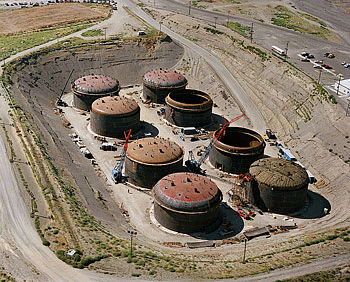 Workers begin removing nuclear waste from leaking Hanford tank http://www.seattletimes.com/seattle-news/workers-begin-removing-nuclear-waste-from-leaking-hanford-tank/ March 4, 2016 Workers have started removing nuclear waste from a leaking tank at the Hanford Site just one day before a state of Washington deadline. By Seattle Times staff The Associated Press KENNEWICK, Wash. — Workers have started removing nuclear waste from a leaking tank at the Hanford Site just one day before a state of Washington deadline.
The Tri-City Herald reports that Hanford workers began pumping waste from the nuclear reservation’s oldest double-shell tank Thursday afternoon.
The tank contains about 150,000 gallons of radioactive sludge covered by about 650,000 gallons of liquid waste. The liquid could be removed by early next week if things go smoothly, but removing the sludge is more complicated.
The Washington Department of Ecology had ordered the U.S. Department of Energy and its contractor Washington River Protection Solutions to begin emptying the waste by March 4 and finish the work within a year.
An unforgettable year for solar power in USA
Solar energy is poised for an unforgettable year, WP, By Chris Mooney March 2 New statistics just released by the U.S. Energy Information Administration suggest that in the coming year, the booming solar sector will add more new electricity-generating capacity than any other — including natural gas and wind.
EIA reports that planned installations for 2016 include 9.5 gigawatts of utility-scale solar — followed by 8 gigawatts (or 8 billion watts) of natural gas and 6.8 gigawatts of wind. This suggests solar could truly blow out the competition, because the EIA numbers are only for large or utility-scale solar arrays or farms and do not include fast-growing rooftop solar, which will also surely add several additional gigawatts of capacity in 2016.
In other words, U.S. solar seems poised for not just a record year but perhaps a blowout year. Last year, in contrast, solar set a new record with 7.3 gigawatts of total new photovoltaic capacity across residential, commercial, and utility scale installations.
“If actual additions ultimately reflect these plans, 2016 will be the first year in which utility-scale solar additions exceed additions from any other single energy source,” says EIA……….
“2016 is going to be a huge year, and then we’re going to continue to see big years over the next 5,” he [Nathan Serota, a solar industry analyst with Bloomberg New Energy Finance] said. Granted, solar could still face some headwinds, particularly from the competition offered by extremely low natural gas prices.
In the grand scheme, the tax credits for solar, as well as an extension of the production tax credit for wind, could serve as a kind of “bridge” into an era in which the Obama administration’s Clean Power Plan is operating — or at least, so the current administration hopes. Granted, that depends on whether that plan survives its current legal challenges.
A recent report from the National Renewable Energy Laboratory found that due to the tax credit extensions, the U.S. will add 53 additional gigawatts of renewable energy capacity by the year 2020. https://www.washingtonpost.com/news/energy-environment/wp/2016/03/02/solar-energy-is-poised-for-an-unforgettable-year/
Global Boom in Wind Power, led by China and USA
 China, U.S. Lead Global Boom in Wind Power, Climate Central, By Bobby Magill
March 2nd, 2016 Wind power had a big year worldwide in 2015 as China became the leader in wind power production capacity while the U.S. kept its top spot in electricity actually produced from wind turbines, according to new data released by the Global Wind Energy Council.
Low-carbon energy sources such as wind and solar power are critical to countries seeking to meet climate goals set forth in the Paris climate agreement struck in December. The pact aims to keep global warming to below 2°C (3.6°F)……..
“Wind power is leading the charge in the transition away from fossil fuels,” GWEC Secretary General Steve Sawyer said in a statement.
“The Chinese government’s drive for clean energy, supported by continuous policy improvement, is motivated by the need to reduce dependence on coal, which is the main source of the choking smog strangling China’s major cities, as well as growing concern over climate change,” the statement said.
No other country came close to China’s level of wind development growth last year. But while China is seeing the biggest wind turbine building boom, the U.S. is better at actually producing electricity from its turbines, generating more wind power than any other country last year.
The U.S. generated 190 million megawatt-hours of wind power in 2015, powering about 17.5 million homes. China clocked in at 185.1 megawatt hours, followed by Germany at 84.6, according to American Wind Energy Association data released Monday……
AWEA chief Tom Kiernan said the U.S. is on its way to generating 20 percent of its electricity from wind power by 2030. http://www.climatecentral.org/news/china-us-lead-global-wind-power-boom-20089
Design flaws in America’s nuclear reactors: NRC engineers call for shutdown, if not fixed
 NRC engineers urge shutdown of nuclear plants if design flaw not fixed, Utility Dive By Robert Walton | March 3, 2016
Dive Brief:
- A group of engineers in the U.S. Nuclear Regulatory Commission say they have identified a design flaw in nearly all nuclear reactors in the country that should result in their mandatory shutdown unless operators fix the problem, Reuters reports.
- In late February, the engineers petitioned the NRC to order immediate enforcement actions to correct the design flaw, which they say could result in damage to cooling systems and ultimately lead to an emergency situation. The filing asks the agency to respond by March 21 and is a part of a standard NRC process, according to the news outlet.
- The filing stems from an incident in January 2012, when Exelon’s Byron 2 unit in Illinois experienced an automatic reactor trip from full power after an undervoltage condition was detected. The unit was shut down for a week, in what is known as an open phase condition created by an unbalanced voltage. The NRC engineers say such an event could cause an electrical short, reducing the abilituy of cooling systems to operate.
Dive Insight:
In a little-noticed public filing, a group engineers from within the NRC are calling for an investigation into the nuclear vulnerability, and why it has not been fixed when the issue has been known since Exelon’s 2012 event.
Union of Concerned Scientists nuclear expert Dave Lochbaum told Reuters the agency “snatched defeat from the jaws of victory,” with its failure to address the issue after it became known in 2012. And the engineers say there has been at least 13 open phase events over the past 14 years.
Lochbaum said it was a positive sign the engineers filed, indicating no fear of reprisals. But the issue means “something is not right with the safety culture at the agency.” ……..http://www.utilitydive.com/news/nrc-engineers-urge-shutdown-of-nuclear-plants-if-design-flaw-not-fixed/414919/#.VthYQXYJX1Y.twitter
-
Archives
- October 2026 (129)
- September 2026 (339)
- August 2026 (330)
- July 2026 (355)
- June 2026 (287)
- May 2026 (306)
- April 2026 (356)
- March 2026 (251)
- February 2026 (267)
- January 2026 (308)
- December 2025 (358)
- November 2025 (359)
-
Categories
- 1
- 1 NUCLEAR ISSUES
- business and costs
- climate change
- culture and arts
- ENERGY
- environment
- health
- history
- indigenous issues
- Legal
- marketing of nuclear
- media
- opposition to nuclear
- PERSONAL STORIES
- politics
- politics international
- Religion and ethics
- safety
- secrets,lies and civil liberties
- spinbuster
- technology
- Uranium
- wastes
- weapons and war
- Women
- 2 WORLD
- ACTION
- AFRICA
- Atrocities
- AUSTRALIA
- Christina's notes
- Christina's themes
- culture and arts
- Events
- Fuk 2022
- Fuk 2023
- Fukushima 2017
- Fukushima 2018
- fukushima 2019
- Fukushima 2020
- Fukushima 2021
- general
- global warming
- Humour (God we need it)
- Nuclear
- RARE EARTHS
- Reference
- resources – print
- Resources -audiovicual
- Weekly Newsletter
- World
- World Nuclear
- YouTube
-
RSS
Entries RSS
Comments RSS

