New USA nuclear missile test
 U.S. conducts nuclear missile test amid N. Korea tensions, CBS News, February 26, 2016, VANDENBERG AIR FORCE BASE, California — Like a giant pen stroke in the sky, an unarmed Minuteman 3 nuclear missile roared out of its underground bunker on the California coastline Thursday and soared over the Pacific, inscribing the signature of American power amid growing worry about North Korea’s pursuit of nuclear weapons capable of reaching U.S. soil.
Disastrous problem of nuclear waste just won’t go away
 A disaster waiting to happen: nuclear waste and Lake Huron, Michigan Radio, By JACK LESSENBERRY , 25 Feb 16 Michigan has been so preoccupied with our own environmental disaster in Flint that we may have missed the announcement that Canada last week indefinitely delayed a decision about whether to bury low-level nuclear waste near Lake Huron……..
Had the conservative government of Prime Minister Stephen Harper been reelected last fall, the decision announced last week would almost certainly have been to bury the waste here. But Harper’s party lost in an unexpected landslide to Justin Trudeau’s more environmentally conscious liberals.
The outcome may be especially welcome in poor, battered Flint. The city hopes to eventually switch to a new water provider using Lake Huron, and the last thing anyone wants to worry about is radioactive waste leaching into the water, as unlikely as that may be.
But this also means we still don’t have an answer to what is to be done with 200,000 cubic feet of nuclear waste, currently stored in above-ground containers near Ontario’s immense Bruce nuclear generating station.
Even more important is finding a permanent home for all those highly radioactive, spent nuclear fuel rods in both our nations. Scientific American estimated seven years ago that the United States alone had produced 64,000 metric tons of those rods.
There’s more now, and any effort to establish a permanent burial site has been killed by narrow, NIMBY, not-in-my-backyard thinking, as it has in Canada.
This is a disaster waiting to happen – there’s tons of this stuff in “temporary,” above-ground storage everywhere from Monroe to Charlevoix, where an old nuclear plant was torn down nearly twenty years ago.
If the apparent decision to not bury low-level waste near Lake Huron makes us forget this far bigger problem, then it is no kind of victory at all. http://michiganradio.org/post/disaster-waiting-happen-nuclear-waste-and-lake-huron#stream/0
CPS Energy writes off $millions from Texas nuclear expansion project
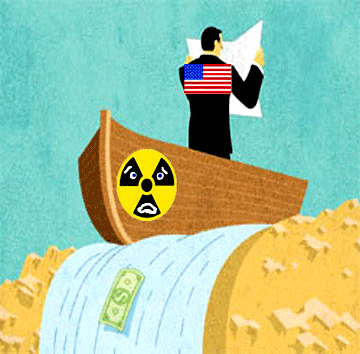 CPS Energy writes off $391.4 million from South Texas Project nuclear expansion San Antonio Express News, 24 Feb 16 CPS Energy revealed Wednesday it has written off $391.4 million in costs associated with its partnership of the unbuilt — and highly criticized — Units 3 and 4 of the South Texas Project nuclear plant……..
Longtime opponents of the nuclear expansion said CPS Energy made the correct move to write off its costs so far.
“CPS’ decision shows that proposed nuclear reactors are worthless. There’s no market for their rate raising, high-cost, high-risk power,” Tom “Smitty” Smith of Public Citizen’s Texas office in Austin said in an email. “The proposed reactor price tag rose from $5.9 billion to $18.2 billion, even before a license was ever issued. Delays, construction problems and lawsuits are the norm for nuclear reactors. They cost so much that even with all the federal subsidies, no bank will loan money to build them. CPS did the smart thing and wrote off this worthless investment.”
Controversy erupted in 2009 over the expansion project, which already had received intense opposition over concerns about storage of waste fuel and estimated cost of $13 billion.
It was revealed that a new cost estimate from partner Toshiba Inc. — $4 million higher than the previous one — had been withheld by utility executives from the CPS board and City Council while additional financing was under consideration……….
“The NRC (Nuclear Regulatory Commission) can license these reactors, but they won’t get built,” added Karen Hadden of the Sustainable Energy and Economic Development Coalition. “Renewable energy is cheaper these days and much safer. Nuclear power creates radioactive waste that remains deadly for hundreds of thousands of years.”…….. http://www.expressnews.com/business/local/article/CPS-Energy-writes-off-391-4-million-from-South-6852804.php
Illegal dumping of nuclear waste in Kentucky
Drilling wastes containing concentrated but naturally occurring radio active materials made their way into Kentucky, state officials confirmed on Thursday. After learning in January that low-level nuclear waste from drilling operations had been dumped illegally in Kentucky last year, state officials are warning this week that all landfills be on the lookout and to not accept any of the radioactive material.
Kentucky Division of Waste Management Director Tony Hatton said officials have confirmed that low-level nuclear waste from drilling operations in Ohio, Pennsylvania and West Virginia was sent to a landfill in Estill County between July and November. Officials are also investigating possible illegal shipments of similar waste to a landfill in Greenup County……..http://www.courier-journal.com/story/tech/science/environment/2016/02/25/nuclear-waste-dumped-illegally-kentucky/80924622/
Spread of Hanford radioactive pollution is “alarming”
 Hanford contamination spread across public highway
Fall windstorm spread radioactive contamination across Route 4 north of Richland
Some contamination likely spread by plants, animals
EPA requires report from DOE in April
BY ANNETTE CARY acary@tricityherald.com 23 Feb 16 The Environmental Protection Agency has called the uncontrolled spread of small amounts of radioactive waste at Hanford “alarming” after a Nov. 17 windstorm.
Surveys six miles north of Richland after the winds subsided found specks of contamination had spread beyond Route 4, the public highway from Richland out to the Wye Barricade secure entrance to Hanford.
The contamination had blown from the 618-10 Burial Ground, which is being cleaned up on the west side of the highway.
The search also turned up previously undiscovered specks of radioactive waste believed to have been spread by plants or animals outside known contaminated areas…….
EPA, in a letter to DOE, said the spread of contamination “is a matter that is alarming to EPA and requires further investigation and discussion.”
It has given DOE until the third week of April to prepare a report on its loss of control of radioactive material. DOE is required to describe for EPA, a Hanford regulator, what actions and technology it plans to prevent a recurrence.
DOE and its contractor, Washington Closure Hanford, have had problems with contamination spread at the 618-10 Burial Ground as early as summer 2014, according to the weekly staff reports of the Defense Nuclear Facilities Safety Board……..
The report required by EPA is expected to address not only issues directly related to the 618-10 Burial Ground but the spread of contamination by plants and animals. http://www.tri-cityherald.com/news/local/hanford/article61710052.html
More about Florida lawsuit over alleged unlawful nuclear fees

 FPL, Duke Energy sued over alleged unlawful nuclear fees http://protectingyourpocket.blog.palmbeachpost.com/2016/02/23/fpl-duke-energy-sued-over-alleged-unlawful-nuclear-fees/
The suit filed in U.S. District Court for the Southern District of Florida accuses Duke Energy and FPL of overcharging through alleged unconstitutional price hikes that increase customers’ electricity bills to fund nuclear construction costs.
Since 2008 the Florida Public Service Commission has authorized the two utilities to collect more than $2 billion in nuclear costs from customers. The lawsuit alleges that Florida’s nuclear cost recovery system violates the Commerce Clause and is preempted by the Atomic Energy Act of 1954 and the Energy Policy Act of 2005 under the Supremacy Clause.
“These two utilities have racked up huge expenses with nuclear power plant projects – some of which they completely abandoned – and have left ratepayers holding the bag,” said Steve Berman, managing partner of Hagens Berman. “We believe the consumers in this instance are being forced to pick up the tab for Duke Energy Florida and FP&L in violation of their constitutional rights.”
To read the lawsuit, go tohbsslaw.com/uploads/case_downloads/florida_energy/fpandlanddukeenergyflorida_class_action_lawsuit_02-22-16.pdf
Juno Beach-based FPL has 4.8 million customer accounts, and Duke Energy Florida, headquartered in St. Petersburg, has 1.7 million customer accounts.
The suit seeks relief for anyone who is a customer of either of the utility companies, including reimbursement from the companies for costs passed onto the customers to fund the companies’ nuclear projects, a declaration binding on defendants that Florida’s Nuclear Cost Recovery System and all nuclear cost recovery orders issued under it are unconstitutional and void, and an order enjoining defendants from further unlawful charges.
The named plaintiffs are William Newton, a Duke Energy customer who resides in Clearwater and is deputy director of the Florida Consumer Action Network and Noreen Allison of Naples, an FPL customer since 1991 and a retired U.S. National Park Service worker.
The lawsuit alleges that since Nov. 12, 2008, Duke and FPL ratepayers have been forced to pay “unlawful charges” to fund various nuclear power plant projects.
Duke abandoned all of its nuclear projects in 2013, and FP&L’s proposed expansion of its Turkey Point plant south of Miami continues to be bogged down in red tape, according to the complaint. FPL is seeking a license to build two more nuclear units, 6 and 7 at Turkey Point.
FPL operates two nuclear units at Turkey Point and two at its St. Lucie plant on Hutchinson Island.
The suit lists as an example that Duke abandoned a nuclear power plant in Levy County, which reportedly cost Florida ratepayers $1.3 billion, and that full amount has not yet been collected.
The Nuclear Cost Recovery System facially discriminates against electricity producers outside of Florida and violates the Constitution’s dormant Commerce Clause, the lawsuit contends.
Gloom in USA nuclear industry: claim they’re ignored in Clean Power Plan
Nuclear industry bemoans Clean Power Plan stay, Power Source, February 23, 2016 For an industry that said it was ignored by the Clean Power Plan, nuclear interests sure took it hard when the Supreme Court halted the rule earlier this month.
Existing nuclear power plants didn’t get any credit for being the largest source of carbon-free electricity in the country, advocates said. There are no direct incentives built into the rule to subsidize new nuclear plants or keep existing ones from retiring early, as more than half a dozen have done or plan to do.
And yet, when the Supreme Court stayed the rule while its merits are hashed out in a lower court, it sent shockwaves through the industry that was counting on the states’ compliance plans to give nuclear energy the credit that the federal government didn’t…….
Across the country, five nuclear plants have already shut down or been put on the early retirement list…..
the nuclear renaissance that the industry banked on, that federal nuclear regulators staffed up for, didn’t happen. ….
USA Dept of Energy wants to dump nuclear waste on Sacred Native American Lands
 Sacred Native American Lands Could Become Nuclear Waste Dump Derrick Broze February 22, 2016 (ANTIMEDIA) Nye County, Nevada —During the 1970s and 80s, a large movement of antinuclear and anti-war activists protested the growing acceptance of nuclear power and the possibility of an impending global nuclear war. The protesters were not only concerned with the Cold War breaking down into a hot war, but also with the dangers that nuclear technology presented to the environment and the health of the public……..
Unfortunately, Native communities in the region are not new to this type of exposure to radiation. From 1951 to 1992, the U.S. government used a 1,300-square mile patch of land known as the Nevada Test Site for nuclear weapons testing. 928 American and 19 British nuclear tests were conducted at the Nevada Test Site. Although no official tests have been conducted to examine the health effects on the Paiute and the Shoshone, the communities believe the radiation has affected their health — and the health of the land…….
The DOE is currently accepting public comment from communities, states, tribes, and other stakeholders regarding how to establish a nuclear waste repository with respect to the community. The DOE says it aims “to establish an integrated waste management system to transport, store, and dispose of commercial spent nuclear fuel and high level defense radioactive waste.” The public comment period ends on June 15, and the DOE and Nuclear Regulatory Commission will likely issue statements shortly after.
Ian Zaparte, representative of the Western Shoshone government, says the NRC and the DOE are ignoring the possibilities for danger in the area.
“There are 26 faults, seven cinder cone volcanoes, 90 percent of the mountain is saturated with 10 percent water,” Zaparte told MintPress. “If you heat the rock, it will release that water. If the water comes up and corrodes the canisters, it will take whatever is in storage and bring it into the water and into the valley.”
However, Ian Zaparte takes his criticism of the project even further. He believes the actions taken by the U.S. government constitute acts of genocide against the Western Shoshone and other tribal nations who have been subject to the effects of nuclear testing and power. He is determined to fight for his people’s way of life and the land that his ancestors fought for. http://theantimedia.org/sacred-native-american-lands-could-become-nuclear-waste-dump/
Legal challenge to Florida utilities’ Nuclear Cost Fees
Lawsuit Challenges Florida Utilities’ $2B Nuclear Cost Fees By CURT ANDERSON, abc, AP LEGAL AFFAIRS WRITER MIAMI — Feb 23, 2016, A federal lawsuit has been filed challenging $2 billion in fees charged by Florida’s two largest electric utilities for nuclear plant projects, some of which were never completed.
The proposed class-action lawsuit filed Monday seeks to stop the fees and recover unspecified damages for about 6.4 million customers of Florida Power & Light and Duke Energy. The fees were imposed on ratepayers under a law passed in 2006 by the Legislature and implemented by the state Public Service Commission.
The suit contends that the law violates the U.S. Constitution’s commerce clause by discriminating against other out-of-state energy producers and that it is pre-empted by federal energy and nuclear laws. It also claims Florida customers are improperly charged for nuclear projects that can be subject to huge cost overruns or that are never built.
One example cited in the lawsuit is Duke’s plan to build two new reactors in Levy County, which enabled the utility to begin collecting recovery fees in 2008. Even though the project was abandoned in 2013, Duke can keep all the fees it has collected plus other amounts deemed prudent by state regulators.
“These two utilities have racked up huge expenses with nuclear power plant projects — some of which they completely abandoned — and have left ratepayers holding the bag,” said attorney Steve Berman, managing partner at Seattle-based Hagens Berman, which filed the lawsuit in South Florida federal court.
Berman’s firm and the nonprofit Institute for Southern Studies say other states, including Georgia and Louisiana, have laws similar to that in Florida allowing utilities to collect such fees…….
According to state records, Duke Energy has collected more than $1.2 billion in nuclear cost recovery fees since 2008. For FPL, the total tops $814 million.
If the lawsuit is certified as a class action, it could eventually repay millions of Florida customers of the two utilities a portion of the fees they have been charged under the law. The lawsuit also asks U.S. District Judge William Dimitrouleas of Fort Lauderdale to halt further collection of the fees by declaring the law unconstitutional. http://abcnews.go.com/US/wireStory/lawsuit-challenges-florida-utilities-2b-nuclear-cost-fees-37145865
Entergy won’t save loss-making FitzPatrick nuclear plant
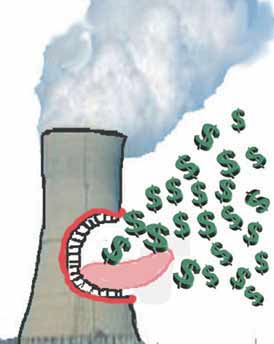 Entergy rebuffs latest NY plan to save FitzPatrick nuclear plant, syracuse.com By Tim Knauss | tknauss@syracuse.com SCRIBA, N.Y. – The state Public Service Commission said today it is working on plans to provide financial assistance to the FitzPatrick nuclear plant in a desperate attempt to keep the plant from shutting down.
PSC officials said they will undertake a rushed review of the plan and expect to have financial subsidies available for FitzPatrick by June, long before the plant’s scheduled closure next January.
The commission did not specify how much assistance it would provide. ………
PSC Chair Audrey Zibelman beseeched Entergy Corp., which owns FitzPatrick, to work with state officials on a financial rescue for the nuclear plant.
“The plan would enable expedited financial support to FitzPatrick and other qualified nuclear power plants in Upstate New York,” said PSC Chair Audrey Zibelman. “Until then, we invite Entergy to work with us to make the plans necessary to refuel FitzPatrick and to support the statewide objectives of New York’s new Clean Energy Standard.”
Entergy officials responded that it is too late to save FitzPatrick, which the company plans to close because it loses money. The company added that if Cuomo wants to reduce carbon emissions, he should back off his insistence that Entergy shut down the Indian Point nuclear facility, which Cuomo says is unsafe because of its proximity to New York City.
Cuomo recently announced his plan to offer financial “clean energy” payments for nuclear power, but the help would only go to Upstate nukes – FitzPatrick and Nine Mile Point in Oswego County, and Ginna in Wayne County. Indian Point’s two reactors would not qualify…….
The commission today agreed to conduct a speeded-up review aimed at making financial supports available to Upstate nuclear plants as early as June. Entergy officials dismissed today’s action as too uncertain and too late to save FitzPatrick…. http://www.syracuse.com/news/index.ssf/2016/02/entergy_to_cuomo_its_too_late_to_save_fitzpatrick_but_not_indian_point.html
“disaster waiting to happen” – Indian Point nuclear plant called
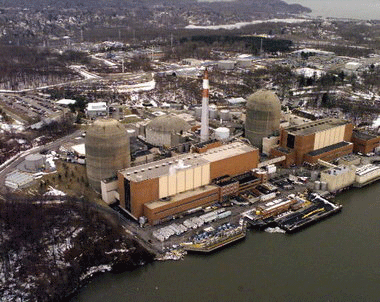 Indian Point nuclear plant called “disaster waiting to happen” CBS News,
In the past year alone there have been a number of mishaps at Indian Point, including a power failure in the reactor core, a transformer fire, an alarm failure, and the escape of radiated water into groundwater. The plant sits about 25 miles north of New York City, so a serious mishap could potentially put millions of people in harm’s way.
“It’s a disaster waiting to happen and it should be shut down,” Paul Gallay, president of Riverkeeper, a watchdog organization dedicated to protecting the Hudson River, told CBS News.
The Indian Point Energy Center, located on the bank of the Hudson River in the town of Buchanan, supplies electricity for millions of homes, businesses and public facilities in New York City and Westchester County, just north of the city.
Environmental groups call the latest problem just the tip of the iceberg, and Gov. Andrew Cuomo is joining with organizations like Riverkeeper, the National Resources Defense Council and others in seeking the permanent closure of the plant.
Earlier this month, Entergy Corporation, which owns Indian Point, reported increased levels of tritium-contaminated water at three monitoring wells, with one well’s radioactivity increasing by as much as 65,000 percent.
Tritium is a radioactive form of hydrogen that occurs naturally in small doses and is a byproduct of nuclear reactors. It could enter a person’s body by drinking tritiated water, or it can also be inhaled as a gas or absorbed through the skin. Tritium can reach all parts of the body like normal water and is eventually expelled through urine. The U.S. Nuclear Regulatory Commission (NRC) says tritium emits “very weak radiation and leaves the body relatively quick.”
Little research has been done on the health effects of exposure to increased levels of tritium. But the NRC states: “Exposure to very small amounts of ionizing radiation is thought to minimally increase the risk of developing cancer, and the risk increases as exposure increases.”……..
The Environmental Protection Agency’s (EPA) standard limit for tritium in drinking water, established in 1976, is 20,000 picocuries per liter. (A picocurie is a unit of radiation that could be measured in a laboratory.) By comparison, after the recent leak, samples showed the tritium-laced water at Indian Point had a radioactivity level of more than 8 million picocuries per liter. That level was the highest regulators have seen at Indian Point, Cuomo said, compared to a normal reading of about 12,300 picocuries per liter.
According to a 2014 notice in the Federal Register, EPA is expected to update the standards for tritium in drinking water. EPA did not make anyone available for comment……..
“The good news is, advances in alternate power sources, grid management and energy conservation have brought us to the day when the aging, unsafe Indian Point can close,” Gallay said. He enumerated a number of other available sources of energy for the region, including 600 megawatts thanks to transmission system upgrades and another 500 megawatts available through energy savings achieved through efficiency and renewable energy.
“There will be enough power to keep the lights on in our homes and hospitals, our businesses and schools — in every place that makes our communities healthy and vibrant,” Gallay said. http://www.cbsnews.com/news/indian-point-nuclear-power-plant-called-a-disaster-waiting-to-happen/
Thousands of nuclear workers made sick by radiation, but not getting any help
Sen. Tom Udall, D-N.M., is among a group of federal lawmakers who have called for an investigation into the program following McClatchy’s probe, which revealed 7,762 workers died after being denied compensation by the government.
The McClatchy DC investigation found that nuclear worker safety remains an issue: Since 2001, more than 186,000 workers have been exposed to radiation.
Efficacy of compensation program for nuclear workers under scrutiny By Rebecca Moss
The New Mexican, 20 Feb 16, “………Due to the commingling of his exposure during the war and his work on various sites at Sandia, Thompson is one of at least 10,273 New Mexicans who have applied for a federal program that compensates individuals with a $150,000 lump sum payment for serious illness or death that can be attributed to work at the state’s nuclear defense facilities since 1943.
As of March 2015, New Mexico had received the second-highest compensation of any state under the fund, with $1.64 billion paid out to workers for compensation and medical bills.
But the program has come under scrutiny lately. An investigation by the McClatchy DC news service found that fewer than half of the people who have applied for benefits have received them, and workers’ complaints are often suspended in the complex process of paperwork or court hearings, with some claims languishing in the system for up to 10 years. A new documentary coming out in March, titled Safe Side of the Fence, questions why side-by-side workers with similar ailments would receive different judgments from the Department of Labor on the validity of their claims.
At least 5,400 workers in New Mexico have been denied financial assistance, according to the Department of Labor, which issues the compensation.
The department recently added new language to the regulations, which is intended to clarify who is eligible for relief. A 60-day public comment period for the proposal ended Thursday. But critics say the new language could make it even more difficult for ailing workers to receive compensation. Continue reading
Westinghouse realised that Small Modular Nuclear Reactors (SMRs) are an economic dud
Westinghouse ditches small reactors http://funologist.org/2014/02/06/westinghouse-ditches-small-reactors/ 5 Feb 2014 The nuclear industry is often referred to as a priesthood, by critics and supporters alike. The thought is that the followers of the belief in nuclear power have to have a strong faith in the technology and a willingness to sacrifice themselves to advance the ideology. Some of the hardest working people I have ever met, promote nuclear power.
 Part of the understanding within the priesthood is that you try to never harm the position of others in the industry when you change your plans. So it was with special interest I read the recent news that Westinghouse had dropped out of the small reactor market. In this news story the Westinghouse spokes people (who are always very careful what they say to the press) tell us that the only reason they are dropping out of this technology is “there are no customers.” They go on to elaborate that the only way they can actually make money on small reactors is by selling a bunch of them. The Westinghouse CEO confessed, “Unless you’re going to build 30 to 50 of them, you’re not going to make your money back.”
Worldwide, no one is building reactors without huge financial incentives from the manufacturer or their supporting country. The idea that small reactors are going to be snapped up by utilities without external generous financing is as fanciful as the notion that nuclear power will be “too cheap to meter.”

But what is really going on here? My guess is that Westinghouse has done the economic math and they see that “they can’t get there from here.” That the persistent experience of the nuclear navy is repeating itself in the non-military world . That being that reactors do not shrink in an economically advantageous way. Nuclear power is fantastically complex stuff, the French EdF/Areva have put a lot of time and money into going the other way and building even larger reactors, hoping to get economies of scale.
The problem is not that you have to sell 50 of them, the problem is that no matter how many you sell, other energies are going to be cheaper, and so it is likely a loosing game from the get go.
New Hampshire shopping complex site has buried radioactive material
Radioactive material to stay put as factory becomes retail center By MARK HAYWARD
New Hampshire Union Leader, 21 Feb 16, MANCHESTER — Before developers go ahead with the conversion of the former Osram Sylvania light-bulb factory into a $60 million shopping center, they have to address one little problem — a buried vault of radioactive material on the property.
Earlier this month, developer Dick Anagnost disclosed the only containment of its kind in New Hampshire of radioactive contaminated soil.
Reportedly safe, it will be located beneath a portion of the parking lot of the would-be shopping center. But for financing purposes, Anagnost and his partner, Brady-Sullivan Properties, need to carve off a half-acre lot that contains the vault. He has asked the Manchester Planning Board to approve the subdivision.
The concrete vault contains thorium, a radioactive element used at the plant from the mid-1960s to mid-1980s, according to state health officials.
When decommissioning the plant, Sylvania discovered that thorium had contaminated some soil. The contaminated material was encapsulated following guidelines set by the U.S. Nuclear Regulatory Commission, Anagnost told the New Hampshire Union Leader……
– See more at: http://www.unionleader.com/Radioactive-material-to-stay-put-as-factory-becomes-retail-center#sthash.5NGL8Sk5.dpuf
Radioactive groundwater a difficult problem at Vermont Yankee nuclear site
 ENTERGY GRAPPLES WITH GROUNDWATER INFILTRATION AT VERMONT YANKEE, VT Digger [good photos] FEB. 18, 2016, BY MIKE FAHER “……….Vermont Yankee stopped power production in December 2014, and the NRC last year removed its resident inspector from the site. But the federal agency has continued periodic inspections, and the groundwater issue first surfaced in the NRC’s fourth-quarter report released in January.
That document says that “radioactive water inventories were increasing due mainly to the intrusion of groundwater.” Officials wrote that Entergy had been considering options both to stem the flow of groundwater and to eventually dispose of it.
After the inspection report was released, Sheehan said the problem is occurring on the lowest level of the plant’s turbine building. Groundwater intrusion has been averaging a few hundred gallons daily, Sheehan said, but there had been “occasional spikes” that on one day rose to 1,500 gallons.
Entergy has a water-management plan and has been pumping and storing groundwater, which is considered contaminated due to its contact with the building. In early February, a total of 90,000 gallons had been collected.
Groundwater intrusion was anticipated and in some ways is a symptom of the plant’s shutdown, since heat from power generation previously had caused some of the liquid to evaporate. But officials said they had not expected so much water to arrive so quickly……..
Regardless of any short-term storage solutions, Entergy must come up with a plan for getting radioactive water off the property eventually. And that plan stretches beyond the groundwater issue, as the NRC has said there are more than 1 million gallons of water at Vermont Yankee including liquid stored in a large, donut-shaped reservoir at the base of the reactor building.
Entergy has requested NRC approval to ship about 200,000 gallons of radioactive water to Idaho for disposal. There also has been preliminary talk of possible discharges into the Connecticut River, though any such plan would come under intense scrutiny by state regulators.
Sheehan said Thursday that the NRC is still “awaiting additional information from Entergy on its broader plans for addressing radioactive water at the site.”……http://vtdigger.org/2016/02/18/entergy-stores-contaminated-vermont-yankee-water-in-swimming-pools/
1 This Month
15 October. Joint Appeal for Nuclear Abolition Day -presentation to the UN on October 15 will be live on UNWebTV
Endorse the Nuclear Abolition Day Appeal
23-25 October – on Zoom – World BEYOND War’s annual global conference

To see nuclear-related stories in greater depth and intensity – go to https://nuclearinformation.wordpress.com
-
Archives
- October 2026 (129)
- September 2026 (339)
- August 2026 (330)
- July 2026 (355)
- June 2026 (287)
- May 2026 (306)
- April 2026 (356)
- March 2026 (251)
- February 2026 (267)
- January 2026 (308)
- December 2025 (358)
- November 2025 (359)
-
Categories
- 1
- 1 NUCLEAR ISSUES
- business and costs
- climate change
- culture and arts
- ENERGY
- environment
- health
- history
- indigenous issues
- Legal
- marketing of nuclear
- media
- opposition to nuclear
- PERSONAL STORIES
- politics
- politics international
- Religion and ethics
- safety
- secrets,lies and civil liberties
- spinbuster
- technology
- Uranium
- wastes
- weapons and war
- Women
- 2 WORLD
- ACTION
- AFRICA
- Atrocities
- AUSTRALIA
- Christina's notes
- Christina's themes
- culture and arts
- Events
- Fuk 2022
- Fuk 2023
- Fukushima 2017
- Fukushima 2018
- fukushima 2019
- Fukushima 2020
- Fukushima 2021
- general
- global warming
- Humour (God we need it)
- Nuclear
- RARE EARTHS
- Reference
- resources – print
- Resources -audiovicual
- Weekly Newsletter
- World
- World Nuclear
- YouTube
-
RSS
Entries RSS
Comments RSS

