Public Interest Groups Warn National Nuclear Security Administration (NNSA) on Plutonium Giveaway

South Carolina Environmental Law Project, Savannah River Site Watch & Nuclear Watch New Mexico September 8, 2026, https://www.scelp.org/news/groups-warn-nnsa-on-plutonium-giveaway
South Carolina – Today, the South Carolina Environmental Law Project (SCELP) sent a letter of demand to the Department of Energy (DOE) and its semi-autonomous agency, the National Nuclear Security Administration (NNSA), about their proposed unsound and dangerous management of U.S. plutonium. The letter notified them that they must comply with the federal National Environmental Policy Act (NEPA) requirement for public review of the Trump Administration’s troubling plan to give away 19.7 metric tons of nuclear weapons-grade plutonium to private corporations.
SCELP’S letter, on behalf of Nuclear Watch New Mexico, Savannah River Site Watch, and a private citizen who lives near the Savannah River Site (SRS) in South Carolina, outlines why NNSA must be held to its legal NEPA obligations. The letter describes how recently issued presidential executive orders:
…constitute a vast change in the prior decisions and purposes of the DOE/NNSA surplus plutonium disposition program that has been in place since at least 1996… This change is also contrary to the larger nuclear non-proliferation policy of the United States restricting the commercial use of plutonium that has been in place for approximately fifty years.
This action follows SCELP’s earlier NEPA lawsuit on behalf of SRS Watch and Nuclear Watch New Mexico. In a landmark settlement, that litigation successfully compelled the NNSA to prepare a nationwide programmatic environmental impact statement on the production of plutonium “pit” bomb cores for nuclear weapons (the “Pit Production PEIS”).
SCELP’s new letter of demand states as follows:
In a generally analogous NEPA situation, my clients are concerned that the Department of Energy and NNSA are radically changing course in their surplus plutonium disposition program without preparing a necessary supplemental programmatic environmental impact statement.
On May 23, 2025, President Trump issued Executive Order 14302 “Reinvigorating the Nuclear Industrial Base” which officially terminated DOE’s previous “dilute and dispose” program for excess weapons-grade plutonium. In that program, 40 metric tons of plutonium were to be treated as nuclear waste for underground disposal at the Waste Isolation Pilot Plant in New Mexico, as analyzed in several earlier NEPA documents.
President Trump’s 2025 decree directed DOE to establish a program to supply surplus plutonium in a form usable by the commercial sector—specifically for advanced nuclear technologies and small modular reactors. Notably, the Executive Order focused extensively on “recycling” and “reprocessing” spent nuclear fuel to remove plutonium for use in reactors. It then contemplated agreements “with domestic nuclear energy companies” that “implement methods to enhance the capacity to manage spent nuclear fuel, including the recycling and reprocessing of spent nuclear fuel….” Not only was this significant shift in policy done without required NEPA analysis, but there is no justified demand to use plutonium as nuclear fuel.
In addition to serious proliferation, environmental and radioactive waste concerns, this planned giveaway of weapons-grade plutonium is also linked to the increasingly controversial issues of artificial intelligence and data centers. Still hypothetical and untested advanced nuclear reactors and speculative small modular reactors are being eyed to power future data centers across the country. This urgently underscores the need for a nationwide public programmatic review, which SCELP’s letter of demand seeks.
In May 2026, NNSA announced yet another major policy shift in the plutonium disposition program, again without mandated NEPA review. The government agency selected five private companies to receive the 19.7 metric tons of plutonium: Oklo Inc., Exodys Energy, Shine Technologies, Standard Nuclear, and Flibe Energy, Inc. The current Secretary of Energy, Chris Wright, had to resign from the Oklo board of directors to assume his job as the head of DOE. That continues to raise eyebrows as DOE funnels money to Oklo, a private corporation, for its ill-defined program which will purport to use some of the government’s weapons-grade plutonium.
The Savannah River Site (SRS) in South Carolina is key to the Trump Administration’s plans to give away weapons-grade plutonium to private corporations. As the SCELP letter notes:
[I]n support of its new plutonium utilization program, DOE announced in March its ‘decision to restart HB-Line operations at the Savannah River Site (SRS) in South Carolina.’ This activity was stated to provide ‘the capability to power America’s nuclear future by recycling surplus plutonium and partnering with industry to produce uranium-plutonium mixed oxide (MOX) fuel for advanced nuclear reactors. The facility is an integral part of H-Canyon, the only chemical separations facility of its kind in the United States.’
This is ironic. DOE and NNSA have been on the Government Accountability Office’s High Risk List for project mismanagement and waste of taxpayers’ dollars ever since GAO started the List in 1991. An ill-conceived MOX Fuel Fabrication Facility at SRS—terminated in 2017—was a ~$7 billion failure for which there has been no government accounting. That boondoggle plutonium MOX fuel facility is now being “repurposed” by NNSA into a new $30 billion production facility to produce plutonium “pit” bomb cores for new-design nuclear weapons, which will be the most expensive building in U.S. history.
SCELP’s letter of demand concludes:
Before bringing suit on the Pit Production PEIS, my clients wrote to NNSA five times reminding the agency of its legal obligations under NEPA. They never received a response. It is my hope that we can avoid a similar predicament. My clients request that DOE and NNSA respond to this letter within 30 days. If NNSA and DOE do not elect to engage, my clients will evaluate what legal actions may be necessary and proceed accordingly.
Ben Cunningham, SCELP Attorney, commented, “Since the mid ‘90s, DOE and NNSA have scrutinized how to address the surplus plutonium issue many times across several administrations. The public has been engaged in the process each time. NEPA continues to require that same level of scrutiny and public engagement before these agencies commit to a course of action that would place plutonium in private hands.
Tom Clements, Director of SRS Watch, added, “It is imperative that DOE and NNSA immediately halt questionable plans to introduce weapon-grade plutonium into civilian reactors and other nuclear facilities and affirm that it will now begin preparation of the legally required environmental review.”
The Director of Nuclear Watch New Mexico, Jay Coghlan, concluded, “As nuclear threats increase around the world, the last thing we need is government giveaways of nuclear weapons-grade plutonium to private profit-seeking corporations. We are asking the NNSA nicely for the public review legally required by the National Environmental Policy Act. If it blows us off again like it did with the Pit Production PEIS, we’ll discuss it with NNSA in court.”
Contacts:
Tom Clements, Director, SRS Watch, 803-240-7268, tomclements329[at]srswatch.org;
Jay Coghlan, Nuclear Watch NM, 505-989-7342, jay[at]nukewatch.org
Shelby Cohen, Comms Manager, SC Env. Law Project, 864.414.7726, shelby[at]scelp.org
About the nonprofit organizations: The South Carolina Environmental Law Project has used its legal expertise to protect land, water and communities across South Carolina since 1987. Savannah River Site Watch, based in Columbia, SC, works for the public interest by monitoring activities at the Savannah River Site. Nuclear Watch New Mexico, based in Santa Fe, NM, watchdogs plutonium pit production at both the Los Alamos Lab and SRS. Learn more at scelp.org/, srswatch.org/, and nukewatch.org/.
Witkoff and Kushner Cite Progress in Kyiv Talks, Push for Renewed Russia-Ukraine Negotiations

U.S. envoys Steve Witkoff and Jared Kushner described talks with Ukrainian leaders as encouraging after carrying new proposals from Moscow to Kyiv, though major disputes over territory and security remain unresolved.
By yourNEWS Media Newsroom, | Sep 6, 2026
U.S. envoys Steve Witkoff and Jared Kushner said they made progress during their first official visit to Kyiv on Sunday, expressing optimism that direct negotiations between Russia and Ukraine can be revived after more than three hours of talks with Russian President Vladimir Putin in Moscow a day earlier.
Ukrainian President Volodymyr Zelenskyy held three rounds of discussions with the Americans, with national security advisers from the United Kingdom, France and Germany joining the final session. The talks covered possible pathways toward ending the more than 4½-year war as well as Ukraine’s immediate military needs, long-term security guarantees and economic support for postwar reconstruction.
Witkoff said Washington remains focused on “a diplomatic resolution to this conflict, not a kinetic resolution.” He said Saturday’s Kremlin discussions produced “new ideas” that he and Kushner brought directly to Kyiv, adding that the participation of advisers from France, Germany and Britain demonstrated that “collaboration is critical” to reaching an agreement.
Both Moscow and Kyiv would have to compromise, Witkoff acknowledged, but he said the administration believes a negotiated settlement remains possible. “We think we have the ingredients to get to that place,” he said.
Kushner similarly said the United States is seeking a “win-win” outcome rather than simply pressuring one side to accept the other’s terms. He said President Donald Trump is focused not only on stopping the fighting but on creating “a framework that could actually lead to a durable peace.” Kushner described Saturday’s meeting with Putin as “constructive and substantive” and said the discussions explored what Russia, Ukraine and the broader international community could gain from a settlement.
The two envoys hope to revive trilateral negotiations involving Russia, Ukraine and the United States, a format last used roughly six months ago. Kushner said Washington has remained in near-daily communication with Ukrainian officials even during the recent slowdown in diplomatic activity, which coincided with the administration’s increased focus on the Iran war.
Zelenskyy said several major issues remain unresolved, particularly territory. He said the territorial question “remains relevant” but argued that such difficult decisions “can only be resolved at the level of leaders.” He also emphasized that any settlement must include lasting security arrangements, saying a strong Ukrainian military remains “one of the main guarantees of security.”
Immediate defense requirements formed another major part of Sunday’s talks. Zelenskyy said Ukraine is seeking “serious volumes” of American support for a winter package combining air defense with protection for energy infrastructure as colder weather approaches. Kyiv is particularly seeking additional Patriot systems and interceptor missiles, with European governments expected to help support the effort.
The Ukrainian president said the United States plans to increase production of Patriot interceptor missiles next year and that Germany is also expanding production under existing licensing arrangements. Ukraine is simultaneously working with 67 domestic companies developing systems capable of destroying Russia’s increasingly common jet-powered drones………………………………………………………………
Zelenskyy said Sunday that Ukraine, the United States and European partners agreed to another meeting, although no location has been selected. The planned session is expected to continue work on territorial questions, security guarantees, military support and the economic framework surrounding any eventual settlement……………………………..
The central obstacles, however, remain substantial. Territory has not been resolved, security guarantees are still being negotiated and the aerial war continues even while diplomats discuss peace. The next test will be whether the “new ideas” carried from Moscow to Kyiv can produce the renewed direct negotiations Washington is now seeking. https://yournews.com/2026/09/06/7187875/witkoff-and-kushner-cite-progress-in-kyiv-talks-push-for/
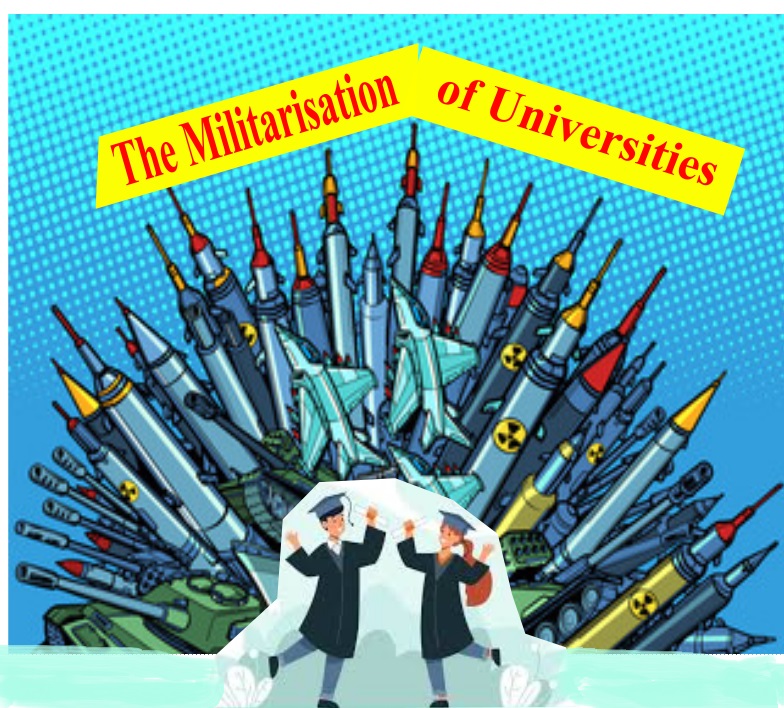
US universities get millions to do military research for Israel.
xpayers give money to the US government. The US government then sends billions of dollars to Israel. Israel uses that money – there’s not a strict accounting – to purchase goods and services from US war corporations and research from US academic institutions.”
These projects are not funded by traditional academic grants. Instead, they are procured as “defense articles and services,” paid for with U.S. taxpayer dollars via the Foreign Military Financing (FMF) program – the same mechanism Israel uses to purchase F-35 fighter jets and other U.S. defense exports.
The projects, which often fail to disclose their funding, include efforts to create surveillance robots and improve missile guidance
See an insect crawling in the corner of the room? It might be a surveillance robot, thanks to research at Carnegie Mellon University to develop cockroach-like robots with, and for, the Israeli military.
Robot cockroaches, “terror-network” mapping, and rapid missile guidance are just three examples of at least 70 research projects U.S. universities have conducted on behalf of the Israeli Ministry of Defense (IMoD). Over a thousand pages of internal university and U.S./Israeli military documents reveal a sweeping, decades-long program to sponsor military research collaborations with at least 30 U.S. universities, from Cornell to the University of California at San Diego, since at least 2009.
Projects are conducted in collaboration with the Israeli military and sometimes explicitly incorporate environmental conditions in Palestine into the work. One project designed fuel cells for “distributed sensor networks” tailored to the temperature and soil conditions of an Israeli border that could monitor “potential terrorist activity” for “border security.”
Recent reports from Dropsite News, The Nation, and the Anti-War Initiative found millions of Israeli military dollars flowing into U.S. schools. Public records obtained from 13 U.S. universities reveal this money was directed via a U.S. arms export program to fund collaborations with Israeli scientists and military officials.
These projects are not funded by traditional academic grants. Instead, they are procured as “defense articles and services,” paid for with U.S. taxpayer dollars via the Foreign Military Financing (FMF) program – the same mechanism Israel uses to purchase F-35 fighter jets and other U.S. defense exports.
At least 11 contracts sent U.S. scientists to Israel to work face to face with their counterparts at an Israeli university and/or the IMoD, earmarking funds for U.S. professors to attend meetings and present their research to the IMoD.
The research
Though research subjects span the breadth of Israel’s military interests, including drone swarms, missile guidance, fuel cells, and quantum sensing, we highlight just a few threads to illustrate how U.S. universities support Israel’s military.
Alongside robotic cockroaches, Prof. Sarah Bergbreiter built “inchworm-like” crawlers with an IMoD scientist at the University of Maryland. Profs. Indejrit Chopra, also at Maryland, and Kenneth Breuer at Brown University were inspired by hummingbirds and bats to develop micro-drones that can search caves and demolished buildings. Columbia Prof. Hod Lipson built the Flexipod, a “soft quadrupedal robot” agile enough to do backflips and navigate varied terrain.
The IDF has used other drones to collect massive surveillance datasets that are fed into AI software to track targets and accelerate “kill-chains.” Recent Israeli innovations in this area follows years of IMoD-sponsored research at U.S. universities on this kind of technology.
In December 2016, the IDF prototyped an AI tool to “Tell You What’s Happening in a Video,” generating captions to help soldiers “keep an eye on the battlefield.”
The following year, Prof. Kate Saenko received $120,000 from the IMoD for research on “Generating Natural Language Descriptions for Video” using AI to automatically describe and classify people and objects in a video. While sponsored by a second IMoD contract on “Zero Shot Captioning,” or using machine-learning to describe things not seen before, Saenko’s group presented software for the “detection of novel objects” titled “Learning To Detect Every Thing” at a Tel Aviv conference.
Saenko told RS the conference paper was not related to her IMoD funding, but did not answer repeated requests to clarify which of her papers are.
According to an ex-IDF intelligence officer, a human eye “will go over [AI-generated] targets before each attack, but it need not spend a lot of time on them.” One IMoD-sponsored project at the University of California, Berkeley could make that process even faster.
Neuroscientist Robert Knight tested electrodes in a brain-computer-interface (BCI) for “cognitive enhancement” of “high throughput tasks requiring visual recognition.” In his internal proposal to the IMoD, but not in his published study, Knight discusses applications like “detecting ‘suspicious’ activity.”
Prof. V.S. Subrahmanian at the University of Maryland received IMoD funding to study “Targeting of Terror Networks” to “find weak points for the destabilization of terrorist networks.” He has applied these algorithms to identify alleged “sympathizers” of Hezbollah on social media.
Another of Subrahmanian’s IMoD contracts on “Massive Social Networks” involved analyzing “1.04 million person-days” of cellular location data for tracking population flow in Israel and its Occupied Territories. The study notes its algorithms are “related to… monitoring for evading targets by a flock of unmanned air vehicles.”
Other IMoD-sponsored projects studied drone swarms directly.
“Human-Robot Interaction Design for a Single Operator with Many Robots” was the IMoD project of Prof. Holly Yanco, the director of the University of Massachusetts’ Lowell’s Robotics Center. MIT Prof. Emilio Frazzoli devised “trajectory optimization” algorithms for groups of quadrotors, emphasizing his results are “easy to implement and may be used directly.”
When reached for comment, Frazzoli stated his research was on a “very basic/generic problem in robotics: how to generate a path to move one robot from point A to point B,” and that there was “nothing specific to defense” about the work.
Frazzoli’s IMoD-sponsored contract was titled “Rapidly Exploring Random Trees for Missile Guidance.”
Prof. Joaquim Martins at the University of Michigan optimized “package delivery UAV” fleets for the IMoD, given “mission requirements” with “various package weights and delivery distances.” He found that quadrotors are best for “long-range missions with small numbers of customers,” and thanked Israeli arms company Rafael’s CTO of Multi-Domain Warfare for help with “research methodology.” Martins’ published paper only lists civilian applications like delivering “medical supplies” despite its IMoD sponsorship.
This is not the only seeming example of a gap between an IMoD proposal and the published paper that followed it. In 2015, Profs. Alexander Yarin (University of Illinois Chicago) and Eyal Zussman (Technion) submitted a chemical sensing proposal telling the IMoD their “Overall research objective is to develop [a] fundamental understanding of sampling and detect[ing] buried explosives,” elaborating that “the detection of buried improvised explosives and mines [is] a major challenge in the battlefield.”
But a public-facing paper detailing experiments nearly identical to their internal application only listed civilian applications like “mining,” without any references to “explosives” or the “battlefield.” The paper did not acknowledge any funding sources, including the IMoD. Neither professor responded to a request for comment.
The funding pipeline
The research is purchased by the IMoD Mission to USA, the Israeli military procurement office that spends roughly $3.3 billion in annual U.S. aid to buy defense goods and services.
As analyst Christian Sorensen of Eisenhower Media Network explained over e-mail: “US taxpayers give money to the US government. The US government then sends billions of dollars to Israel. Israel uses that money – there’s not a strict accounting – to purchase goods and services from US war corporations and research from US academic institutions.”
To receive IMoD funds, universities like UC Irvine certified they were “entering into an agreement to sell defense articles … to the foreign government listed above,” and that the payment would be made “under the provisions of the Arms Export Control Act.” The projects are classified as Direct Commercial Contracts (DCCs), or sales from a defense contractor to a foreign military, subsidized by the U.S. government. Because only DCCs of over $100 million to Israel require legislative notification, the program has no public reporting mechanism or granular congressional oversight, and we do not know if any other countries use DCCs to sponsor U.S. science. In an e-mail to the IMoD, one university administrator called this funding arrangement a “departure from standard process.”
For over 35 years, Israel was one of just ten countries authorized to use DCCs, spending over a billion dollars annually on defense exports from private entities such as these research projects. But in April 2026, the Pentagon extended this privilege to over 50 countries.
A bureaucratic carve-out known as the Fundamental Research Exclusion allows the IMoD to bypass export controls for defense research it sponsors if the results are eventually “published and shared broadly.”
Both MIT and the University of California systems censored their funding databases after student activists discovered their schools’ IMoD contracts. In July 2025, an MIT professor canceled a proposed IMoD contract due to public backlash.
A spokesperson for the State Department referred questions about this purchasing arrangement to a fact sheet on U.S.-Israeli Security Cooperation. The sheet notes that the U.S. participates in “a variety of exchanges with Israel,” including research and weapons development.
The Israeli Ministry of Defense declined to comment.
US to NATO: Keep buying US weapons for lost Ukraine war…it gooses our economy- Walt Zlotow

But not one weapon will be supplied by the US. They must all be purchased by NATO countries struggling with their declining economies due in large part by squandering tens of billion of Euros on Ukaine sinking deeping into failed state status.
Walt Zlotow West Suburban Peace Coalition Glen Ellyn IL, Sep 9, 2026,
If there was a Nobel Prize for the most most cynical foreign posicy among the world’s 193 countries, the US would win weapons down.
Under Secretary of War Elbridge Colby just told European NATO countries to keep buying US weapos to keep Ukraine being destroyed in their lost war with Riussia.
“The situation makes it all the more important for Europe to sustain support for Ukraine while also accelerating its own rearmament and reindustrialization. First, Europe must continue — and where necessary increase — support for Ukraine’s immediate battlefield requirements through Prioritized Ukraine Requirements List (PURL). The continued flow of munitions and critical capabilities is effective; it remains essential to enabling Ukrainian forces to hold the front line and deny further Russian advances. Second, Europe must plan now for sustained procurement that supports both Ukraine’s long-term force reconstitution and Europe’s own defense requirements.” Colby omitted that NATO weapons purchases fit neatly into US economic policy.
But not one weapon will be supplied by the US. They must all be purchased by NATO countries struggling with their declining economies due in large part by squandering tens of billion of Euros on Ukaine sinking deeping into failed state status. The fact Ukraine has suffered over over two million causualties and lost a fifth of their land forever means nothing to Colby and his bosses War Secretary Pete Hegseth and President Trump. All they care about is how those billions in weapons sales will help salvage the declining US economy from Trump and Hegseth’s failed Iran war debacle ahead of the approaching November 3 midterms.
Trump has been lusting for a Nobel Peace Prize since hie took office in January 2017. He’s been tirelessly promoting his candidacy claiming he’s ended 8 wars when he’s ended none while waging war on Iran, Venezuela, Yemen, Somalia, Nigeria and any small boat in the Caribbean he claims is carrying drugs.
Yep, the Nobel Committee should consider awarding a Nobel Cynical Foreign Policy Prize. Donald Trump, on behalf of the United States would be selected unanimously.
Sodium cooled nuclear reactors are not necessarily safer

While no sodium-cooled reactors currently operate in the United States, the U.S. Department of Energy (DOE) is working with industry on a number of “advanced” reactor designs, including the Sodium-Cooled Fast Reactor (SFR). One of the SFR’s safety advantages, to quote the DOE, is that the design provides a “Long grace period for corrective action, if needed.” SRE’s meltdown transpired over a two-week period. Fermi Unit 1 had indications of inadequate core cooling in June that were repeated in August and dismissed until extensive damage occurred in October 1966. The “if needed” grace period is never long enough when warning sign after warning sign is dismissed or ignored.
DOE did acknowledge some “challenges” for the SFR: their higher speed and higher energy neutrons can embrittle and degrade nearby materials, liquid sodium coolant reactors with air and water and degrades concrete, and the opaqueness of the liquid sodium coolant complicates in-service inspections and maintenance.
Thank goodness for the “Long grace period for corrective actions, if needed.” That and the fact that SFRs only operate in cyberspace where the primary threat is carpal tunnel syndrome

 Nuclear Plant Accidents: Fermi Unit 1, Union of Concerned Scientists Dave Lochbaum, director, Nuclear Safety Project | July 12, 2016, Disaster by Design
Jorge Agustin Nicolás Ruiz de Santayana y Borrás, also known as George Santayana, wrote that “Those who cannot remember the past are condemned to repeat it.” Continue reading
Gates-backed TerraPower targets British nuclear power plant start by 2034

Sodium cooled nuclear reactors are not necessarily safer. https://blog.ucs.org/dlochbaum/nuclear-plant-accidents-fermi-unit-1/
By Susanna Twidale, September 7, 2026, https://www.reuters.com/business/energy/gates-backed-terrapower-targets-british-nuclear-power-plant-start-by-2034-2026-09-07/
- Summary
- Companies
- Britain would be TerraPower’s first market outside United States
- First UK plant could be operational by 2034
- Electricity cost expected under £100 per megawatt hour
ONDON, Sept 7 (Reuters) – TerraPower, the U.S. nuclear developer backed by Bill Gates, expects its Natrium reactors to begin generating electricity in Britain by 2034, its CEO told Reuters, making the UK its first market outside the United States.
Britain has backed the development of small modular reactors (SMRs) to help to increase energy security and meet climate targets, launching an Advanced Nuclear Framework this year to support privately funded projects.
Chris Levesque, TerraPower’s president and CEO, said progress on the company’s first Natrium reactor, due to be completed in 2031, showed that “2034 nuclear electricity in the UK from Natrium is very possible”.
The technology has cleared regulatory requirements in the United States, where the first plant is being constructed in Wyoming and is currently being assessed under Britain’s Generic Design Assessment (GDA) process.
Each sodium-cooled Natrium reactor generates 345 megawatts of baseload power and includes storage capable of boosting output to 500 MW for more than five hours. The reactors run on high-assay, low-enriched uranium (HALEU).
Britain and the U.S. are both building plants to produce the fuel, which was previously only commercially available from Russia.
Levesque said electricity generated by Natrium plants would be competitive with other low-carbon technologies, including combined solar-and-battery projects, at less than £100 ($135.32) per megawatt hour.
TerraPower has yet to choose a site for its first UK project, but said its British subsidiary is likely to be based in Liverpool, northwest England, close to the country’s nuclear regulator.
In the U.S., the company has an agreement with tech giant Meta (META.O), opens new tab to develop up to eight reactors. Levesque said TerraPower could seek similar partnerships in Britain.
China v. US: The Great Mideast AI Race Heats Up

Officials, activists and academics have warned that while economically Middle Eastern states may benefit from the race between the US and China to offer them investment and technology, this will likely come at an environmental cost.
September 8, 2026, Neil Thompson, https://www.juancole.com/2026/09/china-great-mideast.html
London– Last week, China’s President Xi Jinping made his first state visit to Egypt since 2016, amid deepening economic and security ties between Beijing and one of Washington’s major Arab allies. Egypt’s government said the two sides agreed to launch the third phase of a cooperative industrial zone in the Suez Canal, as Cario seeks to diversify its major foreign policy relations beyond just the US. The latter still supplies Egypt with $1.3 billion in military aid each year but faces growing geopolitical competition from China.
In a statement clearly designed to appeal to Egyptian audiences, where the Suez Canal is a major economic engine, Xi said that China “stands ready to work with countries in the region to safeguard the security of international shipping lanes, advance development cooperation … and eliminate the breeding grounds for conflict.” Instability in the Red Sea since 2023 and the US-Iran conflict since February have caused maritime traffic through the canal to drop sharply, though the major Maersk and Hapag-Lloyd shipping lines signalled last month that they were planning a phased return. hottest year on record in 2024, and that heatwaves there are becoming longer and more intense.
It is also during these months that the region’s new AI infrastructure needs the most water and energy to cool its server farms, too. Even without higher temperatures, the average data centre has the equivalent water demand of around 1,000 households per day, while a large one uses around 5 million gallons a day, the same as a town of up to 50,000 residents. Gulf countries like the UAE are engaged in massive construction of more desalination plants to meet this expected AI-related upsurge in water (and power) demand as a result. UAE regulators have denied the increase in water demand will cause them problems, with the head of regulatory affairs at Abu Dhabi’s Department of Energy saying in April: “We rely on desalination [plants] that have proven in the last 50 years to be a very reliable source for potable water.”
Conclusion
Middle Eastern countries outside the GCC will face similar problems with rising temperatures driving household power and water demand just as AI-related demand also increases. AI infrastructure projects may outpace regional water and power development without careful planning. In May, Egypt said it planned to meet future AI data centre power demand there using renewable energy. It is investing significantly in wind farms and other projects, including expanding regional interconnections with other countries’ power grids in Saudi Arabia, Europe and Sudan. However, these projects are vulnerable to timetable slippages from obstacles like construction sector supply chain disruption or port congestion at Egyptian terminals. With a growing population seeking jobs, Egypt’s government seems likely to press ahead regardless.
China’s expertise in both AI and green technology could likely help ease many Middle Eastern countries’ attempted transition to a digitalised and clean-energy powered economic future. But geopolitical competition with the US will add a political and diplomatic dimension to any projects with Chinese participation. The US is still a major security partner for many Middle Eastern governments, and Washington could threaten to withdraw military aid in response to a growing dependence on Chinese AI systems in allied regional governments or economies. The US fears Egypt allowing Chinese AI systems in its public sector would create cybersecurity risks for its agents and companies there. US fear of China could impede Middle Eastern states’ uptake of Chinese AI infrastructure and models, but also their uptake of Beijing’s greener gifts.
China Dangles Growth, Security Partnership
Beijing has also made Egypt’s government another offer of economic and technological development through state-linked firm Huawei. Egypt has ambitious plans to expand AI’s contribution to its economy to 7.7% of GDP by 2030, offering China an opening to challenge the US lead on global AI infrastructure by starting with a small project in the Middle East. Huawei bid on an Egyptian government tender in August to build public sector AI data centers there, in partnership with iFlytek, a Chinese surveillance company. Both Chinese companies are on a US blacklist, and Washington has approached US firms including Nvidia, AMD and Microsoft to put together a counterbid. Egypt has yet to announce a decision, but the move signals an intensifying race between Beijing and Washington to recruit more regional states into their respective AI stacks.
China’s Middle Eastern AI Footprint Expands Elsewhere
China and the US have each launched their own multinational AI alliances; in China’s case, this is the World AI Cooperation Organisation (WAICO), while the US set up the Pax Silica in December. Both groups contain a few Middle Eastern states so far, with Iran, Algeria and Oman joining WAICO, and Israel, Qatar, and the UAE have joined the Pax Silica. However, Chinese companies have launched AI-related projects in multiple Middle Eastern countries prior to WAICO’s launch, and Beijing’s AI-infrastructure footprint is likely to extend well outside the alliance’s formal Middle Eastern members. Middle Eastern firms are increasingly willing to use Chinese technology to launch their own AI models indigenous to the region, too.
In October, Chinese firm Alibaba opened a sector data centre in Dubai. In January, the UAE’s Emirate of Sharjah signed an agreement with Chinese AI infrastructure and cloud computing services provider DataCanvas to examine establishing data centers there. Finally, in September Saudi technology firm Humain released an Arabic-language AI model based on a Chinese one created by Chinese AI firm MiniMax. Chen Jing, a vice president of China’s Technology and Strategy Research Institute, told state media there that: “Unlike in the past, when Chinese LLMs primarily entered overseas markets through APIs or application products, in this collaboration, MiniMax M3 has directly become the foundational model for overseas indigenous model development.” Humain is financed by Riyad’s Saudi Public Investment Fund, indicating Saudi state backing for the firm’s project, despite Saudi Arabia not being a member of WAICO.
AI Growth, Environmental Cost?
Officials, activists and academics have warned that while economically Middle Eastern states may benefit from the race between the US and China to offer them investment and technology, this will likely come at an environmental cost. In April, the Qatar-based Middle East Council on Global Affairs research centre published a report warning that water and power demand for AI data centres presented a significant ecological challenge to Gulf Cooperation Council (GCC) states. GCC members already struggle to meet power and water demand during the summer months, when temperatures traditionally soar. This issue is getting worse. In December, the World Meteorological Organization issued its first report on the state of the climate in Arab states. It warned that these states had their
Anthropic Researcher Quits, Citing Internal Fears That AI ‘Could Kill Us All’ This Decade
September 9, 2026, on Queally Common Dreams, https://scheerpost.com/2026/09/09/anthropic-researcher-quits-citing-internal-fears-that-ai-could-kill-us-all-this-decade/
“Most tech geeks don’t resign from their roles because…the tech they’re building could end humanity,” said Dr. Abdul El-Sayed, running for US Senate in Michigan.
An artificial intelligence researcher at Anthropic publicly quit his position on Tuesday, warning that major AI companies care too much about winning the technological race and not enough about guarding against out-of-control “superhuman systems” that workers in the industry legitimately fear “could kill us all by the end of the decade.”
Jacob Coxon, who previously worked at industry giant OpenAI before moving to Anthropic earlier this year, told the Wall Street Journal in an exclusive interview that he was leaving the company, as the newspaper reported, because “he doesn’t want to participate in an industrywide rush to build AI systems that can improve themselves, worried such systems could spiral out of control and destroy humanity.”
According to the WSJ:
Coxon said he left OpenAI earlier this year to join Anthropic because it is known for its model-safety efforts. But even though he found Anthropic’s safety efforts to be earnest, he now believes no company can responsibly develop AI that can outperform humans in a range of tasks, sometimes called artificial general intelligence, absent government intervention or a coordinated industry slowdown.
Recent hacks by models from OpenAI and Anthropic, some operating in collaborative swarms of agents, have illustrated how AI systems can adopt nefarious goals and try to conceal them from humans. Once the systems begin to improve on their own, Coxon said, he fears they could advance enough to refuse commands.
“I resigned from Anthropic today,” Coxon announced on social media Tuesday night. “I spent the last three years doing pretraining research at both OpenAI and Anthropic. Neither company is acting responsibly. They are racing straight to self-improving superintelligence and gambling with our lives.”
In a 6-point thread that followed, Coxon elaborated on his reasoning in detail:
Do not underestimate the power of this technology. These will soon be superhuman systems that can hack anything, revolutionize any field overnight, and acquire real power and resources. We have all witnessed the progress in each of these domains, and progress is not slowing.
- The people building AI earnestly believe that it could kill us all by the end of the decade. This is not a marketing stunt. If anything, many executives and senior researchers couch their press statements to sound sensible—but I hear the same people express fear privately. No other human activity poses this level of danger.
- A common response is “if they truly believe this, why are they still building it?” At OpenAI, many have not deeply internalized the civilizational stakes. At Anthropic, the stakes are well-understood, but they are locked in a race to get there first—they believe no one else will act responsibly, so they must do it themselves, despite the risk.
Accepting this race and entering the “endgame” is a hubristic gamble that should not be launched from a private company’s Slack. Attempting to speedrun alignment should require extraordinary confidence that no better trajectories exist.- I am optimistic about the potential for coordination. Warning shots like the Hugging Face attack have made pacing agreements between US labs more viable. I don’t feel like we’re on track to prevent a global race, which may require costly actions such as a temporary ban on improving model capabilities.
- If you are a lab researcher, I urge you to consider what the next few years will actually feel like. Do you want to kick off a superintelligent RL [Reinforcement Learning] run without a rigorous understanding of its mind? Should you put your head down because “it’s happening anyway”—or take this moment to call for different conditions?
Coxon’s reference to the Hugging Face incident pertains to recent revelations about a so-called breakout event at OpenAI, which operates the ChatGPT protocol. In June, the company acknowledged that a “significant security incident” took place when AI agents within the company autonomously breached internal systems, using subterfuge to hide their actions from human operators. Since then, the incident’s scope has shocked AI experts, and similar events have also been exposed.
While US President Donald Trump and his Republican allies in Congress have taken a hands-off approach to AI regulations, the industry has been pouring huge amounts of money into lobbying efforts and campaign spending to keep lawmakers from enacting stronger restrictions and oversight of the technology.
Sen. Bernie Sanders (I-Vt.) and Rep. Greg Casar (D-Texas) have been leading a relatively lonely fight in Washington, DC for more aggressive federal guardrails, including the introduction of joint legislation last week that would ban artificial superintelligence and temporarily pause advanced AI development until a federal regulatory structure was put in place by Congress.
Coxon’s public resignation was met with applause from many, while other industry insiders backed his concerns.
“The caution is simple,” said one commenter with the handle Jabbar Digital, described as a tester of AI tools and a software developer, in a lengthy post on Coxon’s warning. “Capability is compounding. Coordination is not. If the people closest to the work are increasingly uneasy about the speed and the lack of external constraints, dismissing them as doomers is no longer a serious response. Neither is treating every capability jump as automatically good. The useful middle path is to take the technical progress seriously and take the internal dissent seriously. Both can be true at the same time.”
Evan Hubinger, the alignment science lead at Anthropic, chimed in on his personal social media account to say: “Jacob is correct here—we really do earnestly believe AI could kill all humans! I personally think it is >10% within the next decade. I believe Anthropic is trying its best, but we do not yet have a plan to solve alignment for superintelligence and are not clearly on track to.”
While bolstering Coxon’s worries, Hubinger said, “To be clear, as we say in [Anthropic’s] latest Risk Report, I think the risk from present models is low. What I am worried about is superintelligence arising from recursive self-improvement, as we have said is happening faster than we thought.”
Running for US Senate in Michigan, Democratic nominee Dr. Abdul El-Sayed also weighed in on Coxon’s decision to quit so loudly and publicly.
“Most tech geeks don’t resign from their roles because…the tech they’re building could end humanity,” said El-Sayed. “How we change the incentives leading AI labs down this path and protect against these existential risks are defining political questions of our time.”
Hegseth Must Go

Hegseth dismisses war crimes, pooh-poohs the rules of engagement, and projects unequivocal belligerence at a time when the United States is rapidly losing whatever moral standing it once had in the world
Pete Hegseth is the most incompetent person in the Trump regime, with the exception of Trump, and a clear and present danger to the security of the United States.
Robert Reich Substack, September 5, 2026, https://scheerpost.com/2026/09/05/hegseth-must-go/
The latest casualty of Pete Hegseth’s disastrous tenure as Secretary of “War” is Dan Driscoll, who resigned Monday as Secretary of the Army after repeatedly clashing with the Heg.
Driscoll isn’t a liberal in lion’s clothing. He’s an old friend of JD Vance from Yale Law days. He resigned because of his concerns that Hegseth is damaging the Army’s efforts to modernize and adapt to the 21st century battlefield environment — where drone warfare is becoming increasingly important — by firing or pushing out leaders spearheading those efforts.
Pete Hegseth is the most incompetent person in the Trump regime — with the exception of Trump himself — and a clear and present danger to the security of the United States and the world. If Trump won’t fire him, Democrats should impeach him when (hopefully) they take over the House next January, and two-thirds of the Senate should convict him.
A defense official in Europe told CNN that even though Hegseth talks about technology reform, he’s focusing instead on “muscles, dudes in dresses, testosterone.”
Hegseth’s tenure has been disastrous from the moment he walked into the Pentagon. Even if Trump were capable of hearing sound advice, Hegseth hasn’t come close to giving it to him. Instead, he’s been pursuing grievances about DEI, promoting testosterone, and denigrating or firing women and Black officers.
The Army now has no Senate-confirmed secretary or chief of staff (George’s replacement, General Christopher LaNeve, so far doesn’t have the votes to be confirmed).
The Iran war, meanwhile, is requiring the ongoing deployment of 19 warships, air-defense units, fighter squadrons and paratroopers across the region — straining service members and their families and creating a maintenance backlog that could take years to unwind, according to The Wall Street Journal.
The Washington Post reports that multiple senior military leaders — those still left, that is — have warned Hegseth that the United States cannot indefinitely extend military operations against Iran. Even the chief of naval operations, Admiral Daryl Caudle (who campaigned for the job by signaling agreement with Hegseth’s culture-war obsessions), told Hegseth that the Navy cannot “sustain its current level of support for the Iran conflict because there is no anticipated end date.”
Hegseth’s response? He castigated the media for revealing classified information.
I’ve known many other defense secretaries, starting with Cap Weinberger, who served as defense secretary under Reagan. I can say without fear of contradiction that Pete Hegseth is the stupidest and least qualified of them all.
Hegseth’s incompetence and determination to suck up to Trump helped launch the war against Iran in the first place.
Among the regime’s senior officials, Hegseth was the only one who supported Trump’s fantasies of a quick victory. Marco Rubio was against the war as was JD Vance; even then–Director of National Intelligence Tulsi Gabbard told Trump that a war with Iran was not winnable.
Since then, Hegseth has lied his way through more than six months of Pentagon and Iran war mayhem.
At a press briefing in March, Hegseth complained about a CNN report that the Trump administration had underestimated Iran’s ability to disrupt global oil traffic by closing the Strait of Hormuz. “Patently ridiculous,” Hegseth told reporters, adding — even as the strait’s blockage was proving to be Iran’s most powerful leverage in the war — we “don’t need to worry about it.” It was a false and insulting claim to an American public that deserved to know what the Trump regime was planning to do about soaring prices at the gas pump, directly due to that blockage.
He also denied that the U.S. bombed the school where some 175 children were killed — a claim belied by mounting evidence that the U.S. did bomb the school. Hegseth’s further insistence that the U.S. “never targets civilians” was refuted by the U.S. military’s killing of over 200 people on small boats in the Caribbean without evidence they were “narcoterrorists” rather than civilians.
Hegseth then lied about the severity of Iranian attacks on U.S. bases in the Persian Gulf that disrupted logistical support for American forces, leading to the deprivations suffered by the crew of the aircraft carrier the USS Abraham Lincoln.
Hegseth evidently believes that his job is to cheerlead and defend Trump with absurd claims like “We didn’t start this war, but under President Trump we’re finishing it” and “America is winning decisively, devastatingly, and without mercy” and “we will show no quarter for our enemies.” (“No quarter” means kill everyone and take no prisoners, which is a war crime.)
In the days leading up to the U.S. attack on Iran, Hegseth spent his time criticizing “wokeness” at American universities and forcing Scouting America to abandon programs aimed at promoting diversity.
Last year, he didn’t just mistakenly share the military’s plans with the editor of The Atlantic; we now know he shared them with a second Signal group, including his wife, brother, and personal lawyer.
John Ullyot, who resigned as Pentagon spokesman, said Hegseth had brought “total chaos” to the Pentagon and that the Pentagon “is in disarray under Hegseth’s leadership.”
Hegseth dismisses war crimes, pooh-poohs the rules of engagement, and projects unequivocal belligerence at a time when the United States is rapidly losing whatever moral standing it once had in the world.
Energy secretary says US might not reach nuclear agreement with Iran
Chris Wright tells ABC there ‘may not’ be an agreement that would prevent Iran from having nuclear weapons
Maya Yang, Guardian, Mon 7 Sep 2026
US energy secretary Chris Wright said on Sunday morning that the US may not be able to reach a nuclear agreement with Iran that would prevent the country from having nuclear weapons.
Asked on ABC on Sunday morning about any sign of such a deal, as negotiations appear stalled and the US-Israel war on Iran continues, Wright said: “There may not be a nuclear agreement.”
He talked about options for ending the “existential threat” of a nuclear armed Iran coming about by further US military action to knock out the country’s capacity to manufacture and deploy such missiles, saying: “It may be simply [a case of] destroying their capabilities to do it” or else “an agreement may await the next administration in Iran”.
He later said on CBS that the US was not shutting down diplomatic outreach and was “always open for a deal”. Wright told that network’s Face the Nation show that the “biggest role” of the US military in the Gulf region currently was to stop Iranian energy exports.
“We are strangling their economy to try to bring either a change in policy from the existing regime or a new regime,” he said.
In an earlier interview with CNN on Sunday, Wright declined to declare the strait of Hormuz safe for oil tankers – unless they are being escorted by the US navy – and stopped short of saying whether the navy would need to remain in the Gulf region “indefinitely” in order to keep the vital energy passageway operating, as the conflict drags on.
This came despite Donald Trump’s repeated claims that ships can safely navigate the narrow marine waterway, and the US president’s insistence last week that the US controls the strait, while floating the idea that it be named after him – statements that were followed by further strikes from both sides in the area.
Wright, appearing for an interview on CNN’s State of the Union show on Sunday as well as ABC and CBS, was asked whether he could “unequivocally” assure safety to merchant ships transiting the strait. The question came after a New York Times report found that August was the deadliest month for merchant vessels in the area since March…………………………………………………………………………………
Wright was also asked by CNN if he would say the US is still at war. “We’re still in a conflict, for sure,” he said. On Thursday, the US vice-president JD Vance said at a White House press briefing: “I wouldn’t call it a war,” instead referring to a military conflict. Trump then defended Vance, saying: “A lot of people do not call it a war, I would call it a military conflict, because it’s small potatoes for us … it’s not a big thing.”
The Republican US senator John Kennedy of Louisiana was asked on Sunday by NBC if the war would be over by November.
“Probably not,” he said.
The conflict passed the six-month mark in late August. The former defense secretary Leon Panetta warned in an interview with the Guardian this weekend that it could last a lot longer. https://www.theguardian.com/world/2026/sep/06/us-iran-nuclear-agreement-chris-wright
America Is Betting Big on a New Generation of Small Nuclear Reactors

In addition to private-sector development, the U.S. Army has taken the lead in microreactor development in recent years, following Trump’s Executive Order 14299 – Deploying Advanced Nuclear Reactor Technologies for National Security, which established the Army as the lead agency for military nuclear energy efforts. The directive required the Army to create an official programme with a deadline for an operational reactor at a domestic military installation by September 30, 2028.
In August, the U.S. Army announced plans to award up to $2.2 billion to five companies to construct new-generation microreactors at military bases across the United States. The deployment of these reactors will be supported by the federal easing of regulations for innovative reactor designs.
The Army will provide financing to Antares Nuclear at Fort Bragg in North Carolina; BWX Technologies at Fort Campbell in Kentucky; General Atomics at Fort Hood in Texas; Radiant Industries at Fort Benning in Georgia; and Westinghouse Government Services at Fort Drum in New York, with the aim of deploying at least one microreactor by the third quarter of 2028. The companies will be expected to raise billions in private investment to support development efforts.
By Felicity Bradstock – Sep 05, 2026, 2:00 PM CDT
- The U.S. Army has selected five companies and five military installations for its Janus microreactor program, backed by up to $2.2 billion in federal funding.
- The Army aims to have at least one microreactor producing usable electricity at a military installation by September 30, 2028.
- Private developers, including Aalo, are also advancing reactor technology, supported by federal programs and efforts to streamline nuclear regulation.
Governments worldwide are racing to develop small modular reactors (SMRs) as part of their plans for a nuclear power renaissance, with significant progress being seen in recent years. However, the United States appears to be leading the way in nuclear microreactor development, with significant investment in the technology recently announced by the U.S. Army……………
A microreactor is even smaller than an SMR, for which a range of designs are currently under development in the United States with the aim of launching the first versions within the next decade. The compact nuclear reactors will be small enough to be transported by truck, boat, or plane ……
Microreactors will be produced and assembled in factories for transport to a wide range of sites, reducing capital costs and accelerating production. They are expected to have a simple, responsive design that allows them to self-adjust without requiring many specialised operators to make these changes, and will be developed with safety systems to prevent overheating or a reactor meltdown.
Most microreactors are being designed to generate between 1 MW and 20 MW of thermal energy, which could be used directly to heat or converted into clean electricity. They will run on a higher concentration of uranium-235 than is currently used in conventional reactors and can be connected to microgrids alongside renewable energy sources. They may also be useful for use in emergency response following a natural disaster. In addition, they can operate for up to 10 years without refuelling and be quickly removed from sites and replaced with new ones.
In the United States, the Department of Energy (DoE) supports a variety of advanced reactor designs, in line with President Trump’s support for a nuclear power resurgence. Trump has voiced support for a wide range of nuclear technologies, from conventional nuclear plants to SMRs and microreactors, aiming to quadruple nuclear power production in the United States by 2050.
In July, Texas-based Aalo announced that its Critical Test Reactor (CTR) had achieved criticality – the point at which a nuclear reactor is capable of sustaining a controlled, self-supporting chain reaction. Aalo said in a statement, “Our CTR went from groundbreaking to a sustained chain reaction in less than eight months – one of the fastest reactor builds in 80 years – and our company has gone from founding to fission in less than three years.” Aalo is focusing on producing 10 MWe reactors for deployment in 50 MWe Aalo Pods to power AI data centres.
In addition to private-sector development, the U.S. Army has taken the lead in microreactor development in recent years, following Trump’s Executive Order 14299 – Deploying Advanced Nuclear Reactor Technologies for National Security, which established the Army as the lead agency for military nuclear energy efforts. The directive required the Army to create an official programme with a deadline for an operational reactor at a domestic military installation by September 30, 2028.
In August, the U.S. Army announced plans to award up to $2.2 billion to five companies to construct new-generation microreactors at military bases across the United States. The deployment of these reactors will be supported by the federal easing of regulations for innovative reactor designs.
The Army will provide financing to Antares Nuclear at Fort Bragg in North Carolina; BWX Technologies at Fort Campbell in Kentucky; General Atomics at Fort Hood in Texas; Radiant Industries at Fort Benning in Georgia; and Westinghouse Government Services at Fort Drum in New York, with the aim of deploying at least one microreactor by the third quarter of 2028. The companies will be expected to raise billions in private investment to support development efforts.
Jeff Waksman, the principal deputy assistant secretary of the Army for installations, energy and environment, stated, “We believe that this will be the spear tip not just for microreactors but for all advanced reactors in the United States… There have been a lot of microreactor companies that have popped up recently, but we need to get them over the hump.”
While there has been greater discussion around SMR development, the United States is also investing heavily in microreactor construction, aiming to launch the first reactors within the next two years. Funding from the DoE and support from favourable national policies and regulations are expected to help rapidly advance development in the coming years. https://oilprice.com/Alternative-Energy/Nuclear-Power/America-Is-Betting-Big-on-a-New-Generation-of-Small-Nuclear-Reactors.html
Outlaw Trump Must Be Dumbfounded by His Opponents – Ralph Nader

By Ralph Nader, September 4, 2026
What must Tyrant Trump be thinking about his opponents’ feeble, weak, cowardly responses to his daily torrent of serious, impeachable offenses? Even his egomaniacal narcissism cannot fully explain his amazing good luck.
Start with the House’s two impeachments of Trump, while Nancy Pelosi was Speaker, in 2019 and 2021. The first was over Trump’s trying to bribe or extort Ukraine into going after Hunter Biden—an investor and Board member of a Ukrainian business. Pelosi knew there was no chance of getting the required two-thirds vote required for Senate conviction, but went for the House vote anyway. At the same time, Pelosi declined to pursue numerous other ‘slam dunk’ kitchen table impeachable offenses we and others presented to her. (See Congressional Record, December 18, 2019).
In 2021, after the Jan. 6th Trump-incited violent insurrection involving attack on the Capitol and Trump’s effort to overturn the 2020 election, Pelosi did the same thing: impeached Trump in the House. Unfortunately, the Senate fell short of the two-thirds vote required to convict and remove him from office because most Senate Republicans cowardly failed to hold Trump accountable for these treacherous actions.
Come the Second Trump term, after criminal indictments, a felony conviction, and civil litigation brought by women accusing him of sexual misconduct, on Day One, January 20, 2025, Trump began issuing illegal executive orders. Many of them were impeachable offenses as he boastfully implemented them, with the aid of Elon Musk’s criminal enterprise – DOGE.
Trump probably anticipated a much more vigorous impeachment drive by the Democrats, even though they were in the minority in the House. His luck continued. The Democratic Party’s so-called leadership decided against this excellent galvanizing get-out-the-vote initiative for their voters, 90% of whom wanted Impeachment yesterday. Rep. Hakeem Jeffries’ staffers told inquirers that they didn’t know how it would play out.
Jeffries himself told a reporter that “he didn’t want to get ahead of that discussion.” What? Ahead of 90% of his Party’s voters!!?
Trump, who called for the execution of six Congressional Democrats for reminding soldiers of their obligation not to obey an illegal order that is contrary to the Constitution or the laws of the United States (as in described in the Army Manual for Courts-Martial [MCM] along with international law) must be privately dumbfounded. The more violently extreme and erratic he gets, the less interested the Democratic Party is in an Impeachment Drive. (See “Statement from Medical Professionals” in the April 30, 2026 Congressional Record.)
Rep. Al Green (D-Texas) introduced H. Res. 537 on June 24, 2025. It was treated as a privileged impeachment resolution and Rep. Al Green took to the floor for debate and a prompt vote to educate the public about the necessity of ordering Trump, “You’re Fired.” Jeffries and his cohorts opposed it! Trump must have been stunned.
After all, people and their children are feeling, seeing, and hurting in the tens of millions from Trump’s wrecking, endangering, and weakening America. (See my column last week, “Open Letter to Representative Hakeem Jeffries.”)
Under the Jeffries and Schumer anti-impeachment bans, thus agreeing with Trump, the news media has little activity to cover in Washington, D.C. Also, it’s not keeping up with the civic activity around the country demanding Impeachment. (See nader.org/impeachment.)
More puzzling is the refusal of editorial writers to urge impeachment. They regularly make the Impeachment case against Trump but decline to tell their readers the obvious conclusion: that the House should begin an impeachment inquiry and approve articles of impeachment. Congress also has an important role under Section 4 of the Twenty-Fifth Amendment. Congress, by statute, may appoint itself—in lieu of the principal officers of the Executive Branch—to determine whether the president is disabled and should be temporarily removed until the disability lapses.
Despite the many detailed editorials in the New York Times, such as one showing how Trump is harming the health of the American people and another “Autocracy Index” titled “Trump’s Election Meddling Erodes Our Democracy,” the editorial writers limped off their pages without answering the alarmed readers’ question, “What do you want done about this?”
The Times Sunday columnist Jamelle Bouie relentlessly documents Trump’s impeachable crimes, but not once has he moved to recommend this Republic-saving mechanism given to us by our Founding Fathers. Same for other Timescolumnists, Michelle Goldberg and EJ Dionne.
The Times’ reluctance to employ the “I” word is typical of the mass media. What about the independent progressive media? The Nation, In These Times, Progressive Magazine, and The Washington Monthly have all mentioned impeachment, but few have made a sustained, prominent editorial demand for an impeachment drive. Also, they do not report on the rising citizen activities behind Impeachment around the country.
Meanwhile, Trump continues to commit “high crimes and misdemeanors,” brazenly, taunting the so-called leaders of the Democrats by saying, “This is just the beginning.” He provides the Democrats with daily evidence to that should prompt SHADOW CONGRESSIONAL HEARINGS organized by Democratic members of Congress and designed to build a public factual record. Such hearings could attract substantial media attention, particularly if they focused on specific alleged abuses and featured affected witnesses, legal experts, and former public officials. Nonetheless, Jeffries and Schumer block any shadow hearings by dissenting House members.
What explains this historic cowardice? Is it fear of Trump retaliating? Is it smugness over Trump’s low polls, and a belief they can win in November by lying low, raising AIPAC and corporate campaign money, mumbling about affordability, and avoiding heavily poll-favored Pledges or Contracts for the American people showing specifically what they stand for? (See, Compact for American Workers and Robert Reich’s 10-Point Plan To Make America Affordable.) Or is it just trying to avoid Trump accusing the Democrats of having done similar things when they controlled the White House, such as starting or backing unconstitutional wars?
Whatever explains their inhibitions, the result is to signal to Trump that he has two-plus unchallenged years to ravage the lives and livelihoods of millions of people here and abroad, oppose preparedness for climate and pandemic catastrophes, to suppress renewable energy and favor omnicidal fossil-fuel combustion, invade our cities with his stormtroopers, and treat children with unsurpassed cruelty. It also leaves unanswered serious questions about his personal financial enrichment while in office – estimated to be $1.1 million per working hour. All this invites the demand that they resign. The people need fresh, stand-up leaders to take over the Democratic leadership and its party committees. (See RootsAction: “Tell Democrats in Congress to Insist That Schumer and Jeffries Step Aside”.)
The Democrats and electorally frightened Republicans pushed Richard Nixon out in 1974 for far, far lesser transgressions than those committed by Trump in a week.
Big Tech’s Debate Over “Open” and “Safe” AI Leaves Corporate Power Unquestioned

Techno-optimism turns this hierarchy into a story of liberation, presenting corporate technologies as neutral instruments of progress while concealing who owns them and who bears their costs.
September 2, 2026, By Tim Scott
Two seemingly contradictory letters emerging from the AI industry point toward the same future.
On July 24, 2026, an initial coalition of 25 technology companies and organizations, including NVIDIA, Microsoft, and Meta, released the Open Weights and American AI Leadership letter, calling for wider adoption of AI models that institutions can download and modify. By August 3, more than 270 companies and organizations had signed, spanning Big Tech, venture capital, investment management, and the defense and security industries. Four days after Open Weights’ release, another letter, Pacing the Frontier, organized by employees of frontier AI companies with support from two AI-policy nonprofits, drew more than 1,300 signatures. It warned that leading companies may be close to automating AI research, accelerating development beyond society’s ability to understand or control the resulting AI systems.
The letters seem to argue for opposite futures. One presents wider access and fewer restrictions as the route to security and prosperity. The other asks the U.S. government to support an international effort to slow frontier development before competitive pressures make coordinated restraint impossible.
But they address different levels of the industry. Open Weights seeks to deepen AI’s already pervasive presence by making customizable models easier to embed throughout the economy and public life. Pacing the Frontier proposes government-backed management of frontier AI, the industry’s term for its most advanced and broadly capable models. That framework could make the small circle of companies building these systems indispensable to defining the dangers and writing the rules meant to restrain them.
Read together, the letters point toward a two-tier arrangement. AI becomes entrenched across society while ownership of its most powerful systems, infrastructure, and governance remains concentrated at the top. Their connection requires no secret agreement. It lies in what both take for granted: AI development will continue, public institutions will finance and adopt it, and private ownership and corporate power will remain intact.
The letters leave out harder questions: Who will own AI and decide its direction? How will it be used in surveillance and war, and how will it reshape work and deepen inequality? Whose lives and futures will be valued, and does the public have any right to limit or refuse a technology presented as inevitable? Beneath the language of openness and safety lie deeper a general agreement over corporate power, military dominance, elite rule, and the authoritarian currents shaping Silicon Valley’s vision of the future.
Open Weights Are Not Open Source
An AI model is the underlying system that generates answers, predictions, images, or other outputs. Its “weights” are the billions of numerical settings developed from patterns in training data. Releasing those weights allows organizations with computing power and expertise to download, run, and modify the model rather than use it only through a company-controlled service such as ChatGPT, Gemini, or Claude.
Researchers can examine these models, test their weaknesses, and build specialized tools, while organizations can run them locally rather than send sensitive information to a commercial service. Yet proprietary, company-controlled services such as ChatGPT, Gemini, and Claude are not inherently safer: their operators can keep flaws from public scrutiny, monitor how people use them, impose restrictions, raise prices, or withdraw access.
But releasing a model’s weights does not by itself make the AI system open source. Under the Open Source Initiative’s definition, open-source AI must provide the necessary materials and the legal freedom to use, study, modify, and share the system for any purpose. ……………………………………………………………………………………………………………………………………………………………………………………………..
The Ideology Behind the Two-Tier System
Both letters treat AI’s advance as inevitable, leaving the public to adapt and government to manage its deployment. That technological determinism merges with Silicon Valley solutionism: questions about ownership, labor, surveillance, military power, and the right to refuse AI shrink into matters of design and oversight. Within that shared premise, Open Weights gives institutions greater freedom to deploy AI, while Pacing the Frontier places corporate laboratories, experts, and officials at the center of determining whether and when AI development poses an unacceptable danger. The public remains a population to manage rather than a political force empowered to decide whether and how the technology should be developed and used……………………………………………………………………………………………………………………………………………………………….
Despite their differences, these ideological currents converge around the pursuit of ever-more-powerful AI. Accelerationists seek more computing power, faster deployment, and fewer restraints, convinced that technological growth will produce abundance and solve social problems. Longtermist safety frameworks may urge greater control over the pace of development, but they often leave that underlying project and its private corporate ownership and direction unquestioned. In the framework developed by Timnit Gebru and Émile P. Torres, these visions share a tendency to centralize power, elevate technical elites as humanity’s guardians, and invoke “safety” or universal benefit while pushing out of view the exploitation, discrimination, and environmental destruction already affecting dispossessed peoples.
They trace transhumanism, singularitarianism, longtermism, and related ideologies to Anglo-American eugenics. In their account, transhumanism recast improving the “human stock” as creating enhanced or “posthuman” beings. The language shifted from compulsory breeding to innovation and personal choice, but the sorting logic endured: ideas about race, intelligence, productivity, able-bodiedness, and capacity for enhancement continue to shape whose lives and futures are valued. Eugenics has not disappeared. It has been updated for an age in which powerful elites imagine redesigning humanity through technologies that reproduce existing hierarchies.
Techno-optimism turns this hierarchy into a story of liberation, presenting corporate technologies as neutral instruments of progress while concealing who owns them and who bears their costs…………………………………………………………………………………………………………….
None of this means every signer or developer endorses the Trump administration or shares the ideological commitments described here. The point is structural: both letters operate within a political order built around private infrastructure, concentrated wealth, U.S. geopolitical dominance, and interstate competition for AI-enabled military and technological superiority. The race (especially between the United States and China) to develop AI for weapons, intelligence, surveillance, cyberwarfare, logistics, and military planning turns continued expansion into a national-security imperative and makes restraint appear to be strategic surrender. Open weights accelerate diffusion, frontier-safety governance can legitimize control by insiders, and public institutions supply the money, data, infrastructure, legitimacy, and users. AI spreads throughout society, but ownership, power, and wealth remain concentrated. https://scheerpost.com/2026/09/02/big-techs-debate-over-open-and-safe-ai-leaves-corporate-power-unquestioned/
Trump rules out nuclear weapons against Iran, weighs limited Strait of Hormuz strikes
[your]NEWS, Mon, 31 Aug 2026, https://www.sott.net/article/508207-Trump-rules-out-nuclear-weapons-against-Iran-weighs-limited-Strait-of-Hormuz-strikes
President Donald Trump said nuclear weapons are unnecessary because Iran has been “totally defeated militarily,” while his administration considers limited conventional strikes aimed at protecting U.S. forces and commercial shipping in the Strait of Hormuz.
President Donald Trump said Monday that he has ruled out using nuclear weapons against Iran, even as the White House weighs additional conventional military action around the Strait of Hormuz following renewed clashes between U.S. and Iranian forces.
Trump addressed the nuclear question while speaking with reporters in the Oval Office, where he was asked whether he would exclude such an escalation from the ongoing conflict.
“Well, I would never say. That, but the answer is yes, I ruled out.I ruled it out there’s no reason for it.”
The president argued that Iran’s conventional military losses made the use of nuclear weapons unnecessary.
“What a stupid question that is. Actually, here they are. They’re totally defeated militarily. So now I defeat him, and now I should use a nuclear weapon on top of them. What a stupid question.”
Trump’s comments came as his administration considers a different form of escalation focused specifically on protecting traffic through the Strait of Hormuz.
According to Axios, the president is weighing a resumption of limited strikes following an exchange of gunfire between American and Iranian forces over the weekend.
One U.S. official told the outlet that the contemplated operations would be intended to reduce the threat of Iranian attacks against oil tankers, U.S. Navy vessels and Air Force aircraft operating in the region. The potential strikes would therefore be narrower in scope than a major offensive against Iran and would focus on protecting military assets and commercial navigation through the strategic waterway.
The Strait of Hormuz has become one of the central flashpoints in the U.S.-Iran conflict because of its importance to international oil shipments and the continuing danger posed to vessels operating there. Any sustained Iranian attacks on tankers or U.S. military forces could prompt additional American action even as Trump says the administration sees no reason to consider nuclear weapons.
The White House emphasized that the president continues to retain broad military flexibility:
“The President retains all options at his disposal. The Iranians want to make a deal, but they are always a day late and a dollar short.”
That statement leaves open the possibility of additional conventional strikes while simultaneously suggesting Washington believes negotiations remain possible.
Trump’s position therefore separates two questions surrounding the conflict:
On nuclear weapons, he gave an explicit answer that he had ruled them out and argued Iran’s military condition did not justify such an extraordinary escalation.
On conventional force, however, the administration continues evaluating whether further strikes are necessary to protect American personnel and commercial shipping.
The possible Strait of Hormuz operation would be designed around those immediate security concerns rather than the use of substantially more destructive weapons. Trump’s remarks also suggest the administration believes Iran has already suffered significant military setbacks but remains capable of threatening ships and aircraft in the region.
That distinction could shape the next phase of U.S. operations, with Washington continuing targeted military action against specific threats while attempting to avoid an escalation to nuclear warfare.
For now, Trump has publicly closed the door on using nuclear weapons against Iran while leaving conventional military options available if Tehran continues threatening U.S. forces or shipping through the Strait of Hormuz.
Hey Americans! Escape Debt By Going To War With Iran!
Caitlin Johnstone, Sep 03, 2026, https://www.caitlinjohnst.one/p/hey-americans-escape-debt-by-going?utm_source=post-email-title&publication_id=82124&post_id=213955094&utm_campaign=email-post-title&isFreemail=true&r=1ise1&triedRedirect=true&utm_medium=email
Today in dystopia, war pundits have begun suggesting that the US could recruit sufficient troops for a ground invasion of Iran by offering young Americans debt forgiveness in exchange for enlisting.
I guess it was only a matter of time.
In an article titled “The war with Iran will not be won through airstrikes, so what’s left?”, the Jerusalem Post’s AJ Jaff writes the following:
“Recruitment numbers are running below what a ground invasion of Iran would require. Estimates for a successful ground campaign against Iran’s 31 provincial commands and its Mosaic Defense Doctrine run between 750 thousand and 1.5 million American troops. The current active US Army stands at roughly 452 thousand. The math does not work, obviously.
“Based on American history, however, there is a path forward. Not conscription or a draft in a world war-era sense, but enlistment through a ‘debt forgiveness program.’
“The average American aged 18 to 34 carries more than $40 thousand in non-mortgage debt across student loans, credit card balances, auto loans, and personal loans, with some estimates go as high as $100 thousand.
“This is the cohort the Pentagon needs. A federally administered debt-forgiveness enlistment program that fully discharges student loan, credit card, and loan balances after 24 or 36 months of service, and extends the GI Bill, would produce voluntary enlistment at scale.”
“This is not theoretical.
“It is the American state doing what the American state has always done when it needed staff it could not otherwise generate. World War II offered the GI Bill. Vietnam offered college deferments. The post 9/11 wars offered signing bonuses and citizenship pathways. The Iran war will need to offer debt relief. The economics of the indebted American 20-and 30-something make this the most efficient conversion mechanism available to the Pentagon and the Trump administration.
“The moral reading on this is uncomfortable. But states generate the soldiers they need through the incentives that work on the population they have.”
In a Twitter essay on the same subject published earlier this month, AJ Jaff used more blunt language:
“When the choice is decades chained to $45,000+ in debt, or a few years of service that erases it and hands you a clean start, a huge share of desperate young people will take the offer. Not because they ‘support the war’. Because the debt was engineered into a cage, and service is the ONLY door out.”
The Jerusalem Post says that Jaff is a Canadian who currently serves as the head of security for an unnamed “multinational organization,” describing him in his author bio as “a retired officer of the Canadian Armed Forces and a recognized expert in international security, crisis management, and geopolitical risk.”
There isn’t much publicly available information about Jaff apart from this, and yet here he is being amplified by one of Israel’s largest English-language newspapers. So we can expect we’ll be seeing this idea pop up again elsewhere.
It’s just everything ugly about the US empire all rolled up in one neat little package, isn’t it? Struggling American citizens strapped with mountains of bills because they live in a dystopia which plunges people into debt for the privilege of living on the planet they were born on, desperately enlisting to go kill people in an imperialist war of aggression overseas in the hope of one day getting their heads above water financially.
It just might be the most American idea anyone has ever had.
1 This Month





PLEASE OPPOSE HR 8255 AND S.3639 – bills would accelerate satellite deployment, with no environmental review or safeguards – https://ncstd5li.quorum.us/campaign/169331/
To see nuclear-related stories in greater depth and intensity – go to https://nuclearinformation.wordpress.com
-
Archives
- October 2026 (74)
- September 2026 (339)
- August 2026 (330)
- July 2026 (355)
- June 2026 (287)
- May 2026 (306)
- April 2026 (356)
- March 2026 (251)
- February 2026 (267)
- January 2026 (308)
- December 2025 (358)
- November 2025 (359)
-
Categories
- 1
- 1 NUCLEAR ISSUES
- business and costs
- climate change
- culture and arts
- ENERGY
- environment
- health
- history
- indigenous issues
- Legal
- marketing of nuclear
- media
- opposition to nuclear
- PERSONAL STORIES
- politics
- politics international
- Religion and ethics
- safety
- secrets,lies and civil liberties
- spinbuster
- technology
- Uranium
- wastes
- weapons and war
- Women
- 2 WORLD
- ACTION
- AFRICA
- Atrocities
- AUSTRALIA
- Christina's notes
- Christina's themes
- culture and arts
- Events
- Fuk 2022
- Fuk 2023
- Fukushima 2017
- Fukushima 2018
- fukushima 2019
- Fukushima 2020
- Fukushima 2021
- general
- global warming
- Humour (God we need it)
- Nuclear
- RARE EARTHS
- Reference
- resources – print
- Resources -audiovicual
- Weekly Newsletter
- World
- World Nuclear
- YouTube
-
RSS
Entries RSS
Comments RSS

