Mass Destruction in Southern Lebanon as Israeli Forces Use ‘Gaza Tactics,’ Level Villages

Satellite images confirm over 1,400 buildings destroyed in Israeli invasion
by Jason Ditz | April 16, 2026, https://news.antiwar.com/2026/04/16/mass-destruction-in-southern-lebanon-as-israeli-forces-use-gaza-tactics-level-villages/
Israeli officials have been saying they intended to apply a Gaza Strip model to the invasion of Lebanon, but the extent of the destruction inflicted on the southern part of Lebanon in the first month and a half of the war is even bigger than initially feared.
New reports from the BBC are that they’ve visually confirmed more than 1,400 buildings destroyed in the course of the Israeli offensive using satellite imagery and that, given the limited access on the ground, the true number is potentially far higher.
Images show that villages like Taybeh have been effectively erased, and while it’s being done concurrently with an invasion and occupation, much of the actual destruction is being inflicted by Israeli military bulldozers and demolition crews, explicitly destroying the buildings.
That’s illegal under international law, though the IDF maintains they do “not allow the destruction of property unless there is an imperative military necessity.” In as much as Israel is wiping entire villages off the map systematically and demolishing civilian residences, it would be a real legal challenge to argue that was actually a military necessity above and beyond territorial ambitions on the Israeli far-right.
It’s not only the villages. Part of a UNESCO-listed historical site in Shamaa, the shrine of Prophet Shimon al-Safa, was bulldozed by Israeli forces before its ruins were further leveled by artillery fire. It’s a religious site that includes a Shi’ite mosque.
Here again, the destruction of a shrine with aspects dating back to the 11th century is going to fuel long-term resentment about the Israeli offensive, but importantly, it would also be difficult to argue that such an ancient shrine had any specific, immediate military requirement to be destroyed.
Israel’s promise of Gaza tactics seems definitely to have come to pass, but beyond Israeli military intentions to install more permanent military bases on Lebanese soil, practical policy has been forced mass displacement and systematic destruction of civilian infrastructure, both war crimes under international law.
Jason Ditz is Senior Editor for Antiwar.com. He has 20 years of experience in foreign policy research and his work has appeared in The American Conservative, Responsible Statecraft, Forbes, Toronto Star, Minneapolis Star-Tribune, Providence Journal, Washington Times, and the Detroit Free Press.
Chernobyl could face ‘catastrophic’ collapse as repairs stall following Russian drone strike.
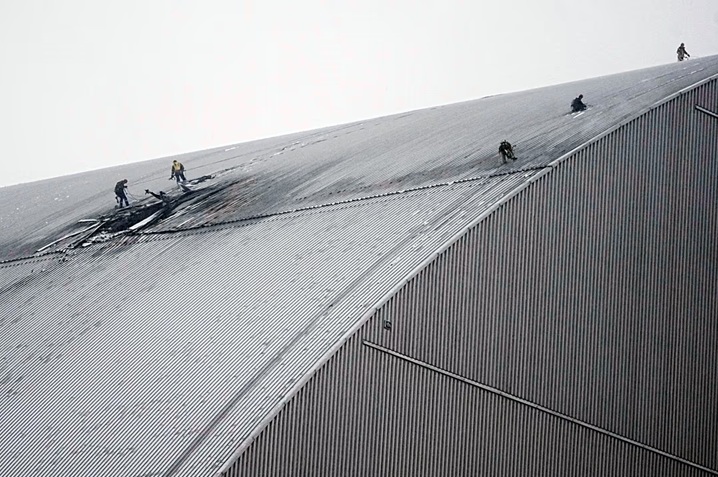
euro news, By Evelyn Ann-Marie Dom, 14/04/2026
Failure to repair the protective structure around the nuclear site could unleash ‘highly radioactive dust’ that ‘does not recognise borders’, experts warn.
A potential collapse of the internal radiation shelter at the defunct Chernobyl nuclear power plant in Ukraine could risk a release of radioactivity into the environment, Greenpeace warned on Tuesday (14 April).
It comes just days before the 40th anniversary of the Chernobyl disaster, which remains the world’s worst nuclear disaster. On 26 April 1986, while Ukraine was part of the Soviet Union, a reactor at the plant exploded, contaminating a vast area spanning Ukraine, Belarus and Russia.
Following the disaster, an inner steel-and-concrete structure, known as the sarcophagus, was hastily built around the destroyed reactor to prevent further radiation leaks.
Years later in November 2016, a high-tech metal dome called the New Safe Confinement (NSC) structure was built, at a cost of €1.5 billion, to reinforce the inner shell.
Why are experts concerned about Chernobyl?
……..While the International Atomic Energy Agency (IAEA) initially had not reported any radiation leaks, in December it confirmed that the drone impact had degraded the steel structure and that it no longer blocked radiation.
IAEA Director General Rafael Grossi said that an inspection “confirmed that the [protective structure] had lost its primary safety functions, including the confinement capability, but also found that there was no permanent damage to its load-bearing structures or monitoring systems.”
Grossi added that while some repairs had taken place, “comprehensive restoration remains essential to prevent further degradation and ensure long-term nuclear safety”
Chernobyl requires an estimated €500 million in repairs
Last month, French Foreign Minister Jean-Noël Barrot estimated the dome required almost €500 million in repairs.
“We presented this evening the first financial estimate of the damage caused by this drone which amounts to around €500 million,” said Barrot after chairing a meeting of G7 foreign ministers in March.
Greenpeace reported that despite some repair efforts, the protective shield has not yet been fully restored. The organisation warned that this increases the risk of radioactivity release, especially in the case of a collapse of the internal structure.
“That would be catastrophic because there’s four tonnes of dust, highly radioactive dust, fuel pellets, enormous amounts of radioactivity inside the sarcophagus,” senior nuclear specialist for Greenpeace Ukraine, Shaun Burnie, told media agency AFP earlier this month.
“And because the New Safe Confinement cannot be repaired at the moment, it cannot function as it was designed, there’s a possibility of radioactive releases,” Burnie added.
‘Radioactive particles do not recognise borders’
The deconstruction of unstable elements of the inner shell is crucial to prevent an uncontrolled collapse, Greenpeace said, but further works to the site have been impeded by Russia’s ongoing attacks.
In addition to Greenpeace’s warning, the power plant’s director Sergiy Tarakanov has also warned that if a rocket were to land near the facility, the structure could be at risk of collapsing due to the impact.
“And from what the 1986 accident showed us…the radioactive particles do not recognise borders,” Tarakanov added. https://www.euronews.com/2026/04/14/chernobyl-could-face-catastrophic-collapse-as-repairs-stall-following-russian-drone-strike
Greenham Women’s Peace Camp: The forgotten protest against nuclear weapons that lasted 19 years
Writing her novel Fallout – set against the backdrop of the Greenham Women’s Peace Camp – turned Eleanor Anstruther into an anarchist
Eleanor Anstruther, The Big Issue, 16 Apr 2026,
You’d have thought a protest that lasted 19 years, involved hundreds of thousands of people, achieved its aims through non-violent direct action and was women-only would already be assured of its place in history. If not in the story of women, then surely as a module in a political degree, or on the school curriculum alongside the suffragettes, apartheid, Gandhi and the American civil rights movement.
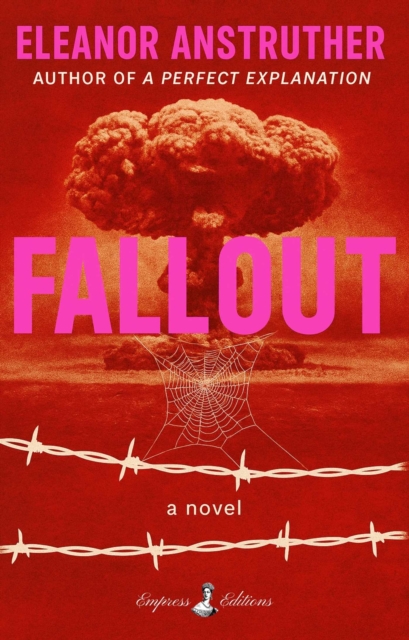
Yet throughout all my research and the many conversations I’ve had since writing Fallout, I’ve only met one – yes, you read that right, one – person under the age of 30 who’d heard of it, and she was a journalist who’d studied politics at university and consciously sought out the missing pieces in the history of British civil disobedience.
.
Even those of us who knew about Greenham from seeing it on the news as young people ourselves in the Eighties are surprised when I tell them how long it lasted. “Nineteen years?” They say, incredulously. “Yes,” I reply,“ and in the signing of the INF treaty which marked the removal of the cruise missiles from RAF Greenham Common, Reagan and Gorbachev cited Greenham women as part of their inspiration.
The leaders of America and Russia, locked for so long in a deadly battle of mutually assured destruction (or MAD for short) found it in themselves to namecheck these women who refused to give in to bullying, not only from the government but consistently from the British media. Yet, the history books? Barely a whisper. A level politics? Forget it. Primary school dress-up days? You can’t move for Emmeline Pankhursts, but Greenham women are nowhere to be found.
Can you hear the outrage in my voice? You’d be right in thinking Fallout is more to me than a book. I thought I knew about Greenham until I started researching it and I thought I had a pretty good handle on the history of protest until I started talking to Greenham women. I’ve been holding up banners and holding up the traffic for much of my adult life, but writing Fallout turned me into an anarchist, and I mean that in the true sense of the word; a belief in the goodness of people to organise themselves around caring for one another.
Because more than a political action which got rid of the bombs and reclaimed the land, Greenham Common Women’s Peace Camp was living proof of our ability to share space with conflicting opinions. Greenham was not one-size-fits-all. It was an idea, not an ideology, and no one, as far as I know, was thrown out of camp for failing to comply. There was no dogma to comply with, and not everyone who came to Greenham was there for political reasons…………………………………….
The women who did leave home to take up space at Greenham did so at their peril – not only physically at the hands of the police but also reputationally throughout their towns and villages. They weren’t held up as icons by their children and husbands; they were lambasted for failing their families.
And this weapon was liberally used by state and media too, shaming them into returning home and if they refused, shaming them on the front pages of national newspapers.
Yet they persisted. Through biting winters and heatwave summers, through prison and beatings and bailiffs and the nighttime assaults by local vigilante groups who tore through camp on motorbikes hurling buckets of blood and maggots.
Despite every effort by the government to get the women to give up and go home, they stood firm. They crawled through brambles, bolt cutters down their boots to cut the fence, proving how poorly the bombs were defended. They threw carpets over barbed wire and danced on the silos. They sang and weaved and fought and held hands and were funny and refused to back down, and they won.
When young people, overwhelmed by the challenge before them, ask me what can be done, I point them towards Greenham. Look, I say. Look what they did. Never underestimate the power of being consistently and creatively annoying. Believe in your rage. There is nothing so powerful as an idea whose time has come. Greenham women are all of us and we are everywhere. https://www.bigissue.com/news/activism/greenham-womens-peace-camp-eleanor-anstruther/
Amid the Iran chaos, war over Taiwan just became less likely
by Marcus Reubenstein | Apr 15, 2026, https://michaelwest.com.au/amid-the-iran-chaos-war-over-taiwan-just-became-less-likely/
Last week’s meeting between Beijing and Taiwan’s main opposition leader is a bad sign for the China hawks and a sign of rapprochement. Marcus Reubenstein reports.
The combination of the US-Israel war on Iran and the anti-China media narrative in Australia has meant the visit of the leader of Taiwan’s main opposition party, Cheng Li-wun, to China has largely been ignored. Cheng chairs the Kuomintang (KMT) party, and she spent five days in mainland China from the 7th until the 12th of April.
Her public pronouncements indicate a belief that it is not in Taiwan’s interest to pin all of its hopes on an economic and military alliance with the US, and its future is better served with a pivot towards Beijing.
A significant proportion of Taiwan’s population does not want armed conflict with China. More importantly, Taiwan’s political leaders are acknowledging the fact that the US is becoming an increasingly unhinged and unreliable ally.
As reported by NBC News, Cheng points to Ukraine, saying,
“People do not want to see Taiwan become the next Ukraine.”
Add to that mix that Taiwan gets 70% of its oil from the Middle East, there is sentiment in Taiwan that the US bombing of Iran has been disastrously thought out and delivers Taiwan massive economic pain. Will Taiwan risk becoming the centrepiece of a future US military disaster?
In December, Cheng told the New York Times, “Could it be the United States is treating Taiwan as a chess piece, a pawn strategically opposing the Chinese Communist Party at opportune times?”
Taiwan’s ruling DPP (Democratic Progressive Party) had attempted to push a $US40B arms deal with the US through parliament in March, but that was sunk by Cheng’s KMT. The ruling DPP was eventually able to get a deal worth just $US11B through – around one third of an AUKUS submarine.
Cheng’s China visit
The visit to China by Taiwan’s opposition leader took in three very significant cities, Nanjing, Shanghai and Beijing. Shanghai and Beijing, as financial and political capitals, were logical, but Nanjing is of great historical significance.
She visited the Sun Yat‑sen Mausoleum in Nanjing with a large Taiwanese delegation, a site honouring the founding father of the Republic of China, revered in both Taiwan and mainland China. Nanjing is also the site of one of Japan’s greatest wartime atrocities, the so-called Rape of Nanjing.
A small number of hardline figures in Japan’s ruling LDP continue to deny Japanese participated in any wartime atrocities. The LDP’s newly elected prime minister, Sanae Takaichi, stating that Japan would send in its military to aid Taiwan in any conflict with China, has dramatically escalated tensions between Beijing and Tokyo.
Takaichi is one of Japan’s most pro-US leaders, and Cheng’s visit to Nanjing would not be lost on the US. By extension, Cheng’s point of visiting Nanjing could be seen as a backhanded message to Japan, which hosts 55,000 US troops, to stay out of Taiwan’s affairs.
Implications for Australia
Cheng’s trip to China has implications for Australia and our foreign policies towards both our biggest trading partner and most important strategic partner.
The Albanese government has gone all in on the US’s East Asia military push, and now the US is showing clear signs of stress. The US has redeployed Thaad missile systems from South Korea to fight its war with Iran, while supercarrier naval vessels based in Japan, and operating in the South China Sea, have also been sent to the Gulf. Despite being the greatest military power in global history, it’s obvious it doesn’t take much to wear US forces thin.
Neither Prime Minister Anthony Albanese, Foreign Minister Penny Wong, nor Defence Minister Richard Marles has deviated from Australia’s blind support for the US war on Iran.
The question is, will they follow the US into an inevitably disastrous war against China or, worse still, act as a proxy in a future war?
Australia’s tilt towards offensive military capability, also enthusiastically supported by the LNP opposition, and the billions committed to submarines which may never arrive, do not augur well.
If the US cannot defeat Iran, there is no path to victory against an equally determined China, far better equipped, with the world’s second largest economy, and that is not a pariah state.
1×1515
2:54 / 8:51
1×1515
0:16 / 8:51
Last week’s meeting between Beijing and Taiwan’s main opposition leader is a bad sign for the China hawks and a sign of rapprochement. Marcus Reubenstein reports.
The combination of the US-Israel war on Iran and the anti-China media narrative in Australia has meant the visit of the leader of Taiwan’s main opposition party, Cheng Li-wun, to China has largely been ignored. Cheng chairs the Kuomintang (KMT) party, and she spent five days in mainland China from the 7th until the 12th of April.
Her public pronouncements indicate a belief that it is not in Taiwan’s interest to pin all of its hopes on an economic and military alliance with the US, and its future is better served with a pivot towards Beijing.
A significant proportion of Taiwan’s population does not want armed conflict with China. More importantly, Taiwan’s political leaders are acknowledging the fact that the US is becoming an increasingly unhinged and unreliable ally.
As reported by NBC News, Cheng points to Ukraine, saying,
People do not want to see Taiwan become the next Ukraine.
Add to that mix that Taiwan gets 70% of its oil from the Middle East, there is sentiment in Taiwan that the US bombing of Iran has been disastrously thought out and delivers Taiwan massive economic pain. Will Taiwan risk becoming the centrepiece of a future US military disaster?
In December, Cheng told the New York Times, “Could it be the United States is treating Taiwan as a chess piece, a pawn strategically opposing the Chinese Communist Party at opportune times?”
Taiwan’s ruling DPP (Democratic Progressive Party) had attempted to push a $US40B arms deal with the US through parliament in March, but that was sunk by Cheng’s KMT. The ruling DPP was eventually able to get a deal worth just $US11B through – around one third of an AUKUS submarine.
Cheng’s China visit
The visit to China by Taiwan’s opposition leader took in three very significant cities, Nanjing, Shanghai and Beijing. Shanghai and Beijing, as financial and political capitals, were logical, but Nanjing is of great historical significance.
She visited the Sun Yat‑sen Mausoleum in Nanjing with a large Taiwanese delegation, a site honouring the founding father of the Republic of China, revered in both Taiwan and mainland China. Nanjing is also the site of one of Japan’s greatest wartime atrocities, the so-called Rape of Nanjing.
A small number of hardline figures in Japan’s ruling LDP continue to deny Japanese participated in any wartime atrocities. The LDP’s newly elected prime minister, Sanae Takaichi, stating that Japan would send in its military to aid Taiwan in any conflict with China, has dramatically escalated tensions between Beijing and Tokyo.
Takaichi is one of Japan’s most pro-US leaders, and Cheng’s visit to Nanjing would not be lost on the US. By extension, Cheng’s point of visiting Nanjing could be seen as a backhanded message to Japan, which hosts 55,000 US troops, to stay out of Taiwan’s affairs.
Implications for Australia
Cheng’s trip to China has implications for Australia and our foreign policies towards both our biggest trading partner and most important strategic partner.
The Albanese government has gone all in on the US’s East Asia military push, and now the US is showing clear signs of stress. The US has redeployed Thaad missile systems from South Korea to fight its war with Iran, while supercarrier naval vessels based in Japan, and operating in the South China Sea, have also been sent to the Gulf. Despite being the greatest military power in global history, it’s obvious it doesn’t take much to wear US forces thin.
Neither Prime Minister Anthony Albanese, Foreign Minister Penny Wong, nor Defence Minister Richard Marles has deviated from Australia’s blind support for the US war on Iran.
The question is, will they follow the US into an inevitably disastrous war against China or, worse still, act as a proxy in a future war?
Australia’s tilt towards offensive military capability, also enthusiastically supported by the LNP opposition, and the billions committed to submarines which may never arrive, do not augur well.
If the US cannot defeat Iran, there is no path to victory against an equally determined China, far better equipped, with the world’s second largest economy, and that is not a pariah state.
Respected US political scientist Professor John Mearsheimer says, US President Donald Trump’s war with Iran is “manna from heaven” for China. He argues the war on Iran has made the US an irresponsible stakeholder in the international system and that China looks like the “adults in the room.”
China’s carrot and stick
China’s approach to Taiwan, and more broadly to much of its global diplomacy, has been a mix of carrot and stick. Beijing is still dangling carrots in front of Taiwan. Reunification with Taiwan remains the endgame,
“but the overwhelming desire is that it should be achieved peacefully.”
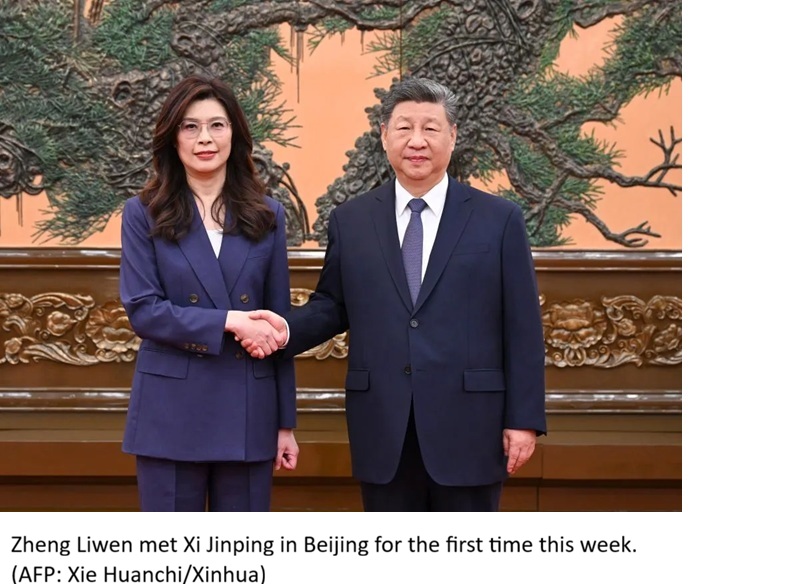
Cheng was warmly received by Chinese President Xi Jinping, and following Cheng’s visit, the Chinese government announced a list of ten new policies to promote economic and travel initiatives to strengthen ties between Beijing and Taiwan.
In the background, a looming stick could be an easily achievable Chinese blockade of commercial shipping around Taiwan. As Iran’s blockade of the Strait of Hormuz demonstrates, it doesn’t take a great deal of military firepower to cripple an economy.
What would, or could, Australia do to intervene? Hypothetically, that is a question which may face Australia, but a reconciliation, indeed possible unification between Taiwan and China, would render moot Australia’s current strategic policy.
Taiwan’s future?
While opinions in Taiwan about Cheng are divided, she has a realistic chance of becoming Taiwan’s next president at the 2028 election. To win, she doesn’t only have to run on China policy; there are plenty of domestic issues facing voters. Also, there is no suggestion that a reunified Taiwan would be considered as a province of China. Instead, it would become a special administrative region, citizens would keep their Taiwanese passports, and the New Taiwan Dollar would remain the official currency.The line in the sand for Beijing would be separatist movements and their sympathisers speaking out publicly. Taiwan would also be prohibited from entering into any military alliances or agreements with other nations.
While this is the same set of conditions imposed on Hong Kong, Taiwan hardly has a tradition of democracy. For its first four decades as a territory, it was governed under martial law, and it wasn’t until 1996 that democratic presidential elections were held.
Current president, Lai Ching-te, is unpopular with his approval rating sinking to 33% in late 2025, having recovered to the low 40% mark in the most recent polls. Cheng’s approval rating is lower, reflecting the distrust Taiwanese people have for their political leaders.
In terms of specific issues, concerns over the economy rank first for Taiwanese voters.
The Chinese, that is to say those of Chinese ethnicity, are by and large very pragmatic. Cheng is betting on a belief that close ties with China represent the future and that the
“Taiwanese people will come to distrust Washington more than they distrust Beijing.”
Netanyahu Doctrine: How one man’s war addiction is consuming Israel, Lebanon, and the World

The concept of Greater Israel – a territory stretching from the Nile to the Euphrates, encompassing all of modern-day Israel, the Palestinian territories, Lebanon, Jordan, Syria, Iraq, Kuwait, Saudi Arabia, and parts of Turkey – is not a fringe fantasy. It is the stated aspiration of the Netanyahu government.
Israel is not being destroyed by its enemies. It is being destroyed by its own internal contradictions. The addiction to war, the messianic ideology, the economic unsustainability, the exodus of the educated – these are not external threats. They are internal cancers.
15 April 2026 Dr Andrew Klein, https://theaimn.net/the-netanyahu-doctrine-how-one-mans-war-addiction-is-consuming-israel-lebanon-and-the-world/
From the ‘Villa in the Jungle’ to the ‘Greater Israel Nightmare’
I. Introduction: The Doctrine of Perpetual War
On October 7, 2023, Israel suffered the worst terrorist attack in its history. Hamas militants crossed from Gaza, unimpeded, and killed and tortured Israeli civilians. That day alone should have disqualified Benjamin Netanyahu from office. In most political systems, he would have been driven from power long ago.
Instead, he did what he has always done: he escalated.
What emerged from the ashes of October 7 is what analysts now call the Netanyahu Doctrine – a security strategy based not on containment, not on deterrence, but on perpetual war. As Netanyahu himself told military officers:
“No more containment of threats. No more the idea of the ‘villa in the jungle’, where one hides from predators beyond the wall. On the contrary: if you don’t go into the jungle, the jungle comes to you.”
The doctrine is simple: preventive attacks against every perceived threat, the creation of buffer zones through the seizure of neighbouring territories, and the constant use of force as the only guarantee of security. It is a doctrine born of trauma, shaped by political expediency, and devoid of any long-term diplomatic vision.
This article examines the Netanyahu Doctrine in action: in Gaza, in Lebanon, in Syria, and against Iran. It documents the destruction, the displacement, and the erosion of Israel’s international standing. It argues that Netanyahu is not a strategist – he is an opportunist. He does not plan for the long term. He plans for the next distraction.
And the world is always distracted.
II. The Greater Israel Dream: From the Nile to the Euphrates
The doctrine is not about security. It is about expansion. The buffer zone is not the goal. The settlements are the goal. The land clearance is not for defence. It is for colonisation.
The concept of Greater Israel – a territory stretching from the Nile to the Euphrates, encompassing all of modern-day Israel, the Palestinian territories, Lebanon, Jordan, Syria, Iraq, Kuwait, Saudi Arabia, and parts of Turkey – is not a fringe fantasy. It is the stated aspiration of the Netanyahu government.
This is not a fringe position. It is the official policy of the Netanyahu government. And it is being executed.
III. Lebanon: The Pattern Repeats
The same pattern as Gaza. The same destruction. The same rubble.
On March 2, 2026, Israel launched an offensive against Hezbollah in Lebanon. The stated goal was to create a “buffer zone” up to the Litani River, approximately 30 kilometres north of Israel’s border, to protect northern Israeli communities from Hezbollah rockets.
The reality is different. The buffer zone is not a buffer. It is a land grab. The territory up to the Litani is not needed for defence. It is needed for settlements.
Defence Minister Israel Katz has been explicit:
“All houses in villages near the Lebanese border will be destroyed, in accordance with the model used in Rafah and Beit Hanoun in Gaza, in order to permanently remove the threats near the border.” Displaced residents will not be allowed to return south of the Litani “until the safety and security of residents of northern Israel is guaranteed” – a condition that may never be met.
The human cost in Lebanon (as of April 2026):
- 1,268 people killed in Israeli strikes, including 125 children and 52 medics
- 303 killed in a single day (April 8, 2026) – one of the deadliest bombings ever inflicted on Lebanon
- 1,200+ killed and 1.2 million displaced since March 2
- 1,094 confirmed martyrs and 3,119 injured according to the Lebanese Ministry of Health.
The air force can project power anywhere. The ground troops are not needed for security. They are needed for clearance.
IV. Conflicting Views: Military vs. Political Leadership
The Israeli military and political leadership are not aligned. The military leaders want a buffer zone. The political leaders want settlements.
In early April 2026, the Israeli army proposed a revised set of objectives for its operations in Lebanon, limiting the goal of disarming Hezbollah to areas south of the Litani River, rather than across the entire country. The proposal triggered sharp disagreements with Israel’s political leadership, leading to the postponement of a cabinet meeting.
Foreign Minister Israel Katz was among those who opposed the plan. Under the alternative military approach, the army would focus on the large-scale destruction of villages in South Lebanon and the forced displacement of their citizens to establish a buffer zone.
The gap is not a failure of communication. It is a feature. The ambiguity provides cover. The confusion provides deniability.
The military leaders can say: “We were only establishing a buffer zone.”
The political leaders can say: “The military recommended it.”
And the settlers move in.
V. The Economic Cost: Israel Cannot Afford This War
The Netanyahu Doctrine is not sustainable. The economic numbers are stark.
The cost to Israel:
The defence budget has ballooned. The army needs approximately 15,000 more soldiers, half of them for ground combat units. Chief of Staff Eyal Zamir warned the government: “I am raising 10 red flags. If this continues, the Israeli army will collapse from within.”- The ultra-Orthodox community, which relies heavily on state benefits, is expected to triple by 2065, pushing the burden on non-Orthodox households to the equivalent of 60,000 shekels ($19,370) a year.
- Foreign investment is down. Institutional investors have been moving money out of the country since the 2008 financial crisis.
- More than 150,000 people have left Israel in the past two years, and more than 200,000 since the current government took office in December 2022. The educated upper class are more able to leave – they speak English, can find jobs, and are more exposed to international media.
The cost to Lebanon:
The Lebanese economy, already in freefall, is being shattered. The destruction of infrastructure, the displacement of 1.2 million people, and the loss of agricultural land in the south will take decades to repair.- Sectarian tensions are rising. Non-Shi’a Lebanese are increasingly ostracising the Shi’a community, viewing them as a liability that brings Israeli bombs. The country’s fragile social fabric is tearing apart.
The Netanyahu Doctrine is not about security. It is about expansion. And expansion costs money that Israel does not have.
VI. The Sabra and Shatila Precedent
This is not the first time Israel has invaded Lebanon. It is not the first time the world has been distracted. And it is not the first time the consequences have been catastrophic.
In 1982, Israeli forces invaded Lebanon and besieged Beirut. On 16 September, under Israeli supervision and protection, Lebanese Forces militias entered the Palestinian refugee camps of Sabra and Shatila. For 43 hours, they tortured and killed everyone they came across. They crushed the heads of children and babies against walls. They raped women and girls before slaughtering them. They dismembered their victims.
An estimated 3,500 to 4,500 Palestinian and Lebanese civilians were killed.
The Israeli government did not deny that it had overseen the camps. It denied knowledge of the massacre, despite order number 6 of the Israel Defense Forces command stating that “the refugee camps are not to be entered” and that “searching and mopping up the camps will be done by the Phalangists/Lebanese Army.”
The Kahan Commission found Israeli Defence Minister Ariel Sharon “personally responsible for ignoring the danger of bloodshed and revenge.” He was forced to resign.
The world was shocked. The world moved on. And Israel invaded Lebanon again.
The Netanyahu Doctrine is not new. It is the same doctrine, dressed in new clothes, enabled by a distracted world, and executed with unprecedented brutality.
VII. The UN Warning: ‘The Gaza Model Must Not Be Replicated’
The international community is not silent. But its warnings are being ignored.
UN Secretary-General Antonio Guterres has issued a warning cry, stressing that the model of destruction witnessed in the Gaza Strip must not be repeated in Lebanese territories. He described the humanitarian repercussions as severe and requiring immediate intervention to prevent a slide towards a comprehensive catastrophe.
Stanford Law Professor Tom Dannenbaum warned that destroying all homes near the Lebanese border would not meet the standard of “absolute military necessity” required by the laws of war. “The unnecessary destruction of property can qualify as a war crime,” he said. Katz’s comments barring residents from returning home “strongly indicate an illegal policy of long-term or permanent displacement.”
European countries have called on Israel to avoid further escalation. Canadian Prime Minister Mark Carney said Israel’s occupation of Lebanese territory was a “violation of their territorial sovereignty” and condemned it.
The world is not silent. But the world is distracted.
VIII. The Netanyahu Doctrine: A Record of Failure
Jonathan Freedland, writing in The Guardian, sums up the Netanyahu record:
“This is now the fourth time in a row – in Gaza, once in Lebanon and twice in Iran – that Netanyahu’s boasts of total victory and the removal of existential threats have been exposed as empty promises.”
The failures are clear:
Gaza: Netanyahu promised “total victory” over Hamas. After a two-year campaign that killed approximately 70,000 people, Hamas still rules the ruins of half of Gaza.- Lebanon (first round): Netanyahu boasted that he had “vanquished” Hezbollah, destroying its ability to menace northern Israel. Hezbollah continues to fire rockets.
- Iran (first round, June 2025): Netanyahu described the 12-day confrontation with Iran as a “historic victory that will stand for generations.” Eight months later, Tehran was once again said to pose an existential threat.
- Iran (second round, February-April 2026): Iran still has a stockpile of enriched uranium. Its rulers remain in place, more hardline than before. Tehran has demonstrated a mighty deterrent – a chokehold on the global economy in the form of the Strait of Hormuz.
As Yair Golan, the Israeli opposition politician and former general, observed: Netanyahu “does not know how to turn military achievements into political security.” There is no attempt to seize diplomatic openings, no effort to turn Israel’s enemies’ enemies into friends.
The Lebanese government and much of its people are desperate to be rid of the Hezbollah cuckoo in their nest. But Netanyahu speaks to them only through bombs.
IX. The Strait of Hormuz Distraction
The timing of the Lebanon escalation is not accidental. The world is focused on Trump and Iran. The media is focused on oil prices. The public is focused on the cost.
On February 28, 2026, the US and Israel launched joint military strikes against Iran. The war has spread across the Middle East. The Strait of Hormuz is effectively blockaded. Oil prices have spiked. Inflation is rising. The global economy is bleeding.
Netanyahu is taking advantage. He always does.
The Iranian threat is not existential. It is useful. The fear is the tool. The distraction is the opportunity.
Netanyahu has been playing this game for decades. He is very good at it.
X. What This Means: The Erosion of Israel’s Standing
The Netanyahu Doctrine has gained nothing. And it has come at a monstrously high price.
Most obviously, in the lives of all those killed – whether in Rafah or the Bekaa Valley or Israel itself. But it has also inflicted perhaps irreparable damage on Israel’s standing in the world. Every day Netanyahu remains in post, he makes his country more of a pariah.
The Knesset has passed a racist law that will, in effect, impose the death penalty on Palestinians convicted of terrorist murderers – but not Jews. The bill was driven by Itamar Ben-Gvir, but Netanyahu went out of his way to vote for it.
Israel is not being destroyed by its enemies. It is being destroyed by its own internal contradictions. The addiction to war, the messianic ideology, the economic unsustainability, the exodus of the educated – these are not external threats. They are internal cancers.
The collapse will not be dramatic. It will be bureaucratic. The economy will contract. The allies will defect. The public will turn. The reservists will refuse. The militias will fight each other.
The Strait of Hormuz crisis will pass. The oil prices will stabilise. The media will move on.
But the land in Lebanon will not return. The settlements will not be dismantled. The buffer zone will become permanent .
The Netanyahu Doctrine is not about security. It is about expansion. The existential threat is not a threat. It is an excuse.
And the world is too distracted to notice.
XI. A Final Word
The Netanyahu Doctrine is a death spiral – for Israel, for Lebanon, for the region. It is a doctrine of perpetual war, sustained by distraction, enabled by silence, and paid for with the bodies of the innocent.
The question is not whether Israel will collapse. The question is how many more must die before the world stops looking away.
Sources……………………………………..
Congress A-OK with Trump murdering thousands in Iran and crashing the world economy

Walt Zlotow West Suburban Peace Coalition Glen Ellyn IL . 17 April 2026
On Thursday the US House completed Congress’ capitulation to Trump’s deranged, failed war to destroy Iran on behalf of Israel.
The House voted 214 -213 to defeat a War Powers Resolution directing Trump to end his failed Iran war. All Democrats but 1 (Rep. Jared Golden) voted to end the war. All Republicans but 1 (Rep. Tom Massie) voted to keep up the murder and mayhem destroying Iran, Israel, Gulf States, and possibly sending the world economy into recession.
A day earlier the Senate put their ignominious approval on Trump’s madness, defeating their War Powers Resolution by a wider margin of 47-52. Again just 1 Republican (Sen. Rand Paul) voted to end the war and 1 Democrat (Sen. John Fetterman) voted to keep it killing and blowing up the world economy.
Republicans both support whatever Trump promotes and relish endless wars in furtherance of US world dominance no matter how murderous and criminal they are. One Republican representative and senator opposing Trump’s criminal wars out of 274 GOP congresspersons disgraces the Grand Old (War) Party.
Democrats are minimally better. Their War Powers vote was more connected to their opposing anything trump supports. They largely enable US military adventurism worldwide, unlimited military spending in support thereof, and acquiescing in Israeli genocide in Gaza and relentless bombing of civilians in Lebanon. They, like nearly the entire GOP, are bought and paid for by US weapons makers and the US Israel Lobby.
As criminally murderous are Trump and his war party of Hegseth, Vance and Rubio, they could not proceed without the support of Congress. By funding Trump’s endless wars, refusing to condemn them thru War Powers Resolutions and gobbling up pro war campaign cash, they ignore the majority of voters who want this madness ended.
At the rate Trump and his enabling Congress are breaking things, this may be the worst in America’s 250 years.
Trump/Newsom Attack Renewables and Push Nuclear

the Trump family’s media company announced a merger with TAE Technologies, a California-based nuclear fusion company, in a deal worth over $6 billion. So, Trump now has a vested financial interest in nuclear power.
Trump-style, Democrat Newsom has also backstabbed a 2018 comprehensive plan he had signed to phase in a 100% renewable energy-based state grid while phasing out the embrittled, hyper-expensive Diablo reactors, which are surrounded by earthquake faults.
Karl Grossman – Harvey Wasserman
Amidst Donald Trump’s wild Middle East War declarations, the tech billionaire push to nuclear reactor suicide has escalated with the shock relicensing of California’s two nuclear power plants at Diablo Canyon, now being pushed by the state’s liberal Governor Gavin Newsom, who has also joined Trump in their all-out attack against renewable energy.
Together, Trump and Newsom are pushing decrepit, virtually uninsured, militarily indefensible nuclear power plants whose drastic deregulation may now rival the dangers posed by any bombs Iran could produce
They also make no economic or ecological sense.
Despite the latest tsunami of “Nuclear Renaissance” hype, nuclear power plants are losing bigly to the worldwide surge in renewable energy. Solar panels, wind turbines, geothermal, and epic advances in battery storage continue to make the green alternative to fossil fuels and nuclear reactors—big and small—a far cheaper, safer, cleaner, more reliable, more job-producing alternative.
Despite the all-out Trump/Newsom all-out anti-green attack, as the “independent global energy think tank” Ember reported last month, “the world installed a record 814 GW of new solar and wind capacity in 2025, 17% more than in 2024 (696 GW).”
“The latest additions bring the combined global installed capacity of wind and solar to 4,174 GW (over 4 TW),” it said.
One GW (gigawatt) equals a billion watts, roughly the capacity of a big nuclear power plant; a TW is a trillion watts.
London-based Ember adds that “solar accounted for the majority of new capacity additions, with almost 4 GW of new solar added globally for every 1 GW of wind.”
Reuters reported last month: “Renewable power made up almost 50% of the world’s electricity capacity last year after a record increase in solar installations.”
Despite the nuclear power push, some 90% of Earth’s annual newly installed annual generating capacity for the past few years has been solar, wind or geothermal, with battery backup.
Nonetheless, Republican Trump says, “nuclear’s a great energy.” His flood of executive orders on nuclear power have weakened or eliminated nuclear safety regulations—making nuclear power plants more dangerous than ever—and has expedited their being built. Last year his administration finalized an $80 billion deal with Westinghouse for new nuclear power plants.
Also, last year, the Trump family’s media company announced a merger with TAE Technologies, a California-based nuclear fusion company, in a deal worth over $6 billion. So, Trump now has a vested financial interest in nuclear power.
Trump is also attacking wind turbines everywhere. He even wants a $928 million chunk of taxpayer cash spent to kill a French-proposed offshore wind project and to instead fund Texas gas/oil projects, some of which will go for export.
Trump is joined in his all-out war on renewables by Newsom’s pro-utility rate hikes, virtually killing California’s once-booming rooftop photovoltaics industry, costing thousands of jobs and billions in extra rate payments. Even a proposed “balcony solar” bill would strictly limit a technology now cheap, reliable, and enough to power the whole state, as it does on a regular basis, without the need for Diablo’s hyper-expensive billionaire-benefitted power.
Trump is also attacking wind turbines everywhere. He even wants a $928 million chunk of taxpayer cash spent to kill a French-proposed offshore wind project and to instead fund Texas gas/oil projects, some of which will go for export.
Trump is joined in his all-out war on renewables by Newsom’s pro-utility rate hikes, virtually killing California’s once-booming rooftop photovoltaics industry, costing thousands of jobs and billions in extra rate payments. Even a proposed “balcony solar” bill would strictly limit a technology now cheap, reliable, and enough to power the whole state, as it does on a regular basis, without the need for Diablo’s hyper-expensive billionaire-benefitted power.
Trump-style, Democrat Newsom has also backstabbed a 2018 comprehensive plan he had signed to phase in a 100% renewable energy-based state grid while phasing out the embrittled, hyper-expensive Diablo reactors, which are surrounded by earthquake faults.
Trump has promised many millions to cover a loan to keep Diablo operating. But state legislators fear he may leave them holding much of the bag. They could vote to turn down the NRC’s 20-year license extension, and close Diablo instead in 2030.
But Newsom, who’s term-limited this year, will be pushing hard, even as his Diablo betrayal underscores global economic failure of nuclear power.
The two nuclear power projects in the U.S. since 2000 have been fiscal fiascoes. Construction of two plants in South Carolina was halted, the would-be plants abandoned, wasting $9 billion while producing zero electricity. Two plants at Vogtle, Georgia, opened seven years late, costing nearly $40 billion, more than double their original price. Projected cost estimates for the ceaselessly hyped “Small Modular Reactors” vastly exceed current prices for proven battery-backed solar, wind and geothermal.
And from the Diablo Canyon nuclear power plants in California to the Palisades plant in Michigan to the Indian Point plants in New York and onto Ukraine and Iran, the perils of nuclear power are clear.
Coupled with nuclear war, nuclear power—hyped as “Atoms for Peace” in the last century—and the more than 400 nuclear power plants worldwide that are now in operation, 94 of them in the United States, constitute lethal threats. The ability of the human species to survive on this planet is being put in nuclear danger, and not just at Diablo Canyon.
Kevin Kamps, executive director of Don’t Waste Michigan, the statewide anti-nuclear coalition founded in the mid-1980s, commented in an interview: “The nuclear industry’s massive campaign contributions to help get its preferred politicians elected in the first place, and it’s even more massive lobbying expenditures to influence office holders and government bureaucrats, explains its stranglehold on law and regulation—it’s the best pro-nuclear democracy money can buy, to paraphrase Greg Palast,” said Kamps. (Palast is the author of the book The Best Democracy Money Can Buy.)
“The industry barbarians are so running rampant through the ‘Halls of Power,’ we might as well just hand over the keys to the U.S. Treasury to the nuclear lobbyists and their bosses,” says Kamps.
“Nearly $400 billion in nuclear power bailouts, at federal taxpayer expense, was authorized in just three bills—the Infrastructure Investment and Jobs Act of 2021, and the Inflation Reduction Act of 2022 as well as the absurdly named, downright dangerous ADVANCE Act of 2024 (“Accelerating Deployment of Versatile, Advanced Nuclear for Clean Energy”). The three bills, signed into law by President Biden, teed up the current even more outrageous giveaways under Trump, not to mention the regulatory free fall, without a parachute, regarding safety, security, health, and the environment.”
“Such collusion,” said Kamps, “between safety regulators, industry, and government officials, was the root cause of the still unfolding Fukushima Daiichi nuclear catastrophe that began in 2011, the Japanese Parliament officially concluded after its year-long independent investigation, the first in its history.”
“After successfully lobbying Michigan Governor Gretchen Whitmer to champion the unprecedented zombie reactor restart of the infamous, closed Palisades reactor, and to grant Holtec $300 million of state taxpayer funding for its trouble, the head of the University of Michigan nuclear engineering department was downright giddy.” Todd Allen, as reported in Stateline, said: “You’re starting to see a lot of states transition to a position where they’re supportive of nuclear. And compared to 30 years ago, the amount of federal support for nuclear is unbelievable.”
Said Kamps: “It is unbelievable, in a shocking, horrifying, insanely exorbitant, and extremely risky sense.”
The U.S. Nuclear Regulatory Commission, emasculated by Trump, has just extended the operating licenses of the two Diablo Canyon nuclear power plants by 20 years.
They are now more than 40 years old—with 40 years the length of time nuclear regulators originally set as the limit for a nuclear power plant running before its innards became embrittled by radioactivity leaving them prone for accidents. And. indeed, both Diablo Canyon plants are now deeply embrittled.
Further, the earthquake faults that surround the Diablo Canyon nuclear plants could easily trigger a catastrophic accident. Indeed, the other major industry in the area of the Diablo Canyon plants are hot spas.
The plants were to be shut down, Unit 1 in 2024 and Unit 2 in 2025, but California Governor Newsom, a Democrat, led in undoing that arrangement.
In the middle of the U.S., the Palisades nuclear plant was closed in 2022, after five decades of operation, and Holtec International got a contract to decommission it. But then Holtec turned around and said it would instead restart the plant. It would be first restart of a closed nuclear power plant in U.S. history.
Last week, Don’t Waste Michigan warned of “dire consequences” in a little more than a year following a restart. It issued a report by Arnie Gundersen, a nuclear engineer with 55 years experience, that cited a document of Holtec contractor, Framatone, that said “if Palisades is allowed to restart, the steam generators will degrade quickly.”
Gundersen said Framatone “determined that Palisades cannot operate safely even after just the first 14.5 months. Holtec’s contractor admits the likelihood of damage will increase ‘exponentially’ after that point if Palisades is restarted.”
The proposed restart has been made possible by $3.12 billion in federal grants and loans and funds from the state of Michigan with Michigan Governor Whitmer, a Democrat, a major advocate of a Palisades restart.
As Roger Rapoport, an author and journalist who has long reported on nuclear power and also Palisades, wrote last month in the Detroit Free Press, how Holtec International’s purported “unprecedented milestone in U.S. nuclear energy” may be turning into a millstone. Holtec is attempting the first-ever reopening of a nuclear plant permanently closed for decommissioning—the Palisades reactor….Twenty-one months into the project, Holtec has announced delay after delay while continuing to draw vast public subsidies…”
Currently, “Holtec seeks exceptions from Nuclear Regulatory Commission for work on a reactor so noncompliant that no government agency would even consider approving its construction today….After multiple delays…Holtec, a New Jersey company with zero nuclear reactor operating experience, is back in line at the Nuclear Regulatory Commission seeking forgiveness for unpermitted welding on the 55-year-old Palisades reactor pressure vessel containment head.”
This “follows a controversial NRC exemption related to re-sleeving approximately 1,400 cracked tubes at the plant’s ancient steam generators…”
Meanwhile, in New York at the site of the Indian Point nuclear power plants—25 miles from New York City—U.S. Department of Energy Secretary Chris Wright, formerly CEO and founder of a fracking company, joined last month with Republican Congressman Mike Lawler of New York calling for the reopening of the two plants.
One plant was shut down in 2020 and a second in 2021 because of safety concerns related to the plants being located in the most densely populated area of the U.S. Some 22 million people live within 50 miles of the nuclear plants. The two plants began operating in 1974 and 1976.

Holtec also got the contract to decommission these plants. Holtec International President Kelly Trice declared interest in his company restarting them instead, at a cost of $10 billion. “I’m getting so many people asking me from New York if this is possible,” he said. “The answer is yes.”
Even on Long Island, east of New York City, where the Long Island Lighting Company proposed nearly 60 years ago to build seven to eleven nuclear power plants, suddenly a pro-nuclear voice has emerged. There was strong opposition from the grassroots and from the government of Suffolk County, where the plants were to be located, and the scheme was blocked, along with the opening of the one plant built, at Shoreham.
Among issues raised in the decades-long battle against nuclear power on Long Island was how the eight million people on Long Island could evacuate in the event of a major nuclear plant accident—considering that the only ways off Long Island are several bridges and tunnels into New York City.
But, last week, John Duffy, treasurer and business manager of Local 138 of the International Union of Operating Engineers, wrote in Long Island Business News a piece which included the heading that “let’s repower Shoreham.”
Even on Long Island, east of New York City, where the Long Island Lighting Company proposed nearly 60 years ago to build seven to eleven nuclear power plants, suddenly a pro-nuclear voice has emerged. There was strong opposition from the grassroots and from the government of Suffolk County, where the plants were to be located, and the scheme was blocked, along with the opening of the one plant built, at Shoreham.
Among issues raised in the decades-long battle against nuclear power on Long Island was how the eight million people on Long Island could evacuate in the event of a major nuclear plant accident—considering that the only ways off Long Island are several bridges and tunnels into New York City.
But, last week, John Duffy, treasurer and business manager of Local 138 of the International Union of Operating Engineers, wrote in Long Island Business News a piece which included the heading that “let’s repower Shoreham.”
She also, in her state of the state address this year, called for the construction of five gigawatts of new nuclear power in the state—the equivalent of five large nuclear power plants. And her Public Service Commission last year approved $33.3 billion to be paid by every electric ratepayer in New York State as a subsidy for four nuclear power plants in upstate New York, including Nine Mile Point 1, the oldest nuclear power plant now running in the United States.
Meanwhile, overseas, in the wars in Ukraine and Iran, nuclear power plants have become examples of what Dr. Bennett Ramberg, an internationally known expert on nuclear proliferation, wrote about in his book “Nuclear Power Plants as Weapons for the Enemy: An Unrecognized Military Peril,” first published in 1980. In it he wrote that “despite multiplication of nuclear power plants, little public consideration has been given to their vulnerability in time of war.”
When Putin sent troops pouring through Belarus into northern Ukraine in 2022, they quickly assaulted the remains of the Chernobyl nuclear power plant, which exploded in 1986. The core of Unit 4 has been covered with a $2 billion sarcophagus funded by European nations.
Since then, Russia has used drones at the Chernobyl site which have punctured the sarcophagus. And has also attacked the six-reactor Zaporyzhia nuclear plant site in Ukraine.
In Iran, there have been attacks at the Bushehr nuclear power plant. Just last month, the International Atomic Energy Agency reported that “following information from Iran of a projectile incident on Tuesday evening, the IAEA can confirm that a structure 350 metres from the Bushehr NPP reactor was hit and destroyed.” IAEA Director General Rafael Mariano Grossi said: “Although there was no damage to the reactor itself nor injuries to staff, any attack at or near nuclear power plants violates the seven indispensable pillars related to ensuring nuclear safety and security during an armed conflict and should never take place.”
But they are taking place—and can be expected to continue because, indeed, nuclear power plants can be “weapons for the enemy” and, indeed, this largely remains an “unrecognized military peril.”
A measure of the impacts of a nuclear plant disaster are detailed in the book “Chernobyl: Consequences of the Catastrophe for People and the Environment.”
Published by the New York Academy of Sciences in 2009, it was authored by three noted scientists: Russian biologist Dr. Alexey Yablokov, former environmental advisor to the Russian presidents Gorbachev and Yeltsin; Dr. Alexey Nesterenko, a biologist and ecologist in Belarus; and Dr. Vassili Nesterenko, a physicist and at the time of the accident director of the Institute of Nuclear Energy of the National Academy of Sciences of Belarus. Its editor was Dr. Janette Sherman, a physician and toxicologist long involved in studying the health impacts of radioactivity.
The book is based on health data, radiological surveys and scientific reports—5,000 documents. It concluded that based on the records that were scrutinized, some 985,000 people died largely of cancer caused by the Chernobyl accident in nations that underwent radioactive fallout from the disaster. That was between when the accident occurred in 1986 and 2004. More deaths, it projected, would follow. And they have.
Contrary to the industry hype, all atomic reactors emit planet-killing radioactive Carbon 14. They directly heat the planet, destroy our lakes, rivers and oceans with chemicals and radiation, kill millions of fish per year. They create radioactive waste for which there is no safe place on this planet. Their “normal” radiation releases ceaselessly harm and kill untold thousands of downwind neighbors.
And with the planet-killing new “Nuclear Renaissance” now in play, there will be more and more deaths from nuclear power—unless there is a stop put to this failed, deadly, hyper-expensive technology, with our species finally taking the true Solartopian road with energy we can live with.
Harvey Wasserman wrote the books Solartopia! Our Green-Powered Earth and The Peoples Spiral of US History. He helped coin the phrase “No Nukes.” He co-convenes the Grassroots Emergency Election Protection Coalition at www.electionprotection2024.org Karl Grossman is the author of Cover Up: What You Are Not Supposed to Know About Nuclear Power and Power Crazy. He the host of the nationally-aired TV program Enviro Close-Up with Karl Grossman (www.envirovideo.com)
Targeting Nuclear Power
Bulletin of Atomic Scientists, Streamed live on 13 Apr 2026, https://www.youtube.com/live/CQGbJKEbzy8
Since it began on February 28th, the war in the Middle East has targeted civilian infrastructure, including energy infrastructure. Civilian nuclear power plants have not been immune as Dimona in Israel and areas near Bushehr in Iran have been targeted repeatedly. In early April, Moscow evacuated Russian nationals working at the Bushehr facility. And IAEA director Rafael Grossi has warned about an increasing possibility of nuclear leaks, raising the specter of a nuclear incident caused by conflict. Years of Russian targeting of the Zaporizhzhia nuclear facility in Ukraine, show that this threat is not unique to one conflict.
Notwithstanding, the US and Iran have reached a ceasefire agreement. But these security concerns should not be forgotten. Interest – and investment – in nuclear energy is increasing globally, as leaders seek to reduce energy interdependence and reliance on fossil fuels.
This panel will discuss growing concerns around nuclear safety as well as broader questions around nuclear power plants becoming targets in war and implications for the future of nuclear energy.
Speakers on the panel include:
Moderator: Rachel Bronson, a senior advisor at the Bulletin of the Atomic Scientists. From February 2015 to January 2025, she served as the Bulletin’s president and CEO. She also serves as the Lester Crown Nonresident Senior Fellow for Energy and Geopolitics at the Chicago Council on Global Affairs.
Lars van Dassen, the Executive Director for the World Institute for National Security. Previously, he served as the Acting Department Head, Section Head and Director for the Office for External Relations at the Swedish Radiation Safety Authority.
Laura S. H. Holgate, who served most recently as the U.S. Ambassador to the United Nations International Organizations in Vienna and the Representative of the United States of America to the International Atomic Energy Agency. Holgate currently leads LSHH International Advisors.
Who’s making money? The arsenal trade after Ukraine and Iran

By Vince Hooper | 15 April 2026, https://independentaustralia.net/life/life-display/whos-making-money-the-arsenal-trade-after-ukraine-and-iran,20929
Defence is no longer a defensive trade, and nowhere is the question of who’s buying, who’s building, and who is being left behind more apparent than in Australia, writes Professor Vince Hooper.
Markets, missiles and the end of the peace dividend — and what it means for Australia
A South Korean missile-maker most Western investors could not have located on a map two years ago has just hit an all-time high. LIG Nex1, a precision-guided munitions and electronic warfare specialist headquartered in Yongin, has nearly quadrupled from its January 2025 base, touching 899,000 won on 6 March 2026 — days after American and Israeli aircraft struck Iranian nuclear and missile facilities.
The Korean defence sector as a whole has returned roughly 137 per cent over the past year. These are not the numbers of a sleepy industrial cyclical. They are the numbers of an asset class being repriced in real time.
Defence is no longer a defensive trade. It is the trade. And nowhere is the question of who is buying, who is building, and who is being left in the queue more pointed than in Australia.
Canberra in the queue
For Australia, the arsenal trade is not an abstract market story. It is a mirror.
AUKUS is now a procurement queue rather than a strategy and the cost of waiting for Virginia-class submarines while the Indo-Pacific darkens is becoming uncomfortable to discuss in polite company.
Canberra is, in effect, paying premium prices for late delivery, while Korean and Japanese yards offer shorter timelines at lower cost.
Hanwha’s confirmed 19.9 per cent strategic stake in Austal, cleared by both the Committee on Foreign Investment in the United States (CFIUS) and Canberra’s Foreign Investment Review Board (FIRB) by late 2025, the Henderson shipyards build-up (now known as the Australian Marine Complex), the AS9 Huntsman self-propelled howitzer program being built by Hanwha at Avalon, near Geelong are not coincidences. They are the early signs of an Australian defence industrial base quietly rotating away from Anglosphere dependence and towards Asian arsenals that can actually deliver.
The strain is visible in real time. As the Sydney Morning Herald reported last week, Canberra’s first crisis call during the Middle East escalation went to Beijing rather than Washington — a reflex inversion that would have been unthinkable a decade ago and that tells you more about the perceived reliability of the American guarantee than any AUKUS communiqué.
The ASX has noticed even if the cabinet has not: DroneShield, Electro Optic Systems, Codan and Austal have all attracted the kind of investor attention that only arrives when a market decides a sector’s tail risks have permanently thickened.
From cost centre to industrial darling
The Ukraine War did the structural work. It converted defence from a politically awkward line item into the most fashionable corner of industrial policy and it taught Western treasuries an uncomfortable lesson about how thin their magazines actually were. Three years of artillery duels in the Donbas drained stockpiles NATO had quietly assumed would last a generation.
The Middle East conflict is the second shock. Patriot interceptors, Terminal High Altitude Air Defense (THAAD) reloads, Iron Dome Tamirs, SM-3s, 155mm shells, loitering munitions — each salvo over the Gulf is, in accounting terms, a revenue recognition event somewhere in Arizona, Alabama, Haifa or Daejeon. Governments that spent the 2010s running down inventories on the assumption of a benign world are now writing cheques to rebuild them, and they are writing those cheques into the same handful of balance sheets.
Who, specifically, is making money
Four tiers are visible.
First, the American primes — Lockheed Martin, RTX, Northrop Grumman, General Dynamics, L3Harris. They capture the replenishment contracts, the integration work, and the multi-year framework agreements that Congress now waves through with rare bipartisan enthusiasm. Their backlogs are at record highs and, after two decades of monopsony complaints, their pricing power has quietly inverted.
Second, the European awakening — Rheinmetall, BAE Systems, Leonardo, Saab AB, Thales. Germany’s Zeitenwende turned out to be real, and Rheinmetall in particular has become the continent’s de facto shell foundry, trading less like an industrial stock and more like a leveraged proxy on NATO’s Article 5 itself.
Third, and most interesting from where Australia sits, the Asian arsenals — Hanwha Aerospace, Korea Aerospace Industries, Hanwha Systems and the LIG Nex1 of the opening paragraph, alongside Mitsubishi Heavy Industries and Kawasaki in Japan. South Korea has done what Europe spent 30 years failing to do: build a deep, exportable, price-competitive defence industrial base with delivery times measured in months rather than decades.
Warsaw noticed first. Riyadh, Canberra and Cairo are noticing now. Israel’s own Elbit, Rafael and IAI sit alongside them as the technological pace-setters, particularly in air defence and electronic warfare, where the Iran exchange has been a brutal but effective live-fire showcase.
Fourth, the invisible compounders — the propellant chemists, the rare-earth magnet refiners, the speciality steel mills, the gallium nitride foundries, the International Traffic in Arms Regulation (ITAR) cleared software shops, the maritime insurers writing war-risk cover on Hormuz transits at multiples of last year’s premium. This is where the quiet fortunes are being made. Lynas Rare Earths, sitting on one of the few non-Chinese heavy rare earth supply chains in existence, belongs in this tier, whether the market has fully priced it in or not.
The Gulf parallel
For the Gulf Cooperation Council (GCC), the calculation is different and more cynical than Australia’s, but the underlying logic is the same. Every Gulf capital is simultaneously a customer, a forward operating base, and a potential target. Sovereign wealth is rotating accordingly — not away from defence, but into it. Saudi Arabia, in particular, is building domestic primes such as the Synchronised Accessible Media Exchange (SAMI) — wholly owned by the Public Investment Fund and openly targeting a place in the global top 25 defence companies by 2030.
The export of security capacity has become a new instrument of influence and the capital flows track the doctrine more faithfully than any white paper. Australia, with its Henderson precinct ambitions and its Hanwha partnership, is on a milder version of the same curve.
The uncomfortable coda
None of this is a celebration. A rising LIG Nex1 share price is, in the end, a market-implied judgement that more young people in more places will be killed by better-engineered weapons. The honest analyst names that trade-off rather than hiding behind the chart.
But the honest analyst also tells the truth about incentives. The Ukraine War did not enrich defence contractors by accident and the Iran strikes will not either. Governments that spent a generation treating deterrence as a sunk cost are now paying the bill they should have been paying all along and the firms holding the order books are, predictably, getting rich.
CNN reported over the weekend that U.S. intelligence believes China is preparing to deliver shoulder-fired air defence missiles (MANPADS) to Iran during the current ceasefire — a claim Beijing has formally denied. If the reporting holds, that single fact reframes the arsenal trade as an explicit great-power contest rather than a Western replenishment cycle — and it makes every defence ministry from Canberra to Riyadh recalculate how long it can afford to wait in the AUKUS queue.
For Australia, the question is sharper than for most. Canberra can keep waiting for Virginia-class boats and hoping the phone in Washington still gets answered, or it can do what Warsaw and Riyadh have already done — back the arsenals that can actually deliver, and accept that strategic autonomy in 2026 looks less like an alliance white paper and more like a procurement contract with Daejeon, Tokyo, Henderson or Geelong.
The post-Cold War peace dividend has been spent. What replaces it is already listed, already trading and already on the front page. The only open question is whether Australia is reading the same page as the rest of the market.
Professor Vince Hooper is a proud Australian-British citizen and professor of finance and discipline head at SP Jain School of Global Management with campuses in London, Dubai, Mumbai, Singapore and Sydney.
They Always Tell You Why The Empire Uses Violence, But Never Why Its Enemies Do
Caitlin Johnstone, Apr 16, 2026, https://www.caitlinjohnst.one/p/they-always-tell-you-why-the-empire?utm_source=post-email-title&publication_id=82124&post_id=194361787&utm_campaign=email-post-title&isFreemail=true&r=1ise1&triedRedirect=true&utm_medium=email
One common feature of western empire propaganda is that we are always given reasons for the empire’s violence, while the violence of those who resist the empire tends to be framed as happening for no reason at all.
We’ve all been fed reasons for the US-Israeli war on Iran, and we all know what those reasons are. Even less-informed members of the western public will have heard something about the Iranians being a nuclear threat, having a tyrannical government, and maybe something about sponsoring terrorist groups.
But the so-called “peaceful protesters” who were killed in an uprising fomented and facilitated by the United States? They were killed for no reason, simply because the Iranian government is evil and hates dissent. All the Iranian police officers who died in the uprising perished for no reason, perhaps of natural causes. It is only by pure coincidence that this happened at the exact same time the US empire was making the decision to try to topple the Iranian government.
We’ve all been given the official reasons why Israel has spent years blanketing the Gaza Strip with military explosives: Israel was attacked by Hamas on October 7 2023, so it needs to get rid of Hamas for its own security.
But why did the Hamas attack happen? It happened for no reason. If you look to the propagandists in the western press for answers, October 7 happened solely because Hamas are evil and wanted to kill Jews for belonging to the wrong religion. Absolutely no mention of Israel’s savage treatment of Palestinians for generations, or the dreadful living conditions imposed upon the giant concentration camp that Gaza had become.
We’ve been told why the western empire is pouring weapons into Ukraine: Ukraine was invaded by Russia. The empire wants to protect the freedom and democracy of the Ukrainian people, and to deter future expansionism by Vladimir Putin.
Why did Russia invade Ukraine? No reason. Putin’s just evil and hates freedom, that’s all. Sure, countless western experts and analysts had been warning for years that NATO aggressions were going to lead to a war on Russia’s border, but they were just rambling lunatics whose forecasts of war were proven correct by pure coincidence.
Our entire understanding of history is framed in this way. Fidel Castro killed people in Cuba. Why did he kill them? No reason; he was just a mean jerk. All the violence of the socialist revolutionaries around the world overthrowing the abusive governments which preceded them is framed as causeless genocidal carnage inflicted by murderous tyrants who simply loved killing people. The desperation caused by the capitalist exploitation that had been imposed upon those populations is completely redacted from our history books.
A mature understanding of our world begins with a curiosity about why the violence is happening. Violence is not always justified, but there is always a reason why it happens. Western pundits, politicians and newscasters will very seldom tell you what those reasons are unless it advances the interests of the western empire.
So if you want to have a truth-based understanding of what’s really going on in our world, you need to actively seek out the answers for yourself.
Swedish state to take stake in nuclear development firm

WNN, Tuesday, 14 April 2026
The Swedish government said it plans to take a majority stake in nuclear project development company Videberg Kraft AB and to take a role in financing the future system for the disposal of radioactive waste and used nuclear fuel.
In May last year, Sweden’s parliament – the Riksdag – approved the government’s proposals for providing state aid to companies that want to invest in new nuclear reactors in the country. The loans – aimed at lowering the cost of financing new nuclear – will be limited to the equivalent of four large-scale reactors (about 5000 MWe of capacity). The government noted that support may only be granted if the new reactors are sited at the same location and have a total installed output of at least 300 MWe. Two-way Contracts for Difference may be entered into once a new reactor has become operational and has been licensed to produce electricity at full capacity. The new act on state aid entered into force on 1 August, since when interested companies have been able to apply for the aid.
The Swedish government received an application for state aid in December to support proposals for either five GE Vernova Hitachi BWRX-300 reactors or three Rolls-Royce SMRs to provide about 1,500 MW capacity at the Ringhals site on the Värö Peninsula. The application came from Videberg Kraft AB, a project company owned by Vattenfall AB (80%) and backed by a series of industrial firms via the Industrikraft i Sverige AB consortium (20%).
The government has now said it is seeking authorisation from the Riksdag to acquire shares in Videberg Kraft in 2026 and 2027, giving the state a voting and ownership share of 60%, and to decide on an initial capital injection to the company of a total of no more than SEK1.8 billion (USD190 million). The government intends to enter into an agreement to acquire shares in Videberg Kraft in 2026. The formal transfer of the shares is expected to take place in the second half of 2027.
The government said it believes that there should be the possibility of increasing or decreasing the state’s voting and ownership share in the company, and is therefore requesting authorisation to adjust the ownership in the range of 51–65% until the reactors are completed and put into operation. Authorisation is also requested to be able to contribute capital to the company of a maximum of SEK34.3 billion during the construction period, provided that other owners also contribute their share of the capital. Funds for future capital contributions are estimated from 2030 onwards Both of these authorisations shall be valid until the reactors are put into routine operation, but not until 2045 at the latest.
The government also said that clarity was also needed regarding financing the disposal of used nuclear fuel and radioactive waste from new nuclear power reactors in a new nuclear waste programme for actors who want to build new reactors. It is seeking authorisation to enter into agreements with Videberg Kraft in 2026 and 2027 regarding the proportion of fixed costs and increases in fixed costs in a new nuclear waste programme that the company and the state will be responsible for. The expected fixed costs for a new nuclear waste programme are estimated to total about SEK122 billion at 2026 prices. In order for Videberg Kraft, as the first actor to enter a new nuclear waste programme, not to have to risk bearing the entire fixed cost and being solely responsible for the new programme, the government believes that a state commitment is justified.
………………………………………………….. In February, the government announced several proposed measures to make it easier to establish new nuclear power in Sweden. These include a new approval law, more possible locations for nuclear power on the coast, and increased government support for municipalities’ feasibility studies. https://www.world-nuclear-news.org/articles/swedish-state-to-take-stake-in-nuclear-development-firm
“‘This war is the result of a coup.’”

The Israeli regime’s deep penetration into the U.S. government is not a new story, if this is not to state the obvious. Via the Zionist lobbies in Washington, Israel more or less owns both houses of Congress. The same is emphatically true of the Trump administration itself: Israel and its Zionist supporters in the United States have groomed Trump since he began his rise in national politics 11 years ago. Wealthy American Jews acting in Israel’s behalf donated $90 million to Donald Trump’s first campaign for the presidency, in 2016, and at least $100 million to his second. Israel owns Donald Trump.
The long, steady Zionist takeover in Washington is now complete. There is no longer any flinching from this.
15 APRIL—We were as stunned as many others to read the closely reported account of how, minute-by-minute, Bibi Netanyahu led the Trump regime into war with Iran when it appeared in The New York Times a little more than a week ago. The two correspondents who produced this work chose the most powerful device available to journalists: The reporting evokes compelling visual images. Images are immediate and force recognitions. They do not bear interpretation as language does. There is no turning away from them.
And there is no turning away from what the Times piece shows us: That the leader of a racist, collectively crazed terror state, a man who is self-evidently psychotic in our view, has taken control of the Executive Branch of the U.S. government.
What follows is a piece that appeared Tuesday in Global Bridge, the independent Swiss journal. There have since been further revelations that, to us, could not be more sobering for the gravity of their implications. During his failed negotiations with the Iranians in Pakistan last weekend, J.D. Vance consulted not only with President Trump—11 telephone calls in the 21 hours of talks—but reportedly also with Netanyahu in Jerusalem. In a videoed appearance subsequently broadcast on Israeli television, the Israeli leader boasted—this in Hebrew—that Vance called him while en route back to Washington to give a full account of what transpired in Islamabad and noted that he, Vance, and other members of the Trump regime, “report to me daily.”
The Iran war faces Americans with many new realities. The limits of U.S. power is one of them, and we will address this in weeks to come. The more immediate truth is the abject surrender of American sovereignty by the hand of a president more beholden to the Zionist state than any other in history. As Americans are able fully to see this for the first time, they are also confronted now with realities from which, with media’s complicity, they have for decades averted their eyes, or shrugged off, or pretended were not of consequence, or to which they have otherwise acquiesced. It is in this that what The Times just forced Americans to look at is of a magnitude it is hard to overstate.
AIPAC’s systematic corruption of Congress and many elections to it: This is a very old story. So is the Zionists’ insidious corruption of mainstream media and, by equally subtle means, public discourse altogether. Lately we witness Zionist takeovers of many American media, attacks on free speech and association in the name of combatting a phantom wave of anti–Semitism, the criminalization of criticism of Israel by way of a preposterous definition of “anti–Semitism.” And on and on.
With the Zionists’ assertion of control over the White House, Americans must now recognize—must if they are to save their crumbling republic, we mean to say—that all of this amounts to a long, systematic attack on their sovereignty. It is obvious now, if it has not been to date, that Zionist ideology is inimical to America’s democratic ideals—representative government, civil liberties, the separation of powers and of church and state. Ridding the government of Zionist control and influence—top-to-bottom, at federal, state and municipal levels—must be the beginning of any restoration project worthy of the term.
Two cases in point to bring these thoughts home. One, all those acting in the Zionist state’s behalf—the Israel lobbies, the Adelsons and others with dual citizenship—should be registered as foreign agents and monitored accordingly. Two, media ownership should be similarly regulated.
The creep of Zionist influence into so many aspects of American life has been a calculated operation conducted over many years. This is the bitter truth that now confronts us. The same is true of Trump we now know (if we didn’t already): The Israelis, by much evidence, determined as soon as he entered national politics that he was sufficiently pliable, sufficiently susceptible to flattery and persuasion, altogether sufficiently stupid to serve their interests—the ultimate among the “useful idiots.” This is the purpose he has just served in following Israel into “Bibi’s war.”
Why has he, Trump, acted so diametrically against his own interests as well as America’s and, indeed, the world’s? This is not clear and may never be. But the thought that the Mossad has a file on Trump that locates him well inside the Epstein mess grows more plausible the deeper Trump digs himself and his country into his hole. Study the photograph atop this piece: To us it is highly suggestive that a cynical exercise in blackmail may be at work between these two men—one victimizer turning another into a victim.
We have chosen to publish the piece that follows as it appeared yesterday but for minor editing adjustments.
—The Editors.
Patrick Lawrence.
13 April—The Israeli regime’s deep penetration into the U.S. government is not a new story, if this is not to state the obvious. Via the Zionist lobbies in Washington, Israel more or less owns both houses of Congress. The same is emphatically true of the Trump administration itself: Israel and its Zionist supporters in the United States have groomed Trump since he began his rise in national politics 11 years ago. Wealthy American Jews acting in Israel’s behalf donated $90 million to Donald Trump’s first campaign for the presidency, in 2016, and at least $100 million to his second. Israel owns Donald Trump.
These are known facts. But one must look very hard to find reference to them in mainstream media or in America’s public discourse altogether. No, Israel’s corruption of American politics and power is part of what I call the Great American Unsayable—a collection of truths too bitter to be acknowledged publicly other than rarely.
Continue readingFresh off Artemis, America is now turning its attention to creating nuclear power in space.
The administration wants to launch the reactors to the moon within the next four years – a timeline that critics say could be a problem
Indeoendent, Julia Musto in New York, Tuesday 14 April 2026
The Trump administration is renewing its focus on creating nuclear power in space, releasing updated guidance for federal agencies following the historic Artemis II lunar mission.
The action is aimed at ensuring the U.S. stays ahead of China in the new space race, which will determine which political power creates the rules there in the future, as humans establish a permanent moon base and work toward getting to Mars in a nuclear-powered spacecraft.
Nuclear energy will be necessary to live and work on the moon because there is not unlimited access to solar power and lunar nights are 14.5 Earth days long. Nuclear reactors can be placed in permanently shadowed areas and can generate power continuously, according to NASA.
The administration’s guidance, issued Tuesday, instructs the Departments of Energy and Defense, the White House Office of Science and Technology Policy and NASA to start taking steps toward safely deploying nuclear reactors in orbit as early as 2028 and launching them to the moon by 2030, in line with a December executive order from President Donald Trump.
“The time has come for America to get underway on nuclear power in space,” NASA Administrator Jared Isaacman, a former SpaceX astronaut, wrote in a post sharing the news on the social media platform X
………………………………. By the next 60 days, it calls for a Department of Energy assessment on the readiness of the nuclear industry to produce “up to four space reactors within five years, including reactor design, delivery of long lead-time components, and fuel allocation or production, along with recommendations for addressing any gaps.”
And the guidance also instructs the OSTP to develop a roadmap that identifies obstacles to achieving these objectives within the next 90 days.
“DOW will, pending availability of funding, pursue deployment of a mission-enabling mid-power in-space reactor by 2031,” the guidance said.
…………………..But some experts say that recent goals for reactors are just not feasible within the allotted timeline – although not everyone agrees.
“The whole proposal is cock-eyed and runs against the sound management of a space program that is now being starved of money,” national security analyst, nuclear expert and author Joseph Cirincione told The Independent last August.
He believes a nuclear reactor on the moon could take up to 20 years to become a reality. https://www.independent.co.uk/space/us-nasa-space-nuclear-power-b2957498.html
There’s a Glaring Safety Problem With Nuclear Energy Startups
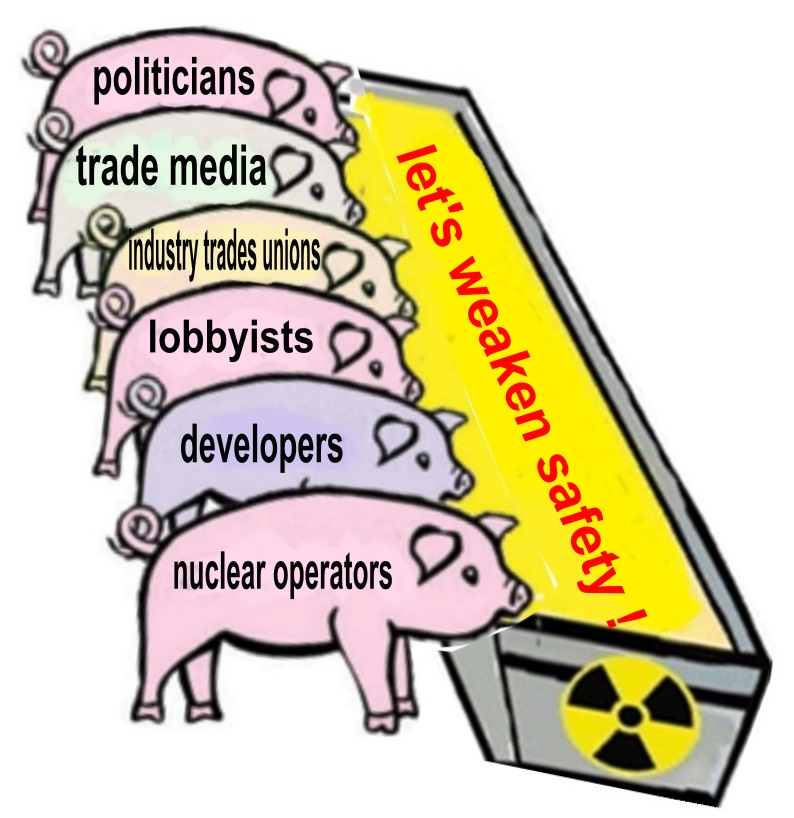
The reason comes down to profit, essentially: why listen to a bunch of bureaucrats telling you to slow down and play it safe when you could just fire up the uranium?
Move fast, break isotopes.,
By Joe Wilkins, Apr 12, 2026, https://futurism.com/science-energy/nuclear-startups-safety
The United States approach to nuclear energy is interesting, to say the least. Of all the countries harnessing the power of the atom, the United States is perhaps the most privatized nuclear energy system in the world. Most countries treat nuclear fission as a government affair — China runs its reactors through state-owned enterprises, and France went so far as to fully renationalize its main nuclear company in 2023. The States, meanwhile, leave their reactors almost entirely in the hands of the private sector.
Disciples of the free market will tell you this is exactly how things should be. If you don’t have a financial stake in the nuclear race, however, you might notice this arrangement comes with side effects like chronic understaffing and public subsidies of private profit. It also raises serious safety questions as a rising number of nuclear startups jostle for a piece of the atomic pie.
Case in point, new reporting by Politico‘s energy publication E&E News found that several baby nuclear companies are avoiding requests to join one of the industry’s main safety organizations. The regulatory body, called the Institute of Nuclear Power Operations (INPO), was formed in the fallout of the partial meltdown at Three Mile Island in 1979. While not a government body, the INPO is a nonprofit nuclear watchdog, responsible for conducting plant inspections, sharing operational guidance between nuclear companies, and helping companies train nuclear personnel.
For a nuclear energy company, joining the INPO is completely voluntary, though every operator has — until now. Of the nine nuclear startups which have sprouted up off the back of the tech industry’s data center boom, only one has signed up to join the INPO, E&E reported. These include companies like the “mass-manufactured nuclear” startup Aalo Atomics, and the “microreactor” company Antares Nuclear.
The reason comes down to profit, essentially: why listen to a bunch of bureaucrats telling you to slow down and play it safe when you could just fire up the uranium?
“These entities are businesses, and they’re trying to make money,” Scott Morris, a nuclear consultant and former US Nuclear Regulatory Commission (NRC) official, told E&E. “Any infrastructure that you put around that entity that is not directly contributing to its bottom line, it’s going to be questioned.”
Their decision to sidestep the INPO is even more concerning in the wake of Donald Trump’s regulatory cutbacks, which put the industry-led INPO in charge of regulations previously handled by the NRC. In effect, these moves have made certain operational regulations completely optional for nuclear energy companies.
“In fact, the NRC has delegated some of its regulatory authority, so to speak, to [the] INPO, specifically in the realm of operations and maintenance training programs,” Morris said. “The NRC and INPO are not duplicative; they’re complimentary.”
New Nuclear Is Too Late and Too Costly for the Climate Crisis

14 April 2026, Paul Dorfman, https://bennettinstitutesussex.org/stories/nuclear-is-too-late-and-too-costly-for-the-climate-crisis/
Dr Paul Dorfman, Bennett Scholar, makes a clear and evidence based case: new nuclear power cannot play a meaningful role in addressing the climate or energy crises. It is not simply expensive, it is structurally misaligned with the speed, scale and affordability required for effective climate action.
In the report, ‘Debt, Delays, Dependencies. Why Public Banks
Should Not Support Nuclear Power‘, Dr Dorfman’s contribution makes clear that new nuclear power represents a policy dead end, diverting scarce resources away from climate‑effective solutions. The opportunity cost is enormous: every pound invested in nuclear is a pound not invested in renewables, energy efficiency, storage or grid resilience. New nuclear is already too late. The renewable transition is happening now – and smart policy must move with it.
Key Findings
Dr Dorfman shows that time is the critical constraint. New nuclear projects consistently take 15–20 years from planning to operation, with average construction overruns of more than 60%. In contrast, wind and solar projects move from planning to generation in months to a few years, making them vastly more effective in the decisive decade for emissions reduction. The Intergovernmental Panel on Climate Change (IPCC) has concluded that renewables are now up to ten times more effective at cutting emissions than new nuclear, underscoring the urgency of choosing technologies that can deliver now rather than decades from now.
Cost compounds the problem. Dr Dorfman highlights that new nuclear is the most expensive form of electricity generation. Nuclear projects routinely double their initial cost estimates, while renewable technologies continue to fall rapidly in price due to economies of scale, innovation and fast global deployment.
The chapter also challenges the notion that nuclear complements renewables. Evidence shows that large, inflexible nuclear plants crowd out investment in grids, storage and flexibility – exactly the systems needed to integrate high shares of renewable energy. Meanwhile, renewables already deliver the bulk of new global power capacity, with wind and solar generating significantly more electricity than nuclear worldwide, and expanding at a far faster rate.
Finally, Dr Dorfman highlights a growing but under‑discussed risk: climate change itself threatens nuclear infrastructure. Rising sea levels, heatwaves, floods and water scarcity increasingly disrupt reactor operation, driving up costs and safety risks. Rather than being a climate solution, nuclear power is becoming more vulnerable because of climate impacts, further undermining its viability.
Why this matters for policy and innovation
Dr Dorfman’s chapter, ‘New nuclear: Too late and too costly for the climate and energy crises‘ has a central insight that aligns squarely with the Bennett Institute’s mission to accelerate effective, evidence‑based policy innovation. The persistence of nuclear in policy debates is not driven by outcomes, but by legacy thinking, political inertia and vested interests. Dr Dorfman’s analysis shows that innovation is not about new reactor designs, but about deploying solutions that already work, quickly, affordably and at scale. This research reinforces a core Bennett Institute principle: policy decisions must be grounded in real‑world delivery.
1 This Month
15 October. Joint Appeal for Nuclear Abolition Day -presentation to the UN on October 15 will be live on UNWebTV
Endorse the Nuclear Abolition Day Appeal
23-25 October – on Zoom – World BEYOND War’s annual global conference

To see nuclear-related stories in greater depth and intensity – go to https://nuclearinformation.wordpress.com
-
Archives
- October 2026 (129)
- September 2026 (339)
- August 2026 (330)
- July 2026 (355)
- June 2026 (287)
- May 2026 (306)
- April 2026 (356)
- March 2026 (251)
- February 2026 (267)
- January 2026 (308)
- December 2025 (358)
- November 2025 (359)
-
Categories
- 1
- 1 NUCLEAR ISSUES
- business and costs
- climate change
- culture and arts
- ENERGY
- environment
- health
- history
- indigenous issues
- Legal
- marketing of nuclear
- media
- opposition to nuclear
- PERSONAL STORIES
- politics
- politics international
- Religion and ethics
- safety
- secrets,lies and civil liberties
- spinbuster
- technology
- Uranium
- wastes
- weapons and war
- Women
- 2 WORLD
- ACTION
- AFRICA
- Atrocities
- AUSTRALIA
- Christina's notes
- Christina's themes
- culture and arts
- Events
- Fuk 2022
- Fuk 2023
- Fukushima 2017
- Fukushima 2018
- fukushima 2019
- Fukushima 2020
- Fukushima 2021
- general
- global warming
- Humour (God we need it)
- Nuclear
- RARE EARTHS
- Reference
- resources – print
- Resources -audiovicual
- Weekly Newsletter
- World
- World Nuclear
- YouTube
-
RSS
Entries RSS
Comments RSS

