America Is Losing the World—and It Doesn’t Know How to Stop
April 10, 2026, Joshua Scheer
The so-called ceasefire is already cracking—and anyone paying attention knows why.
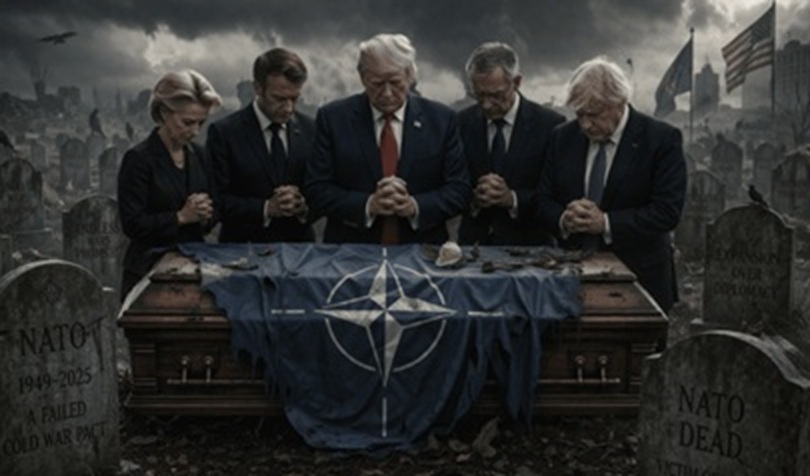
In this wide-ranging and unsettling conversation, retired U.S. Colonel Lawrence Wilkerson pulls back the curtain on a geopolitical order that is not stabilizing, but unraveling. The war with Iran isn’t ending—it’s mutating. NATO isn’t adapting—it’s collapsing. And the United States, rather than recalibrating to a changing world, is doubling down on the very policies accelerating its decline. With Wilkerson saying of NATO: “I think NATO’s dead. I’ve said that before, I’ll say it again. It may take a few months, even a couple of years, for everyone to finally pronounce it dead and say a prayer over its grave—but it’s dead.
Trump may never formally declare the United States is leaving NATO. He’s not that kind of leader—he’s mercurial, inconsistent. You’re not going to get a clear, cogent statement out of him. But it’ll happen all the same.
This is already a fatal situation. Ukraine put the dagger in NATO’s heart—but the wound was there long before that. It began when we broke our promises to Russia after George H.W. Bush, when we failed to integrate them into Europe.
Every president since—starting with Clinton—drove that knife in deeper.”
Wilkerson, a former insider at the highest levels of American power, doesn’t speak in euphemisms. He describes a system running on inertia, denial, and violence—where ceasefires serve as cover, diplomacy is treated as theater, and entire regions are sacrificed to maintain a crumbling illusion of control. The result is not just endless war abroad, but growing instability at home, with the specter of internal fracture no longer unthinkable but increasingly probable.
This is not analysis meant to reassure. It is a warning—from someone who has seen how these decisions are made, and where they lead.
The ceasefire is a lie—and the system selling it knows it.
In this blistering conversation, retired U.S. Colonel Lawrence Wilkerson doesn’t hedge, sanitize, or play along. He calls it what it is: a collapsing global order held together by deception, violence, and delusion. The so-called ceasefire with Iran, he warns, may be nothing more than a tactical pause—a familiar pattern where diplomacy becomes cover for the next round of escalation.
And the implications go far beyond one war.
Wilkerson flatly declares that NATO is “dead”—not weakened, not strained, but functionally finished, a relic already gutted by decades of broken promises and strategic arrogance. He points to a United States that has “created an enemy out of the whole planet,” pursuing confrontation over adaptation as global power shifts away from Western dominance.
Meanwhile, on the ground, the brutality continues. Civilians are being killed at scale, entire cities reduced to rubble, while political leaders posture and stall. There is, in Wilkerson’s assessment, “no inclination whatsoever” from Israeli leadership to stop the slaughter in Lebanon—making any broader ceasefire structurally impossible from the start.
But perhaps most alarming is what comes next.
Wilkerson warns that the United States is not just losing its grip abroad—it is fracturing internally. He describes a political system corrupted across branches, a military being reshaped along ideological lines, and a society saturated with weapons and polarization. The result? A credible path—not hypothetical, but emerging—toward internal conflict.
An empire in denial. A war without an endpoint. And a leadership class, in Wilkerson’s words, willing to “bomb the hell out of everything” rather than confront reality.
But the deeper story isn’t just about Iran or Israel. It’s about a global system breaking apart in real time—and leaders who would rather burn it down than adapt. Wilkerson describes a United States clinging to dominance it no longer has, fighting the rise of a multipolar world with sanctions, bombs, and denial. The result, he warns, is not stability—but escalation on multiple fronts at once.
He points to something even more destabilizing: a fundamental transformation in how power operates. Warfare is changing. Economics are shifting from sea to land. Alliances are dissolving. And yet Washington continues to act as if nothing has changed—doubling down on outdated strategies while the rest of the world moves on without it.
Some of the most important things for all Americans to understand—especially those who may not already—are truths like this from Wilkerson about the United States’ global position: “We’ve created an enemy out of the whole planet—and now we’re shocked the world is pushing back.”
The United States is confronting a reality it refuses to face: the world is changing, and where that change is acknowledged, it is met not with adaptation but with resistance—fought “tooth and nail.” At home, the decay is just as severe. The country, as Wilkerson puts it, has been “damned for a generation,” with dysfunction now entrenched across its core institutions—from Congress to the Supreme Court. That internal fracture is no longer abstract; it carries the real potential for conflict, with multiple factions poised in a nation that has “more guns than people.” And all of this is unfolding at the worst possible moment—during a period of imperial decline—where, in his blunt assessment, this is precisely when you do not want incompetent leadership steering a nation losing ground to rising powers.
As Wilkerson mentioned, there is is the distinct possibility of a civil war, with Wilkerson saying, “You have the potential for a lot of different people out there on the streets—and we have more guns than people.”
I would add this: when some states seem determined to drag us back into the dark ages—stripping away rights, narrowing the horizon of what it means to be free—and when our national leadership speaks of little beyond funding the machinery of war, it forces a reckoning. It makes one confront the unthinkable as something increasingly possible.
A nation cannot endure when its parts move in opposite directions—when some push toward repression while others struggle toward dignity and survival. At a certain point, unity becomes a fiction we tell ourselves to avoid the harder truth: that what we call a country may already be fractured beyond repair.
And if that is the case, then the question is no longer whether we hold together, but whether breaking apart might be the only way to prevent something far worse from tearing us apart first.
On that not at home, the consequences are just as severe. Wilkerson outlines a country hollowed out by corruption, gripped by polarization, and increasingly incapable of governing itself. Institutions are eroding. Trust is collapsing. And in that vacuum, more extreme forces are organizing, arming, and preparing for confrontation.
This is not just a warning about war abroad.
It’s a warning about what happens when a declining power refuses to recognize its own decline—and drags the world down with it.
1 Comment »
Leave a comment
1 This Month

To see nuclear-related stories in greater depth and intensity – go to https://nuclearinformation.wordpress.com
-
Archives
- September 2026 (184)
- August 2026 (330)
- July 2026 (355)
- June 2026 (287)
- May 2026 (306)
- April 2026 (356)
- March 2026 (251)
- February 2026 (267)
- January 2026 (308)
- December 2025 (358)
- November 2025 (359)
- October 2025 (375)
-
Categories
- 1
- 1 NUCLEAR ISSUES
- business and costs
- climate change
- culture and arts
- ENERGY
- environment
- health
- history
- indigenous issues
- Legal
- marketing of nuclear
- media
- opposition to nuclear
- PERSONAL STORIES
- politics
- politics international
- Religion and ethics
- safety
- secrets,lies and civil liberties
- spinbuster
- technology
- Uranium
- wastes
- weapons and war
- Women
- 2 WORLD
- ACTION
- AFRICA
- Atrocities
- AUSTRALIA
- Christina's notes
- Christina's themes
- culture and arts
- Events
- Fuk 2022
- Fuk 2023
- Fukushima 2017
- Fukushima 2018
- fukushima 2019
- Fukushima 2020
- Fukushima 2021
- general
- global warming
- Humour (God we need it)
- Nuclear
- RARE EARTHS
- Reference
- resources – print
- Resources -audiovicual
- Weekly Newsletter
- World
- World Nuclear
- YouTube
-
RSS
Entries RSS
Comments RSS
 nuclear-news
[…] Full reading at nuclear-news 2206 ♥ […]
Pingback by Analysis of U.S. global influence decline and NATO fragmentation amid geopolitical shifts - KillBait Archive | April 14, 2026 |