Trump’s Will Be Done
SCHEERPOST, April 14, 2026 Joshua Scheer Intro
At a moment when political power is increasingly wrapped in spectacle, symbolism, and something closer to religious devotion than democratic accountability, this piece from ScheerPost cuts straight through the illusion. In “Trump’s Will Be Done,” Kenneth A. Carlson examines the dangerous fusion of faith and politics that has helped elevate Donald Trump beyond the realm of politician and into something far more untouchable in the eyes of his followers.
Republishing this now feels especially urgent. As imagery, rhetoric, and power continue to blur into something resembling mythology, Carlson’s question lingers with uncomfortable clarity: not just what would Jesus do—but what happens when political loyalty begins to replace it.
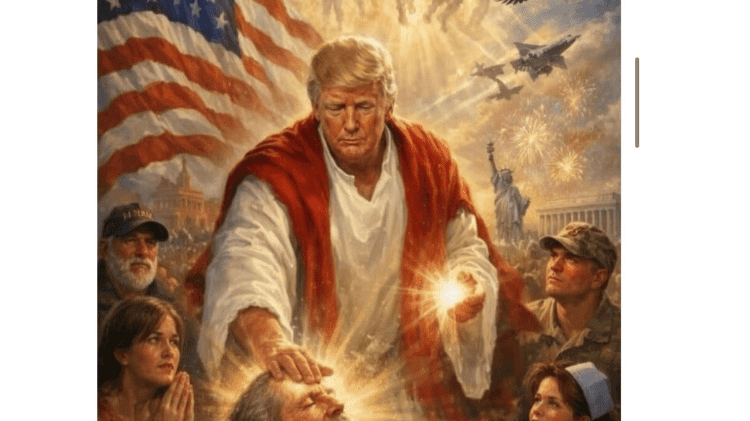
As the war abroad spirals and the stakes grow more dangerous by the day, the spectacle at home has taken on an almost surreal edge. President Donald Trump briefly posted—and then deleted—an AI-generated image depicting himself in Christ-like form, hands glowing as he “healed” the sick, wrapped in flags, fighter jets, and divine symbolism. When pressed, Trump dismissed the backlash, claiming it was merely an image of him as a doctor, not a messianic figure.
But the moment lands differently in a political climate already saturated with religious imagery, blind allegiance, and the merging of power with mythology. It’s not just a post—it’s a signal—one that fits neatly into a broader pattern where politics becomes performance, leadership becomes spectacle, and belief begins to blur into something far more dangerous.
Which brings us to the reality this piece explores: what happens when illusion collides with consequence.
By Kenneth A. Carlson ScheerPost
Trump’s Will Be Done
…………………………………………………………………………………………………………………………………………………………………………………………………………………………………………….. Today, Donald Trump, the former reality TV star, and those around him, understand how to do this all too well. They took their skillset to a new level as they somehow succeeded in fashioning him, and/or he fashioned himself, into a new role as a modern-day messiah — the Chosen One, the Second Coming, the Son of God. And I truly believe he sees himself this way. Remember, this is the same man who once bragged, “I could stand in the middle of Fifth Avenue and shoot somebody, and I wouldn’t lose any voters, OK?” The shocking thing about that statement? It’s likely to be 100% true.
And why? I believe it’s due to some extent to the unfortunate fact that critical thinking in our society is on life-support. People don’t question. They don’t dive deeply and independently into issues. They let others feed it to them in their own private echo chambers. The thirst for knowledge has been replaced by blind allegiance, paving the way for the rise of Donald “The Music Man” Trump — a master showman selling a reckless and dangerous illusion. ……………………………………………………………………
……………………………………. what Donald Trump has tapped into. He positions himself as a godlike figure, offering his followers a false sense of security — a “Daddy’s Home” mentality (yes, there are actual T-shirts for sale on Amazon).
Trump has lulled his base into a dangerous complacency, even as they watch stock markets tumble, inflation soar, entire agencies dismantled, jobs slashed, tariff wars escalated, and unemployment climb. Yet the news they consume assures them it’s all part of his grand plan, and so they wait — idly, expectantly — for a miracle. I never thought my livelihood would be at risk when I voted for him, they say, as if the consequences were unforeseeable.
But critical thinking has been shoved to the backseat, while blind faith handed Trump the wheel. Many have stopped questioning, stopped discerning, stopped seeking truth — because they believe the Almighty Donald Trump will ultimately take care of business.
Nothing could be further from the truth — and the sheer number of his businesses that have filed for bankruptcy should be proof enough. Six of his companies (that we know of) have sought Chapter 11 bankruptcy protection, allowing them to continue operating while erasing massive debts. But behind that legal maneuvering lies a harsh reality: hundreds, perhaps thousands, of workers, vendors, and small businesses left unpaid for their goods and services, are bearing the cost of his failures.
But none of that seems to matter to his unwavering base — the citizens of this so-called God-fearing nation. As a collective, today’s Evangelical and Charismatic Christians appear all too willing to believe a man who promises to end the wars in Ukraine and the Middle East within hours, slash grocery prices, “end inflation,” and miraculously lower the cost of eggs. He also assures us the economy will be “the best ever” — thanks, in large part, to tariffs imposed on both allies and adversaries alike. Few reputable economists would dispute the fact that American consumers will ultimately bear the cost of these tariffs — better known as taxes.
And yet, just over two months into his second term, none of these campaign promises have materialized — not even close. In fact, some might argue the exact opposite has happened.
So why do people still believe him? Why do they worship him with such fervent devotion? Why do they trust him with blind, unquestioning enthusiasm? I believe it’s because he has transcended the role of a mere politician. He has fashioned himself into something greater — a deity of sorts — untouchable, unquestionable, and, to many, infallible.
Trump’s will be done.
So when I ask myself today, ”What would Jesus do?,” the answer seems clear: seek truth, think critically, care for “the other” and break free from the echo chambers that breed blind allegiance. Because if we don’t, our Constitution could erode, our democracy could falter, and Donald Trump could seize the power to declare himself president for an unconstitutional third term — or worse, for life.
Not a Ceasefire—A Reset: The Quiet Expansion of Palestinian Incarceration
April 14, 2026, ScheerPost Staff, https://scheerpost.com/2026/04/14/not-a-ceasefire-a-reset-the-quiet-expansion-of-palestinian-incarceration/
While global attention drifts, the machinery of occupation does not slow—it tightens. Arrests replace releases. Silence replaces scrutiny. And behind it all, a system of incarceration continues to expand, largely out of view.
In this episode of Rattling the Bars, host Mansa Musa sits down with scholar-activist Dr. Rabab Abdulhadi to expose what they describe as a revolving door of detention shaping daily life for Palestinians. What emerges is not simply a prison system—but an architecture of control that extends far beyond prison walls, touching every aspect of Palestinian existence.
More than 9,000 Palestinians are currently held in Israeli custody—a number that continues to climb even after high-profile prisoner releases.
Despite the release of nearly 2,000 Palestinian prisoners during what was labeled a ceasefire in October 2025, a new wave of arrests has already erased that moment. Today, more than 9,000 Palestinians are again held in Israeli custody, according to Dr. Rabab Abdulhadi, with the total constantly shifting as new detentions replace those released.
“It’s a revolving door,” she explains. “You release prisoners—and then you arrest more.”
At the center of that system is administrative detention—imprisonment without charge, without trial, and often without end. Detainees may never be told what they’re accused of, while access to lawyers, family, and even basic information is severely restricted.
Two legal systems operate side by side: one for Israeli settlers, another for Palestinians. Even children are caught in it—Palestinian minors can be prosecuted as adults under military law, stripped of protections others receive.
Inside prisons, conditions continue to deteriorate: reduced food, denied medical care, and near-total isolation since October 2023.
But the system doesn’t end at the prison gates.
Night raids, arbitrary arrests, and movement restrictions turn daily life into an extension of confinement—what Abdulhadi describes as a reality where prison becomes a condition, not just a place.
Children grow up inside it. Families are fractured by it. Entire communities are shaped around it.
And still, the cycle continues.
“The people will resist because they want to live,” Abdulhadi says. This is not a story of what has happened—but of what is still happening, in front of our very eyes.
About children who can identify military aircraft before they can read. Children who grow up navigating checkpoints, raids, and the constant threat of arrest.
“They should not be scared every night,” Abdulhadi says. “They should not have nightmares.”
CND opposes new contract to build nuclear reactors on Anglesey.
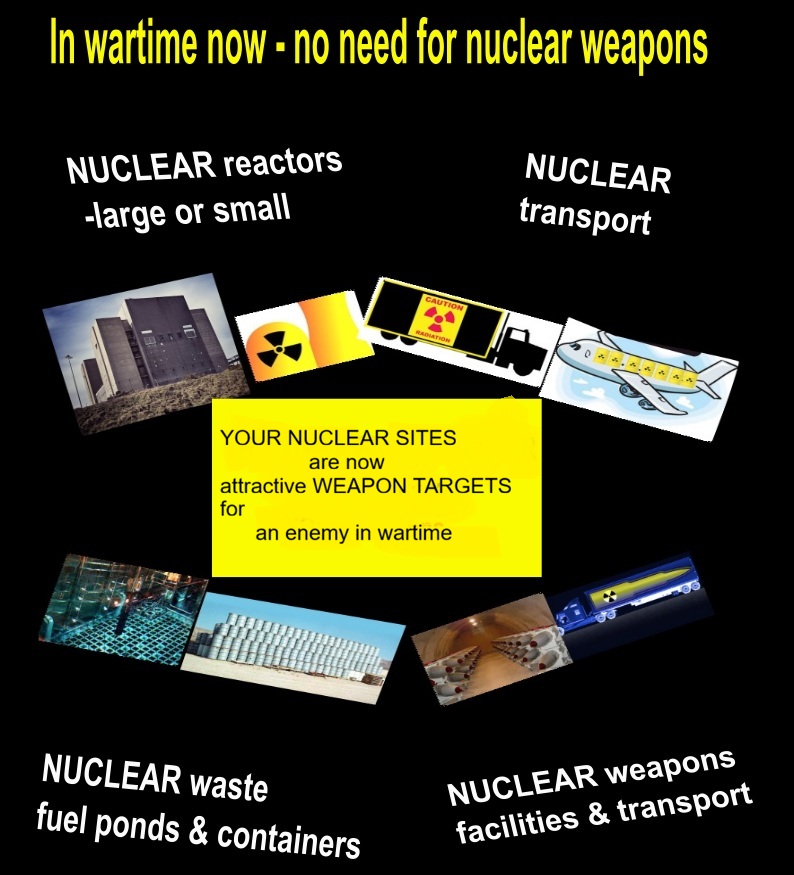
COMMENT Just by the way, in this new Trumpian era, our nuclear sites become a useful weapon for an enemy – an appealing target to be attacked
Anti-nuclear campaigners have condemned plans to build small modular
reactors (SMRs) at Wylfa on Anglesey, dismissing claims that they will
bring energy independence as a “fantasy” today.
CND Cymru commented
after contracts to construct Britain’s first SMRs in north Wales were
signed. Anglesey was selected last year to become the site of the SMR
programme by the Labour government at Westminster.
CND Cymru national
secretary Dylan Lewis-Rowlands said: “Nuclear power does not deliver
energy independence. Wales doesn’t mine fissile material, lacks the
ability to enrich it and convert it into fuel, and has no storage capacity.
“We need to end the corporate nuclear fantasy and focus on the
deliverable solutions that can be done quicker, cheaper and placed in the
hands of communities — that is how we truly make Wales energy
independent.”
Morning Star 13th April 2026, https://morningstaronline.co.uk/article/cnd-opposes-new-contract-build-nuclear-reactors-anglesey
US Aims at Heavy Staff & Budgetary Cuts for United Nations, Seeks to Launch Cost-Saving Artificial Intelligence at UN meetings

By Thalif Deen, UNITED NATIONS, Apr 6 2026 (IPS) –
The US has spelled out in detail its own concept of what a restructured United Nations should look like: after drastic reductions in staff, cutting down its budget, avoiding duplication in mandates, slashing peacekeeping operations worldwide and deploying artificial intelligence (AI) for translations and interpretations in six languages.
As the biggest single contributor to the UN budget—and despite nearly $4.0 billion in unpaid dues—it is using its perceived financial clout to help radically change the world body.
The US says it wants to “make UN great again (MUNGA)”—a variation of President Trump’s oft-repeated slogan “Make America Great Again (MAGA).” ”.
But will it work? And is it feasible?
Ambassador Mike Waltz, U.S. Representative to the United Nations, addressing a Congressional Field Hearing on UN Reform, said last week, “As I stated in my confirmation hearing, the UN truly does need to get what we’re calling back to basics and back to its original mission, from its founding, back to maintaining international peace and security.
“As I’ve mentioned in my hearing then, the UN’s budget in the last 25 years has quadrupled. We have not seen, arguably, a quadrupling of peace and security around the world commensurate with those hard-earned dollars, he said.
“So, we are pressing it. We’re pressing it to streamline its bureaucracy, to eliminate duplication. We’ve made it clear that we will cease participation in some UN agencies that undermine our sovereignty and cannot be reformed.”
Earlier this year, he pointed out, President Trump announced “our withdrawal from 66 international organizations. That review is ongoing. And from my perspective, let me be clear, the U.S. will not fund organizations that act contrary to our interests.”
“On UN compensation and personnel,” he said, “We’re leading reforms to what are often exorbitant compensation and benefit standards that the over 100,000 UN staff receive. The UN pays 17% more than US equivalent civil servants, even though many of them are right here in New York.
“They also have additional generous benefits packages far exceeding what our great civil servants, both here and abroad, receive. And staff costs alone are 70% of their regular budget for these things we’re trying to bring back in line.
“So, we need to, and we are working to bring those compensation and benefits packages back in line with common-sense standards. Part of that will be the pension. There’s over $100 billion in management in the UN pension with 16%—I don’t know of an employer or a government out there that contributes 16% to their pension.”
And there are other reforms, he said.
For example, the number of interpreters and translators—times six for the six UN languages here—technology can be used, AI can be used, and remote translation can be used that will save a lot of the travel and the conference costs, said Waltz.
Stephen Zunes, Professor of Politics at the University of San Francisco and director of Middle Eastern Studies, who has written extensively on the politics of the United Nations, told Inter Press Service (IPS) this is not about cost-cutting or fiscal responsibility.
“Like cutbacks to important U.S. government agencies and domestic programs, the Trump administration appears determined to dismantle the system itself.”
This should be understood in the context of pulling out of international organizations and treaties, the establishment of the so-called “Board of Peace,” the Iran War, and the recently announced dramatic increases in military spending—it is about undermining international legal institutions and replacing them with an imperial order backed by raw military force, said Zunes.
Richard Gowan, Program Director, Global Issues and Institutions, at the Brussels-based International Crisis Group, told IPS in the first half of 2025, U.S. policy towards the UN was pretty chaotic, and diplomats from other countries really had no idea what Washington wanted from the world organization.
Like it or not, he said, Mike Waltz and his team have brought some message discipline and are clarifying their goals for the UN pretty sharply.
“Most diplomats say that Waltz can be reasonable in private and that ultimately, he and his team want to reshape the UN rather than just wreck it. There are times when Waltz goes out of his way to bash the UN and individual UN officials on social media, but I think that is partly him playing to the Republican base.”
Waltz is clear that he wants a slimmed-down UN, Gowan pointed out, and it is worth admitting that this is a popular message among many UN member states. The U.S. is not alone in thinking that the organization’s bureaucracy has grown too big and needs a tough financial diet.
“Trump, Rubio and Waltz are pretty consistent in arguing that the UN should focus on peace and security issues. But I think the administration has not really convinced most other UN members that it has a plan to make the UN deliver on conflict prevention and diplomacy again.”
Instead, he said, the U.S. appears to have a very selective and instrumentalist approach to when and how it uses the UN as a security partner. It wants the UN to help in Haiti but to get out of the way in Lebanon. I do not think there is really a coherent vision at work here. It is a very ad hoc, case-by-case approach.
“Trump’s boosting of the Board of Peace as a potential alternative to the UN has complicated Waltz’s position too. The fact that Trump is willing to flirt with the Board, even if it is not a very serious institution, makes it harder to believe that Washington really wants the UN to regain credibility on peace and security,” declared Gowan.
Meanwhile, excerpts from Ambassador Waltz’s testimony include the following:
- “On budget and staffing cuts, the UN should be doing less and doing it better. Let’s get it more focused and actually achieve more results. The 2026 UN regular budget was estimated at $3.45 billion. The U.S. funds roughly a fifth of that at $820 million in 2025 alone.
- Again, I think we need to reduce the UN’s size and assure every taxpayer dollar is spent responsibly, and thanks to the strong efforts by the United States, led by Ambassador Bartos here and his team in what we call the UN’s Fifth Committee, which approves its budget, we are working towards a leaner and better prioritized 2026 budget going forward.
- In December, we led Member States to adopt a historic 15% cut. $570 million out of the UN’s regular budget. That will eliminate nearly 3000 headquarters positions. And for our contribution, it will reduce our assessment by $126 million. So just in the six months that we’ve been here, we will see going forward, $126 million savings to the U.S. taxpayer.
- We’ve also pushed for a 25% reduction in peacekeeping troops, and I’ll talk a bit about other peacekeeping reforms in a moment that will also save us tens, if not hundreds of millions of dollars while enabling what we call here the repatriation, the sending home of poorly performing peacekeeping troops.
- From an oversight perspective, beyond the salaries and benefits, oversight is essential. We’re leading efforts to empower oversight bodies to root out waste, fraud, abuse, and misconduct.
- On peacekeeping reform, he said, the administration has been clear about focusing on the core mandate of peace and security, and we’re leading efforts to wind down some of these ineffective and costly peacekeeping missions.
………………………………………………………………………………………………………………………….. “We will have a new Secretary-General elected this year, and we’re having those conversations now with the candidates about what they seek to keep and continue or what new things they seek to put in place, but reform is at the top of our list as we meet with some of these candidates.
“So, this is a critical moment with senior leadership transitions approaching here over this next year. We need to have a clear message. We will prioritize qualified Americans. Representative DeLauro, along the lines of what you sought to do so many years ago, of having qualified Americans in UN leadership positions, not just here, but across the ecosystem in Geneva, in Vienna, and Nairobi and other places where you have UN agencies.
“And I’ll just conclude with echoing President Trump’s own words.
“As he said most recently at the General Assembly, the UN has tremendous potential. My charge from him is to help it realize that potential. We are dedicated to making the UN live up to that promise, to making the UN great again—if I can say so, our new acronym is MUNGA…………. https://www.ipsnews.net/2026/04/us-aims-at-heavy-staff-budgetary-cuts-seeks-to-launch-cost-saving-artificial-intelligence-at-un-meetings/?utm_source=email_marketing&utm_admin=146128&utm_medium=email&utm_campaign=US_Pushes_Sweeping_UN_Cuts_Including_Staff_Reductions_and_Budget_Slashes_Inequalities_in_Human_Morta
Ceasefire Exemptions and Quarries of Death: Israel’s War on Lebanon
11 April 2026 Dr Binoy Kampmark, https://theaimn.net/ceasefire-exemptions-and-quarries-of-death-israels-war-on-lebanon/
In the Devil’s Dictionary, Ambrose Bierce defines peace as a period of cheating between two periods of fighting. The Israeli version of a ceasefire might be defined as a moment of war deceptively halted to enable conflict to continue. War as cosplay and camouflage. Under such fragile conditions, military objectives can still be pursued with a ruthlessness offensive to international law, custom and common sense.
Seeing as Israel was a central, if not the central power in pushing the crime of aggression on February 28 against Iran, wooing with seductive voice and lurid promise a deranged egoist in the White House (glory and oil awaits thee, Mr President), not to mention the dedicated thorn in any Middle East peace process that threatens sabotage to any enduring arrangements, the continued attacks on Lebanon seemed quotidian. With a war crimes habit well and truly formed, Israel had already issued displacement orders for some 14% of Lebanon, including areas south of the Zahrani River, a majority chunk of Beirut’s southern suburbs and cuts of the Beqaa region.
With their campaign hitting its strides, the Israeli Defense Forces showed no intention of ceasing operations, despite a Pakistan mediated ceasefire that had paused hostilities between Tehran and Washington. While the parties wrangled over what conditions the Strait of Hormuz would be opened under and what a more lasting peace agreement might look like, Israel exempted itself. While not striking Iran, it would continue its onslaught in Lebanon, despite statements from Pakistan Prime Minister Shehbaz Sharif that the ceasefire would also apply to Lebanon. In the words of Israeli Prime Minister Benjamin Netanyahu, “Israel supports President Trump’s decision to suspend strikes against Iran for two weeks subject to Iran immediately opening the straits and stopping all attacks on the US, Israel and countries in the region.” However, the “ceasefire does not include Lebanon.”
Even homicidal routines can shock with spikes of freakish, callous intensity. These included the 100 strikes within 10 minutes on April 8 that resulted in the deaths of at least 303 people, with 1,150 injured. The Israeli authorities claimed that the majority of those killed were members of Hezbollah, though even a two-third fraction takes it into less than principled territory. The targets lay in the southern suburbs of Beirut, southern Lebanon and the eastern Bekaa Valley. In justifying the slaughter, the IDF expressed the usual pride akin to tribes seeking scalps: the raids had “eliminated Ali Yusuf Harshi, the personal secretary and nephew of Hezbollah Secretary-General Naim Qassem.” Another official dead, only for another to take his place in due course.
The usual, casual destruction of infrastructure that would rankle most justice departments was also celebrated, with the IDF striking “two key crossings used by Hezbollah terrorists and commanders for movement from north to south of the Litani River in Lebanon to transfer thousands of weapons, rockets, and launchers.” Use of such crossings by civilians was of no interest, though the United Nations Office for the Coordination of Humanitarian Affairs (OCHA) did state on March 23 that the destruction of crucial bridges had “significantly [disrupted] movement and humanitarian access,” with certain strikes severing the link between Tyre and Nabatieh, while also limiting “movement between south Lebanon and West Bekaa, including Marjayoun and Hasbaya.”
The previous night, Israeli forces struck a building in front of Hiram Hospital in Al-Aabbassiye, near Tyre. This damaged the hospital and cost the lives of four people. Another strike on the Islamic Health Authority in Qlaileh hit an ambulance, resulting in three deaths. When it comes to targeting and the IDF, categories are highly mutable.
The scale of such killings astonished the United Nations Human Rights Chief Volker Türk. “The scale of the killing and destruction in Lebanon today is nothing short of horrific,” stated the High Commissioner on April 8. “Such carnage, within hours of agreeing to a ceasefire with Iran, defies belief. It places enormous pressure one a fragile peace, which is so desperately needed by civilians.” In truth, they need far more than a fragile peace, and certainly not the targeting pedantry that appears in IDF briefings and justifications, the sort that see corpses as more useful and living civilians. Even in war, Türk states in firm reminder, “Each and every attack must comply with international humanitarian law fundamental principles of distinction, proportionality and precautions to protect civilians.”
The UN official must surely know by now that Israel operates in a vacuum all who have committed crimes in international law inhabit, the quarry of the necropolis, the architectural vision of the Grim Reaper. Even the names for Israel’s military operations are drawn increasingly from the dark – literally. “Operation Eternal Darkness was a very powerful blow to Hezbollah, leaving it stunned and confused by the depth of the penetration and the scale of the track,” glowed Israeli Defence Minister Israel Katz in his video statement. “More than 200 terrorists were eliminated yesterday, bringing the number of those eliminated in this campaign to 1,400.” This was “more than double the number in the Second Lebanon War.” It’s all about thanatotic accounting.
This butchery has taken place in conjunction with the establishment of a four-line security zone in Lebanon. The first is the unimaginative and common destruction of Lebanese villages that might serve as launching posts for Hezbollah attacks and briefing notes for prosecutors of international criminal law; the second constitutes a “defensive line” in Lebanon, currently made up of five forward army posts, and set to bulk to 15. The third comprises the “anti-tank” line and the fourth the Litani River, a goal of security so cherished as to be fetishised in Israeli military objectives. There, according to Katz, the IDF will “prevent further infiltration of terrorists and the return of residents southbound.”
A stunning volte face in these arrangements would be the acceptance of a ceasefire and a genuine affirmation that peace is preferable to war. But the Israeli military-political complex seems to relish the view of US President Theodore Roosevelt, who proudly thundered that the benefits of a prosperous peace would never eclipse or exceed those of war, especially waged with a righteous temper. But budgets for killing and conquest thin over time, as do the support of powers who, for all their abundant hypocrisy, may finally relinquish their backing. The momentum is against Israel, however slow the turning.
1 This Month
23-25 October – on Zoom – World BEYOND War’s annual global conferenc


Shut down the radiation-damaged Heysham nuclear reactors now
To see nuclear-related stories in greater depth and intensity – go to https://nuclearinformation.wordpress.com

Say No to NASA’s Reckless Nuclear Reactor on the Moon
Say No to NASA’s Reckless Nuclear Reactor on the Moon

-
Archives
- October 2026 (247)
- September 2026 (339)
- August 2026 (330)
- July 2026 (355)
- June 2026 (287)
- May 2026 (306)
- April 2026 (356)
- March 2026 (251)
- February 2026 (267)
- January 2026 (308)
- December 2025 (358)
- November 2025 (359)
-
Categories
- 1
- 1 NUCLEAR ISSUES
- business and costs
- climate change
- culture and arts
- ENERGY
- environment
- health
- history
- indigenous issues
- Legal
- marketing of nuclear
- media
- opposition to nuclear
- PERSONAL STORIES
- politics
- politics international
- Religion and ethics
- safety
- secrets,lies and civil liberties
- spinbuster
- technology
- Uranium
- wastes
- weapons and war
- Women
- 2 WORLD
- ACTION
- AFRICA
- Atrocities
- AUSTRALIA
- Christina's notes
- Christina's themes
- culture and arts
- Events
- Fuk 2022
- Fuk 2023
- Fukushima 2017
- Fukushima 2018
- fukushima 2019
- Fukushima 2020
- Fukushima 2021
- general
- global warming
- Humour (God we need it)
- Nuclear
- RARE EARTHS
- Reference
- resources – print
- Resources -audiovicual
- Weekly Newsletter
- World
- World Nuclear
- YouTube
-
RSS
Entries RSS
Comments RSS

