Nuclear costs of the Iran War
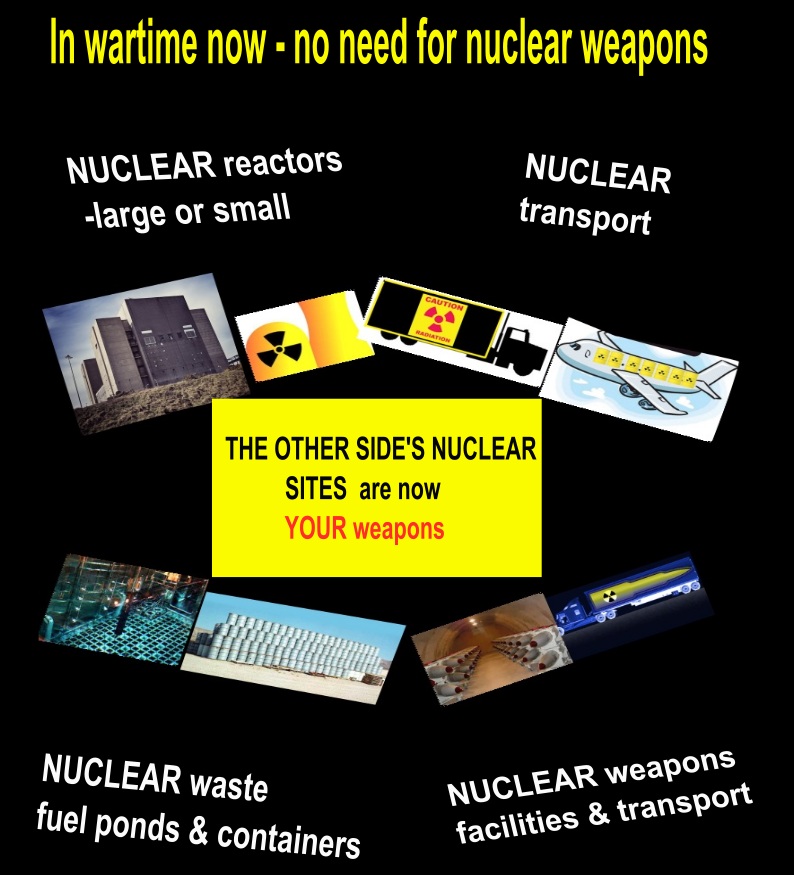
To create a nuclear disaster, it’s not necessary to directly hit the containment building. Damaging on-site and off-site power necessary for cooling can also have severe repercussions.
even reactors in stand-by modes pose radioactive risks in a war zone.

In spite of all this, Director General of the IAEA Grossi promotes rules of the road to help nuclear energy continue operating in warzones. It is a stark reminder that the IAEA’s major mission is to promote nuclear energy, despite the emerging lessons from two “nuclearized” wars.
by beyondnuclearinternational, https://beyondnuclearinternational.org/2026/04/11/nuclear-costs-of-the-iran-war/
Trump’s recent threats to end civilization in Iran gave many a nuclear weapons expert the jitters, writes Sharon Squassoni
President Donald J. Trump’s recent threats to end civilization in Iran gave many a nuclear weapons expert the jitters. For them, existential threats mean only one thing: use of nuclear weapons. Thankfully, Trump’s April 7, 2026 threats were empty and possibly just a ruse to create a dramatic background for the temporary ceasefire in Iran.
To be clear, the use of nuclear weapons in combat would serve no earthly strategic or tactical purpose, but threats to use them can be potent: even a latent capability in the hands of Iran was regarded as too threatening for the United States to tolerate any longer, which reportedly drove the U.S. and Israeli military actions.
It’s hard to tell who’s winning or losing in this conflict, but already it’s clear that disruption of energy sources (Iran’s blocking the Straits of Hormuz and the U.S. and Israel striking Iran’s oil infrastructure) focuses attention like no other infrastructure attack. A sudden cutoff that shrinks supplies and distorts prices echoes in economies across the globe.
This is one reason the world was hesitant to impose sanctions on Iran’s oil some twenty years ago when Iran’s clandestine nuclear program was first unveiled. Today, the Iran war has underscored just how dependent the world continues to be on foreign sources of oil.
Would nuclear energy be any different?
Since 2022, there has been a push in Europe and elsewhere to deploy nuclear reactors to reduce dependencies on Russian oil and gas, triggered by Russia’s invasion of Ukraine. But such a response is almost laughable to anyone paying attention to what has transpired in Ukraine in the last four years.
Russia hesitated not at all to hold the Chernobyl and Zaporizhzhia nuclear power plants hostage, in addition to firing upon them. The only thing that has saved Ukraine from a major nuclear meltdown is the fact that Russia wants to save Ukraine for itself, rather than destroy it utterly.
For those who still believe in international laws, there are rules to prevent attacks on nuclear plants — specifically the Protocol I Additional to the Geneva Conventions, a key document in international humanitarian law adopted in 1979 — that 175 countries follow.
Unfortunately, Russia withdrew in 2019 and the US has never ratified Protocol I (along with Israel, India, Pakistan, Turkey and Iran). The Protocol protects “works and installations containing dangerous forces,” prohibiting attacks on nuclear power plants that generate civilian electricity, among other things. It concedes that some nuclear power plants that regularly support military purposes may be attacked.
For those paying attention to nuclear development trends, this should be worrisome because both China and the United States have programs to develop nuclear reactors for specific military uses. Not content to learn from past experience, the United States plans to deploy a military microreactor by July 4th of this year. Leaving aside questions of cost, safety and peacetime security, such deployments will widen the base of deadly targets in war. Civilians won’t care whether international law deems these “legitimate” targets of attack.
Attacks on nuclear facilities themselves are not new. The United States, Russia, Israel, Iran and Iraq have all, at times, targeted nuclear research and power reactors under various stages of construction and operation in the past. Sometimes these attacks tried to slow nuclear weapons proliferation programs and sometimes, as in the Iran-Iraq war, they were targeted for less specific purposes.
After the June 2025 attacks on uranium enrichment-related facilities by the United States, touted as “obliterating” Iran’s nuclear program, International Atomic Energy Agency Director General Rafael Grossi warned that a strike on the Bushehr power plant could cause a regional catastrophe.
Recently, Iran’s Foreign Minister Abbas Araghchi has claimed that the Bushehr plant, which generates close to 1000 Megawatts of electricity, has been struck four times since February this year. The closest hit has been 75 meters from the plant on April 4, killing a security guard and damaging a building. Russia, which has 128 Rosatom personnel at the plant, is considering further evacuations, which sounds eerily similar to what happened to the Zaporizhzhia plant in March 2022.
To create a nuclear disaster, it’s not necessary to directly hit the containment building. Damaging on-site and off-site power necessary for cooling can also have severe repercussions. In the case of Zaporizhzhia, operators shut down reactors to minimize some of the risks. But even reactors in stand-by modes pose radioactive risks in a war zone.
The Bushehr power plant is still operating and has spent nuclear fuel on-site in spent fuel pools. Who can forget the video footage of the Fukushima Daiichi nuclear power plant in 2011 when crews attempted to spray seawater from helicopters on spent fuel pools damaged by the earthquake and tsunami that devastated Japan? More than a decade later, the site is still undergoing remediation.
In spite of all this, Director General of the IAEA Grossi promotes rules of the road to help nuclear energy continue operating in warzones. It is a stark reminder that the IAEA’s major mission is to promote nuclear energy, despite the emerging lessons from two “nuclearized” wars.
In fact, learning the wrong lessons from this conflict could carry the seeds of unimaginable future disruption. A world that fears reliance on foreign energy could rely even more on nuclear energy for not just electricity, but transportation and data processing, the new currency of power. The greater the reliance, the keener officials will be to keep it up and running. More and more widely distributed nuclear targets will not be protected by Protocol I of the Geneva Convention, or by the International Atomic Energy Agency. There is no International Nuclear Red Cross or Emergency Management Agency.
Many Americans find it hard to contemplate attacks on U.S. soil, with good reason. This is why the 9/11 attacks affected the population so deeply. Those attacks sparked significant improvements in security at nuclear power plants that are now being unraveled by a push to deploy nuclear reactors in the United States as quickly as possible.
In fact, learning the wrong lessons from this conflict could carry the seeds of unimaginable future disruption. A world that fears reliance on foreign energy could rely even more on nuclear energy for not just electricity, but transportation and data processing, the new currency of power. The greater the reliance, the keener officials will be to keep it up and running. More and more widely distributed nuclear targets will not be protected by Protocol I of the Geneva Convention, or by the International Atomic Energy Agency. There is no International Nuclear Red Cross or Emergency Management Agency.
Many Americans find it hard to contemplate attacks on U.S. soil, with good reason. This is why the 9/11 attacks affected the population so deeply. Those attacks sparked significant improvements in security at nuclear power plants that are now being unraveled by a push to deploy nuclear reactors in the United States as quickly as possible.
The Nuclear Regulatory Commission recently voted to discontinue force-on-force commando drills designed to reveal weaknesses in site vulnerabilities. A victim of the DOGE process, the NRC has been stripped of its independence and will now overhaul the entire licensing process, even as the Trump administration seeks to end-run the NRC by deploying new reactors on government sites owned by the Departments of Energy and Defense.
If anything, the Iran war demonstrates Gulliver’s dilemma. Both Ukraine and Iran have used drones successfully to compensate for conventional force inferiority. Are we truly prepared to counter cheaper and more plentiful attacks that are more difficult to detect and defend against?
Iran’s nuclear program was feared for its potential to provide the basis for nuclear weapons. Now it is generating fear for its potential to provoke a more imminent regional catastrophe, whether intended or accidental. These security risks, perhaps not widely appreciated now, will only grow in a more nuclearized future.
Jeffrey Sachs: Ending Israel’s War on Peace
To make lasting peace in the Middle East, the US must end its blank check to Israel’s perpetual wars and join with the rest of the world to force Israel to live within its internationally recognized borders of June 4, 1967.
Jeffrey D. SachsSybil Fares, Apr 09, 2026, https://www.commondreams.org/opinion/israel-war-on-peace
A two-week ceasefire has partially halted the Israel-US war on Iran. The war accomplished precisely nothing that a competent diplomat could not have achieved in an afternoon. The Strait of Hormuz was open before the war and it is open again now, but with more Iranian control.
Meanwhile, the chaos continues. Israel is intent on blowing up the ceasefire, as this was Israel’s war from the start. Israel dazzled Trump with the prospect of a one-day decapitation strike that would put Trump in charge of Iran’s oil. Israel, in turn, was out for bigger prey: to bring down the Iranian regime and thereby become the regional hegemon of Western Asia.
The foundation of the ceasefire is Iran’s 10-point plan, which Trump (perhaps unwittingly) called a “workable basis on which to negotiate.” The plan makes sense, but it is a major climbdown for the US, and probably a redline for Israel. Among other points, the plan calls for an end to the wars raging in the Middle East, almost all of which have Israel at their root cause. The plan would also resolve the nuclear issue, essentially by going back to the JCPOA that Trump ripped up in 2018.
The Iran War, and the other wars raging across the Middle East, trace back to one core Israeli idea, that Israel will permanently and steadfastly oppose a sovereign Palestinian state and will topple any government in the Middle East that supports armed struggle for national sovereignty. It is crucial to note that the UN General Assembly has passed multiple resolutions, such as Resolution 37/43 (1982), affirming that political self-determination is so vital, that armed struggle in the quest for self-determination is legitimate. The UN was born, in part, out of the determination to end the centuries of European imperial domination over Africa and Asia. Of course, there would be no cause for armed struggle if Israel would accept a political solution, notably the two-state solution that has overwhelming support throughout the world.
The peace is within reach, if the US grasps it.
Netanyahu’s core goal may be summarized as Greater Israel. This means no Palestinian sovereignty, and no clear boundaries for Israel even beyond the boundary of historical Palestine under British rule after WWI. Zionist extremists like Netanyahu’s political allies, Ben-Gvir and Smotrich favor Israeli control over parts of Lebanon and Syria, as well as permanent control over all of what was British Palestine. America’s Christian Zionists, exemplified by the US Ambassador to Israel Mike Huckabee, and a strong voter base of Trump, speak of God’s promise to Israel of the lands between the Nile and the Euphrates. Crazy stuff, but these are real beliefs, nonetheless, and they are conveyed in the White House.
Israel’s strategy is therefore regime change in every country that resists Greater Israel, a plan already foreshadowed in the famous political document “A Clean Break: A New Strategy for Securing the Realm,” written by US Zionist neocons as a platform for Netanyahu’s new government in 1996. We’ve had constant wars in the Middle East since then to implement the Clean Break vision. This has included the war in Libya to overthrow Moammar Qaddafi, the wars in Lebanon, the war to overthrow Syria’s Bashar al-Assad, the war to overthrow Iraq’s Saddam Hussein, and now the war to topple the Iranian regime.
This is not to say that the US lacks its own grandiose ideas. Israel wants regional hegemony, this is not a secret. Netanyahu confirmed these ambitions in his recent remarks about Israel becoming “a regional power, and in certain fields a global power.” On the other hand, American officials dream of global hegemony. And Trump dreams of money. He craves the Iranian oil and repeatedly said so.
In any event, it’s clear that this war was Netanyahu’s creation. He and the Mossad chief came to Washington to sell Trump a bill of goods. It’s not hard. Trump was suckered, while everybody else had their doubts about Netanyahu’s claims of an easy one-day decapitation strike—essentially a replay of the US operation in Venezuela.
It’s pathetic to “listen in” on the White House discussion, as revealed by the New York Times. Netanyahu, a con man, presented rosy scenarios of regime change that US intelligence contradicted, yet Trump foolishly accepted. Trump and Netanyahu were cheered on by Christian Zionists (Hegseth), Jewish Zionists and real-estate developers (Kushner and Witkoff), a faith healer (Franklin Graham), and high-level sycophants (Rubio and Ratcliffe).
While Trump was telling the world that Iran was begging for a ceasefire, it was Trump himself who was begging for a ceasefire.
Until Tuesday evening, it looked like Trump might lead the world blindly to World War III. The vulgarity and brutality of his public rhetoric was unmatched in US presidential history. Now we know that he was desperately seeking an off-ramp and using Pakistan for that purpose. While Trump was telling the world that Iran was begging for a ceasefire, it was Trump himself who was begging for a ceasefire. The Pakistani leader delivered it.
The ceasefire is good, and the 10-point plan is good, even if perhaps Trump didn’t know what was in it when he said that it was a good basis for negotiation. Israel will, in any event, work overtime to break it, and has already started to do so, with carpet bombing of Beirut that is killing hundreds of civilians, and with other strikes. A permanent US-Iran agreement is the last thing that Netanyahu wants. That would end his dream of Greater Israel.
Yet there is a way to peace and that is for the US to face reality. Israel is the real “terror state,” waging perpetual war throughout the Middle East for a wholly indefensible reason—to have unchecked freedom to terrorize and rule over the Palestinian people and to expand its borders as Israel’s zealots see fit. To make lasting peace in the Middle East, the US must end its blank check to Israel’s perpetual wars and join with the rest of the world to force Israel to live within its internationally recognized borders of June 4, 1967. Iran’s 10-point plan can be the basis of a comprehensive regional peace—if the US accepts the reality of a state of Palestine. In that case, Iran would likely agree to stop funding non-state belligerents, and Israel, Palestine, Lebanon, and the entire region could live in mutual security and peace. That outcome should be the basis of a negotiated agreement of the US and Iran in the next two weeks.
Israel is the real “terror state,” waging perpetual war throughout the Middle East for a wholly indefensible reason…
The American people have made their views clear. A 2025 Pew survey finds most Jewish Americans lack confidence in Netanyahu and back the two-state solution. Most Americans now view Israel unfavorably, the highest unfavourability in history. Sympathy for Israel has hit a 25-year low. Now the political class must catch up with the public.
The peace is within reach, if the US grasps it. Iran’s proposal is serious and the ceasefire is a fragile opening for a comprehensive settlement. The question is whether the US will, once again, allow Israel to destroy the peace, or rather this time stand up for America’s interests and the world’s interests in a lasting peace.
Goiânia Survivors Challenge Netflix: ‘A Crime Against the Truth’
09.04.26 – Rio de Janeiro, Brazil – Pressenza New York, https://www.pressenza.com/2026/04/goiania-survivors-challenge-netflix-a-crime-against-the-truth/
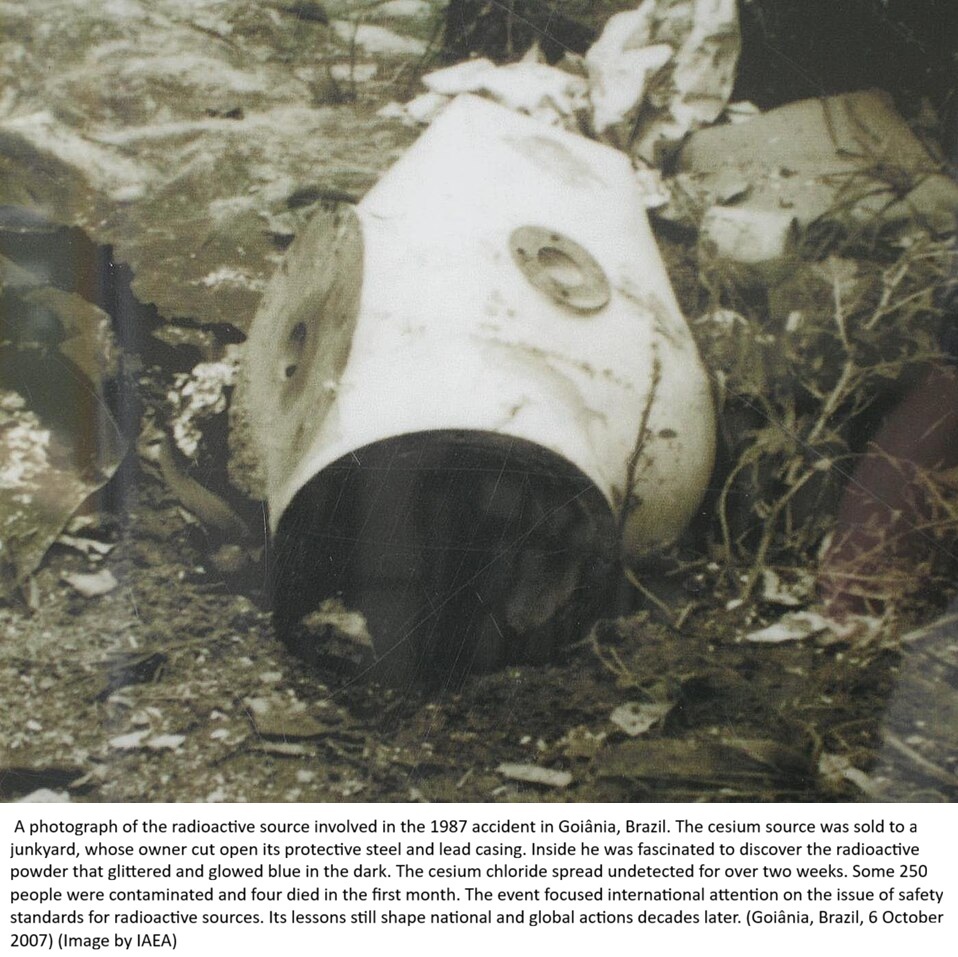
In 2017, Odesson Alves Ferreira, a survivor of the 1987 Goiânia nuclear disaster in central Brazil, received the Lifetime Achievement Award of the International Uranium Film Festival. Odesson himself was severely contaminated by the highly radioactive cesium-137 and lives with the consequences. For over 30 years, he has campaigned for the recognition and fair compensation of the hundreds of cesium victims and for ensuring that this radioactive disaster in Goiânia is never forgotten and never repeated. Now he is strongly criticizing the new Netflix miniseries “Radioactive Emergency”.
By Norbert Suchanek
Netflix series “Radioactive Emergency” distorts facts
In September 1987, the worst nuclear disaster in Latin American history occurred in the central Brazilian city of Goiânia. A scrap metal dealer unknowingly released highly radioactive cesium-137 from an abandoned cancer treatment device, contaminating parts of the city and hundreds of people. Now, in March Netflix has released the miniseries “Radioactive Emergency,” based on this nuclear disaster and claiming to be inspired by true events. However, cesium-137-survivors dispute this. They argue that the Netflix series distorts the facts and ignores the victims.
“The distortion of historical facts is not only a narrative error, but in my view, also a profound disrespect to the memory of the victims and to us survivors,” criticizes Odesson Alves Ferreira, brother of scrap metal dealer Devair Alves Ferreira, who in 1987 bought the lead-encased radioactive head from two young waste pickers without even suspecting that it contained radioactive material.
In his statement to the Brazilian news portal Metrópoles regarding “Radioactive Emergency,” Odesson says: “By distorting the tragic historical facts for the sake of expediency, to make the plot more scientific and commercial, Netflix committed a crime against the truth. The true story we experienced doesn’t need sensational embellishments; it was tragic enough in itself.”
According to the 71-year-old, the streaming service “turns the victims of an irresponsible system into perpetrators and trivializes the tragedy. The memory of Brazil’s worst radioactive tragedy must be protected. We will not simply accept history being rewritten for convenience, because those who ignore the past are doomed to repeat its mistakes.” The former president of the Association of Cesium Victims (AVCésio) also criticizes that the Netflix film crew did not consult those actually affected beforehand.
According to the association, which represents more than 1,000 victims of the Goiânia radioactive disaster, its members were neither consulted on the script nor asked to share their experiences.
“We were not consulted during the production of the series based on our story. Filming didn’t even take place in Goiânia, but in São Paulo. How can you make a series about this story and not let those who experienced it firsthand have their say?” Metropóles quotes the association’s current president, Marcelo Santos Neves. He says, the film crew only contacted the former president, Suely Lina Moraes Silva, once. She reports that she accompanied a small group from the production team on a visit to the contaminated areas in Goiânia. After that, however, there were no further discussions with the team.
Although the International Atomic Energy Agency (IAEA) described the “Cesium-137 disaster” in Goiânia as an “accident,” it was, in the opinion of the victims and others, a crime. However, the villains are not the two young waste pickers, as the Netflix production suggests. “One of the most dangerous nuclear disasters in the world started with a stolen medical device,” the streaming service emphasizes on its website.
In fact, the two youngsters didn’t steal the device; they found it in a partially demolished building, where it had been left behind like trash. And collecting discarded waste for recycling isn’t a crime.
The real culprits are the owners of the partially demolished former cancer treatment center “Instituto Goiano de Radiologia”, who left the dangerous radiotherapy machine there unattended and unsecured like garbage, while at the same time the Brazilian Atomic Energy Commission (CNEN) failed to fulfill its supervisory responsibility for radioactive materials.
Therefore, years later, in the 1990s, the Brazilian judiciary sentenced CNEN to a fine of one million reais (about 200,000 US dollars) and the owners of the Instituto Goiano de Radioterapia to three years in prison.
In its statement to Metrópoles regarding criticism of “Radioactive Emergency,” Netflix affirmed that historical accuracy was a priority in the production of the miniseries. And according to its website, the responsible film team consulted experts from various fields, including doctors and physicists, during the development of the screenplay.
Brasiliens Tschernobyl
Exposição “Mãos de Césio”
When Flotillas Fight for Life, Not Empire
April 10, 2026 , Olivia DiNucci for Codepink, https://scheerpost.com/2026/04/10/when-flotillas-fight-for-life-not-empire/
Flotillas have historically been fleets of military vessels—tools of empire designed for swift offensive or defensive operations at sea. The images they evoke are ones of imperial power and looming violence. Just look at the massive US naval buildup that surrounded Iran as part of the recent US attacks.
But peace activists have also developed a new kind of flotilla.
Instead of instruments of war, flotillas have become symbols of peace—acts of humanitarian direct action, civil resistance, and cross-border solidarity. Take the flotillas that have tried to reach Gaza, like the Global Sumud Flotilla. Even though they have been illegally intercepted by the Israeli military, they have educated millions of people worldwide about Israel’s atrocities, activated entire cities to shut down, and offered a beacon of hope to the beleaguered people of Gaza.
As U.S. policy continues to sanction and blockade Cuba—causing immense hardship for the Cuban people—I, along with many others, felt compelled to escalate our own tactics of solidarity by joining the recent flotilla to Cuba as part of the Nuestra América Convoy. Our boat carried 15 tons of aid, part of the more than 40 tons delivered by the convoy.
The United States is currently imposing some of the harshest sanctions on Cuba in recent history, compounding a 67-year blockade that has restricted access to medicine, fuel, and food. But in recent months, the US added another dimension: a naval blockade to severely limit fuel imports, leading to a humanitarian crisis.
In an ideal world, we wouldn’t need fossil fuels—we would already have made a just transition to renewable energy. And while Cuba is working at lightning speed to expand solar power, the current reality is stark: people still need fuel to cook, to transport food, to operate ambulances, to power hospitals, and to keep ventilators running.
The international community has responded to this escalation in U.S. economic warfare with intensified solidarity. Hundreds of thousands of people around the world have been mobilizing to send aid and condemn the US blockade. In March, Progressive International, CODEPINK, and The People’s Forum launched the Nuestra América Convoy, bringing together over 600 people from 33 countries. We came with millions of dollars’ worth of aid—from urgently needed medical supplies to longer-term solutions like solar panels.
While many of my friends boarded planes to Havana, packing every inch of their luggage with medicine, hygiene products, vitamins, and art supplies, I traveled to Mexico to meet the flotilla crew. We spent four days at sea together—activists, journalists, organizers. Some had helped organize the Gaza Sumud Flotilla; others had taken part in mass protests in solidarity with Palestine.
Our goal was to deliver much-needed aid to the people of Cuba. But just as important was challenging the dominant narrative—that Cuba’s suffering is the result of its own government, rather than decades of U.S. cruel policy.
Even though the boat was full of journalists documenting the trip, their cameras could not fully capture the sense of community among strangers united by a shared mission. I remember being nervous about the cold and the possibility of seasickness, but within minutes, people were offering ginger chews, acupressure bracelets, and rain gear.
Our departure was delayed due to weather, boat repairs, and the logistics of loading the aid. In the meantime, we stayed with supporters in Mexico who couldn’t join the voyage but found other ways to contribute. We shared a send-off dinner at an Egyptian restaurant whose owner had followed the Gaza flotillas. He told us how proud he was to see a flotilla to Cuba leaving from his small town.
On the boat, we shared cooking, dishwashing, and night watch shifts—standard practice in occupations, encampments, and direct actions where resources are limited but creativity and collaboration are abundant. At sea, a simple breakfast of rice, beans, eggs, guacamole, and toast tastes like a feast. We slept under galaxies of stars, woke to sunrises on the horizon, and at sunset made music with whatever we had—a guitar, a bucket drum, water bottles filled with dry beans.
Meanwhile, I stayed connected to those traveling by plane, watching group chats fill with photos of carefully packed bags and urgent questions: Who can fit more supplies? How many solar batteries can we carry on? The coordination was constant, collective, and inspiring.
The blockade severely limits what goods can reach Cuba. While US citizens can still travel there under certain categories, they face restrictions and often risk questioning upon return. But solidarity is not tourism. It is not about swooping in, taking photos, and leaving. It is about building relationships, listening, and committing to ongoing struggle from our home countries.
We had a beautiful reception from the Cuban people when we landed, and then had the opportunity to speak directly with community groups about current conditions.I learned how they overcome so much by placing value in community over the individual.
The US empire is indeed dying, and it is up to us to not just reimagine the better world we need and want, but to actually put that world into practice. Reflecting on my experience, I started thinking — if we can turn flotillas from a force of evil into vessels of hope and solidarity, then what else can we change? What if we built schools around the world instead of sending bombs? What if, like the Cubans, we funded healthcare over warfare and sent doctors to cure people instead of soldiers to kill them?
You don’t have to board a boat with humanitarian supplies to show solidarity. Flotillas are one tactic, but we need a variety and diversity of tactics right now, and always. You can move forward by showing solidarity to your neighbors at home, as well as to our neighbors 90 miles off our shores. Because what we build together, in community—whether through a peace flotilla or local mutual aid—is stronger than anything built through force.
Olivia CODEPINK’s DC Coordinator, who seeks to build and bridge connections from issues to people. She came to this work after living and working abroad as an experiential learning facilitator with college students. She is active in arts and creative communities, direct action, and building out more local to global solidarity in DC through deepening and weaving relationships.
US’s Erosion of the Right to Cartoon Is No Laughing Matter
Hank Kennedy, April 9, 2026 https://fair.org/home/uss-erosion-of-the-right-to-cartoon-is-no-laughing-matter/
During World War II, cartoonist Bill Mauldin was summoned to a meeting with Gen. George S. Patton. Mauldin’s Stars and Stripes cartoons drew Patton’s ire over his matter-of-fact depictions of war and American GIs.
To Mauldin, war was no fun adventure. In Up Front, his Willie and Joe were war-weary and disheveled soldiers, not heroes ready for movie stardom. They expressed a darkly comic view of the life of an infantryman. In an exemplary cartoon, one of the duo says to a medic attempting to hand out a medal: “Just gimme th’ aspirin, I already got a Purple Heart.”
Mauldin avoided punishment when Gen. Dwight Eisenhower circulated a letter instructing all officers “not to interfere” with “such things as Mauldin’s cartoons” (Oklahoman, 4/16/82). Mauldin won the Pulitzer twice for his editorial cartooning, once during the war and once afterwards.
Perhaps Donald Trump’s Pentagon saw itself as acting in the Patton tradition when it eliminated comics from Stars and Stripes. As FAIR (3/20/26) previously documented, Pete Hegseth has taken steps to crack down on the independence of the Pentagon’s own newspaper. Among the new guidelines to promote “good order and discipline” is a ban on syndicated material, including comics (Stars and Stripes, 3/13/26). US servicemembers have now been saved from the woke, subversive influences of Doonesbury, Pearls Before Swine and, perhaps worst of all, Beetle Bailey.
A global trend
Hegseth’s anti-comics viewpoint is part of a global trend. Cartooning for Peace, Cartoonists Rights, Reporters Without Borders and several others have teamed up to produce Under Pressure; the March 2 report surveys the status of caricaturists around the world.
Under Pressure collects the stories of some of the most grave casualties in the global war on satire. Egyptian Ashraf Omar has been imprisoned for over a year, awaiting trial under specious charges of terrorism (Committee to Protect Journalists, 3/2/26). Saudi Cartoonist Mohammed Al Ghamdi (pen name Al Hazza) faces a 23-year sentence for “sympathizing with Qatar” (Reporters Without Borders, 7/23/25)—reflecting a since-resolved quarrel between the two governments—and because he allegedly “insulted the kingdom of Saudi Arabia” . In 2024, Palestinian cartoonist Mahasen al-Khateeb was killed in Gaza by Israeli bombardment (Middle East Eye, 10/20/24).
When the survey turns to the United States, things remain ominous. Kak, the president of Cartoonists for Peace whose work appears in L’Opinion, found the “same tactics” that appear in authoritarian regimes, or those headed in a dictatorial direction, “are being used” in the US. He continued that “the ‘Land of the Free’ is now flashing bright red on our threat map,” putting the US in the same crowd as Iran, India, Turkey and Russia.
It’s quite a shift from the 2023 report Cartoonists on the Line, which had no section dedicated to the United States. Much has changed for the worse in three years.
Trump has long mused about using official pressure to suppress satirical responses to his government. In 2018, he threatened to sue Saturday Night Live over their mockery of his administration (Mother Jones, 12/16/18). His FCC chair, Brendan Carr, argued that it was in the “public interest” to threaten Jimmy Kimmel’s late-night ABC show over the host’s comedy (Variety, 12/17/25). These words and deeds have created a climate of fear in the United States, one that political cartoonists are feeling.
‘Long overdue for a housecleaning’
The report cites a few US examples that paint a dark portrait of freedom of expression under the second Trump administration. Some of them have previously been covered by FAIR, including the resignation of Ann Telnaes from the Washington Post (FAIR.org, 1/7/25), the firing of Palm Beach Post editorial page editor Tony Doris (FAIR.org, 3/27/25) and Bob Whitmore’s firing and belated reinstatement to Creative Loafing (FAIR.org, 9/30/25).
There are other examples, however, that deserve more examination.
In 1999, Felipe Galindo (Pen name Feggo) drew “4th of July From the South Border,” an endlessly reproduced and reprinted piece criticizing the militarization of the border with Mexico. Starting in 2022, Feggo’s work hung in the Smithsonian’s National Museum of American History as part of the ¡Presente! A Latino History of the United States exhibit. Feggo’s illustration was taken down after the Trump White House (8/21/25) attacked it as part of an “anti-American exhibition” that showed the US’s legacy of “colonization” and the history of Latino “victimhood and exploitation.” A crowing editorial in the Washington Examiner (8/24/25) asserted “the Smithsonian is long overdue for a housecleaning” over its “fashionable, culturally Marxist ideas.” The New York Times (3/28/25) described Trump’s interference with the Smithsonian as seeking “a more positive view of American history.” More positive for whom, is a question left unasked. Artist Rigoberto Gonzalez, whose “Refugees Crossing the Border Wall Into South Texas” was likewise removed, compared the administration’s censorship to the Nazi campaign against “degenerate art” (NPR, 8/24/25).
Julie Trébault of Artists at Risk Connection, who wrote Under Pressure‘s section on the United States, said it was a “rare and significant move” for the executive branch to single out “a specific work for removal from a federal museum.”
‘Direct threats’
The report cited another Pulitzer winner, Adam Zyglis, in its section on the United States. His July cartoon for the Buffalo News (7/7/25) on flooding in Texas showed a MAGA hat-sporting Texan being swept away while proclaiming, “Gov’t is the problem not the solution!”
The New York Post (7/10/25) reran a Fox News piece (7/9/25) that slammed the cartoon as “vile.” The Post’s conscience is an interesting development, considering that the paper ran a cartoon in 2009 comparing President Obama to a chimpanzee (Guardian, 2/18/09), echoing a well-known racist trope.
The slings and arrows of press criticism were nothing compared to what was to come. In response to this cartoon, Zyglis was subject to numerous death threats. An appearance at Buffalo Museum was canceled over public safety concerns (Politico, 7/11/25). The Association of American Editorial Cartoonists, the Society of Professional Journalists and the Committee to Protect Journalists all released statements condemning the threats and supporting Zyglis (Daily Cartoonist, 7/17/25).
Trébault notes this as a sinister development. To criticize “the government’s actions or positions,” she wrote, “now exposes artists to direct threats.”
Heads in the sand
Unfortunately, Under Pressure has received little coverage in the United States, excepting the Daily Cartoonist (3/4/26). This contrasts with the coverage in New African Magazine (3/2/26), which gave the incidents the report highlights on that continent wider publicity.
The lack of attention media outlets gave to Under Pressure comes at a dangerous time for press freedom. The Inter American Press Association, a hemispheric media watchdog, recently classified the United States as a nation with “‘restrictions’ on freedom of speech” and of the press (AP, 3/10/26). By not giving reports like Under Pressure attention, media outlets are placing their heads in the sand.
Beyond open political censorship, there are also economic pressures on political cartoonists. Many newspapers do not employ their own cartoonists. Instead they choose material from syndicates, which reduces the amount of total cartoonists employed. It’s simple math. Why hire a dedicated cartoonist when syndicated material can be purchased for a fraction of the price?
The venues for cartoonists are also shrinking and sometimes disappearing. Since 2005, around 3,500 newspapers have shut down (Poynter, 10/20/25). Publications like the Atlantic Journal-Constitution, the Newark Star-Ledger and the Pittsburgh Post-Gazette are either ending their print editions or shutting down entirely. Cartoonist Walt Handelman (Editor & Publisher, 2/18/26), recently retired from the New Orleans Times-Picayune and the Advocate, said he was “optimistic about satire…. The real question is, how do you make a professional living doing it.”
Are there still political cartoonists out there worth looking for? Of course. In These Times has a vibrant comics section with witty and insightful commentary from the likes of Mattie Lubchansky, Jen Sorenson, Tom Tomorrow and others. The annual collection World War 3 Illustrated provides a perspective not likely to be found in other outlets, as exemplified by last year’s issue dedicated to Palestinian cartoonists. In between winning awards for Insectopolis, his comic study of creepy crawlies, Peter Kuper’s work enlivens The Nation. Cartoonists may be “under pressure,” but the best of them are capable of rising to the challenge.
Chernobyl’s 40-year legacy: haunting photographs from the radiation zone
The Chernobyl disaster of April 1986 was the beginning of the end of
the Soviet Union. The photographer Gerd Ludwig, who has visited the site 12
times, explores its legacy with Mark Galeotti.
As the German-American
photographer Gerd Ludwig’s extraordinary photographs on these pages show,
however, Chernobyl is neither gone nor forgotten. Ludwig first visited the
site in 1993 and returned 11 times over the decades, most recently last
month. The disaster remained a baneful presence through so many
developments: the failure of Mikhail Gorbachev’s efforts to reform the
USSR, the initially cordial but ultimately bad-tempered divorce of Russia
and Ukraine, and even the conduct of today’s war.
Chernobyl will remain
with us for a long time, not least because there are some distinct
parallels to the present day.
Times 11th April 2026, https://www.thetimes.com/world/europe/article/chernobyls-40-year-legacy-haunting-photographs-from-the-radiation-zone-k8bkhh79x
Finland Is About to Open the World’s First Permanent Nuclear Waste Site
By Haley Zaremba, Oil Price, – Apr 13, 2026
- Finland’s Posiva is on the verge of receiving an operating license for the world’s first permanent nuclear waste disposal facility, built 400 meters underground in 1.9-billion-year-old bedrock at a cost of 1 billion euros.
- Global spent nuclear fuel stocks are set to surge alongside the nuclear energy renaissance, but as of 2024, the U.S. alone faces a $44.5 billion liability with no permanent storage solution in place.
- The U.S. is inching forward: ARPA-E’s SCALEUP Ready program has directed $40 million to two deep borehole disposal projects, including one from Deep Isolation, which calls it the biggest milestone in the company’s history.
Nuclear energy is experiencing a resurgence in popularity on a global scale, thanks to a resurgence in energy security anxieties worldwide. The AI boom has majorly ramped up energy demand projections around the world at the same time that climate pledges are inching dangerously close with perilously little progress to show. Add to this a near-endless cycle of energy crisis and geopolitical conflict, and you’re presented with a majorly heightened energy trilemma: how to source energy that is sufficient, affordable, and sustainable. To solve this puzzle, nuclear energy — a reliable round-the-clock source of carbon-free energy production — can no longer be ignored.
But a nuclear renaissance, while a no-brainer for energy security and climate goals, will also come with a major uptick in nuclear waste, posing a big problem for public health and safety, as well as for the taxpayers that fund its maintenance. Between the 1950s and 2022, it is estimated that nearly 400,000 tons of spent nuclear fuel were generated on a global scale. Of those 400,000 tons, one-third has been ‘recycled’ in a complex and costly process, and two-thirds remain in temporary storage, either in nuclear fuel pools on-site at individual nuclear energy plants or in dry cask storage sites.
However, neither of these storage options are considered to be permanent solutions, and the global quantity of radioactive nuclear waste is about to explode. In fact, the policy and science behind the storage and disposal of spent nuclear fuel remains a critical liability at a global scale, and especially in the United States. As of 2024, it was estimated that the United States’ spent fuel liability clocked in at a jaw-dropping $44.5 billion.
A report from the National Center for Energy Analytics published earlier this month blasts the United States, the world’s biggest nuclear energy producer, for its kick-the-can-down-the-road approach to this critical issue, decrying that “Federal [nuclear waste] management has been a major black eye and policy failing for nuclear energy generation and technology.”
However, the world is, at long last, currently making great progress toward establishing the world’s first-ever permanent nuclear waste disposal site. In fact, a site on the West Coast of Finland is expecting to receive its license to begin operations in just a few months, an incredibly short stretch of time compared to the more-than two decades that the facility has been under construction. The facility will house canisters of spent fuel 400 meters underground in a remote region, housed in earthquake-resistant 1.9 billion-year-old bedrock……………………………………………………………………………………………………………………………. https://oilprice.com/Alternative-Energy/Nuclear-Power/Finland-Is-About-to-Open-the-Worlds-First-Permanent-Nuclear-Waste-Site.html
1 This Month





PLEASE OPPOSE HR 8255 AND S.3639 – bills would accelerate satellite deployment, with no environmental review or safeguards – https://ncstd5li.quorum.us/campaign/169331/
To see nuclear-related stories in greater depth and intensity – go to https://nuclearinformation.wordpress.com
-
Archives
- October 2026 (49)
- September 2026 (339)
- August 2026 (330)
- July 2026 (355)
- June 2026 (287)
- May 2026 (306)
- April 2026 (356)
- March 2026 (251)
- February 2026 (267)
- January 2026 (308)
- December 2025 (358)
- November 2025 (359)
-
Categories
- 1
- 1 NUCLEAR ISSUES
- business and costs
- climate change
- culture and arts
- ENERGY
- environment
- health
- history
- indigenous issues
- Legal
- marketing of nuclear
- media
- opposition to nuclear
- PERSONAL STORIES
- politics
- politics international
- Religion and ethics
- safety
- secrets,lies and civil liberties
- spinbuster
- technology
- Uranium
- wastes
- weapons and war
- Women
- 2 WORLD
- ACTION
- AFRICA
- Atrocities
- AUSTRALIA
- Christina's notes
- Christina's themes
- culture and arts
- Events
- Fuk 2022
- Fuk 2023
- Fukushima 2017
- Fukushima 2018
- fukushima 2019
- Fukushima 2020
- Fukushima 2021
- general
- global warming
- Humour (God we need it)
- Nuclear
- RARE EARTHS
- Reference
- resources – print
- Resources -audiovicual
- Weekly Newsletter
- World
- World Nuclear
- YouTube
-
RSS
Entries RSS
Comments RSS

